


Simple Summary
The Iranian Ground Jay (Podoces pleskei) is an endemic bird found only in the deserts and steppes of Iran. Although it has adapted well to dry environments, this does not make it resilient to climate change. Using climate models and species occurrence data, we estimated where this bird currently lives and where it may find suitable habitat in the future. Our results show that much of its suitable habitat lies outside protected areas, and future climate change may push the species toward higher elevations and northern regions. These results highlight that adaptation to arid environments does not necessarily equate with climate resilience in Iranian Ground Jay, emphasizing the need to expand protected areas and strengthen conservation planning for this species.
Abstract
The Iranian Ground Jay (Podoces pleskei) is the endemic bird species inhabiting the deserts and steppes of Iran, a region experiencing severe ecological disturbances like habitat loss and fragmentation of preferred habitat. Despite its remarkable adaptation to arid environments, Iranian Ground Jay exhibits strong habitat specialization, making it both ecologically resilient and vulnerable—an intriguing case for evaluating how the species responds to climate-driven habitat shifts. The present study aims to assess the current and future distribution of Iranian Ground Jay under climatic change using MaxEnt incorporating presence records and bioclimatic variables. We modeled the species’ potential distribution under two climate models (HadGEM3-GC31-LL and MIROC6) for 2070. Then, using the predicted habitats, we estimated the coverage of protected areas in Iran. Among climatic variables, we predicted that the annual precipitation (bio12), precipitation of driest quarter (bio17), and temperature seasonality (bio4) significantly influenced the distribution of Iranian Ground Jays. The highly suitable distributions of the species are concentrated in Eastern, Southeastern, and Central Iran. Our results indicated that a vast range of potential distribution is located outside protected areas, emphasizing the importance of conservation efforts. Our investigation shed lighted the consequences of global warming, where the highly suitable habitat is expected to shift under predicted climatic changes, resulting in a reduction in suitable habitat extent projected for the future. Based on these insights, it becomes imperative to reassess current conservation policy and devise an action plan specifically tailored for the Iranian Ground Jay, particularly emphasizing the protection of its core habitats within anthropogenically altered landscapes and non-protected regions.
1. Introduction
The natural environment and wildlife are persistently grappling with substantial hurdles stemming from industrialization, urbanization, land-use/land-cover changes, habitat destruction, and above all, climate change. Endemic species with restricted distribution range and small population size are likely to be vulnerable to human activities and climate change [1,2,3]. In particular, arid-adapted species, which are often assumed to be resilient, may be highly susceptible to climate warming because they already operate near their physiological limits for heat and water balance, as demonstrated in comparative studies of desert birds, particularly arid-adapted passerines [4,5,6].
Proactively addressing these vulnerabilities requires a clear understanding of how species’ geographic distributions are affected by their environment and how these distributions might evolve in the future [7]. However, information on species’ locations and habitat needs is often limited, complicating the development of conservation plans. To address this challenge, ecologists have developed a set of forecasting tools called species distribution models (SDMs). These models bridge a critical gap by using known occurrence records and environmental data to predict habitat suitability across landscapes, making them essential for conservation planning [8].
Mapping and projecting suitable habitats for native and endemic species is vital for managing their declining population in their ranges [9], allowing us to predict suitable areas, assess risks from climate change, and recognize areas most in need of protection [10,11,12]. Species distribution modeling (SDM) is a widely used tool in biogeography and ecology for predicting the potential distribution of species [13]. Beyond mapping range shifts, SDMs can quantify species co-occurrence patterns and identify the environmental conditions that define an ecological niche of species [10,14]. Ultimately, a species’ realized distribution reflects the combined influence of its dispersal capacity and the complex interactions between biotic and abiotic factors that shape its fundamental and realized niche [11]. SDMs produce predictive maps that may prove useful for the development of conservation strategies [8]. Habitat modeling is a practical approach to understanding potential species distribution based on the relationship between presence points and environmental conditions. They are commonly employed to quantify how species respond to climate change [15,16]. Among modern SDM approaches, MaxEnt (Maximum Entropy) has become the dominant standard for predicting distributions from sparse occurrence records [8,17]. MaxEnt models also help pinpoint key environmental factors shaping species’ habitat preferences, and their integration with protected areas network data enhances habitat assessment accuracy [18,19]. By forecasting suitable areas, MaxEnt models enable researchers to identify priority areas for conservation [20,21] and this approach has gained rapid attention [22].
Many studies conducted at the global scale on bird species have shown that climate change is one of the key drivers of range shifts across different elevations and latitudes [3,4,23,24,25]. In addition, habitat-modeling approaches have been widely used to predict both historical and future distributional changes in a wide variety of bird species [26,27]. Another line of research has focused on endemic species, which are often understudied and for which distributional data remain limited [1,2,28,29,30]. Despite the extensive global literature, studies specifically targeting endemic birds of arid regions are considerably fewer, and only a small portion of them have examined the impacts of climatic and anthropogenic changes on desert and semi-desert ecosystems [4,31,32].
Research on birds has shown that species inhabiting arid environments and high elevations are particularly sensitive to climate change and may experience further range contractions in the future [7,33,34,35,36]. There has been some evidence of habitat loss in endemic species such as the Spiny Babbler in Nepal or several Andean birds and the White-naped Tit in India [1,30,32]. In addition to future climatic projections, various investigations have highlighted the importance of incorporating human pressure maps to improve the precision of frameworks modeling species ranges and to better evaluate the rate of habitat transformations [37].
Iran has a unique location with a remarkable diversity of birds with different origins that are living and breeding in the country [38,39]. The endemic Iranian Ground Jay (Podoces pleskei) is considered Least Concern (LC) under IUCN Red List criteria and is generally thought to have a stable population [40,41]. It is distributed across the east and central parts of Iran, where it occupies desert habitats. Some studies surveyed its natural history, distribution, and reproductive ecology [41,42,43,44]. However, its range extent and future distribution are still unknown. Iranian Ground Jay relies on the hard conditions of steppes and arid regions of Iranian central plateau, particularly those dominated by Zygophyllum species [44]. However, extensive land-use changes, including expansion of agricultural lands through land conversion, illegal exploitation of trees and shrubs, and overgrazing, make the taxon particularly susceptible to fluctuations in environmental conditions and ultimately habitat destruction [40,41,43,45]. Thus, the species’ potential distribution is concentrated outside protected areas in Isfahan Province.
Climate change poses substantial threats to global biodiversity, yet its impacts on endemic arid-adapted species remain less understood. The Iranian Ground Jay is considered an ecological indicator and an arid-adapted species that, contrary to assumptions of resilience, remains particularly sensitive to environmental fluctuations, especially global warming, which threatens its food availability and habitat requirements. Despite these issues, there has been no comprehensive study evaluating the ecological niche modeling of this species and high-resolution environmental layers, and multiple GCMs/SSP scenarios have remained absent. Therefore, the present study aims to: (1) utilize MaxEnt to project the potential range of the Iranian Ground Jay under current and future climatic scenarios, (2) identify environmental variables impacting the habitat selection, and (3) assess its overlap with existing protected areas in Iran. By fulfilling these aims, our research will provide the first robust, range-wide assessment of the habitat suitability and climate change vulnerability for the Iranian Ground Jay. The findings will deliver actionable insights for conservation planners to design targeted strategies, potentially informing the extension of the network of protected areas or the creation of ecological corridors, thereby contributing directly to the long-term persistence of this unique endemic species.
2. Material and Methods
2.1. Distribution Data Collection and Environmental Predictors
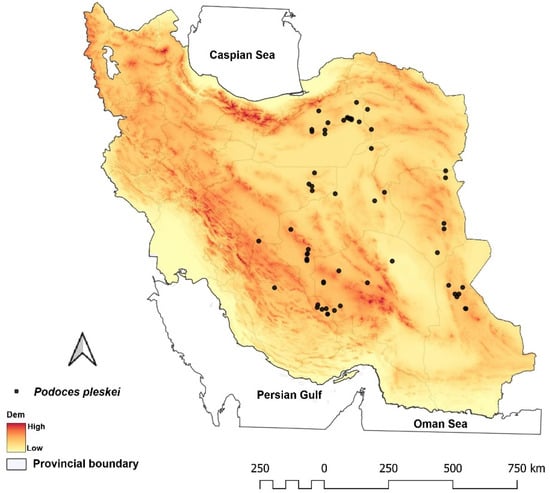
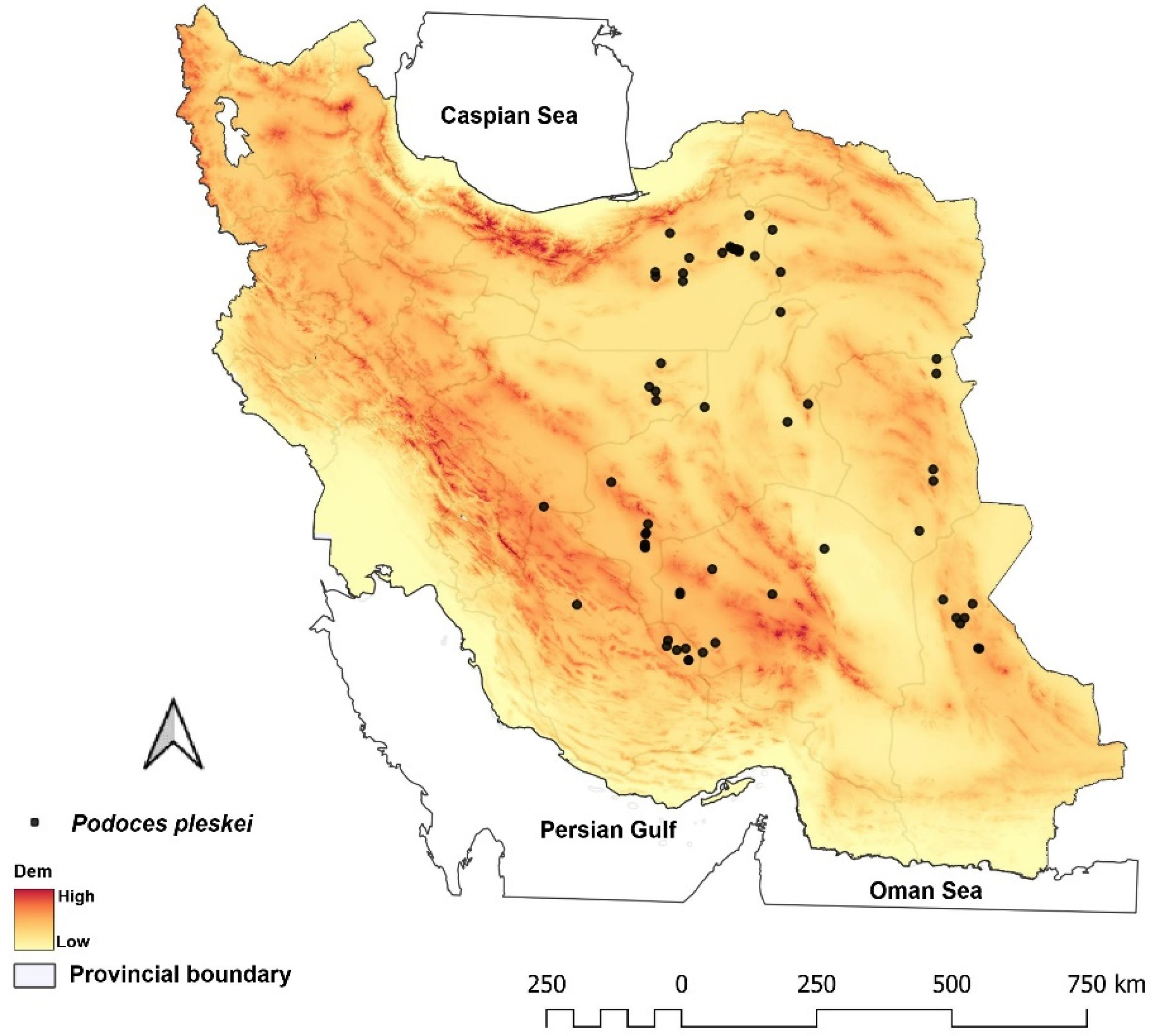
Occurrence points data were obtained from some sources, including fieldwork in Sistan and Baluchestan Province, which provided the geographic coordinate datasets for the Iranian Ground Jay in 2022; published data [44,45]; and multiple open-access sources, including the Global Biodiversity Information Facility (GBIF, https://www.gbif.org/, accessed on 31 October 2025), IUCN Red List spatial data, and eBird (https://ebird.org/home accessed on 18 November 2025). Specifically, we removed points with coordinate precisions of less than 1000 m to minimize sampling gaps. Data were cleaned and duplicates were removed. For spatial bias correction, spatial thinning was applied using a one-kilometer buffer to reduce sampling bias [46]. In total, 60 records were filtered (Figure 1). Climate variables were downloaded from the WorldClim 2.1 dataset (http://www.worldclim.org/ accessed on 19 November 2025) for the current climate baseline period (1970–2000) and 2070 (2061–2080) [34]. All WorldClim variables were collected at 30 arc-second resolution (1 km2) to match the thinned georeferenced data.
Figure 1.
Occurrence records of Iranian Ground Jay overlaid on a digital elevation model (DEM) of Iran, where the brownish colors represent higher elevations and yellowish colors represent lower elevations.
Also, the human footprint index (HFI) [37] was used to measure the anthropogenic impacts (human population density, electric infrastructure, and land transformation) on the niche modeling approach. All layers were clipped to the study area extent using QGIS 3.10 LTR [46] have the same extent, projection, and resolution [8]. We performed a pair-wise Pearson correlation analysis of all variables to remove those highly correlated and reduce their collinearity [47] (Table S1). In the case of high correlation (r > 0.8), we used only one of the variables in the ecological niche modeling. Finally, seven predictors were considered as our environmental variables, including mean diurnal range (Bio2), isothermality (Bio3), temperature seasonality (Bio4), annual precipitation (Bio12), precipitation of driest month (Bio14), precipitation seasonality (Bio15) and precipitation of driest quarter (Bio17), to model the current and future distribution of endemic Iranian Ground Jay. Regarding the future bioclimatic data, we applied two general circulation models, HadGEM3-GC31-LL and MIROC6. These two global circulation models (GCMs) are the most frequently used in climate change impact assessments on birds [26,27]. Coupled Model Intercomparison Project Phase 6 (CMIP6) datasets, with two Shared Socio-economic Pathways (SSPs), SSP1-2.6 and SSP5-8.5 [33], were downloaded as single GeoTIFF files, which were then extracted into 19 future bioclimatic layers using the GDAL ‘Raster Translation’ function in QGIS.
2.2. Modeling Framework
We used the set of variables and the occurrence points to build the models using the maximum entropy algorithm (MaxEnt software version 3.4.1) [8,48]. MaxEnt is one of the most powerful and widely used presence-only modeling approaches, with high predictive ability [15,49,50], and was successfully applied in bird-habitat models [50,51]. MaxEnt relates environmental values at known occurrences of the species to those at a sample of background points to estimate environmental requirements and potential distribution areas [14]. We used 75% of the occurrence points as a training set (model calibration) and the remaining 25% to test the model’s predictive performance (model evaluation) with a maximum of 1000 iterations and 10 model repetitions.
The MaxEnt model was run using the default regularization multiplier (RM = 1), which is the standard setting recommended for medium-sized datasets in MaxEnt, although small sample sizes generally require careful tuning to avoid overfitting [52]. Feature classes were kept at the default configuration of the MaxEnt software (primarily linear and quadratic features), as the sample size (~60 presence points) falls within the range where simple feature sets reduce the risk of model overfitting. The background extent was defined as the entire territory of Iran, representing the accessible area (M) for the species under current and future climatic circumstances. In order to assess models’ performance, we selected two metrics: the area under the receiver operator curve (AUC), which is a statistic widely used to assess ecological niche modeling [28], and the true skill statistics (TSSs). AUC values vary between 0 and 1, with values around 1 representing a perfect fit between the observed and the predicted species distribution. Accordingly, models with AUC values close to 1 were considered acceptable indicators of predictive performance [53]. The TSS is based on a probability threshold that measures the classification performance. We transformed continuous habitat suitability to binary presence/absence based on the maximum training sensitivity plus specificity (MaxSSS) logistic threshold in MaxEnt (threshold = 0.276). This method was selected because it is a widely used and statistically robust approach for presence-only data [13,54]. Moreover, we utilized QGIS to calculate the areas of suitable regions predicted under current conditions.
2.3. Conservation Priority Zones
To determine the representation level of suitable habitats of the Iranian Ground Jay inside the protected areas network in Iran, the binary habitat suitability model was overlaid on the protected areas layer (Department of Environment of Iran).
2.4. Predicting Species Distribution Under Climate Change
In this study, we conducted species distribution modeling using MaxEnt using both current and future bioclimatic variables. Projections of future distributions for this endemic bird under climate change were modeled using two global circulation models (GCMs): HadGEM3-GC31-LL [55] and MIROC6 [56]. These projections were generated for the year 2070 (average for 2060–2080). To assess the impact of climate change on the distribution of the Iranian Ground Jay, we evaluated two Shared Socio-economic Pathways (SSP) scenarios: SSP1-2.6 and SSP5-8.5. Of these, the SSP1-2.6 represents a low level of greenhouse gas emissions, whereas SSP5-8.5 represents a high level of greenhouse gas emissions. Habitat suitability maps for both current and future distributions were converted into binary classifications (suitable vs. non-suitable) using the maximum training sensitivity plus specificity (MTSS) logistic threshold in MaxEnt. Furthermore, we analyzed potential spatial shifts in suitable habitats under each SSP scenario to quantify range dynamics over time.
3. Results
3.1. Model Evaluation, Identification of Key Environmental Variables and Current Potential Distribution
The model demonstrated moderate predictive performance, with a mean training AUC of 0.815 and a TSS score of 0.39 (Figure S1), indicating satisfactory overall model performance and supporting its use for predicting the potential suitable habitat of Iranian Ground Jay. Our analysis identified that the distribution of Iranian Ground Jay is mostly influenced by three significant bioclimatic variables, annual precipitation (bio12) (50.9%), precipitation of driest quarter (bio17) (26.8%), and temperature seasonality (bio4) (8.3%), with a cumulative contribution of 86%; this indicates that they are the most influential variables in the model, while the remaining variables collectively contributed ~14% (Table S2). The jackknife test revealed a variable importance pattern that closely matched the percent contribution findings. To determine the individual impact of the environmental factors, a jackknife test was employed. This analysis provided metrics for percent contribution and permutation importance as shown in Table S2. Bio12 had the highest regularized training gain value (~0.55), followed by bio17 (~0.30) and bio4 (~0.10) (Figure S2). The species response curve depicted the relationship between environmental variables and the species occurrence probability (Figure S3).
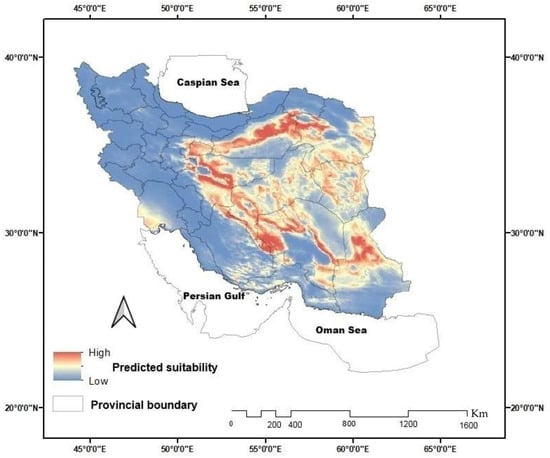
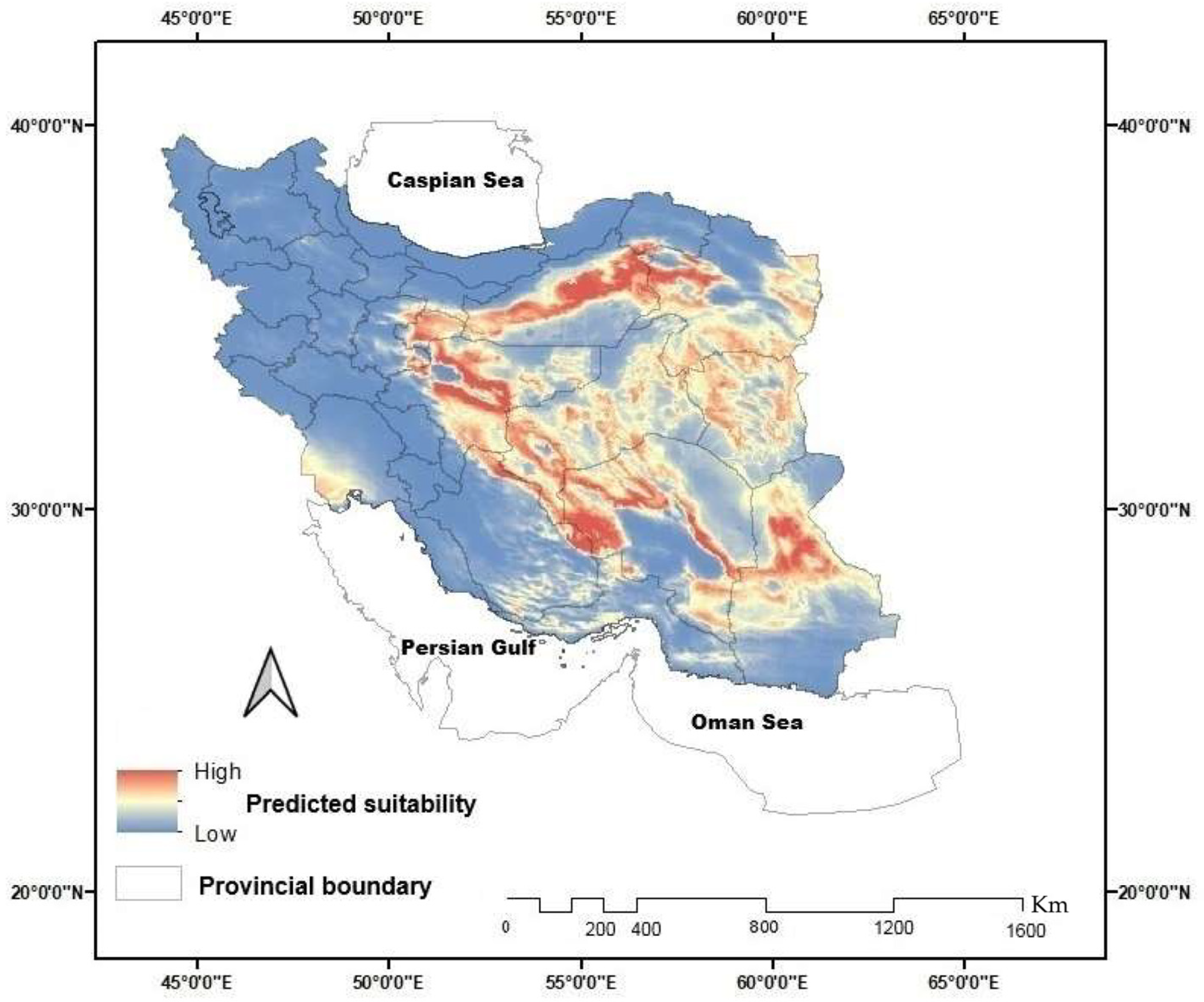
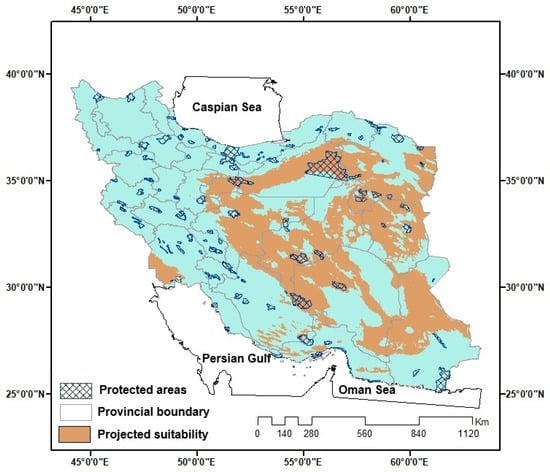
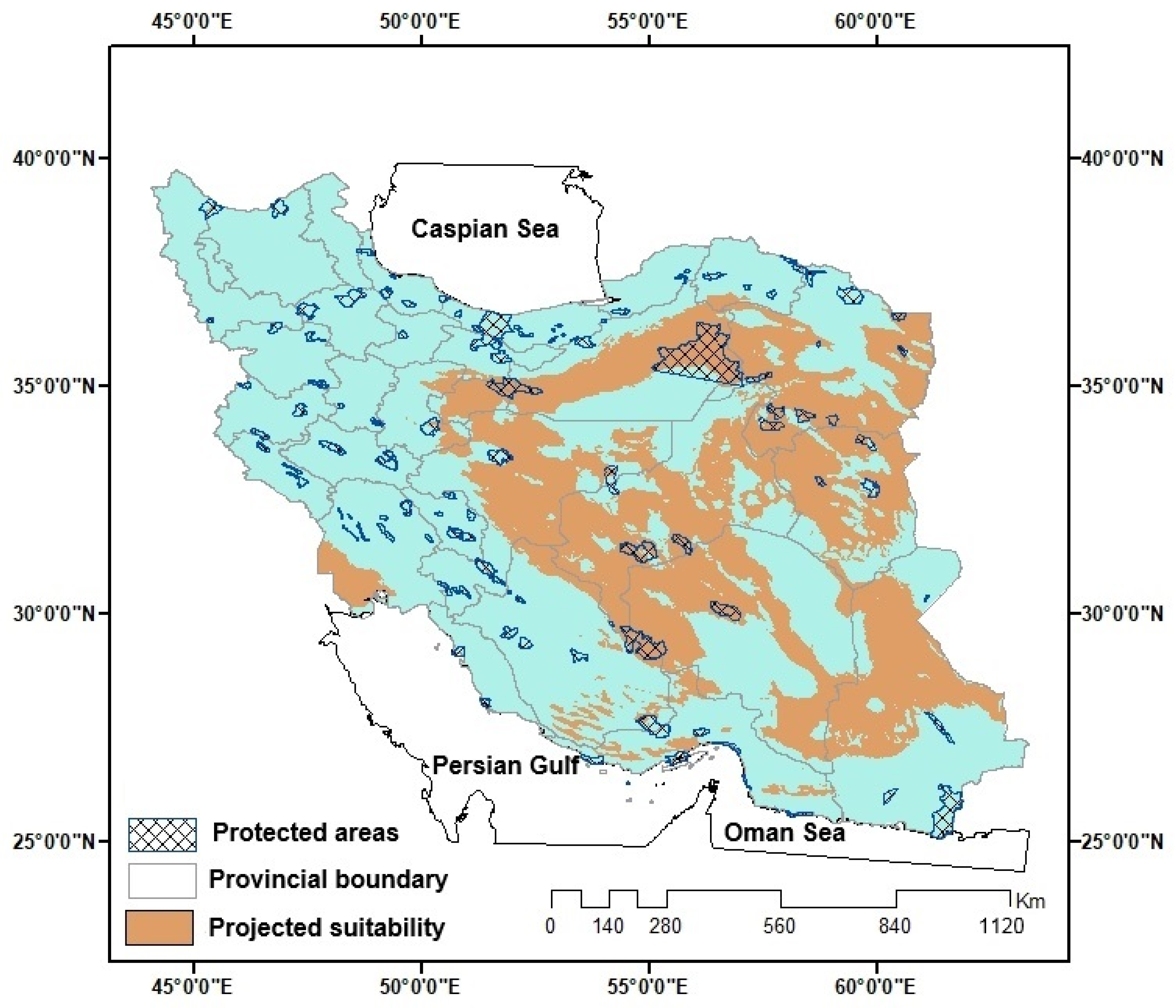
Highly suitable areas existed mostly in the central, eastern and southeastern parts of Iran, with a considerable area occurring in global biodiversity hotspots of Irano-Anatolian. However, some suitable habitats were found in the southwestern part of the study area (Figure 2). The results of species distribution modeling showed that the Iranian Ground Jay was predicted to have 547,231 km2 of suitable habitat in Iran, representing 33.7% of the country’s total area (Figure 3).
Figure 2.
Predicted current suitable and unsuitable habitats for Iranian Ground Jay using MaxEnt.
Figure 3.
An overlay of suitable areas of Iranian Ground Jay in protected areas in Iran.
3.2. Protected Areas Coverage of Suitable Habitats
Suitable areas for the Iranian Ground Jay within protected areas totaled 73,223.2 km2, representing 13.38% of the suitable habitat in Iran (Figure 4B). The results of coverage of the protected areas in the MaxEnt model showed that the majority of suitable habitats occur outside protected areas, suggesting that the endemic Iranian Ground Jay mainly occurs in unprotected areas.
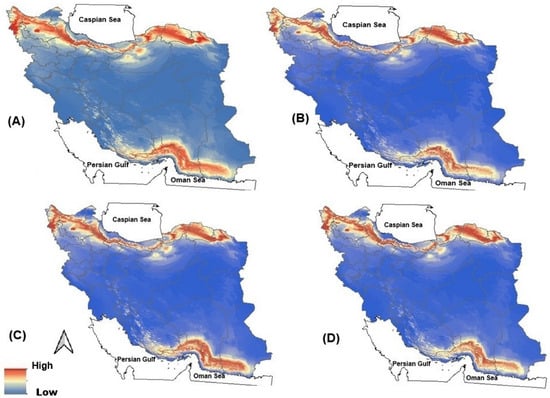
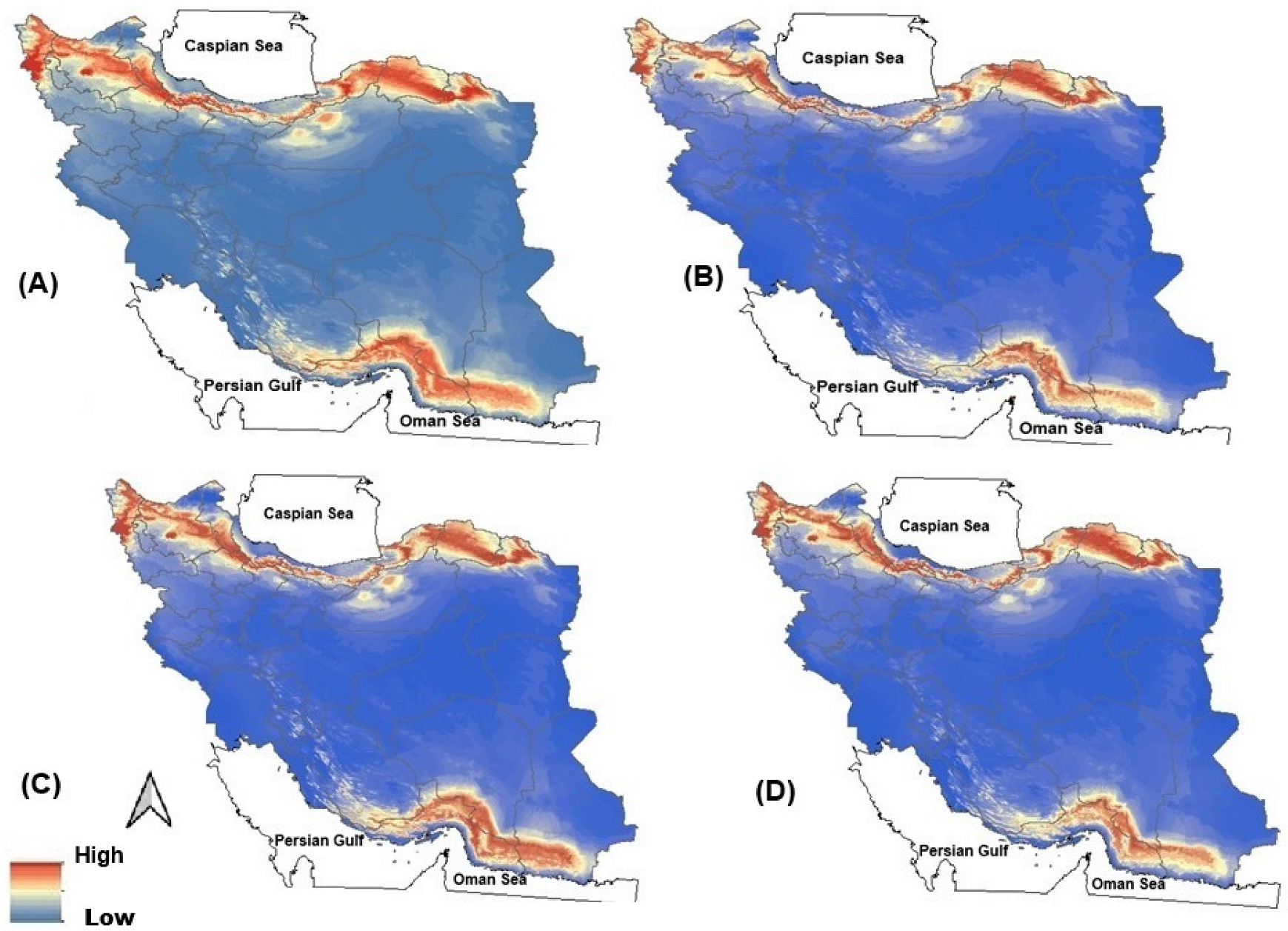
Figure 4.
(A) Predicted future habitat in 2070 for Iranian Ground Jay in Iran, according to GCM-HadGEM3-GC31-LL, SSP1-2.6; (B) SSP5-8.5; (C) GCM-MIROC6, SSP1-2.6; (D) SSP5-8.5.
3.3. Future Potential Distribution for 2070
The role of climate change in altering future distribution possibilities of Iranian Ground Jay in Iran using the HadGEM3-GC31-LL and MIROC6 models with SSP1-2.6 and SSP5-8.5 scenarios are shown in Figure 4. Based on the AUC values calculated for all occurrences, the MaxEnt model showed good predictive performance. The climate change effects on the projected Iranian Ground Jay range showed that the species will lose a large portion of its suitable habitats in all scenario combinations by 2070 (Figure 4). We anticipated drastic changes regarding elevational shifts in suitable habitat for Iranian Ground Jay, with a clear tendency toward higher elevations. Additionally, there is projected to be a considerable northward trend in the geographic distribution of suitable habitats to currently unsuitable areas in Northern Iran. Under the HadGEM3-GC31-LL model, suitable habitat is projected to decrease to 273,878.7 km2 (SSP1-2.6) and 220,251.6 km2 (SSP5-8.5), corresponding to 49.9% and 59.8% reductions, respectively. Under the MIROC6 model, projected reductions are 259,755.8 km2 (SSP1-2.6; 52.6%) and 238,522.5 km2 (SSP5-8.5; 54.9%) (Table 1). However, the predicted distributions under different climate scenarios show significant differences compared to the current distribution of suitable habitats.
Table 1.
Prediction of suitable habitat area of Iranian Ground Jay under current and in year 2070 (km2).
4. Discussion
This research examined how climate change alters the range extent and habitat suitability of the endemic Iranian Ground Jay. Consistent with [23,40], the model was restricted to climatic predictors, while acknowledging that biological factors like food availability and competition may influence distributions [24]. Temperature and precipitation were presumed to be the primary factors, as they directly shape vegetation structure, food resources, and overall habitat quality [25]. Where birds can settle and nest is governed by climate, and shifting conditions can reshape their ranges. Because this species relies on xeric shrublands, temperature and precipitation greatly affect habitat quality, making them key ecological factors in the species’ distribution. Higher precipitation promotes shrub growth and food sources, directly aiding nesting success, while higher temperatures increase thermal stress and decrease suitable habitats. Moreover, the Iranian Ground Jay is specialized in dry and semi-dry habitats, is capable of local movement, and does not require human assistance, suggesting that gradual range shifts under changing climatic conditions are plausible without assisted migration, as indicated by our results.
Moreover, because habitat selection is a hierarchical process—ranging from broad-scale decisions like migration to fine-scale choices such as nesting or foraging site selection—this study focused on broad-scale environmental drivers. Including variables from multiple spatial scales in a single model is generally inappropriate due to analytical challenges such as cross-scale collinearity and overlapping landscape features, as highlighted by previous studies [57,58,59], although this is often overlooked in the literature. As such, many researchers now advocate for spatially hierarchical habitat modeling, emphasizing that both the geographic scale and coverage of the study area should match the scale of the environmental variables considered. Using variables with consistent spatial resolution enhances model discrimination and predictive performance [59]. Therefore, instead of relying on a single comprehensive model, developing several scale-specific sub-models may yield more accurate results. In this study, we adopted this principle by focusing on bioclimatic variables at a broad spatial scale as an initial step in habitat suitability modeling.
Predictions for both the current and future geographical range of the species were generated effectively using the MaxEnt model [60,61]. The current distribution model indicated that areas of highly suitable habitat were located in the eastern, northeastern, and central regions of Iran. The habitats with low probability of occurrence are mainly distributed in the southern parts. We acknowledge that our dispersal analysis, like most species-distribution-modeling studies, was conducted at a single spatial resolution. Single-scale species distribution and connectivity models can substantially misrepresent real dispersal constraints because fine-scale barriers and habitat fragmentation are not detectable at coarser resolutions [62].
In the study conducted by Alizadeh et al. [45], bio1 (annual mean temperature) and bio12 (annual precipitation) had the greatest effect on projecting the Iranian Ground Jay’s habitat suitability in Kerman Province. At the broad, bioclimatic scale, habitat suitability appears to increase with higher precipitation and decline as temperature rises. This is in line with the findings by [31]. Air relative humidity, topography, proximity to sand dunes, and seasonal springs are the dominant landscape-scale drivers of suitability of the Iranian Ground Jay at the Abbas-Abad Wildlife Refuge [40]. Our habitat model identifies suitable areas primarily in unprotected regions. The study also found that over 50% of the predicted suitable habitats are outside protected areas. Temperature fluctuations affect breeding and survival rates. Research shows that endemic birds in regions like the Western Ghats are particularly vulnerable to temperature changes, with some species experiencing substantial reductions in their suitable climatic niche due to rising temperatures [29]. Bio4 (temperature seasonality) was critical for montane bird species due to their sensitivity to temperature fluctuations. Ref. [3] showed that bio4 (temperature seasonality) influenced breeding success in temperate regions. Amini Tehrani [7] used fine-scale distribution models for mountain breeding birds and found that bio4 was consistently the most influential bioclimatic predictor after elevation-corrected temperature means. This demonstrates how bio4 acts as a range-limiting filter, amplifying extinction risk under future warming scenarios. Temperature-related bioclimatic variables are the most influential predictors of habitat suitability for many bird species, as projected for various species in climate scenarios [35,63]. The importance of climate variables (i.e., bio4) in providing suitable habitats for Passeriformes has also been reported, including the Reed Parrotbill (Paradoxornis heudei) [64] and Spiny Babbler (Turdoides nipalensis) [30]. Therefore, it is critical to consider climatic fluctuations when evaluating the sensitivity of species to climate change [65]. Species vulnerability to climate change and their responses have become key scientific focuses [36].
Similar decreasing patterns have also been documented in other Iranian bird species, particularly in arid and semi-arid regions such as the Green Bee-eater, where Bio12 and Bio17 strongly shape distributional limits [63]. Also, studies on species in other arid regions, such as Red-rumped Wheatear in Jordan, White-naped Tit in India, and Salvadori Serin in Ethiopia, are along with our results, where reduced precipitation directly limits vegetation cover and consequently food resources [32,66,67].
The future variations in suitable habitat revealed that the suitable range of the species is forecasted to transition toward higher elevations and latitudes in light of future climatic projections, necessitating that this species shift its distribution toward higher elevations or latitudes as a response to the phenomenon of global warming. The spatial discrepancy between suitable habitats of the Iranian Ground Jay and Iran’s existing protected area network raises significant conservation concerns. Our findings indicate that 13.38% of Iran’s protected areas overlap with suitable habitats, while 31% of the species’ climatically suitable range falls within protected areas, meaning that most suitable habitats still lie outside these boundaries. This suggests that the current network is insufficient to ensure the protection of this endemic species under climate change. The inadequacy of protected areas in supporting species survival in Iran has also been documented in some studies [65]. Therefore, the protected area network and its boundaries should be broadened or redefined to include the valuable habitats identified in this research, particularly the potential climate refugia. Additionally, enhancing habitat connectivity between protected and unprotected regions could help support species survival and increase the overall effectiveness of conservation efforts. Although our findings indicate that only a fraction of climatically suitable habitat falls within protected areas, these estimates do not account for species density or fine-scale habitat quality, which are currently unavailable for P. pleskei. Therefore, the conservation implications should be interpreted with caution, and future field surveys are required to evaluate population density, habitat condition, and the actual effectiveness of protected areas.
The projection results show a significant decline in suitable habitat for the Iranian Ground Jay under the SSP5-8.5 scenario, with reductions of approximately 59.8% and 56.4% by 2070 in the HadGEM3-GC31-LL and MIROC6 models, respectively. The reduction in projected suitable areas under climate change for the Iranian Ground Jay suggests that the conservation status of this species may require re-evaluation in the future due to increasing fragmentation and loss of ecological resources. However, because modeled potential distribution does not substitute for the Area of Occupancy (AOO) or Extent of Occurrence (EOO) used in IUCN assessments, any formal change in category would require additional field-based surveys to verify the current EOO and AOO. Therefore, we recommend that future studies incorporate comprehensive monitoring and spatial assessments to determine whether the Iranian Ground Jay could meet IUCN criteria related to range contraction and habitat decline (e.g., B1ab(iii)/B2ab(iii)). Additionally, performing quantitative extinction risk analyses following Criterion E would help evaluate dispersal capacity and long-term persistence in increasingly fragmented habitats, thereby strengthening national conservation planning. Although IUCN assessments are based on current occurrence and population data, our results, together with several studies [32,63,66,67], documenting rapid climate-driven habitat loss in arid-adapted birds, highlight that for data-poor species, limited field observation may underestimate emerging risks. In such cases, projected habitat change can provide complementary evidence rather than a replacement for AOO/EOO, helping resolve the apparent discrepancy between a current LC status and modeled future declines. Incorporating both past and future trends in habitat dynamics into conservation evaluations may therefore better capture early warning signals and support more proactive management.
5. Conclusions
The duality of the Iranian Ground Jay’s ecological traits—being both highly adapted to arid environments and highly specialized to specific habitats—makes it simultaneously resilient and vulnerable to certain aspects of aridity and potentially vulnerable to climate change. Our results indicate that under climatic conditions, a larger area is climatically suitable for the Iranian Ground Jay to occupy and potentially spread in the south of Iran. Our modeling indicates that this endemic species may be vulnerable to climate change, with predictions representing a notable reduction in suitable habitats by 2070. Additionally, projected habitat shifts indicate that Iranian Ground Jay might experience elevational and latitudinal shifts due to climate change. While these results are based on broad-scale bioclimatic variables, climate change is expected to indirectly also influence multiple non-climatic factors that are critical for species including vegetation structure, food resources, soil characteristics, local microhabitats, and anthropogenic disturbance regimes, which are also expected to change in the future. The absence of these fine-scale ecological and anthropogenic layers represents a major source of ambiguity in our prediction. Thus, adaptation to arid environments does not necessarily equate to climate resilience in Iranian Ground Jay. Future studies should focus on fine-scale assessments, incorporating high-resolution environmental data and hierarchical modeling, to better understand how climate interacts with non-climatic drivers. A concerning finding is that large portions of suitable habitat—both current and projected—lie outside Iran’s protected areas. This points to an essential need for updating spatial conservation priorities, and the climate refugia identified in this study could serve as useful guides for redefining protected area boundaries and the network to support the long-term conservation of the Iranian Ground Jay. To reduce forecasting uncertainty and generate actionable conservation recommendations, future studies should prioritize multi-scale hierarchical modeling that integrates macroclimatic variables with high-resolution layers of vegetation type, soil properties, microtopography, land-use change, and anthropogenic disturbance. Such refined approaches are critical for understanding the interactive effects of climatic and non-climatic drivers on local persistence of the Iranian Ground Jay and for developing effective, climate-informed conservation strategies for this and other arid-endemic specialists. This study provides a critical foundation of baseline habitat information. The logical next step is to use this foundation in systematic conservation planning exercises. Specifically, we recommend future studies to identify potential climate refugia based on habitat stability scores, model functional connectivity corridors, and use spatial optimization algorithms to identify priority sites that efficiently meet conservation targets.
Supplementary Materials
The following supporting information can be downloaded at: https://www.mdpi.com/article/10.3390/birds7020033/s1, Figure S1: Receiver operating characteristic (ROC) plot and area under the curve (AUC) values; Figure S2: Response curves between environmental factors and species presence probability; Figure S3: Jackknife test of regularized training gain for Iranian Ground Jay; Table S1: Pearson’s correlation among environmental variables; Table S2: Percent contribution of environmental variables used in the MaxEnt model.
Author Contributions
Y.R.: Writing—original draft, Data curation, Investigation; M.E.: Writing—review, Investigation, Project administration, Supervision, Methodology, Conceptualization; S.M.: Writing—original draft, Writing—review and editing, Project administration, Supervision, Methodology; N.O.: Writing—review and editing. All authors have read and agreed to the published version of the manuscript.
Funding
No funding was received for conducting this study.
Institutional Review Board Statement
The study involved only field observations of birds. No animals were captured, handled, or harmed, and therefore no ethical approval was required.
Informed Consent Statement
Not applicable.
Data Availability Statement
The data presented in this study are available in the public domain resource WorldClim (https://www.worldclim.org/). The species occurrence data used in this study were collected by the authors and are available from the corresponding author upon reasonable request.
Acknowledgments
We would like to express our sincere gratitude to members of the Department of Environment of Sistan and Baluchestan Province for their help in the field investigation and thank the University of Zabol for the non-financial and logistical support provided under grant codes IR-UOZ-GR-4956 and IR-UOZ-GR-7613.
Conflicts of Interest
The authors declare that they have no known competing financial interests or personal relationships that could have appeared to influence the work reported in this paper.
References
- Del Rosario Avalos, V.; Hernandez, J. Projected Distribution Shifts and Protected Area Coverage of Range-Restricted Andean Birds under Climate Change. Glob. Ecol. Conserv. 2015, 4, 459–469. [Google Scholar] [CrossRef] [Scilit]
- Ferrer-Sánchez, Y.; Rodríguez-Estrella, R. Identifying Best Conservation Areas for an Endangered and Endemic Raptor in Cuba through Abundance Spatial Modeling: A Niche-Centroid Distances Approach. Glob. Ecol. Conserv. 2021, 31, 10877. [Google Scholar] [CrossRef] [Scilit]
- Harris, J.B.C.; Putra, D.D.; Gregory, S.D.; Brook, B.W.; Prawiradilago, D.M.; Sodhi, N.S.; Wei, D.; Fordham, D.A. Rapid Deforestation Threatens Mid-Elevational Endemic Birds but Climate Change Is Most Important at Higher Elevations. Divers. Distrib. 2014, 20, 773–785. [Google Scholar] [CrossRef] [Scilit]
- Ma, L.; Conradie, S.R.; Crawford, C.L.; Gardner, A.S.; Kearney, M.R.; Maclean, I.M.; McKechnie, A.E.; Mi, C.-R.; Senior, R.A.; Wilcove, D.S. Global Patterns of Climate Change Impacts on Desert Bird Communities. Nat. Commun. 2023, 14, 211. [Google Scholar] [CrossRef] [Scilit]
- McKechnie, A.E.; Gerson, A.R.; Wolf, B.O. Thermoregulation in Desert Birds: Scaling and Phylogenetic Variation in Heat Tolerance and Evaporative Cooling. J. Exp. Biol. 2021, 224, jeb229211. [Google Scholar] [CrossRef] [Scilit]
- Vale, C.G.; Brito, J.C. Desert-Adapted Species Are Vulnerable to Climate Change: Insights from the Warmest Region on Earth. Glob. Ecol. Conserv. 2015, 4, 369–379. [Google Scholar] [CrossRef] [Scilit]
- Amini Tehrani, N.; Naimi, B.; Jaboyedoff, M. Modeling Current and Future Species Distribution of Breeding Birds as Regional Essential Biodiversity Variables (SD EBVs): A Bird Perspective in Swiss Alps. Glob. Ecol. Conserv. 2021, 27, 01596. [Google Scholar] [CrossRef] [Scilit]
- Phillips, S.J.; Anderson, R.P.; Schapire, R.E. Maximum Entropy Modeling of Species Geographic Distributions. Ecol. Model. 2006, 190, 231–259. [Google Scholar] [CrossRef] [Scilit]
- Brambilla, M.; Cortesi, M.; Capelli, F.; Chamberlain, D.; Pedrini, P.; Rubolini, D. Foraging Habitat Selection by Alpine White-Winges Snowfinches Montrifringilla Nivalis during the Nestling Rearing Period. J. Ornithol. 2017, 158, 277–286. [Google Scholar] [CrossRef] [Scilit]
- Chevalier, M.; Zarzo-Arias, A.; Guélat, J.; Mateo, R.G.; Guisan, A. Accounting for Niche Truncation to Improve Spatial and Temporal Predictions of Species Distributions. Front. Ecol. Evol. 2022, 10, 944116. [Google Scholar] [CrossRef] [Scilit]
- Elith, J.; Leathwick, J.R. Species Distribution Models: Ecological Explanation and Prediction across Space and Time. Annu. Rev. Ecol. Evol. Syst. 2009, 40, 677–697. [Google Scholar] [CrossRef] [Scilit]
- Fialas, P.C.; Santini, L.; Russo, D.; Amorim, F.; Rebelo, H.; Novella-Fernandez, R.; Marques, F.; Domer, A.; Vella, A.; Martinoli, A. Changes in Community Composition and Functional Diversity of European Bats under Climate Change. Conserv. Biol. 2025, 39, e70025. [Google Scholar] [CrossRef] [Scilit]
- Liu, C.; Newell, G.; White, M. On the Selection of Thresholds for Predicting Species Occurrence with Presence-only Data. Ecol. Evol. 2016, 6, 337–348. [Google Scholar] [CrossRef] [Scilit]
- Peterson, A.T.; Soberón, J.; Pearson, R.G.; Anderson, R.P.; Martínez-Meyer, E.; Nakamura, M.; Araújo, M.B. Ecological Niches and Geographic Distributions; Princeton 678 University Press: Princeton, NJ, USA, 2011; Volume 49, pp. 1–314. [Google Scholar]
- Elith, J.; Kearney, M.; Phillips, S. The Art of Modelling Range-Shifting Species. Methods Ecol. Evol. 2010, 1, 330–342. [Google Scholar] [CrossRef] [Scilit]
- Engler, R.; Guisan, A.; Rechsteiner, L. An Improved Approach for Predicting the Distribution of Rare and Endangered Species from Occurrence and Pseudo-Absence Data. J. Appl. Ecol. 2004, 41, 263–274. [Google Scholar] [CrossRef] [Scilit]
- Lissovsky, A.A.; Dudov, S.V. Species-Distribution Modeling: Advantages and Limitations of Its Application. 2. MaxEnt. Biol. Bull. Rev. 2021, 11, 265–275. [Google Scholar] [CrossRef] [Scilit]
- Kafash, A.; Ashrafi, S.; Yousefi, M. Modeling Habitat Suitability of Bats to Identify High Priority Areas for Field Monitoring and Conservation. Environ. Sci. Pollut. Res. 2022, 29, 25881–25891. [Google Scholar] [CrossRef] [Scilit]
- Marcer, A.; Saez, L.; Molowny-Horas, R.; Pons, X.; Pino, J. Using Species Distribution Modelling to Disentangle Realised versus Potential Distributions for Rare Species Conservation. Biol. Conserv. 2013, 166, 221–230. [Google Scholar] [CrossRef] [Scilit]
- Chen, Y.; Chen, Z.; Xu, M.; Zhao, L. Identification and Delineation of Mariculture Area Based on Maxent and Marxan: A Case Study in Jiangsu, China. Aquaculture 2025, 569, 741831. [Google Scholar] [CrossRef] [Scilit]
- Bosso, L.; Fichera, G.; Mucedda, M.; Pidinchedda, E.; Veith, M.; Smeraldo, S.; De Pasquale, P.P.; Mori, E.; Ancillotto, L. Island Life and Interspecific Dynamics Influence Body Size, Distribution and Ecological Niche of Long-Eared Bats. J. Biogeogr. 2025, 53, e70071. [Google Scholar] [CrossRef] [Scilit]
- Yousefi, M.; Nicolaï, M.P.J.; Bosso, L. Global Scale High-Resolution Habitat Suitability Modeling of Avifauna Providing Pollination Service (Sunbirds, Nectariniidae). Sci. Rep. 2025, 15, 9489. [Google Scholar] [CrossRef] [Scilit]
- Lehikoinen, A.; Virkkala, R. North by North-West: Climate Change and Directions of Density Shifts in Birds. Glob. Change Biol. 2016, 22, 1121–1129. [Google Scholar] [CrossRef] [Scilit]
- Somveille, M.; Bossu, C.M.; DeSaix, M.G.; Alvarado, A.H.; Gómez Villaverde, S.; Rodríguez Otero, G.; Ruegg, K.C. Broad-scale Seasonal Climate Tracking Is a Consequence, Not a Driver, of Avian Migratory Connectivity. Ecol. Lett. 2024, 27, 14496. [Google Scholar] [CrossRef] [Scilit]
- Bick, I.A.; Bakkestuen, V.; Pedersen, M. Exploring the Spatiotemporal Influence of Climate on American Avian Migration with Random Forests. Sci. Rep. 2025, 15, 21054. [Google Scholar] [CrossRef] [Scilit]
- Subedi, T.R.; Peréz-García, J.M.; Gurung, S.; Baral, H.S.; Virani, M.Z.; Sah, S.A.M.; Anadón, J.D. Global Range Dynamics of the Bearded Vulture (Gypaetus barbatus) from the Last Glacial Maximum to Climate Change Scenarios. Ibis 2023, 165, 403–419. [Google Scholar] [CrossRef] [Scilit]
- Popović, T.; Ćurčić, N.B.; Đurđić, S.; Stanojević, G.; Raković, M. An Assessment of the Climate Change Impacts on the Distribution of the Glacial Relict Woodpecker Three-Toed Woodpecker Picoides Tridactylus. Animals 2024, 14, 1879. [Google Scholar] [CrossRef] [Scilit] [PubMed]
- Moreno, R.; Zamora, R.; Molina, J.R.; Vasquez, A.; Herrera, M.Á. Predictive Modeling of Microhabitats for Endemic Birds in South Chilean Temperate Forests Using Maximum Entropy (Maxent). Ecol. Inform. 2011, 6, 364–370. [Google Scholar] [CrossRef] [Scilit]
- Manna, S.; Sarkar, D.; Talukdar, G. Identifying Climatic Niche Shift of the Endemic Avifauna of Western Ghats. J. Wildl. Sci. (JWLS) 2024, 1, 52–61. [Google Scholar] [CrossRef] [Scilit]
- Adhikari, B.; Subedi, S.C.; Bhandari, S.; Baral, K.; Lamichhane, S.; Maraseni, T. Climate-Driven Decline in the Habitat of the Endemic Spiny Babbler (Turdoides nipalensis). Ecosphere 2023, 14, 4584. [Google Scholar] [CrossRef] [Scilit]
- Tkachuk, R.; Nykytiuk, Y.; Komorna, O.; Zymaroieva, A. Global Climate Change Promotes the Expansion of Rural and Synanthropic Bird Species: The Case of Zhytomyr Region (Ukraine). Biosyst. Divers. 2024, 32, 183–192. [Google Scholar] [CrossRef] [Scilit]
- Choudhary, R.; Sharma, V.; Dutta, S.; Mathur, P.; Singh, P.; Sahu, H. Habitat Suitability for Endemic and Vulnerable White-Naped Tit (Machlolophus nuchalis) in Arid and Semi-Arid Landscapes of India. J. Landsc. Ecol. 2025, 18, 125–138. [Google Scholar] [CrossRef] [Scilit]
- Eyring, V.; Bony, S.; Meehl, G.A.; Senior, C.A.; Stevens, B.; Stouffer, R.J.; Taylor, K.E. Overview of the Coupled Model Intercomparison Project Phase 6 (CMIP6) Experimental Design and Organization. Geosci. Model Dev. 2016, 9, 1937–1958. [Google Scholar] [CrossRef] [Scilit]
- Fick, S.E.; Hijmans, R.J. WorldClim 2: New 1km Spatial Resolution Climate Surfaces for Global Land Areas. Int. J. Climatol. 2017, 37, 4302–4315. [Google Scholar] [CrossRef] [Scilit]
- Salas, A.L.; Seamster, V.A.; Boykin, K.G.; Harings, N.M.; Dixon, K.W. Modeling the Impacts of Climate Change on Species of Concern (Birds) in South Central USA Based on Bioclimatic Variables. AIMS Environ. Sci. 2017, 4, 358–385. [Google Scholar] [CrossRef] [Scilit]
- Ashrafzadeh, M.R.; Moradi, M.; Khosravi, R.; Naghipour, A.A.; Chamberlain, D. Impacts of Climate Change on a High Elevation Specialist Bird Are Ameliorated by Terrain Complexity. Glob. Ecol. Conserv. 2024, 56, 03281. [Google Scholar] [CrossRef] [Scilit]
- Venter, O.; Sanderson, E.W.; Magrach, A.; Allan, J.R.; Beher, J.; Jones, K.R. Global Terrestrial Human Footprint Maps for 1993 and 2009. Sci. Data 2016, 3, 160067. [Google Scholar] [CrossRef] [Scilit] [PubMed]
- Khaleghizadeh, A.; Scott, D.A.; Tohidifar, M.; Musavi, S.B.; Ghasemi, M.; Sehhatisabet, M.E.; Ashoori, A.; Khani, A.; Bakhtiari, P.; Amini, H.; et al. Rare birds in Iran in 1980–2010. Podoces 2011, 6, 1–48. [Google Scholar]
- Noori, S.; Zahiri, R.; Yusefi, G.H.; Rajabizadeh, M.; Hawlitschek, O.; Rakhshani, E.; Husemann, M.; Rajaei, H. Patterns of Zoological Diversity in Iran—A Review. Diversity 2024, 16, 621. [Google Scholar] [CrossRef] [Scilit]
- Naderi, M.; Momeni, I.; Akbari Feizabadi, H. Pleske’s Ground Jay Habitat Suitability Modeling: Implications for Conservation. J. Wildl. Biodivers. 2025, 9, 252–261. [Google Scholar] [CrossRef]
- Radnezhad, H.; Satei, N.; Kaboli, M.; Karami, M.; Khorasani, N.; Prodon, R.; Abari, M.F.C.; Cheraghi, S. Breeding Ecology of the Iranian Ground Jay (Podoces pleskei). Afr. J. Biotechnol. 2011, 10, 4494–4500. [Google Scholar]
- Satei, N.; Kaboli, M.; Cheraghi, S.; Karami, M.; Shariat, N.M. A Calculation of Breeding Success in Birds, with Having Missing Information Which Occurred Due to Irregular Visits: Breeding Success of Iranian Ground-Jay (Podoces pleskei), Turan Biosphere Reserve, Semnan Province. J. Nat. Environ. 2011, 64, 209–217. [Google Scholar]
- Nazarizadeh, M.; Fatemizadeh, F.; Kaboli, M.; Cherghi, S.; Hashemi, A.; Tohidifar, M. Home Range of Pleske’s Ground Jay Podoces Pleskei in a Breeding Season in Touran Biosphere Reserve, North-Central Iran. Podoces 2015, 10, 8–14. [Google Scholar]
- Mohammadi, S.; Sarbaz, S.; Moradian, F. Breeding Study of Podoces pleskei in Dasht-e Laghari Wildlife Refuge in Razavi Khorasan Province. J. Anim. Biol. 2015, 7, 45–55. [Google Scholar]
- Alizadeh, F.; Sehatisabet, M.E.; Nezami, B.; Jahani, A.; Shafiei Bafti, S. Effects of Environmental Variables on the Distribution of the Iranian Ground Jay Podoces Pleskei Zarudny, 1896 in Kerman Province. Podoces 2021, 16, 1–12. [Google Scholar]
- QGIS Development Team Geographic Information System API Documentation. Open Source Geospatial Foundation Project; QGIS Association: Laax, Switzerland, 2020. [Google Scholar]
- Kabir, M.; Hameed, S.; Ali, H.; Bosso, L.; Ud Din, J.; Bischof, R.; Redpath, S.; Ali Nawaz, M. Habitat Suitability and Movement Corridors of Grey Wolf (Canis Lupus) in Northern Pakistan. PLoS ONE 2017, 12, 0187027. [Google Scholar] [CrossRef] [Scilit]
- Elith, J.; Graham, C.H.; Anderson, R.P.; DudõÂk, M.; Ferrier, S.; Guisan, A.; Hijmans, R.J.; Huettmann, F.; Leathwick, R.; Lehmann, A.; et al. Novel Methods Improve Prediction of Species’ Distributions from Occurrence Data. Ecography 2006, 29, 129–151. [Google Scholar] [CrossRef] [Scilit]
- Hamidi, K.; Mohammadi, S.; Ghassemi-Khademi, T. Ecological Niche Modeling of Genetic Lineages of the Great Gerbil, Rhombomys opimus (Rodentia: Gerbillinae). PLoS ONE 2021, 16, 0257063. [Google Scholar] [CrossRef] [Scilit]
- Merow, C.; Smith, M.J.; Silander, J.A., Jr. A Practical Guide to MaxEnt for Modeling Species’ Distributions: What It Does, and Why Inputs and Settings Matter. Ecography 2013, 36, 1058–1069. [Google Scholar] [CrossRef] [Scilit]
- Ashoori, A.; Kafash, A.; Varasteh Moradi, H.; Yousefi, M.; Kamyab, H.; Behdarvand, N.; Mohammadi, S. Habitat Modeling of the Common Pheasant Phasianus Colchicus (Galliformes: Phasianidae) in a Highly Modified Landscape: Application of Species Distribution Models in the Study of a Poorly Documented Bird in Iran. Eur. Zool. J. 2018, 85, 373–381. [Google Scholar] [CrossRef] [Scilit]
- Morales, N.S.; Fernández, I.C.; Baca-González, V. MaxEnt’s Parameter Configuration and Small Samples: Are We Paying Attention to Recommendations? A Systematic Review. PeerJ 2017, 5, e3093. [Google Scholar] [CrossRef] [Scilit]
- Liu, C.; White, M.; Newell, G. Measuring and Comparing the Accuracy of Species Distribution Models with Presence- Absence Data. Ecography 2011, 34, 232–243. [Google Scholar] [CrossRef] [Scilit]
- Jimenez-Valverde, A.; Lobo, J.M. Threshold Criteria for Conversion of Probability of Species Presence to Either or Presence-Absence. Acta Oecol. 2007, 31, 361–369. [Google Scholar] [CrossRef] [Scilit]
- Andrews, T.; Andrews, M.B.; Bodas-Salcedo, A.; Jones, G.S.; Kuhlbrodt, T.; Manners, J.; Menary, M.B.; Ridley, J.; Ringer, M.A.; Sellar, A.A.; et al. Forcings, Feedbacks, and Climate Sensitivity in HadGEM3-GC3.1 and UKESM1. J. Adv. Model. Earth Syst. 2019, 11, 4377–4394. [Google Scholar] [CrossRef] [Scilit]
- Tatebe, H.; Ogura, T.; Nitta, T.; Komuro, Y.; Ogochi, K.; Takemura, T.; Sudo, K.; Sekiguchi, M.; Abe, M.; Saito, F.; et al. Description and Basic Evaluation of Simulated Mean State, Internal Variability, and Climate Sensitivity in MIROC6. Geosci. Model Dev. 2019, 12, 2727–2765. [Google Scholar] [CrossRef] [Scilit]
- Erfani, M.; Salmanmahiny, A. Habitat Management of Mugger Crocodile (Crocodylus palustris) through Regional-Scale Niche Modeling for Practical Conservation Planning. J. Environ. Stud. 2025, 51, 41–58. [Google Scholar] [CrossRef]
- Lipsey, M.K.; Naugle, D.E.; Nowak, J.; Lukacs, P.M. Extending Utility of Hierarchical Models to Multi-scale Habitat Selection. Divers. Distrib. 2017, 23, 783–793. [Google Scholar] [CrossRef] [Scilit]
- Sun, X.; Long, Z.; Jia, J. A Multi-Scale Maxent Approach to Model Habitat Suitability for the Giant Pandas in the Qionglai Mountain, China. Glob. Ecol. Conserv. 2021, 30, 01766. [Google Scholar] [CrossRef] [Scilit]
- Li, J.; Fan, G.; He, Y. Predicting the Current and Future Distribution of Three Coptis Herbs in China under Climate Change Conditions, Using the MaxEnt Model and Chemical Analysis. Sci. Total Environ. 2020, 698, 134141. [Google Scholar] [CrossRef] [Scilit]
- Rehan, M.; Hassan, A.; Zeb, S.; Ullah, S.; Ahmad, F.; Bohnett, E.; Bosso, L.; Fida, T.; Kabir, M. Application of Species Distribution Models to Estimate and Manage the Asiatic Black Bear (Ursus thibetanus) Habitat in the Hindu Kush Mountains, Pakistan. Eur. J. Wildl. Res. 2024, 70, 62. [Google Scholar] [CrossRef] [Scilit]
- Zeller, K.A.; Jennings, M.K.; Vickers, T.W.; Ernest, H.B.; Cushman, S.A.; Boyce, W.M. Are All Data Types and Connectivity Models Created Equal? Validating Common Connectivity Approaches with Dispersal Data. Divers. Distrib. 2018, 24, 868–879. [Google Scholar] [CrossRef] [Scilit]
- Gholamhosseini, A.; Baharlu, F. Assessment of Climate Change Impacts on Geographic Distribution of Merops Orientalis in Southern Iran: A Case Study in Fars Province. J. Anim. Res. (Iran. J. Biol.) 2021, 34, 98–109. [Google Scholar]
- Chen, P.; Chen, Y.; Chen, H.; Chen, T.; Liu, B.; Zhang, M.; Wang, S.; Lu, C. Vinous-throated Parrotbills Breed in Invasive Smooth Cordgrass Habitat: Can Native Birds Avoid the Potential Ecological Trap? Avian Res. 2023, 14, 100119. [Google Scholar] [CrossRef] [Scilit]
- Yousefi, S.; Mohammadi, S.; Kafash, A. Modeling Global Habitat Suitability and Environmental Predictor of Distribution of a Near Threatened Avian Scavenger at High Spatial Resolution. Front. Ecol. Evol. 2023, 11, 1112962. [Google Scholar] [CrossRef] [Scilit]
- Khoury, F.; Korner, P.; Saba, M.; Al-Marahleh, M.; Alshamlih, M. Restricted to the Steppe-Desert Ecotone: Distribution and Status of the Regionally Threatened Red-Rumped Wheatear, Oenanthe Moesta in Jordan. Zool. Middle East 2025, 71, 120–134. [Google Scholar] [CrossRef] [Scilit]
- Gelete, T.B.; Tulu, D.; Yasin, K.H.; Kebede, E. Machine Learning Predictions of Climate Change Effects on Nearly Threatened Bird Species (Crithagra xantholaema) Habitat in Ethiopia for Conservation Strategies. Sci. Rep. 2025, 15, 36972. [Google Scholar] [CrossRef] [Scilit]

Disclaimer/Publisher’s Note: The statements, opinions and data contained in all publications are solely those of the individual author(s) and contributor(s) and not of MDPI and/or the editor(s). MDPI and/or the editor(s) disclaim responsibility for any injury to people or property resulting from any ideas, methods, instructions or products referred to in the content. |
© 2026 by the authors. Licensee MDPI, Basel, Switzerland. This article is an open access article distributed under the terms and conditions of the Creative Commons Attribution (CC BY) license.