
Brief Report

Cytogenetic Characterization of Red-Fronted Coot (Fulica rufifrons Philippi & Landbeck, 1861) and Giant Wood Rail (Aramides ypecaha Vieillot, 1819) (Rallidae) and Implications for Avian Karyotype Evolution

by
Luciano Cesar Pozzobon
1,
Felipe Lagreca Bitencourt
1,
Victor Cruz Cuervo
1,
Raqueli Teresinha França
2,
Thales Renato Ochotorena de Freitas
1 and
Rafael Kretschmer
1,*
1
Laboratório de Citogenética e Evolução, Departamento de Genética, Instituto de Biociências, Universidade Federal do Rio Grande do Sul, Porto Alegre 91509-900, RS, Brazil
2
Departamento de Clínicas Veterinária, Faculdade de Veterinária, Universidade Federal de Pelotas, Pelotas 96010-900, RS, Brazil
*
Author to whom correspondence should be addressed.
Birds 2026, 7(2), 30; https://doi.org/10.3390/birds7020030 (registering DOI)
Submission received: 10 April 2026 / Revised: 19 May 2026 / Accepted: 20 May 2026 / Published: 22 May 2026

Simple Summary

Birds often appear to have very similar chromosomes, which are the structures that carry genetic information, but hidden differences can play an important role in how species evolve. In this study, we investigated two South American bird species (Red-fronted Coot and Giant Wood Rail) to understand how their chromosomes have changed over time. We found that even though their overall chromosome structure looks similar, important differences exist due to the movement and expansion of repeated pieces of DNA, which are sequences that occur many times in the genome. These repeated sequences contribute to changes in chromosome shape and organization, especially in the sex-determining chromosomes. One of these sex chromosomes showed clear differences between the two species, indicating that such chromosomes can evolve quickly and independently. We also observed that repeated DNA sequences are distributed differently across large and small chromosomes, suggesting that genome changes occur in multiple, dynamic ways. These findings improve our understanding of how genetic diversity arises in birds and help explain the processes that drive species evolution, which is important for studying biodiversity and conservation.

Abstract

Karyotypic diversification in birds is often masked by overall chromosomal conservation, yet the mechanisms driving lineage-specific variation remain poorly understood. Here, we demonstrate that genome evolution in Rallidae is shaped by dynamic, independent trajectories of chromosomal reorganization, despite the retention of general avian architectural features. By integrating cytogenetic and molecular mapping data from two Neotropical species, Fulica rufifrons Philippi & Landbeck, 1861 (Red-fronted Coot) and Aramides ypecaha Vieillot, 1819 (Giant Wood Rail), we show that repetitive DNA expansion and heterochromatinization contribute to karyotype variability and sex chromosome differentiation. The contrasting structure and heterochromatic composition of the W chromosome between these species reveal that sex chromosomes evolve rapidly and independently, driven by lineage-specific accumulation of repetitive elements. Moreover, the variation in microsatellite distribution, especially the distinct localization of motifs on macro- and microchromosomes, underscores the independent and dynamic evolution of repetitive sequences. Our findings collectively indicate that chromosomal rearrangements, along with the amplification and redistribution of repetitive DNA, are contributing factors of genomic diversification in Rallidae, offering new insights into the mechanisms underlying karyotype evolution and sex chromosome differentiation in birds.

1. Introduction

Birds display a distinctive and highly conserved chromosomal organization compared with other vertebrates, typically characterized by a high diploid number (2n) and the presence of numerous microchromosomes [1,2,3,4]. This karyotypic architecture is considered ancestral for Aves and has remained relatively stable over more than 200 million years of evolution [3]. Nevertheless, increasing evidence from comparative cytogenetics and genomics has demonstrated that avian karyotypes are not static, but rather shaped by lineage-specific chromosomal rearrangements, heterochromatin expansion, and changes in repetitive DNA content [1,3,4,5,6]. These processes have contributed to genome reorganization and diversification across bird lineages, although many avian orders remain poorly investigated at the chromosomal level.
The order Gruiformes comprises a diverse and globally distributed assemblage of birds, including Rails, Gallinules, Coots, Cranes, Limpkins, Finfoots, Trumpeters and Flufftails [7]. Members of this order occupy a wide range of ecological niches, from aquatic and semi-aquatic habitats to terrestrial environments, and exhibit considerable morphological and behavioral diversity [8]. Within Gruiformes, Rallidae (Rails) is one of the most species-rich and taxonomically complex groups, with numerous cryptic species and unresolved phylogenetic relationships. Despite their diversity and broad geographic distribution, cytogenetic information for Rallidae and other Gruiformes is still limited, particularly for Neotropical taxa.
Previous cytogenetic studies in Rallidae have revealed substantial karyotypic variation, with 2n ranging from 72 to 92, and differences in chromosome morphology and sex-chromosome structure. In contrast, karyotypes in Gruidae and Psophiidae are highly conserved, with a modal diploid number of 2n = 80, except for Whooping Crane (Grus americana Linnaeus, 1758), which exhibits 2n = 82 [9,10]. Such variation suggests that chromosomal rearrangements, including fissions, fusions, and inversions, may have contributed in the evolutionary history of this order. However, most available data derive from conventional cytogenetic approaches, and molecular cytogenetic analyses, such as chromosome painting and 18s rDNA and repetitive DNA mapping, remain scarce [11,12]. Repetitive DNA sequences, including ribosomal genes and microsatellite motifs, are integral to chromosome structure and genome organization and are implicated in sex chromosome evolution [13,14,15]. In birds, their genomic distribution and copy number variation have been linked to chromosomal rearrangements and sex chromosome differentiation [11,16]. Mapping these elements therefore provides key insights into genome evolution and karyotype diversification.
Here we present the first cytogenetic characterization of two South American rallids, Red-fronted Coot and Giant Wood Rail, using a combination of conventional and molecular cytogenetic approaches. These widely distributed species occupy distinct ecological niches and represent key lineages within Rallidae [17,18], yet their karyotypes have not previously been described. This lack of data limits our understanding of chromosomal evolution in Neotropical Gruiformes and constrains broader comparative analyses across birds.
We characterize their karyotypes, examine patterns of constitutive heterochromatin, and map the chromosomal distribution of 18S rDNA and microsatellite motifs using fluorescence in situ hybridization. By integrating these data with existing cytogenetic information from Gruiformes and other avian groups, we aim to identify patterns of karyotype diversification and provide insights into genome organization and sex chromosome evolution within the order.

2. Materials and Methods

2.1. Specimens, Chromosomal Preparations and C-Banding

Chromosome preparations were obtained from direct bone marrow cultures of one female Red-fronted Coot and one female Giant Wood Rail, collected in Pelotas, Rio Grande do Sul, Brazil, at the Núcleo de Reabilitação da Fauna Silvestre (NURFS) of the Universidade Federal de Pelotas. Sampling was authorized by the Instituto Brasileiro do Meio Ambiente e dos Recursos Naturais Renováveis (IBAMA; SISBIO permit no. 44173-3). All experimental procedures were conducted in accordance with established ethical guidelines and were approved by the Ethics Committee on Animal Experimentation of the Universidade Federal de Pelotas (protocol no. 113/2023).
Chromosome suspensions were prepared following standard cytogenetic protocols [19], including colchicine (Sigma-Aldrich, St. Louis, MO, USA) treatment (0.05% at 37 °C for 1 h), hypotonic treatment with 0.075 M KCl at 37 °C for 30 min, and fixation in methanol:acetic acid (3:1; Sigma-Aldrich, St. Louis, MO, USA). Cell suspensions were stored at −20 °C until analysis. Diploid numbers and karyotypes were determined from at least 20 metaphase spreads stained with 5% Giemsa (Sigma-Aldrich, St. Louis, MO, USA) in 0.07 M phosphate buffer (pH 6.8) and morphologically characterized according to Levan et al. [20]. Constitutive heterochromatin was detected using the barium hydroxide C-banding method [21].

2.2. Chromosome Probes and Fluorescence In Situ Hybridization (FISH)

In the present study, we determined the chromosomal distribution of the 18S rDNA locus and a set of selected microsatellite motifs using fluorescence in situ hybridization (FISH). The 18S rDNA fragment was obtained by PCR amplification from emu (Dromaius novaehollandiae Latham, 1790) genomic DNA, according to the procedures described by Kretschmer et al. [22].
A panel of microsatellite repeats [(GAG)n, (CAC)n, (TAT)n, (CAG)n, (CAT)n, (CGG)n, (CGC)n, (CAA)n and (GAA)n] was synthesized with a Cy3 fluorochrome directly attached to the 5′ end (Sigma, St. Louis, MO, USA). These labeled oligonucleotides were subsequently employed as probes in FISH assays.
FISH experiments were carried out according to Kretschmer et al. [22], with minor adjustments. Chromosome spreads were initially aged at 60 °C for 1 h. Preparations were then incubated with RNase solution (1.5 μL RNase A, 10 mg/mL, in 1.5 mL 2× SSC) for 1 h 30 min, followed by pepsin digestion in 0.005% (v/v) solution (2.5 μL pepsin, 20 mg/mL; 10 μL 1 M HCl; 99 μL H2O). Chromosomal DNA was denatured in 70% formamide/2× SSC at 72 °C for 2 min. For each slide, 200 ng of probe was diluted in hybridization buffer containing 10% dextran sulfate, 50% formamide, and 2× SSC. The probe mixture was denatured at 86 °C for 10 min and immediately applied to the denatured chromosomal preparations. Hybridization proceeded for 72 h at 37 °C in a humidified chamber protected from light. Post-hybridization washes were performed sequentially in 1× SSC, 4× SSC/Tween, and 1× PBS. Finally, slides were dehydrated through an ethanol series (70%, 85%, and 100%) and counterstained with 4′,6-diamidino-2-phenylindole (DAPI, Invitrogen, Thermo Fisher Scientific, Carlsbad, CA, USA) for metaphase visualization.

3. Results

3.1. Karyotype of Red-Fronted Coot

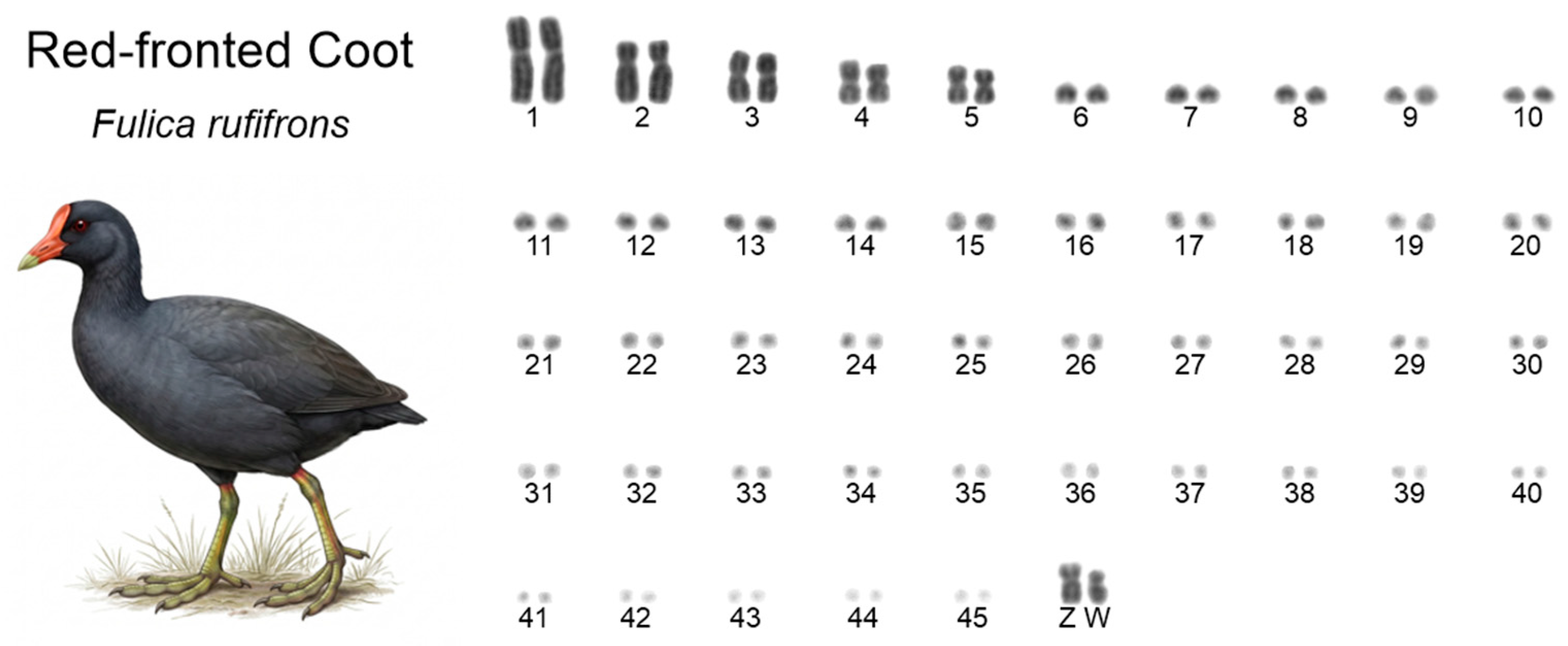
Red-fronted Coot exhibited a diploid complement of 2n = 92, with the first five autosomal pairs biarmed (metacentric or submetacentric) and the remaining autosomes telocentric. The Z and W chromosomes were classified as submetacentric (Figure 1).
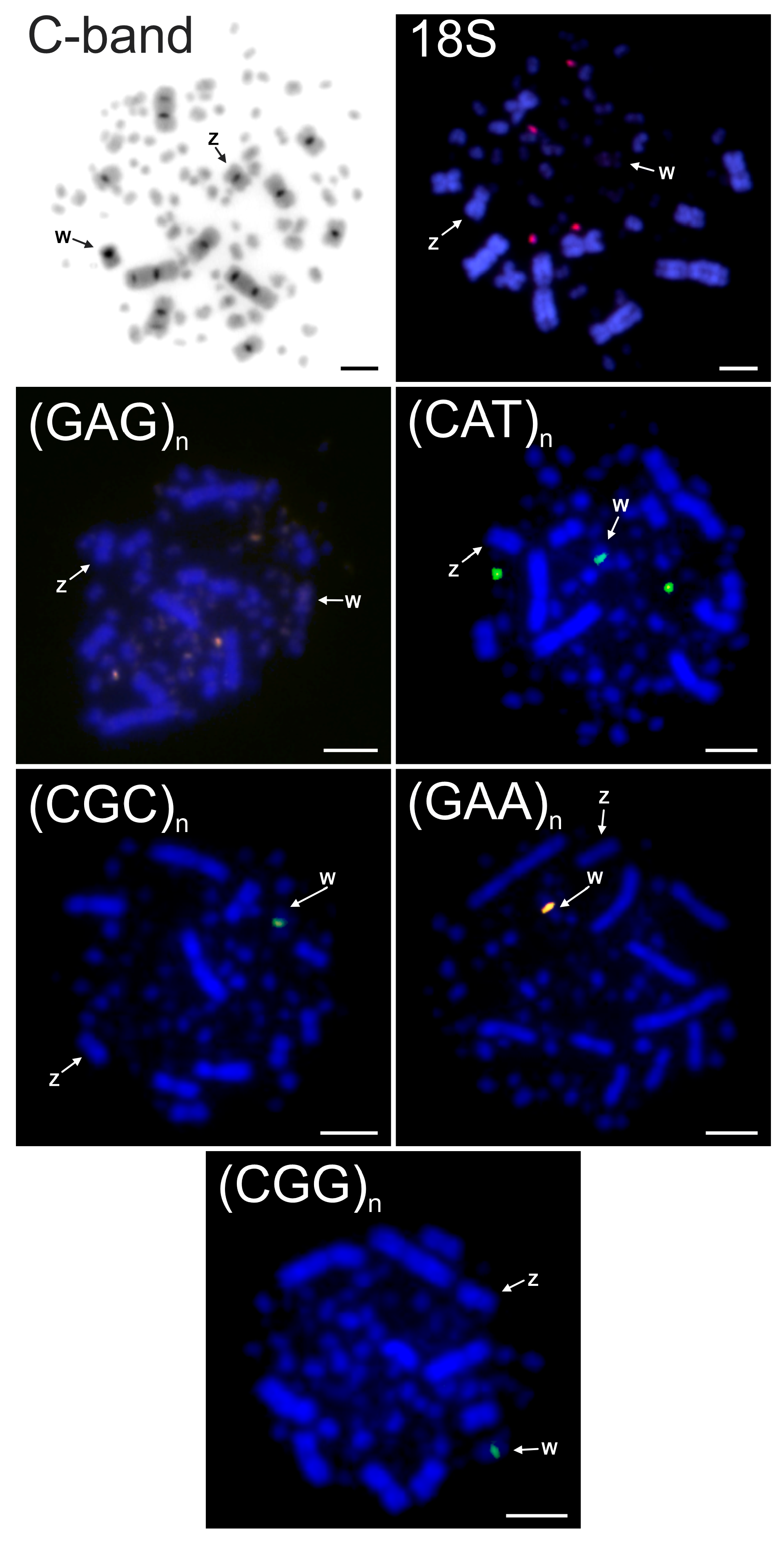
C-banding analysis detected constitutive heterochromatin predominantly at the centromeric regions of the first six autosomal pairs and both sex chromosomes (Figure 2). A conspicuous pericentromeric heterochromatic block was observed on the W chromosome, enabling its unequivocal identification (Figure 2). In addition, interstitial heterochromatic segments were identified on the long arms of the first and second autosomal pairs (Figure 2).
Fluorescence in situ hybridization (FISH) mapping revealed 18S rDNA signals on two distinct pairs of microchromosomes (Figure 2). Of the 11 microsatellite motifs analyzed, five produced detectable signals on Red-fronted Coot chromosomes. Specifically, (CAT)n showed signals on two microchromosomes and in the centromeric region of the W chromosome. The (GAG)n was mapped on microchromosomes and the W chromosome, while (CGC)n, (GAA)n, and (CGG)n were detected exclusively within the centromeric region of the W chromosome (Figure 2). Conversely, no hybridization signals were detected for the remaining six motifs: (CAC)n, (TAT)n, (CAG)n, (CAA)n and (GA)n.

3.2. Karyotype of Giant Wood Rail

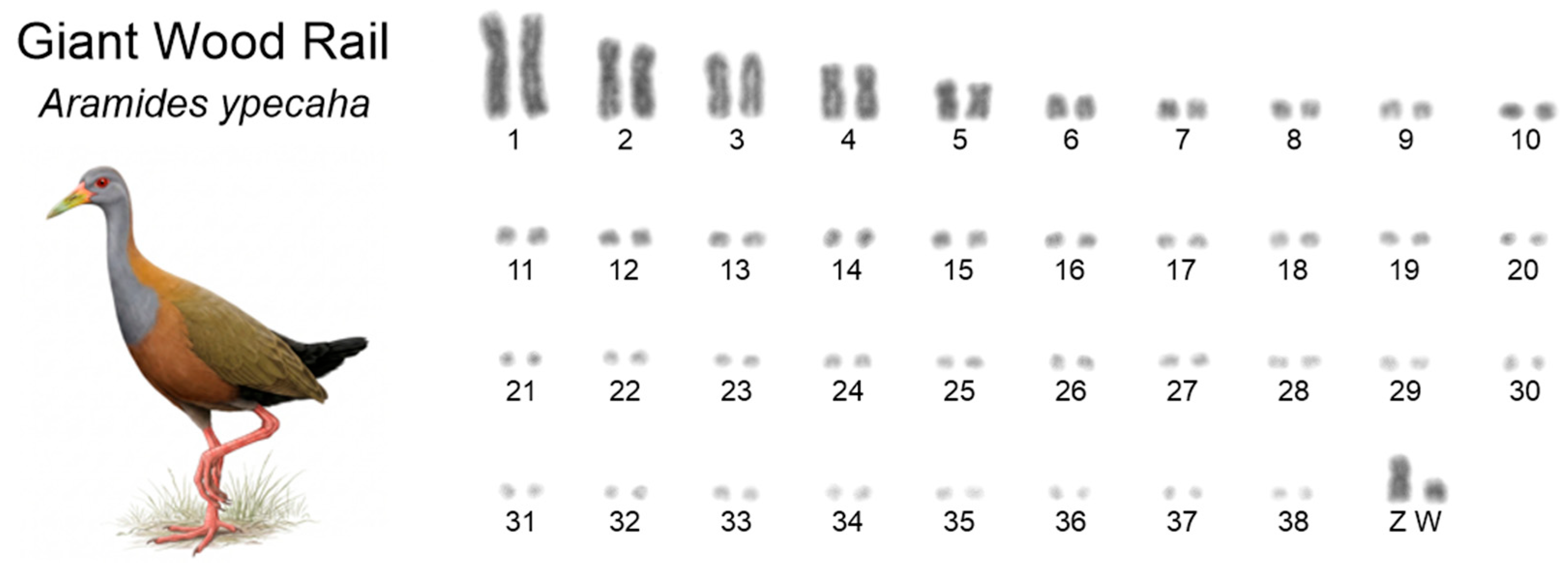
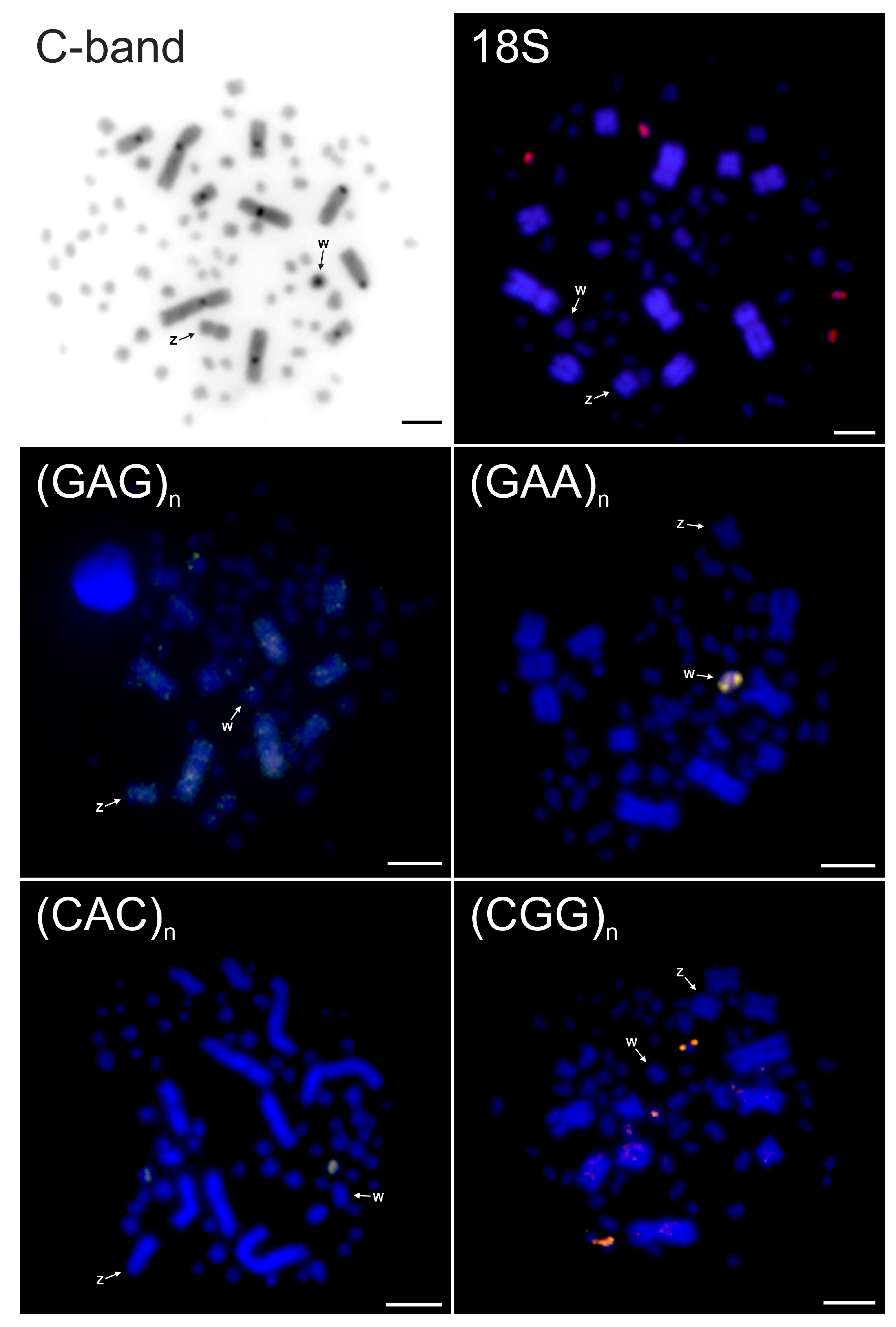
Giant Wood Rail presented a diploid number of 2n = 78 (Figure 3). Autosomal pairs 1, 2, 4, and 5 were biarmed, exhibiting metacentric or submetacentric morphology, whereas pair 3 and the remaining autosomes were telocentric. The Z chromosome was metacentric, and the W chromosome was classified as telocentric.
C-banding revealed constitutive heterochromatin restricted to the centromeric regions of the first five autosomal pairs (Figure 4). No evident heterochromatic blocks were observed on the Z chromosome, while the W chromosome was predominantly heterochromatic along most of its length (Figure 4).
Fluorescence in situ hybridization (FISH) detected 18S rDNA clusters on two pairs of microchromosomes (Figure 4). Of the 11 microsatellite motifs analyzed, four were successfully mapped onto Giant Wood Rail chromosomes. Precisely, (GAG)n showed dispersed signals on macrochromosomes, whereas (GAA)n was observed exclusively on the W chromosome. Additionally, (CAC)n localized to a single pair of microchromosomes, and (CGG)n was detected on autosomal pair 3 and six microchromosomes (Figure 4). In contrast, no detectable signals were observed for the remaining seven microsatellite motifs: (CAT)n, (TAT)n, (CAG)n, (CGC)n, (CAA)n, and (GA)n.

4. Discussion

The present study provides the first cytogenetic characterization of Red-fronted Coot and Giant Wood Rail, expanding chromosomal knowledge within Gruiformes. The karyotype of Red-fronted Coot (2n = 92) is consistent with that reported for Fulica atra [9], suggesting karyotypic stability within the genus Fulica. In contrast, Giant Wood Rail showed 2n =78, the same as Gray-Necked Wood Rail (Aramides cajaneus Müller, 1776, 2n = 78) and similar to Slaty-Breasted Wood Rail (Aramides saracura Spix, 1825, 2n = 80), indicating moderate chromosomal variation within Aramides [12,23].
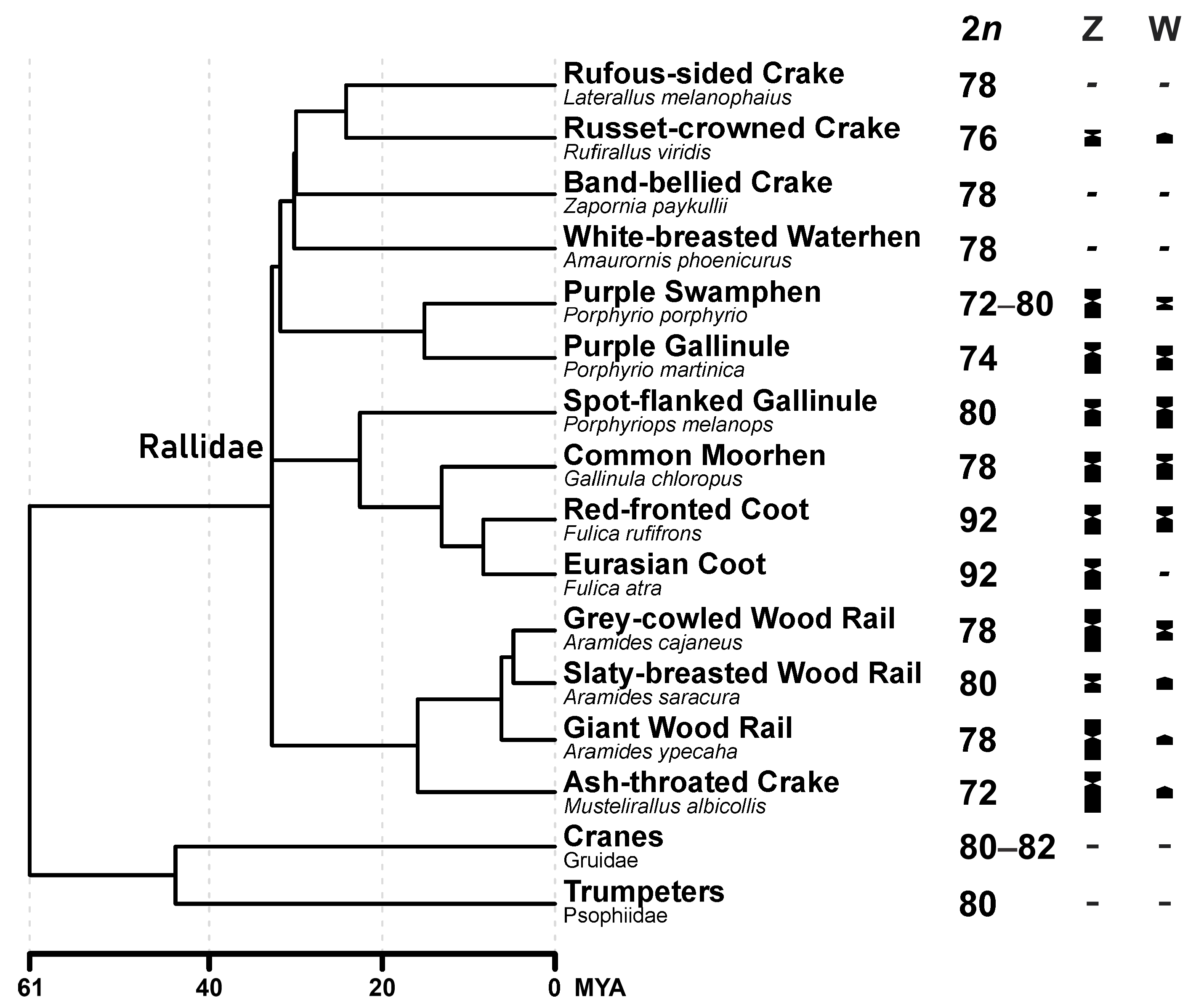
The family Rallidae exhibits considerable karyotypic diversity, with most diploid numbers ranging from 2n = 72 to 2n = 80 and only Coots (Fulica sp.) with to 2n = 92, in contrast to the more conserved karyotypes of Gruidae and Psophiidae (Figure 5). Notably, stability in diploid number does not preclude substantial chromosomal reorganization. For example, Green-Winged Trumpeter Spix, 1825 (Psophia viridis) retains 2n = 80 despite extensive fissions and fusions [12], indicating that conserved diploid numbers can mask underlying structural rearrangements. These observations suggest that, whereas some lineages retain the ancestral avian karyotype [1], others have undergone dynamic genome reorganization, including translocations and inversions, contributing to diversification within Gruiformes. However, the exact nature of these rearrangements remains to be confirmed through future chromosome painting or comparative genomic mapping.
Despite differences in diploid number and chromosome morphology, both species shared several cytogenetic features, including centromeric heterochromatin distribution on macrochromosomes and the presence of two microchromosome pairs carrying 18S rDNA sequences. The occurrence of multiple rDNA-bearing microchromosomes is considered a derived condition in birds, as basal avian lineages typically exhibit a single rDNA-bearing microchromosome pair [24].
Figure 5. Phylogeny of Rallidae based on Kumar et al. [25]. The diploid number is shown (2n) as well as the morphology of the Z and W chromosomes for available data [9,11,26,27,28,29,30]. MYA: million years ago.
Birds 07 00030 g005
The differentiation of sex chromosomes in Rallidae is marked by a distinct pattern of repetitive DNA accumulation. Consistent with this, the W chromosome differs markedly between species—being partially heterochromatic in Red-fronted Coot and almost entirely heterochromatic in Giant Wood Rail—suggesting independent evolutionary trajectories possibly driven by heterochromatin amplification and structural rearrangements [4]. The lineage-specific accumulation of motifs such as (CGC)n and (CGG)n in Red-fronted Coot, which are absent in the W chromosome of Giant Wood Rail, underscores the independent molecular trajectories of sex chromosome differentiation in these rallids.
Within Gruiformes, chromosomal mapping of microsatellites has previously been reported only for Spot-Flanked Gallinule (Porphyriops melanops Vieillot, 1819, Rallidae) [11]. In this species, the W chromosome is larger than the Z chromosome and exhibits the accumulation of six microsatellite motifs: (CAG)n, (CAC)n, (CGG)n, (GAA)n, (GAG)n, and (GA)n. The enrichment of microsatellites on the W chromosome, also observed in fishes [31,32], lizards [33] and other sauropsids [16,34], is consistent with the processes of recombination suppression and heterochromatinization reported in other sauropsids.
Variation is also evident in the autosomal distribution of the (GAG)n motif, which localizes to microchromosomes in the Giant Wood Rail and Spot-Flanked Gallinule, but to macrochromosomes in the Red-fronted Coot [11]. Together with other classes of repetitive DNA, such as transposable elements and satellite DNA, microsatellite may strongly influence sex chromosome morphology across lineages [32,35,36,37]. This pattern may tentatively reflect the deeper divergence of the latter [~33 million years (Myr) versus ~22.6 Myr] [25] (Figure 5). Collectively, our results provide further support to the hypothesis that although repetitive DNA expansion is a common mechanism in avian sex chromosome evolution, the molecular trajectory of these changes is highly lineage-specific.

5. Conclusions

Dynamic and lineage-specific chromosomal rearrangements appear to contribute to karyotype evolution in Rallidae despite the retention of a broadly conserved avian genome structure. Comparative analysis of Red-fronted Coot and Giant Wood Rail demonstrates that repetitive DNA expansion and heterochromatinization are likely involved in evolutionary mechanisms underlying both karyotypic variability and rapid, independent differentiation of the W chromosome. Together, these findings highlight the central role of repetitive sequences in shaping genome organization and provide new insights into the processes driving avian chromosomal diversification.

Author Contributions

Conceptualization, L.C.P., F.L.B. and R.K.; methodology, F.L.B. and R.K.; software, L.C.P., V.C.C. and F.L.B.; validation, L.C.P., V.C.C. and F.L.B.; formal analysis, L.C.P., V.C.C. and F.L.B.; investigation, L.C.P., V.C.C. and F.L.B.; resources, R.T.F., T.R.O.d.F. and R.K.; data curation, L.C.P., V.C.C. and F.L.B.; writing—original draft preparation, L.C.P., V.C.C., F.L.B. and R.K.; writing—review and editing, L.C.P., V.C.C., F.L.B., R.T.F., T.R.O.d.F. and R.K.; visualization, L.C.P., V.C.C. and F.L.B.; supervision, R.K.; project administration, R.K.; funding acquisition, R.T.F., T.R.O.d.F. and R.K. All authors have read and agreed to the published version of the manuscript.

Funding

This research was funded by the Fundação de Amparo à Pesquisa do Rio Grande do Sul (FAPERGS), grant number 24/2551-0001269-9 (R.K.), and Conselho Nacional de Desenvolvimento Científico e Tecnológico (CNPq), grant number 171459/2023-7 (L.C.P.), 405491/2025-5 and 304068/2025-0 (R.K.).

Institutional Review Board Statement

The study was conducted in accordance with sampling authorization granted by the Instituto Brasileiro do Meio Ambiente e dos Recursos Naturais Renováveis (IBAMA; SISBIO permit no. 44173-3). The animal study protocol was approved by the Ethics Committee on Animal Experimentation of the Universidade Federal de Pelotas (protocol no. 113 approved on 7 June 2023).

Informed Consent Statement

Not applicable.

Data Availability Statement

The original contributions presented in this study are included in the article. Further inquiries can be directed to the corresponding author.

Acknowledgments

The authors are grateful to Marcelo Cioffi for critical reading of the manuscript and valuable comments. We also thank Gustavo Toma for his assistance with the experimental approaches. The AI Nano Banana Pro (Gemini 3.1 Pro, Google) was used to create the illustrations of the Red-fronted Coot and the Giant Wood Rail.

Conflicts of Interest

The authors declare no conflicts of interest.

References

  1. Griffin, D.K.; Robertson, L.B.W.; Tempest, H.G.; Skinner, B.M. The Evolution of the Avian Genome as Revealed by Comparative Molecular Cytogenetics. Cytogenet. Genome Res. 2007, 117, 64–77. [Google Scholar] [CrossRef] [PubMed]
  2. Ellegren, H. Microsatellites: Simple Sequences with Complex Evolution. Nat. Rev. Genet. 2004, 5, 435–445. [Google Scholar] [CrossRef] [PubMed]
  3. Griffin, D.K.; Kretschmer, R.; Larkin, D.M.; Srikulnath, K.; Singchat, W.; O’Connor, R.E.; Romanov, M.N. Did the Evolution of Multiple Microchromosomes Help Save Bird and Other Dinosaurs from Extinction? Dev. Biol. 2026, 533, 89–111. [Google Scholar] [CrossRef]
  4. Griffin, D.K.; Kretschmer, R.; Larkin, D.M.; Srikulnath, K.; Singchat, W.; Narushin, V.G.; O’Connor, R.E.; Romanov, M.N. Avian Cytogenomics: Small Chromosomes, Long Evolutionary History. Genes 2025, 16, 1001. [Google Scholar] [CrossRef]
  5. de Oliveira, E.H.C.; Habermann, F.A.; Lacerda, O.; Sbalqueiro, I.J.; Wienberg, J.; Müller, S. Chromosome Reshuffling in Birds of Prey: The Karyotype of the World’s Largest Eagle (Harpy Eagle, Harpia harpyja) Compared to That of the Chicken (Gallus gallus). Chromosoma 2005, 114, 338–343. [Google Scholar] [CrossRef]
  6. Zhang, G.; Li, C.; Li, Q.; Li, B.; Larkin, D.M.; Lee, C.; Storz, J.F.; Antunes, A.; Greenwold, M.J.; Meredith, R.W.; et al. Comparative Genomics Reveals Insights into Avian Genome Evolution and Adaptation. Science 2014, 346, 1311–1320. [Google Scholar] [CrossRef]
  7. AviList Core Team. AviList: The Global Avian Checklist, v2025. 2025. Available online: https://www.avilist.org/checklist/v2025/ (accessed on 18 May 2026). [CrossRef]
  8. Livezey, B.C. A Phylogenetic Analysis of the Gruiformes (Aves) Based on Morphological Characters, with an Emphasis on the Rails (Rallidae). Philos. Trans. R. Soc. Lond. B 1998, 353, 2077–2151. [Google Scholar] [CrossRef]
  9. Hammar, B. The Karyotypes of Thirty-One Birds. Hereditas 1970, 65, 29–58. [Google Scholar] [CrossRef]
  10. Biederman, B.M.; Lin, C.C.; Kuyt, E.; Drewien, R.C. Genome of the Whooping Crane. J. Hered. 1982, 73, 145–146. [Google Scholar] [CrossRef]
  11. Gunski, R.J.; Kretschmer, R.; Santos De Souza, M.; De Oliveira Furo, I.; Barcellos, S.A.; Costa, A.L.; Cioffi, M.B.; De Oliveira, E.H.C.; Del Valle Garnero, A. Evolution of Bird Sex Chromosomes Narrated by Repetitive Sequences: Unusual W Chromosome Enlargement in Gallinula melanops (Aves: Gruiformes: Rallidae). Cytogenet. Genome Res. 2019, 158, 152–159. [Google Scholar] [CrossRef]
  12. Furo, I.D.O.; Kretschmer, R.; O’Brien, P.C.M.; Pereira, J.C.; Ferguson-Smith, M.A.; De Oliveira, E.H.C. Phylogenetic Analysis and Karyotype Evolution in Two Species of Core Gruiformes: Aramides cajaneus and Psophia viridis. Genes 2020, 11, 307. [Google Scholar] [CrossRef]
  13. Ellegren, H. Evolutionary Stasis: The Stable Chromosomes of Birds. Trends Ecol. Evol. 2010, 25, 283–291. [Google Scholar] [CrossRef]
  14. Kobayashi, T. Regulation of Ribosomal RNA Gene Copy Number and Its Role in Modulating Genome Integrity and Evolutionary Adaptability in Yeast. Cell. Mol. Life Sci. 2011, 68, 1395–1403. [Google Scholar] [CrossRef] [PubMed]
  15. Hobza, R.; Kubat, Z.; Cegan, R.; Jesionek, W.; Vyskot, B.; Kejnovsky, E. Impact of Repetitive DNA on Sex Chromosome Evolution in Plants. Chromosome Res. 2015, 23, 561–570. [Google Scholar] [CrossRef]
  16. Kretschmer, R.; De Oliveira, T.D.; De Oliveira Furo, I.; Oliveira Silva, F.A.; Gunski, R.J.; Del Valle Garnero, A.; De Bello Cioffi, M.; De Oliveira, E.H.C.; De Freitas, T.R.O. Repetitive DNAs and Shrink Genomes: A Chromosomal Analysis in Nine Columbidae Species (Aves, Columbiformes). Genet. Mol. Biol. 2018, 41, 98–106. [Google Scholar] [CrossRef] [PubMed]
  17. Taylor, B. Giant Wood-Rail (Aramides ypecaha). In Birds of the World; Billerman, S.M., Keeney, B.K., Rodewald, P.G., Schulenberg, T.S., Eds.; Cornell Lab of Ornithology: Ithaca, NY, USA, 2020. [Google Scholar]
  18. Taylor, B. Red-fronted Coot (Fulica rufifrons). In Birds of the World; Billerman, S.M., Keeney, B.K., Rodewald, P.G., Schulenberg, T.S., Eds.; Cornell Lab of Ornithology: Ithaca, NY, USA, 2024. [Google Scholar]
  19. Garnero, A.D.V.; Gunski, R.J. Comparative Analysis of the Karyotypes of Nothura maculosa and Rynchotus rufescens (Aves: Tinamidae). A Case of Chromosomal Polymorphism. Int. J. Cytol. 2000, 43, 64–70. [Google Scholar]
  20. Levan, A.; Fredga, K.; Sandberg, A.A. Nomenclature for Centromeric Position in Chromosomes. Hereditas 1964, 52, 201–220. [Google Scholar] [CrossRef]
  21. Sumner, A.T. A Simple Technique for Demonstrating Centromeric Heterochromatin. Exp. Cell Res. 1972, 75, 304–306. [Google Scholar] [CrossRef]
  22. Kretschmer, R.; da Silva dos Santos, M.; Furo, I.D.O.; De Oliveira, E.H.C.; Cioffi, M.D.B. FISH—In Birds. In Cytogenetics and Molecular Cytogenetics; Liehr, T., Ed.; CRC Press: Boca Raton, FL, USA, 2022; pp. 263–280. [Google Scholar]
  23. Davide, L.C. Estudo do Complemento Cromossômico de Algumas Espécies da Família Rallidae. Master’s Thesis, Universidade Federal de São Paulo, Piracicaba, Brazil, 1979. [Google Scholar]
  24. Nishida-Umehara, C.; Tsuda, Y.; Ishijima, J.; Ando, J.; Fujiwara, A.; Matsuda, Y.; Griffin, D.K. The Molecular Basis of Chromosome Orthologies and Sex Chromosomal Differentiation in Palaeognathous Birds. Chromosome Res. 2007, 15, 721–734. [Google Scholar] [CrossRef]
  25. Kumar, S.; Suleski, M.; Craig, J.M.; Kasprowicz, A.E.; Sanderford, M.; Li, M.; Stecher, G.; Hedges, S.B. TimeTree 5: An Expanded Resource for Species Divergence Times. Mol. Biol. Evol. 2022, 39, msac174. [Google Scholar] [CrossRef]
  26. Degrandi, T.M.; Barcellos, S.A.; Costa, A.L.; Garnero, A.D.V.; Hass, I.; Gunski, R.J. Introducing the Bird Chromosome Database: An Overview of Cytogenetic Studies in Birds. Cytogenet Genome Res. 2020, 160, 199–205. [Google Scholar] [CrossRef]
  27. Giannoni, M.; Duarte, J.; Moro, M.; Boer, J. Cytogenetic Research in Wild Animals at FCAVJ, Brazil. II. Birds. Genet Sel. Evol. 1991, 23, S123. [Google Scholar] [CrossRef]
  28. Hassan, H.A. Karyological Studies on Six Species of Birds. Cytologia 1998, 63, 349–363. [Google Scholar] [CrossRef]
  29. Itoh, M.; Ikeuchi, T.; Shimba, H.; Mori, M.; Sasaki, M.; Makino, S. A Comparative Karyotype Study in Fourteen Species of Birds. Jpn. J. Genet. 1969, 44, 163–170. [Google Scholar] [CrossRef]
  30. Aguiar, M.L.R. Estudo do Complemento Cromossômico em Algumas Ordens de Aves. Ph.D. Thesis, Universidade Federal de São Paulo, São Paulo, Brazil, 1968. [Google Scholar]
  31. Yano, C.F.; Poltronieri, J.; Bertollo, L.A.C.; Artoni, R.F.; Liehr, T.; De Bello Cioffi, M. Chromosomal Mapping of Repetitive DNAs in Triportheus trifurcatus (Characidae, Characiformes): Insights into the Differentiation of the Z and W Chromosomes. PLoS ONE 2014, 9, e90946. [Google Scholar] [CrossRef]
  32. Poltronieri, J.; Marquioni, V.; Bertollo, L.A.C.; Kejnovsky, E.; Molina, W.F.; Liehr, T.; Cioffi, M.B. Comparative Chromosomal Mapping of Microsatellites in Leporinus Species (Characiformes, Anostomidae): Unequal Accumulation on the W Chromosomes. Cytogenet. Genome Res. 2014, 142, 40–45. [Google Scholar] [CrossRef]
  33. Pokorná, M.; Kratochvíl, L.; Kejnovský, E. Microsatellite Distribution on Sex Chromosomes at Different Stages of Heteromorphism and Heterochromatinization in Two Lizard Species (Squamata: Eublepharidae: Coleonyx elegans and Lacertidae: Eremias velox). BMC Genet. 2011, 12, 90. [Google Scholar] [CrossRef]
  34. Matsubara, K.; O’Meally, D.; Azad, B.; Georges, A.; Sarre, S.D.; Graves, J.A.M.; Matsuda, Y.; Ezaz, T. Amplification of Microsatellite Repeat Motifs Is Associated with the Evolutionary Differentiation and Heterochromatinization of Sex Chromosomes in Sauropsida. Chromosoma 2016, 125, 111–123. [Google Scholar] [CrossRef]
  35. Peona, V.; Palacios-Gimenez, O.M.; Blommaert, J.; Liu, J.; Haryoko, T.; Jønsson, K.A.; Irestedt, M.; Zhou, Q.; Jern, P.; Suh, A. The Avian W Chromosome Is a Refugium for Endogenous Retroviruses with Likely Effects on Female-Biased Mutational Load and Genetic Incompatibilities. Philos. Trans. R. Soc. B 2021, 376, 20200186. [Google Scholar] [CrossRef]
  36. Peona, V.; Kutschera, V.E.; Blom, M.P.K.; Irestedt, M.; Suh, A. Satellite DNA Evolution in Corvoidea Inferred from Short and Long Reads. Mol. Ecol. 2023, 32, 1288–1305. [Google Scholar] [CrossRef]
  37. Li, B.P.; Kang, N.; Xu, Z.X.; Luo, H.R.; Fan, S.Y.; Ao, X.H.; Li, X.; Han, Y.P.; Ou, X.B.; Xu, L.H. Transposable Elements Shape the Landscape of Heterozygous Structural Variation in a Bird Genome. Zool. Res. 2025, 46, 75–86. [Google Scholar] [CrossRef]
Figure 1. Giemsa-stained karyotype of a female Red-fronted Coot, showing the diploid chromosome complement (2n = 92), with homologous chromosome pairs arranged in decreasing order of size. Scale bar = 5 μm. AI-generated illustration using Nano Banana Pro (Gemini 3.1 Pro, Google).
Birds 07 00030 g001
Figure 2. Metaphase chromosome spreads of a female Red-fronted Coot highlighting constitutive heterochromatin regions, 18S rDNA sites, and chromosomal distribution of microsatellite motifs. Arrows indicates the sexual chromosomes. Scale bar = 5 μm.
Birds 07 00030 g002
Figure 3. Complete karyotype of a female Giant Wood Rail, showing the diploid chromosome complement (2n = 78), with homologous chromosome pairs arranged in decreasing order of size. Scale bar = 5 μm. AI-generated illustration using Nano Banana Pro (Gemini 3.1 Pro, Google).
Birds 07 00030 g003
Figure 4. Metaphase chromosome spreads of a female Giant Wood Rail highlighting constitutive heterochromatin regions, 18S rDNA sites, and chromosomal distribution of microsatellite motifs. Arrows indicates the sexual chromosomes. Scale bar = 5 μm.
Birds 07 00030 g004
Disclaimer/Publisher’s Note: The statements, opinions and data contained in all publications are solely those of the individual author(s) and contributor(s) and not of MDPI and/or the editor(s). MDPI and/or the editor(s) disclaim responsibility for any injury to people or property resulting from any ideas, methods, instructions or products referred to in the content.