
Behavioural Responses of Captive Large-billed Crows to Owl Decoys with Different Motion Patterns

1
Civil Engineering and Bioengineering, Nagaoka University of Technology, Nagaoka 940-2188, Japan
2
Sustainable System Research Laboratory, Central Research Institute of Electric Power Industry, Abiko 270-1194, Japan
*
Author to whom correspondence should be addressed.
Birds 2025, 6(4), 64; https://doi.org/10.3390/birds6040064
Submission received: 18 October 2025
/
Revised: 4 December 2025
/
Accepted: 5 December 2025
/
Published: 9 December 2025
Simple Summary
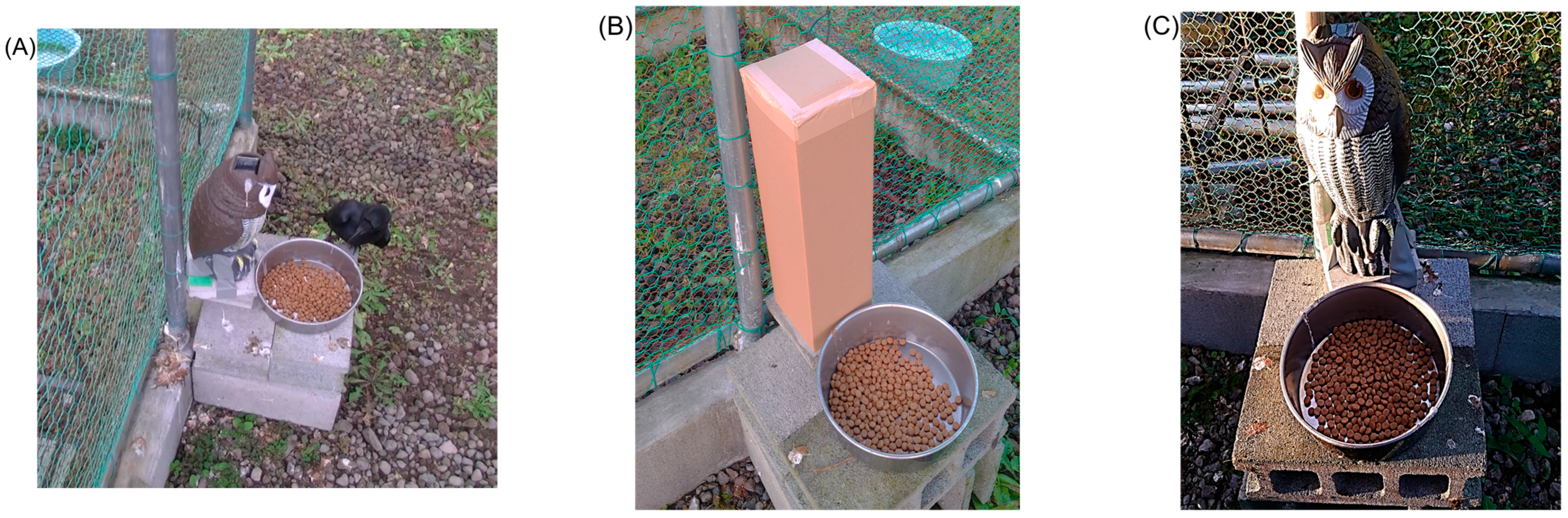
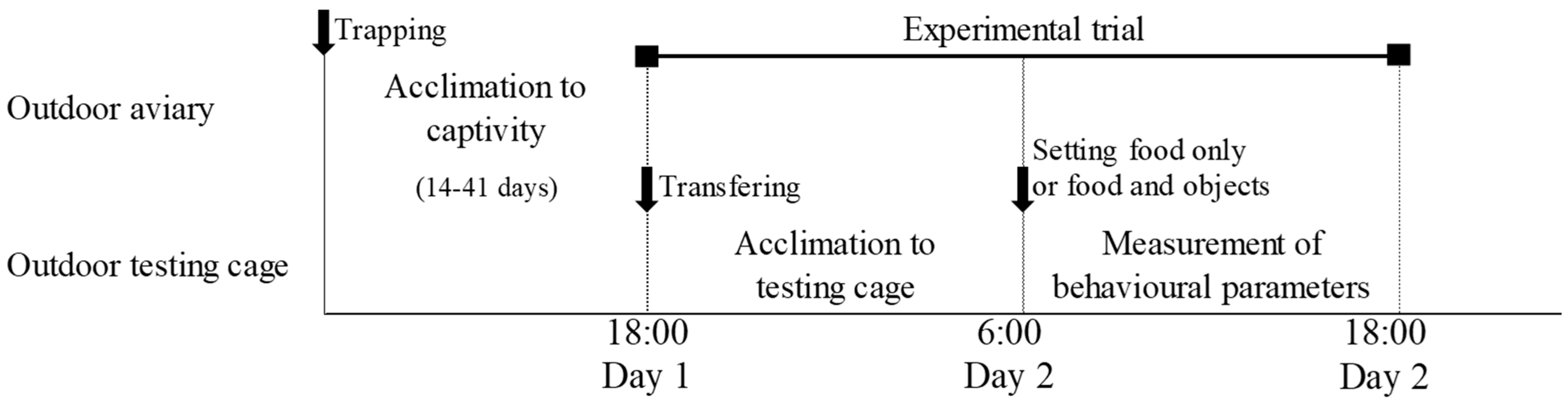
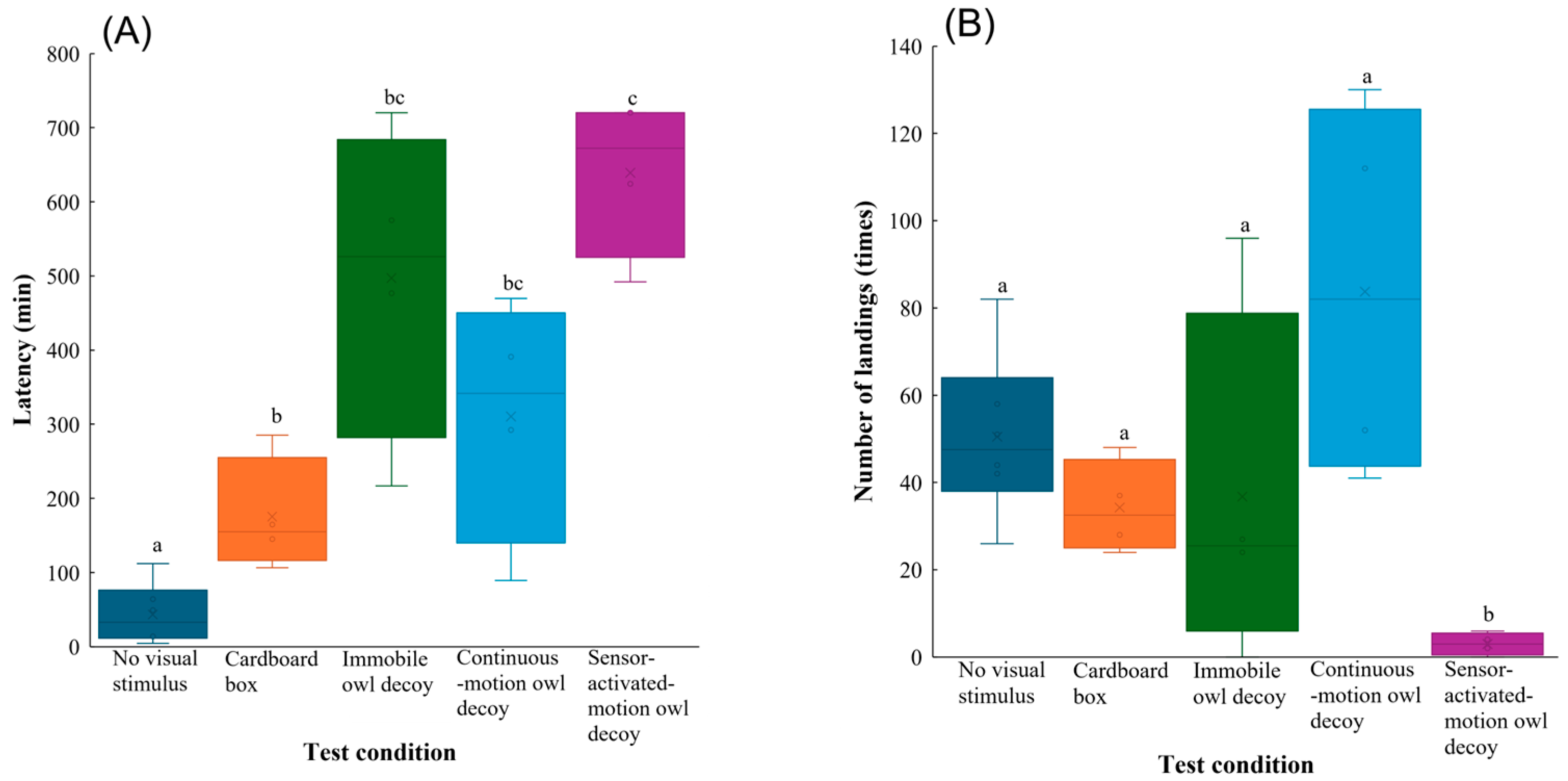
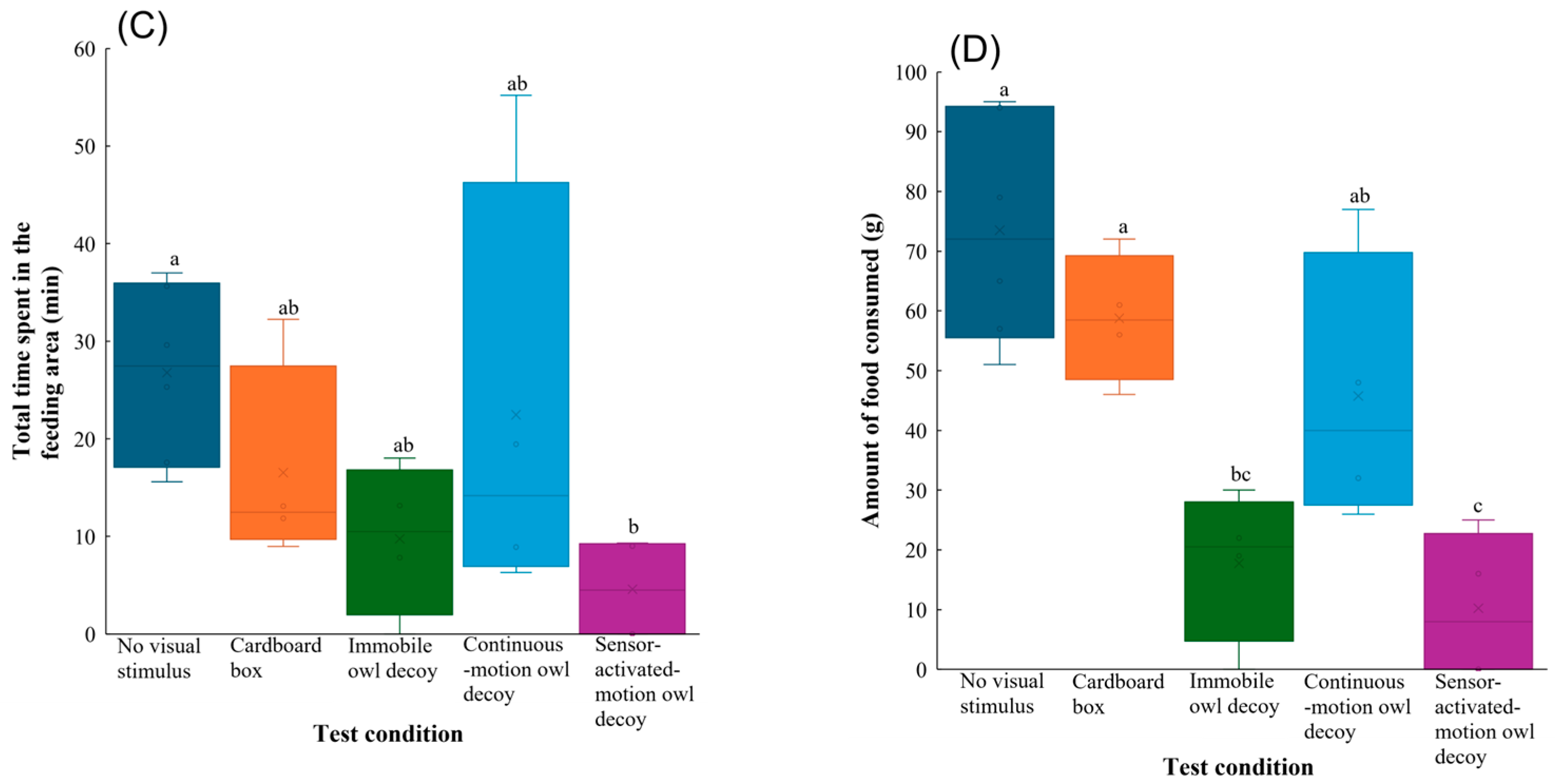
Corvids often avoid objects they consider risky when searching for food, but it is not well understood which object features make them more cautious. In this study, we observed how wild-caught Large-billed Crows (Corvus macrorhynchos) reacted to five different visual conditions near their food: no object, a cardboard box, an immobile owl decoy, a continuous-motion owl decoy, and an owl decoy that moved suddenly when the birds approached. We recorded how long it took the crows to start feeding, how often they landed and how long they remained near the food, and how much food they ate. All objects caused them to hesitate before feeding, but the owl decoy that moved suddenly led to the strongest avoidance. These results suggest that they are influenced not only by the presence of an object but also by how it moves and/or whether it appears biological. Our findings help explain how crows judge potential risks while foraging and highlight the importance of object complexity in shaping their avoidance behaviour.
Abstract
Corvids exhibit avoidance behaviour when foraging in the presence of potentially risky stimuli, yet it remains unclear how stimulus characteristics influence the strength of such responses. In this paper, we present wild-caught Large-billed Crows (Corvus macrorhynchos) with five conditions: no visual stimulus, a cardboard box (non-biological, stationary), an immobile owl decoy (biological, stationary), a continuous-motion owl decoy (biological, moving), and a sensor-activated-motion owl decoy (biological, moving, and sudden). Avoidance was quantified using feeding latency, landing frequency, total time spent in the feeding area, and food consumption. Compared with the condition with no visual stimulus, the presence of any visual stimulus elicited increased latency, indicating that crows detect and respond to objects near food. Among the four objects, the sensor-activated-motion owl decoy produced stronger avoidance responses of the crows than the non-biological and stationary object (cardboard box). This indicates that they evaluate not only the presence of an object but also its motion characteristics and/or perceived biological cues when adjusting their foraging behaviour. Although sample size and individual variation impose limitations, these findings suggest that both the presence of visual stimuli and/or the complexity of their appearance play key roles in shaping avoidance behaviour in corvids.
Keywords:
corvids; avoidance; experimental approach; novel object