Case Report

Nine-Year Follow-Up of Gamma Knife Surgery for Hemangioblastomas in von Hippel–Lindau Disease: Illustrating the Challenge of Distinguishing Radiosurgical Effect from Natural Tumor Quiescence


by
Rusli Muljadi
1,2,*,
Lutfi Hendriansyah
3,
Patricia Diana Prasetiyo
4 and
Gilbert Sterling Octavius
5
1
Thoracic and Cardiovascular Imaging Division, Department of Radiology, Faculty of Medicine, Universitas Pelita Harapan, Tangerang 36136, Indonesia
2
Department of Radiology, Siloam Hospital, Lippo Village, Tangerang 36136, Indonesia
3
Department of Neurosurgery, Siloam Hospital, Lippo Village, Tangerang 36136, Indonesia
4
Pathology Anatomy, Faculty of Medicine, Universitas Pelita Harapan, Tangerang 36136, Indonesia
5
Radiology Department, Faculty of Medicine, Universitas Pelita Harapan, Tangerang 36136, Indonesia
*
Author to whom correspondence should be addressed.
Radiation 2026, 6(1), 11; https://doi.org/10.3390/radiation6010011
Submission received: 24 January 2026 / Revised: 10 March 2026 / Accepted: 16 March 2026 / Published: 17 March 2026

Simple Summary

This case report was prepared to explore the long-term role of Gamma Knife Surgery in treating hemangioblastomas in patients with von Hippel–Lindau disease, a rare inherited condition that causes multiple tumors in the brain and other organs. The authors aim to show how this treatment performs over an extended period by describing a young patient from Indonesia who was followed for nine years after undergoing multiple Gamma Knife procedures. Although the treated tumors initially shrank and symptoms improved, new tumors later developed in other locations, reflecting the progressive nature of the disease. The findings highlight that Gamma Knife Surgery may help control selected tumors and relieve symptoms but does not stop the disease itself. This report provides long-term data from a resource-limited setting and may help clinicians better understand treatment expectations, decision-making, and the importance of prolonged follow-up in von Hippel–Lindau disease.

Abstract

Background/Objectives: Hemangioblastomas are rare, benign, highly vascular tumors of the central nervous system, frequently associated with von Hippel–Lindau (vHL) disease. Case Presentation: We report a 16-year-old female with vHL presenting with recurrent headaches, abdominal distension, and ocular discomfort. Imaging revealed hemangioblastomas in the fourth ventricle and retrobulbar space, alongside multiple pancreatic cysts. The patient underwent three sessions of Gamma Knife Surgery (GKS) with initial tumor regression and symptom relief. However, long-term follow-up demonstrated progressive disease, with new lesions in the cerebellum, spinal cord, and orbit, including cystic transformation. Histopathology confirmed the reticular variant of hemangioblastoma. Despite further radiosurgical and surgical recommendations, the patient and family opted for conservative management, with lesions remaining radiographically stable over nine years. Conclusions: This case demonstrates that Gamma Knife Surgery may provide temporary local disease control for selected solid hemangioblastomas in von Hippel–Lindau disease but does not alter the underlying disease course. Long-term radiographic stability should be interpreted cautiously, as hemangioblastomas exhibit saltatory growth patterns that make it difficult to distinguish treatment effect from natural tumor quiescence. These findings emphasize that radiosurgery should be regarded as a disease-control strategy rather than curative therapy, underscoring the importance of individualized management, multidisciplinary decision-making, and prolonged surveillance.

1. Introduction

Hemangioblastoma is a rare, benign vascular tumor of the central nervous system (CNS), first described by von Hippel–Lindau in 1895 [1]. It accounts for approximately 1–3% of all intracranial space-occupying lesions [2]. Most hemangioblastomas occur sporadically, but approximately 25% are associated with von Hippel–Lindau (vHL) disease, a multiple neoplasia syndrome inherited in an autosomal-dominant pattern and caused by mutations in the VHL tumor suppressor gene on the short arm of chromosome 3p25.3 [3].
The cerebellum is the most common site of both sporadic and vHL-associated hemangioblastomas [4]. The treatment of choice for solitary cystic tumors of the cerebellum is microsurgical excision, as it is safe (procedural mortality < 2%), effective, and curative [5,6]. Brainstem involvement, tumor vascularity, and the cumulative morbidity associated with repeated surgery may contribute to the 15% mortality rate in microsurgical treatment [5,6]. Although hemangioblastomas can be saltatory in nature and do not require urgent treatment, symptomatic hemangioblastomas are the initial manifestation of vHL symptoms in 40% of patients [7].
Gamma Knife Surgery (GKS) is an alternative to microsurgical excision, especially for recurrent and multiple hemangioblastomas in vHL [8]. It offers good tumor control rates with good clinical outcomes in a minimally invasive fashion [9]. However, most studies are limited by short-term follow-up, making it difficult to discern whether the absence of growth in hemangioblastomas associated with vHL reflects the tumor’s saltatory growth pattern or the actual effectiveness of GKS [10].
The first published use of GKS for hemangioblastomas appeared in 1996 [11]. In Indonesia, however, this modality remains relatively new, with the first Gamma Knife center established at our institution in 2012 and only two centers available nationwide as of 2025. To date, just two cases of vHL disease have been reported from Indonesia. One case focused more on the total pancreatoduodenectomy technique [12], while the other case was treated with craniotomy [13], neither of which included long-term follow-up. Here, we present a 16-year-old female with vHL who underwent three sessions of GKS and was followed for nine years, illustrating both the natural history of vHL and our experience in applying radiosurgery for hemangioblastomas in this context. Beyond documenting a long-term clinical course, this case highlights the difficulty of distinguishing radiosurgical treatment effect from the intrinsic saltatory growth behavior of hemangioblastomas in patients with von Hippel–Lindau disease.

2. Case Report

A 16-year-old female presented to our outpatient clinic with a three-month history of recurrent headaches characterized by throbbing and dull pain without identifiable exacerbating factors. She also reported epigastric abdominal distension without nausea, vomiting, weight loss, or fever. Concurrently, she experienced a tingling sensation in her right arm, accompanied by weakness, dizziness, and mild discomfort in her right eye. There was no significant medical history for the patient, nor was there any for her parents or family members.
On physical examination, her vital signs were stable. She weighed 42 kg and was 162 cm tall, resulting in a body mass index of 16. The ophthalmological assessment revealed a hazy right cornea compared to the left, although her vision remained intact. Abdominal palpation revealed a non-tender, non-mobile mass, while neurological examination showed no cranial nerve deficits or motor or sensory impairments. Routine laboratory investigations, including full blood count, random blood sugar, electrolytes, renal and liver function tests, and coagulation indices, were all within normal limits.
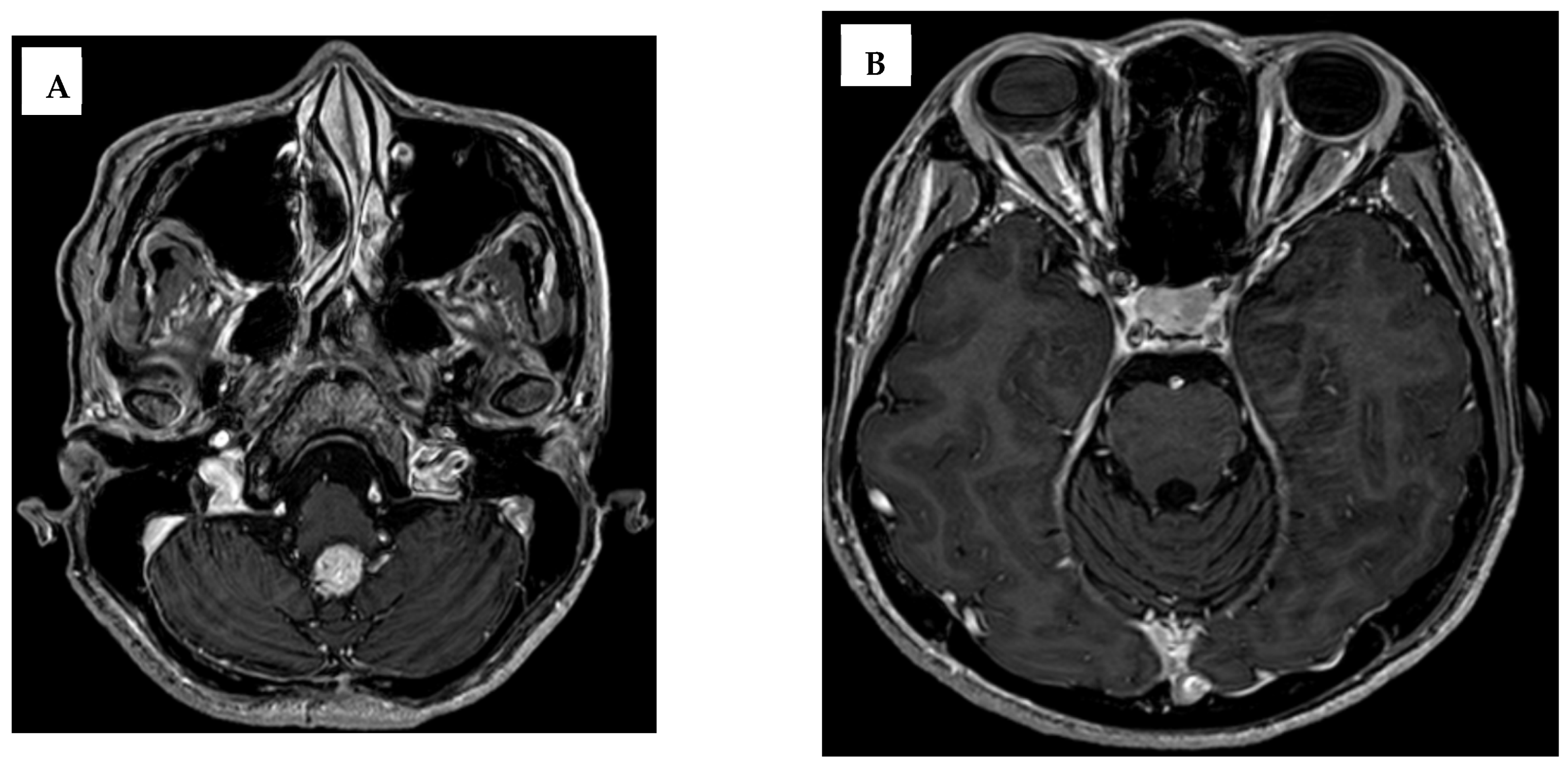
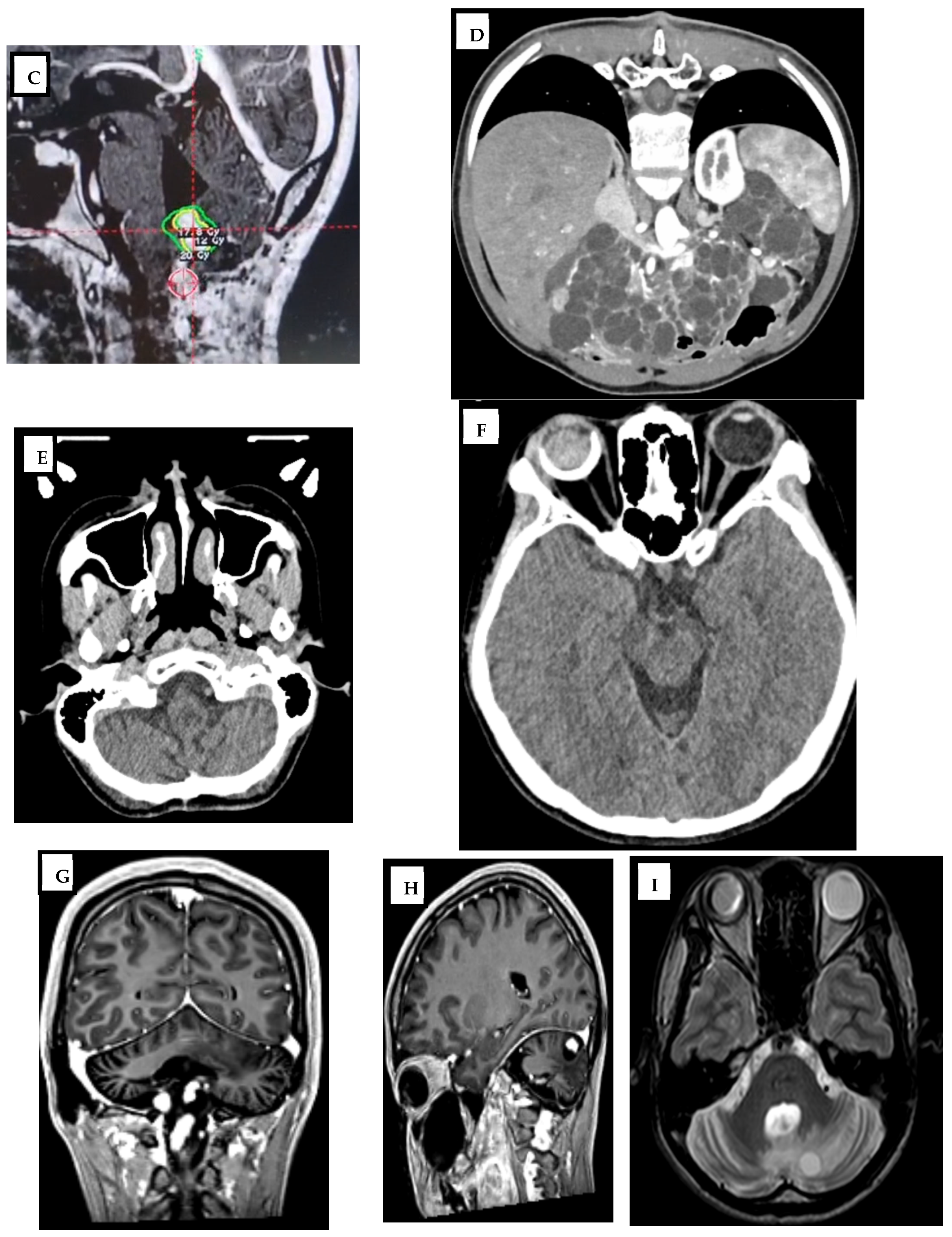
Brain magnetic resonance imaging (MRI) revealed a 19 mm solid, contrast-enhancing mass within the fourth ventricle (Figure 1A) and a homogeneously enhancing, well-defined oval lesion in the right retrobulbar space (Figure 1B), consistent with multiple hemangioblastomas. Although the initial hemangioblastomas were relatively small, both lesions were symptomatic at presentation: the fourth ventricular lesion was associated with recurrent headaches, and the retrobulbar lesion caused ocular discomfort. Given the eloquent anatomical locations and the potential risk of neurological and visual deterioration, active intervention was favored over observation. Microsurgical resection was discussed but declined by the patient and her family because of concerns regarding surgical morbidity. At the same time, watchful waiting was also refused due to persistent symptoms and anxiety related to tumor progression. In this clinical context, GKS was selected as a minimally invasive therapeutic alternative. Subsequent GKS were not performed prophylactically but were undertaken in response to recurrent symptoms and radiological evidence of lesion progression, including an increase in lesion number and size on interval imaging. The radiosurgical sessions were delivered using marginal doses within the same therapeutic dose range. Given the tumor’s location, GKS was chosen over surgical excision with a dose of 17.8 Gy (Figure 1C). The treatment plan used the minimum number of shots required to achieve adequate target coverage while respecting dose constraints to nearby critical structures. The marginal dose of 17.8 Gy was prescribed to the 50% isodose line during Gamma Knife treatment planning. This corresponds to a maximum dose of approximately 35.6 Gy at the center of the target. The marginal dose was selected based on the small tumor volume and its proximity to critical neurovascular structures, consistent with commonly reported radiosurgical dose ranges for intracranial hemangioblastomas. Before the initial GKS, a stereotactic biopsy of the fourth ventricular lesion was performed to obtain tissue for histopathological confirmation. Following two GKS sessions over one year, both lesions decreased in size, and her symptoms partially improved, although tingling in her right arm persisted. Quantitative assessment of the treated lesions demonstrated a reduction in the maximal diameter of the fourth ventricular lesion from 19 mm at baseline to approximately 12 mm on follow-up imaging after the second GKS session. Based on the available orthogonal measurements (approximately 1.2 × 0.95 × 2.6 cm), the estimated lesion volume using an ellipsoid approximation was approximately 1.5 cm3. A summary of longitudinal tumor measurements across the nine-year follow-up is provided in Table 1.
An abdominal evaluation was not initially performed, as the patient prioritized neurological assessment and reported no gastrointestinal symptoms at presentation. However, progressive abdominal distension later prompted a contrast-enhanced abdominal computed tomography (CT) scan, which revealed multiple well-circumscribed, heterogeneously enhancing hypodense cystic lesions within the pancreas (Figure 1D). Pancreatic amylase and lipase levels were normal, and conservative management was initiated. The correlation of these findings with the previous brain MRI raised a strong suspicion of von Hippel–Lindau (VHL) syndrome.
The patient returned three years after the initial visit, having been lost to follow-up during the COVID-19 pandemic. Her symptoms had worsened, resembling their severity before treatment. A non-contrast brain CT revealed progression in both lesions in size and number (Figure 1D,E). A follow-up brain MRI with contrast confirmed additional enhancing nodules at the C1–C2 level (Figure 1F) and in the left cerebellum, with a prominent cyst (Figure 1G). Retinal detachment in the right eye was also noted (Figure 1H,I).
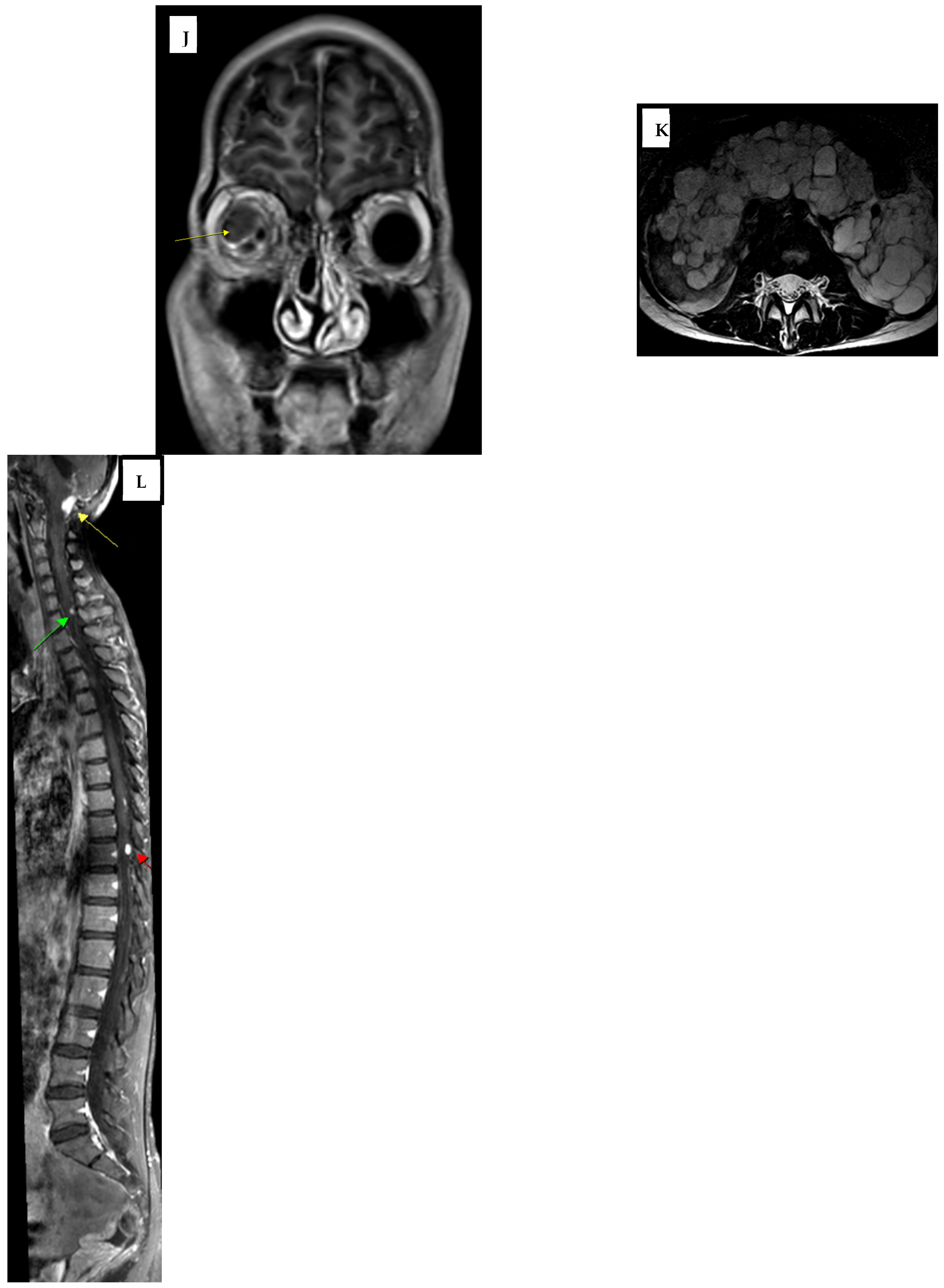
Given the concern for spinal canal involvement, a contrast-enhanced whole-spine MRI was performed. This imaging identified multiple well-circumscribed nodules at the C1–C2, C4, C6–C7, and T8 levels, ranging from 2 to 8 mm in size (Figure 1J). This imaging also delineated the progression of pancreatic cystic lesions (Figure 1K). The patient and her parents refused surgery due to their fear and concerns about the surgery. Therefore, serial yearly follow-up was agreed upon.
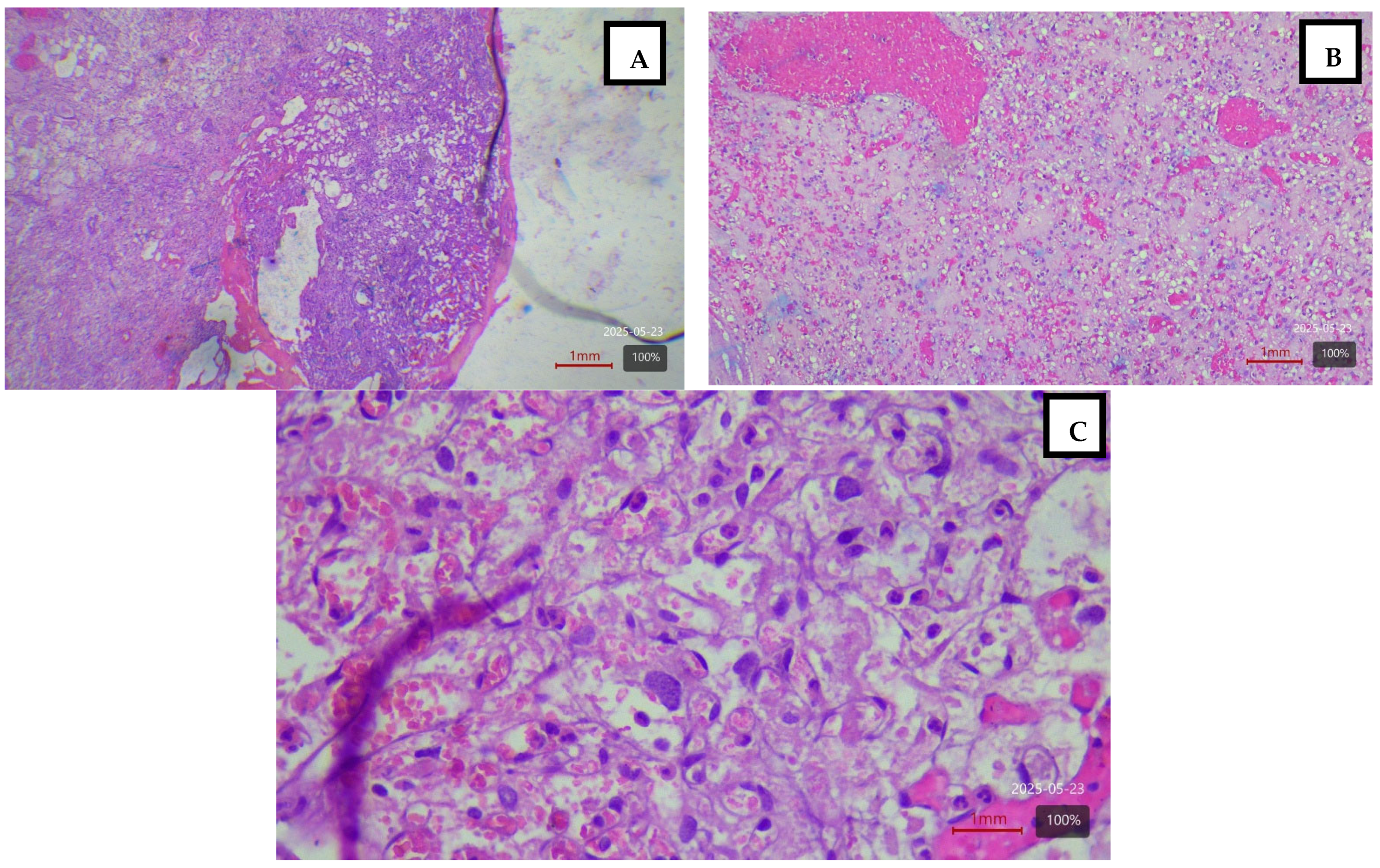
The histopathology results showed a proliferation of blood vessels of various sizes (ranging from large to small), arranged irregularly. The vascular lumina contain erythrocytes, and the vessel walls appear relatively thin. Between the vessels, there was a proliferation of cells with round nuclei, mild pleomorphism, and partly clear, vacuolated cytoplasm, arranged in the intervascular spaces (Figure 2A–C). The findings were consistent with the reticular variant of hemangioblastoma. The patient continued with conservative management. Although the treated lesions remained radiographically stable during long-term follow-up, this finding was interpreted cautiously, as hemangioblastomas in vHL disease are known to exhibit saltatory growth patterns, and periods of stability may reflect tumor quiescence rather than a definitive treatment effect. A subsequent brain MRI showed no further growth of the lesion (approximately 1.2 × 0.9 × 2.6 cm, with an estimated tumor volume of 1.5 cm3). However, due to persistent right eye discomfort, her ophthalmologist recommended enucleation of the right globe, which the patient declined. Her last follow-up was in June 2025, at which time all lesions were stable. At the most recent follow-up, the patient remained neurologically stable, with no focal motor or sensory deficits and preserved independent ambulation. Visual function in the left eye was intact, whereas the right eye continued to have reduced vision due to chronic retinal detachment and intraocular involvement; however, no further deterioration was reported compared with prior assessments. Her last follow-up was in June 2025, at which time all intracranial and spinal lesions remained radiographically stable.
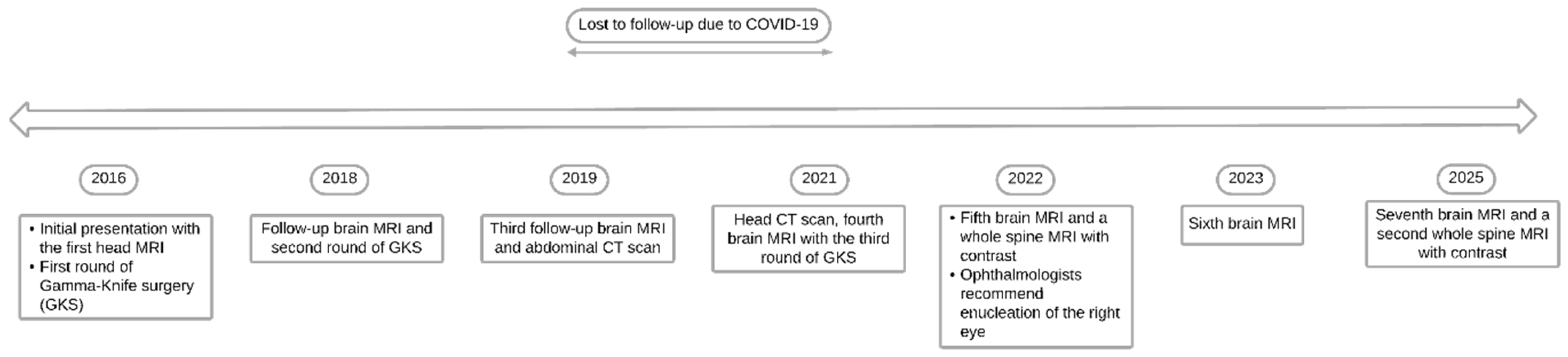
The timeline presented in Figure 3 illustrates several distinct phases in the patient’s clinical course. The initial phase consisted of symptomatic presentation and early radiosurgical intervention, followed by radiographic regression and partial symptom relief. This was subsequently interrupted by a prolonged loss to follow-up during the COVID-19 pandemic, after which imaging demonstrated disease progression with new lesions and cystic transformation. The final phase is characterized by relative radiographic stability under conservative management. This sequence highlights the episodic nature of hemangioblastoma progression in von Hippel–Lindau disease and illustrates how treatment decisions are often influenced by symptom burden, lesion location, and patient preference rather than by radiographic progression alone.

3. Discussion

This case presents a nine-year follow-up of familial hemangioblastoma (vHL) managed with three sessions of GKS in Indonesia, demonstrating the progressive nature of vHL despite the lesion’s apparent stability. With only two Gamma Knife centers currently available in the country, this report underscores our early experience with the growing role of advanced therapeutic modalities in the management of vHL. Although several case reports have described long-term outcomes in patients with von Hippel–Lindau disease, this report represents the first case to document prolonged follow-up of an adolescent-onset case managed with multiple Gamma Knife radiosurgery sessions in a resource-limited setting.

3.1. Diagnosis of von Hippel–Lindau Disease

The diagnosis of von Hippel–Lindau disease is primarily established on clinical findings, although a pathogenic or likely pathogenic genetic variant can be identified in the majority of patients [3]. In a minority of cases, the diagnosis is made on clinical grounds when established diagnostic criteria are met, despite the absence of a detectable pathogenic variant in the VHL gene [14,15]. Current consensus guidelines indicate that, in individuals with a first-degree relative affected by von Hippel–Lindau disease, the presence of at least one disease-related manifestation is sufficient to establish the diagnosis [16]. In patients without a family history of von Hippel–Lindau disease, a clinical diagnosis may be established when two distinct vHL-associated manifestations are present, such as renal cell carcinoma, pheochromocytoma, pancreatic neuroendocrine tumor, or endolymphatic sac tumor, with at least one manifestation being a hemangioblastoma [16]. In the present case, although molecular genetic testing was not performed, the diagnosis of von Hippel–Lindau disease was established on clinical grounds. The patient had multiple central nervous system hemangioblastomas involving the posterior fossa, cerebellum, spinal cord, and orbit, one of which was histopathologically confirmed as a reticular variant hemangioblastoma. In addition, characteristic pancreatic involvement in the form of multiple cystic lesions was demonstrated on serial abdominal imaging. In the absence of a family history, the coexistence of multiple hemangioblastomas with an additional visceral manifestation fulfills current consensus clinical diagnostic criteria for vHL disease. These findings support a definitive clinical diagnosis despite the lack of detectable VHL gene testing. Ideally, all patients meeting these criteria should be discussed within a multidisciplinary team of vHL experts. However, the guidelines emphasize that additional findings, such as multiple pancreatic or renal cysts, may further support the clinical diagnosis of vHL in such cases [16].

3.2. Access to Genetic Testing and Healthcare Context

Access to genetic testing in Indonesia remains limited due to economic constraints, insufficient infrastructure, and limited specialist expertise [17]. If testing resources become more accessible in the future, genetic confirmation and counseling would be recommended to support long-term surveillance and family risk assessment. These limitations reflect differences in healthcare infrastructure rather than biological differences in disease presentation between Indonesia and other regions. The absence of reliable prevalence data for von Hippel–Lindau disease in Indonesia further complicates access to genetic testing. In the absence of definitive epidemiological data, vHL is generally regarded as a very rare disease, which limits investment in diagnostic resources and contributes to the limited availability of genetic testing nationwide. To date, only two vHL case reports have been published from Indonesia, neither of which included genetic analysis, underscoring the lack of accessible genetic testing in the country [12,13]. Only one published case report included genetic analysis for von Hippel–Lindau disease; however, the clinical presentation in that case was not specific to vHL [18].

3.3. Role of Stereotactic Radiosurgery in Hemangioblastomas

Microsurgical resection is not always feasible for hemangioblastomas associated with vHL, given their propensity for progression, multiplicity, recurrence, and the development of new lesions [4]. In our patient, who presented during adolescence, the risks of repeated surgeries and cumulative neuronal injury are considerable. Radiosurgery offers an appealing alternative, particularly for hemangioblastomas with a solid component measuring less than 3 cm in diameter [6]. However, the indication for stereotactic radiosurgery (SRS) is also unclear. One author recommends that solid tumors without a cystic component (type 3 hemangioblastoma), solid tumors with small internal cysts (type 4 hemangioblastoma), and selective cases of cysts with a mural nodule (type 2 hemangioblastoma) are better candidates for SRS [19]. Another author reported that prophylactic treatment of asymptomatic, imaging-detected tumors is unnecessary, recommending that SRS be reserved for patients who are poor surgical candidates or have tumors with features that pose a high surgical risk [20].
In our patient, given her young age, small tumor burden, and preference to avoid surgical resection, GKS represented a reasonable option, particularly since she was also unwilling to pursue watchful waiting. Although the initial hemangioblastomas were relatively small, both lesions were symptomatic at presentation: the fourth ventricular lesion was associated with recurrent headaches, and the retrobulbar lesion caused ocular discomfort. Given the eloquent anatomical locations and the potential risk of neurological and visual deterioration, active intervention was favored over observation [16]. Microsurgical resection was discussed but declined by the patient and her family because of concerns regarding surgical morbidity. At the same time, watchful waiting was also refused due to persistent symptoms and anxiety related to tumor progression. In this clinical context, GKS was selected as a minimally invasive therapeutic alternative. Subsequent GK sessions were not performed prophylactically but were undertaken in response to recurrent symptoms and radiological evidence of lesion progression, including an increase in lesion number and size on interval imaging [10].

3.4. Evidence from Radiosurgery Cohorts and Meta-Analyses

Several studies have evaluated the efficacy of GKS for intracranial hemangioblastomas, with varying outcomes. Silva et al. [9] reported on 12 patients with 20 lesions and a median follow-up of 64 months, demonstrating a reduction in median tumor volume from 946 mm3 to 356 mm3. Tumor control rates were 100% at 1 year, 90% at 3 years, and 85% at 5 years, with complications in two patients. Rajaraman et al. [5] retrospectively analyzed 30 hemangioblastomas in 14 patients, with a mean follow-up of 34 months; three patients died, and local control ranged from 63% to 83% at 6 years. They concluded that radiosurgery provides useful palliation for most hemangioblastomas, though efficacy is limited by ongoing intracranial disease progression. Asthagiri et al. [20] followed 20 vHL patients with 44 lesions for a mean of 8.5 years, showing local control rates of 91% at 2 years, 83% at 5 years, 61% at 10 years, and 51% at 15 years, despite all patients surviving to follow-up. The authors advised against prophylactic treatment of asymptomatic tumors, recommending stereotactic radiosurgery only for lesions unsuitable for surgical resection.
When compared with these published cohorts, the clinical course observed in our patient appears broadly consistent with previously reported patterns of disease control and progression. Similar to the series reported by Asthagiri et al. [20], in which long-term control declined gradually over time despite high early tumor control rates, our patient experienced initial lesion regression followed by the later emergence of new lesions and cystic transformation. Notably, although the treated lesions remained radiographically stable during long-term follow-up, the development of additional hemangioblastomas in the cerebellum, spinal cord, and orbit reflects the systemic and progressive nature of von Hippel–Lindau disease rather than local treatment failure. This pattern underscores that radiosurgery may achieve durable control of individual lesions while not affecting the underlying tumor predisposition inherent to the disease.
Two meta-analyses have evaluated the efficacy of SRS, particularly GKS, in treating CNS hemangioblastomas, with generally favorable short- to mid-term outcomes but uncertainty regarding long-term efficacy [10,21]. Zare et al. [21], in a meta-analysis published in 2025, analyzed 28 studies including 627 patients and 1761 lesions, reporting an overall local control of 89%, with 5- and 10-year control rates of 87% and 80%, respectively. They demonstrated superior 5-year tumor control in VHL-associated lesions compared with sporadic cases (94% vs. 82%, p < 0.01). They identified female sex as a positive predictor of tumor control and reduced adverse events, while higher radiation doses correlated with increased complications. In contrast, Pan et al. [10] published a meta-analysis in 2018, which reviewed 26 studies encompassing 596 patients and 1535 tumors and found a pooled 5-year progression-free survival of 88.4%, without significant differences between spinal and intracranial lesions. Their analysis of individual patient data showed that VHL patients were typically younger and had smaller tumors. Still, unlike Zare et al. [21], Pan et al. [10] concluded that VHL status, sex, tumor location, and tumor volume were not associated with tumor progression. Importantly, Pan et al. [10] emphasized that although mid-term control rates are excellent, the long-term efficacy of SRS remains uncertain, and its role in treating asymptomatic lesions has yet to be clarified. Together, these findings support SRS as a safe and effective modality for managing CNS hemangioblastomas, particularly in VHL, while underscoring the need for further studies to define long-term outcomes and optimize patient selection [10,21].
Almost 10% of hemangioblastomas develop a new cystic component [8], which was evident in this patient five years after her initial presentation. Expansion of the cystic component is correlated with unfavorable tumor growth control and worsening symptoms, which leads to open surgery following a radiosurgical procedure in a mural nodule with the cyst type. Hence, surgical excision is the treatment of choice for hemangioblastoma associated with cysts [4,8]. Our patient continues through her third round of GKS until a follow-up MRI shows an enlarging cystic component, which excludes her from another round of GKS. Ideally, microsurgical excision should be the next step. However, the patient and her parents prefer conservative management.
Radiation dose and adverse events are closely linked. Previous studies suggest that smaller tumor volume and higher radiosurgical dose are associated with good tumor control [6,22], whereas tumor volume control is associated with a small-volume lesion (<3 cm3) [23,24]. Radiation-induced side effects are associated with higher radiation doses (>24 Gy), large tumor size, and overlapping radiation fields [4]. In our patient, the risk of side effects is minimized because optimal marginal radiation doses were employed, with the minimum number of shots used to cover the entire tumoral area. During radiosurgical planning, nearby critical structures, including the brainstem and optic apparatus, were evaluated to ensure that radiation exposure remained within acceptable safety limits. However, detailed dosimetric values for individual organs at risk were not consistently preserved in the available historical treatment records.

3.5. Natural History and Saltatory Growth Patterns

Hemangioblastomas are slow-growing tumors that often follow a saltatory growth pattern, meaning periods of apparent stability may represent phases of quiescence. In the present case, longitudinal imaging demonstrated an initial reduction in tumor size after radiosurgery, followed by radiographic stability over several years. However, because tumor growth kinetics before treatment were not documented, the extent to which this stability reflects radiosurgical response rather than intrinsic tumor quiescence cannot be determined. Hemangioblastomas averaged 1.85 quiescent periods between growth periods before becoming symptomatic and requiring resection [20]. Consequently, it can be difficult to determine whether a stable tumor size after SRS truly reflects treatment efficacy [8,19]. Yamamoto et al. argued that stability should not be considered a treatment response unless significant growth had been documented before radiosurgery [25]. Accordingly, radiographic stability following stereotactic radiosurgery should not be equated with tumor control attributable solely to treatment, particularly in the absence of documented pre-treatment growth. In patients with vHL disease, where new lesions and delayed progression are expected over time, it remains challenging to disentangle the effects of radiosurgery from the underlying natural history of the disease [25]. Therefore, long-term follow-up is essential before attributing any survival benefit to SRS. Our patient developed new lesions four years after the last GKS, highlighting that an absence of growth does not necessarily indicate treatment success. Given the patient’s young age, however, the emergence of additional lesions may be considered almost inevitable. The most recent consensus suggests that for patients with quiescent, asymptomatic hemangioblastomas, craniospinal MRI is recommended every 2 years, or sooner if symptoms develop. Those with progressive tumors or enlarging peritumoral cysts may require more frequent imaging to guide management. The appearance of new CNS-related signs or symptoms between scheduled follow-ups should also prompt immediate MRI evaluation [7].

3.6. Limitations of the Present Case

Several limitations of this report should be acknowledged. Clinical outcomes were primarily assessed using radiographic findings and symptom evolution, without the application of standardized neurological, visual, or quality-of-life outcome measures. Tumor control was defined pragmatically as radiographic stability or reduction in lesion size on follow-up imaging. Formal volumetric segmentation analysis was not performed during follow-up, and tumor size evaluation relied primarily on maximal diameter measurements documented in imaging reports, with approximate volumetric estimation performed using an ellipsoid formula when orthogonal dimensions were available. As a result, subtle functional changes may not have been fully captured, and comparisons with other treatment series employing formal outcome scales are limited. Future studies incorporating validated functional and patient-reported outcome measures would provide a more comprehensive assessment of treatment impact in patients with von Hippel–Lindau-associated hemangioblastomas. In addition, as this report describes the clinical course of a single patient, the observations presented here should be interpreted as hypothesis-generating rather than broadly generalizable to the wider population of patients with von Hippel–Lindau disease. In retrospect, screening for von Hippel–Lindau disease should have been initiated following the identification of multiple hemangioblastomas, including cross-sectional imaging of the abdomen and spine. However, given the rarity of the condition, the patient’s preference, and our limited experience with vHL at the time, comprehensive imaging was deferred and performed later in the course of the disease.

4. Conclusions

This case illustrates the challenges of managing vHL-associated hemangioblastomas in a young patient within a resource-limited setting. While GKS achieved temporary control of selected solid lesions, it did not alter the overall disease trajectory, nor did it prevent the emergence of new tumors or cystic progression. Importantly, long-term lesion stability cannot be unequivocally attributed to radiosurgical efficacy, given the saltatory growth behavior characteristic of hemangioblastomas. These findings reinforce that stereotactic radiosurgery should be viewed as a modality for local disease control and symptom management rather than as a curative treatment. Long-term surveillance, multidisciplinary care, and individualized decision-making remain essential in the management of patients with vHL. Management strategies may include observation for asymptomatic lesions, stereotactic radiosurgery for small solid tumors, or surgical resection for symptomatic or cystic lesions. This case highlights the importance of interpreting long-term radiographic stability after stereotactic radiosurgery with caution, as the saltatory natural history of hemangioblastomas in von Hippel–Lindau disease may mimic treatment response.

Author Contributions

L.H. was responsible for patient management and obtaining informed consent. R.M. performed the radiological interpretation, while P.D.P. analyzed the histopathological findings. G.S.O. prepared the initial manuscript draft, and L.H., R.M., and P.D.P. contributed to critical revisions. All authors have read and agreed to the published version of the manuscript.

Funding

This research received no external funding.

Institutional Review Board Statement

Ethical review and approval were waived for this study, as it is a single case report that does not meet the criteria for research involving human subjects according to institutional and national guidelines.

Informed Consent Statement

Written informed consent has been obtained from the patient(s) to publish this paper.

Data Availability Statement

Available upon request.

Conflicts of Interest

The authors declare no conflicts of interest.

Abbreviations

The following abbreviations are used in this manuscript:
CNSCentral nervous system
CTComputed tomography
GKSGamma Knife Surgery
MRIMagnetic resonance imaging
SRSStereotactic radiosurgery
VHLvon Hippel–Lindau
WHOWorld Health Organization

References

  1. Rocha, L.; Noronha, C.; Taipa, R.; Reis, J.; Gomes, M.; Carvalho, E. Supratentorial hemangioblastomas in von Hippel-Lindau wild-type patients—Case series and literature review. Int. J. Neurosci. 2018, 128, 295–303. [Google Scholar] [CrossRef]
  2. Chen, L.; Xiong, Z.; Zhou, Y.; Li, Y.; Xie, Y.; Xiong, Y.; Wanggou, S.; Li, X. Clinical characteristics, surgical management, and prognostic factors for supratentorial hemangioblastoma: A retrospective study. Front. Surg. 2022, 9, 1092140. [Google Scholar] [CrossRef]
  3. Decker, J.; Neuhaus, C.; Macdonald, F.; Brauch, H.; Maher, E.R. Clinical utility gene card for: Von Hippel-Lindau (VHL). Eur. J. Hum. Genet. 2014, 22, 572. [Google Scholar] [CrossRef]
  4. Karabagli, H.; Genc, A.; Karabagli, P.; Abacioglu, U.; Seker, A.; Kilic, T. Outcomes of gamma knife treatment for solid intracranial hemangioblastomas. J. Clin. Neurosci. 2010, 17, 706–710. [Google Scholar] [CrossRef]
  5. Rajaraman, C.; Rowe, J.G.; Walton, L.; Malik, I.; Radatz, M.; Kemeny, A.A. Treatment options for von Hippel-Lindau’s haemangioblastomatosis: The role of gamma knife stereotactic radiosurgery. Br. J. Neurosurg. 2004, 18, 338–342. [Google Scholar] [CrossRef]
  6. Wang, E.M.; Pan, L.; Wang, B.J.; Zhang, N.; Zhou, L.F.; Dong, Y.F.; Dai, J.Z.; Cai, P.W.; Chen, H. The long-term results of gamma knife radiosurgery for hemangioblastomas of the brain. J. Neurosurg. 2005, 102, 225–229. [Google Scholar] [CrossRef] [PubMed]
  7. Huntoon, K.; Shepard, M.J.; Lukas, R.V.; McCutcheon, I.E.; Daniels, A.B.; Asthagiri, A.R. Hemangioblastoma diagnosis and surveillance in von Hippel-Lindau disease: A consensus statement. J. Neurosurg. 2022, 136, 1511–1516. [Google Scholar] [CrossRef] [PubMed]
  8. Matsunaga, S.; Shuto, T.; Inomori, S.; Fujino, H.; Yamamoto, I. Gamma knife radiosurgery for intracranial haemangioblastomas. Acta Neurochir. 2007, 149, 1007–1013; discussion 1013. [Google Scholar] [CrossRef]
  9. Silva, D.; Grabowski, M.M.; Juthani, R.; Sharma, M.; Angelov, L.; Vogelbaum, M.A.; Chao, S.; Suh, J.; Mohammadi, A.; Barnett, G.H. Gamma Knife radiosurgery for intracranial hemangioblastoma. J. Clin. Neurosci. 2016, 31, 147–151. [Google Scholar] [CrossRef] [PubMed]
  10. Pan, J.; Jabarkheel, R.; Huang, Y.; Ho, A.; Chang, S.D. Stereotactic radiosurgery for central nervous system hemangioblastoma: Systematic review and meta-analysis. J. Neurooncol. 2018, 137, 11–22. [Google Scholar] [CrossRef]
  11. Niemelä, M.; Lim, Y.J.; Söderman, M.; Jääskeläinen, J.; Lindquist, C. Gamma knife radiosurgery in 11 hemangioblastomas. J. Neurosurg. 1996, 85, 591–596. [Google Scholar] [CrossRef]
  12. Jeo, W.S.; Razi, K.; Setiawan, A.; Natasya; Welly Hartono, R. Total pancreatoduodenectomy for multiple pancreatic cysts in von Hippel-Lindau disease presenting as obstructive jaundice: A case report. Int. J. Surg. Case Rep. 2023, 109, 108481. [Google Scholar] [CrossRef]
  13. Setyawan, N.H.; Hartanto, R.A.; Malueka, R.G.; Dwianingsih, E.K.; Dharma, D.P. Dual manifestations: Spinal and cerebellar hemangioblastomas indicative of von Hippel-Lindau syndrome. Radiol. Case Rep. 2024, 19, 5000–5006. [Google Scholar] [CrossRef]
  14. Cybulski, C.; Krzystolik, K.; Murgia, A.; Górski, B.; Dębniak, T.; Jakubowska, A.; Martella, M.; Kurzawski, G.; Prost, M.; Kojder, I.; et al. Germline mutations in the von Hippel-Lindau (VHL) gene in patients from Poland: Disease presentation in patients with deletions of the entire VHL gene. J. Med. Genet. 2002, 39, E38. [Google Scholar] [CrossRef]
  15. Hes, F.; van der Luijt, R.; Janssen, A.; Zewald, R.; de Jong, G.; Lenders, J.; Links, T.; Luyten, G.; Sijmons, R.; Eussen, H.; et al. Frequency of Von Hippel-Lindau germline mutations in classic and non-classic Von Hippel-Lindau disease identified by DNA sequencing, Southern blot analysis, and multiplex ligation-dependent probe amplification. Clin. Genet. 2007, 72, 122–129. [Google Scholar] [CrossRef]
  16. Binderup, M.L.M.; Smerdel, M.; Borgwadt, L.; Nielsen, S.S.B.; Madsen, M.G.; Møller, H.U.; Kiilgaard, J.F.; Friis-Hansen, L.; Harbud, V.; Cortnum, S.; et al. von Hippel-Lindau disease: Updated guideline for diagnosis and surveillance. Eur. J. Med. Genet. 2022, 65, 104538. [Google Scholar] [CrossRef] [PubMed]
  17. Octavius, G.S.; Daleni, V.A.; Sagala, Y.D.S. An Insight into Indonesia’s Challenges in Implementing Newborn Screening Programs and Their Future Implications. Children 2023, 10, 1216. [Google Scholar] [CrossRef]
  18. Kartikasari, A.; Mardia, A.I.; Safriadi, F.; Suryanti, S.; Usman, H.A.; Oehadian, A. Sporadic renal cell carcinoma with widespread metastasis in young patient: A rare case report. Urol. Case Rep. 2023, 49, 102457. [Google Scholar] [CrossRef] [PubMed]
  19. Goyal, N.; Agrawal, D.; Singla, R.; Kale, S.S.; Singh, M.; Sharma, B.S. Stereotactic radiosurgery in hemangioblastoma: Experience over 14 years. J. Neurosci. Rural Pract. 2016, 7, 23–27. [Google Scholar] [CrossRef] [PubMed]
  20. Asthagiri, A.R.; Mehta, G.U.; Zach, L.; Li, X.; Butman, J.A.; Camphausen, K.A.; Lonser, R.R. Prospective evaluation of radiosurgery for hemangioblastomas in von Hippel-Lindau disease. Neuro Oncol. 2010, 12, 80–86. [Google Scholar] [CrossRef] [PubMed]
  21. Zare, A.; Zare, A.; Khaboushan, A.S.; Hajikarimloo, B.; Sheehan, J.P. Stereotactic radiosurgery in the management of central nervous system hemangioblastomas: A systematic review and meta-analysis. Neurosurg. Rev. 2025, 48, 303. [Google Scholar] [CrossRef] [PubMed]
  22. Tago, M.; Terahara, A.; Shin, M.; Maruyama, K.; Kurita, H.; Nakagawa, K.; Ohtomo, K. Gamma knife surgery for hemangioblastomas. J. Neurosurg. 2005, 102, 171–174. [Google Scholar] [CrossRef] [PubMed]
  23. Hasselblatt, M.; Jeibmann, A.; Gerß, J.; Behrens, C.; Rama, B.; Wassmann, H.; Paulus, W. Cellular and reticular variants of haemangio-blastoma revisited: A clinicopathologic study of 88 cases. Neuropathol. Appl. Neurobiol. 2005, 31, 618–622. [Google Scholar] [CrossRef] [PubMed]
  24. Park, Y.S.; Chang, J.H.; Chang, J.W.; Chung, S.S.; Park, Y.G. Gamma knife surgery for multiple hemangioblastomas. J. Neurosurg. 2005, 102, 97–101. [Google Scholar] [CrossRef] [PubMed]
  25. Yamamoto, M.; Ide, M.; Umebara, Y.; Hagiwara, S.; Jimbo, M.; Takakura, K. Gamma knife radiosurgery for brain tumors: Postir-radiation volume changes compared with preradiosurgical growth fractions. Neurol. Med. Chir. 1996, 36, 358–363. [Google Scholar] [CrossRef]
Figure 1. Serial imaging findings in a patient with von Hippel–Lindau disease: (A) Post-contrast T1-weighted fat-suppressed MRI shows a 19-mm enhancing solid lesion in the fourth ventricle. (B) A homogeneously enhancing retrobulbar lesion inferior to the right globe. (C) Pre-Gamma Knife Surgery MRI with target delineation for radiosurgery. (D) Contrast-enhanced abdominal CT demonstrates multiple pancreatic cystic lesions. (E,F) Non-contrast head CT shows persistent nodules in the posterior fossa and right globe. (G,H) Follow-up contrast-enhanced MRI obtained four years later reveals a new enhancing nodule at the C1–C2 level and a cystic lesion in the left cerebellum. (I,J) Enhancing intraocular lesion in the right globe associated with retinal detachment and intraocular hemorrhage (arrow). (K) Axial T2-weighted MRI demonstrates a large cystic pancreatic lesion. (L) Whole-spine contrast-enhanced MRI shows multiple intradural extramedullary enhancing nodules at the C1–C2, C6, and T8 levels (arrows).
Radiation 06 00011 g001aRadiation 06 00011 g001bRadiation 06 00011 g001c
Figure 2. Histopathological features of hemangioblastoma: (A) Low-power hematoxylin–eosin staining (4×) shows a well-circumscribed lesion composed of stromal cells and numerous vascular channels. (B) Intermediate magnification (10×) highlights the prominent vascular network. (C) High-power view demonstrates stromal cells with mild nuclear pleomorphism and clear, vacuolated cytoplasm, consistent with a reticular variant hemangioblastoma (WHO grade 1).
Radiation 06 00011 g002
Figure 3. Timeline of the patient’s presentation.
Radiation 06 00011 g003
Table 1. Longitudinal tumor progression over the course of treatment.
Time Point4th Ventricular LesionRetrobulbar LesionSpinal LesionsNotes
Initial (Year 0)19 mm11 mmNot checkedPre-GKS
After two GKS sessions (Year 1)12 mm11 mmNot checkedPartial regression
Lost to follow-up (Year 3)12 mm11 mmDetected nodules in C1-C2, C6 and T8Progression
Post-progression imagingStableStableMultipleObservation phase
Final follow-up (Year 9)StableStableStableConservative management
GKS, Gamma Knife Surgery.
Disclaimer/Publisher’s Note: The statements, opinions and data contained in all publications are solely those of the individual author(s) and contributor(s) and not of MDPI and/or the editor(s). MDPI and/or the editor(s) disclaim responsibility for any injury to people or property resulting from any ideas, methods, instructions or products referred to in the content.