Systematic Review

Automated High-Dose Sphere Placement in Photon Lattice Radiation Therapy: A Systematic Review

by
David Macias-Verde
1,2,
Javier Burgos-Burgos
2 and
Pedro C. Lara
1,2,3,4,*
1
Department of Clinical Sciences, Universidad de Las Palmas de Gran Canaria (ULPGC), Juan de Quesada, 30, 35001 Las Palmas de Gran Canaria, Spain
2
Oncology Department, Centro Oncologico Integral Canario (COIC), Hospitales Universitarios San Roque (HUSR), Alcalde Francisco Hernandez Gonzalez, 10, 35006 Las Palmas de Gran Canaria, Spain
3
Department of Medicine, Universidad Fernando Pessoa Canarias (UFPC), Mendoza, 6, 35450 Santa Maria de Guia, Spain
4
Instituto Canario de Investigacion del Cancer (ICIC), Avenida de la Trinidad, 61, 38204 Santa Cruz de Tenerife, Spain
*
Author to whom correspondence should be addressed.
Radiation 2026, 6(1), 10; https://doi.org/10.3390/radiation6010010
Submission received: 21 January 2026 / Revised: 28 February 2026 / Accepted: 10 March 2026 / Published: 12 March 2026

Simple Summary

Lattice Radiation Therapy (LRT) is an evolving spatially fractionated radiation therapy (SFRT) technique that delivers heterogeneous dose distributions to large and radioresistant tumors. The literature highlights LRT’s potential for effective tumor debulking, palliation, and immune modulation, while emphasizing the need for unified protocols and further clinical trials to optimize its widespread adoption. This article analyzes recent advancements in LRT, covering its underlying principles, planning tools, and the ongoing challenges and standardization efforts.

Abstract

Introduction: Lattice Radiation Therapy (LRT) is an evolving spatially fractionated radiation therapy (SFRT) technique that delivers heterogeneous dose distributions to large and radioresistant tumors. The literature highlights LRT’s potential for effective tumor debulking, palliation, and immune modulation. Effective LRT planning is crucial for maximizing tumor control while minimizing toxicity to organs at risk (OARs). The process involves defining the size, spacing, and arrangement of high-dose vortexes within the GTV. Traditionally, this has been a manual and time-consuming process, prone to inter-planner variability in vortex placement. Recent research has focused on developing automated or semi-automated tools to address these challenges, enhancing planning standardization. We aimed to systematically review for the first time the available scientific evidence of automated planning tools of vortexes for Lattice Radiotherapy and to assess the efficacy of such tools for standardizing Lattice Radiotherapy delivery. Methods: A systematic review of available studies in PubMed, Web of Science, and Scopus, including the terms “Lattice radiation therapy and (automated or optimized)”. Only LRT clinical planning reports published in English and with access to the full accepted text were considered eligible. This study was conducted in accordance with the PRISMA guidelines and was registered on the PROSPERO platform (CRD420251108024). Results: A total of 82 articles were found. Twenty articles fulfilled all inclusion criteria. Automated treatment planning tools have significantly improved the efficiency, consistency, and scalability of LRT planning, addressing limitations of manual planning. In conclusion, LRT should be planned to use automated tools to improve wide clinical standardization and implementation.

1. Introduction

Spatially fractionated radiation therapy (SFRT), including techniques like Lattice Radiation Therapy (LRT) and high-dose spatially fractionated radiation (GRID), represents an innovative paradigm in the management of advanced cancers [1,2,3,4,5,6,7]. This approach, as described by Mohiuddin et al. [8], unlike conventional radiotherapy, delivers a heterogeneous dose distribution to the tumor target, characterized by regions of high peak dose (vortexes or hot spots) and lower valley doses within the rest of the target. This aims to deliver ablative doses to large tumors without a commensurate increase in toxicity to surrounding healthy tissues.
Historically, stereotactic body radiotherapy (SBRT), from which some SFRT principles are derived, has evolved significantly since it was transferred from cranial stereotactic radiotherapy/radiosurgery in the mid-1990s [9,10] by pioneering work at the Karolinska Hospital in Sweden [11]. This concept was quickly adopted and further developed in Japan and Germany. LRT, a three-dimensional implementation of SFRT, is based on a regular spatial distribution of high-dose spheres (vortexes) inside the tumor [12]. This technique has shown promising clinical results in tumor size reduction and is typically used for large tumor volumes with cytoreduction intent [12,13,14,15,16,17]. The heterogeneous dose distribution in LRT is believed to enhance anti-tumor effects, potentially through mechanisms like the abscopal effect and bystander [18] effects, and can also augment the effectiveness of immunotherapy. A significant challenge in implementing LRT clinically is optimizing the lattice vertex positions and arrangements, which can impact the peak-to-valley dose ratio (PVDR) within the target and the sparing of organs-at-risk (OARs), as investigated by Zhang W et al. [19]. Traditional manual treatment planning for LRT is resource-intensive due to the geometric complexity of target volumes and the required dose distributions.
To address these complexities and enhance efficiency and consistency, recent research has focused on the development of automated treatment planning approaches for LRT. Automated methods, often script-based, are focused on generating ordered lattices with various vertex sizes and center-to-center distances, performing dose optimization and calculation personalized to tumor size and shape, as shown in studies by Botti et al. [20], Gaudreault et al. [21,22], Tucker et al. [23], and Ma et al. [24]. These advances in automated planning are crucial for overcoming current clinical integration limitations and facilitating further investigation into optimal lattice geometries and their associated dosimetry.
For lattice treatments, it is important to try to maximize the number of vortexes and their arrangement inside the target. Due to the vast heterogeneity of tumor shapes, manually finding the best vertex arrangement is not a trivial task but is a time-consuming operation that could also lead to sub-optimal solutions. The development of automated tools for lattice vortex placement is a significant advancement. In this context, an automatic tool capable of generating a lattice structure and finding the optimal spatial configuration could be useful.
Despite its growing clinical application and promising outcomes, the widespread adoption of LRT faces challenges related to treatment planning complexity, dosimetry verification, and the lack of standardized protocols. At the present time, LRT vortex placement, valley definition, and dose administered are still not fully standardized and depend on individual decisions of the treating team. Recommendations from Wu et al. [12] for planning include the following: (a) vortexes should be restricted to remain entirely within the boundaries of the GTV, (b) vortex diameters of 0.5–1.5 cm should adopted as the nominal size, (c) vortexes’ center-to-center distance should be 2–5 cm, and (d) the volumetric fraction of the GTV occupied by vortexes should not be greater than 10%, depending on individual decisions of the treating team.
This review aims for the first time to provide a systematic review of current LRT automated planning strategies, recent advancements, and future directions, drawing insights from the provided scientific literature.

2. Methods

2.1. Research Question

To address the purpose of this review, we decided to frame the following research question: “Which are the available publications in terms of automated Lattice Radiotherapy planning?”, The population (P) consisted of oncological patients, the intervention (I) was automated planning for LRT, and the outcomes (O) were the reported data on dosimetry results, without any time limit (T) on the article’s publication. A comparator (C) was considered not feasible.

2.2. Search Strategy

We systematically searched PubMed, Web of Science, and Scopus from their inception to 19 July 2025. The 2020 updated version of the Preferred Reporting Items for Systematic Reviews and Meta-Analyses (PRISMA) statement was followed in this systematic review. The search term used was: “Lattice radiation therapy planning and (automated or optimized)”.

2.3. Eligibility Criteria

Only fully published, peer-reviewed, full-text articles available in English were considered. Two researchers (D.M.-V. and P.C.L.) independently screened full texts based on the predefined criteria. A third researcher (J.B.-B.) was asked to independently assess the inclusion of controversial articles. This study was conducted in accordance with the PRISMA guidelines [25] and was registered on the PROSPERO platform (CRD420251108024).

3. Results

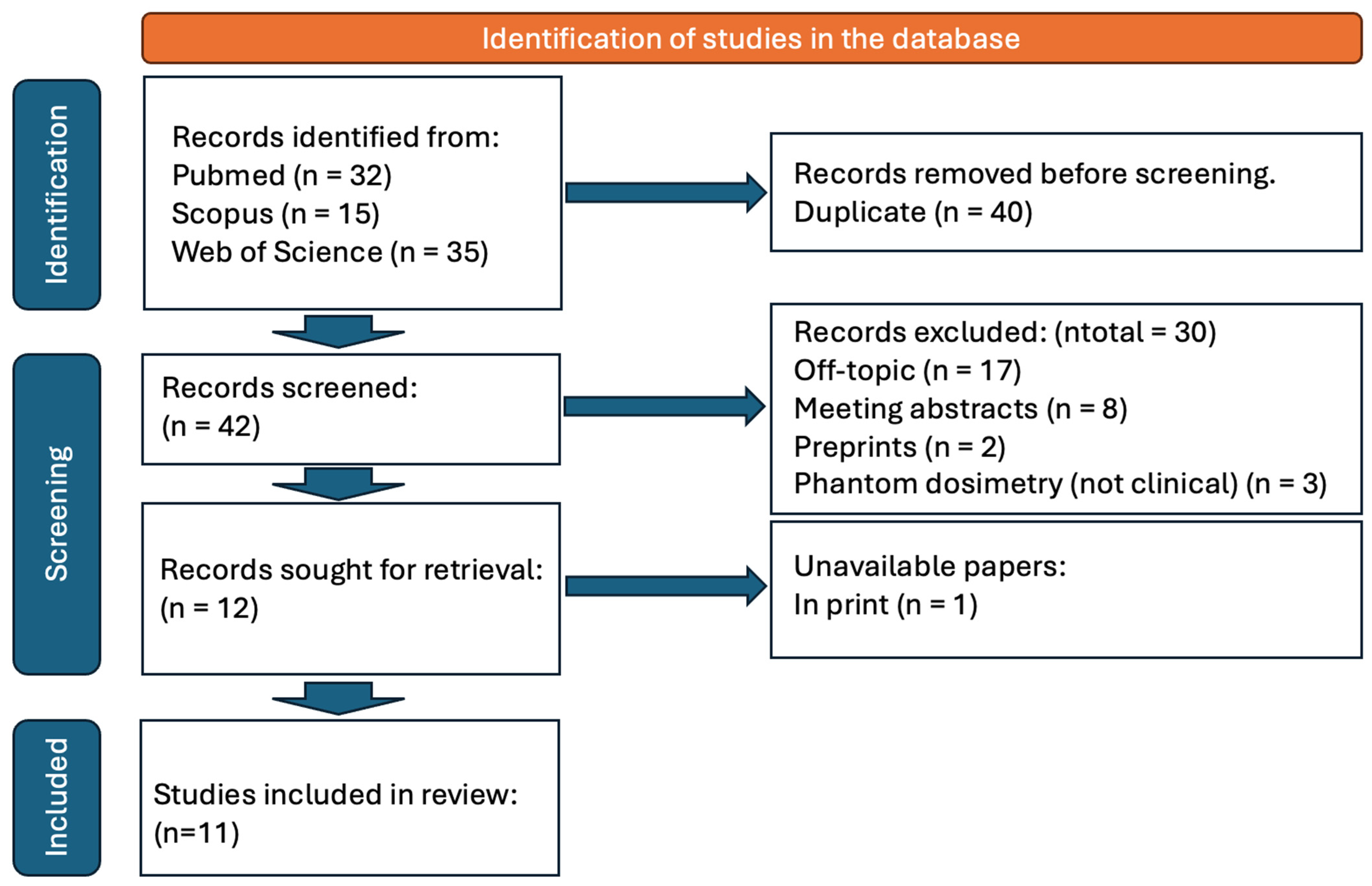
The PubMed, Web of Science, and Scopus search output was 82 articles. Forty of them were removed before the screening due to duplicates. Forty-two records were screened, but 16 were off-topic, eight were meeting abstracts, two were preprint articles, and two phantom dosimetry records were excluded. Fourteen records were sought for retrieval, but one of them was unavailable (in print) at the time of the search. Finally, 14 studies were included in the review (Figure 1).

3.1. Placement of High-Dose Regions (Peaks or Vortexes) in LRT

As referred to above, standardization of vortex placement is a major issue in LRT. Vortex placement is related to dose distribution in the peaks, valleys, and peripheral organs. Two different approaches seem to be favored in the available literature: (a) methods that use automatic in-house tools for placing hot peaks using different parameters to control the process, such as script-based applications written in different languages, supported in some of the cases by the treatment planning software used, and (b) automatic methods for the placement of the hot spheres according to 3D prespecified fixed spacing rules.
A comparison analysis between all the approaches is defined by the LRT planning guidelines by Wu X et al. [12].

3.2. Automated Scripts or Semi-Automated Vortex Placement

In the automatic methods, such as the ones defined here, different authors have used code in different computer languages; for instance, some of them in TPS-specific script formats, such as Eclipse Varian’s ESAPI, or, in other cases, different external software, such as Matlab 2022b scripts or Python 3.13 and Monte Carlo coding. On the other hand, we refer to semi-automatic methods as those that use tools incorporated into the TPS contouring software to locate the peaks manually. For example, in the case of the work by Macias-Verde et al., a scalable grid is used as a template and a 3D brush so that once the spheres are centered on the vortexes of the grid, the system automatically generates the ball in the three dimensions of space.
Zhang W et al. [19] proposed a script to optimize the position of the lattice vortex, where lattice vortexes are modeled as sigmoid functions. The lattice position optimization problem is solved by using scripts based on mathematical tools, such as the iterative convex relaxation method and the alternating direction multiplier method. The positions of the lattice vortexes and photon/proton plan variables are updated together by the quasi-Newton method. The innovation of this work is that it can optimize the positions of the vortexes of the network, i.e., the joint optimization of the positions of the vortexes of the network and photon/proton plan variables to simultaneously optimize the peak-to-valley dose ratio (PVDR) of the target and the preservation of the OARs. Their entire network can be zoomed out of certain OARs to minimize the dose. This approach sets lattice vortexes with a radius of 1 cm, with a center-to-center distance between the centers of adjacent vortexes of 3 cm, and the distance between the vortex boundary and the tumor boundary is at least 0.5 cm, and the peak dose target is five times the trough dose target (PVDR~5). The calculation time for photons was ~21 min (abdomen) and ~36 min (lung).
Botti et al. [20] introduced an application called LatticeOpt, an in-house tool of MATLAB 2022b (MathWorks Inc., Natick, Massachusetts), designed to automatically generate optimal lattice structures. The script maximizes the number of vortexes within the GTV by iterating the process for five different vertex sizes (0.3 cm, 0.5, 0.6, 0.75, and 1 cm) and lattice spacing (1.7, 2.8, 3.4, 4.2, and 5.4 cm). The optimal dimensions of the vortexes and their relative distances depended on the patient. No specific dimensions are given for either the diameter of the spheres or the distance between centers, with the best results. The tool was able to obtain the lattice structures within an average calculation time of 23 min (range 9–45 min). No intervention was necessary except for the initial configuration and the input data management. The application proves to be effective and time-saving, estimated by this group to have a 40 min average time for manual lattice structure creation.
Gaudreault et al. [21] performed automated script segmentation, dose optimization, and calculation using the Eclipse Scripting Application Programming Interface (ESAPI, v16, Varian Medical Systems). The vortexes were within the GTV with diameters of 1, 1.5, and 2 cm and a center-to-center distance of 2 to 5 cm, arranged in a square lattice, alternating along the SI (superior–inferior axis). By iterating over the size of the vortex (V) and the center-to-center distance (D), vortexes are inserted until their number is between a preselected lower and an upper limit. V and D were fixed, with the network being the same in all directions. Lattices with center-to-center distances of 2.5, 3, and 3.5 cm and a diameter of 1.5 cm, and a center-to-center distance of 4 cm and a diameter of 1.5 cm, had the best scores. The average time required for segmentation and planning was from 1 min to 21 min.
Gaudreault et al. [22] used the same automated script-based segmentation mentioned above but in a retrospective in silico study. On this occasion, V and D are not fixed values but depend on the size of the GTV. Based on the best cases, the predicted parameters were V = 0.19 × G T V v o l u m e 1 / 3 and D = 2 × V , both in centimeters. The number of vortexes (N) to be inserted was estimated as N ≤ (24 × 3% GTVVolume)/(4πV3). The best results were characterized by a low number of vortexes (<15), a median vertex size of 1.5 cm, and a median selected center-to-center distance between 2.5 cm and 5 cm. In this case, no reference is made to the average time spent on the process.
Tucker et al. [23] presented another script-based algorithm for sphere placement applied to a retrospective set of 22 treated cases. Their aim was to compare the automated sphere distributions to the manually placed ones. The high-dose spheres were 1.5 cm in diameter and were placed in axial CT simulation planes, alternating high-dose spheres and low-dose spheres spaced 3 cm center-to-center. The planes were spaced 3 cm apart in the SI direction as well. Within a given axial plane, the high-dose spheres were placed on diagonal grid elements and were only placed in vortexes where the entire sphere was confined within the GTV, contracted by 0.5–1.5 cm. The script-produced placement was superior to that of manually placed spheres. The mean time required to generate spheres was significantly less using the script (2.5 min) compared to manual placement by dosimetrists (25.0 and 29.9 min) and a physicist (19.3 min). Plan quality indices were similar in all cases, with no significant difference.
Ma et al. [24] combined hexagonal compact packing to maximize peak-to-valley dose contrast, quantified by peak-to-valley index (PVI), a new variable introduced by them. The PVI characterizes the difference between peak and valley doses. In a retrospective analysis of 17 patients, optimized plans significantly increased vortex distances, improving dosimetric results in terms of PVI. This dosimetric improvement did not compromise the protection of normal tissue. The method proved to be useful in advancing the accuracy and standardization of LRT planning, especially for large or geometrically complex tumors, achieving an average optimization time of approximately 5 min.
Deufel et al. [26] developed a Monte Carlo-based algorithm (script-based) for automated placement that optimizes the number and arrangement of points within the GTV, adhering to OAR-specific spacing rules and minimum spacing between points. It also includes a goal to centralize lattice points within the axial slices of the GTV, which is believed to reduce the dose to the surrounding OARs. Constraints for the algorithm included (#1) minimum distance from the center of the lattice point to the surface of the GTV, (#2) minimum distance from the center of the lattice point to the surface of the OARs, (#3) minimum center-to-center spacing of the lattice points, and (#4) minimum longitudinal separation (SI axis). They retrospectively validated the algorithm in 24 patients with various tumor locations. This study does not provide specific data on the diameter of the spheres or the separation between centers but only compares the density of points obtained using the automatic method with that obtained using the manual method. The lattice sphere density was comparable to the manual method (0.725 vs. 0.704 dots per 100 cm3 for GTV). Mean run time was ~2.9 min (range 0.7–13.0) per patient versus 30–180 min manually. Their script also detected an incorrect diameter of the lattice points and incorrect spacing between lattice points. They recommend that the density of the lattice points should be 0.725 spheres per 100 cm3 of GTV or 138 cm3 per sphere.
Misa et al. [27] proposed a method that places a larger high-dose sphere in the center of the tumor, surrounded by smaller spheres toward the periphery. The goal is to deliver a more effective ablative dose to the tumor core, which is often hypoxic and resistant to radiation therapy drugs. They retrospectively analyzed 30 patients previously treated with standard SFRT. If done manually, this would be achieved by overlaying a grid guide over the GTV, and the remaining vortexes would be contoured using a 3D brush and placed at the intersections of the grid. In addition, they developed an Eclipse API (ESAPI) script that automatically places these vortexes. They found the most effective pattern involves a 3 cm core, 2 cm spacing, and 1.5 cm peripheral spheres. A significant increase in tumor dosage was achieved, maintaining safe doses for OARs.
In a later publication, the same authors, Misa et al. [28], proposed a method named split Principal Component Analysis (PCA) to address the sphere packing problem. The aim of this report was to improve sphere packing for LRT treatments, which would increase the volume of the peak dose the tumor receives from a given lattice configuration, potentially enhancing patient outcomes, and aligning the hexagonal lattice pattern along other axes of the tumor geometry. This new specific orientation significantly increased the number of spheres packed within the tumor. They replanned 35 previously treated SFRT patients, demonstrating that split-PCA statistically outperformed other methods in terms of sphere packing efficiency and various tumor dose metrics, maintaining crucial organ protection. A diameter of 1 cm and a center-to-center separation of 2 cm allowed for sufficient dose heterogeneity in the form of peaks and valleys within the GTV and for a treatment planning time of about 1 h.
Yilmaz et al. [29] explored LRT as a different approach to treat recurrent glioblastoma. Four patients with histologically confirmed GBM were treated with single-fraction LRT. Treatment plans were developed in the gyroscopic ZAP-X system, employing multi-isocentric strategies. Custom lattice geometries were created for each patient using Python-based software that automated the positioning of high-dose spherical regions within the GTV, ensuring that each sphere with a radius of 1 cm was fully contained within that volume, with a margin of at least 0.5 cm from its boundary and a 3 cm gap between centers. PVDR~4 was achieved while minimizing exposure to surrounding healthy tissue. This study mentions treatment time but not the time spent on planning, which is what is being evaluated in this review.
Macías-Verde et al. [30], as did Misa et al. [27] in their semi-automated method, introduced a matrix of semi-automatically placed hot spots, creating a denser peak matrix than in the other studies mentioned above, with the help of a tool that displays a mesh spaced on demand on the contouring module screen and with the following geometry and vortex position: vortexes of 1 cm in diameter; center-to-center distance of 1.5 cm; and even vortex spacing in the axial, sagittal, and coronal planes using automated grid-based 3D sphere segmentation in the Varian Aria system. The vortexes were placed entirely within the LRTV (Lattice Radiation Treatment Volume), which was defined as equal to the GTV (i.e., no contraction). Any vortex that overlapped or was close to critical organs was manually removed to maintain safety margins. The segmentation time of the hot spheres depends directly on the volume of the tumor. The average estimated time is approximately 20 min. The ratio of vortex volume to LRTV had a mean of 7.38%, with a range of 3.45–10.40% and a median of 7.60%. This density is notably higher than in many other previous studies, where vortex–LRTV ratios typically range from 1 to 4%.

4. Discussion

Wu X et al. [12], whose conclusions have been taken as a guide by many authors, including this review, discuss the evolution and practical application of LRT as a 3D extension of traditional 2D GRID therapy. In LRT, the high-dose vortexes are described as sphere-shaped subvolumes with diameters of approximately 1 cm. The centers of these dose vortexes are usually separated by a distance ranging from about 2 to 5 cm. This specific peak–trough dose distribution aims to maximize tumor control by minimizing toxicity to surrounding healthy tissues. The paper highlights that while the concept of SFRT has been around for more than a century, LRT, introduced in 2010, offers unique features that differentiate it from conventional GRID therapy, allowing for more personalized dose distributions within the tumor volume.
Lattice Radiation Therapy (LRT) has emerged as a sophisticated evolution of Spatially Fractionated Radiation Therapy (SFRT), designed specifically for challenging large or radioresistant tumors. This review consolidates several recent studies exploring various LRT planning methods, focusing particularly on the spatial configuration of high-dose subvolumes or vortexes and the implications for treatment efficacy, planning efficiency, and standardization. Details of all cases in terms of the parameters reviewed are shown in Table 1.
Based on their experience, some of the authors have identified some recommended parameters for the performance of satisfactory clinical dosimetry. In this review, we have used the work of Wu et al. [12] as a reference to evaluate the different schemes proposed in all the articles analyzed. Table 2 analyzes the degree of compliance of all the studies analyzed with the three protocols considered on this occasion as pseudo-standards.
LRT planning relies heavily on the selection and arrangement of vortexes. Semi-automated methods, like that of Macias-Verde et al. [30], allowed dense configurations (up to ~7.38% of the tumor volume) but were time-consuming and prone to planner variability. In contrast, fully automated approaches, such as those by Deufel et al. [26] and Gaudreault et al. [8,9], enable faster, reproducible, and rule-based planning. Automated algorithms vary widely in sophistication, from simple geometric rules (e.g., fixed grid distances) to adaptive optimization using Monte Carlo or simulated annealing techniques. These approaches consistently improved inter-planner consistency and reduced planning time from hours to minutes while preserving dosimetry quality.
We found no significant differences between the automatic, semi-automatic, and manual methods, except for the convenience in placing the vortexes, perhaps in a more systematic way, and the shorter time employed by the former. Although the PVDR parameter is extremely important, we have not included it in the comparison table because many papers focus on explaining the automation of the hot spot placement process but do not provide data on it.
The automatic methods really automate the placement of the vortexes and their separation, given a specific GTV, avoiding the surrounding OARs or not, depending on the study, but in all cases it is necessary in all cases to calculate and evaluate the really important parameters, such as the dose in the spheres, the dose in the valleys, the ratio between both, and the dose in the periphery of the segmented volume. It is not clear in any of the papers presented whether the script performs the entire process on its own or requires human intervention in some parts of the process. What is really needed, if possible, is a TPS that optimizes not only the geometric parameters, such as the diameter of the hot spots or the distance between centers, but also the calculation of the dosimetry parameters, arriving at the final result according to the clinical assessment in an iterative manner.
Every study comparing automated and manual planning, including Tucker et al. [23] and Deufel et al. [26], shows a dramatic reduction in planning time, dropping from hours to minutes, along with a notable decrease in differences between planners. However, the review also points out a significant gap: the direct link between a specific automated planning method and better clinical outcomes is still not studied. While works like Ma et al. [24] and Misa et al. [28] illustrate that their algorithms enhance dosimetry metrics, such as the peak-to-valley index (PVI) or sphere packing efficiency, none provide comparative clinical data like local control or toxicity rates to prove that these dosimetry benefits lead to real patient advantages. Therefore, the main reported benefit of automation is not yet a clearly better clinical outcome but rather a stronger, scalable, and standardized foundation for future trials to address that vital question.

5. Conclusions

Lattice Radiation Therapy (LRT) has emerged as a promising evolution of Spatially Fractionated Radiation Therapy (SFRT), particularly suitable for large and radioresistant tumors that are difficult to treat with conventional or stereotactic techniques. Automated treatment planning tools have significantly improved the efficiency, consistency, and scalability of LRT planning, addressing limitations of manual planning.
The analysis carried out in this review is somewhat heterogeneous in terms of the parameters that we have been able to study because there is no global consensus on how to perform clinical dosimetry of LRT, and each group of authors does it in a different way. The literature on vertex location shows that there is no single standard. Some studies treat them as fixed 1 cm spheres for simplicity. Others adjust the sizes based on the patient or even mix large and small spheres in the same plan to improve tumor coverage.
The main benefit of automation is not a direct clinical improvement, such as higher survival rates. Instead, it brings greater efficiency and consistency. Tasks that once took hours can now be completed in minutes, with less variation between planners.
Despite advances, major challenges remain, including the aforementioned lack of standardized clinical protocols across institutions and variability in dose-fractionation schemes and lattice geometries. Future progress in LRT will require multi-institutional clinical trials to establish best practices, refinement of mathematical models for personalized planning, and broader integration into routine oncology workflows via adaptive and AI-assisted systems.
In summary, the field is moving toward more standardized and scalable processes that will confirm whether these dosimetry advantages actually improve tumor control and survival.

Author Contributions

Conceptualization, D.M.-V., J.B.-B. and P.C.L.; methodology, D.M.-V. and P.C.L.; software, D.M.-V., J.B.-B. and P.C.L.; validation, D.M.-V., J.B.-B. and P.C.L.; formal analysis, D.M.-V. and P.C.L.; investigation, D.M.-V. and P.C.L.; resources, D.M.-V. and P.C.L.; data curation, D.M.-V., J.B.-B. and P.C.L.; writing—original draft preparation, D.M.-V., J.B.-B. and P.C.L.; writing—review and editing, D.M.-V., J.B.-B. and P.C.L.; visualization, D.M.-V., J.B.-B. and P.C.L.; supervision, P.C.L.; project administration, P.C.L. All authors contributed equally. All authors have read and agreed to the published version of the manuscript.

Funding

This research received no external funding.

Institutional Review Board Statement

Not applicable.

Informed Consent Statement

Not applicable.

Data Availability Statement

Not applicable.

Conflicts of Interest

The authors declare no conflicts of interest.

References

  1. Dubben, H.H.; Thames, H.D.; Beck-Bornholdt, H.P. Tumor volume: A basic and specific response predictor in radiotherapy. Radiother. Oncol. 1998, 47, 167–174. [Google Scholar] [CrossRef]
  2. Spencer, K.; Parrish, R.; Barton, R.; Henry, A. Palliative radiotherapy. BMJ 2018, 360, k821. [Google Scholar] [CrossRef]
  3. Tubin, S. A Partial Tumor Irradiation Approach for Complex Bulky Disease. Semin. Radiat. Oncol. 2024, 34, 323–336. [Google Scholar] [CrossRef]
  4. Tubin, S.; Vozenin, M.C.; Prezado, Y.; Durante, M.; Prise, K.M.; Lara, P.C.; Greco, C.; Massaccesi, M.; Guha, C.; Wu, X.; et al. Novel unconventional radiotherapy techniques: Current status and future perspectives—Report from the 2nd international radiation oncology online seminar. Clin. Transl. Radiat. Oncol. 2023, 40, 100605. [Google Scholar] [CrossRef]
  5. Duriseti, S.; Kavanaugh, J.; Goddu, S.; Price, A.; Knutson, N.; Reynoso, F.; Michalski, J.; Mutic, S.; Robinson, C.; Spraker, M.B. Spatially fractionated stereotactic body radiation therapy (Lattice) for large tumors. Adv. Radiat. Oncol. 2021, 6, 100639. [Google Scholar] [CrossRef] [PubMed]
  6. Duriseti, S.; Kavanaugh, J.A.; Szymanski, J.; Huang, Y.; Basarabescu, F.; Chaudhuri, A.; Henke, L.; Samson, P.; Lin, A.; Robinson, C.; et al. LITE SABR M1: A phase I trial of Lattice stereotactic body radiotherapy for large tumors. Radiother. Oncol. 2022, 167, 317–322. [Google Scholar] [CrossRef]
  7. Majercakova, K.; Aguilar, N.T.; Isern Verdum, J.; Bargalló, H.V.; Capel, A.V.; Mancera Soto, M.; Gómez de Segura Melcón, G.; Cordero, J.V.R.; González-López, J.A.; Rosell, S.B.; et al. Role of Spatially Fractionated Radiotherapy (LATTICE) Treatment in Inoperable Bulky Soft-Tissue Sarcomas. Cancers 2025, 17, 624. [Google Scholar] [CrossRef]
  8. Mohiuddin, M.; Fujita, M.; Regine, W.F.; Megooni, A.S.; Ibbott, G.S.; Ahmed, M.M. High-dose spatially-fractionated radiation (GRID): A new paradigm in the management of advanced cancers. Int. J. Radiat. Oncol. Biol. Phys. 1999, 45, 721–727. [Google Scholar] [CrossRef] [PubMed]
  9. Kohler, A. Theorie einer Methode, bisher unmöglich langsame und gefahrlose Bestrahlung tief liegender Geschwülste mit Röntgenstrahlen zu ermöglichen. Fortschr. Röntgenstr. 1909, 13, 27–29. [Google Scholar]
  10. Yan, W.; Khan, M.K.; Wu, X.; Simone CB2nd Fan, J.; Gressen, E.; Zhang, X.; Limoli, C.L.; Bahig, H.; Tubin, S.; Mourad, W.F. Spatially fractionated radiation therapy: History, present and the future. Clin. Transl. Radiat. Oncol. 2019, 20, 30–38. [Google Scholar] [CrossRef] [PubMed]
  11. Guckenberger, M.; Andratschke, N.; Alheit, H.; Holy, R.; Moustakis, C.; Nestle, U.; Sauer, O. Definition of stereotactic body radiotherapy: Principles and practice for the treatment of stage I non-small cell lung cancer. [Definition der stereotaktischen Strahlentherapie: Behandlung des nichtkleinzelligen Bronchialkarzinoms (NSCLC) Grad I]. Strahlenther. Und Onkol. 2014, 190, 26–33. [Google Scholar] [CrossRef]
  12. Wu, X.; Perez, N.C.; Zheng, Y.; Li, X.; Jiang, L.; Amendola, B.E.; Xu, B.; Mayr, N.A.; Lu, J.J.; Hatoum, G.F.; et al. The Technical and Clinical Implementation of LATTICE Radiation Therapy (LRT). Radiat. Res. 2020, 194, 737–746. [Google Scholar] [CrossRef] [PubMed]
  13. Ferini, G.; Valenti, V.; Tripoli, A.; Illari, S.I.; Molino, L.; Parisi, S.; Cacciola, A.; Lillo, S.; Giuffrida, D.; Pergolizzi, S. Lattice or Oxy-gen-Guided Radiotherapy: What If They Converge? Possible Future Directions in the Era of Immunotherapy. Cancers 2021, 13, 3290. [Google Scholar] [CrossRef] [PubMed] [PubMed Central]
  14. Amendola, B.E.; Perez, N.C.; Amendola, M.; Wu, X.; Ahmed, M.M.; Iglesias, A.; Alvarez, D. Lattice radiotherapy with RapidArc for inoperable non-small cell lung cancer: A case report. Med. Dosim. 2018, 43, 211–215. [Google Scholar]
  15. Amendola, B.E.; Perez, N.C.; Mayr, N.A.; Wu, X.; Amendola, M. Spatially fractionated radiation therapy using lattice radiation in far-advanced bulky cervical cancer: A clinical and molecular imaging and outcome study. Radiat. Res. 2020, 194, 724–736. [Google Scholar] [CrossRef]
  16. Amendola, B.E.; Perez, N.C.; Wu, X.; Amendola, M.A.; Qureshi, I.Z. Safety and efficacy of lattice radiotherapy in voluminous non-small cell lung cancer. Cureus 2019, 11, e4263. [Google Scholar] [CrossRef]
  17. Ahmed, M.M.; Wu, X.; Mohiuddin, M.; Perez, N.C.; Zhang, H.; Amendola, B.E.; Malachowska, B.; Mohiuddin, M.; Guha, C. Optimizing GRID and lattice spatially frac-tionated radiation therapy: Innovative strategies for radioresistant and bulky tumor management. Semin. Radiat. Oncol. 2024, 34, 310–322. [Google Scholar] [CrossRef] [PubMed]
  18. Lara, P.C.; López-Peñalver, J.J.; Farias, V.d.A.; Ruiz-Ruiz, M.C.; Oliver, F.J.; Ruiz de Almodóvar, J.M. Direct and bystander radiation effects: A biophysical model and clinical perspectives. Cancer Lett. 2015, 356, 5–16. [Google Scholar] [CrossRef] [PubMed]
  19. Zhang, W.; Lin, Y.; Wang, F.; Badkul, R.; Chen, R.C.; Gao, H. Lattice position optimization for LATTICE therapy. Med. Phys. 2023, 50, 7359–7367. [Google Scholar] [CrossRef] [PubMed] [PubMed Central]
  20. Botti, A.; Finocchiaro, D.; Panico, N.; Trojani, V.; Paolani, G.; Iori, F.; Sghedoni, R.; Cagni, E.; Lambertini, D.; Ciammella, P.; et al. LatticeOpt: An automatic tool for planning optimisation of spatially frac-tionated stereotactic body radiotherapy. Phys. Medica 2024, 126, 104823. [Google Scholar] [CrossRef]
  21. Gaudreault, M.; Chang, D.; Kron, T.; Siva, S.; Chander, S.; Hardcastle, N.; Yeo, A. Development of an automated treatment planning approach for lattice radiation therapy. Med. Phys. 2024, 51, 682–693. [Google Scholar] [CrossRef] [PubMed]
  22. Gaudreault, M.; Yu, K.K.; Chang, D.; Kron, T.; Hardcastle, N.; Chander, S.; Yeo, A. Automated lattice radiation therapy treatment planning personalised to tumour size and shape. Phys. Medica 2024, 125, 104490. [Google Scholar] [CrossRef]
  23. Tucker, W.W.; Mazur, T.R.; Schmidt, M.C.; Hilliard, J.; Badiyan, S.; Spraker, M.B.; Kavanaugh, J.A. Script-based implementation of automatic grid placement for lattice stereotactic body radiation therapy. Phys. Imaging Radiat. Oncol. 2024, 29, 100549. [Google Scholar] [CrossRef] [PubMed] [PubMed Central]
  24. Ma, P.; Xu, Y.; Yao, Y.; Lu, N.; Dai, J. Optimization method for determining vortexes in lattice radiotherapy. Front. Oncol. 2025, 15, 1582402. [Google Scholar] [CrossRef] [PubMed] [PubMed Central]
  25. Page, M.J.; McKenzie, J.E.; Bossuyt, P.M.; Boutron, I.; Hoffmann, T.C.; Mulrow, C.D.; Shamseer, L.; Tetzlaff, J.M.; Akl, E.A.; Brennan, S.E.; et al. The PRISMA 2020 statement: An updated guideline for reporting systematic reviews. BMJ 2021, 372, n71. [Google Scholar] [CrossRef] [PubMed] [PubMed Central]
  26. Deufel, C.; Dodoo, C.; Kavanaugh, J.; Finley, R.; Lang, K.; Sorenson, K.; Spreiter, S.; Brooks, J.; Moseley, D.; Ahmed, S.K.; et al. Automated target placement for VMAT lattice radiation therapy: En-hancing efficiency and consistency. Phys. Med. Biol. 2024, 69, 075010. [Google Scholar] [CrossRef]
  27. Misa, J.; St Clair, W.; Pokhrel, D. Demonstration of an enhanced dosing pattern for debulking large and bulky unresectable tumors via differential hole-size spatially fractionated radiotherapy. J. Appl. Clin. Med. Phys. 2025, 26, e70127. [Google Scholar] [CrossRef] [PubMed] [PubMed Central]
  28. Misa, J.; Castle, J.R.; Oldland, T.A.; St Clair, W.; Bernard, M.E.; Pokhrel, D. On the use of principal component analysis method to optimize sphere packing algorithm for lattice radiotherapy of large/bulky unresectable tumor. Med. Phys. 2025, 52, e17982. [Google Scholar] [CrossRef] [PubMed]
  29. Yilmaz, M.T.; Yedekci, F.Y.; Mohammadipour, S.; Kivanc, H.; Cengiz, M.; Cifci, G.; Kertmen, N.; Yazici, G. Advancing Intracranial Tumor Treatment Through Gyroscopic Radiosurgery-Based Lattice Therapy: Evidence from a Case Series Study. Cureus 2025, 17, e85383. [Google Scholar] [CrossRef] [PubMed] [PubMed Central]
  30. Macias-Verde, D.; Burgos-Burgos, J.; Lara, P.C. Automated Clinical Dosimetry Planning of Dense Lattice Radiation Therapy. Cancers 2025, 17, 2048. [Google Scholar] [CrossRef]
Figure 1. Filtering of valid articles for the writing of this review. Finally, 20 papers were reviewed.
Radiation 06 00010 g001
Table 1. Comparison of LRT planning approaches, automated or semi-automated, ordered as they appear in the text.
Author(s)Placement ModeTool/SoftwareVortex DiameterSpacingPlanning TimeKey Innovations
Zhang W et al. [19]AutomatedIn-house application ICR + ADMM + Quasi-Newton method1.0 cm3.0 cm~21–36 minMultiple optimizations
Botti et al. [20]AutomatedIn-house application
LatticeOpt
(MATLAB)
0.3–1.0 cm1.7–5.4 cm~23 minUse of MATLAB
Gaudreault et al. [21]AutomatedIn-house application
ESAPI (Varian)
1.0–1.5–2.0 cm2.0–5.0 cm~1–21 minScript-based
Gaudreault et al. [22]AutomatedIn-house application
ESAPI (Varian)
V = 0.19 × G T V v o l u m e 1 / 3
cm
D = 2 × V
cm
Not mentionedGTV-adaptive spacing, predictive model
Tucker et al. [23]AutomatedIn-house application1.5 cm3.0 cm~2.5 minAutomated and manual comparison
Ma et al. [24]AutomatedIn-house applicationVariesAdaptive~5 minCompact packing
Deufel et al. [26]AutomatedIn-house application
Monte Carlo
Not mentionedNot specified~2.9 minCentering algorithm, spacing from OARs
Misa J et al. [27]Semi-automatedIn-house application
ESAPI (Varian)
3.0 cm in the core, 1.5 cm periphery2.0 cmNot mentionedVortexes with different diameters
Misa J et al. [28]AutomatedIn-house application
split-PCA
1.00 cm2.0 cm~60 minVortexes with different diameters
Yilmaz et al. [29]AutomatedIn-house application
Python-based software
1.0 cm3.0 cmNot mentionedDelivered gyroscopic ZAP-X
Macias-Verde et al. [30]Semi-automatedVarian Eclipse (Aria)1.0 cm1.5 cm~20 minHigher density of hot points (~7.6%), full GTV coverage
Table 2. Compliance of the examined paper with the proposed scheme by Wu et al. [12], ordered as they appear in the text.
#Author(s)Vortex DiameterSpacingWu X et al. [12]
Diameter 0.5–1.5 cm/Center-to-Center Distance 2–5 cm
1Zhang W et al. [19]1.0 cm3.0 cmYes
2Botti et al. [20]0.3–1.0 cm1.7–5.4 cmBasically yes
3Gaudreault et al. [21]1.0–1.5–2.0 cm2.0–5.0 cmBasically yes
4Gaudreault et al. [22] V = 0.19 × G T V v o l u m e 1 / 3 cm D = 2 × V cmIt is not possible to assess
5Tucker et al. [23]1.5 cm3.0 cmYes
6Ma et al. [24]VariableAdaptiveIt is not possible to assess
7Deufel et al. [26]0.725 spheres per 100 cm3 of GTV or 138 cm3 per sphere≥3 cmThe diameter is not mentioned in cm because it is a variable parameter based on the degree of packing, but the spacing meets the requirements.
8Misa J et al. [27]3.0 cm in the core, 1.5 cm periphery2.0 cmYes
9Misa J et al. [28]1.0 cm2.0 cmYes
10Yilmaz et al. [29]1.0 cm3.0 cmYes
11Macias-Verde et al. [30]1.0 cm1.5 cmYes
Disclaimer/Publisher’s Note: The statements, opinions and data contained in all publications are solely those of the individual author(s) and contributor(s) and not of MDPI and/or the editor(s). MDPI and/or the editor(s) disclaim responsibility for any injury to people or property resulting from any ideas, methods, instructions or products referred to in the content.