4.2. The Role of the Culture-Based Tourism Village in Supporting Sustainable Livelihoods
Wanurejo Tourism Village has developed through a community-based approach, with its cultural richness as its primary attraction. The village’s appeal has grown rapidly, bolstered by its strategic location within the “Ring 1” zone—just 600 m from Borobudur Temple—making it a key gateway to the temple complex. Wanurejo’s cultural wealth is evident in centers for *batik tulis* (hand-drawn batik), traditional dance and music, local culinary ventures, and distinctive handicrafts—all managed directly by the local community. The village also offers educational tourism packages, including cultural performances, batik-making workshops, and classes in *gamelan*, Javanese dance, local culinary arts (e.g., mushroom cultivation, *rengginan* rice crackers), and local crafts (e.g., bamboo carving, temple miniatures). Additionally, village exploration packages are available, featuring cycling tours, *andong* (traditional horse-drawn carriage) rides, and safari car tours.
In 2024, Wanurejo Tourism Village won first place in the amenities category at the Indonesian Tourism Village Awards (ADWI). Tourism development is community-driven, with 57% of residents participating in tourism activities alongside their primary occupations. Roles include tour guides, artists, artisans, culinary entrepreneurs, homestay operators, tour package organizers, and performance managers. Community empowerment has revitalized Wanurejo, making it a popular tourism village and more than just a destination—it is now a space for learning about local wisdom and community empowerment. Furthermore, tourism activities generate additional income and support the community’s well-being, demonstrating that tourism effectively fosters sustainable livelihoods in the village. The SLFT questionnaire was used to examine tourism support for the community’s livelihoods in Wanurejo Village, as shown in
Table 7.
Based on the SLFT analysis results shown in
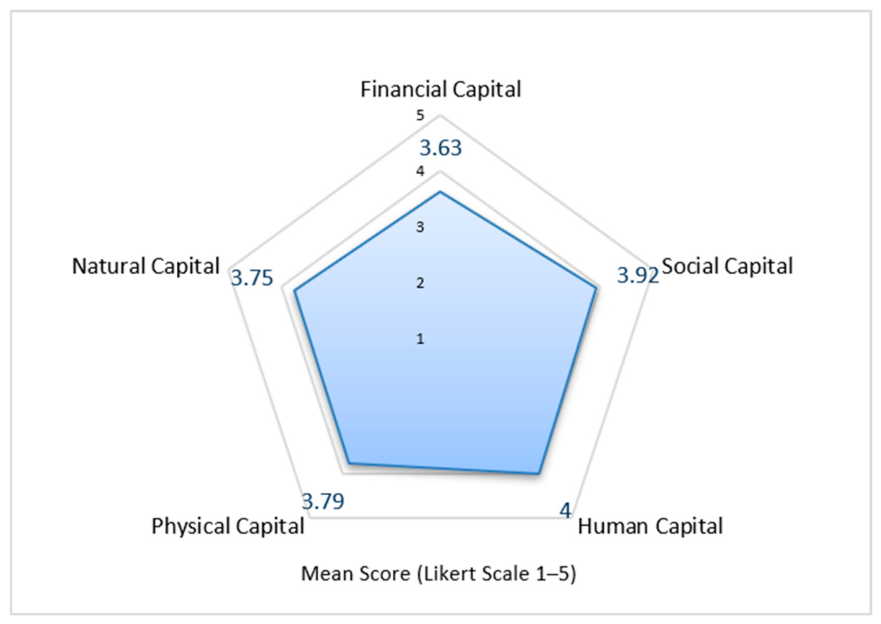
Figure 1, human capital emerged as the most dominant form of capital supporting sustainable livelihoods, with a mean score of 4.00 (SD = 0.72; high category). This was followed by social capital (mean = 3.92; SD = 0.62; high category), physical capital (mean = 3.79; SD = 0.68; high category), natural capital (mean = 3.75; SD = 0.45; high category), and financial capital (mean = 3.63; SD = 0.72; high category). The overall average SLFT score for Wanurejo Tourism Village was 3.82, which falls into the high category; this indicates that the tourism village.’s existence and status strongly support the Wanurejo community’s sustainable livelihoods.
Figure 1 illustrates the tourism village’s dominant support for the Wanurejo community’s sustainable livelihood capitals.
Human capital is the most prominent sustainable livelihood asset in Wanurejo Village. This aligns with an excerpt from an interview with WS, a local tour guide, conducted on 22 June 2026: “Most residents are involved in tourism activities. Some work as tour guides, sell food products or souvenirs, produce batik, run homestays, or operate tour package businesses. Many community members are reaping the benefits of the tourism village. Consequently, people are very enthusiastic about improving their individual skills so they can sustain their participation in these tourism activities. Some are improving their English proficiency; others are learning screen printing to create attractive souvenir T-shirts... basically, a wide variety of things. What is clear is that the community is becoming more knowledgeable.” (WS, personal communication, 22 June 2026). This also aligns with an excerpt from an interview with BR, a homestay entrepreneur, on 28 June 2026: “Nowadays, more and more tour guides can speak fluent English, which is making tourists more satisfied, as more foreign tourists are coming to Wanurejo. The tour guides also learn about Javanese culture and traditions, as well as the tradition of cooperation (gotong royong). The local government, in collaboration with universities, also trains them in guiding skills so they can offer even more engaging tours. Now, the number of tourists, including foreigners, is increasing, creating more job opportunities. This has had a positive impact on Wanurejo Village, as the unemployment rate has decreased, and the community is becoming more prosperous.” (BR, personal communication, 28 June 2026).
An excerpt from an interview with BAS, Head of the Village Economic Center and Head of the Wanurejo Village Tourism Awareness Group (Pokdarwis), on 8 June 2026, supports this statement: “One of the important factors in developing Wanurejo Tourism Village is human resource capacity, especially in today’s digital era. The Wanurejo Pokdarwis holds training sessions to improve young people’s digital skills so they can support tourism marketing, website development, and more. The number of participants is high... This demonstrates the community’s enthusiasm for improving their skills. We also frequently hold training sessions to address community suggestions, such as culinary training, packaging, and even tourist service training to enhance residents’ creativity in developing their culinary businesses so they can compete with other tourism destinations.” (BAS, personal communication, 6 June 2026).
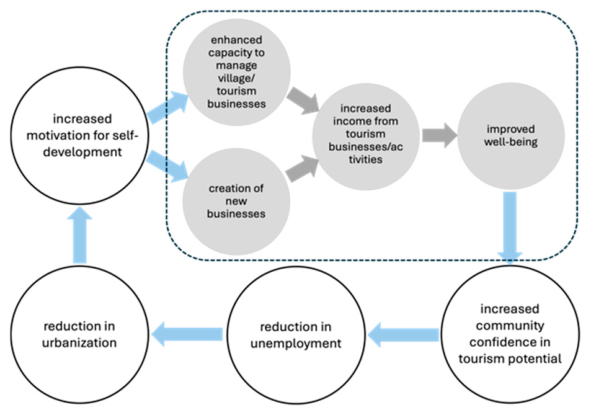
Interviews with the community, the Tourism Awareness Group (Pokdarwis), and the village government revealed that the people of Wanurejo Village benefit in many ways from the tourism village. Increased enthusiasm for learning and improved knowledge and skills can support the sustainability of tourism businesses and create more employment opportunities. This has reduced unemployment and slowed urbanization. Previously, many residents sought work in the city. However, with tourism growth, many residents have chosen to stay and develop tourism businesses in the village.
Social capital also benefits significantly from the village’s tourism development. This is evidenced by the establishment of the Wanurejo Tourism Awareness Group (Pokdarwis) in 2004, which demonstrates community empowerment. Interviews with the community, Pokdarwis, and the village government revealed that Pokdarwis actively organizes activities and tour packages in Wanurejo Village. Togetherness and cooperation underlie the working principles of the Tourism Awareness Group (Pokdarwis), which aim to improve the community’s welfare equally. As stated in an interview with S, a culinary vendor selling traditional Wanurejo Village food on 24 May 2026: “The development of tourism in Wanurejo Village is managed by the Tourism Awareness Group (Pokdarwis) in collaboration with the village government. Those of us involved in various tourism activities—me included—are members of the Pokdarwis. The group holds regular meetings on the 10th of every month; these meetings foster social bonds and help us discuss planned activities. They address any issues that arise during these meetings and seek solutions in a spirit of kinship. Our shared progress matters most, so we resolve problems quickly to prevent them from escalating into prolonged conflicts. Ultimately, communal harmony is the top priority.” (S, personal communication, 24 May 2026).
Interview results indicate that the tourism village initiative has increased community participation and concern for the village’s development. To achieve shared prosperity, the community established a schedule of regular Pokdarwis meetings to facilitate communication and discussion. Residents are moving toward more harmonious interactions and communication while actively avoiding conflict. This process has not been difficult, thanks to the community’s long-standing traditions of harmony and *gotong royong* (cooperation). As highlighted in an interview with SHS, the Hamlet Head of Tinggal Kulon in Wanurejo Village, on 18 June 2026: “The community has always engaged in mutual cooperation for various village activities. However, since the village’s development as a tourist destination, more residents have participated in regular cooperative efforts—such as maintaining environmental cleanliness, caring for public facilities, or organizing tourism amenities. A prime example is the *Merti Dusun* tradition, a cultural practice of village cleansing, which has also become a tourist attraction. As a hamlet official, I have personally witnessed a growing sense of solidarity among the residents. They understand that togetherness and harmony are the key assets for developing the tourism village. Concern for one another has increased; everyone is quick to help those in need, doing so without keeping score. After all, neighbors are our closest family.” (SHS, personal communication, 18 June 2026).
The development of the tourism village has also heightened community awareness of cultural preservation. Artisans specializing in Wanurejo’s distinctive batik continue to develop Borobudur-themed motifs, some of which were showcased at the Magelang Batik Festival in October 2025. Local artists work in studios dedicated to dance, *gamelan* and *karawitan* (traditional music), *angklung*, painting, acrobatics, and *wayang* (puppetry). These artists also organize village cultural festivals to showcase various art forms to tourists; the Tourism Awareness Group (Pokdarwis) coordinates these activities. This heightened cultural awareness is reflected in an excerpt from an interview with PS, a dance artist, on 8 June 2026: “Many children participate in the Kinnara Kinnari Studio, ranging from elementary school age to university students. I am delighted, as this demonstrates their love for art and culture. We practice dancing every Saturday afternoon. However, when a performance is coming up, we practice more frequently, especially if tourist groups make requests. We perform a variety of dances, so the practice schedule becomes more intensive. I feel very proud when the children perform traditional dances beautifully.” (PS, personal communication, 8 June 2026).
Physical capital supporting the tourism village is evident in the excellent condition of road access to and within Wanurejo Village, which facilitates easy arrival and ensures a comfortable travel experience for tourists. Wanurejo Village also has assets that directly support tourism activities, including 85 homestays that are part of the Borobudur Homestay Village network; these homestays offer the experience of living with local families. The village hall and open-air stage host art performances and batik workshops, while the Village Economic Center serves as a batik gallery and handicraft hub showcasing Wanurejo’s signature local products. Wanurejo Village has also developed village tour routes—traversed by bicycle, *andong* (traditional horse-drawn carriage), and safari car—that pass through rice fields, gardens, the open-air stage, and homestays. High-quality village road infrastructure supports these attractions. A centralized parking area and clear signage also make visits easier. Wi-Fi is available in various areas, including homestays, the Village Economic Center, souvenir shops, and other facilities. This infrastructure demonstrates that the physical capital in Wanurejo—developed to support the tourism village—also enhances the convenience of local mobility, as noted in an interview excerpt with NW, a food stall owner, on 8 June 2026: “Since becoming a tourism village, many facilities have been added to Wanurejo Village, such as an open-air stage and a Village Economic Center. Village roads have also been improved, making them more comfortable for cycling, taking *andong* (traditional horse-drawn carriage) rides, or driving. Wi-Fi access is now widely available as well; almost every restaurant, shop, and public facility offers it, making the experience more convenient for tourists.” (NW, personal communication, 8 June 2026).
Wanurejo Village’s natural capital has benefited from support tied to its status as a tourism village, even though its dominance score is lower than those of its human and social capital. The tourism village initiative has heightened community awareness of cleanliness and environmental sustainability. Household and environmental waste management have become more organized since the village’s development as a tourist destination. As noted in an interview on 24 May 2026, with PDJ, a sanitation worker in Wanurejo Village: “Residents’ concern for environmental cleanliness has grown recently because they realize that if the village is dirty, tourists will be reluctant to visit. Residents are increasingly disciplined about disposing of trash in the proper receptacles. No one burns their trash anymore, as they know it only increases pollution. You can see for yourself—the environment here in Wanurejo Village is clean and beautiful.” (PDJ, personal communication, 24 May 2026).
The lush rural landscape, featuring rice fields and gardens, offers a natural vista and a tranquil atmosphere. Wanurejo’s proximity to Borobudur Temple further enhances its tourism appeal, allowing visitors to combine a trip to the World Heritage site with a rural tourism experience. The community capitalizes on these natural assets by offering village tour packages—using bicycles, *andong* carriages, or safari cars—that allow visitors to enjoy views of the rice fields, gardens, and river. Community-managed organic rice fields offer a unique attraction by allowing tourists to actively participate in traditional farming activities, as noted in an interview on 5 July 2026, with H, a village tour guide: “Tourists seem very enthusiastic when given the chance to join in farming activities. The activities vary by season. Sometimes they might try planting rice during the planting season, or shout to scare off birds while shaking strings of cans used as bird scarers. They look very happy, even though their clothes sometimes get dirty.” (H, personal communication, 5 July 2026).
Regarding financial capital, the tourism village provides support, as stated by HW, a cycling tour guide, on 6 June 2026: “The tourism village provides extra income for my family. Besides working as a staff member at the Borobudur District office, I also joined the cycling tour team at the Village Economic Center. My main asset is my bicycle. I lead tours on Saturday and Sunday mornings and afternoons. Thank God, the earnings are decent and serve as additional income for my family; I can earn an extra IDR 1,000,000 to 2,000,000 per month.” (HW, personal communication, 6 June 2026).
Residents earn additional income from tourism-related activities, including homestay operations, batik production and sales, local culinary specialties, bicycle rentals, and performing arts services. Despite ongoing challenges—such as reliance on tourist numbers, particularly during the off-season—the tourism village has created new income streams for residents. As YM, a local culinary entrepreneur, stated on 18 June 2026: “I used to be just an ordinary housewife. I started selling *rengginan* [traditional rice crackers] back in 1996, consigning them to various shops and stalls. However, as the Wanurejo tourism village developed, I decided to open a shop selling local culinary souvenirs—including these *rengginan*. Since 2019, the number of tourists visiting Wanurejo has surged, and they’ve really supported my business. Now, ‘Bu Yatin’s *rengginan*’ is a hit—it’s famous. Basically, if you visit Wanurejo, you must stop by and buy souvenirs from Yatin’s Shop” (YM, personal communication, 18 June 2026).
4.3. The Role of the Nature-Based Tourism Village in Supporting Sustainable Livelihoods
Gunung Prau Tourism Village, located in the Dieng Plateau region, focuses on developing mountain tourism and hiking. The village’s primary assets are its spectacular natural panoramas, including the famous “golden sunrise” of Mount Prau, expansive grasslands, and mountain scenery. Beyond its natural attractions, the village offers unique agricultural educational packages, such as learning to plant potatoes in highland fields, vegetable garden tours, and opportunities to enjoy local produce that defines the region’s agrarian identity.
In 2024, Gunung Prau Tourism Village received an award in the Indonesian Tourism Village Awards (ADWI) in the resilience category; this accolade recognized the village’s ability to adapt, maintain environmental sustainability, and recover from crises. The Gunung Prau community actively engages in tourism activities, including homestays, eateries, sales of local culinary specialties and souvenirs, and rentals of camping equipment, tour guides, and porter services. In addition to natural attractions, community-organized cultural events and traditional activities, such as the “Prau Bersih” (Clean Prau) conservation initiative and annual participation in the Dieng Culture Festival (DCF), also draw tourists. The SLFT questionnaire assessed the tourism sector’s support for community livelihoods in Gunung Prau Village, as shown in
Table 8.
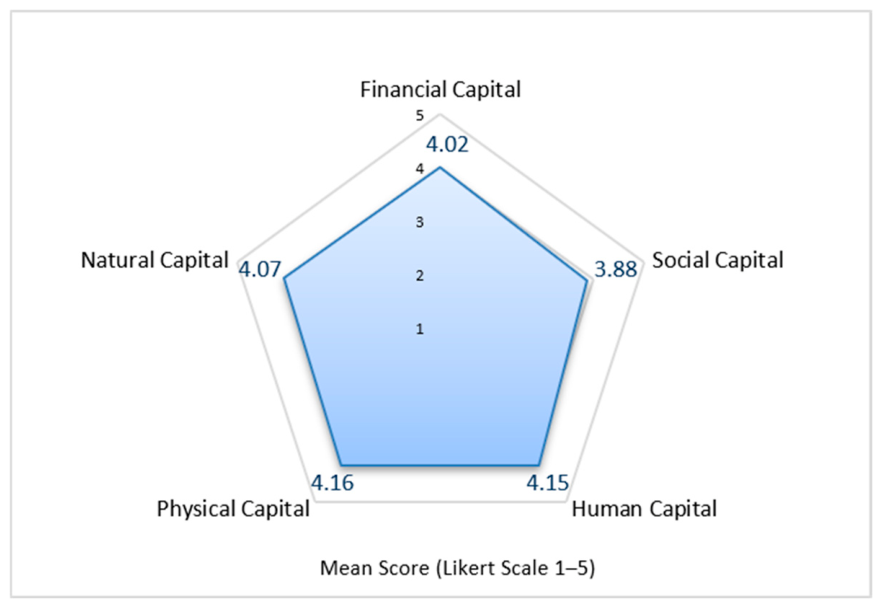
Figure 2 illustrates the hierarchy of support provided by the Gunung Prau tourism village for sustainable livelihood capitals: physical capital at 4.16 (SD = 0.46; high category), human capital at 4.15 (SD = 0.48; high category), natural capital at 4.07 (SD = 0.28; high category), financial capital at 4.02 (SD = 0.38; high category), and social capital at 3.88 (SD = 0.46; high category).
The SLFT analysis indicates that physical capital receives the most support in the Gunung Prau tourism village. This is evident in the good condition of the village’s access infrastructure and the presence of five official hiking trails (Patak Banteng, Dwarawati, Kalilembu, Dieng, and Wates). Each trail features a base camp that serves as a registration point, along with amenities such as parking areas, food stalls, places of worship, restrooms, directional signage, and camping equipment rental services. These features enhance Gunung Prau’s appeal by making tourists feel safer and more comfortable during their hikes. As JW, a hiking guide, stated on 12 June 2026: “Gunung Prau used to be just a farming village, with most residents working in agriculture; vegetable gardens dominated the landscape. However, since the village began developing as a tourist destination around 2010, Gunung Prau has attracted many visitors, particularly hikers. This surge in interest was driven by viral social media photos of the village scenery—especially sunrise shots from Mount Prau. The influx of tourists has had a positive impact: village roads have been improved, hiking trails have been repaired, and base camps have been built with excellent facilities, including restrooms, prayer rooms, food stalls, and adequate parking. Access to clean water and drainage systems has also improved. This physical development has brought tangible benefits to the community’s quality of life. Tourism villages also significantly bolster human capital, as a large portion of the local population (46%) works in tourism-related activities—tour guides, porters, camping gear or motorbike rental providers, homestay operators, food and souvenir vendors, or jeep tour operators. The growth of the tourism village has enhanced the community’s knowledge and skills.” (JW, personal communication, 12 June 2026).
Many local youths have joined the Mount Prau Basecamp Association to serve the needs of hiking tourists. To support this role, they learn rescue techniques and mountaineering ethics. As W, the coordinator of the Patak Banteng basecamp, noted in a 21 June 2026, interview: “Many young people have joined the Mount Prau Basecamp Association. For some, it is a side job alongside farming, while for others, it is their primary occupation; thus, the tourism village helps reduce unemployment. Most local youths can serve as hiking guides because they know the area intimately and are accustomed to climbing Mount Prau. However, to guide professionally, they need the necessary knowledge and skills. Consequently, we have conducted training sessions covering land navigation, logistics and risk management, and wilderness first aid. These skills are crucial for ensuring the safety and smooth progress of hikers’ journeys.” (W, personal communication, 21 June 2026).
Some community members have developed additional tourism attractions—such as educational potato-farming packages and potato field tours—that allow visitors to gain new insights into the Dieng Plateau’s unique cultivation methods. Tourism activities in Gunung Prau Village are further supported by the English proficiency of some tour guides, which facilitates communication with the growing number of international visitors. This English proficiency exemplifies the community’s capacity building, as noted by AB, a farmer, during an interview on 21 June 2026: “I collaborate with the Patak Banteng Agrotourism Package provider on potato farming and field tour packages. Tourists can learn how potatoes grow in the highlands. It is challenging with foreign tourists, though, because I don’t speak English. However, the tour guides have learned English; the demands of the job have driven them to acquire these language skills.” (AB, personal communication, 21 June 2026).
Gunung Prau has immense natural appeal and is a primary tourism icon. Its main attraction is the “golden sunrise” view from the summit, which also offers a panorama of Central Java’s major peaks: Mount Sindoro, Sumbing, Merbabu, Merapi, and Lawu. Another natural asset is the vast summit meadow, dotted with wildflowers such as daisies and edelweiss. Hiking trails that wind through Dieng’s characteristic potato and vegetable fields enhance the natural appeal by adding an agrarian atmosphere to the journey. Tourism numbers have steadily increased, driven by visitors sharing stories and photos online.
The tourism village model strongly supports the community’s sustainable livelihoods. Residents recognize that the area’s natural beauty is a tourism asset that must be preserved to ensure continued positive impacts on community well-being. This aligns with hiking ethics; consequently, developing the tourism village has improved waste management and fostered environmental cleanliness and sustainability. This is reflected in an interview with S, the head of the Patak Banteng Tourism Awareness Group (Pokdarwis), on 20 June 2026: “The Mount Prau area must be preserved to ensure it remains clean and sustainable. We enforce rules for hikers: they are prohibited from leaving trash in the Mount Prau area and must maintain environmental cleanliness and sustainability. Damaging the environment is strictly forbidden. Thankfully, the cleanliness and sustainability of the Mount Prau area have been successfully maintained to date. Beyond serving as a tourist attraction, we also personally benefit from this cleanliness and environmental preservation; the clean environment makes us feel more comfortable.” (S, personal communication, 20 June 2026).
The local community consistently implements the “Prau Bersih” (Clean Prau) program in collaboration with nature enthusiasts to clean the Mount Prau area and reduce litter along hiking trails. Residents have also adopted regulations that limit the number of daily hikers and prohibit damage to edelweiss vegetation to support conservation.
The Gunung Prau Tourism Village initiative primarily supports financial capital. Residents earn income from various sources, including hiking fees, guide and porter services, camping equipment and vehicle rentals, food and beverage sales at the basecamp, souvenir sales, tour packages, and homestay businesses. This is illustrated by an interview with TS, a souvenir shop owner, on 20 June 2026: “I opened a souvenir shop in 2022 because more tourists were visiting Gunung Prau Tourism Village. Thankfully, the returns are quite substantial; I can earn an additional Rp3,000,000 per month. This really helps cover daily needs and school expenses. It is especially helpful when a child falls ill, as it helps offset medical costs.” (TS, personal communication, 20 June 2026).
Pokdarwis manages tourism revenue at the hiking basecamp. This revenue—derived from registration fees (or Conservation Area Entry Permits), parking, equipment rentals, and food stall operations—amounts to IDR 50,000,000 per month. A portion of these earnings goes to developing and maintaining infrastructure and facilities, while the remainder is distributed as supplementary income to the team members involved. This is reflected in an interview with S, the head of the Patak Banteng Tourism Awareness Group (Pokdarwis), on 20 June 2026: “We can truly feel the benefits of the Gunung Prau Tourism Village. The Patak Banteng basecamp alone generates about IDR 50,000,000 per month. That is under normal conditions, of course; during the holiday season, the figure can be even higher. We use part of this money for facility maintenance and repairs—such as maintaining hiking trails and upgrading parking areas, restrooms, and other amenities. The rest is distributed based on workload. *Alhamdulillah*, it serves as a source of additional monthly income.” (S, personal communication, 20 June 2026).
Tourism village development plays a significant role in strengthening the social capital that underpins the community’s sustainable livelihoods. Social ties have grown alongside the village’s tourism growth, as evidenced by the establishment of the Patak Banteng Tourism Awareness Group (*Pokdarwis*) in March 2020. A sense of social togetherness is also evident in residents’ collaborative management of the hiking basecamp, their *gotong royong* (cooperation) to ensure safety and comfort along the hiking trails, and their strong mutual concern for one another. Community members are increasingly active in village activities, as noted in an interview with N, Head of the Gunung Prau Village Youth Organization (*Karang Taruna*), on 21 June 2026: “The growth of this tourism village has fostered a stronger sense of community. United by a shared goal—advancing tourism—residents have become increasingly cohesive in their collaboration. Everyone—from the public, the *Pokdarwis*, and the Youth Organization to local home-based businesses—works together to advance tourism. We hold regular meetings, once or twice a month, to discuss improvements that can attract more tourists. Participation in village activities has also increased; after all, if tourist numbers rise, everyone reaps the benefits. Residents also look out for one another more; if someone faces difficulties or a crisis, people step in to help without being asked. Consequently, these social bonds prove truly reliable when the need arises.” (N, personal communication, 21 June 2026).
However, community interactions are not without challenges, as conflicting interests and economic demands can create issues. To address these and other problems, the community agreed to hold monthly *Pokdarwis* meetings. These meetings prioritize togetherness and solidarity, ensuring that tourism development in Gunung Prau Village continues harmoniously.