1. Introduction
Biosphere reserves are geographical areas designated to promote sustainable development, harmonizing biodiversity conservation with the use of natural resources for activities such as tourism (
Obombo Magio & Velarde Valdez, 2019). In Mexico, the Monarch Butterfly Biosphere Reserve (MBBR) is an example of this interaction, not only due to its ecological relevance as a hibernation sanctuary for the monarch butterfly, but also because of its growing tourism vocation (
Castañeda et al., 2021). Due to the unique opportunity, it offers visitors to see thousands of butterflies gathered in the sanctuaries (
Cruz Bello & López García, 2017), it has become one of the most visited Protected Natural Areas in Mexico (
Brenner & San Germán, 2012).
The MBBR faces significant challenges for tourism, including the decline in butterfly colonies (
Brower et al., 2011) and the appearance of new butterfly colonies outside the reserve (
Pérez-Miranda et al., 2020). On the other hand, most tourist to the reserve come mainly from the states of Michoacán, State of Mexico, and Mexico City. There is almost no international tourism (
Quintanar Maldonado, 2007). This context highlights the need for a better understanding of visitor behaviour to support effective management strategies. However, the heterogeneity of tourist profiles, and the subjective and diffuse nature of visitor experiences make it difficult to identify behavior patterns clearly using traditional approaches, limiting the effectiveness. This limitation reflects a mismatch between the complexity of tourism phenomena in Protected Natural Areas and the analytical tools commonly used to study them.
This situation reflects a mismatch between the complexity of tourism phenomena in Protected Natural Areas and the analytical tools commonly used to study them.
Market segmentation is a key tool in tourism destination management, as it allows for the identification of groups of visitors with similar characteristics and needs, facilitating the adaptation of supply and marketing strategies (
Carvache-Franco et al., 2024). This contributes to more sustainable and efficient management, optimizing resource allocation, and maximizing visitor satisfaction (
Perera et al., 2021;
Ferreira da Silva et al., 2024). However, for destinations such as the MBBR, the absence of systematic tourism management and robust analytical information has limited strategic decision-making aimed at strengthening tourism activity (
Hernández Infante et al., 2025). In practice, most studies continue to rely on classic segmentation methods that assume rigid boundaries between segments, which is insufficient in contexts characterized by diffuse perceptions, overlapping motivations, and non-homogeneous behaviors.
Moreover, existing segmentation approaches in tourism research have been predominantly descriptive and classification-oriented, with limited capacity to explain how these segments influence subsequent behavioural outcomes such as loyalty. This reveals a theoretical limitation, as segmentation is often treated as an end in itself rather than as a structural condition shaping tourist decision-making processes. Thus, while segmentation identifies “who the tourists are”, it provides limited insight into “how they behave” in terms of loyalty formation.
On the other hand, tourist loyalty is a fundamental pillar for the long-term sustainability of any destination, as it not only ensures repeat visits, but also encourages positive word of mouth, which is essential for attracting new visitors (
Almeida-Santana & Moreno-Gil, 2018). Understanding the factors that motivate loyalty is essential for developing management strategies that reinforce the tourist’s emotional connection with the destination, transforming the experience of a single visit into an ongoing commitment (
López-Guzmán et al., 2018). Thus, a destination’s ability to cultivate and maintain loyalty becomes a significant competitive advantage, directly influencing profitability and market consolidation (
Orgaz Agüera & Moral Cuadra, 2017). The loyalty of ecotourists is essential for the sustainable development of the sector, promoting continuous support and environmentally responsible behaviors (
Osman et al., 2025). From this perspective, the goal is to turn the experience of observing monarch butterflies into an ongoing commitment to the destination. However, much of the literature on tourist loyalty assumes direct causal relationships between the experience and the visitor’s future behavior, overlooking the role of indirect or mediated relationships, which can be decisive in complex contexts such as protected natural areas.
This dominant linear perspective has been widely questioned in recent tourism research, where experiential, emotional, and cognitive dimensions interact in non-linear ways. Nevertheless, there is still a lack of integrative frameworks capable of capturing how these indirect relationships operate within differentiated visitor groups. This leads to a second unresolved problem: current loyalty models explain “why tourists return”, but they do not adequately explain “through which mechanisms” loyalty is constructed, particularly when these mechanisms are indirect, mediated, and contingent upon the visitor’s profile. This limitation is especially critical in Protected Natural Areas, where experiences combine learning, emotion, and environmental awareness.
In this sense, tourism market segmentation and loyalty analysis should not be approached as separate processes, but rather as interrelated dimensions, where affinity groups condition the way in which loyalty to the destination is built. In protected natural areas, understanding who the visitors are and how they experience the destination is inseparable from understanding what generates their commitment, intention to return, and recommendations. From this perspective, loyalty can be conceived as a mediated process, influenced by intervening variables that connect initial motivations with subsequent behaviors.
However, despite this conceptual potential, empirical applications that explicitly integrate affinity-based segmentation with mediated loyalty modelling remain scarce in the tourism literature, particularly in the context of Protected Natural Areas. This gap limits the development of more robust theoretical explanations of tourist behaviour under conditions of high environmental and experiential complexity.
Therefore, the research problem addressed in this study lies in the absence of integrative analytical frameworks capable of simultaneously capturing (1) the relational structure of tourist affinities and (2) the mediated nature of loyalty formation.
The strategic management of tourist destinations of high ecological value, such as the Monarch Butterfly Biosphere Reserve, requires the use of tools that allow for the segmentation of its tourist market and the analysis of loyalty, integrating the uncertainty inherent in data on visitor preferences and behaviors (
Carrasco, 2012;
Lu & Zhu, 2024). The inherent heterogeneity of tourist consumers justifies the application of segmentation techniques to classify and explain behavior patterns (
García Reinoso, 2019). In this context, fuzzy logic presents itself not only as a methodological alternative but also as an epistemological necessity, as it allows for the modeling of the ambiguity, subjectivity, and degrees of belonging that characterize the tourist experience. Beyond its methodological application, fuzzy logic provides a theoretical lens to reconceptualize segmentation as a process of gradual membership and loyalty as a system of mediated causal relationships, offering a more realistic representation of tourist behaviour in complex environments.
This study has the following objectives: (1) to determine the affinities between tourists visiting the Monarch Butterfly Biosphere Reserve in Mexico using the Pichat Algorithm in the field of Fuzzy Logic, and (2) to analyze the variables that influence loyalty to the destination using the Forgotten Effects Theory, with the aim of obtaining information that contributes to strategic decision-making for better destination management. In this way, the study seeks to integrate affinity segmentation and loyalty analysis as an indirect process, offering a deeper understanding of the dynamics between visitor perceptions and destination management. This approach is particularly relevant in contexts where predicting loyalty involves high levels of uncertainty. Traditionally, this uncertainty has been addressed using probabilistic tools (
Talaee Malmiri et al., 2021), but fuzzy logic provides a more appropriate framework for representing the complexity of tourist behavior in protected natural areas. By doing so, the study not only addresses an empirical gap but also advances the theoretical integration of segmentation and loyalty, contributing to the development of more comprehensive models of tourist behaviour in sustainability-oriented destinations.
2. Theoretical Framework
This section presents the theoretical context on which the research is based, addressing market segmentation and destination loyalty, as well as the tools used. From an integrative perspective, these constructs are analyzed in the specific context of protected natural areas, incorporating fuzzy logic, decision theory, Forgotten Effects Theory, and the Pichat algorithm as a coherent methodological framework. Beyond a descriptive review, this section critically engages with recent international debates in tourism research, particularly those questioning the stability of market segments and the linearity of loyalty formation in complex experiential contexts, emphasizing the need for more integrative and relational analytical approaches.
2.1. Market Segmentation
Market segmentation is the process of dividing a heterogeneous market into smaller, more homogeneous subsets of consumers who share similar characteristics, needs, or behaviors, facilitating the adaptation of marketing strategies to meet specific demands (
Cardoso et al., 2025). This strategic division allows tourism managers to optimize resource allocation and personalize communication, increasing both the effectiveness of their campaigns and visitor satisfaction (
Zucco et al., 2024). In tourism, segmentation is an indispensable tool for defining marketing strategies and designing tourism policies, as it reveals visitor patterns and provides information on niche markets (
Ferreira da Silva et al., 2024). In practice, segmentation allows tourist destinations to identify groups of consumers with different preferences and travel behaviors, optimizing supply and improving competitiveness (
Barbosa, 2024).
However, recent high-impact tourism research has increasingly challenged the assumption that tourist segments are stable, clearly bounded, and internally homogeneous. Contemporary studies emphasize the fluid, hybrid, and context-dependent nature of tourist identities, particularly in experiential and nature-based tourism, where motivations are overlapping and dynamically constructed. This has led to a growing critique of traditional segmentation approaches, which are often unable to capture the complexity of tourist behavior in real-world contexts.
In the context of protected natural areas, segmentation becomes even more complex due to the coexistence of conservation, environmental education, and recreation objectives, as well as the diversity of symbolic, emotional, and cognitive motivations of visitors. In these spaces, tourists do not always exhibit clearly defined behaviors, but rather share partial affinities that make it difficult to apply classic segmentation methods based on rigid boundaries.
From a theoretical standpoint, this limitation reflects a deeper epistemological issue: traditional segmentation assumes discrete categorization, while tourist experiences are inherently continuous and relational. Thus, a tension emerges between methodological simplicity and experiential complexity, which remains insufficiently resolved in the literature.
Traditional segmentation, based on crisp classification techniques, can be problematic in conservation destinations, as it oversimplifies the heterogeneity of visitors and generates management strategies that are insensitive to diffuse and overlapping perceptions. In this sense, it becomes necessary to adopt flexible or fuzzy segmentation approaches capable of capturing degrees of belonging and affinities between tourist profiles. This is especially important when balancing the visitor experience with the protection of the natural environment.
Despite these advances, there remains a gap in operationalizing affinity-based segmentation in empirical tourism research, particularly through formalized analytical frameworks capable of handling uncertainty. This study addresses this gap by moving from conceptual discussion to empirical operationalization through fuzzy logic.
2.2. Destination Loyalty
Loyalty to a destination is known as a tourist’s recurring inclination to visit a specific place, based on previous positive experiences and a strong emotional connection, which translates into a constant preference over other available alternatives (
Campón-Cerro et al., 2020;
H. Wang et al., 2022). This loyalty is not only manifested in repeat visits, but also in active recommendations and a reluctance to consider alternative destinations, even when faced with external incentives (
Sanagustín Fons et al., 2021;
Rodríguez Rangel & Sánchez Rivero, 2021). Loyalty can be conceptualized as “composite loyalty,” which encompasses both behavioral loyalties, reflected in past visits, and attitudinal loyalty, manifested in the intention to revisit and recommend the destination (
Ferreira da Silva et al., 2024).
From a broader theoretical perspective, tourist loyalty can be understood as a multidimensional process that integrates cognitive, affective, and conative components. Cognitive loyalty is linked to rational evaluations of the destination, such as perceived value and satisfaction. Affective loyalty is associated with the emotional and symbolic bonds developed during the experience. While conative loyalty is reflected in the intention to return and recommend.
Building a robust brand image for the destination, influenced by cognitive and affective factors, is essential to fostering this loyalty, as a destination with a positive and well-defined image is more likely to generate satisfaction and, consequently, repeat visits (
Benseny et al., 2015). Recent studies confirm that tourist satisfaction is a key determinant of loyalty, destination image, and motivation, directly influencing repeat visits and the propensity to recommend the place (
Moll de Alba et al., 2017;
García Reinoso, 2021).
Nevertheless, recent international debates have increasingly questioned the dominance of linear and direct models of loyalty formation, which assume that satisfaction leads straightforwardly to revisit intention. Emerging perspectives highlight the role of mediating, moderating, and non-linear relationships, particularly in complex experiential settings such as nature-based tourism and protected areas.
In the field of ecotourism and protected natural areas, loyalty takes on an additional dimension related to environmental education, learning, and commitment to conservation. In these contexts, the tourist experience seeks not only enjoyment, but also the generation of awareness and responsible attitudes, which can strengthen forms of loyalty based on commitment and support for the destination.
From this perspective, loyalty should not be understood as an immediate outcome, but rather as a mediated process emerging from the interaction between experiential, emotional, and cognitive dimensions. However, the mechanisms through which these mediations occur remain underexplored in the literature.
Thus, loyalty can be built indirectly, mediated by processes of learning, participation, and edutainment, rather than by simple causal relationships.
This study contributes to this debate by explicitly modeling these indirect relationships through the Forgotten Effects Theory, thereby advancing the conceptualization of loyalty as a system of mediated causal structures rather than a direct response to satisfaction.
2.3. Fuzzy Logic and Decision Theory
Mathematics of uncertainty, also known as fuzzy mathematics, arises from attempts to develop a formal construction to address uncertainty and the increasing unpredictability of the social environment directly affected by human decisions (
Gutiérrez Galopa, 2017). In this context, fuzzy logic represents a tool that contributes to the management of linguistic ambiguity and subjectivity in tourist perception, allowing the quantification of degrees of membership in fuzzy sets (
Batista de Freitas et al., 2017).
Tourism, and particularly tourism in protected natural areas, is an inherently diffuse field, characterized by subjective perceptions, emotions, symbolic experiences, and non-linear assessments of value and satisfaction. Visitors interpret their experience based on sensations, learning, and expectations that cannot be adequately expressed through binary or deterministic categories.
Recent methodological discussions in tourism research have highlighted the limitations of traditional statistical approaches in capturing this type of complexity, particularly when dealing with subjective evaluations and overlapping constructs. As a result, there has been a growing interest in alternative paradigms, including fuzzy logic, hybrid models, and soft computing techniques.
For its part, decision theory complements these approaches by providing frameworks for the optimal selection of alternatives under conditions of uncertainty (
Mardani et al., 2015;
Merigó et al., 2016). The application of models that integrate unobservable components of individual utility has proven useful in understanding how the inherent characteristics of a destination influence tourist choice, especially when the sociodemographic and economic profiles of visitors are similar (
Lara Figueroa & García-Salazar, 2019).
Traditional crisp methods have limitations in capturing this complexity, as they force rigid classifications and direct causal relationships that do not adequately reflect the nature of tourist behavior. In contrast, fuzzy logic allows for modeling uncertainty and the gradual nature of perceptions, offering more realistic representations of decision-making in complex tourism contexts.
Despite its potential, the application of fuzzy logic in tourism remains relatively fragmented and often limited to isolated analytical tasks, without fully integrating segmentation and behavioral modeling. This study responds to this limitation by combining fuzzy segmentation (Pichat algorithm) with causal analysis (Forgotten Effects Theory) in a unified framework.
Decision theory distinguishes four basic elements in decision-making: relation, assignment, grouping, and order (
Gutiérrez Galopa, 2017). Within this theory, the elements of relating and grouping are fundamental to the construction of predictive and descriptive models, especially in the contextualization of tourist preferences and the categorization of destinations (
Soria Leyva et al., 2023). The element of relating involves establishing meaningful connections (
Genç & Filipe, 2020), while the element of grouping refers to classification based on similarities in attributes or behaviors. In other words, it refers to affinities (homogeneous groupings that link elements of different natures through their similarities) (
Gutiérrez Galopa, 2017). In this study, the grouping element is addressed using the Pichat Algorithm, while the relating element is analyzed through the Forgotten Effects Theory, forming an integrated framework for analysis.
2.4. The Pichat Algorithm
The Pichat algorithm is a mathematical tool that, in the context of fuzzy logic, recognizes the aggregation of imprecise information for decision-making. It facilitates the construction of homogeneous groups or the evaluation of preferences under uncertainty (
Soria Leyva et al., 2023) and it allows the maximum similarity sub-relations to be obtained from submatrices or transitive graphs (
Merigó, 2008).
Although its application has been documented in different fields, its use in tourism research remains limited, particularly in the analysis of visitor affinities in complex environments. This represents an underexplored methodological opportunity, especially in contexts where traditional clustering techniques fail to capture overlapping memberships.
2.5. Forgotten Effects Theory
Forgotten effects are the result of implicit but not obvious relationships between elements outside direct influence (
A. M. Gil-Lafuente, 2005). Forgotten Effects Theory is based on the concept of incidence, which is a subjective notion linked to reasoned action (
Blanco-Mesa et al., 2023), allowing the recovery of indirect effects (also known as higher-order effects) (
Chávez-Bustamante et al., 2023).
In the context of tourism research, this perspective aligns with recent calls to move beyond linear causal models and to incorporate indirect, latent, and emergent relationships in the analysis of tourist behavior. However, empirical applications of such approaches remain scarce, particularly in the study of loyalty formation.
This theory is particularly relevant for the analysis of tourist loyalty, as it allows the identification of mediating relationships between variables that are not directly apparent but have a significant influence on the tourist’s future behavior. In contexts such as protected natural areas, where learning, satisfaction, perceived value, and commitment interact in complex ways, Forgotten Effects Theory offers an appropriate framework for capturing this dynamic.
By integrating this theory with affinity-based segmentation, this study advances existing research by linking “who the tourist is” with “how loyalty is constructed”, thereby addressing a key gap in the literature: the lack of integrated models that connect segmentation structures with mediated behavioral outcomes.
Together, the Pichat Algorithm and the Forgotten Effects Theory form a coherent methodological framework that allows for the integration of affinity segmentation and loyalty analysis as an indirect process, offering a deeper understanding of tourist behavior in protected natural areas.
3. Materials and Methods
3.1. Data
Table 1 shows the causes and effects that were identified, based on the literature, for the variable loyalty to the destination. These variables were selected because of their relevance in the contexts of ecotourism and protected natural areas, where the tourist experience is built not only on functional attributes but also on learning processes, environmental commitment, and symbolic experiences associated with conservation.
The selection of these variables was grounded in prior literature on tourism loyalty and destination management, ensuring their theoretical relevance for explaining visitor behaviour in nature-based contexts.
In the specific case of the Monarch Butterfly Biosphere Reserve (MBBR), these variables reflect key dimensions of the visitor experience, such as environmental education derived from contact with the migratory phenomenon, entertainment associated with nature viewing, escape from urban routine, and aesthetic perception of the forest landscape. All of these aspects are widely documented as antecedents of loyalty to nature destinations.
A closed-ended questionnaire was designed to collect data. The instrument was structured to capture visitors’ subjective perceptions, emotional assessments, and experiential judgments, dimensions that are often ambiguous and imprecise, particularly in destinations of high ecological value.
The design of the questionnaire prioritized the capture of subjective and perceptual information, consistent with the fuzzy logic approach adopted in this study, which allows modelling gradual and non-binary evaluations of the tourist experience. The items included were based on constructs commonly used in tourism research, adapted to the specific context of the MBBR. The questionnaire used structured response formats based on ordinal evaluation scales, allowing respondents to express degrees of agreement with each item, consistent with the fuzzy logic modelling approach. Prior to its application, the questionnaire was reviewed to ensure clarity and coherence of the items, particularly in relation to their adaptation to the specific context of the MBBR.
The questionnaire was administered to 316 tourists visiting the MBBR. This sample size is consistent with previous empirical studies in natural destinations and allows for the identification of dominant patterns of visitor behavior and perception. Data collection was carried out in situ within the reserve, allowing direct access to visitors during their experience at the destination.
The sampling approach was non-probabilistic and based on accessibility to visitors within the reserve. This approach is justified by the operational constraints of data collection in protected natural areas and the seasonal concentration of tourist flows. However, this implies that the results should be interpreted with caution in terms of external validity, as the findings are not statistically generalizable to the entire population of visitors but rather indicative of prevailing patterns within the observed sample. This type of sampling is appropriate in exploratory studies conducted in complex and context-dependent environments, where the objective is to identify patterns and relationships rather than to achieve statistical representativeness. While this limits statistical generalization, it is appropriate for exploratory modelling and pattern identification in complex tourism contexts.
The predominant visitor profile corresponds to domestic tourism, mainly from nearby states, which reinforces the relevance of analyzing loyalty as a strategic mechanism for destination sustainability. This profile reflects the composition of visitors accessible during the data collection process and is consistent with the applied sampling strategy.
3.2. Process
To find affinities using the Pichat Algorithm, the questionnaire results were delimited geographically, by age, education, and gender. These segmentation variables were selected due to their relevance in differentiating perceptions, expectations, and tourism consumption patterns in the MBBR, where the experience can vary significantly depending on the visitor’s sociocultural context.
These variables were selected based on their widespread use in tourism segmentation studies and their capacity to reflect structural differences in visitor profiles, particularly in contexts characterized by heterogeneous demand.
The groups were organized as shown in
Table 2.
The dissimilarity matrix (M
A) was obtained using the relative Hamming distance. This measure allows capturing gradual differences between tourism perceptions, avoiding rigid classifications typical of classical approaches. The concept of distance serves to calculate the degree of separation between two elements or two sets, among others; in the case of the relative Hamming distance, it is formulated as follows (
Merigó, 2008):
where
j, k = 1, 2, …, m.
The similarity matrix (MB) was obtained by subtracting the dissimilarity matrix (MA) from 1.
An α-cut was defined. It consists of fixing a level α ∈ [0, 1] which is considered the acceptance level (
Gutiérrez Galopa, 2017). The selection of the α-cut follows the logic of fuzzy set theory, where different threshold levels reflect varying degrees of strictness in similarity criteria. In this study, the α level was chosen to ensure meaningful differentiation between tourist profiles while preserving interpretability of the resulting affinity groups.
Based on the similarity matrix (MB) and considering the α-cut value, the Boolean matrix (MC) was obtained. Values equal to or greater than α were assigned a value of 1; otherwise, a value of 0 was assigned.
The exclusion function (F) was defined. Since the similarity matrix (MB) is symmetric, only the upper part of the matrix was considered. For this purpose, the zeros in each row were successively processed as follows:
- (a)
The elements of the columns in which zeros appear were multiplied.
- (b)
A Boolean sum was performed between the element of the corresponding row and the previous product.
The exclusion function was simplified using the Disjunctive Normal Form (DNF) criterion on the website
https://www.dcode.fr/.
Groups were formed from the complements of each summand in the expression. These complementary terms represent the maximum sub-relation of similarity.
This procedure makes it possible to identify real affinities among tourists under conditions of uncertainty, an aspect that is particularly relevant in natural destinations where experiences are highly subjective.
To apply the Forgotten Effects Theory, let X = {x
1, x
2, …, x
n} be the causes of destination loyalty, and Y = {y
1, y
2, …, y
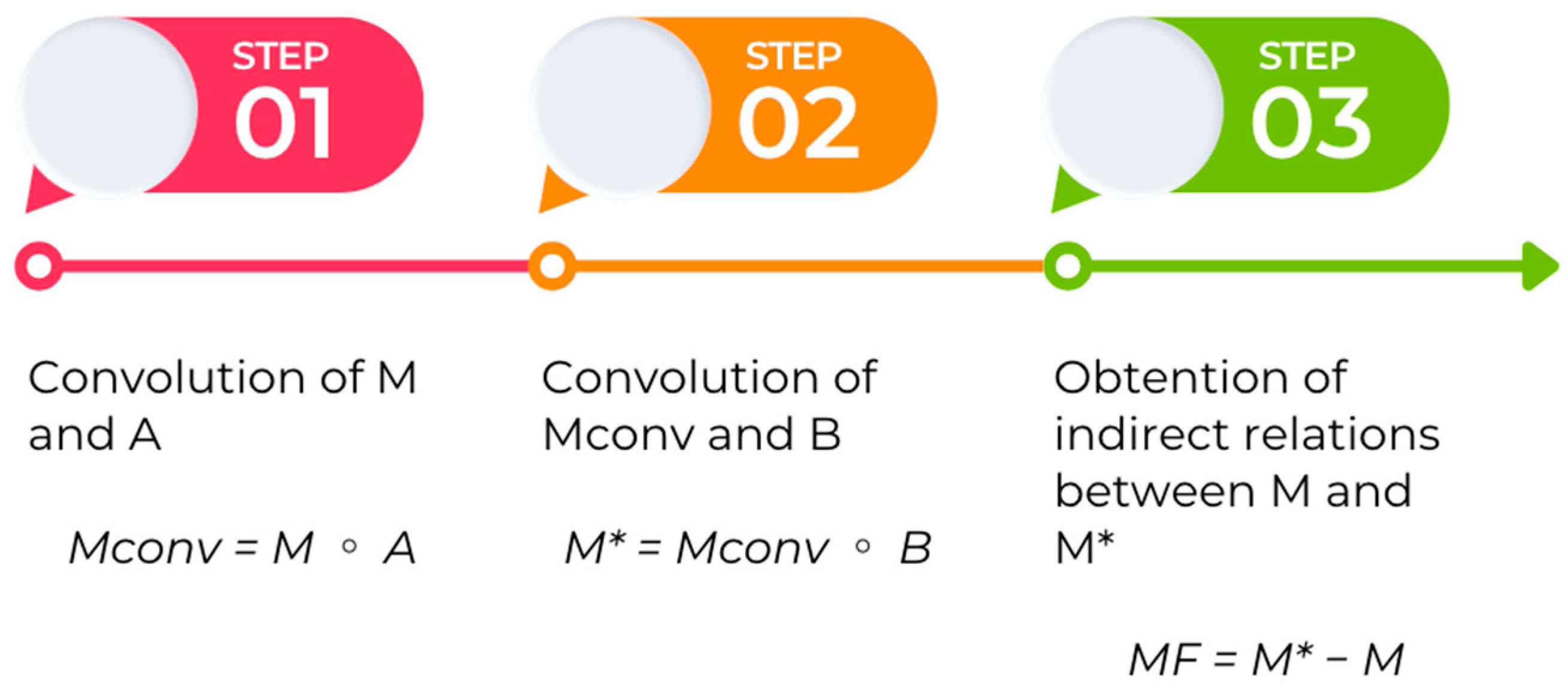
m} be the effects. Three matrices were obtained: M (relationships between causes and effects), A (relationships among causes), and B (relationships among effects). The steps were carried out as indicated by
Gutiérrez Galopa (
2017), as shown in
Figure 1.
The construction of these matrices is based on the aggregation of perceptual evaluations obtained from the questionnaire, allowing the identification of both direct and indirect relationships between variables within a fuzzy framework.
The application of the Forgotten Effects Theory is particularly appropriate in this context, since tourism loyalty in Protected Natural Areas is not constructed solely from direct relationships, but rather through chains of indirect influence that often go unnoticed in traditional analyses.
Finally, to determine which variables exhibit causal incidence—that is, those that generate the forgotten effect—the max–min method proposed by
Tinto Arandes et al. (
2017) was used: (1) values indicating incidence between the cause from matrix A and each of the cause values contained in the rows of matrix M were compared for each effect; (2) once the maximum incidence for the effects was obtained, these values were compared with those contained in the effect column of matrix B. This procedure allows identifying indirect causal structures without imposing linear assumptions, which is consistent with the theoretical perspective of mediated loyalty adopted in this study.
This procedure made it possible to identify strategic factors that, although not directly evident, significantly influence the construction of loyalty toward the MBBR, providing valuable information for decision-making in destination management.
4. Results
4.1. Affinities According to Geographic Delimitation
Table 3 shows the similarity matrix (M
B) for the case of state-based delimitation.
Considering a value of α = 0.9, the following exclusion function was obtained.
After applying the Boolean product, the resulting outcome was obtained.
Based on the above, five groups were formed, which are presented in
Table 4.
From
Table 4, the following observations can be made:
In groups M1 and M2, it is identified that tourists from Tlaxcala and Tamaulipas present response profiles that do not converge with the rest of the system under the requirement of α = 0.9. It can therefore be stated that travelers arriving at the Monarch Butterfly Biosphere Reserve (MBBR) from these destinations exhibit a unique personality. Consequently, they should not be included in generic campaigns; rather, they require tailor-made tourism products that address their specific motivations.
The most stable and robust group, comprising nine states, is the M4 group. In terms of tourism management, this group represents the destination’s natural target market, where communication strategies can be standardized.
There are some versatile markets, resulting from those states that appear in both the M4 and M5 groups; this phenomenon is considered as multi-affiliation. The versatile markets are Mexico City (c), State of Mexico (d), Guanajuato (e), Hidalgo (f), Querétaro (j), and San Luis Potosí (k). These markets can react positively to both national campaigns and those designed for the US market (a).
The only state that has the capacity to oscillate between the mass market (M4) and a very specific niche with Nuevo León (M3) is the state of Michoacán, suggesting a unique flexibility in its visitor profile.
The formation of the M3 group solely by the states of Michoacán and Nuevo León reveals a niche opportunity. Despite the geographical distance, the profile of these visitors converges at a similarity of over 90%.
The United States only managed to integrate into the M5 group, which indicates that American tourists motivations’ only fully coincide with those of a select group of central states.
Key implication for management:
MBBR cannot be addressed through a homogeneous territorial strategy. The coexistence of mass markets, highly specialized niches, and versatile markets requires a combination of standardized and differentiated strategies. Generic campaigns should be avoided for perceptually isolated profiles, especially in Protected Natural Areas, where environmental restrictions, conservation narratives, and carrying capacities mediate the experience.
4.2. Affinities According to Age
Table 5 shows the similarity matrix (M
B) for the age-based delimitation. In this case, a value of α = 0.96 was used, because if the value α = 0.90 was maintained, a single group would be formed.
Considering a value of α = 0.96, the following exclusion function was obtained.
After applying the Boolean product, the result obtained was as follows.
Based on this, the three groups indicated in
Table 6 were formed.
From the groups formed, the following observations can be made:
Generation X is the most versatile, as it appears both with Baby Boomers and Millennials. Therefore, it represents the connecting axis. This relationship indicates that their travel expectations and levels of satisfaction are compatible with both traditional tourism models and emerging consumption trends.
Generation X shares with Baby Boomers the valuation of traditional attributes (aesthetics, order, image), while converging with Millennials in dynamic variables such as novelty and participation. For destination managers, Generation X represents the minimum common denominator. Any improvement at the destination that satisfies Generation X has a high probability of being well received by the rest of the segments.
Baby Boomers and Generation Z represent the opposite poles of the model; they never appear in the same group, indicating that their perceptions of the destination are the most distant from each other.
Key management implication:
Generation X acts as the “minimum common denominator” of the destination. Designing experiences that satisfy this segment increases the likelihood of transversal acceptance by the remaining generations.
4.3. Affinities According to Age and Sex
In the case of age delimitation, a further delimitation considering sex was also included.
Table 7 shows the results.
From the results presented, the following can be observed:
Among men, Generation X behaves similarly to Millennials (forming robust a robust group b, c, and d). Among women, however, Generation X is clearly distinct from Baby Boomers (a). This suggests that the “digital or lifestyle gap” has had a stronger impact on middle-aged women’s perceptions.
Across the three analyses (General, Women, and Men), group c, d (Millennials and Generation Z) remains stable. This demonstrates that youth acts as a homogenizing factor. Regardless of sex, younger visitors perceive the destination under similar parameters.
In the male segment, the oldest group (Baby Boomers) is the most difficult to integrate, generating a direct exclusion with Millennials and Generation Z, and relating only to Generation X (the closest in age). In contrast, female Baby Boomers appear to exhibit more subtle points of contact. Despite the age gap, they show affinity with Generation Z.
Key management implication:
Sex acts as a moderating variable in age-based segmentation. Strategies aimed at women should be more specific to life stage, whereas for men it is possible to design broader generational-based offerings.
4.4. Affinities by Education Level
Table 8 presents the similarity matrix (M
B) for the segmentation by educational level. An α-cut value of 0.96 was applied.
Considering an α value of 0.96, the following exclusion function was obtained.
After applying the Boolean product, the result was derived.
Based on this, the two groups shown in
Table 9 were formed.
The analysis indicates that:
From primary education to undergraduate level, tourists exhibit a unified perception. This constitutes the mass market.
Postgraduate tourists are “outsiders.” Their perception does not align with the previous educational levels; therefore, they represent a specialized tourist segment.
Key management implication:
Higher education does not refine destination perception—it transforms it. Visitors with postgraduate education require offerings with high symbolic, interpretative, and cognitive content.
4.5. Educational Level and Gender Affinities
In the case of educational-level delimitation, a segmentation incorporating gender was also included. The results are presented in
Table 10.
The results indicate that:
In the case of women, the groups that are formed are the same as in the general analysis—a mass group and an elite group—but the polarization is more extreme. The values observed in the similarity matrix are lower (0.899 versus 0.910).
Among men, education progressively fragments the market, even before postgraduate studies. A man with a bachelor’s degree (d) already begins to differentiate himself from one with high school education (c), although he still maintains links with basic education levels.
Regardless of sex, the postgraduate level always forms a solitary group. This confirms that the destination is perceived in a completely different way by the academic elite.
Key management implication:
Postgraduate education represents a transversally isolated segment. Conventional educational strategies are not sufficient for this profile, particularly in the female market.
4.6. Transversal Synthesis of Segmentation
When integrating the results, age creates perceptual bridges, education introduces barriers, and gender modulates these effects.
Gender is a variable that influences generational perception. While the male market tends toward convergence (where Generation X, Millennials, and Generation Z form a single block of perception), the female market is fragmented into more specific niches according to age, showing that the destination is perceived more heterogeneously by women.
These results confirm that tourism perception in the MBBR does not respond to a linear demographic logic, but rather to complex perceptual configurations where age, education, and gender interact in a non-additive way.
Tourist behavior among men is more homogeneous and generationally stable, whereas among women the age factor acts as a powerful differentiator, requiring much more segmented and life-stage-specific communication strategies.
In the general group, generations were perceptually “closer” to each other (values of 0.96). Among women, perceptions are more dispersed (values of 0.94). This indicates that marketing for women in this destination must be far more age-specific than marketing aimed at men.
It can be concluded that for women, postgraduate education is not merely an academic degree, but a paradigm shift. While in the general matrix the lowest relationship value was 0.912, among women it drops to 0.899. This means that higher education distances women tourists’ perceptions from common standards more strongly than in the case of men.
4.7. Forgotten Effects in Destination Loyalty
Finally,
Table 11 presents the forgotten effects identified in the analysis of causes and effects of loyalty toward the MBBR destination.
The most relevant forgotten effects correspond to: Learning/Education (A) versus Commitment (J) (0.30), Learning/Education (A) versus Intention to Revisit (L) (0.30), and Perceived Value (I) versus Intention to Revisit (L) (0.27).
This suggests that Learning/Education in the Monarch Butterfly Biosphere Reserve (MBBR) fosters both commitment and tourists’ return to the destination. In turn, it is also evidenced that, for tourists to develop the intention to revisit the MBBR, it is necessary to invest in Learning/Education and Perceived Value.
The variables influencing the aforementioned forgotten effects are presented below:
- (a)
Learning/Education (A) versus Commitment (J)
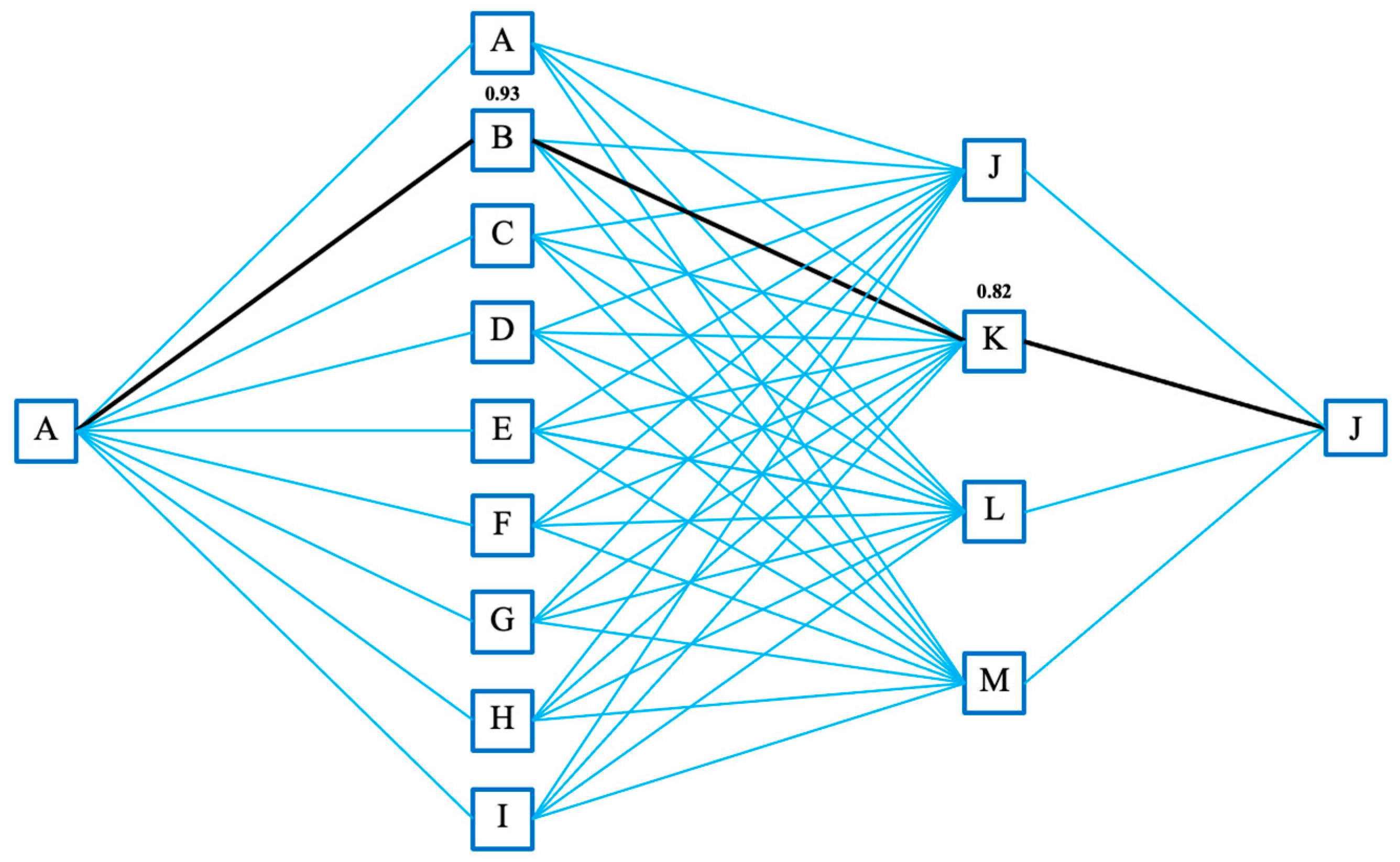
First, the result of the comparison is shown, using the max–min relation, of the values for A from matrix A (cause–cause) with the values from A to I in matrix M (cause–effect):
In this case, 0.93 is the value representing the maximum incidence of the causes on the effect commitment. This value is provided by the entertainment variable. Subsequently, a comparison was performed with the values contained in the effect column of matrix B:
The selected value was 0.82, which comes from Global Satisfaction. The result is shown in
Figure 2. This outcome reveals the existence of a hidden relationship in which the knowledge acquired at the MBBR does not automatically generate commitment to the site, but rather requires global satisfaction through entertainment to build commitment. Therefore, it is not sufficient to provide technical information to tourists. The experience must be entertaining and fully satisfying for learning to translate into real commitment to the sanctuary. The “forgotten” value of 0.30 indicates that current management underestimates the power of learning when combined with an entertaining and pleasurable visitation experience.
- (b)
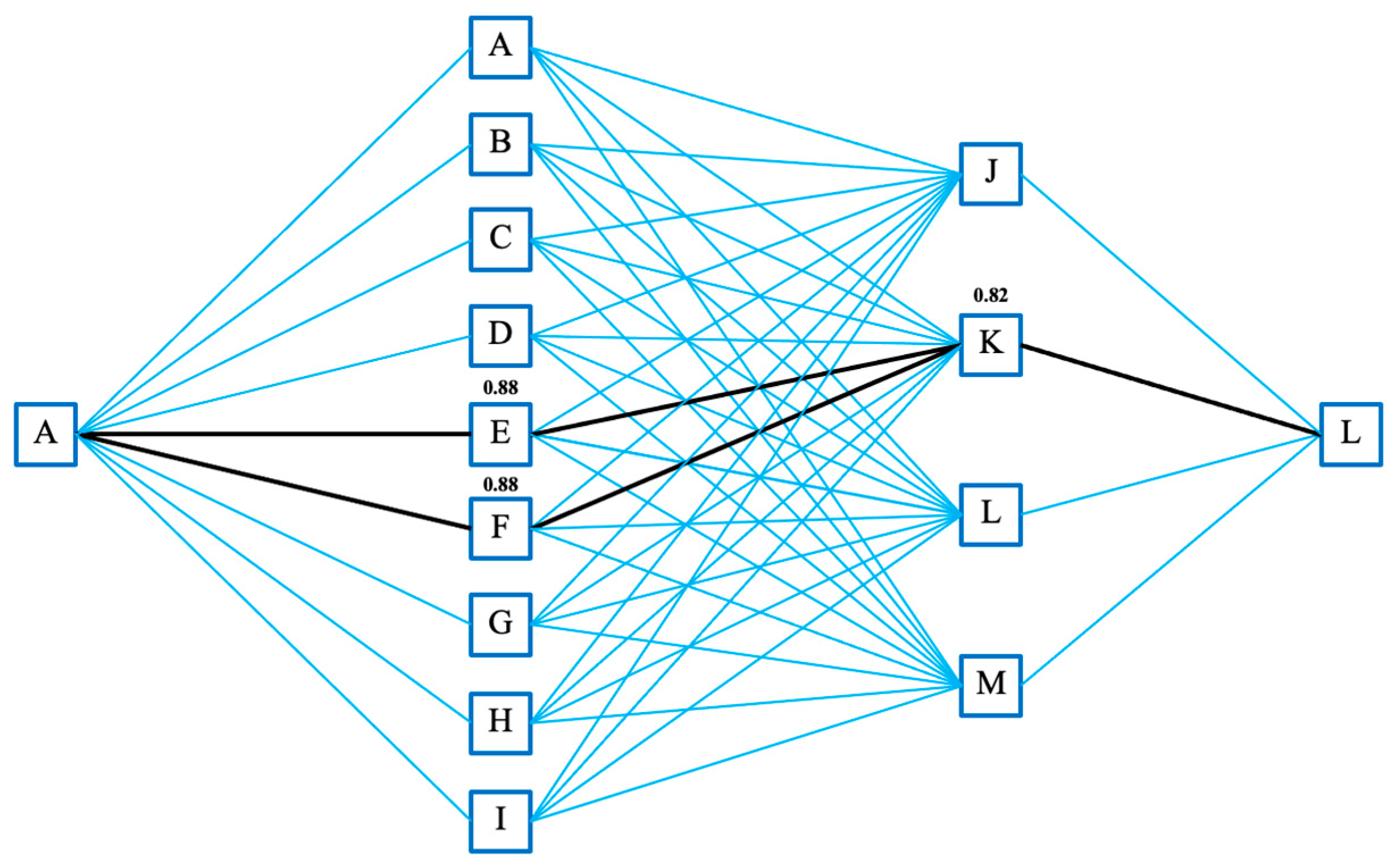
Learning/Education (A) versus Intention to Revisit (L)
Figure 3 presents the results of the analysis. Two links with equal value (0.88) are observed in this relationship: one arises from the Relaxation/Enjoyment variable and the other from the Participation variable; both converge in Global Satisfaction. The analysis reveals that tourists do not wish to return solely to obtain more information, but because the learning process was relaxing and involved their participation. This forgotten effect suggests that the intention to revisit increases when learning is perceived as a high-quality leisure activity, rather than when tourists merely receive technical information.
- (c)
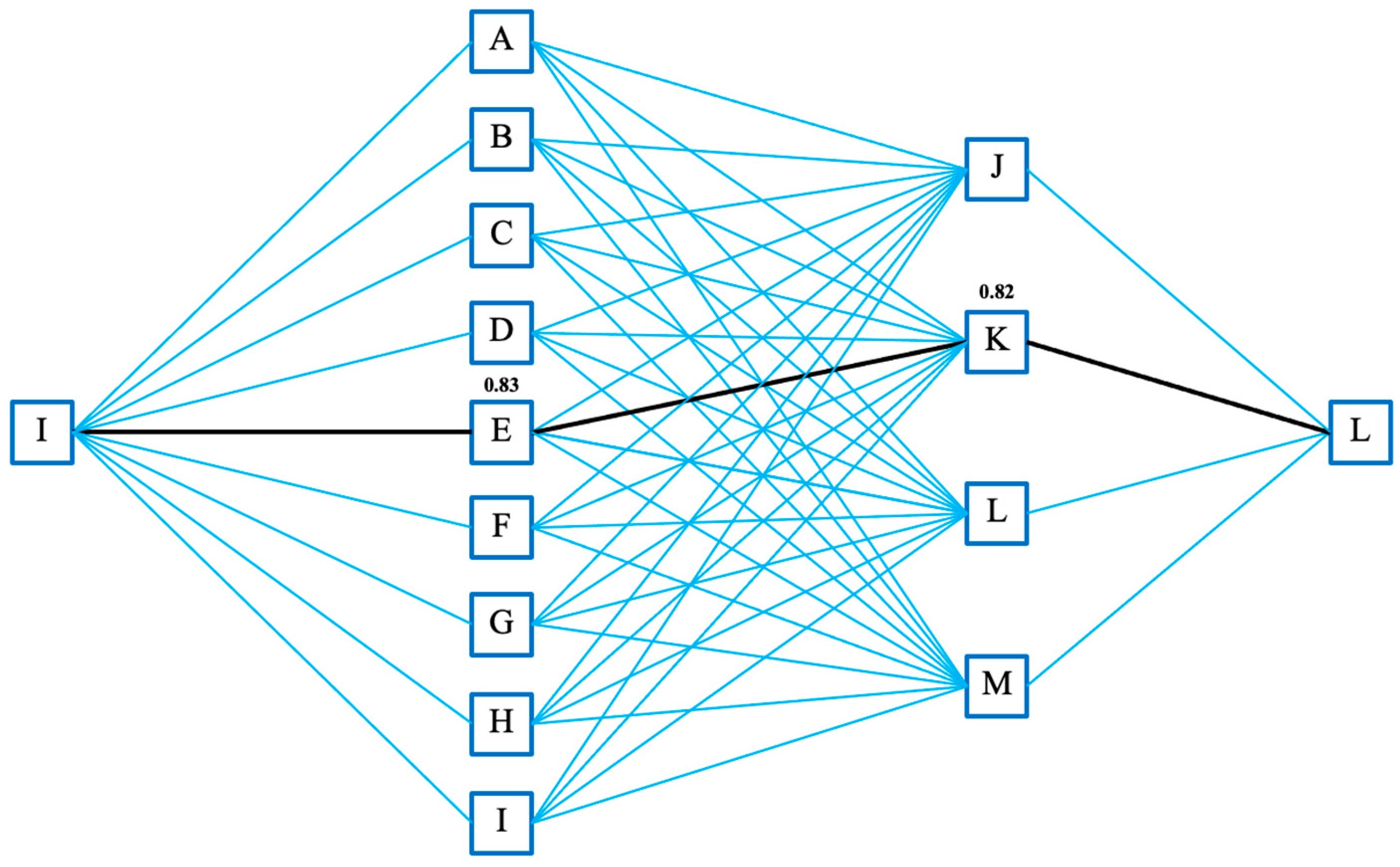
Perceived Value (I) versus Intention to Revisit (L)
Figure 4 shows the results of the analysis. In this case, the variables acting as invisible bridges are Relaxation/Enjoyment and Global Satisfaction. A tourist who perceives high value (quality–price ratio) tends to return to the destination. For this to occur, the experience must be relaxing, enjoyable, and capable of generating satisfaction.
Key management implication:
Learning generates loyalty only when it is experienced as a pleasurable, participatory, and emotionally satisfying experience. The MBBR must evolve toward a structured environmental edutainment model, where education and entertainment are inseparable, as is characteristic of nature destinations and Protected Natural Areas, where environmental interpretation replaces conventional recreational consumption.
4.8. Final Synthesis of Results (Integrated Perspective)
Based on the analysis of affinities and forgotten effects, three major strategic visitor profiles of the MBBR are identified, see
Table 12.
This synthesis confirms that combining the Pichat algorithm with the Forgotten Effects Theory enables not only visitor segmentation, but also an understanding of how loyalty is indirectly and differentially constructed within a Protected Natural Area, where perceptual and experiential mechanisms carry greater weight than traditional sociodemographic variables.
To enhance readability and synthesize the main contributions of the results section, the key findings of the study are summarized below:
- -
Tourist demand in the MBBR is not homogeneous, as it is composed of mass markets, specialized niches, and versatile segments exhibiting multi-affiliation patterns.
- -
Generation X acts as a structural connector across segments, functioning as the minimum common denominator of visitor perceptions.
- -
Educational level—particularly postgraduate studies—introduces a strong perceptual rupture, leading to the formation of a clearly differentiated segment.
- -
Gender operates as a moderating variable, intensifying segmentation patterns, especially within the female market.
- -
Tourist loyalty is not constructed through direct relationships, but rather through indirect and mediated mechanisms, where variables such as entertainment, relaxation, and overall satisfaction act as critical bridges.
5. Discussion
The findings of this research highlight the complexity of demand in the MBBR. Although the vast majority of visitors to the MBBR come from central and western Mexico, as
Quintanar Maldonado (
2007) points out, the application of the Pichat Algorithm in this study shows that there are niches with specific needs, such as postgraduate tourists whose affinities do not converge with the majority group. This result coincides with previous studies that warn that the territorial homogenization of demand hides sub-segments with highly differentiated expectations, particularly in nature destinations (
Ortiz et al., 2018;
Fyall et al., 2003). However, unlike these studies, which tend to assume gradual differentiation between segments, the findings here reveal a more pronounced perceptual rupture, suggesting that segmentation in Protected Natural Areas may be more discontinuous than previously assumed.
In addition, it was found that tourists from the state of Tlaxcala, despite being located in the central part of the country, find affinity with those from Tamaulipas (northern region). This finding differs from classic approaches to geographic segmentation, which assume territorial proximity to be synonymous with perceptual similarity, showing that in Protected Natural Areas, the perception of the destination responds more to values, motivations, and consumption styles than to physical distance. This result contrasts with a substantial body of empirical tourism research that supports spatial proximity as a key segmentation criterion, thereby suggesting that geographic variables may lose explanatory power in high-experience, nature-based contexts. This unique personality of certain segments justifies the need for specific marketing strategies rather than generic campaigns.
On the other hand, identifying hidden links through the Forgotten Effects Theory complements traditional views of loyalty. While there is literature that highlights satisfaction as a direct antecedent of loyalty (
Adinegara et al., 2021), this study reveals that variables such as entertainment and relaxation are invisible bridges that are indispensable for learning to translate into a real intention to revisit the sanctuary. This finding partially diverges from dominant linear models, which prioritize satisfaction as a sufficient condition, by demonstrating that satisfaction alone may be insufficient without experiential mediators. This result provides empirical evidence for the notion that tourist loyalty is not a linear process, but rather a phenomenon mediated by emotional and participatory experiences, especially in nature tourism contexts. The detected forgetting of 0.30 suggests that managers have underestimated the playful component of environmental education. The detected forgetting of 0.30 suggests that managers have underestimated the playful component of environmental education. This magnitude of indirect effect can be considered relatively high compared to similar applications in tourism studies, reinforcing the relevance of hidden relational structures.
From a theoretical perspective, the fact that learning does not act as a direct trigger for loyalty challenges rationalist models of tourist behavior, which assume that greater knowledge automatically generates favorable attitudes. This result contrasts with studies that position knowledge as a primary driver of pro-environmental behaviour, suggesting instead that its effect is conditional and context-dependent. Previous research has demonstrated that knowledge alone is insufficient to explain behaviour, as it operates through complex mediating factors such as values, norms, and situational conditions (
Stern, 2000;
Kollmuss & Agyeman, 2002;
Bamberg & Möser, 2007;
Juvan & Dolnicar, 2014).
In the context of MBBR, learning only becomes a loyalty factor when it is integrated into a pleasant, relaxing, and socially interactive experience. This reinforces the idea that effective environmental education should be conceived as an experiential learning experience (edutainment), rather than a one-way transfer of scientific information.
Likewise, the systematic polarization of the segment with postgraduate studies has relevant implications for the theory of sustainable tourism. Far from representing a progressive refinement of perception, increased educational attainment generates a perceptual rupture, suggesting that visitors with greater cognitive capital evaluate the destination under more demanding symbolic, interpretive, and ethical criteria. This finding is not entirely consistent with prior research that associates higher education with greater alignment toward sustainability-oriented experiences, indicating instead a more critical and less homogeneous response among highly educated visitors. Recent studies show that the relationship between education and sustainable behaviour is mediated, heterogeneous, and sometimes inconsistent, with significant variation in perceptions and attitudes among highly educated individuals (
Zhang & Tavitiyaman, 2022;
Li et al., 2023;
J. Wang et al., 2024). This finding broadens the discussion on sustainability by showing that more informed visitors demand not only conservation but also narrative coherence, interpretive depth, and scientific authenticity.
Taken together, the results confirm that sustainable management in Protected Natural Areas requires abandoning uniform approaches to supply and moving toward flexible models that integrate perceptual segmentation, experiential mediation, and playful environmental education, aligning conservation with visitor satisfaction and loyalty.
6. Conclusions
This study had two objectives: (1) to determine the affinities between tourists visiting the Monarch Butterfly Biosphere Reserve in Mexico using the Pichat Algorithm in the field of Fuzzy Logic, and (2) to analyze the variables that influence loyalty to the destination using the Forgotten Effects Theory.
In terms of affinities, it was found that age is a cohesive factor, functioning as an integrating axis of expectations. Generation X is the most versatile segment and acts as the lowest common denominator, with expectations converging with both Baby Boomers and Millennials, thus facilitating the standardization of services. However, the level of education acts as a barrier to perception. Tourists with postgraduate studies perceive the destination under radically different parameters than those of the mass market, demanding a more scientifically specialized offering and higher quality of service. This pattern confirms that sociodemographic variables do not operate cumulatively or linearly, but rather interact to generate perceptual ruptures and diffuse affinities, which are especially relevant in conservation contexts.
On the other hand, applying the Forgotten Effects Theory allowed us to identify critical links, such as: (1) satisfaction and entertainment, which act as enhancers of the impact of learning on commitment; (2) relaxation/enjoyment, participation, and satisfaction, which increase the relationship between learning and perceived value with the intention of visiting the destination again. These findings reveal that knowledge alone is insufficient to build visitor loyalty; for environmental learning to translate into loyalty, the experience must be perceived as emotionally rewarding, playful, and highly satisfying, confirming the existence of mediation processes that traditional literature often omits.
It is concluded that management strategies in the RBMM should move towards an environmental ‘edutainment’ model. This involves designing programs where scientific education about butterfly migration is integrated with high-quality leisure experiences, ensuring that visitors not only learn but also become active and recurring promoters of Mexico’s natural heritage. Likewise, the results highlight the need to design differentiated strategies for perceptually isolated segments, avoiding homogeneous approaches which may be ineffective or counterproductive in protected natural areas.
From a theoretical perspective, this study makes an explicit contribution by redefining tourist loyalty not as a direct result of experience, but as a mediated and indirect process, conditioned by emotional, cognitive, and experiential variables that interact in a diffuse manner. This approach expands on classic loyalty models by demonstrating that, in Protected Natural Areas, environmental learning requires symbolic and affective mediators to generate commitment, intention to return, and recommendation. Likewise, the study contributes to the theory of tourism segmentation by showing that perceptual affinities can diverge significantly from traditional sociodemographic segmentations, questioning the validity of rigid approaches in contexts of high environmental complexity.
From a methodological point of view, the research provides empirical evidence on the usefulness of fuzzy logic as an integrative framework for analyzing tourist behavior. The combination of Pichat’s Algorithm and Forgotten Effects Theory demonstrates its ability to identify hidden niches, capture gradual belongings, and reveal indirect causal relationships that conventional statistical methods tend to ignore. This methodological contribution is particularly relevant for the study of nature and conservation destinations, where subjectivity, ambiguity, and visitor heterogeneity are the norm rather than the exception.
This study presents several limitations that should be considered when interpreting the results. First, the use of a non-probabilistic sample limits the generalizability of the findings beyond the studied population. Second, the focus on a single protected natural area reduces the external validity and applicability of the conclusions to other destinations. Third, the use of questionnaire-based data introduces a degree of subjectivity that may influence the results. Finally, the application of fuzzy logic involves a certain level of subjectivity in parameter selection, and the methodological complexity may affect replicability in future studies.
As future lines of research, we propose expanding the analysis to international tourism to identify forgotten effects that could encourage the arrival of foreign visitors. Additionally, it is relevant to investigate the impact of digital tools, such as augmented reality, on learning about the destination and its effect on loyalty. It is also suggested that a longitudinal analysis be carried out to observe how the affinities of the segments and the forgotten effects change over several hibernation seasons. Likewise, it would be of great academic value to integrate data mining into social networks (Sentiment Analysis) to feed the initial incidence matrices, contrasting digital opinion with face-to-face surveys. Finally, it is recommended that this model be extended to include the perception of local residents. This would involve analyzing whether there is a disconnect (forgotten effect) between community’s designed offerings and the expected tourist demand, under a sustainable tourism approach.





 ,
,