


Abstract
This study investigates the psychological mechanisms underlying tourists’ carbon offset behavior in air travel by distinguishing between offset choice (OC) and offset spending (OS). Grounded in the Value–Belief–Norm (VBN) framework, the model integrates Environmental Value and Literacy (EVL), Green Identity and Social Motives (GISM), Trust and Risk Perception (TRP), Personal Norm Activation (PNA), and Perceived Effectiveness (PEF). Data were collected onsite from 500 international and domestic tourists at Suvarnabhumi International Airport, Thailand, between June and July 2025, and analyzed using Partial Least Squares Structural Equation Modeling (PLS-SEM). The results indicate that EVL and GISM significantly enhance both PNA and PEF, which in turn exert strong positive effects on OC and OS. PNA emerges as the strongest predictor of both participation and financial commitment, highlighting the central role of moral obligation in motivating carbon offset behavior. While TRP significantly strengthens personal moral norms, its direct effect on Perceived Effectiveness is not significant, suggesting that trust primarily operates through ethical pathways rather than cognitive evaluations of program effectiveness. By distinguishing between participation decisions and spending behavior, this study extends VBN theory to the context of carbon offsets in aviation and demonstrates the mediating roles of moral norms and Perceived Effectiveness in translating environmental values and social identity into compensatory climate action. The findings offer practical implications for airlines and policymakers, emphasizing the importance of moral framing, transparency, and social identity engagement to promote voluntary carbon offset adoption in emerging carbon markets.
1. Introduction
Sustainable flight has become a growing concern as greenhouse gas emissions from aviation continue to increase (Liao et al., 2023). Aviation plays an indispensable role in global connectivity and economic growth, yet it contributes approximately 2% of total global carbon dioxide (CO2) emissions, exacerbating climate change and global warming (Reyes-García et al., 2024; Zhumadilova et al., 2023; Gössling & Scott, 2025). In response, the International Civil Aviation Organization (ICAO) introduced the Carbon Offsetting and Reduction Scheme for International Aviation (CORSIA), which aims to mitigate the environmental impact of aviation by offsetting CO2 emissions from international flights. Likewise, many airlines have integrated sustainability initiatives into their corporate social responsibility (CSR) commitments, further emphasizing the importance of understanding how consumers respond to such schemes (Schleich & Alsheimer, 2024; IATA, 2024).
Previous studies largely focused on passengers’ general environmental attitudes without examining their behavioral choices and willingness to pay for carbon offsets. This study addresses this gap by integrating Environmental Value and Literacy (EVL), Green Identity and Social Motives (GISM), Trust and Risk Perception (TRP), Personal Norm Activation (PNA), and Perceived Effectiveness (PEF) to explain tourists’ offset choice and spending. Specifically, we aim to answer the following questions: (1) Which psychological and evaluative factors influence tourists’ carbon offset behavior? (2) How do these factors interact to determine offset choice and spending?
Despite growing interest in sustainable air travel, research in Thailand remains limited. The urgency of reducing emissions is evident in the Thai context, with Thailand’s CO2 emissions stemming primarily from the energy (40%) and transport (34%) sectors, with smaller shares from industry (21%) and other activities (5%). To address these challenges, the Thai government has pledged to reduce greenhouse gas emissions by 30% by 2030 and achieve net-zero emissions by 2065 (Loureiro et al., 2022). This commitment, while ambitious, remains modest compared with neighboring countries such as Cambodia, Indonesia, and Singapore (Kim et al., 2025). Thailand’s climate strategy relies heavily on carbon pricing and renewable energy development, balancing policy choices between carbon taxes and Emission Trading Systems (ETSs) while also emphasizing the reinvestment of revenues into sustainable initiatives (Pongthanaisawan et al., 2023; van den Bergh et al., 2024).
Within this policy framework, carbon offsetting mechanisms have emerged as crucial tools to encourage more sustainable consumer behavior. In Thailand, the establishment of the Thailand Voluntary Emission Reduction Program (T-VER) provides opportunities for individuals and businesses to voluntarily offset their emissions (Leenoi, 2023). Although T-VER currently accounts for only 7.61% of the global carbon credit trade, its market has expanded rapidly, with a 314.3% increase in credit issuance and a 1222.7% rise in total market value in 2022 (TGO, 2024). Such growth underscores the potential role of tourists and air passengers in supporting voluntary offset schemes, which can significantly influence the sustainability trajectory of the aviation sector (Stloukal et al., 2025).
Despite growing attention to carbon offset programs in aviation, the existing research has largely focused on general environmental attitudes or willingness to participate, offering limited insight into the psychological mechanisms that translate environmental concern into concrete financial behavior (Cordes et al., 2024; Chien, 2023). Most prior studies treat offsetting as a single behavioral outcome, overlooking the distinction between participation decisions and the level of monetary contribution.
This study addresses these gaps by developing a theory-driven behavioral model grounded in the Value–Belief–Norm framework and extending it to the context of sustainable air travel in Thailand. Specifically, it distinguishes between offset choice (the decision to engage in offset programs) and offset spending (the financial commitment level), thereby capturing both behavioral intention and economic sacrifice. Furthermore, the model integrates moral norms, Perceived Effectiveness, social identity, and trust mechanisms to explain how environmental values are transformed into compensatory climate actions.
By empirically testing this integrated framework among air travelers at Suvarnabhumi International Airport, this research offers novel contributions in three ways. First, it extends VBN theory to carbon offset spending behavior in aviation. Second, it reveals the mediating roles of moral obligation and perceived impact in shaping both participation and financial commitment. Third, it provides evidence from an emerging carbon market context, where voluntary offset mechanisms such as Thailand’s T-VER program are rapidly expanding. Together, these contributions enhance theoretical understanding of sustainable consumption and offer practical insights for strengthening climate mitigation efforts in the aviation sector.
2. Theoretical Framework and Hypotheses
2.1. Environmental Value, Literacy, and Green Identity in Norm Activation
Environmental Value and Literacy (EVL) form a critical foundation for pro-environmental behavior in aviation. Environmental literacy comprises knowledge and awareness of climate change, carbon footprints, and mitigation projects, while environmental values reflect ethical orientations that motivate sustainable choices (Loureiro et al., 2022). Previous studies confirm that individuals with strong literacy and values are more likely to recognize the environmental consequences of their actions and feel morally obliged to act responsibly (Berger et al., 2022). Within the Norm Activation Model (NAM), EVL serves as a direct antecedent to Personal Norm Activation (PNA), strengthening passengers’ moral responsibility to support carbon offsetting (Schleich & Alsheimer, 2024). Accordingly, H1 proposes that EVL positively influences PNA, while H2 posits that EVL enhances Perceived Effectiveness (PEF).
Green Identity and Social Motives (GISM) provide additional drivers of sustainable behavior. Green identity reflects the extent to which individuals perceive themselves as environmentally responsible, while social motives capture the influence of peer norms, collective expectations, and social approval (Reyes-García et al., 2024). Studies show that individuals with strong green identities are significantly more likely to engage in voluntary carbon offset programs (Cordes et al., 2024). Furthermore, peer influence and social recognition can reinforce participation, demonstrating the importance of collective norms. In tourism, airlines’ visible offset schemes act as a social signal for sustainability commitment, amplifying personal norms through both self-identity and community validation (Vujko et al., 2025; Deng et al., 2026). These insights support H3 and H4, which hypothesize that GISM positively affects PNA and PEF.
2.2. Personal Norm Activation, Perceived Effectiveness, and Trust
Once activated, Personal Norm Activation (PNA) represents an individual’s moral obligation to act in environmentally responsible ways. Stronger personal norms increase the likelihood that passengers perceive carbon offsetting as a meaningful mechanism for mitigating aviation-related emissions, thereby translating ethical concern into concrete behavioral commitment (Elia et al., 2020; Rodemeier, 2026). Within the Value–Belief–Norm framework, activated moral norms directly shape pro-environmental behaviors, influencing both offset choice (OC) and offset spending (OS). Accordingly, H7 and H8 propose that PNA positively affects tourists’ participation in carbon offset programs and their financial contributions.
Perceived Effectiveness (PEF) constitutes another critical cognitive determinant, reflecting individuals’ beliefs regarding the extent to which carbon offset initiatives genuinely contribute to climate change mitigation. When passengers perceive offset programs as credible and impactful, they are more inclined to engage in sustainable choices and allocate financial resources toward compensatory actions (Rodemeier, 2026; Schleich & Alsheimer, 2024). This theoretical reasoning underpins H9 and H10, which posit positive relationships between PEF and both offset participation and spending.
Trust and Risk Perception (TRP) function as key evaluative mechanisms influencing both moral norm activation and Perceived Effectiveness. Trust in institutions, offset providers, and certification schemes such as Thailand’s voluntary carbon market mechanisms enhances the perceived legitimacy of offset programs and strengthens individuals’ moral and cognitive evaluations of climate action (Leenoi, 2023; TGO, 2024). Conversely, heightened risk perceptions associated with financial misuse, greenwashing, or lack of transparency undermine confidence and discourage participation (Dütschke et al., 2023). Empirical research consistently demonstrates that higher institutional trust reduces skepticism, reinforces moral responsibility, and increases perceived program effectiveness in sustainability initiatives (van den Bergh et al., 2024). Therefore, H5 and H6 propose that TRP positively influences both Personal Norm Activation and Perceived Effectiveness.
2.3. Offset Choices and Spending Behavior
Offset behavior can be observed in two forms: offset choice (OC), the decision to engage in carbon offset programs, and offset spending (OS), the financial level of commitment. These outcomes reflect how tourists transform environmental values and moral obligations into concrete actions supporting climate mitigation. Research has identified Personal Norm Activation (PNA) and Perceived Effectiveness (PEF) as the strongest predictors. Activated moral norms frame offsetting as a duty rather than a discretionary act, while perceptions of program credibility enhance willingness to contribute financially (Elia et al., 2020; Loureiro et al., 2022). When both drivers align, tourists are not only more likely to participate, but also to increase their financial commitments (Chien, 2023). Trust and Risk Perception (TRP) further influence these outcomes by shaping PEF. Trust in certification systems (e.g., T-VER, CORSIA) lowers skepticism and encourages higher spending, whereas doubts about transparency or greenwashing reduce engagement (Dütschke et al., 2023; van den Bergh et al., 2024). Similarly, Green Identity and Social Motives (GISM) strengthen offset behavior when individuals see participation as socially supported and identity-affirming.
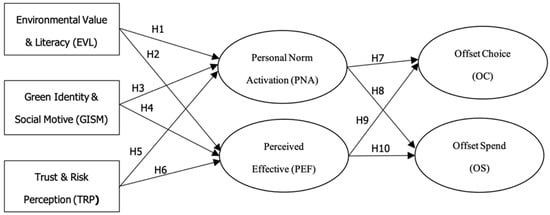
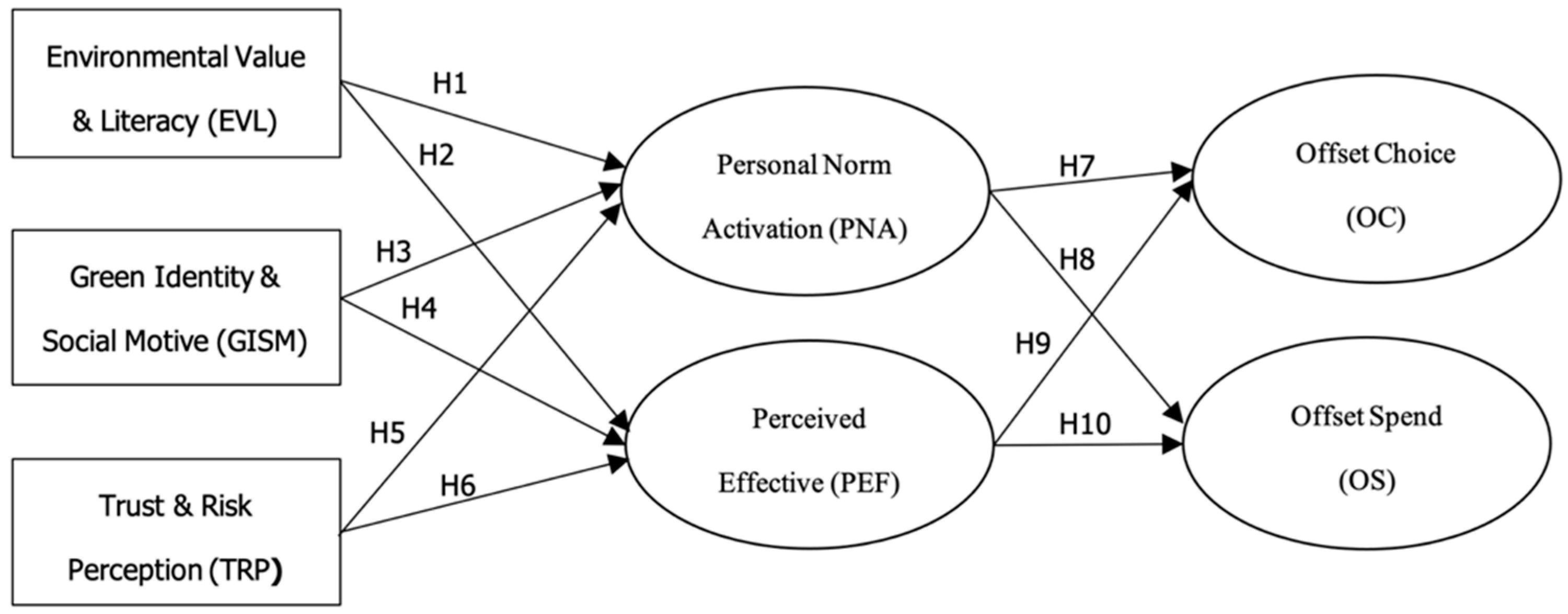
In summary, offset choices and spending result from the interaction of ethical (PNA), cognitive (PEF), and contextual (TRP, GISM) factors. Tourists with strong values and trust perceive offsets as effective, leading to both participation and meaningful financial investment. Figure 1 illustrates the research conceptual framework in which EVL, GISM, and TRP act as antecedents activating PNA and shaping PEF, which in turn drive OC and OS. The model underscores the multidimensional nature of sustainable offset behavior.
Figure 1.
Conceptual framework.
From the Research Conceptual Framework, the following hypotheses were made:
H1.
Environmental Value and Literacy (EVL) positively influence Personal Norm Activation (PNA).
H2.
Environmental Value and Literacy (EVL) positively influence Perceived Effectiveness (PEF).
H3.
Green Identity and Social Motive (GISM) positively influence Personal Norm Activation (PNA).
H4.
Green Identity and Social Motive (GISM) positively influence Perceived Effectiveness (PEF).
H5.
Trust and Risk Perception (TRP) positively influence Personal Norm Activation (PNA).
H6.
Trust and Risk Perception (TRP) positively influence Perceived Effectiveness (PEF).
H7.
Personal Norm Activation (PNA) positively influences offset choice (OC).
H8.
Personal Norm Activation (PNA) positively influences offset spending (OS).
H9.
Perceived Effectiveness (PEF) positively influences offset choice (OC).
H10.
Perceived Effectiveness (PEF) positively influences offset spending (OS).
3. Methodology
The study employed a structured questionnaire consisting of 51 items divided into five sections. The first section collected demographic information, including age, gender, nationality, education, income, and travel-related characteristics. The second section measured environmental awareness and value-based orientations through 21 items capturing Environmental Value and Literacy (EVL) and Green Identity and Social Motives (GISM). The third section assessed passengers’ moral and evaluative responses using 29 items related to Personal Norm Activation (PNA) and Trust and Risk Perception (TRP). The fourth section examined carbon offset behavior through 8 items reflecting offset choice (OC) and offset spending (OS), while the fifth section included an open-ended question for additional comments.
Measurement items for EVL and GISM were adapted from previous studies on pro-environmental behavior and carbon offsetting (e.g., Schleich & Alsheimer, 2024; Cordes et al., 2024). Items for PNA were adapted from the Norm Activation Model literature, while items for PEF and TRP were developed based on prior research on carbon offset programs and sustainability-related trust. Minor wording adjustments were made to fit the aviation context.
All closed-ended items were measured using a five-point Likert scale ranging from 1 (strongly disagree) to 5 (strongly agree), consistent with established practices in environmental and behavioral research. Content validity was ensured through expert review, and a pilot study with 30 respondents confirmed internal consistency, with Cronbach’s alpha coefficients exceeding the recommended threshold of 0.70.
Descriptive statistics were first employed to summarize respondent characteristics and key study variables. The hypothesized relationships were then examined using Partial Least Squares Structural Equation Modeling (PLS-SEM), which is particularly suitable for complex models with multiple latent constructs and prediction-oriented research objectives. The measurement model was evaluated in terms of reliability and convergent and discriminant validity using composite reliability, average variance extracted (AVE), the Fornell–Larcker criterion, and the Heterotrait–Monotrait ratio (HTMT). The structural model was subsequently assessed through bootstrapping procedures to test path coefficients, indirect effects, and overall model robustness.
3.1. Sampling and Data Collection Procedure
Data were collected onsite at Suvarnabhumi International Airport in the international departure terminal between June and July 2025. Passengers who had completed check-in and were waiting in the departure area were approached using convenience sampling. To reduce sampling bias, data collection was conducted on both weekdays and weekends and across different time periods of the day. Of the 560 questionnaires distributed, 500 usable responses were returned, yielding a response rate of 89.3%.
3.2. Ethical Considerations
This study was approved by the Ethics Committee for Human Research, Mahasarakham University (Approval No. 086-106/2568). Prior to participation, all respondents were informed about the purpose of the study, the voluntary nature of participation, their right to withdraw at any time, and data confidentiality. Oral informed consent was obtained from all participants, and no personally identifiable information was collected.
4. Results
An analysis of a sample of 500 tourists traveling through Suvarnabhumi International Airport revealed important insights regarding demographic characteristics, environmental awareness, and connectedness to nature. Among the respondents, 59.2% (n = 296) were female and 40.8% (n = 204) were male. The majority were aged 20–29 years (65.3%, n = 327). Regarding marital status, 68.5% (n = 343) reported being single, and most participants (66.8%, n = 334) were employed in the private sector. In terms of monthly income, 24.7% (n = 124) earned between 20,001 and 30,000 Baht.
The data also indicated a high level of connectedness to nature, with many respondents emphasizing the importance of natural environments for personal well-being and mental tranquility. Overall, the tourists’ environmental awareness was consistently high across multiple dimensions, including knowledge of climate change, understanding of carbon reduction initiatives, awareness of aviation-related environmental impacts, engagement with conservation efforts, and familiarity with government policies for greenhouse gas (GHG) mitigation. The participants demonstrated strong concern regarding climate change and its potential consequences, reflecting the moral and cognitive foundations for sustainable behavior.
The measurement model’s fit statistics, presented in Table 1, summarize the evaluation of construct validity and the adequacy of the proposed model. These results indicate that the observed variables effectively represent the latent constructs, supporting the subsequent structural analyses.
Table 1.
Fit statistics of the measurement model.
Table 1 summarizes the overall fit indices of the measurement model. The results demonstrate that the model achieved an acceptable fit, with SRMR values of 0.045 (saturated model) and 0.056 (estimated model), both below the recommended threshold of 0.08 (Hu & Bentler, 1999). The d_ULS and d_G values are within acceptable limits, indicating that discrepancies between the empirical and model-implied covariance matrices are minimal. These results confirm that the model fits the data adequately and is suitable for further structural model testing (Hair et al., 2017).
Table 2 provides the factor loadings, reliability, and convergent validity of the constructs. All standardized loadings exceed the recommended cut-off of 0.70 (Nunnally, 1978), ranging from 0.755 to 0.980, and all t-values are significant at *** p < 0.01. Composite reliability (CR) values range between 0.934 and 0.967, while Cronbach’s alpha values are all above 0.910, demonstrating strong internal consistency (Hair et al., 2017). The Average Variance Extracted (AVE) values also exceed the 0.50 threshold (Fornell & Larcker, 1981), ranging from 0.632 to 0.909, confirming convergent validity. In addition, the variance inflation factors (VIFs) are between 1.139 and 1.328, well below the recommended maximum of 5.0, indicating no multicollinearity concerns among predictors.
Table 2.
Measurement model results.
Table 3 presents the Heterotrait–Monotrait ratios of correlations (HTMT). All HTMT values were below the conservative cut-off of 0.85 (Henseler et al., 2015), with the highest value being 0.575 (between GISM and PNA). These results confirm discriminant validity, ensuring that the constructs are conceptually and empirically distinct.
Table 3.
Discriminant validity based on Heterotrait–Monotrait ratios (HTMT).
Table 4 shows the Fornell–Larcker criterion assessment of discriminant validity. The square roots of the AVE (diagonal values) range from 0.795 to 0.909, all exceeding the corresponding inter-construct correlations in the same rows and columns. For example, Personal Norm Activation (PNA) has an AVE square root of 0.845, which is higher than its correlations with other constructs (ranging from 0.343 to 0.557). This demonstrates that each construct shares more variance with its indicators than with other constructs, thereby supporting discriminant validity (Fornell & Larcker, 1981).
Table 4.
Discriminant validity based on the Fornell–Larcker criterion.
Table 5 reports the results of the structural path analysis that tested the hypothesized direct relationships between the constructs. Of the ten hypotheses (H1–H10), nine are supported, while one hypothesis (H6: TRP → PEF) is not supported. The non-significant effect of Trust and Risk Perception (TRP) on Perceived Effectiveness (PEF) indicates that passengers’ trust in carbon offset schemes does not necessarily translate into stronger beliefs about the actual effectiveness of these programs in mitigating environmental impacts.
Table 5.
Path analyses (direct effects).
This finding may reflect the characteristics of emerging carbon markets, such as Thailand’s T-VER system, where public understanding of how offset mechanisms operate and how emission reductions are verified remains limited. In such contexts, passengers may develop trust in the institutions or providers offering offset programs, yet still lack sufficient information or tangible evidence to confidently evaluate whether these programs deliver measurable environmental benefits.
The result further suggests that trust operates primarily through normative and ethical pathways rather than through cognitive evaluations of program outcomes. That is, individuals may participate in carbon offsetting because they perceive it as a morally appropriate action, even when they remain uncertain about the concrete environmental impact of their financial contributions. This finding refines the Value–Belief–Norm (VBN) framework by demonstrating that trust does not always function as a direct cognitive antecedent of Perceived Effectiveness, but instead plays a more salient role in activating personal moral norms that subsequently drive offset behavior.
Table 6 presents the mediation analysis reveals that Personal Norm Activation (PNA) and Perceived Effectiveness (PEF) significantly transmit the effects of Environmental Value and Literacy (EVL) and Green Identity and Social Motives (GISM) to both offset choice and offset spending. These findings confirm that values and identity do not directly drive offset behavior but operate through moral obligation and perceived impact. Trust and Risk Perception influences behavioral outcomes primarily through norm activation, reinforcing the ethical pathway proposed in the VBN framework.
Table 6.
Indirect and total effects of antecedent variables on offset behavior.
First, Environmental Value and Literacy (EVL) demonstrated significant positive effects on Personal Norm Activation (PNA) (H1: t = 3.242, p < 0.01) and Perceived Effectiveness (PEF) (H2: t = 2.848, p < 0.05), indicating that individuals with stronger environmental knowledge and values are more likely to perceive offsetting as effective and to feel morally obligated to act. Similarly, Green Identity and Social Motives (GISM) were found to be significant predictors of both PEF (H3: t = 4.582, p < 0.01) and PNA (H4: t = 7.627, p < 0.01). These results suggest that identity-driven and socially reinforced environmental orientations not only enhance beliefs in the effectiveness of carbon offsetting, but also activate moral norms that guide sustainable behavior.
Furthermore, both PEF and PNA had strong and statistically significant effects on behavioral outcomes. PEF positively influenced offset choice (OC) (H5: t = 2.771, p < 0.05) and offset spending (OS) (H6: t = 6.514, p < 0.01), confirming that individuals who perceive offsetting programs as credible are more likely to participate and allocate financial resources. Similarly, PNA emerged as the strongest predictor in the model, with robust effects on both OC (H7: t = 14.330, p < 0.01) and OS (H8: t = 8.291, p < 0.01), highlighting the central role of moral obligation in driving sustainable offset behavior.
With regard to Trust and Risk Perception (TRP), the results were mixed. TRP did not significantly influence PEF (H9: t = 0.592, p > 0.05), suggesting that tourists’ trust levels or risk concerns may not directly shape their evaluation of program effectiveness. However, TRP had a significant positive effect on PNA (H10: t = 3.634, p < 0.01), indicating that higher trust levels strengthen individuals’ sense of moral responsibility to engage in offsetting.
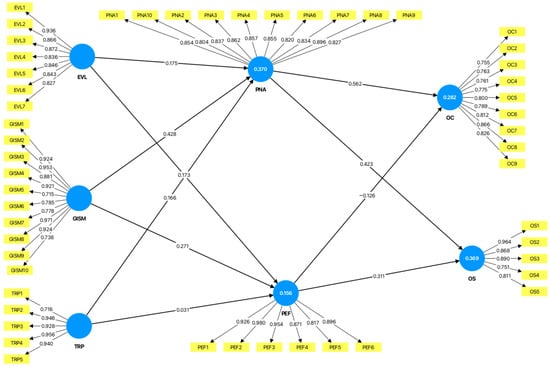
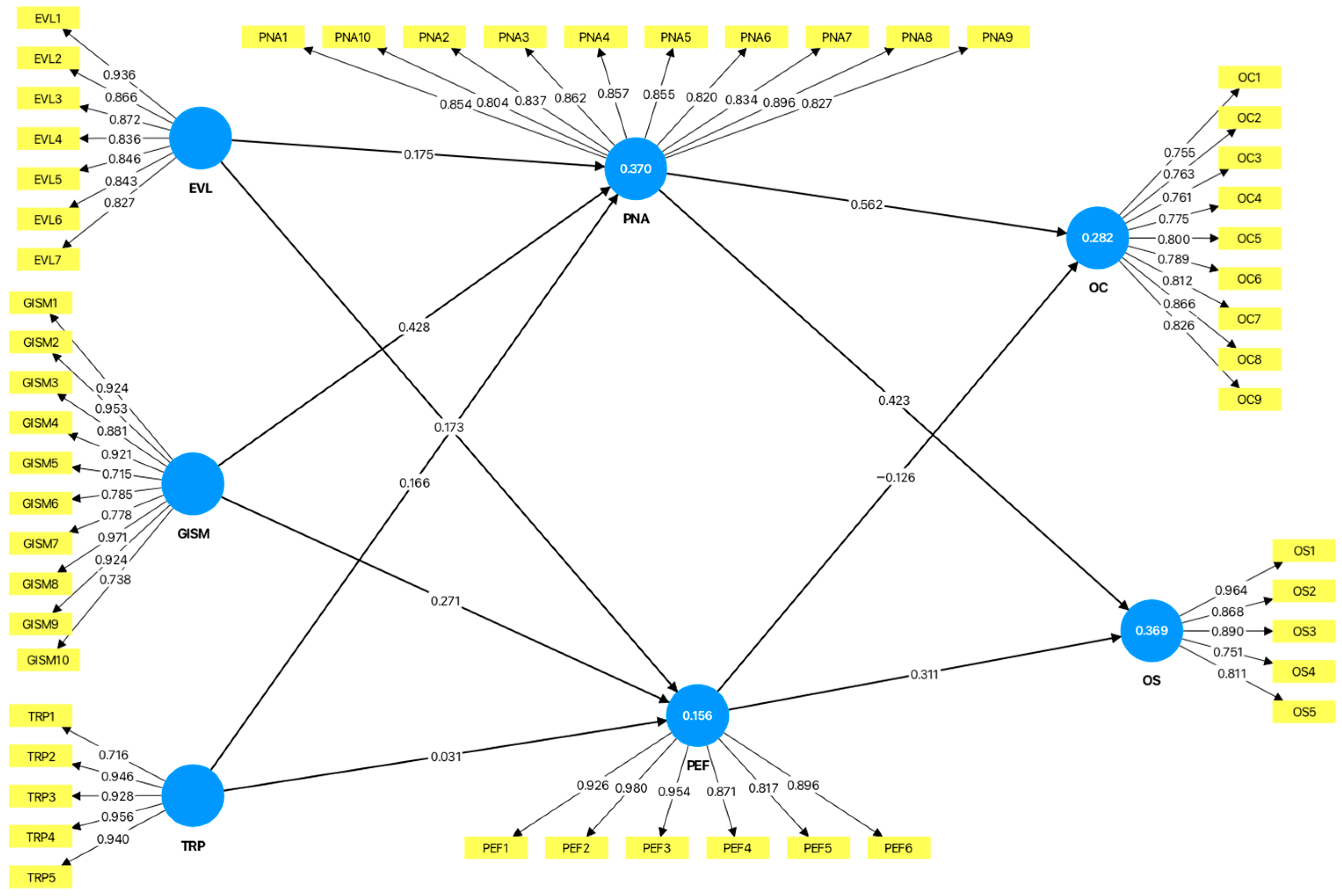
Overall, the findings underscore the pivotal roles of EVL, GISM, PNA, and PEF in explaining offset behavior, with PNA exerting the strongest influence on both offset choice and spending. These results provide strong empirical support for the theoretical framework, while also highlighting the nuanced role of Trust and Risk Perception in shaping personal norms rather than direct effectiveness evaluations, as shown in Figure 2.
Figure 2.
Results of PLS-SEM.
Overall, the structural model demonstrates that Personal Norm Activation (PNA) is the strongest predictor of both offset choice and offset spending, followed by Perceived Effectiveness (PEF). Environmental Value and Literacy (EVL) and Green Identity and Social Motives (GISM) influence offset behavior indirectly through PNA and PEF. Trust and Risk Perception (TRP) contributes primarily through moral norm activation rather than cognitive evaluation of effectiveness. These findings highlight the central role of moral obligation in shaping both participation and financial commitment in voluntary carbon offset programs.
5. Discussion
The present study examined the psychological and evaluative factors influencing tourists’ carbon offset behavior by distinguishing between offset choice (OC) and offset spending (OS). The findings underscore the central roles of Personal Norm Activation (PNA) and Perceived Effectiveness (PEF) as key determinants of sustainable offset engagement, with Environmental Value and Literacy (EVL), Green Identity and Social Motives (GISM), and Trust and Risk Perception (TRP) serving as important antecedents. Together, these results advance the literature on sustainable tourism and environmental psychology by clarifying how values, social identity, and trust translate into tangible pro-environmental actions in the context of aviation carbon offsetting.
First, EVL significantly predicted both PEF and PNA, highlighting the importance of environmental knowledge and ethical values in motivating sustainable behavior. Tourists with higher environmental literacy not only perceived carbon offset programs as more effective but also experienced stronger moral obligations to act, consistent with prior research on environmental literacy and responsible decision-making (Roach & Meeus, 2023; Težak Damijanić et al., 2023). From a practical perspective, this suggests that educational and informational interventions within the aviation sector can enhance both participation and financial commitment. For example, airlines could incorporate clear explanations of offset mechanisms and climate impacts into booking platforms or in-flight communications to strengthen both perceived effectiveness and moral engagement.
Second, GISM emerged as a strong predictor of both PEF and PNA, demonstrating the influence of social identity and peer reinforcement on pro-environmental behavior. When individuals identify with sustainability-oriented communities, they are more likely to perceive offset programs as credible and to feel morally compelled to contribute. This finding aligns with prior studies emphasizing the role of social norms and collective motives in shaping sustainable consumption (Shen et al., 2024). From a practical perspective, social marketing strategies—such as visible recognition of offset participation or community-based sustainability initiatives—may strengthen social identity and further encourage offset adoption.
Third, both PEF and PNA exerted strong effects on OC and OS, with PNA emerging as the most influential predictor. This indicates that carbon offsetting is not merely an instrumental or financial decision but is strongly rooted in moral obligation, consistent with the Value–Belief–Norm (VBN) framework (Batool et al., 2024). The combined influence of moral norms and perceived effectiveness suggests that interventions should simultaneously reinforce ethical responsibility and provide credible information about the environmental impacts of offset programs to enhance both participation and spending.
The role of TRP was more nuanced. While TRP did not significantly influence PEF, it positively affected PNA, indicating that trust primarily reinforces moral responsibility rather than cognitive evaluations of program effectiveness. This pattern suggests that, in emerging carbon markets, institutional trust alone may be insufficient to convince consumers of the tangible environmental outcomes of offset programs. Instead, trust strengthens moral obligation, which subsequently drives behavior.
This finding further suggests a decoupling between institutional trust and perceived program effectiveness in emerging carbon markets. While passengers may trust airlines or offset providers as institutions, they may lack concrete information or feedback mechanisms to evaluate whether carbon offset schemes produce measurable environmental outcomes. This supports the argument that trust in institutions does not automatically translate into cognitive beliefs about outcome effectiveness.
From a practical standpoint, improving transparency and third-party verification, although important, may not be sufficient to enhance perceived effectiveness unless accompanied by clear communication of measurable environmental impacts (e.g., quantified emission reductions, project-level outcomes, and post-purchase updates). Future interventions could therefore strengthen the relationship between trust and perceived effectiveness by providing tangible impact feedback and independent verification. Such mechanisms may help transform general institutional trust into concrete beliefs about the actual effectiveness of offset programs.
To further align the discussion with the hypothesized relationships, the findings can be interpreted in relation to each hypothesis (H1–H10). The significant effects of Environmental Value and Literacy on Personal Norm Activation (H1) and Perceived Effectiveness (H2) confirm that environmental knowledge and values activate both moral obligation and cognitive evaluations of offset effectiveness. Similarly, the strong effects of Green Identity and Social Motives on Personal Norm Activation (H3) and Perceived Effectiveness (H4) support the role of social identity and peer norms in shaping ethical motivation and perceived program credibility. Trust and Risk Perception significantly strengthened Personal Norm Activation (H5), while its non-significant effect on Perceived Effectiveness (H6) suggests that institutional trust in emerging carbon markets primarily operates through ethical rather than cognitive pathways. The strong effects of Personal Norm Activation on both offset choice (H7) and offset spending (H8) reaffirm the central role of moral obligation in driving both participation and financial commitment within the VBN framework. Finally, the significant effects of Perceived Effectiveness on offset choice (H9) and offset spending (H10) demonstrate that beliefs about the credibility and perceived impact of offset programs translate into both willingness to participate and actual monetary contributions. Together, these hypothesis-specific findings strengthen the theoretical coherence of the extended VBN model and demonstrate how value-based, identity-driven, and evaluative factors jointly shape compensatory climate actions in the context of aviation carbon offsetting.
6. Conclusions
This study investigated the psychological mechanisms underlying tourists’ carbon offset behavior in air travel by distinguishing between offset choice (OC) and offset spending (OS) within an extended Value–Belief–Norm (VBN) framework. The findings directly address the two research objectives.
First, the results demonstrate that Personal Norm Activation (PNA) and Perceived Effectiveness (PEF) are the primary drivers of both participation in carbon offset programs and the level of financial contribution. Among these factors, PNA exerts the strongest influence, indicating that carbon offsetting is largely motivated by moral obligation rather than purely instrumental considerations.
Second, Environmental Value and Literacy (EVL) and Green Identity and Social Motives (GISM) indirectly influence offset behavior through the activation of personal norms and perceptions of effectiveness. Trust and Risk Perception (TRP) strengthen moral obligation but do not directly enhance Perceived Effectiveness, suggesting that trust operates mainly through ethical pathways. This highlights a nuanced mechanism through which values, identity, and trust are translated into compensatory climate action.
Theoretically, this study extends the VBN framework by distinguishing between participation and spending behavior and by clarifying the mediating roles of moral and cognitive mechanisms in carbon offset decisions. From a practical perspective, the findings suggest that airlines and policymakers should prioritize moral framing, transparent communication of offset outcomes, and socially visible sustainability initiatives to increase both adoption and financial commitment to carbon offset programs. Together, these strategies can support the broader transition toward low-carbon air travel in emerging carbon markets.
7. Implications, Limitations, and Future Research
7.1. Implications
The findings have several theoretical and practical implications. From a theoretical perspective, this study extends the Value–Belief–Norm (VBN) theory by demonstrating how moral and evaluative processes jointly shape offset behavior in air travel (Batool et al., 2024). It further emphasizes the need to integrate cognitive, ethical, and identity-based determinants into sustainable consumption research. Regarding practical considerations, airlines and policymakers should design interventions that activate moral norms, enhance Perceived Effectiveness, and appeal to social motives. Transparency in offset projects, educational campaigns that improve environmental literacy, and social marketing strategies that position offsetting as a socially recognized behavior can increase both participation rates and financial contributions (Lee & Cho, 2025).
Managerial Applications
From a managerial perspective, the findings offer actionable guidance for the corporate aviation industry. First, airlines should seamlessly integrate carbon offset options into booking platforms using default or opt-out designs to lower participation barriers, as moral norms and Perceived Effectiveness strongly shape offset choice. Second, airlines can enhance Perceived Effectiveness by providing transparent, project-level information (e.g., certified project types, quantified emission reductions, and post-purchase impact feedback), which strengthens both trust and financial commitment. Third, corporate aviation managers can leverage social identity by recognizing offset participation (e.g., digital badges, “carbon-conscious traveler” labels, or loyalty program incentives), thereby activating social motives and reinforcing green identity. Finally, partnerships with credible third-party certifiers (e.g., T-VER, CORSIA-aligned projects) and the integration of offset contributions into corporate sustainability reporting can strengthen institutional trust and align offset programs with broader ESG strategies. Together, these managerial practices can translate psychological drivers into concrete corporate actions that enhance customer engagement with voluntary carbon offset programs.
7.2. Limitations and Future Research
Despite its contributions, this study has several limitations. First, the reliance on self-reported data may be subject to social desirability bias, potentially inflating environmentally positive responses (Zhu et al., 2024). Second, the cross-sectional design limits causal inference, suggesting the need for longitudinal or experimental approaches (Hair et al., 2017). Third, the focus on Thai air travelers may constrain generalizability, as offset behaviors may vary across cultural and regional contexts. Future research should test the model in different settings, examine mediating and moderating mechanisms (e.g., environmental concern, cultural values), and explore behavioral spillover effects, such as how offsetting influences other sustainable travel choices (Behn et al., 2025).
Author Contributions
Conceptualization, J.L. and K.K.; methodology, J.L. and K.K.; software, J.L.; validation, J.L. and K.K.; formal analysis, J.L. and K.K.; investigation, J.L. and K.K.; resources, J.L.; data curation, K.K.; writing—original draft preparation, J.L. and K.K.; writing—review and editing, J.L. and K.K.; visualization, J.L.; supervision, K.K.; project administration, J.L.; funding acquisition, K.K. All authors have read and agreed to the published version of the manuscript.
Funding
This research project was financially supported by Mahasarakham University.
Institutional Review Board Statement
The study was conducted in accordance with the Declaration of Helsinki, and approved by the Ethics Committee of Mahasarakham University Ethics Committee for Research Involving Human Subjects (ECMSU) (protocol code: 086-106/2025 and date of approval: 17 February 2025).
Informed Consent Statement
Informed consent was obtained from all individual participants included in the study.
Data Availability Statement
The original contributions presented in this study are included in the article. Further inquiries can be directed to the corresponding author.
Conflicts of Interest
The authors declare no conflicts of interest.
References
- Batool, N., Wani, M. D., Shah, S. A., & Dada, Z. A. (2024). Theory of planned behavior and value-belief norm theory as antecedents of pro-environmental behaviour: Evidence from the local community. Journal of Human Behavior in the Social Environment, 34(5), 693–709. [Google Scholar] [CrossRef] [Scilit]
- Behn, O., Wichmann, J., Leyer, M., & Schilling, A. (2025). Spillover effects in environmental behaviors: A scoping review about its antecedents, behaviors, and consequences. Current Psychology, 44, 3665–3689. [Google Scholar] [CrossRef] [Scilit]
- Berger, S., Kilchenmann, A., Lenz, O., & Schlöder, F. (2022). Willingness-to-pay for carbon dioxide offsets: Field evidence on revealed preferences in the aviation industry. Global Environmental Change, 73, 102470. [Google Scholar] [CrossRef] [Scilit]
- Chien, F. (2023). The role of technological innovation, carbon finance, green energy, environmental awareness, and urbanization towards carbon neutrality: Evidence from novel CUP-FM CUP-BC estimations. Geoscience Frontiers, 10, 101696. [Google Scholar] [CrossRef] [Scilit]
- Cordes, H., Baumeister, S., & Käyrä, M. (2024). Factors influencing the willingness to pay for aviation voluntary carbon offsets: A literature review. European Journal of Tourism Research, 36, 3602. [Google Scholar] [CrossRef] [Scilit]
- Deng, P., Zheng, P., & Xie, D. (2026). Carbon offset payment intentions in the aviation industry: Altruism vs. egoism and airline sustainability. Tourism Review, 81(1), 294–316. [Google Scholar] [CrossRef] [Scilit]
- Dütschke, E., Preuß, S., Brunzema, I., & Piria, R. (2023). Using the revenues from carbon pricing—Insights into the acceptance and perceptions of particularly burdened groups. Energy Policy, 175, 113468. [Google Scholar] [CrossRef] [Scilit]
- Elia, G., Margherita, A., & Petti, C. (2020). Building responses to sustainable development challenges: A multistakeholder collaboration framework and application to climate change. Business Strategy and the Environment, 29(6), 2465–2478. [Google Scholar] [CrossRef] [Scilit]
- Fornell, C., & Larcker, D. F. (1981). Evaluating structural equation models with unobservable variables and measurement error. Journal of Marketing Research, 18(1), 39–50. [Google Scholar] [CrossRef] [Scilit]
- Gössling, S., & Scott, D. (2025). Tourist demand and destination development under climate change: Complexities and perspectives. Journal of Sustainable Tourism, 1–31. [Google Scholar] [CrossRef] [Scilit]
- Hair, J., Hollingsworth, C. L., Randolph, A. B., & Chong, A. Y. L. (2017). An updated and expanded assessment of PLS-SEM in information systems research. Industrial Management & Data Systems, 117(3), 442–458. [Google Scholar] [CrossRef] [Scilit]
- Henseler, J., Ringle, C. M., & Sarstedt, M. (2015). A new criterion for assessing discriminant validity in variance-based structural equation modeling. Journal of the Academy of Marketing Science, 43(1), 115–135. [Google Scholar] [CrossRef] [Scilit]
- Hu, L. T., & Bentler, P. M. (1999). Cutoff criteria for fit indexes in covariance structure analysis: Conventional criteria versus new alternatives. Structural Equation Modeling, 6(1), 1–55. [Google Scholar] [CrossRef] [Scilit]
- IATA. (2024). Annual review 2023 making sustainability an industry priority. Available online: https://www.iata.org/contentassets/c81222d96c9a4e0bb4ff6ced0126f0bb/annual-review-2023.pdf (accessed on 16 July 2025).
- Kim, H., Lee, Y., Koo, J.-H., & Yeo, M. J. (2025). Changes in future carbon dioxide emissions and contributing factors in Southeast Asia under the shared socioeconomic pathways. Energy for Sustainable Development, 86, 101721. [Google Scholar] [CrossRef] [Scilit]
- Lee, J., & Cho, M.-J. (2025). Online job scams: Unveiling the impact of overconfidence, digital literacy, and algorithmic literacy on user susceptibility to false job advertisements. New Media & Society. Advance online publication. [Google Scholar] [CrossRef] [Scilit]
- Leenoi, P. (2023). Carbon credits: A mechanism for achieving sustainability targets. Krungsri. Available online: https://www.krungsri.com/en/research/research-intelligence/carbon-credit-2023 (accessed on 15 June 2025).
- Liao, W., Fan, Y., & Wang, C. (2023). Exploring the equity in allocating carbon offsetting responsibility for international aviation. Transportation Research Part D: Transport and Environment, 114, 103566. [Google Scholar] [CrossRef] [Scilit]
- Loureiro, S. M. C., Guerreiro, J., & Han, H. (2022). Past, present, and future of pro-environmental behavior in tourism and hospitality: A text-mining approach. Journal of Sustainable Tourism, 30(1), 258–278. [Google Scholar] [CrossRef] [Scilit]
- Nunnally, J. C. (1978). An overview of psychological measurement. In B. B. Wolman (Ed.), Clinical diagnosis of mental disorders: A handbook (pp. 97–146). Springer. [Google Scholar] [CrossRef] [Scilit]
- Pongthanaisawan, J., Wangjiraniran, W., & Nakapreecha, N. (2023). Thailand energy scenarios: Pathways towards carbon neutrality 2050. International Journal of Energy Economics and Policy, 13(1), 489–500. [Google Scholar] [CrossRef] [Scilit]
- Reyes-García, V., García-del-Amo, D., Álvarez-Fernández, S., Benyei, P., Calvet-Mir, L., Junqueira, A. B., Labeyrie, V., Li, X., Miñarro, S., Porcher, V., Porcuna-Ferrer, A., Schlingmann, A., Schunko, C., Soleymani, R., Tofighi-Niaki, A., Abazeri, M., Attoh, E. M. N. A. N., Ayanlade, A., Ávila, J. V. D. C., & Samakov, A. (2024). Indigenous peoples and local communities report ongoing and widespread climate change impacts on local social-ecological systems. Communications Earth and Environment, 5(1), 29. [Google Scholar] [CrossRef] [Scilit]
- Roach, M., & Meeus, L. (2023). An energy system model to study the impact of combining carbon pricing with direct support for renewable gases. Ecological Economics, 210, 107855. [Google Scholar] [CrossRef] [Scilit]
- Rodemeier, M. (2026). Willingness to pay for carbon mitigation: Field evidence from the market for carbon offsets. The Review of Financial Studies, 39(1), 1–29. [Google Scholar] [CrossRef] [Scilit]
- Schleich, J., & Alsheimer, S. (2024). The relationship between willingness to pay and carbon footprint knowledge: Are individuals willing to pay more to offset their carbon footprint if they learn about its size and distance to the 1.5 °C target? Ecological Economics, 219, 108151. [Google Scholar] [CrossRef] [Scilit]
- Shen, J., Zhang, L., & Liu, Y. (2024). Individuals’ social identity and pro-environmental behaviors. Sustainability, 16(24), 11299. [Google Scholar] [CrossRef] [Scilit]
- Stloukal, B., Hospodka, J., & Nagy, I. (2025). Effect of COVID-19 pandemic on aircraft emissions at Václav Havel Airport Prague in 2020. Atmosphere, 16(3), 296. [Google Scholar] [CrossRef] [Scilit]
- Težak Damijanić, A., Pičuljan, M., & Goreta Ban, S. (2023). The role of pro-environmental behavior, environmental knowledge, and eco-labeling perception in relation to travel intention in the hotel industry. Sustainability, 15(13), 10103. [Google Scholar] [CrossRef] [Scilit]
- Thai Greenhouse Gas Management Organization (TGO). (2024). Carbon credit price, volume, and transaction value from the T-VER project. Available online: https://carbonmarket.tgo.or.th/index.php?lang=TH&mod=aG9tZQ== (accessed on 1 February 2026).
- van den Bergh, J., van Beers, C., & King, L. C. (2024). Prioritize carbon pricing over fossil-fuel subsidy reform. iScience, 27(1), 108584. [Google Scholar] [CrossRef] [Scilit] [PubMed]
- Vujko, A., Karabašević, D., Panić, A., Arsić, M., & Mirčetić, V. (2025). AI transparency and sustainable travel under climate risk: A geographical perspective on trust, spatial decision-making, and rural destination resilience. Sustainability, 17(24), 11200. [Google Scholar] [CrossRef] [Scilit]
- Zhu, O. Y., Greene, D., & Dolnicar, S. (2024). Should the risk of social desirability bias in survey studies be assessed at the level of each pro-environmental behaviour? Tourism Management, 104, 104933. [Google Scholar] [CrossRef] [Scilit]
- Zhumadilova, A., Zhigitova, S., & Turalina, M. (2023). The impact of greenhouse gases on climate change. Scientific Horizons, 26(6), 97–109. [Google Scholar] [CrossRef] [Scilit]

Disclaimer/Publisher’s Note: The statements, opinions and data contained in all publications are solely those of the individual author(s) and contributor(s) and not of MDPI and/or the editor(s). MDPI and/or the editor(s) disclaim responsibility for any injury to people or property resulting from any ideas, methods, instructions or products referred to in the content. |
© 2026 by the authors. Licensee MDPI, Basel, Switzerland. This article is an open access article distributed under the terms and conditions of the Creative Commons Attribution (CC BY) license.