
Desire and Behavioral Intention in Sharing Accommodation: Hedonic and Economic Benefits as Mediators and Perceived Risk and Materialism as Moderators



Abstract
1. Introduction
- RQ1: Does desire affect behavioral intention to use sharing accommodation?
- RQ2: Do hedonic and economic benefits mediate the relationship between desire and behavioral intention to use sharing accommodation?
- RQ3: Do perceived risk and materialism have moderating effects on behavioral intention to use sharing accommodation?
2. Theoretical Background
2.1. Model of Goal-Directed Behavior (GDB)
2.2. Hypotheses Development
2.2.1. The Relationship Between Desire and Behavioral Intention
2.2.2. The Relationship Between Desire and Hedonic Benefits
2.2.3. The Relationship Between Hedonic Benefits and Behavioral Intention
2.2.4. Hedonic Benefits as a Mediator
2.2.5. The Relationship Between Desire and Economic Benefits
2.2.6. Relationship Between Economic Benefits and Behavioral Intention
2.2.7. Economic Benefits as a Mediator
2.2.8. Moderated Moderated-Mediation of Perceived Risk and Materialism Between Desire, Hedonic Benefits, and Behavioral Intention
2.2.9. Moderated-Mediation of Perceived Risk Between Desire, Economic Benefits, and Behavioral Intention
3. Method and Materials
3.1. Measures
3.2. Sample Selection and Size
3.3. Data Analytic Technique
3.4. Preliminary Statistical Techniques
3.4.1. Multicollinearity
3.4.2. Common Method Bias (CMB)
4. Results
4.1. Measurement Model
4.2. Hypotheses Testing
4.3. Testing Hypotheses 5, 6, and 7
4.4. Hypothesis Testing of Perceived Risk as a Moderator
5. Discussion
5.1. Theoretical Implications
5.2. Practical Implications
5.3. Limitations and Future Research
6. Conclusions
Author Contributions
Funding
Institutional Review Board Statement
Informed Consent Statement
Data Availability Statement
Conflicts of Interest
References
- Ajzen, I. (1991). The theory of planned behaviour. Organizational Behaviour and Human Decision Processes, 50(2), 179–211. [Google Scholar] [CrossRef]
- Aritenang, A. F. (2025). Impact of COVID-19 on Airbnb occupancy rate in Bandung, Indonesia. Journal of Urban Management, 14(1), 147–159. [Google Scholar] [CrossRef]
- Armstrong, J. S., & Overton, T. S. (1977). Estimating nonresponse bias in mail surveys. Journal of Marketing Research, 14(3), 396–402. [Google Scholar] [CrossRef]
- Arnold, M. J., & Reynolds, K. E. (2003). Hedonic shopping motivations. Journal of Retailing, 79(2), 77–95. [Google Scholar] [CrossRef]
- Asadi, S., Nilashi, M., Samad, S., Abdullah, R., Mahmoud, M., Alkinani, M. H., & Yadegaridehkordi, E. (2021). Factors impacting consumers’ intention toward adoption of electric vehicles in Malaysia. Journal of Cleaner Production, 282, 124474. [Google Scholar] [CrossRef]
- Bagozzi, R. P. (1992). The self-regulation of attitudes, intentions, and behavior. Social Psychology Quarterly, 55(2), 178–204. [Google Scholar] [CrossRef]
- Bamberg, S., Hunecke, M., & Blöbaum, A. (2007). Social context, personal norms and the use of public transportation: Two field studies. Journal of Environment Psychology, 27, 190–203. [Google Scholar] [CrossRef]
- Barnes, S. J., & Mattsson, J. (2016). Understanding current and future issues in collaborative consumption: A four-stage Delphi study. Technological Forecasting and Social Change, 104, 200–211. [Google Scholar] [CrossRef]
- Barry, J. B., Darden, W. R., & Grrffin, A. M. (1994). Measuring hedonic and utilitarian shopping value. Journal of Consumer Research, 20(4), 644–656. [Google Scholar] [CrossRef]
- Bauer, R. A. (1960). Consumer behavior as risk taking. In R. S. Hancock (Ed.), Dynamic marketing for a changing world (pp. 389–398). American Marketing Association. [Google Scholar]
- Belk, R. (2009). Sharing. Journal of Consumer Research, 36, 715–734. [Google Scholar] [CrossRef]
- Belk, R. (2014). Sharing versus pseudo-sharing in Web 2.0. The Anthropologist, 18(1), 7–23. [Google Scholar] [CrossRef]
- Belk, R. W. (1984). Three scales to measure constructs related to materialism: Reliability, validity, and relationships to measures of happiness. Advances in Consumer Research, 11, 291–297. [Google Scholar]
- Botsman, R., & Rogers, R. (2010). What’s mine is yours: The rise of collaborative consumption. Harpers Collins. [Google Scholar]
- Browne, M. W., & Cudeck, R. (1993). Alternative ways of assessing model fit. In K. A. Bollen, & J. S. Long (Eds.), Testing structural equation models (pp. 136–162). Sage. [Google Scholar]
- Chitturi, R., Raghunathan, R., & Mahajan, V. (2008). Delight by design: The role of hedonic versus utilitarian benefits. Journal of Marketing, 72(1), 48–63. [Google Scholar] [CrossRef]
- Chiu, W., Oh, G.-E., & Cho, H. (2022). Impact of COVID-19 on consumers’ impulse buying behavior of fitness products: A moderated mediation model. Journal of Consumer Behavior, 21(2), 245–258. [Google Scholar] [CrossRef] [PubMed]
- Chung, N., Lee, H., Lee, S. J., & Koo, C. (2015). The influence of tourism web site on tourists ‘behavior to determine destination selection: A case study of creative economy in Korea. Technological Forecasting and Social Change, 96(1), 130–143. [Google Scholar] [CrossRef]
- Cohen, B., & Munoz, P. (2016). Sharing cities and sustainable consumption and production: Towards an integrated framework. Journal of Cleaner Production, 134(1), 87–97. [Google Scholar] [CrossRef]
- Comrey, A. L., & Lee, H. B. (1992). A first course in factor analysis (2nd ed.). Lawrence Erlbaum. [Google Scholar]
- Cui, F., Liu, Y., Chang, Y., Duan, J., & Li, J. (2016). An overview of tourism risk perception. Natural Hazards, 82(1), 643–658. [Google Scholar] [CrossRef]
- Dabbous, A., & Tarhini, A. (2019). Assessing the impact of knowledge and perceived economic benefits on sustainable consumption through the sharing economy: A sociotechnical approach. Technological Forecasting and Social Change, 149, 119775. [Google Scholar] [CrossRef]
- Davidson, A., Habibi, M. R., & Laroche, M. (2017). Materialism and the sharing economy: A cross-cultural study of American and Indian consumers. Journal of Business Research, 82, 364–372. [Google Scholar] [CrossRef]
- Ert, E., Fleischer, A., & Magen, N. (2016). Trust and reputation in the sharing economy: The role of personal photos in Airbnb. Tourism Management, 55(1), 62–73. [Google Scholar] [CrossRef]
- Felson, M., & Spaeth, J. L. (1978). Community structure and collaborative consumption: A routine activity approach. The American Behavioral Scientist, 21(4), 614–624. [Google Scholar] [CrossRef]
- Fornell, C., & Larcker, D. (1981). Evaluating structural equation models with unobservable variables and measurement error. Journal of Marketing Research, 18(1), 39–50. [Google Scholar] [CrossRef]
- Forouhar, A., Chapple, K., Allen, J., Jeong, B., & Greenberg, J. (2025). Assessing downtown recovery rates and determinants in North American cities after the COVID-19 pandemic. Urban Studies, 62(6), 1209–1231. [Google Scholar] [CrossRef]
- French, A. M., Luo, X. R., & Bose, R. (2017). Toward a holistic understanding of continued use of social networking tourism: A mixed-methods approach. Information & Management, 54(6), 802–813. [Google Scholar] [CrossRef]
- Gerwe, O. (2021). The COVID-19 pandemic and the accommodation sharing sector: Effects and prospects for recovery. Technological Forecasting & Social Change, 167, 120733. [Google Scholar] [CrossRef]
- Goel, P., Garg, A., Sharma, A., & Rana, N. P. (2022a). I won’t touch money because it is dirty: Examining customer’s loyalty toward M-payment. International Journal of Bank Marketing, 40(5), 992–1016. [Google Scholar] [CrossRef]
- Goel, P., Garg, A., Walia, N., Kaur, R., Jain, M., & Singh, S. (2022b). Contagious diseases and tourism: A systematic review based on bibliometric and content analysis methods. Quality & Quantity, 56(5), 3085–3110. [Google Scholar]
- Goel, P., & Parayitam, S. (2024). Antecedents of behavioral intention and use of shared accommodation: Gender as a moderator. Tourism and Hospitality Management, 30(1), 105–118. [Google Scholar] [CrossRef]
- Gossling, S., Scott, D., & Hall, C. M. (2020). Pandemics, tourism and global change: A rapid assessment of COVID-19. Journal of Sustainable Tourism, 29(1), 1–20. [Google Scholar] [CrossRef]
- Guttentag, D. (2015). Airbnb: Disruptive innovation and the rise of informal tourism accommodation sector. Current Issues in Tourism, 18(12), 1192–1217. [Google Scholar] [CrossRef]
- Guttentag, D. (2019). Progress on Airbnb: A literature review. Journal of Hospitality and Tourism Technology, 10(4), 814–844. [Google Scholar] [CrossRef]
- Guttentag, D., Smith, S., Potwarka, L., & Havitz, M. (2018). Why tourists choose Airbnb: A motivation-based segmentation study. Journal of Travel Research, 57(3), 342–359. [Google Scholar] [CrossRef]
- Hair, J. F., Risher, J. J., Sarstedt, M., & Ringle, C. M. (2019). When to use and how to report the results of PLS-SEM. European Business Review, 31(1), 2–24. [Google Scholar] [CrossRef]
- Hamari, J., Sjöklint, M., & Ukkonen, A. (2016). The sharing economy: Why people participate in collaborative consumption. Journal of the Association for Information Science and Technology, 67(9), 2047–2059. [Google Scholar] [CrossRef]
- Hawley, A. (1950). Human ecology: A theory of community structure. Ronald Press. [Google Scholar]
- Hayes, A. F. (2018). Introduction to mediation, moderation, and conditional process analysis: A regression-based approach. The Guilford Press. [Google Scholar]
- Hirschman, E. C., & Holbrook, M. B. (1982). Hedonic consumption: Emerging concepts, methods and propositions. Journal of Marketing, 46(1), 92–101. [Google Scholar] [CrossRef]
- Hong, J. C., Lin, P. H., & Hsieh, P. C. (2017). The effect of consumer innovativeness on perceived value and continuance intention to use smartwatch. Computers in Human Behavior, 67, 264–272. [Google Scholar] [CrossRef]
- Hong, S.-J., & Tam, K. Y. (2006). Understanding the adoption of multipurpose information appliances. The case of mobile data services. Information Systems Research, 17(2), 162–179. [Google Scholar] [CrossRef]
- Howard, M. C., Boudreaux, M., & Oglesby, M. (2024). Can Harman’s single-factor test reliably distinguish between research designs? Not in published management studies. European Journal of Work and Organizational Psychology, 33(6), 790–804. [Google Scholar] [CrossRef]
- Huang, C., & Chen, T. (2015). Moral norm and the two-component theory of planned behavior model in predicting knowledge sharing intention: A role of mediator desire. Psychology, 6, 1685–1699. [Google Scholar] [CrossRef]
- Hwang, J., Kim, H., & Kim, W. (2019). Investigating motivated consumer innovativeness in the context of drone food delivery services. Journal of Hospitality and Tourism Management, 38(1), 102–110. [Google Scholar] [CrossRef]
- Jiang, G., Yang, W., & Zhang, N. (2025). Effect of perceived risks, perceived benefits and regulatory events on users’ supervision intention towards e-hailing platforms: A mixed method. Journal of Information Science, 51(1), 50–72. [Google Scholar] [CrossRef]
- Kement, U., Çavuşoğlu, S., Demirağ, B., Durmaz, Y., & Bükey, A. (2022). Effect of perception of COVID-19 and nonpharmaceutical intervention on desire and behavioral intention in touristic travels in Turkey. Journal of Hospitality and Tourism Insights, 5(1), 230–249. [Google Scholar] [CrossRef]
- Kock, N. (2015). Common method bias in PLS-SEM: A full collinearity assessment approach. International Journal of e-Collaboration, 11, 1–10. [Google Scholar] [CrossRef]
- Koo, C., & Chung, N. (2014). Examining the eco-technological knowledge of smart green it adoption behavior: A self-determination perspective. Technological Forecasting and Social Change, 88(1), 140–155. [Google Scholar] [CrossRef]
- Krejcie, R. V., & Morgan, D. W. (1970). Determining sample size for research activities. Educational Psychological Measurement, 30(3), 607–610. [Google Scholar] [CrossRef]
- Lamberton, C. P., & Rose, R. L. (2012). When is ours better than mine? A framework for understanding and altering participation in commercial sharing systems. Journal of Marketing, 76(1), 109–125. [Google Scholar] [CrossRef]
- Lee, S., & Kim, D.-Y. (2018). The effect of hedonic and utilitarian values on satisfaction and loyalty of Airbnb users. International Journal of Contemporary Hospitality Management, 30(3), 1332–1351. [Google Scholar] [CrossRef]
- Lee, Z. W. Y., Chan, T. K. H., Balaji, M. S., & Chong, A. Y.-L. (2018). Why people participate in the sharing economy: An empirical investigation of Uber. Internet Research, 28(3), 829–850. [Google Scholar] [CrossRef]
- Leone, L., Perugini, M., & Ercolani, A. P. (2006). Studying, practicing, and mastering: A test of the model of goal-directed behavior (MGB) in the software learning domain. Journal of Applied Social Psychology, 34(9), 1945–1973. [Google Scholar] [CrossRef]
- Li, Y. Q., Li, R., Ruan, W. Q., & Zhang, S. N. (2025). Releasing happiness: Influencing factors and configuration paths of shared accommodation customers’ positive emotions. Tourism Management, 108, 105113. [Google Scholar] [CrossRef]
- Liang, L., Choi, H., & Joppe, M. (2018). Understanding repurchase intention of Airbnb consumers: Perceived authenticity, electronic word-of-mouth, and price sensitivity. Journal of Travel and Tourism Marketing, 35(1), 73–89. [Google Scholar] [CrossRef]
- Lieber, R. (2015). Airbnb horror story points to need for precautions. The New York Times. Available online: http://www.nytimes.com/2015/08/15/your-money/airbnb-horror-story-points-to-need-for-precautions.html (accessed on 1 December 2025).
- Lim, W. M. (2020). The sharing economy: A marketing perspective. Australasian Marketing Journal, 28(1), 4–13. [Google Scholar] [CrossRef]
- Lin, G., Chen, J. L., Li, G., & Song, H. (2024). Substitution between sharing accommodation and hotels: A behavioral economic demand curve analysis. Annals of Tourism Research, 104, 103716. [Google Scholar] [CrossRef]
- Lutz, C., Hoffmann, C. P., Bucher, E., & Fieseler, C. (2018). The role of privacy concerns in the sharing economy. Information, Communication & Society, 21(10), 1472–1492. [Google Scholar]
- Mahadevan, R. (2018). Examination of motivations and attitudes of peer-to-peer users in the accommodation sharing economy. Journal of Hospitality Marketing & Management, 27(6), 679–692. [Google Scholar] [CrossRef]
- Mao, Z., & Lyu, J. (2017). Why travelers use Airbnb again? An integrative approach to understanding travelers’ repurchase intention. International Journal of Contemporary Hospitality and Management, 29(9), 2464–2482. [Google Scholar] [CrossRef]
- Molinari, L. K., Abratt, R., & Dion, P. (2008). Satisfaction, quality and value and effects on repurchase and positive word-of-mouth behavioral intentions in a B2B services context. Journal of Services Marketing, 22(5), 363–373. [Google Scholar] [CrossRef]
- Moreno-Gil, S., & Coca-Stefaniak, J. A. (2020). Overtourism and the sharing economy—Tourism cities at a crossroads. International Journal of Tourism Cities, 6(1), 1–14. [Google Scholar] [CrossRef]
- Narasimhan, C., Papatla, P., Jiang, B., Kopalle, P. K., Messinger, P. R., Moorthy, S., Proserpio, D., Subramanian, U., & Wu, C. (2018). Sharing economy: Review of current research and future directions. Customer Needs and Solutions, 5(9), 93–106. [Google Scholar] [CrossRef]
- Obeidat, M., & Almatarney, A. (2020). Risk perceptions among potential Airbnb hosts. Ethics and Economics, 17(2), 74–87. [Google Scholar]
- Okada, E. M. (2005). Justification effects on consumer choice of hedonic and utilitarian goods. Journal of Marketing Research, 42(1), 43–53. [Google Scholar] [CrossRef]
- Oliver, R. L. (1997). Satisfaction: A behavioral perspective on the consumer. McGraw-Hill. [Google Scholar]
- Overby, J. W., & Lee, E. J. (2006). The effects of utilitarian and hedonic online shopping value on consumer preference and intentions. Journal of Business Research, 59(1), 1160–1166. [Google Scholar] [CrossRef]
- Pappas, N. (2017). The complexity of purchasing intensions in peer-to-peer accommodation. International Journal of Contemporary Hospitality Management, 29(9), 2302–2321. [Google Scholar] [CrossRef]
- Perugini, M., & Bagozzi, R. P. (2001). The role of desires and anticipated emotions in goal-directed behaviours: Broadening and deepening the theory of planned behaviour. British Journal of Social Psychology, 40(1), 79–98. [Google Scholar] [CrossRef] [PubMed]
- Podsakoff, P. M., Mackenzie, S. B., Lee, J.-Y., & Podsakoff, N. P. (2003). Common method biases in behavioral research: A critical review of the literature and recommended remedies. Journal of Applied Psychology, 88(5), 879–903. [Google Scholar] [CrossRef]
- Podsakoff, P. M., Podsakoff, N. P., Williams, L. J., Huang, C., & Yang, J. (2024). Common method bias: It’s bad, it’s complex, it’s widespread, and it’s not easy to fix. Annual Review of Organizational Psychology and Organizational Behavior, 11(1), 17–61. [Google Scholar] [CrossRef]
- Ponchio, M. C., & Aranha, F. (2008). Materialism as a predictor variable of low-income consumer behavior when entering into installment plan agreements. Journal of Consumer Behaviour, 7(1), 21–34. [Google Scholar] [CrossRef]
- Poon, K. Y., & Huang, W.-J. (2017). Past experience, traveler personality and tripographics on intention to use Airbnb. International Journal of Contemporary Hospitality Management, 29(9), 2425–2443. [Google Scholar] [CrossRef]
- Powanga, A., & Powanga, L. (2008). An economic analysis of a timeshare ownership. Journal of Retail and Leisure Property, 7(1), 69–83. [Google Scholar] [CrossRef]
- Prebensen, N. K., & Rosengren, S. (2016). Experience value as a function of hedonic and utilitarian dominant services. International Journal of Contemporary Hospitality Management, 28(1), 113–135. [Google Scholar] [CrossRef]
- Reio, T., Parayitam, S., Aruldoss, A., Mariyapragasam, M., & Ramasamy, P. (2025). Effect of organizational climate on employee withdrawal behaviour and job satisfaction: Training and development and teamwork as moderators. Human Resource Development International. [Google Scholar] [CrossRef]
- Richins, M. L. (2004). The material values scale: Measurement properties and development of a short Form. Journal of Consumer Research, 31, 209–219. [Google Scholar] [CrossRef]
- Richins, M. L., & Dawson, S. (1992). A consumer values orientation for materialism and its measurement: Scale development and validation. Journal of Consumer Research, 19, 303–316. [Google Scholar] [CrossRef]
- Rudmin, F. (2016). The customer science of sharing: A discussant’s observations. Journal of the Association for Consumer Research, 1(2), 198–209. [Google Scholar] [CrossRef]
- Skare, M., Soriano, D. R., & Porada-Rochon, M. (2021). Impact of COVID-19 on the travel and tourism industry. Technological Forecasting & Social Change, 163, 120469. [Google Scholar] [CrossRef]
- Song, H. J., Lee, C. K., Norman, W. C., & Han, H. (2012). The role of responsible gambling strategy informing behavioral intention: An application of a model of goal directed behavior. Journal of Travel Research, 51(4), 512–523. [Google Scholar] [CrossRef]
- Sweeney, J. C., Soutar, G. N., & Johnson, L. W. (1999). The role of perceived risk in the quality-value relationship: A study in a retail environment. Journal of Retailing, 75(1), 77–105. [Google Scholar] [CrossRef]
- Tian, Y., Zhang, H., Xiao, X., Wei, G., & Cao, X. (2021). Measuring perceived risk in sharing economy: A classical test theory and item response theory approach. International Journal of Hospitality Management, 96, 102980. [Google Scholar] [CrossRef]
- Trompenaars, F., & Coebergh, P. H. (2014). 100+ Management models: How to understand and apply the world’s most powerful business tools. Infinite Ideas. [Google Scholar]
- Tsou, H.-T., Chen, J.-S., Chou, C. Y., & Chen, T.-W. (2019). Sharing economy service experience and its effects on behavioral intention. Sustainability, 11, 5050. [Google Scholar] [CrossRef]
- Tsui, A. S., Ashford, S. J., Clair, L. S. T., & Xin, K. R. (1995). Dealing with discrepant expectations: Response strategies and managerial effectiveness. Academy of Management Journal, 38(6), 1515–1543. [Google Scholar] [CrossRef]
- Turel, O., Serenko, A., & Bontis, N. (2010). User acceptance of hedonic digital artifacts: A theory of consumption values perspective. Information & Management, 47(1), 53–59. [Google Scholar] [CrossRef]
- Tussyadiah, I. P. (2015). An exploratory on drivers and deterrents of collaborative consumption in travel. In I. Tussyadiah, & A. Inversini (Eds.), Information & communication technologies in tourism 2015. Springer International Publishing. [Google Scholar]
- Tussyadiah, I. P. (2016). Factors of satisfaction and intention to use peer-to-peer accommodation. International Journal of Hospitality Management, 55(1), 70–80. [Google Scholar] [CrossRef]
- Tussyadiah, I. P., & Pesonen, J. (2016). Impacts of peer-to-peer accommodation use on travel patterns. Journal of Travel Research, 55(8), 1022–1040. [Google Scholar] [CrossRef]
- Venkatesh, V., & Davis, F. D. (2000). A theoretical extension of the technology acceptance model: Four longitudinal field studies. Management Science, 46(2), 186–204. [Google Scholar] [CrossRef]
- Watson, J. J. (2003). The relationship of materialism to spending tendencies, saving, and debt. Journal of Economic Psychology, 24, 723–739. [Google Scholar] [CrossRef]
- Wu, C. W. D., & Cheng, W. L. A. (2019). Differences in perception on safety and security by travelers of Airbnb and licensed properties. Current Issues in Tourism, 22(1), 3092–3097. [Google Scholar] [CrossRef]
- Yi, J., Yuan, G., & Yoo, C. (2020). The effect of the perceived risk on the adoption of the sharing economy in the tourism industry: The case of Airbnb. Information Processing and Management, 57, 102108. [Google Scholar] [CrossRef]
- Yoo, C., Kwon, S., Na, H., & Chang, B. (2017). Factors affecting the adoption of gamified smart tourism applications: An integrative approach. Sustainability, 9(12), 2162. [Google Scholar] [CrossRef]



| Constructs and the Sources of the Constructs | Alpha | VIF Values | Standardized Loadings (λyi) | Reliability (λ2yi) | Variance (Var(εi)) | Average Variance- Extracted Estimate Σ (λ2yi)/ [(λ2yi) + (Var(εi))] |
|---|---|---|---|---|---|---|
| Desire (Hwang et al., 2019; Yi et al., 2020) | 0.92 | 0.81 | ||||
| I desire to book peer to peer accommodations like (Airbnb, OYO, etc.) whenever I need to stay outstation. | 2.248 | 0.89 | 0.80 | 0.20 | ||
| Whenever I go out of station, it’s my desire to use peer to peer accommodations (Airbnb, OYO, etc.) if it is available. | 3.056 | 0.92 | 0.85 | 0.15 | ||
| If I travel, I want to stay in peer-to-peer accommodations (Airbnb, OYO, etc.). | 2.094 | 0.91 | 0.83 | 0.17 | ||
| If I can choose peer to peer accommodations (Airbnb, OYO, etc.) in the near future, I won’t miss the opportunity. | 3.782 | 0.87 | 0.76 | 0.24 | ||
| Hedonic Benefits (Hwang et al., 2019) | 0.89 | 0.83 | ||||
| Choosing peer to peer accommodations (Airbnb, OYO, etc.) will make my life exciting and stimulating. | 2.104 | 0.91 | 0.83 | 0.17 | ||
| Choosing peer to peer accommodations (Airbnb, OYO, etc.) will give me a good feeling. | 1.958 | 0.92 | 0.85 | 0.15 | ||
| Choosing peer to peer accommodations (Airbnb, OYO, etc.) will give me a sense of personal enjoyment. | 3.164 | 0.90 | 0.81 | 0.19 | ||
| Economic Benefits (Dabbous & Tarhini, 2019; Mahadevan, 2018) | 0.91 | 0.71 | ||||
| I can save money if I stay in peer-to-peer accommodations (Airbnb, OYO, etc.). | 2.753 | 0.85 | 0.72 | 0.28 | ||
| My stay in the sharing accommodation can improve my economic situation. | 2.761 | 0.79 | 0.63 | 0.37 | ||
| Staying in peer-to-peer accommodations (Airbnb, OYO, etc.) is cheaper than other options available in the market. | 1.708 | 0.86 | 0.73 | 0.27 | ||
| Due to cost saving in peer-to-peer accommodations (Airbnb, OYO, etc.), I can consider staying longer | 2.350 | 0.85 | 0.72 | 0.28 | ||
| Due to cost saving in peer-to-peer accommodations (Airbnb, OYO, etc.), I can have more to spend during my trip. | 3.095 | 0.88 | 0.77 | 0.23 | ||
| Due to cost saving in peer-to-peer accommodations (Airbnb, OYO, etc.), I can travel more frequently | 2.761 | 0.81 | 0.65 | 0.35 | ||
| Perceived Risk (Mahadevan, 2018) | 0.86 | 0.63 | ||||
| I feel risk of my loss of privacy while staying in peer-to-peer accommodations (Airbnb, OYO, etc.). | 2.063 | 0.75 | 0.57 | 0.43 | ||
| While staying in peer-to-peer accommodations (Airbnb, OYO, etc.). I feel risk about my health safety. | 1.729 | 0.74 | 0.55 | 0.45 | ||
| In peer-to-peer accommodations (Airbnb, OYO, etc.), I feel risk of fake reviews posted on hosts. | 1.386 | 0.85 | 0.72 | 0.28 | ||
| I feel that fake reviews are posted on hosts about peer-to-peer accommodations (Airbnb, OYO, etc.). | 1.667 | 0.81 | 0.66 | 0.34 | ||
| I perceive risk regarding cancellations and refunds in peer-to-peer accommodations (Airbnb, OYO, etc.). | 2.063 | 0.82 | 0.68 | 0.32 | ||
| Materialism (Ponchio & Aranha, 2008) | 0.87 | 0.65 | ||||
| I like to spend money on premium hotels during my stays. | 3.724 | 0.83 | 0.68 | 0.32 | ||
| I like to stay in places that impress others. | 3.852 | 0.80 | 0.65 | 0.35 | ||
| I’d be much happier if I could afford to stay at premium hotels | 2.738 | 0.79 | 0.62 | 0.38 | ||
| I like a lot of luxury in my life. | 4.062 | 0.83 | 0.70 | 0.30 | ||
| It bothers me if I can’t stay in the premium hotel that I like. | 3.095 | 0.78 | 0.61 | 0.39 | ||
| Behavioral Intention (Yi et al., 2020) | 0.93 | 0.83 | ||||
| I think I will stay in peer-to-peer accommodations (Airbnb, OYO, etc.) in future. | 2.253 | 0.91 | 0.83 | 0.17 | ||
| I plan to stay in peer-to-peer accommodations (Airbnb, OYO, etc.) in future. | 3.054 | 0.93 | 0.86 | 0.14 | ||
| I am thinking of using peer to peer accommodations (Airbnb, OYO, etc.) in future for staying. | 2.092 | 0.93 | 0.86 | 0.14 | ||
| I intend to try and use peer to peer accommodations (Airbnb, OYO, etc.) within a year. | 3.788 | 0.88 | 0.78 | 0.22 |
| Variable | Demographics | Number | Percent |
|---|---|---|---|
| Gender | Male | 248 | 46.8 |
| Female | 282 | 53.2 | |
| Age (in Years) | 18–24 | 327 | 61.7 |
| 25–34 | 115 | 21.7 | |
| 35–44 | 41 | 7.7 | |
| 45–54 | 40 | 7.5 | |
| Over 55 | 7 | 1.4 | |
| Annual income (Indian Rupees/US $) | Less than INR 200,000 (USD 2500) | 86 | 16.2 |
| INR 200,000–300,000 (USD 2500–3750) | 45 | 8.5 | |
| INR 300,000–400,000 (USD 3750–5000) | 62 | 11.7 | |
| INR 400,000–600,000 (USD 5000–7500) | 39 | 7.4 | |
| INR 600,000–800,000 (USD 7500–10,000) | 64 | 12.1 | |
| INR 800,000–1,000,000 (USD 10,000–12,500) | 56 | 10.6 | |
| INR 1,000,000–1,200,000 (USD 12,500–15,000) | 64 | 12.1 | |
| Over INR 1,200,000 (USD 15,000) | 114 | 21.4 |
| Variable | Mean | Standard Deviation | 1 | 2 | 3 | 4 | 5 | 6 | Cronbach Alpha | Composite Reliability | Average Variance Extracted (AVE) |
|---|---|---|---|---|---|---|---|---|---|---|---|
| 1. Desire | 3.28 | 0.97 | 0.90 | 0.92 | 0.94 | 0.81 | |||||
| 2. Hedonic Benefits | 3.13 | 0.96 | 0.77 ** | 0.91 | 0.89 | 0.94 | 0.83 | ||||
| 3. Economic Benefits | 3.29 | 0.93 | 0.68 ** | 0.69 ** | 0.84 | 0.91 | 0.93 | 0.71 | |||
| 4. Perceived Risk | 2.88 | 0.87 | −0.38 ** | −0.39 ** | −0.56 ** | 0.79 | 0.86 | 0.89 | 0.63 | ||
| 5. Materialism | 2.91 | 0.90 | 0.44 ** | 0.48 ** | 0.49 ** | −0.55 ** | 0.81 | 0.87 | 0.90 | 0.65 | |
| 6. Behavioral intention | 3.23 | 0.96 | 0.69 ** | 0.65 ** | 0.65 ** | −0.43 ** | 0.49 ** | 0.91 | 0.93 | 0.95 | 0.83 |
| Model | Factors | χ2 | df | χ2/df | ∆χ2 | RMSEA | RMR | Standardized RMR | CFI | TLI = NNFI | GFI |
|---|---|---|---|---|---|---|---|---|---|---|---|
| Null | Saturated Model | 11,352 | 351 | ||||||||
| Baseline Model | Base line Six-factor Model | 1019.37 | 309 | 3.30 | 0.066 | 0.058 | 0.049 | 0.935 | 0.927 | 0.874 | |
| Model 1 | Five-factor model | 1247.17 | 314 | 3.97 | 227.8 ** | 0.075 | 0.059 | 0.050 | 0.915 | 0.905 | 0.835 |
| Model 2 | Four-factor model | 1945.58 | 318 | 6.12 | 926.21 ** | 0.098 | 0.077 | 0.065 | 0.852 | 0.837 | 0.728 |
| Model 3 | Three-factor model | 2704.42 | 321 | 8.42 | 1685.05 ** | 0.118 | 0.106 | 0.089 | 0.783 | 0.763 | 0.644 |
| Model 4 | Two-factor model | 3367.63 | 323 | 10.43 | 2348.26 ** | 0.133 | 0.119 | 0.099 | 0.723 | 0.699 | 0.579 |
| Model 5 | One-factor model: | 4046.87 | 324 | 12.49 | 3027.5 ** | 0.147 | 0.125 | 0.105 | 0.662 | 0.633 | 0.539 |
| DV = Behavioral Intention | DV = Hedonic Benefits H2 | DV = Behavioral Intention | ||||||||||
|---|---|---|---|---|---|---|---|---|---|---|---|---|
| Step 1 | Step 2 | Step 3 | ||||||||||
| Coeff | se | t | p | Coeff | se | t | p | Coeff | se | t | p | |
| Constant | 0.9756 | 0.106 | 9.2038 | 0.0000 | 0.6200 | 0.093 | 6.6641 | 0.0000 | 0.7977 | 0.1069 | 7.4612 | 0.0000 |
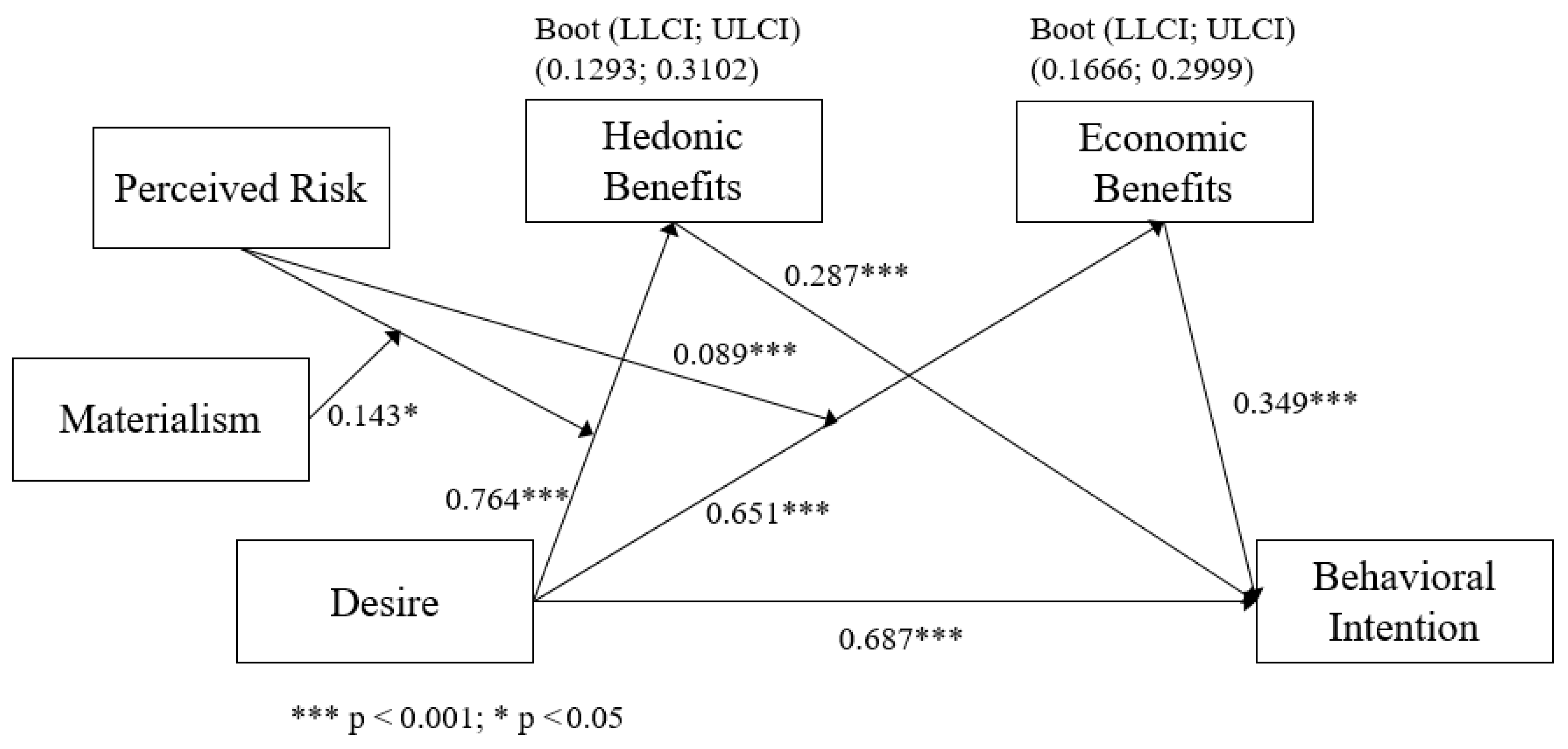
| Desire H1 | 0.6873 | 0.031 | 22.193 | 0.0000 | 0.7636 | 0.0272 | 28.0943 | 0.0000 | 0.4681 | 0.0474 | 9.88 | 0.0000 |
| Hedonic Benefits H3 | 0.2870 | 0.048 | 5.9747 | 0.0000 | ||||||||
| R-square | 0.483 | 0.599 | 0.515 | |||||||||
| F | 492.52 *** | 789.28 *** | 280.29 *** | |||||||||
| df1 | 1 | 1 | 2 | |||||||||
| df2 | 528 | 528 | 527 | |||||||||
| p | 0.0000 | 0.0000 | 0.0000 | |||||||||
| Total Effect | ||||||||||||
| Total Effect | se | t | p | LLCI | ULCI | |||||||
| 0.6873 | 0.031 | 22.193 | 0.0000 | 0.6264 | 0.7481 | |||||||
| Direct Effect | ||||||||||||
| Direct Effect | se | t | p | LLCI | ULCI | |||||||
| Desire → Behavioral Intention | 0.4681 | 0.0474 | 9.8800 | 0.0000 | 0.3751 | 0.5612 | ||||||
| Bootstrapping Indirect Effect: H4 | ||||||||||||
| Indirect Effect | BOOT se | BOOT LLCI | BOOT ULCI | |||||||||
| Desire → Hedonic Benefits → Behavioral Intention | 0.2191 (0.2870 × 0.7636 = 0.2191) | 0.0461 | 0.1293 | 0.3102 | ||||||||
| DV = Hedonic Benefits | DV = Behavioral Intention | |||||||||||
|---|---|---|---|---|---|---|---|---|---|---|---|---|
| Coeff | se | t | p | LLCI | ULCI | Coeff | se | t | p | LLCI | ULCI | |
| Constant | 1.539 | 0.854 | 1.801 | 0.072 | −0.1395 | 3.2173 | 0.7977 | 0.1069 | 7.4612 | 0.0000 | 0.5877 | 1.0077 |
| Desire | 1.039 | 0.188 | 5.516 | 0.000 | 0.1726 | 0.2813 | 0.4681 | 0.0474 | 9.88 | 0.0000 | 0.3751 | 0.5612 |
| Perceived Risk | −0.362 | 0.207 | −1.753 | 0.080 | −0.7682 | 0.0437 | ||||||
| Materialism | 0.554 | 0.280 | 1.975 | 0.049 | 0.1422 | 0.1543 | ||||||
| Desire × Perceived Risk | −0.116 | 0.065 | −1.781 | 0.076 | −0.012 | 0.245 | ||||||
| Desire × Materialism | −0.125 | 0.082 | −1.525 | 0.128 | −0.0233 | 0.2601 | ||||||
| Perceived Risk × Materialism | −0.142 | 0.077 | −1.845 | 0.066 | −0.0359 | 0.2851 | ||||||
| Desire × Perceived Risk × Materialism H2a | 0.143 | 0.042 | 3.404 | 0.027 | 0.0012 | 0.0867 | ||||||
| Hedonic Benefits | 0.287 | 0.048 | 5.9747 | 0.0000 | 0.1926 | 0.3813 | ||||||
| R-square | 0.627 | 0.515 | ||||||||||
| F | 125.60 | 280.29 | ||||||||||
| R-square change | 0.003 | |||||||||||
| df1 | 7 | 2 | ||||||||||
| df2 | 522 | 527 | ||||||||||
| F-Change | 3.90 | |||||||||||
| p value | 0.048 | 0.000 | ||||||||||
| Index of moderated moderated-mediation | ||||||||||||
| Index | BOOT SE | BOOT LLCI | BOOT ULCI | |||||||||
| 0.0125 | 0.0065 | 0.0017 | 0.0269 | |||||||||
| Indices of conditional moderated mediation by Risk | ||||||||||||
| Trust | Index | BOOT SE | BOOT LLCI | BOOT ULCI | ||||||||
| 2.0000 (Low) | 0.0085 | 0.0134 | −0.0145 | 0.0389 | ||||||||
| 3.0000 (Medium) | −0.004 | 0.0126 | −0.0281 | 0.0223 | ||||||||
| 4.0000 (High) | −0.0165 | 0.0149 | −0.0474 | 0.0119 | ||||||||
| Conditional effects of the focal predictor (Hedonic Benefits) at values of moderators (Risk × Materialism) | ||||||||||||
| Risk | Materialism | Effect | se | t | p | LLCI | ULCI | |||||
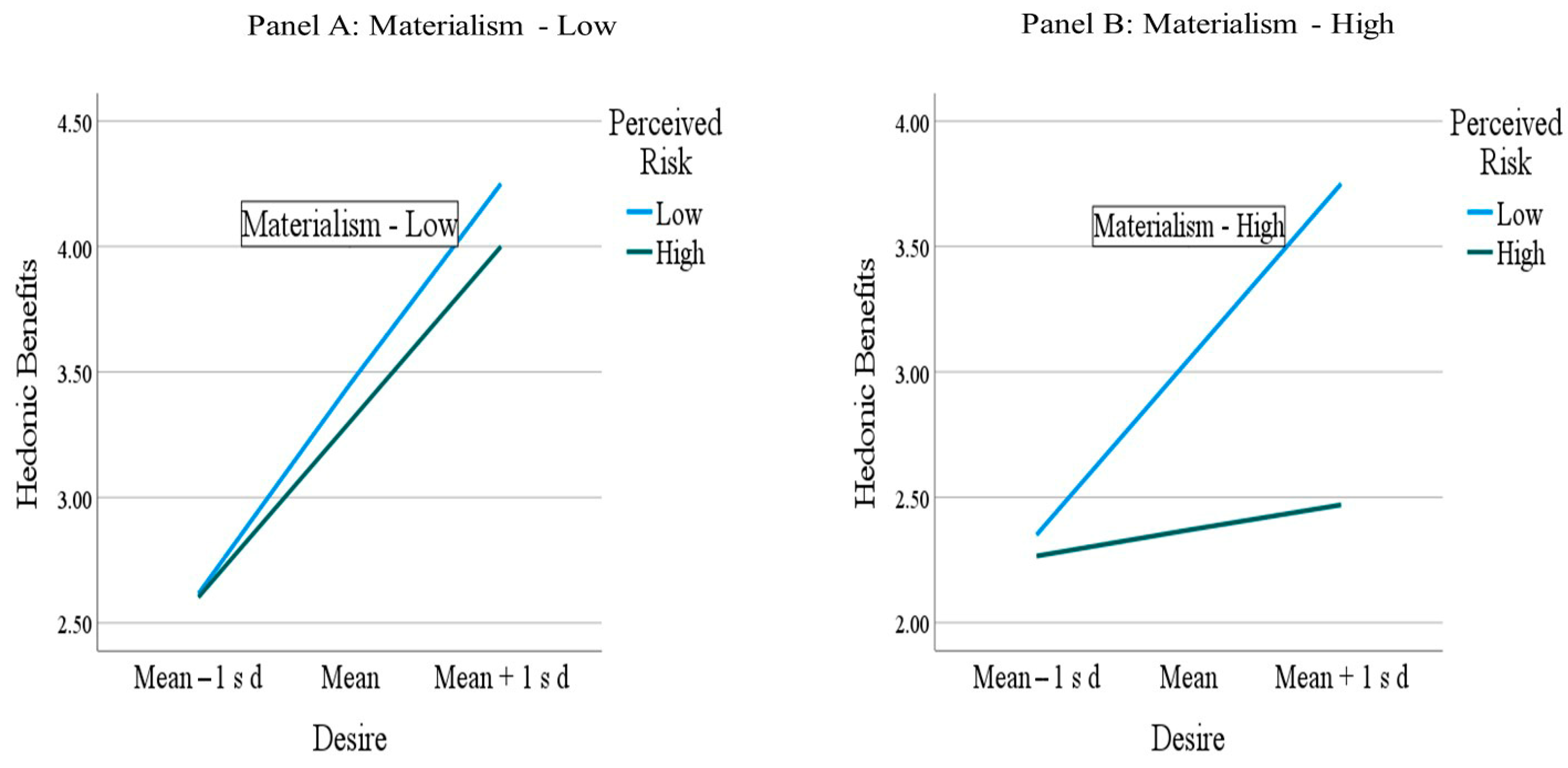
| Low | Low | 0.6361 | 0.0662 | 9.6127 | 0.0000 | 0.5061 | 0.7661 | |||||
| Low | Medium | 0.6676 | 0.0448 | 14.9167 | 0.0000 | 0.5796 | 0.7555 | |||||
| Low | High | 0.699 | 0.0528 | 13.2436 | 0.0000 | 0.5953 | 0.8027 | |||||
| Medium | Low | 0.6597 | 0.0450 | 14.6606 | 0.0000 | 0.5713 | 0.7481 | |||||
| Medium | Medium | 0.6564 | 0.0342 | 19.2097 | 0.0000 | 0.5893 | 0.7235 | |||||
| Medium | High | 0.6531 | 0.0524 | 12.4753 | 0.0000 | 0.5503 | 0.756 | |||||
| High | Low | 0.6893 | 0.0406 | 16.9679 | 0.0000 | 0.6095 | 0.7691 | |||||
| High | Medium | 0.6425 | 0.0523 | 12.2764 | 0.0000 | 0.5397 | 0.7453 | |||||
| High | High | 0.5957 | 0.0842 | 7.0746 | 0.0000 | 0.4303 | 0.7611 | |||||
| Risk | Materialism | Effect | Boot SE | Boot LLCI | Boot ULCI |
|---|---|---|---|---|---|
| 2.0000 (Low) | 2.0000 (Low) | 0.1826 | 0.0435 | 0.0976 | 0.2677 |
| 2.0000 (Low) | 3.0000 (Medium) | 0.1916 | 0.0409 | 0.1096 | 0.2723 |
| 2.0000 (Low) | 4.0000 (High) | 0.2006 | 0.0428 | 0.116 | 0.2850 |
| 2.8000 (Medium) | 2.0000 (Low) | 0.1893 | 0.0414 | 0.1073 | 0.2709 |
| 2.8000 (Medium) | 3.0000 (Medium) | 0.1884 | 0.0391 | 0.1096 | 0.2643 |
| 2.8000 (Medium) | 4.0000 (High) | 0.1874 | 0.0403 | 0.1084 | 0.2670 |
| 3.8000 (High) | 2.0000 (Low) | 0.1978 | 0.0426 | 0.113 | 0.2805 |
| 3.8000 (High) | 3.0000 (Medium) | 0.1844 | 0.0403 | 0.1056 | 0.2634 |
| 3.8000 (High) | 4.0000 (High) | 0.171 | 0.0421 | 0.092 | 0.2570 |
| DV = Behavioral Intention | DV = Economic Benefits H5 | DV = Behavioral Intention | ||||||||||
|---|---|---|---|---|---|---|---|---|---|---|---|---|
| Step 1 | Step 2 | Step 3 | ||||||||||
| Coeff | se | t | p | Coeff | se | t | p | Coeff | se | t | p | |
| Constant | 0.9756 | 0.106 | 9.2038 | 0.0000 | 1.1547 | 0.1056 | 10.9345 | 0.0000 | 0.5729 | 0.1102 | 5.1997 | 0.0000 |
| Desire | 0.6873 | 0.031 | 22.193 | 0.0000 | 0.6507 | 0.0309 | 21.0908 | 0.0000 | 0.4603 | 0.0395 | 11.668 | 0.0000 |
| Economic Benefits H6 | 0.3487 | 0.041 | 8.5057 | 0.0000 | ||||||||
| R-square | 0.483 | 0.457 | 0.545 | |||||||||
| F | 492.52 *** | 444.82 *** | 315.72 *** | |||||||||
| df1 | 1 | 1 | 2 | |||||||||
| df2 | 528 | 528 | 527 | |||||||||
| p | 0.0000 | 0.0000 | 0.0000 | |||||||||
| Total Effect | ||||||||||||
| Total Effect | se | t | p | LLCI | ULCI | |||||||
| 0.6873 | 0.031 | 22.193 | 0.0000 | 0.6264 | 0.7481 | |||||||
| Direct Effect | ||||||||||||
| Direct Effect | se | t | p | LLCI | ULCI | |||||||
| Desire → Behavioral Intention | 0.4603 | 0.0395 | 11.668 | 0.0000 | 0.3828 | 0.5379 | ||||||
| Bootstrapping Indirect Effect: H7 | ||||||||||||
| Indirect Effect | BOOT se | BOOT LLCI | BOOT ULCI | |||||||||
| Desire → Economic Benefits → Behavioral Intention | 0.2269 (0.3487 × 0.6507 = 0.2269) | 0.0316 | 0.1666 | 0.2909 | ||||||||
| Step 1 | Step 2 | |||||||||||
|---|---|---|---|---|---|---|---|---|---|---|---|---|
| DV = Economic Benefits | DV = Behavioral Intention | |||||||||||
| Coeff | se | t | p | LLCI | ULCI | LLCI | ULCI | |||||
| Constant | 3.5537 | 0.2987 | 11.8981 | 0.0000 | 2.9669 | 4.1404 | 0.5729 | 0.1102 | 5.1997 | 0.0000 | 0.3565 | 0.7894 |
| Desire | 0.2371 | 0.0861 | 2.7542 | 0.0061 | 0.068 | 0.4062 | 0.4603 | 0.0395 | 11.668 | 0.0000 | 0.3828 | 0.5379 |
| Perceived Risk | −0.645 | 0.0821 | −7.8601 | 0.0000 | −0.8063 | −0.4838 | ||||||
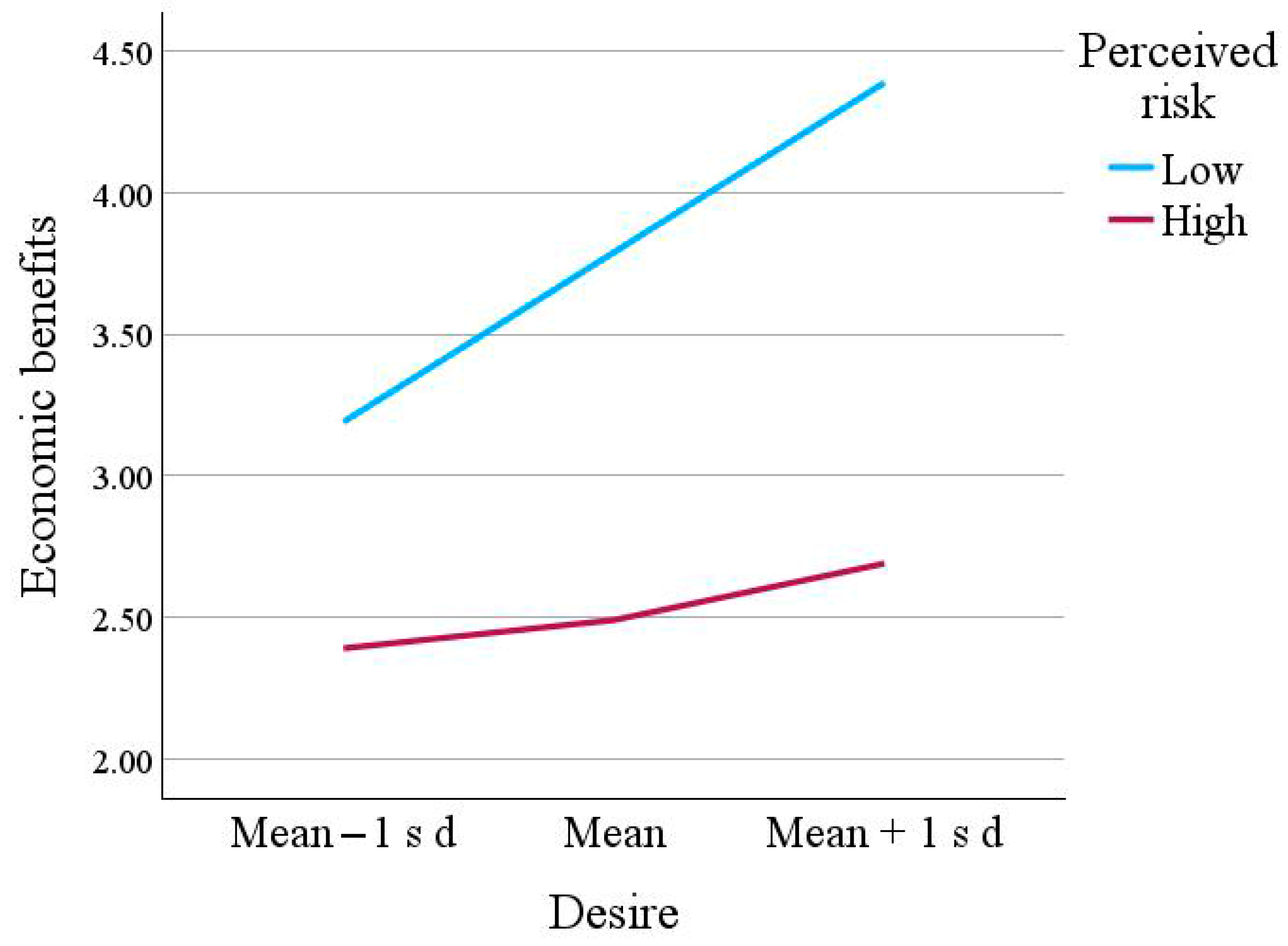
| Desire × Perceived Risk H5a | 0.0893 | 0.0252 | 3.5391 | 0.0004 | 0.0397 | 0.1389 | ||||||
| Economic Benefits | 0.3487 | 0.041 | 8.5057 | 0.0000 | 0.2682 | 0.4293 | ||||||
| R-square | 0.574 | 0.545 | ||||||||||
| F | 235.96 *** | 315.72 *** | ||||||||||
| df1 | 3 | 2 | ||||||||||
| df2 | 526 | 527 | ||||||||||
| p value | 0.0000 | 0.0000 | ||||||||||
| Index of moderated moderated-mediation | ||||||||||||
| Index | BOOT SE | BOOT LLCI | BOOT ULCI | |||||||||
| 0.0311 | 0.0113 | 0.0105 | 0.0550 | |||||||||
| Conditional effects of the focal predictor (Economic Benefits) at the value of the moderator (Perceived Risk) | ||||||||||||
| Risk | Effect | se | t | p | LLCI | ULCI | ||||||
| 2.0000 (Low) | 0.4157 | 0.0424 | 9.8071 | 0.0000 | 0.3324 | 0.499 | ||||||
| 2.8000 (Medium) | 0.4872 | 0.0313 | 15.5778 | 0.0000 | 0.4257 | 0.5486 | ||||||
| 3.8000 (High) | 0.5765 | 0.0332 | 17.3751 | 0.0000 | 0.5113 | 0.6417 | ||||||
| Conditional effects of the focal predictor (Economic Benefits) at values of moderators (Perceived Risk) | ||||||||||||
| Perceived Risk | Effect | se | t | p | LLCI | ULCI | ||||||
| 1.0000 | 0.3264 | 0.063 | 5.1824 | 0.0000 | 0.2027 | 0.4501 | ||||||
| 1.2000 | 0.3443 | 0.0586 | 5.8775 | 0.0000 | 0.2292 | 0.4593 | ||||||
| 1.4000 | 0.3621 | 0.0543 | 6.6719 | 0.0000 | 0.2555 | 0.4688 | ||||||
| 1.6000 | 0.38 | 0.0501 | 7.5817 | 0.0000 | 0.2815 | 0.4784 | ||||||
| 1.8000 | 0.3979 | 0.0461 | 8.6227 | 0.0000 | 0.3072 | 0.4885 | ||||||
| 2.0000 | 0.4157 | 0.0424 | 9.8071 | 0.0000 | 0.3324 | 0.499 | ||||||
| 2.2000 | 0.4336 | 0.0389 | 11.1367 | 0.0000 | 0.3571 | 0.5101 | ||||||
| 2.4000 | 0.4514 | 0.0359 | 12.5910 | 0.0000 | 0.381 | 0.5219 | ||||||
| 2.6000 | 0.4693 | 0.0333 | 14.1097 | 0.0000 | 0.404 | 0.5346 | ||||||
| 2.8000 | 0.4872 | 0.0313 | 15.5778 | 0.0000 | 0.4257 | 0.5486 | ||||||
| 3.0000 | 0.505 | 0.03 | 16.8280 | 0.0000 | 0.4461 | 0.564 | ||||||
| 3.2000 | 0.5229 | 0.0296 | 17.6842 | 0.0000 | 0.4648 | 0.581 | ||||||
| 3.4000 | 0.5408 | 0.03 | 18.0367 | 0.0000 | 0.4819 | 0.5996 | ||||||
| 3.6000 | 0.5586 | 0.0312 | 17.8960 | 0.0000 | 0.4973 | 0.6199 | ||||||
| 3.8000 | 0.5765 | 0.0332 | 17.3751 | 0.0000 | 0.5113 | 0.6417 | ||||||
| 4.0000 | 0.5943 | 0.0358 | 16.6239 | 0.0000 | 0.5241 | 0.6646 | ||||||
| 4.2000 | 0.6122 | 0.0388 | 15.7725 | 0.0000 | 0.536 | 0.6885 | ||||||
| 4.4000 | 0.6301 | 0.0423 | 14.9094 | 0.0000 | 0.547 | 0.7131 | ||||||
| 4.6000 | 0.6479 | 0.046 | 14.0850 | 0.0000 | 0.5576 | 0.7383 | ||||||
| 4.8000 | 0.6658 | 0.05 | 13.3229 | 0.0000 | 0.5676 | 0.764 | ||||||
| 5.0000 | 0.6837 | 0.0541 | 12.6311 | 0.0000 | 0.5773 | 0.79 | ||||||
| Indirect Effect (Desire → Economic Benefits → Behavioral Intention | ||||||||||||
| Risk | Effect | Boot SE | Boot LLCI | Boot ULCI | ||||||||
| 2.0000 (Low) | 0.145 | 0.0245 | 0.0994 | 0.1952 | ||||||||
| 2.8000 (Medium) | 0.1699 | 0.0247 | 0.1234 | 0.2200 | ||||||||
| 3.8000 (High) | 0.201 | 0.0292 | 0.1461 | 0.2606 | ||||||||
| Number | Hypothesis | Result | Managerial and Policy Implications |
|---|---|---|---|
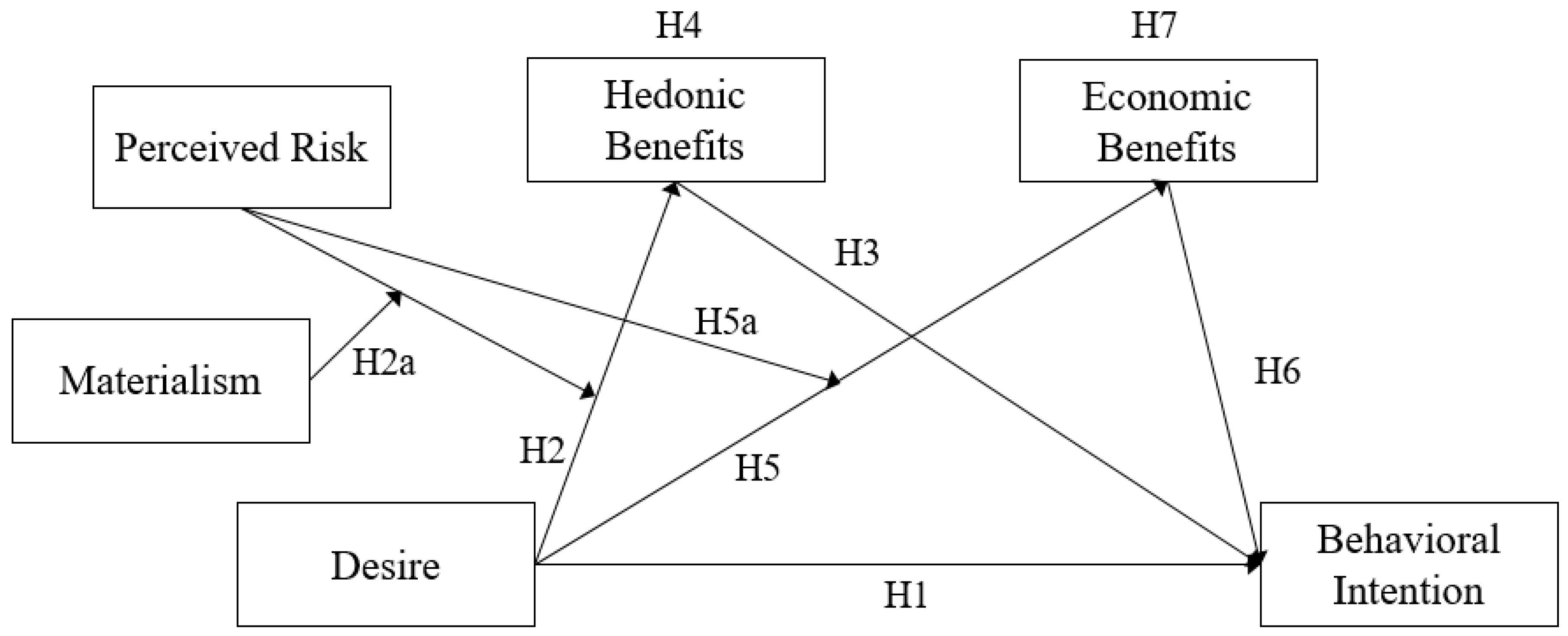
| H1 | Desire is positively and significantly related to behavioral intention. | Supported | Organizations strategize to identify antecedents to desire of the customers to engage in shared accommodation. |
| H2 | Desire is positively and significantly related to hedonic benefits. | Supported | Policy-makers and organizations need to expand the hedonic benefits so that customers show their preference toward shared accommodation. Focus on identification of factors that make the consumers’ life exciting while enjoying the shared accommodation. |
| H3 | Hedonic benefits are positively and significantly related to behavioral intention. | Supported | As behavioral intention plays a vital role in consumers’ intention to prefer shared accommodation, owners of shared accommodation need to identify the factors that motivate the customers to exhibit their intention to use shared accommodation. |
| H4 | Hedonic benefits mediate the relationship between desire and behavioral intention. | Supported | To translate desire to behavioral intention, owners of shared accommodation pay a particular attention to the hedonic benefits so that the users have personal enjoyment and use of the shared accommodation is exciting. |
| H5 | Desire is positively and significantly related to economic benefits. | Supported | As users attempt to save costs, owners may sacrifice some of the profits and provide accommodation at reasonable cost. |
| H6 | Economic benefits are positively and significantly related to behavioral intention. | Supported | Reduction in costs may motivate the users to engage in shared accommodation. |
| H7 | Economic benefits mediate the relationship between desire and behavioral intention. | Supported | As economic benefits play a vital role in behavioral intention, one actionable recommendation is to reduce the costs to as minimum as possible. The owners are recommended not to charge exorbitant prices for using shared accommodation. |
| H2a | Materialism moderates the moderated effect of perceived risk in the relationship between desire and behavioral intention mediated through hedonic benefits. | Supported | One recommendation for the owners is to enhance the quality such that the users may feel that they are staying in luxury hotels. |
| H5a | Perceived risk moderates the relationship between desire and behavioral intention mediated through economic benefits. | Supported | One policy implication is that the users need to perceive less risk in using the shared accommodation. As users are more concerned about the health risks involved, particularly due to fear imposed on by the global pandemic, the users need to make sure that users do not see any risk in using the shared accommodation. |
Disclaimer/Publisher’s Note: The statements, opinions and data contained in all publications are solely those of the individual author(s) and contributor(s) and not of MDPI and/or the editor(s). MDPI and/or the editor(s) disclaim responsibility for any injury to people or property resulting from any ideas, methods, instructions or products referred to in the content. |
© 2025 by the authors. Licensee MDPI, Basel, Switzerland. This article is an open access article distributed under the terms and conditions of the Creative Commons Attribution (CC BY) license.
Share and Cite
Goel, P.; Parayitam, S. Desire and Behavioral Intention in Sharing Accommodation: Hedonic and Economic Benefits as Mediators and Perceived Risk and Materialism as Moderators. Tour. Hosp. 2026, 7, 6. https://doi.org/10.3390/tourhosp7010006
Goel P, Parayitam S. Desire and Behavioral Intention in Sharing Accommodation: Hedonic and Economic Benefits as Mediators and Perceived Risk and Materialism as Moderators. Tourism and Hospitality. 2026; 7(1):6. https://doi.org/10.3390/tourhosp7010006
Chicago/Turabian StyleGoel, Pooja, and Satyanarayana Parayitam. 2026. "Desire and Behavioral Intention in Sharing Accommodation: Hedonic and Economic Benefits as Mediators and Perceived Risk and Materialism as Moderators" Tourism and Hospitality 7, no. 1: 6. https://doi.org/10.3390/tourhosp7010006
APA StyleGoel, P., & Parayitam, S. (2026). Desire and Behavioral Intention in Sharing Accommodation: Hedonic and Economic Benefits as Mediators and Perceived Risk and Materialism as Moderators. Tourism and Hospitality, 7(1), 6. https://doi.org/10.3390/tourhosp7010006