Article

Desire and Behavioral Intention in Sharing Accommodation: Hedonic and Economic Benefits as Mediators and Perceived Risk and Materialism as Moderators


by
Pooja Goel
1 and
Satyanarayana Parayitam
2,*
1
Department of Commerce, Faculty of Commerce & Business, University of Delhi, Delhi 110007, India
2
Department of Management and Marketing, Charlton College of Business, University of Massachusetts Dartmouth, 285 Old Westport Road, North Dartmouth, MA 02747, USA
*
Author to whom correspondence should be addressed.
Tour. Hosp. 2026, 7(1), 6; https://doi.org/10.3390/tourhosp7010006 (registering DOI)
Submission received: 10 September 2025 / Revised: 10 October 2025 / Accepted: 24 December 2025 / Published: 30 December 2025

Abstract

The present study aims to explore the factors that warrant consumers’ behavioral intention through sharing accommodation. A multilayered conceptual model is developed to analyze the impact of desire on behavioral intention through hedonic and economic benefits as mediators and perceived risk and materialism as moderators. Analysis of data collected from 530 respondents from India reveals that (i) hedonic benefits mediate the relationship between desire and behavioral intention, (ii) economic benefits mediate the relationship between desire and behavioral intention, and (iii) perceived risk and materialism moderate the relationship between desire and behavioral intention. Implications for sharing accommodation are discussed.

1. Introduction

The concept of “sharing economy” has received increasing attention from researchers in marketing, hospitality, and tourism from the previous two decades. Sharing economy is defined by Hamari et al. (2016) as “a peer-to-peer-based activity of obtaining, giving, or sharing the access to goods and services, coordinated through community-based online services” (Hamari et al., 2016, p. 3). Based on the concept of sharing economy, in tourism and hospitality, research has focused on accommodation sharing platforms such as Airbnb, Couch Surfing, and 9flats (Guttentag, 2019; Tussyadiah, 2016). The extant research on sharing economy, particularly in the context of the tourism and hospitality, has focused on the financial aspects (French et al., 2017; Koo & Chung, 2014; Lin et al., 2024), travelers’ decision-making process (Ert et al., 2016), and creating value to the society.
For the last three years, the pandemic has caused the deaths of several millions of people and created health problems for many (Yi et al., 2020). The unprecedented global pandemic indiscriminately impacted all the sectors in the world, and hospitality and tourism industry was one of the worst-hit sectors (Goel et al., 2022b; Gossling et al., 2020), contributing to the loss of employment to several thousands of people globally. While the pandemic continues, producing various mutations of the virus, the likelihood of restoring normalcy is far from the near future (Gerwe, 2021). Under the conditions of the high level of uncertainty, the end of the hospitality and tourism industry, particularly in the context of sharing economy, hangs in a dilemma (Aritenang, 2025). However, as individuals continue to rely on famous accommodation-sharing companies such as Airbnb, Couch-surfing, LoveHomeSwap, Onefinestay, and Wimdu, these companies have become competitors to star hotel chains such as Holiday Inn, Hilton, Marriot, Taj, Mourya, Ashoka, and Akbar (Powanga & Powanga, 2008; Wu & Cheng, 2019).
The concept of sharing economy has become popular due to consumers’ desire to make optimum use of scarce resources (Lim, 2020; Tussyadiah & Pesonen, 2016; Trompenaars & Coebergh, 2014). A consumer’s intention to purchase a product or service starts with desire (Bagozzi, 1992). Desire is a complex blend of emotional and rational choices that drive a consumer towards purchase intention (Turel et al., 2010). Before exhibiting the preference for purchase and consumption, an individual evaluates the hedonic benefits of the psychological and aesthetic satisfaction derived from such consumption. Sharing economy provides services at a low cost compared to traditional counterparts or alternatives (Dabbous & Tarhini, 2019; Lamberton & Rose, 2012; Z. W. Y. Lee et al., 2018). The economic benefits are seen in terms of low cost, which acts as a primary driver for the consumers to opt for sharing accommodation (Hamari et al., 2016). Consumers also weigh the perceived risk involved in sharing accommodations before making decisions (Mao & Lyu, 2017; Tian et al., 2021). Researchers have explored various types of risk: privacy, financial, and performance (Sweeney et al., 1999). Further, how consumers exhibit their preference for worldly possessions, called materialism, plays an essential role in sharing accommodation decisions (R. W. Belk, 1984; Ponchio & Aranha, 2008). Behavioral intention is concerned with the willingness of the consumers to engage in purchase decisions. Thus, behavioral intention precedes actual behavior (S. Lee & Kim, 2018; Molinari et al., 2008; Venkatesh & Davis, 2000).
Though the constructs of perceived risk, materialism, economic benefits, and hedonic benefits were studied independently by the researchers, to the best of our knowledge, no prior studies combined all these variables in one comprehensive model; thus, several lines of inquiry remained unexplored (Moreno-Gil & Coca-Stefaniak, 2020). Echoing the call by the researchers, we identified the research gap by highlighting the constructs that largely remained unexplored. A review of the literature revealed that the influence of perceived risk, materialism, hedonic benefits, and economic benefits on the intention to use shared accommodation were understudied in the tourism and hospitality literature. The present study aims to explore the interdependence between these variables through a comprehensive and double-layered model and to test the hypotheses derived from this model. It is important to explore the black box of cognitive decision-making processes that the consumers undertake while making sharing accommodation decisions.
This study was conducted during the post-pandemic period; hence, it focuses on an examination of consumer behavior during this challenging phase (Forouhar et al., 2025; Skare et al., 2021). Most importantly, the global pandemic has increased concerns about safety and health; consumers’ preferences were expected to be skewed to consider the sharing accommodations that provide a healthy and risk-free environment. Therefore, this study is focused on exploring the relationships between consumers’ desires and behavioral intentions during the pandemic and throughout the post-global pandemic period. Most importantly, the relationship between desire and behavioral intention is reviewed. The role of perceived risk involved in sharing accommodation as a moderator changes the strength of association between desire and hedonic benefits. The unique contributions of this study are threefold. First, this study examines the influence of desires on behavioral intention of the tourists specifically during ongoing health calamity. Second, the role of perceived risk and materialism as moderators is the relationship of desires and behavioral intention. To date, no study has found that materialism counters the adverse effect of perceived risk. Lastly, we examined the abovementioned relationships through the lens of GDB, which postulates that consumers’ decisions are guided by desires (Perugini & Bagozzi, 2001). Till now, the existing literature has focused on attitudes and overlooked the role of desire in explaining behavioral intention of using sharing accommodation (Wu & Cheng, 2019). GDB, which is built on the theory of planned behavior (TPB), posits that attitudes, positive and negative anticipated emotions, and subjective norms would influence desires, which, in turn, leads to intentions and then behavior (Perugini & Bagozzi, 2001). As the studies related to consumer behavior with regard to sharing accommodation are sparse, there is a need to explore consumers’ desires and consumer behaviors during the post-pandemic period. Therefore, this study is a maiden attempt to understand the interplay of desires, materialism, perceived risk, and behavioral intention of using accommodation during the ongoing health emergency situation even after two years of the pandemic period. In particular, the present study attempts to address the following research questions.
  • RQ1: Does desire affect behavioral intention to use sharing accommodation?
  • RQ2: Do hedonic and economic benefits mediate the relationship between desire and behavioral intention to use sharing accommodation?
  • RQ3: Do perceived risk and materialism have moderating effects on behavioral intention to use sharing accommodation?

2. Theoretical Background

It was Hawley (1950) who first described the collaborative forms of consumption as beneficial to society. Later, Felson and Spaeth (1978) coined the term “collaborative consumption”, which has now emerged as a “sharing economy” (also known by different names: “collaborative economy”, “access-based consumption”, “peer-to-peer economy”, “platform economy”, “gig economy”, “crowd-based capitalism”, or “on-demand economy”). During recent times, a new economic model, the sharing economy, has evolved whereby efficient utilization of available scarce resources, products, and services has become possible (Botsman & Rogers, 2010). The non-ownership model of sharing economy includes various programs: transportation services such as Uber and Rideshare, Airbnb and Couchsurfing programs of sharing accommodation, and time-sharing condominiums where individuals jointly share the ownership of a vacation house (Guttentag et al., 2018; Powanga & Powanga, 2008). Though the concept of sharing economy existed in history (R. Belk, 2014), it came to the limelight sometime around 2008–2009 because of the financial crisis worldwide, and people started engaging in conscientious consumption behavior (Cohen & Munoz, 2016).

2.1. Model of Goal-Directed Behavior (GDB)

Most of the prior studies (French et al., 2017; Koo & Chung, 2014) on tourism and hospitality used the theory of planned behavior (TPB) and self-determination theory (SDT) to explain consumer behavior with regard to sharing accommodation because of their explanatory power of linking attitudes to behavior in the decision-making process (Ajzen, 1991; Chung et al., 2015; Koo & Chung, 2014). TPB assumes that individuals have access to the resources and make use of opportunities in performing desired behavior. Hence, TPB is unable to explain the individual behavior in the presence of resource constraints. Further, TPB does not consider the influence of the environment on an individual’s decision making (Asadi et al., 2021). Also, TPB does not take into account factors such as fear, mood, and hedonic benefits derived by the individuals in the past while explaining behavioural intention, which limits the applicability of TPB in shared accommodation research (Bamberg et al., 2007).
In this research, the researchers employ the model of goal-directed behavior (GDB) proposed by Perugini and Bagozzi (2001). The basic tenet of GDB is that behavioral intentions to perform are determined mainly by desires rather than attitudes. When comparing TPB and GDB, some researchers conclude that GDB has a more predictive ability of an individual’s behavior as “desires mediate the effects of attitudes, subjective norms, perceived control and anticipated emotions on intentions” (Leone et al., 2006, p. 1945). The GDB posits that attitudes, emotions (positive and negative), subjective norms, frequency of past behavior, and perceived behavioral control influence desires and determine an individual’s intentions; then, the resultant behavior is guided by intentions (Perugini & Bagozzi, 2001).
We adopt GDB for a number of reasons. First, this study contends that “desire” is the most important emotion that drives tourists’ decision making rather than attitude (Song et al., 2012). As desire is an antecedent of behavioral intention, this study gives more importance to the emotion rather than attitude. Second, GDB also considers, in addition to emotion, hedonic characteristics of an individual’s behavior in predicting the behavioral intention and, hence, has a greater explanatory of consumer behavior when compared to TPB (S.-J. Hong & Tam, 2006; Turel et al., 2010). Third, recent studies used GDB in tourism and hospitality research (Kement et al., 2022; Yi et al., 2020). To sum up, the authors believe that GDB is an excellent theoretical platform, consistent with the scholars who have used GDB in tourism and hospitality research.

2.2. Hypotheses Development

2.2.1. The Relationship Between Desire and Behavioral Intention

Behavioral intention is a goal-directed behavior, and desire is the primary antecedent of consumers’ intention to purchase a product or service (Bagozzi, 1992; Huang & Chen, 2015). Oliver (1997) defined behavioral intention as “a stated likelihood to engage in a behavior” (p. 28). An individual’s desire is a complex blend of emotional and rational choices that significantly influence behavioral intention (Turel et al., 2010; Yoo et al., 2017). Various studies suggest a relationship between desire and behavioral intention across different contexts (Hwang et al., 2019; Yi et al., 2020). In a recent study conducted in Turkey, a survey of 712 tourists revealed that desire has a positive effect on behavioral intention (Kement et al., 2022). Thus, based on the above arguments, we offer the following hypothesis.
H1. 
Desire is positively related to behavioral intention.

2.2.2. The Relationship Between Desire and Hedonic Benefits

Sharing enables the tourists to enjoy hedonic benefits (Barry et al., 1994) which may stem from excitement and gratification (Arnold & Reynolds, 2003). Researchers have also demonstrated the positive relationship between desire and hedonic benefits, as individuals would be evaluating the benefits of psychological and aesthetic satisfaction of having shared accommodation (Chitturi et al., 2008). Customers would have the opportunity of sharing their personal experiences with new communities when they adopt sharing accommodation (Tussyadiah, 2015). Based on the above, we offer the following hypothesis:
H2. 
Desire is positively related to hedonic benefits.

2.2.3. The Relationship Between Hedonic Benefits and Behavioral Intention

As behavioral intention is concerned with engaging in certain behaviors, and actual behavior stems from behavioral intention (Venkatesh & Davis, 2000), it is necessary to identify the antecedents of behavioral intention (Molinari et al., 2008; S. Lee & Kim, 2018). Consumers tend to exhibit behavioral intention when they perceive hedonic benefits from the consumption of a product/service, as researchers documented when they conducted a study on 460 consumers from Taiwan about energy sharing services (Tsou et al., 2019). In a recent study, researchers found that consumers motivated by hedonic benefits tend to exhibit behavioral intention (Wu & Cheng, 2019). Based on the available theoretical and empirical evidence, we offer the following hypothesis:
H3. 
Hedonic benefits are positively related to behavioral intention.

2.2.4. Hedonic Benefits as a Mediator

Extant research in sharing accommodation has documented the positive effect of desires on various outcomes such as consumption, repeat purchase, and post-purchase behavior (Yi et al., 2020). After evaluating the costs and benefits of products and services, consumers determine their recreational and hedonic benefits (such as pleasure, enjoyment, and feelings of personal gratification) before making purchase decisions (Overby & Lee, 2006). Most importantly, in contrast to utilitarian motives, consumers are motivated by feelings, aesthetic experiences, or pleasure derived from consuming a product or service. These are subjective opinions most of the time (Hirschman & Holbrook, 1982). As sharing economy consumers are heterogeneous, individuals differ in their subjective evaluations of the hedonic benefits, including fun and playfulness (Prebensen & Rosengren, 2016). Though prior research has not examined the indirect effects of desire on behavioral intention through hedonic benefits, we offer the following exploratory hypothesis:
H4. 
Hedonic benefits mediate the relationship between desire and behavioral intention.

2.2.5. The Relationship Between Desire and Economic Benefits

The association between desire and economic benefits is relatively straightforward. The desire to share accommodation prompts the individuals to look for potential savings (Tsou et al., 2019). In the present-day resource crunch, individuals attempt to apply the principle of hedonism (i.e., deriving maximum benefit at minimum cost) and find ways to cut down the cost of travel by engaging in accommodation sharing. Individuals tend to evaluate the costs and benefits before consuming a product/service, and only when they are convinced that the benefits outweigh the costs will they engage in consumption (Overby & Lee, 2006). Consumers may be willing to pay a higher price when they buy utilitarian products (Okada, 2005), but they certainly prefer to save time and money as much as possible (J. C. Hong et al., 2017). Extant research has documented that economic benefits motivate the individuals to opt for sharing economy because (i) individuals can reduce the costs when compared to traditional modes of owning the products or services (Rudmin, 2016), and (ii) sharing economy services cost less when compared to owning the services (Lamberton & Rose, 2012; Z. W. Y. Lee et al., 2018). Thus, based on the above, we offer the following hypothesis.
H5. 
Desire is positively related to economic benefits.

2.2.6. Relationship Between Economic Benefits and Behavioral Intention

Several studies found that economic benefits are significantly and positively related to the behavioral intention of individuals to share accommodation (Hamari et al., 2016). The greater the economic benefits the individuals perceive, the higher the likelihood of sharing accommodation is. Economic benefits have been cited as one of the most important motivational factors for sharing accommodation (Liang et al., 2018). When individuals perceive economic benefits in terms of saving money, helping in lowering the travel costs, and making the travel more affordable, they see financial benefits in aggregate, which prompts them to show their intention to engage in shared accommodation (Tussyadiah, 2016). Based on the above empirical evidence and logos, we offer the following hypothesis:
H6. 
Economic benefits is positively related to behavioral intention.

2.2.7. Economic Benefits as a Mediator

In addition to hedonic benefits, in this study, we argue that desire results in behavioral intention through economic benefits enjoyed from the consumption of a product/service. Economic benefits consist of saving money by sharing accommodation or resources and improving the financial situation of individuals (Barnes & Mattsson, 2016). The economic benefits, in turn, may prompt the individuals to engage in repurchasing the services and use the saved money for more frequent travel to tourist places using shared accommodation, as some researchers contend that the sharing platforms result in a substantial increase in consumer surplus (Narasimhan et al., 2018). Individuals’ participation in a sharing economy is influenced by several motivational factors: utilitarian, economic, hedonistic, prosocial behaviors, cultural orientation, self-esteem, pleasure, achievement, and social congruence (R. Belk, 2009). Though previous researchers have not examined the economic benefits as a mediator between the desire and behavioral intentions of consumers, we offer the following exploratory hypothesis, based on intuitive logic and anecdotal pieces of evidence:
H7. 
Economic benefits mediate the relationship between desire and behavioral intention.

2.2.8. Moderated Moderated-Mediation of Perceived Risk and Materialism Between Desire, Hedonic Benefits, and Behavioral Intention

Perceived risk, a concept borrowed from psychology (Bauer, 1960), when applied to consumer behavior, is related to the risk involved in relying on asymmetrical information when making decisions (Cui et al., 2016). Researchers in marketing have identified various risks: privacy, social, performance, financial, and physical risk (Sweeney et al., 1999; Tian et al., 2021). Extant research has found that consumers’ perceived risk has significant implications for sharing accommodation (Mao & Lyu, 2017; Yi et al., 2020) primarily because the demand for sharing accommodation has exceeded the supply, resulting in service failures (Guttentag, 2015). In addition, some researchers have reported that sharing accommodation had been utilized even by terrorists (Obeidat & Almatarney, 2020), and others have reported that sharing accommodation has caused psychological damage to tourists (Lieber, 2015).
Performance risk stems from the host’s inability to maintain the desired quality in shared accommodation because of a lack of service experience and training (Yi et al., 2020). As individuals use online services while booking shared accommodations, they are also exposed to privacy risks (Lutz et al., 2018). Further, some shared accommodations (like Airbnb) do not have adequate legal supervision, thus escalating the risk to a higher level (Wu & Cheng, 2019). The employees working in the traditional outlets (such as star hotels) are fully trained in providing services to the customers. Further, the online transactions in traditional outlets are secured, thereby making the services less risky when compared to sharing accommodation (Pappas, 2017). Higher levels of perceived risk discourage individuals from choosing shared accommodation. Also, during COVID-19, people are suspicious of touching public/common properties as it may increase health risk and spread of virus (Goel et al., 2022a). Therefore, perceived risks associated with shared accommodation act counter to the hedonic benefits.
Materialism, as a construct, has gained wide currency in the marketing literature (Richins, 2004; Watson, 2003). According to R. W. Belk (1984), materialism refers to “the importance a consumer attaches to worldly possessions. At the highest levels of materialism, such possessions assume a central place in a person’s life and are believed to provide the greatest sources of satisfaction and dissatisfaction in life” (R. W. Belk, 1984, p. 291). Individuals believing in materialism try to correlate their happiness with the possession of objects and attempt to derive pleasure by acquiring products by spending money wisely (Richins & Dawson, 1992). In a seminal study conducted by Ponchio and Aranha (2008), it was found that low-income group consumers were more susceptible to using credit to enjoy material benefits from the consumption of products. In a recent study conducted by researchers who compared the consumers in USA and India, it was found that materialism was positively associated with the sharing economy in the USA (by encouraging individuals to have similar experiences).
In contrast, the positive association between materialism and sharing economy in India was the perceived utility because of scarce resources (Davidson et al., 2017). Though the effects of perceived risk and materialism on behavioral intentions have been studied individually by the researchers, to the best of our knowledge, the multiplicative effect of perceived risk and materialism on behavioral intention is understudied. It would be interesting to explore materialism as a second moderator and study how it influences the perceived risk (first moderator) in the behavioral intention of shared accommodation. We propose that materialism would increase the hedonic benefits when the perceived risk of sharing accommodation is low. Following this line of argument, we offer the following exploratory moderated moderated-mediation hypothesis:
H2a. 
Materialism moderates the moderated effect of perceived risk in the relationship between desire and behavioral intention mediated through hedonic benefits.

2.2.9. Moderated-Mediation of Perceived Risk Between Desire, Economic Benefits, and Behavioral Intention

As discussed in the previous sections, economic benefits mediate the relationship between desire and behavioral intention; the perceived risk also plays a role in this relationship. When individuals perceive higher levels of risk of accepting the sharing accommodation, it is more likely that the perceived economic benefits would be adversely affected. In addition, the physical, financial, privacy, and performance risks undoubtedly affect behavioral intention (Yi et al., 2020). As reservation of shared accommodation through online platforms involves considerable risks, as discussed earlier (Liang et al., 2018), it is more likely that risks have a potentially harmful effect on the desire and economic benefits. Though extant research has reported the adverse effects of perceived risk on behavioral intentions, to the best of our knowledge, the moderating effect of risk in the relationship is understudied. Poon and Huang (2017) reported that the consumers who already use shared accommodation become aware of the risks involved, whereas non-users may not be aware of such risks. Based on the available little empirical evidence and logos, we offer the following exploratory moderated-mediation hypothesis:
H5a. 
Perceived risk moderates the relationship between desire and behavioral intention mediated through economic benefits.
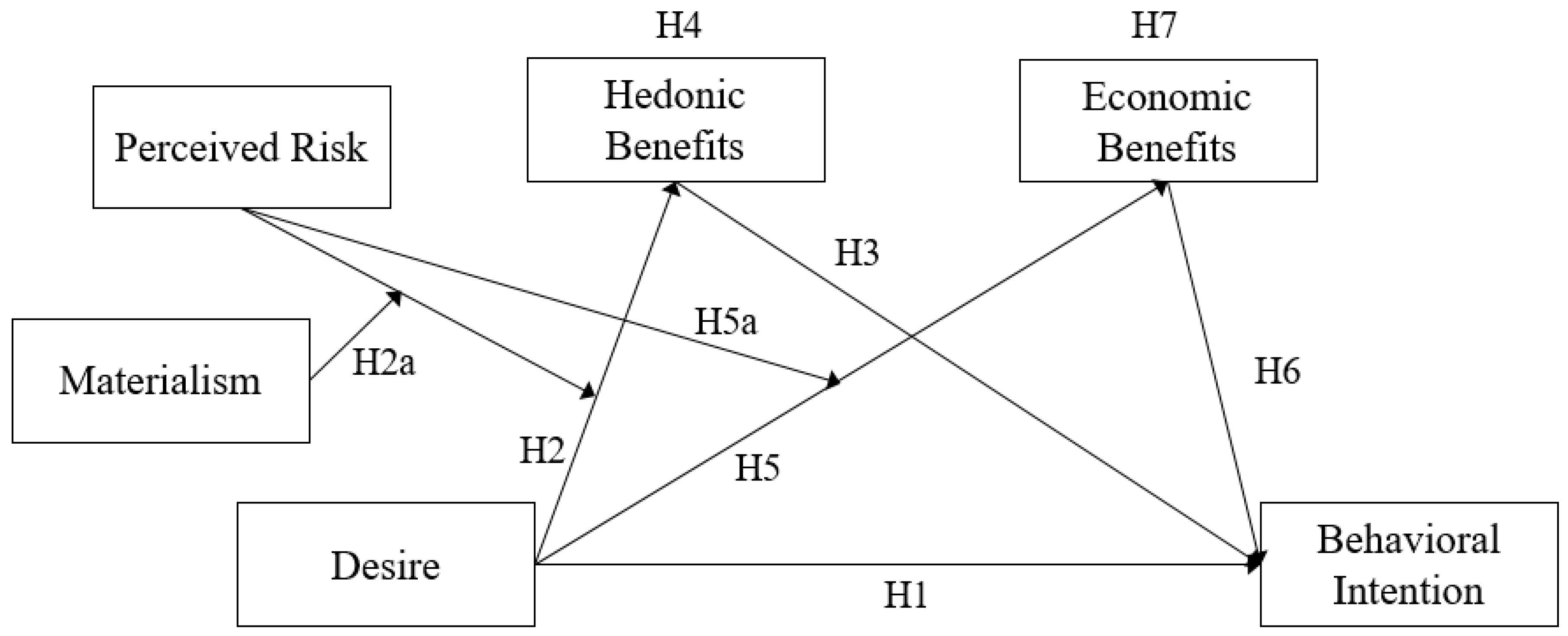
The conceptual model is presented in Figure 1.

3. Method and Materials

3.1. Measures

We measured all the constructs on a Likert-type five-point scale (“1” = strongly disagree; “5” = strongly agree). In all, there were 27 items that have been adapted from the well-established measures from the literature. The measures and the sources of the measures are presented in Table 1.

3.2. Sample Selection and Size

A carefully crafted survey instrument was utilized to collect data from the respondents. Keeping in mind the post-pandemic situation when social distancing is maintained (though not mandatory), the survey was conducted online. Furthermore, the authors employed non-probability-based convenience sampling because there is no fixed list of shared accommodation users. Additionally, the customers may cover a wider area, and the restrictions and frequent lockdowns during and after the pandemic period prohibited authors from interacting with potential customers personally.
The authors used a Google Form to collect data. First, the authors contacted individuals who had used shared accommodation and requested that they recommend the survey to others who had also used shared accommodation. The survey instrument has a qualifying question about whether they used shared accommodation in the last year. If the answer is “no”, then the Google Form will not allow the respondents to continue. This type of snowball sampling is not new in tourism research. During the pandemic and its aftermath, several researchers have employed the convenience sampling technique (Chiu et al., 2022; Goel & Parayitam, 2024; Reio et al., 2025).
The authors started data collection in November 2023 and completed collection on 31 January 2024. In all, 530 surveys were received. As the Google Form does not allow a respondent to proceed forward if any question is not answered, 530 surveys were complete and retained for the analysis. According to Krejcie and Morgan (1970), the minimum required sample size, depending on the population size, is 384, and any sample size exceeding 500 is considered very good (Comrey & Lee, 1992). The authors tested non-response bias by comparing the first 100 respondents with the last 100 and found no statistically significant differences between these two groups (Armstrong & Overton, 1977).
A demographic profile of the respondents is presented in Table 2.

3.3. Data Analytic Technique

The means, standard deviations, zero-order correlations, reliability coefficient (Cronbach’s alpha), composite reliability (CR), and average variance extracted (AVE) estimates are presented in Table 3. Further, Hayes (2018) PROCESS macros (model number 4) was used to test the direct hypotheses, including the mediation hypothesis.
The reliability coefficients (Cronbach’s alpha and composite reliability) of all the constructs were over 0.70, thus vouching for the validity and reliability of the constructs (Hair et al., 2019), and the AVE values were over 0.50 (Fornell & Larcker, 1981; Hair et al., 2019). We also compared the square root of AVE estimates with the correlations between the variables and found that for all the six variables, the correlations between the variables were less than the square root of the AVE. For example, the square root of AVEs of hedonic benefits and materialism were 0.91 and 0.81, and these values were greater than the correlation between these variables (0.48). These results vouch for the discriminant validity of the constructs.

3.4. Preliminary Statistical Techniques

3.4.1. Multicollinearity

According to Tsui et al. (1995), multicollinearity is present if correlations exceed 0.80. In this study, we found that correlations between the variables ranged between 0.38 and 0.77; therefore, multicollinearity is not a problem for the data (Tsui et al., 1995). An additional check of multicollinearity was conducted, observing the variance inflation factor (VIF), and it was found that the VIF values for all the variables were less than 5, indicating that multicollinearity was not a problem (Hair et al., 2019).

3.4.2. Common Method Bias (CMB)

In survey-based research, CMB is a phenomenon that needs to be checked (Podsakoff et al., 2024). The authors performed various statistical methods to check CMB. First, the traditional Harman’s single-factor test, following the recommendations of Podsakoff et al. (2003), was performed and it was noted that the single factor accounted for less than the cut-off value of 0.5. However, recent scholars reported that Harman’s single-factor test is insufficient as a single diagnostic method (Howard et al., 2024), and additional tests need to be conducted. Therefore, as a second test, the authors performed the latent-variable method by loading all the indicators into a single factor and rotating this step for all the constructs. The results revealed inner VIF values of less than 3.3, suggesting that the data is not affected by CMB (Kock, 2015). In the third step, the authors performed a comparison of various models and found that the goodness-of-fit indices for the single-factor model were χ2 = 4046.87; df = 324; χ2/df = 12.49; RMSEA = 0.147; CFI = 0.662; RMR = 0.125; standardized RMR = 0.105; TLI = 0.633; GFI = 0.539. This showed the poor fit of the single-factor model. The six-factor model has more than acceptable goodness-of-fit indices. These results reveal that the data does not have CMB.

4. Results

4.1. Measurement Model

Before testing the hypothesized relationships, we checked the measurement model by using the Lisrel package of structural equation modeling and performing confirmatory factor analysis (CFA). The results of the CFA are presented in Table 1. As shown in Table 1, the factor loadings of all the constructs were well over the acceptable levels of 0.70, and the reliability coefficients of measures were over 0.7. We also compared various models to establish the validity of the six-factor model, and the results are presented in Table 4.
As shown in Table 4, the baseline six-factor model fits the data well (χ2 = 1019.37; df = 309; χ2/df = 3.30; RMSEA = 0.066; CFI = 0.935; RMR = 0.058; standardized RMR = 0.049; TLI = 0.927; GFI = 0.874), when compared to other five alternative models. As suggested by Browne and Cudeck (1993), these goodness-of-fit statistics indicate good fit of the model to the data and provide evidence of distinctiveness of all six constructs used in this study.

4.2. Hypotheses Testing

As shown in Table 5, results reveal that the regression coefficient of desire on behavioral intention (H1: β = 0.687; t = 22.19; p < 0.001), desire on hedonic benefits (H2: β = 0.764; t = 28.09; p < 0.001), and desire on behavioral intention (H3: (β = 0.287; t = 5.97; p < 0.001) were significant, thus supporting H1, H2, and H3.
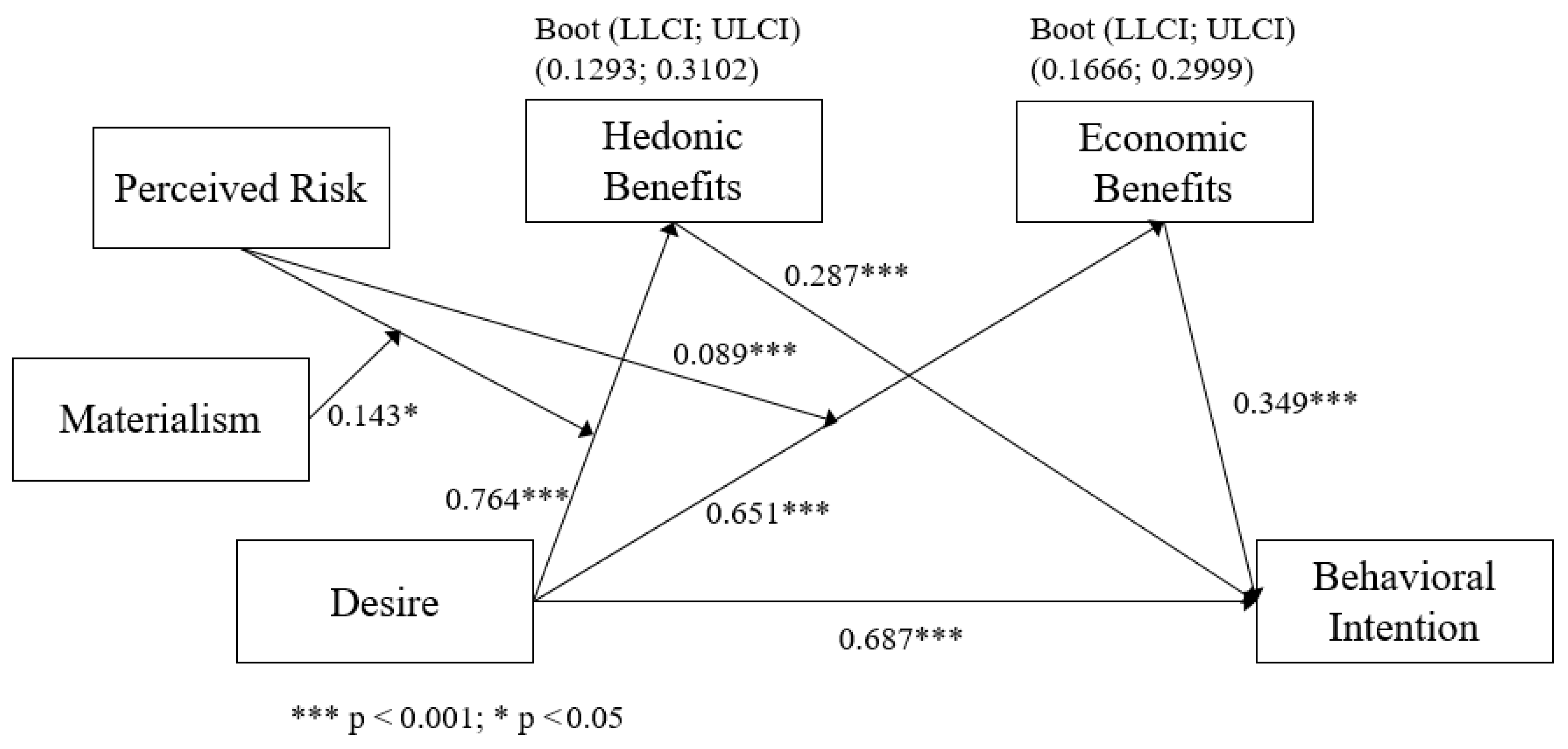
The mediation hypothesis (H4) was checked by the indirect effect of desire on behavioral intention through hedonic benefits as a mediator. The indirect effect of desire on behavioral intention was positive and significant (β = 0.219); hence, the mediation hypothesis is supported. The indirect effect was 0.2191 (0.2870 × 0.7636 = 0.2191), and the total effect was direct effect (0.4681) plus indirect effect (0.2191) equals 0.687. Further, the partially standardized indirect effect was 0.2282 (Boot SE = 0.0476; Boot LLCI and ULCI [0.1354; 0.3218]). The bootstrapping samples of 20,000 thus support the mediation hypothesis (H4) that hedonic benefits mediates the relationship between desire and behavioral intention. The final structural model with path coefficients is shown in Figure 2.
The novel part of this study is testing the moderated moderated-mediation hypothesis (H2a). To test the effect perceived risk (first moderator) and materialism (second moderator) in the relationship between desire and behavioral intention, mediated through hedonic benefits, we used the Hayes (2018) PROCESS macros (model number 11). The results of testing H3a are presented in Table 5.
As shown in Table 6, (desire × perceived risk × materialism) was positive and significant (β = 0.143; t = 3.404; p < 0.05), thus supporting the hypothesis that materialism moderates the moderated relationship between desire and perceived risk. The index of moderated moderated-mediation is shown at the bottom of Table 6. The index was significant (β = 0.0125). The conditional effects of the focal predictor (hedonic benefits) at values of moderators (perceived risk × materialism) are also presented at the bottom of Table 6. Most importantly, the results of conditional moderated moderated-mediation, shown in terms of the indirect effects of desire on behavioral intention mediated through hedonic benefits, are presented in Table 7. The effects at various levels of perceived risk and materialism are presented.
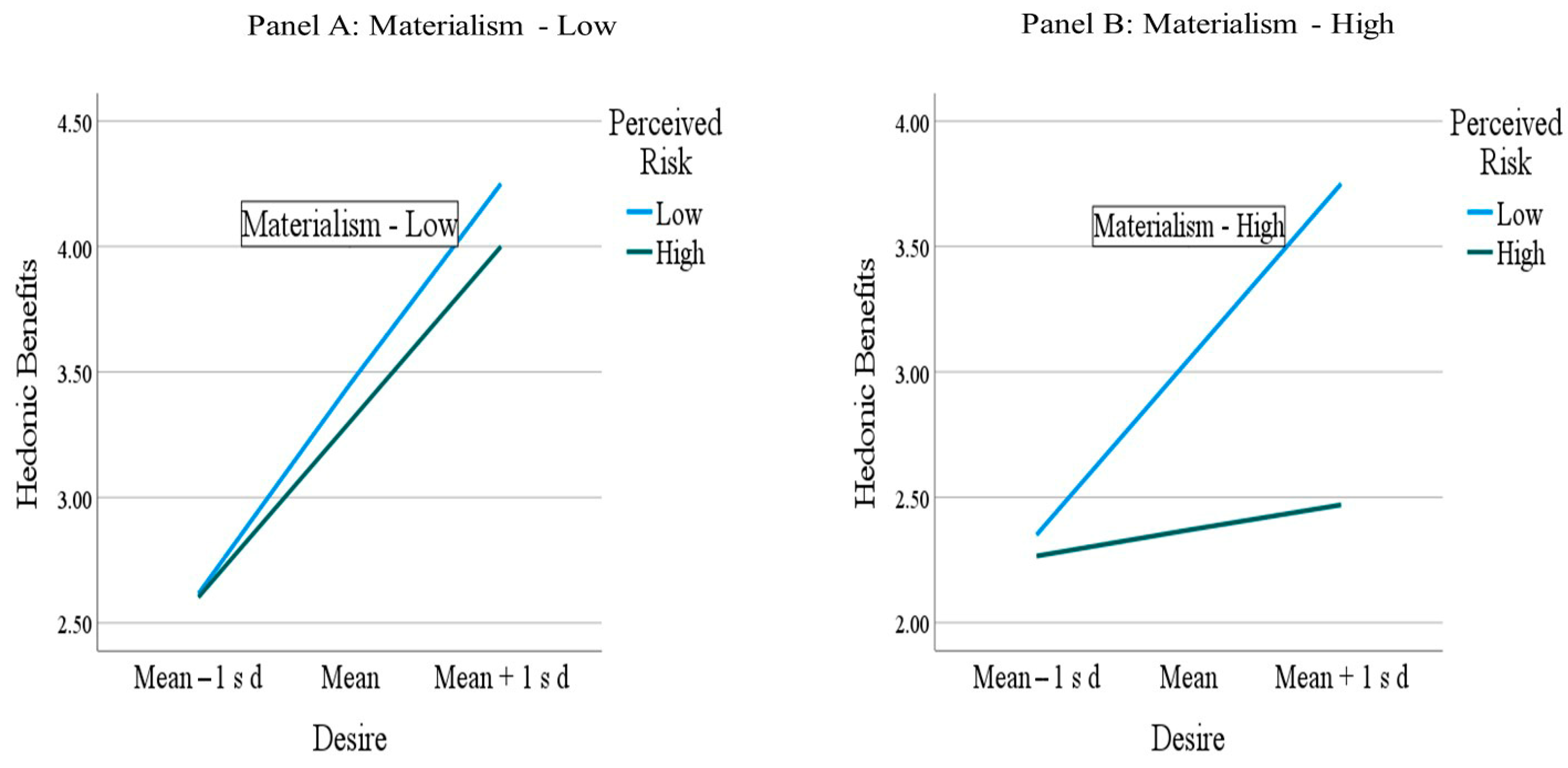
The visual representation of the three-way interaction can be seen in Figure 3.
Figure 3 shows the moderation effect of materialism at low and high values. In panel A, the positive association between desire and hedonic benefits at lower values of risk and higher values of risk converge at the higher levels of desire. In panel B, in a sharp contract, when materialism is at a high level, lower levels of perceived risk are associated with higher hedonic benefits at both lower and higher levels of desire. The divergence of the curve (though it appears to be insignificant in the figure) shows a greater variance in the hedonic benefits as the benefits touch nearly 3.8, as compared to 3.4 when the materialism is low (panel A). The effect is more visible as we move to panel B. These results corroborate the support for moderated moderated-mediation Hypothesis 2a.

4.3. Testing Hypotheses 5, 6, and 7

To test Hypothesis 5, 6, and the mediation Hypothesis 7 (i.e., mediation of economic benefits in the link between desire and behavioral intention), we used model number 4 in Hayes (2018) PROCESS macros and present the results in Table 8.
As shown in Table 8 (step 2), the regression coefficient of desire on economic benefits was positive and significant (β = 0.651; t = 21.09; p < 0.001), thus supporting H5. The regression coefficient of economic benefits on behavioral intention was (shown in Step 3) positive and significant (β = 0.349; t = 8.51; p < 0.001), thus supporting H6.
The mediation hypothesis (H7) was checked by the indirect effect of desire on behavioral intention through economic benefits as a mediator. The results based on bootstrapping samples of 20,000 revealed that the indirect effect of desire on behavioral intention was positive and significant (β = 0.227; LLCI = 0.1666; ULCI = 0.29090), thus supporting H7.

4.4. Hypothesis Testing of Perceived Risk as a Moderator

Hypothesis 5a posits that perceived risk is a moderator in the relationship between desire and economic benefits. To test this relationship, we used model number 7 in Hayes (2018) to see the moderating effect of perceived risk, where the dependent variable is behavioral intention, the mediator is economic benefits, the independent variable is desire, and the moderator variable is perceived risk. The results of moderated-mediation are shown in Table 9.
As shown in Table 9 (step 1), the regression coefficient of perceived risk was negative and significant (β = −0.645; t = −7.86; p < 0.001), which was rather expected. The regression coefficient of the multiplicative term (desire x perceived risk) was significant (β = 0.089; t = 3.54; p < 0.001), indicating that perceived risk moderates the relationship between desire and economic benefits. The index of moderated-mediation was significant (β = 0.0331; Boot SE = 0.0113; BCCI [0.0105; 0.0550]). The conditional effects of the focal predictor (economic benefits) on values of moderator (perceived risk) are also presented at the bottom of Table 8. The indirect effects of desire on behavioral intention through economic benefits are also presented at the bottom of Table 8.
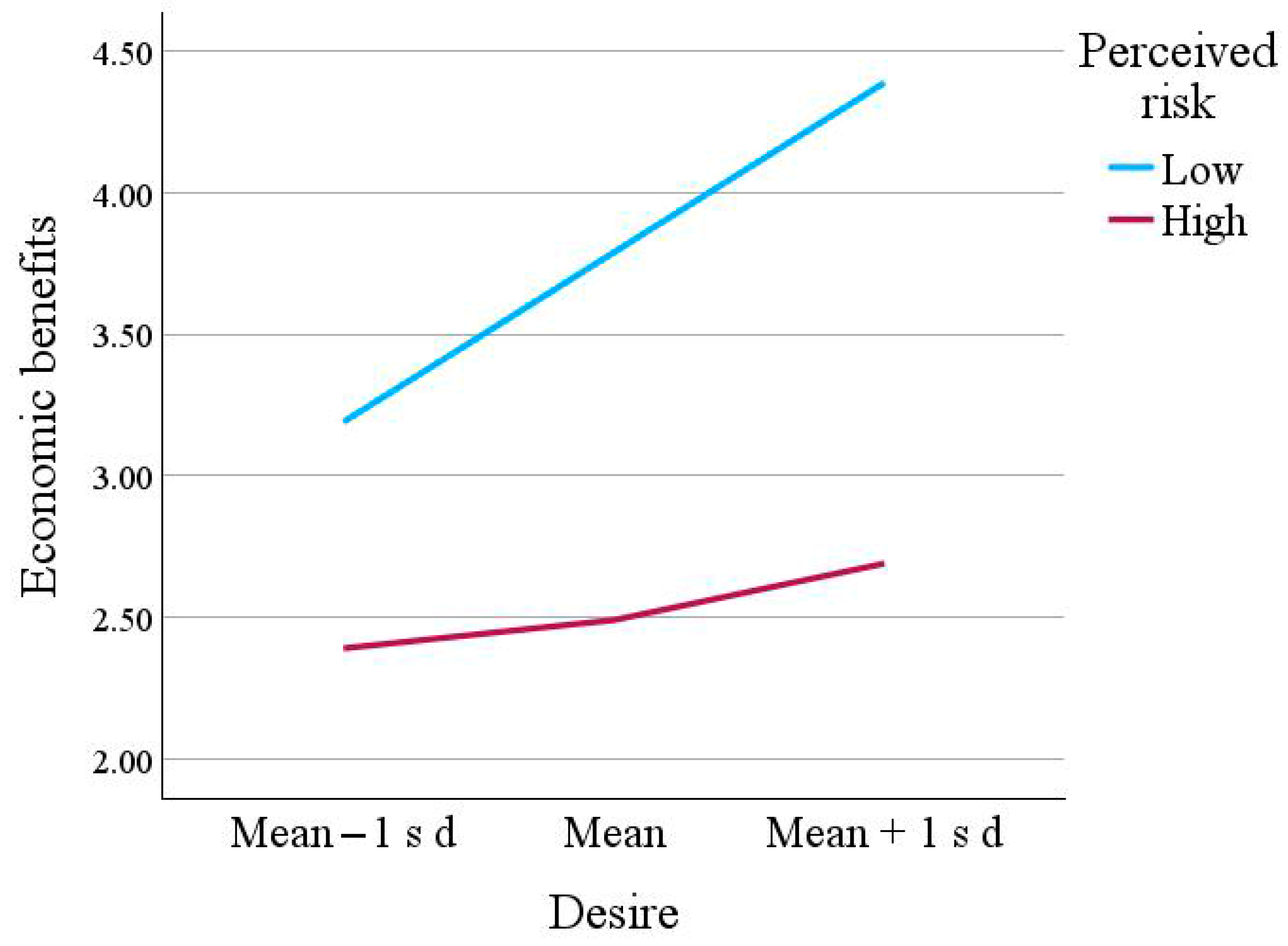
The visual representation of two-way interaction is shown in Figure 4.
As shown in Figure 4, at lower levels of perceived risk, desire is associated with higher levels of economic benefits as compared to higher levels of risk. When desire increases from low to high, higher levels of perceived risk result in lower levels of economic benefits when compared to lower levels of perceived risk. These results render support to the moderated-mediation Hypothesis 5a.
The summary of the hypotheses and managerial and policy implications are mentioned in Table 10.
The empirical model is presented in Figure 2.

5. Discussion

The present study examined the relationship between the desires of consumers to opt for shared accommodation by employing a moderated moderated-mediation model. After collecting data from 530 respondents, the data was analyzed using the Hayes (2018) PROCESS macros and the hypothesized relationships were tested. The instrument’s measurement properties yielded a six-factor model as a fit for the data.
The results from the present study suggest that the behavioral intention is better explained through hedonic benefits as a mediator. First, this study supported the positive association between desire and behavioral intention (H1). This finding is well supported by the results from the literature (Turel et al., 2010; Yoo et al., 2017). As expected, the study reported a positive relationship between desire and hedonic benefits (H2), confirming the results from the previous studies (Chitturi et al., 2008). The results confirm the positive effect of hedonic benefits on behavioral intention (H3), in line with previous studies (Tsou et al., 2019). The findings support that the hedonic benefits of customers mediated the link between desire and behavioral intention (H4). Nonetheless, previous studies were not available to vouch for this result, the benefits of hedonic benefits have been supported (Hwang et al., 2019; Li et al., 2025; Prebensen & Rosengren, 2016); thus, these findings do not contradict the literature.
The second part of the model is related to economic benefits as a mediator in the relationship between desire and behavioral intention. In this study, we found that desire has a positive association with economic benefits (H5). The result is consistent with earlier studies (Dabbous & Tarhini, 2019; Mahadevan, 2018). As proposed, our study revealed the positive effect of economic benefits on behavioral intention (H6). Many studies vouch for this relationship (Barnes & Mattsson, 2016; Tussyadiah, 2016). This study also supported the mediation of economic benefits between desire and behavioral intention of consumers to opt for shared accommodation (H7). Again, no previous research was available to vouch for the relationship that we found; the results are consistent with the notion that economic benefits are the precursors to behavioral intention.
A key finding of this study is the role of perceived risk and materialism as potential moderators in the relationship between desire and behavioral intention. This study established that while perceived risk harms hedonic benefits, materialism counters the adverse effect. As a result, an increase in desire leads to a rise in behavioral intention. More specifically, the results support one of the critical exploratory hypotheses of the study: materialism moderates the moderated effect of perceived risk in the relationship between desire and behavioral intention mediated through hedonic benefits (H2a). The results convey that materialism would help the customers counter the risk associated with shared accommodation. This study extends the theoretical underpinnings of perceived risk by studying materialism as a precursor for behavioral intention, mediated through hedonic benefits. This moderated moderated-mediation analysis has been carried out for the first time in the literature of shared accommodation, to the best of our knowledge, and to vouch for this finding, no previous studies were available. However, the results prove that materialism plays a vital role in enhancing behavioral intention.
Another key finding from this study is the moderating effect of perceived risk between desire and economic benefits (Hypothesis 5a). As the positive association between desire and economic benefits is supported in the literature and found in this study, the perceived risk weakens the positive association. The results support that lower levels of perceived risk are associated with higher levels of behavioral intention at higher levels of desire to opt for shared accommodation (Jiang et al., 2025).
The findings from this study are consistent with the GDB (Perugini & Bagozzi, 2001), and “desire” was the most important variable driving the customers to the behavioral intention of sharing accommodation (Song et al., 2012). As opposed to other earlier studies that considered the “attitude” as a driving force, based on the TRA, this study is a radical departure and provides a motivation-based theory to support the conceptual model we present. As emotional, social, and rational processes are embedded in goal-directed behavior, our results are supported by the GDB theoretical framework.

5.1. Theoretical Implications

The conceptual model of sharing economy was developed and tested in the Indian context. In a multitude of places, this inquiry builds on the existing state of science regarding hospitality management. First, GDB has been used to explain the link between shared accommodation desire and behavioural intention. Second, by demonstrating that hedonic advantages act as a mediating factor in the link between desire and behavioural intention, the present study highlights that desire has an indirect effect on behavioral intention. Third, by establishing the positive effects of desire on hedonic benefits and behavioral intentions, this study supports the results from existing studies and adds to the growing literature on sharing economy (Poon & Huang, 2017; Tussyadiah, 2016).
Fourth, the study’s vital contribution is the multilayered moderated-mediation model whereby the perceived risk as to the first moderator and materialism as a second moderator in the relationship between desire and behavioral intention mediated through hedonic benefits offers a novel concept in sharing accommodation. This study, thus, highlights the importance of the interactive effect of materialism and perceived risk in understanding the intention of consumers to opt for sharing accommodation. Furthermore, an exploration of the three-way interaction between desire, perceived risk, and materialism was conducted, to the best of our knowledge, for the first time. As a result, it makes a substantial contribution to the sharing economy literature.
Fifth, in addition to hedonic benefits, this study also focuses on the indirect effect of desire on behavioral intention through economic benefits. In the present-day post-pandemic period, which has adversely affected the financial position of individuals and families, economic benefits play a vital role in terms of saving money. As the income of many people has shown a downward trend, consumers attempt to take trips with the minimum possible cost without sacrificing quality. Sixth, according to our findings, lower levels of perceived risk are linked to increased behavioural intention as a result of the increased desire. These findings add to the expanding body of knowledge on the sharing economy. Overall, riding on the GDB theory, the conceptual model presented and tested makes a significant addition to the existing research.
In sum, the findings indicate an overly perfect model because cultural factors and contextual influences are not factored into the model. Further, considering that over 85% of the respondents belong to the younger generation (between 18 and 35 years of age), the model may not capture the consumer behavior of all age groups. However, the authors expect to see similar findings by including diverse and balanced age groups.

5.2. Practical Implications

This study offers recommendations for companies engaging in sharing economy and the individuals and families interested in opting for shared accommodation. First, this study establishes the importance of the perceived hedonic benefits of sharing accommodation in influencing their behavioral intention. In addition, the desire of individuals is a precursor for behavioral intention. Hence, the companies of sharing economy focus on identifying the factors motivating the potential customer to express their desire to have shared accommodation. From a practitioner’s standpoint, as shared accommodation has some inherent risks involved, the companies must see that perceived risk is lowered by ensuring the quality required by individuals. As explained before, owners of the shared accommodation may not have the necessary skills to offer better service because of lack of experience and training as expected in the organized sector of hotel accommodation; it is essential to assure the potential customers of the quality of service they provide. Therefore, one of the actionable recommendations for the owners of the accommodations is to focus on quality of service and take steps to reduce the perceived risk involved in sharing accommodation. Further, reservations of shared accommodation are often made online; it is necessary to guard the consumers against the financial and privacy risks of misusing customers’ personal information.
From the viewpoint of individuals attempting to prefer the sharing economy, economic benefits play an essential role. For example, individuals prefer to use the sharing economy when they perceive the services to be economical, convenient, and less risky, as the perceived risks (such as privacy risk and security risk) cause the consumers to shy away from the sharing economy because, as some researchers pointed out, assault, violence, and burglary have occurred in various sharing economy service providers such as Uber and Airbnb (Tsou et al., 2019). Furthermore, the present study emphasizes the importance of materialism in influencing behavioral intention. With the present-day post-pandemic scenario, individuals cut corners to save money, yet continue to make trips to different destinations to counter boredom due to prolonged stays at their homes because of travel restrictions and social distancing in several countries. Therefore, it is suggested to offer the accommodation at affordable prices so that low- to middle-income consumers can enjoy the benefits of the sharing economy. Further, local governments can offer tax benefits for the owners of sharing accommodations to expand their businesses and attract customers, as the benefits of savings from tax may also result in reductions in the rents of shared accommodation.

5.3. Limitations and Future Research

The results from this study should be interpreted in light of some limitations. First, this study gauges consumers’ intention based on self-reported measures; hence, the authors do not deny the reflection of social desirability bias in the study. Second, the sample of this study was from a developing country; hence, their opinions may not resonate with consumers in developed nations. Therefore, the generalizability of findings beyond developing countries (e.g., India, Bangladesh, Sri Lanka) is questionable and is, hence, a limitation of this study. Third, the survey consisted of young respondents (61.7% aged 18–24 and 21.7% aged 25–34, totaling more than 83% under 35), and it is more likely that the results may reflect the behavior of the younger generation. Therefore, underrepresentation of other age groups constitutes another limitation of this study. We suggest that future researchers consider more diverse and balanced sampling strategies to strengthen external validity. Fourth, a non-probabilistic sampling technique for collecting the data may be another limitation of this research. Fifth, as data were collected at a single point in time, it is difficult to establish causal relationships between the variables. Future studies may involve two-wave data to mitigate common method bias and establish causal relationships between independent and dependent variables.
Several future research directions are suggested by the current study. First, this study considered only a limited number of variables affecting behavioral intention. Many other variables, such as trust, the attractiveness of destinations, availability of different traditional modes of accommodation, cultural factors, etc., were not included in this study. Future studies may focus on these variables. Further, tourism scholars may study the influence of personality characteristics on their intention to use shared accommodation or sharing services. Additionally, how customers’ experience and perception affect behavioral intention can be studied by future researchers. Further, the influence of eWOM in motivating the non-users of the sharing economy to switch their preferences from ownership to non-ownership sharing accommodation may also be examined. Finally, a cross-country comparison of relationships between the variables in the study could add to the literature on the sharing economy.

6. Conclusions

The sharing economy, as a concept, has gathered momentum around 2008, and now with the global pandemic and post-pandemic situation, the importance of the sharing economy has escalated because of the decrease in the income of many individuals worldwide. Further, as research on sharing accommodation has progressed, customers (tourists) are increasingly concerned with the health-consciousness, safety, and reliability of available accommodations amidst the worldwide pandemic consequences. These study results would help both academicians and practicing managers engaged in the sharing economy by unraveling the complex relationships between desire, perceived risk, and materialism regarding sharing accommodation. As the global pandemic adversely affected the sharing accommodation sector, the resilient strategies could include providing more economical and hedonic benefits so that more and more customers would exhibit their intention to use shared accommodations, resulting in benefits for both the hosts and the guests. As the importance of the sharing economy is growing day after day, research on the identification of variables that contribute to the satisfaction of consumers remains on the agenda of hospitality and tourism research.

Author Contributions

Conceptualization, P.G. and S.P.; methodology, S.P.; software, S.P.; validation, P.G. and S.P., formal analysis, P.G. and S.P.; investigation, P.G. and S.P.; resources, P.G.; data curation, S.P.; writing—original draft preparation, P.G. and S.P.; writing—review and editing, P.G. and S.P.; visualization, P.G.; supervision, S.P.; project administration, P.G. and S.P. All authors have read and agreed to the published version of the manuscript.

Funding

This research received no external funding.

Institutional Review Board Statement

The study was conducted in accordance with the Declaration of Helsinki, and approved by the Institutional Review Board of Department Academic Integration Panel (DAIP) (protocol code CO/921/25 and 23 December 2025).

Informed Consent Statement

Informed consent was obtained from all subjects involved in the study.

Data Availability Statement

The original contributions presented in the study are included in the article, further inquiries can be directed to the corresponding author.

Conflicts of Interest

The authors declare no conflict of interest.

References

  1. Ajzen, I. (1991). The theory of planned behaviour. Organizational Behaviour and Human Decision Processes, 50(2), 179–211. [Google Scholar] [CrossRef]
  2. Aritenang, A. F. (2025). Impact of COVID-19 on Airbnb occupancy rate in Bandung, Indonesia. Journal of Urban Management, 14(1), 147–159. [Google Scholar] [CrossRef]
  3. Armstrong, J. S., & Overton, T. S. (1977). Estimating nonresponse bias in mail surveys. Journal of Marketing Research, 14(3), 396–402. [Google Scholar] [CrossRef]
  4. Arnold, M. J., & Reynolds, K. E. (2003). Hedonic shopping motivations. Journal of Retailing, 79(2), 77–95. [Google Scholar] [CrossRef]
  5. Asadi, S., Nilashi, M., Samad, S., Abdullah, R., Mahmoud, M., Alkinani, M. H., & Yadegaridehkordi, E. (2021). Factors impacting consumers’ intention toward adoption of electric vehicles in Malaysia. Journal of Cleaner Production, 282, 124474. [Google Scholar] [CrossRef]
  6. Bagozzi, R. P. (1992). The self-regulation of attitudes, intentions, and behavior. Social Psychology Quarterly, 55(2), 178–204. [Google Scholar] [CrossRef]
  7. Bamberg, S., Hunecke, M., & Blöbaum, A. (2007). Social context, personal norms and the use of public transportation: Two field studies. Journal of Environment Psychology, 27, 190–203. [Google Scholar] [CrossRef]
  8. Barnes, S. J., & Mattsson, J. (2016). Understanding current and future issues in collaborative consumption: A four-stage Delphi study. Technological Forecasting and Social Change, 104, 200–211. [Google Scholar] [CrossRef]
  9. Barry, J. B., Darden, W. R., & Grrffin, A. M. (1994). Measuring hedonic and utilitarian shopping value. Journal of Consumer Research, 20(4), 644–656. [Google Scholar] [CrossRef]
  10. Bauer, R. A. (1960). Consumer behavior as risk taking. In R. S. Hancock (Ed.), Dynamic marketing for a changing world (pp. 389–398). American Marketing Association. [Google Scholar]
  11. Belk, R. (2009). Sharing. Journal of Consumer Research, 36, 715–734. [Google Scholar] [CrossRef]
  12. Belk, R. (2014). Sharing versus pseudo-sharing in Web 2.0. The Anthropologist, 18(1), 7–23. [Google Scholar] [CrossRef]
  13. Belk, R. W. (1984). Three scales to measure constructs related to materialism: Reliability, validity, and relationships to measures of happiness. Advances in Consumer Research, 11, 291–297. [Google Scholar]
  14. Botsman, R., & Rogers, R. (2010). What’s mine is yours: The rise of collaborative consumption. Harpers Collins. [Google Scholar]
  15. Browne, M. W., & Cudeck, R. (1993). Alternative ways of assessing model fit. In K. A. Bollen, & J. S. Long (Eds.), Testing structural equation models (pp. 136–162). Sage. [Google Scholar]
  16. Chitturi, R., Raghunathan, R., & Mahajan, V. (2008). Delight by design: The role of hedonic versus utilitarian benefits. Journal of Marketing, 72(1), 48–63. [Google Scholar] [CrossRef]
  17. Chiu, W., Oh, G.-E., & Cho, H. (2022). Impact of COVID-19 on consumers’ impulse buying behavior of fitness products: A moderated mediation model. Journal of Consumer Behavior, 21(2), 245–258. [Google Scholar] [CrossRef] [PubMed]
  18. Chung, N., Lee, H., Lee, S. J., & Koo, C. (2015). The influence of tourism web site on tourists ‘behavior to determine destination selection: A case study of creative economy in Korea. Technological Forecasting and Social Change, 96(1), 130–143. [Google Scholar] [CrossRef]
  19. Cohen, B., & Munoz, P. (2016). Sharing cities and sustainable consumption and production: Towards an integrated framework. Journal of Cleaner Production, 134(1), 87–97. [Google Scholar] [CrossRef]
  20. Comrey, A. L., & Lee, H. B. (1992). A first course in factor analysis (2nd ed.). Lawrence Erlbaum. [Google Scholar]
  21. Cui, F., Liu, Y., Chang, Y., Duan, J., & Li, J. (2016). An overview of tourism risk perception. Natural Hazards, 82(1), 643–658. [Google Scholar] [CrossRef]
  22. Dabbous, A., & Tarhini, A. (2019). Assessing the impact of knowledge and perceived economic benefits on sustainable consumption through the sharing economy: A sociotechnical approach. Technological Forecasting and Social Change, 149, 119775. [Google Scholar] [CrossRef]
  23. Davidson, A., Habibi, M. R., & Laroche, M. (2017). Materialism and the sharing economy: A cross-cultural study of American and Indian consumers. Journal of Business Research, 82, 364–372. [Google Scholar] [CrossRef]
  24. Ert, E., Fleischer, A., & Magen, N. (2016). Trust and reputation in the sharing economy: The role of personal photos in Airbnb. Tourism Management, 55(1), 62–73. [Google Scholar] [CrossRef]
  25. Felson, M., & Spaeth, J. L. (1978). Community structure and collaborative consumption: A routine activity approach. The American Behavioral Scientist, 21(4), 614–624. [Google Scholar] [CrossRef]
  26. Fornell, C., & Larcker, D. (1981). Evaluating structural equation models with unobservable variables and measurement error. Journal of Marketing Research, 18(1), 39–50. [Google Scholar] [CrossRef]
  27. Forouhar, A., Chapple, K., Allen, J., Jeong, B., & Greenberg, J. (2025). Assessing downtown recovery rates and determinants in North American cities after the COVID-19 pandemic. Urban Studies, 62(6), 1209–1231. [Google Scholar] [CrossRef]
  28. French, A. M., Luo, X. R., & Bose, R. (2017). Toward a holistic understanding of continued use of social networking tourism: A mixed-methods approach. Information & Management, 54(6), 802–813. [Google Scholar] [CrossRef]
  29. Gerwe, O. (2021). The COVID-19 pandemic and the accommodation sharing sector: Effects and prospects for recovery. Technological Forecasting & Social Change, 167, 120733. [Google Scholar] [CrossRef]
  30. Goel, P., Garg, A., Sharma, A., & Rana, N. P. (2022a). I won’t touch money because it is dirty: Examining customer’s loyalty toward M-payment. International Journal of Bank Marketing, 40(5), 992–1016. [Google Scholar] [CrossRef]
  31. Goel, P., Garg, A., Walia, N., Kaur, R., Jain, M., & Singh, S. (2022b). Contagious diseases and tourism: A systematic review based on bibliometric and content analysis methods. Quality & Quantity, 56(5), 3085–3110. [Google Scholar]
  32. Goel, P., & Parayitam, S. (2024). Antecedents of behavioral intention and use of shared accommodation: Gender as a moderator. Tourism and Hospitality Management, 30(1), 105–118. [Google Scholar] [CrossRef]
  33. Gossling, S., Scott, D., & Hall, C. M. (2020). Pandemics, tourism and global change: A rapid assessment of COVID-19. Journal of Sustainable Tourism, 29(1), 1–20. [Google Scholar] [CrossRef]
  34. Guttentag, D. (2015). Airbnb: Disruptive innovation and the rise of informal tourism accommodation sector. Current Issues in Tourism, 18(12), 1192–1217. [Google Scholar] [CrossRef]
  35. Guttentag, D. (2019). Progress on Airbnb: A literature review. Journal of Hospitality and Tourism Technology, 10(4), 814–844. [Google Scholar] [CrossRef]
  36. Guttentag, D., Smith, S., Potwarka, L., & Havitz, M. (2018). Why tourists choose Airbnb: A motivation-based segmentation study. Journal of Travel Research, 57(3), 342–359. [Google Scholar] [CrossRef]
  37. Hair, J. F., Risher, J. J., Sarstedt, M., & Ringle, C. M. (2019). When to use and how to report the results of PLS-SEM. European Business Review, 31(1), 2–24. [Google Scholar] [CrossRef]
  38. Hamari, J., Sjöklint, M., & Ukkonen, A. (2016). The sharing economy: Why people participate in collaborative consumption. Journal of the Association for Information Science and Technology, 67(9), 2047–2059. [Google Scholar] [CrossRef]
  39. Hawley, A. (1950). Human ecology: A theory of community structure. Ronald Press. [Google Scholar]
  40. Hayes, A. F. (2018). Introduction to mediation, moderation, and conditional process analysis: A regression-based approach. The Guilford Press. [Google Scholar]
  41. Hirschman, E. C., & Holbrook, M. B. (1982). Hedonic consumption: Emerging concepts, methods and propositions. Journal of Marketing, 46(1), 92–101. [Google Scholar] [CrossRef]
  42. Hong, J. C., Lin, P. H., & Hsieh, P. C. (2017). The effect of consumer innovativeness on perceived value and continuance intention to use smartwatch. Computers in Human Behavior, 67, 264–272. [Google Scholar] [CrossRef]
  43. Hong, S.-J., & Tam, K. Y. (2006). Understanding the adoption of multipurpose information appliances. The case of mobile data services. Information Systems Research, 17(2), 162–179. [Google Scholar] [CrossRef]
  44. Howard, M. C., Boudreaux, M., & Oglesby, M. (2024). Can Harman’s single-factor test reliably distinguish between research designs? Not in published management studies. European Journal of Work and Organizational Psychology, 33(6), 790–804. [Google Scholar] [CrossRef]
  45. Huang, C., & Chen, T. (2015). Moral norm and the two-component theory of planned behavior model in predicting knowledge sharing intention: A role of mediator desire. Psychology, 6, 1685–1699. [Google Scholar] [CrossRef]
  46. Hwang, J., Kim, H., & Kim, W. (2019). Investigating motivated consumer innovativeness in the context of drone food delivery services. Journal of Hospitality and Tourism Management, 38(1), 102–110. [Google Scholar] [CrossRef]
  47. Jiang, G., Yang, W., & Zhang, N. (2025). Effect of perceived risks, perceived benefits and regulatory events on users’ supervision intention towards e-hailing platforms: A mixed method. Journal of Information Science, 51(1), 50–72. [Google Scholar] [CrossRef]
  48. Kement, U., Çavuşoğlu, S., Demirağ, B., Durmaz, Y., & Bükey, A. (2022). Effect of perception of COVID-19 and nonpharmaceutical intervention on desire and behavioral intention in touristic travels in Turkey. Journal of Hospitality and Tourism Insights, 5(1), 230–249. [Google Scholar] [CrossRef]
  49. Kock, N. (2015). Common method bias in PLS-SEM: A full collinearity assessment approach. International Journal of e-Collaboration, 11, 1–10. [Google Scholar] [CrossRef]
  50. Koo, C., & Chung, N. (2014). Examining the eco-technological knowledge of smart green it adoption behavior: A self-determination perspective. Technological Forecasting and Social Change, 88(1), 140–155. [Google Scholar] [CrossRef]
  51. Krejcie, R. V., & Morgan, D. W. (1970). Determining sample size for research activities. Educational Psychological Measurement, 30(3), 607–610. [Google Scholar] [CrossRef]
  52. Lamberton, C. P., & Rose, R. L. (2012). When is ours better than mine? A framework for understanding and altering participation in commercial sharing systems. Journal of Marketing, 76(1), 109–125. [Google Scholar] [CrossRef]
  53. Lee, S., & Kim, D.-Y. (2018). The effect of hedonic and utilitarian values on satisfaction and loyalty of Airbnb users. International Journal of Contemporary Hospitality Management, 30(3), 1332–1351. [Google Scholar] [CrossRef]
  54. Lee, Z. W. Y., Chan, T. K. H., Balaji, M. S., & Chong, A. Y.-L. (2018). Why people participate in the sharing economy: An empirical investigation of Uber. Internet Research, 28(3), 829–850. [Google Scholar] [CrossRef]
  55. Leone, L., Perugini, M., & Ercolani, A. P. (2006). Studying, practicing, and mastering: A test of the model of goal-directed behavior (MGB) in the software learning domain. Journal of Applied Social Psychology, 34(9), 1945–1973. [Google Scholar] [CrossRef]
  56. Li, Y. Q., Li, R., Ruan, W. Q., & Zhang, S. N. (2025). Releasing happiness: Influencing factors and configuration paths of shared accommodation customers’ positive emotions. Tourism Management, 108, 105113. [Google Scholar] [CrossRef]
  57. Liang, L., Choi, H., & Joppe, M. (2018). Understanding repurchase intention of Airbnb consumers: Perceived authenticity, electronic word-of-mouth, and price sensitivity. Journal of Travel and Tourism Marketing, 35(1), 73–89. [Google Scholar] [CrossRef]
  58. Lieber, R. (2015). Airbnb horror story points to need for precautions. The New York Times. Available online: http://www.nytimes.com/2015/08/15/your-money/airbnb-horror-story-points-to-need-for-precautions.html (accessed on 1 December 2025).
  59. Lim, W. M. (2020). The sharing economy: A marketing perspective. Australasian Marketing Journal, 28(1), 4–13. [Google Scholar] [CrossRef]
  60. Lin, G., Chen, J. L., Li, G., & Song, H. (2024). Substitution between sharing accommodation and hotels: A behavioral economic demand curve analysis. Annals of Tourism Research, 104, 103716. [Google Scholar] [CrossRef]
  61. Lutz, C., Hoffmann, C. P., Bucher, E., & Fieseler, C. (2018). The role of privacy concerns in the sharing economy. Information, Communication & Society, 21(10), 1472–1492. [Google Scholar]
  62. Mahadevan, R. (2018). Examination of motivations and attitudes of peer-to-peer users in the accommodation sharing economy. Journal of Hospitality Marketing & Management, 27(6), 679–692. [Google Scholar] [CrossRef]
  63. Mao, Z., & Lyu, J. (2017). Why travelers use Airbnb again? An integrative approach to understanding travelers’ repurchase intention. International Journal of Contemporary Hospitality and Management, 29(9), 2464–2482. [Google Scholar] [CrossRef]
  64. Molinari, L. K., Abratt, R., & Dion, P. (2008). Satisfaction, quality and value and effects on repurchase and positive word-of-mouth behavioral intentions in a B2B services context. Journal of Services Marketing, 22(5), 363–373. [Google Scholar] [CrossRef]
  65. Moreno-Gil, S., & Coca-Stefaniak, J. A. (2020). Overtourism and the sharing economy—Tourism cities at a crossroads. International Journal of Tourism Cities, 6(1), 1–14. [Google Scholar] [CrossRef]
  66. Narasimhan, C., Papatla, P., Jiang, B., Kopalle, P. K., Messinger, P. R., Moorthy, S., Proserpio, D., Subramanian, U., & Wu, C. (2018). Sharing economy: Review of current research and future directions. Customer Needs and Solutions, 5(9), 93–106. [Google Scholar] [CrossRef]
  67. Obeidat, M., & Almatarney, A. (2020). Risk perceptions among potential Airbnb hosts. Ethics and Economics, 17(2), 74–87. [Google Scholar]
  68. Okada, E. M. (2005). Justification effects on consumer choice of hedonic and utilitarian goods. Journal of Marketing Research, 42(1), 43–53. [Google Scholar] [CrossRef]
  69. Oliver, R. L. (1997). Satisfaction: A behavioral perspective on the consumer. McGraw-Hill. [Google Scholar]
  70. Overby, J. W., & Lee, E. J. (2006). The effects of utilitarian and hedonic online shopping value on consumer preference and intentions. Journal of Business Research, 59(1), 1160–1166. [Google Scholar] [CrossRef]
  71. Pappas, N. (2017). The complexity of purchasing intensions in peer-to-peer accommodation. International Journal of Contemporary Hospitality Management, 29(9), 2302–2321. [Google Scholar] [CrossRef]
  72. Perugini, M., & Bagozzi, R. P. (2001). The role of desires and anticipated emotions in goal-directed behaviours: Broadening and deepening the theory of planned behaviour. British Journal of Social Psychology, 40(1), 79–98. [Google Scholar] [CrossRef] [PubMed]
  73. Podsakoff, P. M., Mackenzie, S. B., Lee, J.-Y., & Podsakoff, N. P. (2003). Common method biases in behavioral research: A critical review of the literature and recommended remedies. Journal of Applied Psychology, 88(5), 879–903. [Google Scholar] [CrossRef]
  74. Podsakoff, P. M., Podsakoff, N. P., Williams, L. J., Huang, C., & Yang, J. (2024). Common method bias: It’s bad, it’s complex, it’s widespread, and it’s not easy to fix. Annual Review of Organizational Psychology and Organizational Behavior, 11(1), 17–61. [Google Scholar] [CrossRef]
  75. Ponchio, M. C., & Aranha, F. (2008). Materialism as a predictor variable of low-income consumer behavior when entering into installment plan agreements. Journal of Consumer Behaviour, 7(1), 21–34. [Google Scholar] [CrossRef]
  76. Poon, K. Y., & Huang, W.-J. (2017). Past experience, traveler personality and tripographics on intention to use Airbnb. International Journal of Contemporary Hospitality Management, 29(9), 2425–2443. [Google Scholar] [CrossRef]
  77. Powanga, A., & Powanga, L. (2008). An economic analysis of a timeshare ownership. Journal of Retail and Leisure Property, 7(1), 69–83. [Google Scholar] [CrossRef]
  78. Prebensen, N. K., & Rosengren, S. (2016). Experience value as a function of hedonic and utilitarian dominant services. International Journal of Contemporary Hospitality Management, 28(1), 113–135. [Google Scholar] [CrossRef]
  79. Reio, T., Parayitam, S., Aruldoss, A., Mariyapragasam, M., & Ramasamy, P. (2025). Effect of organizational climate on employee withdrawal behaviour and job satisfaction: Training and development and teamwork as moderators. Human Resource Development International. [Google Scholar] [CrossRef]
  80. Richins, M. L. (2004). The material values scale: Measurement properties and development of a short Form. Journal of Consumer Research, 31, 209–219. [Google Scholar] [CrossRef]
  81. Richins, M. L., & Dawson, S. (1992). A consumer values orientation for materialism and its measurement: Scale development and validation. Journal of Consumer Research, 19, 303–316. [Google Scholar] [CrossRef]
  82. Rudmin, F. (2016). The customer science of sharing: A discussant’s observations. Journal of the Association for Consumer Research, 1(2), 198–209. [Google Scholar] [CrossRef]
  83. Skare, M., Soriano, D. R., & Porada-Rochon, M. (2021). Impact of COVID-19 on the travel and tourism industry. Technological Forecasting & Social Change, 163, 120469. [Google Scholar] [CrossRef]
  84. Song, H. J., Lee, C. K., Norman, W. C., & Han, H. (2012). The role of responsible gambling strategy informing behavioral intention: An application of a model of goal directed behavior. Journal of Travel Research, 51(4), 512–523. [Google Scholar] [CrossRef]
  85. Sweeney, J. C., Soutar, G. N., & Johnson, L. W. (1999). The role of perceived risk in the quality-value relationship: A study in a retail environment. Journal of Retailing, 75(1), 77–105. [Google Scholar] [CrossRef]
  86. Tian, Y., Zhang, H., Xiao, X., Wei, G., & Cao, X. (2021). Measuring perceived risk in sharing economy: A classical test theory and item response theory approach. International Journal of Hospitality Management, 96, 102980. [Google Scholar] [CrossRef]
  87. Trompenaars, F., & Coebergh, P. H. (2014). 100+ Management models: How to understand and apply the world’s most powerful business tools. Infinite Ideas. [Google Scholar]
  88. Tsou, H.-T., Chen, J.-S., Chou, C. Y., & Chen, T.-W. (2019). Sharing economy service experience and its effects on behavioral intention. Sustainability, 11, 5050. [Google Scholar] [CrossRef]
  89. Tsui, A. S., Ashford, S. J., Clair, L. S. T., & Xin, K. R. (1995). Dealing with discrepant expectations: Response strategies and managerial effectiveness. Academy of Management Journal, 38(6), 1515–1543. [Google Scholar] [CrossRef]
  90. Turel, O., Serenko, A., & Bontis, N. (2010). User acceptance of hedonic digital artifacts: A theory of consumption values perspective. Information & Management, 47(1), 53–59. [Google Scholar] [CrossRef]
  91. Tussyadiah, I. P. (2015). An exploratory on drivers and deterrents of collaborative consumption in travel. In I. Tussyadiah, & A. Inversini (Eds.), Information & communication technologies in tourism 2015. Springer International Publishing. [Google Scholar]
  92. Tussyadiah, I. P. (2016). Factors of satisfaction and intention to use peer-to-peer accommodation. International Journal of Hospitality Management, 55(1), 70–80. [Google Scholar] [CrossRef]
  93. Tussyadiah, I. P., & Pesonen, J. (2016). Impacts of peer-to-peer accommodation use on travel patterns. Journal of Travel Research, 55(8), 1022–1040. [Google Scholar] [CrossRef]
  94. Venkatesh, V., & Davis, F. D. (2000). A theoretical extension of the technology acceptance model: Four longitudinal field studies. Management Science, 46(2), 186–204. [Google Scholar] [CrossRef]
  95. Watson, J. J. (2003). The relationship of materialism to spending tendencies, saving, and debt. Journal of Economic Psychology, 24, 723–739. [Google Scholar] [CrossRef]
  96. Wu, C. W. D., & Cheng, W. L. A. (2019). Differences in perception on safety and security by travelers of Airbnb and licensed properties. Current Issues in Tourism, 22(1), 3092–3097. [Google Scholar] [CrossRef]
  97. Yi, J., Yuan, G., & Yoo, C. (2020). The effect of the perceived risk on the adoption of the sharing economy in the tourism industry: The case of Airbnb. Information Processing and Management, 57, 102108. [Google Scholar] [CrossRef]
  98. Yoo, C., Kwon, S., Na, H., & Chang, B. (2017). Factors affecting the adoption of gamified smart tourism applications: An integrative approach. Sustainability, 9(12), 2162. [Google Scholar] [CrossRef]
Figure 1. Conceptual model.
Tourismhosp 07 00006 g001
Figure 2. Results of structural model.
Tourismhosp 07 00006 g002
Figure 3. Moderation effect of materialism (low and high values).
Tourismhosp 07 00006 g003
Figure 4. Perceived risk as a moderator in the relationship between desire and economic benefits.
Tourismhosp 07 00006 g004
Table 1. Confirmatory factor analysis.
Constructs and the Sources of the ConstructsAlphaVIF ValuesStandardized
Loadings
yi)
Reliability
2yi)
Variance
(Var(εi))
Average
Variance-
Extracted
Estimate
Σ (λ2yi)/
[(λ2yi) + (Var(εi))]
Desire (Hwang et al., 2019; Yi et al., 2020)0.92 0.81
I desire to book peer to peer accommodations like (Airbnb, OYO, etc.) whenever I need to stay outstation. 2.2480.890.800.20
Whenever I go out of station, it’s my desire to use peer to peer accommodations (Airbnb, OYO, etc.) if it is available. 3.0560.920.850.15
If I travel, I want to stay in peer-to-peer accommodations (Airbnb, OYO, etc.). 2.0940.910.830.17
If I can choose peer to peer accommodations (Airbnb, OYO, etc.) in the near future, I won’t miss the opportunity. 3.7820.870.760.24
Hedonic Benefits (Hwang et al., 2019)0.89 0.83
Choosing peer to peer accommodations (Airbnb, OYO, etc.) will make my life exciting and stimulating. 2.1040.910.830.17
Choosing peer to peer accommodations (Airbnb, OYO, etc.) will give me a good feeling. 1.9580.920.850.15
Choosing peer to peer accommodations (Airbnb, OYO, etc.) will give me a sense of personal enjoyment. 3.1640.900.810.19
Economic Benefits (Dabbous & Tarhini, 2019; Mahadevan, 2018)0.91 0.71
I can save money if I stay in peer-to-peer accommodations (Airbnb, OYO, etc.). 2.7530.850.720.28
My stay in the sharing accommodation can improve
my economic situation.
2.7610.790.630.37
Staying in peer-to-peer accommodations (Airbnb, OYO, etc.) is cheaper than other options available in the market. 1.7080.860.730.27
Due to cost saving in peer-to-peer accommodations (Airbnb, OYO, etc.), I can consider staying longer 2.3500.850.720.28
Due to cost saving in peer-to-peer accommodations (Airbnb, OYO, etc.), I can have more to spend during my trip. 3.0950.880.770.23
Due to cost saving in peer-to-peer accommodations (Airbnb, OYO, etc.), I can travel more frequently 2.7610.810.650.35
Perceived Risk (Mahadevan, 2018)0.86 0.63
I feel risk of my loss of privacy while staying in peer-to-peer accommodations (Airbnb, OYO, etc.). 2.0630.750.570.43
While staying in peer-to-peer accommodations (Airbnb, OYO, etc.). I feel risk about my health safety. 1.7290.740.550.45
In peer-to-peer accommodations (Airbnb, OYO, etc.), I feel risk of fake reviews posted on hosts. 1.3860.850.720.28
I feel that fake reviews are posted on hosts about peer-to-peer accommodations (Airbnb, OYO, etc.). 1.6670.810.660.34
I perceive risk regarding cancellations and refunds in peer-to-peer accommodations (Airbnb, OYO, etc.). 2.0630.820.680.32
Materialism (Ponchio & Aranha, 2008)0.87 0.65
I like to spend money on premium hotels during my stays. 3.7240.830.680.32
I like to stay in places that impress others. 3.8520.800.650.35
I’d be much happier if I could afford to stay at premium hotels 2.7380.790.620.38
I like a lot of luxury in my life. 4.0620.830.700.30
It bothers me if I can’t stay in the premium hotel that I like. 3.0950.780.610.39
Behavioral Intention (Yi et al., 2020)0.93 0.83
I think I will stay in peer-to-peer accommodations (Airbnb, OYO, etc.) in future. 2.2530.910.830.17
I plan to stay in peer-to-peer accommodations (Airbnb, OYO, etc.) in future. 3.0540.930.860.14
I am thinking of using peer to peer accommodations (Airbnb, OYO, etc.) in future for staying. 2.0920.930.860.14
I intend to try and use peer to peer accommodations (Airbnb, OYO, etc.) within a year. 3.7880.880.780.22
Table 2. Demographic profile of respondents.
VariableDemographicsNumberPercent
GenderMale24846.8
Female28253.2
Age (in Years)18–2432761.7
25–3411521.7
35–44417.7
45–54407.5
Over 5571.4
Annual income (Indian Rupees/US $)Less than INR 200,000 (USD 2500)8616.2
INR 200,000–300,000
(USD 2500–3750)
458.5
INR 300,000–400,000
(USD 3750–5000)
6211.7
INR 400,000–600,000
(USD 5000–7500)
397.4
INR 600,000–800,000
(USD 7500–10,000)
6412.1
INR 800,000–1,000,000
(USD 10,000–12,500)
5610.6
INR 1,000,000–1,200,000
(USD 12,500–15,000)
6412.1
Over INR 1,200,000 (USD 15,000)11421.4
Table 3. Correlations, reliability, and validity.
VariableMeanStandard Deviation123456Cronbach
Alpha
Composite ReliabilityAverage Variance Extracted
(AVE)
1. Desire3.280.970.90 0.920.940.81
2. Hedonic Benefits3.130.960.77 **0.91 0.890.940.83
3. Economic Benefits3.290.930.68 **0.69 **0.84 0.910.930.71
4. Perceived Risk2.880.87−0.38 **−0.39 **−0.56 **0.79 0.860.890.63
5. Materialism2.910.900.44 **0.48 **0.49 **−0.55 **0.81 0.870.900.65
6. Behavioral intention3.230.960.69 **0.65 **0.65 **−0.43 **0.49 **0.910.930.950.83
** p < 0.01; the values on diagonals and bold represent the square root of AVE.
Table 4. Comparison of measurement models.
ModelFactorsχ2dfχ2/df∆χ2RMSEARMRStandardized
RMR
CFITLI = NNFIGFI
NullSaturated Model11,352351
Baseline
Model
Base line Six-factor Model1019.373093.30 0.0660.0580.0490.9350.9270.874
Model 1Five-factor model1247.173143.97227.8 **0.0750.0590.0500.9150.9050.835
Model 2Four-factor model1945.583186.12926.21 **0.0980.0770.0650.8520.8370.728
Model 3Three-factor model2704.423218.421685.05 **0.1180.1060.0890.7830.7630.644
Model 4Two-factor model3367.6332310.432348.26 **0.1330.1190.0990.7230.6990.579
Model 5One-factor model:4046.8732412.493027.5 **0.1470.1250.1050.6620.6330.539
** p < 0.01. Six-factor model: desire, hedonic benefits, economic benefits, perceived risk, materialism, behavior intention. Five-factor model: desire + hedonic benefits, economic benefits, perceived risk, materialism, behavior intention. Four-factor model: desire + hedonic benefits + economic benefits, perceived risk, materialism, behavior intention. Three-factor model: desire + hedonic benefits + economic benefits + perceived risk, materialism, behavior intention. Two-factor model: desire + hedonic benefits + economic benefits + perceived risk + materialism, behavior intention. One-factor model: desire + hedonic benefits + economic benefits + perceived risk + materialism + behavior intention.
Table 5. Testing H1, H2, H3, and H4 (mediation hypothesis).
DV = Behavioral IntentionDV = Hedonic Benefits H2DV = Behavioral Intention
Step 1Step 2Step 3
CoeffsetpCoeffsetpCoeffsetp
Constant0.97560.1069.20380.00000.62000.0936.66410.00000.79770.10697.46120.0000
Desire H10.68730.03122.1930.00000.76360.027228.09430.00000.46810.04749.880.0000
Hedonic Benefits H3 0.28700.0485.97470.0000
R-square0.483 0.599 0.515
F492.52 *** 789.28 *** 280.29 ***
df11 1 2
df2528 528 527
p0.0000 0.0000 0.0000
Total Effect
Total EffectsetpLLCIULCI
0.68730.03122.1930.00000.62640.7481
Direct Effect
Direct EffectsetpLLCIULCI
Desire → Behavioral Intention0.46810.04749.88000.00000.37510.5612
Bootstrapping Indirect Effect: H4
Indirect EffectBOOT seBOOT
LLCI
BOOT
ULCI
Desire → Hedonic Benefits → Behavioral Intention0.2191 (0.2870 × 0.7636 = 0.2191)0.04610.12930.3102
Notes: N = 530. Boot LLCI refers to the lower bound bootstrapping confidence intervals. Boot ULCL refers to the upper bound bootstrapping confidence intervals. *** p < 0.001
Table 6. Testing of Hypothesis 2a (three-way interaction) (results of moderated moderated-mediation model).
DV = Hedonic BenefitsDV = Behavioral Intention
CoeffsetpLLCIULCICoeffsetpLLCIULCI
Constant1.5390.8541.8010.072−0.13953.21730.79770.10697.46120.00000.58771.0077
Desire1.0390.1885.5160.0000.17260.28130.46810.04749.880.00000.37510.5612
Perceived Risk−0.3620.207−1.7530.080−0.76820.0437
Materialism0.5540.2801.9750.0490.14220.1543
Desire × Perceived Risk−0.1160.065−1.7810.076−0.0120.245
Desire × Materialism−0.1250.082−1.5250.128−0.02330.2601
Perceived Risk × Materialism−0.1420.077−1.8450.066−0.03590.2851
Desire × Perceived Risk × Materialism H2a0.1430.0423.4040.0270.00120.0867
Hedonic Benefits 0.2870.0485.97470.00000.19260.3813
R-square0.627 0.515
F125.60 280.29
R-square change0.003
df17 2
df2522 527
F-Change3.90
p value0.048 0.000
Index of moderated moderated-mediation
IndexBOOT SEBOOT LLCIBOOT ULCI
0.01250.00650.00170.0269
Indices of conditional moderated mediation by Risk
TrustIndexBOOT SEBOOT LLCIBOOT ULCI
2.0000 (Low)0.00850.0134−0.01450.0389
3.0000 (Medium)−0.0040.0126−0.02810.0223
4.0000 (High)−0.01650.0149−0.04740.0119
Conditional effects of the focal predictor (Hedonic Benefits) at values of moderators (Risk × Materialism)
RiskMaterialismEffectsetpLLCIULCI
LowLow0.63610.06629.61270.00000.50610.7661
LowMedium0.66760.044814.91670.00000.57960.7555
LowHigh0.6990.052813.24360.00000.59530.8027
MediumLow0.65970.045014.66060.00000.57130.7481
MediumMedium0.65640.034219.20970.00000.58930.7235
MediumHigh0.65310.052412.47530.00000.55030.756
HighLow0.68930.040616.96790.00000.60950.7691
HighMedium0.64250.052312.27640.00000.53970.7453
HighHigh0.59570.08427.07460.00000.43030.7611
DV = behavioral intention; mediator = hedonic benefits; moderators: perceived risk (first moderator) and materialism (second moderator); IV = desire.
Table 7. Indirect effect (desire → hedonic benefits → behavioral intention).
RiskMaterialismEffectBoot SEBoot LLCIBoot ULCI
2.0000 (Low)2.0000 (Low)0.18260.04350.09760.2677
2.0000 (Low)3.0000 (Medium)0.19160.04090.10960.2723
2.0000 (Low)4.0000 (High)0.20060.04280.1160.2850
2.8000 (Medium)2.0000 (Low)0.18930.04140.10730.2709
2.8000 (Medium)3.0000 (Medium)0.18840.03910.10960.2643
2.8000 (Medium)4.0000 (High)0.18740.04030.10840.2670
3.8000 (High)2.0000 (Low)0.19780.04260.1130.2805
3.8000 (High)3.0000 (Medium)0.18440.04030.10560.2634
3.8000 (High)4.0000 (High)0.1710.04210.0920.2570
Table 8. Testing H5, H6, and H7 (mediation hypothesis).
DV = Behavioral IntentionDV = Economic Benefits H5DV = Behavioral Intention
Step 1Step 2Step 3
CoeffsetpCoeffsetpCoeffsetp
Constant0.97560.1069.20380.00001.15470.105610.93450.00000.57290.11025.19970.0000
Desire 0.68730.03122.1930.00000.65070.030921.09080.00000.46030.039511.6680.0000
Economic Benefits H6 0.34870.0418.50570.0000
R-square0.483 0.457 0.545
F492.52 *** 444.82 *** 315.72 ***
df11 1 2
df2528 528 527
p0.0000 0.0000 0.0000
Total Effect
Total EffectsetpLLCIULCI
0.68730.03122.1930.00000.62640.7481
Direct Effect
Direct EffectsetpLLCIULCI
Desire → Behavioral Intention0.46030.039511.6680.00000.38280.5379
Bootstrapping Indirect Effect: H7
Indirect EffectBOOT seBOOT
LLCI
BOOT
ULCI
Desire → Economic Benefits → Behavioral Intention0.2269 (0.3487 × 0.6507 = 0.2269)0.03160.16660.2909
Notes: N = 530. Boot LLCI refers to the lower bound bootstrapping confidence intervals. Boot ULCL refers to the upper bound bootstrapping confidence intervals. *** p < 0.001
Table 9. Testing of Hypothesis 5a (results of two-way interaction).
Step 1Step 2
DV = Economic BenefitsDV = Behavioral Intention
CoeffsetpLLCIULCI LLCIULCI
Constant3.55370.298711.89810.00002.96694.14040.57290.11025.19970.00000.35650.7894
Desire0.23710.08612.75420.00610.0680.40620.46030.039511.6680.00000.38280.5379
Perceived Risk−0.6450.0821−7.86010.0000−0.8063−0.4838
Desire × Perceived Risk H5a0.08930.02523.53910.00040.03970.1389
Economic Benefits 0.34870.0418.50570.00000.26820.4293
R-square0.574 0.545
F235.96 *** 315.72 ***
df13 2
df2526 527
p value0.0000 0.0000
Index of moderated moderated-mediation
IndexBOOT SEBOOT LLCIBOOT ULCI
0.03110.01130.01050.0550
Conditional effects of the focal predictor (Economic Benefits) at the value of the moderator (Perceived Risk)
RiskEffectsetpLLCIULCI
2.0000 (Low)0.41570.04249.80710.00000.33240.499
2.8000 (Medium)0.48720.031315.57780.00000.42570.5486
3.8000 (High)0.57650.033217.37510.00000.51130.6417
Conditional effects of the focal predictor (Economic Benefits) at values of moderators (Perceived Risk)
Perceived RiskEffectsetpLLCIULCI
1.00000.32640.0635.18240.00000.20270.4501
1.20000.34430.05865.87750.00000.22920.4593
1.40000.36210.05436.67190.00000.25550.4688
1.60000.380.05017.58170.00000.28150.4784
1.80000.39790.04618.62270.00000.30720.4885
2.00000.41570.04249.80710.00000.33240.499
2.20000.43360.038911.13670.00000.35710.5101
2.40000.45140.035912.59100.00000.3810.5219
2.60000.46930.033314.10970.00000.4040.5346
2.80000.48720.031315.57780.00000.42570.5486
3.00000.5050.0316.82800.00000.44610.564
3.20000.52290.029617.68420.00000.46480.581
3.40000.54080.0318.03670.00000.48190.5996
3.60000.55860.031217.89600.00000.49730.6199
3.80000.57650.033217.37510.00000.51130.6417
4.00000.59430.035816.62390.00000.52410.6646
4.20000.61220.038815.77250.00000.5360.6885
4.40000.63010.042314.90940.00000.5470.7131
4.60000.64790.04614.08500.00000.55760.7383
4.80000.66580.0513.32290.00000.56760.764
5.00000.68370.054112.63110.00000.57730.79
Indirect Effect (Desire → Economic Benefits → Behavioral Intention
RiskEffectBoot SEBoot LLCIBoot ULCI
2.0000 (Low)0.1450.02450.09940.1952
2.8000 (Medium)0.16990.02470.12340.2200
3.8000 (High)0.2010.02920.14610.2606
DV = behavioral intention; mediator = economic benefits; moderatos: perceived risk; IV = desire. *** p < 0.001.
Table 10. Summary of the results of hypotheses testing.
NumberHypothesisResultManagerial and Policy Implications
H1Desire is positively and significantly related to behavioral intention.SupportedOrganizations strategize to identify antecedents to desire of the customers to engage in shared accommodation.
H2Desire is positively and significantly related to hedonic benefits.SupportedPolicy-makers and organizations need to expand the hedonic benefits so that customers show their preference toward shared accommodation. Focus on identification of factors that make the consumers’ life exciting while enjoying the shared accommodation.
H3Hedonic benefits are positively and significantly related to behavioral intention.SupportedAs behavioral intention plays a vital role in consumers’ intention to prefer shared accommodation, owners of shared accommodation need to identify the factors that motivate the customers to exhibit their intention to use shared accommodation.
H4Hedonic benefits mediate the relationship between desire and behavioral intention.SupportedTo translate desire to behavioral intention, owners of shared accommodation pay a particular attention to the hedonic benefits so that the users have personal enjoyment and use of the shared accommodation is exciting.
H5Desire is positively and significantly related to economic benefits.SupportedAs users attempt to save costs, owners may sacrifice some of the profits and provide accommodation at reasonable cost.
H6Economic benefits are positively and significantly related to behavioral intention.SupportedReduction in costs may motivate the users to engage in shared accommodation.
H7Economic benefits mediate the relationship between desire and behavioral intention.SupportedAs economic benefits play a vital role in behavioral intention, one actionable recommendation is to reduce the costs to as minimum as possible. The owners are recommended not to charge exorbitant prices for using shared accommodation.
H2aMaterialism moderates the moderated effect of perceived risk in the relationship between desire and behavioral intention mediated through hedonic benefits.SupportedOne recommendation for the owners is to enhance the quality such that the users may feel that they are staying in luxury hotels.
H5aPerceived risk moderates the relationship between desire and behavioral intention mediated through economic benefits.SupportedOne policy implication is that the users need to perceive less risk in using the shared accommodation. As users are more concerned about the health risks involved, particularly due to fear imposed on by the global pandemic, the users need to make sure that users do not see any risk in using the shared accommodation.
Disclaimer/Publisher’s Note: The statements, opinions and data contained in all publications are solely those of the individual author(s) and contributor(s) and not of MDPI and/or the editor(s). MDPI and/or the editor(s) disclaim responsibility for any injury to people or property resulting from any ideas, methods, instructions or products referred to in the content.