
Visualizing Indigeneity as a Local Defense: Tourism in the Chittagong Hill Tracts, Bangladesh



Abstract
1. Introduction
2. Literature Review: Indigeneity in Between Otherness and Belongingness
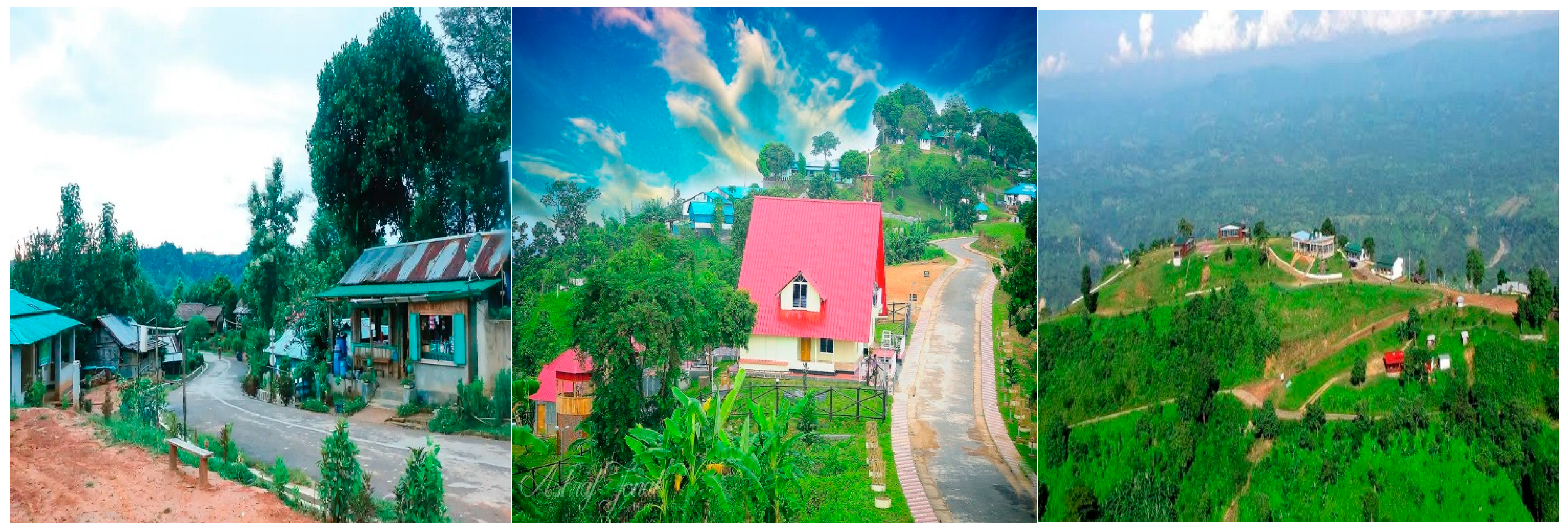
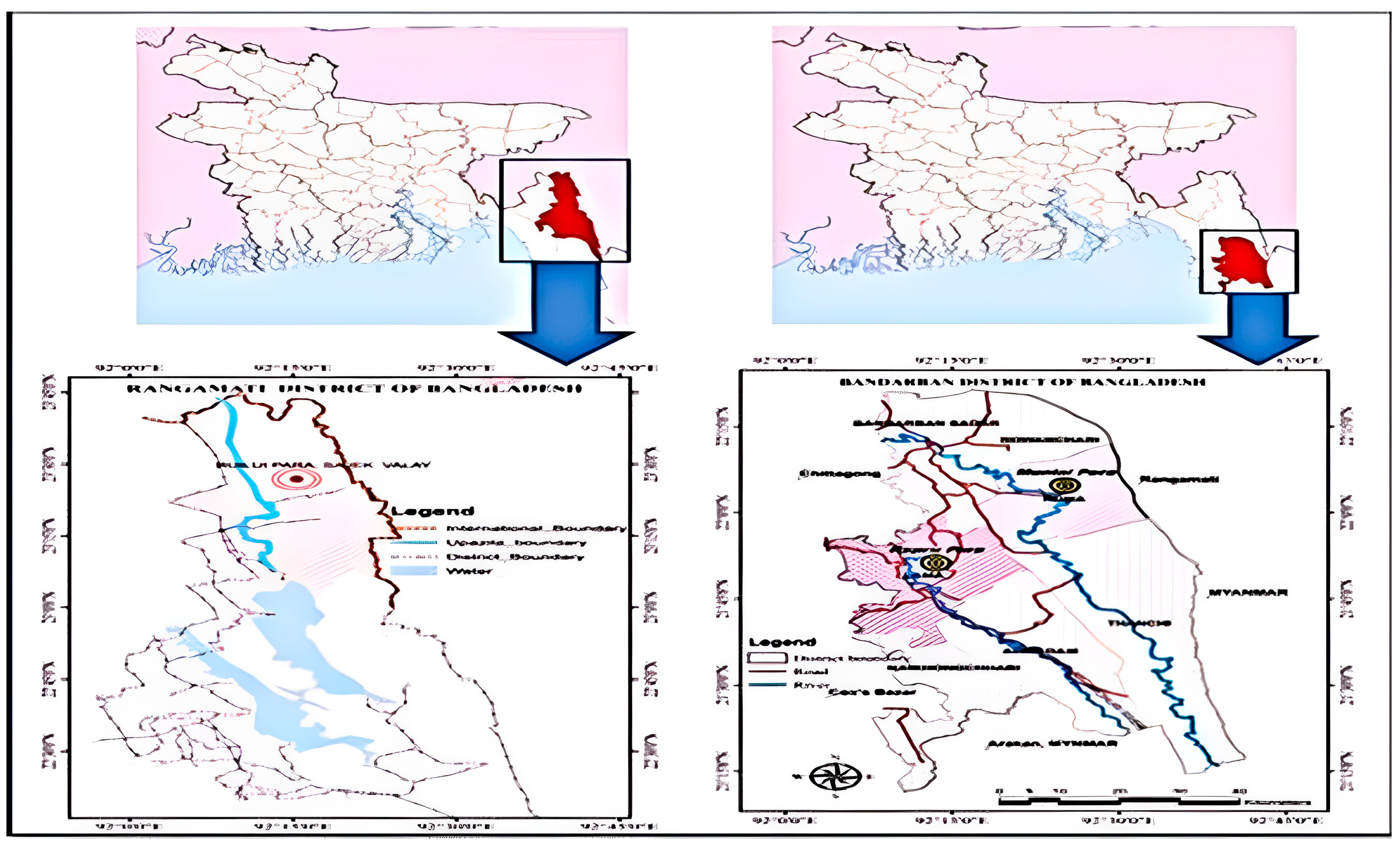
3. Research Sites
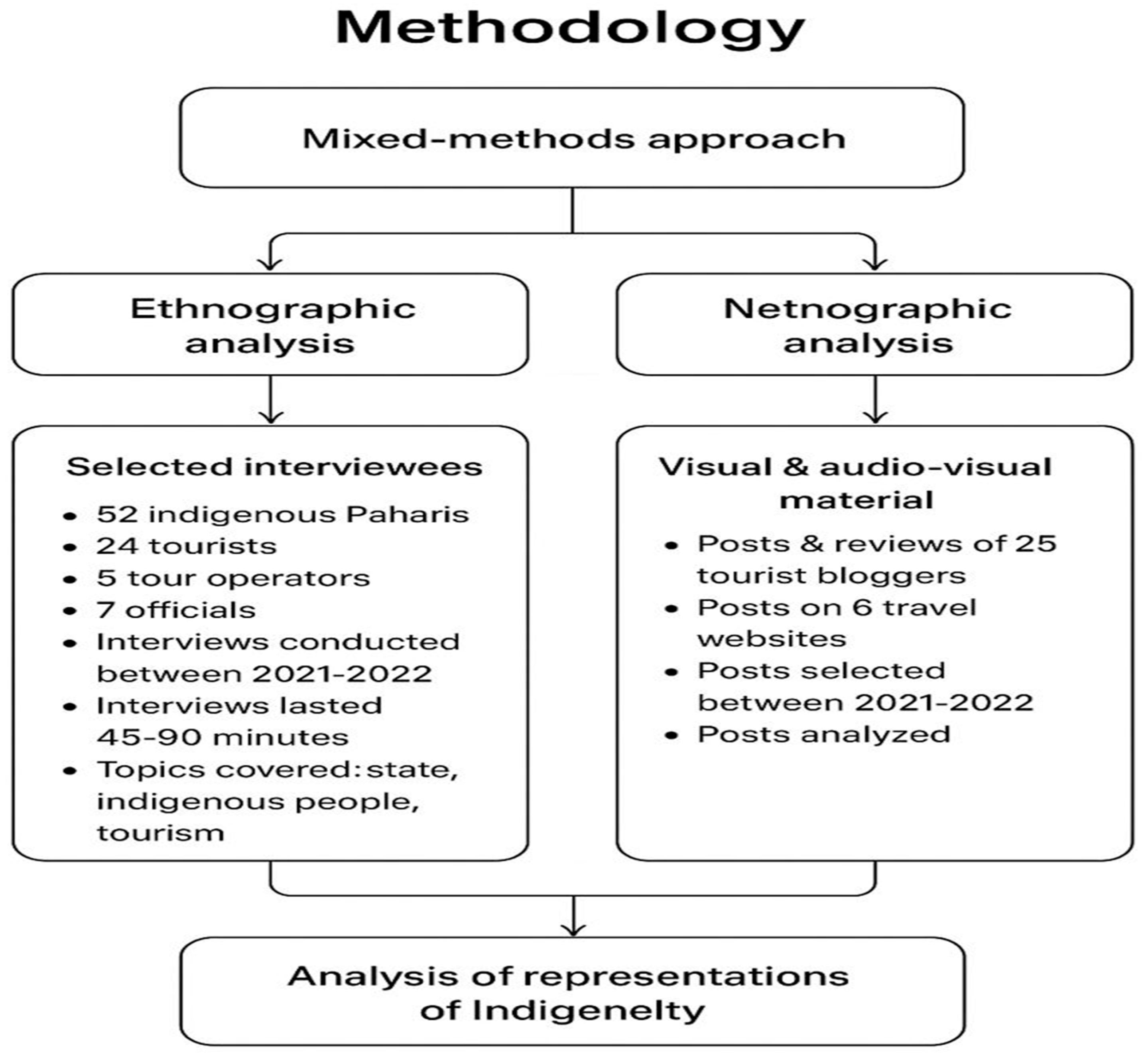
4. Research Design and Methodology
5. Findings of the Study
5.1. Indigenous Food as an Ethnic Marker
5.2. Indigeneity as a Cultural Capital
“There was a cultural practice that was more likely a homestay or paying guest framework; when a passerby crossed a para (village), he/she would bring some rice with him/her. When the sun set, passerby would offer their rice to a local family in exchange for shelter, food, and a place to stay for the night. Such gestures from the receiver and provider foster a mutual bond between the two families. We have already lost such a tradition. We must uphold this practice, and tourism allows us to continue it”.
5.3. Branding ‘Indigeneity’ Through Agency
“I stayed outside the Chittagong Hill Tracts for ten years. I was the only Marma in our office. Once, I went to another department for work. The official there got to know me and said, well, you are Marma. Your main festival is ‘Sangrai’, right? At that time, you play water sports. right? I saw it on TV. To Bengali tourists, the Marma community is perceived as backward and uneducated people from the hills who love festivals and enjoy playing with water during the Sangrai festival. The majority of people in Bangladesh share the same impression of us. However, they are unaware of our long history of struggle. Our history of exploitation, deprivation, and genocide by the State”.
“In the rainy season, it overflowed! it was big! Lots of water is moving around in the dry season, too! It was the source of life in Remakri. Pahari during all seasons! I have been there more than 13 times. You have to go through the Tindu Boro Pathor area with a boat and a guide, which will cost 3500tk for the boat and 2000tk for the guide, to visit Nafakum! You have to take permission from the Police and BGB for going there”.
6. Discussion
7. Conclusions
Author Contributions
Funding
Institutional Review Board Statement
Informed Consent Statement
Data Availability Statement
Conflicts of Interest
| 1 | Eleven ethnic minorities are in CHT, namely, Chakma, Marma, Tripura, Tanchangya, Chak, Mru, Bawm, Lushai, Khyang, Pankhua, and Khumi. |
| 2 | https://munlai.com.bd/ (accessed on 30 May 2024). |
References
- Ahamed, F. U. (2022). Quest for Alternative Livelihood: Localizing Tourism among Indigenous Communities in the Chittagong Hill Tracts of Bangladesh. In F. U. Ahamed (Ed.), Rethinking development in South Asia: Issues, perspectives and practices (pp. 43–67). Cambridge Scholars Publishing. [Google Scholar]
- Ahmed, H. S. (2017). Tourism and state violence in the Chittagong Hill Tracts of Bangladesh [Master’s thesis, The University of Western Ontario]. Available online: https://hdl.handle.net/20.500.14721/27497 (accessed on 5 June 2022).
- Alam, S. M. S. (2015). Governmentality and counter-hegemony in Bangladesh. Palgrave Macmillan. [Google Scholar] [CrossRef]
- Avijatrik. (n.d.). Keokradong Hiking Tour—Stay with the tribal community. Available online: https://avijatrik.net/tour/bandarban-tour-keokradong (accessed on 4 April 2024).
- Bal, E., & Siraj, N. (2017). “We are the true citizens of this country”: Vernacularisation of democracy and exclusion of minorities in the Chittagong Hills of Bangladesh. Asian Journal of Social Science, 45(6), 666–692. Available online: https://www.jstor.org/stable/26567210 (accessed on 5 June 2024). [CrossRef]
- BBS (Bangladesh Bureau of Statistics). (2022). Population and housing census 2022 preliminary report. Ministry of Planning, Government of the People’s Republic of Bangladesh. Available online: http://www.bbs.gov.bd/site/page/b588b454-0f88-4679-bf20-90e06dc1d10b/- (accessed on 26 February 2025).
- Cavaliere, C. T. (2017). Foodscapes as alternate ways of knowing: Advancing sustainability and climate consciousness through tactile space. In S. L. Slocum, & C. Kline (Eds.), Linking urban and rural tourism: Strategies for sustainability (pp. 49–64). CABI. [Google Scholar]
- Chakma, M. (2016). Tourism development in the Chittagong Hill Tracts, Bangladesh: The impact on Indigenous Peoples (IPs) [Master’s thesis, Flinders University, School of History and International Relations]. Available online: https://theses.flinders.edu.au/view/6842a80c-cce0-4f2a-a85f-8014acf5ec07/1 (accessed on 25 November 2024).
- Cohen, E. (1988). Authenticity and commoditization in tourism. Annals of Tourism Research, 15, 371–386. [Google Scholar] [CrossRef]
- Comaroff, J. L., & Comaroff, J. (2009). Ethnicity, Inc. University of Chicago Press. [Google Scholar] [CrossRef]
- Dann, G. (1996). The language of tourism: A sociolinguistic perspective. CABI. [Google Scholar]
- Edensor, T. (2001). Performing tourism, staging tourism: (Re)Producing tourist space and practice. Tourist Studies, 1(1), 59–81. [Google Scholar] [CrossRef]
- Egresi, I., & Buluç, M. (2016). Local gastronomy: A tasty tourist attraction in Turkey. In I. Egresi (Ed.), Alternative tourism in Turkey. Springer International Publishing. [Google Scholar] [CrossRef]
- Galvez, J. C. P., Granda, M. J., Lopez-Guzman, T., & Coronel, J. R. (2017). Local gastronomy, culture and tourism sustainable cities: The behavior of the American tourist. Sustainable Cities and Society, 32, 604–612. [Google Scholar] [CrossRef]
- Gibbs, M., Meese, J., Arnold, M., Nansen, B., & Carter, M. (2015). # Funeral and Instagram: Death, social media, and platform vernacular. Information, Communication & Society, 18(3), 255–268. [Google Scholar]
- Gowen, M., Maclaren, F., Martínez Yáñez, C., & Smith Christensen, C. (2023). ICOMOS charters on cultural tourism throughout the 50 years of the UNESCO World Heritage Convention. Restauro Archeologico, 30(1). [Google Scholar] [CrossRef]
- Gyimóthy, S., & Mykletun, R. J. (2009). Scary food: Commodifying culinary heritage as meal adventures in tourism. Journal of Vacation Marketing, 15(3), 259–273. [Google Scholar] [CrossRef]
- Haider, M. H. (2021, February 16). Ethnic treats of chittagong hill tracts in Dhaka. The Daily Star. Available online: https://www.thedailystar.net/lifestyle/news/ethnic-treats-chittagong-hill-tracts-dhaka-2045505 (accessed on 17 February 2024).
- Hall, C. M., & Tucker, H. (2004). Tourism and postcolonialism: Contested discourses, identities and representations. Routledge. [Google Scholar]
- Hettiarachchi, C. (2019). South Asia as a tourism orbit formulating a regional tourism strategy. In Strengthening physical, emotional and economic linkages in South Asia, A consortium of South Asian think tanks (COSATT) project (pp. 1–12). COSATT. Available online: https://www.academia.edu/4059562/South_Asia_as_a_Tourism_Orbit_Formulating_a_Regional_Tourism_Strategy (accessed on 12 October 2024).
- Hill Travel. (2020, October 20). Facebook post on the Travel CHT website. Available online: https://www.facebook.com/TravelCHT (accessed on 23 March 2023).
- Hooks, B. (2009). Eating the other: Desire and resistance. In Black looks: Race and representation (pp. 21–39). South End Press. [Google Scholar]
- Ingram, L., Slocum, S., & Cavaliere, C. (Eds.). (2020). Neolocalism and tourism: Understanding a global movement. Goodfellow Publishers. [Google Scholar] [CrossRef]
- King, J., Wijesuriya, G., & Copithorne, J. (2006, August 31). Integrating traditional knowledge systems and concern for cultural and natural heritage into risk management strategies [Paper presentation]. International Disaster Reduction Conference (IDRC), Davos, Switzerland, organized by ICCROM and the UNESCO World Heritage Centre. [Google Scholar]
- Kirtsoglou, E., & Theodossopoulos, D. (2004). They are taking our culture away: Tourism and culture commodification in the Garifuna Community of Roatan. Critique of Anthropology, 24(2), 135–157. [Google Scholar] [CrossRef]
- Kozinets, R. V. (2002). The field behind the screen: Using netnography for marketing research in online communities. Journal of Marketing Research, 39, 61–72. [Google Scholar] [CrossRef]
- Lichrou, M., O’Malley, L., & Patterson, M. (2008). Place-product or place narrative(s)? Perspectives in the marketing of tourism destinations. Journal of Strategic Marketing, 16(1), 27–39. [Google Scholar] [CrossRef]
- MacCannell, D. (1999). The tourist: A new theory of the leisure class. University of California Press. [Google Scholar]
- Maci, S., Sala, M., & Godnič Vičič, Š. (2018). The language of tourism: An introduction to the topical issue. Scripta Manent, 12, 1–5. [Google Scholar]
- Maoz, D. (2006). The mutual gaze. Annals of Tourism Research, 33(1), 221–239. [Google Scholar] [CrossRef]
- Marma, P. (2013, April 22). আদিবাসীদের বিকাশ এবং ব্যাপারীদের bKash (Development of Indigenous people and Corporates’ bKash). Available online: https://mongoldhoni.wordpress.com/2013/04/22/development-of-indigenous-or-trading-with-their-life/ (accessed on 11 January 2025).
- Mkono, M. (2011). The Othering of Food in Touristic Eatertainment: A Netnography. In Tourist studies (Vol. 11, Issue 3, pp. 253–270). Sage Publications. [Google Scholar] [CrossRef]
- Mohiuddin, M., & Sajib, S. M. S. (2021). Indigenous Gastronomy in the Chittagong Hill Tracts: A Study on the Application of Information Technology for Tourism Development. In A. Hassan (Ed.), Technology application in the tourism and hospitality industry of Bangladesh. Springer Nature. [Google Scholar] [CrossRef]
- Molz, J. G. (2007). Eating Difference. Space and Culture, 10(1), 77–93. [Google Scholar] [CrossRef]
- Monterrubio, C. (2019). Hosts and guests’ social representations of nudism: A mutual gaze approach. Annals of Tourism Research, 75, 18–28. [Google Scholar] [CrossRef]
- Nogue’s-Pedregal, A. M. (Ed.). (2012). Conclusion: Sociocultural Nature and Context of Tourism. In Culture and society in tourism contexts (Vol. 17, pp. 1–28). Tourism Social Science Series. Emerald Group Publishing Limited. [Google Scholar] [CrossRef]
- Odermatt, P. (1996). A Case of Neglect? The Politics of (Re)presentation: A Sardinian Case. In J. Boissevain (Ed.), Coping with tourists. Berghahn. [Google Scholar]
- Padovan, D., & Alietti, A. (2019). Geo-capitalism and global racialization in the frame of Anthropocene. International Review of Sociology, 29(2), 172–196. [Google Scholar] [CrossRef]
- Rahman, M. S. U. (2019). Co-Management for tourism development and community wellbeing: The case of Hill Tracts, Bangladesh [Ph.D. thesis, Lincoln University]. Available online: https://researcharchive.lincoln.ac.nz/handle/10182/10711 (accessed on 8 April 2022).
- Rasul, G., & Manandhar, P. (2009). Prospects and problems in promoting tourism in South Asia: A regional perspective. South Asia Economic Journal, 101, 187–207. [Google Scholar] [CrossRef]
- Rázusová, M. (2009). The language of tourism (pp. 198–201). Available online: https://www.semanticscholar.org/paper/The-Language-of-Tourism-R%C3%A1zusov%C3%A1/006e92f081fb4bbd43598b3c033d4c48665c72cf#related-papers (accessed on 12 December 2024).
- Said, E. (1978). Orientalism. Vintage. [Google Scholar]
- Sajib, S. M. S. (2022). Nicknaming tourism as development: Commercialization of culture and nature in CHT, Bangladesh. Journal of Tourism and Cultural Change, 20(1–2), 273–285. [Google Scholar] [CrossRef]
- Salazar, N. B. (2013). Imagineering otherness: Anthropological legacies in contemporary tourism. Anthropological Quarterly, 86(3), 669–696. [Google Scholar] [CrossRef]
- Schendel, W. V. (2002). A politics of nudity: Photographs of the ‘Naked Mru’ of Bangladesh. Modern Asian Studies, 36(2), 341–374. [Google Scholar] [CrossRef]
- Silver, I. (1993). Marketing authenticity in Third World countries. Annals of Tourism Research, 20(3), 302–318. [Google Scholar] [CrossRef]
- Smith, L. (2006). Uses of heritage (1st ed.). Routledge. [Google Scholar] [CrossRef]
- Staff Editor. (2019, April 28). Indigenous (tribal/ethnic) people of Bangladesh: Their belief, lifestyle and culture. Travel Mate Bangladesh. Available online: https://www.travelmate.com.bd/indigenous-tribal-ethnic-people-of-bangladesh-their-belief-lifestyle-and-culture/ (accessed on 12 March 2023).
- Tice, K. E. (1995). Kuna crafts, gender, and the global economy. University of Texas Press. [Google Scholar]
- Timothy, D. J., & Ron, A. S. (2013). Heritage cuisines, regional identity and sustainable tourism. In C. M. Hall, & S. Gossling (Eds.), Sustainable culinary systems: Local foods, innovation, and tourism and hospitality (pp. 275–290). Routledge. [Google Scholar]
- Tripadvisor. (2018, May). A place of tranquility, Reviews—Nafa-khum, Bandarban, CHT. Available online: https://www.tripadvisor.com/ShowUserReviews-g2368232-d10279447-r594730714-Nafa_khum-Bandarban_Chittagong_Division.html (accessed on 24 March 2023).
- Tripadvisor. (2020, October). Beauty with boldness, Reviews—Nafa-khum, Bandarban, CHT. Available online: https://www.tripadvisor.com/ShowUserReviews-g2368232-d10279447-r773411856-Nafa_khum-Bandarban_Chittagong_Division.html (accessed on 24 March 2024).
- Uddin, R. N. (2013, April 15). Boisabi: A ‘khichuri’ suffix of Bengalis. bdnews24.com. Available online: https://opinion.bdnews24.com/bangla/archives/9093 (accessed on 30 January 2023).
- UNDP & CHTDF. (2012). Supporting local development in the Chittagong Hill Tracts (CHT). Report prepared for the European Union by Chittagong Hill Tracts Development Facility (CHTDF), DCI-ASIE/2011/266-983. United Nations Development Programme (UNDP). Available online: https://info.undp.org/docs/pdc/Documents/BGD/Donor%20Progress%20Report%202011-Supporting%20Local%20Development%20in%20the%20CHT.pdf (accessed on 24 July 2024).
- Urry, J. (2002). The tourist gaze (2nd ed.). Sage Publications. [Google Scholar]
- Wilson, T. D., & Ypeij, A. (2012). Introduction: Tourism, gender, and ethnicity. Latin American Perspectives, 39(6), 5–16. Available online: http://www.jstor.org/stable/41702290 (accessed on 20 July 2024). [CrossRef]
- Xie, P. F. (2011). Authenticity and indigenous tourism: The commodification debate. Channel View Publications. [Google Scholar]


Disclaimer/Publisher’s Note: The statements, opinions and data contained in all publications are solely those of the individual author(s) and contributor(s) and not of MDPI and/or the editor(s). MDPI and/or the editor(s) disclaim responsibility for any injury to people or property resulting from any ideas, methods, instructions or products referred to in the content. |
© 2026 by the authors. Licensee MDPI, Basel, Switzerland. This article is an open access article distributed under the terms and conditions of the Creative Commons Attribution (CC BY) license.
Share and Cite
Sajib, S.M.S.a.; Uddin, M.J. Visualizing Indigeneity as a Local Defense: Tourism in the Chittagong Hill Tracts, Bangladesh. Tour. Hosp. 2026, 7, 12. https://doi.org/10.3390/tourhosp7010012
Sajib SMSa, Uddin MJ. Visualizing Indigeneity as a Local Defense: Tourism in the Chittagong Hill Tracts, Bangladesh. Tourism and Hospitality. 2026; 7(1):12. https://doi.org/10.3390/tourhosp7010012
Chicago/Turabian StyleSajib, S M Sadat al, and Mohammed Jamir Uddin. 2026. "Visualizing Indigeneity as a Local Defense: Tourism in the Chittagong Hill Tracts, Bangladesh" Tourism and Hospitality 7, no. 1: 12. https://doi.org/10.3390/tourhosp7010012
APA StyleSajib, S. M. S. a., & Uddin, M. J. (2026). Visualizing Indigeneity as a Local Defense: Tourism in the Chittagong Hill Tracts, Bangladesh. Tourism and Hospitality, 7(1), 12. https://doi.org/10.3390/tourhosp7010012