Article

Tourism Resilience and Adaptive Recovery in an Island’s Economy: Evidence from the Maldives

by
Krisanadej Jaroensutasinee
1,
Aishath Hussain
1,*,
Mullica Jaroensutasinee
1,* and
Elena B. Sparrow
2
1
Center of Excellence for Ecoinformatics, School of Science, Walailak University, Nakhon Si Thammarat 80160, Thailand
2
Department of Natural Resources and Environment, University of Alaska Fairbanks, Fairbanks, AK 99775-7340, USA
*
Authors to whom correspondence should be addressed.
Tour. Hosp. 2025, 6(5), 282; https://doi.org/10.3390/tourhosp6050282 (registering DOI)
Submission received: 9 November 2025 / Revised: 6 December 2025 / Accepted: 11 December 2025 / Published: 13 December 2025

Abstract

This study investigates the resilience dynamics of the Maldives’ tourism sector through a longitudinal analysis of tourist arrivals from six global regions (2008–2024), focusing on spatiotemporal behavioral shifts induced by external shocks such as the COVID-19 pandemic. Using ANOVA and time-series data, the findings reveal divergent recovery trajectories across regions, highlighting resilience as a differentiated and adaptive process. European markets exhibited a rapid, V-shaped rebound, surpassing pre-pandemic levels by 2022, reflecting the “One Island, One Resort” model’s alignment with post-crisis preferences for safety, isolation, and controlled environments. Conversely, Asian markets experienced a more gradual, L-shaped recovery due to extended mobility restrictions and slower border reopening. The analysis further demonstrates that tourism seasonality has been structurally reconfigured, with European arrivals still driven by climatic “push” factors (winter-sun demand). In contrast, Middle Eastern travel is anchored in cultural and religious “pull” factors, such as halal tourism and school vacations. These findings emphasize that tourism resilience is spatially, temporally, and behaviorally contingent, rather than uniform. Accordingly, policymakers should move beyond one-size-fits-all recovery models and implement spatially targeted, adaptive strategies, including customized marketing, diversified tourism offerings, and crisis-ready governance frameworks, to mitigate seasonality and reinforce the Maldives’ long-term capacity to withstand future shocks.

1. Introduction

Island economies face vulnerabilities within the global tourism system. The geographic isolation amplifies opportunities while protecting them from external shocks and market dependencies (Leal Filho et al., 2020). Developing Island nations are particularly prone to the cascading effects of global disruptions due to their economic dependence on a single sector, international connectivity, and their remote locations. (Adham et al., 2025). The same applies to the Maldives: the economy primarily relies on a single sector—the tourism sector—which accounts for up to 18.7% of gross domestic product. This makes them more vulnerable to external shocks, global market fluctuations, natural disasters, and geopolitical tensions (Maldives Bureau of Statistics, 2023).
The resilience of the tourism sector in an island economy must be understood through the lens of the adaptive capacity of source markets and tourists’ behavioral responses during periods of disruption and recovery. The “One Island, One Resort” Model and the heavy reliance on luxury accommodation present both opportunities and challenges for resilience (Rabeeu et al., 2022). According to Stoffelen and Timothy (2023), tourism’s place-making role is entrenched in bordering (spatial demarcation), ordering (hierarchical organization), and othering (cultural differentiation) processes, which are particularly evident in the Maldives’ “One island, One Resort” Model. This model also influences seasonal behaviors, as tourists perceive the Maldives as both an exclusive and safe destination (Rabeeu et al., 2022).
Beyond its unique geographic position, the country’s status as an entirely Muslim nation has attracted specific market segments, including halal tourism, which emphasizes safety, privacy, and cultural alignment amid global uncertainty (Adham et al., 2025). The period 2008–2024 showed how external shocks disrupt and reshape the systems of such an island nation, leading to distinct recovery patterns. The global financial crisis of 2008–2009 provided a glimpse into market dominance and its consequences in Europe, while emerging markets, such as Asian markets, began to expand. In recent years, growth cycles in arrivals have been observed, driven primarily by shifting preferences, including the rise in Asian tourism and sustained demand from the European market (World Bank, 2023).
International tourism worldwide experienced significant fluctuations due to COVID-19, resulting in substantial declines in travel, arrivals, and revenue. In early 2020, the world faced unexpected events, including border closures and restrictions on inbound and outbound travel, in response to the spread of COVID-19. This took a significant toll on the economies of the tourism-dependent countries (World Tourism Organization, 2024; Zaika & Avriata, 2024). The World Tourism Organization reported that global tourism experienced a 73% decline in tourist arrivals, resulting in a loss of 415 million travelers relative to previous years. This also reduced revenue by 74%, the most pronounced decline in the industry’s history (World Tourism Organization, 2024). Countries responded differently to this catastrophe because they were unprepared. The same was true for the Maldives, as evidenced by parity in arrivals between 2019 and 2020 and by a 14.7% increase in tourist arrivals in 2019 relative to 2018. In 2020, we saw a 67% decline (Maldives Bureau of Statistics, 2020). The crisis deepened when the Maldives closed its borders on 27 March 2020, in response to the global COVID-19 outbreak, thereby temporarily shutting down the entire tourism sector.
Understanding tourism resilience in island economies requires moving beyond simple recovery metrics to examine how destinations and tourist behavior interact through disruptive incidents or cycles. While external shocks, such as pandemics, disrupted flows, the longer-term issues are how tourist behavior and destination systems adapt to the new conditions. It will illustrate if the markets recover to the previous state or become more resilient to future shocks (Rabeeu et al., 2021). While existing studies have examined tourism crisis management and destination recovery separately, there remains a gap in understanding how shock recovery cycles build adaptive capacity in tourism-dependent island economies. There are few studies on how tourists’ behavioral adaptations across different source markets and seasonal patterns contribute to destination resilience mechanisms over 16 years.
Building on Butler’s (1980) Tourist Area Life Cycle (TALC) model and contemporary resilience theory, this study examines tourism resilience and the adaptive mechanisms of source markets in the Maldives from 2008 to 2024. This period witnessed one of the significant external shocks, namely the COVID-19 Pandemic. This study pursues two interrelated objectives: (1) to trace the evolution of tourist behavioral patterns across six source regions and seasonal cycles throughout the 2008–2024 period; and (2) to evaluate how these behavioral adaptations have shaped engineered, adaptive, and transformative resilience mechanisms within the Maldivian tourism economy. To operationalize these objectives, we pose three research questions: (1) How do monthly arrival volumes differ across regions before and after the COVID-19 shock?, (2) Which combination of engineered, adaptive, or transformative resilience best explains the observed post-shock trajectories?, and (3) To what extent has seasonality been reconfigured, and what policy levers can exploit the new temporal structure? We hypothesized that post-COVID-19 recovery trajectories differ significantly across regions after controlling for seasonality, reflecting distinct cultural, climatic, and institutional push–pull factors.

2. Data and Methods

2.1. Data Source

This study used multiple data sources to analyze Maldivian tourism arrivals and the persistence of seasonality from 2008 to 2024. The primary dataset, sourced from the Maldives Ministry of Tourism’s statistical publications and reports, includes monthly and annual data on tourist arrivals, disaggregated by country and region of origin, from 2008 onward (Ministry of Tourism, 2024). Complementary data were extracted from global tourism databases, such as those from the World Bank (2025), to understand travel patterns and the external factors influencing arrivals. Moreover, economic performance indicators and visitor demographics were collected from the Maldives National Bureau of Statistics (Maldives Bureau of Statistics, 2023) to provide further context for the analysis. While traditional surveys and national statistics provide macro-level insights, future research could integrate GPS tracking or social media geotags to capture micro-scale spatial behaviors (e.g., intra-atoll movement).
To ensure the accuracy and reliability of the findings, data preprocessing was conducted to handle missing and insignificant data points. Any incomplete or irrelevant data were excluded from the analysis. For example, data that were grouped and difficult to attribute to a specific source country, as well as data from countries with limited availability (e.g., other African countries), were excluded from the study. For countries for which tourist arrival data became available only in later years (e.g., 2010), pre-launch period missing data points were imputed with zeros to maintain data consistency. These countries jointly contributed 2.7% of the Maldives’ arrivals, even at their peak year, 2024—Macro-level noise. These preprocessing steps were crucial for maintaining data integrity and enabling a robust examination of tourism trends in the Maldives.

2.2. Theoretical Framework

This study is grounded in three integrated theoretical concepts that provide a lens for analyzing the spatiotemporal dynamics and resilience of the Maldives’ tourism sector: the TALC, tourism resilience, and tourism seasonality. These concepts offer a detailed understanding of how the Maldivian tourism system adapts and reorganizes in response to shocks and long-term fluctuations. This selection of frameworks is informed by the evolution of tourism studies, in which linear developmental models have been progressively complemented by complex systems thinking to better account for shocks, adaptation, and temporal cycles (Cochrane, 2010). These frameworks collectively explain the structural, behavioral, and temporal dimensions of destination resilience in small island tourism economies.

2.2.1. Theoretical Integration and Evolution

The rationale for this integrated approach is to address gaps within each standalone theory. Butler’s (1980) TALC model provides a macro-level framework for understanding the long-term evolution of a destination. The model posits that any destination progresses through a sequence of stages: exploration, involvement, development, consolidation, stagnation, and, thereafter, either decline or rejuvenation. While foundational, the deterministic lineage of the TALC model has been critiqued for underplaying the role of external shocks and adaptive agency in altering a destination’s trajectory. The Maldives, with its established “One Island, One Resort” model and high-volume arrivals, can be positioned in the consolidation-to-stagnation stage, characterized by a well-defined market, controlled growth, and vulnerability to external shocks (Butler, 1980). Precisely because of this maturity, the model alone cannot fully explain the mechanism of change when a shock disrupts the system’s equilibrium. However, the COVID-19 pandemic is considered an external shock that could disrupt equilibrium and push the system into a critical adaptive phase. The post-pandemic response can be pictured as a form of rejuvenation through innovation and structural transformation, including digital adoption, sustainability certification, and market diversification. By situating the Maldives’ recovery within the TALC model, this study conceptualizes resilience as the capacity of a mature destination to self-reorganize and renew its growth trajectory following unexpected shocks.
Resilience theory, rooted in Holling’s (1973) ecological systems framework, emphasizes a system’s ability to absorb disturbance, reorganize, and retain essential functions while transforming. Within the tourism context, resilience extends beyond rapid recovery to include adaptive learning and institutional flexibility (Biggs et al., 2012; Williams et al., 2016). The application of resilience in tourism has evolved from an initial focus on engineering resilience (a rapid return to pre-shock normality) to embracing adaptive and transformative resilience, which accounts for learning, reorganization, and systemic change (Singh, 2018). This study distinguishes between three key resilience dimensions: (1) engineered resilience, which focuses on the speed and efficiency of the source market to return to a predefined stable equilibrium after a disruption; (2) adaptive resilience, which denotes the system’s behavioral and structural flexibility to adapt and reorganize to new equilibria due to the disruption or change; and (3) transformative resilience, which refers to fundamental ability to create a new equilibrium when existing structure is untenable.
Seasonality is the third pillar of this framework. Seasonality refers to the periodic fluctuations in tourism demand driven by climatic, cultural, and institutional factors (Hartmann, 1986). Whereas this has often been considered as an operational concern, contemporary research reframes it as a structural determinant of vulnerability and a modulator of long-term resilience (Tunca et al., 2025). Here, seasonality is theoretically elevated from a background condition to a core temporal dynamic that continuously interacts with the pattern and resilience capacity. The pronounced seasonal rhythm of the Maldives creates a pre-existing “pulse of stress and recovery” that influences its economic buffers, operational flexibility, and labor stability. Consequently, the destination’s ingrained seasonality shapes both its available pathways for adaptive or transformative response, thereby mediating the interaction between TALC stage and resilience outcomes.

2.2.2. Synthesized Analytical Lens

By integrating the TALC model, resilience, and seasonality, this study conceptualizes the Maldivian tourism system as a complex adaptive system in which structural maturity (TALC), behavioral flexibility (resilience), and temporal rhythm (seasonality) are in constant interaction. The combined framework positions resilience not as a static outcome but as a dynamic process and ongoing negotiation between vulnerability and adaptability.
Ultimately, the tripartite framework offers a novel analytical tool to disentangle how a mature SIDS destination navigates the interlocking challenges of shock recovery, long-term adaptation, and seasonal sustainability. It enables a nuanced interpretation of how the Maldives might absorb disturbances, adapt to uncertainty, and transform adversity into a strategic renewal of its development pathway.

2.3. Study Area

The study area focused on the Maldives, an archipelago of 26 atolls in the Indian Ocean, situated between latitudes 7°6′ N and 0°42′ S and longitudes 72°32′ E and 73°45′ E, covering an area of nearly 90,000 km2 (Zubair et al., 2011). The Maldives comprises 1192 coral islands, of which about 200 are inhabited, with the rest primarily used for tourism and agriculture (Naseer, 2006). The islands are characterized by low elevation, with an average height of 1.5 m above sea level (World Bank, 2025). The Maldives generally experiences a tropical monsoon climate, characterized by two distinct monsoons: the dry northeast monsoon from November to April and the wet southwest monsoon from May to October (Imad & Chan, 2021). The average temperature in the Maldives typically ranges from 2 to 32 °C, with an annual mean of 28 °C. The average annual rainfall is 2124 mm, with higher precipitation occurring mainly during the southwest monsoon (Maldives Meteorological Service, 2023). The Maldives’ economy is heavily reliant on tourism, with many islands hosting luxury resorts. At the same time, guesthouses are also found on other islands and in cities, initially introduced to cater to economically conscious tourists (Ministry of Tourism, 2024). The archipelago’s location, climate, and coral reef ecosystems make it a prime destination for beach and marine tourism, attracting visitors from around the world (Imad & Chan, 2021).

2.4. Regional Categorization

Tourist arrivals from 69 countries were examined. The countries were further categorized into six distinct regions: (1) Europe comprising 34 countries: Belarus, Bulgaria, Czech Republic, Hungary, Kazakhstan, Latvia, Lithuania, Poland, Romania, Russia, Slovakia, Ukraine, Uzbekistan, Denmark, Finland, Ireland, Norway, Sweden, the United Kingdom, Croatia, Greece, Italy, Portugal, Serbia, Slovenia, Spain, Austria, Belgium, France, Germany, the Netherlands, Switzerland, Israel, and Turkey; (2) Asia comprising 16 countries: China, Japan, Korea, Taiwan, Indonesia, Malaysia, Myanmar, the Philippines, Singapore, Thailand, Vietnam, Bangladesh, India, Iran, Pakistan, and Sri Lanka; (3) Oceania comprising two countries, Australia and New Zealand; (4) the Americas comprising five countries: Argentina, Brazil, Canada, Mexico, and the United States; (5) the Middle East comprising nine countries: Egypt, Jordan, Kuwait, Lebanon, Oman, Qatar, Saudi Arabia, Syria, and the United Arab Emirates; and (6) Africa comprising three countries: Algeria, Morocco, and South Africa (Ministry of Tourism, 2024).

2.5. Data Analysis

A combination of statistical methods was utilized to investigate tourism dynamics in the Maldives. Analysis of Variance (ANOVA) was selected as the primary analytical tool over other methods, such as time-series regression, for two key reasons that align with our research questions. First, our core objective was to compare the mean number of tourist arrivals across distinct, predefined categorical groups (e.g., Europe vs. Asia, pre-COVID-19 vs. post-COVID-19, Winter vs. Summer) rather than to forecast a continuous time series or model the influence of continuous predictors. ANOVA is statistically robust and well-suited for testing group mean differences. Second, the two-way ANOVA allows explicit testing of an interaction effect between region and time period, which is essential for assessing whether the COVID-19 shock affected different source markets in significantly different ways, a central hypothesis of this study. This method is optimal for a between-subjects comparison of aggregated group means but, by its nature, does not model the continuous, nonlinear trajectories of recovery that characterize adaptive or transformative resilience processes over time (Box et al., 2015). Consequently, while ANOVA robustly can test for significance of structural breaks and regional divergences, providing clear evidence pertinent to engineered resilience, the analysis of dynamic recovery pathways remains a vital avenue for future research.
Two-way ANOVA tests with Bonferroni Post Hoc tests were conducted to compare the evolution of the tourism industry in the pre-COVID-19 period (2008–2019) and the post-COVID-19 period (2020–2024). The factorial ANOVA was explicitly chosen over a series of independent t-tests to appropriately test main effects and interactions within a single model, thereby controlling the Type I error rate. While ANOVA assumes normality and homoscedasticity (verified via Shapiro–Wilk tests, Q-Q plots, and Levene’s test), the large dataset size (17 years) provides robustness to minor violations of these assumptions, given the Central Limit Theorem. A significance threshold of α = 0.05 was used for all tests unless otherwise specified, with Bonferroni correction controlling for multiple comparisons.
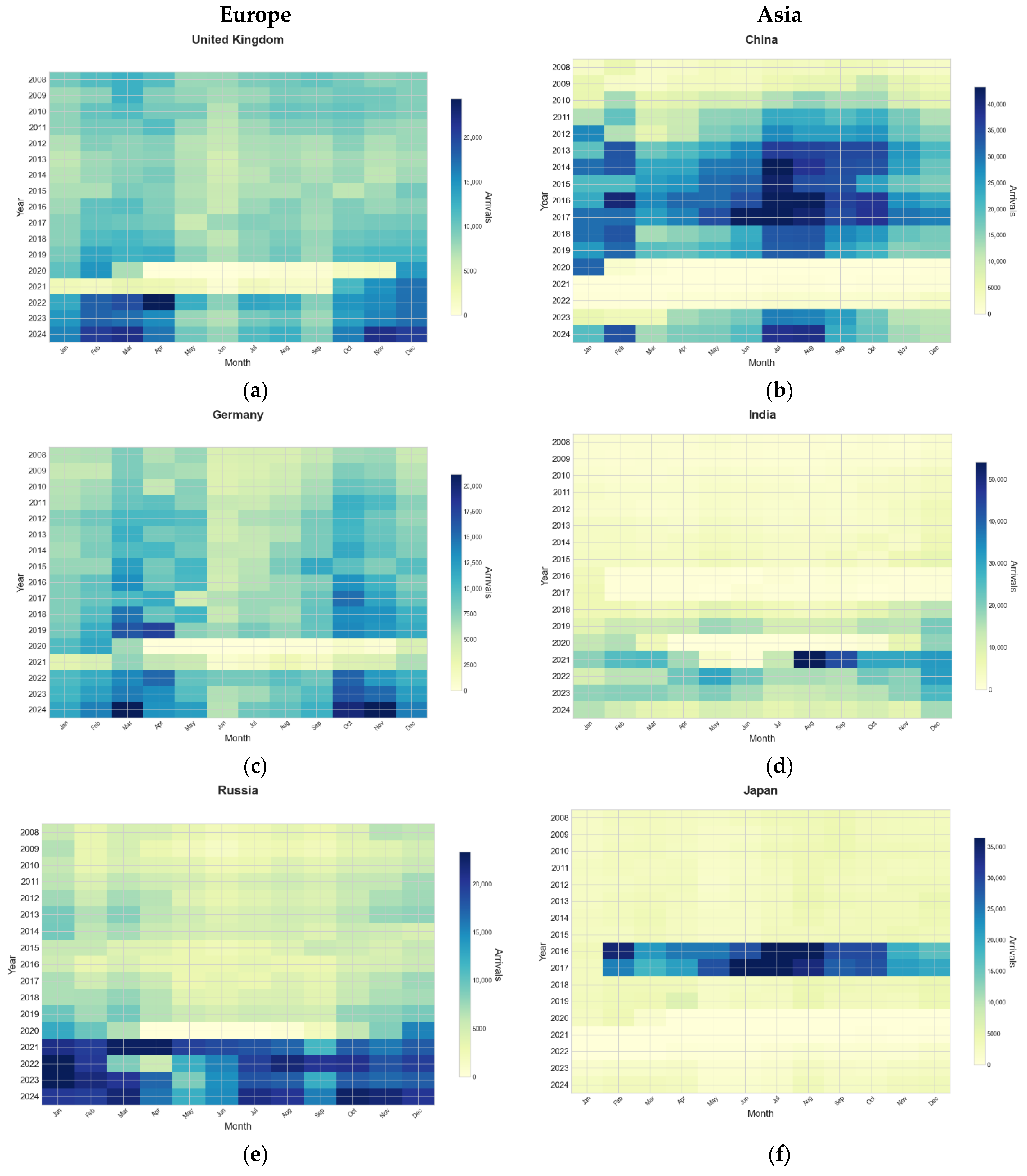
Furthermore, a one-way ANOVA was used to evaluate seasonal effects on tourism across regions and the top three countries of origin in the top two regions (i.e., Europe (United Kingdom, Germany, and Russia) and Asia (China, India, and Japan)). These two regions were selected because they consistently remained the top contributors to the Maldives. The statistical analysis was performed in SPSS 26.0. This analysis used Pandas and NumPy for data loading, cleaning, and aggregation. The visualization was primarily created using Matplotlib 3.10.7 to generate multi-panel figure grids and Seaborn 1.17.0 to enhance the aesthetic style of the plots. The core seasonal patterns were visualized using Matplotlib’s imshow function to generate heatmaps, with a color gradient in which intensity corresponds to tourist arrival counts.

3. Results

3.1. Pre-Shock Vulnerability: A Landscape of Concentrated Dependence

The regional distribution of tourist arrivals to the Maldives from 2008 to 2024 reveals a clear and persistent hierarchy, underscoring the market’s deep-seated dependencies. Europe consistently accounted for the dominant share of arrivals throughout the study period, with the United Kingdom (1,883,978 arrivals), Germany (1,671,038), and Russia (1,646,029) serving as its primary engines of demand. Asia is ranked as a secondary yet formidable market. However, its aggregate figure masks a critical insight: China emerged as the largest source country, with 3,545,584 arrivals, significantly outpacing all European countries. This indicates that while Europe is the dominant region, pre-pandemic tourism volumes were critically reliant on a single Asian giant. India (1,457,295) and Japan (1,063,488) further solidified Asia’s pivotal role, though their recovery patterns, as analyzed later, would diverge sharply. The remaining regions—the Middle East, Oceania, the Americas, and Africa—together accounted for a smaller share of the market. The Middle East, while ranking third, recorded arrival numbers an order of magnitude lower than those of the top two regions (e.g., Saudi Arabia: 180,871), highlighting significant potential for growth rather than established dominance. Similarly, Oceania and the Americas, led by Australia (346,232) and the United States (348,203), respectively, demonstrated a consistent but niche presence. These rankings highlight a core vulnerability of the Maldives: a high concentration of its tourism economy in two key regions—Europe and Asia—and an overreliance on a handful of leading nations within them (Ministry of Tourism, 2024). This spatial concentration, while driving pre-pandemic growth, set the stage for the dramatically asymmetric shocks revealed by the subsequent COVID-19 crisis (Ministry of Tourism, 2024).

3.2. Differential Resilience: Post-Shock Recovery Trajectories Across Regions

The typology of regional resilience in monthly tourist arrivals (2008–2024) was categorized as Engineered Resilience (Europe, Americas), Adaptive Resilience (Asia, Oceania), and Transformative Resilience (Africa, Middle East) (Figure 1a–f). The heatmaps illustrate how each region’s recovery trajectory and seasonal intensity reflect differing capacities to rebound and adapt following the COVID-19 disruption. Europe and America exhibit strong resilience and recovery patterns, with a gradual post-COVID-19 resurgence that has surpassed pre-pandemic levels, with peaks concentrated between December and March. Europe and the Americas exemplify “Engineered Resilience,” characterized by a rapid, V-shaped rebound (Figure 1a and Figure 2d). In contrast, Asia and Oceania exhibit a slower, more “Adaptive Resilience,” with a lagged, gradual recovery from external shocks such as COVID-19, and weaker color intensities after 2020 than the intense peaks of 2015–2017 (Figure 2b,e). From a seasonality perspective, Asia shows higher arrivals in mid-year months, particularly in pre-COVID-19 years such as 2014 and 2017. Finally, Africa and the Middle East exhibit transformative resilience, with atypical peaks in Africa in 2019 and in the Middle East in 2021, which occurred after the downturn, underscoring that they typically have yet to be categorized as a constant source market like Europe (Figure 1c,f). Regarding seasonality, the Middle East shows a concentration during the summer months, typically June to August. Overall, the heatmaps reveal three broad groupings: Europe and the Americas as strong recovery leaders, Asia and Oceania as slower rebounders, and Africa and the Middle East as regions characterized by irregular but significant peaks.

3.3. Statistical Validation of Differential Post-Shock Recovery

During the pre-COVID-19 period, the mean number of arrivals was highest from Europe and Asia, followed by the Americas, the Middle East, Oceania, and Africa. In the post-COVID-19 period, arrivals increased across all regions, with the highest increases in Europe and Asia. Moderate increases were observed in the Americas, the Middle East, Oceania, and Africa (Table 1). There was a significant interaction between the COVID-19 period (pre- and post-COVID) and region on the number of tourist arrivals to the Maldives (two-way ANOVA: COVID-19 period: F1, 90 = 9.124, p < 0.01; regions: F5, 90 = 58.032, p < 0.001; interaction: F5, 90 = 2.779, p < 0.001). Bonferroni Post Hoc tests were conducted to examine pairwise differences across regions. Bonferroni Post Hoc comparisons revealed that Europe and Asia had significantly higher mean arrivals than all other regions (p < 0.01). Europe differed significantly from Africa, the Americas, the Middle East, and Oceania (p < 0.001) and from Asia (p = 0.005), although both regions remained the leading tourist markets. Likewise, Asia differed significantly from Africa, the Americas, the Middle East, and Oceania (p < 0.001). No significant differences were found among Africa, the Americas, the Middle East, and Oceania. Overall, the findings demonstrate that while all regions experienced post-pandemic recovery, Europe and Asia remained the dominant and statistically distinct markets, contributing the most to the Maldives’ tourism resilience and recovery.

3.4. The Behavioral Anchors of Resilience: Persistent Yet Reconfigured Seasonality

The persistence of seasonality, albeit in a reconfigured form, post-COVID-19, serves as a key behavioral indicator of the system’s adaptive resilience. Figure 2a,c,e depicts the interplay between seasonality and resilience in tourist arrivals from the United Kingdom, Germany, and Russia over the period 2008–2024. European travel patterns showed a strong winter-dominant seasonality, with peaks consistently observed between December and March, reflecting the climatic contrast between Europe’s cold season and the Maldives’ dry season. The COVID-19 disruption (2020–2021) temporarily flattened these seasonal cycles, yet the rapid reappearance of peak periods since 2022 indicates a resilient demand structure.
Among the three markets, Russia demonstrated the fastest and most robust recovery, maintaining extended seasonal inflows beyond traditional winter months. At the same time, the United Kingdom and Germany gradually reverted to pre-pandemic seasonality. The persistence and re-establishment of these cyclical trends underscore the adaptability and resilience of European outbound markets, reinforcing the Maldives’ dependence on predictable seasonal demand even amid global shocks. The seasonal dynamics and resilience of tourist arrivals from China, India, and Japan between 2008 and 2024 are shown in Figure 2b,d,f.
Clear cyclical patterns emerged across all three markets, underscoring the dominance of seasonality in outbound travel from Asia to the Maldives. Chinese arrivals showed clear summer peaks from June to August, while Japanese arrivals exhibited a similar mid-year surge aligned with national holidays. In contrast, Indian arrivals showed a counter-seasonal pattern, peaking between October and December, consistent with the nation’s festive and winter travel periods. The pronounced collapse during the COVID-19 period (2020–2021) disrupted these well-established cycles. However, since 2022, all three markets have shown resilience, with seasonal peaks re-emerging despite lingering global travel uncertainties. This recovery highlights the structural stability of seasonal tourism flows in Asia and the Maldives’ ability to regain momentum by 2024 through diversified regional market dependence.

3.5. Seasonal Resilience Patterns

Seasons had a significant impact on arrivals from Europe and the Middle East; arrivals from the rest of the world did not exhibit seasonal patterns (Table 2). Europe recorded the fewest summer arrivals among seasons (Table 2). On the other hand, the Middle East recorded the highest number of arrivals in summer compared with other seasons (Table 2). Seasons did not affect four source regions: the Americas, Africa, Asia, and Oceania (Table 2). When the two source regions—Europe (United Kingdom, Germany) and Asia (China)—were compared, these three arrival countries exhibited seasonal variation across the six major countries studied (Table 2).
The number of arrivals from the United Kingdom and Germany was significantly lower in the summer than in other seasons (Table 2). On the other hand, the number of arrivals from China in the summer was significantly higher than in the spring (Table 2). There were no seasonal effects on arrivals from India, Japan, and Russia (Table 2). No statistically significant seasonal differences were observed in tourist arrivals from these countries, indicating a more stable arrival pattern throughout the year. These findings suggest that seasonal preferences vary across source markets, with European travelers (from the United Kingdom and Germany) exhibiting the most substantial seasonal fluctuations. In contrast, Asian traveler markets (China, India, Japan, and Russia) exhibit a more stable arrival trend.

4. Discussion

4.1. Phased Policy Response by the Maldivian Government to Address COVID-19 Impacts on Its Tourism Sector

The Maldives experienced one of the most pronounced economic downturns during the pandemic, with an estimated loss of 1.9 million tourists and $3.5 billion in tourism revenue between early 2020 and mid-2021 (Rabeeu et al., 2021; Ali et al., 2023). The Maldives followed a unique phased policy to address the impact of COVID-19 on the tourism industry. This was a multifaceted policy aimed at accelerating vaccination and implementing strict health protocols. The government established a national task force to manage and coordinate the execution of one of the fastest COVID-19 vaccination campaigns globally, a key factor in reopening borders to tourists earlier than those of other tourism-dependent countries (Ma, 2023; World Bank, 2023). One of the key parts of the strategy was a strict PCR testing requirement, which facilitated vaccination for employees in the tourism industry and medical professionals. These helped regulate the condition and create a less risky environment (Ma, 2023).
The Maldivian government introduced a digital platform, “OneGov,” to improve service efficiency and support the recovery of the tourism sector (Ali et al., 2023). These measures have led to a noticeable recovery in tourist arrivals, with forecasted levels projected to rise by 34% by mid-2021, one of the fastest recoveries among SIDS (Ma, 2023). This outcome was only possible due to the comprehensive policy approach. They had a well-balanced mix of health measures, digital innovation, and strategic marketing to mitigate the impact of external shocks (Siah & Chan, 2022; Tiwari, 2024). The calculated moves the government took in developing practical policies made it one of the first destinations to successfully open its borders to international travelers and ensure their safety (Ali et al., 2023).

4.2. A Typology of Regional Resilience: Contrasting Post-Shock Recovery Pathways

Our findings regarding the uneven spatial recovery patterns reflect dynamics that Butler’s (1980) TALC model would characterize as destination-specific adaptations during consolidation phases (Whitfield, 2009). The pandemic served as a global shock that tested and revealed the multi-dimensional nature of tourism market resilience, shaped by varying levels of tourist confidence, government policies, and underlying travel motivations. The recovery landscape reveals fundamentally different trajectories, which can be categorized into a clear typology of regional responses.

4.2.1. Engineered Resilience: The Calculated Luxury and V-Shaped Rebound of Europe and the Americas

European and American travelers exhibited a strong propensity for “calculated luxury,” prioritizing safety and seclusion, which facilitated a rapid and robust V-shaped recovery. European arrivals demonstrated remarkable resilience, exceeding pre-pandemic levels both during and after the COVID-19 pandemic, a pattern mirrored in the Americas. This exceptional performance can be attributed to three place-specific factors: the robust healthcare infrastructure in the source countries, rapid vaccination rollout (Li et al., 2021), and the Maldives’ distinctive “One Island, One Resort” model, which provided built-in social distancing through geographical isolation (Shenaan & Schänzel, 2024). Their rapid return was driven by a perception of the Maldives’ “One Island, One Resort” model as a series of prepackaged, safe havens in which built-in isolation and stringent health protocols minimized perceived risk.
This resilience is quantified by the V-shaped rebound, led by Russian arrivals, which reached 172% of 2019 numbers by 2024, with the United Kingdom and Germany also surpassing 2019 benchmarks by 47.9% and 24.2%, respectively (Ministry of Tourism, 2024). Distinct seasonal behaviors underpinned this recovery. The travel habits of tourists from the United Kingdom and Germany demonstrated strong winter seasonality, with peak arrivals occurring during colder months as travelers seek tropical warmth (Yuniati, 2020). This pattern is further refined in the German market, where travel planning is often consciously aligned with significant festivals, such as Easter, illustrating how cultural calendars influence leisure mobility (Gössling et al., 2017). In contrast, Russian arrivals were more consistent throughout the year. Collectively, these patterns reflect high adaptive resilience in the European market, rapid behavioral normalization underpinned by trust in institutional safety measures, and stable demand motivations.
Policy recommendations for engineered resilience markets are structured around three critical pillars: (1) Market Consolidation and Premium Positioning, (2) Infrastructure and Service Excellence, and (3) Strategic Partnership Development.
To address the first pillar, policy frameworks must prioritize consolidating the existing luxury market presence while simultaneously driving rigorous improvements in operational efficiency. The Maldives should implement dynamic pricing mechanisms that leverage seasonal demand fluctuations, particularly during European winter peaks, using AI-driven revenue management systems (Shaik, 2024). This approach aligns with post-pandemic tourism recovery models that emphasize premium market segmentation and value-based pricing strategies (Sigala, 2020).
For the second pillar, given the success of the “One Island, One Resort” model, policies should prioritize maintaining and enhancing this unique selling proposition. Investment in sustainable luxury infrastructure should be mandated through updated tourism development guidelines that incorporate circular-economy principles and climate-resilience measures (Pham et al., 2021). The implementation of contactless service technologies and health-tech solutions across resorts can further enhance the perceived safety and exclusivity that European markets value in the post-COVID-19 period (Buhalis et al., 2019).
Lastly, Strategic Partnership Development: Bilateral tourism agreements with key European source markets should be strengthened to incorporate digital health passports and streamlined travel protocols informed by lessons learned from the pandemic (Kock et al., 2020). The establishment of virtual tourism offices and digital engagement platforms in primary European markets can facilitate direct marketing and real-time crisis communication channels (Gretzel et al., 2020).

4.2.2. Adaptive and Partial Resilience: Divergent Pathways Within the Asia-Pacific Region

In stark contrast to the unified European rebound, the recovery across Asia-Pacific markets was highly fragmented, revealing divergent tourist confidence and priorities and exemplifying what can be termed adaptive, partial resilience. In general, Asian markets experienced a delayed recovery, which exposed the vulnerability of spatially concentrated source markets (Ministry of Tourism, 2020). This lag primarily resulted from prolonged border closures and path-dependent travel corridors, creating substantial arrival deficits during peak periods. The behavior of Japanese tourists was more complex, with post-pandemic arrivals plummeting to 19,481 visitors, 27% below pre-COVID-19 levels. This illustrates psychological resilience barriers—where the speed of recovery depends as much on travelers’ perceptions as on policy relaxation. This sluggish recovery is attributed to the psychological “mobility paradox,” where pent-up travel demand clashes with enduring risk aversion developed during prolonged pandemic restrictions (Sakai et al., 2021). Similarly, China experienced a pronounced L-shaped recovery, with arrivals lagging significantly. This was not merely a function of prolonged government restrictions but also a deep-seated caution among Chinese travelers, who exhibited prolonged risk aversion. The Asian subregion, therefore, exemplifies partial resilience, where structural capacity exists but adaptive flexibility remains limited. Conversely, the Indian market demonstrated a rapid, V-shaped recovery, achieving 100% growth above pre-pandemic levels by 2024. This robust resilience can be attributed to a consistent year-round travel pattern, a behavior enabled by the Maldives’ geographic proximity and India’s diverse climatic conditions.
This triad of outcomes—India’s robust growth, Japan’s cautious re-emergence, and China’s protracted struggle—underscores the critical need for nuanced, market-specific approaches. Consequently, strategic approaches must be as diverse as the markets themselves. Maintaining continuous engagement with India’s stable market is crucial, while psychologically informed wellness retreats could directly address the safety-seeking behavior of Japanese tourists. To win back China, campaigns must rebuild confidence through flexible policies and targeted reassurance. These tailored strategies embody the principles of the Tourism Adaptable Digital Marketing Framework, which uses behavioral insights to steer tourist demand across diverse market segments (Krabokoukis, 2025).
Policy recommendations for adaptive resilience markets are structured around four critical pillars: (1) Differentiated Market Recovery Strategies, (2) Psychological Recovery and Trust-Building Initiatives, (3) Cultural Sensitivity and Product Adaptation, and (4) Digital Engagement and Communication. Focusing on the first pillar, the Maldives must implement a three-tiered policy approach that integrates behavioral economics and cultural sensitivity frameworks (Sharma et al., 2021) to address the distinct recovery patterns observed across Asia-Pacific markets. For the robust Indian market, policies must shift toward sustainable tourism models that balance high market accessibility with rigorous environmental protection. Long-term agreements with India should include provisions for managing overtourism through innovative Destination Management Systems and carrying capacity frameworks (Phi, 2020).
For the second pillar—markets exhibiting psychological barriers (Japan and China)—the government should establish specialized wellness tourism certification programs that address post-pandemic anxiety and health concerns through evidence-based therapeutic approaches (Buckley & Cooper, 2022). The development of “safe travel corridors” through enhanced health protocols, blockchain-verified health credentials, and comprehensive travel insurance partnerships can address persistent risk aversion (Wachyuni & Kusumaningrum, 2020).
For the third pillar, tourism product development policies should mandate cultural adaptation training for hospitality providers, incorporating post-pandemic service expectations and digital engagement preferences specific to Asian markets (Wen et al., 2021). The establishment of cultural intelligence programs can facilitate a deeper understanding of evolving Asian market preferences and behavioral patterns in the post-COVID-19 era
For the final pillar, investment in omnichannel digital marketing infrastructure must prioritize key Asian social media platforms and emerging communication technologies and incorporate AI-powered crisis communication protocols for each market segment. Crucially, the implementation of real-time sentiment analysis systems using machine learning will provide predictive indicators for market confidence levels and travel intention patterns.

4.2.3. Transformative Resilience: Emerging Growth and Cultural Affinity in the Middle East and Africa

The Middle East and Africa presented fascinating case studies of transformative resilience, where growth was driven by factors beyond pandemic-related safety concerns, leading to a reconfiguration of market importance. Although it did not rank among the top 10 source countries, the Middle East market distinguished itself by exhibiting unique, highly resilient travel patterns. It was the only region showing growth (4.9%) in arrivals during the first quarter of 2020. After declining in subsequent quarters, Middle Eastern arrivals rebounded significantly in 2021, reaching a 16-year high of 87,173, a 75.3% increase over 2019. The most telling behavioral pattern emerged from the Middle East. Here, travel was motivated less by pandemic-related safety concerns and more by a deep cultural affinity. This remarkable performance stems from a strong cultural–spatial affinity, with Middle Eastern travelers particularly valuing the Maldives’ alignment with Islamic culture, the availability of halal food, and its gender-segregated facilities (Isaac, 2024). Middle Eastern tourists actively seek destinations that align with Islamic values, such as the availability of halal food and privacy for families, making the Maldives a natural and resilient choice (Alreshaidan, 2016). The remote island concept further appeals to families seeking privacy in accordance with Islamic values (World Bank, 2023). Concluding the regional analysis, African arrivals showed consistent improvement throughout the pandemic, suggesting an emerging trend of market exploration and diversification. From a pre-COVID-19 average of 4695 arrivals, the number rose to 8574 during the pandemic and to 15,600 in the post-COVID-19 period. This sustained growth suggests successful market diversification and positions Africa as an increasingly important source market for Maldivian tourism, underscoring its role in a transformative, resilient market structure.
Policy recommendations for transformative resilience markets are structured around four integrated pillars, designed to leverage cultural distinctiveness for high-value growth: (1) Faith-Based Tourism Policy and Branding, (2) Cultural Infrastructure and Service Standards, (3) Market Diversification and Growth Management, and (4) Cultural-Specific Infrastructure Development.
The first pillar requires establishing a comprehensive Islamic tourism policy framework to guide strategic positioning. This framework must incorporate post-pandemic Halal tourism standards and robust digital certification systems (Battour et al., 2021). Specific initiatives should include blockchain-verified Halal certification for resorts, AI-powered prayer-time applications, and culturally appropriate digital wellness initiatives (Kiswa Office for Religious Services, 2024). Furthermore, to strengthen financial ties with Middle Eastern markets, developing Islamic fintech partnerships for tourism investment that leverage Sharia-compliant financing mechanisms is crucial (Alsmadi & Al Omoush, 2025). This pillar simultaneously drives a dual-branding strategy that reinforces luxury positioning while emphasizing cultural authenticity (Femenia-Serra et al., 2019), supported by virtual cultural tourism products (Tom Dieck & Jung, 2017).
For the second pillar, policy frameworks must mandate comprehensive cultural competency training for all tourism-sector employees, with specific modules addressing Islamic customs and African cultural preferences. This training should be delivered using innovative methods like virtual reality (VR) and immersive learning technologies (Alrawadieh et al., 2020). The operational framework requires establishing cultural advisory committees comprising representatives from key Middle Eastern and African markets that use digital collaboration platforms and cultural intelligence analytics to monitor and adapt service expectations continuously (Farmaki et al., 2020).
The third pillar addresses strategic market expansion and sustainability. Policy should prioritize sustainable growth in emerging African markets by targeting investment incentives and digital marketing support while simultaneously embedding principles of climate-resilient tourism development (Rogerson & Rogerson, 2021). To facilitate this, the creation of Africa–Maldives tourism development funds should enable direct flight partnerships, digital tour operator platforms, and virtual promotional activities, including the use of Metaverse technologies (Buhalis & Karatay, 2022).
Lastly, airport and transportation infrastructure policies must accommodate the specific needs of Middle Eastern and African travelers using innovative technologies. This includes implementing prayer facility locators, Halal dining recommendation systems, and culturally appropriate digital services within airports. Furthermore, the development of specialized, innovative tourism zones that cater to cultural and religious requirements, leveraging IoT technologies, can enhance market appeal while maintaining operational efficiency through predictive analytics (Gretzel & Collier de Mendonça, 2019).
These tailored, behaviorally informed strategies are not optional but essential, aligning precisely with the modular and responsive nature advocated by the Tourism Adaptable Digital Marketing Framework (Krabokoukis, 2025). The Asia-Pacific experience, therefore, serves as a crucial global case study, demonstrating conclusively that genuine post-crisis resilience relies on a granular understanding of psychological inertia and the implementation of highly customized, behaviorally informed strategic responses.

4.2.4. Implementation Challenges in a Small Island Developing State Context

While the proposed digital and culture-specific strategies provide a pathway to transformative resilience, their implementation must be pragmatically assessed against the material and structural constraints of a Small Island Developing State (SIDS) such as the Maldives (UNCTAD, 2022). The vision for AI-powered services, blockchain certification, and metaverse marketing encounters significant real-world hurdles. Firstly, technological infrastructure and other resource implications pose a primary challenge. For instance, nationwide high-speed internet connectivity, a prerequisite for robust existing digital platforms, can be inconsistent, particularly on local islands and in more remote resorts (ITU, 2024). The capital investment required for IoT systems, VR training suites, and secure data analytics platforms is substantial for a country where fiscal resources are stretched across climate adaptation, essential services, and debt management. Prioritizing and securing funding for high-tech tourism infrastructure demands careful cost–benefit analysis and innovative financing models, such as public–private partnerships. Second, the availability and development of the necessary human capital are critical bottlenecks. Implementing and maintaining advanced digital systems requires a skilled workforce in fields such as data science and cybersecurity, which are in global shortage and difficult to retain in an SIDS context (UNDP, 2024). The proposed cultural competency and VR training for thousands of tourism employees itself represents a massive logistical and financial undertaking. Therefore, a phased, capacity-building approach is required, starting with pilot projects and building partnerships with international institutions.
Furthermore, acknowledged data constraints, particularly the absence of subnational and tourist expenditure data, pose an analytical limitation that extends to policy formulation (Bassil et al., 2023). Our reliance on national-level arrival data may obscure critical intra-country variations in resort performance and mask the economic vulnerability of specific atolls. The lack of granular expenditure data limits our ability to correlate high-value tourism with specific source markets or initiatives, potentially biasing strategies toward volume over value. Future research must prioritize the development of an integrated national tourism data hub that captures expenditure, movement flows, and satisfaction at a granular level to validate and refine these strategic recommendations.

4.3. Seasonality as Behavioral Phenomenon

Beyond regional discrepancies, these post-COVID-19 variations intersected with pre-existing spatiotemporal imbalances, disclosing how pandemic recovery patterns intensified traditional tourism seasonality (Cardona & Sánchez-Fernández, 2024). The study quantified distinct seasonal travel behaviors among European and Middle Eastern tourists, which are linked to climatic and cultural factors. European markets exhibited a prominent winter peak (December–February), accounting for 49% of annual arrivals, a pattern driven by tourist motivation to escape cold Northern Hemisphere winters, reinforcing the traditional “winter sun” appeal (Lohmann & Hübner, 2013). The United Kingdom and Germany alone contributed 29% of these winter arrivals (Ministry of Tourism, 2020), underscoring their crucial role in seasonal demand. This concentration aligns with the ‘push–pull’ framework (Potti et al., 2023), where cold winters ‘push’ European travelers toward warmer destinations, while the Maldives’ luxury amenities ‘pull’ demand. In contrast, Middle Eastern arrivals increased in the summer (June–August), aligning with school holidays and exceeding shoulder-season arrivals (Yabancı, 2023). This countercyclical trend stems from cultural ‘institutional seasonality’ (Hartmann, 1986), whereby families’ travel patterns significantly influence their leisure decisions.
In contrast to European tourists seeking a climate escape, Middle Eastern travelers prioritize reconfigured leisure mobility centered on cultural safety (e.g., halal resorts) and family-friendly infrastructure (Isaac, 2024; Ruggieri & Platania, 2024). The behavior of tourists from other regions (the Americas, Africa, Asia, and Oceania) showed minimal seasonal fluctuation, indicating they are a reliable, year-round source of visitors. Different regions (the Americas, Africa, Asia, and Oceania) exhibited minimal seasonal fluctuations, suggesting potential for year-round occupancy. This presents an opportunity to integrate cultural tourism and luxury offerings, as Thailand’s model for year-round tourism demonstrates (Sangnak, 2025).

4.4. Strategic Implications: Navigating Post-Stagnation Trajectories Through Resilience-Based Planning

The critical juncture facing the Maldives lies in leveraging these differential resilience patterns to avoid the five post-stagnation pitfalls identified by Butler: decline through market saturation, stabilization without growth, catastrophic instant decline from external shocks, plateauing due to limited innovation, or successful rejuvenation through strategic transformation (Butler, 2009). The current evidence suggests that, without strategic intervention, the destination risks stabilization or plateauing, particularly given its overreliance on established European markets and the slow recovery in key Asian segments.
To navigate toward rejuvenation rather than stagnation, the Maldives must embrace “reorientation strategies” that fundamentally restructure its market positioning and product offerings. They should shift the focus from transitional products such as sun, sea, and sand toward offering a unique, immersive experience in stewardship, quality, and local engagement (Lewis-Cameron & Brown-Williams, 2022). This requires moving beyond incremental improvements to embrace radical innovation in tourism products, market engagement strategies, and sustainability frameworks (Aydın & Aksöz, 2024). The transformative resilience demonstrated by emerging markets provides a blueprint for such reorientation, suggesting that cultural authenticity and values-based tourism experiences represent untapped potential for destination renewal.
The policy recommendations outlined for each resilience type should therefore be viewed not merely as recovery strategies, but as proactive measures to prevent stagnation and facilitate destination rejuvenation (Butler, 2009). The integration of digital technologies, cultural sensitivity frameworks, and sustainable development principles across all market segments represents the comprehensive transformation necessary to reset the destination’s life-cycle trajectory (Priestley & Mundet, 1998). This approach acknowledges that successful navigation of post-stagnation scenarios requires simultaneous attention to market diversification, product innovation, and infrastructure adaptation, as evidenced by the differential resilience patterns observed across regional markets.

4.5. Broader Implications for International Tourism Resilience

The differential resilience patterns observed in the Maldives extend beyond the regional context, offering critical insights for the global tourism ecosystem, particularly for mature destinations and SIDS worldwide. This study demonstrates that post-crisis recovery is not monolithic but fundamentally shaped by the pre-existing structural relationship between a destination and its source markets. First, the Maldives case provides a global template for understanding market-resilience typologies. The engineered resilience of Europe reflects the recovery pattern of traditional, volume-driven markets in established destinations. The adaptive resilience of Asia mirrors the challenges faced by destinations reliant on geographically proximate but highly competitive and price-sensitive markets. Most significantly, the transformative resilience emerging from the Middle East and Africa illustrates a decisive paradigm shift: that crises can accelerate the rise of values-based tourism, where cultural and religious affinity supersedes conventional convenience factors. This shift is observable globally, from the growth of halal tourism in non-Muslim-majority countries (Muhamad et al., 2019) to the rise of diaspora tourism in the Caribbean and Africa. Secondly, the integrated TALC–Resilience–Seasonality framework developed here is directly transferable. Other mature island destinations (e.g., the Caribbean, Seychelles, Bali) or coastal resorts facing stagnation can use this lens to diagnose their own market vulnerabilities and identify potential vectors for rejuvenation. The key lesson is that strategic diversification must be psychologically and culturally informed, not just geographically.
Furthermore, the study underscores a universal principle for post-pandemic tourism: that resilience is increasingly digital and cognitive. The proposed digital tools—from AI-driven personalization to blockchain for sustainability verification—are not Maldivian peculiarities but represent the new baseline for competitive, trustworthy, and efficient global tourism, as seen in the accelerating adoption of innovative tourism ecosystems (Gretzel & Collier de Mendonça, 2019) and metaverse applications for destination marketing (Jain, 2024). The universal challenge, however, is navigating the gap between strategic necessity and the constraints of resources, scale, and capacity, a challenge acutely felt by SIDS but relevant to all destinations. In this sense, the Maldives’ journey is a microcosm of the broader struggle to build tourism systems that are not only profitable but also adaptable, sustainable, and equitable amid persistent shocks. This aligns with global calls for a fundamental transformation of tourism governance, moving from recovery to a more resilient, regenerative model.

4.6. Limitation

Although this is a longitudinal study of tourist arrivals from 2008 to 2024, it was constrained by numerous data limitations. First, relying solely on nationally aggregated statistics obscures subnational differences. This introduces a potential aggregation bias, as the mean recovery trajectory may not reflect the significant vulnerabilities or successes of specific atolls or resorts, limiting the generalizability of resilience findings to localized contexts. Such spatial detail is essential for understanding localized adaptive resilience and spatial reconfiguration. Future studies should adopt participatory GIS or real-time tracking (Shoval et al., 2018) to overcome these aggregation biases and assess subnational mobility. Second, there was a lack of data on tourists’ spending habits across regions to assess economic resilience and value-chain diversification following external shocks. Consequently, the quantitative assessment of recovery is biased toward volume metrics, potentially overlooking critical shifts in tourism value that are essential for evaluating accurate economic adaptation. Third, although psychological characteristics such as Japanese tourists’ risk aversion were hypothesized, the lack of market-specific behavioral datasets hindered empirical validation. Fourth, the lack of detailed demographic data (e.g., age cohorts, trip-purpose segmentation) precluded an in-depth examination of transformative resilience—how changes in traveler profiles may reshape the tourism system. Future research should prioritize (1) collaboration with Maldivian resorts to get geo-referenced trip statistics, (2) focused surveys measuring post-COVID-19 behavioral key source markets like Europe and Asia, and (3) sentiment analysis of social media or review platforms to capture real-time demand.

5. Conclusions

The findings indicate that the Maldives’ post-pandemic tourism recovery reflects differentiated forms of resilience—engineered, adaptive, and transformative—across source regions. Europe and the Americas are showing strong rebounds due to vaccination programs and the natural “One Island, One Resort” isolation advantage. At the same time, Oceania lags because of prolonged border closures. Seasonal patterns remain but can be strategically managed to enhance adaptive capacity through targeted promotions, including winter promotions for European tourists, summer family packages for Middle Eastern visitors, and year-round wellness offerings for resilient markets like Russia and India. By integrating these insights with digital innovation (e.g., virtual visit previews) and sustainability initiatives (e.g., halal certification and eco-tourism), the Maldives can mitigate seasonal fluctuations and enhance its long-term resilience to future crises.
This study mainly highlights the significant impact of external shocks and unexpected shocks on tourist arrivals in the Maldives, revealing substantial changes in travel patterns both before and after the pandemic. The findings underscore the importance of developing tailored marketing strategies that align with seasonal variations and recovery trends across key regions. With targeted promotions, the Maldives can effectively manage tourist flows and sustain growth by targeting specific markets, such as Europe, the Middle East, and Asia. Additionally, focusing on sustainability, local tourism, and virtual experiences can enhance the destination’s appeal and support long-term resilience amid future disruptions. Importantly, the resilience typologies and integrated strategic framework identified here offer a transferable model for other mature destinations and SIDS navigating post-crisis recovery and long-term adaptation. Overall, the Maldives’ tourism sector can benefit by aligning its policies with these insights. This case thus contributes to a global understanding of how destinations can move beyond uniform recovery to build a more stable, values-based, and strategically diversified tourism economy. This ensures a balanced, sustainable recovery and fosters a competitive advantage in the global tourism market.

Author Contributions

Conceptualization, A.H., K.J. and M.J.; methodology, A.H., K.J. and M.J.; software, A.H., K.J. and M.J.; validation, A.H., K.J. and M.J.; formal analysis, A.H., K.J. and M.J.; investigation, A.H., K.J. and M.J.; resources, A.H., K.J. and M.J.; data curation, A.H., K.J. and M.J.; writing—original draft preparation, A.H., K.J. and M.J.; writing—review and editing, A.H., K.J., M.J. and E.B.S.; visualization, A.H., K.J. and M.J.; supervision, K.J. and M.J.; project administration, K.J. and M.J.; funding acquisition, K.J. and M.J. All authors have read and agreed to the published version of the manuscript.

Funding

This research was funded by the TIPP under TICA, the Ministry of Foreign Affairs, the Thai Government Scholarship, and the College of Graduate Studies at Walailak University (Grant no. 01/2024).

Institutional Review Board Statement

Not applicable.

Informed Consent Statement

Not applicable.

Data Availability Statement

The data presented in this study are available in Ministry of Tourism at [https://www.tourism.gov.mv/en/statistics/publications]. These data were derived from the following resources available in the public domain: 1. Ministry of Tourism, Maldives—Statistics Publications (https://www.tourism.gov.mv/en/statistics/publications), 2. Maldives Bureau of Statistics—Statistics (https://statisticsmaldives.gov.mv/statistics/), and 3. The World Bank—GDP (current US$) data (https://data.worldbank.org/indicator/NY.GDP.MKTP.CD).

Acknowledgments

We are grateful to the reviewers for their input on previous drafts of this manuscript and to David C. Chang and Curt Barnes for their remarks on earlier iterations of this work about editing and the use of English. This project is conducted within the Reinventing Project for Enhancing Thai Universities into International Education, a project of the Ministry of Higher Education, Science, Research, and Innovation. The researchers sincerely thank the TIPP under TICA, the Ministry of Foreign Affairs, the Thai Government Scholarship, the Walailak University Graduate Scholarship, the Center of Excellence for Ecoinformatics, and the Research and Innovation Institute of Excellence, Walailak University, for their invaluable facility and financial support throughout the project.

Conflicts of Interest

The authors declare no conflicts of interest. The funders had no role in the design of the study, the collection, analysis, or interpretation of data, the writing of the manuscript, or the decision to publish the results.

References

  1. Adham, K. A., Mahmad Nasir, N., Sinaau, A., Shaznie, A., & Munawar, A. (2025). Halal tourism on an island destination: Muslim travellers’ experiences in the local islands of the Maldives. Journal of Islamic Marketing, 16(1), 236–257. [Google Scholar] [CrossRef]
  2. Ali, A., Mallari, M., Gentile, E., & Ng, T. H. (2023). Open for business: How the Maldives overcame the COVID-19 crisis. ADB Briefs, 281, 1–12. [Google Scholar] [CrossRef]
  3. Alrawadieh, Z., Cetin, G., Dincer, M. Z., & Istanbullu Dincer, F. (2020). The impact of emotional dissonance on quality of work life and life satisfaction of tour guides. The Service Industries Journal, 40(1–2), 50–64. [Google Scholar] [CrossRef]
  4. Alreshaidan, F. (2016). An analysis of Saudi international pleasure and leisure travel behavior [Master’s thesis, Rochester Institute of Technology]. RIT Scholar Works. Available online: https://repository.rit.edu/theses/9241 (accessed on 1 November 2025).
  5. Alsmadi, A. A., & Al Omoush, K. S. (2025). Adoption of Islamic Fintech: Exploring influential factors and the mediating role of Islamic work ethics. EuroMed Journal of Business, ahead of print. 1–26. [Google Scholar] [CrossRef]
  6. Aydın, B., & Aksöz, E. O. (2024). Identifying rejuvenation strategies in micro tourism destinations: The case of Kaş. Journal of Hospitality and Tourism Insights, 7(5), 3222–3242. [Google Scholar] [CrossRef]
  7. Bassil, C., Harb, G., & Al Daia, R. (2023). The economic impact of tourism at regional level: A systematic literature review. Tourism Review International, 27(2), 159–175. [Google Scholar] [CrossRef]
  8. Battour, M., Salaheldeen, M., Mady, K., & Elsotouhy, M. (2021). Halal tourism: What is next for sustainability? Journal of Islamic Tourism, 1, 80–91. [Google Scholar]
  9. Biggs, R., Schlüter, M., Biggs, D., Bohensky, E. L., BurnSilver, S., Cundill, G., Dakos, V., Daw, T. M., Evans, L. S., Kotschy, K., Leitch, A. M., Meek, C., Quinlan, A., Raudsepp-Hearne, C., Robards, M. D., Schoon, M. L., Schultz, L., & West, P. C. (2012). Toward principles for enhancing the resilience of ecosystem services. Annual Review of Environment and Resources, 37, 421–448. [Google Scholar] [CrossRef]
  10. Box, G. E. P., Jenkins, G. M., Reinsel, G. C., & Ljung, G. M. (2015). Time series analysis: Forecasting and control (5th ed.). John Wiley & Sons. [Google Scholar]
  11. Buckley, R. C., & Cooper, M.-A. (2022). Tourism as a tool in nature-based mental health: Progress and prospects post-pandemic. International Journal of Environmental Research and Public Health, 19(20), 13112. [Google Scholar] [CrossRef] [PubMed]
  12. Buhalis, D., Harwood, T., Bogicevic, V., Viglia, G., Beldona, S., & Hofacker, C. (2019). Technological disruptions in services: Lessons from tourism and hospitality. Journal of Service Management, 30(4), 484–506. [Google Scholar] [CrossRef]
  13. Buhalis, D., & Karatay, N. (2022). Mixed Reality (MR) for Generation Z in cultural heritage tourism: Toward the metaverse. In Z. Xiang, M. Fuchs, U. Gretzel, & W. Höpken (Eds.), Handbook of e-tourism (pp. 1–21). Springer. [Google Scholar] [CrossRef]
  14. Butler, R. W. (1980). The concept of a tourist area’s cycle of evolution: Implications for resource management. Canadian Geographer/Le Géographe Canadien, 24(1), 5–12. [Google Scholar] [CrossRef]
  15. Butler, R. W. (2009). Tourism in the future: Cycles, waves or wheels? Futures, 41(5), 346–352. [Google Scholar] [CrossRef]
  16. Cardona, J. R., & Sánchez-Fernández, M. D. (2024). The social impacts of tourist seasonality: Theoretical reflections and a case study. In M. A. Camilleri (Ed.), Tourism planning and destination marketing (2nd ed., pp. 3–54). Emerald Publishing Limited. [Google Scholar] [CrossRef]
  17. Cochrane, J. (2010). The sphere of tourism resilience. Tourism Recreation Research, 35(2), 173–185. [Google Scholar] [CrossRef]
  18. Farmaki, A., Miguel, C., Drotarova, M. H., Fredotovic, A. A., & Efthymiadou, F. (2020). Impacts of COVID-19 on peer-to-peer accommodation platforms: Host perceptions and responses. International Journal of Hospitality Management, 91, 102663. [Google Scholar] [CrossRef] [PubMed]
  19. Femenia-Serra, F., Neuhofer, B., & Ivars-Baidal, J. A. (2019). Towards a conceptualisation of smart tourists and their role within the smart destination scenario. Service Industries Journal, 39(2), 109–133. [Google Scholar] [CrossRef]
  20. Gössling, S., Gössling, S., Lohmann, M., Grimm, B., & Scott, D. (2017). Leisure travel distribution patterns of Germans: Insights for climate policy. Case Studies on Transport Policy, 5(4), 59–63. [Google Scholar] [CrossRef]
  21. Gretzel, U., & Collier de Mendonça, M. (2019). Smart destination brands: Semiotic analysis of visual and verbal signs. International Journal of Tourism Cities, 5(4), 560–580. [Google Scholar] [CrossRef]
  22. Gretzel, U., Fuchs, M., Baggio, R., Höpken, W., Law, R., Neidhardt, J., Pesonen, J., Zanker, M., & Xiang, Z. (2020). e-Tourism beyond COVID-19: A call for transformative research. Information Technology & Tourism, 22(2), 187–203. [Google Scholar] [CrossRef]
  23. Hartmann, R. (1986). Tourism, seasonality and social change. Leisure Studies, 5(1), 25–33. [Google Scholar] [CrossRef]
  24. Holling, C. S. (1973). Resilience and stability of ecological systems. Annual Review of Ecology and Systematics, 4, 1–23. [Google Scholar] [CrossRef]
  25. Imad, A. R., & Chan, T. J. (2021). Promoting sustainable tourism in the Maldives through social media: A review. Sustainable Business and Society in Emerging Economies, 3(2), 107–114. [Google Scholar] [CrossRef]
  26. International Telecommunication Union. (2024). Small island developing states need digital connectivity for resilience. ITU Hub. Available online: https://www.itu.int/hub/2024/04/small-island-developing-states-need-digital-connectivity-for-resilience/ (accessed on 18 June 2024).
  27. Isaac, J. (2024). Exploring the impact of halal tourism standards on international travel choices: A comparative study of key destinations. International Journal of Halal Ecosystem and Management Practices, 2(2), 1–28. [Google Scholar] [CrossRef]
  28. Jain, M. K. (2024). Immersive decision-making: A quantitative analysis of metaverse applications in tourism marketing. International Journal of Scientific Research in Computer Science, Engineering and Information Technology, 10(5), 580–589. [Google Scholar] [CrossRef]
  29. Kiswa Office for Religious Services. (2024). Sajdah: Prayer times & qibla (Version 2.2.0) [Mobile app]. Google Play Store. Available online: https://play.google.com/store/apps/details?id=com.hbku.sajdah (accessed on 1 November 2025).
  30. Kock, F., Nørfelt, A., Josiassen, A., Assaf, A. G., & Tsionas, M. G. (2020). Understanding the COVID-19 tourist psyche: The evolutionary tourism paradigm. Annals of Tourism Research, 85, 103053. [Google Scholar] [CrossRef]
  31. Krabokoukis, T. (2025). Bridging Neuromarketing and data analytics in tourism: An adaptive digital marketing framework for hotels and destinations. Tourism and Hospitality, 6(1), 12. [Google Scholar] [CrossRef]
  32. Leal Filho, W., Lütz, J. M., Sattler, D. N., & Nunn, P. D. (2020). Coronavirus: COVID-19 transmission in pacific small island developing states. International Journal of Environmental Research and Public Health, 17(15), 5409. [Google Scholar] [CrossRef]
  33. Lewis-Cameron, A., & Brown-Williams, T. (2022). Rethinking destination success: An island perspective. Island Studies Journal, 17(1), 141–156. [Google Scholar] [CrossRef]
  34. Li, J., Nguyen, T. H. H., & Coca-Stefaniak, J. A. (2021). Understanding post-pandemic travel behaviours: China’s golden week. Journal of Hospitality and Tourism Management, 49, 84–88. [Google Scholar] [CrossRef]
  35. Lohmann, M., & Hübner, A. C. (2013). Tourist behavior and weather. Understanding the role of preferences, expectations, and in-situ adaptation. Mondes du Tourisme, 8, 44–59. [Google Scholar] [CrossRef]
  36. Ma, X. (2023). The impact of COVID-19 transmission and control on the tourism industry and tourist countries: A case study of Saint Lucia and the Maldives. Advances in Economics, Management and Political Sciences, 54, 187–196. [Google Scholar] [CrossRef]
  37. Maldives Bureau of Statistics. (2020). Maldives in figures: Monthly statistics, May 2020. Statistics Maldives. Available online: https://statisticsmaldives.gov.mv/nbs/wp-content/uploads/2020/06/MIF-MAY-2020.pdf (accessed on 1 November 2025).
  38. Maldives Bureau of Statistics. (2023). Statistical yearbook 2023. Ministry of National Planning, Housing & Infrastructure, Republic of Maldives. Available online: https://statisticsmaldives.gov.mv/yearbook/2023/ (accessed on 1 November 2025).
  39. Maldives Meteorological Service. (2023). Weather summary for the Maldives–October 2023. Available online: https://meteorology.gov.mv/downloads/409/view (accessed on 5 October 2025).
  40. Ministry of Tourism. (2020). Tourism statistics dashboard. Available online: https://www.tourism.gov.mv/en/statistics/dashboard (accessed on 2 April 2025).
  41. Ministry of Tourism. (2024). Annual tourism statistics. Available online: https://www.tourism.gov.mv/en/statistics/annual (accessed on 1 November 2025).
  42. Muhamad, N. S., Sulaiman, S., Adham, K. A., & Said, M. F. (2019). Halal tourism: Literature synthesis and direction for future research. Pertanika Journal of Social Science and Humanities, 27(1), 729–745. [Google Scholar]
  43. Naseer, A. (2006). Vulnerability and adaptation assessment of the coral reefs of Maldives (technical papers to maldives national adaptation plan of action for climate change). Ministry of Environment, Energy, and Water. Available online: https://mymaldiveshome.environment.gov.mv/wp-content/uploads/2021/09/state-of-the-environment.pdf (accessed on 1 November 2025).
  44. Pham, T. D., Dwyer, L., Su, J. J., & Ngo, T. (2021). COVID-19 impacts of inbound tourism on the Australian economy. Annals of Tourism Research, 88, 103179. [Google Scholar] [CrossRef] [PubMed]
  45. Phi, G. T. (2020). Framing overtourism: A critical news media analysis. Current Issues in Tourism, 23(17), 2093–2097. [Google Scholar] [CrossRef]
  46. Potti, A. M., Nair, V., & George, B. (2023). Re-examining the push-pull model in tourists’ destination selection: COVID-19 in the context of Kerala, India. Académica Turística, 16(2), 173–189. [Google Scholar] [CrossRef]
  47. Priestley, G., & Mundet, L. (1998). The post-stagnation phase of the resort cycle. Annals of Tourism Research, 25(1), 85–111. [Google Scholar] [CrossRef]
  48. Rabeeu, A., Ramos, D. L., & Rahim, A. B. A. (2022). Measuring seasonality in Maldivian inbound tourism. Journal of Smart Tourism, 2(3), 17–30. [Google Scholar] [CrossRef]
  49. Rabeeu, A., Shou-Ming, C., Hasan, A., Ramos, D. L., & Rahim, A. B. (2021). Assessing the recovery rate of inbound tourist arrivals amid COVID-19: Evidence from the Maldives. International Journal of Management Science and Business Administration, 7(6), 7–15. [Google Scholar] [CrossRef]
  50. Rogerson, C. M., & Rogerson, J. M. (2021). African tourism in uncertain times: COVID-19 and the sustainable development goals. African Journal of Hospitality, Tourism and Leisure, 38(4), 1026–1032. [Google Scholar] [CrossRef]
  51. Ruggieri, G., & Platania, M. (2024). Islands’ tourism seasonality: A data analysis of Mediterranean islands’ tourism comparing seasonality indicators (2008–2018). Sustainability, 16(9), 3674. [Google Scholar] [CrossRef]
  52. Sakai, H., Shimizu, M., Yoshimura, T., & Hato, E. (2021). Psychological reactance to mobility restrictions due to the COVID-19 pandemic: A Japanese population study. Frontiers in Psychology, 12, 655022. [Google Scholar] [CrossRef]
  53. Sangnak, D. (2025). Sustainable tourism development in Thailand: The role of agricultural tourism and government support for SMEs. Sustainable Futures, 9, 100782. [Google Scholar] [CrossRef]
  54. Shaik, M. (2024). AI-driven revenue management using LLMs in hospitality. International Journal of Leading Research Publication, 5(3), 1–11. [Google Scholar] [CrossRef]
  55. Sharma, G. D., Thomas, A., & Paul, J. (2021). Reviving tourism industry post-COVID-19: A resilience-based framework. Tourism Management Perspectives, 37, 100786. [Google Scholar] [CrossRef] [PubMed]
  56. Shenaan, M., & Schänzel, H. (2024). The guesthouse phenomenon in the Maldives: Development and issues. Tourism Cases. advance online publication. [Google Scholar] [CrossRef]
  57. Shoval, N., Schwimer, Y., & Tamir, M. (2018). Real-time measurement of tourists’ objective and subjective emotions in time and space. Journal of Travel Research, 57(1), 3–16. [Google Scholar] [CrossRef]
  58. Siah, A. K. L., & Chan, L. M. L. (2022). Responses to the COVID-19 pandemic: Exploring leakage and opportunities along the Maldives’ tourism value chain. In A. O. J. Kwok, M. Watabe, & S. G. Koh (Eds.), COVID-19 and the evolving business environment in Asia (pp. 23–258). Springer. [Google Scholar] [CrossRef]
  59. Sigala, M. (2020). Tourism and COVID-19: Impacts and implications for advancing and resetting industry and research. Journal of Business Research, 117, 312–321. [Google Scholar] [CrossRef]
  60. Singh, T. V. (2018). Tourism and resilience. Tourism Recreation Research, 43(3), 413–414. [Google Scholar] [CrossRef]
  61. Stoffelen, A., & Timothy, D. J. (2023). Bordering, ordering, and othering through tourism: The tourism geographies of borders. Tourism Geographies, 25(8), 1974–1992. [Google Scholar] [CrossRef]
  62. Tiwari, P. (2024). What made the Maldives a preferred tourist destination in Asia during COVID-19? Lessons for the Indian tourism sector. In S. W. Maingi, V. G. Gowreesunkar, & M. E. Korstanje (Eds.), Tourist behaviour and the new normal (Vol. I, pp. 29–50). Palgrave Macmillan. [Google Scholar] [CrossRef]
  63. Tom Dieck, M. C., & Jung, T. (2017). Value of augmented reality at cultural heritage sites: A stakeholder approach. Journal of Destination Marketing & Management, 6, 110–117. [Google Scholar] [CrossRef]
  64. Tunca, S., Balcioğlu, Y. S., Çerasi, C. Ç., Doganer, M., & Bayraktar, U. (2025). Cyclical dynamics and market resilience in global domestic tourism: A multi-country analysis of accommodation trends and disruption patterns. International Journal of Accounting and Economics Studies, 12(5), 511–521. [Google Scholar] [CrossRef]
  65. United Nations Conference on Trade and Development. (2022). COVID-19 and tourism: An update. Available online: https://unctad.org/publication/covid-19-and-tourism-update (accessed on 1 November 2025).
  66. United Nations Development Programme (UNDP). (2024). Small island digital states: How digital can catalyse SIDS development. Available online: https://www.undp.org/publications/small-island-digital-states-how-digital-can-catalyse-sids-development (accessed on 1 November 2025).
  67. Wachyuni, S. S., & Kusumaningrum, D. A. (2020). The effect of the COVID-19 pandemic: How will future tourist behavior? Journal of Education, Society and Behavioural Science, 33(4), 67–76. [Google Scholar] [CrossRef]
  68. Wen, J., Kozak, M., Yang, S., & Liu, F. (2021). COVID-19: Potential effects on Chinese citizens’ lifestyle and travel. Tourism Review, 76(1), 74–87. [Google Scholar] [CrossRef]
  69. Whitfield, J. (2009). The cyclical representation of the UK conference sector’s life cycle: The use of refurbishments as rejuvenation triggers. Tourism Analysis, 14(5), 559–572. [Google Scholar] [CrossRef]
  70. Williams, A. N., Whiteman, G., & Kennedy, S. (2016). Social-ecological resilience: The role of organizations amidst panarchy. Academy of Management Proceedings, 2016(1), 17403. [Google Scholar] [CrossRef]
  71. World Bank. (2023). Maldives development update, October (2023): Batten down the hatches. World Bank. [Google Scholar] [CrossRef]
  72. World Bank. (2025). The world bank in the Maldives. Available online: https://www.worldbank.org/en/country/maldives/overview (accessed on 28 February 2025).
  73. World Tourism Organization. (2024). UNWTO world tourism barometer and statistical annex, January 2024. World Tourism Barometer, 22(1), 1–6. Available online: https://webunwto.s3.eu-west-1.amazonaws.com/s3fs-public/2024-01/UNWTO_Barom24_01_January_Excerpt.pdf?VersionId=IWu1BaPwtlJt66kRIw9WxM9L.y7h5.d1 (accessed on 1 November 2025).
  74. Yabancı, O. (2023). Seasonality management in tourism. International Journal of Geography and Geography Education, 50, 353–369. [Google Scholar] [CrossRef]
  75. Yuniati, N. (2020). Determinants of Purchasing and loyalty of European guests choosing green hotels. E-Journal of Tourism, 7(2), 276. [Google Scholar] [CrossRef]
  76. Zaika, S., & Avriata, A. (2024). Analysis of the impact of the COVID-19 pandemic on the development of the international tourism market. International Science Journal of Management, Economics & Finance, 3(2), 56–68. [Google Scholar] [CrossRef]
  77. Zubair, S., Bowen, D., & Elwin, J. (2011). Not quite paradise: Inadequacies of environmental impact assessment in the Maldives. Tourism Management, 32(2), 225–234. [Google Scholar] [CrossRef]
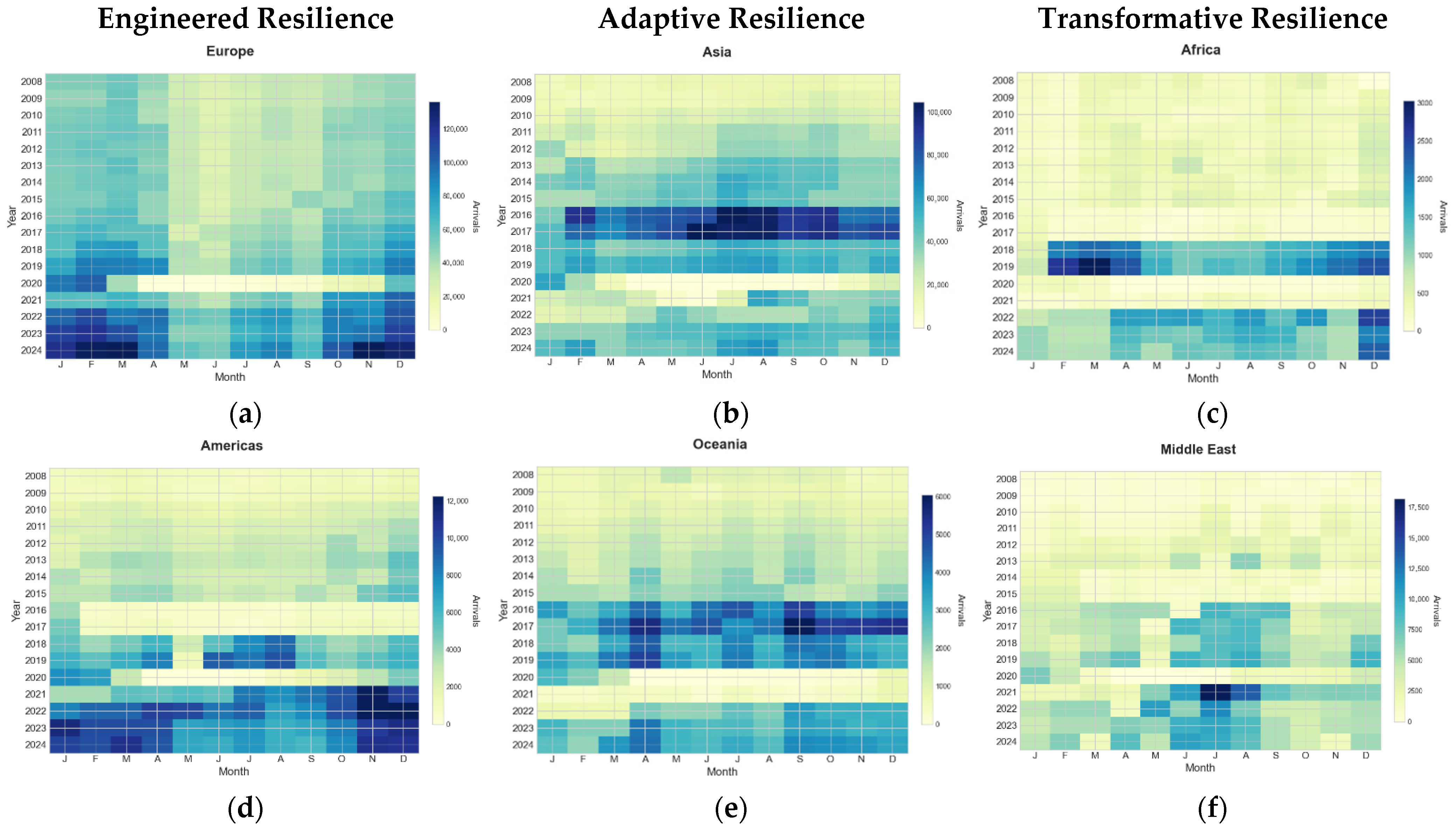
Figure 1. Regional patterns of resilience and seasonality in monthly tourist arrivals (2008–2024), categorized as Engineered Resilience: (a) Europe and (d) Americas; Adaptive Resilience: (b) Asia, and (e) Oceania; and Transformative Resilience (c) Africa, and (f) Middle East.
Tourismhosp 06 00282 g001
Figure 2. Inflow Resilience and seasonal resilience in monthly tourist arrivals (2008–2024) from the top countries of the two main source markets—Europe: (a) United Kingdom, (c) Germany, (e) Russia, and Asia: (b) China, (d) India, (f) Japan.
Tourismhosp 06 00282 g002
Table 1. Tourist Arrivals by Region (Pre- and Post-COVID).
RegionPre-COVID-19 Arrivals
( x _ ± SD)
Post-COVID-19 Arrivals
( x _ ± SD)
Europe560,143.36 ± 208,202.63923,560.83 ± 384,743.88
Asia432,571.18 ± 257,655.25568,536.67 ± 316,700.26
Americas33,643.64 ± 19,951.5387,900.33 ± 28,850.90
Middle East25,005.36 ± 20,768.5666,418.50 ± 21,986.85
Oceania20,662.27 ± 12,543.4422,681.17 ± 18,741.54
Africa4898.55 ± 4757.1615,616.33 ± 819.71
Table 2. Seasonal variation in tourist arrivals across regions and key source countries, and one-way ANOVA test results. ** p < 0.001, * p < 0.01. Different superscript letters (a, b) within a row indicate statistically significant differences between seasons.
RegionsSeasonsANOVA Test
SpringSummerFallWinter
Europe54,630.98 ± 25,299.65 a39,511.86 ± 19,098 ᵇ52,671.04 ± 23,540.84 ᵃ71,006.82 ± 25,728.655 ᵃF3, 200 = 15.323 **
UK9749.7843 ± 4619.89 a7427.529 ± 3004.75 b9204.90 ± 3770.78 a10,558.53 ± 4122.87 aF3, 200 = 5.835 *
Russia7376.53 ± 5716.816931.88 ± 6476.548054.92 ± 5763.019911.61 ± 6256.71F3, 200 = 2.391
Germany9558.96 ± 3860.80 a5453.90 ± 2265.93 a9489.37 ± 4319.99 a8191.36 ± 3728.13 aF3, 200 = 16.647 **
Asia33,609.78 ± 21,035.7042,986.45 ± 27,935.5040,583.41 ± 21,880.50374,896.63 ± 19,806.71F3, 200 = 1.601
China13,585.49 ± 10,542.80 b21,856.88 ± 15,304.49 a18,012.47 ± 12,158.59 b16,066.41 ± 11,868.50 bF3, 200 = 3.922 *
India6385.49 ± 7432.696014.88 ± 8819.847405.9216 ± 8959.858768.12 ± 8451.82F3, 200 = 1.088
Japan4743.88 ± 7028.176279.71 ± 10,580.545479.12 ± 7731.274350.00 ± 6124.82F3, 200 = 0.571
America3848.82 ± 3080.653763.20 ± 3037.5894188.14 ± 3183.174677.08 ± 3298.64F3, 200 = 0.883
Middle East2894.47 ± 2609.85 b5076.20 ± 4397.094 a3111.18 ± 2144.69 a3249.49 ± 2151.07 aF3, 200 = 5.839 *
Oceania2121.14 ± 1420.622033.84 ± 1279.862259.82 ± 1575.451815.00 ± 1153.42F3, 200 = 0.950
Africa648.69 ± 691.48585.43 ± 541.63589.08 ± 598.50614.41 ± 712.75F3, 200 = 0.106
Disclaimer/Publisher’s Note: The statements, opinions and data contained in all publications are solely those of the individual author(s) and contributor(s) and not of MDPI and/or the editor(s). MDPI and/or the editor(s) disclaim responsibility for any injury to people or property resulting from any ideas, methods, instructions or products referred to in the content.