Article

Behavioural Time Allocation and Responses to Environmental Enrichment in Zoo-Housed Yellow-Breasted Capuchin Monkeys (Sapajus xanthosternos)

by
Djalma da Nobrega Ferreira
1,
Sérgio L. G. Nogueira-Filho
1,2,†,
Guillermina Hernández-Cruz
3,
Stella G. C. Lima
1,
Mike Mendl
3 and
Selene S. C. Nogueira
1,2,*
1
Laboratório de Etologia Aplicada, Universidade Estadual de Santa Cruz, Ilhéus 45662-900, Brazil
2
National Institute of Science and Technology in Interdisciplinary and Transdisciplinary Studies in Ecology and Evolution (INCT IN-TREE), Salvador 40110-906, Brazil
3
Center for Behavioral Biology, School of Veterinary Science, University of Bristol, Bristol BS8 1QU, UK
*
Author to whom correspondence should be addressed.
This article is dedicated to the memory of Sérgio Luiz Gama Nogueira-Filho, who made invaluable contributions to the study and to the field of applied ethology.
J. Zool. Bot. Gard. 2026, 7(2), 17; https://doi.org/10.3390/jzbg7020017
Submission received: 7 July 2025 / Revised: 23 March 2026 / Accepted: 26 March 2026 / Published: 2 April 2026

Abstract

Understanding how environmental enrichment influences behavioural time allocation is particularly important for threatened primate species maintained under human care. Accordingly, we investigated whether environmental enrichment (EE) influences behavioural time allocation in yellow-breasted capuchin monkeys (Sapajus xanthosternos), aiming to inform evidence-based husbandry practices in zoological settings. Employing the standard ethological approach of behavioural coding, we observed 20 capuchins housed in three groups comprising adult and juvenile males and females. We recorded behavioural categories including: aggressive, exploratory, affiliative/play, general activity, alert, inactivity, and abnormal behaviour. To evaluate individual engagement with EE, we applied the ABA paradigm, wherein phases A1 and A2 (controls) represented standard zoo conditions, while phase B corresponded to the implementation of an EE programme. Each phase spanned 10 days, and behavioural data were collected via focal animal sampling (2 × 10 min focal sessions per animal per day), resulting in a total of 1200 focal sessions. Behavioural time allocation was analysed using a multivariate generalized linear mixed modelling approach that accounted for the interdependence among behavioural categories. Based on previous studies, we predicted that environmental enrichment may promote higher levels of play and exploration and lower aggression and inactivity. However, despite by-eye suggestions of increases in play and decreases in activity during enrichment, when behavioural categories were analysed simultaneously within the multivariate framework, overall behaviour time budgets and behavioural diversity were found not to change significantly across experimental phases. There were also no sex or age effects on behaviour. This indicates that for S. xanthosternos, the enrichment protocol used here did not provide sufficient novelty or complexity to alter established activity patterns. Integrated analytical approaches are needed to further evaluate the effectiveness of enrichment strategies to ensure they are tailored to specific cognitive and social needs of complex species; future studies could explore how social dynamics, enclosure design, and environmental complexity interact to shape behavioural responses to enrichment.

1. Introduction

Environmental enrichment refers to the modification of the environment to enhance the biological functioning of captive animals [1]. The use of environmental enrichment techniques may minimize the impact of the challenges of captivity and thus promote animal welfare [2,3] by reducing the occurrence of, for example, stereotypy [4,5], stress [6] and anxiety [7], while stimulating the expression of species-typical behaviours [8,9]. However, responses to environmental enrichment are not always uniform and behavioural variability among individuals and across contexts can influence how animals interact with enrichment devices [10,11,12,13,14]. Such variability can complicate the interpretation of enrichment outcomes when only average responses are considered, highlighting the importance of analytical approaches that explicitly account for behavioural heterogeneity between individuals when assessing enrichment effectiveness and informing evidence-based management strategies in zoo-housed animals [2,15]. Accordingly, in the present study, we investigated how environmental enrichment influences behavioural time allocation across functionally defined behavioural categories in yellow-breasted capuchin monkeys (Sapajus xanthosternos), using an integrated analytical approach that accounts for behavioural heterogeneity between individuals.
The yellow-breasted capuchin lives mainly in the northern part of the Brazilian Atlantic Forest and in dry inland forests in two highly threatened biomes, the Cerrado and the Caatinga [16]. The species is classified as critically endangered due to habitat loss and hunting [16,17,18,19]. Due to its disappearance from much of its original range [20], several conservation strategies have been implemented to increase the wild population, alongside the growth of the captive founder population [21,22]. However, yellow-breasted capuchins in Brazilian zoos have been observed to exhibit stress-related behaviours in the presence of the public. These behaviours include grimacing, vigilance, alarm calls, pacing, head turning, increased allogrooming and body turning, which occur mainly due to inadequate enclosures [23,24,25].
Given the high conservation priority of the yellow-breasted capuchin monkey, this study aims to explore how environmental enrichment influences their behaviour. Accordingly, we investigated whether environmental enrichment alters behavioural time allocation across functionally defined behavioural categories, using a standard ethological approach based on behavioural coding sensu [26] Given that Sapajus spp. exhibit pronounced sexual dimorphism, with adult males notably larger than females [27,28], and that such dimorphism in Sapajus xanthosternos is hypothesized to drive divergent behavioural responses by imposing distinct morphological constraints that facilitate niche partitioning and influence energetic allocation to foraging and social interactions [28], we expected sex-related differences in behavioural time allocation, particularly in behaviours associated with aggression and general activity. In addition, we predicted systematic differences in behavioural time allocation between age classes, as juveniles are expected to engage more frequently in play and exploratory behaviours, for instance, whereas adults prioritize social grooming, infant care, and competitive interactions due to their specific reproductive and social roles [28,29]. Based on previous studies examining the effects of environmental enrichment in capuchin monkeys and other primates [10,25], we hypothesized that the introduction of enrichment components would be associated with shifts in behavioural time budgets, including increased exploratory and affiliative behaviours, greater behavioural diversity, and reduced abnormal/stereotypical behaviour and inactivity. These predictions were evaluated by comparing behavioural time allocation across experimental phases using a standard ethological approach.

2. Materials and Methods

2.1. Ethical Note

This work followed the “Principles of laboratory animal care” (NIH publication No. 86-23, revised 1985) and was approved by the Committee of Ethics for Animal Use at the Universidade Estadual de Santa Cruz (proc. #0072015).

2.2. Study Site and Animals

We observed 20 yellow-breasted capuchins (Sapajus xanthosternos) at the Getúlio Vargas Zoobotanical Park (Salvador Zoo), Salvador, Bahia, Brazil (13°0′23″ S and 38°30′20” W). The adult individuals were aged between 5 and 8 years, while juveniles were aged from 9 to 12 months, following the age classification proposed by [19]. The yellow-breasted capuchins lived in three groups which were maintained in distinct conditions: an off-exhibit enclosure (G1) composed of three adult males, two adult females and one juvenile male; in a group closer to the public enclosure (G2) which was composed of three adult males, three adult females, one male juvenile, and one female juvenile; and in a group farther from the public enclosure (G3) which was composed of one adult male, four adult females, and one male juvenile.
G1 was housed in a 47 m2 (8.4 m length × 5.6 m width × 4.7 m height) enclosure with a dirt floor and surrounded and covered by a wired-mesh fence supported by concrete and iron bars. Fire hydrant hoses, branches and tree trunks were introduced throughout the enclosure as decorations and did not work as environmental enrichment because the objects were only changed when they needed to be replaced. Feed was provided in a wooden feeder (0.6 m length × 0.6 m width × 0.1 m high), while water was available ad libitum in a bucket (0.6 m length × 0.6 m width × 0.3 m high) fixed to the fence. This enclosure was in a non-visited area of the zoo because this group of animals was being rehabilitated for a reintroduction programme. G2 occupied a 72 m2 enclosure divided into two areas: a backstage area of 55.3 m2 (15.3 m length × 6.1 m width × 4.6 m high) and an exhibition area of 16.7 m2 (4.9 m length × 3.5 m width × 2.6 m high). The exhibition area had a cement floor and concrete walls, tile roofing and a reinforced glass wall for exhibiting animals to zoo visitors. This area has a plastic drinking fountain (0.6 m long × 0.6 m wide × 0.3 high) and a wooden feeder (0.6 m length × 0.6 m width × 0.1 m high). In this enclosure, the minimum distance between animals and visitors was 3.0 m. The backstage area was connected to the exhibition area by a door (0.8 m width × 2.1 m high), and the animals could choose if they wanted or not to have contact with the public. The area had a dirt floor and was surrounded and covered by a mesh wire fence fixed to concrete and iron bars. As described above for G1, decoration of the enclosure was also present, with fire hydrant hoses, branches and tree trunks. These objects were replaced when necessary. The G3 group was kept on an artificial island of approximately 120 m2 (12.0 m length × 10.0 m width), surrounded by an artificial stream (3 m width × 0.5 m depth). Outside the island area, there were four jackfruit trees (Artocarpus heterophyllus) and two cashew trees (Spondias mombin). Some branches of these trees reached the island enclosure, providing shade and some fruits that animals could grab and eat. Feed was provided in two plastic feeders (0.6 m long × 0.6 m wide × 0.3 high) fixed on wooden logs 1.5 m high above the floor and covered by a wooden ceiling, while water was available ad libitum in a cement drinker (0.80 m length × 0.80 m width × 0.25 m depth). On the island’s earthy ground, there were four concrete pipes and six hollow trunks of varying sizes used as shelter for the animals, and some objects such as fire hydrant hoses and tree branches, decorating the facility and being replaced when necessary. In this enclosure, the minimum distance between animals and visitors was 6.0 m.
All groups were fed twice daily at 9:00 am and 3:30 pm. Morning meals included whole grain bread, fruits, cooked vegetables, cereals, eggs, and primate-specific food. In the afternoon, the animals were provided with fruits and vegetables. Additionally, keepers conducted daily enclosure cleaning between 7:00 am and 9:00 am. The Salvador Zoo does not have an environmental enrichment team, so the facilities’ decorations are just replaced from time to time.

2.3. Data Collection

During 20 days of a period of habituation to the observer’s presence, the observer recognized the individuals by variation in their natural appearance and selected the behaviours to be recorded in all phases of the study (Table 1).
The behavioural repertoire of yellow-breasted capuchins was assessed using a standard ethological approach based on behavioural coding, as defined by [26]. Behavioural data were gathered through continuous focal animal sampling [30], conducted twice daily—from 8:00 am to 10:00 am and from 1:00 pm to 3:00 pm—across ten consecutive days following a 20-day habituation period. Observations were recorded using a digital camcorder (JVC, model GZ-HD500; Tokyo, Japan). Positioned approximately 2 m in front of the pen, the observer video-recorded each capuchin for a duration of 10 min per day, resulting in a total of 100 min of data collection per individual for the behavioural coding analysis. Behavioural data were quantified as the duration (in seconds) of each behaviour listed in Table 1, and/or as the frequency or rate per 10 min focal observation.
We applied the ABA paradigm [31] to evaluate the effect of the environmental enrichment (A1 and A2: non-enrichment phases, B: environmental enrichment phase). As elements of physical environmental enrichment, during phase B we introduced into the enclosures interlaced sisal ropes (G 1: 16 m; G2: 16 m; G3: 24 m). Additionally, we hung in these ropes three yellow plastic rings (0.8 m diameter and 16 mm thick) and a wooden triangle (0.80 m high) (Figure 1). We chose the rings and triangle for their ease of movement and sliding on the sisal rope, and because they were different in shape from any object or pattern found in the enclosure, in the expectation of stimulating play and exploration behaviours. All enrichment items were introduced at the same time into the enclosure on the first day of phase B, remaining for 10 days, being replaced when necessary and removed by the keeper on the last day of this phase. In turn, the control phases (A1 and A2), without introduction of new stimuli to the animals, lasted 10 days as well. In all phases (A1, B, A2) the feeding routine was maintained according to the times and places already defined by the zoo and described above.
The observer collected 20 focal samples per animal and phase, recording the behaviours using the same digital camera described above. Each focal sample lasted 10 min per animal, and they were collected at two different times during a day, once in the morning between 8:00 am and 10:00 am and once in the afternoon between 1:00 pm and 3:00 pm. The order of observation of the enclosures was chosen by a draw without replacement, as was the sequence of individuals to start the observations.

2.4. Analyses and Statistics

For the behavioural coding assessment, video-recorded focal observations (100 min per individual) were analysed by a single observer who was blind to the objectives of the study. The observer recorded the total duration (in seconds) that each individual spent in each behavioural state during the 100 min session using CowLog 3.0.2 [30,32]. Subsequently, we aggregated these data, in seconds, by behavioural category, defined a priori based on the ethogram (Table 1), which represents functionally meaningful behavioural classes. These included aggressive, exploratory, affiliative/play, general activity, alert, inactivity, and abnormal behaviour. We analysed behavioural time data using a single multivariate generalized linear mixed model to evaluate the effects of environmental enrichment while accounting for the interdependence among behavioural categories. We used the total time (in seconds) spent in each behavioural category as the response variables. We included behavioural category, experimental phase (A1, B, A2), sex (female vs. male), and age class (adult vs. juvenile) as fixed effects, as well as the interaction between behavioural category and experimental phase (Category × Phase), and between sex and age class (Sex × Age). We included group identity as a random effect to account for the hierarchical structure of the data and the non-independence of observations within social groups. We chose this approach because behavioural time budgets are inherently interdependent, as time allocated to one category constrains time available for others. Analysing categories jointly allowed us to account for covariance among behavioural responses and to avoid inflating Type I error rates associated with multiple univariate models. Post hoc tests would have been conducted if statistically significant multivariate effects had been detected; however, as no significant multivariate effects were found, no post hoc analyses were performed.
Because behavioural time data consisted of continuous non-negative values with a substantial proportion of zeros and a right-skewed distribution, we fitted models using a Tweedie error distribution with a log link function [33,34]. All statistical analyses were performed in R version 4.5.2 [35], using the packages glmmTMB [33], DHARMa [36], and emmeans [35]. We assessed model assumptions using simulation-based residual diagnostics implemented in the DHARMa package [35], including tests of residual uniformity, dispersion, and outliers. Visual inspection of residual plots and diagnostic tests indicated no substantial deviations from model assumptions. We obtained estimated marginal means and conducted pairwise comparisons when appropriate. We set statistical significance at p < 0.05, and we report results as estimated marginal means with 95% confidence intervals.

2.5. Behavioural Diversity Procedures

We used behavioural diversity as a positive welfare indicator [37] to complement other behavioural metrics used to assess the effects of environmental enrichment presented in this study, following Goswami et al. [37]. We calculated the Shannon–Weaver Diversity Index (SWI) of the enriched and unenriched subjects per observation day according to the observation phases (A1, B, A2). When calculating behavioural diversity, only species-typical behaviours were included [37]; therefore, abnormal repetitive behaviour (e.g., pacing) and inactivity were excluded from the activity budget when determining the behavioural diversity.

3. Results

3.1. Behavioural Time Allocation

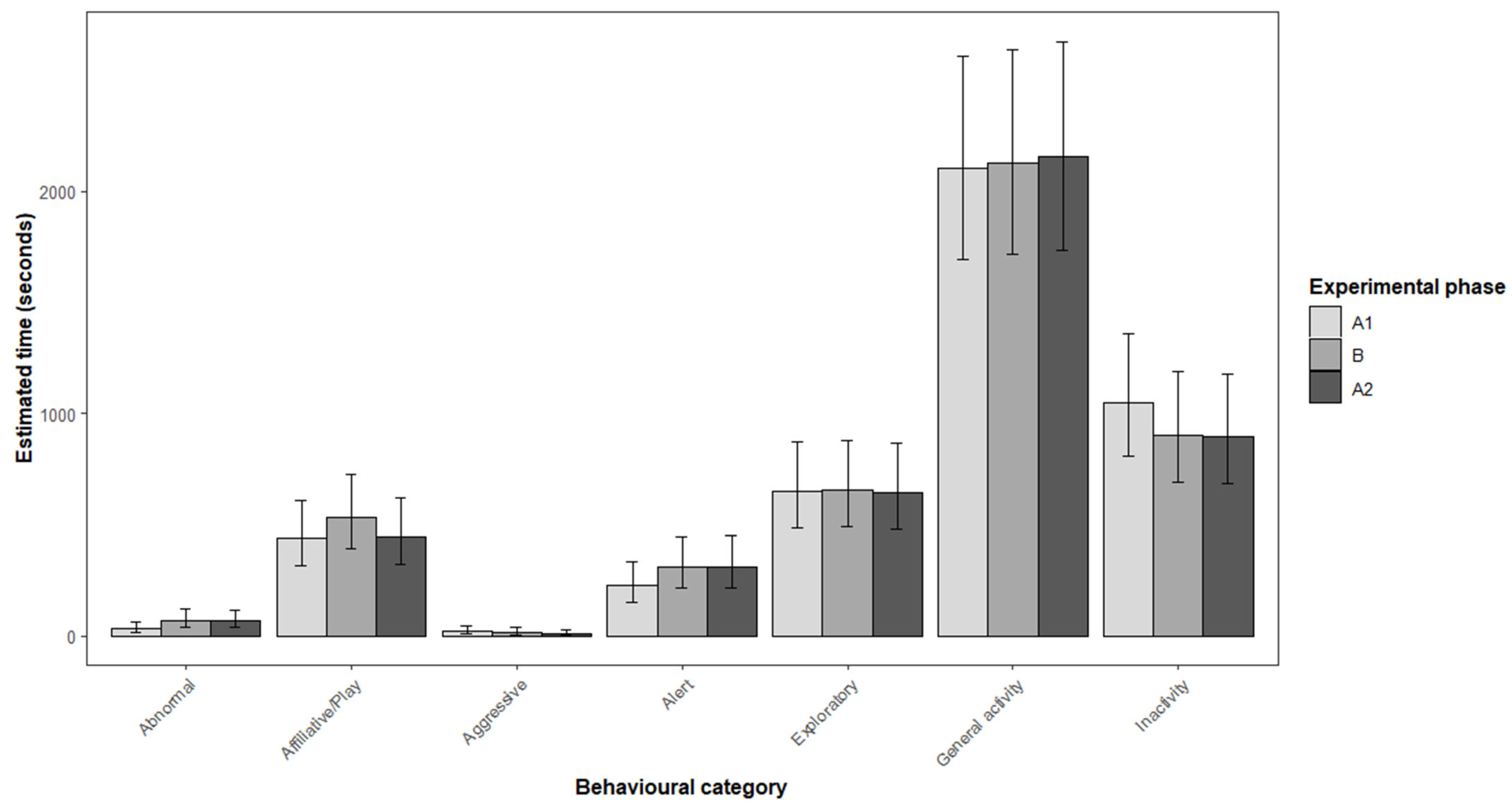
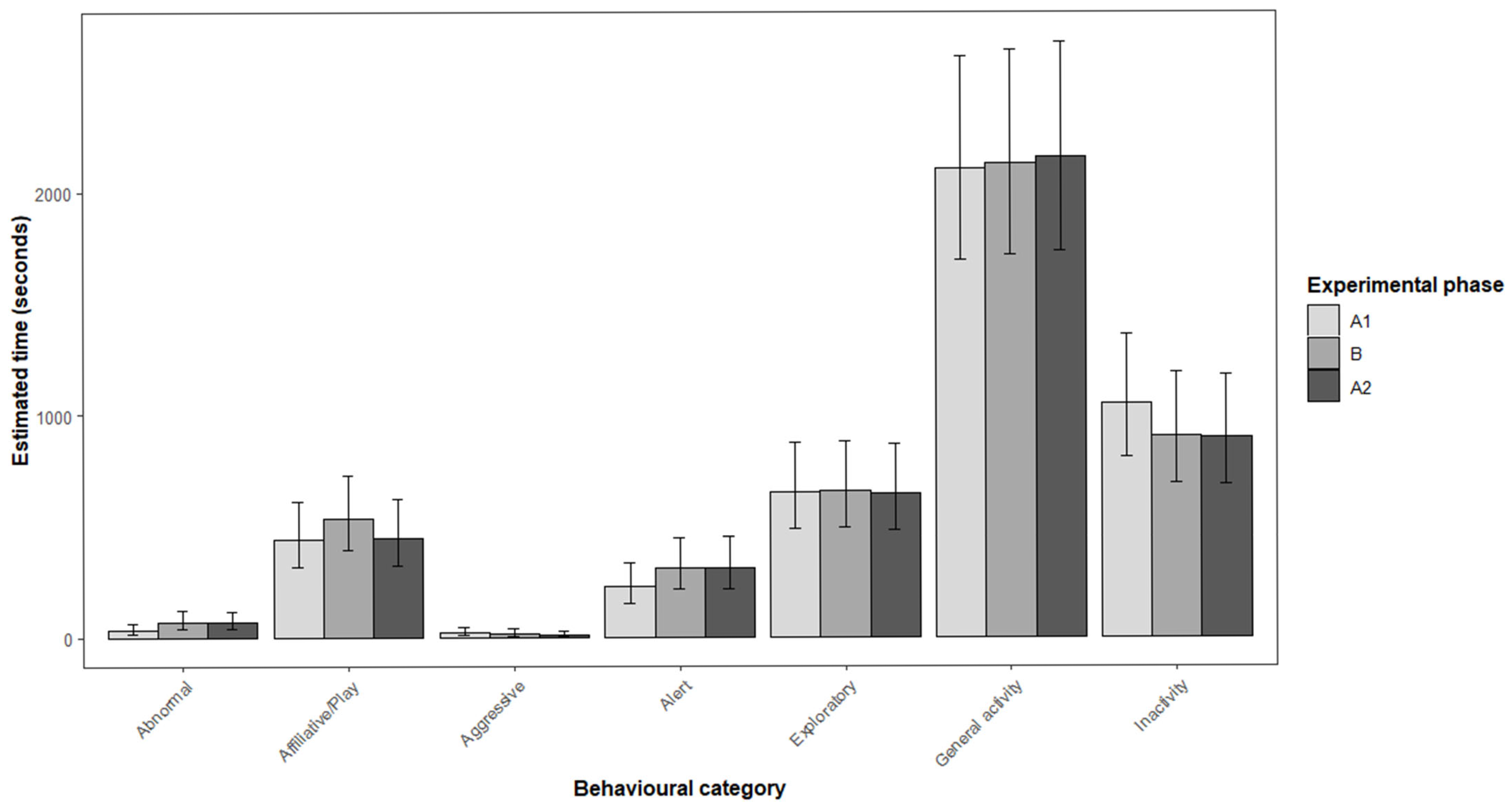
The time budget of behavioural data indicated marked heterogeneity in time allocation among behavioural states across experimental phases. Locomotor and general activity behaviours accounted for the largest proportion of observed time, whereas aggressive and abnormal behaviours occurred infrequently. A detailed summary of the population time budget across behavioural categories is provided in the Supplementary Materials (Table S1). Estimated marginal means indicated that general activity accounted for the largest proportion of behavioural time across all experimental phases, followed by exploratory and affiliative/play behaviours, whereas aggressive and abnormal behaviours represented a comparatively small proportion of the activity budget (Figure 2). Behavioural time allocation remained broadly consistent across the control (A1 and A2) and enrichment (B) phases, although descriptive trends suggested subtle category-specific variation. Simple by-eye inspection of Figure 2 suggests that affiliative/play and alert behaviour showed higher estimated mean values during the enrichment phase relative to A1 and, for play only, relative to A2. In contrast, inactivity tended to decrease during the enrichment phase and remained lower in A2 compared to A1. No other patterns are detectable.
These patterns, formally tested using a multivariate generalized linear mixed model, revealed a strong effect of behavioural category on time allocation (χ2 = 906.23, df = 6, p < 0.0001), indicating marked differences in the amount of time allocated to distinct behavioural categories across the study (Figure 2). In contrast, the experimental phase did not significantly influence behavioural time allocation (χ2 = 1.34, df = 2, p = 0.51), nor did sex (χ2 = 0.27, df = 1, p = 0.61) or age class (χ2 = 0.01, df = 1, p = 0.93). No significant interactions were detected between behavioural category and experimental phase (χ2 = 7.98, df = 12, p = 0.79), nor between sex and age class (χ2 = 0.74, df = 1, p = 0.39).

3.2. Behavioural Diversity

Behavioural diversity remained stable across the three experimental phases. Mean diversity values (± SD) were 1.56 ± 0.16 during the initial control phase (A1), 1.57 ± 0.16 during the enrichment phase (B), and 1.57 ± 0.13 during the post-enrichment control phase (A2), indicating no marked changes in the overall diversity of species-typical behaviours across phases.
When stratified by sex, females consistently exhibited higher behavioural diversity than males across all phases. In contrast, behavioural diversity showed only minor variation between age classes, with adults presenting slightly higher values than subadults in all phases (Supplementary Materials, Figure S1 and Table S2). Behavioural diversity was analysed as a complementary welfare indicator and presented descriptively.

4. Discussion

Contrary to our initial predictions, the multivariate framework detected no systematic differences in behavioural time allocation between age classes. While we expected distinct activity profiles due to the differing social roles and biological needs of juveniles and adults, our findings suggest that, in this specific context, functional behavioural categories may remain relatively stable across these ontogenetic stages. Although some studies on Sapajus spp. have reported age-related shifts in sociability or social engagement (e.g., [38]), such discrepancies likely reflect differences in the age ranges examined and in the behavioural metrics considered. In particular, Delval et al. [39] focused on infants, juveniles and adults up to 36 months of age and employed a broader set of social behaviours, whereas the present study focused on juveniles and adults and used functionally defined behavioural categories.
Despite expectations associated with sexual dimorphism in Sapajus spp. [27], sex did not significantly influence behavioural time allocation when behavioural categories were analysed simultaneously. Our findings reveal notable stability in the activity budget of S. xanthosternos across experimental phases, contrasting with the high behavioural plasticity typically reported for Sapajus spp. in wild settings. In natural habitats, these primates exhibit significant seasonal and sex-based variations in time allocation, primarily driven by fluctuations in food availability and reproductive demands [16]. This indicates that, under the housing and management conditions of the present study, males and females allocated comparable proportions of time to the major behavioural categories. Social dynamics, enclosure design and resource availability may have contributed to this similarity, although further studies explicitly addressing these mechanisms are warranted.
In contrast to the absence of sex effects on time allocation, behavioural diversity analysis revealed that females consistently exhibited higher Shannon–Weaver diversity values than males across experimental phases, indicating a broader distribution of behavioural states rather than differences in the amount of time devoted to specific categories. This distinction underscores that behavioural diversity captures aspects of behavioural organization that are not necessarily reflected in time-based allocation alone, and suggests that sex-related differences may emerge in the variability of behavioural expression rather than in overall activity budgets.
Previous studies have shown that environmental enrichment may promote engagement in species-typical behaviours such as play and exploration, and decrease levels of aggression and inactivity whilst awake, the latter of which have been suggested to be markers of a depression-like state in non-human animals [40,41,42,43]. Whilst mean levels of play/affiliative behaviour went up during enrichment and those of inactivity went down, when behavioural categories were analysed simultaneously within the multivariate framework, neither of these changes reached statistical significance, likely due to high levels of variation between individuals. Another possible reason for the lack of an effect is that the enrichment provided was not sufficiently powerful to induce measurable changes in the overall behavioural time budget. Alternatively, the animals may already have experienced a relatively adequate level of environmental stimulation within their housing conditions, thereby limiting the magnitude of behavioural shifts following the introduction of additional enrichment. It is also possible that the total number of observation hours constrained the detection of more subtle behavioural adjustments, while the aggregation of behavioural data prior to analysis may have obscured short-term or transient responses. Taken together, these considerations suggest that, although enrichment may influence the expression of particular behaviours, the broader organization of the behavioural time budget can remain relatively stable under certain management conditions.
Behavioural diversity also remained stable across experimental phases, indicating that enrichment did not substantially alter the overall diversity of species-typical behaviours expressed. The observed mean diversity values (approximately 1.57 across phases) indicate moderate behavioural diversity, consistent with adequate housing conditions and management practices that allow individuals to express a stable behavioural repertoire [44]. The low and stable occurrence of abnormal or stereotypic behaviours further supports the interpretation that baseline welfare conditions were already favourable, potentially limiting the scope for further reductions in such behaviours [45].
Overall, our findings indicate that environmental enrichment does not substantially alter the repertoire’s overall composition or diversity. Importantly, these results highlight that sex-based differences may manifest as behavioural variability rather than merely in time allocation, reinforcing the value of integrated analytical approaches that combine behavioural time budgets and diversity metrics when assessing enrichment effects in captive non-human primates.
This study provides no clear evidence of how environmental enrichment influences behavioural diversity, and some limitations should be noted. The lack of significant differences regarding sex and age in time allocation suggests a relatively uniform response to the interventions within this group. This may be explained by the cohesive social dynamics and the standardized management conditions of the enclosure. Therefore, their predictive value for solitary individuals or different social structures may be limited. Future research should explore these factors across more diverse captive settings to confirm the breadth of these findings. Furthermore, it is important to acknowledge that our sample size was relatively small, which may limit the statistical power to detect more subtle differences between sex and age classes. Moreover, our results should be interpreted with caution when extrapolated to larger or more demographically diverse populations of Sapajus spp.

5. Conclusions

The overall behavioural time budget and diversity remained stable across experimental phases, with no significant shifts observed in response to the enrichment provided. While descriptive trends might suggest minor fluctuations in specific categories, the lack of significant change indicates that the intervention did not fundamentally reorganize time allocation or expand the behavioural repertoire of the study group. These findings suggest that for S. xanthosternos, the current enrichment protocol may not have provided sufficient novelty or complexity to alter established activity patterns. Consequently, this underscores the necessity of integrated analytical approaches to re-evaluate enrichment strategies and ensure they are effectively tailored to the specific cognitive and social needs of complex species.

Supplementary Materials

The following supporting information can be downloaded at https://www.mdpi.com/article/10.3390/jzbg7020017/s1, Figure S1: Behavioural diversity (Shannon–Weaver index) of yellow-breasted capuchin monkeys across experimental phases (A1, B, A2), stratified by sex and age class. Boxes represent interquartile ranges, horizontal lines indicate medians, and points represent individual values.; Table S1: Total time, mean time, and standard deviation (seconds) spent in each behavioural state by yellow-breasted capuchin monkeys (Sapajus xanthosternos), organized by functional behavioural category across all experimental phases.; Table S2: Behavioural diversity (Shannon–Weaver index, H′) of yellow-breasted capuchin monkeys across experimental phases (A1, B, A2). Values are presented as mean ± standard deviation (SD), stratified by sex and age class. Behavioural diversity was calculated excluding inactivity and abnormal behaviours and is presented as a complementary descriptive metric.

Author Contributions

Conceptualization, S.S.C.N., D.d.N.F. and S.L.G.N.-F., methodology, S.S.C.N., D.d.N.F., M.M. and S.L.G.N.-F.; validation, S.G.C.L. and S.S.C.N.; formal analysis, S.L.G.N.-F. and G.H.-C.; investigation, D.d.N.F.; resources, S.S.C.N.; data curation, S.G.C.L.; writing—original draft preparation, D.d.N.F.; writing—review and editing, S.S.C.N., S.L.G.N.-F., M.M.; visualization, S.S.C.N., S.L.G.N.-F., G.H.-C., M.M.; supervision, S.S.C.N.; project administration, S.S.C.N.; funding acquisition, S.S.C.N. All authors have read and agreed to the published version of the manuscript.

Funding

This study was supported in part by the Coordination for the Improvement of Higher Education Personnel (CAPES—Finance Code 001). D.N.F. received a grant from Fundação de Amparo à Pesquisa do Estado da Bahia (FAPESB) (Process #0300/2016), S.G.C.L. received a grant from CAPES (Process #88882.314913/2019-1), and S.S.C.N. and S.L.G.N.F. received grants from the Brazilian National Research Council (CNPq) (Processes # 303320/2022-2 and # 304593/2022-2, respectively).

Data Availability Statement

Dataset available on request from the authors.

Acknowledgments

This article is dedicated to the memory of our coauthor Sérgio Luiz Gama Nogueira-Filho, who made invaluable contributions to the study and to the field of applied ethology. We are grateful to the Getúlio Vargas Zoobotanical Park (Salvador Zoo) for their valuable support and collaboration throughout the course of this work. We also thank Mariana Carvalho for help with the statistics and Cláudia Andressa Cardoso for reviewing the figures and tables.

Conflicts of Interest

The authors declare no conflict of interest.

References

  1. Newberry, R.C. Environmental enrichment: Increasing the biological relevance of captive environments. Appl. Anim. Behav. Sci. 1995, 44, 229–243. [Google Scholar] [CrossRef]
  2. Mellen, J.; Sevenich MacPhee, M. Philosophy of environmental enrichment: Past, present, and future. Zoo Biol. 2001, 20, 211–226. [Google Scholar] [CrossRef]
  3. Young, R. Environmental Enrichment for Captive Animals; Blackwell Science: Oxford, UK, 2003; pp. 1–6. [Google Scholar]
  4. Swaisgood, R.R.; Shepherdson, D. Scientific approaches to enrichment and stereotypies in zoo animals: What’s been done and where should we go? Zoo Biol. 2005, 24, 499–518. [Google Scholar] [CrossRef]
  5. Swaisgood, R.R.; Shepherdson, D.J. Environmental enrichment as a strategy for mitigating stereotypies in zoo animals: A literature review and meta-analysis. In Stereotypic Animal Behaviour: Fundamentals and Applications to Welfare; Mason, G.J., Rushen, J., Eds.; CAB International: Wallingford, UK, 2007; pp. 256–285. [Google Scholar]
  6. Marcon, M.; Mocelin, R.; Benvenutti, R.; Costa, T.; Herrmann, A.P.; de Oliveira, D.L.; Koakoski, G.; Barcellos, L.J.; Piato, A. Environmental enrichment modulates the response to chronic stress in zebrafish. J. Exp. Biol. 2018, 221, jeb176735. [Google Scholar] [CrossRef]
  7. Brooker, J.S. An investigation of the auditory perception of western lowland gorillas in an enrichment study. Zoo Biol. 2016, 35, 398–408. [Google Scholar] [CrossRef]
  8. Davey, G. Visitors’ effects on the welfare of animals in the zoo. J. Appl. Anim. Welf. Sci. 2007, 9, 215–218. [Google Scholar] [CrossRef]
  9. Greggor, A.L.; Vicino, G.A.; Swaisgood, R.R.; Fidgett, A.; Brenner, D.; Kinney, M.E.; Farabaugh, S.; Masuda, B.; Lamberski, N. Animal welfare in conservation breeding: Applications and challenges. Front. Vet. Sci. 2018, 5, 323. [Google Scholar] [CrossRef]
  10. Highfill, L.E. The use of personality assessments in designing environmental enrichment for Garnett’s bushbabies (Otolemur garnettii). Ph.D. Thesis, The University of Southern Mississippi, Hattiesburg, MS, USA, 2008. [Google Scholar]
  11. Izzo, G.N.; Bashaw, M.J.; Campbell, J.B. Enrichment and individual differences affect welfare indicators in squirrel monkeys (Saimiri sciureus). J. Comp. Psychol. 2011, 125, 347–352. [Google Scholar] [CrossRef]
  12. Massen, J.J.; Antonides, A.; Arnold, A.M.K.; Bionda, T.; Koski, S.E. A behavioral view on chimpanzee personality: Exploration tendency, persistence, boldness, and tool-orientation measured with group experiments. Am. J. Primatol. 2013, 75, 947–958. [Google Scholar] [CrossRef]
  13. Paulino, R.; Nogueira-Filho, S.L.G.; Nogueira, S.S.C. The role of individual behavioural distinctiveness in exploratory and anti-predatory behaviours of red-browed Amazon parrot (Amazona rhodocorytha) during pre-release training. Appl. Anim. Behav. Sci. 2018, 205, 107–114. [Google Scholar] [CrossRef]
  14. Meira, J.E.; Nogueira-Filho, S.L.; Mendl, M.; Lima, S.G.; Fureix, C.; Nogueira, S.S.C. Responses to environmental enrichment are associated with personality characteristics in chestnut-bellied seed finches (Sporophila angolensis). Behav. Process. 2023, 204, 104801. [Google Scholar] [CrossRef]
  15. Watters, J.V.; Powell, D.M. Measuring animal personality for use in population management in zoos: Suggested methods and rationale. Zoo Biol. 2012, 31, 1–12. [Google Scholar] [CrossRef] [PubMed]
  16. Canale, G.R.; Kierulff, M.C.M.; Chivers, D.J. A critically endangered capuchin monkey (Sapajus xanthosternos) living in a highly fragmented hotspot. In Primates in Fragments; de Oliveira, M.M., Marsh, L.K., Eds.; Springer: New York, NY, USA, 2013; pp. 299–311. [Google Scholar]
  17. Mittermeier, R.A.; Coimbra-Filho, A.F.; Constable, I.D.; Rylands, A.B.; Valle, C. Conservation of primates in the Atlantic forest region of eastern Brazil. Int. Zoo Yearb. 1982, 22, 2–17. [Google Scholar] [CrossRef]
  18. Kierulff, M.C.M.; Mendes, S.L.; Rylands, A.B. Sapajus xanthosternos. The IUCN Red List of Threatened Species 2015: E.T4074A70615251. 2015. Available online: https://www.iucnredlist.org/search?query=Sapajus%20xanthosternos&searchType=species (accessed on 29 December 2019).
  19. Silva, F.A.; Canale, G.R.; Kierulff, M.C.M.; Duarte, G.T.; Paglia, A.P.; Bernardo, C.S. Hunting, pet trade, and forest size effects on population viability of a critically endangered Neotropical primate, Sapajus xanthosternos (Wied-Neuwied, 1826). Am. J. Primatol. 2016, 78, 950–960. [Google Scholar] [CrossRef] [PubMed]
  20. Kierulff, M.C.M.; Canale, G.; Gouveia, P.S. Monitoring the yellow-breasted capuchin monkey (Cebus xanthosternos) with radiotelemetry: Choosing the best radiocollar. Neotrop. Primates 2005, 13, 32–34. [Google Scholar] [CrossRef]
  21. Oliver, W.L.R.; Santos, I.B. Threatened endemic mammals of the Atlantic forest region of south-east Brazil. J. Wildl. Preserv. Trust. 1991, 4, 1–26. [Google Scholar]
  22. Lernould, J.M.; Kierulff, M.C.M.; Canale, G. Yellow-breasted capuchin Cebus xanthosternos: Support by zoos for its conservation—A success story. Int. Zoo Yearb. 2012, 46, 71–79. [Google Scholar] [CrossRef]
  23. Rodrigues, N.S.S.O.; Azevedo, C.S.D. Influence of visitors on the behaviour of yellow-breasted capuchins Sapajus xanthosternos at Belo Horizonte Zoo (BH Zoo), Brazil. Int. Zoo Yearb. 2017, 51, 215–224. [Google Scholar] [CrossRef]
  24. Fernández-Bolaños, M.; Delval, I.; de Oliveira, R.S.; Izar, P. Assessing the personality structure of wild capuchin monkeys (Sapajus xanthosternos) using trait rating and behavioural coding. J. Comp. Psychol. 2020, 134, 349–360. [Google Scholar] [CrossRef]
  25. Vazire, S.; Gosling, S.D.; Dickey, A.S.; Schapiro, S.J. Measuring personality in nonhuman animals. In Handbook of Research Methods in Personality Psychology; Robins, R.W., Fraley, R.C., Krueger, R.F., Eds.; The Guilford Press: New York, NY, USA, 2007; pp. 190–206. [Google Scholar]
  26. Fragaszy, D.M.; Visalberghi, E.; Fedigan, L.M. The Complete Capuchin: The Biology of the Genus Cebus; Cambridge University Press: Cambridge, UK, 2004. [Google Scholar]
  27. Fragaszy, D.M.; Izar, P.; Liu, Q.; Eshchar, Y.; Young, L.A.; Visalberghi, E. Body mass in wild bearded capuchins (Sapajus libidinosus): Ontogeny and sexual dimorphism. Am. J. Primatol. 2016, 78, 473–484. [Google Scholar] [CrossRef]
  28. Réale, D.; Reader, S.M.; Sol, D.; McDougall, P.T.; Dingemanse, N.J. Integrating animal temperament within ecology and evolution. Biol. Rev. 2007, 82, 291–318. [Google Scholar] [CrossRef] [PubMed]
  29. Altmann, J. Observational study of behaviour: Sampling methods. Behaviour 1974, 49, 227–266. [Google Scholar] [CrossRef] [PubMed]
  30. Pastell, M. CowLog—Cross-platform application for coding behaviours from video. J. Open Res. Softw. 2016, 4, e15. [Google Scholar] [CrossRef]
  31. Heffner, C.L. Research Methods for Education, Psychology and the Social Sciences, Chapter 4.2 ABAB, 2004. Available online: http://www.allpsych.com/researchmethods (accessed on 28 November 2024).
  32. Shono, H. Application of the Tweedie distribution to zero-catch data in CPUE analysis. Fish. Res. 2008, 93, 154–162. [Google Scholar] [CrossRef]
  33. Brooks, M.E.; Kristensen, K.; van Benthem, K.J.; Magnusson, A.; Berg, C.W.; Nielsen, A.; Skaug, H.J.; Maechler, M.; Bolker, B.M. glmmTMB balances speed and flexibility among packages for zero-inflated generalized linear mixed modeling. R. J. 2017, 9, 378–400. [Google Scholar] [CrossRef]
  34. Hartig, F. R Package, version 0.4.7; DHARMa: Residual Diagnostics for Hierarchical [Multi-Level/Mixed] Regression Models; R. Foundation for Statistical Computing: Vienna, Austria, 2024. [CrossRef]
  35. Lenth, R.; Piaskowski, J. R Package, version 4.5.2; emmeans: Estimated Marginal Means, Aka Least-Squares Means; R. Foundation for Statistical Computing: Vienna, Austria, 2025. [Google Scholar] [CrossRef]
  36. R Core Team, version; 4.3.0 R: A Language and Environment for Statistical Computing; R. Foundation for Statistical Computing: Vienna, Austria, 2025. Available online: https://www.R-project.org/ (accessed on 31 March 2025).
  37. Miller, L.J.; Vicino, G.A.; Sheftel, J.; Lauderdale, L.K. Behavioral diversity as a potential indicator of positive animal welfare. Animals 2020, 10, 1211. [Google Scholar] [CrossRef]
  38. Goswami, S.; Tyagi, P.C.; Malik, P.K.; Gupta, B.K. Effects of enclosure complexity and visitor presence on the welfare of Asiatic lions. Appl. Anim. Behav. Sci. 2023, 260, 105853. [Google Scholar] [CrossRef]
  39. Delval, I.; Fernández-Bolaños, M.; Izar, P. A longitudinal assessment of behavioral development in wild capuchins: Personality is not established in the first three years. Am. J. Primatol. 2020, 82, e23116. [Google Scholar] [CrossRef]
  40. Fureix, C.; Meagher, R.K. What can inactivity (in its various forms) reveal about affective states in non-human animals? A review. Appl. Anim. Behav. Sci. 2015, 171, 8–24. [Google Scholar] [CrossRef]
  41. Martau, P.A.; Caine, N.G.; Candland, D.K. Reliability of the Emotions Profile Index, primate form, with Papio hamadryas, Macaca fuscata, and two Saimiri species. Primates 1985, 26, 501–505. [Google Scholar] [CrossRef]
  42. Suomi, S.J.; Chaffin, A.C.; Higley, J.D. Reactivity and behavioural inhibition as personality traits in nonhuman primates. In Personality and Temperament in Nonhuman Primates; Weiss, A., King, J., Murray, L., Eds.; Springer: New York, NY, USA, 2011; pp. 285–311. [Google Scholar] [CrossRef]
  43. Blaszczyk, M.B. Primates got personality, too: Toward an integrative primatology of consistent individual differences in behavior. Evol. Anthropol. 2020, 29, 56–67. [Google Scholar] [CrossRef]
  44. Magurran, A.E. Diversity Indices and Species Abundance Models. In Ecological Diversity and its Measurement; Croom Helm: London, UK, 1988; pp. 7–46. [Google Scholar]
  45. Mason, G. Stereotypic behaviour: Fundamentals and applications to animal welfare and beyond. In Stereotypies in Captive Animals, 2nd ed.; Mason, G., Rushen, J., Eds.; CAB International: Wallingford, UK, 2006; pp. 325–356. [Google Scholar]
Figure 1. Image of the enclosure farther from the public (G3) during phase B, showing physical environmental enrichment elements, including sisal ropes, three yellow plastic rings and a wooden triangle.
Jzbg 07 00017 g001
Figure 2. Estimated marginal means (± 95% asymptotic confidence intervals) of time spent in each behavioural category across experimental phases (A1 and A2: non-enrichment phase, B: enrichment phase), obtained from a multivariate generalized linear mixed model with a Tweedie error distribution.
Jzbg 07 00017 g002
Table 1. Description of the behavioural states of yellow-breasted capuchin monkeys (n = 20) kept in the Salvador Zoo.
CategoryBehavioural StateDescription
Aggressive Threatening Non-contact aggressive displays including body posturing, piloerection, open-mouth displays or direct stares toward another individual.
ChasingRapid directed locomotion toward another individual, resulting in displacement or retreat.
Agonistic call Short, abrupt vocalization directed toward another individual in an aggressive context, without physical approach.
ExploratoryForaging In search of food, the animal manipulates the substrate as it moves.
Object manipulationManual or oral contact with the EE involving repeated handling, rotating, rubbing or inspection.
Using toolsThe individual uses a stone as a tool to open fruit or anything resembling food when foraging. It may also use branches to pluck ants and small insects from tree trunks.
DiggingRepeated displacement of substrate using hands or tools.
Affiliative/PlaySocial groomingManual inspection or manipulation of another individual’s fur.
Social playTwo or more individuals interact by rolling, running, and nibbling each other. There is no vocalization and no other apparent function.
Solitary playNon-social behavioural activity performed alone, involving variable and flexible locomotor patterns and/or manipulation of objects, characterized by irregular sequences of movements that are not rigidly repeated and that vary in form and duration across occurrences.
General activity WalkingAn individual moves on the floor of the enclosure in a bipedal or quadrupedal locomotion.
RunningAn individual moves quickly on the floor of the enclosure on two or four legs.
FeedingThe animal grasps the food, brings it to its mouth with the aid of its hands, and consumes it.
DrinkingThe individual licks the water.
ClimbingVertical locomotion with active displacement.
HangingBody suspended without displacement, supported by limbs.
Abnormal
behaviour/stereotype
PacingA repetitive, invariant motor pattern performed in a highly similar manner across successive occurrences, with fixed form and sequence, and lacking observable variation in structure or context.
InactivityRestingWith eyes open and no apparent activity, the animal remains in a sitting or lying position.
AlertVigilanceThe animal remains in an upright posture or concealed behind an obstacle, monitoring the surrounding environment through head movements.
Disclaimer/Publisher’s Note: The statements, opinions and data contained in all publications are solely those of the individual author(s) and contributor(s) and not of MDPI and/or the editor(s). MDPI and/or the editor(s) disclaim responsibility for any injury to people or property resulting from any ideas, methods, instructions or products referred to in the content.