Article

Assessing Welfare in Ex Situ Lowland Tapirs Through Activity Patterns and Machine Learning

1
Department of Chemistry and Bioscience, Aalborg University, Fredrik Bajers Vej 7H, 9220 Aalborg, Denmark
2
Aalborg Zoo, Mølleparkvej 63, 9220 Aalborg, Denmark
*
Author to whom correspondence should be addressed.
J. Zool. Bot. Gard. 2026, 7(1), 11; https://doi.org/10.3390/jzbg7010011
Submission received: 9 December 2025 / Revised: 19 January 2026 / Accepted: 26 January 2026 / Published: 3 February 2026

Abstract

This study evaluates activity patterns and determines optimal observation periods for assessing the welfare of lowland tapirs (Tapirus terrestris L.) housed in the following two Danish zoological institutions: Aalborg Zoo and Randers Regnskov. The objectives were to identify the most efficient time window for welfare assessments, determine whether machine learning (ML) could support behavioral evaluations by providing automated estimates of activity, and examine whether automated pose-based tracking could serve as a proxy for manual ethogram observations. Behavioral data were collected using standardized ethograms from wildlife camera footage recorded over 72 h. Lowland tapirs were generally more active during daytime, with individuals at Aalborg Zoo showing peak activity between 07:00 and 14:00, while those at Randers Regnskov were most active between 12:00 and 18:00. Activity patterns differed between institutions, with Aalborg individuals displaying concentrated activity peaks and Randers individuals showing more evenly distributed activity. A preliminary ML analysis using the pose-estimation tool SLEAP demonstrated that movement-based activity estimates closely matched manually coded data, suggesting that automated tracking may offer an efficient and non-invasive tool for welfare monitoring. The findings highlight the potential for integrating automated analysis into routine welfare assessments of zoo-housed animals.

1. Introduction

The primary purpose of modern zoological institutions is the conservation of wildlife. This is achieved through direct field engagement, environmental education, public awareness and advocacy, breeding programs, fundraising, as well as research collaborations and partnerships [1]. While the conservation of wildlife is the core purpose of leading zoological institutions, maintaining high standards of animal welfare has become a central operational priority. Animal conservation and welfare have become closely intertwined, creating opportunities to combine these to enhance the species-specific knowledge required to secure the survival and the welfare of the wildlife [1]. The importance of welfare assessments for zoological institutions lies in their role in ensuring the physical and psychological well-being of animals under human care, as stated in the current Animal Welfare Act (Animal Welfare Act, 2024). These assessments are not only critical for maintaining ethical standards but also support broader conservation goals. Zoological institutions have evolved to play a vital role in preserving and maintaining genetic diversity through coordinated breeding programs and by facilitating scientific research, supported by zoo-managed animal populations [2].
Assessing animal welfare is often time-consuming due to the considerable variation in behavior across species. Lowland tapirs (Tapirus terrestris L.) are generally considered to be predominantly nocturnal in situ, where they rest during the day and forage at night, particularly around midnight [3,4]. They are the largest native herbivores in the tropical forests of South America and play a key role in seed dispersal of various fruits and plants, helping to maintain their environment [5]. Lowland tapirs are solitary by nature, often traveling alone and only associating during the mating season, which lasts 48 h and occurs every 50 to 80 days [3]. In zoological institutions, lowland tapirs are long-lived mammals, which emphasized the importance of efficient and sustainable long-term welfare monitoring.
Differences between zoological enclosures and lowland tapirs’ natural environment complicate accurate welfare assessment. Identifying the optimal observation period is therefore essential for constructing reliable activity budgets. A common tool for behavioral studies is the use of ethograms, which categorize specific behaviors [6]. When applied over a defined observation period, an ethogram can be used to construct both time and activity budgets of the focal animal [7], allowing researchers to determine when and how behaviors are expressed.
The general aim of this study was to optimize welfare assessment of lowland tapirs in zoological institutions by identifying an efficient observation period and exploring the potential of automated behavioral assessment methods. Specifically, the objectives were to identify the most efficient time period for assessing the welfare of lowland tapirs. Furthermore, the aim was to explore whether machine learning (ML) could support behavioral assessment by providing rapid, automated estimates of activity and to evaluate whether automated tracking could serve as a proxy for manual ethogram-based observation, potentially reducing observer effect while maintaining meaningful welfare insight.

2. Materials and Methods

In this study, the activity pattern of six lowland tapirs was studied, with three individuals from Aalborg Zoo and three at Randers Regnskov.
The lowland tapirs in Aalborg Zoo consisted of a 21-year-old female (F1A), a 15-year-old male (M1A), and their 1-year-old female calf (F2A). F1A arrived from Newquay Zoo in England in 2004, and M1A arrived from Neuwied Zoo in Germany in 2019.
In Randers Regnskov, the lowland tapirs consisted of a 7-year-old female (F1R), a 7-year-old male named (M1R), and their 1-year-old female calf named (F2R). F1R arrived from Poznan Zoo in Poland in 2021, and M1R arrived from Zooparc de Beauval in France in 2019. F1A and F1R were pregnant at the time of this study. As the first-generation lowland tapir, M1R is vital for the lowland tapir breeding program, by lowering the risk of inbreeding with the potential introduction of new genes present in in situ individuals.
The enclosure at Aalborg Zoo comprises an inside area of 35 m2 and an outside area of 780 m2. The interior area contains sleeping pens along with a pool where the lowland tapirs can swim and dive. The temperature and humidity resembled rainforest conditions. The outside area contains an open area, where the lowland tapirs can walk unobstructed and the weather conditions were determined by local seasonal changes (Supplementary Figure S1). During the test period, the lowland tapirs shared the outside enclosure with three female vicuñas (Vicugna vicugna).
The enclosure in Randers Regnskov consists of an inside area of 114 m2, with rainforest-like climate. This enclosure was divided between an area with concrete flooring and an imitation of a forest floor with dirt and wood chips. It also contains a pool which allows them to swim and dive. The lowland tapirs share the enclosure with various animals, such as birds and tamarins, moving freely in the entire South American biosphere section (Supplementary Figure S2).
Before the experiment, an ethogram was constructed based on previous studies of lowland tapirs according to Montenegro [8]. This newly constructed ethogram was later adapted to cover the behavior of zoo lowland tapirs, based on in-person observations (Table 1).
A definition of what constituted a behavior was provided, ensuring a coherent understanding of the behavioral categories, thereby supporting reliable data analysis and reducing observer bias. Swimming was recorded as a separate behavioral category due to the availability of water pools and the species-specific use of aquatic environments for thermoregulation, resting, defecation, and enrichment, and was therefore distinguished from other locomotor behaviors. The behaviors observed in the recordings were cataloged, including the start time of the observation period. This allowed a general understanding of when the animals were active and which behaviors were common during different times of the day. On top of behaviors, an “out of sight” category was also made for when an individual was absent or left during a recording.
Data were collected with the use of wildlife cameras (3 × Boly BG584 (Boly Inc., Santa Clara, CA, USA) and 1 × Spromise S378 (Spromise, Alexandria, Australia)). Before the experiment, the cameras were placed in the lowland tapir enclosure to test their recording reliability over 24 h. This also served to acclimate the cameras to the indoor enclosures, especially towards the increased humidity. These data were not used in the results. Thereafter, an interobserver reliability test was made with the use of camera reliability data [9]. This test was needed for a comparison between observers to establish the accuracy of all observers [9], thereby facilitating valid conclusions and supporting meaningful scientific analysis.
The test was made by observing nineteen video recordings individually among five observers. The observations were then compared with one another, and the percentage difference among the observers was calculated. For the observations to be considered excellent, a minimum of 75% similarity is needed [9]. If any individual failed to meet the requirement, the definitions of behaviors were further specified, and a new set of nineteen videos was observed. Afterwards, the interobserver reliability test results were collected, and the reliability coefficient was calculated by using Fleiss Kappa test, in RStudio (2023.12.1 Build 402, Posit Software, PBC, Boston, MA, USA) [10]. Fleiss Kappa test is used to measure the reliability between multiple independent raters’ results in determined classified categories, such as walking, standing, etc. (Supplementary Table S1).
In the case of both indoor and outdoor areas, both areas were monitored with wildlife cameras. The cameras were placed to minimize the area of blind spots in the lowland tapir enclosures. In Aalborg Zoo, two cameras were installed indoors and two outdoors. In Randers Regnskov, three cameras were installed indoors. The cameras were configured to trigger on the detection of movement and would record for 30 s, meaning each video recorded counted as an observation period. The animals were monitored over a three-day (72 h) period. The cameras’ batteries and memory cards were replaced daily, every 24 h. The recording period in Aalborg Zoo began on 1 November 2024 and ended on 4 November 2024. In Randers Regnskov, the recording period began on 18 November 2024 and ended on 21 November 2024. After the 72 h period, the recordings were sorted based on which camera they came from. If a lowland tapir was observed in the recording, all behavioral tendencies were noted in Google Sheets (Google LLC, web-based application, Mountain View, CA, USA) (along with the date and start time of the recording. These recordings were used, with the standardized ethogram, to observe individuals’ activity budgets from the two different enclosures and construct a time budget for the period [6]. These time budgets were used to identify the most efficient period for assessing the welfare of lowland tapirs.
To explore automated alternatives to manual behavioral scoring, an ML approach was implemented, focusing on activity level detection. ML refers to computational methods that identify patterns in data and was here used to support behavioral assessment by providing automated estimates of activity. Using the video recordings, lowland tapir movement was analyzed with SLEAP (Version 1.4.1a2, Princeton University, Princeton, NJ, USA), an open-source deep learning-based framework for multi-animal pose tracking. Rather than classifying detailed behaviors, the analysis focused on estimating general activity levels (e.g., periods of movement versus rest), which is more robust to issues such as partial occlusion and limited nighttime visibility.
SLEAP (Version 1.4.1a2) was used to track the head, shoulder, and hip of each lowland tapir across time. To quantify movement, a body centroid was calculated for each frame by averaging the x- and y-coordinates of the shoulder and hip points. The Euclidean distance between centroids in consecutive frames was then calculated to estimate moment-to-moment movement. Because this raw displacement data is subject to noise from pose estimation jitter and small positional fluctuations, a smoothing procedure was applied. A centered rolling average over thirty frames (equivalent to one second at 30 frames per second) was used to reduce short-term noise and better reveal longer-term activity trends.
The resulting smoothed activity profiles allowed visualization of changes in movement intensity over time, facilitating identification of patterns such as bursts of locomotion or extended periods of rest. This approach provides a scalable and objective method for assessing activity levels across large video datasets without the need for manual annotation.
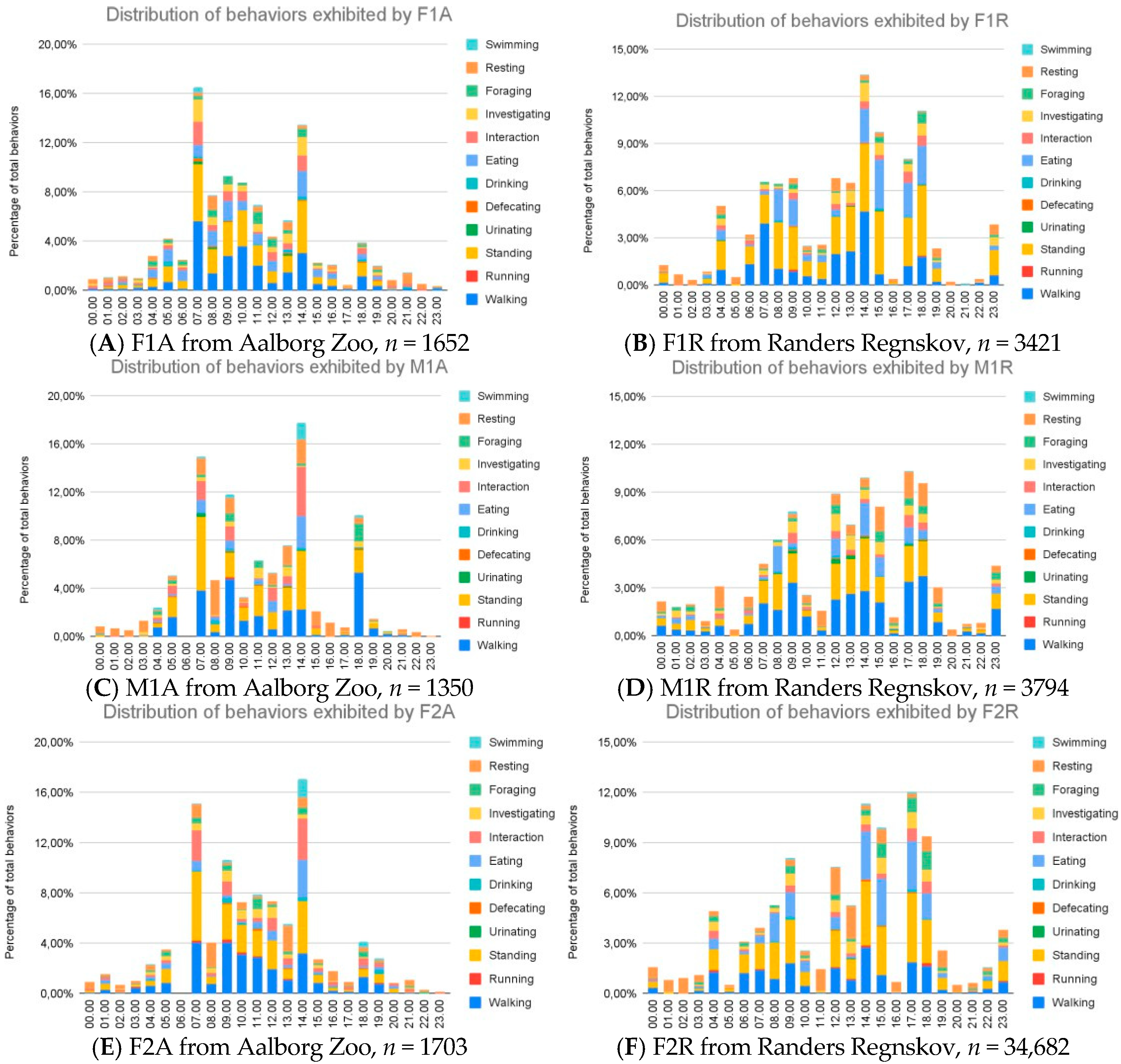
Statistical visualizations of data were made using Google Sheets (Google LLC, web-based application). This included (1) tables of activity budgets for every 24 h and all 72 h combined for each lowland tapir (Table 2; Supplementary Tables S2 and S3). (2) In addition, diagrams illustrating the hourly distribution of instances of behaviors across all 72 h were combined for each lowland tapir (Figure 1A–F). (3) A table showing the percentage of how many times “out of sight” was denoted for each lowland tapir with the total observation periods (Supplementary Table S4). “Out of sight” was also denoted every time a lowland tapir was on camera and walked out of the picture.
Statistical tests were made using the program RStudio (2023.12.1 Build 402) [10], which uses the coding language R. The level of significance was set to α = 0.05. Chi-square test was used to determine and analyze differences in behavior between observation days for each lowland tapir, between total behaviors across the 72 h observation period among individuals from their respective zoological institutions and between total behaviors across zoological institutions based on their family role comparing dam-dam, sir-sir, and calf-calf (Supplementary Tables S5–S9).
Furthermore, Mann–Whitney U-test was used to test for differences in medians for two independent groups, with time intervals in hours, which in summary aggregate to a 24 h period (Supplementary Tables S10–S14). This helped to conclude in which period to observe possible differences in activity for zoologically based lowland tapirs.

3. Results

3.1. Distribution of Behaviors

Generally, the same pattern among all three lowland tapirs in Aalborg Zoo is observed (Figure 1A,C,E). The highest percentage of behaviors exhibited by all lowland tapirs happened between 07:00 and 14:00. This indicates that most activity among the lowland tapirs in Aalborg Zoo happened within this timeframe. For these individuals, specific hours stood out, notably 07:00, 09:00, and 14:00, with 18:00 also highlighted for M1A. Furthermore, these specific hours include all behaviors listed in the ethogram (Table 1), except “urinating” for F2A (Supplementary Table S15).
Similarly, Figure 1B,D,F generally present the same pattern among all three lowland tapirs in Randers Regnskov. Most behaviors were exhibited by all three lowland tapirs between 12:00 and 18:00. This indicates that most activity among the lowland tapirs in Randers Regnskov happened within this timeframe. For these individuals, specific hours stood out, particularly 14:00, 15:00, 17:00, and 18:00, while for M1R, the hours 12:00, 14:00, 17:00, and 18:00 were prominent. During these specific hours, all behaviors listed in the ethogram (Table 1) were exhibited, except “running” for M1R (Supplementary Table S16).
Within the two institutions, the individuals show a greater degree of similarity, generally following the same behavioral patterns.

3.2. Tracking Activity Using Machine Learning

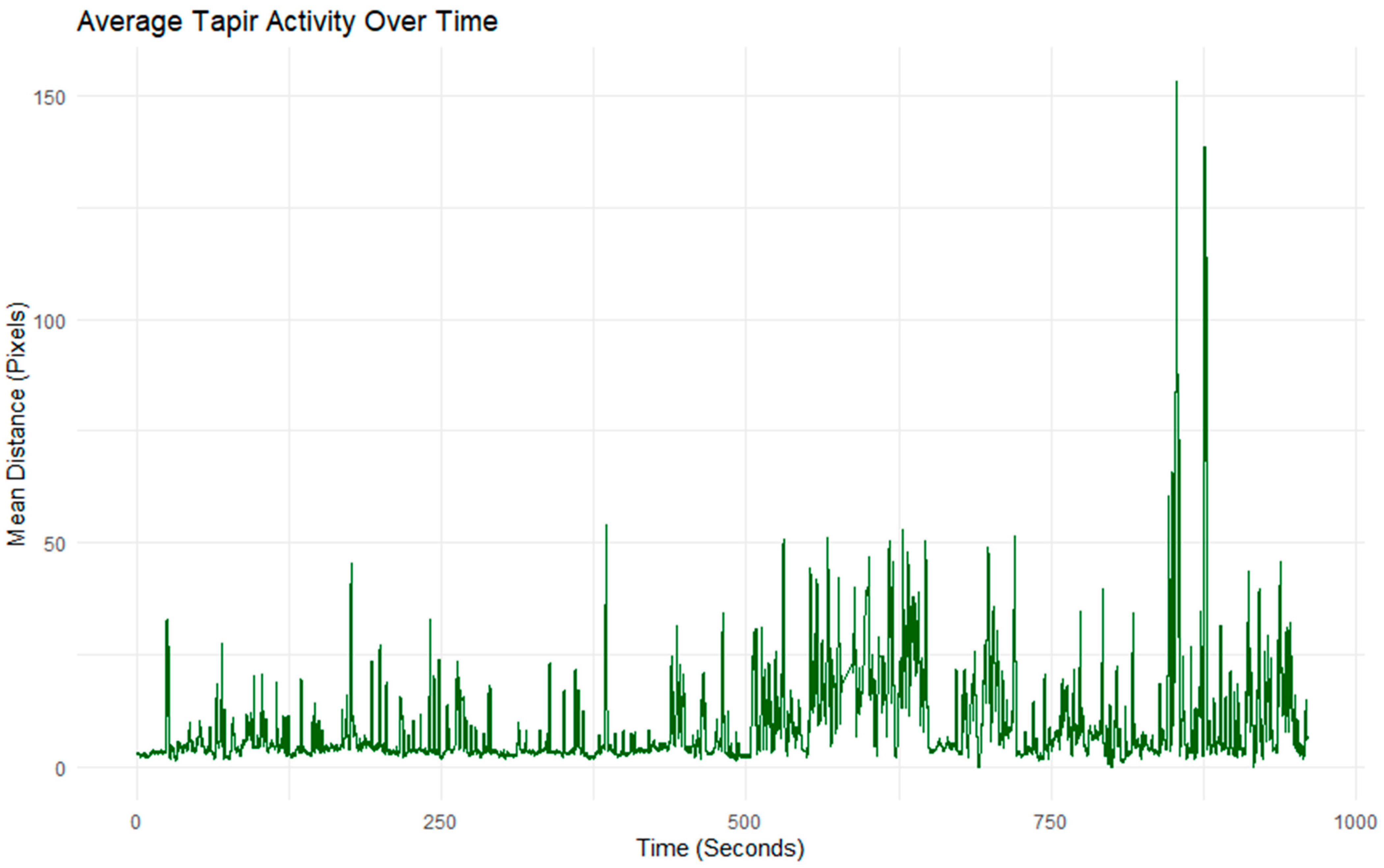
Automated tracking and movement analysis revealed clear variation in lowland tapir activity over time. As shown in Figure 2, overall activity levels remained low for most of the observation period, with intermittent spikes indicating short bursts of movement. The smoothed displacement values, expressed as mean distance in pixels per frame, highlighted extended periods of low activity, consistent with resting behavior, punctuated by clusters of elevated movement.
In the early portion of the video (0–400 s), activity remained minimal, with occasional small peaks. Between 400 and 800 s, activity became more frequent and sustained, including several moderate bursts. The highest peak in activity occurred around 820–840 s, with a sharp increase in displacement exceeding 200 pixels, suggesting a brief episode of intense locomotion. Following this, activity decreased again, though short movements continued to occur.
These patterns suggest alternating periods of rest and movement, consistent with natural lowland tapir behavior. The use of smoothed centroid displacement values proved effective in minimizing noise from tracking jitters, enabling clearer interpretation of overall movement trends.
The ML analysis was applied to a short illustrative video segment to demonstrate methodological feasibility rather than to provide comprehensive quantitative validation against the 72 h manual dataset. The selected segment represents a period of mixed activity under typical enclosure conditions but does not capture full diurnal or nocturnal variation. Accordingly, the ML results should be interpreted as a proof of concept rather than a fully generalizable behavioral proxy. Future studies should extend pose estimation across multiple time windows and perform direct quantitative comparisons with ethogram-based data to more robustly assess ML-derived activity patterns.

3.3. Cumulative Activity Analysis

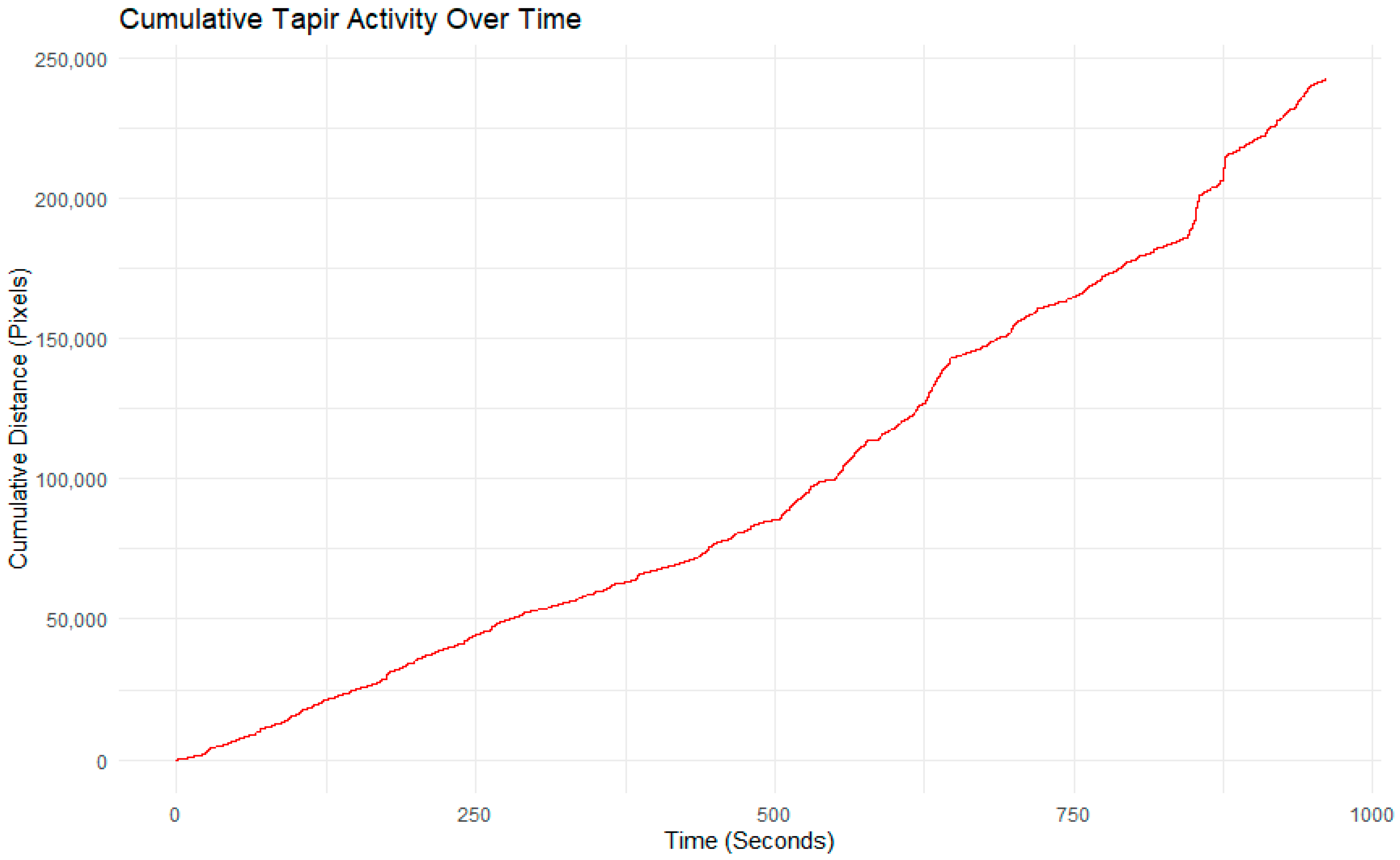
By summing displacement values over time, it was possible to visualize how total distance traveled accumulated throughout the observation period. As shown in Figure 3, the slope of the cumulative curve reflects the relative intensity of movement as follows: flat sections correspond to prolonged resting phases, while steeper slopes mark bursts of locomotion. The extended portions of less locomotion before 400 s highlight resting behavior, whereas the steep rise after 400 s indicates sustained movement activity. This cumulative view thus complements the smoothed displacement plots by offering a simple, intuitive measure of overall activity budgets across the session.

3.4. Activity Budgets Day to Day

Tables in the Supplementary Table S2 illustrate the percentage of behavior each day exhibited by each lowland tapir, displaying that F1A generally exhibits the same behavior each day, but differentiates in “resting” and “drinking” when comparing day 1 to day 2 and 3. M1A differs more in behavior as it displays differences in “walking”, “interaction”, and “swimming” when comparing day 2 to day 1 and 3. F2A only displays a difference in “interaction” when comparing day 2 to day 1 and 3. However, the Chi-square tests implements significant differences in behavior between each day for all individuals (Supplementary Table S5).
Likewise, tables in the Supplementary Table S3 show that F1R exhibits the same behaviors each day, but differentiates in “investigating” when comparing day 3 to day 1 and 2. M1R differentiates in “walking” when comparing day 1 to day 2 and 3, “investigating” when comparing day 3 to day 1 and 2, and in “resting” when comparing day 2 to day 1 and 3. Finally, F2R only differentiates in “investigating” when comparing day 3 to day 1 and 2. However, the Chi-square tests implements significant differences in behavior between each day for all individuals (Supplementary Table S7).

3.5. Activity Budgets over All Three Days

Table 2 shows the total behavior exhibited for each of the individual lowland tapirs in Aalborg Zoo and Randers Regnskov. For all three lowland tapirs in Aalborg Zoo, the two most prominent behaviors displayed are “walking” and “standing”. However, a noticeable difference emerges in the third most prominent behavior which is “eating” for F1A, “resting” for M1A, and “interaction” for F2A. Similarly to the lowland tapirs in Aalborg Zoo, the lowland tapirs in Randers Regnskov display “walking” and “standing” as their two most prominent behaviors. Likewise, the third most prominent behavior differentiates between the individuals. It is “eating” for F1R and F2R, and “resting” for M1R.
A noticeable difference emerges when comparing the individuals from Aalborg Zoo with the use of a Chi-square test (Supplementary Table S8). It reveals that F2A and M1A differ in activity across the categories of “running” = F2A > M1A, “defecating” = M1A > F1A, “drinking” = F2A > M1A, and “investigating” = F2A > M1A, while F2A and F1A differ in the categories “running” = F2A > F1A, “defecating” = F1A > F2A, and “swimming” = F2A > F1A. Additionally, M1A and F1A differ in the categories “defecating” = F1A > M1A, “drinking” = F1A > M1A, “resting” = M1A > F1A, and “swimming” = M1A > F1A.
When comparing the individuals from Randers Regnskov, differences appear using Chi-square test (Supplementary Table S10). It shows that F1R and M1R differ in activity across the categories of “running” = F1R > M1R, “urinating” = M1R > F1R, “defecating” = M1R > F1R, “drinking” = M1R > F1R, and “swimming” = M1R > F1R, while F1R and F2R differ in categories “running” = F2R > F1R, “urinating”= F1R > F2R, and “resting” = F2R > F1R. Additionally, M1R and F2R differ in the categories “running”= F2R > M1R, “urinating” = M1R > F2R, “defecating” = F2R > M1R, and “swimming” = F2R > M1R.

3.6. Differences Between the Zoological Institutions

When comparing the two zoological institutions’ dams, sires, and calves, it becomes apparent that there are a lot of differences in the amount of a certain behavior displayed. The dams show the most similarities between the two zoological institutions. The differences emerge when comparing the individuals from Aalborg Zoo with the corresponding sex and age from Randers Regnskov (Table 3).
These results are based on differences in percentages displayed in Table 2 supported by Chi-square test results, where it shows a significant difference between the behaviors and individuals (Supplementary Table S11).

4. Discussion

The present study is based on a limited sample size comprising six lowland tapirs from two zoological institutions, including parent–offspring pairs. Consequently, the findings should be interpreted within an exploratory and method-oriented framework rather than as population-level inferences. Furthermore, environmental conditions and enclosure characteristics were not quantified or analyzed as independent variables but instead formed part of the overall context in which activity patterns were assessed. The discussion therefore focuses on institution-specific patterns shaped by multiple interacting factors.
In addition, welfare assessment in this study is based on activity patterns, which provide an indirect but a commonly applied indicator of animal welfare. The integration of physiological stress measures would provide valuable complementary insight and represent an important direction for future research beyond the scope of the present study.
The results show a clear difference in behaviors, particularly “resting” and “swimming”, between Aalborg Zoo and Randers Regnskov, despite the individuals sharing the same genders and familial roles. This can be attributed to a difference in enclosures, both in area size and content, as seen in Supplementary Figure S1 and S2 [11]. Within the two institutions, the individuals show a greater degree of similarity, generally following the same behavioral patterns, as seen on the histograms in Figure 1A–F. This indicates that the gender and age of the lowland tapirs play a lesser role in determining their behavior, while the enclosure type plays a greater role. This is supported by their natural behavior, where there is little to no difference between the genders in terms of behavior [12].
Both groups of lowland tapirs show a higher activity during the daytime, which contrasts with their documented natural behavior in situ [3] ). A more natural enclosure, like Randers Regnskov, would be expected to facilitate more natural behavior. Other factors, like feeding time and visitor numbers, could have attributed to this, as eating behavior seems to be focused during the afternoon hours. Other studies have shown a similar pattern, though with a species of elephants (Elephas maximus), where feeding was more prevalent during the day than night despite their natural behavior [13]. Another effect of feeding times is the emergence of anticipatory behaviors. These often manifest as an increase in activities like walking in the form of pacing right before being fed [14]. A study has shown that an unpredictable feeding schedule helped facilitate more natural behavior in a group of chimpanzees (Pan troglodytes) [15]. Implementing an unpredictable feeding schedule should be tested on lowland tapirs kept in zoos to observe potential changes in their behavior. Visitor numbers are another source of behavioral disturbances for most ex situ animals [16]. The detrimental effect of visitor numbers is discussed in a study from Arignar Anna Zoological Park, in India, on four individuals of ex situ Indian gaur (Bos gaurus) [17]. The study indicates that zoo visitors can be a potential source of disturbance and stress for ex situ animals. Another study showed that an increase in visitors caused a group of Malayan tapirs (Tapirus indicus) to become more anxious and alarmed, becoming less active, thereby lowering their welfare [11]. Conversely, the Malayan tapirs became more active during low visitor hours, where walking and swimming became more prevalent [11]. A different study conducted on lowland tapirs in situ in Brazil showed a similar result [18]. The study found that the presence of humans in or near their habitat can lead to altered behavior. The study suggests that lowland tapirs exhibit behavioral adaptations to optimize resource access while minimizing disturbances in environments with dynamic or uncertain conditions [18]. The idea that lowland tapirs modify their behavior in response to perceived environmental changes, no matter how slight, is supported by these studies. This suggests that the behavioral patterns observed in Aalborg Zoo and Randers Regnskov may also be influenced by a natural adaptive mechanism in response to human visitors.
The distribution of individual activity budgets, as shown in Figure 1A–F, indicates that lowland tapirs at Aalborg Zoo and Randers Regnskov generally follow similar behavioral patterns within each institution. This consistency suggests that the lowland tapirs exhibit some level of synchronization. These findings support studies which challenge the long-held belief that lowland tapirs are strictly solitary animals [12]. Instead, it has been observed that lowland tapirs can live together in family groups, typically consisting of a monogamous pair and their offspring [12].
This study revealed significant behavioral differences between days in some cases, observed in both individuals at Aalborg Zoo and Randers Regnskov. Behaviors such as “foraging”, “resting”, and “swimming” varied daily for almost every individual.
Similarly, a study conducted on lowland tapirs in the Atlantic Forest found that daily activity patterns were influenced by factors such as temperature, lunar phases, and increased rainfall [3].These factors affected energy utilization and encouraged foraging under less stressful conditions. During months with high precipitation and low temperatures, there was an increase in diurnal activity compared to days with higher temperatures [3]. Additionally, periods of increased lunar light led to reduced activity and foraging, as lowland tapirs sought areas with more cover or dense vegetation to avoid potential threats from predators or humans [3]. These factors could be considered crucial for explaining the significant behavioral differences observed between the individuals in each institution in this study. The lowland tapirs at Aalborg Zoo had access to an outdoor area of approximately 780 m2, with minimal vegetation cover, during the study period. This suggests that lunar light might have had a pronounced impact on nocturnal activities at Aalborg Zoo.
The indoor facility at Aalborg Zoo spanned 35 m2 and maintained high humidity (80–100% RH) and temperature. Compared to the conditions described in a previous study [3], access to an open outdoor area during November, combined with the humid indoor environment, is likely to influence the lowland tapirs’ ability to regulate their body temperature. Research indicates that the optimal temperature range for lowland tapirs to thrive is between 21 °C and 27 °C and they struggle to adapt to significantly lower temperatures [19]. This could be an influencing factor in their time spent outdoors in colder months, while the higher humidity and temperature indoors could impact activity level, such as a decrease in foraging or an increase in resting and swimming indoors. The size of the facility could also play a significant role in shaping these behaviors [11].
In contrast, the facility in Randers Regnskov was located within a dome, characterized by high humidity (80–100% RH, stable temperatures, and coverage from various trees and bushes). Here, natural lunar light was reduced, and the indoor temperature remained consistent. While the individuals in Randers Regnskov did not experience the same fluctuations in environmental conditions or outdoor access as those in Aalborg Zoo, significant behavioral differences between days among individuals in Randers Regnskov still emerged, even when these factors remained constant.
All above mentioned studies highlight the importance of accounting for both macro-and micro-environmental factors, as well as abiotic and biotic elements, when conducting behavioral studies on lowland tapirs [18]. By considering this broader context, researchers can gain a more comprehensive understanding of the factors shaping lowland tapir behavior.
Besides welfare assessment, this study demonstrates the feasibility and utility of applying pose estimation techniques, specifically SLEAP, to quantify basic activity levels in lowland tapirs using video data. By tracking key body parts and calculating centroid displacement over time, we were able to derive meaningful movement profiles that distinguish periods of rest from bouts of locomotion without relying on detailed behavioral annotations. This approach offers a promising automated alternative to manual scoring, which is often time-consuming and subject to observer bias.
The results highlight how smoothing displacement data can effectively mitigate the influence of pose estimation noise and small positional jitter inherent in ML-based tracking. The centered rolling average over one second (30 frames) proved sufficient to reveal underlying activity trends, enabling the identification of natural behavioral rhythms such as resting phases and short bursts of movement. This method’s robustness to partial occlusion and challenging lighting conditions, common in wildlife videos, is a notable advantage for studying elusive or nocturnal species like lowland tapirs.
While this approach does not classify complex behaviors or social interactions, focusing on coarse activity levels is particularly useful in ecological and behavioral monitoring contexts where large datasets demand scalable analysis. Future work could extend these findings by integrating additional body points or combining pose data with environmental or physiological measurements to better interpret the functional significance of observed activity patterns.
Given these technical constraints and the challenges associated with nocturnal video data, the ML analysis using SLEAP was intentionally limited to coarse activity level estimation (movement versus rest) to ensure robustness under conditions of partial occlusion, low nighttime visibility, and limited training data. While this approach does not capture complex behaviors or social interactions, it provides a scalable and objective proxy for general activity patterns. Extending pose estimation to multi-class behavioral classification represents an important direction for future work.
Limitations include the reliance on video quality and the potential for missed or mis-tracked points during occlusions or rapid movements, which may reduce accuracy. Additionally, while centroid displacement provides a convenient proxy for movement, it may not capture subtle postural changes or non-locomotor activities such as grooming or feeding. Addressing these limitations may require more sophisticated multi-point tracking models or complementary sensor data.
Overall, the application of SLEAP-based pose estimation for lowland tapir activity monitoring represents a valuable step toward automated behavioral analysis in wildlife research, offering an objective, reproducible, and efficient tool to quantify activity levels across extensive video datasets.
Technical difficulties with the cameras could have influenced the results, particularly when considering the total observation periods. The number of observation periods was significantly higher for Randers Regnskov, likely due to the cameras nearly covering the entire facility. Additionally, the facility housed various other species, which could have triggered the cameras to start recording. This does not influence the results when looking at individuals within institutions but can complicate the comparison between Aalborg Zoo and Randers Regnskov (Supplementary Table S1). Furthermore, the use of percentages in the Chi-square analysis stems from the fact that the total observation counts varied between individuals and zoological institutions. While this facilitated relative comparisons across individuals and sites, it does not conform to standard Chi-square procedures, which are conventionally based on raw counts [20,21]. The Chi-square results should therefore be interpreted with caution and were cross-checked against the underlying raw data presented in Table 2. Future analyses should apply Chi-square tests directly to raw frequency data to avoid potential biases.


5. Conclusions

Based on our study, it is recommended that future welfare assessments for lowland tapirs conduct ethogram observations between 07:00 hrs. and 14:00 hrs. in Aalborg Zoo during continuous observations. If the lowland tapirs were to be observed specifically based on hours, it should be at 07:00, 09.00, and 14:00 hrs. In Randers Regnskov, the lowland tapirs should be observed between 12:00 hrs. and 18:00 hrs. during continuous observations. If the lowland tapirs were to be observed specifically based on hours, it should be around 12:00, 14:00, 15:00, 17:00, and 18:00 hrs. The given timeframes and specific hours both capture the most varied diversity of behaviors and the highest overall total of behavioral observations in their respective zoos. This study also showed that lowland tapirs from different zoos behave differently compared to each other. Therefore, it is recommended that each zoo establish its optimal interval for observing its lowland tapirs to evaluate their welfare. It should be noted that these recommendations are based on a limited number of individuals and should therefore be interpreted within the exploratory scope of the study, highlighting the need for future validation across additional zoological institutions.
Additionally, the use of automated pose estimation tools like SLEAP to track general activity levels provides a scalable and objective complement to manual observations, enabling more efficient monitoring of lowland tapir movement patterns across extended video recordings. Such a model could also provide novel abilities in welfare tracking, such as setting off an alarm when abnormal activity levels are detected.

Supplementary Materials

The following supporting information can be downloaded at https://www.mdpi.com/article/10.3390/jzbg7010011/s1, Figure S1: Visualization of facility in Aalborg Zoo with cameras and their field of vision; Figure S2: Visualization of facility in Randers Regnskov with cameras and their field of vision; Table S1: Raw data from interobserver reliability test and results from the Fleiss´ Kappa test; Table S2: Individual behaviors for all tapirs in Aalborg Zoo over all three days in counts and percentages; Table S3: Individual behaviors for all tapirs in Randers Regnskov over all three days in counts and percentages; Table S4: “Out of sight” in relation to observation periods for all tapirs; Table S5: Chi-square and corresponding p-value, for each individual, in Aalborg Zoo; Table S6: Chi-square and corresponding p-value, between each individual, in Aalborg Zoo; Table S7: Chi-square and corresponding p-value, for each individual, in Randers Regnskov; Table S8: Chi-square and corresponding p-value, between each individual, in Randers Regnskov; Table S9: Chi-square and corresponding p-value, between corresponding sex and “age”, between Aalborg Zoo and Randers Regnskov; Table S10: Mann-Whitney U test for individuals in Aalborg Zoo; Table S11: Mann-Whitney U test for individuals in Randers Regnskov; Table S12: Mann-Whitney U test for comparison between individuals in Aalborg Zoo; Table S13: Mann-Whitney U test for comparison between individuals in Randers Regnskov; Table S14: Mann-Whitney U test for comparison between individuals in Aalborg Zoo and Randers Regnskov; Table S15: Distribution of behavior over all three days combined for each individual tapir in Aalborg Zoo in counts; Table S16: Distribution of behavior over all three days combined for each individual tapir in Randers Regnskov in counts; Table S17: Comparison between corresponding individuals over all three days combined in Aalborg Zoo and Randers Regnskov. Further inquiries can be directed at the corresponding author.

Author Contributions

Conceptualization, P.O.F.C., M.H.C., T.L.F., F.G., S.M.L., A.P.M.N., J.N., N.H.O., T.K.O., S.P., and C.P.; Methodology, P.O.F.C., M.H.C., T.L.F., F.G., S.M.L., A.P.M.N., J.N., N.H.O., T.K.O., S.P., and C.P.; Software, P.O.F.C., M.H.C., T.L.F., F.G., S.M.L., A.P.M.N., J.N., N.H.O., T.K.O., S.P., and C.P.; Validation, P.O.F.C., M.H.C., T.L.F., F.G., S.M.L., A.P.M.N., J.N., N.H.O., T.K.O., S.P., and C.P.; Formal Analysis, P.O.F.C., M.H.C., T.L.F., F.G., S.M.L., A.P.M.N., J.N., N.H.O., T.K.O., S.P., and C.P.; Investigation, P.O.F.C., M.H.C., T.L.F., F.G., S.M.L., A.P.M.N., J.N., N.H.O., T.K.O., S.P., and C.P.; Resources, P.O.F.C., M.H.C., T.L.F., F.G., S.M.L., A.P.M.N., J.N., N.H.O., T.K.O., S.P., and C.P.; Data Curation, P.O.F.C., M.H.C., T.L.F., F.G., S.M.L., A.P.M.N., J.N., N.H.O., T.K.O., S.P., and C.P.; Writing—Original Draft Preparation, P.O.F.C., M.H.C., T.L.F., A.P.M.N., N.H.O., T.K.O., S.P., and C.P.; Writing—Review and Editing, T.L.F., F.G., S.M.L., A.P.M.N., J.N., N.H.O., S.P., and C.P.; Visualization, P.O.F.C., M.H.C., T.L.F., F.G., S.M.L., A.P.M.N., J.N., N.H.O., T.K.O., S.P., and C.P.; Supervision, T.L.F., S.P., and C.P.; Project Administration, A.P.M.N., N.H.O., and T.K.O. All authors have read and agreed to the published version of the manuscript.

Funding

The study was funded by the Aalborg Zoo Conservation Foundation (AZCF; grant number 2024-07).

Institutional Review Board Statement

All procedures involving animals were non-invasive and consisted of setting up wildlife camera traps in enclosures at Aalborg Zoo and Randers Regnskov. The study was conducted in compliance with Danish national legislation and institutional guidelines under the Zoological Institutions’ Declaration [22]. This study contributes to the activities described under §18, as it enhances species-specific knowledge and supports conservation and welfare monitoring in Danish zoological institutions. No animal was handled, disturbed, or subjected to stress or harm during the study.

Data Availability Statement

The data presented in this study are available on request from the corresponding author.

Acknowledgments

We would like to thank Aalborg Zoo and Randers Regnskov for the opportunity to work with their lowland tapirs and for their cooperation.

Conflicts of Interest

The authors declare no conflicts of interest.

References

  1. de Graff, N.; Gusset, M.; Hanuliaková, J.; Hofer, H.; Hogg, C.; Hosey, G.; Hunt, S.; Maple, T.L.; Melfi, V.; Mellor, D.J.; et al. Caring for Wildlife: The World Zoo and Aquarium Animal Welfare Strategy; WAZA Executive Office: Gland, Switzerland, 2015; pp. 14–22. ISBN 978-2-8399-1695-0. [Google Scholar]
  2. Beer, H.N.; Shrader, T.N.; Schmidt, T.B.; Yates, D.T. The evolution of zoos as conservation institutions: A summary of the transition from menageries to zoological garden and parallel improvement of mammalian welfare management. J. Zool. Bot. Gard. 2023, 4, 648–664. [Google Scholar] [CrossRef]
  3. Cruz, P.; Paviolo, A.; Bó, R.F.; Thompson, J.J.; Di Bitetti, M.S. Daily activity patterns and habitat use of the lowland tapir (Tapirus terrestris) in the Atlantic Forest. Mamm. Biol. 2014, 79, 376–383. [Google Scholar] [CrossRef]
  4. Ayala, G.; Viscara, M.; Wallace, R. Lowland tapir (Tapirus terrestris) distribution, activity patterns and relative abundance in the Greater Madidi Tambopata Landscape. Integr. Zool. 2012, 7, 407–419. [Google Scholar]
  5. Henry, O.; Feer, F.; Sabatier, D. Diet of the Lowland Tapir (Tapirus terrestris L.) in French Guiana. Biotropica 2000, 32, 364–368. [Google Scholar] [CrossRef]
  6. Brockmann, H.J. Measuring Behaviour: Ethograms, Kinematic Diagrams, and Time Budgets; Technical document; Department of Biology, University of Florida: Gainesville, FL, USA, 1994. [Google Scholar]
  7. Altmann, J. Observational Study of Behavior: Sampling Methods. Behaviour 1974, 49, 227–266. [Google Scholar] [CrossRef] [PubMed]
  8. Montenegro, O.L. The Behavior of Lowland Tapir (Tapirus terrestris) at a Natural Mineral Lick in the Peruvian Amazon. Master’s Thesis, University of Florida, Gainesville, FL, USA, 1998. [Google Scholar]
  9. Kaufman, A.B.; Rosenthal, R. Can you believe my eyes? The importance of interobserver reliability statistics in observations of animal behaviour. Anim. Behav. 2009, 78, 1487–1491. [Google Scholar] [CrossRef]
  10. Rstudio, Version 1.4.1564. [Computer Software]. Posit PBC: Boston, MA, USA, 2011.
  11. Arumugam, K.A.; Luan, L.Q.; Ibrahim, W.N.B.W.; Tah, M.B.M.; Buesching, C.D.; Annavi, G. Influence of Enclosure Conditions and Visitors on the Behavior of Captive Malayan Tapir (Tapirus indicus): Implications for Ex Situ Management and Conservation. Int. J. Sci. Res. Publ. 2018, 8, 22–33. [Google Scholar] [CrossRef]
  12. Gilmore, M. Tapir behavior: An Examination of Activity Patterns, Mother-Young Interactions, Spatial Use, and Environmental Effects in Captivity on Two Species (Tapirus indicus and Tapirus bairdii). Master’s Thesis, Oklahoma State University, Stillwater, OK, USA, 2007. [Google Scholar]
  13. Lukacs, D.E.; Poulin, M.; Besenthal, H.; Fad, O.C.; Miller, S.P.; Atkinson, J.L.; Finegan, E.J. Diurnal and nocturnal activity time budgets of Asian elephants (Elephas maximus) in a zoological park. Anim. Behav. Cogn. 2016, 3, 63–77. [Google Scholar] [CrossRef]
  14. Newbolt, J. Predictable Feeding in Zoos: Research Methods and Behavioural Effects. Ph.D. Thesis, University of Plymouth, Plymouth, UK, 2013. [Google Scholar] [CrossRef]
  15. Bloomsmith, M.A.; Lambeth, S.P. Effects of predictable versus unpredictable feeding schedules on chimpanzee behavior. Appl. Anim. Behav. Sci. 1994, 44, 65–74. [Google Scholar] [CrossRef]
  16. Davey, G. Visitors’ Effects on the Welfare of Animals in the Zoo: A Review. J. Appl. Anim. Welf. Sci. 2007, 10, 169–183. [Google Scholar] [CrossRef] [PubMed]
  17. Archunan, G.; Rajagopal, T.; Sekar, M. Influence of zoo visitor presence on the behavior of captive Indian Gaur (Bos gaurus gaurus) in a zoological park. J. Appl. Anim. Welf. Sci. 2008, 11, 352–357. [Google Scholar] [CrossRef] [PubMed]
  18. Burs, K.; Möcklinghoff, L.; Marques, M.I.; Schuchmann, K.-L. Spatial and Temporal Adaptations of Lowland Tapirs (Tapirus terrestris) to Environmental and Anthropogenic Impacts. Life 2022, 13, 66. [Google Scholar] [CrossRef] [PubMed]
  19. Cordeiro, J.L.; Fragoso, J.M.; Crawshaw, D.; Oliveira, L.F. Lowland tapir distribution and habitat loss in South America. PeerJ 2016, 4, e2456. [Google Scholar] [CrossRef] [PubMed]
  20. Lin, L. Bias caused by sampling error in meta-analysis with small sample size. PLoS ONE 2018, 13, e0204056. [Google Scholar] [CrossRef] [PubMed]
  21. Thomas, M.D.; Brown, P.P. Using percentages to calculate chi-square tests of independence. Ga. J. Sci. 2023, 81, 144. [Google Scholar]
  22. Proclamation of Zoos, etc., BEK No. 1397 of 2 December 2015 (Denmark). Available online: https://www.retsinformation.dk/eli/lta/2015/1397 (accessed on 25 January 2026).
Figure 1. (AF): Percentage of behaviors of lowland tapirs from Aalborg Zoo and Randers Regnskov over the three-day study period, displayed over a 24 h period. The y-axis shows the percentage of behaviors observed in the hour. The x-axis represents the time of day in hours.
Jzbg 07 00011 g001
Figure 2. Average activity of the group of lowland tapirs, as tracked automatically using pose estimation (SLEAP). Movement is displayed as mean distance in pixels over time in seconds. Gaps in the graph show NA values where no lowland tapirs were found during the frames.
Jzbg 07 00011 g002
Figure 3. Cumulative activity of the group of lowland tapirs, displayed as cumulative displacement (pixels) over time in seconds. The slope of the line indicates relative activity levels, with steeper slopes corresponding to higher movement rates.
Jzbg 07 00011 g003
Table 1. Ethogram of lowland tapir behaviors and a description of each specific behavior.
BehaviorDescription
WalkingThe lowland tapir is moving while having at least two legs on the ground, and moves from one place to another, no matter the distance and speed.
RunningThe lowland tapir is moving while having no legs on the ground at some point in the movement, and moves from one place to another, no matter the distance and speed.
StandingThe lowland tapir remains stationary with most of its legs touching the ground, while its torso stays elevated and does not make contact with the ground, maintaining this position for at least 3 s.
RestingThe lowland tapir is sitting on its bottom with its front legs stretched or laying down on its stomach or side. Either sleeping or having its eyes open and head raised.
UrinatingThe lowland tapir is urinating.
DefecatingThe lowland tapir is defecating, either visible or twitching its lower back inwards, while standing still.
InteractionThe lowland tapir reacts in response to another tapir or species. This reaction does not require direct contact, and the distance between the individuals is irrelevant.
InvestigationThe lowland tapir stands still, moving its head around sniffing or flehmen at objects or surroundings, for at least 3 s.
ForagingThe lowland tapir walks with its head down with its nose closer to the ground than the belly, sniffing the ground in search of food for at least 3 s.
DrinkingThe lowland tapir is drinking.
EatingThe lowland tapir is chewing something in its mouth.
SwimmingThe lowland tapir is standing or submerged in the pool.
Table 2. Overview of behaviors shown in counts and percentages for each lowland tapir in Aalborg Zoo and Randers Regnskov over the course of all three observation days.
AalborgF1AM1AF2A
CountsPercentage (%)CountsPercentage (%)CountsPercentage (%)
Walking42225.035626.446127.1
Running10.120.2120.7
Standing43527.834625.643625.6
Urinating90.3100.700.0
Defecating150.870.550.3
Drinking262.8100.7271.6
Eating20914.9906.71267.4
Interaction15710.414310.621312.5
Investigating1348.3554.11015.9
Foraging1085.6604.4794.6
Resting1153.523517.419711.6
Swimming210.8362.7462.7
Total1652100.01350100.01703100.0
RandersF1RM1RF2R
Walking79723.3121432.065919.0
Running80.210.03210.6
Standing126136.992524.4102029.4
Urinating50.2401.120.06
Defecating40.1100.3110.3
Drinking140.4240.6260.8
Eating58217.03759.961217.7
Interaction1384.01694.51414.1
Investigating2326.82867.52417.0
Foraging1183.51844.92186.3
Resting2527.454614.449214.2
Swimming100.3200.5250.7
Total3421100.03794100.03468100.0
Table 3. Overview of differences in behavior between individuals with corresponding age and sex from Aalborg Zoo and Randers Regnskov.
F1A v F1RM1A v M1RF2A v F2R
Difference in % Difference in % Difference in %
Running0.23F1A < F1RN/AN/A0.9F2A > F2R
Urinating0.1F1A > F1R0.31M1A < M1RN/AN/A
DefecatingN/AN/A0.26M1A > M1R0.3F2A < F2R
Investigating1.55F1A > F1R3.47M1A < M1R1.02F2A > F2R
EatingN/AN/A2.17M1A < M1RN/AN/A
Resting3.83F1A < F1R3.02M1A > M1R2.62F2A < F2R
Swimming0.47F1A > F1R2.14M1A > M1R2.62F2A < F2R
DrinkingN/AN/AN/AN/A0.84F2A > F2R
Foraging2.11F1A > F1RN/AN/AN/AN/A
InteractionN/AN/A6.14M1A > M1R8.44F2A > F2R
Disclaimer/Publisher’s Note: The statements, opinions and data contained in all publications are solely those of the individual author(s) and contributor(s) and not of MDPI and/or the editor(s). MDPI and/or the editor(s) disclaim responsibility for any injury to people or property resulting from any ideas, methods, instructions or products referred to in the content.