
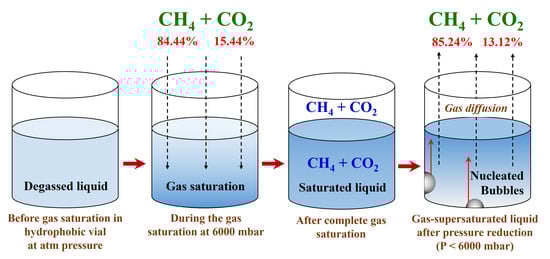
Wettability-Induced Preferential Bubble Nucleation of a Gas from a Two-Gas Dissolved Liquid System



Abstract
1. Introduction
2. Materials and Methods
2.1. Materials
2.2. Wettability Alteration Procedure
2.3. Static Contact Angle and Roughness Measurements
2.4. Bubble Nucleation Experimental Facility
2.5. Procedure to Measure Gas Concentrations in the Absence of Water
2.6. Bubble Nucleation Experiments
3. Results and Discussion
3.1. Static Contact Angle and Surface Roughness Measurements
3.2. Measurement of Gas Concentrations in the Absence of Water
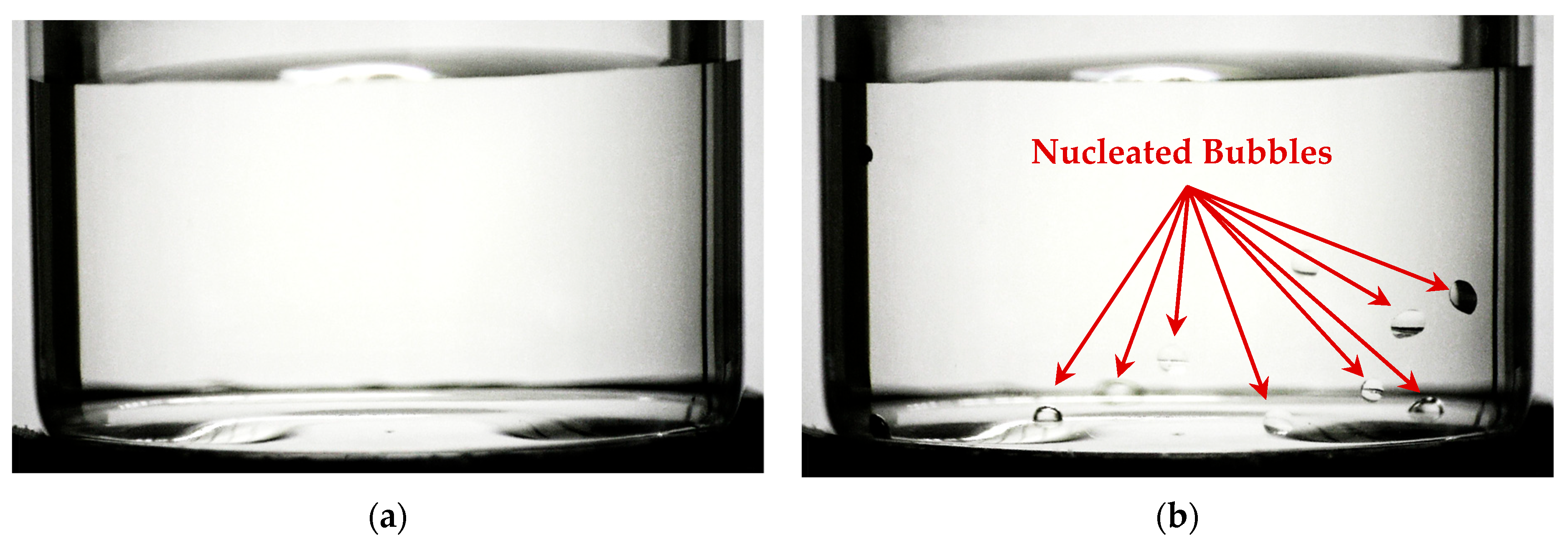
3.3. Bubble Nucleation Experiments
3.3.1. Bubble Nucleation in Hydrophilic Vials (Saturation Pressure: 6000 mbar)
3.3.2. Bubble Nucleation in Hydrophobic Vials (Saturation Pressure: 6000 mbar)
3.3.3. Bubble Nucleation in Hydrophobic Vials (Saturation Pressure: 3000 mbar)
4. Conclusions
Author Contributions
Funding
Data Availability Statement
Acknowledgments
Conflicts of Interest
References
- Stern, S.; Krishnakumar, B.; Charati, S.; Amato, W.; Friedman, A.; Fuess, D. Performance of a bench-scale membrane pilot plant for the upgrading of biogas in a wastewater treatment plant. J. Membr. Sci. 1998, 151, 63–74. [Google Scholar] [CrossRef]
- Favre, E.; Bounaceur, R.; Roizard, D. Biogas, membranes and carbon dioxide capture. J. Membr. Sci. 2009, 328, 11–14. [Google Scholar] [CrossRef]
- Rodenas, T.; Van Dalen, M.; García-Pérez, E.; Serra-Crespo, P.; Zornoza, B.; Kapteijn, F.; Gascon, J. Visualizing MOF mixed matrix membranes at the nanoscale: Towards structure-performance relationships in CO2/CH4 separation over NH2-MIL-53(Al)@PI. Adv. Funct. Mater. 2014, 24, 249–256. [Google Scholar] [CrossRef]
- Scholes, C.A.; Stevens, G.W.; Kentish, S.E. Membrane gas separation applications in natural gas processing. Fuel 2012, 96, 15–28. [Google Scholar] [CrossRef]
- Iulianelli, A.; Drioli, E. Membrane engineering: Latest advancements in gas separation and pre-treatment processes, petrochemical industry and refinery, and future perspectives in emerging applications. Fuel Process. Technol. 2020, 206, 106464. [Google Scholar] [CrossRef]
- Straatman, P.J.; van Sark, W.G. Indirect air CO2 capture and refinement based on OTEC seawater outgassing. iScience 2021, 24, 102754. [Google Scholar] [CrossRef]
- Hsia, C.C.; Hyde, D.M.; Weibel, E.R. Lung structure and the intrinsic challenges of gas exchange. Compr. Physiol. 2016, 6, 827. [Google Scholar] [CrossRef]
- Nuccio, P.; Paonita, A. Magmatic degassing of multicomponent vapors and assessment of magma depth: Application to Vulcano Island (Italy). Earth Planet. Sci. Lett. 2001, 193, 467–481. [Google Scholar] [CrossRef]
- Alqaheem, Y.; Alomair, A.; Vinoba, M.; Pérez, A. Polymeric gas-separation membranes for petroleum refining. Int. J. Polym. Sci. 2017, 2017, 4250927. [Google Scholar] [CrossRef]
- Slansky, C.M. Separation processes for noble gas fission products from the off-gas of fuel-reprocessing plants. Atom. Energy Rev. 1971, 9, 423–440. [Google Scholar]
- Lakzian, E.; Yazdani, S.; Salmani, F.; Mahian, O.; Kim, H.D.; Ghalambaz, M.; Ding, H.; Yang, Y.; Li, B.; Wen, C. Supersonic separation towards sustainable gas removal and carbon capture. Prog. Energy Combust. Sci. 2024, 103, 101158. [Google Scholar] [CrossRef]
- Bae, Y.-S.; Mulfort, K.L.; Frost, H.; Ryan, P.; Punnathanam, S.; Broadbelt, L.J.; Hupp, J.T.; Snurr, R.Q. Separation of CO2 from CH4 using mixed-ligand metal− organic frameworks. Langmuir 2008, 24, 8592–8598. [Google Scholar] [CrossRef]
- Bae, Y.-S.; Farha, O.K.; Spokoyny, A.M.; Mirkin, C.A.; Hupp, J.T.; Snurr, R.Q. Carborane-based metal–organic frameworks as highly selective sorbents for CO2 over methane. Chem. Commun. 2008, 35, 4135–4137. [Google Scholar] [CrossRef]
- Babarao, R.; Jiang, J.; Sandler, S.I. Molecular simulations for adsorptive separation of CO2/CH4 mixture in metal-exposed, catenated, and charged metal−organic frameworks. Langmuir 2009, 25, 5239–5247. [Google Scholar] [CrossRef] [PubMed]
- Karra, J.R.; Walton, K.S. Molecular simulations and experimental studies of CO2, CO, and N2 adsorption in metal−organic frameworks. J. Phys. Chem. C 2010, 114, 15735–15740. [Google Scholar] [CrossRef]
- Rodenas, T.; Luz, I.; Prieto, G.; Seoane, B.; Miro, H.; Corma, A.; Kapteijn, F.; i Xamena, F.X.L.; Gascon, J. Metal–organic framework nanosheets in polymer composite materials for gas separation. Nat. Mater. 2015, 14, 48–55. [Google Scholar] [CrossRef]
- Understanding Global Warming Potentials. 2025. Available online: https://www.epa.gov/ghgemissions/understanding-global-warming-potentials (accessed on 27 February 2025).
- Intergovernmental Panel on Climate Change (IPCC). Climate Change 2007: The Physical Science Basis. Agenda. 2013. Available online: https://www.ipcc.ch/site/assets/uploads/2020/02/ar4-wg1-sum_vol_en.pdf (accessed on 11 November 2025).
- Bernardo, P.; Drioli, E.; Golemme, G. Membrane gas separation: A review/state of the art. Ind. Eng. Chem. Res. 2009, 48, 4638–4663. [Google Scholar] [CrossRef]
- Ali, A.; Pothu, R.; Siyal, S.H.; Phulpoto, S.; Sajjad, M.; Thebo, K.H. Graphene-based membranes for CO2 separation. Mater. Sci. Energy Technol. 2019, 2, 83–88. [Google Scholar] [CrossRef]
- Kusakabe, M. Lakes Nyos and Monoun gas disasters (Cameroon)—Limnic eruptions caused by excessive accumulation of magmatic CO2 in crater lakes. Geochem. Monogr. Ser. 2017, 1, 1–50. [Google Scholar] [CrossRef]
- Vaselli, O.; Tedesco, D.; Cuoco, E.; Tassi, F. Are Limnic Eruptions in the CO2–CH4-Rich Gas Reservoir of Lake Kivu (Democratic Republic of the Congo and Rwanda) Possible? Insights from Physico-Chemical and Isotopic Data. In Volcanic Lakes; Springer: Berlin/Heidelberg, Germany, 2015; pp. 489–505. [Google Scholar]
- Defusing Africa’s Killer Lakes. Available online: https://www.smithsonianmag.com/science-nature/defusing-africas-killer-lakes-88765263/ (accessed on 26 June 2025).
- Kling, G.W.; Evans, W.C.; Tanyileke, G.; Kusakabe, M.; Ohba, T.; Yoshida, Y.; Hell, J.V. Degassing Lakes Nyos and Monoun: Defusing certain disaster. Proc. Natl. Acad. Sci. USA 2005, 102, 14185–14190. [Google Scholar] [CrossRef]
- Kusakabe, M.; Ohba, T.; Yoshida, Y.; Satake, H.; Ohizumi, T.; Evans, W.C.; Tanyileke, G.; Kling, G.W. Evolution of CO2 in Lakes Monoun and Nyos, Cameroon, before and during controlled degassing. Geochem. J. 2008, 42, 93–118. [Google Scholar] [CrossRef]
- Pradhan, S. Influence of Wettability on Dissolved Gas Separation, Nucleate Boiling, and Enhanced Oil Recovery. Ph.D. Dissertation, Oklahoma State University, Stillwater, OK, USA, 2021. [Google Scholar]
- Pradhan, S.; Qader, R.J.; Sedai, B.R.; Bikkina, P.K. Influence of Wettability on Pressure-Driven Bubble Nucleation: A Potential Method for Dissolved Gas Separation. Sep. Purif. Technol. 2019, 217, 31–39. [Google Scholar] [CrossRef]
- Pradhan, S.; Bikkina, P. Influence of step-down pressure on wettability-controlled heterogeneous bubble nucleation of sparingly soluble gases in water. Sep. Purif. Technol. 2024, 328, 125098. [Google Scholar] [CrossRef]
- Pradhan, S.; Bikkina, P.K. An Analytical Method to Estimate Supersaturation in Gas–Liquid Systems as a Function of Pressure-Reduction Step and Waiting Time. Eng 2022, 3, 116–123. [Google Scholar] [CrossRef]
- Pradhan, S.; Bikkina, P.K. Effects of Stepdown Pressure and Wettability on Bubble Nucleation in Gas-Supersaturated Oil-Water Systems. SPE J. 2024, 29, 3337–3347. [Google Scholar] [CrossRef]
- Huhtamäki, T.; Tian, X.; Korhonen, J.T.; Ras, R.H. Surface-wetting characterization using contact-angle measurements. Nat. Protoc. 2018, 13, 1521. [Google Scholar] [CrossRef]
- Marmur, A. A guide to the equilibrium contact angles maze. In Contact Angle Wettability and Adhesion; CRC Press: Boca Raton, FL, USA, 2009; Volume 6. [Google Scholar]
- Pradhan, S.; Counts, S.; Enget, C.; Bikkina, P.K. Effect of wettability on vacuum-driven bubble nucleation. Processes 2022, 10, 1073. [Google Scholar] [CrossRef]
- Bird, R.B.; Stewart, W.E.; Lightfoot, E.N. Transport Phenomena, 2nd ed.; John Wiley & Sons: New York, NY, USA, 2004. [Google Scholar]
- Lucile, F.; Cézac, P.; Contamine, F.; Serin, J.-P.; Houssin, D.; Arpentinier, P. Solubility of carbon dioxide in water and aqueous solution containing sodium hydroxide at temperatures from (293.15 to 393.15) K and pressure up to 5 MPa: Experimental measurements. J. Chem. Eng. Data. 2012, 57, 784–789. [Google Scholar] [CrossRef]
- Lekvam, K.; Bishnoi, P.R. Dissolution of methane in water at low temperatures and intermediate pressures. Fluid Phase Equilib. 1997, 131, 297–309. [Google Scholar] [CrossRef]
- Hemmingsen, E. Supersaturation of gases in water: Absence of cavitation on decompression from high pressures. Science 1970, 167, 1493–1494. [Google Scholar] [CrossRef] [PubMed]
- Hemmingsen, E.A. Cavitation in gas− supersaturated solutions. J. Appl. Phys. 1975, 46, 213–218. [Google Scholar] [CrossRef]
- Hemmingsen, E.A. Spontaneous formation of bubbles in gas-supersaturated water. Nature 1977, 267, 141–142. [Google Scholar] [CrossRef] [PubMed]
- Mahmood, S.; Kwak, H.-Y. Nucleation and growth of nano-sized bubble on hydrophobic surfaces. J. Korean Phys. Soc. 2023, 82, 375–385. [Google Scholar] [CrossRef]
- Lafuma, A.; Quéré, D. Superhydrophobic states. Nat. Mater. 2003, 2, 457–460. [Google Scholar] [CrossRef]
- Grate, J.W.; Dehoff, K.J.; Warner, M.G.; Pittman, J.W.; Wietsma, T.W.; Zhang, C.; Oostrom, M. Correlation of oil–water and air–water contact angles of diverse silanized surfaces and relationship to fluid interfacial tensions. Langmuir 2012, 28, 7182–7188. [Google Scholar] [CrossRef] [PubMed]



| At 6000 mbar Saturation Pressure | |||
|---|---|---|---|
| Initial Gas Concentration | Final Gas Concentration | Onset Nucleation Pressure | |
| vol.% (mol/m3) | vol.% (mol/m3) | mbar | |
| CH4 | 84.6 ± 0.2% (168.0 ± 0.5) | 85.5 ± 0.6% (169.9 ± 1.2) | 4875 ± 231 |
| CO2 | 15.3 ± 0.2% (30.5 ± 0.5) | 13.3 ± 0.5% (26.3 ± 1.1) | |
| At 3000 mbar Saturation Pressure | |||
| Initial Gas Concentration | Final Gas Concentration | Onset Nucleation Pressure | |
| vol.% (mol/m3) | vol.% (mol/m3) | mbar | |
| CH4 | 85.1 ± 0.3% (69.4 ± 0.2) | 86.1 ± 1.2% (70.1 ± 1.0) | 2000 ± 0 |
| CO2 | 14.7 ± 0.1% (12.0 ± 0.1) | 12.0 ± 1.0% (9.8 ± 0.8) | |
Disclaimer/Publisher’s Note: The statements, opinions and data contained in all publications are solely those of the individual author(s) and contributor(s) and not of MDPI and/or the editor(s). MDPI and/or the editor(s) disclaim responsibility for any injury to people or property resulting from any ideas, methods, instructions or products referred to in the content. |
© 2026 by the authors. Licensee MDPI, Basel, Switzerland. This article is an open access article distributed under the terms and conditions of the Creative Commons Attribution (CC BY) license.
Share and Cite
Pradhan, S.; Bikkina, P. Wettability-Induced Preferential Bubble Nucleation of a Gas from a Two-Gas Dissolved Liquid System. Gases 2026, 6, 13. https://doi.org/10.3390/gases6010013
Pradhan S, Bikkina P. Wettability-Induced Preferential Bubble Nucleation of a Gas from a Two-Gas Dissolved Liquid System. Gases. 2026; 6(1):13. https://doi.org/10.3390/gases6010013
Chicago/Turabian StylePradhan, Sushobhan, and Prem Bikkina. 2026. "Wettability-Induced Preferential Bubble Nucleation of a Gas from a Two-Gas Dissolved Liquid System" Gases 6, no. 1: 13. https://doi.org/10.3390/gases6010013
APA StylePradhan, S., & Bikkina, P. (2026). Wettability-Induced Preferential Bubble Nucleation of a Gas from a Two-Gas Dissolved Liquid System. Gases, 6(1), 13. https://doi.org/10.3390/gases6010013