
Article

Personality Functioning, Maladaptive Traits, and Emotion Dysregulation in Severe Psychiatric Inpatients: Associations with Psychological Symptom Domains


by
Marco Lauriola
1,*,
Costanza Falzetti
2,
Francesca Noto
2,
Manuela Tomai
2 and
Andrea Buzzi
2,3
1
Department of Developmental & Socialization Processes, Sapienza University of Rome, 00185 Roma, Italy
2
Department of Dynamic, Clinical and Health Psychology, Sapienza University of Rome, 00185 Roma, Italy
3
“Colle Cesarano” Psychiatric Residential Facility and Care Home, 00019 Tivoli, Italy
*
Author to whom correspondence should be addressed.
Psychiatry Int. 2026, 7(5), 224; https://doi.org/10.3390/psychiatryint7050224
Submission received: 7 July 2026 / Revised: 10 September 2026 / Accepted: 22 September 2026 / Published: 4 October 2026

Abstract

The Hierarchical Taxonomy of Psychopathology (HiTOP) has gained substantial empirical support as a dimensional model for understanding severe psychopathology. However, the integration of the Level of Personality Functioning (LPF) into this framework remains debated, and its specific contribution to understanding psychological symptoms is less extensively studied. This study examined the associations among impairments in personality functioning (self and interpersonal), maladaptive personality traits, alexithymia, and emotion regulation with psychological symptoms in a transdiagnostic sample of severe psychiatric inpatients. Ninety-three patients from a comprehensive mental health facility providing sub-acute care and long-term rehabilitation completed the SCL-27 for symptom assessment, LPFS-BF for personality functioning, PID-5-BF for maladaptive traits, the Toronto Alexithymia Scale and the Cognitive Emotion Regulation Questionnaire for emotion dysregulation. Standard and hierarchical multiple regression analyses were conducted to examine unique incremental associations across symptom domains. Self and interpersonal functioning measures showed strong associations with all symptom scales, while alexithymia was also broadly associated with symptom severity in initial models. After accounting for emotion dysregulation variables, interpersonal functioning remained uniquely associated with dysthymic, social phobia, and mistrust symptoms, while self-functioning associations were no longer evident for vegetative, depressive, and agoraphobic symptoms. These findings demonstrated that core personality functioning impairments accounted for psychiatric symptom expression beyond maladaptive traits alone. The results supported greater integration of personality functioning into dimensional models of psychopathology like HiTOP.

1. Introduction

During the past decade, the Hierarchical Taxonomy of Psychopathology (HiTOP) has gained increasing empirical support as a dimensional model for understanding psychopathology [1,2]. HiTOP posits a general vulnerability factor alongside six broad domains (called spectra), which capture shared characteristics across traditionally distinct mental disorders. Within this framework, psychotic disorders are conceptualized under the Thought Disorder spectrum, characterized by reality distortion, disorganization, diminished emotional expression, and avolition [3]. Maladaptive personality traits, conceptualized as extreme variants of normal dispositions, are also integrated at multiple levels of the HiTOP hierarchy [4]. Accordingly, previous research has linked three of these traits to clinical features of psychosis. Detachment, marked by social withdrawal, disinterest in relationships, and emotional unresponsiveness, has been associated with the negative symptoms of psychosis, such as flat affect and avolition [5,6]. Psychoticism, marked by eccentric or unusual thinking, and Negative Affectivity, characterized by heightened emotional sensitivity and interpersonal difficulties, have been consistently associated with the positive symptoms of psychosis, such as hallucinations, delusions, and perceptual distortions [5,7,8].
These findings provided the theoretical rationale for examining maladaptive personality traits in relation to psychopathological symptoms. However, the present study does not directly assess core psychotic symptoms; rather, the symptoms evaluated in the present study cover broader affective, somatic, and interpersonal distress domains. This broader focus is supported by evidence that maladaptive traits can be elevated and clinically meaningful not only in individuals with psychosis but also across a range of severe mental disorders [9,10]. In addition, it aligns with a core premise of HiTOP, that is, psychopathology is organized along continuous dimensions that cut across diagnostic categories [2,11]. Accordingly, the maladaptive traits examined here can be understood as transdiagnostic personality dispositions that may reach clinically significant levels across multiple forms of mental illness, including mood, personality, and substance use disorders [12,13]. This transdiagnostic perspective is further reflected in the recently proposed HiTOP Psychosis Superspectrum, which encompasses major components of psychoticism/thought disorder and detachment and extends beyond conventional psychotic disorders to include non-psychotic conditions that share genetic, neurobiological, and phenomenological features with schizophrenia-spectrum pathology, such as Schizotypal and Paranoid personality disorders [14].
Studying associations between maladaptive traits and clinical symptoms in a diagnostically heterogeneous population, including individuals with psychosis and other severe conditions, provides an opportunity to test whether trait–outcome relationships identified in previous research [5,7,8] generalize across different forms of mental illness. Such an approach is also consistent with the clinical reality of inpatient settings, where patients commonly present with comorbidity and trait elevations that do not correspond neatly to discrete diagnostic categories. However, examining maladaptive traits alone may not fully capture the severity of personality pathology inherent in psychosis and other severe mental disorders. The Level of Personality Functioning (LPF), introduced in the DSM-5, provides a complementary framework by assessing impairments in self- and interpersonal functioning, including identity coherence, self-direction, empathy, and intimacy, which represent fundamental capacities underlying the organization of psychological experience [15,16]. Thus, whereas maladaptive traits primarily reflect relatively enduring stylistic tendencies that characterize how personality pathology is expressed [17], LPF is thought to capture core impairments in self (identity coherence & self-direction) and interpersonal functioning (empathy & intimacy), thereby indexing the severity of personality pathology rather than its specific stylistic manifestations [18].
Maladaptive traits and LPF are typically correlated and may mutually influence one another; however, they are not identical constructs. This distinction raises an important question regarding the extent to which LPF captures aspects of personality pathology that are not adequately represented by maladaptive traits. Some scholars have argued that LPF deficits are largely subsumed by maladaptive trait dimensions (e.g., Negative Affectivity) and therefore do not provide incremental validity in predicting existing spectra [16], whereas others have contended that LPF may capture a fundamental deficit that transcends single trait elevations or specific trait configurations [15,19,20]. For example, Gruber and colleagues [21] found that individuals with first-episode psychosis exhibited significant personality impairments beyond elevated trait scores.
Emerging research has also examined the role of LPF across transdiagnostic clinical and community populations [22,23,24]. Specifically, greater impairments in self and interpersonal functioning have been associated with psychosocial outcomes [24], internalizing and externalizing symptom dimensions [22], and a broad range of diagnoses and higher-order dimensions of psychopathology [21,23]. Collectively, these findings indicated that LPF may capture psychopathology severity that extends across diagnostic categories. However, the extent to which this association reflects variance that is distinct from maladaptive personality traits remains less clear. Joint analyses have indicated substantial shared variance, while also suggesting that LPF, maladaptive traits, or both may account for unique variance depending on the outcome examined [19,20]. Consequently, it remains unclear whether LPF contributes to the explanation of symptom burden beyond maladaptive personality traits, particularly in diagnostically heterogeneous inpatient populations, where personality dysfunction and symptom complexity may be particularly pronounced.
One potential mechanism through which LPF may contribute to symptom burden involves emotion dysregulation. Impairments in self-direction and identity may compromise the capacity to identify, understand, and regulate emotional experiences, although empirical evidence for this association has largely emerged from research on alexithymia [25]. Specifically, difficulties identifying and labeling internal emotional states may contribute to diffuse psychological distress manifesting as somatic complaints, anxiety, or depressive symptoms [26,27,28]; difficulties processing and communicating emotions may exacerbate interpersonal sensitivity and social withdrawal [29,30]; and impoverished imaginative activity may contribute to thought constriction and disorganized emotional experience [31]. Alternatively, alexithymia and LPF deficits may represent overlapping correlates of a more fundamental disturbance in self and emotional processing, which may in turn contribute to global psychopathology severity across diagnostic categories [22,32].
These emotion dysregulation pathways are transdiagnostic, but may be particularly relevant to symptom expression in conditions characterized by emotional and perceptual disturbances. Although emotional disturbances are well-established in mood disorders, they are increasingly recognized in individuals with psychosis, who typically experience elevated negative affective states (e.g., sadness, fear) and reduced positive affect (e.g., joy, happiness) compared to nonclinical participants [33,34]. Such disturbances may be linked to rigid and maladaptive use of emotion regulation strategies, potentially related to underlying impairments in personality functioning. For instance, emotion suppression has been consistently associated with greater positive symptom severity [35,36], whereas findings on reappraisal remain mixed [37]. Other maladaptive strategies, including rumination and self-blame, have also been associated with psychotic symptoms [37]. Cognitive models suggest that repetitive, rigid thought patterns, like rumination, intensify negative affect and may contribute to the onset and persistence of psychotic experiences [33,38]. Building on this literature, the present study examines these associations across broader dimensions of psychopathology rather than focusing solely on positive symptoms.

The Present Study

In sum, the literature has provided empirical support for the HiTOP hierarchy and demonstrated that broad psychopathology dimensions are associated with functional impairment and impairments in personality functioning [39]. However, the joint contribution of LPF, maladaptive personality traits, alexithymia, and emotion regulation to specific symptom domains remains insufficiently investigated. This gap is clinically and theoretically relevant for understanding the clinical manifestations of severe psychopathology, in which diagnostic boundaries can be blurred and disturbances in self and interpersonal functioning, emotional awareness, and regulation can co-occur across diagnostic groups. For example, recent transdiagnostic evidence has shown that emotion-regulation difficulties, including reduced reappraisal and increased rumination and suppression, are evident across a wide range of psychiatric disorders [40,41]. Furthermore, maladaptive personality traits, emotion dysregulation, and impairments in personality functioning are interrelated, with emotion dysregulation emerging as a potential pathway linking pathological trait domains to broader personality dysfunction [42,43]. Notably, trait-level emotion regulation difficulties may also stem from broader structural deficits in personality functioning, which limit the capacity to recognize, label, and manage emotional experiences [44,45].
Given this theoretical framework, the present study adopted an integrative dimensional approach, simultaneously examining the unique and incremental contributions of LPF, maladaptive traits, alexithymia, and cognitive emotion-regulation strategies to multiple psychological symptom domains in a clinically heterogeneous inpatient sample. In extending previous HiTOP and LPF research, the study aimed to examine not only whether these constructs were associated with clinical symptoms, but also how their overlapping and distinctive contributions relate to symptom variation across a transdiagnostic inpatient population. Two primary hypotheses guided the study. First, greater LPF impairments were predicted to be associated with increased psychological symptom severity, independent of the variance accounted for by maladaptive personality traits. Second, alexithymia and maladaptive cognitive emotion-regulation strategies (e.g., self-blame and rumination) were each expected to predict greater symptom severity, whereas adaptive strategies such as reappraisal were tentatively expected to predict reduced severity, over and above the effects of LPF and maladaptive traits. Given the cross-sectional design, these hypotheses concern associations among the constructs and do not imply mediation or causal relationships.
In addition to the primary hypotheses and given the transdiagnostic nature of the sample and the study’s dimensional approach, several more specific expectations were examined on an exploratory basis. These included whether Detachment and Psychoticism would show the strongest trait-level associations with symptom severity, whether self-functioning deficits would demonstrate more robust links to symptoms relative to interpersonal functioning deficits, and whether specific emotion-regulation strategies would show differential associations across symptom domains.

2. Materials and Methods

2.1. Participants and Procedures

Participants were recruited from a mental health facility near Rome, Italy, offering sub-acute care and psychiatric rehabilitation. From an initial pool of 200 individuals, eligible participants were adults (≥18 years), legally capable of providing informed consent, without intellectual disability, confirmed by clinical evaluation supported by the Kennedy Axis V (K-Axis) and Mini-Mental State Examination (MMSE). One hundred and eight eligible patients were initially identified for inclusion (N = 48 from the Territorial Intensive Psychiatric Treatment unit; N = 60 from the Residential Therapeutic Rehabilitation facility). Fifteen patients (14%) did not complete the assessment protocol due to early discharge or transfer. No significant differences emerged between completers and non-completers regarding age (p = 0.294), gender (p = 0.987), education (p = 0.562), or facility unit (p = 0.060), despite the higher prevalence of non-completers in the inpatient unit compared with the residential facility.
The analyses were completed on a sample of 93 participants (60% male, 40% female), aged 19–77 (M = 43.80, SD = 14.50). As detailed in Table 1, the sample was transdiagnostic: 72% had diagnoses within the psychotic or mood spectra. While mood disorders typically map to the Internalizing spectrum, Bipolar I disorder is provisionally placed within the Psychosis superspectrum in HiTOP [3,46], supporting their inclusion in this analysis alongside psychotic disorders. It is important to note, however, that the placement of mania within the psychosis superspectrum remains provisional and is subject to uncertainty in some analyses [14,46].
Diagnostic information was typically available at admission, having been formulated by referring mental health services. This also applied to first-episode or previously untreated patients, most frequently admitted from the Psychiatric Service for Diagnosis and Care (SPDC). All diagnoses were subsequently evaluated and confirmed by the ward psychiatrist according to ICD-9 criteria and could be revised during hospitalization or at discharge based on further clinical and anamnestic investigation.
Data on illness severity, illness duration, and age at onset were not systematically recorded and were therefore unavailable for use as covariates. Pharmacotherapy was individually tailored and frequently adjusted in the intensive care unit, whereas treatment was generally more stable in the residential rehabilitation setting, including the use of long-acting formulations. Detailed information on medication regimens was not systematically recorded and was therefore not included in the analyses. Prior to each assessment session, the ward psychiatrist evaluated patients’ clinical suitability for assessment as an indicator of clinical stability at the time of evaluation.
Participants completed the study materials in a private room, where the study’s aims and procedures were clearly explained. Written informed consent was obtained after confirming participants’ full comprehension, which was assessed by asking them to paraphrase the study’s general purpose and procedures and respond to basic questions about their rights and participation. For 40 participants with reading difficulties or motor impairments (e.g., tremors due to psychopharmacological treatment), individualized support was provided by the second and third authors of this paper. Assistance was standardized and intentionally limited to reading items aloud verbatim, clarifying lexical or terminological terms only, and recording responses exactly as indicated by the participant. No item interpretation, rephrasing, or suggestive guidance regarding responses was provided to minimize any influence on self-report ratings.
The assessment protocol was conducted in two phases: an initial screening phase (T0), during which personality traits, LPF, and psychological symptoms were assessed, followed by a second phase (T1) assessing habitual emotion regulation strategies, along with additional measures not relevant to the purpose of the current study. The planned interval between the baseline assessment (T0) and the second assessment (T1) was approximately two weeks. In the intensive psychiatric care units, this interval encompassed ongoing clinical, pharmacological, and rehabilitative treatment. The same two-week interval was maintained in the residential rehabilitation setting to standardize assessment procedures across facilities. Accordingly, T0 and T1 should not be interpreted as perfectly simultaneous snapshots of an identical clinical state. The study adhered to national and institutional ethical standards for research involving human participants and was approved by the local ethics committee at the Department of Developmental and Socialization Processes, Sapienza University of Rome (Prot. 0001369, 28 October 2022). All participants provided written informed consent and received no financial compensation for their participation.

2.2. Instruments

2.2.1. Psychological Symptoms

Psychological symptoms were assessed using the Symptom Checklist-27 [47,48], a 27-item self-report measure covering six symptom domains: Depressive, Dysthymic, Vegetative, Agoraphobic, Social Phobia, and Mistrust. Items were rated on a 5-point Likert scale (0–4), with higher scores indicating greater symptom severity. Internal consistency was acceptable to good across subscales (α = 0.70–0.85).

2.2.2. Personality

The Level of Personality Functioning Scale—Brief Form 2.0 [49] is a 12-item self-report scale assessing self- and interpersonal functioning. Responses are given on a 4-point Likert scale, with higher scores indicating greater impairment. Internal consistency was good (α = 0.87 for self-functioning; α = 0.78 for interpersonal functioning).
The Personality Inventory for DSM-5—Brief Form [50] is a 25-item measure assessing five pathological trait domains: Negative Affectivity, Detachment, Antagonism, Disinhibition, and Psychoticism. Items were rated on a 4-point Likert scale. Internal consistency ranged from α = 0.67 to 0.77 across domains, with excellent reliability for the total score (α = 0.90).

2.2.3. Emotion Dysregulation

The Toronto Alexithymia Scale [51] is a 20-item self-report questionnaire measuring difficulties in identifying and describing feelings and externally oriented thinking. Items were rated on a Likert scale, with higher scores indicating greater alexithymia. Internal consistency for the total score was acceptable (α = 0.70).
The Cognitive Emotion Regulation Questionnaire [52] is a 36-item self-report measure assessing nine cognitive strategies used in response to negative events, rated on a 5-point Likert scale. Subscale reliabilities ranged from α = 0.53 to 0.83. Two composite scores were used in analyses: adaptive strategies (Acceptance, Positive Refocusing, Refocus on Planning, Positive Reappraisal, Putting into Perspective) and maladaptive strategies (Self-Blame, Rumination, Catastrophizing, Blaming Others).

2.3. Statistical Analysis

Preliminary inspection revealed sporadic missing data at the item level (less than 5% overall). Little’s MCAR test confirmed that the data were missing completely at random (MCAR), χ2(166) = 167.85, p = 0.445. Accordingly, for each scale, total scores were computed using the mean of the non-missing item responses within that scale. To examine the relations among maladaptive traits, personality functioning, emotion dysregulation, and psychological symptoms, separate multiple regression analyses were conducted for each of the symptom scores. Two regression models were specified. In standard regressions, personality variables predicted symptom scores, including personality functioning scales and maladaptive traits (PID-5 domains), which entered simultaneously as predictors. Next, hierarchical regressions were conducted. Step 1 controlled for potential confounding effects by entering socio-demographic variables: gender (0 = male, 1 = female), educational level (dummy-coded by level completed) and age (continuous). Step 2 introduced alexithymia and composite adaptive and maladaptive emotion regulation strategies as predictors. Step 3 added maladaptive traits and personality functioning scales. The final step allowed us to determine whether personality factors accounted for unique variance in psychological symptoms beyond that explained by socio-demographic variables and emotion dysregulation.
Prior to model interpretation, regression assumptions were evaluated for both the standard and hierarchical regression analyses. To quantify the degree of construct overlap suggested by the correlation matrix (Table 2), we examined the squared correlations r2 among key predictors, representing the proportion of shared variance between pairs. As shown in Table A1. Personality functioning and alexithymia showed some overlap. Self-functioning and Alexithymia shared 52% of their variance, while Interpersonal Functioning and Alexithymia shared 48%. Similarly, Detachment and Alexithymia shared 40% of their variance. The two personality functioning dimensions shared 55% of their variance with each other. The Variance Inflation Factors (VIFs) across regression models ranged from 1.63 to 4.40 (see Table A1). Although these values indicate substantial shared variance, none exceeded the conservative threshold of 5.00, indicating no problematic multicollinearity. Visual inspection of diagnostic plots indicated that the assumption of linearity was adequately satisfied. Several models exhibited heteroscedasticity, and residuals showed some deviations from normality, particularly in the upper tail. Considering this and given the relatively low subjects-per-variable ratio in the hierarchical regression models (SPV < 10:1) [53], statistical inference relied on bootstrap bias-corrected and accelerated (BCa) 95% confidence intervals (5000 resamples) [54,55]. The BCa is a nonparametric approach that provides robust parameter estimation under conditions of non-normality, heteroscedasticity, and limited sample size [56]. However, while bootstrap estimation improves stability and mitigates overfitting risks given the relatively complex models for the available sample size, findings should nonetheless be interpreted cautiously. To further guard against spurious inference, we tracked the stability of regression coefficients by assessing directional consistency across the generated sub-samples. Specifically, regression coefficients were deemed robust only if their BCa confidence intervals excluded zero and their sign-flip rate across bootstrap replications remained strictly below 5%. This dual criterion represents a self-imposed conservative safeguard based on bootstrap-based assessment of coefficient stability [54,55]. A low sign-flip rate indicates that the direction of the association was consistent across resamples, thereby flagging and excluding unstable coefficients for interpretation. This approach limits false-positive conclusions and cautiously retains for interpretation only effects that were not only statistically detectable but also stable across resamples. Analyses were performed in R (version 4.4) using packages car, lmtest, sandwich, boot, pwr, and lm.beta for model estimation, bootstrapped BCa confidence intervals, power assessment, and standardized coefficients.

3. Results

The correlation analysis (Table 2) revealed several notable trends with meaningful effect sizes across psychological symptoms, maladaptive traits, personality functioning, and emotion regulation. Correlations within symptom scales and between personality variables and symptoms were predominantly moderate to large in magnitude, indicating clinically relevant shared variance rather than merely statistically significant associations. Personality functioning measures (both Self Functioning and Interpersonal Functioning) showed strong, large-magnitude correlations (r = 0.47–0.68) with all symptom scales (Vegetative, Depressive, Agoraphobic, Social Phobia, Dysthymic, Mistrust), highlighting the link between core personality dysfunction and symptom severity. In contrast, personality traits showed a more heterogeneous pattern. Negative Affect, Detachment and Disinhibition showed moderate-magnitude correlations (r = 0.37–0.57) across all symptoms. Psychoticism showed moderate correlations with all symptoms except Depressive ones (r = 0.36–0.49). Antagonism showed weaker associations (r = 0.13–0.38), indicating a limited but present influence on certain symptoms. Among emotion regulation measures, Alexithymia was associated with greater use of maladaptive strategies, while it showed little or no meaningful link with adaptive strategies. Somewhat unexpectedly, adaptive and maladaptive strategies were themselves modestly positively correlated, indicating overlapping rather than mutually exclusive coping repertoires.
Alexithymia stood out as a particularly impactful emotion-dysregulation factor, showing moderate-to-strong magnitude associations (r = 0.46–0.62) with all symptom scales, indicating that difficulties in identifying and describing emotions were linked to higher symptom severity across domains. Maladaptive strategies showed small-to-moderate positive correlations with symptoms (r = 0.16–0.35), suggesting that a greater reliance on non-adaptive coping processes exacerbated symptom burden to a lesser extent than Alexithymia. Adaptive strategies were less systematically associated with symptom scales, with small negative associations (r = −0.26 to −0.37) with Depressive, Social Phobia, and Mistrust. These associations were more variable and generally weaker than those observed for alexithymia and maladaptive strategies.
Alexithymia was also robustly associated with personality dysfunction scales and was positively related to all maladaptive traits. A similar pattern emerged for maladaptive strategies, although the coefficients were in the moderate range. In contrast, adaptive strategies showed weak and mostly non-significant associations with alexithymia and several symptom dimensions, whereas maladaptive strategies and alexithymia showed broader and more consistent links with symptoms, highlighting the centrality of difficulties in identifying and expressing emotions and interpersonal functioning in clinical expressions of severe mental disorders.
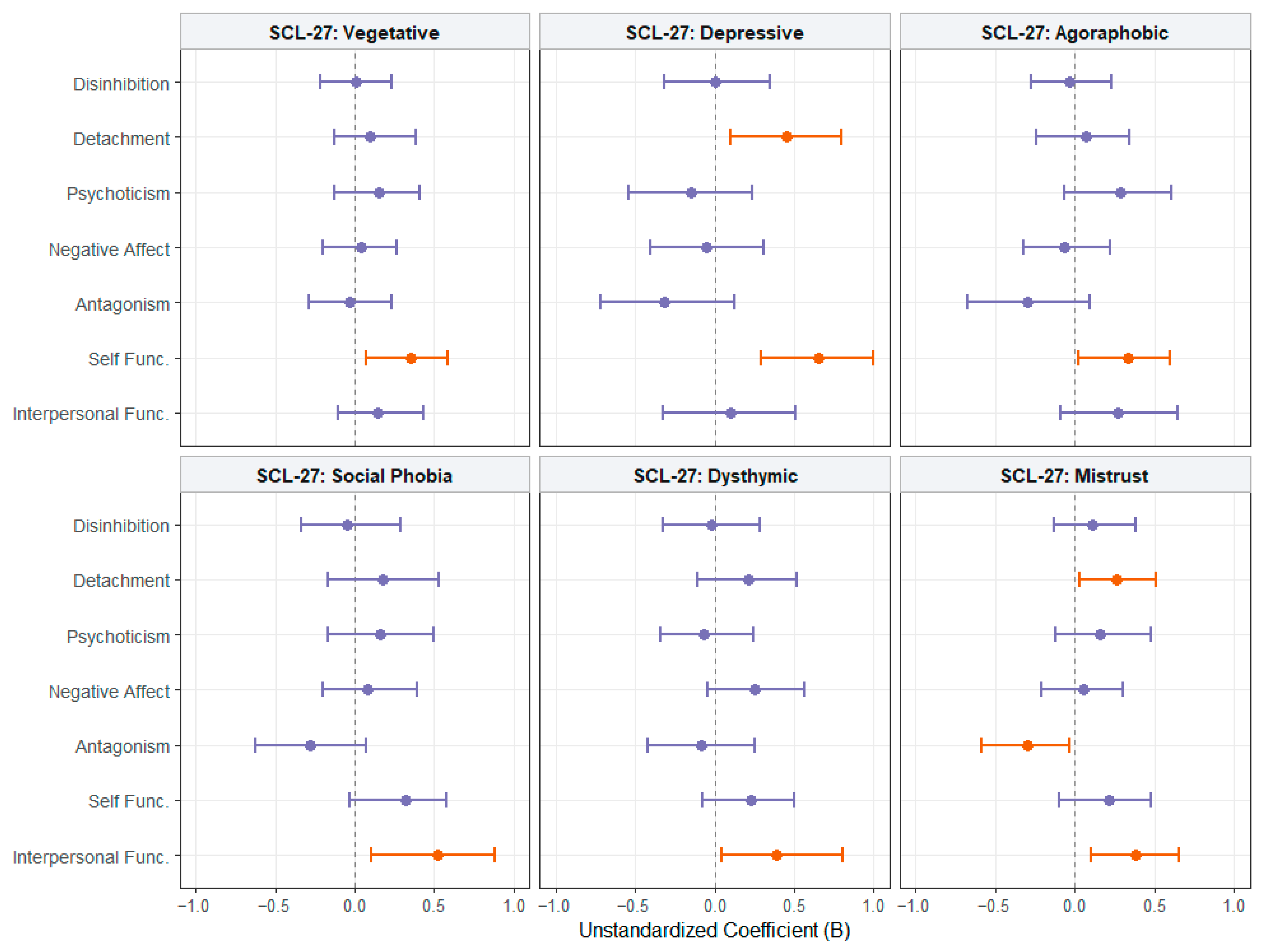
Standard multiple regression models examined the unique associations of personality variables with each symptom domain. Detailed coefficients and significance tests are provided in Table A2 (Appendix B), while key findings are summarized graphically in Figure 1. All models demonstrated clinically substantial explanatory power, with personality traits and functioning accounting for 39% and 57% of the variance across symptom outcomes (Table A2), indicating that personality pathology captured roughly two-fifths to more than half of the variability in clinical presentation. Interpretation prioritized effect magnitude alongside statistical precision.
For Vegetative symptoms (Table A2a), only self-functioning impairment emerged as a reliable predictor, with a moderate-to-large effect size (β = 0.40). In standardized terms, each one-standard-deviation increase in self-functioning impairment was associated with a 0.40-standard-deviation increase in vegetative symptoms, reflecting a substantial difference in somatic symptom burden. Turning to Depressive symptoms (Table A2b), self-functioning impairment showed an even larger effect (β = 0.52), corresponding to just over a half-standard-deviation difference in depressive symptoms, including sadness, loss of interest, and hopelessness. Detachment also showed a moderate association (β = 0.30), indicating that greater detachment was uniquely associated with higher levels of emotional distress beyond self-functioning impairment. In the Agoraphobic symptoms analysis (Table A2c), self-functioning impairment showed a moderate association (β = 0.36), with each one-standard-deviation increase in self-functioning impairment corresponding to an approximately 0.36-standard-deviation increase in agoraphobic symptoms, including fear of leaving home alone and avoidance behaviors. This finding highlights the relevance of self-functioning impairment to individual differences in panic-related avoidance. Notably, no PID traits retained robust unique associations. For Social Phobia and Dysthymic symptoms (Table A2d and Table A2e, respectively), interpersonal functioning impairment emerged as the sole robust predictor. For Social Phobia, it showed a large effect (β = 0.52), indicating a strong unique association between interpersonal functioning impairment and social-evaluative anxiety. In standardized terms, each one-standard-deviation increase in interpersonal impairment was associated with just over a half-standard-deviation increase in social phobia symptoms. For Dysthymic symptoms, the association was moderate (β = 0.30), indicating that greater interpersonal impairment was uniquely associated with higher levels of chronic low energy, demoralization, and diminished vitality. Finally, for Mistrust symptoms (Table A2f), interpersonal functioning impairment showed a moderate association (β = 0.33), indicating that greater interpersonal impairment was uniquely associated with higher levels of suspiciousness and mistrust. Detachment also showed a small-to-moderate positive association (β = 0.21), suggesting that greater social withdrawal and reduced emotional engagement were associated with higher levels of interpersonal suspicion. Antagonism, by contrast, displayed a moderate inverse association (β = −0.22) that contrasted with its corresponding bivariate correlation (Table 2). This discrepancy reflected a statistical suppression effect, whereby the direction or magnitude of an association can change when correlated predictors are considered simultaneously [57]. After partialling out the variance shared with the other predictors (see Appendix A, Table A1), the remaining unique component of Antagonism showed an inverse association with mistrust symptoms. This adjusted partial coefficient should not be interpreted as evidence that antagonism was protective. Rather, the positive bivariate correlation observed in Table 2 remains the appropriate estimate of Antagonism’s total unadjusted relationship with mistrust symptoms, whereas the negative regression coefficient reflected their association after accounting for variance shared with the other predictors.
As illustrated in Figure 1, two clear patterns emerged for personality functioning. First, self-functioning impairment was the most consistent predictor across internalizing-like outcome domains, characterized by physiological arousal/somatization (Vegetative), emotional distress (Depressive), and panic-related avoidance (Agoraphobic). Second, interpersonal functioning impairment was most consistent across interpersonal vulnerability domains characterized by anticipation of negative judgement or rejection (Social Phobia), chronic negative self-evaluation (Dysthymic), relationship difficulties and negative interpretation of others’ intentions (Mistrust). Among PID traits, detachment showed consistent effects only for Depressive and Mistrust domains, when personality functioning was controlled for.
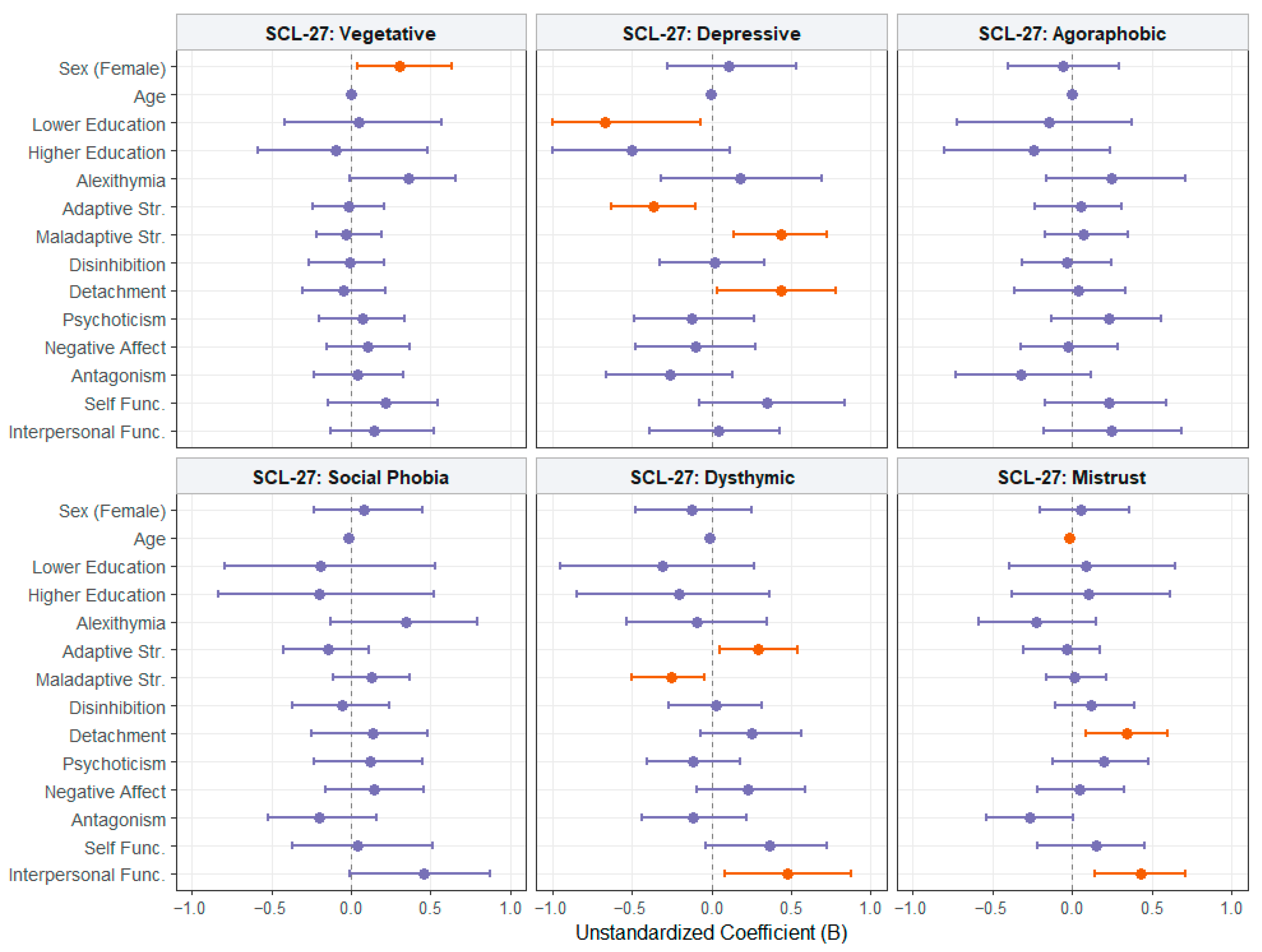
Hierarchical regression analyses were conducted to reassess the robustness of the initial findings and to further examine the interplay of emotion dysregulation and personality variables in predicting different symptom domains. Sociodemographic variables (age, gender, education) were entered at Step 1, emotion dysregulation measures at Step 2, and personality variables at Step 3. The full analyses are publicly available online (see Data Availability Statement), while detailed coefficients and significance tests for Step 3 are reported in Table A3 (Appendix B). The principal findings are summarized graphically in Figure 2.
At Step 1, sociodemographic variables accounted for a relatively modest proportion of variance, ranging from 3.4% (Vegetative) to 16.6% (Mistrust). Female gender showed a small-to-moderate unique association (β = 0.23) with Vegetative symptoms, while younger age showed small-to-moderate effects (β = −0.24 to −0.31) across Depressive, Social Phobia, and Mistrust domains.
Adding emotion dysregulation variables at Step 2 produced large, clinically meaningful gains in explanatory power. ΔR2 ranged from 22% (Dysthymic) to 40% (Social Phobia), indicating that emotion dysregulation accounted for roughly one-fifth to two-fifths of symptom severity independently of demographics. Alexithymia displayed consistently large effects (β = 0.32–0.57) across all six domains, establishing it as a core clinical risk factor for symptom expression. Adaptive and maladaptive strategies showed moderate, domain-specific effects, most notably for Depressive (β = −0.37 and β = 0.38) and Social Phobia symptoms (β = −0.20 and β = 0.19).
Adding personality variables at Step 3 yielded incremental explanatory gains of varying magnitude: substantial for Dysthymic (ΔR2 = 0.27, accounting for more than one-quarter of additional variance) and Mistrust symptoms (ΔR2 = 0.23), moderate yet meaningful for Social Phobia (ΔR2 = 0.10), and negligible for Vegetative, Depressive, and Agoraphobic domains. Examination of coefficients (Figure 2 & Table A3) showed alexithymia’s predictive strength diminished markedly from Step 2 to Step 3, with reductions ranging from 51% (Vegetative symptoms) to near-complete attenuation. Alexithymia, highly significant across all domains at Step 2 (all p < 0.001), lost significance in every model except Vegetative symptoms, where its coefficient fell from β = 0.57 to β = 0.28. For Dysthymic symptoms at Step 3 (Figure 2 & Table A3e), Adaptive and Maladaptive Strategies showed sign inversions relative to their bivariate correlations (Table 2). Again, these are suppression effects arising from partialling shared variance among predictors; they do not imply that maladaptive strategies are beneficial or adaptive strategies harmful. The zero-order correlations provide the appropriate estimate of total unadjusted associations. Antagonism’s inverse trend in the hierarchical Mistrust model (Figure 2 & Table A3f) followed the same suppression logic and should likewise not be interpreted as a protective effect.
To examine the potential role of emotion dysregulation variables in the relationship between personality pathology and psychological symptoms, we compared the regression coefficients from standard regression models with those from hierarchical models (see Table 3). A reduction in the predictive power of personality variables in hierarchical regressions would suggest that emotion dysregulation (and demographics to a lesser extent) could potentially account for the relationship between personality pathology and symptomatology. Conversely, if personality variables remained significant predictors after controlling for emotion dysregulation (and demographics), this would indicate an independent contribution to psychological symptoms.
For Vegetative and Agoraphobic symptoms, the moderate-to-large effects of self-functioning impairment observed in the standard models (β = 0.36–0.40) were substantially attenuated (β = 0.24–0.25) and lost unique predictive value once emotion dysregulation and demographics were entered. This magnitude reduction indicated that these associations were largely explained by shared variance with emotion dysregulation, particularly alexithymia. A similar pattern emerged for Depressive symptoms, where the large effect of self-functioning (β = 0.52) was markedly reduced in magnitude (β = 0.28) and no longer retained unique predictive power in the fully adjusted model. The fact that effect sizes dropped by roughly 30–40% once emotion regulation was accounted for indicated that the clinical impact of poor self-functioning on somatic, panic-related, and depressive presentations was largely mediated through deficits in emotional awareness.
In contrast, for Dysthymic and Mistrust symptoms, interpersonal functioning retained meaningful effect magnitudes and unique predictive power after full adjustment (from β = 0.30–0.33 to β-s = 0.37). The association between interpersonal functioning and Social Phobia symptoms, however, was no longer significant in hierarchical analyses, although it remained at trend level (Figure 2 & Table A3d). Detachment was the only maladaptive trait that maintained moderate, stable effects on both Depressive and Mistrust symptoms across models, suggesting that social withdrawal and anhedonia operated independently of emotion dysregulation variables to influence these presentations.

4. Discussion

The present study examined how impairments in personality functioning, maladaptive personality traits, and emotion dysregulation were related to psychological symptoms in an inpatient psychiatric sample mostly comprising individuals with psychotic disorders, mood disorders, and personality disorders, a diagnostically heterogeneous composition chosen to adopt a transdiagnostic perspective. Although the SCL-27 was not specifically designed for psychotic disorders and does not include validated scales for core positive psychotic symptoms such as hallucinations or formal thought disorder, this instrument allowed us to assess a wide range of symptoms frequently observed in psychosis and other forms of severe psychopathology [48]. For example, the mistrust symptoms directly reflect common features of schizophrenia disorders, such as paranoid ideation and suspiciousness. Depressive, dysthymic, and vegetative symptoms (prevalent during prodromal and post-psychotic phases) mirror mood, cognitive and somatic disturbances typical of psychotic depression and mood disorders with psychotic features, as well as chronic affective disturbances seen in severe personality disorders [58,59]. Lastly, agoraphobic and social phobia symptoms align with the social withdrawal and interpersonal anxiety seen in psychosis, where avoidance driven by persistent anxieties may even reach agoraphobia thresholds [60], and social anxiety frequently co-occurs as a distinct comorbidity in first-episode psychosis [61] as well as in mood and personality disorders characterized by interpersonal sensitivity and avoidance. By focusing on broader phenomenological domains, we prioritized ecological validity over nosographic precision, allowing us to explore cross-cutting processes and patterns of association (e.g., personality functioning deficits) that operate across diagnostic boundaries and which may therefore represent shared maintenance factors relevant to multiple forms of severe psychopathology.
A significant contribution of this study is the demonstration of consistent, robust associations between impairments in personality functioning and psychological symptoms. These findings highlight the potential relevance of personality structure for understanding psychopathology across diagnostic boundaries [62]. In this regard, personality functioning may provide a useful framework for capturing clinically meaningful variation in symptom severity that is not restricted to specific diagnostic categories [63]. This perspective is particularly relevant given that personality functioning has received less empirical attention than maladaptive personality traits in psychosis research. Notably, our results corroborate those of Gruber and colleagues [21], who found that individuals at ultra-high risk for psychosis and those with first-episode psychosis exhibited significant impairments in personality functioning, particularly in self-coherence and relational capacities.
Consistent with previous research, Negative Affectivity, Detachment and Disinhibition emerged as the most pervasive maladaptive traits associated with symptom severity in correlational analyses, spanning affective, interpersonal, and behavioral domains [5,6,7,8]. Rather than being specific to psychosis, these traits may reflect broader transdiagnostic vulnerabilities underlying diverse forms of psychopathology, including emotional instability, social withdrawal, and difficulties with behavioral and emotional regulation [3,46]. Psychoticism also showed moderate associations with overall symptom severity, suggesting a broader relation with perceptual and cognitive disturbances, although specific links with positive psychotic symptoms could not be directly examined in the present study [7,8]. Taken together, these findings are consistent with a dimensional, transdiagnostic perspective in which maladaptive personality traits and impairments in personality functioning may relate to psychopathology across diagnostic categories [2,11,12,13].
Nevertheless, regression analyses revealed that self and interpersonal functioning consistently reduced the unique predictive value of maladaptive traits in explaining symptom severity. On the one hand, these findings suggest that personality functioning was independently associated with symptom expression beyond individual trait dimensions. On the other hand, these results also contribute to the ongoing debate regarding the incremental validity of personality functioning over maladaptive traits [16]. While some argued that LPF largely reflects the generalized elevation of maladaptive traits [64], others proposed that it captures distinct aspects of personality pathology not fully explained by trait models [16,19]. The observed influence of personality functioning in the present study aligns with calls for greater integration of this construct into dimensional models such as HiTOP [16,19].
The study highlights that the impairments in self-functioning were uniquely associated with vegetative and depressive symptoms, whereas deficits in interpersonal functioning were specifically linked to social anxiety and mistrust. Although still preliminary and based on a small-scale study, these findings align with the conceptual definitions of these constructs [15,16]. Self-functioning encompasses an individual’s sense of identity, self-direction, and capacity for self-reflection and emotional regulation [65]. From this perspective, a fragmented identity and deficient self-direction may be associated with chronic dysphoria, reduced motivation, and difficulties in regulating basic physiological states. Conversely, interpersonal functioning pertains to the ability to relate to others, including empathy, intimacy, and the navigation of social interactions [65]. Through this lens, impairments in understanding others’ emotions and sustaining meaningful relationships may be associated with social fears, such as fear of negative evaluation, or with excessive mistrust, in which others are perceived as threatening due to compromised relational capacities.
Previous research has linked emotional disturbances to the rigid and maladaptive use of emotion regulation strategies in psychosis [37]. In our study, specific emotion regulation strategies (adaptive and maladaptive) demonstrated robust, independent associations primarily with depressive and dysthymic symptoms, while their predictive power for other domains was largely overshadowed by alexithymia and personality factors. Notably, alexithymia stood out as a key vulnerability factor, consistently predicting psychological symptoms across all domains at Step 2. However, its influence diminished substantially once personality variables were introduced at Step 3. This marked attenuation may indicate that a substantial portion of alexithymia’s initial predictive variance overlapped with that captured by personality pathology. Conceptually, alexithymia may be viewed as closely tied to, or a manifestation of, core personality dysfunction, such that its initial association with symptoms is largely shared with deeper-seated deficits in self and interpersonal functioning [22,25,32]. Conversely, the partial retention of predictive power for Vegetative symptoms may suggest that alexithymia may relate to symptomatology partly through distinct somatic or bodily-affective pathways that may not be fully captured by personality functioning [27,28].
Although the study’s cross-sectional design limits causal interpretation, some patterns suggest possible explanatory relationships. For depressive symptoms, the fact that alexithymia’s effect was fully accounted for when personality traits were included is consistent with the possibility that the association between alexithymia and depressive symptoms may largely overlap with variance accounted for by Detachment (and self-functioning impairments to a lesser extent). The tendency to withdraw and restrict affect, as well as difficulties in maintaining a stable and integrated sense of self, may be associated with difficulties in recognizing and processing emotions and, in turn, with greater depressive symptomatology [66]. For dysthymic and mistrust symptoms, the attenuation of the alexithymia associations after accounting for personality variables is consistent with substantial overlap with interpersonal functioning, with relational deficits (such as poor empathy and difficulty forming close bonds) emerging as reliable, independent predictors. These findings are consistent with previous research linking alexithymia to difficulties in social adaptation and to greater interpersonal stress and psychological distress [29]. Finally, while its effect was reduced, alexithymia retained a marginal, independent association with vegetative symptoms. Consistent with the somatization hypothesis [27], individuals high in alexithymia may experience greater difficulty understanding and verbalizing emotional distress associated with psychosis, a pattern that has been associated with greater somatic symptom reporting in previous research [27]. We emphasize that these interpretations are based on statistical attenuation and shared variance rather than formal mediation testing.
This study has several limitations that should be acknowledged. First and foremost, the sample size is modest for hierarchical regression analyses with a relatively large number of predictors. In the final step of the hierarchical models, with 14 predictor variables and a sample of N = 93 participants, the subjects-to-predictor variable ratio was approximately 6.6:1. Conservative benchmarks have traditionally recommended minimum ratios of 10:1 to 15:1 to ensure stability of parameter estimates and protect against overfitting [53]. However, the same source demonstrated via simulation that, for linear regression estimated via ordinary least squares, coefficients, standard errors, and confidence intervals remain accurately estimated with as few as 2 subjects per variable, and that bias in coefficient estimation remains minimal even well below the 10:1 threshold [53]. Accordingly, our observed ratio of ~6.6:1 falls above the empirically derived threshold for accurate coefficient estimation, though it remains below the more conservative benchmarks commonly cited in the literature. In addition, at lower SPV ratios, the conventional R2 statistic may be upwardly biased, and generalizability to independent samples is less certain unless prediction performance is externally validated [53]. To mitigate potential instability due to the SPV ratio in hierarchical models, we used a multistep resampling approach for statistical inference [56] and applied a strict dual interpretation criterion, defining robust predictors as those that both attained significance within 95% bootstrap confidence intervals and maintained a sign-flip rate below 5%. Even so, effect size estimates and model R2 should be interpreted with appropriate caution, and the final hierarchical models should ideally be validated in independent samples to confirm their generalizability.
Second, we must acknowledge two related measurement issues. To begin with, the SCL-27 does not specifically assess psychotic symptoms (e.g., hallucinations or formal thought disorders), which are better captured by clinician-ratings like the PANSS or BPRS. However, as a broadband scale, validated for use with psychiatric samples [48], the SCL-27 efficiently captures a wide range of psychopathological dimensions across diagnostic groups, making it well suited for transdiagnostic research. Beyond this, the current study relied exclusively on self-report assessments rather than clinician ratings. In the presence of severe psychopathology (including psychotic-spectrum presentations), impaired clinical insight and compromised self-observation capacity may reduce response reliability and validity, particularly for reflective measures such as the PID-5-BF and LPFS-BF, although self-report measures may be valid for most personality and symptom domains [67]. Importantly, however, assessment was only conducted after the facility psychiatrist confirmed each participant’s clinical and cognitive suitability to complete the protocol. This pre-screening step helped mitigate concerns regarding capacity to provide valid self-report. Future studies should address both issues by using clinician-rated, psychosis-specific measures alongside self-reports or behavioral tasks.
Third, the lack of stratification by diagnostic subtype constitutes an important limitation, as the patterns observed may not be uniform across the psychotic, mood, and personality disorders represented in our sample. For instance, the association between interpersonal functioning deficits and mistrust symptoms may be stronger in schizophrenia-spectrum disorders, where paranoid ideation is central. Conversely, self-functioning impairment may show particularly strong links to depressive symptoms in mood disorders and certain personality disorders, in which identity diffusion and chronic dysphoria feature prominently. We acknowledge that formal diagnostic stratification would be required to identify such disorder-specific nuances and to determine whether the differential associations between self- versus interpersonal functioning and symptom domains hold consistently across conditions. Nevertheless, this limitation is partly offset by the conceptual and clinical value of adopting a transdiagnostic perspective. By analyzing these patients collectively, we were able to identify generalized regulatory and personality processes that cut across traditional diagnostic boundaries. This approach is consistent with calls for dimensional models of psychopathology that prioritize functional impairment over categorical labels, and it mirrors real-world clinical practice where comorbidity is the rule rather than the exception. While these transdiagnostic findings require replication in larger and more varied clinical cohorts, and their generalizability to specific diagnostic subgroups remains to be formally tested, this study provides substantive new insights into the core roles of personality dysfunction and emotion dysregulation across the spectrum of severe psychopathology.
Last, the cross-sectional design limits causal inferences about the relationships between personality functioning, maladaptive traits, emotion regulation, and symptoms. While our findings revealed possible key associations, longitudinal and experimental studies are needed to clarify the causal pathways. Nonetheless, cross-sectional research remains useful for identifying patterns among understudied variables in clinical populations.

5. Conclusions

In routine clinical practice, psychological interventions are often primarily oriented toward the acute reduction in psychological symptoms, such as alleviating anxiety, depressive mood disturbances, or formal thought and perceptual abnormalities. The present findings suggest that, alongside symptom-focused strategies, person-centered care and support planning, as well as individualized treatment plans, may benefit from a systematic focus on improving personality functioning as a higher-order target of intervention, with important distinctions to be drawn between impairments in self-functioning versus interpersonal functioning.
A further clinical implication concerns the need to align specific domains of personality functioning with distinct symptom profiles. For instance, in the treatment of social anxiety, paranoid ideation, and dysthymic symptomatology, our findings generate the hypothesis that interventions targeting strengthening interpersonal functioning could be beneficial. Such approaches could involve enhancing the capacity to understand and reflect upon others’ mental states, increasing tolerance for alternative perspectives, and fostering more flexible interpretations of social cues, helping patients to perceive others not as inherently threatening but as complex agents with diverse intentions and viewpoints. In addition to social skills training and rehabilitative interventions commonly delivered in residential or community settings, mentalization-based approaches could be a promising candidate for future investigation for symptoms primarily maintained by deficits in interpersonal functioning, given that they directly target the relational capacities that our data linked to these symptom domains.
Conversely, for symptom presentations characterized by depressive affectivity, autonomic disturbances, and agoraphobic avoidance, therapeutic work could potentially target self-functioning. This could include strengthening identity coherence, reinforcing self-direction, and supporting the reconstruction of stable internal boundaries, so that patients may develop a more enduring sense of who they are and greater agency over their own lives, alongside the enhancement of adaptive emotion regulation strategies. Within this framework, interventions aimed at improving adaptive emotion regulation strategies and reducing reliance on maladaptive ones represent another promising avenue for future research, as our data linked emotional dysregulation specifically to depressive and dysthymic symptom presentations.
Finally, the role of alexithymia as a potential bridging construct between personality functioning and symptom expression underscores the clinical importance of targeting basic emotional awareness processes as a testable therapeutic hypothesis. Helping patients with severe mental disorders to identify, label, and verbally articulate internal emotional states is proposed here as a potential propaedeutic therapeutic step worthy of empirical evaluation. Reducing alexithymia features could, if this hypothesis is supported, facilitate subsequent engagement in more structured psychotherapeutic and rehabilitative interventions, thereby improving overall treatment responsiveness across clinical presentations.
We emphasize that these proposed clinical directions are derived from cross-sectional correlational data and should be regarded as hypotheses to be tested in prospective, longitudinal, and intervention research rather than as treatment guidelines.

Author Contributions

Conceptualization, M.L. and A.B.; methodology, M.L.; validation, F.N. and C.F.; formal analysis, F.N., C.F. and M.L.; resources, A.B.; data curation, F.N., C.F. and M.L.; writing—original draft preparation, F.N., C.F. and M.L.; writing—review and editing, F.N., C.F. and M.L.; supervision, M.T.; project administration, M.L.; funding acquisition, M.L. All authors have read and agreed to the published version of the manuscript.

Funding

This research was funded by SAPIENZA University of Rome, grant number RP1221816147D5DF.

Institutional Review Board Statement

The study was conducted in accordance with the Declaration of Helsinki and approved by the Ethics Committee of the Department of Developmental and Socialization Processes, Sapienza University of Rome (protocol code 0001369 and date of approval 28 October 2022).

Informed Consent Statement

Informed consent was obtained from all subjects involved in the study.

Data Availability Statement

The data presented in this study are openly available in [OSF] at [https://osf.io/z56yg/overview?view_only=725bfbf11851472ea2918b6c0033ba44], accessed on 7 July 2026.

Acknowledgments

The authors would like to thank Giovanna Raimondo and Daniela Ruggiero, for their valuable support in facilitating data collection. We are also grateful to Simone Serratore, for his assistance and collaboration throughout the research process. Special thanks go to Silvia Fabiani, for her contribution during the initial phase of data collection.

Conflicts of Interest

Author Andrea Buzzi was employed by “Colle Cesarano” Psychiatric Residential Facility and Care Home, Tivoli, Rome, Italy, during the period of data collection, but was no longer employed by the facility at the time of manuscript submission. The remaining authors declare that the research was conducted in the absence of any commercial or financial relationships that could be construed as a potential conflict of interest.

Appendix A

Table A1. Shared Variance Among Key Constructs.
VariableVIF123456789
1. Alexithymia3.06—
2. Adaptive Str.1.630.02—
3. Maladaptive Str.1.650.120.08—
4. Disinhibition2.080.280.010.08—
5. Detachment2.680.400.040.060.25—
6. Psychoticism2.550.280.000.060.350.22—
7. Negative Affect2.450.210.030.090.240.360.27—
8. Antagonism2.200.140.000.070.220.230.410.20—
9. Self Func.4.400.520.060.190.380.440.250.440.18—
10. Interpersonal Func.3.930.480.050.110.250.480.340.460.310.55
Note. Values = squared correlations (r2), representing the proportion of shared variance between each pair of predictors. Legend. Str. = Strategies; Func. = Functioning.

Appendix B

Table A2. Standard multiple regression analyses predicting specific symptom domains from maladaptive personality traits and personality functioning.
(a) Vegetative Symptoms (R2 = 0.48)
PredictorB (Beta)tp95% CI bootstrap BCaSign flip %
Disinhibition0.01 (0.01)0.100.924[−0.21, 0.24]44.4%
Detachment0.10 (0.09)0.780.440[−0.13, 0.38]24.7%
Psychoticism0.15 (0.15)1.310.194[−0.12, 0.41]15.7%
Negative Affect0.04 (0.04)0.310.758[−0.20, 0.26]33.9%
Antagonism−0.03 (−0.03)−0.240.809[−0.29, 0.23]43.7%
Self Func.0.36 (0.40)2.93 **0.004[0.07, 0.58]0.6%
Interpersonal Func.0.14 (0.14)0.960.339[−0.11, 0.43]15.4%
(b) Depressive Symptoms (R2 = 0.46)
PredictorB (Beta)tp95% CI bootstrap BCaSign flip %
Disinhibition0.00 (0.00)0.020.982[−0.32, 0.35]48.6%
Detachment0.45 (0.30)2.51 *0.014[0.10, 0.80]0.5%
Psychoticism−0.15 (−0.11)−0.910.368[−0.54, 0.24]19.9%
Negative Affect−0.05 (−0.03)−0.280.778[−0.40, 0.31]42.9%
Antagonism−0.32 (−0.19)−1.69 †0.094[−0.72, 0.13]8.3%
Self Func.0.65 (0.52)3.73 ***<0.001[0.29, 1.01]0.1%
Interpersonal Func.0.10 (0.07)0.480.630[−0.33, 0.51]28.9%
(c) Agoraphobic Symptoms (R2 = 0.39)
PredictorB (Beta)tp95% CI bootstrap BCaSign flip %
Disinhibition−0.03 (−0.03)−0.240.814[−0.27, 0.23]41.0%
Detachment0.07 (0.06)0.500.619[−0.24, 0.35]30.4%
Psychoticism0.28 (0.27)2.11 *0.038[−0.07, 0.60]6.5%
Negative Affect−0.06 (−0.06)−0.450.652[−0.32, 0.22]34.0%
Antagonism−0.29 (−0.23)−1.95 †0.054[−0.68, 0.09]8.2%
Self Func.0.34 (0.36)2.40 *0.018[0.03, 0.60]1.9%
Interpersonal Func.0.27 (0.24)1.580.117[−0.09, 0.65]7.6%
(d) Social Phobia Symptoms (R2 = 0.53)
PredictorB (Beta)tp95% CI bootstrap BCaSign flip %
Disinhibition−0.05 (−0.03)−0.300.762[−0.34, 0.29]38.3%
Detachment0.18 (0.13)1.160.251[−0.17, 0.53]15.7%
Psychoticism0.16 (0.12)1.100.276[−0.17, 0.50]19.6%
Negative Affect0.08 (0.06)0.550.583[−0.20, 0.39]27.2%
Antagonism−0.28 (−0.18)−1.75 †0.084[−0.63, 0.08]7.9%
Self Func.0.32 (0.27)2.11 *0.038[−0.03, 0.58]2.8%
Interpersonal Func.0.52 (0.39)2.88 **0.005[0.10, 0.88]0.6%
(e) Dysthymic Symptoms (R2 = 0.47)
PredictorB (Beta)tp95% CI bootstrap BCaSign flip %
Disinhibition−0.02 (−0.02)−0.160.874[−0.33, 0.29]45.2%
Detachment0.21 (0.16)1.340.184[−0.11, 0.52]9.2%
Psychoticism−0.07 (−0.06)−0.470.641[−0.34, 0.25]29.7%
Negative Affect0.25 (0.20)1.68 †0.097[−0.04, 0.57]5.4%
Antagonism−0.08 (−0.06)−0.510.614[−0.42, 0.25]31.7%
Self Func.0.23 (0.21)1.500.138[−0.08, 0.50]6.9%
Interpersonal Func.0.39 (0.30)2.10 *0.039[0.04, 0.80]1.8%
(f) Mistrust Symptoms (R2 = 0.57)
PredictorB (Beta)tp95% CI bootstrap BCaSign flip %
Disinhibition0.11 (0.09)0.910.366[−0.13, 0.38]15.1%
Detachment0.26 (0.21)2.01 *0.047[0.03, 0.51]1.3%
Psychoticism0.16 (0.14)1.330.186[−0.12, 0.48]19.5%
Negative Affect0.05 (0.05)0.440.663[−0.21, 0.30]29.5%
Antagonism−0.30 (−0.22)−2.21 *0.030[−0.59, −0.04]3.3%
Self Func.0.22 (0.21)1.71 †0.092[−0.10, 0.48]9.5%
Interpersonal Func.0.38 (0.33)2.50 *0.014[0.10, 0.66]0.6%
Note. † p < 0.10. * p < 0.05. ** p < 0.01. *** p < 0.001. Predictors shown in bold were significant according to the bootstrap analysis and exhibited a sign-flip rate below 5%. Legend. Str. = Strategies; Func. = Functioning.
Table A3. Hierarchical multiple regression analyses predicting specific symptom domains from maladaptive personality traits and personality functioning.
(a) Vegetative Symptoms (R2 = 0.48)
PredictorB (Beta)tp95% CI bootstrap BCaSign flip %
Sex (Female)0.31 (0.18)2.15 *0.035[0.04, 0.64]2.2%
Age−0.00 (−0.01)−0.140.889[−0.01, 0.01]47.0%
Lower Education0.05 (0.03)0.210.833[−0.42, 0.57]45.8%
Higher Education−0.09 (−0.06)−0.420.678[−0.59, 0.48]34.8%
Alexithymia0.36 (0.28)2.08 *0.041[−0.00, 0.66]2.2%
Adaptive Str.−0.02 (−0.02)−0.150.878[−0.24, 0.21]46.5%
Maladaptive Str.−0.03 (−0.03)−0.320.749[−0.22, 0.19]36.2%
Disinhibition−0.01 (−0.01)−0.070.941[−0.26, 0.21]50.8%
Detachment−0.04 (−0.04)−0.330.741[−0.30, 0.22]37.5%
Psychoticism0.07 (0.07)0.580.564[−0.20, 0.33]32.5%
Negative Affect0.10 (0.10)0.820.414[−0.15, 0.37]19.2%
Antagonism0.04 (0.04)0.300.761[−0.23, 0.33]36.8%
Self Func.0.21 (0.24)1.490.141[−0.15, 0.54]11.7%
Interpersonal Func.0.14 (0.14)0.900.369[−0.13, 0.52]20.2%
(b) Depressive Symptoms (R2 = 0.46)
PredictorB (Beta)tp95% CI bootstrap BCaSign flip %
Sex (Female)0.11 (0.05)0.560.577[−0.27, 0.53]33.1%
Age−0.00 (−0.05)−0.550.584[−0.02, 0.01]31.9%
Lower Education−0.67 (−0.29)−2.22 *0.030[−1.25, −0.07]1.1%
Higher Education−0.50 (−0.22)−1.650.103[−1.09, 0.12]4.3%
Alexithymia0.18 (0.10)0.750.456[−0.32, 0.69]23.6%
Adaptive Str.−0.36 (−0.25)−2.62 *0.010[−0.63, −0.10]0.4%
Maladaptive Str.0.44 (0.31)3.23 **0.002[0.14, 0.72]0.3%
Disinhibition0.02 (0.01)0.110.912[−0.33, 0.33]43.3%
Detachment0.44 (0.29)2.40 *0.019[0.04, 0.78]1.6%
Psychoticism−0.13 (−0.09)−0.760.447[−0.49, 0.27]23.6%
Negative Affect−0.10 (−0.07)−0.620.538[−0.48, 0.28]31.3%
Antagonism−0.26 (−0.16)−1.420.160[−0.66, 0.13]10.1%
Self Func.0.35 (0.28)1.78 †0.079[−0.08, 0.84]7.6%
Interpersonal Func.0.04 (0.03)0.190.847[−0.39, 0.43]39.7%
(c) Agoraphobic Symptoms (R2 = 0.39)
PredictorB (Beta)tp95% CI bootstrap BCaSign flip %
Sex (Female)−0.06 (−0.03)−0.360.718[−0.40, 0.30]35.5%
Age−0.00 (−0.05)−0.560.576[−0.02, 0.01]32.1%
Lower Education−0.15 (−0.08)−0.560.579[−0.72, 0.38]27.6%
Higher Education−0.24 (−0.14)−0.890.376[−0.81, 0.24]17.3%
Alexithymia0.25 (0.18)1.190.238[−0.16, 0.71]13.4%
Adaptive Str.0.06 (0.05)0.450.651[−0.24, 0.31]31.8%
Maladaptive Str.0.07 (0.07)0.610.546[−0.17, 0.35]30.2%
Disinhibition−0.03 (−0.03)−0.230.820[−0.31, 0.24]44.7%
Detachment0.04 (0.04)0.250.805[−0.36, 0.33]37.3%
Psychoticism0.23 (0.22)1.580.117[−0.13, 0.56]12.3%
Negative Affect−0.02 (−0.02)−0.160.874[−0.33, 0.29]44.3%
Antagonism−0.32 (−0.25)−1.95 †0.055[−0.73, 0.12]7.7%
Self Func.0.23 (0.25)1.370.175[−0.17, 0.59]13.3%
Interpersonal Func.0.24 (0.22)1.290.200[−0.18, 0.69]13.4%
(d) Social Phobia Symptoms (R2 = 0.53)
PredictorB (Beta)tp95% CI bootstrap BCaSign flip %
Sex (Female)0.08 (0.04)0.480.631[−0.23, 0.45]33.2%
Age−0.01 (−0.18)−2.25 *0.027[−0.03, 0.00]2.7%
Lower Education−0.19 (−0.09)−0.690.490[−0.79, 0.53]24.5%
Higher Education−0.20 (−0.09)−0.730.465[−0.84, 0.52]24.4%
Alexithymia0.35 (0.21)1.640.106[−0.12, 0.79]7.2%
Adaptive Str.−0.14 (−0.10)−1.140.257[−0.43, 0.11]17.0%
Maladaptive Str.0.13 (0.10)1.040.299[−0.11, 0.37]15.8%
Disinhibition−0.06 (−0.04)−0.410.686[−0.37, 0.24]35.4%
Detachment0.14 (0.10)0.840.402[−0.25, 0.48]22.4%
Psychoticism0.12 (0.09)0.800.426[−0.23, 0.45]25.3%
Negative Affect0.14 (0.11)0.940.350[−0.16, 0.46]17.7%
Antagonism−0.20 (−0.13)−1.180.240[−0.52, 0.16]13.3%
Self Func.0.04 (0.04)0.250.804[−0.37, 0.51]42.0%
Interpersonal Func.0.45 (0.34)2.36 *0.021[−0.01, 0.88]2.3%
(e) Dysthymic Symptoms (R2 = 0.47)
PredictorB (Beta)tp95% CI bootstrap BCaSign flip %
Sex (Female)−0.13 (−0.06)−0.710.477[−0.48, 0.25]22.1%
Age−0.01 (−0.13)−1.490.140[−0.02, 0.00]9.0%
Lower Education−0.31 (−0.15)−1.110.272[−0.95, 0.27]14.4%
Higher Education−0.21 (−0.10)−0.740.460[−0.85, 0.37]23.0%
Alexithymia−0.09 (−0.06)−0.430.671[−0.54, 0.35]37.6%
Adaptive Str.0.29 (0.23)2.27 *0.026[0.05, 0.54]1.4%
Maladaptive Str.−0.26 (−0.20)−2.05 *0.044[−0.50, −0.04]1.5%
Disinhibition0.03 (0.02)0.170.866[−0.27, 0.32]39.1%
Detachment0.25 (0.19)1.510.134[−0.07, 0.56]5.6%
Psychoticism−0.12 (−0.10)−0.790.431[−0.40, 0.18]18.9%
Negative Affect0.23 (0.18)1.450.151[−0.09, 0.59]9.1%
Antagonism−0.11 (−0.08)−0.670.506[−0.43, 0.22]23.4%
Self Func.0.36 (0.33)2.01 *0.048[−0.03, 0.72]4.4%
Interpersonal Func.0.47 (0.37)2.39 *0.019[0.08, 0.88]1.0%
(f) Mistrust Symptoms (R2 = 0.57)
PredictorB (Beta)tp95% CI bootstrap BCaSign flip %
Sex (Female)0.05 (0.03)0.370.713[−0.20, 0.36]37.7%
Age−0.01 (−0.22)−2.83 **0.006[−0.02, −0.00]0.7%
Lower Education0.08 (0.04)0.370.715[−0.40, 0.65]41.2%
Higher Education0.10 (0.06)0.440.660[−0.38, 0.61]36.9%
Alexithymia−0.23 (−0.16)−1.270.207[−0.59, 0.15]10.3%
Adaptive Str.−0.04 (−0.03)−0.330.739[−0.31, 0.17]43.1%
Maladaptive Str.0.01 (0.01)0.130.895[−0.16, 0.21]48.4%
Disinhibition0.12 (0.10)0.960.342[−0.11, 0.39]14.3%
Detachment0.34 (0.28)2.48 *0.015[0.09, 0.60]0.5%
Psychoticism0.20 (0.18)1.600.113[−0.12, 0.48]12.3%
Negative Affect0.04 (0.04)0.340.733[−0.21, 0.32]35.6%
Antagonism−0.27 (−0.20)−1.90 †0.061[−0.54, 0.00]3.8%
Self Func.0.15 (0.15)1.040.300[−0.22, 0.45]17.8%
Interpersonal Func.0.43 (0.37)2.67 **0.009[0.14, 0.71]0.3%
Note. † p < 0.10. * p < 0.05. ** p < 0.01. Predictors shown in bold were significant according to the bootstrap analysis and exhibited a sign-flip rate below 5%. The results in the table refer to Step 3. The shaded area represents the contribution of personality variables after controlling for demographics (Step 1) and emotion dysregulation variables (Step 2). Legend. Str. = Strategies; Func. = Functioning.

References

  1. Ringwald, W.R.; Forbes, M.K.; Wright, A.G.C. Meta-Analysis of Structural Evidence for the Hierarchical Taxonomy of Psychopathology (HiTOP) Model. Psychol. Med. 2023, 53, 533–546. [Google Scholar] [CrossRef] [Scilit] [PubMed]
  2. Kotov, R.; Krueger, R.F.; Watson, D. A Paradigm Shift in Psychiatric Classification: The Hierarchical Taxonomy Of Psychopathology (HiTOP). World Psychiatry 2018, 17, 24–25. [Google Scholar] [CrossRef] [Scilit] [PubMed]
  3. Martin, E.A.; Jonas, K.G.; Lian, W.; Foti, D.; Donaldson, K.R.; Bromet, E.J.; Kotov, R. Predicting Long-Term Outcomes in First-Admission Psychosis: Does the Hierarchical Taxonomy of Psychopathology Aid DSM in Prognostication? Schizophr. Bull. 2021, 47, 1331–1341. [Google Scholar] [CrossRef] [Scilit] [PubMed]
  4. Sellbom, M.; Carragher, N.; Sunderland, M.; Calear, A.L.; Batterham, P.J. The Role of Maladaptive Personality Domains across Multiple Levels of the HiTOP Structure. Personal. Ment. Health 2020, 14, 30–50. [Google Scholar] [CrossRef] [Scilit] [PubMed]
  5. Miralles, C.; Alonso, Y.; Algora, M.J.; López-Sánchez, L.; Sánchez-Gistau, V.; Vilella, E.; Baillès, E.; Gutiérrez-Zotes, A.; Martorell, L. Maladaptive Personality Traits in Patients with Recent-Onset Psychosis: A Case-Control Study Using the Personality Inventory for the DSM-5 (PID-5). Schizophr. Res. 2023, 252, 216–224. [Google Scholar] [CrossRef] [Scilit] [PubMed]
  6. Meliante, M.; Rossi, C.; Malvini, L.; Niccoli, C.; Oasi, O.; Barbera, S.; Percudani, M. The Relationship between PID-5 Personality Traits and Mental States. A Study on a Group of Young Adults at Risk of Psychotic Onset. Medicina 2021, 57, 33. [Google Scholar] [CrossRef] [Scilit] [PubMed]
  7. Bastiaens, T.; Smits, D.; De Hert, M.; Thys, E.; Bryon, H.; Sweers, K.; Teugels, T.; Van Looy, J.; Verwerft, T.; Vanwalleghem, D.; et al. The Relationship Between the Personality Inventory for the DSM-5 (PID-5) and the Psychotic Disorder in a Clinical Sample. Assessment 2019, 26, 315–323. [Google Scholar] [CrossRef] [Scilit] [PubMed]
  8. Longenecker, J.M.; Krueger, R.F.; Sponheim, S.R. Personality Traits across the Psychosis Spectrum: A Hierarchical Taxonomy of Psychopathology Conceptualization of Clinical Symptomatology. Personal. Ment. Health 2020, 14, 88–105. [Google Scholar] [CrossRef] [Scilit] [PubMed]
  9. Christopher Fowler, J.; Sharp, C.; Kalpakci, A.; Madan, A.; Clapp, J.; Allen, J.G.; Christopher Frueh, B.; Oldham, J.M. A Dimensional Approach to Assessing Personality Functioning: Examining Personality Trait Domains Utilizing DSM-IV Personality Disorder Criteria. Compr. Psychiatry 2015, 56, 75–84. [Google Scholar] [CrossRef] [Scilit] [PubMed]
  10. Lugo, V.; de Oliveira, S.E.S.; Hessel, C.R.; Monteiro, R.T.; Pasche, N.L.; Pavan, G.; Motta, L.S.; Pacheco, M.A.; Spanemberg, L. Evaluation of DSM-5 and ICD-11 Personality Traits Using the Personality Inventory for DSM-5 (PID-5) in a Brazilian Sample of Psychiatric Inpatients. Personal. Ment. Health 2019, 13, 24–39. [Google Scholar] [CrossRef] [Scilit] [PubMed]
  11. Kotov, R.; Krueger, R.F.; Watson, D.; Achenbach, T.M.; Althoff, R.R.; Bagby, R.M.; Brown, T.A.; Carpenter, W.T.; Caspi, A.; Clark, L.A.; et al. The Hierarchical Taxonomy of Psychopathology (HiTOP): A Dimensional Alternative to Traditional Nosologies. J. Abnorm. Psychol. 2017, 126, 454–477. [Google Scholar] [CrossRef] [Scilit] [PubMed]
  12. Heath, L.M.; Drvaric, L.; Hendershot, C.S.; Quilty, L.C.; Bagby, R.M. Normative and Maladaptive Personality Trait Models of Mood, Psychotic, and Substance Use Disorders. J. Psychopathol. Behav. Assess. 2018, 40, 606–613, Erratum in J. Psychopathol. Behav. Assess. 2018, 40, 614. https://doi.org/10.1007/s10862-018-9693-3. [Google Scholar] [CrossRef] [Scilit] [PubMed]
  13. Henriques-Calado, J.; Pires, R.; Paulino, M.; Gama Marques, J.; Gonçalves, B. Psychotic Spectrum Features in Borderline and Bipolar Disorders within the Scope of the DSM-5 Section III Personality Traits: A Case Control Study. Borderline Personal. Disord. Emot. Dysregul. 2023, 10, 2. [Google Scholar] [CrossRef] [Scilit] [PubMed]
  14. Jonas, K.G.; Cannon, T.D.; Docherty, A.R.; Dwyer, D.; Gur, R.C.; Gur, R.E.; Nelson, B.; Reininghaus, U.; Kotov, R. Psychosis Superspectrum I: Nosology, Etiology, and Lifespan Development. Mol. Psychiatry 2024, 29, 1005–1019. [Google Scholar] [CrossRef] [Scilit] [PubMed]
  15. Sharp, C.; Wall, K. DSM-5 Level of Personality Functioning: Refocusing Personality Disorder on What It Means to Be Human. Annu. Rev. Clin. Psychol. 2021, 17, 313–337. [Google Scholar] [CrossRef] [Scilit] [PubMed]
  16. Widiger, T.A.; Bach, B.; Chmielewski, M.; Clark, L.A.; DeYoung, C.; Hopwood, C.J.; Kotov, R.; Krueger, R.F.; Miller, J.D.; Morey, L.C.; et al. Criterion A of the AMPD in HiTOP. J. Pers. Assess. 2019, 101, 345–355. [Google Scholar] [CrossRef] [Scilit] [PubMed]
  17. Krueger, R.F.; Hobbs, K.A. An Overview of the DSM-5 Alternative Model of Personality Disorders. Psychopathology 2020, 53, 126–132. [Google Scholar] [CrossRef] [Scilit] [PubMed]
  18. Bender, D.S.; Morey, L.C.; Skodol, A.E. Toward a Model for Assessing Level of Personality Functioning in DSM–5, Part I: A Review of Theory and Methods. J. Personal. Assess. 2011, 93, 332–346. [Google Scholar] [CrossRef] [Scilit] [PubMed]
  19. Martí Valls, C.; Balazadeh, K.; Kajonius, P. Investigating the Overlap and Predictive Validity between Criterion A and B in the Alternative Model for Personality Disorders in DSM-5. Int. J. Test. 2023, 23, 190–204. [Google Scholar] [CrossRef] [Scilit]
  20. Hentschel, A.G.; Pukrop, R. The Essential Features of Personality Disorder in DSM-5. J. Nerv. Ment. Dis. 2014, 202, 412–418. [Google Scholar] [CrossRef] [Scilit] [PubMed]
  21. Gruber, M.; Alexopoulos, J.; Doering, S.; Feichtinger, K.; Friedrich, F.; Klauser, M.; Hinterbuchinger, B.; Litvan, Z.; Mossaheb, N.; Parth, K.; et al. Personality Functioning and Self-Disorders in Individuals at Ultra-High Risk for Psychosis, with First-Episode Psychosis and with Borderline Personality Disorder. BJPsych Open 2023, 9, e150. [Google Scholar] [CrossRef] [Scilit] [PubMed]
  22. Towne, H.; Burke, J.; Stanton, K. Personality Functioning’s Associations with Psychopathology: A Transdiagnostic Examination. J. Personal. Assess. 2026, 1–10. [Google Scholar] [CrossRef] [Scilit] [PubMed]
  23. Buer Christensen, T.; Eikenaes, I.; Hummelen, B.; Pedersen, G.; Nysæter, T.-E.; Bender, D.S.; Skodol, A.E.; Selvik, S.G. Level of Personality Functioning as a Predictor of Psychosocial Functioning—Concurrent Validity of Criterion A. Personal. Disord. Theory Res. Treat. 2020, 11, 79–90. [Google Scholar] [CrossRef] [Scilit] [PubMed]
  24. Girard, J.M.; Wright, A.G.C.; Beeney, J.E.; Lazarus, S.A.; Scott, L.N.; Stepp, S.D.; Pilkonis, P.A. Interpersonal Problems across Levels of the Psychopathology Hierarchy. Compr. Psychiatry 2017, 79, 53–69. [Google Scholar] [CrossRef] [Scilit] [PubMed]
  25. Chaim, C.H.; Almeida, T.M.; de Vries Albertin, P.; Santana, G.L.; Siu, E.R.; Andrade, L.H. The Implication of Alexithymia in Personality Disorders: A Systematic Review. BMC Psychiatry 2024, 24, 647. [Google Scholar] [CrossRef] [Scilit] [PubMed]
  26. Li, S.; Zhang, B.; Guo, Y.; Zhang, J. The Association between Alexithymia as Assessed by the 20-Item Toronto Alexithymia Scale and Depression: A Meta-Analysis. Psychiatry Res. 2015, 227, 1–9. [Google Scholar] [CrossRef] [Scilit] [PubMed]
  27. Taylor, G.J.; Parker, J.D.A.; Michael Bagby, R.; Acklin, M.W. Alexithymia and Somatic Complaints in Psychiatric Out-Patients. J. Psychosom. Res. 1992, 36, 417–424. [Google Scholar] [CrossRef] [Scilit] [PubMed]
  28. Lumley, M.A.; Neely, L.C.; Burger, A.J. The Assessment of Alexithymia in Medical Settings: Implications for Understanding and Treating Health Problems. J. Pers. Assess. 2007, 89, 230–246. [Google Scholar] [CrossRef] [Scilit] [PubMed]
  29. Vanheule, S.; Desmet, M.; Meganck, R.; Bogaerts, S. Alexithymia and Interpersonal Problems. J. Clin. Psychol. 2007, 63, 109–117. [Google Scholar] [CrossRef] [Scilit] [PubMed]
  30. Nicolò, G.; Semerari, A.; Lysaker, P.H.; Dimaggio, G.; Conti, L.; D’Angerio, S.; Procacci, M.; Popolo, R.; Carcione, A. Alexithymia in Personality Disorders: Correlations with Symptoms and Interpersonal Functioning. Psychiatry Res. 2011, 190, 37–42. [Google Scholar] [CrossRef] [Scilit] [PubMed]
  31. Di Trani, M.; Mariani, R.; Renzi, A.; Greenman, P.S.; Solano, L. Alexithymia According to Bucci’s Multiple Code Theory: A Preliminary Investigation with Healthy and Hypertensive Individuals. Psychol. Psychother. Theory Res. Pract. 2018, 91, 232–247. [Google Scholar] [CrossRef] [Scilit] [PubMed]
  32. Winterstein, S.; Mazzucchelli, T.G.; Gross, J.J.; Krueger, R.F.; Preece, D.A. Alexithymia and Personality Pathology. J. Personal. Disord. 2024, 38, 435–454. [Google Scholar] [CrossRef] [Scilit] [PubMed]
  33. Livingstone, K.; Harper, S.; Gillanders, D. An Exploration of Emotion Regulation in Psychosis. Clin. Psychol. Psychother. 2009, 16, 418–430. [Google Scholar] [CrossRef] [Scilit] [PubMed]
  34. Hutchins, J.; Rhodes, J.; Keville, S. Emotional Earthquakes in the Landscape of Psychosis: An Interpretative Phenomenology. Cogn. Behav. Ther. 2016, 9, e30. [Google Scholar] [CrossRef] [Scilit]
  35. Cicero, D.C.; Klaunig, M.J.; Trask, C.L.; Neis, A.M. Anomalous Self-Experiences and Positive Symptoms Are Independently Associated with Emotion Processing Deficits in Schizophrenia. Schizophr. Res. 2016, 176, 456–461. [Google Scholar] [CrossRef] [Scilit] [PubMed]
  36. Nittel, C.M.; Lincoln, T.M.; Lamster, F.; Leube, D.; Rief, W.; Kircher, T.; Mehl, S. Expressive Suppression Is Associated with State Paranoia in Psychosis: An Experience Sampling Study on the Association between Adaptive and Maladaptive Emotion Regulation Strategies and Paranoia. Br. J. Clin. Psychol. 2018, 57, 291–312. [Google Scholar] [CrossRef] [Scilit] [PubMed]
  37. Ludwig, L.; Werner, D.; Lincoln, T.M. The Relevance of Cognitive Emotion Regulation to Psychotic Symptoms—A Systematic Review and Meta-Analysis. Clin. Psychol. Rev. 2019, 72, 101746. [Google Scholar] [CrossRef] [Scilit] [PubMed]
  38. Garety, P.A.; Bebbington, P.; Fowler, D.; Freeman, D.; Kuipers, E. Implications for Neurobiological Research of Cognitive Models of Psychosis: A Theoretical Paper. Psychol. Med. 2007, 37, 1377–1391. [Google Scholar] [CrossRef] [Scilit] [PubMed]
  39. Sanchez-Garcia, M.; Lozano, O.M.; Rossi, G.; De la Rosa-Cáceres, A.; Díaz-Batanero, C. From Symptoms to Spectra: Testing the Hierarchical Taxonomy of Psychopathology Structure and Its Relation to Functional Outcomes. J. Ment. Health 2026, 1–14. [Google Scholar] [CrossRef] [Scilit] [PubMed]
  40. Clamor, A.; Lincoln, T.M.; Schulze, L. Emotion Regulation in Mental Disorders: A Systematic Review and Multilevel Meta-Analysis of Transdiagnostic and Disorder-Specific Impairments. Psychol. Bull. 2026, 152, 157–200. [Google Scholar] [CrossRef] [Scilit] [PubMed]
  41. Sun, T.; Tamam, L.; Demirkol, M.E.; Yeşiloğlu, C. Alexithymia Across Psychiatric Disorders. Psikiyatr. Güncel Yaklaşımlar 2026, 18, 1330–1345. [Google Scholar] [CrossRef] [Scilit]
  42. Nazari, A.; Mafakheri, N.; Shafiei, R.; Nargesi, F.; Sharp, C.; Komasi, S. Decoding Personality Functioning: The Impact of DSM-5 Pathological Traits Mediated by Emotion Dysregulation and Metacognition. Borderline Personal. Disord. Emot. Dysregul. 2025, 12, 40. [Google Scholar] [CrossRef] [Scilit] [PubMed]
  43. Thimm, J.C. The Associations between Personality Functioning (Criterion A) and Pathological Personality Traits (Criterion B) in the Alternative Model for Personality Disorders in DSM-5: A Meta-Analysis. Front. Psychiatry 2025, 16, 1673139. [Google Scholar] [CrossRef] [Scilit] [PubMed]
  44. Simonsen, S.; Eikenaes, I.U.M.; Bach, B.; Kvarstein, E.; Gondan, M.; Møller, S.B.; Wilberg, T. Level of Alexithymia as a Measure of Personality Dysfunction in Avoidant Personality Disorder. Nord. J. Psychiatry 2021, 75, 266–274. [Google Scholar] [CrossRef] [Scilit] [PubMed]
  45. Johansen, M.S.; Normann-Eide, E.; Normann-Eide, T.; Klungsøyr, O.; Kvarstein, E.; Wilberg, T. Relationship between Affect Consciousness and Personality Functioning in Patients with Personality Disorders: A Prospective Study. J. Pers. Disord. 2016, 30, 633–652. [Google Scholar] [CrossRef] [Scilit] [PubMed]
  46. Kotov, R.; Jonas, K.G.; Carpenter, W.T.; Dretsch, M.N.; Eaton, N.R.; Forbes, M.K.; Forbush, K.T.; Hobbs, K.; Reininghaus, U.; Slade, T.; et al. Validity and Utility of Hierarchical Taxonomy of Psychopathology (HiTOP): I. Psychosis Superspectrum. World Psychiatry 2020, 19, 151–172. [Google Scholar] [CrossRef] [Scilit] [PubMed]
  47. Hardt, J.; Gerbershagen, H.U. Cross-validation of the SCL-27: A Short Psychometric Screening Instrument for Chronic Pain Patients. Eur. J. Pain 2001, 5, 187–197. [Google Scholar] [CrossRef] [Scilit] [PubMed]
  48. Kuhl, H.C.; Hartwig, I.; Petitjean, S.; Müller-Spahn, F.; Margraf, J.; Bader, K. Validation of the Symptom Checklist SCL-27 in Psychiatric Patients: Psychometric Testing of a Multidimensional Short Form. Int. J. Psychiatry Clin. Pract. 2010, 14, 145–149. [Google Scholar] [CrossRef] [Scilit] [PubMed]
  49. Bach, B.; Hutsebaut, J. Level of Personality Functioning Scale–Brief Form 2.0: Utility in Capturing Personality Problems in Psychiatric Outpatients and Incarcerated Addicts. J. Pers. Assess. 2018, 100, 660–670. [Google Scholar] [CrossRef] [Scilit] [PubMed]
  50. Krueger, R.F.; Derringer, J.; Markon, K.E.; Watson, D.; Skodol, A.E. The Personality Inventory for DSM-5—Brief Form (PID-5-BF)—Adult. American Psychiatric Association. 2013. Available online: https://www.psychiatry.org/File%20Library/Psychiatrists/Practice/DSM/APA_DSM5_The-Personality-Inventory-For-DSM-5-Brief-Form-Adult.pdf (accessed on 21 September 2026).
  51. Bagby, R.M.; Parker, J.D.A.; Taylor, G.J. The Twenty-Item Toronto Alexithymia Scale-I. Item Selection and Cross-Validation of the Factor Structure. J. Psychosom. Res. 1994, 38, 23–32. [Google Scholar] [CrossRef] [Scilit] [PubMed]
  52. Garnefski, N.; Kraaij, V. The Cognitive Emotion Regulation Questionnaire. Eur. J. Psychol. Assess. 2007, 23, 141–149. [Google Scholar] [CrossRef] [Scilit]
  53. Austin, P.C.; Steyerberg, E.W. The Number of Subjects per Variable Required in Linear Regression Analyses. J. Clin. Epidemiol. 2015, 68, 627–636. [Google Scholar] [CrossRef] [Scilit] [PubMed]
  54. Davison, A.C.; Hinkley, D.V. Bootstrap Methods and Their Application; Cambridge University Press: Cambridge, UK, 1997. [Google Scholar]
  55. Efron, B.; Tibshirani, R.J. An Introduction to the Bootstrap; Chapman and Hall/CRC: Boca Raton, FL, USA, 1994. [Google Scholar]
  56. Field, A.P.; Wilcox, R.R. Robust Statistical Methods: A Primer for Clinical Psychology and Experimental Psychopathology Researchers. Behav. Res. Ther. 2017, 98, 19–38. [Google Scholar] [CrossRef] [Scilit] [PubMed]
  57. Maassen, G.H.; Bakker, A.B. Suppressor Variables in Path Models: Definitions and Interpretations. Sociol. Methods Res. 2001, 30, 241–270. [Google Scholar] [CrossRef] [Scilit]
  58. Nastro, F.F.; Pelle, M.; Clemente, A.; Albanesi, G.; Ribolsi, M.; Niolu, C.; Fortuna, E.; Siracusano, A.; Lorenzo, G. Di Bridging the Gap: Aberrant Salience, Depressive Symptoms and Their Role in Psychosis Prodrome. J. Psychopathol. 2023, 29, 80–87. [Google Scholar] [CrossRef]
  59. Kjelby, E.; Gjestad, R.; Sinkeviciute, I.; Kroken, R.A.; Løberg, E.M.; Jørgensen, H.A.; Johnsen, E. Trajectories of Depressive Symptoms in the Acute Phase of Psychosis: Implications for Treatment. J. Psychiatr. Res. 2018, 103, 219–228. [Google Scholar] [CrossRef] [Scilit] [PubMed]
  60. Freeman, D.; Lambe, S.; Galal, U.; Yu, L.M.; Kabir, T.; Petit, A.; Rosebrock, L.; Dudley, R.; Chapman, K.; Morrison, A.; et al. Agoraphobic Avoidance in Patients with Psychosis: Severity and Response to Automated VR Therapy in a Secondary Analysis of a Randomised Controlled Clinical Trial. Schizophr. Res. 2022, 250, 50–59. [Google Scholar] [CrossRef] [Scilit] [PubMed]
  61. Michail, M.; Birchwood, M. Social Anxiety Disorder in First-Episode Psychosis: Incidence, Phenomenology and Relationship with Paranoia. Br. J. Psychiatry 2009, 195, 234–241. [Google Scholar] [CrossRef] [Scilit] [PubMed]
  62. Ohse, L.; Kerber, A.; Zimmermann, J.; Kampe, L.; Mohr, J.; Busch, O.; Rentrop, M.; Hörz-Sagstetter, S. Empirical Convergence between Kernberg’s Model of Personality Organization and the Alternative DSM-5 Model for Personality Disorders. Personal. Ment. Health 2025, 19, e1641. [Google Scholar] [CrossRef] [Scilit] [PubMed]
  63. Franquillo, A.C.; Guccione, C.; Angelini, G.; Carpentieri, R.; Ducci, G.; Caretti, V. The Role of Personality in Schizophrenia and Psychosis: A Systematic Review. Clin. Neuropsychiatry 2021, 18, 28–40. [Google Scholar] [CrossRef] [Scilit] [PubMed]
  64. García, L.F.; Gutiérrez, F.; García, O.; Aluja, A. The Alternative Model of Personality Disorders: Assessment, Convergent and Discriminant Validity, and a Look to the Future. Annu. Rev. Clin. Psychol. 2024, 20, 431–455. [Google Scholar] [CrossRef] [PubMed]
  65. American Psychiatric Association. Diagnostic and Statistical Manual of Mental Disorders; American Psychiatric Association Publishing: Arlington, VA, USA, 2022. [Google Scholar]
  66. Vine, V.; Marroquín, B. Affect Intensity Moderates the Association of Emotional Clarity with Emotion Regulation and Depressive Symptoms in Unselected and Treatment-Seeking Samples. Cogn. Ther. Res. 2018, 42, 1–15. [Google Scholar] [CrossRef] [Scilit] [PubMed]
  67. Bell, M.; Fiszdon, J.; Richardson, R.; Lysaker, P.; Bryson, G. Are Self-Reports Valid for Schizophrenia Patients with Poor Insight? Relationship of Unawareness of Illness to Psychological Self-Report Instruments. Psychiatry Res. 2007, 151, 37–46. [Google Scholar] [CrossRef] [Scilit] [PubMed]
Figure 1. Forest plots showing regression coefficients (B) and 95% bias-corrected and accelerated (BCa) bootstrap confidence intervals for personality predictors across symptom domains. Estimated coefficients are shown as points, with horizontal bars representing 95% CIs. Red intervals indicate statistically significant associations (CI excludes zero); blue intervals indicate non-significant associations (CI includes zero).
Psychiatryint 07 00224 g001
Figure 2. Forest plot displaying regression coefficients (B) and 95% bias-corrected and accelerated (BCa) bootstrap confidence intervals for demographic, educational, psychological, and personality predictors across six symptom domains: Vegetative, Depressive, Agoraphobic, Social Phobia, Dysthymic, and Mistrust Symptoms. Predictors include Sex (Female), Age, Lower Education, Higher Education, Alexithymia, Adaptive Strategies, Maladaptive Strategies, Disinhibition, Detachment, Psychoticism, Negative Affect, Antagonism, Self-Functioning, and Interpersonal Functioning. Points represent estimated coefficients; horizontal bars denote 95% CIs. Red intervals indicate statistically significant associations (CI excludes zero); blue intervals indicate non-significant associations (CI includes zero).
Psychiatryint 07 00224 g002
Table 1. Sample characteristics: demographics and psychiatric diagnoses.
Variablen (%) or M (SD)
Sex
  Male56 (60%)
  Female37 (40%)
Age
  Mean (SD)43.8 (14.5)
  Range19.0–77.0
Education Level
  Primary/Lower Secondary Education36 (39%)
  Upper Secondary/Tertiary Education45 (48%)
  Not reported12 (13%)
Psychiatric Diagnosis
  Psychosis Superspectrum disorders57 (61%)
    Schizoaffective Disorders13 (14%)
    Schizophrenia22 (24%)
    Other Psychotic Disorders9 (10%)
    Bipolar I Disorders (Mania)11 (12%)
    Depressive Disorders with psychotic features2 (2%)
  Personality disorders17 (18%)
  Mood disorders10 (11%)
    Depressive Disorders9 (10%)
    Unspecified mood disorders1 (1%)
  Non-psychotic comorbidities 16 (6%)
Other disorders 23 (3%)
1 Comorbidities include: Major depressive affective disorder, recurrent episode, in partial or unspecified remission; Dependent personality disorder; Cocaine dependence, in remission; Obsessive-compulsive disorders; Unspecified episodic mood disorder; Depressive disorder not otherwise specified; Unspecified personality disorder; Other personality disorders; Gender identity disorder in childhood; Borderline personality disorder; Depressive disorder, not elsewhere classified; Unspecified personality disorder; Depressive disorder, not elsewhere classified. 2 Other disorders include: Adjustment disorder with mixed anxiety and depressed mood; Gender identity disorder in childhood; Other and unspecified alcohol dependence, unspecified.
Table 2. Correlation matrix of symptom scales, emotion regulation variables, maladaptive personality traits and personality functioning aspects.
1.2.3.4.5.6.7.8.9.10.11.12.13.14.15.16.
1. Vegetative—
2. Depressive0.49 ***—
3. Agoraphobic0.73 ***0.53 ***—
4. Social Phobia0.64 ***0.70 ***0.57 ***—
5. Dysthymic0.68 ***0.50 ***0.66 ***0.59 ***—
6. Mistrust0.60 ***0.60 ***0.49 ***0.77 ***0.52 ***—
7. Alexithymia0.61 ***0.49 ***0.54 ***0.62 ***0.46 ***0.53 ***—
8. Adaptive Str.−0.16−0.37 ***−0.11−0.29 **−0.12−0.26 *−0.15—
9. Maladaptive Str.0.26 *0.35 ***0.30 **0.30 **0.160.26 *0.35 ***0.28 **—
10. Negative Affect0.52 ***0.40 ***0.41 ***0.55 ***0.57 ***0.56 ***0.46 ***−0.160.30 **—
11. Detachment0.54 ***0.53 ***0.44 ***0.57 ***0.56 ***0.62 ***0.63 ***−0.190.24 *0.60 ***—
12. Antagonism0.38 ***0.130.22 *0.30 **0.32 **0.31 **0.38 ***0.060.27 **0.45 ***0.48 ***—
13. Disinhibition0.47 ***0.34 ***0.37 ***0.41 ***0.38 ***0.50 ***0.53 ***−0.110.29 **0.49 ***0.50 ***0.47 ***—
14. Psychoticism0.49 ***0.200.43 ***0.44 ***0.36 ***0.48 ***0.53 ***0.040.25 *0.52 ***0.47 ***0.64 ***0.59 ***—
15. Interpersonal Func.0.60 ***0.47 ***0.53 ***0.68 ***0.63 ***0.67 ***0.69 ***−0.22 *0.33 **0.68 ***0.69 ***0.56 ***0.50 ***0.58 ***—
16. Self Func.0.66 ***0.62 ***0.56 ***0.65 ***0.60 ***0.66 ***0.72 ***−0.25 *0.44 ***0.66 ***0.66 ***0.42 ***0.62 ***0.50 ***0.74 ***—
M0.891.190.861.191.381.292.593.323.021.471.150.711.091.042.272.31
SD0.821.150.871.071.020.930.640.790.810.790.770.680.750.830.800.93
Note. * p < 0.05. ** p < 0.01. *** p < 0.001. Legend. Str. = Strategies; Func. = Functioning.
Table 3. Comparison of Significant Predictors: Standard vs. Hierarchical Regression Models.
Symptom DomainSignificant in Standard Model (Table A2)Remained Significant in
Hierarchical Model (Table A3)
Lost Significance in
Hierarchical Model
VegetativeSelf-Func.—Self-Func.
DepressiveDetachment, Self-Func.DetachmentSelf-Func.
AgoraphobicSelf-Func.—Self-Func.
Social PhobiaSelf-Func., Interpersonal Func.Interpersonal Func. (trend)Self-Func.
DysthymicInterpersonal Func.Interpersonal Func.—
MistrustDetachment, Interpersonal Func., AntagonismDetachment, Interpersonal Func.Antagonism
Note. Significance defined as bootstrap BCa 95% CI excluding zero + sign-flip rate < 5%. “Remained Significant” includes trend-level bootstrap effects where noted. Loss of significance indicates that the association was explained by demographics, alexithymia, and emotion regulation strategies. Legend. Func = Functioning.
Disclaimer/Publisher’s Note: The statements, opinions and data contained in all publications are solely those of the individual author(s) and contributor(s) and not of MDPI and/or the editor(s). MDPI and/or the editor(s) disclaim responsibility for any injury to people or property resulting from any ideas, methods, instructions or products referred to in the content.