1. Introduction
The public health importance of mental health has grown considerably over the past twenty-five years, reaching a decisive milestone with the publication of the World Health Organization’s 2001 report, Mental Health: New Understanding, New Hope [
1]. Building on a decade of work throughout the 1990s [
2], this report established several foundational principles, most notably the premise that mental health and general health are inseparable. It also promoted the deinstitutionalisation and community integration of people with mental illness as a means of safeguarding their human and civil rights. This process was inseparable from the fight against social stigma and discrimination, and its success depended on stronger and more coherent public mental health policies. Rather than privileging a reactive approach centred on mental disorder and treatment, the report promoted a proactive perspective grounded in two major theoretical and practical traditions: the prevention of mental disorders and mental health promotion [
3,
4,
5,
6].
As mental health gained prominence across multiple sectors, education emerged as one of its most important fields of application. Schools, understood as critical developmental ecosystems, became settings not only for the early identification of mental health problems, thereby mitigating vulnerabilities before they crystallised in adulthood, but also for fostering positive mental health across the life course. Two constructs emerged at this intersection of prevention and promotion during the 1990s. Health literacy (HL) drew on the work of Nutbeam and colleagues in Australia [
7,
8,
9], while mental health literacy (MHL) was introduced by Anthony Jorm and colleagues, also in Australia [
10]. The two constructs subsequently followed distinct trajectories. Within the HL field, the proliferation of models and definitions has been far greater than in MHL [
3]. By contrast, within the field of mental health, MHL became the dominant conceptual framework over more than two decades, culminating in the international development and dissemination of the Mental Health First Aid training programme [
11].
Through this concept, Jorm sought to address two major gaps that had, to some extent, divided the fields of health and mental health. On the one hand, the health literacy movement and its foundational model did not explicitly incorporate mental health. On the other, the mental health field largely overlooked the health literacy movement, focusing primarily on strengthening the technical competencies of general practitioners. Against this background, MHL emerged as a framework for increasing awareness of the high prevalence of mental health problems while promoting early recognition, effective management, and everyday prevention of these conditions [
10,
12,
13,
14,
15,
16]. In its seminal formulation [
10], MHL was defined as knowledge and beliefs about mental disorders that aid their recognition, management, or prevention. It was operationalised through six components. These were the ability to recognise specific disorders or types of psychological distress; knowledge and beliefs about risk factors and causes; knowledge and beliefs about self-help interventions; knowledge and beliefs about available professional help; attitudes that facilitate recognition and appropriate help-seeking; and knowledge of how to seek mental health information. Jorm revised these components in 2012 [
12]. The revised set comprised knowledge of when a person is developing a mental disorder, knowledge of how to prevent mental health problems, knowledge of available help-seeking options and treatments, knowledge of the effectiveness of self-help strategies for milder problems, and the skills required to provide first aid to individuals developing a disorder or experiencing a mental health crisis.
MHL therefore emerged at the intersection of two distinct traditions, prevention and promotion, which nonetheless share a common objective: reducing the global burden of mental health problems while promoting the mental health and well-being of populations [
4,
5]. Improving quality of life, addressing the social determinants of health, and strengthening the protective factors that enable individuals to cope with everyday adversity are objectives common to both approaches. Despite this shared purpose, however, the theoretical debate between them has often been polarised, with the primacy of one tradition frequently asserted through the devaluation of the other, resulting in an unproductive dichotomy that contributes little to the effectiveness of public health action. Divergent positions coexist in the literature: whereas some authors advocate the conceptual and operational integration of prevention and promotion, others argue for a clear distinction based on their underlying assumptions [
3,
5], at times giving precedence to prevention [
16]. Prevention has been criticised for adopting a pathogenic perspective centred on symptoms and deficits, whereas promotion, particularly during the 1980s and 1990s, was criticised for its conceptual vagueness, especially when invoking broad notions such as empowerment and salutogenesis. This conceptual openness, whereby the breadth of the concept accommodates virtually any intervention and privileges normative and evaluative dimensions over technical ones, subsequently permeated MHL itself, which came to reproduce the same dichotomy [
3,
17,
18,
19,
20].
It is against this background that the boundaries of MHL began to blur. Although Jorm has argued that a general health literacy concept does not meet the specific needs of the mental health field [
11], MHL cannot be treated as a synonym of health literacy, as sometimes occurs in the literature. One illustration of this confusion is the conceptualisation of MHL as the capacity to obtain, understand, and use health information in order to identify, manage, and prevent mental health problems, while simultaneously assuming that it fosters resilience and coping strategies [
21]. This constitutes an inconsistent theoretical amalgam that attempts to encompass everything and thereby risks emptying the original MHL construct [
3]. Domains such as access and comprehension, associated with functional literacy, become fused with resilience, drawn from mental health promotion, and with recognition, management, and prevention, drawn from MHL. Such definitions dissolve the boundary between knowledge about health and the individual’s capacity to adapt in daily life. They also transfer to the individual the responsibility for their own mental health, as though command of information could substitute for basic structures of support [
21].
What may be described as the refinement of the MHL concept [
3] was subsequently advanced by a substantial body of authors [
22,
23,
24,
25,
26,
27,
28,
29], giving rise to the concept of Positive Mental Health Literacy (PMHL). PMHL has been defined as encompassing knowledge of how to achieve and maintain positive mental health, understanding of mental disorders and their treatments, stigma reduction, and enhanced help-seeking efficacy [
27], and has been organised around three interrelated dimensions: knowledge, attitudes, and help-seeking efficacy. Despite efforts to align these definitions with Jorm’s original framework and with the prevailing multidimensional model of HL [
30,
31], critical analysis reveals a conceptual architecture that is, to a considerable extent, redundant. What is presented as conceptual innovation appears instead to represent a process of theoretical annexation operating on two fronts. The first is the rehabilitation of mid-twentieth-century models, such as Jahoda’s conception of positive mental health [
32]. The second is the incorporation of already well-established domains, particularly well-being theory and the positive psychology movement [
33,
34,
35].
In this respect, the conceptual territories incorporated into PMHL include the understanding of mental health as flourishing and Keyes’s dual-continuum model [
36,
37,
38], Ryff’s model of psychological well-being, centred on self-realisation and eudaimonic functioning [
39,
40,
41,
42,
43], Diener’s conception of subjective well-being, centred on hedonic life evaluation [
44,
45,
46], and the broader positive psychology movement [
33,
34]. Viewed from this perspective, it may be hypothesised that the expansion of MHL represents less a scientific evolution than a process of conceptual reconfiguration, in which the qualifier positive serves to reintroduce long-established constructs into the contemporary MHL framework, potentially at the expense of theoretical parsimony. This is a proposition that the bibliometric analysis reported below sets out to examine empirically rather than to assume. By favouring the label Positive Mental Health Literacy over alternatives such as Well-Being Literacy, these authors arguably duplicate constructs whose underlying content has formed the basis of psychological and subjective well-being research for decades. From this perspective, PMHL may therefore be understood as a reformulation of well-established well-being concepts rather than as a genuinely distinct construct, extending the scope of MHL while remaining within the broader framework of public mental health.
This ambiguity is not merely terminological; it also has important implications for measurement. When MHL is expanded to encompass desirable states such as well-being, vitality, or meaning in life, together with their psychological correlates, including optimism, resilience, and gratitude, the measurement of literacy becomes increasingly difficult to distinguish from the measurement of outcomes. This creates a circular logic in which positive mental health is assessed through indicators that themselves reflect well-being, only to conclude that higher PMHL is associated with better positive mental health, an inference that approaches tautology. By contrast, the tradition stemming from Jorm’s pioneering work [
10] defines MHL as a competence specifically oriented towards understanding the mental health system and its implications, structured around the triad of recognition, management, and prevention. This conceptual specificity risks being diluted when MHL is extended, without clear conceptual boundaries, to encompass the broader agendas of well-being, happiness, and flourishing. This concern should not be interpreted as questioning the legitimacy of promoting well-being, which remains a fundamental objective, given that mental health cannot be reduced to the absence of mental disorder. Rather, the concern arises when knowledge about mental health and the capacity to live well are treated as essentially synonymous, and when beliefs, attitudes, or self-efficacy are operationalised as indicators of knowledge or metacognitive competence.
Taken together, these conceptual tensions justify a systematic examination of the evolution of the field. Bibliometric analysis is well suited to this purpose, as it maps authorship, countries, collaboration networks, citation patterns, and thematic structures. It can therefore reveal whether the scientific landscape reflects a transition from a relatively circumscribed literacy construct towards a broader and less clearly delimited discourse aligned with mental health promotion and well-being science.
Accordingly, this study employed bibliometric analysis to map and clarify the conceptual evolution of Mental Health Literacy over recent decades. Five objectives were pursued. The first was to analyse global trends and publication patterns in MHL and PMHL research, including scientific productivity, geographical contributions, and international collaboration networks. The second was to identify the dominant theoretical frameworks and methodological approaches shaping the field, distinguishing Jorm’s original conceptualisation from the subsequent expansion towards positive mental health. The third was to map the intellectual structure of the field by examining the transition from a model centred on disorder recognition and prevention to one incorporating constructs associated with well-being and positive psychology. The fourth was to evaluate conceptual redundancy and terminological overlap, particularly between PMHL and related constructs such as well-being literacy and mental health promotion. The fifth was to explore how citation and co-authorship networks reflect the relationship between the prevention and promotion traditions within the academic literature.
2. Materials and Methods
2.1. Study Design and Rationale
This study adopted a bibliometric research design. Bibliometrics is a quantitative research approach that applies statistical techniques to analyse and evaluate large bodies of scientific literature [
47,
48]. This approach enables the systematic mapping of a body of evidence by identifying publication patterns, the most influential authors and institutions, and the historical development and scientific impact of a given field [
49,
50].
Its analytical focus may also extend to the conceptual and structural relationships among publications through citation, co-citation, and keyword co-occurrence networks [
50,
51]. Consequently, bibliometric analysis is particularly well suited to identifying emerging topics and gaps in the literature, as it enables researchers to visualise how concepts and research clusters evolve and interconnect over time [
47,
48]. It therefore provides a robust framework for synthesising the state of the art and informing the future development of a scientific field [
49,
52]. In the present study, this design was selected because the research question concerns the historical and structural evolution of a construct, namely, the transition from MHL to PMHL, rather than the effectiveness of a specific intervention.
Accordingly, bibliometric mapping provides a means of examining, at the level of the entire field, whether the scientific landscape reflects a transition from a circumscribed literacy construct towards a broader discourse aligned with well-being science. The reporting of this study followed the Preferred Reporting Items for Bibliometric Analysis (PRIBA) [
53], was mapped against the Guideline for Reporting Bibliometric Reviews of the Biomedical Literature (BIBLIO) [
54], registered with the EQUATOR Network, and was aligned with the emerging Guidance List for the repOrting of Bibliometric AnaLyses (GLOBAL) [
55,
56]. The completed reporting checklists are provided as
Supplementary Materials.
2.2. Data Sources and Search Strategy
Bibliographic records were retrieved from four databases: Web of Science (Core Collection), Scopus, MEDLINE (via PubMed), and CINAHL (via EBSCO). These databases were selected because of their multidisciplinary coverage, comprehensive citation indexing, and established use in bibliometric research, thereby reducing the coverage bias associated with reliance on a single source. Furthermore, combining a specialist health sciences database such as CINAHL with the broader multidisciplinary coverage provided by Scopus and Web of Science enabled the identification of both the nursing and health promotion literature and the wider psychological and public health literature in which MHL and PMHL have been developed.
The search strategy was based on the core terms “mental health literacy” and “positive mental health literacy”, together with the acronyms “PMHL” and “PMeHL” and the related terms “mental illness literacy”, “wellbeing literacy”, and “well-being literacy”. This first group of terms was combined, using the Boolean operator AND, with a second group representing the two conceptual traditions examined in this study: prevention and promotion. The second group included help-seeking, stigma, mental health promotion, positive mental health, mental well-being, psychological well-being, flourishing, resilience, coping, and positive psychology, together with related constructs such as salutogenesis, empowerment, protective factors, social determinants of health, socio-emotional skills, early detection, and the pathogenic, single-continuum, and dual-continuum models.
In MEDLINE and CINAHL, controlled vocabulary (MeSH terms and CINAHL Subject Headings, respectively) was combined with title and abstract searches, whereas in Scopus and Web of Science the search was performed across the title, abstract, and keyword fields. All searches were conducted in April 2026. The Scopus records were retrieved on 23 April 2026, whereas the Web of Science, MEDLINE, and CINAHL searches were conducted on 27 April 2026. The complete search strategies for each database are provided in the
Supplementary Materials (
File S1) to ensure reproducibility.
In Scopus and Web of Science, an exclusion clause based on the PubMed identifier was included in the search syntax with the intention of reducing cross-database duplication at retrieval. Verification showed that this clause did not operate as intended: 1006 of the 2015 Scopus records carry a populated PubMed identifier. Within the final corpus of 2443 documents, 1351 are indexed in MEDLINE, 1909 in Scopus, 755 in CINAHL, and 522 in Web of Science. The pairwise overlaps with MEDLINE are 1228 documents shared with Scopus, 333 with CINAHL, and 12 with Web of Science. These pairwise counts sum to 1573 pairings against 1351 MEDLINE documents because a document present in three or more databases contributes more than one pairing: of the MEDLINE documents, 111 are exclusive to that source, 908 appear in exactly two databases, 331 in three, and one in all four, so that the pairings total 908 plus 662 plus 3, which is 1573. Deduplication was therefore achieved solely during harmonisation, by Digital Object Identifier and, where absent, by normalised title.
2.3. Eligibility and Corpus Construction
The search covered the period from 1997 to 2026. The lower bound corresponds to the seminal publication in which Jorm and colleagues first introduced the concept of Mental Health Literacy (MHL) [
10], marking the conceptual origin of the field, although the earliest indexed records retrieved dated from 2000. The upper bound reflects the date of data extraction, with 2026 necessarily representing a partial publication year. Eligibility criteria were defined at the level appropriate for bibliometric research. Only original research articles and review articles were included, whereas conference papers, meeting abstracts, editorials, notes, letters, errata, and book chapters were excluded, as these document types do not contribute comparably to the citation structure or thematic development of a scientific field. No language restrictions were applied to minimise the geographical and indexing bias that would result from restricting the search to English-language publications.
Records retrieved from the four databases were harmonised into a common data structure and subsequently deduplicated. Deduplication was performed first using Digital Object Identifiers (DOIs) and, for records without a DOI, using normalised titles. Database provenance was retained for each unique record to quantify the degree of overlap among data sources.
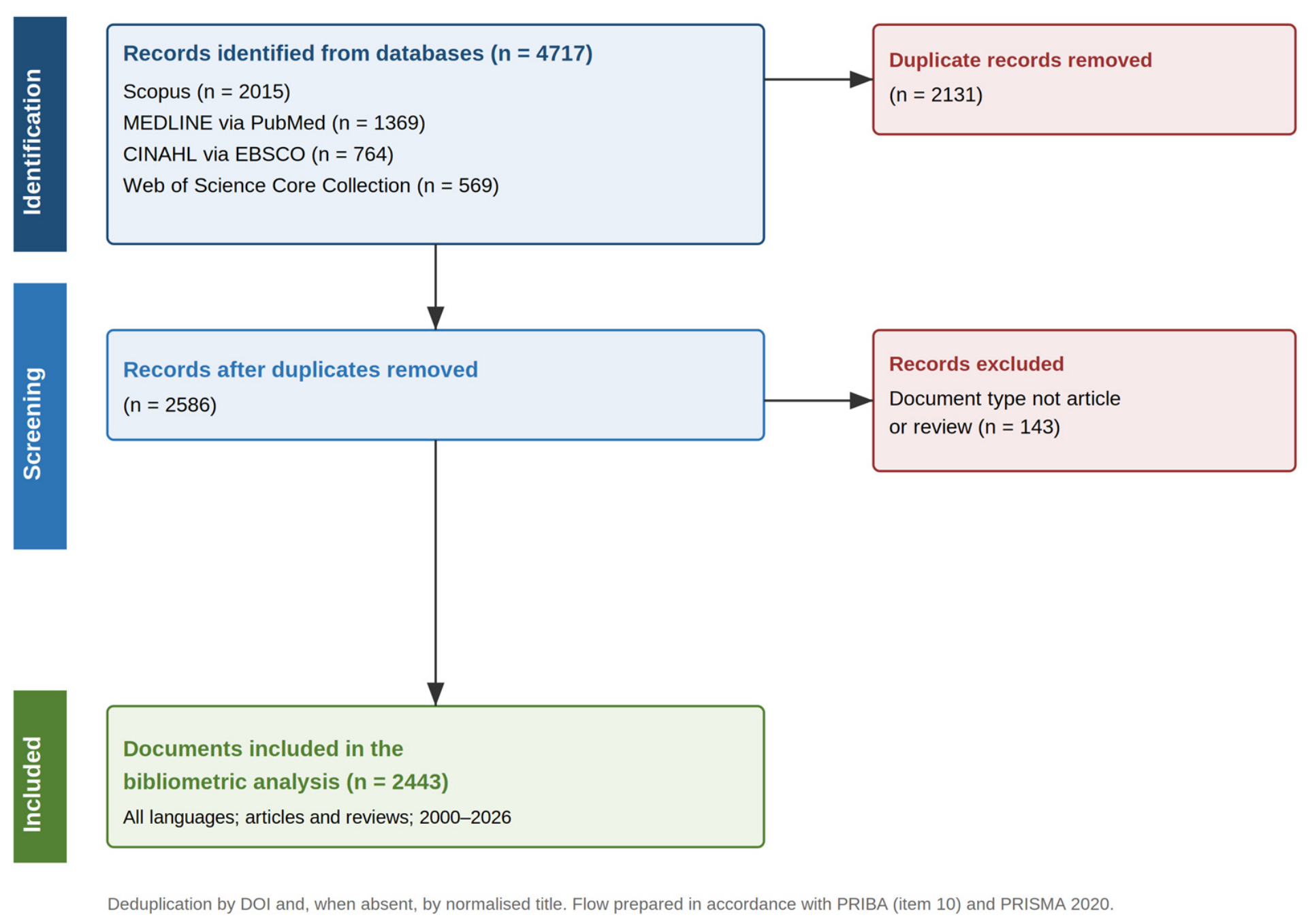
The four database exports yielded 4717 records (Scopus, 2015; MEDLINE, 1369; CINAHL, 764; and Web of Science, 569). Following deduplication, 2586 unique records remained, of which 900 were retrieved from a single database, 1251 from two databases, 434 from three databases, and one from all four databases, confirming the complementary coverage provided by the selected sources. The sum of these database appearances is 4708, nine fewer than the 4717 records retrieved. This difference corresponds exactly to nine within-database duplicates, that is, the same document exported twice by the same source: eight in CINAHL and one in Scopus. Application of the document-type eligibility criteria resulted in the exclusion of a further 143 records, yielding a final corpus of 2443 documents published between 2000 and 2026 (
Figure 1).
Because the MEDLINE export did not include a document-type field, 111 records retrieved exclusively from this database could not be classified and were therefore retained as having an undetermined document type. This issue is addressed further in the Section Limitations. Consistent with the objectives of bibliometric research, no methodological quality appraisal of individual records was undertaken, as the analysis focused on the structure and evolution of the scientific literature rather than on the synthesis of evidence regarding intervention effectiveness.
2.4. Bibliometric Indicators and Analytical Procedures
Analyses were conducted in the R statistical computing environment using the bibliometrix package (version 5.4.1) [
57], complemented by VOSviewer [
58] for network visualisation. Three complementary levels of analysis were performed.
The first, a descriptive level, examined scientific production and impact through annual publication output, average citations per year, author productivity based on Lotka’s Law, and source dispersion according to Bradford’s Law.
The second, a structural level, investigated the intellectual and social organisation of the field. Keyword co-occurrence analysis was conducted on the science-mapping subset. Co-citation analysis of cited references and bibliographic coupling of documents were conducted separately on the Scopus records alone, because cited-reference data are written in a database-specific format and are therefore not comparable across merged collections. For this purpose the Scopus search was re-executed with the References field selected, and the resulting records were intersected with the final corpus so that only documents already included in the corpus entered the analysis. This yielded 1924 documents, of which 1905 (99.0%) carried cited-reference data, from which a co-citation network of 86,016 distinct cited references was derived. These two analyses are therefore based on a single database and cover 78.8% of the corpus, a coverage limitation that is stated with the results.
The third, a conceptual level, examined the thematic structure of the field and its evolution over time. The thematic structure was represented using a thematic map (strategic diagram), in which themes are positioned within four quadrants defined by their centrality and density: motor themes, niche themes, emerging or declining themes, and basic themes. Centrality and density were operationalised using Callon’s centrality and Callon’s density [
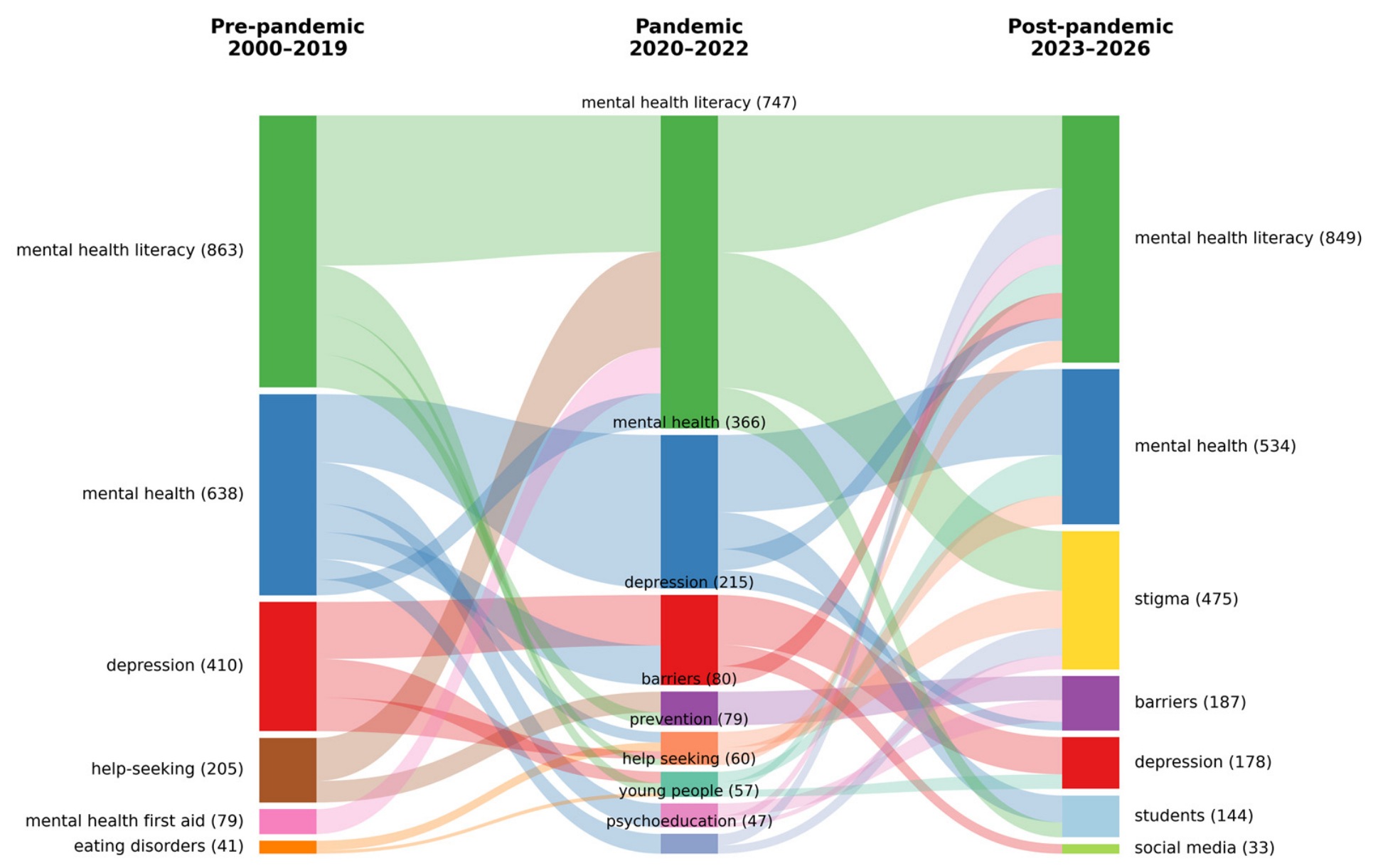
59], which quantify, respectively, the strength of a theme’s external connections with other themes and the internal cohesion of the terms composing it. The temporal evolution of themes was examined using thematic evolution analysis, represented by a Sankey diagram that illustrates how themes merge, split, or are renamed across successive time periods [
60]. The time periods were defined by reference to an external event rather than by arbitrary cut-points, namely the COVID-19 pandemic, giving a pre-pandemic period (2000–2019), a pandemic period (2020–2022), and a post-pandemic period (2023–2026). These boundaries correspond to the declaration of a Public Health Emergency of International Concern by the World Health Organization in January 2020 and to its termination in May 2023. This periodisation has the additional advantage of rendering testable the attribution of recent growth to the pandemic. The final period ends in a partial year, since data extraction took place in April 2026. Network visualisation was performed in VOSviewer version 1.6.20 [
58], whereas the thematic map and the thematic evolution analysis were generated in bibliometrix. The author-keyword co-occurrence network was constructed using full counting, with a minimum of five occurrences per keyword, which retained 252 keywords. Links were normalised using the association strength method, and the layout was generated with attraction set to 2 and repulsion set to 1. Clustering used a resolution parameter of 1.00 and a minimum cluster size of 5, yielding 14 clusters, 3136 links, and a total link strength of 9004.
For citation-based analyses, and because citation counts are not directly comparable across databases, the highest citation count available for each document was retained. This pragmatic approach maximised coverage while acknowledging that the resulting citation counts combine the citation windows of Scopus and Web of Science. To avoid conflating indexing artefacts with substantive thematic content, controlled-vocabulary descriptors assigned during database indexing, such as generic MeSH population terms, were distinguished from author keywords in the conceptual analyses. Before analysis, author names, journal titles, country names, and keywords were harmonised and disambiguated across databases. Author names were standardised by normalising initials and resolving evident duplicates; journal titles were standardised to a single form; country names were extracted from affiliation data and harmonised; and author keywords were converted to lower case and merged where orthographic variants were identified.
The keyword co-occurrence, thematic map, and thematic evolution analyses were performed on the merged Web of Science and Scopus dataset, restricted to articles and reviews using the same document-type criterion applied to the full corpus, yielding 2059 documents. Co-citation and bibliographic coupling analyses require complete cited-reference fields, which were unavailable in the retrieved database exports. Consequently, these analyses could not be performed and are discussed as a limitation of the study.
3. Results
3.1. Annual Scientific Production and Citation Trends
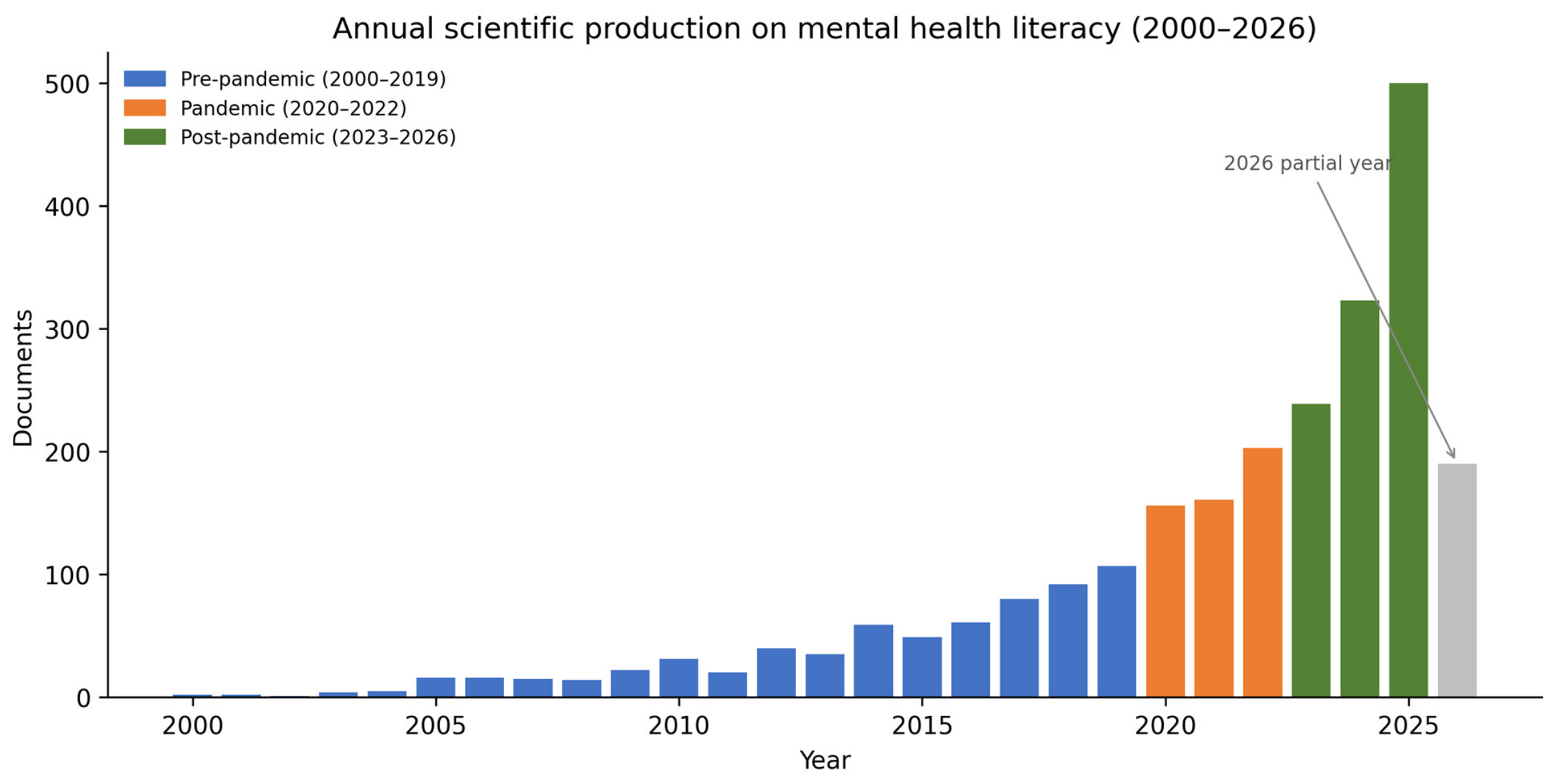
The final corpus comprised 2443 documents published between 2000 and 2026 across 956 sources and authored by 8948 unique researchers. The temporal distribution of publications reveals a clearly non-linear pattern. Scientific output remained limited throughout the first decade, with fewer than 20 publications per year until 2005 and a first modest increase around 2012, when annual output exceeded 40 publications for the first time. Sustained growth became evident from 2017 onwards, with annual output increasing from 80 publications in 2017 to 156 in 2020, coinciding with the onset of the COVID-19 pandemic. The most pronounced expansion, however, occurred more recently, with output rising from 203 publications in 2022 to 239 in 2023, 323 in 2024, and 500 in 2025, the most productive year of the study period, accounting for approximately one-fifth of the entire corpus. The 190 publications recorded for 2026 represent a partial year, as data extraction took place during the second quarter. Overall, approximately 72% of all documents (1772) were published from 2020 onwards, indicating that although the field originated conceptually in the late 1990s, its empirical development is relatively recent, with much of its intellectual structure emerging over the past six years.
The citation metrics are consistent with this recent expansion. The corpus accumulated 57,098 citations, corresponding to an average of 23.4 citations per document. However, the distribution was highly skewed, with a median of only four citations, 737 uncited documents, and 114 publications receiving more than 100 citations. Citations are therefore concentrated in a small group of foundational publications, while the large and rapidly expanding body of recent research has not yet had time to accumulate them. The annual distribution of output is shown in
Figure 2.
3.2. Leading Countries and Collaboration Patterns
The geographical distribution of the corpus confirms a strong concentration of scientific output in high-income, predominantly Anglophone countries. Australia, where the concept of MHL originated, ranks first, followed by the United States and the United Kingdom, with Canada, China, and Germany completing the leading group. India, Portugal, Spain, and other Asian countries constitute a second tier of contributors (
Table 1).
These counts are based on the 2197 documents for which author affiliation data were available, corresponding to 89.9% of the full corpus (n = 2443). The three subsets are nested but distinct and are defined by different criteria: the full corpus comprises 2443 documents; the affiliation subset comprises the 2197 documents carrying retrievable address fields; and the science-mapping subset comprises the 2059 documents indexed in Web of Science or Scopus after the document-type criterion, the remaining 384 documents being exclusive to MEDLINE or CINAHL. Because publications co-authored by researchers from more than one country contribute to the count of each participating country, the figures should be interpreted as indicators of national participation rather than as mutually exclusive totals. Within this subset, 485 documents involved authors affiliated with two or more countries, indicating a moderate, but not predominant, level of international collaboration, as most publications originated from a single country. Australia’s leadership is noteworthy not only in quantitative terms but also in its foundational role, as the country gave rise to both the original MHL framework and the internationally disseminated Mental Health First Aid programme. Institutional-level counts are not reported, as affiliation disambiguation was not undertaken for this corpus; disambiguated institutional rankings are identified as a priority for future analysis.
3.3. Most Influential Authors, Sources, and Documents
Author productivity follows a Lotkaian distribution, with 86.1% of authors contributing only a single publication and a small core of highly productive researchers shaping the field. Anthony Jorm is by far the most prolific author, followed by a group of frequent collaborators, including Reavley, Wei, Kutcher, Slewa-Younan, Subramaniam, Hart, and Morgan (
Table 2). This core closely reflects the Australian and Canadian research networks associated with the Mental Health First Aid programme and the subsequent extension of the MHL construct into school-based settings and positive mental health. These findings are consistent with the co-authorship structure expected in a field centred on a well-established foundational research programme.
Source dispersion conforms to Bradford’s Law. A compact core of 38 journals accounts for approximately one-third of the total output (805 documents), a second zone of 201 journals accounts for a further third, and a long tail of more than 700 journals accounts for the remainder. This distribution confirms that the field is supported by a relatively small group of core journals embedded within a highly dispersed publishing landscape. The core includes both general psychiatry and public health journals, led by BMC Psychiatry, the International Journal of Environmental Research and Public Health, and BMC Public Health, together with Frontiers in Psychiatry, PLOS One, and the Journal of Mental Health. The prominence of both psychiatric and public health journals within the core reflects the field’s dual orientation, spanning disorder-focused and promotion-oriented research traditions.
At the level of individual publications, the citation structure is dominated by a small group of foundational works. Citation counts correspond to the highest value recorded across the databases and therefore combine citations accumulated within different database-specific citation windows (
Table 3).
The thematic profile of the most highly cited publications is particularly revealing. Citation impact is concentrated on studies addressing help-seeking, stigma, and the recognition of mental disorders, together with the foundational and measurement studies originating from Jorm’s research tradition. By contrast, constructs related to positive mental health and well-being are notably absent from the most highly cited publications. These findings suggest that the classical, disorder-oriented conceptualisation of MHL continues to constitute the intellectual core of the field, despite the growing expansion of the literature towards themes associated with mental health promotion.
3.4. Intellectual Structure: Co-Citation and Bibliographic Coupling
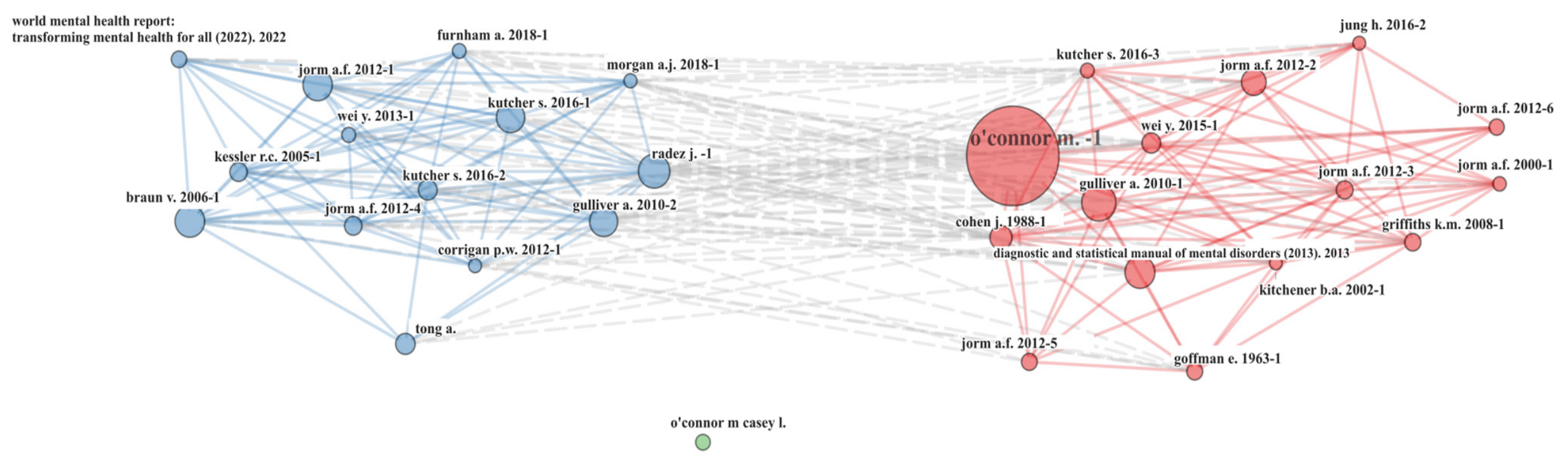
The intellectual base of the field was examined through co-citation analysis of cited references drawn from the Scopus records (
n = 1924; 86,016 distinct cited references). The co-citation network resolved into two clusters, shown in
Figure 3, both of which are composed almost entirely of the classical tradition. The first is organised around Jorm’s 2012 reformulation, the Mental Health First Aid literature associated with Kutcher and Wei, the help-seeking barriers literature of Gulliver and Radez, and the stigma work of Corrigan. The second is organised around the Mental Health Literacy Scale of O’Connor and Casey, Jorm’s foundational surveys, Kitchener and Jorm’s first aid evaluation, Griffiths, and Goffman’s classical account of stigma. Both clusters are therefore disorder-oriented, and no cluster corresponding to well-being theory or positive psychology emerged.
A direct test of the intellectual foundations claimed for PMHL reinforces this reading. Counting citations to each tradition across the co-citation network, the classical sources dominate overwhelmingly: references authored by Jorm account for 2498 citations, the Mental Health First Aid literature associated with Kitchener for 1770, and the stigma tradition of Corrigan, Goffman, Link, and Thornicroft for 1240. By contrast, the well-being theorists that PMHL invokes as its conceptual foundations are barely cited at all. Keyes, whose dual-continuum model is routinely presented as the theoretical basis of positive mental health, accounts for 107 citations; the positive psychology literature associated with Seligman and Csikszentmihalyi for 26; Ryff’s model of psychological well-being for 18; Diener’s work on subjective well-being for 11; and Jahoda’s original formulation of positive mental health for 5. The measure of positive mental health literacy developed by Bjornsen and colleagues accounts for 4. Jorm alone is therefore cited approximately twenty-three times more often than Keyes, one hundred and thirty-nine times more often than Ryff, and five hundred times more often than Jahoda.
This finding bears directly on the third objective and on the central argument. The expansion towards PMHL is articulated in the language of well-being science, yet the intellectual base of the field, understood as the body of work that its authors actually cite, remains almost exclusively the disorder-recognition tradition established by Jorm. The constructs annexed into the literacy framework are therefore invoked without their original sources being read, which is consistent with terminological transfer rather than with genuine theoretical integration. Bibliographic coupling of documents, computed on the same records, produced research fronts that likewise remain anchored in help-seeking, stigma, and measurement, without a distinct promotion-oriented front emerging.
Considered alongside the citation analysis, these results are mutually reinforcing. The most highly cited publications presented in
Table 3 anchor the same classical, disorder-oriented tradition around the foundational and measurement studies of Jorm and colleagues together with the principal contributions on stigma and help-seeking, while publications associated with positive mental health and well-being are absent from the most-cited tier. The co-citation network shows that this absence extends to the intellectual base itself and is not merely a feature of the most visible publications.
3.5. Conceptual Structure: Keyword Co-Occurrence
The conceptual structure of the field was examined through the co-occurrence of author keywords after separating substantive keywords from the generic controlled-vocabulary descriptors introduced through database indexing. The frequency distribution of these substantive keywords provides direct insight into both the intellectual core of the field and its emerging conceptual periphery (
Table 4).
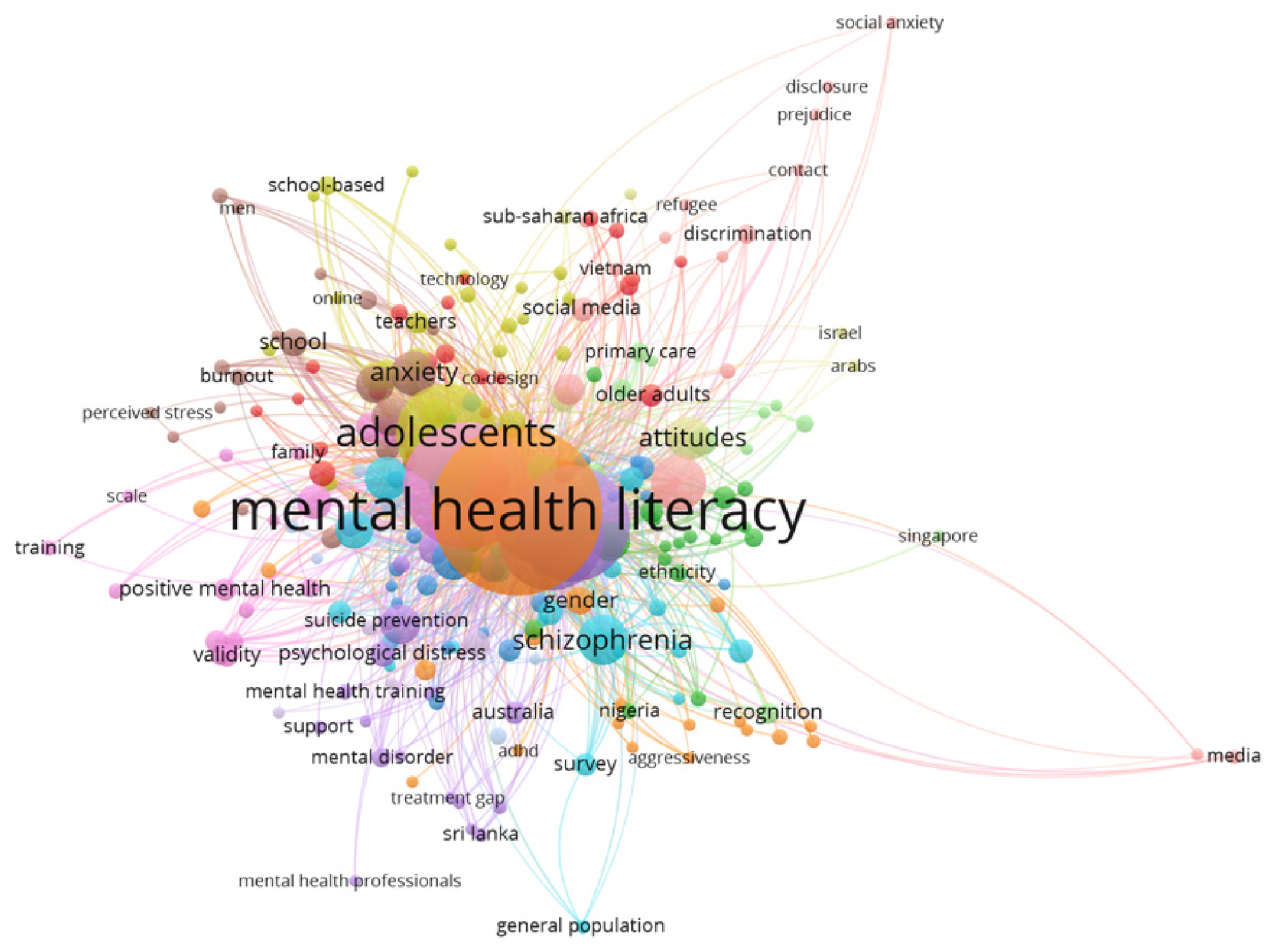
Two thematic clusters emerge from this distribution. The first, and by far the larger, corresponds to the classical formulation of MHL, organised around stigma, help-seeking, the recognition of specific mental disorders such as depression, anxiety, and schizophrenia, and the associated services and educational interventions. The second, substantially smaller, reflects the expansion towards positive mental health and is organised around health promotion, psychological well-being, resilience, and coping. The two clusters are markedly asymmetric in size. The well-being and health-promotion cluster is clearly present and continues to expand, yet it remains quantitatively secondary to the disorder-recognition and stigma cluster. Furthermore, the co-occurrence of terms such as health literacy and psychological well-being alongside mental health literacy provides preliminary evidence of the conceptual overlap and increasingly blurred boundaries identified in the Introduction, as these constructs progressively occupy the same keyword space as the literacy construct itself. The network is shown in
Figure 4.
3.6. Thematic Map and Thematic Evolution
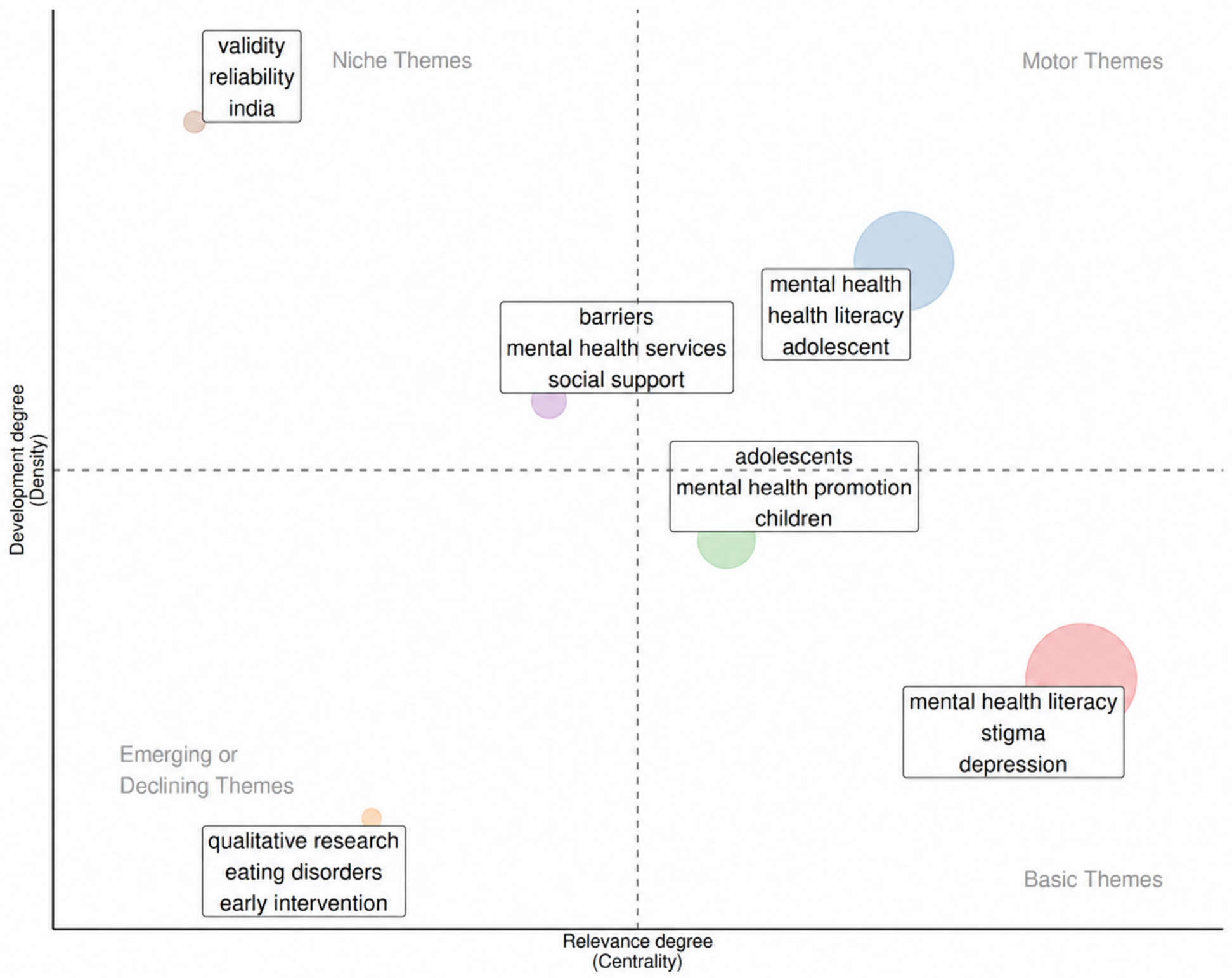
The thematic map, computed from author keywords with themes positioned according to Callon’s centrality and density, is shown in
Figure 5, and the composition of the clusters is summarised in
Table 5. Six clusters were retained. A single motor theme combines mental health with health literacy and adolescent populations (51 keywords; centrality 0.539; density 7.81), indicating a well-developed set of terms strongly connected to the rest of the field. The largest cluster by frequency, which couples mental health literacy with stigma and depression (35 keywords; 2586 occurrences), occupies the basic quadrant: it is the most central set of terms in the field (centrality 0.629) but its internal density is comparatively low (6.19), which is characteristic of foundational vocabulary that is used across many research lines rather than developed within one. A third cluster, organised around adolescents, mental health promotion, and children (13 keywords; 400 occurrences), also falls in the basic quadrant. Two niche clusters appear, one organised around barriers, mental health services, and social support (9 keywords), and one around validity, reliability, and psychometric work (8 keywords; density 9.07, the highest recorded). A single emerging or declining theme groups qualitative research with eating disorders and early intervention (5 keywords).
The status of promotion-related terminology requires explicit comment, since it bears on the central argument of this study. Contrary to a stronger formulation that the present data do not support, a cluster containing mental health promotion did form. It is, however, organised around a population rather than around a construct: mental health promotion appears alongside adolescents and children, which indicates that promotion vocabulary enters the field predominantly through school-age and youth research. Three features qualify its standing. First, it occupies the basic quadrant rather than the motor quadrant, with moderate centrality (0.308) and the second-lowest density recorded (6.21), so it is neither well developed internally nor strongly connected to the remainder of the field. Second, it is markedly smaller than the classical core, accounting for 400 keyword occurrences across 13 keywords against 2586 across 35 for the mental health literacy, stigma, and depression cluster. Third, and most consequentially for the argument advanced here, neither positive mental health literacy nor well-being literacy appears anywhere in the map, since neither term reached the minimum of five occurrences required for inclusion. The evidence therefore supports a more precise claim than the one it might be tempting to make: promotion-related research is present and clusters coherently, but it does so around youth populations and without organising itself around PMHL as a named construct.
Circle size reflects the frequency of keyword occurrences within each theme, and colour distin-guishes individual thematic clusters, as in
Figure 4. The dashed lines mark the median values of centrality and density, delimiting the four canonical quadrants of the strategic diagram (motor, basic, niche, and emerging or declining themes).
The thematic evolution of the field is presented in
Figure 6 across three periods defined by the COVID-19 pandemic. In the pre-pandemic period (2000–2019), the leading themes were mental health literacy (863 occurrences), mental health (638), depression (410), help-seeking (205), mental health first aid (79), and eating disorders (41). During the pandemic period (2020–2022), they were mental health literacy (747), mental health (366), depression (215), barriers (80), prevention (79), help seeking (60), and young people (57). In the post-pandemic period (2023–2026), they were mental health literacy (849), mental health (534), stigma (475), barriers (187), depression (178), students (144), and social media (33). The classical constructs of mental health literacy, mental health, stigma, and help-seeking therefore persist as the backbone of the field across all three periods. No theme related to promotion, well-being, resilience, or flourishing reached the threshold for inclusion as a leading theme in any period, which is consistent with the position of the promotion cluster in the thematic map described above.
4. Discussion
This bibliometric analysis of 2443 documents published between 2000 and 2026 provides a structural perspective on the evolution of Mental Health Literacy (MHL). Although the concept originated in the late 1990s, approximately 72% of the corpus was published from 2020 onwards, so that the empirical expansion of the field has occurred largely within the past six years. This growth coincides with the heightened public and policy attention to mental health during and following the COVID-19 pandemic, making the examination of the field’s conceptual boundaries particularly timely. This temporal association is interpreted here as coincidental rather than causal. The present bibliometric design does not permit inferences about the drivers of publication growth, and benchmarking this corpus against the wider mental health literature over the same period would be required to substantiate a causal interpretation.
The intellectual organisation of the field remains strongly anchored in a single foundational tradition. Australia is the leading contributor in terms of scientific output, and Anthony Jorm is, by a substantial margin, the most prolific author, supported by a cohesive research network associated with the Mental Health First Aid programme and the subsequent extension of the MHL framework into school-based settings. The concentration of citation impact within a relatively small group of publications, led by Jorm’s foundational studies and his 2012 reformulation of the construct, together with the principal references on stigma and help-seeking, indicates that the field continues to rely on a stable intellectual canon. This centrality of Jorm’s original framework is consistent with the finding that the classical, disorder-oriented conceptualisation of MHL continues to constitute the intellectual core of the field and provides the context for interpreting the subsequent analyses.
Against this stable core, the analysis also documents the expansion that motivated the present study. The conceptual structure derived from keyword co-occurrence reveals two distinct thematic clusters: a dominant classical cluster organised around stigma, help-seeking, and the recognition of specific mental disorders, and a smaller, more recent cluster centred on health promotion, psychological well-being, resilience, and coping. What this asymmetry implies is that the growth of promotion- and well-being-related terminology has not translated into intellectual centrality: such terminology is largely absent from the most influential publications and did not consolidate into a theme in any of the three periods examined. The expansion towards PMHL has enlarged the conceptual periphery of the field rather than reshaping its centre.
Whether this diversification represents conceptual enrichment or conceptual dilution constitutes the central interpretative question arising from these findings. Considered alongside the conceptual history outlined in the Introduction, the bibliometric evidence is consistent with the interpretation that a substantial part of this expansion reflects the incorporation into the MHL construct of domains that were already well established within well-being science. The vocabulary associated with well-being and positive psychology appears to have entered the field relatively recently and from its periphery, rather than emerging organically from within the original literacy tradition. This pattern is more consistent with conceptual extension than with the development of a genuinely distinct theoretical framework. In this context, the preference for the label PMHL over the available alternative of well-being literacy appears to duplicate constructs whose conceptual foundations, from Jahoda’s positive mental health [
32] to Keyes’s dual-continuum model [
36,
37,
38], Ryff’s psychological well-being [
39,
40,
41,
42,
43], and Diener’s subjective well-being [
44,
45,
46], have been central to well-being research for several decades.
This conceptual overlap has implications that extend beyond terminology. At the level of measurement, incorporating desirable psychological states and their determinants into the literacy construct blurs the distinction between what individuals know and how they function, such that instruments intended to assess literacy increasingly measure well-being outcomes. This creates a degree of conceptual circularity, whereby higher literacy is associated with greater well-being partly because well-being is embedded within the construct itself. Such overlap may compromise the interpretability of empirical findings and reduce the comparability of measurement instruments. At the theoretical level, conceptual redundancy weakens parsimony and hinders the cumulative development of knowledge, as studies ostensibly addressing the same construct may, in practice, be measuring substantially different phenomena. At the level of intervention, an overly inclusive construct provides limited guidance for programme design and evaluation, as a construct encompassing almost any desirable psychological state offers little discriminatory value when assessing intervention effectiveness.
The clustering patterns identified in the present study do not, in themselves, indicate that the field has already become fragmented. These findings can be situated in relation to the only adjacent bibliometric work identified. A search of MEDLINE via PubMed combining mental health literacy with bibliometric terminology returned a single record, which is not a bibliometric analysis of MHL. Qi and colleagues mapped global health literacy research between 1995 and 2020 using CiteSpace across 9492 documents, reporting that mental health had become the most active research area in recent years and anticipating mental health literacy as one of two directions in which the field would expand [
64]. The present analysis confirms that anticipated expansion empirically and extends it by mapping the internal conceptual structure of the mental health literacy field itself, which had not previously been the object of a dedicated bibliometric analysis. On the contrary, the persistence of a dense and highly cited classical core argues against such an interpretation. Rather, the findings suggest a potential risk of future fragmentation, whereby a promotion-oriented research stream continues to expand while remaining conceptually intertwined with adjacent well-being constructs. This distinction is important because the appropriate response to emerging conceptual overlap is greater conceptual clarification rather than the consolidation strategies required in an already fragmented field. This interpretation is further supported by both the thematic map and the thematic evolution analysis, which show that promotion-related terminology does not consolidate into a dominant or motor theme in any of the three periods examined. A more definitive characterisation of the intellectual structure of the field will require future co-citation and bibliographic coupling analyses based on complete cited-reference data.
Several implications emerge from these findings. First, the field would benefit from a clearer conceptual distinction between mental health literacy, understood as a knowledge- and skills-based competence related to mental health and the mental healthcare system, and the promotion of well-being, which represents a broader and equally legitimate objective. Second, future instrument development should distinguish knowledge and metacognitive competence from beliefs, attitudes, self-efficacy, and the well-being outcomes that these constructs are intended to predict rather than constitute. Third, where the primary focus is genuinely well-being literacy, adopting that terminology would reduce conceptual redundancy and facilitate the cumulative development of knowledge. More broadly, given the recent and rapid expansion of the field, the present moment offers an important opportunity to clarify these conceptual boundaries before the terminological overlap documented here becomes embedded in future measurement frameworks and public health policy. A final clarification of scope is warranted for readers approaching this study from a clinical or evidence-based practice perspective. Bibliometric prominence indexes scholarly attention, not therapeutic value: the identification of help-seeking, stigma, or health promotion as prominent themes describes how research effort has been distributed and says nothing about whether any particular intervention improves outcomes for people experiencing mental health problems. That question belongs to a distinct and already substantial evidence base, exemplified by meta-analytic work on digital mental health literacy interventions [
65] and by systematic reviews of school-based programmes targeting literacy and stigma [
66], both of which report positive but heterogeneous effects. Systematically appraising the effectiveness of MHL and PMHL interventions, and examining whether the conceptual expansion documented here has affected the comparability of their outcome measures, constitutes a complementary direction for future research.
Limitations
This study has several limitations inherent to bibliometric research. First, the findings depend on the coverage of the selected databases and the sensitivity of the search strategy. Consequently, relevant publications indexed under different terminology or available only in non-indexed sources may not have been retrieved. Although four databases were combined to minimise single-source bias, the possibility of language and indexing biases cannot be entirely excluded. Furthermore, while the inclusion of publications in all languages reduced Anglophone bias, it also introduced greater heterogeneity in the quality and completeness of bibliographic metadata.
Second, because the MEDLINE export did not include a document-type field, 111 records retrieved exclusively from this database were retained as having an undetermined document type. Although this decision may have resulted in the inclusion of a small number of non-article publications, excluding these records solely because of missing metadata would have introduced an avoidable source-specific bias. Citation counts were harmonised by retaining the highest value recorded across databases, a pragmatic approach that combines different citation windows and should therefore be interpreted as indicative rather than exact. Similarly, country-level analyses, and any future institutional analyses, rely on affiliation parsing, which may be affected by incomplete or inconsistently reported affiliation data.
Third, the keyword co-occurrence, thematic map, and thematic evolution analyses were performed on the merged Web of Science and Scopus dataset (n = 2059). Co-citation and bibliographic coupling were conducted on the Scopus records alone (n = 1924), because cited-reference data are recorded in database-specific formats that cannot be reconciled across sources. These two analyses therefore cover 78.8% of the corpus and reflect the indexing coverage of a single database, which should be borne in mind when interpreting the intellectual structure reported in
Section 3.4. Because the MEDLINE CSV export format does not contain a publication-type field, 111 records retrieved solely from that source could not be classified and were retained as undetermined.
Finally, bibliometric analysis describes the structural organisation and evolution of a body of literature but cannot, by itself, resolve conceptual debates. Accordingly, the interpretations advanced in this study should be understood as evidence-informed arguments grounded in the observed bibliometric patterns rather than as definitive demonstrations of conceptual relationships.