
Relationship Between Salivary Cortisol and Psychological Scales in the Stress Assessment of Shift Workers: A Narrative Review


Abstract
1. Introduction
2. Materials and Methods
2.1. Search Strategy and Selection Criteria
2.2. Data Extraction
3. Results
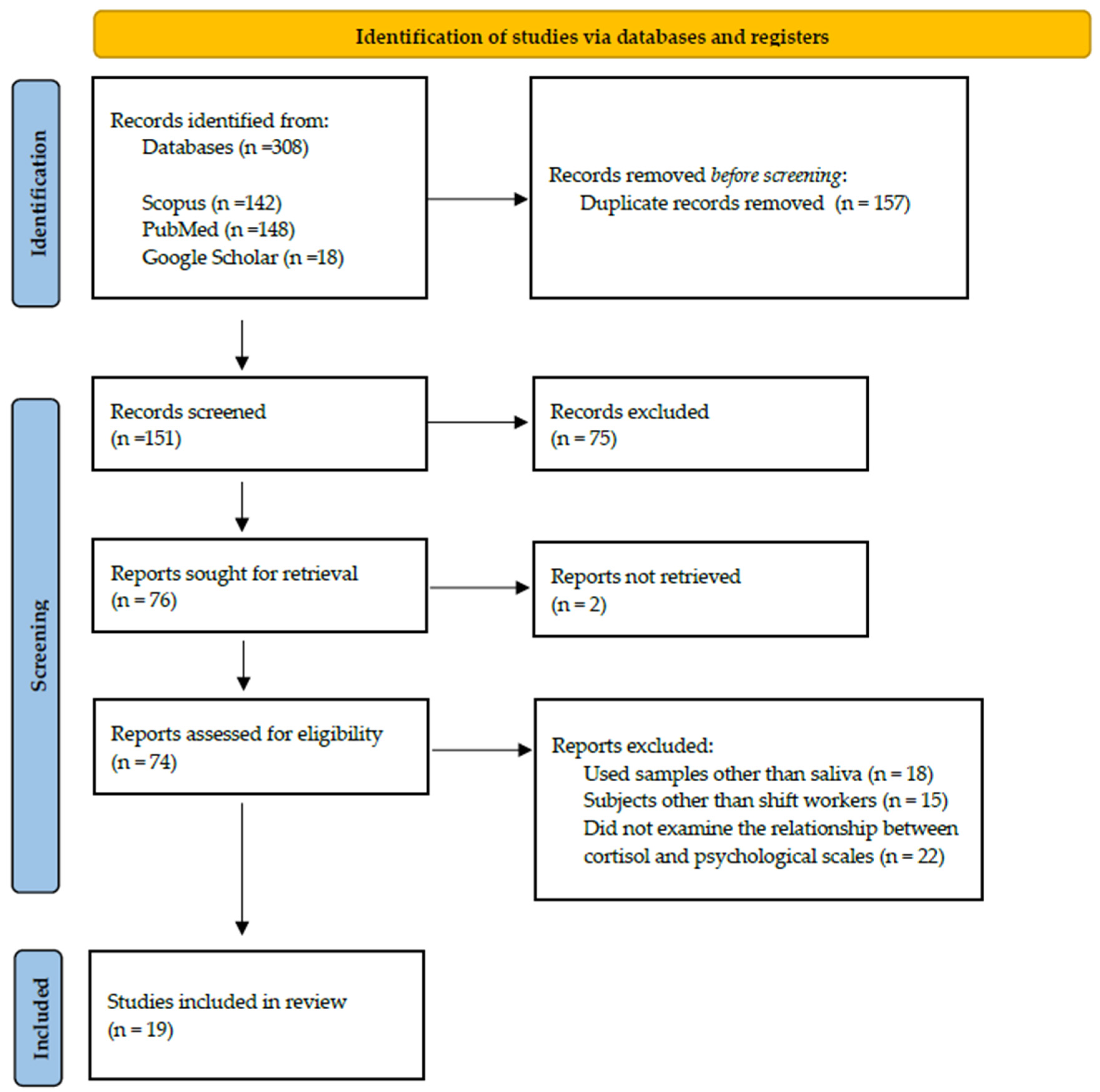
3.1. Study Search and Inclusion
3.2. Attributes of the Subjects in the Articles
3.3. Psychological Measures Reflecting Cortisol Levels
3.4. Summary of the Relationship Between Various Psychological Scales Related to Cortisol and Other Biomedical Measurements in Each Article
3.5. Relationship Between Saliva Collection Time, Number of Collections, and Psychological Scales
4. Discussions
Limitations
5. Conclusions
Author Contributions
Funding
Institutional Review Board Statement
Informed Consent Statement
Data Availability Statement
Conflicts of Interest
References
- Gold, D.R.; Rogacz, S.; Bock, N.; Tosteson, T.D.; Baum, T.M.; Speizer, F.E.; Czeisler, C.A. Rotating Shift Work, Sleep, and Accidents Related to Sleepiness in Hospital Nurses. Am. J. Public Health 1992, 82, 1011–1014. [Google Scholar] [CrossRef] [Scilit] [PubMed]
- Ishii, N.; Iwata, T.; Dakeishi, M.; Murata, K. Effects of Shift Work on Autonomic and Neuromotor Functions in Female Nurses. J. Occup. Health 2004, 46, 352–358. [Google Scholar] [CrossRef] [Scilit] [PubMed]
- Tenkanen, L.; Sjöblom, T.; Kalimo, R.; Alikoski, T.; Härmä, M. Shift Work, Occupation and Coronary Heart Disease over 6 Years of Follow-up in the Helsinki Heart Study. Scand. J. Work Environ. Health 1997, 23, 257–265. [Google Scholar] [CrossRef] [Scilit] [PubMed]
- Murata, K.; Yano, E.; Shinozaki, T. Impact of Shift Work on Cardiovascular Functions in a 10-Year Follow-up Study. Scand. J. Work Environ. Health 1999, 25, 272–277. [Google Scholar] [CrossRef] [Scilit] [PubMed]
- Kirschbaum, C.; Kudielka, B.M.; Gaab, J.; Schommer, N.C.; Hellhammer, D.H. Impact of Gender, Menstrual Cycle Phase, and Oral Contraceptives on the Activity of the Hypothalamus-Pituitary-Adrenal Axis. Psychosom. Med. 1999, 61, 154–162. [Google Scholar] [CrossRef] [Scilit] [PubMed]
- Trueba, A.F.; Mizrachi, D.; Auchus, R.J.; Vogel, P.D.; Ritz, T. Effects of Psychosocial Stress on the Pattern of Salivary Protein Release. Physiol. Behav. 2012, 105, 841–849. [Google Scholar] [CrossRef] [Scilit] [PubMed]
- Den, R.; Toda, M.; Ohira, M.; Morimoto, K. Levels of Awakening Salivary CgA in Response to Stress in Healthy Subjects. Environ. Health Prev. Med. 2011, 16, 155–157. [Google Scholar] [CrossRef] [Scilit] [PubMed]
- Campisi, J.; Bravo, Y.; Cole, J.; Gobeil, K. Acute Psychosocial Stress Differentially Influences Salivary Endocrine and Immune Measures in Undergraduate Students. Physiol. Behav. 2012, 107, 317–321. [Google Scholar] [CrossRef] [Scilit] [PubMed]
- Kudielka, B.M.; Buske-Kirschbaum, A.; Hellhammer, D.H.; Kirschbaum, C. HPA Axis Responses to Laboratory Psychosocial Stress in Healthy Elderly Adults, Younger Adults, and Children: Impact of Age and Gender. Psychoneuroendocrinology 2004, 29, 83–98. [Google Scholar] [CrossRef] [Scilit] [PubMed]
- Dutheil, F.; de Saint Vincent, S.; Pereira, B.; Schmidt, J.; Moustafa, F.; Charkhabi, M.; Bouillon-Minois, J.B.; Clinchamps, M. DHEA as a Biomarker of Stress: A Systematic Review and Meta-Analysis. Front. Psychiatry 2021, 12, 688367. [Google Scholar] [CrossRef] [Scilit] [PubMed]
- Cozma, S.; Dima-Cozma, L.C.; Ghiciuc, C.M.; Pasquali, V.; Saponaro, A.; Patacchioli, F.R. Salivary Cortisol and α-Amylase: Subclinical Indicators of Stress as Cardiometabolic Risk. Braz. J. Med. Biol. Res. 2017, 50, e5577. [Google Scholar] [CrossRef] [Scilit] [PubMed]
- Bunney, W.E.; Bunney, B.G. Molecular Clock Genes in Man and Lower Animals: Possible Implications for Circadian Abnormalities in Depression. Neuropsychopharmacology 2000, 22, 335–345. [Google Scholar] [CrossRef] [Scilit] [PubMed]
- Costa, G. Shift Work and Health: Current Problems and Preventive Actions. Saf. Health Work 2010, 1, 112–123. [Google Scholar] [CrossRef] [Scilit] [PubMed]
- Fabbri, M.; Beracci, A.; Martoni, M.; Meneo, D.; Tonetti, L.; Natale, V. Measuring Subjective Sleep Quality: A Review. Int. J. Environ. Res. Public Health 2021, 18, 1082. [Google Scholar] [CrossRef] [Scilit] [PubMed]
- Andreo, P.H.M.; Meletti, P.C. Analysis Of Salivary Cortisol As A Resource In The Evaluation Of Occupational Stress: A Systematic Review Of The Literature. Rev. Ação Ergonômica 2023, 17, 1–21. [Google Scholar] [CrossRef] [Scilit]
- Gonçalves, T.; Santos, M.; Pontífice-sousa, P.; Antunes, V. Nursing Interventions for Post-Intensive Care Syndrome in Follow-Up Clinics: A Scoping Review. Nurs. Rep. 2026, 16, 55. [Google Scholar] [CrossRef] [Scilit] [PubMed]
- Valentin, B.; Grottke, O.; Skorning, M.; Bergrath, S.; Fischermann, H.; Rörtgen, D.; Mennig, M.T.; Fitzner, C.; Müller, M.P.; Kirschbaum, C.; et al. Cortisol and Alpha-Amylase as Stress Response Indicators during Pre-Hospital Emergency Medicine Training with Repetitive High-Fidelity Simulation and Scenarios with Standardized Patients. Scand. J. Trauma Resusc. Emerg. Med. 2015, 23, 31. [Google Scholar] [CrossRef] [Scilit] [PubMed]
- Wen, B.M. Stress, Adaptation, and Disease Allostasis and Allostatic Load. Ann. N. Y. Acad. Sci. 1998, 840, 33–44. [Google Scholar] [CrossRef] [Scilit] [PubMed]
- Mommersteeg, P.M.C.; Heijnen, C.J.; Keijsers, G.P.J.; Verbraak, M.J.P.M.; Van Doornen, L.J.P. Cortisol Deviations in People with Burnout before and after Psychotherapy: A Pilot Study. Health Psychol. 2006, 25, 243–248. [Google Scholar] [CrossRef] [Scilit] [PubMed]
- De Vente, W.; Olff, M.; Van Amsterdam, J.G.C.; Kamphuis, J.H.; Emmelkamp, P.M.G. Physiological Differences between Burnout Patients and Healthy Controls: Blood Pressure, Heart Rate, and Cortisol Responses. Occup. Environ. Med. 2003, 60, 54–61. [Google Scholar] [CrossRef] [Scilit] [PubMed]
- Ruger, M.; Scheer, F.A.J.L. Effects of Circadian Disruption on the Cardiometabolic System. Rev. Endocr. Metab. Disord. 2009, 10, 245–260. [Google Scholar] [CrossRef] [Scilit] [PubMed]
- Kristensen, T.S.; Borritz, M.; Villadsen, E.; Christensen, K.B. The Copenhagen Burnout Inventory: A New Tool for the Assessment of Burnout. Work Stress 2005, 19, 192–207. [Google Scholar] [CrossRef] [Scilit]
- Kakiashvili, T.; Leszek, J.; Rutkowski, K. The Medical Perspective on Burnout. Int. J. Occup. Med. Environ. Health 2013, 26, 401–412. [Google Scholar] [CrossRef] [Scilit] [PubMed]
- Baethge, C.; Goldbeck-Wood, S.; Mertens, S. SANRA—A Scale for the Quality Assessment of Narrative Review Articles. Res. Integr. Peer Rev. 2019, 4, 5. [Google Scholar] [CrossRef] [Scilit] [PubMed]
- Page, M.J.; McKenzie, J.E.; Bossuyt, P.M.; Boutron, I.; Hoffmann, T.C.; Mulrow, C.D.; Shamseer, L.; Tetzlaff, J.M.; Akl, E.A.; Brennan, S.E.; et al. The PRISMA 2020 Statement: An Updated Guideline for Reporting Systematic Reviews. BMJ 2021, 372, 71. [Google Scholar] [CrossRef] [Scilit]
- Yamaguchi, S.; Fujita, T.; Kato, S.; Yoshimitsu, Y.; Ito, Y.M.; Yano, R. Utility of Salivary Cortisol Profile as a Predictive Biomarker in Nurses’ Turnover Risk: A Preliminary Study. J. Physiol. Anthropol. 2024, 43, 1. [Google Scholar] [CrossRef] [Scilit] [PubMed]
- Miyoshi, T.; Ida, H.; Nishimura, Y.; Ako, S.; Otsuka, F. Effects of Yoga and Mindfulness Programs on Self-Compassion in Medical Professionals during the COVID-19 Pandemic: An Intervention Study. Int. J. Environ. Res. Public Health 2022, 19, 12523. [Google Scholar] [CrossRef] [Scilit] [PubMed]
- Kuzmin, M.Y.; Tyumentseva, D.P.; Rashidova, M.A.; Sholokhov, L.F.; Marianian, A.Y. Subjective Assessment of Stress and Its Relationship with Neuroendocrine Mechanisms of Its Development in Obstetricians-Gynecologists against the Background of Professional Burnout. Int. J. Biomed. 2021, 11, 551–557. [Google Scholar] [CrossRef] [Scilit]
- Deneva, T.; Ianakiev, Y.; Keskinova, D. Burnout Syndrome in Physicians—Psychological Assessment and Biomarker Research. Medicina 2019, 55, 209. [Google Scholar] [CrossRef] [Scilit] [PubMed]
- Colonnello, V.; Carnevali, L.; Russo, P.M.; Ottaviani, C.; Cremonini, V.; Venturi, E.; Mattarozzi, K. Reduced Recognition of Facial Emotional Expressions in Global Burnout and Burnout Depersonalization in Healthcare Providers. Peer J. 2021, 9, e10610. [Google Scholar] [CrossRef] [Scilit] [PubMed]
- Deneva, T.I.; Ianakiev, Y.P. Evaluation of Anxiety, Depression, and Biological Markers in Health Professionals with Burnout Syndrome. Folia Med. 2021, 63, 122–128. [Google Scholar] [CrossRef] [Scilit] [PubMed]
- Wingenfeld, K.; Schulz, M.; Damkroeger, A.; Rose, M.; Driessen, M. Elevated Diurnal Salivary Cortisol in Nurses Is Associated with Burnout but Not with Vital Exhaustion. Psychoneuroendocrinology 2009, 34, 1144–1151. [Google Scholar] [CrossRef] [Scilit] [PubMed]
- Bringel, J.M.d.A.; Abreu, I.; Muniz, M.C.M.C.; de Almeida, P.C.; Silva, M.R.G. Excessive Noise in Neonatal Units and the Occupational Stress Experienced by Healthcare Professionals: An Assessment of Burnout and Measurement of Cortisol Levels. Healthcare 2023, 11, 2002. [Google Scholar] [CrossRef] [Scilit] [PubMed]
- Cockerham, M.; Kang, D.H.; Beier, M.E. Consecutive Shifts: A Repeated Measure Study to Evaluate Stress, Biomarkers, Social Support, and Fatigue in Medical/Surgical Nurses. Behav. Sci. 2023, 13, 571. [Google Scholar] [CrossRef] [Scilit] [PubMed]
- Bani-Issa, W.; Radwan, H.; Al Marzooq, F.; Al Awar, S.; Al-Shujairi, A.M.; Samsudin, A.R.; Khasawneh, W.; Albluwi, N. Salivary Cortisol, Subjective Stress and Quality of Sleep among Female Healthcare Professionals. J. Multidiscip. Healthc. 2020, 13, 125–140. [Google Scholar] [CrossRef] [Scilit] [PubMed]
- Cockerham, M.; Kang, D.-H.; Howe, R.; Weimer, S.; Boss, L.; Kamat, S.R. Stress and Cortisol as Predictors of Fatigue in Medical/Surgical Nurses and Nurse Leaders: A Biobehavioral Approach. J. Nurs. Educ. Pract. 2017, 8, 76. [Google Scholar] [CrossRef] [Scilit]
- Bergomi, M.; Modenese, A.; Ferretti, E.; Ferrari, A.; Licitra, G.; Vivoli, R.; Gobba, F.; Aggazzotti, G. Work-Related Stress and Role of Personality in a Sample of Italian Bus Drivers. Work 2017, 57, 433–440. [Google Scholar] [CrossRef] [Scilit] [PubMed]
- Zefferino, R.; Fortunato, F.; Arsa, A.; Di Gioia, S.; Tomei, G.; Conese, M. Assessment of Stress Salivary Markers, Perceived Stress, and Shift Work in a Cohort of Fishermen: A Preliminary Work. Int. J. Environ. Res. Public Health 2022, 19, 699. [Google Scholar] [CrossRef] [Scilit] [PubMed]
- Lin, Y.H.; Jen, H.J.; Lin, Y.K.; Seo, J.D.; Chang, W.P. Cortisol Awakening Response and Stress in Female Nurses on Monthly Shift Rotations: A Longitudinal Study. BioMed Res. Int. 2022, 2022, 9506583. [Google Scholar] [CrossRef] [Scilit] [PubMed]
- Pérez-Valdecantos, D.; Caballero-García, A.; Del Castillo-Sanz, T.; Bello, H.J.; Roche, E.; Córdova, A. Stress Salivary Biomarkers Variation during the Work Day in Emergencies in Healthcare Professionals. Int. J. Environ. Res. Public Health 2021, 18, 3937. [Google Scholar] [CrossRef] [Scilit] [PubMed]
- Briguglio, G.; Teodoro, M.; Italia, S.; Verduci, F.; Pollicino, M.; Coco, M.; De Vita, A.; Micali, E.; Alibrandi, A.; Lembo, G.; et al. Salivary Biomarkers and Work-Related Stress in Night Shift Workers. Int. J. Environ. Res. Public Health 2021, 18, 3184. [Google Scholar] [CrossRef] [Scilit] [PubMed]
- Baba, M.; Ohkura, M.; Koga, K.; Nishiuchi, K.; Herrera C., L.R.; Matsuse, R.; Inoue, T. Analysis of Salivary Cortisol Levels to Determine the Association between Depression Level and Differences in Circadian Rhythms of Shift-Working Nurses. J. Occup. Health 2015, 57, 237–244. [Google Scholar] [CrossRef] [Scilit] [PubMed]
- Wirth, M.; Burch, J.; Violanti, J.; Burchfiel, C.; Fekedulegn, D.; Andrew, M.; Zhang, H.; Miller, D.B.; Hébert, J.R.; Vena, J.E. Shiftwork Duration and the Awakening Cortisol Response among Police Officers. Chronobiol. Int. 2011, 28, 446–457. [Google Scholar] [CrossRef] [Scilit] [PubMed]
- Yamaguchi, S.; Watanabe, K.; Sugimura, N.; Shishido, I.; Konya, I.; Fujita, T.; Yoshimitsu, Y.; Kato, S.; Ito, Y.M.; Yano, R. Salivary Biomarker Profiles and Chronic Fatigue among Nurses Working Rotation Shifts: An Exploratory Pilot Study. Healthcare 2022, 10, 1416. [Google Scholar] [CrossRef] [Scilit] [PubMed]
- Rogerson, O.; Wilding, S.; Prudenzi, A.; O’Connor, D.B. Effectiveness of Stress Management Interventions to Change Cortisol Levels: A Systematic Review and Meta-Analysis. Psychoneuroendocrinology 2024, 159, 106415. [Google Scholar] [CrossRef] [Scilit] [PubMed]
- Hellhammer, D.H.; Wüst, S.; Kudielka, B.M. Salivary Cortisol as a Biomarker in Stress Research. Psychoneuroendocrinology 2009, 34, 163–171. [Google Scholar] [CrossRef] [Scilit] [PubMed]
- Jerjes, W.K.; Taylor, N.F.; Wood, P.J.; Cleare, A.J. Enhanced Feedback Sensitivity to Prednisolone in Chronic Fatigue Syndrome. Psychoneuroendocrinology 2007, 32, 192–198. [Google Scholar] [CrossRef] [Scilit] [PubMed]
- Kudielka, B.M.; Buchtal, J.; Uhde, A.; Wüst, S. Circadian Cortisol Profiles and Psychological Self-Reports in Shift Workers with and without Recent Change in the Shift Rotation System. Biol. Psychol. 2007, 74, 92–103. [Google Scholar] [CrossRef] [Scilit] [PubMed]
- Putignano, P.; Dubini, A.; Toja, P.; Invitti, C.; Bonfanti, S.; Redaelli, G.; Zappulli, D.; Cavagnini, F. Salivary Cortisol Measurement in Normal-Weight, Obese and Anorexic Women: Comparison with Plasma Cortisol. Eur. J. Endocrinol. 2001, 145, 165–171. [Google Scholar] [CrossRef] [Scilit] [PubMed]
- Hobfoll, S.E. Conservation of resources: A new attempt at conceptualizing stress. Am. Psychol. 1989, 44, 513–524. [Google Scholar] [CrossRef] [PubMed]
- Kumari, M.; Shipley, M.; Stafford, M.; Kivimaki, M. Association of Diurnal Patterns in Salivary Cortisol with All-Cause and Cardiovascular Mortality: Findings from the Whitehall II Study. J. Clin. Endocrinol. Metab. 2011, 96, 1478–1485. [Google Scholar] [CrossRef] [Scilit] [PubMed]
- Maslach, C.; Jackson, S.E. The Measurement of Experienced Burnout. J. Organ. Behav. 1981, 2, 99–113. [Google Scholar] [CrossRef] [Scilit]
- Bond, A.; Lader, M. The Use of Analogue Scales in Rating Subjective Feelings. Br. J. Med. Psychol. 1974, 47, 211–218. [Google Scholar] [CrossRef] [Scilit]
- Heller, G.Z.; Manuguerra, M.; Chow, R. How to Analyze the Visual Analogue Scale: Myths, Truths and Clinical Relevance. Scand. J. Pain 2016, 13, 67–75. [Google Scholar] [CrossRef] [Scilit] [PubMed]
- Koo, M.; Yang, S. Visual Analogue Scale. In Handbook of Disease Burdens and Quality of Life Measures; Springer: New York, NY, USA, 2010; p. 4349. [Google Scholar] [CrossRef] [Scilit]
- Riethof, N.; Bob, P.; Laker, M.; Zmolikova, J.; Jiraskova, T.; Raboch, J. Alexithymia, Traumatic Stress Symptoms and Burnout in Female Healthcare Professionals. J. Int. Med. Res. 2020, 48. [Google Scholar] [CrossRef] [Scilit] [PubMed]
- Antonijevic, J.; Binic, I.; Zikic, O.; Manojlovic, S.; Tosic-Golubovic, S.; Popovic, N. Mental Health of Medical Personnel during the COVID-19 Pandemic. Brain Behav. 2020, 10, e01881. [Google Scholar] [CrossRef] [Scilit] [PubMed]
- Cohen, S.; Kamarck, T.; Mermelstein, R. A Global Measure of Perceived Stress. J. Health Soc. Behav. 1983, 24, 385–396. [Google Scholar] [CrossRef] [Scilit]
- Cohen, S.; Williamson, G. Perceived stress in a probability sample of the United States. In The Social Psychology of Health: Claremont Symposium on Applied Social Psychology; Spacapan, S., Oskamp, S., Eds.; Sage Publications Inc.: Thousand Oaks, CA, USA, 1988; pp. 31–67. [Google Scholar]
- Cohen, S.; Kessler, R.C.; Gordan, L.U. Measuring Stress: A Guide for Health and Social Scientists; Oxford University Press: New York, NY, USA, 1997; Volume 10, pp. 3–28. [Google Scholar]
- Roerink, M.E.; Roerink, S.H.P.P.; Skoluda, N.; van der Schaaf, M.E.; Hermus, A.R.M.M.; van der Meer, J.W.M.; Knoop, H.; Nater, U.M. Hair and Salivary Cortisol in a Cohort of Women with Chronic Fatigue Syndrome. Horm. Behav. 2018, 103, 1–6. [Google Scholar] [CrossRef] [Scilit] [PubMed]
- Fiorentino, L.; Saxbe, D.; Alessi, C.A.; Woods, D.L.; Martin, J.L. Diurnal Cortisol and Functional Outcomes in Post-Acute Rehabilitation Patients. J. Gerontol. Ser. A Biomed. Sci. Med. Sci. 2012, 67A, 677–682. [Google Scholar] [CrossRef] [Scilit] [PubMed]
- Danhof-Pont, M.B.; van Veen, T.; Zitman, F.G. Biomarkers in Burnout: A Systematic Review. J. Psychosom. Res. 2011, 70, 505–524. [Google Scholar] [CrossRef] [Scilit] [PubMed]
- Sonnenschein, M.; Mommersteeg, P.M.C.; Houtveen, J.H.; Sorbi, M.J.; Schaufeli, W.B.; van Doornen, L.J.P. Exhaustion and Endocrine Functioning in Clinical Burnout: An in-Depth Study Using the Experience Sampling Method. Biol. Psychol. 2007, 75, 176–184. [Google Scholar] [CrossRef] [Scilit] [PubMed]
- Fujiwara, K.; Tsukishima, E.; Kasai, S.; Masuchi, A.; Tsutsumi, A.; Kawakami, N.; Kishi, R. Urinary catecholamines and salivary cortisol on workdays and days off in relation to job strain among female health care providers. Scand. J. Work Environ. Health 2004, 30, 129–138. [Google Scholar] [CrossRef] [Scilit] [PubMed]
- González-Cabrera, J.; Fernández-Prada, M.; Iribar-Ibabe, C.; Peinado, J.M. Acute and Chronic Stress Increase Salivary Cortisol: A Study in the Real-Life Setting of a National Examination Undertaken by Medical Graduates. Stress 2014, 17, 149–156. [Google Scholar] [CrossRef] [Scilit] [PubMed]
- Stalder, T.; Kirschbaum, C.; Kudielka, B.M.; Adam, E.K.; Pruessner, J.C.; Wüst, S.; Dockray, S.; Smyth, N.; Evans, P.; Hellhammer, D.H.; et al. Assessment of the Cortisol Awakening Response: Expert Consensus Guidelines. Psychoneuroendocrinology 2016, 63, 414–432. [Google Scholar] [CrossRef] [Scilit] [PubMed]


| Author and Year of Publication | Study Design | Shift Pattern | Occupation | Gender | Sample Size | Psychological Scale | Relationship Between the Psychological Scale and Cortisol | Time of Saliva Collection | No. of Saliva Samples Collected | Main Limitation |
|---|---|---|---|---|---|---|---|---|---|---|
| Yamaguchi et al., (2024) [26] | Longitudinal study | Two-shift system | Nurse | Female | 40 | Maslach Burnout Inventory (MBI) The 15-item Occupational Fatigue/Exhaustion Recovery Scale | + + | Upon awakening | Before three different day shifts within one month (3 times total) | Single facility, pandemic impact, uncontrolled physiological/work factors |
| Miyoshi et al. (2022) [27] | Intervention research | Unknown | Health-care worker | Male Female | 18 | MBI Sense of Coherence Connor-Davidson Resilience Scale Patient Health Questionnaire | − − − − | Before the yoga/mindfulness session (7:00 or 8:00 p.m.) and 1 h after | 4 times (pre/post first and last program sessions) | small sample, lack of sub-analysis, uncontrolled confounders |
| Kuzmin et al. (2021) [28] | Cross-sectional study | Unknown | Nurse Doctor | Male Female | 96 | MBI Beck Depression Inventory Ways of Coping Checklist | − + − | 8:00 a.m. to 9:00 a.m. (fasting) | 1 time during the procedure | Specialized occupation only, cross-sectional |
| Deneva and Ianakiev (2021) [29] | Cross-sectional study | Unknown | Doctor Biologist Chemist Laboratory technician | Male Female | 95 | MBI State–Trait Anxiety Inventory Zung Self-Rating Depression Scale (SDS) | − − − | 6:00 a.m. to 8:00 a.m. | 1 time in the morning. | Small sample |
| Colonnello et al. (2021) [30] | Cross-sectional study | Unknown | Health-care worker | Male Female | 90 | MBI | + | End of shift (2:00 p.m. or 8:00 p.m.) | 2 times at 7-min intervals | Lack of causality, female-dominated sample |
| Deneva (2019) [31] | Cross-sectional study | Unknown | Doctor | Male Female | 308 | MBI | + | 6:00 a.m. to 8:00 a.m. | 1 time in the morning | Descriptive cross-sectional design |
| Wingenfeld et al. (2009) [32] | Cross-sectional study | Unknown | Nurse | Male Female | 279 | MBI Maastricht Vital Exhaustion Questionnaire | + − | 7:00 a.m., 11:30 a.m., 5:30 p.m., and 8:00 p.m. | 4 times during a day shift workday | Limited time points (4) |
| Bringel et al. (2023) [33] | Cross-sectional study | Two-shift system | Nurse Doctor Physiotherapist Speech therapist | Male Female | 256 | Burnout Characterization Scale | − | Around 4:30 p.m. | 6 times total (pre/post intervention & sessions) | Small pilot study, female bias |
| Cockerham et al. (2023) [34] | Prospective study | Two-shift system | Nurse | Male Female | 81 | The 14-item Perceived Stress Scale (PSS-14) Visual Analog Scale (VAS) Nurse Stress Scale (NSS) Multidimensional Fatigue Inventory (MFI-20) | − − − − | Pre-shift (6:00–7:00 a.m.) and post-shift (6:00–7:00 p.m.) | 5 times (Baseline, Day 1 and 3 pre/post) | Limited to specific units, selection bias |
| Bani-Issa et al. (2020) [35] | Cross-sectional study | Unknown | Nurse Doctor Dentist (Others) | Female | 335 | PSS-14 Stress Symptoms Scale Brief Coping Scale | − − − | Upon awakening (7:00–8:00 a.m.) and at bedtime (7:00–8:00 p.m.) | 2 times per participant | Insufficient duration/frequency |
| Cockerham et al. (2017) [36] | Cross-sectional study | Three-shift system | Nurse | Male Female | 59 | PSS-14 VAS NSS MFI-20 | − + − − | Pre-shift (6:30–7:15 a.m.) and post-shift (6:45–7:15 p.m.) | 4 times (pre/post for 2 consecutive 12 h shifts) | Limited facility type, sample loss (overtime) |
| Bergomi et al. (2017) [37] | Cross-sectional study | Unknown | Bus driver | Male Female | 42 | The 10-item Perceived Stress Scale Driver Stress Inventory | + + | Shift start, middle, and end (Working hours unknown) | 6 times (3 times on workdays and 3 on days off) | self-report bias, high biomarker variability |
| Zefferino et al. (2022) [38] | Randomized controlled trial | Three-shift system | Fisherman | Unknown | 30 | The Professional Stress Scale | + | 8:00 a.m. and 2:00 p.m. | 2 times per participant | Small sample of specific occupation, lack of control group |
| Lin et al. (2022) [39] | Cross-sectional study | Three-shift system | Nurse | Female | 41 | Nurse Stress Checklist | − | Upon waking and 30 min after waking | 18 times (3 days/month for 3 months) | insufficient CAR points (2) |
| Pérez- Valdecantos et al. (2021) [40] | Cross-sectional study | Unknown | Nurse Doctor | Male Female | 97 | The revised version of the Medical Personnel Stress Survey | − | 8:00 a.m., 12:00 p.m., 3:00 p.m., and 12:00 a.m. | 4 times during a regular workday | Single-day follow-up, interference from diet/psychological perception |
| Briguglio et al. (2021) [41] | Cross-sectional study | Unknown | Nurse | Male Female | 106 | The Effort/Reward Imbalance Questionnaire | − | 2 h after awakening and 10:00 p.m. | 2 times total | Lack of causality, timing/circadian overlap |
| Baba et al. (2015) [42] | Cross-sectional study | Two-shift system | Nurse | Female | 36 | SDS | + | 10 specific times over 3 days (e.g., 8:00 a.m., 12:00 p.m., 5:00 p.m.) | 10 times total covering day and night shifts | Difficulty in time management, sampling bias |
| Wirth et al. (2011) [43] | Cross-sectional study | Three-shift system | Police officer | Male Female | 68 | The Center for Epidemiologic Studies Depression Scale | − | Upon awakening, and 15, 30, and 45 min after | 4 consecutive points (Cortisol Awakening Response: CAR) | Effect attenuation due to off-day sampling |
| Yamaguchi et al. (2022) [44] | Pilot study | Two-shift system | Nurse | Female | 45 | The Cumulative Fatigue Symptom Index | + | Before each shift (Day: 8:30 a.m.~, Night: 4:30 p.m.~) | 4 times (before 2 day and 2 night shifts) | Single facility, small sample, sample loss |
| Psychological Scale Category | Name of Psychological Scale | No. of Articles | Positive Relation with Cortisol |
|---|---|---|---|
| Burnout | Maslach Burnout Inventory | 7 | 4 |
| Burnout Characterization Scale | 1 | 0 | |
| Stress | The 14-item Perceived Stress Scale | 3 | 0 |
| Visual Analog Scale | 2 | 1 | |
| Nursing Stress Scale | 2 | 0 | |
| The 10-item Perceived Stress Scale | 1 | 1 | |
| Professional Stress Scale | 1 | 1 | |
| Driver Stress Inventory | 1 | 1 | |
| Nurse Stress Checklist | 1 | 0 | |
| Sense of Coherence | 1 | 0 | |
| Connor–Davidson Resilience Scale | 1 | 0 | |
| Revised version of the Medical Personnel Stress Survey | 1 | 0 | |
| Effort/Reward Imbalance Questionnaire | 1 | 0 | |
| Stress Symptoms Scale | 1 | 0 | |
| Depression | Zung Self-Rating Depression Scale | 2 | 1 |
| Beck Depression Inventory | 1 | 1 | |
| Patient Health Questionnaire | 1 | 0 | |
| The Center for Epidemiologic Studies Depression Scale | 1 | 0 | |
| Fatigue | Multidimensional Fatigue Inventory | 2 | 0 |
| The 15-item Occupational Fatigue/Exhaustion Recovery Scale | 1 | 1 | |
| The Cumulative Fatigue Symptom Index | 1 | 1 | |
| Maastricht Vital Exhaustion Questionnaire | 1 | 0 | |
| Coping | Ways of Coping Checklist | 1 | 0 |
| Brief Coping Scale | 1 | 0 |
Disclaimer/Publisher’s Note: The statements, opinions and data contained in all publications are solely those of the individual author(s) and contributor(s) and not of MDPI and/or the editor(s). MDPI and/or the editor(s) disclaim responsibility for any injury to people or property resulting from any ideas, methods, instructions or products referred to in the content. |
© 2026 by the authors. Licensee MDPI, Basel, Switzerland. This article is an open access article distributed under the terms and conditions of the Creative Commons Attribution (CC BY) license.
Share and Cite
Kumagai, Y.; Kudo, N.; Suda, T.; Narita, Y.; Yoshioka, M. Relationship Between Salivary Cortisol and Psychological Scales in the Stress Assessment of Shift Workers: A Narrative Review. Psychiatry Int. 2026, 7, 149. https://doi.org/10.3390/psychiatryint7040149
Kumagai Y, Kudo N, Suda T, Narita Y, Yoshioka M. Relationship Between Salivary Cortisol and Psychological Scales in the Stress Assessment of Shift Workers: A Narrative Review. Psychiatry International. 2026; 7(4):149. https://doi.org/10.3390/psychiatryint7040149
Chicago/Turabian StyleKumagai, Yuka, Naoko Kudo, Tomomi Suda, Yoshimi Narita, and Masato Yoshioka. 2026. "Relationship Between Salivary Cortisol and Psychological Scales in the Stress Assessment of Shift Workers: A Narrative Review" Psychiatry International 7, no. 4: 149. https://doi.org/10.3390/psychiatryint7040149
APA StyleKumagai, Y., Kudo, N., Suda, T., Narita, Y., & Yoshioka, M. (2026). Relationship Between Salivary Cortisol and Psychological Scales in the Stress Assessment of Shift Workers: A Narrative Review. Psychiatry International, 7(4), 149. https://doi.org/10.3390/psychiatryint7040149