1. Introduction
Suicide remains a pressing global public health issue. According to the World Health Organization, the age-standardized suicide rate in Kazakhstan in 2021 was 15.2 cases per 100,000 population. In comparison, the global average of the age-standardized suicide rate stands at 8.9 per 100,000 the same year [
1]. According to the Portal of Legal Statistics and Special Accounts of the State Office of the Prosecutor General of the Republic of Kazakhstan, recorded 3408 cases of completed suicide and 4036 suicide attempts in 2024 [
2].
In recent years, the internet and social media have served a dual role as mediums of expression and a risk factor. Social media benefits include the reduction of stigma and an encouragement for individuals to openly share their emotional struggles and suicidal thoughts [
3]. Engagement with suicide-related or self-injury content online has been associated with increased suicidal ideation [
4], although the mechanisms behind this link are not fully understood. On the other hand, forums and social media platforms may contribute to the normalization or romanticization of suicide within vulnerable populations. For instance, a suicide cluster affecting eight young individuals across different schools and communities was reported by Robertson et al. [
5]. These individuals were linked via social media platforms and text messaging. Some of them were interconnected through websites centered on earlier suicide incidents, reflecting the complex network of online and offline influences on suicidal behavior.
Recent research has further examined the impact of social media use on suicidality. General frequency of social media use was not found to have a significant association with suicidal thoughts (odds ratio (OR) = 1.45), plans (OR = 1.47), or non-suicidal self-injury (NSSI) (OR = 2.03) [
6]. However, when focusing specifically on suicide and self-harm-related content, stronger associations emerged. Engagement with such content, whether through posting, discussing, or viewing relevant materials, has been associated with suicidal ideation (OR = 2.79), plans (OR = 3.78), attempts (OR = 3.94), and NSSI (OR = 2.98) [
6]. Digital self-harm behavior was also found to correlate with a 5- to 7-fold increase in the likelihood of reporting suicidal thoughts and a 9- to 15-fold increase in suicide attempts [
7].
One of the most popular social networking websites in Kazakhstan and other post-Soviet countries is VKontakte. In 2016, the number of VKontakte users in Kazakhstan alone was 7.78 million people, which is 32.5% more than in the previous year [
8]. The platform’s structure supports both open and closed communities, private and public messaging, and discussion threads, making it a relevant context for analyzing expressions of suicidal behavior online. Studies specifically involving Kazakhstani users on online suicide risk detection remain nonexistent, although international research is growing. Platforms such as VKontakte, despite their extensive use in Kazakhstan and other post-Soviet countries, remain overlooked, which emphasizes the need for culturally and regionally informed methods for suicide prevention.
VKontakte may serve as a culturally and regionally appropriate platform for exploring how indicators of suicidal ideation may be expressed in online environments in Kazakhstan, in contrast to Western social media platforms. Although international interest in using digital platforms to detect and respond to suicide risk is increasing, most research is centered on Western social media such as Facebook and Twitter [
9,
10,
11]. The international studies highlight how social media can help to detect emotional distress, identify suicidal signals, and initiate early intervention. Shoib et al. emphasized that user-generated content such as suicide notes, livestreams, and grieving posts can provide valuable insight into individuals’ psychological state prior to suicide [
10]. Jashinsky et al. and Wang et al. also observed a correlation between tweets related to suicide and suicide rates at the state level in the U.S. and in Japan, accordingly [
9,
11]. This indicates that social media content can reflect real-world risk patterns.
Despite the growth of international research on suicidal behavior on social media platforms like Twitter, Reddit, Instagram, and TikTok, systematic qualitative studies of suicidal communities on VKontakte, particularly in Central Asian countries and Kazakhstan, remain limited. Currently, there are no published studies proposing a structured typology of such communities based on their naming principles, content characteristics, and moderation practices in the Kazakhstani context.
To address this need, the present study applies a qualitative content analysis of suicidal behavior on online platforms as reflected in: (a) textual expressions of suicidal ideation and depression, (b) the number of subscriptions to suicide or depression-related communities, and (c) the sentiment of the content within those communities. To explore these patterns, the study uses AIMap, a platform designed to map and gather digital indicators of mental health. In the present study, the tool was utilized to analyze VKontakte content linked to suicidal ideation.
The main objective of this research is to describe how online communities that are related to suicide and self-harm behavior manifest on VKontakte and assess potential engagement of Kazakhstani users. It is the first attempt to categorize online communities in VKontakte and draw attention to the importance of social media influence. The findings of the present study may provide an exploratory foundation for future research on digital indicators relevant to suicide prevention. Accordingly, this study addressed the following research questions:
- (1)
How do VKontakte communities associated with suicide, self-harm, and depression that include Kazakhstan users signal these themes through their names, descriptions, visual elements, and posts?
- (2)
How can these communities be categorized into thematic groups based on naming conventions and content characteristics?
- (3)
What patterns of community subscriptions are observed among users from Kazakhstan who follow these suicide- and self-harm-related communities?
2. Materials and Methods
2.1. Study Design
The study employed a qualitative descriptive content analysis focusing on community-level patterns in naming, textual content, and visual elements. Descriptive quantification, in the form of dichotomous (yes/no) coding and frequency counts, was used as a supplementary approach to summarize the distribution of observed features across communities. The primary analytic orientation remained qualitative and interpretive, with quantitative elements serving a descriptive, non-inferential role.
2.2. Data Sources
VKontakte allows users to create public or private communities. Public communities are accessible without prior permission and display subscriber lists even when individual user profiles are hidden. Only public communities were included in this study because of their unrestricted accessibility and visibility of subscription data.
Data collection was conducted between 30 December 2021 and 4 March 2025. The data source consisted exclusively of public VKontakte communities.
2.3. Sampling and Community Identification Procedures
2.3.1. Stage 1: Initial Identification
The initial set of communities was identified through manual keyword-based searches using terms related to suicide, self-harm, depression, and emotional distress in Russian and Kazakh languages. During this process, the subscriber lists (members) of these communities and accessibility were also collected through the Application Programming Interface (API) service in the “VKontakte for Developers” and uploaded to the AIMap platform.
2.3.2. Stage 2: Network Expansion
Two additional strategies were applied:
- (1)
Algorithmic recommendations provided by VKontakte.
- (2)
For each identified community, subscriber lists were examined to identify additional communities with overlapping membership, thereby enabling network-based expansion of the sample.
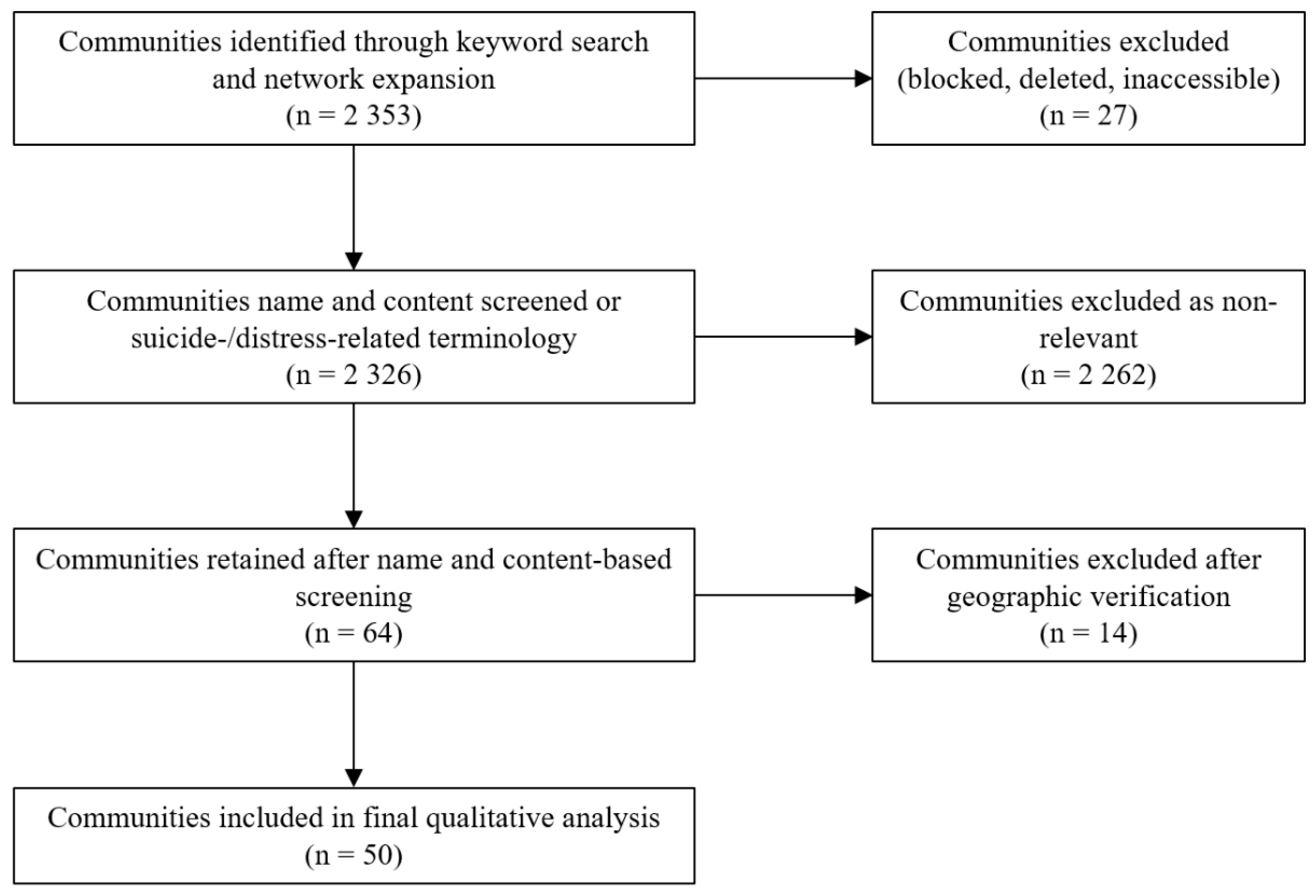
The identification process was conducted iteratively during the data collection process and continued until no substantially new communities meeting the inclusion criteria were identified through additional search cycles, indicating saturation of relevant results within the accessible network. This process yielded 2353 communities (see
Figure 1).
2.3.3. Stage 3: Accessibility Verification
AIMap was used to assist in filtering communities based on accessibility (public vs. closed or deleted). Following verification, 27 communities were excluded because they were blocked, deleted, or inaccessible, resulting in 2326 accessible communities.
2.3.4. Stage 4: Double Independent Screening
All 2326 accessible communities were manually screened by two trained coders for the presence of terminology related to suicide, self-harm, or emotional distress in their titles, as well as for such content within communities using masked or non-obvious names. After cross-verification, 64 communities met the naming criteria.
2.3.5. Stage 5: Geographic Verification
At this stage, two datasets were available: (1) a filtered subset of communities identified through strict inclusion criteria based on suicide-, self-harm-, or emotional distress-related naming and content (n = 64), and (2) a dataset of users with publicly available profile indicators suggesting a connection to Kazakhstan, including the lists of communities to which these users were subscribed. For both datasets, community-level metadata (including community name and URL) were recorded. The final analytic sample was obtained by matching community URLs across these datasets, allowing identification of communities from the filtered subset that included subscribers with a probable connection to Kazakhstan.
The final analytic sample of 50 communities was selected using purposive, criterion-based sampling, with the aim of capturing maximum variation in naming strategies and content orientation among suicide- and self-harm-related VKontakte communities linked to users from Kazakhstan. Rather than estimating prevalence, the study sought to identify and qualitatively examine distinct patterns of symbolic framing, thematic emphasis, and moderation practices across communities.
A community was considered relevant to Kazakhstan if it included at least one subscriber whose publicly available profile metadata indicated a likely connection to Kazakhstan. This inference was based on a combination of self-declared location, language use (Russian and/or Kazakh), and network affiliation visible in public profiles. Because VKontakte does not provide verified geographic identifiers, this criterion should be understood as probabilistic rather than definitive.
This criterion was intentionally inclusive and designed to capture a broad range of communities with observable user linkage, rather than to establish representativeness of the national digital ecosystem.
The authors acknowledge that this approach may misclassify some users’ geographic location; however, for the purposes of identifying communities with demonstrable engagement by Kazakhstan-based users, this criterion was considered sufficient.
In addition, the inclusion criterion based on at least one user with a probable connection to Kazakhstan does not imply that the analyzed communities are representative of the broader Kazakhstani digital ecosystem. The sample reflects communities with observable linkage to users in this context and was not designed to support population-level generalization.
2.4. Measures and Coding Variables
For the final 50 communities, four binary indicators (yes/no) were coded:
(1) The community name included terminology associated with suicide, self-harm, or emotional distress; (2) the community description featured language related to these topics; (3) at least one post, whether textual, audio, or visual contained references to suicide or self-harm; and (4) the main or cover photo of the community depicted imagery suggestive of suicidal or self-harming behavior.
2.5. Data Collection and Recording
All observations were conducted manually by trained coders. Screenshots of community pages and relevant posts were archived as qualitative verification evidence, particularly because VK communities frequently change names and thematic orientation over time.
For each identified community, basic metadata were recorded, including the community’s name and its corresponding URL. Similarly, the dataset derived from subscriber lists included community names and URLs for all communities followed by the identified users. This structure enabled consistent cross-referencing and linkage between the content-based community sample and the broader subscription network.
All coding outcomes were recorded in a structured Microsoft Excel database. Variables were coded dichotomously (yes/no). No automated text-mining or machine-learning classification was applied at the coding stage.
The development of the community typology followed a multi-stage approach. In the initial stage, communities were classified based on the semantic characteristics of their names, resulting in four preliminary categories: Explicitly Marked/Concrete Names, Thematically Non-Obvious Names, Masking (Meaningless) Names, and Pseudo-Positive/Ironic Names. This classification was based on the degree of thematic transparency and the presence or absence of explicit references to suicide, self-harm, or emotional distress in community titles. For communities with masking names, an additional verification step was conducted to confirm the presence of suicide- or self-harm-related content.
Following the application of inclusion criteria and reduction of the dataset to the final analytical sample, a refined typology was developed using a rule-based classification approach. Communities were grouped according to dominant thematic signals present in their names, with content, descriptions, and interaction patterns used selectively to confirm or refine classification where necessary.
2.6. Qualitative Analysis
A structured qualitative content analysis approach was applied to interpret symbolic community names, language in descriptions, suicidal narratives in posts, and visual representations in cover images. The analysis focused on identifying explicit, implicit, and concealed forms of suicidal expression.
Categories were defined using rule-based criteria grounded in observable linguistic features of community names. These included the presence of direct references to suicide or self-harm, expressions of emotional distress, and indirect, metaphorical, or stylized language (e.g., ironic or coded phrasing).
In addition, descriptive frequency counts of the four binary indicators were calculated to summarize how frequently specific features appeared across the community sample. These counts were used solely for descriptive purposes and did not involve statistical inference or hypothesis testing.
2.7. Coding Reliability and Methodological Integrity
All stages of screening and content evaluation were performed by two independent coders applying identical predefined criteria. The first coder conducted the primary screening and content coding, after which the second coder independently reviewed all coding decisions to verify accuracy. Any discrepancies identified between coders were resolved through structured consensus discussions.
Formal inter-rater reliability coefficients (e.g., Cohen’s κ) were not calculated because the analytic process involved iterative refinement of categories and interpretive judgment typical of qualitative content analysis. Instead, analytic trustworthiness was ensured through full double-coding, transparent documentation of coding decisions, and maintenance of an audit trail consisting of archived screenshots and coding logs.
Initial coder agreement was high for categories with explicit semantic markers (e.g., suicidal, self-harm, supportive, not related). Disagreements occurred primarily in cases involving ambiguous, metaphorical, or ironic naming. While formal agreement statistics were not calculated, these cases were resolved through discussion and consensus, guided by predefined classification principles distinguishing direct personal intent from metaphorical or generalized expressions.
Attention was given to distinguishing between conceptually adjacent categories. For example, the “despair and pain” category included direct expressions of emotional distress (e.g., statements of hopelessness or exhaustion), whereas the “ironic” category was characterized by indirect, metaphorical, or stylized expressions (e.g., sarcasm, wordplay, or aestheticized references to death). This distinction was applied consistently during coding and reviewed during consensus discussions.
2.8. Researcher Positioning and Collaborative Verification
The study was conducted in collaboration with the AIMap analytical platform, which has more than six years of experience in social media behavioral research. Analysts specialized in behavioral profiling based on publicly declared user interests and community structures.
Communities were repeatedly re-verified over time because VK groups frequently change names, themes, or content orientation, a dynamic that required ongoing observational monitoring.
2.9. Ethical Considerations
As the data analyzed were publicly available, informed consent from individual users was not required. However, no personal or user identifiers were used or stored in the collected data to prevent any potential harm or re-identification.
All data collected were limited to public communities that did not require permission for viewing or subscription. No private messages, closed group content, or individual user profiles were accessed or recorded. During the data collection process, particular attention was paid to user privacy. No usernames, profile URLs, or other identifying information were stored, analyzed, or presented in the final report.
Although the data was public, such content may reflect acute psychological distress. The study was strictly observational and retrospective, without real-time monitoring or interaction with users; therefore, no direct intervention or referral to support services was feasible. This reflects an inherent limitation of non-interventional designs and highlights the ethical tension between passive observation and potential duty of care.
To reduce potential harm, care was taken not to reproduce or amplify harmful content. The study also acknowledges the broader role of platform governance, as exposure to suicide-related material may be influenced by moderation and recommendation systems. While this was beyond the scope of the present analysis, it represents an important direction for future ethically guided research and policy development.
3. Results
3.1. Typology of Community Naming Conventions
The methodology delineates the initial four distinct typologies for community names from observation of 2353 communities:
Explicitly Marked/Concrete Names are characterized by their direct and unambiguous indication of the community’s thematic focus. Examples include “kill yourself” or “Depression with a taste of pain”.
Thematically Non-Obvious Names subtly obscure the underlying depressive or negative nature of the content. Phrases such as “January sixteenth” or “Boy’s heart” exemplify this type. This naming strategy reflects indirect or non-explicit thematic signaling, where the connection to suicide- or distress-related content is not immediately apparent from the title alone.
Masking (Meaningless) Names are deliberately designed to conceal the community’s theme. These are frequently observed in closed groups that disseminate sensitive or taboo content, including topics related to suicide or self-harm, often appearing as random alphanumeric sequences.
Pseudo-Positive/Ironic Names present a stylistic contradiction between the title’s apparent positivity or humor and the actual dark or depressive nature of the content. Illustrative examples include “a little worse than dead” when referring to melancholic themes, or “sometimes it gets better” for content exhibiting sadness.
3.2. Overview of the Dataset
A total of 5550 users from Kazakhstan were identified as subscribers of 50 communities dedicated to suicide and self-harm (see
Table 1). Among them, 55.0% were female (
n = 3054) and 45.0% were male (
n = 2496). Age information was available for slightly more than half of the sample (
n = 3029). Of those with identifiable ages, the majority were between 18 and 30 years old (38.3%,
n = 2125), followed by users aged 30 years and older (10.8%,
n = 597), while individuals younger than 18 years constituted 5.5% (
n = 307) of the sample. A substantial proportion of users (45.4%,
n = 2521) did not have age data available.
Regarding community subscription patterns, most users (84.8%, n = 4707) followed only one suicide-related community. Smaller proportions subscribed to two (8.8%, n = 491) or three (3.4%, n = 188) such communities, while a minority (3.0%, n = 164) were members of four or more (up to 12 subscriptions). Overall, most users followed a single suicide-related community, with progressively fewer users subscribed to multiple communities.
The dataset showed variation in the degree to which suicidal themes were explicitly represented across communities. Some groups explicitly reflected suicidal ideation in their headlines, while others contained only subtle or indirect references, with references to despair appearing primarily in user-generated content. Notably, only a subset of these communities demonstrated consistent activity related to suicide-related content; others contained content with unrelated or less explicit themes.
3.3. Categorization of VKontakte Communities
A total of 50 VKontakte communities were analyzed, with each group evaluated according to its name, description, published posts, visual elements, and indicators of suicide, self-harm, or depression-related content. The final six-category typology reflects a transition from an initial name-based classification to a more refined community-level classification, capturing both explicit and implicit forms of suicide-related communication.
Overall, most of the communities were classified as suicidal (n = 16), despair- and pain-oriented (n = 14), or ironic (n = 14), together accounting for 88% of the sample. In contrast, self-harm-focused (n = 3), supportive (n = 2), and not related (n = 1) communities were relatively rare.
Suicide-related features were unevenly distributed across communities. Suicide-related features were unevenly distributed, with 18 communities containing relevant posts or comments, 9 including relevant descriptions, and 4 displaying related imagery in cover photos.
3.4. Content Analysis
Community names served as the primary indicator of thematic orientation. Six naming patterns emerged: suicidal, self-harm, despair and pain, ironic, supportive, and not related (see
Table 2). The largest subset included communities whose titles conveyed explicit suicidal and self-harming intent, often phrased in a direct or imperative manner (e.g., “Let’s die together,” “There are cuts on her hands”). Slightly less than half of the examined communities fell within this category, indicating that such themes are explicitly present in community naming. A third category consisted of names expressing despair and pain but non-explicit sentiments, such as “I’m tired of life” or “eternity pain”. These communities primarily contained expressions of emotional exhaustion or apathy rather than explicit references to suicide.
A fourth, more subtle group used ironic, aestheticized, or metaphorical names, such as “I will remain a flower on your windowsill” or “Keep fading/freezing”. Although these names did not directly mention suicide, qualitative content analysis revealed that some of them included romanticized images of death or self-harm in their posts. Fifth, a small number of communities had names that explicitly presented suicide as a problem to be prevented, such as “Suicide is not a solution” or “Help: Depression, Suicide, Loneliness”. These communities positioned themselves as support-oriented communities rather than as platforms for the dissemination of harmful content. Finally, one example in the “not related” category did not contain any obvious signs of suicide or self-harm in their names, descriptions, or visual representations. However, self-harm-related content occasionally appeared, showing that even communities with neutral labels can contain deviant content without active moderation.
3.5. Community Descriptions and Stated Purpose
The community descriptions were inconsistent in reflecting the true thematic direction of groups. Of the 50 communities included in the final analytic sample, 41 communities contained descriptions that did not include any terminology associated with suicide, self-harm, or emotional distress. In these cases, descriptions included generic text with no reference to mental health and some lacked descriptions altogether. However, those that did contain related descriptions fall into three categories: (a) preventive and supportive, (b) poetic and suicide-aestheticized, and (c) possible risk groups. The first category representatives claimed to reject suicidal behavior, outlined the community rules that are against harmful discussions, and encouraged users to reach out for help. The second category used romanticized and poetic phrases that present suffering in a poetic or aestheticized form. And the final category often did not state their purpose or used hopeless phrases such as “Mental grave”, “Peaceful apathy”. Such variations indicate that surface-level descriptions may not accurately represent the underlying content of a given community.
3.6. Content Characteristics
Of the 50 communities analyzed, 18 contained posts or comments referring to suicide or self-harming behavior. The analysis of posts and user interactions revealed several recurrent patterns. Direct mentions of suicidal intent appeared in multiple communities, with users writing statements such as “I want to die” or “In a couple of days I will commit suicide”. Such posts gained various responses, from supportive comments and suggestions of professional help to sarcasm and encouragement of self-harming behavior.
Another pattern observed across the content was the presence of stylized or aestheticized representations of suicide-related themes. This theme was explored in both visual and textual content. For example, textual posts included metaphorical expressions such as “death is an art” or references to death as an abstract or poetic state (e.g., “I will throw myself into the arms of silence”), rather than as a purely clinical or crisis-related concept. Also, death was described as a form of beauty, an escape from reality, and an act of art. Visual imagery often features anime-style drawings of people depicting characters expressing a desire to die or interacting with symbolic representations of death (e.g., ropes, pills, or wounds), holding razor blades or pills, while textual content included poetic metaphors. Accordingly, communities that featured self-harm included references to cutting, which could be posted alongside illustrations of wounds or stylized photographs. Such posts received varied responses, ranging from supportive comments encouraging help-seeking to dismissive or harmful replies (e.g., “goodbye” or “don’t come back”), indicating the coexistence of different communicative responses within the same discussion spaces. These patterns may be interpreted as stylized or indirect representations of suicide-related themes within certain communities.
It is worth noting that some communities lacked internal consistency. For example, although their descriptions stated that they do not encourage suicide, their published content contained explicit images and fatalistic messages. One such example is the community “Suicide of My Faith”. While the description explicitly rejects suicide and emphasizes support and care, the posted material includes images and vocabulary associated with suicide, such as repeated visual statements of “I want to die”, suicide-related idioms, and aestheticized depictions of depression and suicidal thoughts. A potentially positive post linking to the book “What to Do Instead of Suicide” was presented in a sarcastic tone, which contrasts with the stated supportive description. Despite the stated preventative focus, supportive moderation was largely absent.
3.7. Community Cover Imagery
Contrary to initial expectations, most community covers and profile photos were neutral, and explicit visual references to suicide or self-harm appeared primarily in posts rather than as persistent identifiers. Nevertheless, a minority used covers or main images that could be considered hinting at suicidal or self-harming behavior. Examples of potentially dangerous images include anime characters with a potential suicide attempt, hands with wounds, and a quote with suicidal thoughts.
4. Discussion
This study presents the first categorization and content analysis of VKontakte communities related to suicide and self-harm, revealing multiple indicators presented in content, visual design, and group naming rules. Among 50 publicly accessible communities, features of suicide- and self-harm-related content were identified within communities followed by users from Kazakhstan, especially adolescents and young adults.
Our study highlights the importance of community names, as we believe that in the case of VKontakte, the name of an online community serves as the first entry point into the content, fulfilling a semiotic function: it not only denotes the topic, but also pre-sets expectations for further content. Explicit, implicit, or concealed levels of references can be applied to the names of communities as to content related to suicide [
12].
We have expanded the third name category to masking names and ironic names. For example, community “vspak” uses the name that is unrelated to suicide or self-harm, nonetheless, the content includes posts expressing distress and suicidal ideation, as well as indirect references to self-harm. Illustrative examples include metaphorical or poetic expressions (e.g., references to emotional pain, loss, or self-directed negativity) and statements indicating distress or desire to withdraw (e.g., “I have no more strength, in a couple of days I will commit suicide”). These patterns indicate that suicide- and self-harm-related themes may be present even in communities with non-indicative names. The logic of content type that Scherr has mentioned, specifically the presence of ironic, cynical content, and jokes, is applicable to the names. The communities, “I will remain a flower on your windowsill”, “death suits you, dear sir”, or “Keep fading/freezing”, at first glance does not reflect a suicidal subtext, but despite this, within communities it is not uncommon to encounter suicidal content, the symbolism (“I’ll look at my wrists, they contain my whole life”), aestheticization of death (“death is an art”), and memes. This ironic juxtaposition can diminish critical perception of depressive content, thereby inadvertently normalizing it through a seemingly innocuous or humorous presentation [
12,
13].
These findings can be interpreted through the lens of cultural normalization, drawing on the normalization-of-deviance framework [
14], according to which repeated symbolic exposure to deviant or taboo content may be interpreted as reflecting shifts in how such content is framed and encountered within online environments. Within this theoretical perspective, the ironic, aestheticized, and metaphorical framing of suicide-related content in VKontakte communities does not function as a direct behavioral trigger, but rather as a process of symbolic familiarization, through which suffering, self-harm, and death may become less cognitively alarming over time [
12].
These patterns can be further interpreted through frameworks of suicide contagion and social learning. A systematic review by Cheng et al. highlights that suicide contagion is often inconsistently defined and may operate through contextual mechanisms, in which shifts in perceived group norms lower the threshold at which suicidal behavior is interpreted as an acceptable response to distress [
15]. In the present study, suicidal, self-harm, and ironic communities reflect such contextual dynamics. For example, several communities combined aestheticized or metaphorical representations of death with direct user-generated expressions of distress, while 18 of 50 communities contained posts or comments referring to suicidal or self-harming behavior.
Similarly, research on non-suicidal self-injury demonstrates that exposure to such behaviors through peers or media increases the likelihood of engagement via social learning [
16]. The coexistence of direct expressions and stylized representations observed in VKontakte communities suggests that both normalization and imitation mechanisms may operate simultaneously within these environments.
The names of the communities “Help: Depression, Suicide, Loneliness” and “Suicide is not a solution” show that these groups are focused on support. While the former community has hidden the posts, possibly to protect vulnerable users from negative commentaries or its influence to others, is run by two psychologists, based on self-proclaimed information [
17,
18]. The latter community allows users to send any message to the administrator, after which posts can be uploaded anonymously. Posts include personal stories from users, suicide notes, supportive messages from users, and supportive admin comments attached to notes [
13,
18].
In some cases, both dynamics coexist within the same community, as shown by “Suicide of My Faith,” whose supportive description contrasts sharply with the presence of explicit and triggering suicide-related imagery. Similar cross-over was also observed in comment sections under user posts about suicide, where supportive messages encouraging help-seeking appeared alongside negative or harmful responses, creating a mixed communicative environment containing both supportive and negative responses. This pattern is consistent with international evidence showing that online suicide-related spaces can simultaneously provide informal peer support while also facilitating normalization, triggering, or even encouragement of self-harm, particularly in forums and image-based platforms where protective moderation is inconsistent [
18].
Recent empirical findings further indicate that social media use is associated with increased exposure to cyberbullying dynamics, including bystander involvement and direct victimization, with bystander exposure significantly predicting victimization in online environments [
19]. In this context, the coexistence of supportive and harmful responses observed in the present study reflects interactional conditions in which users may be simultaneously exposed to different forms of peer engagement, including potentially harmful or aggressive reactions to expressions of distress. However, the present study does not assess individual-level processes such as victimization or psychological outcomes, and therefore these observations remain descriptive of communication patterns.
Searching for and consuming deviant content is associated with an increased risk of suicidal behavior and self-harm [
6,
13,
20]. Using the example of the VKontakte community recommendation system, we can look at the process of engagement in content related to suicide or self-harm. VKontakte algorithms reinforce preferences by recommending similar communities, which may contribute to exposure to increasingly similar types of content. A possible trajectory for finding communities starts with following less overtly malicious groups dedicated to sadness, breakups, or depressive music, may be followed by exposure to more overtly suicidal or self-destructive content.
In a comparative perspective, the patterns observed in VKontakte communities are consistent with findings from studies of suicide-related content on other platforms such as Reddit, Twitter/X, Instagram, and Tumblr. Research on Reddit and Twitter demonstrates the coexistence of recovery-oriented, ironic, and harmful suicide-related subcommunities, with repeated peer-to-peer exposure shaping normative boundaries of acceptability [
6,
18]. Studies of Instagram and Tumblr emphasize the role of visual aestheticization and poetic framing in softening the perceived severity of self-harm and depressive content [
13]. Compared to these platforms, VKontakte’s persistent community-based structure and visible subscription lists may facilitate longer-term thematic immersion and repeated algorithmic reinforcement of exposure.
This study proposes the number and type of group subscriptions as exploratory digital exposure variables that may be examined in future studies for their potential statistical association with clinical outcomes. The quantity of subscriptions to deviant online communities may be examined in future research as exploratory indicators of patterns of engagement with suicide-related content. While not diagnostic, such data can inform digital mental health strategies aimed at identifying and supporting at-risk individuals in a culturally nuanced and ethically responsible way.
The primary analytical importance of the proposed categorization lies in its capacity to organize a highly heterogeneous set of suicide-related digital communities into coherent, interpretable groups based on naming strategies and content orientation. While the present study is descriptive and does not assess individual-level psychological outcomes, these categories establish a conceptual framework for future hypothesis-driven research. In subsequent studies that integrate clinical or epidemiological data, patterns of community participation (e.g., exclusive engagement with suicidal or self-harm-oriented communities versus engagement with supportive or preventive communities) may be examined as exploratory digital exposure variables for their potential statistical association with suicidal ideation, help-seeking behavior, or other mental health outcomes under appropriate ethical safeguards.
Prevention efforts may be considered, including the broader online ecosystem that contributes to increased risk. Educational campaigns targeting young users could promote digital literacy by teaching people to recognize harmful content, resist the normalization of self-harm, and seek healthier coping mechanisms. In low-resource settings, such digitally delivered interventions are not only cost-effective but also highly scalable, allowing preventive information and support resources to reach large populations, including remote and underserved regions. At the same time, the development of moderated peer-support communities could provide safer alternatives where individuals can express their experiences without being exposed to triggering or harmful content.
From an Equity, Diversity, and Inclusion (EDI) perspective, this study addresses a digitally underrepresented region in global suicide research by focusing on Kazakhstan and on VKontakte, a platform rarely examined in Western-centric digital mental health literature. The inclusion of both Kazakh- and Russian-language communities reflects the multilingual digital ecology of the country. At the same time, we acknowledge that structural inequalities in internet access, regional disparities, and gendered patterns of platform use may influence who becomes visible in public online data, limiting full representativeness.
Limitations
This study has a number of limitations that need to be considered. The study is intentionally platform-specific and geographically bounded to Kazakhstan in order to produce culturally grounded insights into VKontakte’s digital suicide-related ecology; however, this design necessarily limits the direct generalizability of the findings to other social media platforms or national contexts.
First, the analysis is limited to publicly accessible VKontakte communities, excluding closed or hidden groups. This makes it difficult to determine the prevalence and intensity of suicide-related content. Using special characters or unrelated names makes it difficult to find online communities related to suicide or self-harm using AI or other algorithms.
Another limitation is the level of analysis: the study focused on community-level characteristics rather than individual user trajectories or interaction networks, which limits the understanding of individual risk patterns or social contagion effects.
Furthermore, although the study included content in both Russian and Kazakh, there remains a risk of misinterpretation of coded language, cultural references, or sarcasm due to the subjectivity of qualitative analysis. The lack of clinical or behavioral validation further limits the ability to confirm actual levels of risk associated with the content; indicators of suicidality were derived rather than tested.
VKontakte’s platform-specific design (e.g., persistent community format, visibility of group membership) may influence both the nature of published content and user behavior, thereby limiting the transferability of the findings to other social media platforms with different affordances.
In addition, because the study was strictly observational and did not involve real-time monitoring or direct engagement with users, no referral or crisis intervention mechanisms could be ethically implemented. While this approach aligns with the non-interventional nature of the research, future applied studies that involve real-time detection or platform-level monitoring must incorporate formal referral pathways, crisis response protocols, and cooperation with mental health services to ensure user safety.
An additional limitation relates to the dynamic nature of online communities. During the data collection period, community names, descriptions, and content orientation could change over time, including shifts away from or toward suicide- or self-harm-related themes. As a result, the classification of communities reflects their characteristics at the time of observation and may not fully capture temporal changes in content or purpose.
Importantly, following or subscribing to a community does not necessarily imply meaningful engagement, psychological vulnerability, or intent related to self-harm or suicide. The study does not capture the extent, frequency, or subjective interpretation of user interaction with content.
The reliance on inferred geographic indicators may introduce misclassification bias, as publicly available profile information may be incomplete, outdated, or inaccurate. As a result, geographic attribution should be interpreted as indicative of possible user linkage rather than confirmed location.
Future research should expand both the scope and depth of analysis to more fully understand how online communities contribute to suicide risk, including examining why users engage in following and seeking out content related to suicide and self-harm. Additionally, studying the impact of online content that contributes to the emergence of suicidal behavior or influences existing suicidal thoughts or tendencies is necessary.



 ,
,