

Dog-Assisted Interventions Reduce Salivary Cortisol in Ukrainian Military Personnel with Post-Traumatic Stress Disorder (PTSD): A Pilot Study


Abstract
1. Introduction
2. Materials and Methods
2.1. Study Participants
2.2. Dog-Assisted Interventions (DAIs) and Saliva Sampling
2.3. Study Design and Statistics
3. Results
3.1. Demographics
3.2. Within-Group Comparison
3.3. Between-Group Comparison
4. Discussion
5. Conclusions
Supplementary Materials
Author Contributions
Funding
Institutional Review Board Statement
Informed Consent Statement
Data Availability Statement
Acknowledgments
Conflicts of Interest
Abbreviations
| DAI | Dog-assisted intervention |
| PTSD | Post-traumatic stress disorder |
| HPA | Hypothalamic–pituitary–adrenal |
| WHO | World Health Organization |
References
- Charlson, F.; Van Ommeren, M.; Flaxman, A.; Cornett, J.; Whiteford, H.; Saxena, S. New WHO prevalence estimates of mental disorders in conflict settings: A systematic review and meta-analysis. Lancet 2019, 394, 240–248. [Google Scholar] [CrossRef]
- Bryant, R.A.; Hadzi-Pavlovic, D. The course of symptoms over time in people with posttraumatic stress disorder. Psychol. Trauma 2025, 17, 131. [Google Scholar] [CrossRef]
- Kakaje, A.; Al Zohbi, R.; Hosam Aldeen, O.; Makki, L.; Alyousbashi, A.; Alhaffar, M.B.A. Mental disorder and PTSD in Syria during wartime: A nationwide crisis. BMC Psychiatry 2021, 21, 2. [Google Scholar] [CrossRef]
- Opaas, M.; Hartmann, E.J. Traumatized refugees in psychotherapy: Long-term changes in personality, mental health, well-being, and exile life functioning. J. Nerv. Ment. Dis. 2021, 209, 859–871. [Google Scholar] [CrossRef] [PubMed]
- Kashdan, T.B.; Mishra, A.; Breen, W.E.; Froh, J.J. Gender differences in gratitude: Examining appraisals, narratives, the willingness to express emotions, and changes in psychological needs. J. Pers. 2009, 77, 691–730. [Google Scholar] [CrossRef] [PubMed]
- Abu-El-Noor, M.K.; Abu-El-Noor, N.I.; Alswerki, M.; Naim, F.N.; Elessi, K.A.; Al-Asmar, Y.Z.; Afifi, T. Post-traumatic stress disorder among victims of great march of return in the Gaza Strip, Palestine: A need for policy intervention. Arch. Psychiatr. Nurs. 2022, 36, 48–54. [Google Scholar] [CrossRef]
- Johnson, B.N.; Kivity, Y.; Rosenstein, L.K.; LeBreton, J.M.; Levy, K.N. The association between mentalizing and psychopathology: A meta-analysis of the Reading the Mind in the Eyes task across psychiatric disorders. Clin. Psychol. Sci. Pract. 2022, 29, 423. [Google Scholar] [CrossRef]
- Wagner, A.J.; Reifegerste, D. Real men don’t talk? Relationships among depressiveness, loneliness, conformity to masculine norms, and male non-disclosure of mental distress. SSM Ment. Health 2024, 5, 100296. [Google Scholar] [CrossRef]
- Steel, Z.; Chey, T.; Silove, D.; Marnane, C.; Bryant, R.A.; Van Ommeren, M. Association of torture and other potentially traumatic events with mental health outcomes among populations exposed to mass conflict and displacement: A systematic review and meta-analysis. J. Am. Med. Assoc. 2009, 302, 537–549. [Google Scholar] [CrossRef]
- Karatzias, T.; Murphy, P.; Cloitre, M.; Bisson, J.; Roberts, N.; Shevlin, M.; Hyland, P.; Maercker, A.; Ben-Ezra, M.; Coventry, P.; et al. Psychological interventions for ICD-11 complex PTSD symptoms: Systematic review and meta-analysis. Psychol. Med. 2019, 49, 1761–1775. [Google Scholar] [CrossRef]
- Hoppen, T.H.; Morina, N. The prevalence of PTSD and major depression in the global population of adult war survivors: A meta-analytically informed estimate in absolute numbers. Eur. J. Psychotraumatol. 2019, 10, 1578637. [Google Scholar] [CrossRef] [PubMed]
- World Health Organization. Clinical Descriptions and Diagnostic Requirements for ICD-11 Mental, Behavioural and Neurodevelopmental Disorders; World Health Organization: Geneva, Switzerland, 2024. [Google Scholar]
- Cloitre, M.; Khan, C.; Mackintosh, M.A.; Garvert, D.W.; Henn-Haase, C.M.; Falvey, E.C.; Saito, J. Emotion regulation mediates the relationship between ACES and physical and mental health. Psychol. Trauma 2019, 11, 82. [Google Scholar] [CrossRef] [PubMed]
- Krasnodemska, I.; Savitskaya, M.; Berezan, V.; Tovstukha, O.; Rodchenko, L. Psychological consequences of warfare for combatants: Ways of social reintegration and support in Ukraine. Amazon. Investig. 2023, 12, 78–87. [Google Scholar] [CrossRef]
- Giacomuzzi, S.; Kocharian, A.; Barinova, N.; Barinov, S. Experiencing and coping with trauma in warfare and military conflicts. Psychol. Couns. Psychother. 2021, 16, 40–44. [Google Scholar] [CrossRef]
- Murthy, R.S.; Lakshminarayana, R. Mental health consequences of war: A brief review of research findings. World Psychiatry 2006, 5, 25. Available online: https://pmc.ncbi.nlm.nih.gov/articles/PMC1472271/ (accessed on 14 July 2025).
- Chudzicka-Czupała, A.E.; Zhou, N.; Tay, A.; Chiang, S.K.; Capińska, M.; Pomyluiko, V.; Ostafińska-Molik, B.; Czupała, M.; Żywiołek-Szeja, M.; Yen, C.-F.; et al. Mental health, psychological wellbeing, and coping with stress by Ukrainian war refugees staying in Poland. Front. Public Health 2025, 13, 1731764. [Google Scholar] [CrossRef]
- Lushchak, O.; Velykodna, M.; Bolman, S.; Strilbytska, O.; Berezovskyi, V.; Storey, K.B. Prevalence of stress, anxiety, and symptoms of post-traumatic stress disorder among Ukrainians after the first year of Russian invasion: A nationwide cross-sectional study. Lancet Reg. Health Eur. 2024, 36, 100773. [Google Scholar] [CrossRef]
- Krupelnytska, L.; Yatsenko, N.; Morozova-Larina, O. Longitudinal trajectories of post-traumatic stress among Ukrainian refugees: A cohort study. Chronic Stress 2026, 10, 24705470261422385. [Google Scholar] [CrossRef]
- Bryant, R.A.; Schnurr, P.P.; Pedlar, D. Addressing the mental health needs of civilian combatants in Ukraine. Lancet Psychiatry 2022, 9, 346–347. [Google Scholar] [CrossRef]
- Zasiekina, L.; Duchyminska, T.; Bifulco, A.; Bignardi, G. War trauma impacts in Ukrainian combat and civilian populations: Moral injury and associated mental health symptoms. Mil. Psychol. 2024, 36, 555–566. [Google Scholar] [CrossRef] [PubMed]
- Stadnik, O.; Vaniushyna, O.; Khodus, O.; Boiko, V.; Gaivoronska, T.; Dievochkina, N. The problematics of value orientations in the discourse of contemporary Ukraine. Cad. Educ. Tecnol. Soc. 2025, 18, 224–233. [Google Scholar] [CrossRef]
- Melnyk, Y.; Stadnik, A.; Mykhaylyshyn, U.; Pypenko, I. The Impact of War on Mental Health of Young Students. Intern. J. Psychol. Psychol. Ther. 2025, 25, 245–254. [Google Scholar] [CrossRef]
- Anjum, G.; Aziz, M.; Hamid, H.K. Life and mental health in limbo of the Ukraine war: How can helpers assist civilians, asylum seekers and refugees affected by the war? Front. Psychol. 2023, 14, 1129299. [Google Scholar] [CrossRef]
- Pavlova, I.; Rogowska, A.M. Exposure to war, war nightmares, insomnia, and war-related posttraumatic stress disorder: A network analysis among university students during the war in Ukraine. J. Affect. Disord. 2023, 342, 148–156. [Google Scholar] [CrossRef] [PubMed]
- Pavlova, I.; Krauss, S.; McGrath, B.; Cehajic-Clancy, S.; Bodnar, I.; Petrytsa, P.; Synytsya, T.; Zhara, H. Individual and contextual predictors of young Ukrainian adults’ subjective well-being during the Russian-Ukrainian war. Appl. Psychol. Health Well-Being 2024, 16, 886–905. [Google Scholar] [CrossRef]
- Zhdanova, I.; Shakhova, O.; Rodenkova, V. Mental states dynamics in civilians during the war in Ukraine. Visnyk Karazin Kharkiv Natl. Univ. 2023, 74, 7–12. [Google Scholar] [CrossRef]
- Glenk, L.M.; Kothgassner, O.D. Life out of balance: Stress-related disorders in animals and humans. In Comparative Medicine; Jensen-Jarolim, E., Ed.; Springer: Cham, Switzerland, 2017; pp. 95–112. [Google Scholar]
- Ben-Ezra, M.; Mor-Ben-Ishai, S.; Hamama-Raz, Y.; Bachem, R.; Leshem, E.; Levin, Y. The association between negative war-related beliefs and probable PTSD and complex PTSD among Ukrainians during the 2022 Russian invasion. Psychiatry Res. 2024, 339, 116051. [Google Scholar] [CrossRef] [PubMed]
- Kokun, O. The stability of mental health during war: Survey data from Ukraine. J. Loss Trauma 2025, 30, 242–263. [Google Scholar] [CrossRef]
- Kurapov, A.; Balashevych, O.; Borodko, Y.; Vovk, Y.; Borozenets, A.; Danyliuk, I. Psychological well-being of Ukrainian civilians: A data report on the impact of traumatic events on mental health. Front. Psychol. 2025, 16, 1553555. [Google Scholar] [CrossRef]
- Naeem, A.; Sikder, I.; Wang, S.; Barrett, E.S.; Fiedler, N.; Ahmad, M.; Nguyen, U.-S.D.; Martsenkovskyi, D.; Holovanova, I.; Hicks, M.H.-R.; et al. Parent-child mental health in Ukraine in relation to war trauma and drone attacks. Compr. Psychiatry 2025, 139, 152590. [Google Scholar] [CrossRef]
- Kateryna, M.; Trofimov, A.; Vsevolod, Z.; Tetiana, A.; Liudmyla, K. The role of pets in preserving the emotional and spiritual wellbeing of Ukrainian residents during Russian hostilities. J. Relig. Health 2023, 62, 500–509. [Google Scholar] [CrossRef]
- Elmously, A. No One Behind: A Visual Sentiment Analysis of Refugees from Gaza and Ukraine Saving Their Pets. Int. J. Semiot. Law 2025, 38, 2519–2546. [Google Scholar] [CrossRef]
- Jones, K.R. Beastly Britain: An Animal History; Yale University Press: New Haven, CT, USA, 2025. [Google Scholar] [CrossRef]
- Lemish, M.G. War Dogs: A History of Loyalty and Heroism; University of Nebraska Press: Lincoln, NE, USA, 2022. [Google Scholar] [CrossRef]
- Alger, J.M.; Alger, S.F. Canine soldiers, mascots, and stray dogs in US wars: Ethical considerations. In Animals and War; Brill: Leiden, The Netherlands, 2013; pp. 77–104. [Google Scholar]
- Beetz, A.; Schöfmann, I.; Girgensohn, R.; Braas, R.; Ernst, C. Positive effects of a short-term dog-assisted intervention for soldiers with post-traumatic stress disorder—A pilot study. Front. Veter. Sci. 2019, 6, 170. [Google Scholar] [CrossRef]
- Maran, D.A.; Capitanelli, I.; Cortese, C.G.; Ilesanmi, O.S.; Gianino, M.M.; Chirico, F. Animal-assisted interventions and post-traumatic stress disorder of military workers and veterans: A systematic review. Animals 2022, 12, 383. [Google Scholar] [CrossRef]
- Nieforth, L.O.; Leighton, S.C. Animal-assisted interventions for military families: A systematic review. Front. Public Health 2024, 12, 1372189. [Google Scholar] [CrossRef]
- Leighton, S.C.; Nieforth, L.O.; O’Haire, M.E. Assistance dogs for military veterans with PTSD: A systematic review, meta-analysis, and meta-synthesis. PLoS ONE 2022, 17, e0274960. [Google Scholar] [CrossRef] [PubMed]
- Nieforth, L.O.; Leighton, S.C. Animal-assisted interventions for military families: A synthesis of the current evidence. In Handbook on Animal-Assisted Therapy; Academic Press: Cambridge, MA, USA, 2025; pp. 437–447. [Google Scholar]
- Leighton, S.C.; Rodriguez, K.E.; Zhuang, R.; Jensen, C.L.; Miller, E.A.; Sabbaghi, A.; O’Haire, M.E. Psychiatric service dog placements are associated with better daily psychosocial functioning for military veterans with posttraumatic stress disorder. Psychol. Trauma 2023, 16, S707–S717. [Google Scholar] [CrossRef] [PubMed]
- Rodriguez, K.E.; Bryce, C.I.; Granger, D.A.; O’Haire, M.E. The effect of a service dog on salivary cortisol awakening response in a military population with posttraumatic stress disorder (PTSD). Psychoneuroendocrinology 2018, 98, 202–210. [Google Scholar] [CrossRef] [PubMed]
- Etherton, J.L.; Farley, R. Behavioral activation for PTSD: A meta-analysis. Psychol. Trauma 2022, 14, 894. [Google Scholar] [CrossRef]
- Maoz, I.; Zubedat, S.; Dolev, T.; Aga-Mizrachi, S.; Bloch, B.; Michaeli, Y.; Eshed, Y.; Grinstein, D.; Avital, A. Dog training alleviates PTSD symptomatology by emotional and attentional regulation. Eur. J. Psychotraumatol. 2021, 12, 1995264. [Google Scholar] [CrossRef]
- Vitte, P.; Bragg, K.; Graham, D.; Davidson, J.; Bratten, T.; Angus-Leppan, G. The role of canines in the treatment of posttraumatic stress disorder: A systematic review. Psychol. Trauma 2021, 13, 899. [Google Scholar] [CrossRef] [PubMed]
- Jöhr, J.; Martinez, T.; Marquis, R.; Bruce, S.; Binz, P.A.; Rey, S.; Hafner, G.; Attwell, C.; Diserens, K. Measuring Salivary Cortisol to Assess the Effect of Natural Environments on Stress Level in Acute Patients with Severe Brain Injuries: An Exploratory Study. Cureus 2023, 15, e44878. [Google Scholar] [CrossRef] [PubMed]
- Glenk, L.M.; Kothgassner, O.D.; Felnhofer, A.; Gotovina, J.; Pranger, C.L.; Jensen, A.N.; Mothes-Luksch, N.; Goreis, A.; Palme, R.; Jensen-Jarolim, E. Salivary cortisol responses to acute stress vary between allergic and healthy individuals: The role of plasma oxytocin, emotion regulation strategies, reported stress and anxiety. Stress 2020, 23, 275–283. [Google Scholar] [CrossRef] [PubMed]
- Haluza, D.; Kersten, P.; Lazic, T.; Steinparzer, M.; Godbold, D. Unlocking the power of nature: Insights from a 20-minute forest visit on well-being. Forests 2025, 16, 792. [Google Scholar] [CrossRef]
- International Society for Animal Assisted Therapy (ISAAT). Available online: https://isaat.org/de/home-2/ (accessed on 12 January 2026).
- European Society for Animal Assisted Therapy (ESAAT). Available online: https://www.esaat.org/ (accessed on 12 January 2026).
- Foltin, S.; Kostenko, S.; Hartwig, A.D.; Glenk, L.M. War exposure and canine cortisol responses: Country differences in cortisol profiles of therapy dogs. Animals 2026, 16, 381. [Google Scholar] [CrossRef]
- Cohen, J. Set correlation and contingency tables. Appl. Psychol. Meas. 1988, 12, 425–434. [Google Scholar] [CrossRef]
- Martin, E.L.; Martinez, D.A. The effect size in scientific publication. Educ. XX1 2023, 26, 9–17. [Google Scholar] [CrossRef]
- Richardson, J.T. Eta squared and partial eta squared as measures of effect size in educational research. Educ. Res. Rev. 2011, 6, 135–147. [Google Scholar] [CrossRef]
- Haydabrus, A.; Santana-Santana, M.; Lazarenko, Y.; Giménez-Llort, L. Current war in Ukraine: Lessons from the impact of war on combatants’ mental health during the last decade. Int. J. Environ. Res. Public Health 2022, 19, 10536. [Google Scholar] [CrossRef]
- Reschke-Hernández, A.E.; Okerstrom, K.L.; Bowles Edwards, A.; Tranel, D. Sex and stress: Men and women show different cortisol responses to psychological stress induced by the Trier social stress test and the Iowa singing social stress test. J. Neurosci. Res. 2017, 95, 106–114. [Google Scholar] [CrossRef]
- Skinner, A.T.; Pavlov, I.; Godwin, J.; Reilly, E.B.; Georgiades, A. Hair cortisol concentrations among youth in Ukraine: Associations with war experiences and post-traumatic-stress symptoms. Psychoneuroendocrinology 2026, 186, 107761. [Google Scholar] [CrossRef]
- Huțul, A.; Holman, A.C.; Huțul, T.D. Complex posttraumatic stress disorder and prolonged grief disorder in times of war: Diagnostic symptoms and impact on the mental health of Ukrainian civilians during the Russia–Ukraine war. Psychol. Trauma 2025, Epub ahead of print, 1–12. [Google Scholar] [CrossRef]
- Treur, J. How environment and epigenetics lead to reduced self-regulation and the development of related mental disorders: A computational multi-level adaptive dynamical system analysis. In Studies in Systems, Decision and Control; Springer: Cham, Switzerland, 2025. [Google Scholar] [CrossRef]
- Barker, S.B.; Barker, R.T. The safety of therapy dog teams. J. Anim. Ass. Ther. 2014, 7, 1–15. [Google Scholar] [CrossRef]
- Barker, S.B.; Knisley, J.; Barker, R.T. Animal-assisted intervention for trauma: A systematic review. Hum. Anim. Inter. Bull. 2020, 8, 10–20. [Google Scholar] [CrossRef]
- Telfer, S.; Granger, A. The role of therapy dogs in disaster relief: An exploratory study. Disaster Man 2019, 27, 129–139. [Google Scholar] [CrossRef]
- Sokulskyi, I.M.; Dunaievska, O.F.; Goralskyi, L.P.; Radzyhovskyi, M.L.; Gutyj, B.V. Service dogs in military affairs: Historical development and significance under martial law. Sci. Messenger LNU Veter. Med. Biotechnol. 2025, 27, 195–202. [Google Scholar] [CrossRef]
- Yotanyamaneewong, S.; Junla, D.; Brown, J.L.; Siriapaipant, N.; Yodkamol, N.; Prachasilchai, W.; Saengthong, A.; Sanguansak, P.; Kankonsue, T.; Punyapornwithaya, V.; et al. The impact of canine-assisted intervention on stress reduction among university students in Thailand. PLoS ONE 2025, 20, e0318777. [Google Scholar] [CrossRef]
- Kiiroja, L.; Gadbois, S.; Stewart, S.H. A Critical analysis of service dogs within canine-assisted interventions for PTSD. In The Palgrave Handbook of Human-Animal Interactions in the Global Context of Climate Change, Disasters, and Other Crises; Springer: Cham, Switzerland, 2025; pp. 535–566. [Google Scholar] [CrossRef]
- Krause-Parello, C.A.; Friedmann, E.; Taber, D.; Zhu, H.; Quintero, A.; Yount, R. Veterans training service dogs for other veterans: An animal-assisted intervention for post-traumatic stress disorder. Behav. Sci. 2025, 15, 1180. [Google Scholar] [CrossRef] [PubMed]
- Glenk, L.-M. Trends in Animal Welfare Research in Animal-Assisted Interventions. In Handbook on Animal-Assisted Therapy; Elsevier: Amsterdam, The Netherlands, 2025; pp. 235–248. [Google Scholar] [CrossRef]


| Total Sample (n = 46) | |
|---|---|
| Gender | n (%) |
| Male | 33 (72) |
| Female | 13 (28) |
| Sample | Age 1 Md (IQR) |
| All | 35.6 (28.9–44.0) |
| Male | 37.2 (33.8–45.0) |
| Female | 29.0 (26.9–37.7) |
| Mn ± SD | Median (IQR) | Min–Max | |
|---|---|---|---|
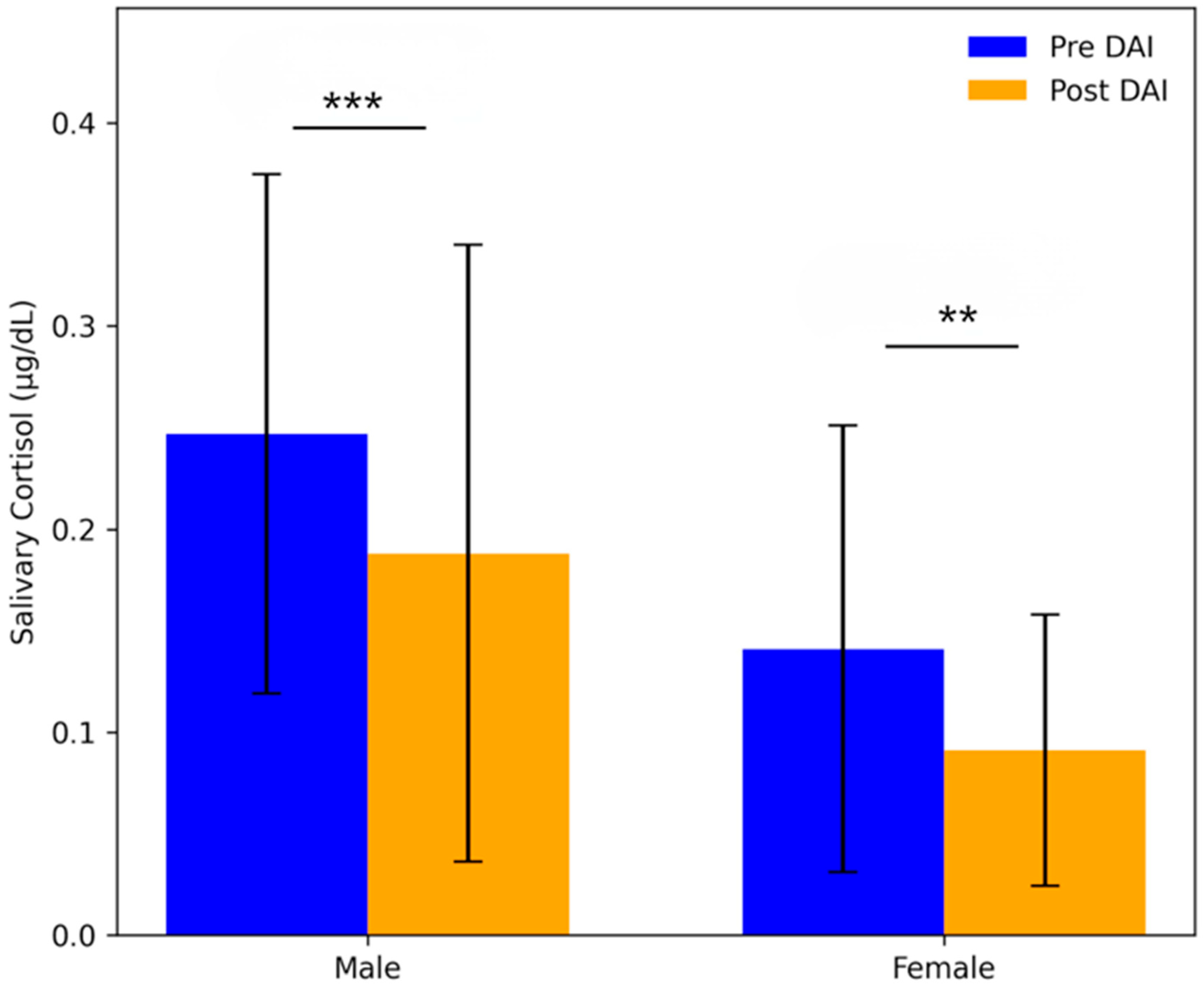
| Male participants pre DAI 1 | 0.262 ± 0.172 | 0.225 (0.135–0.349) | 0.067–0.470 |
| Male participants post DAI | 0.179 ± 0.145 | 0.143 (0.114–0.230) | 0.022–0.831 |
| Female participants pre DAI | 0.131 ± 0.110 | 0.093 (0.086–0.164) | 0.024–0.376 |
| Female participants post DAI | 0.081 ± 0.066 | 0.075 (0.042–0.121) | 0.018–0.240 |
| Salivary Cortisol (µg/dL) | Test | p | Effect Size | |
|---|---|---|---|---|
| Male vs. Female (Pre-DAI 1) | 0.262 vs. 0.131 | Mann–Whitney-U | 0.031 * | r = 0.34 |
| Male vs. Female (Post-DAI) | 0.179 vs. 0.081 | Mann–Whitney-U | 0.042 * | r = 0.33 |
Disclaimer/Publisher’s Note: The statements, opinions and data contained in all publications are solely those of the individual author(s) and contributor(s) and not of MDPI and/or the editor(s). MDPI and/or the editor(s) disclaim responsibility for any injury to people or property resulting from any ideas, methods, instructions or products referred to in the content. |
© 2026 by the authors. Licensee MDPI, Basel, Switzerland. This article is an open access article distributed under the terms and conditions of the Creative Commons Attribution (CC BY) license.
Share and Cite
Foltin, S.; Kostenko, S.; Glenk, L.M. Dog-Assisted Interventions Reduce Salivary Cortisol in Ukrainian Military Personnel with Post-Traumatic Stress Disorder (PTSD): A Pilot Study. Psychiatry Int. 2026, 7, 101. https://doi.org/10.3390/psychiatryint7030101
Foltin S, Kostenko S, Glenk LM. Dog-Assisted Interventions Reduce Salivary Cortisol in Ukrainian Military Personnel with Post-Traumatic Stress Disorder (PTSD): A Pilot Study. Psychiatry International. 2026; 7(3):101. https://doi.org/10.3390/psychiatryint7030101
Chicago/Turabian StyleFoltin, Sandra, Svitlana Kostenko, and Lisa Maria Glenk. 2026. "Dog-Assisted Interventions Reduce Salivary Cortisol in Ukrainian Military Personnel with Post-Traumatic Stress Disorder (PTSD): A Pilot Study" Psychiatry International 7, no. 3: 101. https://doi.org/10.3390/psychiatryint7030101
APA StyleFoltin, S., Kostenko, S., & Glenk, L. M. (2026). Dog-Assisted Interventions Reduce Salivary Cortisol in Ukrainian Military Personnel with Post-Traumatic Stress Disorder (PTSD): A Pilot Study. Psychiatry International, 7(3), 101. https://doi.org/10.3390/psychiatryint7030101