1. Introduction
Schizoaffective disorder is a chronic and complex psychiatric illness that significantly impacts an individual’s overall functioning. Severe cases that do not respond to conventional pharmacological treatment present a significant clinical challenge, necessitating personalised therapeutic strategies [
1,
2]. The coexistence of this pathology alongside endocrine dysfunctions and chronic inflammatory diseases, such as psoriasis, raises questions regarding shared pathophysiological mechanisms.
Psoriasis is a chronic, immune-mediated inflammatory disease that primarily affects the skin but can also present with systemic manifestations and relevant comorbidities. Its most common form, plaque psoriasis, is characterized by erythematous, scaly lesions typically located on extensor surfaces, the scalp, and the lower back. The pathogenesis involves a genetic predisposition and dysregulation of the IL-23/Th17 axis, leading to keratinocyte hyperproliferation and persistent inflammation [
3,
4]. Of particular interest is the potential role of persistent systemic inflammation in the development and maintenance of both psychopathological and somatic symptoms [
5,
6].
The presence of these three chronic conditions together is particularly relevant due to possible interconnections through common immunoinflammatory mechanisms, parallel clinical evolution between the psychiatric and dermatological domains, and the importance of an integrated approach [
7]. This case report aims to stimulate reflection on the need for a more holistic understanding of complex psychopathological conditions.
We aimed to analyse the role of chronic systemic inflammation in psychiatric disorders, using a clinical case report of treatment-resistant schizoaffective disorder in a patient with psoriasis and hypophysitis. We explored the effects of psychopharmacological treatment on the progression of both psychiatric symptoms and psoriatic lesions. This case is reported in accordance with the CARE (CAse REport) Statement and Checklist [
8]. Informed consent was obtained in accordance with the Declaration of Helsinki.
2. Clinical Case Description
This case report was approved by the Ethics Committee Santo António/ICBAS. This report was conducted in accordance with the principles of the Declaration of Helsinki and informed consent was obtained from the subject involved in the study. Patient J is a 40-year-old single, childless Caucasian male. He has lived alone since his mother died three years ago and is from a low socio-economic background with poor social support. He has been under the care of a psychiatrist since early adulthood, having been diagnosed with severe, treatment-resistant schizoaffective disorder. He has experienced multiple episodes of psychotic decompensation requiring hospitalisation, and has a history of treatment resistance, as evidenced by his lack of response to at least two different antipsychotics administered at appropriate doses and durations. During a previous hospitalisation two years ago, he underwent electroconvulsive therapy due to positive symptoms, but this was not beneficial.
Patient J’s first psychotic episode occurred at the age of 19. He reported delusional ideation of a mystical–persecutory nature involving “occult forces” but said that he had been protected from them by divine intervention. Throughout his clinical evolution, he did not experience complete remission of the mystical delusional core. He had recurrent episodes of severe psychotic decompensation and mood decompensation. There were also progressive social isolation and cognitive deterioration despite adherence to therapy.
He also had a history of hypothyroidism and hypocortisolism, which was identified during an endocrinology consultation. The ACTH stimulation test revealed cortisol levels consistent with secondary adrenal insufficiency. Thyroid hormone levels were consistent with secondary hypothyroidism. IGF-1 levels were normal. FSH, LH and total testosterone values were consistent with preserved gonadotrophic function. Prolactin levels were increased, presumably due to an iatrogenic cause. A cranial MRI scan showed diffused prominence of cerebrospinal fluid circulation pathways, consistent with cerebral atrophy, slightly greater than expected for the patient’s age. The pituitary gland shows normal morphology and dimensions, with no expansive lesions but with homogeneous post-contrast gadolinium enhancement. A mild right lateral deviation of the pituitary stalk is noted. These findings are suggestive of hypophysitis. Patient J was prescribed levothyroxine (0.050 mg/day) and prednisolone (5 mg/day), which were tolerated well.
Patient J had a history of chronic plaque psoriasis for over 20 years, previously managed with several topical therapies (calcipotriol, betamethasone, coaltar, tacrolimus and pimecrolimus). However, he had not been under dermatological care for the past 11 years and was not under active treatment at the time of hospitalisation. Notably, he reported worsening of skin lesions during periods of psychiatric decompensation, raising the possibility of an interaction between systemic inflammatory activity and psychopathological instability. To the best of our knowledge, there was no exposure to environmental, occupational, or chemical factors in the patient’s usual routine that could have contributed to worsening psoriasis.
The medication that Patient J reported taking included: 150 mg of paliperidone depot and 100 mg of haloperidol decanoate every 21 days; 800 mg of amisulpride; 1 mg of lorazepam at bedtime; 5 mg of prednisolone; and 0.05 mg of levothyroxine.
Patient J was admitted to the emergency department in April 2025 due to an exacerbation of his psychopathological condition. Upon arrival, he appeared visibly distressed and tearful, exhibiting disorganised speech and a strong focus on delusional themes of a mystical–religious nature. He manifested delusions of grandeur, guilt and ruin, displaying significant emotional distress, and claimed to be “God’s chosen one’” on a mission to “prevent the third world war”, “heal with his hands” and “end world hunger”. He also expressed the belief that he had failed a ‘divine test’, and that he was now condemned to a fate of ‘suffering and misery’, considering himself deserving of a ‘divine punishment’. He interpreted events in his daily life as delusional, attributing pathological significance to coincidences and banal occurrences. For example, he said that “in January I stopped praying, in February I didn’t pray, and only in March did I return; I sinned” and interpreted this sequence as the beginning of divine punishment. He also mentioned having ‘insulted the Holy Spirit through improper thoughts’, believing that these had “collective consequences”. He reported receiving daily signs, either through comments made by people who ‘wanted to give him messages’, or through the appearance of bird feathers, which he attributed symbolic or mystical significance to.
On initial examination of his mental state, he was conscious and alert, oriented in time, space, and person. He appeared careful and cooperative, made fleeting eye contact, and his attention could be captured and fixed. His mood was depressed, with congruent affect, his speech was pressured, with no evidence of a flight of ideas. He had delusions of grandeur and ruin centred on a mystical–religious theme, with marked associated anguish. There were no alterations in sensory perception. He had no ideation of self-injury or homicide and did not criticise his illness.
At the time of assessment, Patient J had a BMI of 23 kg/m2 and a waist circumference of 84 cm. Normal blood pressure values were consistently reported. There was no family history of premature cardiovascular disease. Laboratory screening showed a fasting glucose of 78 mg/dL, HbA1c of 5.1%, total cholesterol of 200 mg/dL, LDL-C 131 mg/dL, VLDL-C 19 mg/dL, HDL-C 50 mg/dL, and triglycerides of 97 mg/dL.
2.1. Outcome Measures
To comprehensively assess the clinical presentation and treatment response in the psychopathological and dermatological domains, the Transdiagnostic Global Impression–Psychopathology (TGI-P) and Psoriasis Area and Severity Index (PASI) score, respectively, were used.
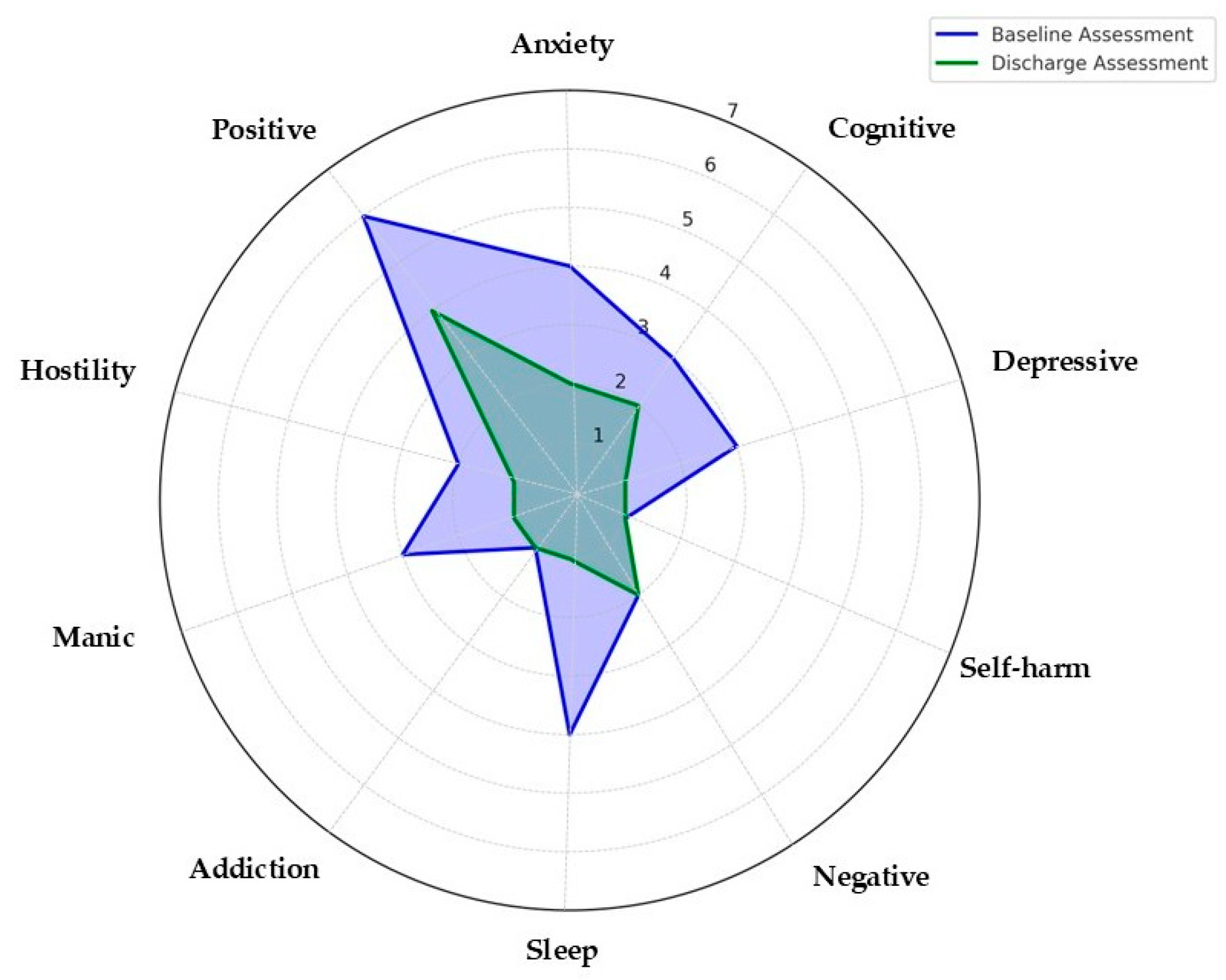
The TGI-P scale was used to evaluate and monitor the severity of psychosis symptoms [
9]. The TGI-P extends the Clinical Global Impression–Severity Scale (CGI-S) by encompassing ten transdiagnostic symptom domains: positive symptoms, negative symptoms, manic symptoms, depressive symptoms, addiction-related symptoms, cognitive symptoms, anxiety symptoms, sleep symptoms, hostility symptoms, and self-harm symptoms. Each domain is rated on a seven-point Likert scale (from 1 to 7), with higher scores indicating greater symptom severity. The TGI-P also facilitates visual depictions of individual symptom profiles, providing a more comprehensive understanding of patients’ psychopathological presentations. Three psychiatrists (R.M.P., R.D. and F.C.) conducted the assessment independently, each blinded to the evaluations of the others. Inter-rater agreement was calculated by dividing the number of domains with identical scores among the raters by the total number of domains (7) and multiplying by 100 to get the percentage of identical ratings across the seven symptom domains of the TGI-P. After the independent assessments were completed, the same raters participated in a consensus discussion to produce a single, unified evaluation. Therefore, the inter-rater agreement across the ten TGI-P symptom domains in the baseline assessment was 70%, corresponding to seven out of ten identical ratings among the evaluators. By the final assessment, full agreement was reached, with 100% concordance across all ten symptom ratings.
The PASI score is a validated tool to assess psoriasis severity, combining lesion characteristics with the extent of body surface involvement [
10,
11]. It evaluates four anatomical regions: head and neck (HN), upper limbs (UL), trunk (T), and lower limbs (LL). For each region, the extent of skin involvement is rated with a numerical value reflecting the percentage of surface area affected: 1 (0–9%), 2 (10–29%), 3 (30–49%), 4 (50–69%), 5 (70–89%), or 6 (90–100%). Additionally, in each area (HN, UL, T, LL), the severity of three plaque characteristics—erythema, induration/thickness, and scaling/desquamation—is measured on a 5-point scale: 0 (none), 1 (mild), 2 (moderate), 3 (severe), and 4 (very severe). The resulting score can range from 0 (no disease) to 72 (maximal clinical disease manifestation).
2.2. Intervention
During his hospitalisation, his depot therapeutic regimen was maintained, and he was given clozapine in a titration regimen of up to 150 mg per day. Patient J showed a favourable psychopathological response to clozapine. However, he experienced significant sialorrhoea, prompting discontinuation of the drug due to its potential to compromise adherence to oral treatment. It was decided to switch to olanzapine at a dose of 20 mg per day to maintain clinical improvement with no associated adverse effects.
Patient J was discharged on depot antipsychotic therapy (haloperidol + paliperidone), alongside oral olanzapine (20 mg/day). Metabolic risk will be monitored during follow-up outpatient consultations.
3. Outcomes
Discharge assessment indicated positive changes in measured outcomes. The patient’s overall psychopathological profile as measured by the TGI-P scores demonstrated a marked improvement from the initial to the final assessment. At baseline, elevated scores were observed in domains such as anxiety (4), sleep disturbances (4), positive symptoms (6) and manic symptoms (3), indicating significant clinical distress. By the end of the intervention, however, notable reductions were evident across nearly all domains. Anxiety decreased to 2, depressive symptoms to 1 and sleep disturbances to 1, while positive symptoms decreased to 4. Domains such as self-harm, addiction, and negative symptoms either remained stable or improved slightly, reflecting clinical stability (
Figure 1).
On admission, Patient J presented with erythematous scaly plaques, consistent with chronic plaque psoriasis, involving the: periocular region (moderate erythema and fine scaling); retroauricular and scalp regions (mild scaling); elbows, lateral aspects of the legs, thighs and trunk (moderate erythema and fine to coarse scaling). The estimated PASI score was 8.3, corresponding to moderate to severe disease (
Table 1). At discharge, following stabilization of the psychiatric condition, there was a significant improvement of the cutaneous findings. Lesions had completely resolved on the head, trunk and thighs, remaining only post-inflammatory hyperpigmentation, residual scaling on the elbows and a few erythematous plaques on the legs. The estimated PASI score at discharge was 1.8, indicating a reduction to mild disease severity (
Table 1).
Examination of his mental state revealed that he was conscious and alert, oriented in time, space and person. He appeared careful and cooperative, maintained eye contact and had an attentive and fixed gaze. His mood was euthymic, with congruent affect, and his speech was normal in tone and rate. He verbalised ideas of a delusional nature with less dynamism and without associated distress. There were no alterations in sensory perception or self-injurious ideation. He is partially critical of his illness and realises that he needs treatment. His sleep–wake cycle is regular. His appetite is maintained.
4. Discussion
This clinical case report allows us to explore the interaction between severe and treatment-resistant psychosis, endocrine dysfunction due to hypophysitis and chronic plaque psoriasis, considering chronic systemic inflammation as a common pathophysiological axis.
The monoamine hypothesis has been considered the basis of most psychiatric disorders. However, marked clinical heterogeneity, variability in the progression of illnesses, and different responses to treatment suggest the involvement of additional mechanisms. Growing evidence of the immune system’s involvement in psychiatric disorders could contribute to a paradigm shift, paving the way for new therapeutic approaches and a more comprehensive understanding of their aetiopathogenesis. Moving from a syndrome-centred approach to one that focuses on individual symptoms or symptom clusters could help to identify specific links between clinical phenotypes and underlying biological mechanisms. This could shed light on the role of the immune system in the aetiopathogenesis of psychiatric illnesses. In this regard, the literature has mainly focused on describing the link between inflammatory diseases and schizophrenia and mood disorders. Schizoaffective disorder, which shares clinical characteristics with these disorders, has been relatively neglected, despite its hybrid nature potentially reflecting a common aetiopathogenic basis. Therefore, in this case, we extrapolate the results described for schizophrenia and mood disorders to more general affective-psychotic syndromes, such as schizoaffective disorder.
Recent studies have shown that levels of inflammatory markers increase during acute psychotic episodes and tend to normalise with symptomatic remission. However, in cases of treatment-resistant psychosis, these levels remain persistently high. This suggests that inflammatory processes may be involved in the pathophysiology of therapy resistance [
12,
13,
14].
The T helper 17 (Th17) pathway has been consistently implicated in the pathophysiology of treatment-resistant schizophrenia and is one of the primary immuno-inflammatory pathways associated with persistent symptoms and therapeutic resistance [
15]. According to Leboyer et al. (2021) patients with treatment-resistant schizophrenia, including those with ultra-refractory resistance to clozapine, had significantly higher levels of cytokines associated with Th17 pathway activation, such as IL-17A, IL-6, IL-10 and IL-12/IL-23p40 [
16].
Psoriasis is a chronic immune-mediated inflammatory disease primarily driven by the IL-23/Th17 axis, promoting persistent systemic inflammation [
17]. This chronic inflammation can compromise the integrity of the blood–brain barrier, thereby facilitating the migration of T lymphocytes to the central nervous system and enhancing neuroinflammatory phenomena characterised by increased T lymphocyte density and microglial activation [
18,
19]. Additionally, evidence suggests that Th17 cells are the primary drivers of pituitary inflammation in hypophysitis [
20]. These mechanisms are increasingly being implicated in the pathophysiology of psychosis [
21]. Concurrently, evidence suggests increased expression of dopamine receptors in T cells, notably the D3 receptor, in individuals with schizophrenia. Stimulation of D5 dopamine receptors in dendritic cells has been associated with the amplification of Th17 immunity, whereas the inhibition of D1 receptors appears to mitigate this differentiation process. Therefore, given the established hyperdopaminergic hypothesis of schizophrenia, it is conceivable that this exacerbates the Th17 response, perpetuating chronic inflammatory states in the central nervous system [
21].
As Moynihan et al. (2010) described, there is a biological interconnection between depression, anxiety, and psoriasis [
22]. This is consistent with the central characteristics of Patient J’s symptomatology. Given that selective serotonin reuptake inhibitors promote a downregulation of T-cell proliferation [
23], it would be important to clarify their role in improving psoriasis, as well as the possible benefit of antipsychotics.
The presence of secondary hypocortisolism in Patient J creates an additional vulnerability axis with significant implications for the stress response and immune modulation. In situations involving psychological stress, the sympathetic nervous system becomes activated, resulting in the release of noradrenaline. Without adequate cortisol levels, the pro-inflammatory effect of catecholamines on macrophages becomes predominant. This promotes the release of inflammatory cytokines, contributing to sustained immune activation and worsening of psychiatric symptoms [
5]. Furthermore, cortisol deficiency may be associated with resistance to psychopharmacological treatment [
13].
This case report emphasises the importance of considering immunological factors when conceptualising refractory psychiatric phenotypes. The observation of a simultaneous improvement in both psychotic symptoms and psoriatic skin lesions following psychopharmacological stabilisation, without the introduction of targeted therapy, strengthens the likelihood of a shared systemic inflammatory state being the underlying cause of both conditions [
24].
Undoubtedly, when associated with chronic inflammatory diseases such as psoriasis and hypophysitis, schizoaffective disorder may represent a clinical manifestation of a dysfunctional neuroimmune phenotype. Recognising these patterns early on could allow for more targeted therapeutic interventions, including the introduction of anti-inflammatory or immunomodulatory strategies. A truly integrated approach that brings together psychiatry, dermatology and endocrinology is fundamental for overcoming therapeutic barriers and improving the functional prognosis of these patients.
This clinical case report exemplifies the intricate relationship between treatment-resistant psychosis, endocrine dysfunction caused by suspected autoimmune hypophysitis, and a chronic inflammatory skin condition. Patient J’s clinical trajectory, characterised by long-standing schizoaffective disorder, recurrent psychotic exacerbations, a partial response to clozapine and endocrine abnormalities, occurs in a context of systemic inflammation. The occurrence of psoriasis, secondary hypocortisolism and an MRI pattern suggestive of hypophysitis supports the hypothesis that a shared immuno-inflammatory axis underlies the patient’s neuropsychiatric and somatic symptoms. The improvement in both psychotic symptoms and psoriatic skin lesions following psychopharmacological stabilisation, despite the absence of active dermatological treatment, further supports the possibility of a common pathophysiological process driven by immune dysregulation, potentially involving activation of the Th17 pathway. Patient J thus exemplifies how chronic peripheral inflammation can contribute to central neuroinflammatory mechanisms, therapeutic resistance and multisystemic involvement. His case therefore serves as a compelling example of how immunoendocrine dysfunction can affect the severity of psychiatric conditions and highlights the importance of an integrative, cross-disciplinary approach to managing complex, refractory psychiatric conditions.
Limitations
This report has several important limitations. Firstly, as it is a single case report, it is not possible to establish causal relationships between psychiatric and dermatological clinical evolution and the proposed immunological mechanisms; only plausible hypotheses can be raised based on the available literature. Secondly, the absence of serum dosages of specific inflammatory biomarkers prevents the empirical validation of the underlying inflammatory hypothesis in this patient. Thirdly, the lack of a longitudinal assessment of hormone levels during hospitalisation prevents a dynamic analysis of the interaction between hypothalamic–pituitary–adrenal axis dysfunction and the psychiatric and immune clinical state. Additionally, no complementary tests were performed to confirm blood–brain barrier dysfunction or active neuroinflammation. Furthermore, the MRI was performed in a private setting and only the written report was available, limiting detailed assessment. For future cases, obtaining high-quality MRI images through collaboration with the radiology department is recommended. Lastly, the positive response to antipsychotic treatment could be due to multiple pharmacodynamic factors and not exclusively to immunomodulatory effects.
5. Conclusions
This clinical case report emphasises the importance of recognising psychiatric phenotypes that may be driven by systemic inflammatory processes. The presence of psoriasis, hypophysitis and treatment-resistant psychosis together suggests that immune dysregulation, particularly via the Th17 pathway, may be a unifying factor in various clinical manifestations. Early identification of such patterns could enable more targeted interventions, such as adjuvant anti-inflammatory strategies, the more precise selection of psychotropic drugs with an immunomodulatory profile, and integrated clinical surveillance. Such a multidisciplinary approach can help to overcome therapeutic resistance and improve the functional prognosis of complex patients.





 and
and