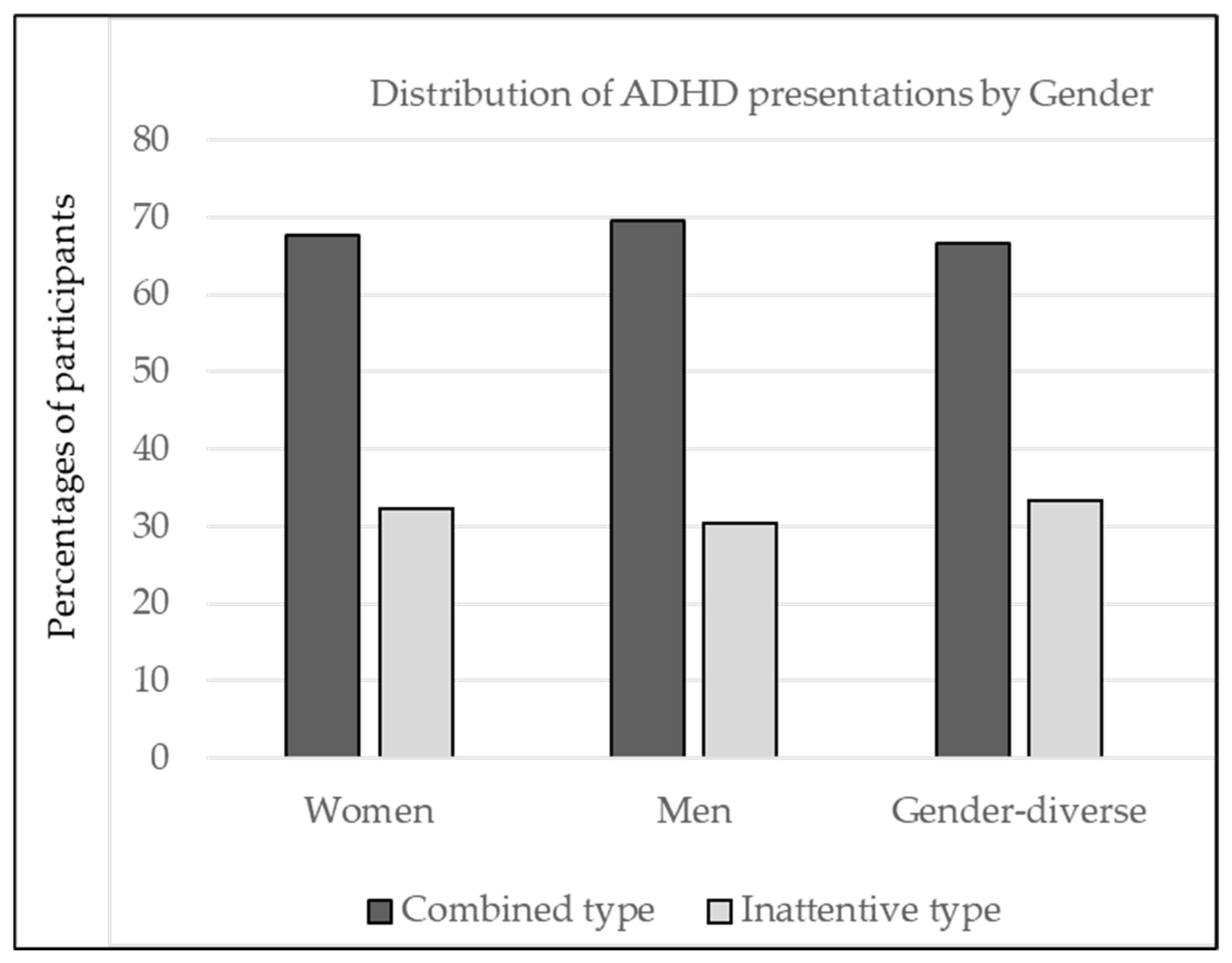

Demographic and Psychosocial Correlates of Adult ADHD Subtypes in Rural Canada: A Gender-Based Analysis


Abstract
1. Introduction
2. Materials and Methods
2.1. Study Design
2.2. Participants and Recruitment
2.3. Measures
2.4. Statistical Analysis
3. Results
3.1. Sample Characteristics and ADHD Subtype Distribution
3.2. Bivariate Associations Among ADHD Subtype, Demographic and Psychosocial Variables
3.3. Factors Associated with ADHD Diagnostic Subtype (Combined vs. Inattentive)
3.4. Gender-Based Stratified Analyses of ADHD Subtypes
4. Discussion
5. Strengths and Limitations
6. Implications for Practice
7. Conclusions
Author Contributions
Funding
Institutional Review Board Statement
Informed Consent Statement
Data Availability Statement
Conflicts of Interest
References
- Fayyad, J.; Sampson, N.A.; Hwang, I.; Adamowski, T.; Aguilar-Gaxiola, S.; Al-Hamzawi, A.; Andrade, L.H.; Borges, G.; de Girolamo, G.; Florescu, S.; et al. The descriptive epidemiology of DSM-IV adult ADHD in the World Mental Health Surveys. ADHD Atten. Deficit Hyperact. Disord. 2017, 9, 47–65. [Google Scholar] [CrossRef] [Scilit]
- Platania, N.M.; Starreveld, D.E.J.; Wynchank, D.; Beekman, A.T.F.; Kooij, J.J.S. Bias by gender: Exploring gender-based differences in the endorsement of ADHD symptoms and impairment among adult patients. Front. Glob. Women’s Health 2025, 6, 1549028. [Google Scholar] [CrossRef] [Scilit] [PubMed]
- Espinet, S.D.; Graziosi, G.; Toplak, M.E.; Hesson, J.; Minhas, P. A Review of Canadian Diagnosed ADHD Prevalence and Incidence Estimates Published in the Past Decade. Brain Sci. 2022, 12, 1051. [Google Scholar] [CrossRef] [Scilit] [PubMed]
- Faraone, S.V. Attention deficit hyperactivity disorder and premature death. Lancet 2015, 385, 2132–2133. [Google Scholar] [CrossRef] [Scilit] [PubMed]
- Bogdańska-Chomczyk, E.; Majewski, M.K.; Kozłowska, A. ADHD in adulthood: Clinical presentation, comorbidities, and treatment perspectives. Int. J. Mol. Sci. 2025, 26, 11020. [Google Scholar] [CrossRef] [Scilit]
- Murphy, K.R.; Barkley, R.A. Occupational functioning in adults with ADHD. ADHD Rep. 2007, 15, 6–10. [Google Scholar] [CrossRef] [Scilit]
- Ersoy, M.A.; Topçu Ersoy, H. Gender-role attitudes mediate the effects of adult ADHD on marriage and relationships. J. Atten. Disord. 2019, 23, 40–50. [Google Scholar] [CrossRef] [Scilit]
- Quintero, J.; Morales, I.; Vera, R.; Zuluaga, P.; Fernández, A. The impact of adult ADHD on quality of life. J. Atten. Disord. 2019, 23, 1007–1016. [Google Scholar] [CrossRef] [Scilit]
- Kessler, R.C.; Adler, L.; Barkley, R.; Biederman, J.; Conners, C.K.; Demler, O.; Faraone, S.V.; Greenhill, L.L.; Howes, M.J.; Secnik, K.; et al. The prevalence and correlates of adult ADHD in the United States: Results from the National Comorbidity Survey Replication. Am. J. Psychiatry 2006, 163, 716–723. [Google Scholar] [CrossRef] [Scilit]
- Eklund, H.; Cadman, T.; Findon, J.; Hayward, H.; Howley, D.; Beecham, J.; Xenitidis, K.; Murphy, D.; Asherson, P.; Glaser, K. Clinical service use as people with ADHD transition into adolescence and adulthood. BMC Health Serv. Res. 2016, 16, 248. [Google Scholar] [CrossRef] [Scilit]
- Culpepper, L.; Mattingly, G. Challenges in identifying and managing attention-deficit/hyperactivity disorder in adults in the primary care setting: A review of the literature. Prim. Care Companion J. Clin. Psychiatry 2010, 12, PCC.10r00951. [Google Scholar] [CrossRef] [Scilit] [PubMed]
- Faber, S.C.; Osman, M.; Williams, M.T. Access to mental health care in Canada. Int. J. Ment. Health 2023, 52, 312–334. [Google Scholar] [CrossRef] [Scilit]
- Pong, R.W.; Desmeules, M.; Lagacé, C. Rural–urban disparities in health in Canada and Australia. Aust. J. Rural Health 2009, 17, 58–64. [Google Scholar] [CrossRef] [Scilit] [PubMed]
- Goetz, T.G.; Adams, N. The transgender and gender-diverse ADHD nexus: A systematic review. J. Gay Lesbian Ment. Health 2024, 28, 2–19. [Google Scholar] [CrossRef] [Scilit]
- Rucklidge, J.J. Gender differences in ADHD: Implications for psychosocial treatments. Expert Rev. Neurother. 2010, 10, 247–260. [Google Scholar] [CrossRef] [Scilit]
- Sobanski, E.; Brüggemann, D.; Alm, B.; Kern, S.; Deschner, M.; Schubert, T.; Philipsen, A.; Rietschel, M. Psychiatric comorbidity and functional impairment in adults with ADHD. Eur. Arch. Psychiatry Clin. Neurosci. 2007, 257, 371–377. [Google Scholar] [CrossRef] [Scilit]
- Skirrow, C.; Asherson, P. Emotional lability, comorbidity, and impairment in adult ADHD. J. Affect. Disord. 2013, 147, 80–86. [Google Scholar] [CrossRef] [Scilit]
- Quinn, P.O.; Madhoo, M. A review of attention-deficit/hyperactivity disorder in women and girls: Uncovering this hidden diagnosis. Prim. Care Companion CNS Disord. 2014, 16, 27250. [Google Scholar] [CrossRef] [Scilit]
- Young, S.; Adamo, N.; Ásgeirsdóttir, B.B.; Branney, P.; Beckett, M.; Colley, W.; Cubbin, S.; Deeley, Q.; Farrag, E.; Gudjonsson, G.; et al. Females with ADHD: An expert consensus statement. BMC Psychiatry 2020, 20, 404. [Google Scholar] [CrossRef] [Scilit]
- Hinshaw, S.P.; Nguyen, P.T.; O’Grady, S.M.; Rosenthal, E.A. ADHD in girls and women: Underrepresentation and key directions. J. Child Psychol. Psychiatry 2022, 63, 484–496. [Google Scholar] [CrossRef] [Scilit]
- Kooij, J.J.S.; Bijlenga, D.; Salerno, L.; Jaeschke, R.; Bitter, I.; Balázs, J.; Thome, J.; Dom, G.; Kasper, S.; Filipe, C.N.; et al. Updated European Consensus Statement on diagnosis and treatment of adult ADHD. Eur. Psychiatry 2019, 56, 14–34. [Google Scholar] [CrossRef] [Scilit]
- Hartung, C.M.; Lefler, E.K.; Abu-Ramadan, T.M.; Stevens, A.E.; Serrano, J.W.; Miller, E.A.; Shelton, C.R. A call to analyze sex, gender, and sexual orientation in psychopathology research. J. Psychopathol. Behav. Assess. 2025, 47, 18. [Google Scholar] [CrossRef] [Scilit]
- Caxaj, C.S. Mental health approaches for rural communities in Canada. Can. J. Community Ment. Health 2016, 35, 29–45. [Google Scholar] [CrossRef] [Scilit]
- Government of Canada, Women and Gender Equality Canada. What Is Gender-Based Analysis Plus (GBA+)? Available online: https://www.canada.ca/en/women-gender-equality/gender-based-analysis-plus/what-gender-based-analysis-plus.html (accessed on 20 December 2025).
- American Psychiatric Association. Diagnostic and Statistical Manual of Mental Disorders, 5th ed.; APA Publishing: Washington, DC, USA, 2013. [Google Scholar] [CrossRef] [Scilit]
- Hong, M.; Kooij, J.J.S.; Kim, B.; Joung, Y.-S.; Yoo, H.K.; Kim, E.-J.; Lee, S.I.; Bhang, S.-Y.; Lee, S.Y.; Han, D.H.; et al. Validity of the Korean version of DIVA-5. Neuropsychiatr. Dis. Treat. 2020, 16, 2371–2380. [Google Scholar] [CrossRef] [Scilit] [PubMed]
- Zamani, L.; Shahrivar, Z.; Alaghband-Rad, J.; Sharifi, V.; Davoodi, E.; Ansari, S.; Emari, F.; Wynchank, D.; Kooij, J.J.S.; Asherson, P. Reliability, Criterion and Concurrent Validity of the Farsi Translation of DIVA-5: A Semi-Structured Diagnostic Interview for Adults with ADHD. J. Atten. Disord. 2021, 25, 1666–1675. [Google Scholar] [CrossRef] [Scilit] [PubMed]
- Di Lorenzo, R.; Latella, E.; Gualtieri, F.; Adriani, A.; Ferri, P.; Filippini, T. Validity of the Italian version of DIVA-5. Healthcare 2025, 13, 244. [Google Scholar] [CrossRef] [Scilit]
- IBM Corp. IBM SPSS Statistics for Windows, Version 28; IBM Corp.: Armonk, NY, USA, 2021.
- Agresti, A. Categorical Data Analysis, 3rd ed.; Wiley: Hoboken, NJ, USA, 2013. [Google Scholar]
- Peduzzi, P.; Concato, J.; Kemper, E.; Holford, T.R.; Feinstein, A.R. Simulation study of events per variable in logistic regression. J. Clin. Epidemiol. 1997, 49, 1373–1379. [Google Scholar] [CrossRef] [Scilit]
- Faraone, S.V.; Asherson, P.; Banaschewski, T.; Buitelaar, J.K.; Ramos-Quiroga, J.A.; Rohde, L.A.; Sonuga-Barke, E.J.S.; Tannock, R. Attention-deficit/hyperactivity disorder. Nat. Rev. Dis. Primers 2021, 1, 15020. [Google Scholar] [CrossRef] [Scilit]
- Faraone, S.V.; Biederman, J.; Mick, E. Age-dependent decline of ADHD. Psychol. Med. 2006, 36, 159–165. [Google Scholar] [CrossRef] [Scilit]
- Gershon, J.; Gershon, J. Meta-analytic review of gender differences in ADHD. J. Atten. Disord. 2002, 5, 143–154. [Google Scholar] [CrossRef] [Scilit]
- Arnett, A.B.; Pennington, B.F.; Willcutt, E.G.; DeFries, J.C.; Olson, R.K. Sex differences in ADHD symptom severity. J. Child Psychol. Psychiatry 2015, 56, 632–639. [Google Scholar] [CrossRef] [Scilit] [PubMed]
- Mowlem, F.D.; Agnew-Blais, J.; Taylor, E.; Asherson, P. Sex differences in predicting ADHD diagnosis and treatment. Psychiatry Res. 2019, 272, 765–773. [Google Scholar] [CrossRef] [Scilit] [PubMed]
- Kosheleff, A.R.; Mason, O.; Jain, R.; Koch, J.; Rubin, J. Functional impairments and pharmacological treatment in adult ADHD. J. Atten. Disord. 2023, 27, 669–697. [Google Scholar] [CrossRef] [Scilit]
- Williamson, D.; Johnston, C. Gender differences in adults with ADHD. Clin. Psychol. Rev. 2015, 40, 15–27. [Google Scholar] [CrossRef] [Scilit] [PubMed]
- de la Peña, I.C.; Pan, M.C.; Thai, C.G.; Alisso, T. Attention-Deficit/Hyperactivity Disorder Predominantly Inattentive Subtype/Presentation: Research Progress and Translational Studies. Brain Sci. 2020, 10, 292. [Google Scholar] [CrossRef] [Scilit]
- Cortese, S.; Adamo, N.; Del Giovane, C.; Mohr-Jensen, C.; Hayes, A.J.; Carucci, S.; Atkinson, L.Z.; Tessari, L.; Banaschewski, T.; Coghill, D.; et al. Comparative efficacy and tolerability of ADHD medications. Lancet Psychiatry 2018, 5, 727–738. [Google Scholar] [CrossRef] [Scilit]
- Mattingly, G.; Weisler, R.; Dirks, B.; Babcock, T.; Adeyi, B.; Scheckner, B.; Lasser, R. Attention deficit hyperactivity disorder subtypes and symptom response in adults treated with lisdexamfetamine dimesylate. Innov. Clin. Neurosci. 2012, 9, 22–30. [Google Scholar]
- Kooij, S.J.J.; Bejerot, S.; Blackwell, A.; Caci, H.; Casas-Brugué, M.; Carpentier, P.J.; Edvinsson, D.; Fayyad, J.; Foeken, K.; Fitzgerald, M.; et al. European consensus statement on adult ADHD. BMC Psychiatry 2010, 10, 67. [Google Scholar] [CrossRef] [Scilit]
- Kleinman, A. Patients and Healers in the Context of Culture: An Exploration of the Borderland Between Anthropology, Medicine, and Psychiatry; University of California Press: Berkeley, CA, USA, 1980. [Google Scholar]


| Characteristics | Frequencies (n) | Percentage (%) |
|---|---|---|
| Gender Identity | ||
| Women | 419 | 63.5 |
| Men | 222 | 33.6 |
| Gender-diverse | 19 | 2.9 |
| Age (at the time of diagnosis) | ||
| Young adult (20–40) | 408 | 61.8 |
| Middle age (41–60) | 211 | 32.0 |
| Older adult (61+) | 41 | 6.2 |
| ADHD Subtype | ||
| Combined type | 442 | 67.0 |
| Inattentive type | 200 | 30.3 |
| Hyperactive/impulsive type | 18 | 2.7 |
| Employment status | ||
| No | 328 | 49.7 |
| Yes | 332 | 50.3 |
| Marital status | ||
| Single | 321 | 48.6 |
| Married/common-law | 276 | 41.8 |
| Separated/divorced/widowed | 63 | 9.5 |
| Prescribed ADHD medication | ||
| No | 310 | 47.0 |
| Yes | 350 | 53.0 |
| Comorbidity | ||
| None | 235 | 35.6 |
| Internalizing (PDD OCD, BED & GAD) | 218 | 33.0 |
| Borderline personality disorder | 121 | 18.3 |
| Externalizing/Neurodevelopmental (ASD & Substance use disorder) | 86 | 13.0 |
| Variables | χ2 | df | p |
|---|---|---|---|
| Gender identity (women, men, gender-diverse) | 0.225 | 2 | 0.893 |
| Age group (young, middle, older adult) | 1.29 | 2 | 0.525 |
| Comorbidity (none, internalizing, externalizing/neurodevelopmental, and borderline personality disorder) | 9.16 | 3 | 0.027 * |
| Prescribed ADHD medication (no, yes) | 12.36 | 1 | 0.001 * |
| Marital status (single, married/common-law, other) | 1.78 | 2 | 0.411 |
| Employment status (no, yes) | 0.88 | 1 | 0.349 |
| Variables | Reference Category | OR | 95% CI | p |
|---|---|---|---|---|
| Comorbidity | None | 0.945 | 0.808–1.106 | 0.484 |
| Age group | Young adult | 0.929 | 0.696–1.242 | 0.621 |
| Gender identity | Women | 1.043 | 0.759–1.433 | 0.797 |
| Prescribed ADHD medication | Yes | 0.544 | 0.384–0.771 | 0.001 |
| Employment status | Employed | 0.947 | 0.669–1.340 | 0.757 |
| Marital status | Single | 0.869 | 0.660–1.145 | 0.318 |
| Variables | Women (n = 403) | Men (n = 210) | Gender-Diverse (n = 18) |
|---|---|---|---|
| Age group | ns | ns | Descriptive only |
| Comorbidity | ns | ns | Descriptive only |
| Prescribed ADHD medication | p = 0.002 | p = 0.079 | Descriptive only |
| Employment status | ns | ns | Descriptive only |
| Marital status | ns | ns | Descriptive only |
| Variables | Women (n = 403) | Men (n = 210) | Gender-diverse (n = 18) |
| Age group | ns | ns | Descriptive only |
Disclaimer/Publisher’s Note: The statements, opinions and data contained in all publications are solely those of the individual author(s) and contributor(s) and not of MDPI and/or the editor(s). MDPI and/or the editor(s) disclaim responsibility for any injury to people or property resulting from any ideas, methods, instructions or products referred to in the content. |
© 2026 by the authors. Licensee MDPI, Basel, Switzerland. This article is an open access article distributed under the terms and conditions of the Creative Commons Attribution (CC BY) license.
Share and Cite
Agboji, H.; Obanye, J.; Agboji, A. Demographic and Psychosocial Correlates of Adult ADHD Subtypes in Rural Canada: A Gender-Based Analysis. Psychiatry Int. 2026, 7, 64. https://doi.org/10.3390/psychiatryint7020064
Agboji H, Obanye J, Agboji A. Demographic and Psychosocial Correlates of Adult ADHD Subtypes in Rural Canada: A Gender-Based Analysis. Psychiatry International. 2026; 7(2):64. https://doi.org/10.3390/psychiatryint7020064
Chicago/Turabian StyleAgboji, Hezekiah, Joseph Obanye, and Aderonke Agboji. 2026. "Demographic and Psychosocial Correlates of Adult ADHD Subtypes in Rural Canada: A Gender-Based Analysis" Psychiatry International 7, no. 2: 64. https://doi.org/10.3390/psychiatryint7020064
APA StyleAgboji, H., Obanye, J., & Agboji, A. (2026). Demographic and Psychosocial Correlates of Adult ADHD Subtypes in Rural Canada: A Gender-Based Analysis. Psychiatry International, 7(2), 64. https://doi.org/10.3390/psychiatryint7020064