Article

Demographic and Psychosocial Correlates of Adult ADHD Subtypes in Rural Canada: A Gender-Based Analysis


1
Department of Psychiatry, GR Baker Memorial Hospital, Quesnel, BC V2J 2K7, Canada
2
Department of Family Practice, GR Baker Memorial Hospital, Quesnel, BC V2J 2K7, Canada
3
School of Nursing, University of Northern British Columbia, Quesnel, BC V2N 4Z9, Canada
*
Author to whom correspondence should be addressed.
Psychiatry Int. 2026, 7(2), 64; https://doi.org/10.3390/psychiatryint7020064
Submission received: 31 December 2025 / Revised: 11 February 2026 / Accepted: 10 March 2026 / Published: 13 March 2026

Abstract

Background/Objectives: Attention-deficit/hyperactivity disorder (ADHD) frequently persists into adulthood and is characterized by heterogeneous clinical presentations influenced by gender, demographic and psychosocial factors. Although gender-related differences in adult ADHD have been reported, individuals residing in rural settings remain underrepresented in empirical research. Guided by Gender-Based Analysis Plus (GBA+) framework, this study examined gender differences and psychosocial correlates of ADHD subtypes among adults in a rural Canadian population. Methods: A cross-sectional study was conducted using de-identified medical record data collected between February 2021 and January 2024 from a rural outpatient clinic in Northern British Columbia, Canada. The sample comprised 660 adults aged 19 years and older with a documented ADHD diagnosis. The combined presentation was the most common (67.0%), followed by the inattentive presentation (30.3%), while the hyperactive/impulsive presentation was rare (2.7%). In bivariate analyses, ADHD presentation was not significantly associated with gender, age group, employment status, or marital status. Prescribed ADHD medication differed across presentations (χ2 (1) = 12.36, p < 0.001), with a higher proportion of individuals with the inattentive presentation reporting pharmacological treatment. In the pooled logistic regression model, prescribed ADHD medication was the only variable independently associated with presentation (OR = 0.54, 95% CI 0.38–0.77, p = 0.001). In gender-stratified models, this association remained evident among women, whereas no stable inferential conclusions could be drawn for men or gender-diverse participants. Conclusions: Within a GBA+ perspective, the findings suggest that gender may shape recognition and entry into care, rather than the clinical subtype identified at assessment, underscoring the need for a comprehensive assessment in rural clinical practice.

1. Introduction

Attention-deficit/hyperactivity disorder (ADHD) is increasingly recognized as a lifelong neurodevelopmental condition with substantial clinical relevance in adulthood [1,2,3]. Studies estimate that approximately 5.3% of adults meet diagnostic criteria for ADHD globally and 2.9% in Canada province-wide [3], with many more experiencing subthreshold symptoms associated with functional impairment and even premature death [4,5]. Additionally, adult ADHD has been linked to difficulties in occupational functioning [6], interpersonal relationships [7], and quality of life [8], as well as higher levels of psychiatric comorbidity and health-service use [9,10]. Despite these negative impacts, adult ADHD remains underdiagnosed and undertreated, particularly within rural healthcare settings where access to specialized assessment and follow-up services is often limited [11,12,13].
Gender has emerged as a key factor shaping the recognition, diagnosis, and clinical expression of ADHD across the lifespan, including in adulthood [2,14]. Studies consistently report higher rates of internalizing disorders, including anxiety and depression, among women with ADHD, whereas men show higher rates of externalizing disorders and substance use [15,16,17,18,19]. These comorbidity profiles can obscure ADHD symptomatology and influence diagnostic decision-making, especially in adult mental health settings where presenting complaints may prioritize mood or anxiety symptoms over attentional difficulties [15]. Gendered differences in help-seeking behavior further compound these challenges, with women more likely to engage with health services for emotional distress and men more likely to present following functional or behavioral difficulties [20].
Despite growing awareness of gender differences in adult ADHD, research remains largely binary in its conceptualization of gender [21]. Evidence on ADHD among nonbinary and gender-diverse adults is sparse [22], reflecting both small sample sizes and the historical absence of inclusive gender measures in clinical research. Emerging work suggests that gender-diverse individuals may experience heightened rates of ADHD and co-occurring mental health conditions, potentially reflecting shared vulnerabilities related to stress and barriers to care [2,14,22].
Geographic context can play a substantial role in shaping mental health risk, access to care, and diagnostic pathways for adults with ADHD. In Canada, for example, rural and remote communities face structural barriers to mental health services, including shortages of specialist providers, long wait times, limited continuity of care, and greater reliance on primary care for complex psychiatric conditions [13,23]. These constraints have serious implications for adult ADHD, a condition that often requires specialized assessment, longitudinal follow-up, and careful differentiation from comorbid psychiatric disorders.
The Gender-Based Analysis Plus (GBA+) framework [24] provides a structured approach for examining the complex interplay among age, geographic context, and psychosocial conditions that shape mental health outcomes. Within this framework, gender is conceptualized as a social determinant of mental health that operates through norms, expectations, and institutional practices affecting diagnosis, help-seeking, and treatment [24]. In adult ADHD, age-related changes in symptom expression, rural service availability, employment conditions, and comorbidity profiles may interact with gender, resulting in distinct diagnostic and treatment pathways [2]. Yet, no research to date has applied this lens to examine the nuanced relationship between ADHD subtypes and their associated psychosocial correlates, situating individual clinical presentations within their broader social and structural context.
To address this gap in knowledge, this study aims to describe the distribution of ADHD subtypes among adults attending a rural outpatient clinic, examine demographic and psychosocial factors associated with ADHD subtypes, and explore gender-based variation in these associations using a GBA+ framework. Understanding these intersecting factors is essential for improving diagnostic accuracy and tailoring intervention strategies in rural mental health settings, where gendered social roles and structural barriers frequently shape pathways to care.

2. Materials and Methods

2.1. Study Design

This is a cross-sectional study using data drawn from electronic medical records of patients visiting a rural outpatient clinic in Northern British Columbia, Canada, where adult ADHD assessment and treatment are primarily delivered through a specialist service. This design was chosen as it is well-suited for estimating prevalence and exploring associations among diagnostic presentations, demographic and psychosocial variables within a defined population at a specific point in time. Data were collected retrospectively over a three-year period, spanning February 2021 to January 2024. This timeframe was selected to capture contemporary diagnostic practices and treatment pathways for adult ADHD within rural health-care systems, while allowing for sufficient sample size and variability in clinical presentations.

2.2. Participants and Recruitment

The study population consisted of adults aged 19 years and older with a confirmed diagnosis of adult ADHD. ADHD diagnoses were established by the psychiatrist and documented in medical records. Inclusion criteria comprised: (1) age 19 years or older at the time of diagnosis or clinical encounter; (2) a documented diagnosis of ADHD in the medical record; and (3) receipt of care within a rural healthcare setting during the study timeframe. Participants were required to have sufficient clinical documentation to allow extraction of ADHD subtype and key psychosocial variables of interest.
Exclusion criteria included: (1) individuals younger than 19 years; (2) records lacking confirmation of an ADHD diagnosis or subtype; (3) cases with incomplete or missing data on core study variables that precluded meaningful analysis; (4) cases with clinical record indicating primary neurodevelopmental or cognitive conditions that could substantially obscure or confound ADHD symptom attribution, including learning disabilities or intellectual impairment, and where ADHD diagnosis could not be clearly differentiated from these conditions based on available assessment data. This criterion was applied to ensure diagnostic clarity and reduce the risk of misclassification in subtype analyses.
Ethical approval for the study was granted by the Harmonized Ethics Review process in collaboration with the Institutional Research Ethics Board. Confidentiality was maintained through de-identification of data collected from medical records.

2.3. Measures

The available dataset included gender, age group, employment status, marital status, comorbidity classification, and current medication documentation. Other contextual variables relevant to GBA+ in rural Northern British Columbia (e.g., education, income, distance to services and Indigenous identity) were not captured in the clinical record and therefore could not be analysed.
ADHD diagnosis and subtype classification were based on clinical assessment by the psychiatrist (first author) using the Diagnostic and Statistical Manual of Mental Disorders, Fifth Edition [25] and the Diagnostic Interview for ADHD in Adults, version 5 (DIVA-5) [21], a semi-structured interview grounded in DSM-5 criteria. The DIVA-5 has been shown to demonstrate good diagnostic accuracy, sensitivity, and specificity in adult clinical samples [26,27], and cross-cultural validation studies report acceptable reliability and concurrent validity with established ADHD rating scales [28].
Gender identity was extracted from the medical record as the individual’s preferred gender category, as documented at the time of clinical assessment. Gender identity included women, men, and gender-diverse participants. Gender identity was treated as a social variable and was analyzed in accordance with the GBA+ framework [24].
Age at the time of diagnosis was categorized into three groups reflecting adult life stages (young adult, middle-aged adult and older adult) to capture potential age-related variation in ADHD presentation and psychosocial context. Employment status was coded dichotomously to indicate whether the individual was employed at the time of assessment. Marital status was grouped into three categories reflecting relationship context, including single, married or common-law, and other (separated, divorced, or widowed). Comorbidity was coded based on documented diagnoses in the medical record and grouped into four mutually exclusive categories for analysis: none (no comorbidity reported); internalizing disorders (persistent depressive disorder [PDD], generalized anxiety disorder [GAD], obsessive–compulsive disorder [OCD], and binge eating disorder [BED]; externalizing or neurodevelopmental disorders (autism spectrum disorder [ASD] and substance use disorder); and Borderline personality disorder. Prescribed ADHD medication was recoded as a dichotomous variable “Yes or No”. Prescribed ADHD medication was operationalized as an indicator of whether pharmacotherapy (stimulant and non-stimulant) had been initiated or maintained rather than as evidence of therapeutic effectiveness or clinical response.

2.4. Statistical Analysis

All statistical analyses were conducted using SPSS version 28 [29]. Descriptive statistics were used to summarize sample characteristics and the distribution of ADHD subtypes across demographic and psychosocial variables. Frequencies and percentages were reported for categorical variables. Bivariate analysis examined the association among ADHD subtype and gender, age group, employment status, marital status, comorbidity category, and medication using chi-square tests of independence. Descriptive statistics were calculated using the full dataset (N = 660). Inferential analyses were restricted to participants with combined or inattentive ADHD presentations. Participants with hyperactive/impulsive presentation (n = 18) were excluded from modelling. In addition, cases with missing data on any covariate (gender, age group, employment status, marital status, comorbidity, or prescribed ADHD medication) were removed using listwise deletion, resulting in an analytic sample of N = 631. Expected cell counts were reviewed, and results were interpreted cautiously where sparse data were present [30].
Guided by a GBA+-informed analytic approach, associations among ADHD presentation (combined vs. inattentive), demographic and psychosocial variables were examined using binary logistic regression. All predictors were entered simultaneously and treated as categorical variables using indicator (dummy) coding with defined reference categories. Because the hyperactive/impulsive subtype had a very small sample size and produced unstable estimates, it was excluded from inferential modelling. The regression analyses therefore contrasted combined and inattentive presentations only, with the inattentive presentation specified as the reference category. Additionally, due to the small size of the gender-diverse subgroup, analyses were conducted in two stages. First, a pooled model including gender category was estimated to describe overall associations. Second, gender-stratified logistic regression models were run separately within women and men subgroups to examine whether associations differed across gender categories. The gender-diverse subgroup was reported descriptively only. Model fit was evaluated using an omnibus likelihood ratio test and Hosmer–Lemeshow goodness-of-fit test, and categorical variables were harmonized prior to analysis to minimize sparse-cell instability [31]. Statistical significance was defined as p < 0.05 for all tests. Statistical significance was set at p < 0.05 for all tests. Odds ratios (ORs) with 95% confidence intervals (CIs) were reported.

3. Results

3.1. Sample Characteristics and ADHD Subtype Distribution

Table 1 presents the sample characteristics. The study sample comprised 660 adults, with an age range between 20 and 75 years (mean age = 38 years), with a confirmed diagnosis of ADHD receiving care in a rural outpatient clinic. The majority of participants identified as women (n = 419, 63.5%), followed by men (n = 222, 33.6%). A small proportion of the sample identified as nonbinary (n = 19, 2.9%). Most participants were diagnosed with combined-type (n = 442, 67.0%), followed by inattentive-type (n = 200, 30.3%), while the hyperactive/impulsive presentation was rare (n = 18, 2.7%). The sample was also predominantly composed of young adults (n = 408, 61.8%), with middle-aged adults accounting for 32.0% (n = 211) and older adults for 6.2% (n = 41). Employment status was evenly distributed, with 49.7% unemployed (n = 328) and 50.3% employed (n = 332). Nearly half of participants were single (48.6%, n = 321), while 41.8% were married or in common-law relationships (n = 276) and 9.5% were separated, divorced, or widowed (n = 63). Psychiatric comorbidity was common, with 35.6% reporting no comorbidity (n = 235), 33.0% internalizing disorders including persistent depressive disorder (PDD) (n = 47), generalized anxiety disorder (GAD) (n = 127), obsessive–compulsive disorder (OCD) (n = 22) and binge eating disorder (BED) (n = 22); 13.0% externalizing or neurodevelopmental disorders encompassing substance use disorder and autism spectrum disorder (ASD) (n = 86); and 18.0% borderline personality disorders (n = 121). Slightly more than half of the sample was prescribed ADHD medication (both stimulant and non-stimulant medications) at the time of analysis (53.0%, n = 350).

3.2. Bivariate Associations Among ADHD Subtype, Demographic and Psychosocial Variables

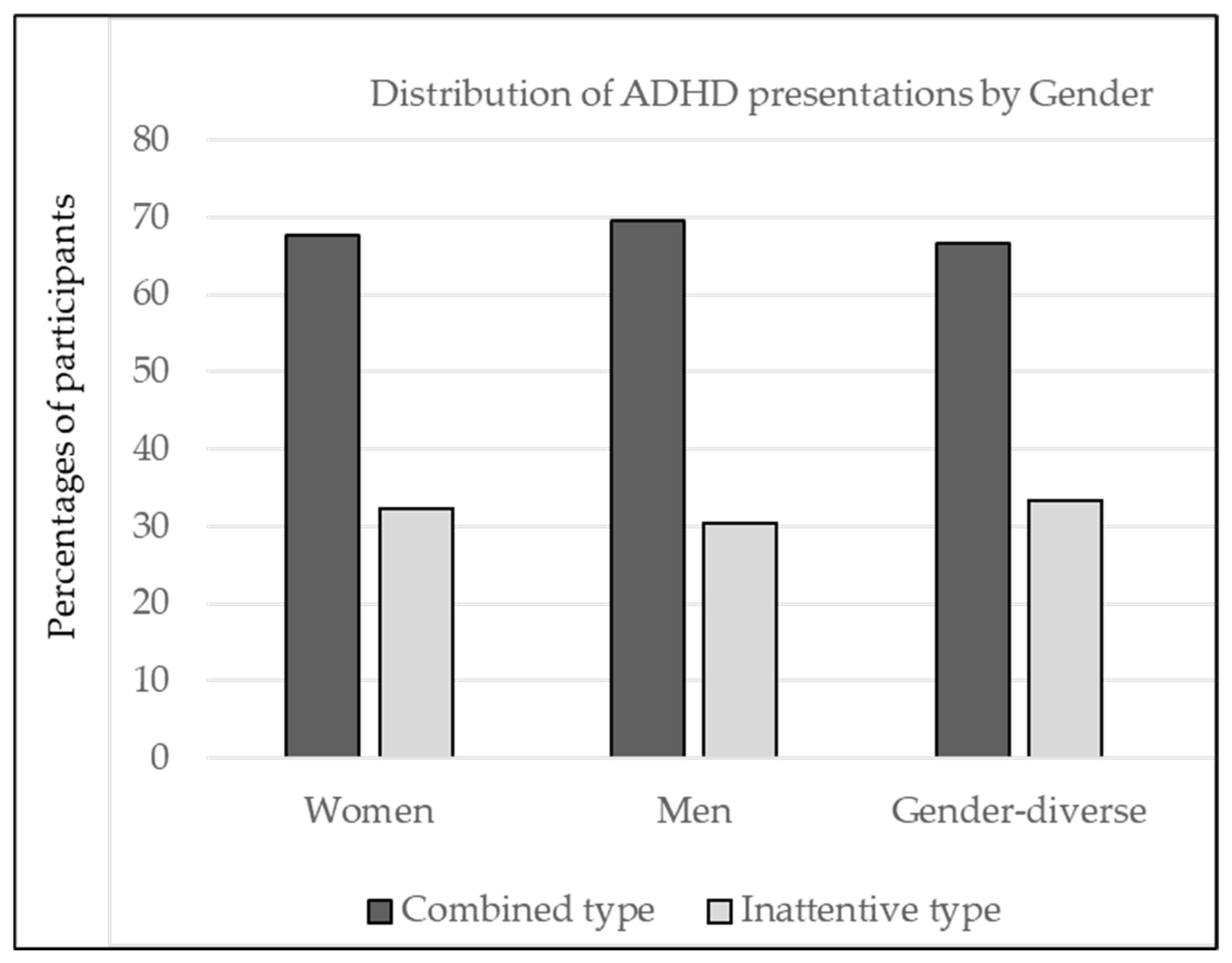
As aforementioned, a chi-square test of independence was conducted to examine the association among ADHD diagnosis subtype (combined vs. inattentive), demographic and psychosocial variables (Table 2). Gender identity was not significantly associated with ADHD presentation, χ2 (2, N = 631) = 0.225, p = 0.893. Women comprised the largest proportion of participants in both inattentive and combined presentations, with comparable gender distributions across subtypes (Figure 1). Age group was not significantly associated with either subtype (χ2 (2) = 1.29, p = 0.525). Most participants were young adults, followed by middle-aged adults, while older adults represented a small proportion of the sample. Employment status also did not differ between subtypes (χ2 (1) = 0.88, p = 0.349). Marital status was not significantly associated with ADHD subtype (χ2 (2) = 1.78, p = 0.411), with comparable distributions of single, married or common-law, and other (separated, widow or divorced individuals) across presentations. In contrast, psychiatric comorbidity demonstrated a statistically significant association with ADHD presentation, χ2 (3) = 9.16, p = 0.027. Prescribed ADHD medication also differed significantly by presentation, χ2 (1) = 12.36, p < 0.001. Participants with inattentive ADHD were more likely to report current prescribed ADHD medication (63.5%) than those with combined ADHD (48.5%).

3.3. Factors Associated with ADHD Diagnostic Subtype (Combined vs. Inattentive)

A binary logistic regression examined whether demographic and psychosocial variables were independently associated with ADHD presentation (combined vs. inattentive) (Table 3). The overall model was statistically significant (Omnibus χ2 (6) = 14.88, p = 0.021) with no evidence of poor fit (Hosmer–Lemeshow p = 0.399), although the explained variance was small (Nagelkerke R2 = 0.033).
Prescribed ADHD medication was the only variable significantly associated with ADHD presentation. Individuals receiving medication had lower odds of a combined presentation relative to an inattentive presentation (OR = 0.54, 95% CI 0.38–0.77, p = 0.001), indicating that combined presentation was more common among those not receiving medication. Age group, comorbidity, gender, employment status, and marital status were not statistically significant in the adjusted model. The hyperactive/impulsive subtype was excluded from inferential modelling due to insufficient sample size and is reported descriptively only.

3.4. Gender-Based Stratified Analyses of ADHD Subtypes

Consistent with GBA+ framework, separate adjusted logistic regression models were estimated within women and men (Table 4). The gender-diverse subgroup was not modelled inferentially because the sample size was insufficient for stable estimation and is therefore reported descriptively only.
Among women, prescribed ADHD medication remained significantly associated with ADHD presentation. Women not using medication had higher odds of a combined presentation relative to an inattentive presentation (p = 0.002). No other predictors were statistically significant.
Among men, no variables reached statistical significance, although the direction of association for prescribed ADHD medication was similar but did not meet conventional thresholds (p = 0.079).
Overall, stratified analyses indicate that the association between prescribed ADHD medication and ADHD presentation was driven primarily by the women subgroup, while no reliable adjusted associations were observed among men.

4. Discussion

To the best of the authors’ knowledge, this is the first study to examine the demographic and psychosocial correlates of ADHD subtypes among adults receiving care in a rural outpatient clinic through the lens of the GBA+ framework. In this study, the combined type was the most frequently observed subtype, followed by inattentive type, while the hyperactive/impulsive type was less common. This distribution is consistent with prior research indicating that ADHD frequently persists into adulthood, but that overt hyperactivity tends to attenuate with age, resulting in clinical profiles dominated by attentional and executive dysfunction [21,32,33].
Furthermore, gender-stratified analyses did not identify statistically significant differences in ADHD presentation, with similar distributions observed across women, men, and gender-diverse participants. This pattern aligns with a growing body of adult ADHD research suggesting that, once individuals reach clinical attention in adulthood, core ADHD presentation may be more similar across genders than traditionally assumed [19,34]. In addition, meta-analyses and large cohort studies demonstrate that gender differences are more evident in pathways to recognition and referral than in the distribution of diagnostic presentations among adults with ADHD, particularly when standardized diagnostic procedures are used [2,35,36]. This finding has important implications for treatment planning and functional assessment in adult ADHD, underscoring the need to prioritize individual symptom burden and functional impairment rather than relying on assumptions based on gender [2,37,38].
Moreover, employment status did not differ significantly across ADHD subtypes in our sample. However, the broader literature consistently links adult ADHD to occupational instability, underemployment, and reduced work productivity, particularly when symptoms are unrecognized or inadequately treated [4]. In rural settings, where employment opportunities are often more constrained and characterized by reduced flexibility, untreated or inadequately managed ADHD symptoms may be associated with disproportionately greater functional impairment. These contextual factors underscore the importance of timely and accurate diagnosis, as well as sustained follow-up care, to support occupational functioning and vocational stability among adults with ADHD residing in rural communities.
The association between prescribed ADHD medication and ADHD presentation remained significant in the adjusted model, with individuals not prescribed medication showing higher odds of a combined presentation relative to an inattentive presentation. Accordingly, adults identified with the inattentive presentation were more likely to be prescribed medication at the time of assessment. Previous studies indicate that use of ADHD medication in adulthood varies according to symptom profile, psychiatric comorbidity, and functional impairment rather than diagnosis alone [39,40,41]. The present findings are consistent with this literature and may reflect differences in clinical recognition and treatment engagement across presentations [16,42].
Given the absence of statistically significant subtype differences, patterns related to marital status should also be interpreted cautiously and situated within a broader gendered and relational context. In a clinical study of heterosexual couples, Ersoy and Topçu Ersoy (2019) [7] found that gender-role attitudes mediated the relationship between adult ADHD and marital outcomes, with non-ADHD women reporting greater relational burden and emotional strain than men. These findings suggest that socially constructed gender roles influence how ADHD-related impairments are experienced, interpreted, and negotiated within partnerships. More importantly, these findings highlight the need to move beyond categorical marital status indicators and to consider gendered relational processes when interpreting adult ADHD outcomes, reinforcing the value of GBA+-informed frameworks for both research and clinical practice.
Despite methodological constraints, the inclusion of gender-diverse participants is ethically and scientifically important. Excluding gender-diverse individuals from analysis perpetuates invisibility and reinforces binary assumptions that are increasingly recognized as inadequate for understanding mental health across populations [14]. Emerging research indicates that gender-diverse individuals experience distinct mental health risks and barriers to care, underscoring the need for inclusive data practices and analytic strategies that extend beyond binary gender categories [2,14,15].

5. Strengths and Limitations

This study has several notable strengths. This study addresses an important gap in the adult ADHD literature by examining the gender dynamics in adult ADHD subtype and its demographic and psychosocial correlates within a rural Canadian setting, a population that is often underrepresented in psychiatric research. Diagnostic information was obtained using standardized DSM-5–aligned assessment procedures administered by a psychiatrist experienced in adult ADHD. This approach was intended to promote consistency in clinical classification; however, it does not preclude broader conceptual debates regarding the construct validity of ADHD or its interpretation across different cultural and contextual settings [43]. The inclusion of psychosocial and demographic variables, as well as gender-stratified adjusted analyses, strengthens the interpretability and relevance of the findings for real-world practice. At the same time, important limitations must be acknowledged. The cross-sectional design limits causal inference, and reliance on medical records introduces the possibility of incomplete or inconsistent documentation. Small subgroup sizes, particularly for the hyperactive/impulsive presentation and nonbinary participants, reduced statistical power and contributed to model instability, necessitating cautious interpretation of these findings. Additionally, findings reflect a healthcare-seeking clinical population assessed within a Western psychiatric system and should not be generalized to non-clinical or cross-cultural populations where attentional styles may carry different functional significance [25,43]. Finally, the rural clinical setting, while a key strength, may limit generalizability to urban populations or other healthcare systems.

6. Implications for Practice

The findings of this study have important implications for mental-health practice and policy in rural healthcare settings. The predominance of combined and inattentive ADHD presentations, coupled with the rarity of the hyperactive/impulsive subtype, underscores the need for rural service planning that recognizes adult ADHD as a persistent and functionally impairing condition rather than a disorder confined to childhood. Given the limited availability of specialized mental-health services in many rural communities, strengthening assessment capacity within primary care and community-based settings is essential to support timely diagnosis and appropriate management across the adult lifespan.
Training initiatives that incorporate gender-informed approaches to ADHD assessment may be beneficial. Although ADHD presentation did not differ by gender, descriptive differences were noted in comorbidity distribution and in receipt of prescribed ADHD medication, particularly among women with internalizing conditions. Educational efforts for healthcare practitioners should therefore address how gendered expectations, symptom internalization, and co-occurring mental health conditions can influence recognition, diagnostic evaluation, and treatment pathways. Integrating GBA+ principles into professional training may help reduce diagnostic overshadowing and support more equitable, person-centred care in rural clinical settings.
At the policy level, the findings highlight the need for improved data collection practices to support GBA+-informed research and service evaluation. Routine collection of inclusive gender identity data, together with standardized documentation of comorbidities and treatment history, would strengthen the identification of disparities and support more tailored interventions for adults with ADHD. Enhancing data infrastructure within rural health systems is therefore a key step toward ensuring that ADHD services are responsive to the diverse needs of individuals across gender identities and social contexts.

7. Conclusions

This study contributes to the growing literature on adult ADHD epidemiology by providing insight into the gender dynamics in adult ADHD subtype and both its demographic and psychosocial correlates within a rural Canadian population. Integrating gender and rural context through GBA+ framework underscores the importance of moving beyond subtype classification alone to consider how gender, psychosocial factors, and structural constraints intersect to shape adult ADHD diagnosis and treatment, particularly in rural and underserved settings. Future research should build on these findings using longitudinal designs and larger, more diverse samples to better capture subtype trajectories across adulthood and to support more robust analysis of gender-diverse populations. Strengthening rural data infrastructure and incorporating GBA+-informed approaches will be essential for advancing equitable and context-responsive ADHD research, practice, and policy.

Author Contributions

Conceptualization, H.A., J.O. and A.A.; methodology, H.A.; formal analysis, H.A. and A.A.; investigation, H.A.; data curation, H.A.; writing—original draft, H.A.; writing—review and editing, H.A., J.O. and A.A. All authors have read and agreed to the published version of the manuscript.

Funding

This research received no external funding.

Institutional Review Board Statement

The study was conducted in accordance with the Declaration of Helsinki and approved by the University of British Columbia (UBC) Clinical Research Ethics Board in collaboration with Northern Health Authority (NHA) (protocol code REB#H24-01749 and 14 March 2025).

Informed Consent Statement

Informed consent was waived due to the retrospective nature of the study and the use of fully anonymized electronic medical record data, in accordance with approval granted by the University of British Columbia (UBC) Clinical Research Ethics Board in collaboration with Northern Health Authority (NHA).

Data Availability Statement

The data presented in this study are available on request from the corresponding author. The data are not publicly available due to ethical/privacy issues.

Conflicts of Interest

The authors declare no conflicts of interest.

References

  1. Fayyad, J.; Sampson, N.A.; Hwang, I.; Adamowski, T.; Aguilar-Gaxiola, S.; Al-Hamzawi, A.; Andrade, L.H.; Borges, G.; de Girolamo, G.; Florescu, S.; et al. The descriptive epidemiology of DSM-IV adult ADHD in the World Mental Health Surveys. ADHD Atten. Deficit Hyperact. Disord. 2017, 9, 47–65. [Google Scholar] [CrossRef] [Scilit]
  2. Platania, N.M.; Starreveld, D.E.J.; Wynchank, D.; Beekman, A.T.F.; Kooij, J.J.S. Bias by gender: Exploring gender-based differences in the endorsement of ADHD symptoms and impairment among adult patients. Front. Glob. Women’s Health 2025, 6, 1549028. [Google Scholar] [CrossRef] [Scilit] [PubMed]
  3. Espinet, S.D.; Graziosi, G.; Toplak, M.E.; Hesson, J.; Minhas, P. A Review of Canadian Diagnosed ADHD Prevalence and Incidence Estimates Published in the Past Decade. Brain Sci. 2022, 12, 1051. [Google Scholar] [CrossRef] [Scilit] [PubMed]
  4. Faraone, S.V. Attention deficit hyperactivity disorder and premature death. Lancet 2015, 385, 2132–2133. [Google Scholar] [CrossRef] [Scilit] [PubMed]
  5. Bogdańska-Chomczyk, E.; Majewski, M.K.; Kozłowska, A. ADHD in adulthood: Clinical presentation, comorbidities, and treatment perspectives. Int. J. Mol. Sci. 2025, 26, 11020. [Google Scholar] [CrossRef] [Scilit]
  6. Murphy, K.R.; Barkley, R.A. Occupational functioning in adults with ADHD. ADHD Rep. 2007, 15, 6–10. [Google Scholar] [CrossRef] [Scilit]
  7. Ersoy, M.A.; Topçu Ersoy, H. Gender-role attitudes mediate the effects of adult ADHD on marriage and relationships. J. Atten. Disord. 2019, 23, 40–50. [Google Scholar] [CrossRef] [Scilit]
  8. Quintero, J.; Morales, I.; Vera, R.; Zuluaga, P.; Fernández, A. The impact of adult ADHD on quality of life. J. Atten. Disord. 2019, 23, 1007–1016. [Google Scholar] [CrossRef] [Scilit]
  9. Kessler, R.C.; Adler, L.; Barkley, R.; Biederman, J.; Conners, C.K.; Demler, O.; Faraone, S.V.; Greenhill, L.L.; Howes, M.J.; Secnik, K.; et al. The prevalence and correlates of adult ADHD in the United States: Results from the National Comorbidity Survey Replication. Am. J. Psychiatry 2006, 163, 716–723. [Google Scholar] [CrossRef] [Scilit]
  10. Eklund, H.; Cadman, T.; Findon, J.; Hayward, H.; Howley, D.; Beecham, J.; Xenitidis, K.; Murphy, D.; Asherson, P.; Glaser, K. Clinical service use as people with ADHD transition into adolescence and adulthood. BMC Health Serv. Res. 2016, 16, 248. [Google Scholar] [CrossRef] [Scilit]
  11. Culpepper, L.; Mattingly, G. Challenges in identifying and managing attention-deficit/hyperactivity disorder in adults in the primary care setting: A review of the literature. Prim. Care Companion J. Clin. Psychiatry 2010, 12, PCC.10r00951. [Google Scholar] [CrossRef] [Scilit] [PubMed]
  12. Faber, S.C.; Osman, M.; Williams, M.T. Access to mental health care in Canada. Int. J. Ment. Health 2023, 52, 312–334. [Google Scholar] [CrossRef] [Scilit]
  13. Pong, R.W.; Desmeules, M.; Lagacé, C. Rural–urban disparities in health in Canada and Australia. Aust. J. Rural Health 2009, 17, 58–64. [Google Scholar] [CrossRef] [Scilit] [PubMed]
  14. Goetz, T.G.; Adams, N. The transgender and gender-diverse ADHD nexus: A systematic review. J. Gay Lesbian Ment. Health 2024, 28, 2–19. [Google Scholar] [CrossRef] [Scilit]
  15. Rucklidge, J.J. Gender differences in ADHD: Implications for psychosocial treatments. Expert Rev. Neurother. 2010, 10, 247–260. [Google Scholar] [CrossRef] [Scilit]
  16. Sobanski, E.; Brüggemann, D.; Alm, B.; Kern, S.; Deschner, M.; Schubert, T.; Philipsen, A.; Rietschel, M. Psychiatric comorbidity and functional impairment in adults with ADHD. Eur. Arch. Psychiatry Clin. Neurosci. 2007, 257, 371–377. [Google Scholar] [CrossRef] [Scilit]
  17. Skirrow, C.; Asherson, P. Emotional lability, comorbidity, and impairment in adult ADHD. J. Affect. Disord. 2013, 147, 80–86. [Google Scholar] [CrossRef] [Scilit]
  18. Quinn, P.O.; Madhoo, M. A review of attention-deficit/hyperactivity disorder in women and girls: Uncovering this hidden diagnosis. Prim. Care Companion CNS Disord. 2014, 16, 27250. [Google Scholar] [CrossRef] [Scilit]
  19. Young, S.; Adamo, N.; Ásgeirsdóttir, B.B.; Branney, P.; Beckett, M.; Colley, W.; Cubbin, S.; Deeley, Q.; Farrag, E.; Gudjonsson, G.; et al. Females with ADHD: An expert consensus statement. BMC Psychiatry 2020, 20, 404. [Google Scholar] [CrossRef] [Scilit]
  20. Hinshaw, S.P.; Nguyen, P.T.; O’Grady, S.M.; Rosenthal, E.A. ADHD in girls and women: Underrepresentation and key directions. J. Child Psychol. Psychiatry 2022, 63, 484–496. [Google Scholar] [CrossRef] [Scilit]
  21. Kooij, J.J.S.; Bijlenga, D.; Salerno, L.; Jaeschke, R.; Bitter, I.; Balázs, J.; Thome, J.; Dom, G.; Kasper, S.; Filipe, C.N.; et al. Updated European Consensus Statement on diagnosis and treatment of adult ADHD. Eur. Psychiatry 2019, 56, 14–34. [Google Scholar] [CrossRef] [Scilit]
  22. Hartung, C.M.; Lefler, E.K.; Abu-Ramadan, T.M.; Stevens, A.E.; Serrano, J.W.; Miller, E.A.; Shelton, C.R. A call to analyze sex, gender, and sexual orientation in psychopathology research. J. Psychopathol. Behav. Assess. 2025, 47, 18. [Google Scholar] [CrossRef] [Scilit]
  23. Caxaj, C.S. Mental health approaches for rural communities in Canada. Can. J. Community Ment. Health 2016, 35, 29–45. [Google Scholar] [CrossRef] [Scilit]
  24. Government of Canada, Women and Gender Equality Canada. What Is Gender-Based Analysis Plus (GBA+)? Available online: https://www.canada.ca/en/women-gender-equality/gender-based-analysis-plus/what-gender-based-analysis-plus.html (accessed on 20 December 2025).
  25. American Psychiatric Association. Diagnostic and Statistical Manual of Mental Disorders, 5th ed.; APA Publishing: Washington, DC, USA, 2013. [Google Scholar] [CrossRef] [Scilit]
  26. Hong, M.; Kooij, J.J.S.; Kim, B.; Joung, Y.-S.; Yoo, H.K.; Kim, E.-J.; Lee, S.I.; Bhang, S.-Y.; Lee, S.Y.; Han, D.H.; et al. Validity of the Korean version of DIVA-5. Neuropsychiatr. Dis. Treat. 2020, 16, 2371–2380. [Google Scholar] [CrossRef] [Scilit] [PubMed]
  27. Zamani, L.; Shahrivar, Z.; Alaghband-Rad, J.; Sharifi, V.; Davoodi, E.; Ansari, S.; Emari, F.; Wynchank, D.; Kooij, J.J.S.; Asherson, P. Reliability, Criterion and Concurrent Validity of the Farsi Translation of DIVA-5: A Semi-Structured Diagnostic Interview for Adults with ADHD. J. Atten. Disord. 2021, 25, 1666–1675. [Google Scholar] [CrossRef] [Scilit] [PubMed]
  28. Di Lorenzo, R.; Latella, E.; Gualtieri, F.; Adriani, A.; Ferri, P.; Filippini, T. Validity of the Italian version of DIVA-5. Healthcare 2025, 13, 244. [Google Scholar] [CrossRef] [Scilit]
  29. IBM Corp. IBM SPSS Statistics for Windows, Version 28; IBM Corp.: Armonk, NY, USA, 2021.
  30. Agresti, A. Categorical Data Analysis, 3rd ed.; Wiley: Hoboken, NJ, USA, 2013. [Google Scholar]
  31. Peduzzi, P.; Concato, J.; Kemper, E.; Holford, T.R.; Feinstein, A.R. Simulation study of events per variable in logistic regression. J. Clin. Epidemiol. 1997, 49, 1373–1379. [Google Scholar] [CrossRef] [Scilit]
  32. Faraone, S.V.; Asherson, P.; Banaschewski, T.; Buitelaar, J.K.; Ramos-Quiroga, J.A.; Rohde, L.A.; Sonuga-Barke, E.J.S.; Tannock, R. Attention-deficit/hyperactivity disorder. Nat. Rev. Dis. Primers 2021, 1, 15020. [Google Scholar] [CrossRef] [Scilit]
  33. Faraone, S.V.; Biederman, J.; Mick, E. Age-dependent decline of ADHD. Psychol. Med. 2006, 36, 159–165. [Google Scholar] [CrossRef] [Scilit]
  34. Gershon, J.; Gershon, J. Meta-analytic review of gender differences in ADHD. J. Atten. Disord. 2002, 5, 143–154. [Google Scholar] [CrossRef] [Scilit]
  35. Arnett, A.B.; Pennington, B.F.; Willcutt, E.G.; DeFries, J.C.; Olson, R.K. Sex differences in ADHD symptom severity. J. Child Psychol. Psychiatry 2015, 56, 632–639. [Google Scholar] [CrossRef] [Scilit] [PubMed]
  36. Mowlem, F.D.; Agnew-Blais, J.; Taylor, E.; Asherson, P. Sex differences in predicting ADHD diagnosis and treatment. Psychiatry Res. 2019, 272, 765–773. [Google Scholar] [CrossRef] [Scilit] [PubMed]
  37. Kosheleff, A.R.; Mason, O.; Jain, R.; Koch, J.; Rubin, J. Functional impairments and pharmacological treatment in adult ADHD. J. Atten. Disord. 2023, 27, 669–697. [Google Scholar] [CrossRef] [Scilit]
  38. Williamson, D.; Johnston, C. Gender differences in adults with ADHD. Clin. Psychol. Rev. 2015, 40, 15–27. [Google Scholar] [CrossRef] [Scilit] [PubMed]
  39. de la Peña, I.C.; Pan, M.C.; Thai, C.G.; Alisso, T. Attention-Deficit/Hyperactivity Disorder Predominantly Inattentive Subtype/Presentation: Research Progress and Translational Studies. Brain Sci. 2020, 10, 292. [Google Scholar] [CrossRef] [Scilit]
  40. Cortese, S.; Adamo, N.; Del Giovane, C.; Mohr-Jensen, C.; Hayes, A.J.; Carucci, S.; Atkinson, L.Z.; Tessari, L.; Banaschewski, T.; Coghill, D.; et al. Comparative efficacy and tolerability of ADHD medications. Lancet Psychiatry 2018, 5, 727–738. [Google Scholar] [CrossRef] [Scilit]
  41. Mattingly, G.; Weisler, R.; Dirks, B.; Babcock, T.; Adeyi, B.; Scheckner, B.; Lasser, R. Attention deficit hyperactivity disorder subtypes and symptom response in adults treated with lisdexamfetamine dimesylate. Innov. Clin. Neurosci. 2012, 9, 22–30. [Google Scholar]
  42. Kooij, S.J.J.; Bejerot, S.; Blackwell, A.; Caci, H.; Casas-Brugué, M.; Carpentier, P.J.; Edvinsson, D.; Fayyad, J.; Foeken, K.; Fitzgerald, M.; et al. European consensus statement on adult ADHD. BMC Psychiatry 2010, 10, 67. [Google Scholar] [CrossRef] [Scilit]
  43. Kleinman, A. Patients and Healers in the Context of Culture: An Exploration of the Borderland Between Anthropology, Medicine, and Psychiatry; University of California Press: Berkeley, CA, USA, 1980. [Google Scholar]
Figure 1. This figure illustrates the distribution of gender by ADHD subtypes.
Psychiatryint 07 00064 g001
Table 1. Sample characteristics (N = 660). Descriptive statistics based on full sample.
CharacteristicsFrequencies (n)Percentage (%)
Gender Identity
Women41963.5
Men22233.6
Gender-diverse192.9
Age (at the time of diagnosis)
Young adult (20–40)40861.8
Middle age (41–60)21132.0
Older adult (61+)416.2
ADHD Subtype
Combined type44267.0
Inattentive type20030.3
Hyperactive/impulsive type182.7
Employment status
No32849.7
Yes33250.3
Marital status
Single32148.6
Married/common-law27641.8
Separated/divorced/widowed639.5
Prescribed ADHD medication
No31047.0
Yes35053.0
Comorbidity
None23535.6
Internalizing (PDD OCD, BED & GAD)21833.0
Borderline personality disorder12118.3
Externalizing/Neurodevelopmental (ASD & Substance use disorder)8613.0
Table 2. Chi-Square Tests of Associations among Combined and Inattentive Subtypes, Demographic and Psychosocial Variables (N = 631).
Variablesχ2dfp
Gender identity (women, men, gender-diverse)0.22520.893
Age group (young, middle, older adult)1.2920.525
Comorbidity (none, internalizing, externalizing/neurodevelopmental, and borderline personality disorder)9.1630.027 *
Prescribed ADHD medication (no, yes)12.3610.001 *
Marital status (single, married/common-law, other)1.7820.411
Employment status (no, yes)0.8810.349
Note: * Significant value.
Table 3. Demographic and psychosocial variables associated with ADHD Subtypes (Reference = Inattentive).
VariablesReference CategoryOR95% CIp
Comorbidity None0.9450.808–1.1060.484
Age groupYoung adult0.9290.696–1.2420.621
Gender identityWomen1.0430.759–1.4330.797
Prescribed ADHD medicationYes0.5440.384–0.7710.001
Employment statusEmployed0.9470.669–1.3400.757
Marital statusSingle0.8690.660–1.1450.318
Note: Outcome coded as Combined (1) vs. Inattentive (0); reference ADHD subtype = inattentive. All predictors were entered simultaneously and treated as categorical variables using indicator (dummy) coding with defined reference categories: comorbidity (reference = None), age group (reference = young adult), and gender category (reference = women), prescribed ADHD medication = yes, employment status = employed, and marital status = single. Odds ratios are from the pooled binary logistic regression model. The hyperactive/impulsive presentation was excluded from inferential analyses due to sparse cell counts and resulting model instability.
Table 4. Gender-stratified adjusted logistic regression predicting ADHD subtypes (Reference category = Inattentive type).
VariablesWomen (n = 403)Men (n = 210)Gender-Diverse (n = 18)
Age groupnsnsDescriptive only
Comorbidity nsnsDescriptive only
Prescribed ADHD medicationp = 0.002p = 0.079Descriptive only
Employment statusnsnsDescriptive only
Marital statusnsnsDescriptive only
VariablesWomen (n = 403)Men (n = 210)Gender-diverse (n = 18)
Age groupnsnsDescriptive only
Note: Binary logistic regression models were estimated separately by gender. Dependent variable: ADHD presentation (1 = Combined, 0 = Inattentive). “ns” indicates p ≥ 0.05. The gender-diverse subgroup was not modeled due to insufficient sample size.
Disclaimer/Publisher’s Note: The statements, opinions and data contained in all publications are solely those of the individual author(s) and contributor(s) and not of MDPI and/or the editor(s). MDPI and/or the editor(s) disclaim responsibility for any injury to people or property resulting from any ideas, methods, instructions or products referred to in the content.