Article

Human Rights Protections and Ethical Governance in Global Psychiatry: A Cross-National Review of Ethical Codes from Member Societies of the World Psychiatric Association


1
Department of Forensic Psychiatry, University of Bern, Hochulstrasse 4, 3012 Bern, Switzerland
2
Institute of Psychiatry, Psychology & Neuroscience, King’s College London, London SE5 8AF, UK
3
Research Group on Epidemiology of Mental Disorders, Psychopathology and Neurosciences, School of Medical Sciences, National University of Asunción, San Lorenzo 111421, Paraguay
4
Vice-Rectorate for Research and Postgraduate Studies, University of Los Lagos, Osorno 5290000, Chile
5
School of Health Sciences, Sudamericana University, Pedro Juan Caballero 130101, Paraguay
6
Department of Clinical and Experimental Medicine, University of Foggia, 71122 Foggia, Italy
7
Department of Psychiatry, Psychotherapy and Psychosomatics, Psychiatric Hospital, University of Zurich, 8091 Zurich, Switzerland
*
Author to whom correspondence should be addressed.
Psychiatry Int. 2026, 7(2), 50; https://doi.org/10.3390/psychiatryint7020050
Submission received: 16 December 2025 / Revised: 27 January 2026 / Accepted: 22 February 2026 / Published: 2 March 2026

Abstract

Background: Psychiatrists operate at the interface of clinical care, legal frameworks, and governmental power, where external pressures and insufficient safeguards can potentially engender ethical vulnerabilities. Supranational instruments and wider professional standards notwithstanding, the extent to which national-level psychiatric associations articulate protections against torture and abusive practices in their ethical codes remains underexplored. Methods: A cross-sectional documentary audit was conducted of all 145 World Psychiatric Association (WPA) Member Societies, representing ≈250,000 psychiatrists globally. National-level psychiatric ethical codes were located via systematic web searches and examined for clauses specifically referencing torture or analogous abuses and for any associated enforcement procedures. Results: Only nineteen (13.1%) WPA Member Societies maintained publicly accessible ethical codes, with ten (6.9%) containing explicit provisions proscribing torture and associated abuses. These predominantly originated from high-income countries or jurisdictions with documented histories of human rights violations. Most codes invoked broad principles without directly addressing such abuses, and fewer than half delineated any enforcement mechanisms. Conclusions: Gaps persist in ethical governance and human-rights safeguards amongst WPA Member Societies. Although beneficence and non-maleficence provide moral foundations for psychiatric practice, generic commitments alone may prove inadequate under duress. Strengthening anti-torture prohibitions within national-level psychiatric codes could therefore help support ethical resilience and accountability in situations of institutional or political coercion.

1. Introduction

1.1. Physicians, Human Rights Abuses, and Structural Vulnerabilities in Psychiatry

In a turbulent geopolitical landscape, systemic human rights violations continue to occur. These include instances of physical and psychological torture, at times involving both passive and active complicity by medical personnel [1,2,3,4,5]. Since modalities and classifications of torture can differ, for this analysis, torture is defined in line with the United Nations Convention Against Torture (UNCAT). Under UNCAT, torture is described as “any act by which severe pain or suffering, whether physical or mental, is intentionally inflicted on a person for such purposes as obtaining from him or a third person information or a confession, punishing him for an act he or a third person has committed or is suspected of having committed, or intimidating or coercing him or a third person, or for any reason based on discrimination of any kind, when such pain or suffering is inflicted by or at the instigation of or with the consent or acquiescence of a public official or other person acting in an official capacity. It does not include pain or suffering arising only from, inherent in or incidental to lawful sanctions” [6]. Guided by beneficence and non-maleficence (primum non nocere), physicians should be fundamentally opposed to all modalities of torture [1,2,3,4,5]. However, this moral consensus alone can be fragile without sufficient safeguards, especially when abstract ideals are selectively reinterpreted under political and institutional duress [1,2,3,4,5,7,8,9].
Indeed, sizeable proportions of survivors of torture have reported medical oversight of their abuse and, in aggregate, some commentators have posited that more physicians may have abetted torture than have treated its victims [8]. Accordingly, this has motivated longstanding calls for robust ethical prohibitions against torture and associated abuses from inside the international medical community [5,8,9].
To better contextualise medical abuses, torture must be understood as a complex phenomenon, which has transcended disparate historical and political settings [10]. Building on the UNCAT definition, torture is embedded within asymmetric power relations and has recurrently transpired in situations of armed conflict and counterinsurgency, as well as forms of authoritarian and colonial (or postcolonial) rule [10,11,12]. Ethnographic and sociological scholarship has shown that torture operates as a technique for engendering fear and enforcing submission through the systematic destruction of bodily integrity and moral agency [13,14]; information extraction has sometimes been a pretext for these methods, oriented towards social control [11,12].
Bureaucratic, legal, and professional paradigms sustain torture by diffusing responsibility across institutions and actors and by normalising physical and psychological violence via national security and public safety invocations [11,12]. Frequently, torture has been administratively concealed and euphemised, including through technocratic and medicalised language that obfuscates its coercive nature and lends it a veneer of legitimacy [15]. In this regard, the already-severe power imbalances between the torturer and the tortured are further exacerbated through the deployment of specialist knowledge (e.g., medical expertise) [1,3,4,5,8,9,15].
Amidst this larger ecology, psychiatry becomes especially vulnerable to instrumentalisation due to its legally and institutionally defined roles at the intersection of clinical care, judicial dynamics, and governmental powers [16]. Worldwide, these overlapping mandates can precipitate competing obligations, with duties to patients conceivably conflicting with state directives driven by institutional and security agendas (i.e., dual-loyalty conflicts) [16]. Notably, psychiatrists practice within legal parameters that authorise coercive treatment procedures, forensic evaluations, and assessments of mental capacity and dangerousness, creating scope for misuse under certain conditions [2,16].
Depending on the jurisdiction, legal protections against torture include UNCAT (1984), the Geneva Conventions (1949), the International Covenant on Civil and Political Rights (1966), regional instruments such as the European Convention on Human Rights (1950), and national criminal codes [17,18,19]. Despite the existence of these national and supranational human-rights protections, treaties, and other legal conventions, this structural positioning can perpetuate acute power asymmetries, which have previously been exploited to redirect psychiatric expertise towards forced interrogation, intimidation, and punishment [2,11,20,21,22,23,24,25,26,27]. This may involve the misuse of psychoactive medications for non-therapeutic purposes and the weaponisation of diagnostic authority to pathologise dissent and justify indefinite detention, as well as more direct assistance in designing and implementing coercive interrogation strategies [11,12,20,21,22,23,24,25,26,27].
For example, as historical precedents, psychiatrist knowledge was integrated into modalities of psychological warfare deployed by British colonial forces attempting to suppress the Mau Mau rebellion in Kenya (1952–1960) [24]. Later, during the reign of Argentina’s junta (1976–1983), mental health practitioners participated in depersonalisation and brainwashing schemes targeting political prisoners in clandestine detention facilities [25]. Meanwhile, in the “War on Terror” (2001–), psychiatrists reportedly aided “Enhanced Interrogation” programmes at Guantánamo Bay and so-called “black sites” administered by the United States’ Central Intelligence Agency [20,21,26]. Contemporary reports have also documented egregious practices in the Islamic Republic of Iran, the People’s Republic of China, and the Russian Federation, amongst other jurisdictions [1,2,3,4,5,27].

1.2. Global and Local Ethical Standards

Whilst governments and intelligence agencies have recurrently obscured acts of torture and human rights transgressions, medical collusion poses enduring questions about the degradation of professional ethics based on purportedly exceptionalist rationales [2,9,15,20,21,22,23,24,25,26,27]. These concerns have prompted psychiatric organisations to repudiate medical participation in (or the facilitation of) the commission of torture and associated human rights abuses.
For example, in past statements, the World Psychiatric Association (WPA), representing 145 Member Societies and ≈250,000 psychiatrists, affirmed that psychiatrists should “not take part in any process of mental or physical torture, even when authorities attempt to force their involvement” [28]. This was articulated in the WPA’s Declaration of Madrid (1996), which all new and existing Member Societies were mandated to ratify or would reportedly face expulsion from the WPA [29].
Over two decades later, the WPA’s Code of Ethics for Psychiatry (2020) expressly proscribes “torture”, “the abuse of psychiatry for political purposes”, and “the interrogation of persons deprived of liberty by military or civilian investigative agencies or law enforcement” [30]. The WPA also has a Scientific Section dedicated to the “Psychological Consequences of Torture & Persecution” [31].
In part, this WPA position and its related initiatives were informed by the political instrumentalisation of psychiatry in the Soviet Union, whereby dissidents were diagnosed with spurious conditions (e.g., “sluggish schizophrenia”) and subsequently subjected to involuntary hospitalisation and forced medication [11,18]; these episodes of punitive psychiatry generated intense debate in the 1980s between WPA Member Societies and beyond [2,20].
Similar stances appear in the European Psychiatric Association’s (EPA) Code of Ethics (2024, revised), as well as the World Medical Association’s (WMA) Declaration of Tokyo (1975, revised) and guidelines from the United Nations (UN) (1982), all of which prohibit medical participation in torture [32,33,34]. In parallel, the United Nations’ Istanbul Protocol (2022, revised) provides authoritative medicolegal recommendations for the effective investigation and documentation of torture, including specific guidance relevant to psychiatric practice [35].
Yet, importantly, though the WPA advised its Member Societies to endorse and align with the tenets outlined in the Code of Ethics for Psychiatry upon its release, the level of international implementation remains unclear at the time of writing [36]. In fact, recent evidence indicates that most WPA Member Societies lack publicly accessible ethical codes [37]; concomitantly, this raises further uncertainties about the adoption of the WPA’s Code of Ethics for Psychiatry and the availability of torture prohibitions from national-level associations throughout global psychiatry.
As WPA Member Societies mediate between universal principles and local professional, legal, and sociocultural paradigms, they can constitute a valuable interface for embedding global directives and normative moral values into practicable, day-to-day decision-making [4,6,7,38]. Hence, in today’s era of democratic backsliding, burgeoning authoritarianism, and intensifying military engagements (conditions that are linked to elevated risks of human rights abuses), anti-torture regulations from national-level psychiatric organisations may be increasingly important [37].
Of course, whether these formal stipulations would demonstrably prevent psychiatric participation in torture is empirically uncorroborated. Still, their absence removes one potential institutional safeguard that could support individual refusal and accountability in coercive circumstances [1,2,3,4,5,38,39]. Simultaneously, national, speciality-specific provisions can establish foundations for education, disciplinary mechanisms, and advocacy amidst local contexts of psychiatric practice [4,6,7,37].

2. Methods

2.1. Study Aims, World Psychiatric Association Member Society Sample, and Data Sources

Building on analogous cross-country analyses, this study aimed to systematically examine ethical codes of WPA Member Societies [37,40,41] to (1) determine if they explicitly forbid torture; (2) evaluate the scope and enforceability of any torture-specific clauses.
To that end, a cross-sectional, documentary audit was conducted via web-based searches of psychiatric associations classified as WPA Member Societies at the time of data collection (October 2025) [42]. The sampling frame comprised the complete organisational roster listed by the WPA (N = 145/100%). Website information for Member Societies was obtained through the WPA website and search engine queries [42]. Standalone social media sites were ineligible.
Two members of the research team (AS and SH) assessed the official website of Member Societies (including linked subpages and document repositories) to identify applicable, national-level ethical codes. Specifically, menu navigation and (where available) on-site search functions were utilised, applying relevant keywords in English (e.g., “ethics”, “code”, “deontology”, “torture”) and translations with DeepL Translator (DeepL SE) in local, primary languages. Supplementary web searches were also performed, combining the name of each Member Society with equivalent search terms.

2.2. Definitions of Ethical Codes and Torture-Specific Provisions

Based on earlier work, this study defined an ethical code as a formally adopted psychiatry- and organisation-specific document issued by a WPA Member Society articulating normative principles or prescriptive rules of conduct [37]. By corollary, clinical practice guidelines, organisational by-laws/statutes, advocacy resources, and standalone position statements were excluded. These documents can exhibit variable nomenclature, complicating searches, and typically address standalone issues rather than establishing systematic frameworks for professional conduct throughout the breadth of psychiatric practice.
To ensure transnational comparability and avoid imposing externally derived legal or cultural interpretations, no independent definitional framework for “torture” was created for the purposes of this study. Instead, a strictly procedural operationalisation was applied; clauses were coded as “torture-specific” only where an ethical code explicitly used the term “torture” directly and/or where the document included unambiguous language directly aligned with internationally recognised formulations of torture prohibitions (e.g., those delineated by UNCAT) [6,34].
This narrow text-based definition facilitated consistent and reproducible classifications, without inferring substantive intent from references to broader principles (e.g., respect for dignity, avoiding harm, or promoting patient wellbeing). Accordingly, this research focussed exclusively on the explicit presence or absence of such provisions within publicly accessible ethical codes.

2.3. Data Extraction and Classification

Two reviewers (AS and SH) conducted the extraction process, and for each Member Society, the following information was derived: (1) official website (excluding social media pages): yes/no; (2) ethical code availability: yes/no; (3) presence/absence of torture-specific provisions: yes/no (per Section 2.2); (4) enforcement architecture, where applicable (e.g., ethics committee, procedures, sanctions); and, for any located document, the title, issuing body, adoption/revision date, web link, and full content.
Thereafter, Member Societies were classified into four categories, as outlined in Table 1. Disagreements were resolved by consensus, with a third member of the research team (ML) consulted as required. Ethical codes not written in English were extracted and translated through DeepL Translator, with verification by native speakers within the authorship team (i.e., of Spanish and Italian materials) where applicable.
Subsequently, an inductive, descriptive analysis was undertaken of ethical codes from WPA Member Societies where relevant documentation was identified, focussing on the scope and wording of torture-related content (or its absence). Illustrative examples are presented in the Results (Section 3.2), supported by relevant paraphrases and quotations.

3. Results

3.1. Overview of WPA Member Societies

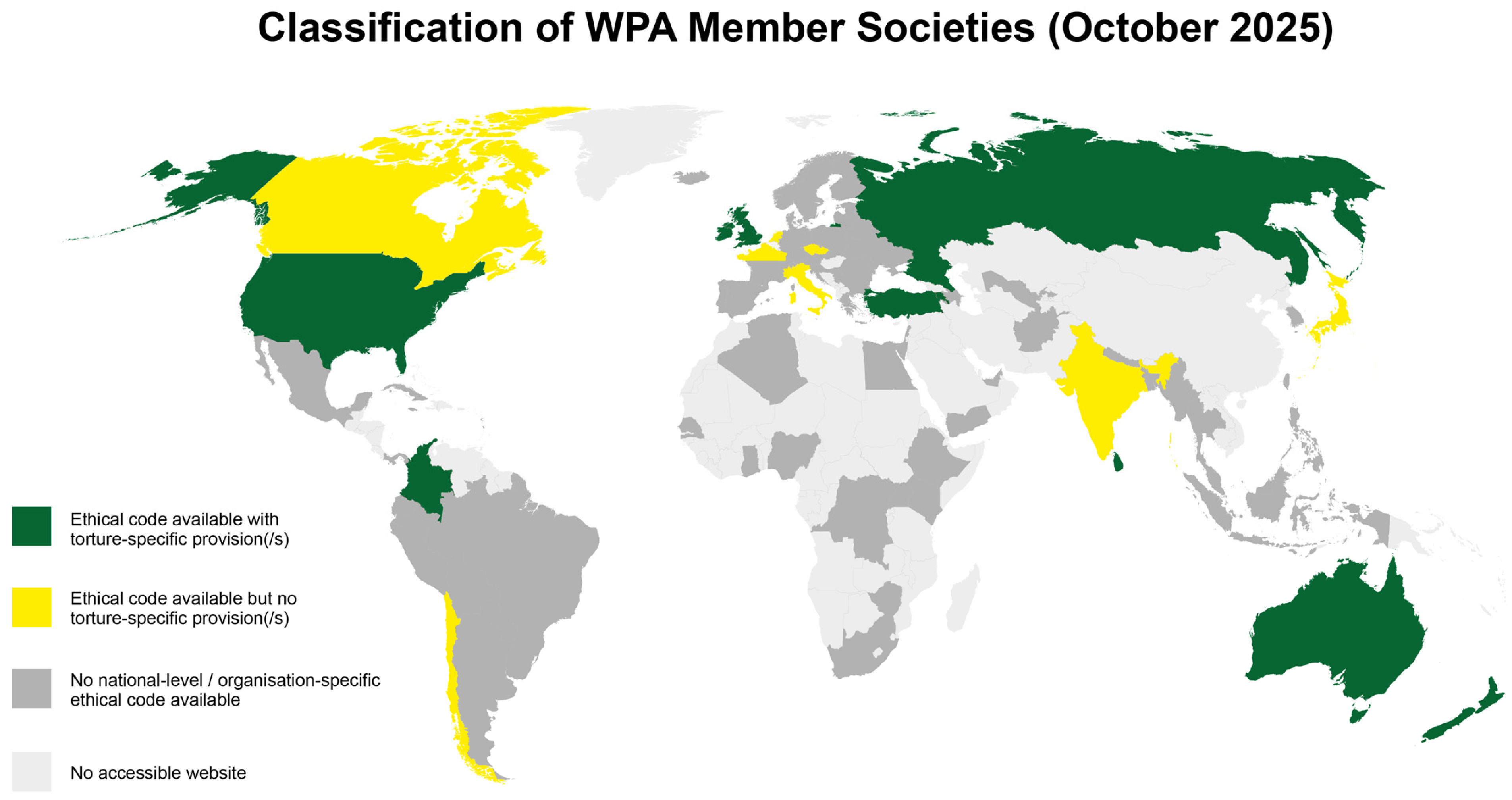
Of the 145 WPA Member Societies, 13.1% (n = 19) had a publicly identifiable ethics code following the operationalised criteria (Section 2.2). Separately, at the time of data collection, 29.7% (n = 43) had “No accessible website” and 57.2% (n = 83) had “No national-level ethical code available” (Figure 1).
Amongst the nineteen national-level psychiatric organisations with ethical codes, just over 50% (n = 10; 6.9% of total Member Societies) included a torture-specific provision, per Section 2.2. Figure 1 provides a geographical overview of these classifications. A complete list of WPA Member Societies and their classifications, along with a summary table of organisations with torture-specific provisions and key verbatim excerpts for ease of reference, is provided in the Supplementary Materials.

3.2. WPA Member Society Ethical Positions

3.2.1. “Ethical Code Available with Torture-Specific Provision(/s)” (n = 10)

Specific anti-torture provisions from WPA Member Societies varied considerably in scope and content, ranging from expansive definitions and contextual guidance to brief statements.
The Psychiatric Association of Turkey (PAT) and the Colombian Psychiatric Association (ACP) adopted the most detailed provisions [43,44]. The PAT’s Ethical Rules of Psychiatry (2002) comprised a “[n]on-assistance in Torture” clause, requiring psychiatrists to “be against torture under all circumstances”, provide care for torture survivors, and utilise professional knowledge to investigate applicable allegations [43].
The ACP’s Ethical Principles and Deontological Code rejects psychiatric involvement “as investigator, adviser, or cover-up” in cruel, inhuman, or degrading practices, clarifying that “situations of armed conflict, civil war, revolution, terrorism or similar do not justify such procedures” [44]. The Armenian Psychiatric Association (ArPA) echoed this position in its Code of Professional Ethics, eschewing “military conflict”, “revolutions”, and “terrorist acts” as pretexts for torture and related abuses [45].
Fewer than half of the identified documents described any enforcement procedures. Nevertheless, the PAT, the ACP, the Royal Australian and New Zealand College of Psychiatrists (RANZCP), and the Hungarian Psychiatric Association (HPA) referenced disciplinary committees and penalties for breaching their ethical codes, including torture-specific provisions [43,44,46,47].
For example, actions from the HPA may range from condemnation of unethical behaviour to informing the statutory body, the Hungarian Medical Chamber, depending on the severity of the case [47]. For grave transgressions, relevant sanctions could also include “suspension” of membership, “exclusion” from the HPA, or “the initiation of legal proceedings (in case of a reasonable suspicion of a violation of the law) [47]. The ACP likewise describes various possible disciplinary responses to unethical conduct from warnings through to “expulsion” from the organisation [44].
Meanwhile, the RANZCP asserted that “practitioners who breach the principles may be subject to complaints procedures and disciplinary action, including expulsion from the RANZCP” [46]. Conversely, influential organisations like Royal College of Psychiatrists (RCPsych) forbid participation in torture but did not explicitly detail any enforcement architecture underpinning this position [47].
Several organisations imposed affirmative reporting duties; the PAT, the RANZCP, RCPsych, and the College of Psychiatrists of Ireland (CPsychI) required psychiatrists who “become aware” or “suspect” acts of torture to report relevant cases to authorities or relevant entities [43,46,48,49]. Elsewhere, the ACP code mandated reporting to its Ethics Committee and other applicable bodies [44]. Finally, other bodies including the Sri Lankan College of Psychiatrists, and the Russian Society of Psychiatrists (RSP) foregrounded comparable proscriptions, albeit with minimal elaboration about their scope and enforcement [50,51].

3.2.2. “Ethical Code Available but No Torture-Specific Provision(/s)” (n = 9)

Nine associations possessed codes that did not expressly prohibit torture but instead contained general tenets implicitly pertinent to such conduct. These invoked provisions around “respect for dignity” and adherence to “binding regulations for the performance of [the] profession”, amongst other clauses. For instance, the Czech Psychiatric Association’s Code of Ethics (2022) and the Japanese Society of Psychiatry and Neurology’s Bylaws of the Code of Ethics for Psychiatrists (2021) articulate analogous obligations [52,53].
Elsewhere, the Canadian Psychiatric Association (CPA) had not incorporated torture prohibitions into its Canadian Medical Association Code of Ethics Annotated for Psychiatrists (1996) but has issued a comprehensive position statement unequivocally forbidding psychiatric involvement in torture and coercive interrogations [54,55]. In this, the CPA strongly affirm that their organisation “opposes the use of torture for whatever reasons by whatever individuals in whatever location” and that “torture is both morally and ethically abhorrent” [55]. Correspondingly, the CPA repudiate any distinction “between torture and coercive interrogation” insofar as it might be used to justify psychiatric involvement [55].
Similarly, some organisations with torture provisions in their codes (i.e., the APA, RCPsych, and the RANZCP) have also published supplementary position statements [56,57,58]. The APA assert that “psychiatrists should not participate in, or otherwise assist or facilitate, the commission of torture” including the “interrogation of persons held in custody by military or civilian investigative or law enforcement authorities” [56]. In its position statement, the RANZCP “strongly condemns torture”, endorsing psychiatric awareness of its psychological harms, refusal to participate in inhuman treatment, and more research into the rehabilitation of survivors [58].

3.2.3. “No National-Level/Organisation-Specific Ethical Code Available” and “No Accessible Website” (n = 126)

Of the 83 Member Societies with accessible websites but no psychiatry-specific ethical codes, several explicitly deferred to larger medical or international frameworks. The Bulgarian Psychiatric Association, for example, is committed to adopting “principles proclaimed by the UN, its specialised bodies, the World Medical Association and the World Psychiatric Association, regarding human rights, medical ethics and […] the psychiatric profession” [59]. Similar, in the absence of their own ethical codes, the Brazilian Association of Psychiatry, the Estonian Psychiatric Association, and the Lithuanian Psychiatric Association, amongst others, foregrounded references to broader medical ethical guidelines, which do prohibit torture [60,61,62].
Different organisations (e.g., the Malaysian Psychiatric Association) appeared to host ethical regulations in member-only areas of their website, thereby excluding them from the analysis [63]. Additionally, 43 Member Societies lacked functional or accessible websites at the time of data collection, and it remained unclear whether these organisations maintain codes that were not publicly accessible through web-based searches.

4. Discussion

4.1. Overview and Characteristics of Anti-Torture Provisions in Global Psychiatry

This study examined the ethical codes of WPA Member Societies for human rights protections relevant to torture and abusive practices, drawing on 145 psychiatric organisations spanning six continents. The findings revealed limited coverage of anti-torture provisions in ethical codes transnationally; only 13.1% of WPA Member Societies maintain accessible ethical codes, and of these, approximately half (6.9% of all associations) comprised torture-related content. These results are striking given past human rights abuses and instances of medical involvement in torture, although they align with earlier investigations underlining a paucity of national-level ethical frameworks within global psychiatry [2,20,21,22,23,24,25,26,27,37,40].
Anti-torture clauses were primarily identified amongst WPA Member Societies across diverse political systems, particularly from high-income countries and in jurisdictions exposed to recent human rights violations and armed conflicts. Specifically, in scenarios of armed conflict, security imperatives and emergency powers could undermine professional boundaries, heightening risks for psychiatric complicity through institutional pressures and bureaucratic instrumentalisation [10,11,12,16]. Thus, whilst the precise pathways and contributing factors remain unclear, this suggests that the emergence of explicit anti-torture clauses may be partly attributable to institutional capacity and prior national experiences (e.g., the RSP code was in part developed as a reaction to Soviet-era punitive psychiatry [64]).
The most extensive provisions, exemplified by the PAT, ACP, and ArPA, directly rejected exceptionalist pretexts for torture, including war, terrorism, and other national security justifications, reinforcing guidelines from the WPA, EPA, WMA, and UN [30,32,33,34]. This may indicate a measure of resistance to external pressures. However, written statements alone offer limited protective force unless underpinned by judicial safeguards, robust monitoring, and collective professional solidarity [5,20]. Additionally, several WPA Member Societies (i.e., the PAT, the RANZCP, RCPsych, and CPsychI) mandated affirmative reporting obligations for suspected torture, requiring practitioners to actively guard against abuses, thereby corresponding with the Istanbul Protocol [35,43,46,48,49,65].
Fewer than half of the WPA Member Societies with torture-related provisions stipulated enforcement mechanisms in their codes (e.g., disciplinary committees or career sanctions), reflecting larger accountability deficits previously noted across psychiatric ethics [37]. Although these omissions do not render anti-torture clauses meaningless, they do constrain their ability to deter misconduct and signal that ethical transgressions will entail tangible consequences; this concern is amplified by historical evidence showing how representative bodies have not always responded adequately to medical abuses or complicity in torture (e.g., [5,8,9,66]).

4.2. Gaps, Implications, and Recommendations

The scarcity of general ethical policies and anti-torture provisions from WPA Member Societies should not be interpreted as indifference; rather, several factors likely contributed, with Member Societies differing in their organisational structure, resources, mandates, and membership numbers [42]. Some are predominantly special interest groups focussed on promoting research or organising conferences. Additionally, sociocultural and sociolegal dynamics vary substantially cross-jurisdictionally.
Several associations articulated anti-torture stances through position statements or deferred to broader medical protocols and transnational instruments (e.g., [55,59,60,61]). Notably, in some jurisdictions, ethical governance is centralised under state medical councils and other statutory bodies, representing the varied models of professional oversight throughout global psychiatry (and, indeed, global medicine) [41,67]. Hence, the associations covered in this analysis may deem these multi-layered arrangements as superseding psychiatry- and society-specific ethical codes.
Moreover, some professional and disciplinary contexts may accentuate aspiration-based, normative guidance over prescriptive rules, possibly diminishing the perceived necessity for direct torture prohibitions [68]. It might also be argued that general beliefs (e.g., the Hippocratic tradition and principles of beneficence and non-maleficence) already preclude the infliction of individual harms (and, by extension, torture) by medical practitioners.
Nonetheless, historical and continuing instances of state-sponsored repression demonstrate that supranational legislation and abstract ideals, even in democratic states with extensive human rights laws, can be susceptible to selective circumvention [2,66,68,69]. In various situations, clinicians have justified injurious interventions by citing therapeutic intentions, public-safety rationales, and exceptionalist interpretations of their professional duties [1,2,3,4,5,9,20,21,22,23,24,25,26,27]. Together, these episodes illustrate how widely endorsed ethical values can be selectively reframed under institutional pressure, which may erode their protective power.
Of course, it remains unclear (and perhaps unknowable) if explicit provisions would demonstrably reduce psychiatric complicity in torture compared to reliance on high-level commitments alone. The existence of anti-torture clauses in countries with reported histories of human rights breaches and conflict involvement might suggest they were primarily remedial responses as opposed to proactive safeguards (e.g., for the RSP [64]). Alternatively, provisions adopted post hoc could deter future violations, blurring this preventive-versus-reactive distinction.
Even so, whatever their primary intention, anti-torture provisions in ethical codes from national associations represent one layer in a larger protective ecology [1,2,3,4,5,38,39]. This is particularly important because torture in itself is rarely an isolated act; instead, it is typically enabled by institutional pressures and bureaucratic instrumentalisation that can normalise coercive practices and dilute individual accountability [11,12,13,14,15]. Within such frameworks, ethical codes may establish visible standards reinforcing external oversight, provide legal and even rhetorical resources for refusal (i.e., “my ethical code forbids this”), and create reference points for disciplinary proceedings and professional socialisation [68,70,71].
Moreover, as normative, regulatory, and legitimising instruments, they can convert universal moral axioms into concrete professional expectations, which could subsequently be linked to regulatory levers in psychiatric care that many Member Societies oversee (e.g., licensing, reaccreditation) [37,68,70,71,72]. Accordingly, national psychiatric associations should incorporate anti-torture content into their ethical codes at the next opportunity for revision, drawing upon comprehensive existing models.
For under-resourced Member Societies or those lacking ethical frameworks, concise position statements or documentation underpinned by the WPA’s Code of Ethics for Psychiatry may offer a pragmatic interim step, provided they are accessible and integrated into organisational processes [37]. The WPA can encourage harmonisation via technical assistance and periodic review of Member Society alignment, potentially drawing upon applicable expertise from its Scientific Section on the “Psychological Consequences of Torture & Persecution” [31].
Still, these recommendations presuppose that ethical documents will translate into practice and retain their purpose cross-culturally throughout international psychiatry. Conversely, empirical studies highlight how the awareness and the utility of ethical codes in daily care can be limited [72,73]. Ultimately, unless they are underpinned by robust dissemination and enforcement, these materials risk functioning merely as symbolic artefacts [37].
Instead, the value of ethical guidelines may depend less on their existence than on whether psychiatrists know them, regard them as authoritative, and can invoke them without fear of retaliation. Consequently, embedding torture-related ethics into psychiatric training programmes internationally will be essential for equipping clinicians to respond to coercive actions and for cultivating a moral community [5,7,37,39,40].

4.3. Study Strengths, Limitations, and Future Research Directions

This study reports the first thorough investigation of human rights protections, specifically torture-related provisions, across all WPA Member Societies (145 organisations in six continents). The systematic approach and wide geographical coverage provide important insights into transnational patterns of ethical governance in psychiatry. Additionally, the inclusion of enforcement procedures and reporting obligations broadens the current analysis to incorporate practical considerations.
Nonetheless, several limitations warrant acknowledgment. First, this study focussed on explicit ethical codes to facilitate searching and comparative assessments in global psychiatry, and did not directly search for alternative instruments like position statements (e.g., [55,56,57,58]). The operationalised definition of torture was informed by UNCAT language, conceivably omitting regulations that substantively prohibit the same conduct using different terminology and culturally specific framing [6]. Equally, automated translation was used for non-English ethical codes and was verified by native speakers where applicable; no formal back-translation was performed.
Moreover, solely examining publicly accessible materials may underrepresent guidance available to practising psychiatrists through internal channels (although public accessibility itself constitutes an important dimension of transparency and accountability). Web-based searches inevitably risk omissions, particularly since 29.7% of Member Societies lacked functional websites.
Indeed, the absence of an accessible website may reflect issues related to the digital divide, including sites not indexed by Western search engines and other access barriers. For example, due to state-level internet restrictions, this is likely applicable for the Chinese Society of Psychiatry and the Iranian Psychiatric Association, which were both classified as having “No accessible website” (e.g., [74,75]). This is further complicated by the fact that the cross-sectional nature of the data collected from Member Societies only reflects a singular point in time; ultimately, codes may be subject to revision and adoption trends will inevitably evolve.
Despite these limitations, the results offer a robust basis for further inquiries. To that end, longitudinal work can track code developments and surveys could explore awareness and attitudes towards these documents in psychiatry [37]. Studies assessing how Member Societies embed anti-torture content within training curricula will clarify how ethical regulations are translated into professional practice.
Identifying the barriers that under-resourced Member Societies might face in developing ethical codes could inform targeted support mechanisms from the WPA and other international entities. Finally, extending this design to encompass anti-torture provisions from general medical councils and national medical associations would elucidate how different regulatory models address similar ethical challenges, potentially informing more effective governance structures in psychiatry.

5. Conclusions

This study derived ethical codes from WPA Member Societies to examine the extent of protections against torture and related abuses, including the scope and enforceability of extant provisions. Overall, the findings revealed major gaps in coverage; amongst those nineteen organisations with publicly accessible codes, ten included torture-specific prohibitions (representing 6.9% of all WPA Member Societies), and enforcement mechanisms remained largely inconsistent.
Notably, torture prohibitions clustered in higher-income Member Societies and in jurisdictions shaped by legacies of psychiatric abuses or human rights violations and armed conflict (e.g., Armenia, Colombia, the Russian Federation, Turkey, and the United States). Consequently, these patterns indicate that there may be multiple catalysts for ethical codification. In short, this initial assessment identified more extensive models as well as areas of deficiency, simultaneously yielding actionable insights for national psychiatric organisations developing and refining their ethical frameworks.
In an era of intensifying geopolitical fissures, resurgent authoritarianism, and persistent reports of torture worldwide, the protective architecture surrounding psychiatric procedures requires proactive reinforcement. Given the institutional, bureaucratic, and legal frameworks that can normalise torture and other abuses, ethical codes alone will not prevent all instances of professional complicity, but their absence does weaken the foundations upon which mental health professionals might resist participation. Therefore, as the WPA continues to champion human rights in clinical care, strengthening normative paradigms amongst its Member Societies may well be necessary to safeguard ethical psychiatric practice and support the dignity of all individuals within an ever-more tumultuous world.

Supplementary Materials

The following supporting information can be downloaded at: https://www.mdpi.com/article/10.3390/psychiatryint7020050/s1, Table S1: WPA Member Societies Classified as “Ethical Code Available with Torture-Specific Provision(s)” (n = 10); Table S2: Classification of WPA Member Societies (October 2025).

Author Contributions

Conceptualization, A.J.S., S.H., D.B., A.P., J.T., A.V., A.B. and M.L.; Methodology, A.J.S., S.H., A.B. and M.L.; Validation, A.B. and M.L.; Formal analysis, A.J.S. and S.H.; Investigation, A.J.S. and S.H.; Writing—original draft, A.J.S. and S.H.; Writing—review & editing, A.J.S., S.H., D.B., A.P., J.T., A.V., A.B. and M.L.; Supervision, A.B. and M.L. All authors have read and agreed to the published version of the manuscript.

Funding

This research received no external funding.

Institutional Review Board Statement

The article is solely a documentary analysis, which does not describe any research on human subjects and therefore, ethical approval is not required.

Informed Consent Statement

The article is solely a documentary analysis, which does not describe any research on human subjects and therefore, ethical approval is not required.

Data Availability Statement

The original contributions presented in this study are included in the article/Supplementary Materials. Further inquiries can be directed to the corresponding author.

Conflicts of Interest

A.J.S., A.B., A.V., D.B., J.T., and M.L. are members of the Geopsychiatry Special Interest Group of the World Psychiatric Association and A.P. is the chair of the Geopsychiatry Special Interest Group of the World Psychiatric Association. S.H. declares no conflicts of interest.

Abbreviations

ACPColombian Psychiatric Association
ArPAArmenian Psychiatric Association
CPACanadian Psychiatric Association
CPsychICollege of Psychiatrists of Ireland
EPAEuropean Psychiatric Association
HPAHungarian Psychiatric Association
PATPsychiatric Association of Turkey
RANZCPRoyal Australian and New Zealand College of Psychiatrists
RSPRussian Society of Psychiatrists
RCPsychRoyal College of Psychiatrists
UNUnited Nations
UNCATUnited Nations Convention Against Torture
WMAWorld Medical Association
WPAWorld Psychiatric Association

References

  1. McColl, H.; Bhui, K.; Jones, E. The role of doctors in investigation, prevention and treatment of torture. J. R. Soc. Med. 2012, 105, 464–471. [Google Scholar] [CrossRef]
  2. Smith, A.J.; van Voren, R.; Bhugra, D.; Buadze, A.; Liebrenz, M. The urgent responsibility to confront psychiatric abuses and defend ethical principles in a turbulent world. J. R. Soc. Med. 2025, 118, 97–98. [Google Scholar] [CrossRef]
  3. Jones, P. Medical involvement in torture in Syria. Torture 2019, 29, 77–79. [Google Scholar] [CrossRef]
  4. Hoffman, S.J. Ending medical complicity in state-sponsored torture. Lancet 2011, 378, 1535–1537. [Google Scholar] [CrossRef]
  5. Allbrook, D.B. Torture and the teaching of medical ethics. Med. J. Aust. 1983, 2, 206–207. [Google Scholar] [CrossRef]
  6. Office of the United Nations High Commissioner for Human Rights. Convention Against Torture and Other Cruel, Inhuman or Degrading Treatment or Punishment. Available online: https://www.ohchr.org/en/instruments-mechanisms/instruments/convention-against-torture-and-other-cruel-inhuman-or-degrading (accessed on 27 January 2026).
  7. Kaczmarek, A.; Żok, A.; Baum, E. Ethical principles across countries: Does ‘ethical’ mean the same everywhere? Front. Public Health 2025, 13, 1579778. [Google Scholar] [CrossRef]
  8. Miles, S.H. Doctors’ complicity with torture. BMJ 2008, 337, a1088. [Google Scholar] [CrossRef]
  9. Jesper, S. Doctors’ involvement in torture. Torture 2008, 18, 161–175. [Google Scholar]
  10. Einolf, C.J. The Fall and Rise of Torture: A Comparative and Historical Analysis. Sociol. Theory 2007, 25, 101–121. [Google Scholar] [CrossRef]
  11. Rejali, D. Torture and Democracy; Princeton University Press: Princeton, NJ, USA, 2007. [Google Scholar]
  12. McCoy, A.W. A Question of Torture: CIA Interrogation, from the Cold War to the War on Terror; Metropolitan Books: New York, NY, USA; p. 200.
  13. Scarry, E. The Body in Pain: The Making and Unmaking of the World; Oxford University Press: New York, NY, USA, 1987. [Google Scholar]
  14. Crelinsten, R.D.; Schmid, A. (Eds.) The Politics of Pain: Torturers and Their Masters; Routledge: New York, NY, USA, 1995. [Google Scholar]
  15. Lifton, R.J. The Nazi Doctors: Medical Killing and the Psychology of Genocide; Basic Books: New York, NY, USA, 1986. [Google Scholar]
  16. Smith, A.; Ogunwale, A.; Moura, H.F.; Bhugra, D.; Ventriglio, A.; Liebrenz, M. Mental health and justice beyond borders: Global crises, sociopolitical determinants, and contemporary practices in forensic psychiatry. Int. Rev. Psychiatry 2024, 36, 784–793. [Google Scholar] [CrossRef]
  17. International Committee of the Red Cross. The Geneva Conventions and Their Commentaries. Available online: https://www.icrc.org/en/law-and-policy/geneva-conventions-and-their-commentaries (accessed on 27 January 2026).
  18. Office of the United Nations High Commissioner for Human Rights. International Covenant on Civil and Political Rights. Available online: https://www.ohchr.org/en/instruments-mechanisms/instruments/international-covenant-civil-and-political-rights (accessed on 27 January 2026).
  19. European Court of Human Rights. European Convention on Human Rights. Available online: https://www.echr.coe.int/documents/d/echr/convention_ENG (accessed on 27 January 2026).[Green Version]
  20. Sidhu, N.; Srinivasraghavan, J. Ethics and Medical Practice: Why Psychiatry is Unique. Indian J. Psychiatry 2016, 58, S199–S202. [Google Scholar] [CrossRef]
  21. Balfe, M. The enhanced interrogator: Dr. James Mitchell’s perspectives on enhanced interrogation. Hist. Psychiatry 2025, 1–9. [Google Scholar] [CrossRef]
  22. World Psychiatric Association. World Psychiatric Association Declaration on Participation of Psychiatrists in Interrogation of Detainees. Available online: https://tidsskrift.dk/torture-journal/article/download/103980/152919/213301 (accessed on 27 January 2026).
  23. van Voren, R. Political abuse of psychiatry—An historical overview. Schizophr. Bull. 2010, 36, 33–35. [Google Scholar] [CrossRef]
  24. Hasian, M., Jr. The deployment of ethnographic sciences and psychological warfare during the suppression of the Mau Mau rebellion. J. Med. Humanit. 2013, 34, 329–345. [Google Scholar] [CrossRef]
  25. Samojedny, C. Rawson (1974–1984). Testimonios de la Unidad Penitenciaria N°6. Psicología y Dialéctica del Represor y el Reprimido [Rawson (1974–1984). Testimonies from Penitentiary Unit No. 6. Psychology and Dialectics of the Repressor and the Repressed]; Puño y Letra: Buenos Aires, Argentina, 1986. [Google Scholar]
  26. Halpern, A.L.; Halpern, J.H.; Doherty, S.B. “Enhanced” interrogation of detainees: Do psychologists and psychiatrists participate? Philos. Ethics Humanit. Med. 2008, 3, 21. [Google Scholar] [CrossRef]
  27. Smith, A.; van Voren, R.; Liebrenz, M. Resurgent trends in punitive psychiatry in the Russian Federation. Lancet Reg. Health Eur. 2024, 42, 100935. [Google Scholar] [CrossRef]
  28. Asociación Mundial de Psiquiatría. Declaración de Madrid Sobre Los Requisitos Éticos de la Práctica de la Psiquiatría [Madrid Declaration on Ethical Standards for Psychiatric Practice]. Actas Esp. Psiquiatr. 2003, 31, 107–110. [Google Scholar]
  29. World Psychiatric Association. Declaration of Madrid. Available online: https://www.wpanet.org/wp-content/uploads/2025/09/declaration-madrid-current-psychiatric-practice-2.pdf (accessed on 27 January 2026).
  30. World Psychiatric Association. WPA Code of Ethics. Available online: https://www.wpanet.org/wp-content/uploads/2025/09/WPA-Code-of-Ethics-2020.final2_.pdf (accessed on 27 January 2026).
  31. World Psychiatric Association. Psychological Consequences of Torture & Persecution. Available online: https://www.wpanet.org/section-page/psychological-consequences-of-torture-persecution/ (accessed on 27 January 2026).
  32. European Psychiatric Association. EPA Code of Ethics. Available online: https://www.europsy.net/epa-code-of-ethics/ (accessed on 27 January 2026).
  33. World Medical Association. WMA Declaration of Tokyo—Guidelines for Physicians Concerning Torture and other Cruel, Inhuman or Degrading Treatment or Punishment in Relation to Detention and Imprisonment. Available online: https://www.wma.net/policies-post/wma-declaration-of-tokyo-guidelines-for-physicians-concerning-torture-and-other-cruel-inhuman-or-degrading-treatment-or-punishment-in-relation-to-detention-and-imprisonment/ (accessed on 27 January 2026).
  34. United Nations Human Rights Office of the High Commissioner. Principles of Medical Ethics Relevant to the Role of Health Personnel, Particularly Physicians, in the Protection of Prisoners and Detainees Against Torture and Other Cruel, Inhuman or Degrading Treatment or Punishment. Available online: https://www.ohchr.org/en/instruments-mechanisms/instruments/principles-medical-ethics-relevant-role-health-personnel (accessed on 27 January 2026).
  35. United Nations Human Rights Office of the High Commissioner. Istanbul Protocol: Manual on the Effective Investigation and Documentation of Torture and Other Cruel, Inhuman or Degrading Treatment or Punishment (2022 Edition). Available online: https://www.ohchr.org/en/publications/policy-and-methodological-publications/istanbul-protocol-manual-effective-0 (accessed on 27 January 2026).
  36. Appelbaum, P.S.; Tyano, S. The WPA Code of Ethics for Psychiatry. World Psychiatry 2021, 20, 308–309. [Google Scholar] [CrossRef]
  37. Bloch, S.; Kenn, F.; Lim, I. Codes of ethics for psychiatrists: Past, present and prospect. Psychol. Med. 2022, 52, 1201–1207. [Google Scholar] [CrossRef]
  38. O’Connor, M. Can we prevent doctors being complicit in torture? Breaking the serpent’s egg. J. Law Med. 2009, 17, 426–438. [Google Scholar]
  39. Polatin, P.B.; Modvig, J.; Rytter, T. Helping to stop doctors becoming complicit in torture. BMJ 2010, 340, c973. [Google Scholar] [CrossRef] [PubMed]
  40. Smith, A.; Hachen, S.; van Wijnkoop, M.; Schiltz, K.; Falkai, P.; Liebrenz, M. The Goldwater Rule at 50 and its relevance in Europe: Examining the positions of National Psychiatric Association Members of the European Psychiatric Association. Eur. Psychiatry 2023, 66, e34. [Google Scholar] [CrossRef] [PubMed]
  41. Samochowiec, J.; Frydecka, D.; Skonieczna-Żydecka, K.; Schouler-Ocak, M.; Carpinello, B.; Chkonia, E.; Dom, G.; Falkai, P.; Misiak, B.; da Costa, M.P.; et al. Ethical dilemmas in contemporary psychiatry: Findings from a survey of National Psychiatric Associations in Europe. Eur. Psychiatry 2023, 66, e94. [Google Scholar] [CrossRef] [PubMed]
  42. World Psychiatric Association. Member Societies. Available online: https://www.wpanet.org/wpa-member-societies/ (accessed on 27 January 2026).
  43. Psychiatric Association of Turkiye. The Ethical Rules of Psychiatry. Available online: https://psikiyatri.org.tr/eng/?page=ethical (accessed on 27 January 2026).
  44. Colombian Associaton of Psychiatry. Principios Éticos y Código Deontológico Asociación Colombiana de Psiquiatría [Ethical Principles and Code of Conduct Colombian Association of Psychiatry]. Available online: https://psiquiatria.org.co/documentos/codigo-deontologico.pdf (accessed on 27 January 2026).
  45. Armenian Psychiatric Association. Հոգեբույժի Մասնագիտական Էթիկայի Կոդեքս [Psychiatrist’s Code of Professional Ethics]. Available online: https://www.apnet.am/arm/16/%D5%80%D5%B8%D5%A3%D5%A5%D5%A2%D5%B8%D6%82%D5%B5%D5%AA%D5%AB-%D5%B4%D5%A1%D5%BD%D5%B6%D5%A1%D5%A3%D5%AB%D5%BF%D5%A1%D5%AF%D5%A1%D5%B6-%D5%A7%D5%A9%D5%AB%D5%AF%D5%A1%D5%B5%D5%AB-%D5%AF%D5%B8%D5%A4%D5%A5%D6%84%D5%BD.html (accessed on 27 January 2026).
  46. The Royal Australian and New Zealand College of Psychiatrists. Code of Ethics. Available online: https://www.ranzcp.org/getmedia/2e090981-cdd2-4dee-a317-f8718bc7dc47/ranzcp-code-of-ethics.pdf (accessed on 27 January 2026).
  47. Hungarian Psychiatric Association. Etika Kódex [Ethical Code]. Available online: https://mptpszichiatria.hu/upload/pszichiatria/document/mpt_etikaikodex2001_20171026.pdf?web_id=%E2%80%9D (accessed on 27 January 2026).
  48. Royal College of Psychiatrists. Good Psychiatric Practice Code of Ethics. Available online: https://www.rcpsych.ac.uk/docs/default-source/improving-care/better-mh-policy/college-reports/college-report-cr186.pdf (accessed on 27 January 2026).
  49. College of Psychiatrists of Ireland. Professional Ethics for Psychiatrists. Available online: https://irishpsychiatry.ie/wp-content/uploads/2019/05/CPsychI-HRE-Professional-Ethics-for-Psychiatrists-FINAL.pdf (accessed on 27 January 2026).
  50. Sri Lanka College of Psychiatrists. College Ethical Guidelines. Available online: https://slcpsych.lk/college-ethical-guidelines/ (accessed on 27 January 2026).
  51. Russian Society of Psychiatrists. Кодекс Профессиональной Этики Психиатра [Code of Professional Ethics for Psychiatrists]. Available online: https://psychiatr.ru/about/code (accessed on 27 January 2026).
  52. The Japanese Society of Psychiatry and Neurology. Bylaws of the Code of Ethics for Psychiatrists. Available online: https://www.jspn.or.jp/uploads/uploads/files/about/Bylaws_of_the_Code_of_Ethics_for_Psychiatrists.pdf (accessed on 27 January 2026).
  53. Czech Psychiatric Society. Etický Kodex PS ČLS JEP [Code of Ethics of the PS CLS JEP]. Available online: https://www.psychiatrie.cz/spolecnost/dokumenty/eticky-kodex (accessed on 27 January 2026).
  54. Canadian Psychiatric Association. The 1996 CMA Code of Ethics Annotated for Psychiatrists. Available online: https://www.capda.ca/_Library/resources_ethics_codes_and_practice_guidelines/canadian-psychiatric-association-the-cma-code-of-ethics-annotated-for-psychiatrists-2002.pdf (accessed on 27 January 2026).
  55. Canadian Psychiatric Association. The Involvement of Psychiatrists in Coercive Interrogation and Torture. Available online: https://www.cpa-apc.org/wp-content/uploads/Torture-2009-26s-R1-EN-web-Final-v2.pdf (accessed on 27 January 2026).
  56. American Psychiatric Association. Position Statement on Psychiatric Participation in Interrogation of Detainees. Available online: https://www.psychiatry.org/getattachment/015a4fab-0de9-4c57-96b3-126c38e40e48/Position-Psychiatric-Participation-in-Interrogation-of-Detainees.pdf (accessed on 27 January 2026).
  57. Royal College of Psychiatrists. Definition of Torture in the Context of Immigration Detention Policy. Available online: https://www.rcpsych.ac.uk/docs/default-source/improving-care/better-mh-policy/position-statements/ps07_2016.pdf?sfvrsn=3fa8ee14_4 (accessed on 27 January 2026).
  58. The Royal Australian and New Zealand College of Psychiatrists. Abolition of Torture and Other Inhuman Treatment. Available online: https://www.ranzcp.org/clinical-guidelines-publications/clinical-guidelines-publications-library/abolition-of-torture-and-other-inhuman-treatment (accessed on 27 January 2026).
  59. Bulgarian Psychiatric Association. Устав и Правила [Statutes and Rules]. Available online: https://www.bpabg.com/?q=node/45 (accessed on 27 January 2026).
  60. Brazilian Medical Association. Código de Ética Médica [Medical Code of Ethics]. Available online: https://d494f813-3c95-463a-898c-ea1519530871.filesusr.com/ugd/947d6c_38c30a6ee60140299b6fb01fe0decfc1.pdf (accessed on 27 January 2026).
  61. Estonian Psychiatric Association. Eesti Arstieetika Koodeks [Estonian Code of Medical Ethics]. Available online: https://psy.ee/materjalid/eetikajuhised (accessed on 27 January 2026).
  62. Lithuanian Psychiatric Association. Profesinė Etika [Professional Ethics]. Available online: https://www.psichiatrija.lt/profesine-etika/ (accessed on 27 January 2026).
  63. Malaysian Psychiatric Association. Ethical Guidelines Relevant to Psychiatry. Available online: https://psychiatry-malaysia.com/medical-professional/guidelines-in-psychiatry/ethic-guidelines-relevant-to-psychiatry/ (accessed on 27 January 2026).
  64. Polubinskaya, S.V.; Bonnie, R.J. The code of professional ethics of the Russian Society of Psychiatrists. Text and commentary. Int. J. Law Psychiatry 1996, 19, 143–172. [Google Scholar] [CrossRef]
  65. Kretzmer, D. Torture, Prohibition of. In Max Planck Encyclopedia of Public International Law (MPEPIL); Peters, A., Wolfrum, R., Eds.; Oxford University Press: Oxford, UK, 2022; Available online: https://opil.ouplaw.com/display/10.1093/law:epil/9780199231690/law-9780199231690-e880 (accessed on 27 January 2026).
  66. Crosby, S.S.; Benavidez, G. From Nuremberg to Guantanamo Bay: Uses of Physicians in the War on Terror. Am. J. Public Health 2018, 108, 36–41. [Google Scholar] [CrossRef]
  67. Bauchner, H.; Fontanarosa, P.B.; Thompson, A.E. Professionalism, governance, and self-regulation of medicine. JAMA 2015, 313, 1831–1836. [Google Scholar] [CrossRef]
  68. Komparic, A.; Garon-Sayegh, P.; Bensimon, C.M. The promises and limitations of codes of medical ethics as instruments of policy change. Bioethics 2023, 37, 406–415. [Google Scholar] [CrossRef]
  69. United Nations Human Rights Office of the High Commissioner. Torture Allegations Continue in Syria Despite ICJ Order: UN Expert. Available online: https://www.ohchr.org/en/press-releases/2024/07/torture-allegations-continue-syria-despite-icj-order-un-expert (accessed on 27 January 2026).
  70. Pellegrino, E.D. Professionalism, profession and the virtues of the good physician. Mt. Sinai J. Med. 2002, 69, 378–384. [Google Scholar]
  71. Lepora, C.; Millum, J. The tortured patient: A medical dilemma. Hastings Cent. Rep. 2011, 41, 38–47. [Google Scholar] [CrossRef]
  72. Tadd, W.; Clarke, A.; Lloyd, L.; Leino-Kilpi, H.; Strandell, C.; Lemonidou, C.; Petsios, K.; Sala, R.; Barazzetti, G.; Radaelli, S.; et al. The value of nurses’ codes: European nurses’ views. Nurs. Ethics 2006, 13, 376–393. [Google Scholar] [CrossRef]
  73. Malloy, D.C.; Sevigny, P.; Hadjistavropoulos, T.; Jeyaraj, M.; McCarthy, E.F.; Murakami, M.; Paholpak, S.; Lee, Y.; Park, I. Perceptions of the effectiveness of ethical guidelines: An international study of physicians. Med. Health Care Philos. 2009, 12, 373–383. [Google Scholar] [CrossRef]
  74. Normile, D. Science suffers as China plugs holes in Great Firewall. Science 2017, 357, 856. [Google Scholar] [CrossRef]
  75. Tidy, J.; Bayan, F. Fears Iran’s Internet Shutdown Could Lead to ‘Extreme Digital Isolation’. BBC News. Available online: https://www.bbc.com/news/articles/cg5gegrdq3go (accessed on 27 January 2025).
Figure 1. Geographical view of WPA Member Society classifications.
Psychiatryint 07 00050 g001
Table 1. World Psychiatric Association Member Society classifications.
ClassificationDescription
“No accessible website”No functional or accessible official website could be identified for the Member Society, excluding standalone social-media pages
“No national-level/organisation-specific ethical code available”Member Society had a website, but no psychiatry-specific ethical code could be located through search procedures
“Ethical code available but no torture-specific provision(/s)”Member Society had a publicly accessible ethical code, but it contains no explicit reference to torture or conduct consistent with the UNCAT definition (per Section 2.2)
“Ethical code available with torture-specific provision(/s)”Member Society had a publicly accessible ethical code containing one or more provisions that explicitly reference torture or prohibit conduct consistent with the UNCAT definition (per Section 2.2)
Disclaimer/Publisher’s Note: The statements, opinions and data contained in all publications are solely those of the individual author(s) and contributor(s) and not of MDPI and/or the editor(s). MDPI and/or the editor(s) disclaim responsibility for any injury to people or property resulting from any ideas, methods, instructions or products referred to in the content.