
Invisible Scars: Psychopathology, Shame and Self-Judgment Following Perinatal Loss—A Cross-Sectional Study




Abstract
1. Introduction
2. Materials and Methods
3. Results
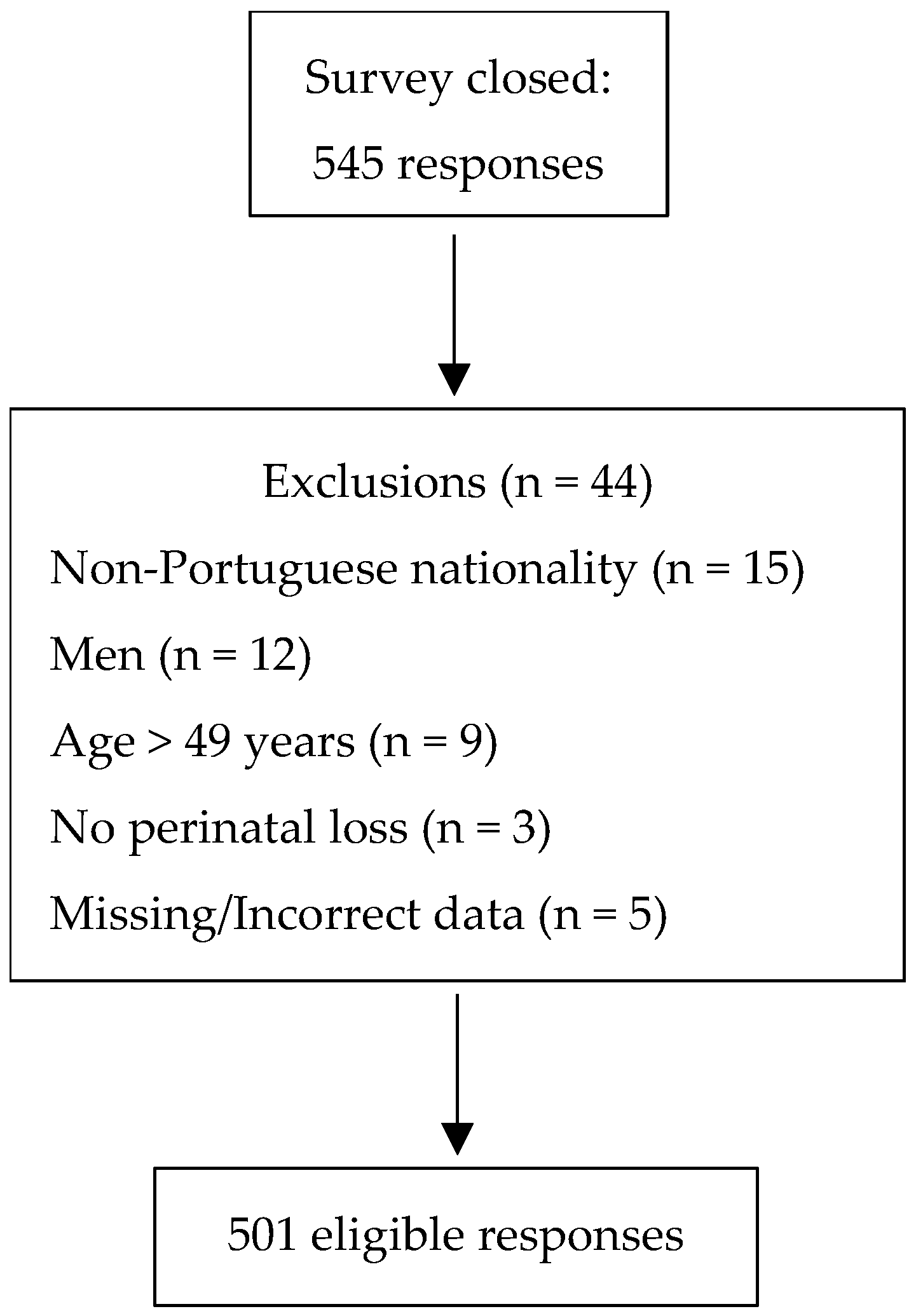
3.1. Participants
3.2. Anxiety and Depressive Symptoms
3.3. Effects of Psychosocial Predictors Controlling for Clinical and Demographic Variables
4. Discussion
4.1. Psychopathological Symptoms
4.2. Influence of Psychosocial and Sociodemographic Factors on Psychopathological Symptoms
4.3. Self-Judgment and Shame
5. Conclusions
Author Contributions
Funding
Institutional Review Board Statement
Informed Consent Statement
Data Availability Statement
Acknowledgments
Conflicts of Interest
Abbreviations
| UNICEF | United Nations Children’s Fund |
| WHO | World Health Organization |
| BSI-18 | Brief Symptom Inventory-18 |
| SCS | Self-Compassion Scale |
| PAQ | Shame Scale |
| SPSS | Statistical Package for the Social Science |
References
- Gabriel, S.; Paulino, M.; Baptista, T.M. Intervenção Psicológica no Luto Parental. In Luto: Manual de Intervenção Psicológica; PACTOR—Edições de Ciências Sociais, Forenses e da Educação: Lisbon, Portugal, 2021; Volume 1, pp. 183–218. [Google Scholar]
- Quenby, S.; Gallos, I.D.; Dhillon-Smith, R.K.; Podesek, M.; Stephenson, M.D.; Fisher, J.; Brosens, J.J.; Brewin, J.; Ramhorst, R.; Lucas, E.S.; et al. Miscarriage matters: The epidemiological, physical, psychological, and economic costs of early pregnancy loss. Lancet 2021, 397, 1658–1667. [Google Scholar] [CrossRef] [Scilit]
- Mora-Alferez, A.P.; Paredes, D.; Rodríguez, O.; Quispe, E.; Chavesta, E.K.; Zighelboim, E.K.; De Michelena, M. Anomalías Cromosómicas en Abortos Espontáneos. Rev. Peru. Ginecol. Obstet. 2016, 62, 141–151. Available online: http://www.scielo.org.pe/pdf/rgo/v62n2/a02v62n2.pdf (accessed on 3 June 2025). [CrossRef] [Scilit]
- Zhou, H.; Liu, Y.; Liu, L.; Zhang, M.; Chen, X.; Qi, Y. Maternal pre-pregnancy risk factors for miscarriage from a prevention perspective: A cohort study in China. Eur. J. Obstet. Gynecol. Reprod. Biol. 2016, 199, 57–63. [Google Scholar] [CrossRef] [Scilit]
- Mendes, D.C.G.; Fonseca, A.; Cameirão, M.S. The psychological impact of early pregnancy loss in Portugal: Incidence and effect on psychological morbidity. Front. Public Health 2023, 11, 1188060. [Google Scholar] [CrossRef] [Scilit] [PubMed]
- World Health Organization. Why We Need to Talk About Losing a Baby; WHO: Geneva, Switzerland, 2016; Available online: https://www.who.int/news-room/spotlight/why-we-need-to-talk-about-losing-a-baby (accessed on 3 June 2025).
- Maslovich, M.M.; Burke, L.M. Intrauterine Fetal Demise; StatPearls Publishing: Treasure Island, FL, USA, 2022. Available online: https://pubmed.ncbi.nlm.nih.gov/32491465/ (accessed on 3 June 2025).
- PORDATA. Óbitos Fetais e Neonatais [Fetal and Neonatal]; Fundação Francisco Manuel dos Santos: Lisbon, Portugal, 2024; Available online: https://www.pordata.pt/pt/estatisticas/saude/mortalidade/obitos-fetais-e-neonatais (accessed on 3 June 2025).
- Prezotto, K.M.; Bortolato-Major, C.; Moreira, R.C.; Oliveira, R.R.; Melo, E.C.; Silva, F.R.; Abreu, I.S.; Molena Fernandes, C.A. Early and late neonatal mortality: Preventable causes and trends in Brazilian regions. Acta Paul. Enferm. 2023, 36, eAO023222. [Google Scholar]
- Miranda, A.M.; Zangão, M. Vivências maternas em situação de morte fetal. Rev. Enferm. Ref. 2020, 5, 1–8. [Google Scholar] [CrossRef] [Scilit]
- UNICEF. Neonatal Mortality. UNICEF. 2023. Available online: https://data.unicef.org/topic/child-survival/neonatal-mortality/ (accessed on 3 June 2025).
- World Health Organization. Abortion. WHO. 2024. Available online: https://www.who.int/news-room/fact-sheets/detail/abortion (accessed on 3 June 2025).
- Diário da República. Despacho n° 741-A/2007 do Ministério da Saúde. Diário da República, 2007, Série I, n° 118. Available online: https://diariodarepublica.pt/dr/detalhe/diario-republica/118-2007-126208 (accessed on 7 June 2025).
- Arriaga, M.; Oliveira, D.; Mota, E.; Campos, A.; Alves, M.J.; Bombas, T.; Santos, S. Relatório de Análise dos Registos das Interrupções da Gravidez|2023. Direção-Geral da Saúde. 2024. Available online: https://www.dgs.pt/em-destaque/relatorio-de-analise-dos-registos-da-interrupcao-da-gravidez-de-2023-pdf.aspx (accessed on 7 June 2025).
- Herbert, D.; Young, K.; Pietrusińska, M.; MacBeth, A. The mental health impact of perinatal loss: A systematic review and meta-analysis. J. Affect. Disord. 2022, 297, 118–129. [Google Scholar] [CrossRef] [Scilit] [PubMed]
- Mergl, R.; Quaatz, S.M.; Edeler, L.-M.; Allgaier, A.-K. Grief in Women with Previous Miscarriage or Stillbirth: A Systematic Review of Cross-Sectional and Longitudinal Prospective Studies. Eur. J. Psychotraumatology 2022, 13, 2108578. [Google Scholar] [CrossRef] [Scilit]
- Davoudian, T.; Gibbins, K.; Cirino, N.H. Perinatal Loss: The Impact on Maternal Mental Health. Obstet. Gynecol. Surv. 2021, 76, 223–233. [Google Scholar] [CrossRef] [Scilit]
- Gausia, K.; Moran, A.C.; Ali, M.; Ryder, D.; Fisher, C.; Koblinsky, M. Psychological and social consequences among mothers suffering from perinatal loss: Perspective from a low-income country. BMC Public Health 2011, 11, 451. [Google Scholar] [CrossRef] [Scilit]
- Bennett, S.M.; Litz, B.T.; Maguen, S.; Ehrenreich, J.T. An exploratory study of the psychological impact of loss and clinical care of perinatal loss. J. Loss Trauma 2008, 13, 485–510. [Google Scholar] [CrossRef] [Scilit]
- Fernández-Sola, J.M.; Fernández-Medina, C.; Camacho-Ávila, M.; Hernández-Padilla, I.M.; Jiménez-López, F.R.; Hernández-Sánchez, E.; Conesa-Ferrer, M.B.; Granero-Molina, J. Impact of perinatal death on the social and family context of the parents. Int. J. Environ. Res. Public Health 2020, 17, 3421. [Google Scholar] [CrossRef] [Scilit]
- Evans, N.T.M.; Hsu, Y.L.; Kabasele, C.M.; Kirkland, C.; Pantuso, D.; Hicks, S. A qualitative exploration of stressors: Voices of African American women who have experienced each type of fetal/infant loss. J. Black Psychol. 2023, 49, 236–263. [Google Scholar] [CrossRef] [Scilit]
- Shakeel, G.; Shafi, I.; Noor, R.; Bashir, S. Prevalence of stress among women after first-trimester miscarriage. Rawal Med. J. 2021, 46, 391–394. [Google Scholar]
- Farren, J.; Mitchell-Jones, N.; Verbakel, J.; Timmerman, D.; Jalmbrant, M.; Bourne, T. The psychological impact of early pregnancy loss. Hum. Reprod. Update 2018, 24, 731–749. [Google Scholar] [CrossRef] [Scilit]
- Gilbert, P.; Irons, C. Shame, self-criticism, and self-compassion in adolescence. In Adolescent Emotional Development and the Emergence of Depressive Disorders; Allen, N.B., Sheeber, L.B., Eds.; Cambridge University Press: Cambridge, UK, 2009; pp. 195–214. Available online: https://self-compassion.org/wp-content/uploads/2016/06/Gilbert_Irons_2009.pdf (accessed on 3 September 2025).
- Neff, K.D. Self-Compassion: An Alternative Conceptualization of a Healthy Attitude Toward Oneself. Self Identity 2003, 2, 85–101. [Google Scholar] [CrossRef] [Scilit]
- Galhardo, A.; Pinto-Gouveia, J.; Cunha, M.; Matos, M. The impact of shame and self-judgment on psychopathology in infertile patients. Hum. Reprod. 2011, 26, 2408–2414. [Google Scholar] [CrossRef] [Scilit]
- Neff, K.D. Does Self-Compassion Entail Reduced Self-Judgment, Isolation, and Over-Identification? Mindfulness 2016, 7, 791–797. [Google Scholar] [CrossRef] [Scilit]
- Fung, A.W.T.; Lam, L.C.W.; Chan, S.S.M.; Lee, S. Knowledge of mental health symptoms and help-seeking attitude in a population-based sample in Hong Kong. Int. J. Ment. Health Syst. 2021, 15, 39. [Google Scholar] [CrossRef] [Scilit] [PubMed]
- Vara, H.; Thimm, J.C. Associations between self-compassion and grief symptoms in bereaved individuals: An exploratory study. Nord. Psychol. 2020, 72, 235–247. [Google Scholar] [CrossRef] [Scilit]
- Bardos, J.; Hercz, D.; Friedenthal, J.; Missmer, S.A.; Williams, Z.; Temple-Smith, M.J.; Bilardi, J.E. A national survey on public perceptions of miscarriage. Obstet. Gynecol. 2015, 125, 1313–1320. [Google Scholar] [CrossRef] [Scilit] [PubMed]
- Goss, K.; Allan, S. Shame, pride and eating disorders. Clin. Psychol. Psychother. 2009, 16, 303–316. [Google Scholar] [CrossRef] [Scilit] [PubMed]
- Gilbert, P.; Procter, S. Compassionate Mind Training for People with High Shame and Self-Criticism: Overview and Pilot Study of a Group Therapy Approach. Clin. Psychol. Psychother. 2006, 13, 353–379. [Google Scholar]
- Jones, A.E.; Scoresby, K.; Duong, C.C. Navigating grief and pregnancy loss through online storytelling. Qual. Soc. Work. 2022, 22, 795–809. [Google Scholar] [CrossRef] [Scilit]
- Matos, M.; Pinto-Gouveia, J. Shame as a traumatic memory. Clin. Psychol. Psychother. 2009, 17, 299. [Google Scholar] [CrossRef] [Scilit]
- Barbosa, J.C. Saúde e Bem-Estar das Mulheres: Um Potencial a Alcançar. 2022. Available online: https://www.saudes.pt/media/1067/estudo-2022.pdf (accessed on 3 July 2025).
- Kocourková, J.; Konečná, H.; Burcin, B.; Kučera, T. How old is too old? A contribution to the discussion on age limits for assisted reproduction technique access. Reprod. Biomed. Online 2015, 30, 482–492. [Google Scholar] [CrossRef] [Scilit] [PubMed]
- PORDATA. Fertility Rate by Age Group. PORDATA. 2023. Available online: https://www.pordata.pt/portugal/taxa+de+fecundidade+por+grupo+etario-415-2391 (accessed on 3 July 2025).
- Schoemann, A.M.; Boulton, A.J.; Short, S.D. Determining power and sample size for simple and complex mediation models. Soc. Psychol. Personal. Sci. 2017, 8, 379–386. [Google Scholar] [CrossRef] [Scilit]
- Canavarro, M.C.; Nazaré, B.; Pereira, M. Inventário de sintomas Psicopatológicos 18 (BSI-18). In Psicologia Clínica e da Saúde: Instrumentos de Avaliação; Gonçalves, M.M., Simões, M.R., Almeida, L., Eds.; Pactor: Lisboa, Portugal, 2017; pp. 115–130. Available online: https://scispace.com/pdf/inventario-de-sintomas-psicopatologicos-18-bsi-18-i7jtl0drm3.pdf (accessed on 3 July 2025).
- Castilho, P.; Pinto-Gouveia, J.; Duarte, J. Evaluating the Multifactor Structure of the Long and Short Versions of the Self-Compassion Scale in a Clinical Sample. J. Clin. Psychol. 2015, 71, 856–870. [Google Scholar] [CrossRef] [Scilit]
- Geada, M. Questionário de Sentimentos Pessoais; Faculdade de Psicologia da Universidade de Lisboa: Lisbon, Portugal, 2003. [Google Scholar]
- Harder, D.; Greenwald, D.F. Further validation of the shame and guilt scales of Harder’s Personal Feelings Questionnaire–2. Psychol. Rep. 1999, 85, 271–281. [Google Scholar] [CrossRef] [Scilit]
- Irmscher, L.; Marx, R.; Linke, M.; Zimmermann, A.; Drössler, S.; Berth, H. Anxiety, depression, somatization and psychological distress before and 2–6 years after a late termination of pregnancy due to fetal anomalies. BMC Women’s Health 2024, 24, 255. [Google Scholar] [CrossRef] [Scilit]
- Nazaré, B.; Pereira, M.; Canavarro, M.C. Avaliação breve da psicossintomatologia: Análise fatorial confirmatória da versão portuguesa do Brief Symptom Inventory (BSI-18). Anál. Psicol. 2017, 35, 213–230. [Google Scholar] [CrossRef] [Scilit]
- Reddy, U.M. Management of pregnancy after stillbirth. Clin. Obstet. Gynecol. 2010, 53, 700–709. [Google Scholar] [CrossRef] [Scilit]
- Carter, D.; Misri, S.; Tomfohr, L. Psychologic aspects of early pregnancy loss. Clin. Obstet. Gynecol. 2007, 50, 154–165. [Google Scholar] [CrossRef] [Scilit]
- Geller, P.A.; Kerns, D.; Klier, C.M. Anxiety following miscarriage and the subsequent pregnancy: A review of the literature and future directions. J. Psychosom. Res. 2004, 56, 35–45. [Google Scholar] [CrossRef] [Scilit]
- deMontigny, F.; Verdon, C.; Meunier, S.; Dubeau, D. Women’s persistent depressive and perinatal grief symptoms following a miscarriage: The role of childlessness and satisfaction with healthcare services. Arch. Women’s Ment. Health 2017, 20, 655–662. [Google Scholar] [CrossRef] [Scilit] [PubMed]
- Cumming, G.P.; Klein, S.; Bolsover, D.; Lee, A.J.; Alexander, D.A.; Maclean, M.; Jurgens, J. The emotional burden of miscarriage for women and their partners: Trajectories of anxiety and depression over 13 months. BJOG 2007, 114, 1138–1145. [Google Scholar] [CrossRef] [Scilit]
- Robinson, G.E. Pregnancy loss. Best Pract. Res. Clin. Obstet. Gynaecol. 2014, 28, 169–178. [Google Scholar] [CrossRef] [Scilit]
- Chen, T.Y.; Geng, J.H.; Chen, S.C.; Lee, J.I. Living alone is associated with a higher prevalence of psychiatric morbidity in a population-based cross-sectional study. Front. Public Health 2022, 10, 1054615. [Google Scholar] [CrossRef] [Scilit]
- Stahl, S.T.; Beach, S.R.; Musa, D.; Schulz, R. Living alone and depression: The modifying role of the perceived neighborhood environment. Aging Ment. Health 2017, 21, 1065–1071. [Google Scholar] [CrossRef] [Scilit] [PubMed]
- Oliveira, C.M.; de Silva, A.D.; Ramalho, C.; Costa, M.E.; Martins, M.V. Effects of marital satisfaction and ritual utility on bereavement experience in abortion. Cogitare Enferm. 2022, 27, e82691. [Google Scholar] [CrossRef] [Scilit]
- Cassidy, P.R. Beyond emotional support: Predictors of satisfaction and perceived care quality following the death of a baby during pregnancy. J. Périnat. Med. 2022, 50, 832–843. [Google Scholar] [CrossRef] [Scilit]
- Kamravamanesh, M.; Ashabi, B.; Jabarqadri, N.; Salari, N.; Mahmoudi, E. The relationship between self-compassion and depression in pregnant women. Curr. Psychosom. Res. 2023, 1, 462–473. [Google Scholar] [CrossRef] [Scilit]
- Belhouse, C.; Temple-Smith, M.J.; Bilardi, J.E. “It’s jus tone of those things people don’t seem to talk about…”. Women’s experiences of social support following miscarriage: A qualitative study. BMC Women’s Health 2018, 18, 176. [Google Scholar] [CrossRef] [Scilit]
- Volgsten, H.; Jansson, C.; Svanberg, A.S.; Darj, E.; Stavreus-Evers, A. Longitudinal study of emotional experiences, grief, and depressive symptoms in women and men after miscarriage. Midwifery 2018, 64, 23–28. [Google Scholar] [CrossRef] [Scilit] [PubMed]
- Jones, S.L. The Psychological Miscarriage: An Exploration of Women’s Experience of Miscarriage in the Light of Winnicott’s ‘Primary Maternal Preoccupation’, Process of Grief According to Bowlby and Parkes, and Klein’s Theory of Mourning. Br. J. Psychother. 2015, 31, 433–447. [Google Scholar] [CrossRef] [Scilit]
- Hanschmidt, F.; Linde, K.; Hilbert, A.; Riedel-Heller, S.G.; Kersting, A. Abortion stigma: A systematic review. Perspect. Sex. Reprod. Health 2016, 48, 169–177. [Google Scholar] [CrossRef] [Scilit]
- Andrews, B.; Qian, M.; Valentine, J.D. Predicting depressive symptoms with a new measure of shame: The Experience of Shame Scale. Br. J. Clin. Psychol. 2002, 41, 29–42. [Google Scholar] [CrossRef] [Scilit]
- Cheung, M.S.P.; Gilbert, P.; Irons, C. An exploration of shame, social rank, and rumination in relation to depression. Personal. Individ. Differ. 2004, 36, 1143–1153. [Google Scholar] [CrossRef] [Scilit]
- Tangney, J.P.; Stuewig, J. Shame, Guilt, and Remorse: Implications for Offender Populations. J. Forensic Psychiatry Psychol. 2011, 22, 706–723. [Google Scholar] [CrossRef] [Scilit]
- Broen, A.N.; Moum, T.; Bodtker, A.S.; Ekeberg, O. Psychological impact on women of miscarriage versus induced abortion: A 2-year follow-up study. Psychosom. Med. 2004, 66, 265–271. [Google Scholar] [CrossRef] [Scilit] [PubMed]


| Variables | Category | 0–6 (n = 19) | 7–18 (n = 232) | 19–30 (n = 131) | 31–42 (n = 51) | 43+ (n = 68) |
|---|---|---|---|---|---|---|
| Age | M = 32.95 (SD = 4.97) | M = 33.21 (SD = 4.47) |
M = 34.23 (SD = 4.84) | M = 33.73 (SD = 4.62) | M = 36.74 (SD = 4.71) | |
| Marital status | Single | __ |
7.8% (n = 18) |
6.1% (n = 8) |
7.8% (n = 4) |
7.4% (n = 5) |
| Nonmarital partnership |
36.8% (n = 7) |
47.0% (n = 109) |
46.6% (n = 61) |
37.3% (n = 19) |
22.1% (n = 15) | |
| Married |
63.2% (n = 12) |
44.8% (n = 104) |
45.8% (n = 60) |
52.9% (n = 27) |
69.1% (n = 47) | |
| Separated | __ | 0.4% (n = 1) |
0.16% (n = 2) |
2.0% (n = 1) | 1.5% (n = 1) | |
| Household socioeconomic status | Less than €500 | __ | __ |
0.8% (n = 1) |
3.9% (n = 2) |
1.5% (n = 1) |
| Between 500 € and 999 € |
5.3% (n = 1) |
3.4% (n = 8) |
5.3% (n = 7) |
2.0% (n = 1) |
4.4% (n = 3) | |
| Between 1000 € and 2499 €. |
42.1% (n = 8) |
58.2% (n = 135) |
58.8% (n = 77) |
56.9% (n = 29) |
55.9% (n = 38) | |
| Between 2500 € and 4999 € |
47.4% (n = 9) |
33.6% (n = 78) |
33.6% (n = 44) |
27.5% (n = 14) |
32.4% (n = 22) | |
| More than 5000 € |
5.3% (n = 1) |
4.7% (n = 11) |
1.5% (n = 2) |
9.8% (n = 5) |
5.9% (n = 4) | |
| Academic qualifications | High School (9th grade) | __ |
1.7% (n = 4) |
2.3% (n = 3) | __ |
5.9% (n = 4) |
| High School (12th grade) |
10.5% (n = 2) |
23.3% (n = 54) |
20.6% (n = 27) |
23.5% (n = 12) |
25.0% (n = 17) | |
| Bachelor’s degree |
36.8% (n = 7) |
34.5% (n = 80) |
34.4% (n = 45) |
41.2% (n = 21) |
42.6% (n = 29) | |
| Master’s degree |
52.6% (n = 10) |
39.2% (n = 91) |
42.0% (n = 55) |
35.3% (n = 18) |
25.0% (n = 17) | |
| Doctoral degree | __ |
1.3% (n = 3) |
0.8% (n = 1) | __ |
1.5% (n = 1) | |
| Professional Status | Unemployed |
10.5% (n = 2) |
3.9% (n = 9) |
2.3% (n = 3) |
7.8% (n = 4) |
4.4% (n = 3) |
| Employed |
84.2% (n = 16) |
94.4% (n = 219) |
91.6% (n = 120) |
88.2% (n = 45) |
89.7% (n = 61) | |
| Student | __ | __ |
0.8% (n = 1) | __ | __ | |
| Worker/Student |
5.3% (n = 1) |
1.7% (n = 4) |
5.3% (n = 7) |
3.9% (n = 2) |
5.9% (n = 4) | |
| Household | Living alone | __ |
1.3% (n = 3) |
1.5% (n = 2) |
2.0% (n = 1) |
1.5% (n = 1) |
| Living with child(ren) | __ | __ |
0.8% (n = 2) |
3.9% (n = 2) |
2.9% (n = 2) | |
| Living with a partner |
73.7% (n = 14) |
62.5% (n = 145) |
49.6% (n = 65) |
17.6% (n = 9) |
13.2% (n = 9) | |
| Living with a partner and child(ren) |
26.3% (n = 5) |
32.3% (n = 75) |
47.3% (n = 62) |
74.5% (n = 38) |
80.9% (n = 55) | |
| Other households | __ |
3.9% (n = 9) |
0.8% (n = 1) |
2.0% (n = 1) |
1.5% (n = 1) | |
| Place of Residence | Village |
5.3% (n = 1) |
8.6% (n = 20) |
9.2% (n = 12) |
17.6% (n = 9) |
19.1% (n = 13) |
| Town |
10.5% (n = 2) |
18.1% (n = 42) |
19.8% (n = 26) |
19.6% (n = 10) |
11.8% (n = 8) | |
| Small city |
36.8% (n = 7) |
26.7% (n = 62) |
29.8% (n = 39) |
31.4% (n = 16) |
38.2% (n = 26) | |
| Large city |
47.4% (n = 9) |
46.6% (n = 108) |
41.2% (n = 54) |
31.4% (n = 16) |
30.9% (n = 21) | |
| Number of pregnancies | M = 1.89 (DP = 1.45) |
M = 2.20 (DP = 1.15) | M = 2.15 (DP = 1.03) |
M = 2.49 (DP = 1.22) | M = 3.01 (DP = 1.37) | |
| Number of perinatal losses | M = 1.47 (DP = 0.77) |
M = 1.60 (DP = 0.94) | M = 1.34 (DP = 0.68) |
M = 1.37 (DP = 0.82) | M = 1.69 (DP = 1.06) | |
| Type of perinatal loss (most recent loss) | Early miscarriage |
78.9% (n = 15) |
63.8% (n = 148) |
58.8% (n = 77) |
72.5% (n = 37) |
57.4% (n = 39) |
| Late miscarriage |
15.8% (n = 3) |
18.1% (n = 42) |
13.0% (n = 17) |
13.7% (n = 7) |
16.2% (n = 11) | |
| Fetal and neonatal death |
5.3% (n = 1) |
18.1% (n = 42) |
28.2% (n = 37) |
13.7% (n = 7) |
26.5% (n = 18) | |
| Psychological or psychiatric support (in the past) | Yes |
63.2% (n = 12) |
47.0% (n = 109) |
45.8% (n = 60) |
47.1% (n = 24) |
39.7% (n = 27) |
| No |
36.8% (n = 7) |
53.0% (n = 123) |
54.2% (n = 71) |
52.9% (n = 27) |
60.3% (n = 41) | |
| Psychological or psychiatric support (currently) | Yes |
42.1% (n = 8) |
43.1% (n = 100) |
31.3% (n = 41) |
17.6% (n = 9) |
22.1% (n = 15) |
| No |
57.9% (n = 11) |
56.9% (n = 132) |
68.7% (n = 90) |
82.4% (n = 42) |
77.9% (n = 53) | |
| Time Since Last Perinatal Loss | ||||||||||
|---|---|---|---|---|---|---|---|---|---|---|
| 0–6 (n = 19) | 7–18 (n = 232) | 19–30 (n = 131) | 31–42 (n = 51) | 43+ (n = 68) | ||||||
| Median (IQR) | M (SD) | Median (IQR) | M (SD) | Median (IQR) | M (SD) | Median (IQR) | M (SD) | Median (IQR) | M (SD) | |
| BSI-18: Anxiety | 6 (4–10) | 6.95 (3.84) | 8 (5–11) | 8.23 (4.65) | 6 (3–10) | 7.05 (4.87) | 6 (4–11) | 7.22 (5.12) | 6 (3–11) | 6.96 (5.16) |
| BSI-18: Depression | 6 (4–11) | 7.16 (4.50) | 8 (4–12) | 8.33 (5.07) | 6 (3–10) | 7.04 (5.20) | 6 (2–11) | 6.41 (5.09) | 5 (3–10) | 6.88 (5.46) |
| SELFCS: Self-criticism | 2.6 (2.2–3) | 2.64 (0.70) | 2.8 (2.2–3.4) | 2.74 (0.79) | 2.8 (2.2–3.2) | 2.78 (0.85) | 2.6 (2.2–3.2) | 2.70 (0.84) | 2.7 (2.2–3.35) | 2.76 (0.88) |
| SELFCS: Isolation | 2.5 (2–3.25) | 2.64 (0.86) | 2.88 (2.25–3.5) | 2.82 (0.88) | 2.75 (2–3.25) | 2.68 (0.90) | 3 (2.25–3.25) | 2.81 (0.83) | 2.75 (2.25–3.5) | 2.86 (0.91) |
| SELFCS: Over-identification | 2.75 (2.25–3.25) | 2.83 (0.68) | 3 (2.5–3.5) | 2.99 (0.85) | 3 (2.25–3.5) | 2.89 (0.88) | 2.75 (2.25–3.5) | 2.84 (0.88) | 3 (2.25–3.5) | 2.88 (0.86) |
| PAQ: Shame | 11 (7–15) | 11.68 (5.40) | 12 (7.25–16) | 12.54 (6.62) | 12 (7–16) | 12.69 (6.76) | 12 (8–17) | 12.71 (6.73) | 13 (10–19) | 14.49 (6.69) |
| Variables | 1 | 2 | 3 | 4 | 5 | 6 | 7 | 8 | 9 | 10 | 11 | 12 | 13 | 14 | 15 | 16 |
|---|---|---|---|---|---|---|---|---|---|---|---|---|---|---|---|---|
| 1. Age | 1 | |||||||||||||||
| 2. Marital status | 0.181 ** | 1 | ||||||||||||||
| 3. Academic qualifications | 0.054 | 0.197 ** | 1 | |||||||||||||
| 4. Professional Status | 0.091 * | −0.063 | 0.111 * | 1 | ||||||||||||
| 5. Place of Residence | 0.059 | 0.067 | 0.242 * | 0.029 | 1 | |||||||||||
| 6. Household socioeconomic status | 0.153 * | 0.181 * | 0.339 * | 0.083 | 0.265 ** | 1 | ||||||||||
| 7. Household | 0.224 ** | 0.205 ** | 0.007 | 0.014 | −0.045 | 0.094 * | 1 | |||||||||
| 8. Number of pregnancies | 0.302 ** | 0.160 ** | −0.028 | −0.052 | 0.008 | 0.037 | 0.471 ** | 1 | ||||||||
| 9. Number of perinatal losses | 0.225 ** | 0.046 | −0.022 | −0.020 | 0.010 | −0.009 | 0.049 | 0.627 ** | 1 | |||||||
| 10. Type of perinatal loss (most recent loss) | −0.065 | −0.011 | −0.084 | 0.009 | −0.040 | −0.025 | −0.068 | −0.094 * | −0.127 ** | 1 | ||||||
| 11. BSI-18—Anxiety | −0.098 * | −0.095 * | −0.173 ** | −0.027 | −0.103 * | −0.076 | −0.128 ** | −0.079 | −0.035 | 0.133 ** | 1 | |||||
| 12. BSI-18—Depression | −0.080 | −0.110 * | −0.182 * | −0.053 | −0.112 * | −0.109 * | −0.119 ** | −0.122 ** | −0.015 | 0.113 * | 0.753 ** | 1 | ||||
| 13. SCS—Self-criticism | −0.053 | −0.048 | −0.019 | 0.038 | −0.017 | 0.006 | 0.007 | −0.057 | −0.039 | 0.032 | 0.399 | 0.433 ** | 1 | |||
| 14. SCS—Isolation | −0.077 | −0.097 * | −0.085 | 0.036 | −0.056 | 0.009 | −0.059 | −0.064 | −0.010 | 0.056 | 0.452 ** | 0.504 ** | 0.709 ** | 1 | ||
| 15. SCS—Over-identification | −0.080 | −0.024 | 0.016 | 0.022 | 0.011 | 0.015 | −0.040 | −0.043 | 0.021 | 0.029 | 0.408 ** | 0.402 ** | 0.724 ** | 0.707 ** | 1 | |
| 16. PAQ-Shame | −0.075 | −0.093 * | −0.093 * | 0.000 | −0.154 ** | −0.080 | 0.038 | 0.014 | 0.015 | −0.009 | 0.443 ** | 0.436 ** | 0.526 ** | 0.516 ** | 0.493 ** | 1 |
| Predictors of Anxiety Symptoms | ||||||
|---|---|---|---|---|---|---|
| Model I | Model II | |||||
| β | R2 (R2adj) | F(df) | β | R2 (R2adj) | F(df) | |
| (Constant) | 3.249 * | 0.218 (0.217) | 139.421 (1.499) * | 0.154 | 0.284 (0.281) | 98.582 (2.498) * |
| Shame | 0.339 * | 0.221 * | ||||
| Isolation | 1.655 * | |||||
| Predictors of Depression Symptoms | ||||||
|---|---|---|---|---|---|---|
| Model I | Model II | |||||
| β | R2 (R2adj) | F(df) | β | R2 (R2adj) | F(df) | |
| (Constant) | −0.935 | 0.270 (0.269) | 184.661 (1.499) * | −1.275 | 0.327 (0.324) | 121.000 (2.498) * |
| Isolation | 3.049 * | 2.156 * | ||||
| Shame | 0.220 * | |||||
Disclaimer/Publisher’s Note: The statements, opinions and data contained in all publications are solely those of the individual author(s) and contributor(s) and not of MDPI and/or the editor(s). MDPI and/or the editor(s) disclaim responsibility for any injury to people or property resulting from any ideas, methods, instructions or products referred to in the content. |
© 2026 by the authors. Licensee MDPI, Basel, Switzerland. This article is an open access article distributed under the terms and conditions of the Creative Commons Attribution (CC BY) license.
Share and Cite
Ribeiro, M.; Carvalho, P.S.; Torres, A.; Ferreira, D. Invisible Scars: Psychopathology, Shame and Self-Judgment Following Perinatal Loss—A Cross-Sectional Study. Psychiatry Int. 2026, 7, 43. https://doi.org/10.3390/psychiatryint7010043
Ribeiro M, Carvalho PS, Torres A, Ferreira D. Invisible Scars: Psychopathology, Shame and Self-Judgment Following Perinatal Loss—A Cross-Sectional Study. Psychiatry International. 2026; 7(1):43. https://doi.org/10.3390/psychiatryint7010043
Chicago/Turabian StyleRibeiro, Mariana, Paula Saraiva Carvalho, Ana Torres, and Dário Ferreira. 2026. "Invisible Scars: Psychopathology, Shame and Self-Judgment Following Perinatal Loss—A Cross-Sectional Study" Psychiatry International 7, no. 1: 43. https://doi.org/10.3390/psychiatryint7010043
APA StyleRibeiro, M., Carvalho, P. S., Torres, A., & Ferreira, D. (2026). Invisible Scars: Psychopathology, Shame and Self-Judgment Following Perinatal Loss—A Cross-Sectional Study. Psychiatry International, 7(1), 43. https://doi.org/10.3390/psychiatryint7010043