1. Introduction
Depressive symptoms and clinically diagnosed depressive disorders are among the most frequent and clinically significant sequelae of COVID-19 and often constitute an important component of the clinical presentation of post-COVID syndrome (PCS). In outpatient follow-up, this burden is encountered not only as a formal diagnosis but also as persistent affective distress that can shape patients’ perceived recovery and overall health-related quality of life. Large electronic registry-based studies have shown an excess risk of psychiatric outcomes in individuals with previous COVID-19 compared with uninfected persons or patients with other respiratory infections. In a retrospective electronic health record (EHR) database including 236,379 survivors, the proportion with any neurological or psychiatric diagnosis within 6 months was 33.6%, including mood disorders in 13.7% [
1]. In a cohort of U.S. veterans, the adjusted hazard ratio for incident depressive disorders reached 1.39 (95% CI 1.34–1.43) compared with a matched group without COVID-19 [
2]. Two-year risk trajectories indicate that the excess burden of depressive disorders is most pronounced in the first months after infection compared with respiratory controls, although some neurological outcomes remain elevated over longer follow-up periods [
3].
Long-term observational studies confirm the persistence of affective burden after COVID-19. When assessed with health-related quality-of-life instruments, this persistence becomes visible as ongoing self-reported problems in domains that capture emotional distress. Among hospitalized survivors, the proportion of problems on the EQ-5D anxiety/depression dimension was around 23% at 6 months after the acute phase and remained at clinically meaningful levels at 24 months compared with population reference values [
4,
5]. In practical terms, these EQ-5D “problems” indicate continued patient-reported impairment in the EQ-5D anxiety/depression dimension, rather than a transient early-recovery reaction. In the multicenter British PHOSP-COVID cohort, clinically significant depressive symptoms (PHQ-9 ≥ 10) were present in 30.5% of patients at the first visit and in 26.1% approximately one year later, indicating persistent affective distress in a subgroup of survivors [
6,
7]. Here, PHQ-9 ≥ 10 corresponds to symptom severity typically consistent with at least a moderate depressive symptom burden.
In the nationally representative U.S. National Health Interview Survey (NHIS), the prevalence of survey-based depression was 16.8% among adults with PCS versus 7.1% in other adults; adjusted odds ratios for survey-based depression and related mental health outcomes were approximately twofold (around 2.0) compared with the group without PCS [
8]. This contrast illustrates that survey-based depression is reported substantially more often among those who meet criteria for PCS than among other adults. In a retrospective comparison of outpatients attending a PCS clinic with general practice patients without PCS, mean PHQ-9 scores were several points higher in the PCS group (direct between-cohort comparison) [
9]. In outpatient and mixed survivor cohorts, depressive symptoms have been recorded in roughly one quarter of patients (around 25–26%) within the first 0.5–6 months after infection [
10]. Thus, beyond persistence over time, a clinically relevant share of survivors—approximately one in four in several cohorts—report depressive symptomatology during early post-infection follow-up. Overall, depressive symptoms appear to be more common in those who meet criteria for PCS, reinforcing the need to consider mental health as part of post-COVID outpatient care.
The problem of depressive symptoms is particularly salient in older adults. In a comparative study of “older survivors after COVID-19” versus a community sample without COVID-19, the proportion with screening-positive depressive symptoms on the GDS-15 exceeded 80% in older COVID-19 survivors and remained below 50% in community controls [
11]. Within PCS, specific symptom clusters (e.g., persistent dyspnea) are more frequently associated with pre-existing depression and other mental disorders than among patients from the same cohort without such predictors [
12], underscoring the contribution of mental health factors to symptom persistence and the subjective burden of disease. In this age group, where symptom presentation can be multifactorial and complaints may be shaped by comorbidity and functional status, clear and feasible detection pathways are especially important in routine practice.
For outpatient practice, an essential task remains the accurate initial identification of depressive symptoms in older survivors, including patients with PCS. Reliance solely on spontaneous complaints leads to systematic underestimation of depressive symptoms, whereas the use of simple standardized questions about mood substantially improves detection compared with unstructured elicitation of complaints in routine visits [
13,
14]. This distinction is clinically important because a patient’s failure to voice mood symptoms does not preclude clinically meaningful depressive symptom burden. In older adults, brief geriatric instruments such as the Geriatric Depression Scale and its 15-item version (GDS-15) have been developed and validated as screening tools for depressive symptoms [
15,
16]. At the same time, quantitative estimates of the proportion of “hidden” cases of depressive symptoms in older adults after COVID-19, as well as the association between the detectability of depressive symptoms and the presence of PCS, remain insufficiently characterized, which provides the rationale for the present study.
The objective of the current study was to assess the under-detection of depressive symptoms in older ambulatory patients and to examine its relationship with PCS status.
2. Materials and Methods
2.1. Study Design and Setting
This observational study of an outpatient clinical cohort was conducted at the clinical sites of the Department of General Practice of the Kazakhstan-Russian Medical University: City Polyclinic № 32 and City Polyclinic № 26 (Almaty, Kazakhstan) between June 2024 and April 2025. All diagnostic and research procedures were performed in the outpatient setting according to an approved protocol. Participant selection reflected routine healthcare-seeking patterns; no research-related interventions were introduced. Group allocation was natural and based on the presence or absence of post-COVID syndrome (PCS). Across both outpatient sites, recruitment and assessments were conducted by two study investigators trained in the protocol, using the same standardized procedures and documentation, to ensure consistency between clinics.
2.2. Ethical Approval and Informed Consent
The study was conducted in accordance with the Declaration of Helsinki and national regulatory requirements. The protocol was reviewed and approved by the Local Ethics Committee of the Kazakhstan-Russian Medical University (Protocol № 22, 22 April 2024). All participants were informed about the study procedures and provided written informed consent.
2.3. Participants and Eligibility Criteria
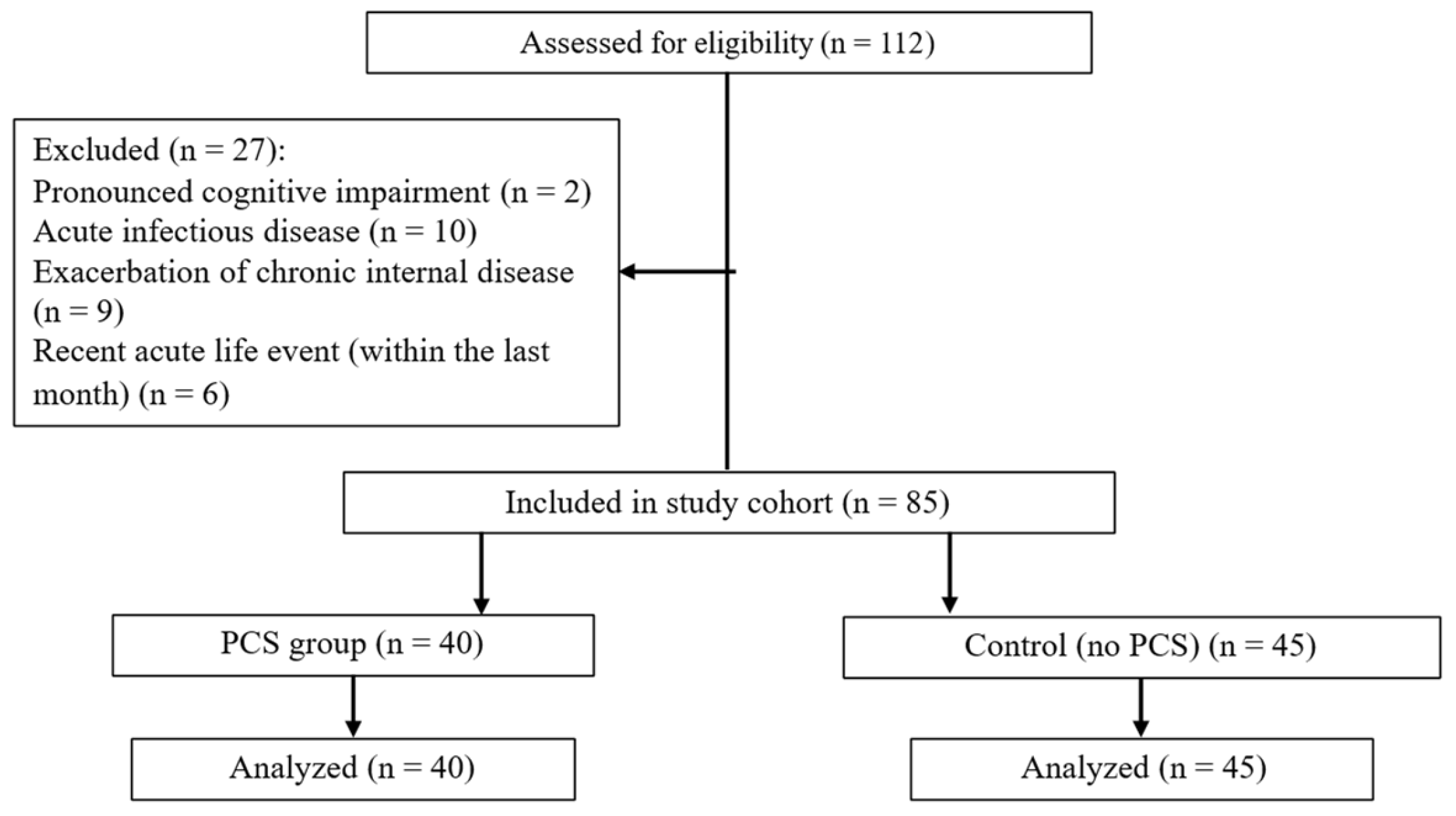
Inclusion criteria were as follows: age 60–89 years (according to the World Health Organization age stratification [
17]); documented previous SARS-CoV-2 infection. Exclusion criteria were as follows: pronounced cognitive impairment based on medical history and the treating physician’s clinical judgment at the study visit. Operationally, this was defined as cognitive changes causing marked functional dependence in daily activities, such that the patient could not attend and complete routine outpatient procedures independently and typically required an accompanying person; acute infectious disease or an exacerbation of chronic internal diseases; a recent acute life event (within the last month); refusal to participate (
Figure 1).
2.4. Verification of Post-COVID Syndrome
The operational definition of PCS followed the national clinical protocol of the Ministry of Health of the Republic of Kazakhstan, “Post-COVID Syndrome” (2023), which is a mandatory normative document in the healthcare system. Classification required the simultaneous fulfillment of three criteria: confirmed or probable previous SARS-CoV-2 infection; persistence or recurrence of symptoms for at least 12 weeks after the onset of COVID-19; inability to attribute the symptoms to an alternative diagnosis [
18]. At both outpatient sites, PCS assessment was performed in accordance with this national protocol. At the outpatient visit, patients were asked to describe the complaints they personally associated with the prior coronavirus infection. Information on chronic conditions was ascertained based on patient report and available medical documentation. Alternative explanations were assessed pragmatically based on the patient’s history and available outpatient documentation (including recorded chronic diagnoses/active problems and recent medication changes); no formal checklist or uniform diagnostic work-up was mandated, and additional evaluation was initiated as clinically indicated when another active condition was suspected. PCS status was then assigned by the study investigator based on clinical judgment guided by the national protocol, with particular attention to whether the reported complaints could be reasonably explained by the patient’s known chronic diseases or another active condition. When classification was uncertain, the case was reviewed collegially by the study team and the final decision was made by consensus to improve consistency across the two clinical sites. An English summary of the relevant sections of this national protocol (formal definition and diagnostic criteria of PCS) is provided in
Supplementary File S1.
2.5. Sample and Groups
A total of 85 patients who met the inclusion and exclusion criteria were enrolled. Depending on PCS status, participants were divided into two groups: the PCS group (n = 40) and the non-PCS control group (n = 45). Baseline demographic characteristics are presented in
Table 1.
According to self-report and available outpatient documentation, no prior psychiatric history or current use of psychotropic medications was identified among participants.
2.6. Procedures
During the outpatient visit, spontaneously reported complaints were recorded according to the standard scheme. At both outpatient sites, the clinical interview and all study procedures were administered by trained study investigators using the same protocol and the same order of assessment. Spontaneous complaints were recorded during the routine clinical interview and documented by the investigator in the study case report form; complaints related to depressive symptoms were then coded by the investigator as a binary variable. A complaint of depressive symptoms was defined as any spontaneous patient statement indicating a subjectively lowered or “poor” mood; this included both explicit terms (“depression”, “depressive state”) and descriptive complaints (“constantly sad”, “bad mood”, “nothing brings joy”). For comparability with the direct question, complaint coding was anchored to the current outpatient visit (i.e., whether depressive symptoms were spontaneously reported during the visit). All such statements, reported during the visit, irrespective of their presumed duration and context, were coded as a single binary variable (“complaint of depressive symptoms”). For spontaneous complaints, the approximate duration of the reported state was additionally clarified, including whether it was related to recent acute life events, but duration was not used in binary coding. Thus, both the complaint variable and the direct question reflected symptom status at the time of the visit, differing only in whether symptoms were volunteered spontaneously or elicited by a standardized question.
Subsequently, previous COVID-19 infection was confirmed from available medical documentation and recorded, and the emergence of depressive symptoms after infection (“new onset” by self-report) was ascertained. Patients were then asked a direct standardized question about the current presence of depressive symptoms, in which the term “depression” was complemented by descriptive examples (“constantly sad”, “bad mood”, “nothing brings joy”). The direct question was asked verbatim using the same wording across both outpatient sites (e.g., “Do you currently have depressive symptoms, such as feeling constantly sad, having a bad mood, or feeling that nothing brings you joy?”), and responses were recorded as yes/no. The direct question referred to the patient’s status at the time of the visit. After the clinical interview, psychometric testing was performed using the Russian-language version of the Geriatric Depression Scale-15 (GDS-15) to assess depressive symptomatology [
15,
16,
19]. The questionnaire was administered in Russian in a validated format under investigator supervision; if needed, the investigator clarified item wording without leading the respondent toward a particular answer [
19]. A positive screening result for depressive symptoms was defined as a total GDS-15 score ≥ 5 [
16].
2.7. Outcomes
Three independent channels of primary detection of depressive symptoms were defined:
“complaint at the visit”—spontaneous mention of depressive symptoms;
“direct question”—affirmative response to the standardized question about current depressive symptoms;
“screening test”—exceeding the GDS-15 threshold (≥5 in the primary analysis; ≥6 in sensitivity analyses).
The primary outcomes were the proportions of patients with depressive symptoms identified through each detection channel and the proportions of “under-detection”, defined as disagreement between channels (presence of symptoms according to the direct question and/or GDS-15 in the absence of a corresponding complaint at the visit).
Secondary outcomes included: agreement between “complaint” and “direct question” for depressive symptoms; the association between PCS and depressive-symptom indicators (by detection channels and by GDS-15); and screening-performance characteristics of complaints and the direct question for identifying a positive psychometric screening result on the GDS-15.
2.8. Statistical Analysis
Statistical analysis was performed using Python 3.12.4 and Microsoft Excel 365. Categorical variables were described as proportions with 95% confidence intervals (CIs; binomial CIs calculated by the Wilson method). Quantitative variables were summarized as mean ± standard deviation (SD) or median and interquartile range (IQR), as appropriate. Agreement between “complaint” and “direct question” for binary outcomes was assessed using Cohen’s κ coefficient; paired differences in frequencies were evaluated by McNemar’s test. Associations between PCS status and binary depressive-symptom indicators (by each detection channel and by GDS-15 positivity) were quantified using modified Poisson regression with robust (sandwich) standard errors to estimate risk ratios (RRs) with 95% confidence intervals and two-sided p-values. All RR estimates, 95% CIs, and p-values reported in the Results were obtained using this prespecified approach (or the prespecified continuity-correction procedure in the presence of zero cells), ensuring a single consistent framework for sparse data. This approach yields RRs directly and provides confidence intervals and p-values within a single consistent model framework, which is preferable in the presence of sparse cells and avoids discordance between confidence intervals and hypothesis tests. In comparisons with zero cells (i.e., no events in one group), modified Poisson models may become unstable or non-estimable; therefore, a continuity correction (Haldane-Anscombe, +0.5) was applied and RRs were computed using Katz-type confidence intervals/Wald testing, with cautious interpretation due to sparse data.
For stratified analyses by sex and age (≤75 and >75 years), RRs were estimated within strata using the same modified Poisson approach; where appropriate, pooled estimates across strata were obtained using a fixed-effects model and heterogeneity was assessed using the Breslow-Day test for homogeneity of strata. For paired within-subject comparisons of detection channels, McNemar’s test was retained as the primary method.
The association between PCS and continuous GDS-15 scores was assessed using Spearman rank correlation with 95% CIs.
Screening-performance characteristics of complaints and the direct question relative to the reference GDS-15 threshold included sensitivity, specificity, positive and negative predictive values (with 95% CIs), as well as positive and negative likelihood ratios (LR+ and LR−) with confidence intervals on the logarithmic scale; additionally, the F1-score was calculated as the harmonic mean of sensitivity and positive predictive value. Because the GDS-15 is a screening instrument and not a diagnostic gold standard, sensitivity, specificity, and related measures were interpreted as agreement with GDS-15 threshold classification. Sensitivity analyses used an alternative GDS-15 threshold of ≥6 with recalculation of screening metrics. A two-sided p-value < 0.05 was considered statistically significant.
3. Results
In the group of patients with post-COVID syndrome, the proportion of women was comparable to the group without post-COVID syndrome: 90.0% (n = 36) versus 88.9% (n = 40); p = 1.000. Mean age was lower in patients with post-COVID syndrome: 70.67 ± 4.83 years versus 73.07 ± 6.43 years in patients without post-COVID syndrome; mean difference −2.39 years (−4.83–0.05); p = 0.054.
New-onset depressive symptoms after COVID-19 were more frequent in patients with post-COVID syndrome: 17.5% (n = 7) versus 0.0% (n = 0) in patients without post-COVID syndrome; RR = 16.83 (0.99–285.65); p = 0.051. Given sparse events (including a zero cell in the control group), this estimate had a wide confidence interval and was interpreted cautiously.
A spontaneous complaint of depressive symptoms at the visit was recorded in 7.5% (n = 3) of patients with post-COVID syndrome and in 0.0% (n = 0) of patients without post-COVID syndrome; RR = 7.85 (0.42–147.55); p = 0.168. This comparison was also limited by sparse events and wide confidence intervals.
A positive response to the direct question about the presence of current depressive symptoms at the visit was observed in 30.0% (n = 12) of patients with post-COVID syndrome versus 11.1% (n = 5) of patients without post-COVID syndrome; RR = 2.70 (1.04–7.00);
p = 0.041 (
Table 2).
When spontaneous complaints of depressive symptoms were compared with responses to the direct question on current depressive symptoms, 15 patients had depressive symptoms that were not reflected as a complaint at the visit, but were captured by the direct question. The opposite discordance (a recorded complaint despite a negative response to the direct question) was observed in 1 patient. Agreement between complaint and direct question was low (κ = 0.149), and the discordance was statistically significant (McNemar’s test:
p = 0.00052). Key agreement and under-detection metrics are summarized in
Table 3.
The proportion of “hidden cases” among patients not reporting depressive symptoms as a complaint at the visit was 18.3% (15 of 82; 95% CI 11.4–28.0%). The proportion of discordant cases in the opposite direction was 1.5% (1 of 68; 95% CI 0.3–7.9%).
Among patients with a positive GDS-15 screening result for depressive symptoms (GDS-15 ≥ 5; n = 29), a spontaneous complaint was absent in 26 cases, corresponding to under-detection versus the screening threshold of 89.7% (26 of 29; 95% CI 73.6–96.4%). Among patients positive by either the direct question and/or GDS-15 ≥ 5 (n = 36), a spontaneous complaint was absent in 33 cases (91.7% (33 of 36; 95% CI 78.2–97.1%)).
Median scores on the Geriatric Depression Scale (GDS-15) were identical: 2.00 (1.00–5.25) in patients with post-COVID syndrome and 2.00 (1.00–5.00) in patients without post-COVID syndrome; p = 1.000.
In the analysis of the association between post-COVID syndrome status and GDS-15 scores, the following Spearman’s ρ values were obtained: for the PCS–GDS-15 association, ρ = 0.00 (−0.21–0.22), p = 1.000, indicating no monotonic association between the presence of post-COVID syndrome and total GDS-15 score.
When complaints of depressive symptoms were compared with the threshold GDS-15 ≥ 5, the distribution of outcomes was as follows: true positives = 3, false positives = 0, false negatives = 26, true negatives = 56 (TP/FP/FN/TN = 3/0/26/56). The sensitivity of the complaint was 10.3% (3.6–26.4), specificity = 100.0% (93.6–100.0), positive predictive value = 100.0% (43.9–100.0), and negative predictive value = 68.3% (57.6–77.4). The likelihood ratio for a positive result was not estimable (FP = 0), and for a negative result = 0.90 (0.79–1.01); F1 = 0.19 (
Table 4).
When responses to the direct question about current depressive symptoms were compared with the threshold GDS-15 ≥ 5, the distribution of outcomes was: true positives = 10, false positives = 7, false negatives = 19, true negatives = 49 (TP/FP/FN/TN = 10/7/19/49). The sensitivity of the direct question was 34.5% (19.9–52.7), specificity = 87.5% (76.4–93.8), positive predictive value = 58.8% (36.0–78.4), and negative predictive value = 72.1% (60.4–81.3). The likelihood ratio for a positive result was 2.76 (1.17–6.49), and for a negative result = 0.75 (0.56–0.99); F1 = 0.43 (
Table 4).
For GDS-15 screen-positive depressive symptoms, when the alternative threshold GDS-15 ≥ 6 was applied, the sensitivity of a complaint of depressive symptoms was 15.0% with specificity remaining at 100.0%; the F1-score was 0.26. For the direct question about current depressive symptoms at the threshold GDS-15 ≥ 6, sensitivity increased to 45.0% with specificity of 87.7%; the F1-score was 0.49.
In age-stratified analyses, the risk of depressive symptoms detected by the direct question was higher in patients with PCS than in those without PCS. In the ≤75-year group, the relative risk was 4.55 (1.08; 19.10); p = 0.039, whereas in the >75-year group it was 1.43 (0.30; 6.72); p = 0.652. Overall, this association remained after adjustment for sex and age strata (adjusted RR = 2.85 (1.15; 7.05); p = 0.024). Estimates in stratified analyses were imprecise, with wide confidence intervals.
In sex-stratified analyses, the relative risk of a positive response to the direct question in patients with PCS versus those without PCS was 2.67 (1.04; 6.83); p = 0.041 in women. In men, estimates were not estimable/unstable due to the small sample size (n = 9) and sparse cells.
4. Discussion
In our outpatient cohort, we observed a marked discrepancy between spontaneous complaints and responses to the direct question about current depressive symptoms. Specifically, even among patients without spontaneous complaints, approximately one fifth still provided a positive response to the direct question. In contrast, the “reverse” situation—presence of a complaint with a negative response—was observed only in isolated cases. Taken together, this pattern indicates an asymmetry in how depressive symptoms are communicated during routine visits and suggests that passive, complaint-based detection may miss a meaningful proportion of cases. Consistent with this interpretation, agreement between complaint and direct question was low (κ = 0.149), suggesting that spontaneous complaints capture only a limited fraction of the screen-positive depressive symptom burden. Importantly, this gap is unlikely to reflect a lack of feasible geriatric screening tools, because the Geriatric Depression Scale (GDS-15), its short versions, and their adaptations for geriatric and primary care settings have demonstrated acceptable reliability, validity, and feasibility in older adults [
15,
16,
19]. In this context, evidence syntheses in long COVID and PCS consistently show that depressive and anxiety symptoms remain frequent months after infection, typically affecting about one quarter to one third of patients [
20,
21], with similar estimates reported for broader neuropsychiatric symptom clusters [
22,
23,
24]. Therefore, post-COVID outpatient care should not rely on spontaneous disclosure alone, but should incorporate active elicitation of affective symptoms.
Data from individual cohorts of COVID-19 survivors further contextualize this symptom burden and reinforce the plausibility of our observations in routine follow-up. For example, among adults with long COVID in primary care in Barcelona, clinically relevant anxiety, stress, and depressive symptoms on standardized scales were observed in approximately half of participants [
25]. Similarly, cross-sectional studies from different regions, involving survivors assessed from several weeks up to years after acute infection, consistently report high prevalences of depressive symptoms, anxiety, and stress symptoms [
26,
27,
28]. Among survivors of intensive care unit admission for COVID-19, anxiety and depressive symptoms also remain common at one-year follow-up [
29]. Thus, across settings and follow-up windows, affective symptomatology appears to persist beyond the acute phase, supporting its continued prioritization during outpatient follow-up.
Beyond prevalence, depressive symptoms detected by standardized geriatric scales have important functional implications in older adults, which strengthens the practical significance of under-detection. In geriatric rehabilitation settings, depressive symptoms according to the GDS-Short Form are associated with poorer functional outcomes and a lower probability of regaining independence in activities of daily living [
30]. Accordingly, in older outpatients after COVID-19, missed identification of depressive symptoms may correspond to missed opportunities to address factors linked to daily functioning and rehabilitation potential. This linkage suggests that under-detection is not merely a measurement issue, but may be relevant for functional trajectories in this age group.
To interpret symptom expression and disclosure in PCS, recent reviews synthesizing correlates of anxiety and depressive symptoms in long COVID provide a useful framework. Systematic reviews and meta-analyses limited to post-COVID cohorts identify female sex, prior psychiatric history, greater acute COVID-19 severity, and a higher burden of persistent somatic symptoms as consistent correlates of anxiety–depressive symptomatology [
31,
32]. In addition, narrative and scoping reviews emphasize frequent co-occurrence of depressive symptoms with fatigue, cognitive complaints, and sleep disturbance, and suggest that mean differences in depressive symptom scores between individuals with and without long COVID are generally of small-to-moderate magnitude [
33,
34]. In an elderly cohort of post-COVID patients, women more frequently exhibited clinically significant depressive symptoms and higher psychological distress, whereas higher resilience levels were associated with a lower probability of psychiatric symptoms [
35]. Accordingly, characteristics that co-vary with PCS status may also shape symptom expression and help-seeking behavior, and should be considered when interpreting between-group patterns.
Relatedly, under-recognition and under-treatment of depressive and anxiety symptoms are well documented in cohorts composed exclusively of individuals with post-COVID condition, and these data help clarify why symptoms may remain “hidden” in routine encounters. In a large U.S. sample of adults with post-COVID-19 condition, moderate-to-severe depressive and anxiety symptoms were frequent [
8]. Participants with PCS were approximately twice as likely as other U.S. adults to report such symptoms. Among those with depressive or anxiety symptoms, about one third had not received mental health treatment, and around two fifths reported cost-related barriers to accessing therapy [
8]. Qualitative mixed-methods work in patients with PCS describes a substantial “silent” psychological burden (sadness, emotional exhaustion, cognitive “fog,” and loss of motivation). These experiences are often normalized or attributed exclusively to physical illness and therefore not articulated during clinical encounters [
36]. Reviews of healthcare workers after COVID-19 similarly report high levels of anxiety and depressive symptoms and highlight gaps between symptom burden and consistent engagement with specialized mental health services [
37,
38,
39]. Taken together, these observations align with our finding that patients without spontaneous complaints may still report symptoms when asked directly, underscoring the role of structured elicitation in routine care.
When framed as a case-finding problem, our results also have clear screening-performance implications. In our sample, spontaneous complaints showed very high specificity with extremely low sensitivity. No false-positive complaints were observed (FP = 0), yet most GDS-15 screen-positive cases did not report a complaint. In contrast, the direct question about current depressive symptoms increased sensitivity, with only a moderate reduction in specificity, thereby improving the F1-score of the screening step. However, the direct question still missed some GDS-15 screen-positive cases, indicating that brief questioning can improve initial detection but does not replace standardized screening. Importantly, in older patients this distinction is clinically relevant because even subclinical depressive symptom levels detected by geriatric scales can adversely affect rehabilitation and everyday functioning [
15,
16,
19,
30]. Thus, a brief direct question may be considered a feasible initial filter in outpatient encounters, while a validated scale remains necessary when screening is positive or when clinical concern persists.
This interpretation is also consistent with evidence from other high-risk post-COVID groups in which affective symptoms appear embedded within broader symptom constellations. Among workers in health and social services with prior COVID-19, long-term follow-up studies describe persistent symptom clusters that include fatigue, cognitive difficulties, and affective disturbances. These clusters are frequently accompanied by functional impairment and work limitations [
38,
39]. In this light, proactive identification of affective symptoms fits a broader clinical pattern in which post-COVID presentations may be multi-symptom and functionally consequential, and in which reliance on spontaneous disclosure may be insufficient.
Correspondingly, two-step screening strategies are increasingly discussed for people with long COVID and related high-risk groups. Recent reviews of interventions and care models emphasize structured mental health screening and stepped-care pathways. In these models, an initial brief screen or single question is followed by more detailed assessment and targeted interventions in those who screen positive [
40,
41]. Consistent with this approach, our findings suggest that a simple, structured question can strengthen the first step of outpatient case-finding, while standardized instruments remain important to improve completeness of detection.
At the same time, the weak and statistically unstable correlations we observed between PCS status and total GDS-15 scores align with evidence that, although mean depressive symptom scores tend to be higher in individuals with long COVID than in those without PCS, effect sizes are usually modest [
20,
21,
22,
23,
24,
31,
32,
33,
34,
35]. Longitudinal and cross-sectional studies of survivors and healthcare workers show associations between PCS, lower quality of life, and higher depressive symptom scores, but also emphasize substantial inter-individual variability and the contribution of pre-existing mental health conditions, occupational stress, somatic comorbidities, and access to care [
25,
26,
27,
28,
29,
35,
37,
38,
39]. In the present study, PCS-related risk ratio estimates (including stratified results) should therefore be interpreted cautiously given sparse events and limited precision, and they should be viewed primarily as exploratory. Importantly, we did not perform multi-variable adjustment for major somatic comorbidities, prior psychiatric history, or psychotropic treatment; accordingly, the observed PCS-related RRs may reflect residual confounding rather than a PCS-specific effect. Overall, these considerations indicate that the principal contribution of our results is less about attributing depressive symptoms to PCS and more about demonstrating the need for robust, structured detection pathways in heterogeneous older outpatient populations after COVID-19.
4.1. Future Research Directions
Future studies should aim to validate the observed asymmetry between spontaneous complaints and direct questions in other post-COVID outpatient cohorts, considering a broader age range, different phenotypes of post-COVID syndrome, and diverse models of primary care delivery. Standardization of question wording and the use of a shared timeframe across detection channels would strengthen interpretability and help distinguish disclosure-related effects from measurement effects. It will be important to compare the diagnostic performance of different combinations of clinical questions and scales (direct question, complaint, GDS-15 and other instruments) and to refine optimal cut-off values and algorithms for their use in depressive symptom screening. Replication in well-characterized cohorts will help disentangle disclosure-related phenomena from differences attributable to instrument choice and operational definitions.
A further priority is prospective research evaluating the prognostic value of positive responses to direct questions and elevated scores for functional outcomes, quality of life, and health care utilization in patients with post-COVID syndrome. It is also promising to investigate the mechanisms underlying the “silent” affective burden in older adults (the role of stigma, cultural norms, cognitive impairment, and somatic comorbidity) using mixed-methods designs, in order to better tailor communication strategies and screening for depressive symptomatology. These directions would clarify both clinical relevance (what detection predicts) and implementation (how to operationalize feasible screening pathways).
4.2. Implications for Clinical Practice
Our findings indicate that reliance solely on spontaneous complaints leads to systematic under-detection of screen-positive depressive symptoms in older adults after COVID-19. In routine outpatient consultations, it may be reasonable to include at least one brief standardized question about low mood or loss of interest as part of post-COVID follow-up, because direct elicitation identifies additional cases that are not volunteered spontaneously. At the same time, PCS-related between-group estimates in the present sample should be interpreted cautiously and primarily as exploratory due to sparse events and limited precision in stratified analyses. Accordingly, strengthening detection does not require causal attribution to PCS, but rather the incorporation of simple, structured prompts within routine follow-up.
Given that direct questions improve sensitivity compared with complaints but remain less informative than validated screening instruments, a stepped approach may be preferable: an initial brief standardized question, followed by a questionnaire-based screen (such as the GDS-15) when the response is positive or when clinical concern persists. Embedding such a pathway into follow-up checklists or primary care documentation may help reduce under-recognition of depressive symptom burden in older post-COVID outpatients. In practice, this supports a pragmatic workflow in which direct elicitation guides the selective use of standardized scales.
4.3. Limitations
This study has several limitations, primarily related to its design and sample. It was conducted in a single outpatient cohort recruited during routine examinations across two outpatient clinics, which limits the generalizability of the findings to other age groups, regions, and models of care organization. The onset of depressive symptoms was assessed mainly through self-report and questionnaires, without confirmation by structured psychiatric interviews and in the absence of pre-COVID baseline data, which introduces the risk of information and recall bias and precludes firm conclusions about causality. In this context, the GDS-15 functioned as a screening rather than a diagnostic tool, and dichotomization of scale scores and clinical questions may have led to information loss and reduced statistical power. In several strata (particularly by age and sex), the number of events was limited, resulting in wide confidence intervals and increased instability of risk estimates. Finally, the potential impact of uncontrolled confounders (pre-existing mental disorders, cognitive impairment, socioeconomic status, pharmacotherapy, and others) could not be fully accounted for and warrants caution in interpreting the observed associations. PCS classification—particularly the criterion “not attributable to an alternative diagnosis”—relied on routine outpatient documentation and clinical judgment without a standardized checklist or a uniform diagnostic work-up to exclude competing conditions; therefore, some residual subjectivity and potential misclassification of PCS status cannot be excluded, which may affect the reproducibility of PCS assignment and PCS-stratified comparisons.
Functional status was not measured using a standardized instrument (e.g., ADL/IADL, ECOG, Karnofsky, or EQ-5D), which limits characterization of baseline functional heterogeneity and may influence symptom reporting and disclosure during the visit. In addition, prior SARS-CoV-2 infection was recorded as a confirmed history without a reliably documented index date in the available outpatient records; therefore, time since infection could not be quantified, precluding analyses of depressive symptom detection as a function of follow-up interval. Because the assessment sequence was fixed (direct question preceding the GDS-15), a potential order/priming effect cannot be excluded: asking about depressive symptoms may increase symptom salience and influence subsequent self-report on the GDS-15, potentially affecting discrepancy measures and screening-benchmark estimates. These limitations particularly affect the precision and interpretability of PCS-stratified estimates, which should be regarded as preliminary.
Cognitive status was not assessed using a formal screening instrument (e.g., MMSE or MoCA); instead, exclusion for pronounced cognitive impairment relied on medical history and the treating physician’s clinical judgment, using functional dependence in routine outpatient care as an operational criterion. Therefore, milder cognitive deficits may still have been present among included participants. This approach may have introduced misclassification at the boundary between mild and more pronounced impairment and could have influenced the comparability of the detection channels (spontaneous complaint and direct questioning). Accordingly, uncertainty in cognitive classification may have affected disclosure patterns and the observed agreement between detection channels. If milder cognitive deficits reduced spontaneous symptom disclosure more than responses to direct questioning, the discrepancy between channels (and complaint-based under-detection) could be overestimated; conversely, if they impaired comprehension or consistent responding, discrepancies could be affected in the opposite direction.
Psychiatric history and psychotropic medication use were based largely on patient reports and available outpatient documentation; given stigma around psychiatric care and potentially limited access to psychiatric records for non-psychiatric clinicians, under-ascertainment is possible, and residual confounding cannot be excluded. Accordingly, the statement that no participant had prior psychiatric history or psychotropic medication use should be interpreted as reflecting self-report and available outpatient documentation rather than definitive absence, and some under-reporting or under-ascertainment in routine care cannot be ruled out.




 ,
,