
Psychological and Social Impact on Mothers of Minors Who Have Experienced Child Sexual Abuse: A Systematic Review



Abstract
1. Introduction
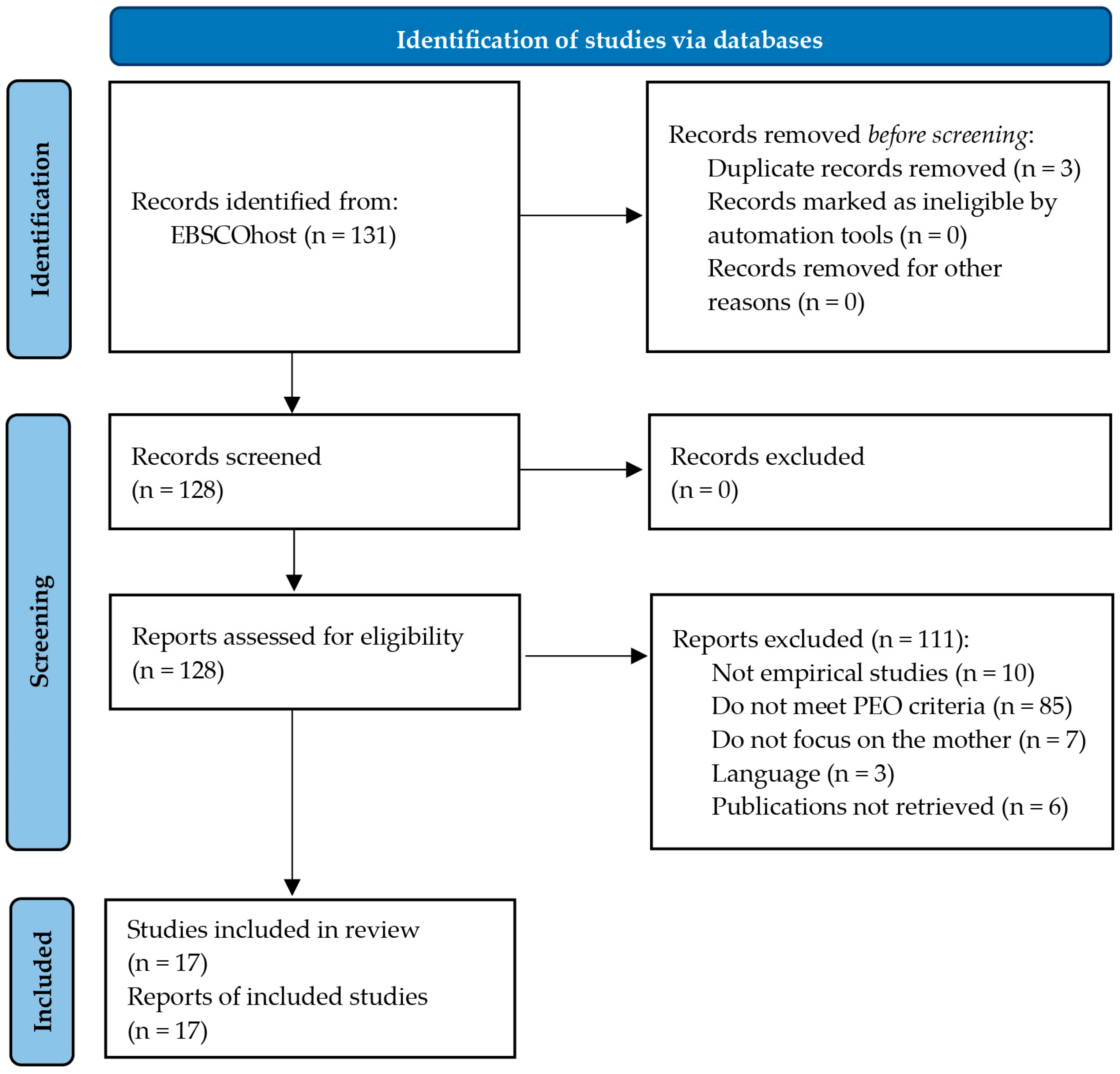
2. Materials and Methods
2.1. Design and Protocol
2.2. Search Strategy
2.3. Eligibility Criteria
- Studies that met the PEO guidelines (Table 1);
- Empirical research, including qualitative, quantitative, and mixed-method studies;
- Publications from the year 2000 onwards;
- Studies published in Spanish or English.
- Theoretical articles, systematic reviews, and meta-analyses;
- Research focused on other forms of violence without specifically addressing the impact of CSA on mothers;
- Studies analysing only the perspective of healthcare professionals, police officers, lawyers, or other members of the judicial system, without including testimonies or direct data from mothers of children who have been victims of sexual abuse.
2.4. Screening Process and Assessment of Bias
- 1
- Confounding factors. We assessed whether the study considered potential confounders that could bias the observed association, including criteria such as: did the authors adequately identify potential confounders; were these measured appropriately and/or controlled for; and did the study collect information indicating the influence of any variables that had not been controlled previously?
- 2
- Measurement of the exposure. We reviewed the quality of the instruments used to measure exposure, outcomes, and other variables, including criteria such as: did the instruments show good validity (measuring what they claim to measure) and reliability (consistency and reproducibility); and were there systematic differences in measurement across groups?
- 3
- Participants in the study. We evaluated whether the way participants were selected might have introduced bias and affected sample representativeness, including criteria such as was the sample was random or based on convenience, and were participants excluded for reasons that could bias the results.
- 4
- Post-exposure interventions. We analysed how the exposure was measured and classified in participants, including criteria such as: Were there misclassification errors (individuals incorrectly categorised)? Was it likely that these errors were related to the outcome?
- 5
- Missing data. We examined whether key data were missing (lost or incomplete) and whether this could have introduced bias, including criteria such as: what proportion of data was missing; and was missingness likely related to exposure or outcome?
- 6
- Outcome measurement. We assessed how the process of measuring results was conducted and whether it could have introduced bias, including criteria such as: were outcomes measured validly and objectively; was there a risk of bias due to knowledge of exposure status?
- 7
- Reported results (selectivity in the presentation of results). We evaluated whether there was reporting bias; that is, whether authors selected only certain results to publish. Criteria included: Is there evidence that some results were omitted? Did the study follow a prior protocol or registered analysis?
3. Results
3.1. Characteristics of the Results and Risk of Bias Assessment
3.2. Analysis of Results
3.2.1. Types of Maternal Responses Following CSA Disclosure
- Destabilisation: the initial phase in which parental expectations are shattered. Caregivers enter “protective mode,” redirecting all their resources toward the child’s well-being while setting aside their own needs. The primary focus is on restoring a sense of normality, as they face intense emotions such as shock, disbelief, and a loss of trust in their surroundings.
- Recalibration: as the child begins to show signs of improvement, parents start to adjust their parenting approach. They broaden their focus beyond the trauma, integrate new insights, resume self-care, and promote a more balanced family dynamic.
- Re-stabilisation: a new post-traumatic equilibrium is reached, which not only involves a reduction in negative symptoms, but also the emergence of previously absent benefits–such as improved family communication, stronger bonds, and personal growth [21].
3.2.2. Sociocultural Factors Influencing Maternal Response
3.2.3. Psychological, Physical, and Socioeconomic Consequences for Mothers
3.2.4. Psychological Intervention Proposals
4. Discussion
4.1. General Interpretation of Findings
4.2. Modulating Factors and Social Context
4.3. Methodological Limitations of the Present Review
4.4. Intervention Proposals and Future Directions
5. Conclusions
- TF-CBT, which has been suggested to help restructure abuse-specific cognitions, reduce maternal distress, and improve maternal coping with CSA;
- Rumination-focused interventions, recommended as a modifiable driver of symptoms;
- Resilience-oriented components;
- Empowerment and reinforcement of support networks;
- Culturally sensitive approaches; and
- An ecological, multi-level intervention guide coordinating psychological treatment with spiritual, legal, crisis, group, and community resources.
Supplementary Materials
Author Contributions
Funding
Institutional Review Board Statement
Informed Consent Statement
Data Availability Statement
Conflicts of Interest
Abbreviations
| WHO | World Health Organization |
| CSA | Child sexual abuse |
| INE | National Institute of Statistics |
| TF-CBT | Trauma-focused cognitive behavioural therapy |
| OSF | Open Science Framework |
| PRISMA | Preferred Reporting Items for Systematic reviews and Meta-Analyses |
| PEO | Population, exposure, outcome |
| ROBINS-E | Risk of Bias in Non-randomisedrandomized Studies of Exposures |
| IPV | Intimate partner violence |
| PTSD | Post-traumatic stress disorder |
Appendix A

| Equation | Justification |
|---|---|
| ((“mothers of sexually abused children” OR “mothers of child sexual abuse survivors” OR “maternal experience” OR “maternal response” OR “parental response” OR “maternal adjustment” OR “maternal distress” OR “non-offending mothers” OR “maternal trauma” OR “maternal reaction” OR “maternal experience”) | Corresponds to the P (Population) component of the PEO model. It is also linked to the third exclusion criterion, as it focuses on studies specifically addressing mothers, not other actors. |
| AND (“child sexual abuse” OR “sexual abuse survivors” OR “childhood sexual trauma” OR “CSA” OR “child abuse” OR “child molestation” OR “sexual abuse of child” OR “sexual child molestation” OR “sexually abused children” OR “children exposed to sexual violence” OR “sexual victimisation of children”) | Corresponds to the E (Exposure) component of the PEO model. It connects with the second exclusion criterion, which targets studies specifically related to CSA. |
| AND (“impact” OR “consequences” OR “effects” OR “coping” OR “stress” OR “trauma” OR “psychological impact” OR “mental health” OR “social impact” OR “family dynamics” OR “economic impact” OR “health impact”)) | Related to the O (Outcome) component of the PEO model: effects on physical, mental, emotional, or social health. This supports the inclusion of studies that specifically address the repercussions of CSA on mothers. |
References
- World Health Organization (WHO). Child Maltreatment 2024. Available online: https://www.who.int/news-room/fact-sheets/detail/child-maltreatment (accessed on 20 February 2025).
- Echeburúa, E.; Guerricaechevarría, C. Abuso Sexual en la Infancia: Nuevas Perspectivas Clínicas y Forenses, 2nd ed.; Ariel: Barcelona, Spain, 2021; pp. 23–163. [Google Scholar]
- Jefatura del Estado. Ley Orgánica 10/1995, de 23 de Noviembre, Del Código Penal; Jefatura del Estado: Madrid, Spain, 1995; Volume BOE-A-1995-25444, pp. 33987–34058. Available online: https://www.boe.es/eli/es/lo/1995/11/23/10/con (accessed on 22 February 2025).
- Durán Sáez, M.P. El Abuso Sexual Infantil: Reflexiones Críticas Sobre Textos Publicados Entre 2015–2020. Una Revisión. Revista Inclusiones: Revista de Humanidades y Ciencias Sociales 2024, 11, 192–225. Available online: https://dialnet.unirioja.es/servlet/articulo?codigo=9637421 (accessed on 25 February 2025). [CrossRef]
- Andrés-Pueyo, A.; Nguyen-Vo, T.; Rayò-Bauzà, A.; Redondo-Illescas, S. Análisis Empírico Integrado y Estimación Cuantitativa de los Comportamientos Sexuales Violentos (No Consentidos) en España. Violencia Sexual en España: Una Síntesis Estimativa; Grupo de Estudios Avanzados en Violencia (GEAV), Universidad de Barcelona, Ministerio del Interior: Barcelona, Spain, 2020. [Google Scholar]
- Pereda, N.; Guilera, G.; Forns, M.; Gómez-Benito, J. The Prevalence of child sexual abuse in community and student samples: A meta-Analysis. Clin. Psychol. Rev. 2009, 29, 328–338. [Google Scholar] [CrossRef] [PubMed]
- Instituto Nacional de Estadística (INE). Delitos Sexuales Según Sexo. 2024. Available online: https://www.ine.es/jaxiT3/Datos.htm?t=28750 (accessed on 2 March 2025).
- Pereda, N. El espectro del abuso sexual en la infancia: Definición y tipología. Revista de Psicopatología y Salud Mental del Niño y del Adolescente 2010, 16, 69–78. [Google Scholar]
- Apraez-Villamarin, G.E. Factores de riesgo de abuso sexual infantil. Antistio Rev. Cient. INMLCF Colomb. 2015, 2, 87–94. [Google Scholar] [CrossRef][Green Version]
- Fontes, L.F.C.; Conceição, O.C.; Machado, S. Childhood and adolescent sexual abuse, victim profile and its impacts on mental health. Ciência Saúde Coletiva 2017, 22, 2919–2928. [Google Scholar] [CrossRef]
- De Manuel Vicente, C. Detectando el abuso sexual infantil. Pediatría Atención Primaria 2017, 19, 39–47. [Google Scholar]
- Carvalho, Q.C.M.; Galvão, M.T.G.; Cardoso, M.V.L.M.L. Child sexual abuse: The perception of mothers concerning their daughters’ sexual abuse. Rev. Latino-Am. Enferm. 2009, 17, 501–506. [Google Scholar] [CrossRef]
- Caro, P.; Turner, W.; Caldwell, D.M.; Macdonald, G. Comparative effectiveness of psychological interventions for treating the psychological consequences of sexual abuse in children and adolescents: A network meta-analysis. Cochrane Database Syst. Rev. 2023, 2023, CD013361. [Google Scholar] [CrossRef]
- Thielemann, J.F.B.; Kasparik, B.; König, J.; Unterhitzenberger, J.; Rosner, R. Stability of treatment effects and caregiver-reported outcomes: A meta-analysis of Trauma-Focused Cognitive Behavioral Therapy for children and adolescents. Child Maltreatment 2024, 29, 375–387. [Google Scholar] [CrossRef]
- Otterman, G.; Nurmatov, U.B.; Akhlaq, A.; Korhonen, L.; Kemp, A.M.; Naughton, A.; Chalumeau, M.; Jud, A.; Vollmer-Sandholm, M.J.; Mora-Theuer, E.; et al. Clinical care of childhood sexual abuse: A systematic review and critical appraisal of guidelines from European countries. Lancet Reg. Health–Eur. 2024, 39, 100868. [Google Scholar] [CrossRef]
- Page, M.J.; Moher, D.; Bossuyt, P.M.; Boutron, I.; Hoffmann, T.C.; Mulrow, C.D.; Shamseer, L.; Tetzlaff, J.M.; Akl, E.A.; Brennan, S.E.; et al. PRISMA 2020 Explanation and elaboration: Updated guidance and exemplars for reporting systematic reviews. BMJ 2021, 372, n160. [Google Scholar] [CrossRef]
- Ouzzani, M.; Hammady, H.; Fedorowicz, Z.; Elmagarmid, A. Rayyan—A web and mobile app for systematic reviews. Syst. Rev. 2016, 5, 210. [Google Scholar] [CrossRef] [PubMed]
- Higgins, J.P.T.; Morgan, R.L.; Rooney, A.A.; Taylor, K.W.; Thayer, K.A.; Silva, R.A.; Lemeris, C.; Akl, E.A.; Bateson, T.F.; Berkman, N.D.; et al. A tool to assess risk of bias in non-randomized follow-up studies of exposure effects (ROBINS-E). Environ. Int. 2024, 186, 108602. [Google Scholar] [CrossRef] [PubMed]
- Alaggia, R. Cultural and religious influences in maternal response to intrafamilial child sexual abuse: Charting new territory for research and treatment. J. Child Sex. Abus. 2001, 10, 41–60. [Google Scholar] [CrossRef] [PubMed]
- Alaggia, R.; Turton, J.V. Against the odds: The impact of woman abuse on maternal response to disclosure of child sexual abuse. J. Child Sex. Abus. 2005, 14, 95–113. [Google Scholar] [CrossRef]
- Cummings, J.A. Transformational Change in Parenting Practices after Child Interpersonal Trauma: A Grounded Theory Examination of Parental Response. Child Abus. Negl. 2018, 76, 117–128. [Google Scholar] [CrossRef]
- Cyr, M.; McDuff, P.; Hébert, M. Support and profiles of nonoffending mothers of sexually abused children. J. Child Sex. Abus. 2013, 22, 209–230. [Google Scholar] [CrossRef]
- Dubé, V.; Tremblay-Perreault, A.; Allard-Cobetto, P.; Hébert, M. Alexithymia as a mediator between Intimate Partner Violence and Post-Traumatic Stress Symptoms in mothers of children disclosing sexual abuse. J. Fam. Violence 2024, 39, 359–367. [Google Scholar] [CrossRef]
- Edwards, C.N. Feelings and Health Effects Experienced by Non-Offending Mothers Whose Prepubescent Daughters Disclosed Sexual Abuse by a Known Perpetrator. Doctoral Dissertation, Texas Woman’s University, USA, Denton, TX, USA, 2008. [Google Scholar]
- Hébert, M.; Daigneault, I.; Collin-Vézina, D.; Cyr, M. Factors linked to distress in mothers of children disclosing sexual abuse. J. Nerv. Ment. Dis. 2007, 195, 805–811. [Google Scholar] [CrossRef]
- Langevin, R.; Hébert, M.; Allard-Dansereau, C.; Bernard-Bonnin, A.-C. Emotion regulation in sexually abused preschoolers: The contribution of parental factors. J. Trauma. Stress 2016, 29, 180–184. [Google Scholar] [CrossRef]
- Lewin, L.; Bergin, C. Attachment Behaviors, depression, and anxiety in nonoffending mothers of child sexual abuse victims. Child Maltreat 2001, 6, 365–375. [Google Scholar] [CrossRef]
- Lipinsky, A.S.; Goldner, L. “God, why?”: The experience of mothers from the Israeli ultra-orthodox sector after their child’s disclosure of sexual abuse. J. Interpers. Violence 2022, 37, NP16799–NP16828. [Google Scholar] [CrossRef] [PubMed]
- Masilo, G.M.; Davhana-Maselesele, M. Experiences of mothers of sexually abused children in North-West province, post disclosure. Curationis 2016, 39, e1–e9. [Google Scholar] [CrossRef]
- Masilo, G.M.; Davhana-Maselesele, M. Guidelines for support to mothers of sexually abused children in North-West province. Curationis 2017, 40, e1–e9. [Google Scholar] [CrossRef] [PubMed]
- McGillivray, C.J.; Pidgeon, A.M.; Ronken, C.; Credland-Ballantyne, C.A. Resilience in non-offending mothers of children who have reported experiencing sexual abuse. J. Child Sex. Abus. 2018, 27, 793–810. [Google Scholar] [CrossRef] [PubMed]
- McMillan, L. Non-Offending Mothers of Sexually Abused Children: How They Decide Whom to Believe. Doctoral Dissertation, University of South Carolina, Columbia, SC, USA, 2013. [Google Scholar][Green Version]
- Plummer, C.A. Non-Abusive Mothers of Sexually Abused Children: The Role of Rumination in Maternal Outcomes. J. Child Sex. Abus. 2006, 15, 103–122. [Google Scholar] [CrossRef]
- Runyon, M.K.; Spandorfer, E.D.; Schroeder, C.M. Cognitions and distress in caregivers after their child’s sexual abuse disclosure. J. Child Sex. Abus. 2014, 23, 146–159. [Google Scholar] [CrossRef]
- Van Delft, I.; Finkenauer, C.; Tybur, J.M.; Lamers-Winkelman, F. Disgusted by sexual abuse: Exploring the association between disgust sensitivity and posttraumatic stress symptoms among mothers of sexually abused children. J. Trauma. Stress 2016, 29, 237–244. [Google Scholar] [CrossRef]

| Acronym | Description |
|---|---|
| P | Mothers of children who have been victims of CSA. |
| E | Experience of CSA. |
| C | (Not applicable in this case) |
| O | Consequences on the physical, mental, and emotional health of mothers following the disclosure of the abuse. |
| Quote | Confounding Factors | Measurement of the Exposure | Participants into the Study | Post-Exposure Interventions | Missing Data | Outcome Measurement | Reported Results | Overall Risk of Bias |
|---|---|---|---|---|---|---|---|---|
| Alaggia, 2001 [19] | L | M | L | L | L | L | L | M |
| Alaggia & Turton, 2005 [20] | L | M | L | L | L | L | L | M |
| Cummings, 2018 [21] | L | M | L | L | L | L | L | M |
| Cyr et al., 2013 [22] | L | L | L | L | L | L | L | L |
| Dubé et al., 2024 [23] | L | L | L | M | L | L | L | M |
| Edwards, 2008 [24] | L | M | L | M | L | L | L | M |
| Hébert et al., 2007 [25] | L | L | L | L | L | L | L | L |
| Langevin et al., 2016 [26] | L | M | L | L | L | L | L | M |
| Lewin & Bergin, 2001 [27] | M | M | M | L | L | L | L | M |
| Lipinsky & Goldner, 2022 [28] | L | M | M | M | L | L | L | M |
| Masilo & Davhana-Maselesele, 2016 [29] | L | M | M | L | L | L | L | M |
| Masilo & Davhana-Maselesele, 2017 [30] | L | L | L | L | L | L | L | L |
| McGillivray et al., 2018 [31] | M | L | M | L | L | M | L | M |
| McMillan, 2013 [32] | L | M | L | L | L | L | L | M |
| Plummer, 2006 [33] | L | L | L | L | L | L | L | L |
| Runyon et al., 2014 [34] | L | L | L | L | L | L | L | L |
| Van Delft et al., 2016 [35] | L | L | L | L | L | L | L | L |
| Quote | Sample | Objective | Evaluation instruments | Conclusions/Results |
|---|---|---|---|---|
| Alaggia, 2001 [19] | 10 mothers of children victims of CSA by the mother’s partner. | To explore how culture and religion influence maternal responses to intrafamilial CSA. | In-depth interviews, adjusted during the study. QSR NUD*IST software. | Maternal responses were influenced by religious and cultural beliefs. Some mothers kept contact with the perpetrator due to cultural or religious pressure. |
| Alaggia & Turton, 2005 [20] | 7 women (4 mothers and 3 survivors of CSA) and 1 man (survivor of CSA) with presence of intimate partner violence. | To explain how abuse of the woman influences the maternal response to the disclosure of CSA. | Semi-structured in-depth interviews, secondary data analysis. | Mothers who suffered physical abuse showed more protective responses and less ambivalence when separating from the perpetrator. Victims of psychological abuse tended to show greater ambivalence and avoidance regarding disclosure. Fear of the perpetrator led some children not to disclose the CSA. |
| Cummings, 2018 [21] | 15 parents (12 mothers, 3 fathers) of 22 children who have been victims of interpersonal trauma (sexual abuse, domestic violence, bullying, etc.). | To develop an explanatory theory on how parenting strategies change after childhood interpersonal trauma, considering parental responses as a dynamic and non-linear process. | Open-ended interviews. Theoretical sampling and constant comparison were used until saturation was reached. | The theoretical model “Protecting and Healing” was developed, consisting of three phases: 1. Destabilisation: a rupture in parental expectations. 2. Recalibration: adjustment of parenting strategies, broadening their focus beyond the trauma. 3. Re-stabilisation: parents and the child regain part of their equilibrium. |
| Edwards, 2008 [24] | 9 non-offending mothers (aged 27 to 56) of prepubescent girls (aged 3 to 11) who were victims of CSA by a known perpetrator. | To explore the emotions and health effects experienced by mothers following the disclosure of CSA. | In-person, semi-structured interviews recorded in audio, incorporating open-ended questions and prompts to facilitate discussion. | Mothers experienced guilt, anger, confusion, denial, fear, loss of trust, and physical symptoms. Some were able to move toward resolution, establishing new ways of communicating with their daughters and expressing a desire to let go and find peace. |
| Lipinsky & Goldner, 2022 [28] | 21 mothers (aged 29 to 69) of CSA victims (aged 3 to 18) from the ultra-Orthodox Jewish community in Israel. | To explore how the normalisation of sexual abuse shapes the maternal experience following CSA disclosure within the ultra-Orthodox Jewish community. | In-depth, semi-structured interviews, followed by a drawing task. Interpretative Phenomenological Analysis. | Central themes included: social stigmatisation and the role of religion in disclosing the child’s abuse; the impact of disclosure on the mother’s mental health; unprocessed trauma and coping strategies. The tension between adhering to religious norms and preserving one’s social group emerged as a major concern |
| Masilo & Davhana-Maselesele, 2016 [29] | 17 mothers (aged 23 to 59) of children (aged 0 to 16) who were victims of CSA. | To explore and describe mothers’ experiences following the disclosure of CSA in their children, in order to develop recommendations. | In-depth unstructured interviews, audio recordings, field notes. Analysis with open coding (Tesch). | Mothers expressed emotional pain, shock, suicidal ideation, guilt, anger, depression, and perceived lack of support, experiencing secondary trauma. Socioeconomic barriers and religious or spiritual coping strategies were identified. Mothers observed both physical and psychological trauma in their children. |
| McMillan, 2013 [32] | 20 non-offending mothers (aged 25 to 55) whose children were victims of CSA perpetrated by the mother’s current or former partner. | To explore how mothers decide whom to believe after the disclosure of CSA, and to identify factors that facilitate, hinder, or cause fluctuations in that belief. | Interview guides. In-depth semi-structured interviews, audio-recorded and transcribed. | The child’s disclosure acted as “tipping points” to decide the nature of the relationship with the accused: - Mothers who had prior suspicions believed and protected their kid immediately. - Those without prior suspicions experienced ambivalence until gathering enough information to lead them to believe. Believing the child was closely linked to the decision to end the relationship with the perpetrator. |
| Quote | Sample | Objective | Evaluation Instruments | Conclusions/Results |
|---|---|---|---|---|
| Cyr et al., 2013 [22] | 226 non-offending mothers (aged 22 to 51) of children victims of CSA (aged 2 to 17). | To identify maternal profiles that explain differences in the support provided to children after CSA disclosure. | Impact of Event Scale (IES). Psychiatric Symptom Index (PSI); questionnaire adapted from the Incest History Questionnaire; NEO Five-Factor Inventory (NEO-FFI); Index of Parental Attitudes (IPA); Ways of Coping Questionnaire (WQC); Social Support Questionnaire (SSQ); Life Events Checklist (LEC); Parental Reaction to Abuse Disclosure Scale (PRADS); two 8-item subscales from the Parental Behaviors and Attitudes Questionnaire (PBAQ); two subscales from the Alabama Parenting Questionnaire (APQ); Child Behavior Checklist-Parent Report Form (CBCL); sociodemographic questionnaire. | Four profiles were identified: Resilient: low scores on most measures, fewer post-traumatic stress disorder (PTSD) symptoms; greater support and positive parenting practices. Avoidant-coping: moderate level of PTSD; greater use of avoidant strategies, lower specific support, adequate general support. Traumatised: negative relationships with biological family, high levels of prior maltreatment, neuroticism and stress, but relatively adequate maternal response. Anger-oriented reaction: higher PTSD scores, greater hostility, punitive and inconsistent practices; lack of maternal support. |
| Dubé et al., 2024 [23] | 158 non-offending mothers of children victims of CSA (aged 6 to 12). | To examine whether alexithymia mediates the relationship between intimate partner violence (IPV) experienced by mothers of children victims of CSA and maternal PTSD symptoms after disclosure; in addition to assessing the prevalence of PTSD, IPV, and CSA in mothers. | Ad hoc questionnaire. Conflict Tactics Scale 2 (CTS-2). Single self-report item. Toronto Alexithymia Scale (TAS-20; adapted version). Modified PTSD symptom Scale-Self-Report (MPSS-R). | Half of the mothers had experienced CSA, and most had experienced at least one instance of IPV. A total of 19.3% reported PTSD symptoms. Alexithymia mediated the indirect relationship between having experienced IPV and presenting PTSD symptoms. A history of CSA in the mother was directly associated with greater PTSD symptoms, without mediation by alexithymia. |
| Hébert et al., 2007 [25] | 149 mothers of girls (aged 4 to 12) who were victims of CSA. | To investigate factors associated with clinical levels of psychological distress in mothers of girls who were victims of CSA following disclosure. | Psychological Distress Scale of the Quebec Health Survey (adapted version). Psychiatric Symptom Index. Ways of Coping Questionnaire (brief 21-item version). Family Empowerment Scale. Single self-report item. Conflict Tactics Scale (short version). Medical records. | 57.9% of mothers presented clinical levels of distress, highlighting the importance of seeking therapeutic support. Factors associated with higher distress included: intrafamilial abuse, maternal history of CSA, intimate partner violence, avoidant coping strategies, and low parental empowerment. |
| Langevin et al., 2016 [26] | 153 children aged 3.5 to 6.5 and their non-offending caregivers (92.6% mothers), divided into two groups: CSA victims (n = 75) and control group (n = 78). | To explore whether maternal history of CSA and their psychological distress affect emotional regulation in preschool-aged children who are victims of CSA. | Emotion Regulation Checklist (ERC). Psychiatric Symptom Index. Single self-report item. | Child lability/negativity was associated with higher parental distress, caregiver’s history of CSA, and male gender. Children showed lower scores in emotional regulation. |
| Lewin & Bergin, 2001 [27] | 64 non-offending mothers (over 18 years old) of children aged 6 to 48 months, divided into two groups: mothers of abused children (n = 38) and control group (n = 27). | To examine the psychological well-being (depression and anxiety) and attachment behaviours of non-offending mothers of CSA victims, and their relation to maternal abuse history. | Ad hoc questionnaire. Ainsworth’s Maternal Behaviors Scales. Videotapes of the play session. Beck Depression Inventory-II (BDI-II). State-Trait Anxiety Inventory (STAI). | No differences were found between mothers with a history of abuse and those without. Mothers of CSA victims showed high levels of depression and anxiety, and less sensitive attachment behaviours (sensitivity, acceptance, cooperation, accessibility). |
| McGillivray et al., 2018 [31] | 68 non-offending mothers (aged 28 to 67) of children who were victims of CSA. | To examine differences in psychosocial traits between mothers with high and low resilience; and the mediating role of these traits in the relationship between resilience and psychological distress. | Depression Anxiety and Stress Scales-21 (DASS-21). Connor–Davidson Resilience Scale (CD-RISC). 4-item Cognitive Emotional Regulation Questionnaire (CERQ) Positive Reappraisal subscale. Self-Compassion Scale (SCS). Social Provisions Scale (SPS). | Mothers with higher resilience showed lower psychological distress and higher self-compassion, social support, and positive reappraisal. These psychosocial traits significantly mediated the relationship between resilience and psychological distress. Distress was negatively mediated by self-compassion and social support. Positive reappraisal predicted higher distress. |
| Plummer, 2006 [33] | 125 non-offending mothers (aged 20 to 62; M = 36.05) of children who were victims of CSA. | To explore the role of rumination in the emotional and behavioural outcomes of mothers following CSA disclosure, and its relation to other risk factors. | Ruminative Responses Scale (RRS), subscale of the Response Style Questionnaire. Abuse Severity (composite ad hoc score). Three self-report items on physical, emotional, and sexual abuse. Parenting Daily Hassles Scale-Revised; Life Events Scale. PANAS/Negative Affect Schedule. Response Styles Questionnaire. | Rumination, as a modifiable cognitive process, was the strongest predictor of emotional distress and external anger expression–above uncontrollable factors such as abuse severity, history of CSA, or life stressors. It also fully mediated the effect of childhood abuse history and life stressors on maternal outcomes. CSA severity was not related to the outcome variables. |
| Runyon et al., 2014 [34] | 68 non-offending mothers (aged 23 to 54; M = 33.5) of children (aged 3 to 17) who were victims of CSA | To explore the relationship between maternal attributions and abuse-specific cognitions with symptoms of depression and trauma in mothers following CSA disclosure. | Attributional Style Questionnaire (ASQ). Three ad hoc items. Beck Depression Inventory-II (BDI-II). Impact of Event Scale-Revised (IES-R). Ad hoc structured interview. | Abuse-specific cognitions were the strongest predictor of depressive symptoms in mothers, even when controlling general negative attributions. In contrast, PTSD symptoms were associated only with general negative attributions. |
| Van Delft et al., 2016 [35] | 72 non-offending mothers of children (aged 4 to 16) who were victims of CSA. | To explore the association between disgust sensitivity and PTSD symptoms in mothers of children who were victims of CSA. | Open-ended question. Single self-report item. Children’s treatment files. Adverse Childhood Experiences Questionnaire (ACEs). Three Domain Disgust Scale (TDDS). Impact of Event Scale-Revised (IES-R). | Mothers with higher disgust sensitivity–particularly in the sexual domain–reported more intense post-traumatic stress symptoms. Sexual disgust sensitivity was the strongest predictor of PTSD, but only when the perpetrator was not biologically related to the child. |
| Quote | Sample | Objective | Evaluation Instruments | Conclusions/Results |
|---|---|---|---|---|
| Masilo & Davhana-Maselesele, 2017 [30] | 17 mothers for the qualitative part and 180 for the quantitative part (aged 19 to 70), all with children (aged 0 to 16) who were victims of CSA. | To develop support guidelines for mothers of children who are victims of CSA following disclosure. | Unstructured interviews. Brief Cope Inventory. Post-Traumatic Stress Disorder Checklist. Beck Depression Inventory (BDI). Social Support Grid. | 87.8% of mothers showed extreme PTSD symptoms; 76.1% were unable to cope with the situation; 36.1% showed signs of depression; and 38.8% perceived low levels of support. Intervention guidelines were developed to address secondary trauma. |
Disclaimer/Publisher’s Note: The statements, opinions and data contained in all publications are solely those of the individual author(s) and contributor(s) and not of MDPI and/or the editor(s). MDPI and/or the editor(s) disclaim responsibility for any injury to people or property resulting from any ideas, methods, instructions or products referred to in the content. |
© 2025 by the authors. Licensee MDPI, Basel, Switzerland. This article is an open access article distributed under the terms and conditions of the Creative Commons Attribution (CC BY) license (https://creativecommons.org/licenses/by/4.0/).
Share and Cite
Valente, S.A.; Iborra Marmolejo, I.; Mora Ascó, J.J. Psychological and Social Impact on Mothers of Minors Who Have Experienced Child Sexual Abuse: A Systematic Review. Psychiatry Int. 2025, 6, 158. https://doi.org/10.3390/psychiatryint6040158
Valente SA, Iborra Marmolejo I, Mora Ascó JJ. Psychological and Social Impact on Mothers of Minors Who Have Experienced Child Sexual Abuse: A Systematic Review. Psychiatry International. 2025; 6(4):158. https://doi.org/10.3390/psychiatryint6040158
Chicago/Turabian StyleValente, Solange A., Isabel Iborra Marmolejo, and Juan J. Mora Ascó. 2025. "Psychological and Social Impact on Mothers of Minors Who Have Experienced Child Sexual Abuse: A Systematic Review" Psychiatry International 6, no. 4: 158. https://doi.org/10.3390/psychiatryint6040158
APA StyleValente, S. A., Iborra Marmolejo, I., & Mora Ascó, J. J. (2025). Psychological and Social Impact on Mothers of Minors Who Have Experienced Child Sexual Abuse: A Systematic Review. Psychiatry International, 6(4), 158. https://doi.org/10.3390/psychiatryint6040158