Article

Entosis in Colorectal, Lung, and Breast Cancer: Associations with Clinicopathological Features, Patient Outcomes, and Copy Number Alteration Landscape


by
Ksenia A. Gaptulbarova
1,2,*,
Sergey V. Vtorushin
1,3,
Marina K. Ibragimova
1,2,4,
Irina A. Tsydenova
1,5,
Natalia A. Tarabanovskaya
1,
Vitaly P. Shubin
6,
Aleksey S. Tsukanov
6,
Evgeny O. Rodionov
1,7,
Sergey I. Achkasov
6 and
Nikolai V. Litviakov
1,2,8
1
Cancer Research Institute, Tomsk National Research Medical Center, Russian Academy of Sciences, 634009 Tomsk, Russia
2
Biological Institute, National Research Tomsk State University, 634050 Tomsk, Russia
3
Diagnostic Division, Department of Pathology, Siberian State Medical University, 634050 Tomsk, Russia
4
Department of Biochemistry and Molecular Biology with a Course in Clinical Laboratory Diagnostics, Siberian State Medical University, 634050 Tomsk, Russia
5
Preclinical Research Center, Siberian State Medical University, 634050 Tomsk, Russia
6
Ryzhikh National Medical Research Centre for Coloproctology, 123423 Moscow, Russia
7
Department of Oncology, Siberian State Medical University, 634050 Tomsk, Russia
8
Laboratory of Genetic Technologies, Siberian State Medical University, 634050 Tomsk, Russia
*
Author to whom correspondence should be addressed.
J. Mol. Pathol. 2026, 7(1), 12; https://doi.org/10.3390/jmp7010012
Submission received: 16 December 2025 / Revised: 10 March 2026 / Accepted: 11 March 2026 / Published: 17 March 2026

Abstract

Objective: This study examined the frequency of entosis in solid tumors of various origins (colorectal cancer, breast cancer, and lung cancer) and its association with clinical and pathological characteristics. It also examined survival and copy number alterations (CNAs) in genes associated with stem cells. The aim was to assess the potential prognostic value of entotic events in tumors. Methods: A total of 238 patients were included: 96 with colorectal cancer (CRC), 45 with lung cancer (LC), and 97 with breast cancer (BC). Entotic cell-in-cell (CIC) structures were evaluated on hematoxylin–eosin–stained slides using Mackay’s criteria. A CIC frequency >0.1 per 20 high-power fields was considered positive. Clinicopathological parameters, overall survival (CRC), metastasis-free survival (LC and BC), and CNA profiles of stemness-related genes were analyzed. Amplifications of MAP1LC3A and other chromosomal loci were assessed. Results: CRC demonstrated the highest entosis rate, more than two-fold higher compared with BC and LC (p < 0.05). Entosis correlated with high tumor grade (G3) in CRC (p = 0.03). In LC, CIC-positive tumors were more frequent in patients with lymph-node metastases (p = 0.02), whereas in BC, the opposite trend was observed (p = 0.02). It was noted that in patients with stage III–IV LC, the frequency of entosis was significantly higher than in patients with stage I–II cancer (p = 0.03). CIC-positive status was associated with poorer overall survival in CRC (p = 0.03) and reduced metastasis-free survival in LC (p = 0.011). In breast cancer, no statistically significant survival differences were observed. Tumors harboring two or more stemness-gene amplifications showed significantly higher entosis frequency regardless of tumor site. A strong association was identified between entosis and MAP1LC3A amplification. Conclusions: Enosis is not a random morphological phenomenon but a process associated with unfavorable tumor characteristics, high malignancy, reduced survival, and amplification of stem cell-related genes. The results of this study confirm the working hypothesis that entosis may contribute to the emergence of aneuploid clones of tumor cells, including those containing amplifications of stem cell-associated genes. This positions entosis as a potential factor in tumor genetic heterogeneity, which is particularly important in the context of therapeutic selection pressure. The observed association between high entosis frequency and the presence of ≥2 stem cell gene amplifications, as well as its association with poor prognosis in colorectal and lung cancer, highlights its potential value as a prognostic indicator. Furthermore, MAP1LC3A amplification data may serve as a molecular marker of entotic activity and a potential therapeutic target.

1. Introduction

In 2007, M. Overholtzer et al. described a new type of cell death called entosis. It is a form of non-apoptotic cell death in which one living cell actively invades another cell of the same type. The inner cell becomes completely surrounded by a membrane, forming an entotic vacuole [1]. It was initially thought that entosis is triggered by the cell losing contact with the extracellular matrix [2,3]. However, subsequent studies have shown that cell-in-cell (CIC) structures can arise without detachment from the substrate [2,4]. Although entosis is more commonly observed in tumor cells, it has also been described in some normal cell populations [2,5].
Entosis has been identified in a variety of malignant tumors: breast cancer [1,6,7,8], lung cancer [9], colorectal cancer [10], ovarian tumors [11], pancreatic cancer [12,13], and head and neck tumors [10]. While in vitro studies have allowed detailed characterization of the molecular mechanisms of entosis, clinical and translational studies investigating its relationship with tumor molecular characteristics and prognosis remain limited. Nevertheless, the accumulated data suggest a possible link between entosis and aggressive tumor behavior [13].
In breast cancer, homotypic cell-in-cell structures (hoCIC) are more common in highly malignant tumors and are associated with faster progression and reduced overall survival [14]. Gupta K. and Dey P. demonstrated that hoCICs are detected in malignant bladder tumors but are absent in benign lesions, suggesting that they may serve as an additional diagnostic criterion [15]. Similar findings were reported for squamous cell carcinoma of the head and neck, lung cancer, and rectal cancer [16,17]. However, Zhang X. et al. reported that in breast cancer, the presence of hoCIC may, conversely, correlate with a more favorable prognosis [14], which is consistent with the hypothesis of a possible tumor-suppressive role of entosis in certain contexts [1]. Thus, the influence of entosis on tumor behavior appears to be dual and context-dependent.
We previously proposed a classification of entosis based on the fate of the inner cell, which may explain differences in its biological effects [18]. Our earlier studies showed that in 5–40% of cases, breast cancer patients develop new amplifications of stemness genes after neoadjuvant chemotherapy (NAC), which is strongly associated with metastasis development [19]. In the absence of such amplifications and without NAC, the metastasis rate did not exceed 0%, whereas the presence of ≥2 amplifications or their induction during NAC was associated with a marked reduction in metastasis-free survival [19,20]. We hypothesized that one mechanism underlying the rapid emergence of aneuploidy and amplifications of stemness genes may be entosis, accompanied by fusion of tumor-cell nuclei [18].
This study evaluated the frequency of entotic structures (CIC) in tumors of various locations—breast, lung, and colorectal cancer—and their associations with clinical and morphological parameters, copy number abnormalities (CNA), stemness-gene amplifications, therapeutic response, and disease outcomes.
The aim of the study was to quantitatively assess the frequency of entosis and identify its associations with molecular genetic alterations, tumor proliferative activity, treatment response, and clinical prognosis.

2. Materials and Methods

2.1. Patients

The study included 96 patients with colorectal cancer (CRC) T1–4N0–3M0–1 (I–IIIB stages), 45 patients with lung cancer (LC) T1–3N0–3M0–1 (IIA–IIIA stages) and 97 patients with breast cancer (BC) T1–3 N0–3 M0–1 (IIA–IIIB stages) with a morphologically confirmed diagnosis (Table 1). The histological diagnosis was established in all cases according to the current World Health Organization (WHO) classification of tumors. The stage of the disease was determined according to the TNM system (UICC/AJCC, 8th edition). The degree of malignancy (Grade) was assessed according to accepted morphological criteria for each location. Patients with breast cancer and lung cancer underwent combined treatment, examination, and observation at the Cancer Research Institute, Tomsk National Research Medical Center, Russian Academy of Science (Tomsk, Russia).
Biological material from patients with CRC was obtained from the National Medical Research Center of Coloproctology named after A. N. Ryzhikh. All patients with colorectal cancer underwent surgery as the initial stage of treatment. Adjuvant drug therapy was prescribed when indicated, in accordance with current clinical guidelines.
The study was conducted in accordance with the ethical principles set out in the Declaration of Helsinki (revised in 2013) [21] and was approved by the local biomedical ethics committee. All patients provided voluntary written informed consent to participate in the study and to allow the use of their biological material.

2.2. Definition of Entotic Structures

Tumor tissue obtained from surgical or biopsy specimens was used for analysis. After fixation in 10% neutral buffered formalin, samples were embedded in paraffin, and serial histological sections were prepared and stained with haematoxylin and eosin using standard protocols. Morphological identification of cell-in-cell (entotic) structures was performed according to the criteria proposed by Mackay et al. [16].
A structure was considered entotic if at least four of the following six features were present: clearly visualisable core of the internal (internalized) cell;
  • preserved cytoplasm of the inner cell;
  • clearly distinguishable host cell nucleus;
  • the nucleus of the host cell has a characteristic crescent or moon-like shape;
  • preserved cytoplasm of the host cell;
  • the presence of an entotic vacuole between the host cell and the internal cell (loser cell).
Counting was performed using a Nikon light microscope at ×600 magnification (dry lens, without immersion). Two independent pathologists, blinded to clinical data, evaluated the frequency of entosis. CIC frequency was recorded as the number of entotic structures per 20 consecutive high-power fields in the most cellular tumor areas.

2.3. DNA Extraction

DNA was extracted using the QIAamp DNA Mini Kit (Qiagen, Hilden, Germany). DNA quality and concentration were measured using a Qubit 4.0 fluorometer (Agilent Technologies, Santa Clara, CA, USA) in the range of 50–250 ng/µL. DNA integrity was assessed using capillary electrophoresis on a TapeStation 4150 system (Agilent Technologies, Santa Clara, CA, USA), ensuring fragment lengths greater than 60 kb.

2.4. Analysis of the CNA Genetic Landscape of Tumors

Copy number alterations were analyzed using CytoScan HD Array microarrays (Affymetrix, Santa Clara, CA, USA), which allow detection of large chromosomal deletions and amplifications. Sample preparation, hybridisation, and scanning were performed according to the manufacturer’s protocol using the Affymetrix GeneChip® Scanner 3000 7G. Data were processed using the Chromosome Analysis Suite 4.3 software package (Affymetrix, Santa Clara, CA, USA). The analysis included identification of chromosomal gains and losses affecting all genes, including stemness-related genes.

2.5. Statistical Data Processing

Statistical analysis was performed using Statistica 8.0 (StatSoft Inc., Palo Alto, CA, USA). The normality of quantitative data was evaluated using the Shapiro–Wilk test. Descriptive statistics were presented as mean (M) and standard error of the mean (m). Comparisons between two independent groups were carried out using the non-parametric Wilcoxon–Mann–Whitney test.
Survival curves (overall survival and metastasis-free survival) were constructed using the Kaplan–Meier method, and differences between curves were assessed using the log-rank test. Spearman’s correlation coefficient was used to analyze the relationships between quantitative or ordinal variables. A p-value < 0.05 was considered statistically significant. To determine the independent prognostic value of entosis, Cox multivariate regression analysis was performed using the SPSS statistical package (IBM SPSS Statistics 25).

3. Results

3.1. Morphological Assessment of Entosis in Tumor Tissue

In the first stage of the study, the frequency of entotic (cell-in-cell, CIC) structures was evaluated in histological sections from patients with colorectal cancer (CRC), breast cancer (BC), and lung cancer (LC). Entosis was defined as a CIC frequency greater than 0.1 per 20 high-power fields, which served as the threshold value for positivity.
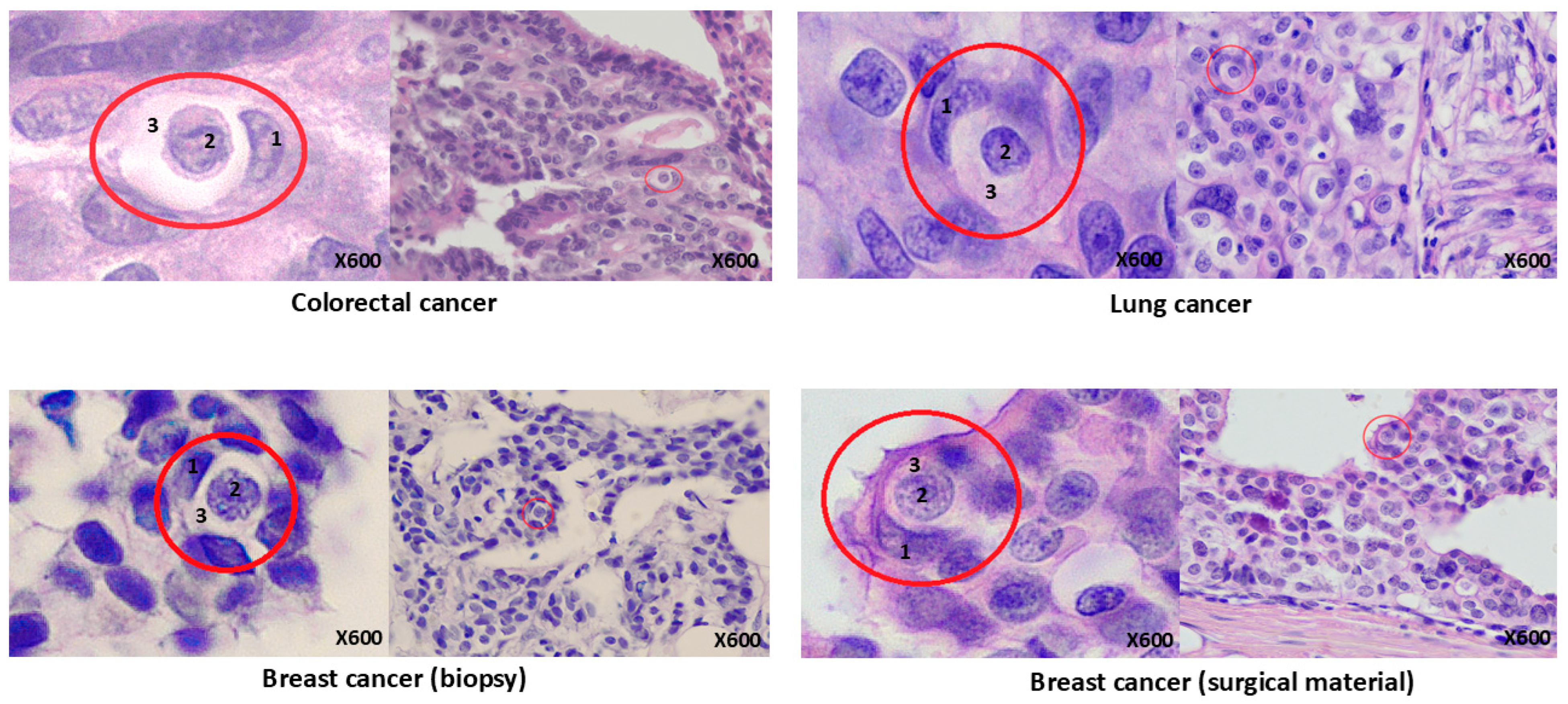
During morphological assessment, a variety of entotic structures were identified, including classic homotypic CICs (a tumor cell engulfed by another tumor cell) as well as less typical forms. Representative examples are shown in Figure 1.
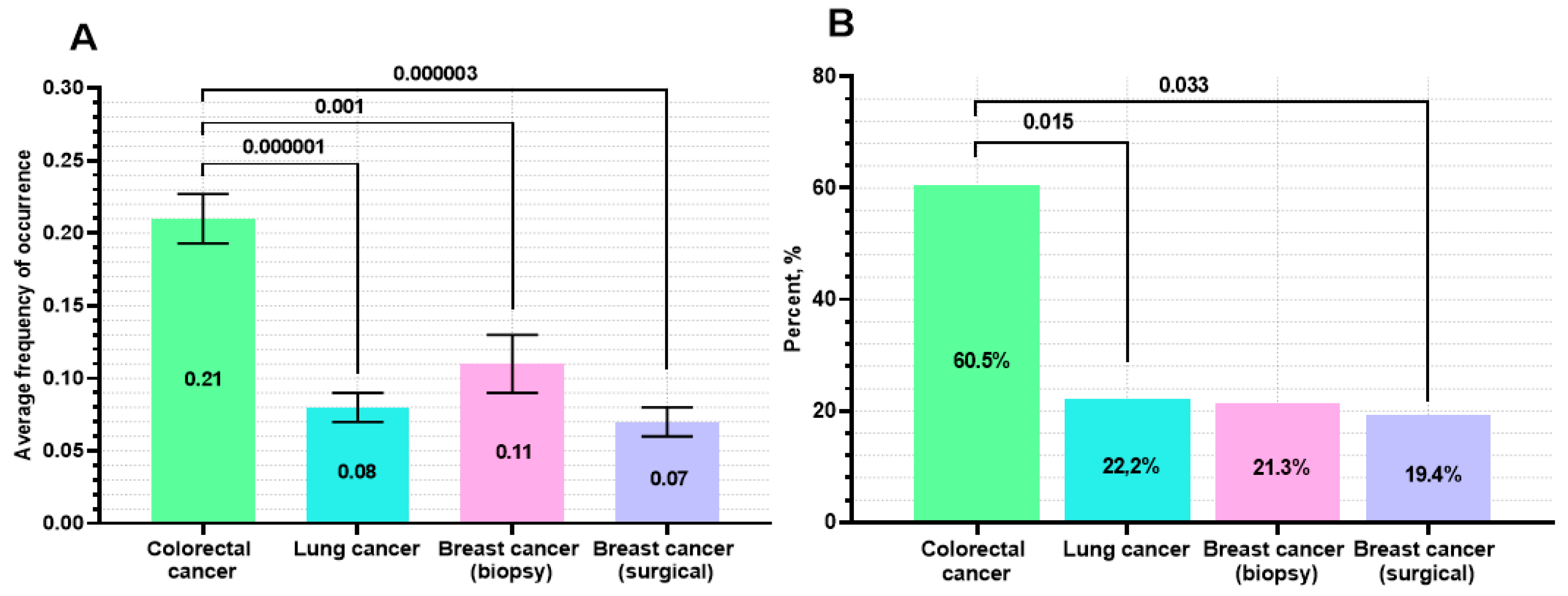
The highest average entosis frequency was observed in CRC tumors (0.21), which was significantly higher than in BC or LC (p < 0.05) (Figure 2A). Entosis was detected in 60.5% (58/96) of CRC cases, 22.2% (10/45) of LC cases, 21.3% (13/61) of BC biopsy samples, and 19.4% (7/36) of BC surgical samples (Figure 2B). A statistically significant difference in entosis frequency was observed between CRC and the other tumor types, while no significant differences were found between BC and LC.

3.2. Associations Between Entosis Frequency and Clinicopathological Characteristics

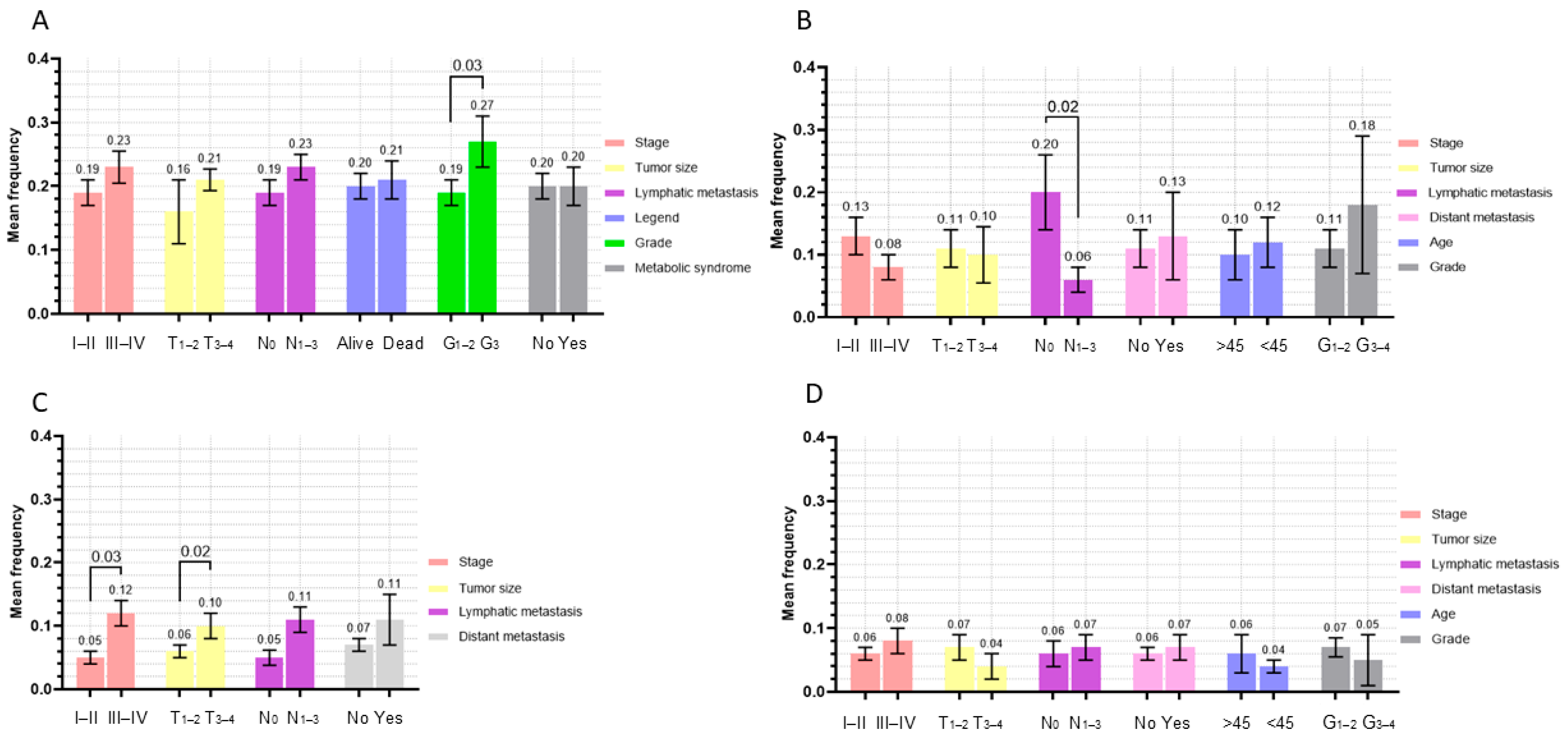
In the second stage of the study, we examined whether the frequency of entotic (CIC) structures in tumor tissue was associated with key clinicopathological characteristics. The parameters analyzed included primary tumor size, disease stage (TNM), tumor grade, and the presence of lymphogenous or distant metastases (Figure 3).
In the overall cohort, CIC frequency did not show a strong association with most clinical or morphological tumor characteristics. However, several statistically significant associations were identified within specific tumor types. In colorectal cancer, entosis was more common in high-grade (G3) tumors compared to G1–G2 tumors (p = 0.03).
It was noted that in patients with stage III–IV lung cancer, the frequency of entosis was significantly higher than in patients with stage I–II cancer (p = 0.03). Also, in lung cancer, the frequency of entotic structures was higher in patients with lymphogenous metastases than in patients without lymph node involvement (p = 0.02).
In contrast, the opposite pattern was observed in breast cancer biopsy samples, where the frequency of CIC was higher in patients without lymph node metastases than in patients with lymph node involvement (p = 0.02).
No additional statistically significant associations between CIC frequency and other clinical and pathological characteristics were observed.

3.3. Prognostic Significance of Entosis Frequency

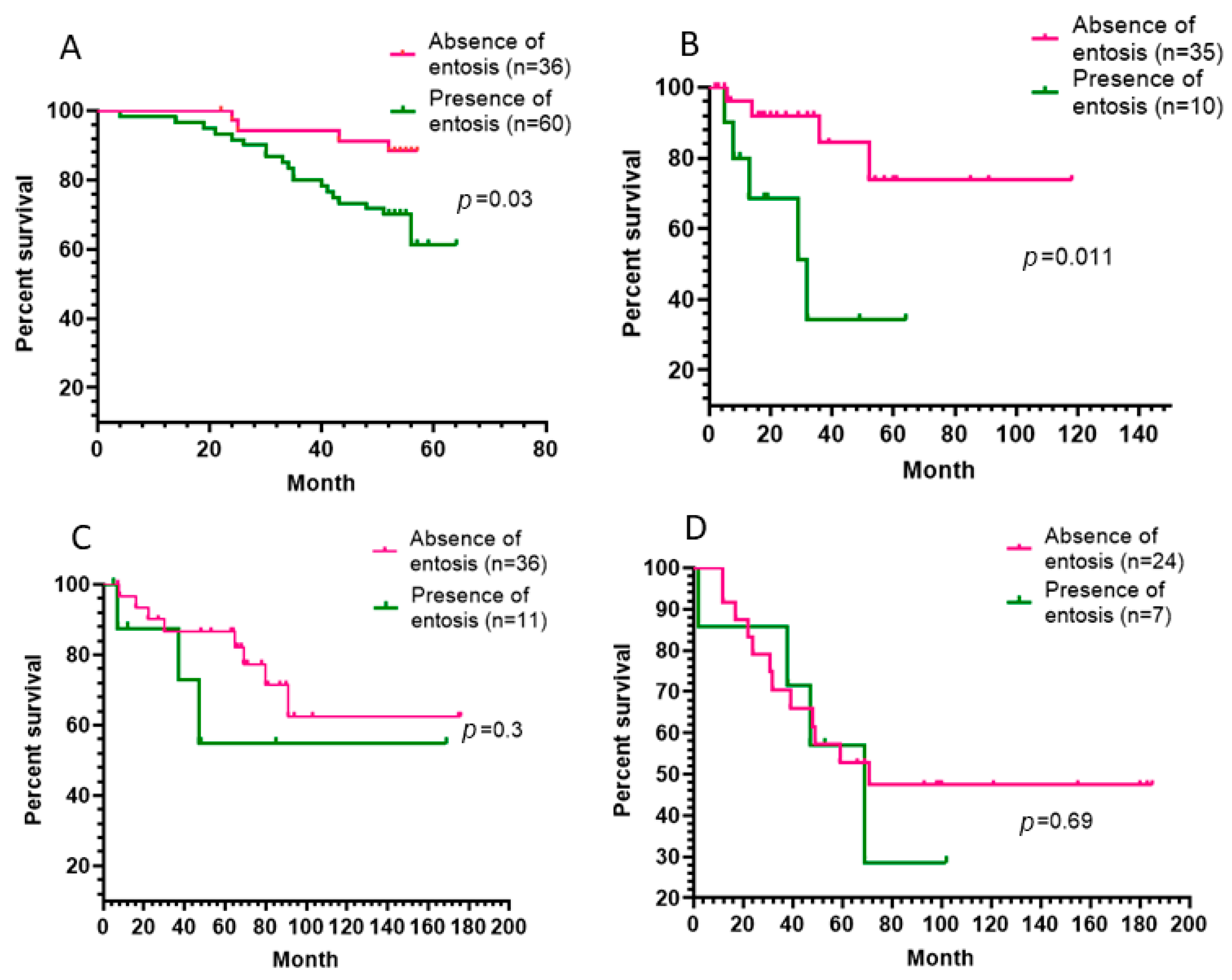
To evaluate the prognostic significance of entosis, Kaplan–Meier survival analysis was performed, stratifying patients into two groups: CIC-positive (entosis frequency > 0.1) and CIC-negative (≤0.1). Survival endpoints varied by tumor type: overall survival was assessed for CRC, while metastasis-free survival was evaluated for BC and LC (Figure 4).
In lung cancer, the presence of entotic structures was associated with significantly reduced metastasis-free survival (p = 0.011). The Kaplan–Meier curves demonstrated earlier metastatic progression in the CIC-positive group compared with CIC-negative patients.
In colorectal cancer, CIC-positive tumors were likewise associated with unfavorable outcome: overall survival was significantly lower in CIC-positive than in CIC-negative patients (p = 0.03).
In breast cancer, differences in metastasis-free survival between CIC-positive and CIC-negative patients did not reach statistical significance, both in biopsy material and in surgical specimens obtained after NAC. Nevertheless, the Kaplan–Meier curves showed a consistent downward trend in metastasis-free survival in cases where CIC structures were present.
To determine the independent prognostic value of entosis, Cox multivariate regression analysis was performed, taking into account temporal dependence and adjusting for standard clinical and pathological parameters (Table 2 and Table 3).
According to Cox regression analysis, the following criteria were found to be significant for overall survival in patients with colorectal cancer: stage and presence of entosis (yes/no). Moreover, the level of significance and the Wald criterion and HR(Exp(B)) were higher for the criterion “presence of entosis” than for the stage.
In patients with lung cancer, the criteria that were statistically significant for non-metastatic survival were anatomical form and the presence of entosis. As with CRC, the significance, Wald, and HR indicators for the “presence of entosis” criterion were higher than for anatomical form.

3.4. The Relationship Between the Frequency of Entotic Events and the Number of CNAs and Amplifications of Stemness Genes in Tumors

Using CytoScan HD Array microarrays, we assessed the number of chromosomal amplifications and deletions in lung, colorectal, and breast tumors both before treatment and after neoadjuvant chemotherapy (NAC). Amplifications of 50 stemness-related genes were additionally analyzed, as the presence of two or more amplifications in distinct chromosomal loci is known to be associated with metastatic potential [19].
Table 4 shows data on the correlation between the frequency of entosis and the number of stem cell gene amplifications, as well as the total number of chromosomal gains and losses in the analyzed tumors. A moderate correlation was observed between the frequency of entosis and the number of stem cell gene amplifications in lung and breast tumors after NAC. A weak correlation was observed in colorectal cancer tumors and breast tumors before treatment. Among the CNA parameters, only the number of chromosomal gains showed a significant correlation with the frequency of entosis. The number of chromosomal losses did not correlate with the frequency of entosis in any tumor type.
Of particular note, the correlation coefficient between entosis frequency and the number of stemness-gene amplifications increased sharply in breast tumors following NAC, indicating a treatment-associated enhancement of this relationship.
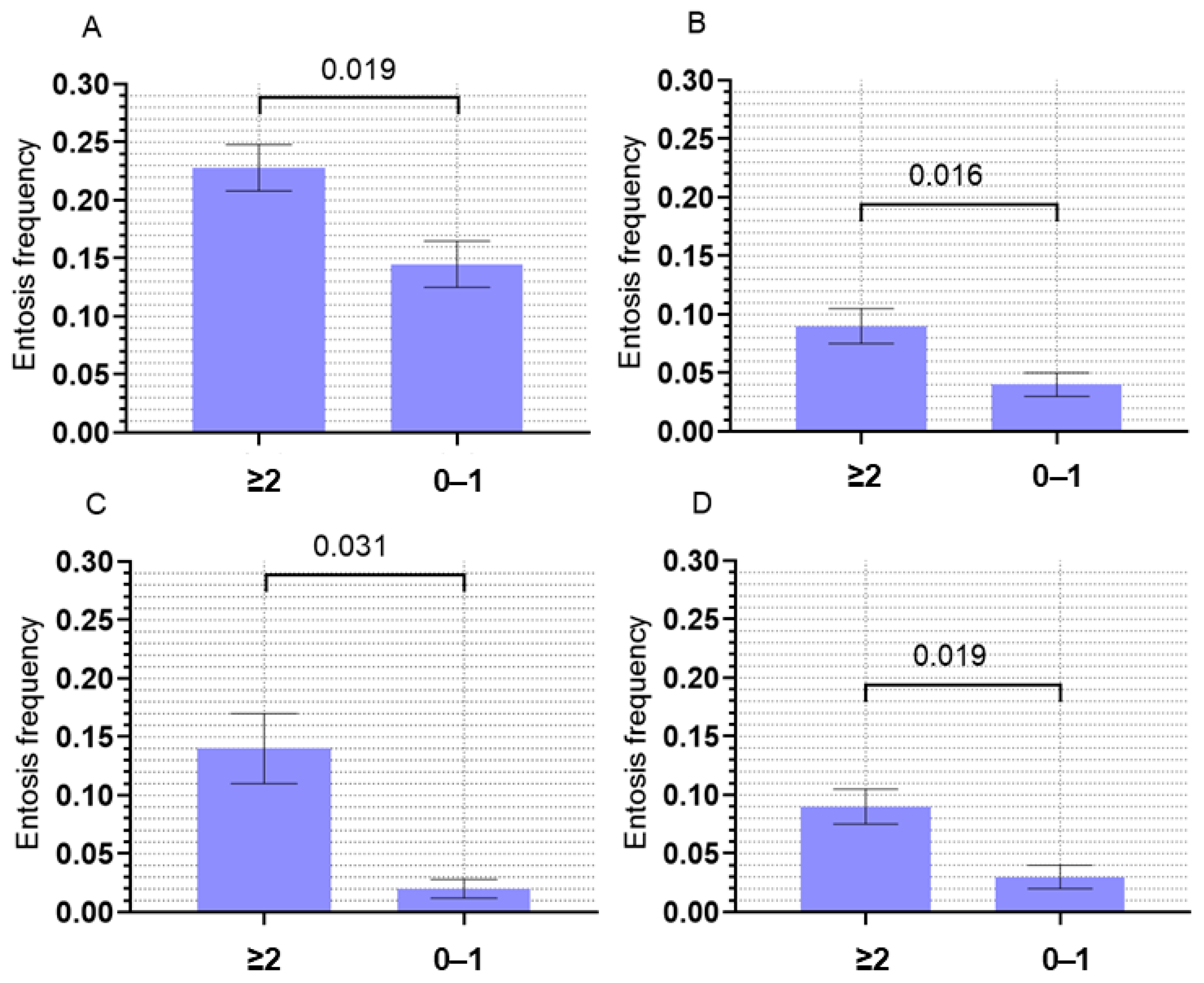
Across all tumor types, the frequency of entosis was significantly higher in patients harboring two or more amplifications of stemness-related genes located in different chromosomal loci—a molecular pattern strongly associated with metastatic potential [19]—compared with patients who had 0–1 amplification (Figure 5). These findings further support our hypothesis that entosis may contribute to the emergence of aneuploid tumor clones under the selective pressure of NAC, promoting not only clonal diversification but also the development of more aggressive, dedifferentiated clones capable of metastatic dissemination through the acquisition of stemness-gene amplifications [19].
Across all tumor types, the frequency of entosis was significantly higher in patients harboring two or more amplifications of stemness-related genes located in different chromosomal loci—a molecular pattern strongly associated with metastatic potential [19]—compared with patients who had 0–1 amplification (Figure 5). We also indicated the number of amplifications of stem cell genes for each patient in the Supplementary (Tables S1–S4).
These findings further support our hypothesis that entosis may contribute to the emergence of aneuploid tumor clones under the selective pressure of NAC, promoting not only clonal diversification but also the development of more aggressive, dedifferentiated clones capable of metastatic dissemination through the acquisition of stemness-gene amplifications [19].

3.5. The Relationship Between the Frequency of Entotic Events and the Amplification of the MAP1LC3A Gene in Tumors

The MAP1LC3A gene (20q11.22), which encodes the LC3 protein—one of the key mediators of phagosome lipidisation during endocytosis and a recognized marker of lysosomal activity [22,23]—showed a strong association with entosis frequency across tumor types. Entosis frequency in tumor tissue was significantly linked to amplification of the MAP1LC3A locus.
MAP1LC3A amplification was detected in 66% of CRC cases, and entosis frequency in this group was approximately twice as high as in tumors with a normal locus (0.22 ± 0.02 vs. 0.11 ± 0.02, p = 0.004). In BC and LC, MAP1LC3A amplification was less frequent (16.1% and 15.2%, respectively), and entosis frequency was correspondingly lower than in CRC (Figure 2). Following NAC, the proportion of BC tumors with MAP1LC3A amplification declined to 8.3%, paralleled by a reduction in entosis frequency (Figure 2).
A very strong correlation was observed between the number of MAP1LC3A amplifications and entosis frequency (r = 0.98, p = 0.017). In LC, tumors with MAP1LC3A amplification demonstrated significantly higher entosis frequency than non-amplified tumors (0.16 ± 0.03 vs. 0.06 ± 0.01; p = 0.005). In BC prior to treatment, tumors harboring MAP1LC3A amplification showed markedly elevated entosis levels (0.24 ± 0.09) compared with non-amplified tumors (0.08 ± 0.02; p = 0.02).
Because only 3 of 36 BC tumors retained MAP1LC3A amplification after NAC, a statistically meaningful post-treatment comparison was not feasible. Nevertheless, the overall findings strongly indicate that MAP1LC3A amplification is a robust molecular marker of entotic activity, consistently observed across all three tumor types examined.

4. Discussion

This study demonstrates that entosis is a common phenomenon in human malignant tumor tissue; however, its frequency varies markedly across tumor types. Among the three tumor groups analyzed—colorectal, breast, and lung cancer—the highest frequency of cell-in-cell (CIC) structures was observed in colorectal cancer. The mean number of CICs per 20 high-power fields was significantly higher in colorectal cancer compared with breast and lung cancers, indicating more active entotic processes in colorectal tumors.
The analysis of clinicomorphological associations revealed that, overall, CIC frequency showed only weak relationships with tumor size, stage, and the presence of distant metastases. The notable exception was tumor grade in colorectal cancer: entosis occurred significantly more often in high-grade (G3) tumors than in G1–G2 tumors (p = 0.03). These findings are consistent with the observations of Sidorova O.A. et al. [24], who reported a higher frequency of entotic structures in triple-negative breast cancer compared with fibroadenoma. In a study by Bozkurt E. et al., no statistically significant differences were found in CRC patients between CIC structures and TNM stages (tumor size, spread, and metastasis), age, sex, lymphovascular invasion, and treatment [25].
An intriguing aspect was the divergent association between entosis and lymphogenous metastasis across tumor localisations. In lung cancer, CIC frequency was higher in patients with lymph node involvement (p = 0.02), whereas in breast cancer the opposite pattern was found, with entosis occurring more frequently in patients without lymphogenous metastases (p = 0.02). Similar heterogeneity was also reported by Liu X. et al. [26], who analyzed 411 cases of non-small cell lung cancer (NSCLC) and found that high hoCIC frequency was associated with male sex, smoking, squamous cell subtype, poor differentiation, stage III–IV, lymphogenous metastasis, pleural and vascular invasion, necrosis, and high Ki-67 levels.
Our data further confirm the prognostic relevance of entosis. Kaplan–Meier survival analysis showed that the presence of CICs was associated with reduced overall survival in colorectal cancer (p = 0.03) and decreased metastasis-free survival in lung cancer (p = 0.011) (Figure 4). In breast cancer, statistically significant differences were not reached; however, survival curves demonstrated a clear trend towards poorer prognosis in CIC-positive cases. These findings align with reports by Liu X. et al. (2024) [26]. At the same time, contradictory evidence exists. In pancreatic adenocarcinoma, elevated CIC levels have been associated with a lower likelihood of metastasis [27,28], highlighting the biological complexity of entosis and suggesting that its functional role may be context-dependent.
In contrast, Bozkurt E. et al. found no differences in disease-free survival (DFS) and disease-specific survival curves in patients with colorectal cancer when comparing groups with or without entotic structures. However, interestingly, patients with CIC structures at the invasive tumor margin had an approximately twofold increased risk of recurrence (p = 0.051) and cancer-specific mortality (p = 0.02) compared to patients without detectable CIC structures. They also noted that the prognostic significance of CIC structures at the invasive margin was observed only in stage 3 patients (p = 0.02 and p = 0.04) for DFS and DSS, respectively. Thus, in a multivariate analysis taking into account baseline clinical and pathological characteristics, stage 3 patients had an increased risk of recurrence (p = 0.004) and cancer-related mortality (p = 0.02) [25].
A key focus of our study was the association between entosis and tumor molecular alterations. We found that CIC frequency was significantly higher in patients with two or more amplifications of stemness-related genes, irrespective of tumor localisation (Figure 5). Notably, no correlation was observed between entosis and the total number of copy number aberrations (deletions and amplifications) (Table 2). Given prior findings [19] that stemness-gene amplification is a critical determinant of metastatic potential, our results support the hypothesis that entosis may contribute to the emergence of tumor clones harboring such amplifications.
This interpretation is strengthened by the strong association identified between entosis frequency and amplification of the MAP1LC3A gene, which participates in autophagy. In patients with MAP1LC3A amplification, CIC frequency was two- to three-fold higher than in patients without amplification. These findings suggest that MAP1LC3A may act as a potential molecular regulator of entosis. Several studies also indicate a possible role of KRAS in promoting entosis through the regulation of E- and P-cadherins [27], providing additional mechanistic support for the interplay between oncogenic signaling and cell-in-cell processes.
Entosis can be caused by cell detachment from the matrix, glucose starvation [29], penetration into neighboring cells after mitotic division (mitotic entosis) [30], or induced by UV radiation [31]. Drugs targeting TRAIL death receptors are of broad interest and are potentially considered as candidates for the treatment of malignant neoplasms. An interesting discovery by Bozkurt E. et al. was the data obtained from the study of apoptosis-inducing molecules. They found that colorectal cancer cells simultaneously initiate entosis and apoptosis when stimulated by TRAIL. When treated with TRAIL, some cells penetrated other cells via endocytosis, and cells that did not express the death receptors DR4 (TRAIL-R1) and DR5 (TRAIL-R2) more often became outer cells, protecting the inner cells from TRAIL stimulation [25].
The work of Ojasalu K. et al. indicates the role of LPA (lysophosphatidic acid) in the induction of entosis through the ROCK, MAPK, and PKC-controlled signaling pathway in high-grade serous ovarian carcinoma (HGSC) cells. First, it is shown that an important component of the signaling network is MYPT1 (myosin-binding subunit of myosin phosphatase), which stimulates protein phosphatase 1 (PP1), which in turn is a negative regulator of myosin light chain 2 (MLC2). LPA induces MYPT1 phosphorylation via ROCK (T853) and PKC/ERK (S507), which is mainly mediated by LPAR1. Inhibition of MYPT1, PKC, or ERK prevents LPA-induced cell migration and chemotaxis, while interference with ROCK activity and MLC2 phosphorylation selectively blocks chemotaxis. Second, they demonstrated a novel signaling pathway regulated by LPAR2 and RAC-GEF DOCK7 that is required for the induction of entosis in HGSC cells. Taken together, these considerations suggest that the identification of LPA-triggered MYPTs associated with the progression of high-grade serous ovarian carcinoma may represent a promising target for interfering with specific PP1 functions necessary for the progression of HGSC [32].
It is interesting to note the global problem of identifying CIC structures in patient histological material, which currently can only be quantified manually. Unfortunately, manual quantitative assessment of CICs is usually oversimplified to counting CICs, which is a serious obstacle to in-depth mechanistic studies. The article by Tang M. et al. demonstrates artificial intelligence technology for an automatic method of identifying CICs, which performs a comprehensive analysis in an automated and efficient manner. Thus, AIM-CICs (automatic identification method of CICs), developed based on a convolutional neural network algorithm, can not only distinguish between CICs and non-CICs, but also accurately classify them into five subclasses based on CIC stages and the number of cells involved. Such work clearly demonstrates the possibility of applying modern AI technologies in the analysis of structures during entosis [33].

5. Limitations of the Study

One significant limitation remains: the data currently available do not allow us to clearly distinguish between entosis functioning solely as a non-causal epiphenomenon (a consequence of the tumor microenvironment) and entosis as an active, integrated participant in the process of tumor carcinogenesis (driving force). It should be noted that this study lacks data on the mechanisms of entosis in in vitro or in vivo models that clarify the role of MAP1LC3A in the induction of entosis, which is shown phenomenologically; this is the subject of our future work.

6. Conclusions

Entosis is a rare form of non-apoptotic cell death under physiological conditions, yet it acquires substantially greater biological relevance within tumor tissue. Beyond its recently demonstrated role in normal processes—such as during blastocyst implantation, where entosis-like engulfment of endometrial epithelial cells by trophoblasts has been described—an increasing body of evidence supports its involvement in tumor progression, clonal diversification, and the development of metastatic potential.
The findings of this study support the working hypothesis that entosis may contribute to the emergence of aneuploid tumor cell clones, including those harboring amplifications of stemness-related genes. This positions entosis as a potential driver of tumor genetic heterogeneity, a feature of particular importance under conditions of therapeutic selection pressure. The observed association between high entosis frequency and the presence of ≥2 stemness-gene amplifications, together with its link to unfavorable prognosis in colorectal and lung cancers, underscores its potential value as a prognostic indicator.
Special attention should be given to the strong correlation identified between entosis frequency and amplification of the MAP1LC3A gene, a key regulator of autophagy. This finding suggests the existence of a molecularly controlled pathway governing entosis activation, opening prospects for targeted therapeutic strategies. Inhibition of critical regulators of entosis—such as MAP1LC3A—could, in theory, slow tumor progression, limit the emergence of treatment-resistant clones, and enhance therapeutic efficacy.
Taken together, these results indicate that entosis should be regarded not merely as a morphological phenomenon but as a potentially significant mechanism of tumor evolution and adaptation. Future research aimed at elucidating the molecular determinants of entosis, identifying marker profiles of cells undergoing this process, and experimentally blocking entosis pathways represents a promising direction for advancing our understanding of tumor biology.

Supplementary Materials

The following supporting information can be downloaded at: https://www.mdpi.com/article/10.3390/jmp7010012/s1; Table S1: Frequency of entosis and number of amplifications of stemness genes and Loss and Gain across the CRC genome; Table S2: Frequency of entosis and number of amplifications of stemness genes and Loss and Gain across the entire LC genome: Table S3: Frequency of entosis and number of amplifications of stemness genes and Loss and Gain across the entire BC genome prior to treatment; Table S4: Frequency of entosis and number of amplifications of stemness genes and Loss and Gain across the entire BC genome after treatment.

Author Contributions

K.A.G. collected literature data, wrote, designed, and edited the manuscript. K.A.G. and S.V.V. performed instrumental studies (microscopy for entotic phenomena). K.A.G. and N.V.L. performed statistical and mathematical methods of data analysis and worked with graphic material. S.V.V. and N.V.L. substantiated the main provisions stated in the manuscript, critically revised the manuscript text (including the stages before and after the manuscript publication), and edited the manuscript text. N.V.L. wrote the main hypotheses, interpreted the results of our study, and formulated conclusions. M.K.I. and I.A.T. performed microarray data analysis. N.A.T., V.P.S., A.S.T., E.O.R. and S.I.A. provided histological material. K.A.G. and S.V.V. translated the manuscript into English. All authors have read and agreed to the published version of the manuscript.

Funding

This research received no external funding.

Institutional Review Board Statement

The study was conducted in accordance with the ethical principles set out in the Declaration of Helsinki (revised in 2013) and was approved by the bioethics committee of the Cancer Research Institute of the Tomsk National Research Medical Center of the Russian Academy of Sciences (Tomsk, Russia), protocol №6 dated 12 April 2023.

Informed Consent Statement

Informed consent was obtained from all subjects involved in the study.

Data Availability Statement

The original contributions presented in this study are included in the article/Supplementary Material. Further inquiries can be directed to the corresponding author.

Conflicts of Interest

The authors declare no conflicts of interest.

Abbreviations

The following abbreviations are used in this manuscript:
CNACopy number alterations
CRCColorectal cancer
LCLung cancer
BCBreast cancer
CICCell-in-cell
MAP1LC3AMicrotubule associated protein 1 light chain 3 alpha
hoCICHomotypic cell-in-cell structures
NACNeoadjuvant chemotherapy
OSOverall survival
MFSMetastasis-free survival
TRAILTNF-related-apoptosis inducing ligand
ROCKRho-associated protein kinase
MAPKMitogen-activated protein kinase
MYPT1Myosin-binding subunit of myosin phosphatase
MLC2Myosin light chain 2
LPALysophosphatidic acid

References

  1. Overholtzer, M.; Mailleux, A.A.; Mouneimne, G.; Normand, G.; Schnitt, S.J.; King, R.W.; Cibas, E.S.; Brugge, J.S. A Nonapoptotic Cell Death Process, Entosis, That Occurs by Cell-in-Cell Invasion. Cell 2007, 131, 966–979. [Google Scholar] [CrossRef]
  2. Garanina, A.S.; Khashba, L.A.; Onishchenko, G.E. Stages of cell cannibalism-entosis-in normal human keratinocyte culture. Biochemistry 2015, 80, 1469–1477. [Google Scholar] [CrossRef]
  3. Mazzone, M.; Selfors, L.M.; Albeck, J.; Overholtzer, M.; Sale, S.; Carroll, D.L.; Pandya, D.; Lu, Y.; Mills, G.B.; Aster, J.C.; et al. Dose-dependent induction of distinct phenotypic responses to Notch pathway activation in mammary epithelial cells. Proc. Natl. Acad. Sci. USA 2010, 107, 5012–5017. [Google Scholar] [CrossRef]
  4. Wan, Q.; Liu, J.; Zheng, Z.; Zhu, H.; Chu, X.; Dong, Z.; Huang, S.; Du, Q. Regulation of myosin activation during cell-cell contact formation by Par3-Lgl antagonism: Entosis without matrix detachment. Mol. Biol. Cell 2012, 23, 2076–2091. [Google Scholar] [CrossRef] [PubMed]
  5. Overholtzer, M.; Brugge, J.S. The cell biology of cell-in-cell structures. Nat. Rev. Mol. Cell Biol. 2008, 9, 796–809. [Google Scholar] [CrossRef] [PubMed]
  6. Solovieva, M.; Shatalin, Y.; Odinokova, I.; Krestinina, O.; Baburina, Y.; Mishukov, A.; Lomovskaya, Y.; Pavlik, L.; Mikheeva, I.; Holmuhamedov, E.; et al. Disulfiram oxy-derivatives induce entosis or paraptosis-like death in breast cancer MCF-7 cells depending on the duration of treatment. Biochim. Biophys. Acta—Gen. Subj. 2022, 1866, 130184. [Google Scholar] [CrossRef]
  7. Abodief, W.T.; Dey, P.; Al-Hattab, O. Cell cannibalism in ductal carcinoma of breast. Cytopathology 2006, 17, 304–305. [Google Scholar] [CrossRef]
  8. Dziuba, I.; Gawel, A.M.; Tyrna, P.; Rybczynska, J.; Bialy, L.P.; Mlynarczuk-Bialy, I. Fate of Entosis: From the Beginning to the End in Untreated Advanced Breast Cancer. Int. J. Mol. Sci. 2023, 24, 12142. [Google Scholar] [CrossRef]
  9. Brouwer, M.; Feltkamp, C.A.; Elema, J.; Jongsma, A.P.M.; De Ley, L. Serum-dependent “cannibalism” and autodestruction in cultures of human small cell carcinoma of the lung. Cancer Res. 1984, 44, 2947–2951. [Google Scholar]
  10. Schwegler, M.; Wirsing, A.M.; Schenker, H.M.; Ott, L.; Ries, J.M.; Büttner-Herold, M.; Fietkau, R.; Putz, F.; Distel, L.V. Prognostic Value of Homotypic Cell Internalization by Nonprofessional Phagocytic Cancer Cells. BioMed Res. Int. 2015, 2015, 359392. [Google Scholar] [CrossRef]
  11. Ojasalu, K. Novel Molecular Targets in Biological Processes Associated with Ovarian Cancer Metastasis; Philipps-Universität Marburg: Marburg, Germany, 2023; p. 105. [Google Scholar]
  12. Song, J.; Xu, R.; Zhang, H.; Xue, X.; Ruze, R.; Chen, Y.; Yin, X.; Wang, C.; Zhao, Y. Cell-in-Cell–Mediated Entosis Reveals a Progressive Mechanism in Pancreatic Cancer. Gastroenterology 2023, 165, 1505–1521.e20. [Google Scholar] [CrossRef]
  13. Hayashi, A.; Yavas, A.; McIntyre, C.A.; Ho, Y.-J.; Erakky, A.; Wong, W.; Varghese, A.M.; Melchor, J.P.; Overholtzer, M.; O’Reilly, E.M.; et al. Genetic and clinical correlates of entosis in pancreatic ductal adenocarcinoma. Mod. Pathol. 2020, 33, 1822–1831. [Google Scholar] [CrossRef] [PubMed]
  14. Zhang, X.; Niu, Z.; Qin, H.; Fan, J.; Wang, M.; Zhang, B.; Zheng, Y.; Gao, L.; Chen, Z.; Tai, Y.; et al. Subtype-Based Prognostic Analysis of Cell-in-Cell Structures in Early Breast Cancer. Front. Oncol. 2019, 9, 895. [Google Scholar] [CrossRef]
  15. Gupta, K.; Dey, P. Cell cannibalism: Diagnostic marker of malignancy. Diagn. Cytopathol. 2003, 28, 86–87. [Google Scholar] [CrossRef] [PubMed]
  16. Mackay, H.L.; Moore, D.; Hall, C.; Fan, J.; Wang, M.; Zhang, B.; Zheng, Y.; Gao, L.; Chen, Z.; Tai, Y.; et al. Genomic instability in mutant p53 cancer cells upon entotic engulfment. Nat. Commun. 2018, 9, 3070. [Google Scholar] [CrossRef]
  17. Schenker, H.; Büttner-Herold, M.; Fietkau, R.; Distel, L.V. Cell-in-cell structures are more potent predictors of outcome than senescence or apoptosis in head and neck squamous cell carcinomas. Radiat. Oncol. 2017, 12, 21. [Google Scholar] [CrossRef]
  18. Gaptulbarova, K.A.; Tsydenova, I.A.; Dolgasheva, D.S.; Kravtsova, E.A.; Ibragimova, M.K.; Vtorushin, S.V.; Litviakov, N.V. Mechanisms and significance of entosis for tumour growth and progression. Cell Death Discov. 2024, 10, 109. [Google Scholar] [CrossRef]
  19. Litviakov, N.; Ibragimova, M.; Tsyganov, M.; Kazantseva, P.; Deryusheva, I.; Pevzner, A.; Doroshenko, A.; Garbukov, E.; Tarabanovskaya, N.; Slonimskaya, E. Amplifications of stemness genes and the capacity of breast tumors for metastasis. Oncotarget 2020, 11, 1988–2001. [Google Scholar] [CrossRef]
  20. Litviakov, N.V.; Ibragimova, M.K.; Tsyganov, M.M.; Kazantseva, P.V.; Doroshenko, A.V.; Garbukov, E.Y.; Frolova, I.G.; Slonimskaya, E.M. Amplifications of stemness gene loci—New markers for the determination of the need for neoadjuvant chemotherapy for patients with breast cancer. A prospective study. J. Pers. Med. 2021, 11, 397. [Google Scholar] [CrossRef]
  21. Schwartz, G.F.; Hortobagyi, G.N.; Cady, B.; Consensus Conference Committee. Proceedings of the consensus conference on neoadjuvant chemotherapy in carcinoma of the breast, April 26–28, 2003, Philadelphia, Pennsylvania. Cancer 2004, 100, 2512–2532. [Google Scholar] [CrossRef]
  22. Florey, O.; Kim, S.E.; Sandoval, C.P.; Haynes, C.M.; Overholtzer, M. Autophagy machinery mediates macroendocytic processing and entotic cell death by targeting single membranes. Nat. Cell Biol. 2011, 13, 1335–1343. [Google Scholar] [CrossRef] [PubMed]
  23. Buchheit, C.L.; Weigel, K.J.; Schafer, Z.T. Cancer cell survival during detachment from the ECM: Multiple barriers to tumour progression. Nat. Rev. Cancer 2014, 14, 632–641. [Google Scholar] [CrossRef] [PubMed]
  24. Sidorova, O.A.; Shiripenko, I.A.; Lozina, M.V.; Soldatova, A.A.; Tarasova, P.A.; Pavlova Yu, G.; Kuznetsov, V.A.; Malygin, B.V. Entosis in tumors: New data and prognostic significance. In Proceedings of the International Morphological Symposium, Nancy, France, 13–15 September 2023; pp. 107–110. [Google Scholar]
  25. Bozkurt, E.; Düssmann, H.; Salvucci, M.; Cavanagh, B.L.; Van Schaeybroeck, S.; Longley, D.B.; Martin, S.J.; Prehn, J.H. TRAIL signaling promotes entosis in colorectal cance. J. Cell Biol. 2021, 220, e202010030. [Google Scholar] [CrossRef]
  26. Liu, X.; Guo, R.; Li, D.; Wang, Y.; Ning, J.; Yang, S.; Yang, J. Homotypic cell-in-cell structure as a novel prognostic predictor in non-small cell lung cancer and frequently localized at the invasive front. Sci. Rep. 2024, 14, 18952. [Google Scholar] [CrossRef]
  27. Kroemer, G.; Perfettini, J.L. Entosis, a key player in cancer cell competition. Cell Res. 2014, 24, 1280–1281. [Google Scholar] [CrossRef]
  28. Gupta, N.; Jadhav, K.; Shah, V. Emperipolesis, entosis and cell cannibalism: Demystifying the cloud. J. Oral Maxillofac. Pathol. 2017, 21, 92–98. [Google Scholar] [CrossRef]
  29. Hamann, J.C.; Surcel, A.; Chen, R.; Teragawa, C.; Albeck, J.G.; Robinson, D.N.; Overholtzer, M. Entosis Is Induced by Glucose Starvation. Cell Rep. 2017, 20, 201–210. [Google Scholar] [CrossRef]
  30. Durgan, J.; Tseng, Y.Y.; Hamann, J.C.; Domart, M.C.; Collinson, L.; Hall, A.; Overholtzer, M.; Florey, O. Mitosis can drive cell cannibalism through entosis. eLife 2017, 6, e27134. [Google Scholar] [CrossRef]
  31. Chen, R.; Ram, A.; Albeck, J.G.; Overholtzer, M. Entosis is induced by ultraviolet radiation. iScience 2021, 24, 102902. [Google Scholar] [CrossRef]
  32. Ojasalu, K.; Lieber, S.; Sokol, A.M.; Nist, A.; Stiewe, T.; Bullwinkel, I.; Finkernagel, F.; Reinartz, S.; Müller-Brüsselbach, S.; Grosse, R.; et al. The lysophosphatidic acid-regulated signal transduction network in ovarian cancer cells and its role in actomyosin dynamics, cell migration and entosis. Theranostics 2023, 13, 1921. [Google Scholar] [CrossRef]
  33. Tang, M.; Su, Y.; Zhao, W.; Niu, Z.; Ruan, B.; Li, Q.; Zheng, Y.; Wang, C.; Zhang, B.; Zhou, F.; et al. AIM-CICs: An automatic identification method for cell-in-cell structures based on convo lutional neural network. J. Mol. Cell Biol. 2022, 14, mjac044. [Google Scholar] [CrossRef]
Figure 1. Representative examples of entotic (cell-in-cell, CIC) structures in tumor tissue from patients with colorectal cancer, breast cancer, and lung cancer. Haematoxylin and eosin–stained sections; original magnification ×600. Key morphological features: 1—crescent-shaped nucleus of the host cell; 2—nucleus of the internalized cell; 3—entotic vacuole separating the two cells.
Jmp 07 00012 g001
Figure 2. Frequency and distribution of entotic (cell-in-cell, CIC) structures across three tumor types: (A) Mean entosis frequency in tumor tissue from patients with CRC, BC (biopsy and surgical specimens), and LC. (B)—Proportion of patients with CIC-positive tumors across the same tumor types. Comparisons between two independent groups were carried out using the non-parametric Wilcoxon–Mann–Whitney test (p < 0.05).
Jmp 07 00012 g002
Figure 3. Association between the frequency of cell-in-cell (CIC) structures and key clinicopathological characteristics in colorectal cancer, breast cancer, and lung cancer. Panels: (A) Colorectal cancer; (B) Breast cancer (biopsy specimens); (C) Lung cancer; (D) Breast cancer (surgical specimens). Comparisons between two independent groups were carried out using the non-parametric Wilcoxon–Mann–Whitney test (p < 0.05).
Jmp 07 00012 g003
Figure 4. Kaplan–Meier survival curves stratified by the presence of entotic (cell-in-cell, CIC) structures in tumor tissue. Panels: (A)—Overall survival in colorectal cancer; (B)—Metastasis-free survival in lung cancer; (C)—Metastasis-free survival in breast cancer (biopsy); (D)—Metastasis-free survival in breast cancer (surgical specimens after neoadjuvant chemotherapy). Survival curves (overall survival and metastasis-free survival) were generated using the Kaplan–Meier method, and differences between curves were assessed using the log-rank test (p < 0.05).
Jmp 07 00012 g004
Figure 5. Frequency of entosis in tumor tissue in relation to the number of stemness-gene amplifications (0–1 vs. ≥2). Panels: (A) Colorectal cancer; (B) Lung cancer; (C) Breast cancer before treatment; (D) Breast cancer after neoadjuvant chemotherapy.
Jmp 07 00012 g005
Table 1. Clinical-pathological characteristics of patients included in the study.
Clinical-Pathological
Parameter
Colorectal
Cancer (n = 96)
Breast Cancer (n = 97)Lung Cancer
(n = 45)
Biopsy
(n = 61)
Surgical
Material
(n = 36)
Age>45424161
<4592372044
Tumor sizeT151599
T27372019
T348439
T436-41
Grade11---
269362712
325923
41---
StageI117420
II45371811
III2871112
IV12--1
Metastases to lymph nodesN057221124
N11727116
N222338
N3-361
N4--4-
Distant metastasesM025391637
M17018208
Presence of recurrenceYes723-
No833027-
Metabolic syndromeYes15---
No81---
Table 2. Cox regression of colorectal cancer.
Variables in the Equation
BSEWalddfSig.Exp(B)
N0,6070,8070,56710,4521,835
Grade0,4730,3701,63310,2011,605
Size1,1560,7782,20610,1373,178
Entosis1,7580,7195,98810,0145,803
Stage−2,1530,9065,65110,0170,116
Fr_Entosis−3,4082,0822,68010,1020,033
Table 3. Cox regression of lung cancer.
Variables in the Equation
BSEWalddfSig.Exp(B)
Entosis22,3859,7615,25910,0225267 × 109
Histotype0,6640,7550,77210,3791,942
St_Differen1,1461,3640,70610,4013,147
N−1,7611,0792,66410,1030,172
Size−0,8171,1930,46810,4940,442
Anat_Form−3,9811,8344,71110,0300,019
Table 4. Spearman’s correlation coefficients between the frequency of entosis and the number of amplifications of stemness genes, Gain and Loss in the tumor.
CorrelationsLung
Cancer
(n = 45)
Colorectal
Cancer (n = 96)
Breast Cancer
Before NAC
(n = 57)
Breast Cancer After NAC (n = 34)
Entosis frequency & Number amplifications of stemness genesR = 0.479
p-value = 0.0008
R = 0.243
p-value = 0.015
R = 0.267
p-value = 0.045
R = 0.506
p-value = 0.002
GainR = 0.136
p-value = 0.372
R = 0.204
p-value = 0.042
R = −0.066
p-value = 0.703
R = −0.017
p-value = 0.935
Entosis frequency & Number Loss in tumorR = 0.141
p-value = 0.357
R = 0.169
p-value = 0.093
R = −0.075
p-value = 0.669
R = −0.006
p-value = 0.977
Disclaimer/Publisher’s Note: The statements, opinions and data contained in all publications are solely those of the individual author(s) and contributor(s) and not of MDPI and/or the editor(s). MDPI and/or the editor(s) disclaim responsibility for any injury to people or property resulting from any ideas, methods, instructions or products referred to in the content.