
Too Much Information, Too Little Interest: Local Newspapers and the Communication Paradox of EU Politics


Abstract
1. Introduction
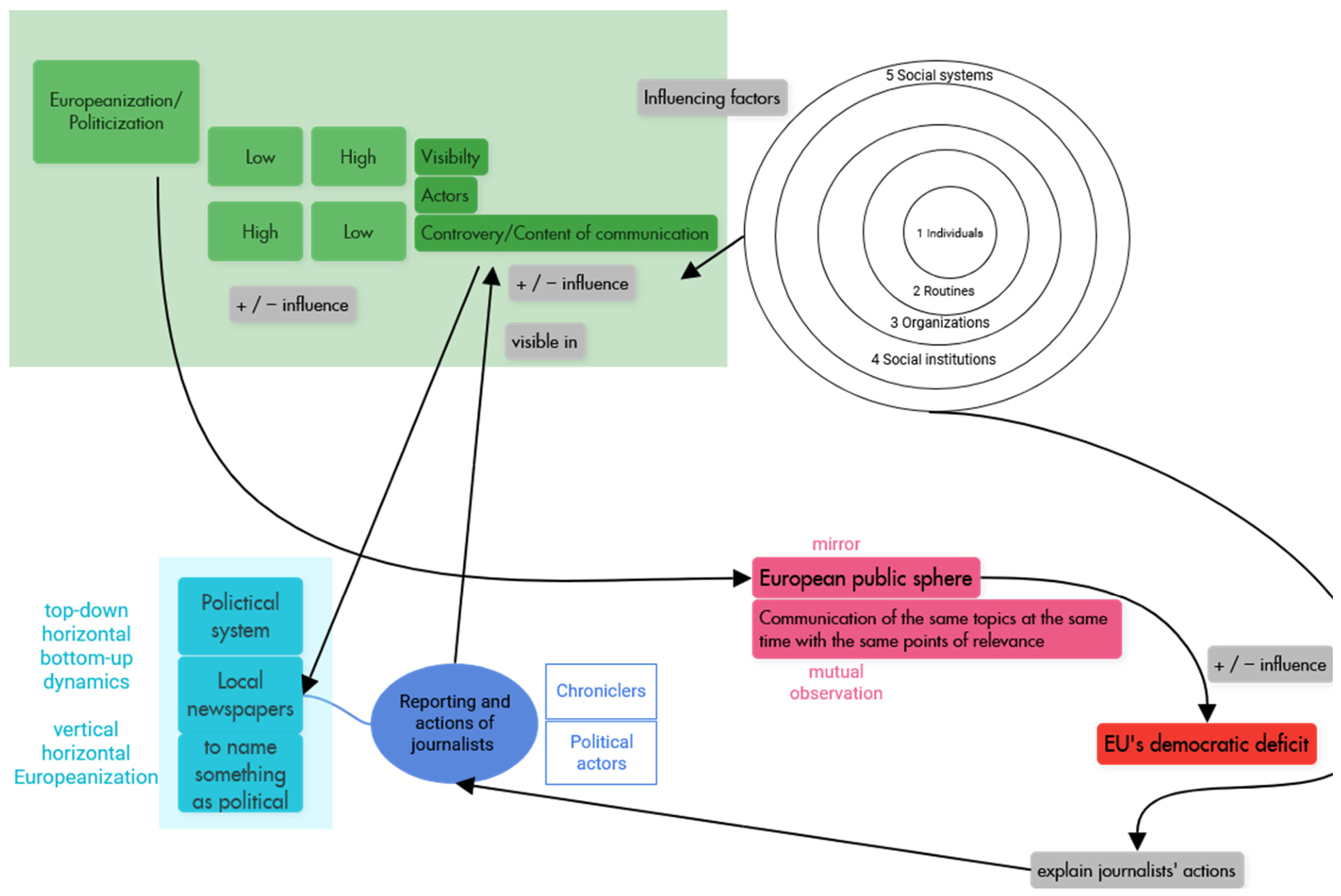
2. The Model of the Top-Down and Bottom-Up Dynamics of Europeanization and Politicization in Local Newspapers
- At a thematic level via an increase in visibility of EU issues, increased EU reporting or public prominence;
- At the actor level through rising inclusivity and an expanding range of participants (including those from EU and other member states);
- At the substantive level, where the focus is either “the extent to which appeals or demands are directed at actors from other EU member states, as well as the use of similar frames and patterns of opinion in debates”11 (Wenzel, 2025, p. 111) or “growing contentiousness of an EU issue and the associated controversies and disagreements”12 (Wenzel, 2025, p. 112).
- Low Europeanization and low politicization resulting in only a few articles on the EU and a lack of controversy or debate on EU issues in local newspapers. These publications predominantly adopt a local or national perspective, eschewing the utilization of shared frames. Low vertical (meaning European stakeholders, e.g., MEPs or local (EU) activists, are underrepresented) and horizontal (meaning few references to other member states and few similarities in EU reporting) Europeanization prevail.
- High Europeanization and high politicization resulting in multitude of articles concerning the EU, numerous controversies, and coverage of contentious EU issues, similar frames and patterns of opinion across member states, as well as strong vertical (high presence of European stakeholders in the reporting) and horizontal (numerous references to other member states, many similarities in reporting) Europeanization.
- High Europeanization but low politicization leading to a substantial number of articles pertaining to the EU, as well as a high level of both vertical and horizontal Europeanization. Additionally, there is a notable similarity in the frames and patterns of opinion across member states. However, this is accompanied by little controversy or debate on EU issues in local newspapers, and there is a lack of critical reporting.
- Low Europeanization and high politicization resulting in numerous controversies and extensive coverage of contentious EU issues, but only low vertical and horizontal Europeanization.
- Minimal resonance and interest for EU issues are to be expected. Local newspapers dedicate little to no resources to EU-related content, leading to what is known as “permissive consensus” (Hooghe & Marks, 2009). This situation appears to be counterproductive to addressing the EU’s democratic deficit.
- Politicization and Europeanization promote EU democracy by facilitating transparency, informed opinion formation, and the inclusion of a diverse range of actors. It is possible that these processes reinforce one another, thereby making an even greater contribution to the improvement of the EU’s democratic deficit.
- The absence of debates and controversies leads to a deficiency in transparency, which in turn impedes the formation of opinions. This results in a predominantly negative impact on the EU’s democratic deficit. While a modest contribution may be feasible, it is based on the assumption that Europeanization and regular reporting on EU affairs serve as a preliminary step toward politicization (Risse, 2010, pp. 8, 232).
- Minimal Europeanization, both vertically and horizontally, gives rise to national or local treatment of EU issues. The EU is experiencing a decline in its relevance and importance, which is exerting a negative influence on its democratic deficit.
3. Materials and Methods
4. Reader Interest and Information Availability
4.1. Reader Interest
4.2. Information Availability
4.3. Consequences for the Democratic Deficit
5. Conclusions
Funding
Institutional Review Board Statement
Informed Consent Statement
Data Availability Statement
Acknowledgments
Conflicts of Interest
Abbreviations
| EDIC | Europe Direct Information Center |
| EP | European Parliament |
| EPS | European Public Sphere |
| EU | European Union |
| MEP | Member of the European Parliament |
| 1 | |
| 2 | This article does not focus on the role of digital platforms and social media, despite the increasing importance of these phenomena. However, it should be noted that a significant number of local newspapers employ social media for a variety of purposes. A variety of research projects have been undertaken, including but not limited to: changes in the communication infrastructure (Pfetsch, 2020), the role of social media in facilitating an EPS (Hänska & Bauchowitz, 2019), the emergence of a “post-digital” EPS (Pane, 2025) or engagement on specific platforms (see e.g., Bossetta et al., 2017; Tuñón-Navarro & Carral-Vilar, 2021). |
| 3 | |
| 4 | Own translation. |
| 5 | Only recently have deliberative and participatory mechanisms and instruments been introduced into the EU institution’s communication strategy (Vidačak & Matan, 2026, pp. 36–37). For an overview see Vidačak and Matan (2026, p. 37). |
| 6 | See Note 4 above. |
| 7 | Pan-European public spheres or segmented transnational public spheres are two alternatives to the Europeanization of national public spheres (see Wenzel, 2025, pp. 56–57). But a pan-European public sphere is found to be highly unlikely (Lingenberg, 2010, pp. 103–104; Scharpf, 2017, p. 328; Koopmans & Statham, 2010, p. 36) and a singular public sphere is conceivable only in theoretical and normative terms (Latzer & Saurwein, 2006, p. 11; Saxer, 2006, p. 62; Trenz, 2015, p. 237). Segmented transnational public spheres could furthermore lead to a systematic exclusion of citizens from participating in political discourse (Eilders & Voltmer, 2003, p. 253). |
| 8 | See Palonen (2019) and Wiesner (2021) for elaborations on the distinction between politics as field versus as activity (see also Wenzel, 2025, pp. 74–76). |
| 9 | See Note 4 above. |
| 10 | The indicators are only capable of quantifying the status at a discrete moment in time. In order to comprehensively grasp the processes and identify trends, it is necessary to employ a variety of measurements at different times. Additionally, the indicators of politicization only allow for measurement when the political system has been attained (see Wiesner, 2019b; Hutter & Grande, 2014; Wenzel, 2025, pp. 75, 110). In this study, no measurements were obtained; rather, a qualitative analysis was conducted. This analysis was informed by interviews and reporting in local newspapers. |
| 11 | See Note 4 above. |
| 12 | See Note 4 above. |
| 13 | |
| 14 | It should be noted that with regard to the two particular factors analyzed below, no country-specific differences were apparent in the analyzed interviews, but rather similarities. However, Section 4 provides more details on the differences observed among the actor groups. |
| 15 | |
| 16 | In a case study on communication by the EU Commission and coverage in news media, Bijsmans and Altides (2007) explain aspects of the tension between the media and the political logic. |
| 17 | See Michailidou (2008) on the Commission’s public communication strategy in connection with the internet. |
References
- Abernathy, P. M. (2020). News deserts and ghost newspapers: Will local news survive? Available online: https://www.usnewsdeserts.com/reports/news-deserts-and-ghost-newspapers-will-local-news-survive/ (accessed on 13 March 2026).
- Aldridge, M. (2007). Understanding the local media. Open University Press/McGraw-Hill. [Google Scholar]
- Anders, L. H., Scheller, H., & Tuntschew, T. (2018). Die politisierung der europäischen union und die rolle der parteien: Konzeptionelle grundlagen, desiderate und perspektiven. In L. H. Anders, H. Scheller, & T. Tuntschew (Eds.), Parteien und die politisierung der europäischen union (pp. 1–35). Springer Fachmedien Wiesbaden GmbH. [Google Scholar]
- Baglioni, S., & Hurrelmann, A. (2016). The Eurozone crisis and citizen engagement in EU affairs. West European Politics, 39(1), 104–124. [Google Scholar] [CrossRef] [Scilit]
- Balčytienė, A., & Vinciūnienė, A. (2010). Assessing conditions for the homogenisation of the European public sphere: How journalists report, and could report, on Europe. In C. Bee, & E. Bozzini (Eds.), Mapping the European public sphere: Institutions, media and civil society (pp. 141–158). Ashgate Publishing Limited. [Google Scholar]
- Baugut, P. (2017). Politiker und journalisten in interaktion: Einfluss des medienwettbewerbs auf lokale politische kommunikationskulturen. Springer Fachmedien Wiesbaden GmbH. [Google Scholar]
- BDZV—Bundesverband Digitalpublisher und Zeitungsverleger e.V. (2026). Reichweiten der zeitungen. Available online: https://www.bdzv.de/alle-themen/marktdaten/reichweiten-der-zeitungen (accessed on 23 April 2025).
- Benert, V., & Pfetsch, B. (2022). Europäische Öffentlichkeit unter dem Einfluss von Digitalisierung und Politisierung. In I. Borucki, K. Kleinen von Königslöw, S. Marschall, & T. Zerback (Eds.), Springer eBook collection. Handbuch politische kommunikation (pp. 363–379). Springer Fachmedien Wiesbaden GmbH; Imprint Springer VS. [Google Scholar]
- Berkel, B. (2006). Konflikt als motor europäischer öffentlichkeit: Eine inhaltsanalyse von tageszeitungen in deutschland, frankreich, Großbritannien und österreich. VS Verlag für Sozialwissenschaften|GWV Fachverlage GmbH. [Google Scholar]
- Bijsmans, P., & Altides, C. (2007). ‘Bridging the Gap’ between EU politics and citizens? The European Commission, national media and EU affairs in the public sphere. Journal of European Integration, 29(3), 323–340. [Google Scholar] [CrossRef] [Scilit]
- Boomgaarden, H. G., Vliegenthart, R., de Vreese, C. H., & Schuck, A. R. (2010). News on the move: Exogenous events and news coverage of the European Union. Journal of European Public Policy, 17(4), 506–526. [Google Scholar] [CrossRef] [Scilit]
- Bossetta, M., Dutceac Segesten, A., & Trenz, H.-J. (2017). Engaging with European politics through Twitter and Facebook: Participation beyond the national? In M. Barisione, & A. Michailidou (Eds.), Social media and European politics: Rethinking power and legitimacy in the digital era (pp. 53–75). Palgrave Macmillan UK. [Google Scholar]
- Caune, H. (2018). The politics of labour reforms in Portugal: Politicization and Europeanization before and after the bailout. Portuguese Journal of Social Science, 17(3), 311–334. [Google Scholar] [CrossRef] [Scilit] [PubMed]
- Clausen, L. (2010). International news flow. In S. Allan (Ed.), The Routledge companion to news and journalism (pp. 127–136). Routledge. [Google Scholar]
- Dahl, R. A. (1989). Democracy and its critics. Yale University Press. [Google Scholar]
- Dahl, R. A. (2015). On democracy (R. A. Dahl, & I. Shapiro, Eds.; pp. 1–188). Yale University Press. [Google Scholar]
- de Vreese, C. H. (2001). ‘Europe’ in the news: A cross-national comparative study of the news coverage of key EU events. European Union Politics, 2(3), 283–307. [Google Scholar] [CrossRef] [Scilit]
- de Vreese, C. H., Banducci, S., Semetko, H. A., & Boomgaarden, H. G. (2005). “Off-line”: The 2004 European parliamentary elections on television news in the enlarged Europe. Information Polity, 10(3,4), 177–188. [Google Scholar] [CrossRef] [Scilit]
- Diakopoulos, N. (2019). Automating the news: How algorithms are rewriting the media. Harvard University Press. [Google Scholar]
- Dorostan, Y. (2017). Die zukunft europapolitischer information und kommunikation: Eine delphi-studie zur entwicklung von zukunftsszenarien. Nomos Verlagsgesellschaft mbH & Co. KG. [Google Scholar]
- Eder, K., & Kantner, C. (2000). Transnationale resonanzstrukturen in Europa. Eine kritik der rede vom öffentlichkeitsdefizit. In M. Bach (Ed.), Kölner zeitschrift für soziologie und sozialpsychologie. Sonderhefte: Vol. 40. Die Europäisierung nationaler gesellschaften (pp. 306–331). Westdeutscher Verlag GmbH. [Google Scholar]
- Eilders, C. (2006). Nachrichtenauswahl. In U. Hasebrink (Ed.), Medien von A bis Z (pp. 256–259). VS Verlag für Sozialwissenschaften|Springer Fachmedien Wiesbaden GmbH. [Google Scholar]
- Eilders, C. (2016). Journalismus und nachrichtenwert. In M. Löffelholz, & L. Rothenberger (Eds.), Handbuch journalismustheorien (pp. 431–442). Springer Fachmedien Wiesbaden GmbH. [Google Scholar]
- Eilders, C., & Voltmer, K. (2003). Zwischen deutschland und Europa. Eine empirische untersuchung zum grad von Europäisierung und Europa-unterstützung der meinungsführenden deutschen tageszeitungen. Medien & Kommunikationswissenschaft, 51(2), 250–270. [Google Scholar] [CrossRef]
- Engelmann, I. (2016). Gatekeeping (Vol. 16). Konzepte. Ansätze der medien- und kommunikationswissenschaft. Nomos Verlagsgesellschaft mbH & Co. KG. [Google Scholar]
- Firmstone, J. (2008). Approaches of the transnational press to reporting Europe. Journalism: Theory, Practice & Criticism, 9(4), 423–442. [Google Scholar] [CrossRef] [Scilit]
- Firmstone, J. (2024). The shaping of news: A framework for analysis. Springer Nature Switzerland AG; Imprint Palgrave Macmillan. [Google Scholar]
- Fossum, J. E. (2023). In what sense does right-wing populism pose a democratic challenge for the European Union? Social & Legal Studies, 32(6), 930–952. [Google Scholar] [CrossRef] [Scilit]
- Føllesdal, A., & Hix, S. (2006). Why there is a democratic deficit in the EU: A response to majone and moravcsik. Journal of Common Market Studies, 44(3), 533–562. [Google Scholar] [CrossRef] [Scilit]
- Frangonikolopoulos, C. A., & Papapadopoulou, L. (2021). Greek correspondents and EU: Organic critiques and proposed remedies to address EU’s Communication deficit. Journalism Practice, 15(8), 1108–1128. [Google Scholar] [CrossRef] [Scilit]
- Gerhards, J. (1997). Diskursive versus liberale öffentlichkeit: Eine empirische auseinandersetzung mit jürgen habermas. Kölner Zeitschrift Für Soziologie Und Sozialpsychologie, 49(1), 1–39. [Google Scholar]
- Gerhards, J. (2000). Europäisierung von ökonomie und politik und die trägheit der entstehung einer europäischen öffentlichkeit. In M. Bach (Ed.), Kölner zeitschrift für soziologie und sozialpsychologie. sonderhefte: Vol. 40. Die europäisierung nationaler gesellschaften (pp. 277–305). Westdeutscher Verlag GmbH. [Google Scholar]
- Gerhardt, W. (2013). Demokratie in Europa—Geleitwort von wolfgang gerhardt. In D. Doering, C. Eckner, S. Hentrich, S. Liermann, & D. Schuster (Eds.), Demokratie in Europa: Liberale perspektiven (pp. 9–12). Tectum-Verlag. [Google Scholar]
- Gioltzidou, G., Gioltzidou, F., & Chrysafis, T. (2023). Media communication in the European Union: How do media cover EU? A comparison analysis of Germany, Croatia, Belgium and Greece. European Journal of Communication and Media Studies, 2(2), 1–10. [Google Scholar] [CrossRef] [Scilit]
- Gläser, J., & Laudel, G. (2010). Experteninterviews und qualitative inhaltsanalyse als instrumente rekonstruierender untersuchungen. VS Verlag für Sozialwissenschaften|Springer Fachmedien Wiesbaden GmbH. [Google Scholar]
- Gleissner, M., & de Vreese, C. H. (2005). News about the EU Constitution. Journalism: Theory, Practice & Criticism, 6(2), 221–242. [Google Scholar] [CrossRef] [Scilit]
- Goldberg, A. C., van Elsas, E. J., & de Vreese, C. H. (2020). Mismatch? Comparing elite and citizen polarisation on EU issues across four countries. Journal of European Public Policy, 27(2), 310–328. [Google Scholar] [CrossRef] [Scilit]
- Gurevitch, M., & Blumler, J. G. (1990). Political communication systems and democratic values. In J. Lichtenberg (Ed.), Cambridge studies in philosophy and public policy. Democracy and the mass media (pp. 269–289). Cambridge University Press. [Google Scholar]
- Habermas, J. (1990). Strukturwandel der öffentlichkeit: Untersuchungen zu einer kategorie der bürgerlichen gesellschaft. Mit einem vorwort zur neuauflage 1990 (Vol. 891). Suhrkamp Verlag GmbH & Co. KG. [Google Scholar]
- Habermas, J. (2006). Political communication in media society: Does democracy still enjoy an epistemic dimension? The impact of normative theory on empirical research. Communication Theory, 16(4), 411–426. [Google Scholar] [CrossRef] [Scilit]
- Habermas, J. (2021). Überlegungen und hypothesen zu einem erneuten strukturwandel der politischen öffentlichkeit. In M. Seeliger, & S. Sevignani (Eds.), Sonderband leviathan: Vol. 37. Ein neuer strukturwandel der öffentlichkeit? (pp. 470–500). Nomos Verlagsgesellschaft mbH & Co. KG. [Google Scholar]
- Habermas, J. (2022). Ein neuer strukturwandel der öffentlichkeit und die deliberative politik. Suhrkamp Verlag AG. [Google Scholar]
- Hallin, D. C., & Mancini, P. (2004). Comparing media systems: Three models of media and politics. Communication, society, and politics. Cambridge University Press. [Google Scholar]
- Hallin, D. C., & Mancini, P. (2012). Comparing media systems: A response to critics. In F. Esser, & T. Hanitzsch (Eds.), Handbook of comparative communication research (pp. 207–220). International Communication Association (ICA) handbook series. Routledge; Taylor and Francis. [Google Scholar]
- Harcup, T., & O’Neill, D. (2017). What is news? Journalism Studies, 18(12), 1470–1488. [Google Scholar] [CrossRef] [Scilit]
- Hänska, M., & Bauchowitz, S. (2019). Can social media facilitate a European public sphere? Transnational communication and the Europeanization of Twitter during the Eurozone crisis. Social Media + Society, 5(3), 205630511985468. [Google Scholar] [CrossRef] [Scilit]
- Hepp, A., Brüggemann, M., Kleinen von Königslöw, K., Lingenberg, S., & Möller, J. (2012). Politische diskurskulturen in Europa: Die mehrfachsegmentierung europäischer öffentlichkeit. Medien—Kultur—Kommunikation. VS Verlag für Sozialwissenschaften|Springer Fachmedien Wiesbaden GmbH. [Google Scholar]
- Hess, K., & Waller, L. (2017). Local journalism in a digital world: Theory and practice in the digital age. Palgrave Macmillan; Bloomsbury Academic; Bloomsbury Publishing (UK). [Google Scholar]
- Hooghe, L., & Marks, G. (2009). A postfunctionalist theory of European integration: From permissive consensus to constraining dissensus. British Journal of Political Science, 39(1), 1–23. [Google Scholar] [CrossRef] [Scilit]
- Huber, C. K. (2012). Zwischen routine, ratspräsidentschaft und gipfel: Interaktionen von medien und politik in der Europäischen Union. VS Verlag für Sozialwissenschaften|Springer Fachmedien Wiesbaden GmbH. [Google Scholar]
- Hurrelmann, A., Gora, A., & Wagner, A. (2015). The politicization of European integration: More than an elite affair? Political Studies, 63(1), 43–59. [Google Scholar] [CrossRef] [Scilit]
- Hutter, S., & Grande, E. (2014). Politicizing Europe in the national electoral arena: A comparative analysis of five West European countries, 1970–2010. Journal of Common Market Studies, 52(5), 1002–1018. [Google Scholar] [CrossRef] [Scilit]
- Janson, M. (2024). Weniger lokalzeitungen. Statista. Available online: https://de.statista.com/infografik/33589/verbreitung-von-wirtschaftlich-unabhaengigen-lokaljournalistischen-tageszeitungen-in-deutschland/ (accessed on 23 April 2024).
- Kambeck, M. (2004). Politikvermittlung auf EU- und bundesebene—Ein vergleich in theorie und praxis unter besonderer berücksichtigung des politikfeldes informationsgesellschaft. Inaugral-Dissertation zur Erlangung der Doktorwürde der Philosophischen Fakultät der Rheinischen Friedrich-Wilhelms-Universität zu Bonn. Available online: https://bonndoc.ulb.uni-bonn.de/xmlui/handle/20.500.11811/2163 (accessed on 7 September 2020).
- Kermer, J. E., & Nijmeijer, R. A. (2020). Identity and European public spheres in the context of social media and information disorder. Media and Communication, 8(4), 28–39. [Google Scholar] [CrossRef] [Scilit]
- Kleinen von Königslöw, K. (2012). Europe in crisis? Testing the stability and explanatory factors of the Europeanization of national public spheres. International Communication Gazette, 74(5), 443–463. [Google Scholar] [CrossRef] [Scilit]
- Koopmans, R. (2004). Integrated report: Cross-national, cross-issue, cross-time. Integrated Report WP 2. Available online: http://www.europub.wz-berlin.de (accessed on 23 March 2019).
- Koopmans, R. (2007). The transformation of political mobilisation and communication in European public spheres: Europub.com. Office for Official Publications of the European Communities. Available online: https://op.europa.eu/en/publication-detail/-/publication/e34269d3-9aa3-48ac-99a8-691f17360cc9 (accessed on 6 July 2021).
- Koopmans, R., & Statham, P. (2010). Theoretical framework, research design, and methods. In P. Statham, & R. Koopmans (Eds.), Communication, society, and politics. The making of a European public sphere: Media discourse and political contention (pp. 34–60). Cambridge University Press. [Google Scholar]
- Krzyżanowski, M., Triandafyllidou, A., & Wodak, R. (2009). Introduction. In A. Triandafyllidou, R. Wodak, & M. Krzyżanowski (Eds.), The European public sphere and the media: Europe in crisis (pp. 1–11). Palgrave Macmillan. [Google Scholar]
- Kümpers, L. (2022). The implications of Europeanized EU-Journalists on the citizens and its government: The Brussels bubble—A paradise for EU-journalists’ to become a good reporter? MaRBLe, 1(1), 1–20. Available online: https://openjournals.maastrichtuniversity.nl/Marble/article/view/876 (accessed on 13 March 2026).
- Latzer, M., & Saurwein, F. (2006). Europäisierung durch medien: Ansätze und erkenntnisse der öffentlichkeitsforschung. In W. R. Langenbucher, & M. Latzer (Eds.), Europäische öffentlichkeit und medialer wandel: Eine transdisziplinäre perspektive (pp. 10–44). VS Verlag für Sozialwissenschaften|GWV Fachverlage GmbH. [Google Scholar]
- Lauerer, C., & Keel, G. (2019). Journalismus zwischen unabhängigkeit und einfluss. In T. Hanitzsch, J. Seethaler, & V. Wyss (Eds.), Studies in international, transnational and global communications. Journalismus in deutschland, österreich und der schweiz (pp. 103–134). Springer Fachmedien Wiesbaden GmbH. [Google Scholar]
- Lecheler, S. (2008). EU membership and the press. Journalism: Theory, Practice & Criticism, 9(4), 443–464. [Google Scholar] [CrossRef] [Scilit]
- Lecheler, S., Gattermann, K., & Aaldering, L. (2023). Disinformation and the Brussels bubble: EU correspondents’ concerns and competences in a digital age. Journalism, 1736–1753. [Google Scholar] [CrossRef] [Scilit]
- Liebert, U. (2012). Civil society, public sphere and democracy in the EU. In E. O. Eriksen, & J. E. Fossum (Eds.), Routledge studies on democratizing Europe: Vol. 7. Rethinking democracy and the European Union (pp. 112–142). Routledge. [Google Scholar]
- Liebetruth, D. (2012). Europa vor ort verankern: Potenzial und journalistische Gestaltungsmöglichkeiten lokaler EU-Nachrichten in der regionalen Tagespresse; eine Analyse mit Beispielen niedersächsischer Lokalzeitungen. Mensch und Buch Verlag. [Google Scholar]
- Lingenberg, S. (2010). Europäische Publikumsöffentlichkeiten. VS Verlag für Sozialwissenschaften|GWV Fachverlage GmbH. [Google Scholar]
- Machill, M., Beiler, M., & Fischer, C. (2006). Europa-themen in Europas medien—Die debatte um die europäische öffentlichkeit.: Eine metaanalyse medieninhaltsanalytischer studien. In W. R. Langenbucher, & M. Latzer (Eds.), Europäische öffentlichkeit und medialer wandel: Eine transdisziplinäre perspektive (pp. 132–155). VS Verlag für Sozialwissenschaften|GWV Fachverlage GmbH. [Google Scholar]
- Martinsen, R. (2009). Öffentlichkeit in der “Mediendemokratie” aus der perspektive konkurrierender demokratietheorien. In F. Marcinkowski, & B. Pfetsch (Eds.), Politik in der mediendemokratie (pp. 37–69). VS Verlag für Sozialwissenschaften|GWV Fachverlage GmbH. [Google Scholar]
- Maurer, M., & Reinemann, C. (2006). Medieninhalte: Eine einführung. VS Verlag für Sozialwissenschaften|GWV Fachverlage GmbH. [Google Scholar]
- Mayring, P. (1989). Qualitative inhaltsanalyse. In G. Jüttemann (Ed.), Qualitative forschung in der psychologie: Grundfragen, verfahrensweisen, anwendungsfelder (pp. 187–211). Roland Asanger Verlag. [Google Scholar]
- Mayring, P. (2008). Neuere entwicklungen in der qualitativen forschung und der qualitativen inhaltsanalyse. In P. Mayring, & M. Gläser-Zikuda (Eds.), Pädagogik. Die praxis der qualitativen inhaltsanalyse (pp. 7–19). Beltz Verlag. [Google Scholar]
- Mayring, P. (2015). Qualitative inhaltsanalyse: Grundlagen und techniken. Beltz Verlag. [Google Scholar]
- McNair, B. (2009). 17 Journalism and democracy. In K. Wahl-Jorgensen, & T. Hanitzsch (Eds.), The handbook of journalism studies (pp. 237–249). International Communication Association (ICA) handbook series. Routledge. [Google Scholar]
- Meyer, C. O. (1999). Political legitimacy and the invisibility of politics: Exploring the European Union’s Communication deficit. Journal of Common Market Studies, 37(4), 617–639. [Google Scholar] [CrossRef] [Scilit]
- Meyer, C. O. (2003). Die wächterfunktion von europäischer öffentlichkeit. Das brüsseler pressecorps und der rücktritt der EU-Kommission. In A. Klein, R. Koopmans, H.-J. Trenz, C. Lahusen, & D. Rucht (Eds.), Bürgerschaft, öffentlichkeit und demokratie in Europa (pp. 233–245). Leske + Budrich. [Google Scholar]
- Michailidou, A. (2008). Democracy and new media in the European Union: Communication or participation deficit? Journal of Contemporary European Research, 4(4), 346–368. [Google Scholar] [CrossRef] [Scilit]
- Michailidou, A., & Trenz, H.-J. (2020). EU differentiation, dominance and the control function of journalism. EU3D Research Papers, No. 3. Available online: https://papers.ssrn.com/sol3/papers.cfm?abstract_id=3529331 (accessed on 9 February 2020).
- Monza, S., & Anduiza, E. (2016). The visibility of the EU in the national public spheres in times of crisis and austerity. Politics & Policy, 44(3), 499–524. [Google Scholar] [CrossRef] [Scilit]
- Möhring, W. (2015). Lokaljournalismus im fokus der wissenschaft: Zum forschungsstand lokaljournalismus—Unter besonderer berücksichtigung von nordrhein-westfalen. Eine expertise im auftrag der Landesanstalt für Medien Nordrhein-Westfalen (LfM). LfM-dokumentation: Vol. 51. Landesanstalt für Medien Nordrhein-Westfalen. Available online: https://pdfdokument.com/lokaljournalismus-im-lfm-publikationen_59f3330a1723ddaf2d4a5bd0.html (accessed on 6 July 2021).
- Nazarewska, B. (2014). Lokalfürsten der regionalzeitung: Wer bestimmt die redaktionelle nachrichtenauswahl im lokalteil? Inaugural-dissertation zur erlangung des doktorgrades der philosophisch-sozialwissenschaftlichen fakultät der universität augsburg [Inaugural-Dissertation, Universität Augsburg]. Available online: https://opus.bibliothek.uni-augsburg.de/opus4/frontdoor/deliver/index/docId/3752/file/Diss_Nazarewska.pdf (accessed on 1 April 2019).
- Neff, T., & Pickard, V. (2023). Building better local media systems: A comparative policy discourse analysis of initiatives to renew journalism around the world. Journalism Studies, 24(15), 1877–1897. [Google Scholar] [CrossRef] [Scilit]
- Nesti, G., & Valentini, C. (2010). Conclusions. In C. Valentini, & G. Nesti (Eds.), Public communication in the European Union: History, perspectives and challenges (pp. 389–408). Cambridge Scholars Publishing. [Google Scholar]
- Neuberger, C. (2022). Journalistische produktion und auswahl. In I. Borucki, K. Kleinen von Königslöw, S. Marschall, & T. Zerback (Eds.), Springer eBook collection. Handbuch politische kommunikation (pp. 281–297). Springer Fachmedien Wiesbaden GmbH; Imprint Springer VS. [Google Scholar]
- Niedziałkowski, K. (2023). Between Europeanisation and politicisation: Wolf policy and politics in Germany. Environmental Politics, 32(5), 793–814. [Google Scholar] [CrossRef] [Scilit]
- Nielsen, R. K. (2015). Local newspapers as keystone media: The increased importance of diminished newspapers for local political information environments: Pre-publication version of chapter in Rasmus Kleis Nielsen (ed.) 2015 Local Journalism: The decline of newspapers and the rise of digital media (I.B. Tauris, London). Forthcoming. Available online: https://papers.ssrn.com/sol3/papers.cfm?abstract_id=2614326 (accessed on 24 September 2020).
- Offerhaus, A. (2011). Die professionalisierung des deutschen EU-Journalismus. VS Verlag für Sozialwissenschaften|Springer Fachmedien Wiesbaden GmbH. [Google Scholar]
- Offerhaus, A., Mollen, A., & Hepp, A. (2014). Nationalizing Europe regionally—The Europeanization of public spheres in regional newspaper reporting and the “Crisis” in Europe. In A. Stępińska (Ed.), Media and communication in Europe (pp. 13–32). Logos Verlag Berlin. [Google Scholar]
- Oleart, Á., & Haapala, T. (2022). Introduction: Towards a multi-faceted approach to politicisation in the EU context. In T. Haapala, & Á. Oleart (Eds.), Springer eBook collection. Tracing the politicisation of the EU: The future of Europe debates before and after the 2019 elections (pp. 1–17). Springer Nature Switzerland AG; Imprint Palgrave Macmillan. [Google Scholar]
- Palonen, K. (2019). Politicisation: Disorder or chance? From literary to parliamentary cebates. In Contemporary Political Theory (Ed.), Critical exchange: Rethinking politicisation (pp. 249–254). Springer. Available online: https://link.springer.com/article/10.1057/s41296-019-00326-y (accessed on 7 September 2026).
- Pane, S. (2025). The European ‘post-digital’ public sphere: Foundations of an emerging paradigm in the social sciences. Methaodos. Revista De Ciencias Sociales, 13(1), m251301a08. [Google Scholar] [CrossRef] [Scilit]
- Park, S., Lee, J. Y., & Fisher, C. (2025). News closures, trust, and community attachment among regional news audiences: A case study of Australia. Journalism Practice, 19(6), 1239–1253. [Google Scholar] [CrossRef] [Scilit]
- Pfetsch, B. (2004). The voice of the media in European public sphere: Comparative analysis of newspaper editorials [Integrated Report WP 3]. Available online: http://europub.wz-berlin.de (accessed on 23 September 2019).
- Pfetsch, B. (2020). Democracy and digital dissonance: The co-occurrence of the transformation of political culture and communication infrastructure. Central European Journal of Communication, 13(1), 96–110. [Google Scholar] [CrossRef] [Scilit] [PubMed]
- Plavec, J. G. (2020). Babylon oder blase? Die Brüsseler EU-Kommunikationskultur: Einstellungen von politikern und journalisten im vergleich (Vol. 20). Politische kommunikation und demokratische öffentlichkeit. Nomos Verlagsgesellschaft mbH & Co. KG. [Google Scholar]
- Prochazka, F., Soontjens, K., Beckers, K., Hopmann, D. N., & Schuck, A. (2025). Projection in journalists’ perceptions of public opinion. Journalism, 27, 1307–1325. [Google Scholar] [CrossRef] [Scilit]
- Rapp, M. (2025). How important is European integration for pro-European voters in times of politicization? Politische Vierteljahresschrift, 66(3), 545–573. [Google Scholar] [CrossRef] [Scilit]
- Reese, S. D., & Shoemaker, P. J. (2016). A media sociology for the networked public sphere: The hierarchy of influences model. Mass Communication and Society, 19(4), 389–410. [Google Scholar] [CrossRef] [Scilit]
- Risse, T. (2010). A community of Europeans? Transnational identities and public spheres. Cornell paperbacks. Cornell University Press. [Google Scholar] [CrossRef] [Scilit]
- Risse, T. (2014a). European public spheres, the politicization of EU affairs, and its consequences. In T. Risse (Ed.), Contemporary European politics. European public spheres: Politics is back (pp. 141–164). Cambridge University Press. [Google Scholar]
- Risse, T. (2014b). Introduction. In T. Risse (Ed.), Contemporary European politics. European public spheres: Politics is back (pp. 1–26). Cambridge University Press. [Google Scholar]
- Risse, T. (2014c). No demos? Identities and public spheres in the Euro crisis. Journal of Common Market Studies, 52(6), 1207–1215. [Google Scholar] [CrossRef] [Scilit]
- Rivas-de-Roca, R. (2022). La polarización en la información local sobre la Unión Europea: Un estudio transnacional. Comunicació: Revista De Recerca I D’anàlisi, 39(1), 41–60. [Google Scholar] [CrossRef]
- Rivas-de-Roca, R., Caro-González, F. J., & García-Gordillo, M. (2022). Covering the EU at local level: A multiple-case study in Germany, the UK and Spain. International Communication Gazette, 124–145. [Google Scholar] [CrossRef] [Scilit]
- Rivas-de-Roca, R., Caro-González, F. J., & Sánchez-Torné, I. (2024). Journalistic roles at the local press: Between demographic characteristics and the commitment with the community. Journalism Practice, 2362–2379. [Google Scholar] [CrossRef] [Scilit]
- Rivas-de-Roca, R., García-Gordillo, M., & Caro-González, F. J. (2020). La construcción del periodismo “localizado” en medios digitales europeos. Estudio de casos. Revista Latina, (75), 1–26. [Google Scholar] [CrossRef] [Scilit]
- Rivas-de-Roca, R., Jerónimo, P., & Torre, L. (2026). A systematic literature review on local news production (2012–2022). Comunicação E Sociedade, 49, 1–22. [Google Scholar] [CrossRef] [Scilit] [PubMed]
- Rohrer, M. (2010). Von der konstruktion europäischer öffentlichkeiten. Eine theoretische einordnung der kommunikationspolitik von parlament und kommission. In E. Klaus, C. Sedmak, R. Drüeke, & G. Schweiger (Eds.), VS research. Identität und inklusion im europäischen Sozialraum (pp. 69–84). VS Research. [Google Scholar]
- Salovaara-Moring, I. (2009). Domesticating Europe: Communicative spaces of the East of West. In A. Charles (Ed.), Media in the enlarged Europe: Politics, policy and industry (pp. 69–78). Intellect Books Ltd. [Google Scholar]
- Saurugger, S. (2014). Europeanisation in times of crisis. Political Studies Review, 12(2), 181–192. [Google Scholar] [CrossRef] [Scilit]
- Saxer, U. (2006). Europäischer gesellschafts-, medien- und öffentlichkeitswandel—Eine kommunikationssoziologische perspektive. In W. R. Langenbucher, & M. Latzer (Eds.), Europäische öffentlichkeit und medialer wandel: Eine transdisziplinäre perspektive (pp. 62–92). VS Verlag für Sozialwissenschaften|GWV Fachverlage GmbH. [Google Scholar]
- Scharpf, F. W. (2017). De-constitutionalisation and majority rule: A democratic vision for Europe. European Law Journal, 23(5), 315–334. [Google Scholar] [CrossRef] [Scilit]
- Schulz, W. (1990). Die konstruktion von realität in den nachrichtenmedien: Analyse der aktuellen berichterstattung (Vol. 4). Alber-broschur kommunikation. Verlag Karl Alber. [Google Scholar]
- Schulz, W. (2011). Politische kommunikation: Theoretische ansätze und ergebnisse empirischer forschung. VS Verlag für Sozialwissenschaften|Springer Fachmedien Wiesbaden GmbH. [Google Scholar]
- Semetko, H. A., de Vreese, C. H., & Peter, J. (2000). Europeanised politics—Europeanised media? European integration and political communication. West European Politics, 23(4), 121–141. [Google Scholar] [CrossRef] [Scilit]
- Shoemaker, P. J., & Reese, S. D. (1996). Mediating the message: Theories of influences on mass media content. Princeton legacy library. Longman Publishers USA. [Google Scholar]
- Shoemaker, P. J., & Reese, S. D. (2014). Mediating the message in the 21st Century: A media sociology perspective. Routledge. [Google Scholar]
- Shoemaker, P. J., Vos, T. P., & Reese, S. D. (2009). 6 Journalists as gatekeepers. In K. Wahl-Jorgensen, & T. Hanitzsch (Eds.), The handbook of journalism studies (pp. 73–87). International Communication Association (ICA) handbook series. Routledge. [Google Scholar]
- Statham, P. (2008). Making Europe news: How journalists view their role and media performance. Journalism, 9(4), 398–422. [Google Scholar] [CrossRef] [Scilit]
- Statham, P., & Trenz, H.-J. (2013a). How European Union politicization can emerge through contestation: The constitution case. Journal of Common Market Studies, 51(5), 965–980. [Google Scholar] [CrossRef] [Scilit]
- Statham, P., & Trenz, H.-J. (2013b). The politicization of Europe: Contesting the constitution in the mass media (Vol. 8). Routledge studies on democratizing Europe. Routledge. [Google Scholar]
- Statham, P., & Trenz, H.-J. (2015). Understanding the mechanisms of EU politicization: Lessons from the Eurozone crisis. Comparative European Politics, 13(3), 287–306. [Google Scholar] [CrossRef] [Scilit]
- Tobler, S. (2010). Transnationalisierung nationaler öffentlichkeit: Konfliktinduzierte kommunikationsverdichtungen und kollektive identitätsbildung in Europa. VS Verlag für Sozialwissenschaften|GWV Fachverlage GmbH. [Google Scholar]
- Tomaz, T. (2024). European news media in the decade of digitalisation: Persisting democratic performance with uneven developments. Journalism, 25(5), 996–1013. [Google Scholar] [CrossRef] [Scilit]
- Trenz, H.-J. (2008a). Measuring the Europeanisation of public communication: The question of standards. European Political Science, 7(3), 273–284. [Google Scholar] [CrossRef] [Scilit]
- Trenz, H.-J. (2008b). Understanding media impact on European integration: Enhancing or restricting the scope of legitimacy of the EU? Journal of European Integration, 30(2), 291–309. [Google Scholar] [CrossRef] [Scilit]
- Trenz, H.-J. (2010). The Europeanisation of political communication: Conceptual clarifications and empirical measurements. In C. Bee, & E. Bozzini (Eds.), Mapping the European public sphere: Institutions, media and civil society (pp. 15–29). Ashgate Publishing Limited. [Google Scholar]
- Trenz, H.-J. (2015). Europeanising the public sphere—Meaning, mechanisms, effects. In U. Liebert, & J. Wolff (Eds.), Interdisziplinäre Europastudien: Eine einführung (pp. 233–251). Springer Fachmedien Wiesbaden GmbH. [Google Scholar]
- Tuñón-Navarro, J., & Carral-Vilar, U. (2021). Has COVID-19 promoted or discouraged a European public sphere? Comparative analysis of the Twitter interactions of German, French, Italian and Spanish MEPSs during the pandemic. Communication & Society, 34(3), 135–151. [Google Scholar] [CrossRef] [Scilit]
- van Aelst, P. (2014). Media, political agendas and public policy. In C. Reinemann (Ed.), Handbooks of communication science: Vol. 18. Political communication (pp. 231–248). Walter de Gruyter GmbH. [Google Scholar]
- Vetters, R. (2007). Vor Ort in Europa: Ein vergleich der EU-Berichterstattung deutscher qualitäts- und regionalzeitungen. Medien & Kommunikationswissenschaft, 55(3), 355–371. [Google Scholar] [CrossRef]
- Vidačak, I., & Matan, A. (2026). Rethinking EU institutional communication: Pathways to democratic legitimacy. In C. Wiesner (Ed.), Debating Europe: Towards the critical informed citizen? (pp. 31–47). Routledge. [Google Scholar]
- Vliegenthart, R., Schuck, A. R. T., Boomgaarden, H. G., & de Vreese, C. H. (2008). News coverage and support for European integration, 1990–2006. International Journal of Public Opinion Research, 20(4), 415–439. [Google Scholar] [CrossRef] [Scilit]
- Vonbun-Feldbauer, R., Grüblbauer, J., Berghofer, S., Krone, J., Beck, K., Steffan, D., & Dogruel, L. (2020). Regionaler pressemarkt und publizistische vielfalt: Strukturen und inhalte der regionalpresse in Deutschland und Österreich 1995–2015. Springer Fachmedien Wiesbaden GmbH. [Google Scholar]
- Walter, S. (2015). Three models of the European public sphere: An analysis of the actor structure in EU news. Journalism Studies, 18(6), 1087815. [Google Scholar] [CrossRef] [Scilit]
- Walter, S. (2017). Explaining the visibility of EU citizens: A multi-level analysis of European Union news. European Political Science Review, 9(2), 233–253. [Google Scholar] [CrossRef] [Scilit]
- Walter, S. (2019). Better off without You? How the British media portrayed EU citizens in brexit news. The International Journal of Press/Politics, 24(2), 210–232. [Google Scholar] [CrossRef] [Scilit]
- Wenzel, M. C. (2025). Top-down und bottom-up dynamiken europäischer öffentlichkeit im Lokalen. Springer Fachmedien Wiesbaden GmbH. [Google Scholar]
- Wenzel, M. C., Wiesner, C., & Kaja, Z. (2026). Students as EU citizens. In C. Wiesner (Ed.), Debating Europe: Towards the critical informed citizen? (pp. 120–268). Routledge. [Google Scholar]
- Wiesner, C. (2018). Parteien, europäisierung und die politisierung der europäischen integration: Eine vergleichende betrachtung deutschlands und frankreichs. In L. H. Anders, H. Scheller, & T. Tuntschew (Eds.), Parteien und die politisierung der Europäischen Union (pp. 283–309). Springer Fachmedien Wiesbaden GmbH. [Google Scholar]
- Wiesner, C. (2019a). Inventing the EU as a democratic polity: Concepts, actors and controversies. Palgrave studies in European political sociology. Springer Nature Switzerland AG; Imprint Palgrave Macmillan. [Google Scholar]
- Wiesner, C. (2019b). Preface. In Contemporary Political Theory (Ed.), Critical exchange: Rethinking politicisation (p. 249). Springer. Available online: https://link.springer.com/article/10.1057/s41296-019-00326-y (accessed on 29 September 2023).
- Wiesner, C. (2019c). Rethinking politicisation as a multi-stage and multilevel concept. In Contemporary Political Theory (Ed.), Critical exchange: Rethinking politicisation (pp. 255–259). Springer. Available online: https://link.springer.com/article/10.1057/s41296-019-00326-y (accessed on 29 September 2023).
- Wiesner, C. (2021). Politicisation, politics and democracy. In C. Wiesner (Ed.), Palgrave studies in European political sociology. Rethinking politicisation in politics, sociology and international relations (pp. 19–42). Palgrave Macmillan. [Google Scholar]
- Wiesner, C. (2022). Between optimism and pessimism: Rethinking EU politicisation in theory, conceptualisation, and research. In T. Haapala, & Á. Oleart (Eds.), Springer eBook collection. Tracing the politicisation of the EU: The future of Europe debates before and after the 2019 elections (pp. 21–44). Springer Nature Switzerland AG; Imprint Palgrave Macmillan. [Google Scholar]
- Wilking, T. (1990). Strukturen lokaler nachrichten: Eine empirische untersuchung von text- und bildberichterstattung (Vol. 47). Dortmunder Beiträge zur zeitungsforschung. K.G. Saur. [Google Scholar]

Disclaimer/Publisher’s Note: The statements, opinions and data contained in all publications are solely those of the individual author(s) and contributor(s) and not of MDPI and/or the editor(s). MDPI and/or the editor(s) disclaim responsibility for any injury to people or property resulting from any ideas, methods, instructions or products referred to in the content. |
© 2026 by the author. Licensee MDPI, Basel, Switzerland. This article is an open access article distributed under the terms and conditions of the Creative Commons Attribution (CC BY) license.
Share and Cite
Wenzel, M.C. Too Much Information, Too Little Interest: Local Newspapers and the Communication Paradox of EU Politics. Journal. Media 2026, 7, 188. https://doi.org/10.3390/journalmedia7030188
Wenzel MC. Too Much Information, Too Little Interest: Local Newspapers and the Communication Paradox of EU Politics. Journalism and Media. 2026; 7(3):188. https://doi.org/10.3390/journalmedia7030188
Chicago/Turabian StyleWenzel, Muriel Cathérine. 2026. "Too Much Information, Too Little Interest: Local Newspapers and the Communication Paradox of EU Politics" Journalism and Media 7, no. 3: 188. https://doi.org/10.3390/journalmedia7030188
APA StyleWenzel, M. C. (2026). Too Much Information, Too Little Interest: Local Newspapers and the Communication Paradox of EU Politics. Journalism and Media, 7(3), 188. https://doi.org/10.3390/journalmedia7030188