Article

Digital Engagement in Geopolitical Crises: A Comparative Analysis of Message Attributes on Instagram and X During the Capture of Nicolás Maduro

by
Edwin Arango Espinal
1,*,
Paula Andrea López Herrera
2,3 and
Carlos Fernando Osorio-Andrade
2,3
1
Research, Innovation, and Development in Specialty Coffees Group (GiiDCE), System of Regionalization, Universidad del Valle, Caicedonia 762540, Valle del Cauca, Colombia
2
System of Regionalization, Universidad del Valle, Buga 76304, Valle del Cauca, Colombia
3
Group Sinergia, Institución Universitaria de Roldanillo (UNINTEP), Roldanillo 761550, Valle del Cauca, Colombia
*
Author to whom correspondence should be addressed.
Journal. Media 2026, 7(3), 185; https://doi.org/10.3390/journalmedia7030185
Submission received: 3 May 2026 / Revised: 24 June 2026 / Accepted: 11 July 2026 / Published: 9 September 2026

Abstract

This study examines the determinants of digital engagement during geopolitical crises, using the capture of Venezuelan President Nicolás Maduro by U.S. forces on 3 January 2026 as a case study. The aim is to identify which message attributes drive audience interaction and how their effects vary across platforms with distinct communicative architectures. A corpus of 1000 posts collected during the seven days following the event was assembled, evenly distributed between Instagram and X and between Spanish and English, and coded through quantitative content analysis. The effects of news frames, responsibility attribution, message type, format, and source type on likes and comments on both platforms—as well as reposts on X—were estimated using negative binomial regression. Findings reveal that both platforms operate as distinct ecosystems: on X, conflict and legality frames, shock-driven messages, and video amplify interaction, whereas on Instagram, humor emerges as the only robust positive driver. Citizen and influencer accounts substantially outperform institutional sources, explicit responsibility attribution significantly reduces participation—challenging the applicability of Situational Crisis Communication Theory—and Spanish-language posts concentrate higher levels of engagement.

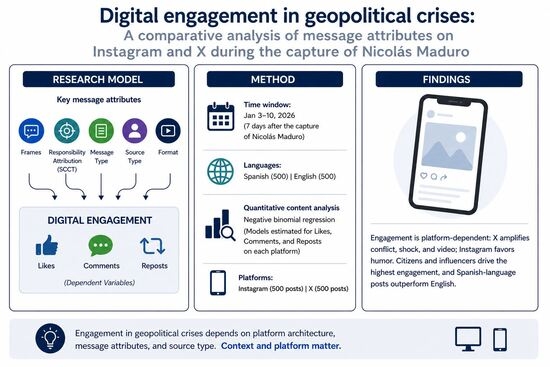
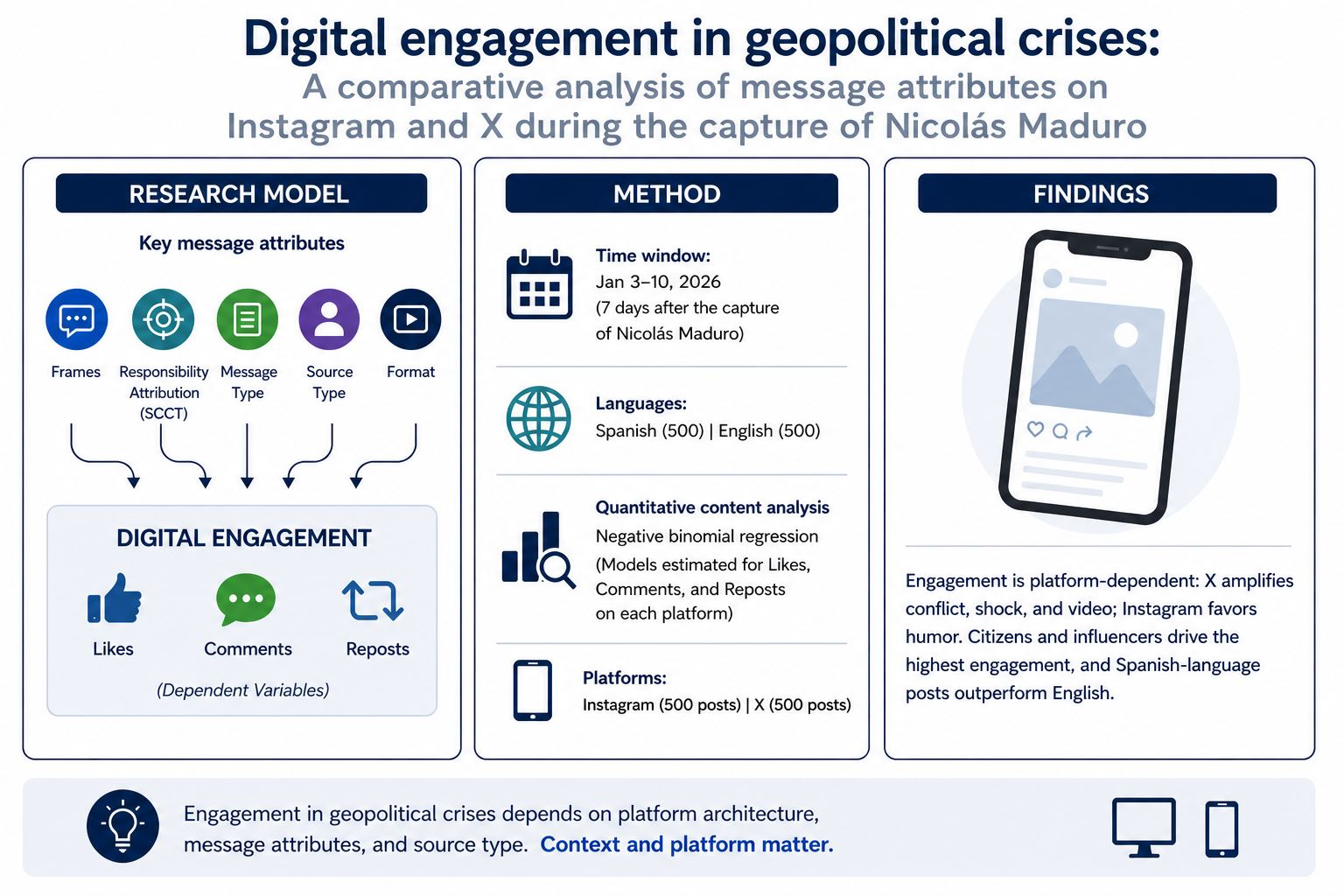
Graphical Abstract

1. Introduction

On 3 January 2026, the capture of Venezuelan ruler Nicolás Maduro by U.S. special forces as part of Operation “Absolute Resolution” triggered an unprecedented international media crisis characterized by deep polarization of public opinion: while several governments condemned the alleged violation of Venezuelan sovereignty and an intense debate over the legality of the intervention under international law ensued, other political actors and segments of the citizenry celebrated the event as a step forward in accountability and the eventual end of the regime (Scheffer, 2026; Muggah, 2026).
This event generated an extraordinary volume of social media activity that within hours consolidated as one of the most intense digital conversations surrounding a recent Latin American political event (Paternoster & Nilsson-Julien, 2026). In this context, governments, media outlets, public figures, political leaders, and ordinary citizens simultaneously competed for visibility within a highly saturated information ecosystem, deploying antagonistic frames, divergent emotional tones, and heterogeneous formats in their attempts to capture the attention of millions of users (Al Jazeera, 2026). Understanding which message attributes influence the generation of digital interaction in high-intensity information environments thus emerges as a question of considerable empirical and practical relevance for the study of digital communication, user behavior, and engagement dynamics in platform-mediated social environments.
The answer to this question extends beyond a specific communicative analysis. In the information age, digital engagement—expressed through metrics such as likes, comments, and reposts—is not merely an indicator of popularity but a central visibility mechanism that determines which crisis narratives achieve widespread diffusion and which remain marginal (Ballerini et al., 2023). In this context, crisis communication in digital environments ceases to be a unidirectional process and becomes an interactive flow in which institutional actors, media, and citizens intervene simultaneously before fragmented and highly reactive audiences (Eriksson, 2018; Du Plessis, 2018). Consequently, the digital ecosystem constitutes an environment in which the technical and discursive attributes of a message decisively influence its capacity to generate interaction beyond its substantive content (Kleer & Kunz, 2023). Identifying those attributes and understanding how they operate across platforms governed by different logics is precisely the purpose of this study.
In light of the foregoing, this study examines the determinants of digital engagement through the analysis of a corpus of 1000 posts (500 from Instagram and 500 from X) collected during the first seven days following Maduro’s capture, with a balanced distribution between Spanish- and English-language content. Through quantitative content analysis and the estimation of negative binomial regression models, the effect of five variable blocks—message frames, responsibility attribution (SCCT), functional content type, source type, and format—on the interaction metrics of likes and comments on both platforms, and additionally reposts on X, is assessed, comparing their dynamics across both digital ecosystems.
Despite the abundant literature on digital communication, crisis communication, and user behavior on social media, empirical research on digital engagement during events of institutional rupture in Latin America presents significant gaps that this study seeks to address. First, most existing studies have focused on public health crises—particularly during the COVID-19 pandemic—or on electoral processes in Northern Hemisphere countries, with scant attention to geopolitical crises in the region (Parveen et al., 2025). This gap is especially relevant considering that Latin America had not previously experienced an event of this nature in a social media-mediated environment: although precedents exist, such as the capture of Manuel Noriega following the U.S. invasion of Panama in 1989 (Gilboa, 1995), those episodes occurred within a pre-digital media ecosystem lacking platforms capable of amplifying citizen interaction in real time. Second, studies on crisis engagement rarely compare in a systematic manner platforms with differentiated architectures and usage cultures, such as Instagram and X, often treating them as equivalent environments despite their distinct interaction dynamics (X. Zhang & Zhu, 2022). Third, the literature has examined variables such as framing, emotional tone, and source type in isolation, without considering their combined effect as predictors of engagement, thereby limiting understanding of the mechanisms that drive interaction (Castillo & Peña y Lillo, 2024; Ho et al., 2024). Accordingly, this study contributes to the literature in three respects: it demonstrates that Instagram and X respond differently to message attributes, it challenges the applicability of Situational Crisis Communication Theory in highly polarized contexts, and it reveals the persistence of news media as central sources of engagement during geopolitical crises.

2. Theoretical Framework

2.1. Digital Interaction in High-Intensity Political Crisis Contexts

In contexts of institutional rupture, digital engagement expressed through likes, comments, and reposts operates as the primary mechanism of algorithmic visibility, determining which narratives achieve mass diffusion (Ballerini et al., 2023; Lu & Ngai, 2024). However, this interaction is not homogeneous: passive engagement (likes) and active engagement (comments and reposts) respond differently to message attributes and must be analyzed as distinct dimensions (Tenenboim, 2022). On platforms such as Instagram and X, these metrics also feed recommendation systems that condition content reach (Mellado et al., 2021; X. Zhang & Zhu, 2022), an effect that intensifies in crisis scenarios where information overload increases the search for cognitive and emotional reference points (Kleer & Kunz, 2023; Ma et al., 2024). Explaining variations in interaction therefore requires integrating substantive dimensions of the message—such as framing, responsibility attribution, tone, and source—with its formal characteristics, including format and language. The following sections develop these dimensions and formulate the study’s hypotheses.

2.2. News Framing and Digital Engagement

Framing theory constitutes a central framework for understanding how political actors and media outlets structure information in order to influence audience interpretation and, consequently, digital behavior. From this perspective, messages do not merely convey information but emphasize certain aspects of reality, shaping the way users interpret and react to events (Semetko & Valkenburg, 2000). In crisis contexts, the literature identifies recurring frames such as conflict, human interest, geopolitical or economic consequences, and morality/legality, each associated with distinct psychological mechanisms that modulate digital interaction (Castillo & Peña y Lillo, 2024; Ritchart & Britt, 2024).
The conflict frame is characterized by emphasizing confrontation among actors, highlighting disagreements, tensions, or disputes between individuals, groups, or states (Sui et al., 2023). This frame tends to capture attention by simplifying reality in terms of opposition, which fosters affective polarization processes and, consequently, increases digital engagement (Sergidou et al., 2024). In the context of Maduro’s capture, the juxtaposition between the U.S. interventionist narrative and Latin American sovereigntist discourses reinforces this effect, creating a scenario of high emotional activation (Su & Liu, 2026).
The geopolitical and economic consequences frame, in turn, presents events in terms of their material or strategic effects on countries, institutions, or citizens, translating the crisis into tangible impacts such as stability, costs, or risks (Yousaf et al., 2022). This type of frame increases the perceived relevance of the event and activates perceptions of threat or collective interest, thereby raising the likelihood of content diffusion through shares (Ho et al., 2024). The legality or morality frame situates events within normative frameworks, evaluating actions in terms of right and wrong and appealing to social values or ethical principles (Castillo & Peña y Lillo, 2024). By activating moral judgments, this frame generates responses of indignation or approval that manifest primarily in higher levels of discursive interaction (Aguila Sánchez et al., 2021). Finally, the human interest frame introduces an emotional dimension by personalizing events through stories, experiences, or specific faces, facilitating empathy and affective connection with the audience (Ballerini et al., 2023). This mechanism may favor more passive forms of interaction such as likes, as it activates immediate emotional responses without necessarily requiring deep cognitive elaboration (Lu & Ngai, 2024).
Nevertheless, recent studies challenge the assumption that media frames operate homogeneously across different channels. Lo et al. (2021) demonstrated that in digital electoral contexts, user comments on Facebook reconfigured legacy media coverage, reversing the traditional flow of framing and revealing that social media platforms produce their own framing dynamics that classical theory does not fully capture. Along the same lines, Uzunoğlu (2025) found that journalists adapt their editorial frames to the algorithmic visibility logics of the platform, adopting negative and crisis-oriented frames not out of editorial conviction but as a reach strategy—introducing a confounding variable that classical framing theory does not account for. Likewise, Nguyen et al. (2024) demonstrated that the frames emerging on social media during a given crisis differ substantially from those of conventional media and evolve independently throughout the crisis cycle, suggesting that in digital communication environments the notion of a controllable dominant frame is problematic.
Taken together, the theory suggests that different frames activate differentiated cognitive and affective mechanisms that translate into heterogeneous patterns of digital interaction, affecting both the intensity and type of engagement. However, given the exploratory nature of this study and the contextual variability of framing effects in digital environments, it is not possible to anticipate specific directions in the relationship between each frame and the different forms of interaction. Accordingly, the following non-directional effect hypothesis is proposed:
H1. 
News frames significantly influence audience digital engagement as measured through likes, comments, and reposts.

2.3. Responsibility Attribution (SCCT) and Sender Positioning

Responsibility attribution is understood as the process through which an audience evaluates the extent to which an actor is the cause of an event, which directly influences their emotional and behavioral responses (Buse et al., 2024). According to Situational Crisis Communication Theory (SCCT), when an actor is perceived as responsible for a crisis, emotions such as anger are activated, increasing negative responses and sanctioning behaviors. In contrast, when the actor is presented as a victim of external factors, blame assignment is reduced and responses of sympathy or defense may emerge (Coombs, 2007; Buse et al., 2024). Empirical evidence in digital environments shows that these differences in attribution condition both the volume and form of interaction, generating differentiated engagement patterns depending on the causal interpretation of the event (Tian & Yang, 2022).
In the case of Maduro’s capture, this logic is clearly observed. On the one hand, pro-U.S. actors promoted direct responsibility attribution, presenting the event as a consequence of the Venezuelan regime’s actions (Marczak, 2026; Bramonte, 2026). On the other hand, Chavismo and its allies deployed victimage strategies, framing the situation as an external aggression in order to dilute blame (Tian & Yang, 2022). The literature on SCCT suggests that these positionings not only affect the valence of responses but also generate differentiated engagement dynamics: while responsibility attribution tends to intensify rejection responses such as critical comments and condemnatory reposts, victim positioning may activate both solidarity among sympathetic audiences and rejection among opposing audiences, amplifying polarization and interaction (Kleer & Kunz, 2023).
Consequently, the source’s positioning in terms of responsibility attribution constitutes a key mechanism for shaping audience digital engagement. However, as with message framing, given the exploratory nature of this study and the contextual variability of these effects, it is not possible to establish a priori a specific direction in the relationship between attribution types and different forms of interaction.
Nevertheless, SCCT faces limitations when applied to crises on algorithmic platforms. P. Zhang et al. (2026) note that the theory was developed in the pre-social media era and empirically demonstrate that responsibility attribution is reconfigured in short-video environments along multiple emotional pathways conditioned by regional socioeconomic factors—dynamics that the original SCCT model does not account for. (Wu & Gao, 2026) found that in the Chinese government’s management of the COVID-19 infodemic, the strategies employed—including legal punishment as an information control tool—represent an extension that exceeds SCCT’s theoretical framework, and that the apparent efficacy of the authoritarian response coexisted with public skepticism and erosion of trust. In complex political crisis contexts, Ndone and Carpenter (2026) demonstrated that in a socio-political polycrisis on social media, negative public sentiment overwhelmingly predominated regardless of the actors’ communicative strategies, and that algorithmic amplification generated crisis dynamics that surpass SCCT’s situational response model, originally conceived for more bounded organizational scenarios. Therefore, the following general hypothesis is proposed:
H2. 
The type of responsibility attribution in posts significantly influences audience digital engagement as measured through likes, comments, and reposts.

2.4. Functional Message Type: Shock, Humor, and Collective Identity

Message type refers to the functional form and emotional tone through which content is presented, influencing how audiences process information and the behavioral responses it generates in digital environments (Parveen et al., 2025). Unlike framing, which organizes the meaning of content, message type operates at the expressive level, defining the communicative style through which that content is conveyed (Ngai et al., 2020).
Based on this definition, message type is approached through three conceptual categories documented in the literature that also proved to be the most prevalent in the analyzed corpus. First, shock or fear messages, which emphasize threat, urgency, or risk through alarmist narratives and high-impact resources, activating immediate responses of attention and participation (Sui et al., 2023; Ma et al., 2024). Second, humor or meme messages, which draw on satire, irony, and shared cultural codes to facilitate comprehension of the event and reduce cognitive friction in its diffusion (Rúas Araújo et al., 2021; Galița & Bonta, 2022). Third, messages based on collective identity, which appeal to group belonging and opposition to an adversary, reinforcing polarization and ideological alignment in digital environments (Hsu & Tsai, 2022).
The literature indicates that these message types activate distinct emotional and social mechanisms—such as alarm, gratification, or group identification—that translate into variations in the intensity and form of digital engagement expressed through likes, comments, and reposts (Parveen et al., 2025; Ho et al., 2024; Ballerini et al., 2023). Based on the above, the following research hypothesis is proposed:
H3. 
Message type—operationalized as shock or fear messages, humor or meme messages, and collective identity messages—significantly influences audience digital engagement as measured through likes, comments, and reposts.

2.5. Message Format and Media Richness

Message format refers to the technical form in which content is presented in a post, including text, image, video, or combinations thereof (Shahbaznezhad et al., 2021). This dimension directly influences how the audience perceives, processes, and interacts with information in digital environments. The theoretical foundation for this relationship is found in Media Richness Theory (MRT), formulated by Daft and Lengel (1986) and Lengel and Daft (1984), who propose that media differ in their capacity to transmit information along four dimensions: immediate feedback, variety of sensory channels, message personalization, and the use of natural language. In this regard, richer formats—that is, those combining multiple cues such as image, movement, sound, and text—reduce information ambiguity and facilitate comprehension, thereby increasing the likelihood of interaction (Hussain et al., 2022).
Applied to the social media environment, MRT allows for the anticipation that audiovisual formats generate higher levels of digital engagement than static formats, insofar as they simultaneously activate multiple cognitive and emotional channels (Y. Zhu et al., 2023). Video in particular combines vividness—the capacity to represent reality in a vivid and immersive manner—with informativeness and aesthetic elements that promote sustained attention and message retention (Y. Zhu et al., 2023; Lee et al., 2022). Evidence from digital marketing shows that this type of content captures attention more effectively than static images, promoting both passive interactions (likes) and active ones (comments and reposts) (Hussain et al., 2022). This logic is especially relevant in political crisis contexts, where the complexity of the event and the demand for immediate information favor the use of high-richness formats (Ope-Davies & Shodipe, 2023).
However, Media Richness Theory has been questioned in social media contexts. K. Zhu et al. (2024) found that live streaming—the format with the highest media richness—presented no advantages over less rich formats for building trust in social commerce, suggesting that content quality and user experience mediate richness effects. Guo et al. (2025) found that on governmental TikTok accounts during health crises, neither source credibility nor multiple media cues—both central dimensions of MRT—predicted citizen engagement, calling into question the theory’s transferability to short-video platforms. Yang et al. (2025) further challenge the theory’s linear assumptions by demonstrating that on institutional social media, content credibility can substitute for media sophistication as a predictor of engagement, and that lower-richness formats (static images) outperform video in several contexts, evidencing that engagement on digital platforms responds to configurational logics that MRT does not capture. Based on these arguments, the following hypothesis is formulated:
H4. 
Messages with higher media richness formats generate higher levels of digital engagement than those with lower richness.

2.6. Source Type and Credibility Capital

Source type refers to the actor who originates and disseminates a message in the digital environment, whose perceived credibility directly influences how audiences interpret and respond to the content (Yu & Zhao, 2025). The theoretical foundation for this relationship lies in source credibility models, which hold that the effectiveness of a message depends on attributes such as expertise, trustworthiness, and perceived closeness to the audience (Hovland & Weiss, 1951; Ohanian, 1990). In this sense, credibility is not merely an objective property of the sender but a socially constructed perception that conditions levels of attention, trust, and interaction (Dewantara et al., 2025).
The specialized literature distinguishes between elite institutional sources—such as governments, official leaders, and traditional media—and non-institutional sources—such as influencers, content creators, and citizen actors—demonstrating that these categories produce differentiated effects on digital engagement depending on context and levels of institutional trust (Mellado et al., 2021; X. Zhang & Zhu, 2022). During crisis events, government accounts tend to centralize the informational flow through more unidirectional communication strategies aimed at preserving their legitimacy (Souza, 2024). However, empirical evidence shows that these sources do not necessarily achieve higher levels of interaction than non-institutional ones (X. Zhang & Zhu, 2022).
In contrast, actors with high public visibility—such as influencers or media figures—tend to generate greater engagement volumes due to the perceived authenticity of their messages and their emotional proximity to the audience (Jia et al., 2024). Studies in digital communication show that messages from non-expert sources can receive more positive responses than those from sources with high institutional credibility, precisely because they are perceived as more relatable and accessible (Jia et al., 2024). Experts, for their part, play a relevant role in reducing uncertainty by acting as sensemakers, although their influence may be constrained by competition with pseudo-experts and by the politicization of the information environment (Lin & Wu, 2025). Based on the above, the following research hypothesis is proposed:
H5. 
Source type has a significant effect on audience eWOM on both platforms.

2.7. Formal Message Characteristics and Temporal Dynamics of the Crisis

In addition to the substantive variables that articulate the model’s central hypotheses, the literature on digital engagement identifies formal message attributes with their own explanatory capacity, which are therefore incorporated as control variables. First, language conditions the reach and interpretation of content; while the topic analyzed is of predominantly Spanish-speaking interest, variations in interaction metrics may arise from the use of other languages or from transnational audiences, which justifies its inclusion as a control variable (Parveen et al., 2025; X. Zhang & Zhu, 2022).
Second, hashtags function as categorization and visibility mechanisms that allow content to be integrated into broader conversations and increase its diffusion (Andrade et al., 2023; Metzler & Garcia, 2024). However, excessive use may produce counterproductive effects when perceived as over-optimization or spam (Metzler & Garcia, 2024). Third, message length—measured in characters—reflects the level of discursive elaboration and tends to be negatively associated with interaction on platforms that favor immediacy, due to the greater cognitive load it implies (X. Zhang & Zhu, 2022; Tenenboim, 2022).
Finally, temporality is a key factor in crisis contexts, where digital attention concentrates in the early phases of the event and progressively diminishes as the news cycle advances (Su & Liu, 2026; Sergidou et al., 2024).
It should be noted that the study’s hypotheses were formulated in a non-directional manner—that is, without anticipating the specific direction of the relationship between the independent variables and engagement. This methodological decision is grounded in three fundamental reasons. First, research on digital engagement in geopolitical crises constitutes an emerging area where prior findings are insufficient to predict with certainty the direction of effects (McNeil, 1997). Second, the theoretical review reveals mixed or contradictory results regarding the same phenomena across different cultural contexts and platforms, which precludes confidently anticipating the direction of the effect (Kaur, 2017). Third, the interaction among factors in tension—the specific affordances of each platform, the Latin American cultural context, and the divergent findings from other regions—generates an uncertainty that justifies not committing the research to directional predictions that could prove incorrect for at least one of the platforms analyzed.
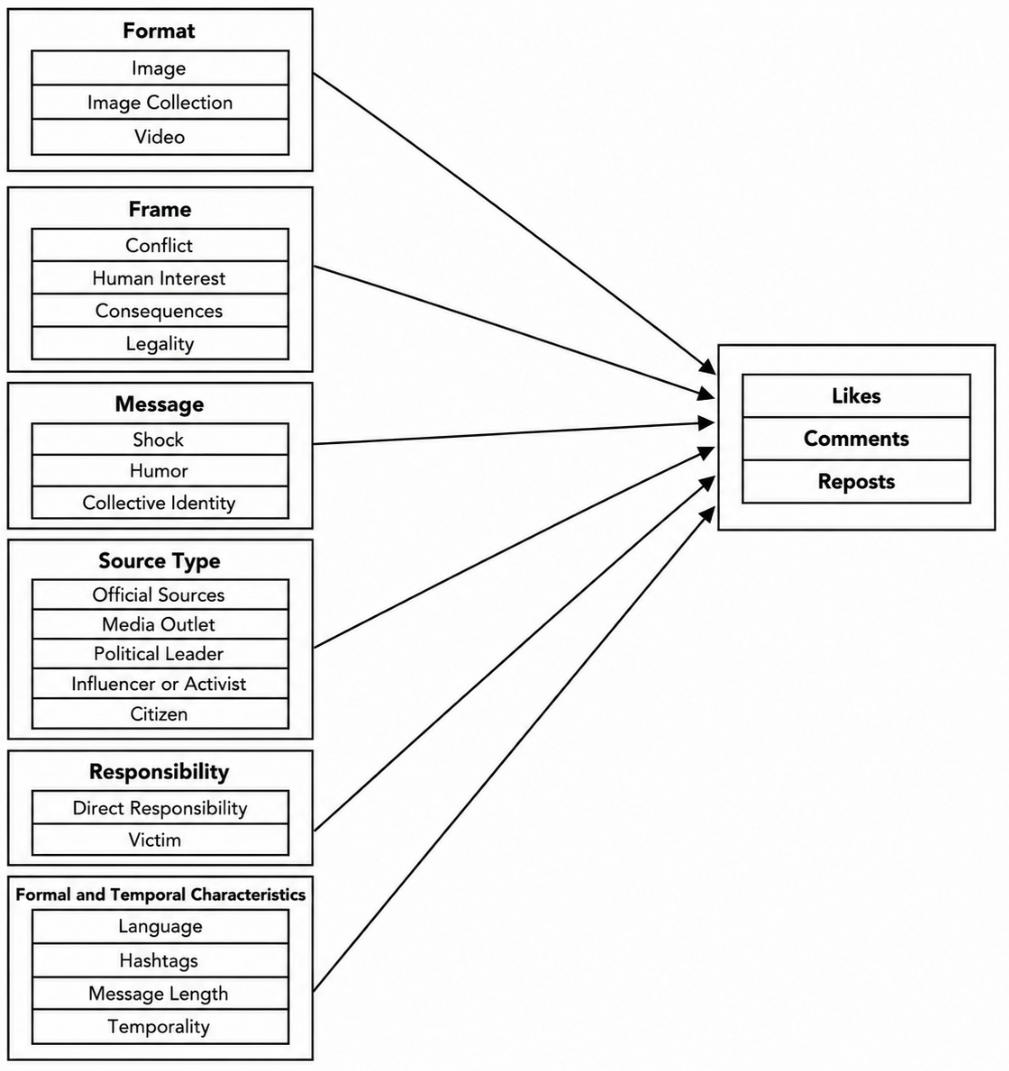
Figure 1 presents the proposed research model, which integrates news frames, responsibility attribution, message type, format, and source as explanatory variables of digital engagement, along with these control variables, allowing for a more precise capture of interaction dynamics in crisis contexts.

3. Materials and Methods

3.1. Sample Description

The unit of analysis in this study corresponds to individual posts generated on Instagram and X during the conjuncture of Nicolás Maduro’s capture. The observation window was delimited between 3 January and 10 January 2026, a decision grounded in the digital attention lifecycle of institutional rupture events: the crisis communication literature indicates that the peak of maximum citizen interaction is sharply concentrated during the first week of the event, after which engagement metrics experience a significant decline due to feed saturation and information fatigue (Ruiz Incertis et al., 2024).
To construct the empirical corpus, a systematic search strategy was designed based on high-penetration keywords and hashtags, covering posts in both Spanish and English. In the Spanish-speaking sphere, tags such as #Maduro, #CapturaDeMaduro, #MaduroCapturado, #Venezuela, #VenezuelaLibre, #SecuestroDeMaduro, and #MaduroDetenido were monitored, supplemented by the structured search strings “captura Maduro” and “Maduro detenido.” In the English-speaking context, #Maduro, #MaduroCaptured, #MaduroArrested, #Venezuela, #FreeVenezuela, and #AbsoluteResolve were used, along with the exact combinations “Maduro captured” and “Maduro arrested.” Following systematic filtering, a final sample of 1000 posts was consolidated, distributed in a balanced manner—500 on Instagram and 500 on X. Within each platform, a symmetric linguistic quota of 250 posts in Spanish and 250 in English was ensured, a configuration that allows for a robust comparative analysis across distinct digital architectures and sociolinguistic contexts.

3.2. Content Analysis

The corpus was coded through quantitative content analysis, a technique widely employed in digital communication studies for its capacity to systematically, objectively, and reproducibly examine message characteristics (Krippendorff, 2018). Content analysis is especially pertinent in research on social media engagement because it allows the message structure to be decomposed into discrete and operationalizable dimensions that can be empirically linked to interaction metrics, overcoming the limitations of purely qualitative or computational approaches when the objective is the validation of theoretical hypotheses about audience behavior (Lombard et al., 2022). Krippendorff (2018) notes that this technique is ideal for studies in which text, image, or their multimodal combination constitutes the unit of analysis—precisely the case of posts on contemporary digital platforms.
Variables were operationalized based on a coding manual developed from prior literature on framing, crisis communication, and digital participation. The manual covers news frames, responsibility attribution (SCCT), functional message type, source type, format, and formal content characteristics including hashtags, language, and length. The operational definition of each variable, its categories, and coding criteria are presented in Table 1. Coding was carried out primarily in dichotomous form (0 = absence, 1 = presence), which made it possible to capture the complexity of social media discourse, where a single post may simultaneously incorporate multiple characteristics. It is therefore important to note that all dichotomous variables are non-mutually exclusive, meaning that a single post can be coded as present in several categories at the same time. The only exceptions are format and source type, which were coded using mutually exclusive categories, given that each post necessarily corresponds to a single predominant format and originates from a single identifiable source.
To ensure the reliability of the process, two previously trained coders conducted a calibration phase on a subsample of 20% of the total corpus—100 Instagram posts and 100 from X, with linguistic parity in each case. Krippendorff’s Alpha coefficient was calculated for each variable, considered the most robust indicator for assessing intercoder reliability in content analysis due to its correction for chance agreement and its adaptability to different measurement levels (Krippendorff, 2018). The values obtained, reported in Table 1, exceed the thresholds recommended in the literature—α ≥ 0.80 for most variables and α ≥ 0.70 for those with greater interpretive complexity—indicating an adequate level of coding consistency. In cases where discrepancies between coders were identified, additional training was conducted in which doubts arising during coding were resolved, the manual criteria were reviewed, and the material was recoded—a standard procedure in content analysis to ensure category consistency prior to definitive coding (Lombard et al., 2022) (See Appendix A).

3.3. Empirical Analysis

The dependent variables correspond to discrete digital engagement metrics—likes, comments, and in the case of X, reposts—which conditions the choice of statistical model. Given that these are count variables, Poisson regression models were initially estimated; however, upon evaluating data dispersion, overdispersion was identified in all dependent variables, as the variance substantially exceeds the mean, violating the central assumption of the Poisson model and biasing standard error estimates (Cameron & Trivedi, 2013). For this reason, negative binomial regression models were adopted, which incorporate an additional dispersion parameter that corrects this problem. The definitive model selection was based on the Akaike Information Criterion (AIC) and the Bayesian Information Criterion (BIC), both of which favored negative binomial regression over Poisson, consistent with prior studies on social media engagement (Kleer & Kunz, 2023).
It should be noted that the repost metric was not included as a dependent variable in the Instagram models. Meta introduced the repost function on Instagram in August 2025 (Meta Newsroom, 2025). However, the repost count was not publicly visible on posts, unlike likes and comments, which any user can observe. Only the account owner could access the number of reposts through Instagram Insights, restricting this information to one’s own professional accounts (RedSocial, 2026). Additionally, repost metrics were not available through the Instagram Marketing API until December 2025 (Hutchinson, 2025), just two months before the data collection for the present study, conducted in February 2026, which limited their integration into third-party analytics tools. Consequently, the Instagram models were estimated exclusively with likes and comments as dependent variables.
To empirically substantiate the model choice, the comparative information criteria and the overdispersion test are reported below. Table 2 presents the AIC and BIC values for the Poisson and negative binomial models for each dependent variable and platform. In all cases, negative binomial regression yields substantially lower AIC and BIC values than the Poisson model, confirming its superiority in terms of fit. Additionally, Table 3 reports the results of the Likelihood Ratio Test, which evaluates whether the dispersion parameter α differs significantly from zero. In all estimated models, the test rejects the null hypothesis of α = 0 (p < 0.001), confirming the presence of overdispersion in the data and empirically justifying the use of negative binomial regression over the standard Poisson model.
Prior to estimation, the presence of multicollinearity was assessed using the Variance Inflation Factor (VIF), obtaining values below the critical threshold of 5 for all independent variables. Additionally, to control for the temporal dynamics of engagement, the terms Days and Days2—the number of days elapsed since the onset of the event and its quadratic transformation—were incorporated, allowing for the capture of the nonlinear decay effect of digital attention described in the literature (Su & Liu, 2026; Sergidou et al., 2024). The estimated model corresponds to the following specification:
L o g ( Y j )   =   α +   β 1   C o n f l i c t   +   β 2   H u m a n   I n t e r e s t   +   β 3   C o n s e q u e n c e s   +   β 4   L e g a l i t y   +   β 5   I m a g e   +   β 6   I m a g e   C o l l e c t i o n   +   β 7   V i d e o   +   β 8   V i c t i m   +   β 9   R e s p o n s i b l e   +   β 10   S h o c k   a n d   F e a r   +   β 11   H u m o r   a n d   M e m e   +   β 12   C o l l e c t i v e   I d e n t i t y   +   β 13   S o u r c e   T y p e   +   β 14   H a s h t a g s   +   β 15   L e n g t h   +   β 16   L a n g u a g e   +   β t   D a y s   +   β t   D a y s 2   +   L o g ( f o l l o w e r s )
where Y represents the expected number of interactions on the post—such as likes, comments, and reposts—α is the intercept, β1 through βt are the coefficients associated with the independent variables, and Log(followers) is the exposure term that controls for the number of followers of the source, recognizing that accounts with a larger base audience structurally generate higher volumes of interaction regardless of message characteristics. The models were estimated independently for Instagram and X, given that both platforms exhibit qualitatively distinct algorithmic architectures and interaction cultures that render their joint treatment unfeasible.

4. Results

4.1. Descriptive Results

Table 4 and Table 5 present the descriptive results for quantitative and qualitative variables. The data show that the analyzed accounts have an average of 1,872,328 followers (SD = 4,638,210), with a range spanning from 4 to 61,400,000. Regarding interaction, posts recorded an average of 12,857.57 likes (SD = 37,027.77), 599.20 comments (SD = 2205.94), and 1007.15 reposts (SD = 3625.53), with values ranging from 0 to 412,000 likes, 0 to 26,000 comments, and 0 to 46,000 reposts, respectively.
Regarding qualitative variables, the predominant format is image (67.6%), followed by image collections (21.8%) and video (10.6%). In terms of source type, influencers or activists with more than 10k followers account for 39.2% of posts, followed by media outlets (21.5%), political leaders (17.8%), official country sources (12.6%), and citizens (8.9%). With respect to language, posts are distributed equally between Spanish (50.0%) and English (50.0%). Finally, among content elements, collective identity appears in 69.5% of cases, followed by human interest (36.9%) and conflict (30.3%). Other elements include consequences (26.4%), legality (26.3%), hashtags (21.0%), shock/fear (11.8%), humor (9.8%), responsible (9.5%), and victim (8.6%).

4.2. Instagram Model Results

The results of the negative binomial regression model for Instagram are presented in Table 6. Format, source type, responsibility attribution, functional message type, and language constitute the most relevant predictors, while news frames show limited explanatory capacity.
Regarding format, image collections significantly reduce likes (IRR = 0.473, p < 0.001) and comments (IRR = 0.325, p < 0.001) relative to individual images, while video does not reach statistical significance on any metric. Source type is the predictor of greatest magnitude. Compared to official sources (reference category), political leaders show the most pronounced declines, with reductions of 67% in likes (IRR = 0.333, p < 0.001) and 73% in comments (IRR = 0.275, p < 0.001). Media outlets also generate significantly fewer likes (IRR = 0.466, p < 0.01) and comments (IRR = 0.575, p < 0.10). Influencers do not differ from the reference category. In contrast, citizens exhibit the most pronounced positive effect in the model, generating approximately four times more likes (IRR = 3.901, p < 0.001) and more than eight times more comments (IRR = 8.335, p < 0.001) than government sources.
Of the news frames, only the geopolitical consequences frame reaches significance, showing a negative effect on likes (IRR = 0.695, p < 0.10). Conflict, human interest, and legality frames are not significant. Regarding responsibility attribution, both positionings penalize interaction: the victim frame reduces likes by 61% (IRR = 0.394, p < 0.001) and the direct responsibility frame reduces them by 54% (IRR = 0.459, p < 0.001), with an additional negative effect on comments (IRR = 0.590, p < 0.10).
In terms of functional message type, shock drastically reduces likes (IRR = 0.402, p < 0.001) and comments (IRR = 0.382, p < 0.001), while collective identity penalizes likes (IRR = 0.432, p < 0.001) without affecting comments. Humor is the only positive effect in this block, increasing likes by 125% (IRR = 2.249, p < 0.001) with no significant effects on comments.
Among control variables, language is the most powerful predictor: English-language posts receive 77% fewer likes (IRR = 0.231, p < 0.001) and 91% fewer comments (IRR = 0.093, p < 0.001). Hashtags reduce comments by 38% (IRR = 0.621, p < 0.05). Each additional day elapsed reduces comments by 36% (IRR = 0.637, p < 0.001), confirming a linear decay in conversation. Text length and the quadratic days term do not reach significance. The likes model yields LR chi2(20) = 228.93 (p = 0.000) with pseudo R2 = 0.0236, and the comments model LR chi2(20) = 315.20 (p = 0.000) with pseudo R2 = 0.0463.

4.3. X Model Results

The results for X are presented in Table 7. Unlike Instagram, news frames, shock, and video format emerge as central predictors, while responsibility attribution and humor lose relevance.
Video multiplies likes by 4.2 (IRR = 4.209, p < 0.001), increases comments by 55% (IRR = 1.550, p < 0.10), and multiplies reposts by 3.3 (IRR = 3.338, p < 0.001). Image collections do not reach significance on any metric. Source type presents the largest coefficients. Citizens multiply likes by 43 (IRR = 43.007, p < 0.001), comments by 22.3 (IRR = 22.316, p < 0.001), and reposts by 22.8 (IRR = 22.774, p < 0.001) relative to official sources. Influencers generate more than six times more likes (IRR = 6.336, p < 0.001) and triple comments and reposts. Political leaders show a positive effect exclusively on comments (IRR = 5.505, p < 0.001). Media outlets do not reach statistical significance.
News frames show greater relevance than on Instagram. The conflict frame increases likes by 80% (IRR = 1.795, p < 0.10) and doubles comments (IRR = 2.148, p < 0.001). The geopolitical consequences frame increases likes by 93% (IRR = 1.925, p < 0.05) and comments by 64% (IRR = 1.639, p < 0.10). The legality frame increases likes (IRR = 1.669, p < 0.10) and reposts by 115% (IRR = 2.151, p < 0.001). The human interest frame and both responsibility attribution categories do not reach statistical significance.
Shock and fear constitute the most robust positive predictor: they quadruple likes (IRR = 4.073, p < 0.001), double comments (IRR = 2.229, p < 0.01), and nearly quadruple reposts (IRR = 3.744, p < 0.001)—a pattern opposite to that observed on Instagram. Humor and collective identity are not significant.
Among control variables, language maintains negative effects across all three metrics, with reductions between 65% and 68% for English-language posts. Hashtags significantly reduce all three metrics by between 45% and 57%. Text length shows marginal negative effects on likes and comments. Temporality exhibits a curvilinear dynamic: days elapsed initially increase comments (IRR = 1.814, p < 0.001) and reposts (IRR = 1.520, p < 0.001), but the quadratic term confirms a subsequent decay (p < 0.001 for both metrics). The likes model reports LR chi2(20) = 270.91 (p = 0.000) with pseudo R2 = 0.0276, the comments model LR chi2(20) = 254.29 (p = 0.000) with pseudo R2 = 0.0382, and the reposts model LR chi2(20) = 236.07 (p = 0.000) with pseudo R2 = 0.0285.
Finally, it is pertinent to note that the McFadden pseudo R2 values reported in the results tables do not admit the same interpretation as the coefficient of determination R2 in Ordinary Least Squares linear regression. In nonlinear models for count data, such as negative binomial regression, the pseudo R2 constitutes a relative goodness-of-fit indicator whose primary function is comparison between alternative models, and its absolute values should not be interpreted as percentages of explained variance (Long, 1997; Long & Freese, 2006).

5. Discussion

The results of this study demonstrate that Instagram and X operate as distinct engagement ecosystems during geopolitical crises, a finding that challenges the frequent practice in the literature of treating platforms as functionally equivalent environments (X. Zhang & Zhu, 2022). While on X the news frames of conflict, consequences, and legality act as significant amplifiers of interaction, on Instagram these same frames lack relevant explanatory capacity, with the marginal exception of the consequences frame on likes. This pattern suggests that X’s microblogging architecture—oriented toward public debate and brief argumentation—favors the cognitive activation that news frames promote, in line with Semetko and Valkenburg’s (2000) observations on the capacity of framing to shape audience interpretation. On Instagram, by contrast, the platform’s visual and algorithmic logic appears to subordinate the effect of discursive framing to other message attributes, offering partial support for H1 and revealing that framing efficacy is conditioned by the media infrastructure in which it operates.
The divergent behavior of shock and fear across platforms constitutes one of the study’s most noteworthy findings. On X, this message type quadruples likes and triples reposts, whereas on Instagram it reduces both metrics by more than 60%. This asymmetry can be interpreted in light of differences in the usage culture of each platform: X functions as a space for alerting and immediate diffusion where urgency acts as a catalyst for virality (Ma et al., 2024), while Instagram, by privileging aesthetically elaborated and emotionally gratifying content, penalizes messages perceived as disruptive or threatening (Hermida & Mellado, 2020). Humor, for its part, shows the inverse pattern: it increases likes by 125% exclusively on Instagram without reaching significance on X, confirming that emotional gratification mechanisms operate in a platform-dependent manner (Galița & Bonta, 2022). These results offer partial support for H3 and underscore the need to disaggregate message type analysis by platform.
The results regarding responsibility attribution pose a significant challenge to SCCT. Contrary to what this perspective predicts (Coombs, 2007), both victim positioning and direct responsibility attribution significantly reduce engagement on Instagram, while on X neither reaches statistical significance. This finding suggests that in contexts of high geopolitical polarization—where audiences already possess consolidated interpretive frameworks—explicit causal attribution does not function as an interaction activator but may instead generate discursive fatigue or rejection. In any case, the results invite questioning the direct applicability of SCCT to political crises of this nature (Buse et al., 2024; Tian & Yang, 2022). H2 therefore receives only partial support, restricted to Instagram.
The effect of format partially confirms H4, but exclusively on X, where video multiplies interaction across all metrics, consistent with Media Richness Theory (Lengel & Daft, 1984). On Instagram, however, image collections penalize engagement and video shows no significant effects, indicating that media richness does not operate as a universal predictor but rather that its efficacy depends on the visual grammar of each platform (Y. Zhu et al., 2023). Nevertheless, it is necessary to consider that X’s algorithm actively prioritizes video-format content within users’ feeds (Metzler & Garcia, 2024), which constitutes a confounding variable that could artificially amplify the participation metrics associated with this format. Consequently, the observed effect of video on X cannot be attributed exclusively to media richness but likely reflects the interaction between the format’s intrinsic properties and the platform’s algorithmic amplification—an aspect that the observational design of the present study does not allow to disentangle.
Source type emerges as the predictor of greatest magnitude on both platforms, confirming H5. Citizens generate extraordinarily higher interaction rates than institutional sources, especially on X, where they multiply likes by 43% relative to government accounts. This result can be attributed to the fact that citizen accounts establish a direct emotional connection with the audience by sharing personal experiences, opinions, and reactions to the crisis, whereas government sources are confined to institutional communiqués that prioritize official information over interaction (Jia et al., 2024). This asymmetry in the capacity to generate identification and emotional proximity amplifies citizens’ engagement metrics relative to institutional sources, whose role is oriented more toward providing informational frameworks that other actors subsequently amplify. Nevertheless, media outlets maintain a structural role as providers of informational frameworks that other actors amplify, which nuances interpretations of total disintermediation within the information ecosystem (Mellado et al., 2021).
Language constitutes the most potent control predictor on both platforms: English-language posts receive between 65% and 91% less interaction than Spanish-language posts, a result that transcends the mere linguistic composition of the sample and reflects the concentration of the event’s perceived relevance among Spanish-speaking audiences directly affected by the crisis (Parveen et al., 2025). This finding should be interpreted in light of the sociolinguistics of digital platform use in Latin America and, particularly, the transnational character of Venezuelan diaspora audiences. Esberg and Siegel (2023), drawing on an analysis of more than five million tweets by Venezuelan activists, demonstrate that exile transforms digital communicative practices: activists abroad increase their use of English and reorient their discourse toward international audiences, while those who remain in Venezuela maintain Spanish as the predominant language linked to local concerns. In this context, the crisis surrounding Maduro’s capture constitutes an event of high identity relevance for Spanish-speaking communities both within and outside Venezuela, which would explain why Spanish-language content functions as a marker of cultural proximity that activates higher levels of engagement. This dynamic is consistent with evidence on the digital political engagement of Latino communities, where language operates not only as a vehicle for information but as an indicator of belonging to a shared discursive space (Abrajano et al., 2025), generating cross-border information environments in which Spanish-speaking audiences interact with greater intensity in response to events that directly affect their communities of origin.

6. Conclusions

The findings of this study suggest that the message attributes driving digital engagement during geopolitical crises are not universal but rather mediated by the architecture and usage culture of each platform—a finding with implications for communicative practice that must nonetheless be interpreted with caution given the singularly polarizing nature of the case analyzed. For governments and international organizations seeking to position narratives in highly polarized contexts, the results suggest that communication strategies could benefit from platform-specific design: on X, the data indicate that video formats and messages that activate urgency may favor interaction, while on Instagram, humor and simple visual formats appear to facilitate passive interaction. Strategies based on explicit responsibility attribution—common in governmental crisis communication—show a significant reduction in participation on Instagram in the context analyzed, which invites a rethinking of institutional communication protocols derived from SCCT, although the generalization of this finding requires validation in other crisis contexts.
For media outlets and digital journalism professionals, the data indicate that citizen accounts and influencers substantially outperform institutional sources in their capacity to generate interaction, which does not imply media irrelevance but rather a possible shift in their function: from direct generators of engagement to providers of informational frameworks that other actors reinterpret and amplify. Nevertheless, it is essential to distinguish between the maximization of engagement as a legitimate objective for activist or citizen actors and the essential functions of journalism—accuracy, contextualization, and accountability—which should not be subordinated to the logic of virality. In this regard, the recommendations for media outlets should not be interpreted as an invitation to adapt journalistic content to interaction metrics, but rather to understand each platform’s dynamics in order to distribute verified information more effectively. Likewise, the recommendation to employ humor as a communicative resource during geopolitical crises must be weighed against the risks of trivializing suffering and decontextualizing complex events.
The study presents limitations that should be considered. First, the seven-day observation window captures the acute phase of the crisis but does not allow for the evaluation of medium-term engagement dynamics. Second, the cross-sectional design precludes establishing causal relationships, and manual coding, although validated through Krippendorff’s alpha, inevitably introduces a certain degree of interpretive subjectivity. Future lines of research should incorporate longitudinal analyses that allow tracking the evolution of engagement beyond the acute phase, integrate natural language processing techniques to scale the analysis to larger corpora, and explore the role of recommendation algorithms as mediators between message attributes and observed interaction. It would also be valuable to replicate this design in geopolitical crises in other regions to assess the generalizability of the findings and examine whether the platform asymmetries identified here reflect structural patterns or particularities of the case analyzed.
Additionally, the sampling strategy based on hashtags and keywords introduces an inherent selection bias by excluding posts that, without employing such markers, may have achieved significant levels of participation. This approach may overrepresent activist and partisan content, potentially inflating the apparent effects of the collective identity frame and citizen sources. Future research should complement this strategy with random sampling or platform API-based sampling to capture a broader spectrum of the digital conversation.
Regarding Instagram reposts, the model does not incorporate this dependent variable because the platform did not consistently provide repost counts during the study period. While reposts constitute a relevant indicator of participation, their availability depends on both the platform and the data collection tool employed. In this regard, future studies could incorporate Instagram reposts and sends as additional dependent variables once these metrics are fully accessible, which would enable a more comprehensive measurement of digital engagement in its amplification and private distribution dimensions. Furthermore, the study’s observational design precludes isolating the effect of media richness from the effect of algorithmic amplification. In particular, X’s algorithm prioritizes video-format content within users’ feeds, which represents a confounding variable that could artificially amplify the participation metrics associated with this format. Future research employing experimental or quasi-experimental designs would make it possible to disentangle both mechanisms. Finally, it would also be pertinent for future studies to integrate specialized deepfake and synthetic content detection techniques to more precisely quantify the presence of artificial intelligence and assess its impact on digital engagement dynamics.

Author Contributions

Conceptualization, C.F.O.-A.; methodology, C.F.O.-A. and P.A.L.H.; software, P.A.L.H.; validation, C.F.O.-A. and E.A.E.; formal analysis, P.A.L.H.; investigation, C.F.O.-A., P.A.L.H. and E.A.E.; resources, E.A.E.; data curation, P.A.L.H.; writing—original draft preparation, P.A.L.H.; writing—review and editing, C.F.O.-A. and E.A.E.; visualization, P.A.L.H.; supervision, C.F.O.-A.; project administration, E.A.E.; funding acquisition, E.A.E. All authors have read and agreed to the published version of the manuscript.

Funding

This research was funded by Universidad del Valle, grant number CI 9211.

Institutional Review Board Statement

Ethical review and approval were waived for this study due to: The study has been classified as low-risk research, in accordance with the current ethical regulations in Colombia (Resolution 8430 of 1993 from the Ministry of Health Chapter I, Article 11). The study was based on the content analysis of publicly available information on social media, without direct intervention with individuals or collection of personal or sensitive data. The information used was secondary and publicly accessible, and the data on user interaction (e.g., number of likes or comments) were collected completely anonymously, without recording or using usernames or any personal identifiers.

Informed Consent Statement

Not applicable.

Data Availability Statement

The data presented in this study are openly available in ZENODO at https://doi.org/10.5281/zenodo.19979610, reference number 19979610.

Acknowledgments

In the creation of this article, Anthropic’s Claude 4.7 Opus generative artificial intelligence was used to improve the orthotypographic quality of the manuscript content in English.

Conflicts of Interest

The authors declare no conflicts of interest.

Appendix A. Coding Manual: Variable Categories and Illustrative Examples

VariableCategoryExample
News FrameConflictTHE FIRST PHOTO OF MADURO DETAINED AND THE REACTIONS TO HIS CAPTURE. Following the United States attack and the capture of Nicolás Maduro, opinions were divided among politicians and public figures. Journalmedia 07 00185 i001 Some celebrated the operation and viewed it as good news for Venezuela and the region. Journalmedia 07 00185 i002 Others criticized the action and spoke of a violation of the country’s sovereignty.

Human interest“THE NATIONAL GUARD KIDNAPPED MY MOM WITH MY 2-YEAR-OLD GODDAUGHTER AND PUT HER IN A CELL.” The courageous testimony of @anaiscastro reflects what many Venezuelans experienced in their country and what they recall today following the capture of dictator Maduro. “I have the right to celebrate… they contaminated my soul and my heart.” #VenezuelaFree
ConsequencesHere we explain it. 3 market keys that could occur following the capture of Nicolás Maduro. 1. Stock market crash on Monday: A sharp drop is anticipated due to extreme political uncertainty and a massive flight of investors toward safer assets (“Panic” effect). 2. Immediate oil price surge: A sharp rise is expected due to the risk of sabotage to Venezuelan infrastructure and possible supply retaliation from allies such as Russia. 3. Bullish momentum in gold: Gold will spike if military tensions persist or if there is a diplomatic escalation with China, consolidating its status as the ultimate safe haven against chaos. And you—what do you think might happen?
LegalityAsian countries react following the U.S. military operation in Venezuela. China demanded the immediate release of Nicolás Maduro and called for a negotiated solution, while Japan spoke of “restoring democracy” and India expressed deep concern, refraining from commenting on the legality of the attack. In contrast, Malaysia denounced that Maduro’s capture constitutes a violation of international law, highlighting the global divide over Washington’s action and the growing diplomatic impact of the Venezuelan conflict. Read more at www.ntelemicro.com #Asia #Reactions #Capture #Maduro #NTelemicro5 #BreakingNews
ResponsibilityVictimFollowing the capture of Nicolás Maduro by U.S. forces, his son, Nicolás Maduro Guerra, issued a statement denouncing an “imperialist aggression” against Venezuela and declared that his father had signed a decree authorizing armed struggle to defend national sovereignty. “This attack is not only against the Government—it is against the entire Venezuelan people. The enemy wants our resources, but we will not surrender,” said Maduro Guerra, who also called for national mobilization and urged unity in the face of what he described as an invasion. The message has generated international concern over a possible escalation of the conflict in the region. #MaduroCaptured #NicolásMaduroGuerra #Venezuela #ArmedStruggle #VenezuelanCrisis #BreakingNews #International #USA #Sovereignty #InfoNación
Direct ResponsibilityAre we all blind or what? The U.S. has just colonized a country before the eyes of the entire planet, they have already proclaimed themselves internal rulers of Venezuela, and some people are actually applauding this. President of Venezuela. Trump is shaking. #FreeVenezuela Venezuelans Nicolás Maduro
Message TypeShock/FearBreaking news: About 75 people were killed in Venezuela during Saturday’s military raid to capture President Nicolás Maduro, including dozens of fatalities that resulted from a gun battle at his compound in Caracas, according to U.S. officials.
Humor/MemeTrump captured Maduro and included him in his starting 6 Pokémon. #trump #maduro #pokemon #pokemonnews #pokemonfunny
Collective IdentityIn a surprise and highly coordinated mission, the United States government carried out the capture of Venezuelan dictator Nicolás Maduro. Swipe. Follow us @offipanama

References

  1. Abrajano, M., Garcia, M., Pope, A., Kamau, E., Vidigal, R., Tucker, J. A., & Nagler, J. (2025). Understanding Latino political engagement and activity on social media. Political Research Quarterly, 78(2), 635–650. [Google Scholar] [CrossRef] [Scilit]
  2. Aguila Sánchez, J. C., Llano Guibarra, N. I., & Pereyra-Zamora, P. (2021). Media agenda and press conferences on COVID-19 in Mexico: An analysis of journalists’ questions. International Journal of Environmental Research and Public Health, 18(22), 12067. [Google Scholar] [CrossRef] [Scilit] [PubMed]
  3. Al Jazeera. (2026, January 3). World reacts to US bombing of Venezuela, ‘capture’ of Maduro. Available online: https://www.aljazeera.com/news/2026/1/3/world-reacts-to-reported-us-bombing-of-venezuela (accessed on 1 May 2026).
  4. Andrade, E. L., Abroms, L. C., González, A. I., Favetto, C., Gomez, V., Díaz-Ramírez, M., & Edberg, M. C. (2023). Assessing Brigada digital de Salud audience reach and engagement: A digital community health worker model to address COVID-19 misinformation in Spanish on social media. Vaccines, 11(8), 1346. [Google Scholar] [CrossRef] [Scilit] [PubMed]
  5. Ballerini, J., Alam, G. M., Zvarikova, K., & Santoro, G. (2023). How emotions from content social relevance mediate social media engagement: Evidence from European supermarkets during the COVID-19 pandemic. British Food Journal, 125(5), 1698–1715. [Google Scholar] [CrossRef] [Scilit]
  6. Bramonte, J. I. (2026, January 3). Venezuela at a crossroads: The perplexing desire for US intervention and the future of our political imagination. Security in Context. Available online: https://www.securityincontext.org/posts/venezuela-at-a-crossroads-the-perplexing-desire-for-us-intervention-and-the-future-of-our-political-imagination (accessed on 1 May 2026).
  7. Buse, C., Meissner, F., & Sievert, H. (2024). Understanding what is at stake: Challenges and opportunities for corporate communication during the COVID-19 crisis. In Risk and crisis communication in Europe: Towards integrating theory and practice in unstable and turbulent times (pp. 292–310). Springer. [Google Scholar]
  8. Cameron, A. C., & Trivedi, P. K. (2013). Regression analysis of count data (2nd ed.). Cambridge University Press. [Google Scholar]
  9. Castillo, G., & Peña y Lillo, M. (2024). Depression framings on Twitter: Stigmas and attributes of responsibility. Cuadernos.Info, (59), 118–137. [Google Scholar] [CrossRef] [Scilit]
  10. Coombs, W. T. (2007). Protecting organization reputations during a crisis: The development and application of situational crisis communication theory. Corporate Reputation Review, 10(3), 163–176. [Google Scholar] [CrossRef] [Scilit]
  11. Daft, R. L., & Lengel, R. H. (1986). Organizational information requirements, media richness and structural design. Management Science, 32(5), 554–571. [Google Scholar] [CrossRef] [Scilit]
  12. Dewantara, M. H., Jin, X., & Gardiner, S. (2025). What makes a travel vlog attractive? Parasocial interactions between travel vloggers and viewers. Journal of Vacation Marketing, 31(1), 113–129. [Google Scholar] [CrossRef] [Scilit]
  13. Du Plessis, C. (2018). Social media crisis communication: Enhancing a discourse of renewal through dialogic content. Public Relations Review, 44(5), 829–838. [Google Scholar] [CrossRef] [Scilit]
  14. Eriksson, M. (2018). Lessons for crisis communication on social media: A systematic review of what research tells the practice. International Journal of Strategic Communication, 12(5), 526–551. [Google Scholar] [CrossRef] [Scilit]
  15. Esberg, J., & Siegel, A. A. (2023). How exile shapes online opposition: Evidence from Venezuela. American Political Science Review, 117(4), 1361–1378. [Google Scholar] [CrossRef] [Scilit]
  16. Galița, R., & Bonta, E. (2022). Humour and laughter: Theoretical and practical approaches. Cultural Perspectives, (27), 61–82. [Google Scholar]
  17. Gilboa, E. (1995). The Panama invasion revisited: Lessons for the use of force in the post cold war era. Political Science Quarterly, 110(4), 539–562. [Google Scholar] [CrossRef] [Scilit]
  18. Guo, J., Zawawi, J. W. M., & Kamarudin, S. (2025). Identifying determinants for promoting public engagement via Chinese E-government TikTok in public health emergencies. PLoS ONE, 20(6), e0325967. [Google Scholar] [CrossRef] [Scilit] [PubMed]
  19. Hermida, A., & Mellado, C. (2020). Dimensions of social media logics: Mapping forms of journalistic norms and practices on Twitter and Instagram. Digital Journalism, 8(7), 864–884. [Google Scholar] [CrossRef] [Scilit]
  20. Ho, S. S., Chuah, A. S. F., Ho, V. S., Rosenthal, S., Kim, H. K., & Soh, S. S. H. (2024). Crisis and emergency risk communication and emotional appeals in COVID-19 public health messaging: Quantitative content analysis. Journal of Medical Internet Research, 26, e56854. [Google Scholar] [CrossRef] [Scilit] [PubMed]
  21. Hovland, C. I., & Weiss, W. (1951). The influence of source credibility on communication effectiveness. Public Opinion Quarterly, 15(4), 635–650. [Google Scholar] [CrossRef] [Scilit] [PubMed]
  22. Hsu, J. T. H., & Tsai, R. T. H. (2022). Increased online aggression during COVID-19 lockdowns: Two-stage study of deep text mining and difference-in-differences analysis. Journal of Medical Internet Research, 24(8), e38776. [Google Scholar] [CrossRef] [Scilit] [PubMed]
  23. Hussain, A., Ting, D., & Mazhar, M. (2022). Driving consumer value co-creation and purchase intention by social media advertising value. Frontiers in Psychology, 13, 800206. [Google Scholar] [CrossRef] [Scilit] [PubMed]
  24. Hutchinson, A. (2025, December 12). Meta announces updates for the Instagram marketing API. Social Media Today. Available online: https://www.socialmediatoday.com/news/meta-announces-updates-for-the-instagram-marketing-api/807083/ (accessed on 1 May 2026).
  25. Jia, X., Ahn, S., Seelig, M. I., & Morgan, S. E. (2024). The role of health belief model constructs and content creator characteristics in social media engagement: Insights from COVID-19 vaccine tweets. Healthcare, 12(18), 1845. [Google Scholar] [CrossRef] [Scilit] [PubMed]
  26. Kaur, S. P. (2017). Variables in research. Indian Journal of Research and Reports in Medical Sciences, 3(4), 36–38. [Google Scholar] [CrossRef] [Scilit]
  27. Kleer, N., & Kunz, R. E. (2023). The impact of company-generated posts with crisis-related content on online engagement behavior. Journal of Business Research, 164, 114021. [Google Scholar] [CrossRef] [Scilit]
  28. Krippendorff, K. (2018). Content analysis: An introduction to its methodology (4th ed.). Sage. [Google Scholar]
  29. Lee, S., Kim, J., & Sung, Y. H. (2022). When infographics work better: The interplay between temporal frame and message format in e-health communication. Psychology & Health, 37(7), 917–931. [Google Scholar] [CrossRef] [Scilit]
  30. Lengel, R. H., & Daft, R. L. (1984). An exploratory analysis of the relationship between media richness and managerial information processing. In B. M. Staw, & L. L. Cummings (Eds.), Research in organizational behavior (Vol. 6, pp. 191–233). JAI Press. [Google Scholar]
  31. Lin, X., & Wu, H. (2025). Science-brokers or sense-givers: How experts participate in public crisis communication on social media. Natural Hazards Review, 26(2), 04025008. [Google Scholar] [CrossRef] [Scilit]
  32. Lo, W. H., Lam, B. S. Y., & Cheung, M. M. F. (2021). The dynamics of political elections: A big data analysis of intermedia framing between social media and news media. Social Science Computer Review, 39(4), 627–647. [Google Scholar] [CrossRef] [Scilit]
  33. Lombard, M., Snyder-Duch, J., & Bracken, C. C. (2022). Practical resources for assessing and reporting intercoder reliability in content analysis research projects. Temple University. Available online: https://matthewlombard.com/reliability/ (accessed on 1 May 2026).
  34. Long, J. S. (1997). Regression models for categorical and limited dependent variables. Sage Publications. [Google Scholar]
  35. Long, J. S., & Freese, J. (2006). Regression models for categorical dependent variables using Stata (2nd ed.). Stata Press. [Google Scholar]
  36. Lu, W., & Ngai, S. B. C. (2024). Social media communication and public engagement in different health crisis stages: The framing of COVID-19 in Chinese official media. Communication and the Public, 9(2), 216–243. [Google Scholar] [CrossRef] [Scilit]
  37. Ma, X., Yang, Y., Qian, S., Ding, Y., Lin, Q., & Wang, N. (2024). Social media users’ engagement with fear appeal elements in government’s health crisis communication via state-owned media. Journal of Health Communication, 29(8), 524–537. [Google Scholar] [CrossRef] [Scilit] [PubMed]
  38. Marczak, J. (2026, January 3). Experts react: The US just captured Maduro. What’s next for Venezuela and the region? Atlantic Council. Available online: https://www.atlanticcouncil.org/dispatches/us-just-captured-maduro-whats-next-for-venezuela-and-the-region/ (accessed on 1 May 2026).
  39. McNeil, K. (1997). The directionality of research hypotheses. Nurse Researcher, 5(2), 73–80. Available online: https://files.eric.ed.gov/fulltext/ED409374.pdf (accessed on 1 May 2026).
  40. Mellado, C., Hallin, D., Cárcamo, L., Alfaro, R., Jackson, D., Humanes, M. L., & Ramos, A. (2021). Sourcing pandemic news: A cross-national computational analysis of mainstream media coverage of COVID-19 on Facebook, Twitter, and Instagram. Digital Journalism, 9(9), 1271–1295. [Google Scholar] [CrossRef] [Scilit]
  41. Meta Newsroom. (2025, August 6). New Instagram features to help you connect. Meta. Available online: https://about.fb.com/news/2025/08/new-instagram-features-help-you-connect/ (accessed on 1 May 2026).
  42. Metzler, H., & Garcia, D. (2024). Social drivers and algorithmic mechanisms on digital media. Perspectives on Psychological Science, 19(2), 417–435. [Google Scholar] [CrossRef] [Scilit] [PubMed]
  43. Muggah, R. (2026, January 6). 5 Scenarios for a post-Maduro Venezuela—And what they could signal to the wider region. The Conversation. Available online: https://theconversation.com/5-scenarios-for-a-post-maduro-venezuela-and-what-they-could-signal-to-the-wider-region-272675 (accessed on 1 May 2026).
  44. Ndone, J., & Carpenter, N. (2026). Hashtags, protests, and polycrisis: A machine learning analysis of Kenyans’ sentiments on the 2024 finance bill protests using X data. International Journal of Strategic Communication, 20(2), 1–27. [Google Scholar] [CrossRef] [Scilit]
  45. Ngai, C. S. B., Singh, R. G., Lu, W., & Koon, A. C. (2020). Grappling with the COVID-19 health crisis: Content analysis of communication strategies and their effects on public engagement on social media. Journal of Medical Internet Research, 22(8), e21360. [Google Scholar] [CrossRef] [Scilit] [PubMed]
  46. Nguyen, D., Nguyen, S., Le, P. H., Oomen, T., & Wang, Y. (2024). Utilizing computational methods for analysing media framing of organizational crises: The ‘Datalek’ scandal during the COVID-19 pandemic in the Netherlands. Journal of Contingencies and Crisis Management, 32(3), e12595. [Google Scholar] [CrossRef] [Scilit]
  47. Ohanian, R. (1990). Construction and validation of a scale to measure celebrity endorsers’ perceived expertise, trustworthiness, and attractiveness. Journal of Advertising, 19(3), 39–52. [Google Scholar] [CrossRef] [Scilit]
  48. Ope-Davies, T., & Shodipe, M. (2023). A multimodal discourse study of selected COVID-19 online public health campaign texts in Nigeria. Discourse & Society, 34(1), 96–119. [Google Scholar] [CrossRef] [Scilit] [PubMed]
  49. Parveen, S., Pereira, A. G., Garzon-Orjuela, N., McHugh, P., Surendran, A., Vornhagen, H., & Vellinga, A. (2025). COVID-19 public health communication on X (formerly Twitter): Cross-sectional study of message type, sentiment, and source. JMIR Formative Research, 9, e59687. [Google Scholar] [CrossRef] [Scilit] [PubMed]
  50. Paternoster, T., & Nilsson-Julien, E. (2026, January 7). How an information vacuum about Maduro’s capture was filled with deepfakes and AI. Euronews. Available online: https://www.euronews.com/my-europe/2026/01/07/how-an-information-vacuum-about-maduros-capture-was-filled-with-deepfakes-and-ai (accessed on 1 May 2026).
  51. RedSocial. (2026). How to see who reposted your Instagram post. Available online: https://www.redsocial.com/blog/how-to-see-who-reposted-your-instagram-post/ (accessed on 1 May 2026).
  52. Ritchart, A., & Britt, R. K. (2024, January 3–6). Pro-social framing and sentiment in U.S. broadcast networks’ Instagram posts about the COVID-19 vaccine. Annual Hawaii International Conference on System Sciences (pp. 3837–3846), Honolulu, HI, USA. [Google Scholar] [CrossRef] [Scilit]
  53. Ruiz Incertis, R., Sánchez del Vas, R., & Tuñón Navarro, J. (2024). Comparative analysis on the disinformation regarding the death of queen Elizabeth II in Europe [Análisis comparado de la desinformación difundida en Europa sobre la muerte de la reina Isabel II]. Revista de Comunicación, 23(1), 507–534. [Google Scholar] [CrossRef] [Scilit]
  54. Rúas Araújo, J., Rodríguez-Martelo, T., & Fontenla-Pedreira, J. (2021). Memes distribution during COVID-19 third wave. Cultura, Lenguaje y Representación, 26, 209–227. [Google Scholar] [CrossRef] [Scilit]
  55. Scheffer, D. J. (2026, January 6). Maduro’s capture and international law: The Noriega precedent. Council on Foreign Relations. Available online: https://www.cfr.org/expert-brief/maduros-capture-and-international-law-noriega-precedent (accessed on 1 May 2026).
  56. Semetko, H. A., & Valkenburg, P. M. (2000). Framing European politics: A content analysis of press and television news. Journal of Communication, 50(2), 93–109. [Google Scholar] [CrossRef]
  57. Sergidou, N. M., Triga, V., & Tsapatsoulis, N. (2024). Media battles in the cybersphere: Analyzing news and social media agendas during the 2015 Greek bailout referendum. Frontiers in Political Science, 6, 1477767. [Google Scholar] [CrossRef] [Scilit]
  58. Shahbaznezhad, H., Dolan, R., & Rashidirad, M. (2021). The role of social media content format and platform in users’ engagement behavior. Journal of Interactive Marketing, 53, 47–65. [Google Scholar] [CrossRef] [Scilit]
  59. Souza, C. S. E. (2024). The evidence of populism in the narratives of the president of Brazil during the COVID-19 pandemic. KOME, 12(1), 111–140. [Google Scholar] [CrossRef] [Scilit]
  60. Su, C., & Liu, J. (2026). Digital nationalism in comparative perspective: Trump blaming China on social media in the United States and China. Nations and Nationalism, 32(1), 57–74. [Google Scholar] [CrossRef] [Scilit]
  61. Sui, M., Hawkins, I., & Wang, R. (2023). When falsehood wins? Varied effects of sensational elements on users’ engagement with real and fake posts. Computers in Human Behavior, 142, 107654. [Google Scholar] [CrossRef] [Scilit]
  62. Tenenboim, O. (2022). Comments, shares, or likes: What makes news posts engaging in different ways. Social Media + Society, 8(4). [Google Scholar] [CrossRef] [Scilit]
  63. Tian, Y., & Yang, J. (2022). Deny or bolster? A comparative study of crisis communication strategies between Trump and Cuomo in COVID-19. Public Relations Review, 48(2), 102182. [Google Scholar] [CrossRef] [Scilit] [PubMed]
  64. Uzunoğlu, S. (2025). Digital voices, discursive power: The siege of Turkey’s digital news media by interpretive journalism. Electronic News, 19(4), 233–259. [Google Scholar] [CrossRef] [Scilit]
  65. Wu, H., & Gao, H. (2026). Cultural and political dimensions of crisis management: The Chinese government’s information governance and response to COVID-19 rumors. Journal of Contingencies and Crisis Management, 34, e70132. [Google Scholar] [CrossRef] [Scilit]
  66. Yang, Y., Wang, S., & Shi, W. (2025). Balancing authority and accessibility: Configurational communication strategies of Chinese provincial heritage institutions on social media. SAGE Open, 15(4), 21582440251409587. [Google Scholar] [CrossRef] [Scilit]
  67. Yousaf, M., Hassan Raza, S., Mahmood, N., Core, R., Zaman, U., & Malik, A. (2022). Immunity debt or vaccination crisis? A multi-method evidence on vaccine acceptance and media framing for emerging COVID-19 variants. Vaccine, 40(12), 1855–1863. [Google Scholar] [CrossRef] [Scilit] [PubMed]
  68. Yu, J., & Zhao, Y. (2025). Health messages that engage audiences after the COVID-19 pandemic: Content analysis of Chinese posts on social media. Frontiers in Public Health, 13, 1533390. [Google Scholar] [CrossRef] [Scilit] [PubMed]
  69. Zhang, P., Wei, Z., & Kong, F. (2026). Reconfiguring responsibility: An empirical analysis of crisis discourse and situational crisis communication on Douyin. International Journal of Disaster Risk Science, 17(1), 16–32. [Google Scholar] [CrossRef] [Scilit]
  70. Zhang, X., & Zhu, R. (2022). How source-level and message-level factors influence journalists’ social media visibility during a public health crisis. Journalism, 23(12), 2627–2645. [Google Scholar] [CrossRef] [Scilit]
  71. Zhu, K., Tan, C. S. L., & Panwar, T. (2024). Assessing the influence mechanism of media richness on customer experience, trust and swift guanxi in social commerce. In HCI in Business, Government and Organizations (Lecture Notes in Computer Science) (Vol. 14720, pp. 127–142). Springer. [Google Scholar] [CrossRef] [Scilit]
  72. Zhu, Y., Wang, Y., Wei, J., & Hao, A. (2023). Effects of vividness, information and aesthetic design on the appeal of pay-per-click ads. Journal of Research in Interactive Marketing, 17(6), 848–864. [Google Scholar] [CrossRef] [Scilit]
Figure 1. Research Model.
Journalmedia 07 00185 g001
Table 1. Variable operationalization and intercoder reliability.
VariableOperationalizationKrippendorff’s Alpha
Message formatExclusive category: image, image collection, and video0.945
News FrameConflict frameDichotomous: 1 if the message emphasizes confrontation between antagonistic actors, 0 otherwise0.815
Human interest frameDichotomous: 1 if the message personalizes the narrative through individual stories or emotional appeals, 0 otherwise0.846
Consequences frameDichotomous: 1 if the message highlights geopolitical or economic implications of the event, 0 otherwise0.790
Legality frameDichotomous: 1 if the message appeals to ethical, legal, or normative frameworks to evaluate the event, 0 otherwise0.824
ResponsibilityVictimDichotomous: 1 if the sender presents themselves as a target of exogenous forces, 0 otherwise0.790
Direct ResponsibilityDichotomous: 1 if the message attributes direct or avoidable responsibility to an actor, 0 otherwise0.834
Message TypeShock/fearDichotomous: 1 if the message draws on alarm, urgency, or threat narratives, 0 otherwise0.820
Humor/memeDichotomous: 1 if the message employs satire, irony, or humorous devices, 0 otherwise0.832
Collective identityDichotomous: 1 if the message appeals to in-group solidarity or hostility toward the out-group, 0 otherwise0.793
Source type (sender)Exclusive category: Official country sources, Media outlet, Political leader, Influencer or activist (>10k followers), Citizen0.834
LanguageCategorical: 1 = Spanish, 2 = EnglishN/A
HashtagsDichotomous: 1 if the message contains #, 0 otherwiseN/A
Day-level temporalityContinuous: number of days since 3 January 2026; quadratic transformation includedN/A
Text lengthNumber of characters in the text of the postN/A
EngagementQuantitative: likes, comments, repostsN/A
Table 2. AIC and BIC Information Criteria.
PlatformDependent VariableModelAICBIC
InstagramLikesPoisson13,642,21413,642,303
Negative binomial9518.649611.36
CommentsPoisson782,459.2782,547.7
Negative binomial6542.786635.51
XLikesPoisson16,206,53616,206,625
Negative binomial9600.789693.50
CommentsPoisson709,573.9709,662.4
Negative binomial6439.006531.72
RepostsPoisson2,940,8912,940,980
Negative binomial8087.898180.61
Table 3. Likelihood Ratio Test for Overdispersion.
PlatformDep. Variablechibar2(01)Estimated α95% CI for αp-ValueDecision
InstagramLikes1.4 × 1072.895[2.618–3.202]<0.001Reject H0
Comments7.8 × 1052.930[2.642–3.249]<0.001Reject H0
XLikes1.6 × 1073.653[3.315–4.026]<0.001Reject H0
Comments7.0 × 1053.374[3.048–3.735]<0.001Reject H0
Reposts2.9 × 1063.414[3.094–3.768]<0.001Reject H0
Note. The LR test evaluates whether the dispersion parameter α differs significantly from zero. Rejection of H0 indicates overdispersion and justifies the use of negative binomial regression over Poisson. 95% CI = 95% confidence interval for α.
Table 4. Descriptive statistics of quantitative variables.
VariableMeanStd. Dev.MinimumMaximum
Likes12,857.5737,027.770412,000
Followers1,872,3284,638,210461,400,000
Comments599.202205.94026,000
Reposts1007.153625.53046,000
Days (1)2.452.3307
Days (2)11.4015.12049
Text length294.06207.8702149
Table 5. Distribution of qualitative variables.
VariableCategoryFrequency%
FormatImage67667.6%
Image Collection21821.8%
Video10610.6%
Source typeOfficial country sources12612.6%
Media outlet21521.5%
Political leaders17817.8%
Influencer or activist with more than 10k followers39239.2%
Citizen898.9%
LanguageSpanish50050.0%
English50050.0%
Hashtags 21021.0%
Conflict 30330.3%
Human interest 36936.9%
Consequences 26426.4%
Legality 26326.3%
Victim 868.6%
Responsible 959.5%
Shock/Fear 11811.8%
Humor/meme 989.8%
Collective identity 69569.5%
Table 6. Negative binomial regression results for Instagram engagement (likes and comments).
VariableLikes βIRRComments βIRR
Format (Base 1 Image)
Image Collection−0.749 ***0.473 ***−1.123 ***0.325 ***
Video0.3041.355−0.4020.669
Source type (Base 1 Official country sources)
Media outlet−0.764 **0.466 **−0.553 *0.575 *
Political leaders−1.100 ***0.333 ***−1.292 ***0.275 ***
Influencer or activist > 10k followers−0.0780.9250.1981.219
Citizen1.361 ***3.901 ***2.120 ***8.335 ***
Conflict−0.1490.8620.2611.298
Human interest0.1061.112−0.0590.943
Consequences−0.364 *0.695 *0.0091.009
Legality−0.1800.835−0.1970.821
Victim−0.931 ***0.394 ***−0.4140.661
Responsible−0.779 ***0.459 ***−0.528 *0.590 *
Shock−0.912 ***0.402 ***−0.963 ***0.382 ***
Humor0.810 ***2.249 ***−0.2360.790
Identity−0.840 ***0.432 ***−0.3790.685
Text length−0.0010.999−0.0010.999
Language−1.465 ***0.231 ***−2.370 ***0.093 ***
Hashtags−0.3130.731−0.476 **0.621 **
Days−0.1810.834−0.450 ***0.637 ***
Days2−0.0140.9860.0081.008
Constant1.076 *2.932 *−0.7030.495
Followers Exposure Exposure
LR chi2(20) 228.93 315.20
Prob Chi2 0.000 0.0000
Pseudo R2 0.0236 0.0463
Notes: IRR = Incidence Rate Ratio. Coefficients (β) are estimated from negative binomial regression models. Standard errors are robust. The reference categories are: Image (format) and Official country sources (source type). Statistical significance levels are indicated as follows: * p < 0.10, ** p < 0.05, *** p < 0.01.
Table 7. Negative binomial regression results for X engagement (likes, comments, and reposts).
VariableLikes βIRRComments βIRRReposts βIRR
Format (Base 1 Image)
Image Collection0.2091.233−0.1540.857−0.0360.964
Video1.437 ***4.209 ***0.439 *1.550 *1.205 ***3.338 ***
Source type (Base 1 Official country sources)
Media outlet−0.2160.806−0.4430.642−0.6250.535
Political leaders0.5921.8081.706 ***5.505 ***0.0261.026
Influencer or activist > 10k followers1.846 ***6.336 ***1.123 ***3.073 ***1.226 ***3.407 ***
Citizen3.761 ***43.007 ***3.105 ***22.316 ***3.126 ***22.774 ***
Conflict0.585 *1.795 *0.764 ***2.148 ***0.3471.414
Human interest−0.2880.7500.2411.273−0.0820.921
Consequences0.655 **1.925 **0.494 *1.639 *0.3831.467
Legality0.512 *1.669 *0.2141.2380.766 ***2.151 ***
Victim−0.2370.7890.3071.3590.4101.507
Responsible0.0991.104−0.2740.7610.3981.489
Shock1.404 ***4.073 ***0.801 **2.229 **1.320 ***3.744 ***
Humor0.1331.1420.4501.568−0.1410.869
Identity−0.4260.6530.1661.181−0.2830.754
Text length−0.003 ***0.997 ***−0.002 *0.998 *−0.0010.999
Language−1.048 ***0.351 ***−1.125 ***0.325 ***−1.151 ***0.316 ***
Hashtags−0.844 ***0.430 ***−0.678 **0.508 **−0.603 **0.547 **
Days0.2171.2430.596 ***1.814 ***0.419 ***1.520 ***
Days2−0.050 **0.951 **−0.091 ***0.913 ***−0.069 ***0.933 ***
Constant−2.268 ***0.103 ***−5.946 ***0.003 ***−4.018 ***0.018 ***
Followers Exposure Exposure Exposure
LR chi2(20) 270.91 254.29 236.07
Prob Chi2 0.0000 0.0000 0.0000
Pseudo R2 0.0276 0.0382 0.0285
Notes: IRR = Incidence Rate Ratio. Coefficients (β) are estimated from negative binomial regression models. Standard errors are robust. The reference categories are: Image (format) and Official country sources (source type). Statistical significance levels are indicated as follows: * p < 0.10, ** p < 0.05, *** p < 0.01.
Disclaimer/Publisher’s Note: The statements, opinions and data contained in all publications are solely those of the individual author(s) and contributor(s) and not of MDPI and/or the editor(s). MDPI and/or the editor(s) disclaim responsibility for any injury to people or property resulting from any ideas, methods, instructions or products referred to in the content.