1. Introduction
The relationship between politics and the media has long occupied a central place in political communication research. Even in increasingly fragmented and platformised information environments, mediated visibility remains crucial to political relevance (
Mazzoleni & Schulz, 1999;
Strömbäck, 2008;
Chadwick, 2017), and parliamentary speech is no exception. Yet while the literature on the mediatization of politics has extensively examined how political actors adapt to media formats, rhythms, and logics (
Landerer, 2013;
Strömbäck & Van Aelst, 2013;
Strömbäck & Esser, 2014), less attention has been paid to how journalism enters political discourse itself as an explicit external resource. This omission matters because, if political actors continue to operate in media-shaped environments, then one way of tracing that relationship is to observe when and how they explicitly invoke journalism inside institutional political speech. More specifically, the knowledge gap addressed here concerns the still limited attention paid to the entry of journalistic discourse into parliamentary debate itself, that is, to the explicit uptake of news media by MPs as external discursive resources within plenary speech. Parliament provides a particularly useful setting for doing so. As a highly regulated arena of formal democratic debate, it allows us to examine not only media influence in the abstract, but also the concrete ways in which journalistic discourse is incorporated into parliamentary argumentation (
Norton, 2002;
Lin & Osnabrügge, 2018;
Alemán & Micozzi, 2022).
This article examines how Portuguese Members of Parliament (MPs) have incorporated journalistic media as external discursive resources in plenary speech from 1976 to 2025. Rather than studying media coverage of parliament, it focuses on the reverse movement: the entry of journalistic discourse into parliamentary debate through MPs’ explicit references to media, news outlets, and journalistic products. This perspective brings together three strands of literature that are often connected only indirectly. The first is mediatization, which highlights the growing entanglement of politics with the media environment (
Mazzoleni & Schulz, 1999;
Strömbäck, 2008). The second is intertextuality, which draws attention to the way discourse is formed through the incorporation, reframing, and contestation of other texts and voices (
Bakhtin, 1986;
N. Fairclough, 2003;
Reyes, 2011). The third is journalistic authority, which helps explain why news can function as a source of legitimacy, evidence, and rhetorical support in political speech (
Carlson, 2016,
2017;
Zelizer, 1992,
1993,
2007). The central question is therefore straightforward: how has Portuguese parliamentary speech incorporated journalistic media as external discursive resources over time, how does this vary across parties, and what functions do these references perform once mobilised inside parliamentary debate?
This question is significant for both empirical and normative reasons. Empirically, it allows closer observation of how parliamentary discourse engages with external public texts under conditions of mediatized politics. Normatively, it bears on the role journalism is often assumed to play in democratic life as a source of common knowledge, public scrutiny, and discursive authority. To address it, the article analyses the full corpus of Portuguese parliamentary plenary interventions from 1976 to 2025 at the level of the individual intervention (
Cruz, 2026b). It combines a rule-based, three-layer detection strategy with manual functional coding. The detection design distinguishes between broad media references, named outlet references, and a stricter set of high-confidence journalistic invocations in which news is clearly mobilised as an external resource. These strict invocations are then examined through a functional coding scheme that identifies evidentiary, agenda-introducing, meta-media, and adversarial uses. In addition to tracing these references over time, the analysis compares outlet repertoires across parties and examines contemporary party-level differences in the functional deployment of strict journalistic references.
The article shows that explicit journalistic references are rare but analytically significant features of Portuguese parliamentary speech. Their rarity qualifies strong readings of mediatization as simple media saturation, while their patterned use shows that journalism continues to function as a selective source of authority, validation, and issue framing inside parliament. At the same time, the long-term decline in explicit references suggests that journalism’s visible place within parliamentary discourse may be weaker, and more contested, than normative democratic accounts often imply. By focusing on the explicit uptake of journalistic discourse within parliamentary debate, the article contributes to research on political communication, parliamentary discourse, and journalism by showing that the politics–media relationship can also be traced through the selective mobilisation of news as an external discursive resource.
1.1. Mediatization and the Growing Entanglement of Parliamentary Speech with the Media Environment
The transformation of political systems, together with the development of new technologies of mass information and communication across the twentieth and twenty-first centuries, has rendered the interdependence between politics and the mass media a sustained and productive field of scholarly inquiry (
Kepplinger, 2002). Although news consumption habits have changed substantially in recent years, with audiences increasingly accessing news through online sites, apps, and social media rather than through older broadcast-dominant routines (
Shearer et al., 2024), legacy news organisations continue to occupy a distinctive and institutionally significant position within contemporary information environments (
Deacon et al., 2024). While these organisations have been challenged by platform-based and digital-native forms of news distribution, this shift is better understood in terms of restructuring and uneven adaptation than of straightforward decline or disappearance, as declining circulation and advertising revenue have coincided, in some cases, with processes of digital reorientation, reconversion, and even renewed profitability under adverse market conditions (
van der Burg & Van den Bulck, 2017;
Rios-Rodríguez et al., 2023;
Abebe et al., 2024). This remains particularly significant in an information environment increasingly shaped by concerns over misinformation and disinformation (
Adams et al., 2023;
Reuter et al., 2025), where traditional broadcast and print media continue to retain comparatively stronger claims to trust, credibility, and narrative authority than online platforms and social media, even as the latter have become increasingly central to news access and circulation (
Fotopoulos, 2023;
Bock et al., 2025). More broadly, recent research suggests that trust in news has declined more sharply in media environments less structured by television news use and more structured by social media news use, underscoring the continued significance of legacy media within contemporary news ecologies (
Thurman, 2021;
Müller, 2024;
Fletcher et al., 2025).
What does this mean for politicians and political actors, and why bring in this broader comparison at all? The reason is straightforward: even if the media environment has become more fragmented, hybrid, and platformised, political relevance still depends to a significant extent on mediated visibility. Political actors continue to rely on news media as key intermediaries through which visibility, reach, and political legitimacy are secured, a point long central to the literature on the mediatization of politics and still supported by recent work on media visibility and political competition (
Mazzoleni & Schulz, 1999;
Vesa et al., 2025). Even if one may ask, as
Mumby (
1997) does, what communication is not political (or indeed whether all communication is political), political communication is understood here as purposeful communication about politics (
McNair, 2011), encompassing communication by political actors, communication directed at them, and communication about them in media discourse, with particular emphasis, following
van Dijk (
1997), on discourse produced by participants acting as political actors within political contexts and for primarily political purposes. Yet insofar as such actors continue to rely on media to reach broader publics, they must also communicate within, and respond to, the institutional and communicative conditions under which media operates (
Strömbäck & Esser, 2014;
Esteves, 2019). This is the core premise of the mediatization of politics literature: as media institutions have become more autonomous, political actors have become increasingly dependent on them and, in turn, more likely to adapt to their formats, rhythms, selection criteria, and presentational constraints. Mediatization, in this sense, refers not simply to the presence of media in politics, but to the growing pressure on political actors to make themselves legible, visible, and competitive within media-shaped environments (
Mazzoleni & Schulz, 1999;
Strömbäck, 2008;
McNair, 2011;
Strömbäck & Van Aelst, 2013). This is not without controversy, however, as the relationship between politicians and media professionals cannot be reduced either to antagonism or to cooperation alone, but is instead marked by a permanent struggle over the right to define political communication. If mediatization captures the pressure exerted by media over politics, politicization names the reverse movement: the attempt by political actors to influence, condition, and at times shape media processes in ways that may tilt the relationship in their favour rather than simply subject politics to media logic (
Landerer, 2013;
Birkner, 2015;
Esteves, 2019). The rise of digital and platform-based media does not invalidate this framework. If anything, it extends it into a more complex communication environment in which older and newer media coexist, interact, and compete, while political actors remain compelled to negotiate the changing conditions of visibility, circulation, and public relevance across that wider ecology (
Chadwick, 2017;
Peixinho & Santos, 2021;
Davis, 2026).
Parliament is a particularly revealing site in which to investigate these dynamics because it operates not only as a formal institutional arena, but also as a communicative and symbolic one (
Norton, 2002;
Cruz, 2026a). Debate and speech are central to legislative activity, even if parliamentary and legislative studies have often devoted greater attention to other dimensions of legislative behaviour than to parliamentary discourse itself (
Lin & Osnabrügge, 2018;
Martin et al., 2022). Parliamentary debates are also highly regulated rhetorical exchanges, structured by standing orders, precedent, and institutional authority, which reinforces the point that parliamentary speech is not free-floating but organised through specific procedural and normative constraints (
Haselmayer et al., 2022). Parliamentary speech is therefore shaped by parliamentary rules, party norms, and the institutional organisation of legislative activity, making it difficult to assume in advance that media logic straightforwardly overrides institutional logic (
Bulut & İlter, 2020;
Alemán & Micozzi, 2022). Yet legislative speech is not directed exclusively inward. From a mediatization perspective, it is also oriented towards audiences beyond the chamber, including constituents and wider publics, as political actors increasingly operate under conditions in which visibility, publicity, and audience appeal matter, and adapt their communication to media formats, presentational constraints, and audience-oriented logics (
Landerer, 2013;
Strömbäck & Van Aelst, 2013;
Lin & Osnabrügge, 2018;
Cruz, 2024). The quality and tone of parliamentary discourse therefore matter beyond parliament itself. For example, uncivil rhetoric can intensify antagonistic conflict among elites, weaken parliamentary exchange, and shape wider norms of public communication, not least because citizens encounter elite language through the media and tend to reproduce the communicative habits of political leaders (
Gervais, 2014;
Coffey et al., 2015;
Kwiatkowska, 2021;
Walter, 2021). This outward significance is reinforced by the fact that parliamentary activity also shapes politicians’ media visibility, even if the strength and form of that relationship vary across contexts (
Yildirim et al., 2023). Parliament is therefore useful not because it proves mediatization in advance, but because it provides a strongly institutionalised setting in which the extent, form, and limits of the relationship between media-oriented communication and political discourse can be examined rather than assumed (
Williamson, 2009;
Alemán & Micozzi, 2022;
Yildirim et al., 2023;
Russell & James, 2024).
1.2. Intertextuality and the Incorporation of External Texts into Political Discourse
Discourse, understood here in the narrower sense of language in use (
Brown & Yule, 1983;
N. Fairclough, 1995a) both spoken and written (
Schiffrin, 1994), never emerges in a vacuum. It is always articulated in relation to prior utterances, circulating representations, and external textual materials (
Bakhtin, 1986). Thus, the Bakhtinian formulation that “to speak is to reply” (
Haye & Larraín, 2018, p. 75), together with the proposition that “any discourse is a discourse about other discourses” (
Haye & Larraín, 2018, p. 84), is central to understanding language as living discourse (
Bakhtin, 1986;
Voloshinov, 1986), in which the utterance is understood as fundamentally relational. It is not merely a semiotic composition, but a situated act through which a speaking subject takes up a position in relation to other voices, necessarily implying an evaluative orientation within the field of interaction (
Voloshinov, 1986). Fundamental to this relational understanding of language as living discourse is the concept of articulation, understood not merely as linkage or structuration, but as the production of a “contingent new reality from the given, or becoming” (
Haye & Larraín, 2018, p. 78). To speak, in this sense, is to articulate a particular response from a broader and irreducibly chaotic field of possible replies. Discursive communication therefore involves not only responsiveness to prior utterances, but also the contingent emergence of specific responses from a wider field of interlocution in which each utterance, in turn, reopens the horizon of possible responses. This movement is constitutive of discourse itself: present utterances take shape through the embedding of prior and anticipated discourse, whether by recalling, citing, reframing, presupposing, commenting on, or otherwise responding to other utterances (
Bakhtin, 1984;
Voloshinov, 1986;
Haye & Larraín, 2018). Discourse is therefore not simply accompanied by other discourse, but formed through operations upon it. This is precisely the argument advanced here: to the extent that speaking always involves orientation towards prior, present, and anticipated utterances, discourse is necessarily marked by intertextuality. Put differently, texts do not stand alone, but are constituted through their relations with other texts and voices, whether through incorporation, representation, quotation, transformation, or more diffuse forms of textual presence and recall (
Kristeva, 1980;
Genette, 1982;
N. Fairclough, 2003;
Bula, 2022). This remains true in contemporary digital environments, where intertextuality is reworked through platformed and participatory forms of communication; recent work, for example, has shown how intertextual reference also operates through humour and discursive recirculation on Twitter (
Ajala, 2022).
There is, then, no obvious reason why these constitutive properties of discourse should not also apply to political discourse. Political discourse is still discourse—albeit discourse operating under distinctive conditions of public communication, political contestation, and practical reasoning about action (
Chilton, 2004;
I. Fairclough & Fairclough, 2011;
Reyes, 2011). As such, it too unfolds in relation to prior utterances, circulating representations, and socially available textual materials. In this sense, political speech is also intrinsically intertextual: it advances arguments, claims, and positions through the recall, reframing, citation, presupposition, and revoicing of other texts and voices within its own argumentative performance. Yet political discourse does not merely inherit intertextuality as a formal property of discourse in general. It realizes that property under the conditions sketched above, in which external texts and voices become available for political appropriation, reframing, and contestation. Under such conditions, the incorporation of external texts and voices is not incidental but strategic: it becomes a means through which political discourse appropriates prior discourse, integrates it into new contexts, and turns it to argumentative and rhetorical use. Intertextuality in political discourse should therefore be understood not merely as textual connectedness, but as a practical operation of political meaning-making. External texts can be recalled, quoted, presupposed, reframed, or contested in order to substantiate claims, expose contradictions, construct authority, challenge opponents, or shift the very terms of debate. In that sense, it follows that political speech does not only refer to other discourse; it actively works upon it. The intertextual incorporation of external materials is therefore part of how political actors intervene in ongoing struggles over interpretation, authority, and the definition of social and political reality.
Among the many external texts available to political actors, news texts are especially salient not least because, as the previous section has argued, mediated visibility remains central to contemporary political communication. News texts circulate publicly and organize events into recognizable stories, topics, and frames, while also representing voices through selection, attribution, and reported speech (
van Dijk, 1988;
Bell, 1991;
N. Fairclough, 1995b,
2003). Their incorporation into political discourse is therefore especially consequential: it allows speakers not only to speak about events, but to do so by drawing on already circulating public representations of those events. When political actors invoke news, they are not simply mentioning media content; they are appropriating publicly available discourse and redeploying it within political struggle. It is precisely this operation, namely the explicit incorporation of journalistic material into parliamentary speech, that concerns the present analysis.
1.3. Journalistic Authority
Journalistic authority has long been a matter of debate in both industry and academic discussions, particularly in relation to who holds it, what it is worth (
Keller, 2010), what counts as news, and where journalism derives its authority from (
Eason, 1986;
Carlson, 2016,
2017). If journalism is understood, as Bill Keller suggests, as a hierarchical public service accountable to high standards, with journalists working on behalf of the public and the common good, then the profession must also be seen as one best reserved for legitimate professionals, whose authority is closely tied to a strongly defended occupational ideology (
Deuze, 2005;
Carlson, 2017). Yet journalistic authority has become increasingly contested in the transition from the scarcity of the analogue era to the abundance of the digital media environment. This shift has raised a more fundamental question than mere adaptation: not simply how journalism changes, but on what basis news can still claim authority (
Lewis, 2012;
Carlson, 2017).
Thus, a preliminary question emerges: what, exactly, is journalistic authority? The term is often used without sufficient depth or explanation (
Carlson, 2017), as though it possessed a self-evident meaning that renders further conceptual clarification unnecessary. Yet this circularity is precisely the problem. Journalistic authority cannot simply be assumed, nor derived from normative ideals about what journalism is supposed to be; it must be conceptually clarified. This circularity is perhaps understandable because journalistic authority often appears intuitively as a matter of trust, credibility, and legitimacy (
Kohring & Matthes, 2007;
Carlson, 2017;
Strömbäck et al., 2020;
Curry & Stroud, 2021;
Knudsen et al., 2022). But that is exactly why it requires specification rather than assumption. Beneath this issue lies an earlier and more revealing question: what gives journalism the right to be listened to (
Höpfl, 1999;
Carlson, 2017)? More precisely, why is journalism situated within the normative horizon of something regarded as necessary to the functioning of liberal-democratic societies, and why is authority the key element in that relationship?
The urgency of this issue is heightened by the fact that journalism is frequently described as facing a broader epistemic and legitimacy crisis under digital conditions (
Hayes et al., 2007;
Neuberger et al., 2023). Yet
Carlson (
2017) insists that the answer cannot lie simply in repeating journalism’s democratic self-image. The profession has long justified itself by appealing to public service, watchdog functions, and the objectivity norm as sources of democratic legitimacy (
Schudson, 2001;
Deuze, 2005). However, such claims, even if normatively compelling, do not explain how journalism comes to be accepted as a legitimate producer of knowledge, or how its truth claims are warranted in practice (
Carlson, 2017;
Godler & Reich, 2017). Thus, we argue that authority is the central element that makes journalism work because journalism only performs its public role insofar as its accounts are recognised as legitimate, credible, and worthy of belief.
This is where the relational dimension becomes decisive. To encounter news is to enter into a relationship structured by asymmetries of access, recognition, and expectation, in which journalists lay claim to authority and audiences are asked to recognise that authority as legitimate (
Höpfl, 1999;
Carlson, 2017;
Smeenk et al., 2023). Journalists are expected to witness, relay, record, and interpret events that lie beyond the immediate experience of audiences, while audiences expect them to communicate that knowing in ways that are intelligible, credible, and socially meaningful (
Zelizer, 1993,
2007). If journalism is expected to act as a watchdog, the fourth estate, a public forum, communal glue, or an enabler of deliberative democracy, then it must first be recognised as having the right to speak authoritatively about the world (
Schudson, 2001;
Deuze, 2005). Put differently, journalism often presents itself as a protector of democracy without fully confronting the fact that this protective role is itself derived from authority and from its public recognition as legitimate (
Carlson, 2017). Authority is therefore not external to journalism’s democratic mission, nor merely an added source of prestige; it is one of the constitutive conditions that allows journalism to inform, orient, and matter in public life at all. In that sense, journalistic authority is best understood not as a fixed possession, but as a contingent and relational accomplishment, formed through the interactions, expectations, and recognitions that make journalism possible in the first place (
Carlson, 2017).
Thus, journalistic authority may be understood, first, as journalists’ capacity to establish themselves as credible and authoritative interpreters of real-life events (
Zelizer, 1992). At the same time, it may also be conceived, in more explicitly relational terms, as a context-dependent social arrangement through which some actors acquire the recognised standing to produce legitimate discursive accounts of events for others (
Carlson, 2017). From this perspective, it becomes entirely intelligible that political actors, and politicians in particular, frequently seek not only to project their own authority but also to borrow, mobilise, and instrumentalise the authority of others, especially journalistic authority (
Mazzoleni & Schulz, 1999;
Strömbäck, 2008;
Davis, 2009). If authority is relational, publicly recognised, and sustained through legitimacy rather than mere assertion, then news discourse becomes a valuable symbolic resource for actors seeking to validate their claims beyond the confines of partisan self-presentation. Seen in these terms, political actors do not turn to journalism simply as a channel of dissemination, but, as previously stated, as a legitimating institution whose authority can be appropriated through quotation, citation, headlines, reports, and mediated visibility. The journalist–source relationship is especially useful here: sources seek publicity and legitimacy by drawing on the symbolic authority of journalists, while journalism simultaneously reproduces its own authority by selecting, hierarchising, and attributing already authorised knowers. In this sense, the political invocation of journalistic discourse is not an anomaly or secondary tactic, but a structurally expected feature of contemporary political communication. Where journalism is socially recognised as having the right to speak authoritatively about the world, political actors have strong incentives to anchor their own interventions in that authority, transforming journalistic discourse into a resource for persuasion, legitimation, and strategic public positioning.
2. Materials and Methods
2.3. Object of Analysis and Detection Strategy
The object of analysis is the explicit textual incorporation of journalistic media into official plenary transcripts. This object of analysis was defined deductively from the article’s theoretical focus on mediatization, intertextuality, and journalistic authority. This includes named references to newspapers, magazines, television channels, radio stations, and news sites; generic references such as “the press”, “the media”, “the newspapers”, or “the news”; references to journalistic products such as articles, reports, interviews, editorials, headlines, covers, and revelations; and explicit reporting constructions such as “according to”, “as reported by”, and “as published in”. It excludes anything inferred from video, props or visual performances not registered in the transcript, and implicit media influence without explicit textual mention.
The identification of journalistic media references was performed through a computationally implemented, rule-based, three-layer detection pipeline applied to the full text of each intervention. The pipeline was developed iteratively through repeated inspection of false positives and false negatives on random samples drawn from the corpus and validated against a stratified manual sample described below. All detection was implemented in Python 3.14.2 using the built-in re library. Data processing was performed with pandas 2.3.3 (
The Pandas Development Team, 2026) and NumPy 2.4.0 (
Harris et al., 2020); figures were generated using Matplotlib 3.10.8 (
Hunter, 2007).
The first and broadest layer, media_ref_any, captures any explicit textual reference to journalistic media or journalistic content. This layer is constructed as the union of all lower layers and serves primarily as a descriptive benchmark. The second layer distinguishes between reference subtypes. generic_media_ref identifies generic references to the press or media field through a set of lemmatised patterns covering terms such as “imprensa”, “comunicação social”, “jornais”, and “órgãos de comunicação”. named_outlet_ref captures named references to specific outlets. Within it, print_outlet_ref captures named references to print outlets, while broadcast_outlet_ref captures named references to broadcast outlets, though these are counted analytically only where they form part of a strict journalistic invocation.
The third and analytically central layer is news_invocation_strict, which identifies high-confidence cases in which journalism is clearly mobilised as an external discursive resource. This is the article’s main outcome variable. A strict invocation is coded as present when the intervention contains either: (a) an explicit reporting construction linking a named outlet to a reporting verb or evidential marker, such as “segundo o Público”, “como noticiou o Expresso”, “como publicou o Diário de Notícias”, “vem hoje no Jornal de Notícias”, “na reportagem da SIC”, or “na entrevista à TSF”; or (b) a strong local combination of a named outlet and a journalistic product term such as “reportagem”, “entrevista”, “manchete”, or editorial within a window of sixty characters. This 60-character window was defined empirically during iterative pipeline development in order to capture outlet names and journalistic product terms occurring within the same local syntactic context rather than merely elsewhere in the same intervention. Narrower windows excluded valid constructions in which outlet and product were separated by short modifiers or prepositions, whereas wider windows generated additional false positives by capturing unrelated co-occurrences across clauses.
The outlet lexicon was constructed from a comprehensive review of Portuguese news outlets published and broadcasted after 25 April 1974. The selected newspapers were identified and cross-validated through primary and secondary institutional sources, including the Portuguese National Library and its national bibliographic catalogue (PORBASE), the National Digital Library, the ERC media registry, the Hemeroteca Digital de Lisboa, and the University of Coimbra’s exhibition “Jornais e Revistas no pós-25 de Abril” (
Universidade de Coimbra, 2024;
Biblioteca Nacional de Portugal, 2026;
Hemeroteca Digital, 2026;
PORBASE, 2026). The lexicon included major print, broadcast, and digital news outlets, namely
Diário de Notícias,
Jornal de Notícias,
Correio da Manhã,
Observador,
Jornal de Negócios,
Diário Económico,
A Bola,
Mais Futebol,
Diário de Lisboa,
Diário Popular,
Jornal Novo,
Destak,
RTP,
TVI,
CMTV,
TSF,
Antena 1,
Antena 3,
Renascença, and
Rádio Comercial, as well as a stricter set of context-sensitive titles matched only under tighter lexical conditions, including
Público,
Expresso,
Visão,
Sábado,
Sol,
O Jogo,
O Crime,
JN,
i,
Tal e Qual,
O Século,
O Jornal,
O Dia,
O Diário,
A Luta,
Tempo,
Semanário,
O Diabo,
O Independente,
24 Horas, and
SIC; each outlet was assigned an active publication window based on its founding and closure dates, and matching was restricted to the corresponding years in the corpus, with additional constraints applied to lexically ambiguous titles in order to minimise false positives. Several outlet names coincide with common Portuguese words and were therefore matched only in prepositional or nominal constructions that unambiguously identify them as media outlets, such as “no Público”, “no jornal O Dia”, or “revista Visão”; similarly,
24 Horas was matched only when preceded by explicit outlet identifiers to avoid false positives from the common temporal expression, while
Observador was matched with a strict word boundary to avoid false positives from plural common-noun forms such as “observadores”.
2.5. Functional Coding
To move beyond the frequency of media references and examine what MPs do with journalistic material once it enters parliamentary discourse, a functional coding layer was developed and applied to a stratified subsample of strict invocations. The four functional categories were not defined a priori from the theoretical literature. Rather, they emerged inductively during an exploratory phase in which the first author systematically read through the first batches of detected references while cleaning and inspecting the corpus. It became apparent at that stage that the references were performing qualitatively distinct discursive operations: some were clearly evidential, others were transparently adversarial, others imported topics that had appeared in the press, and others made the media themselves the subject of the intervention. The coding scheme was formalised from these inductively derived observations and only subsequently anchored to the theoretical concepts of mediatization and intertextuality used in the literature review. This coding process was guided by a written codebook available in English and Portuguese versions, which defined all four categories, provided decision rules for difficult boundaries, and included worked examples.
A stratified random sample of 200 interventions was drawn from the 1295 strict positives using Python’s pandas sampling function with a fixed random seed (random_state = 42), ensuring reproducibility. Stratification by decade was used to ensure temporal coverage across the full period, and smaller contemporary parties (Chega, IL, PAN, PEV) were deliberately oversampled to avoid underrepresentation. The target of 200 cases was chosen as a manageable subsample for manual coding while still providing adequate coverage across decades and party groups. Upon manual review, 26 rows were excluded as detection false positives, yielding a final coded sample of 174 valid interventions.
Each intervention was assigned a primary discursive function from the following four categories. Evidentiary (EVID) invocations are those in which journalism is used as supporting evidence, confirmation, or validation of a claim made by the MP. Adversarial (ADVERS) invocations are those in which journalistic reporting is mobilised to attack opponents, expose wrongdoing, or amplify scandal. Agenda-introducing (AGENDA) invocations are those in which a media-defined issue or topic is imported into parliamentary debate, with the media reference serving as the trigger or justification for raising the subject. Meta-media (META) invocations are those in which the media outlet or the media field itself is the object of discussion rather than a vehicle for another argument, including debates about press freedom, editorial independence, public broadcasting governance, and media regulation.
In addition to the primary function, each intervention was also coded on four binary dimensions corresponding to the four categories, allowing the identification of invocations that serve multiple functions simultaneously. Where multiple functions were present, the primary code was assigned according to the dominant function, that is, the function that best captured what the MP was doing with the media reference at that moment in the intervention. The codebook also specified decision rules for the most difficult boundaries. For EVID versus ADVERS, references were coded as adversarial where there was an explicit target being attacked or contradicted, and as evidentiary where the reference primarily supported the speaker’s own argument without a clear target. For EVID versus AGENDA, references were coded as evidentiary where the topic was already under discussion and media were used to support the argument, and as agenda-introducing where the topic was introduced because it had appeared in the media.
Coding was performed by the first author on all 174 rows. To establish inter-rater reliability, 50 rows were independently coded by the second author. Cohen’s kappa calculated on the primary function variable for the 45 valid pairs was κ = 0.698, with a simple agreement rate of 82.2%, indicating substantial agreement (
Landis & Koch, 1977). Disagreements were concentrated at the EVID–ADVERS boundary, reflecting the genuine functional ambiguity of invocations in which journalism is used simultaneously to support an argument and to damage an opponent. Following the initial reliability check, the first author independently reviewed the disputed cases using the calibration sheet and revised codes where the second author’s interpretation was judged more defensible. This process did not involve a joint adjudication session or a separate formal adjudication protocol, and the kappa reported above reflects the revised coding.
To enable a contemporary party-level functional comparison, the coding was extended beyond the initial stratified sample. All strict invocations from 2019 onwards attributed to PSD (n = 30), PS (n = 20), PCP (n = 19), and Chega (n = 23) were manually coded in their entirety by the first author using the same coding scheme. This exhaustive coding of the 2019–2025 period for these four parties ensures that the party-level functional analysis is based on complete coverage rather than a stratified sample and allows direct comparison between established parties and Chega, which entered parliament in 2019. Whereas the stratified historical sample underpins the overall functional and decade-level analyses, this complete contemporary coding makes it possible to examine current partisan differences in the functional deployment of journalistic references without distortion from sampling variation.
3. Results
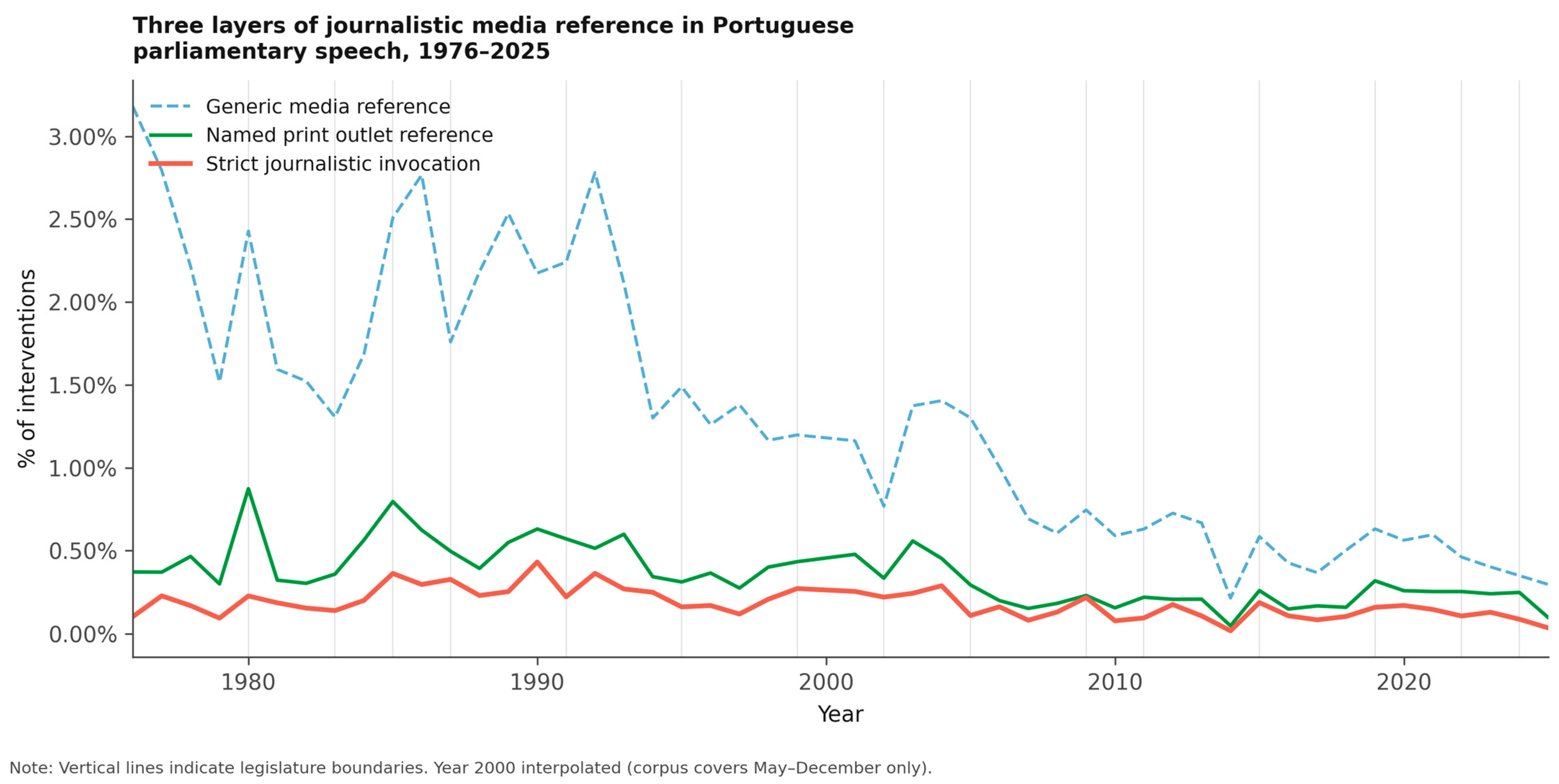
Across the 726,153 parliamentary interventions in the analytical corpus, explicit references to journalistic media were uncommon. In the broadest layer, media_ref_any was identified in 10,703 interventions (1.47%). Generic media references (generic_media_ref) appeared in 8916 interventions (1.23%), named outlet references (named_outlet_ref) in 6563 (0.90%), print outlet references (print_outlet_ref) in 2506 (0.35%), and broadcast outlet references (broadcast_outlet_ref) in 4245 (0.58%). The strict analytical variable, news_invocation_strict, was present in 1295 interventions, corresponding to 0.18% of the corpus.
Figure 1 shows the annual evolution of the three main layers retained for descriptive comparison: generic references, named print references, and strict invocations. All three remain low across the full 1976–2025 period. Generic references are consistently the most frequent, while named print references and strict invocations remain substantially rarer throughout. The decade-level comparison indicates that generic references were most frequent in the earlier decades, declining from 2.28% in the 1970s and 2.01% in the 1980s to 0.42% in the 2020s. Print outlet references follow a similar pattern, moving from 0.38% in the 1970s and 0.51% in the 1980s to 0.22% in the 2020s. Strict invocations remain rare throughout, reaching their highest decade-level values in the 1980s (0.23%) and 1990s (0.24%), before declining to 0.11% in the 2010s and 0.11% in the 2020s.
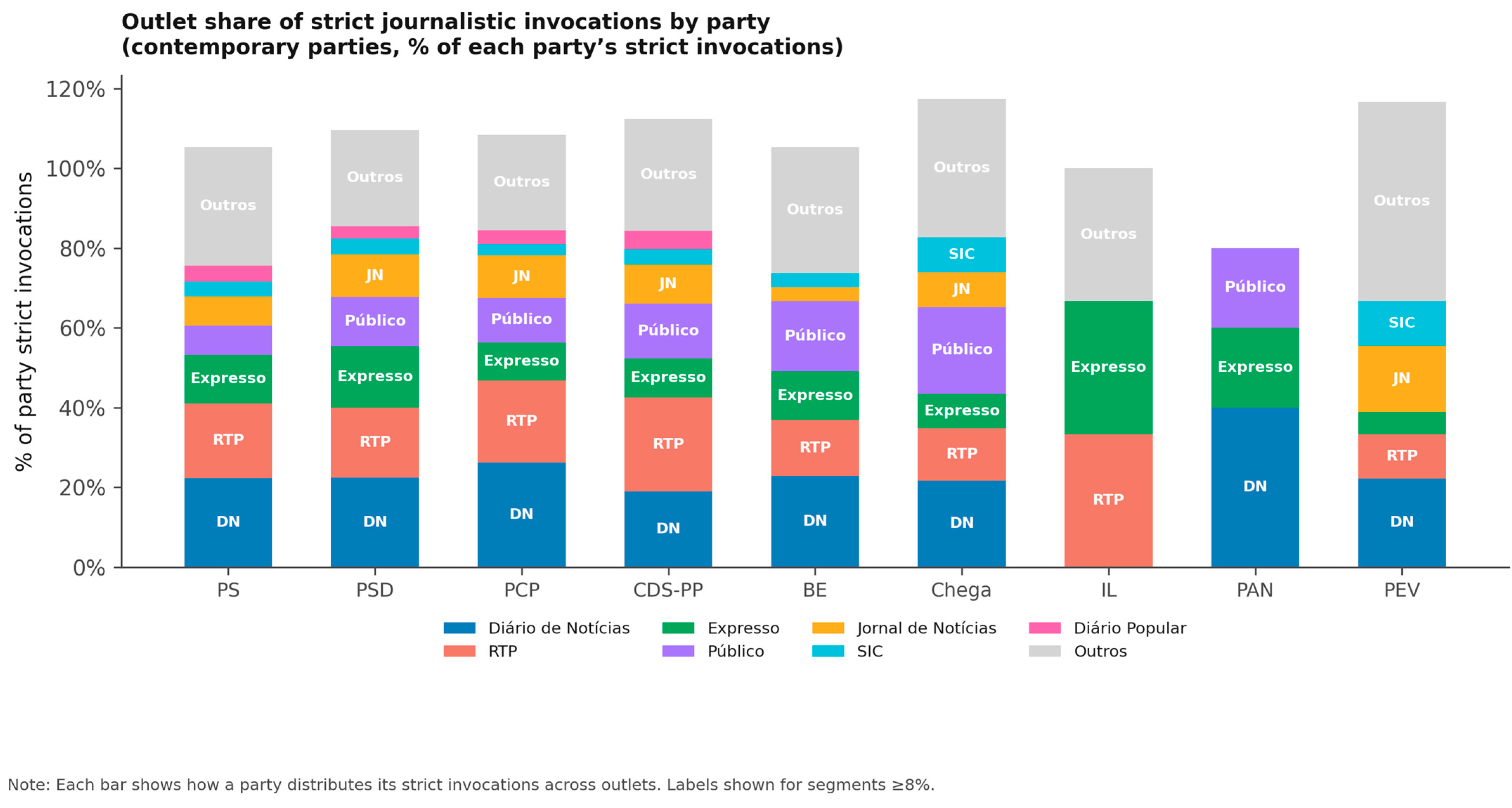
Figure 2 presents the outlet repertoire of contemporary parties, showing how strict invocations are distributed across specific journalistic outlets. Across the full period, the most frequently invoked outlets in strict references were
Diário de Notícias (286 references; 22.9% of all strict invocations with outlet identified),
RTP (232; 18.5%),
Expresso (153; 12.2%),
Público (142; 11.4%), and
Jornal de Notícias (119; 9.5%). Taken together, these five outlets account for most identified strict invocations.
The party-level repertoire shows substantial concentration around a common group of outlets, especially Diário de Notícias, RTP, Expresso, Público, and Jornal de Notícias. Among the larger contemporary parties, PSD recorded 325 strict invocations, with Diário de Notícias (22.5%) and RTP (17.5%) as the two most frequent outlets, followed by Expresso (15.4%), Público (12.3%), and Jornal de Notícias (10.8%). PS recorded 246 strict invocations and shows a similar structure, led by Diário de Notícias (22.4%), RTP (18.7%), and Expresso (12.2%). PCP, with 252 strict invocations, also concentrates most strongly on Diário de Notícias (26.2%) and RTP (20.6%), followed by Público (11.1%), Jornal de Notícias (10.7%), and Expresso (9.5%). CDS-PP, with 153 strict invocations, differs slightly in placing RTP first (23.5%) and Diário de Notícias second (19.0%).
The smaller contemporary parties show more limited but still identifiable repertoires. BE (57 strict invocations) is led by Diário de Notícias (22.8%) and Público (17.5%), while PEV (18 strict invocations) is led by Diário de Notícias (22.2%) and Jornal de Notícias (16.7%). Chega, with 23 strict invocations, shows a more fragmented distribution, with TSF, Público, and Diário de Notícias each accounting for 21.7% of its strict references. IL and PAN register very small numbers of strict invocations and therefore show highly reduced repertoires.
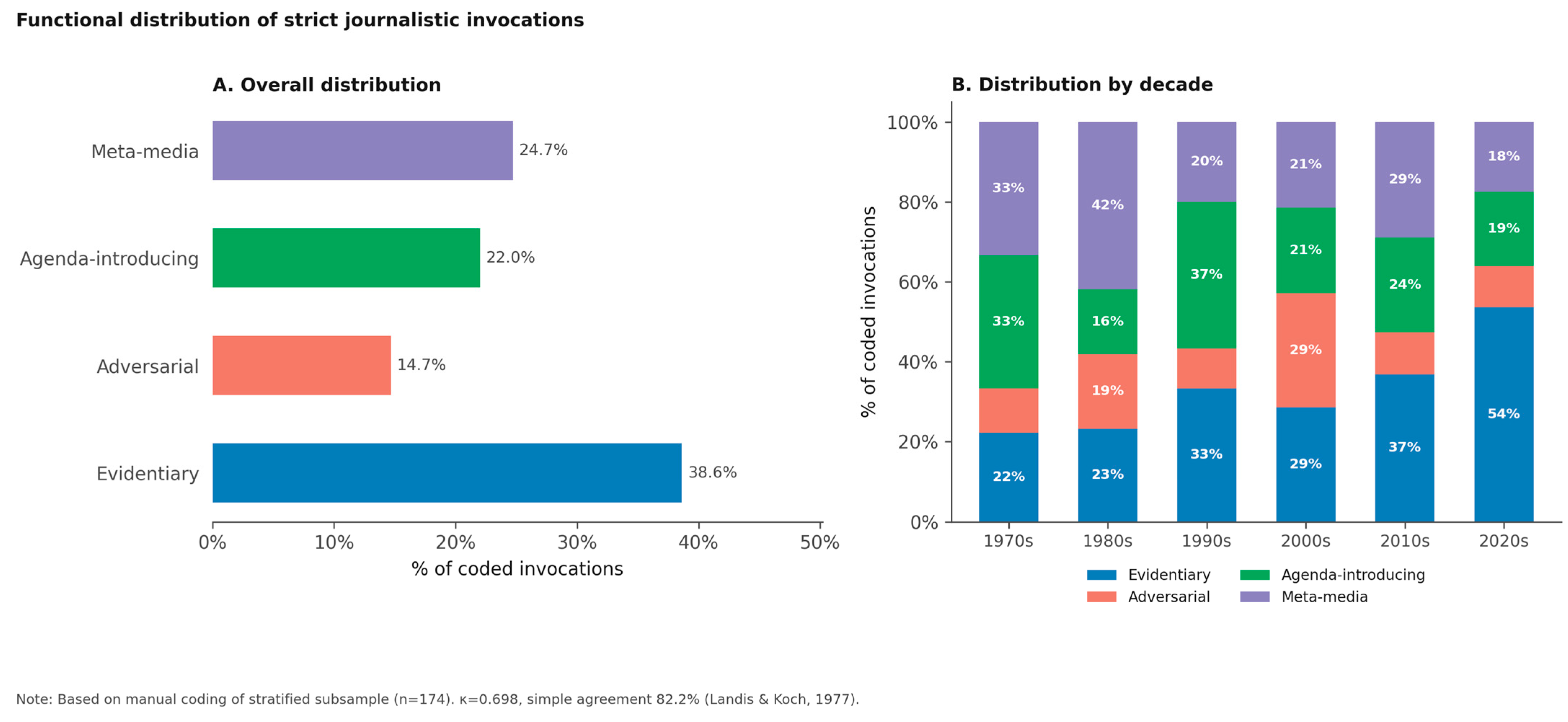
Figure 3 reports the distribution of primary discursive functions within the manually coded sample of 174 valid strict invocations. Evidentiary use is the most frequent category, with 100 cases (38.6%). Meta-media invocations follow with 64 cases (24.7%), then agenda-introducing references with 57 (22.0%), and adversarial invocations with 38 (14.7%).
The distribution by decade shows clear variation in the relative weight of these functions. In the 1970s, agenda-introducing and meta-media uses each account for 33.3% of coded cases, while evidentiary uses represent 22.2%. In the 1980s, meta-media references are the largest category (41.9%). In the 1990s, evidentiary (33.3%) and agenda-introducing (36.7%) uses become more prominent. In the 2000s, evidentiary and adversarial uses each account for 28.6% of the coded cases. In the 2010s, evidentiary references remain the largest category (36.8%), followed by meta-media (28.9%). In the 2020s, evidentiary use becomes clearly dominant, accounting for 53.6% of the coded sample, while agenda-introducing (18.6%), meta-media (17.5%), and adversarial (10.3%) uses remain less frequent.
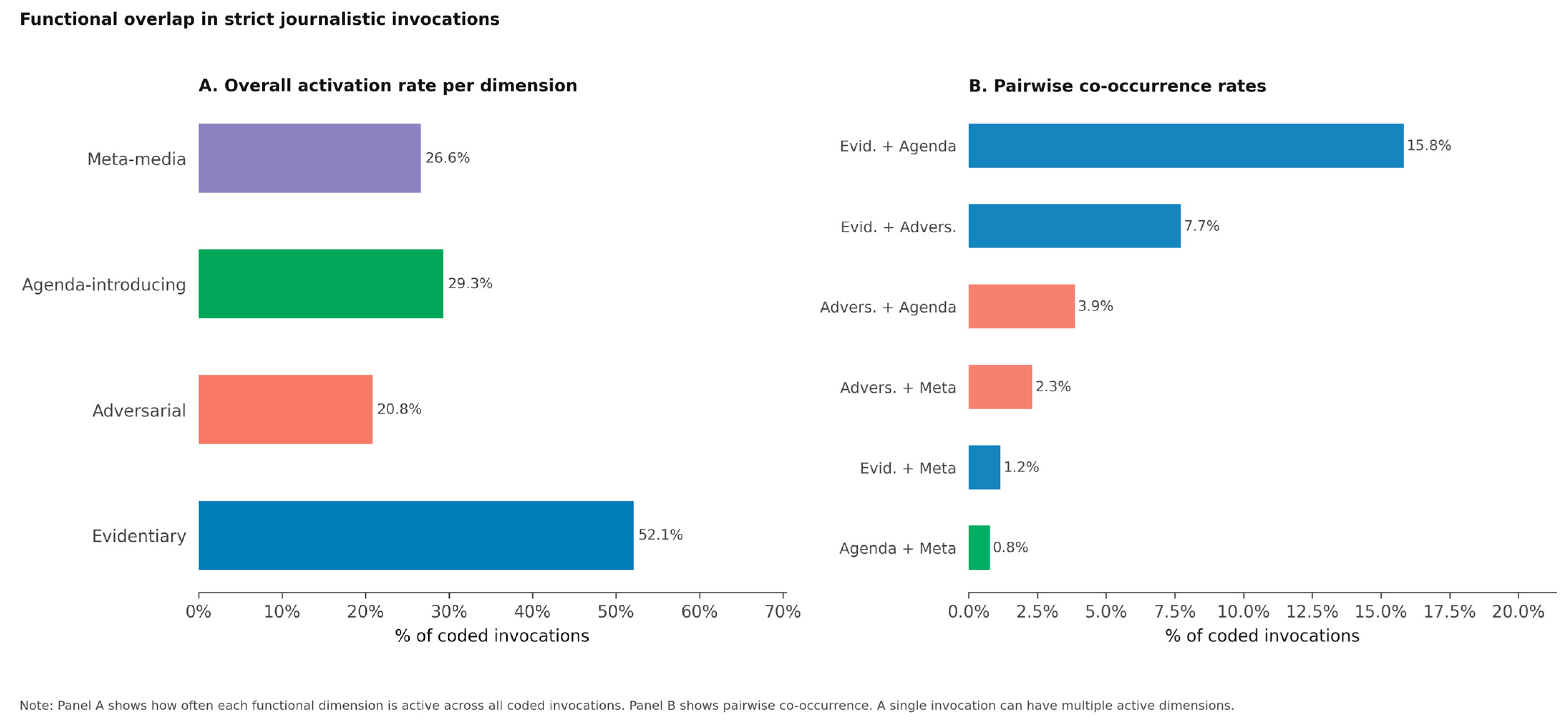
Figure 4 examines the overlap structure of strict invocations using the binary coding scheme. Across the full coded sample, evidentiary activation is the most frequent binary dimension, present in 52.1% of cases. This is followed by agenda-introducing activation (29.3%), meta-media activation (26.6%), and adversarial activation (20.8%).
Pairwise co-occurrence rates are generally low. The most frequent overlap is between evidentiary and agenda-introducing functions, present in 15.8% of coded cases. Evidentiary and adversarial overlap in 7.7% of cases. All remaining pairings occur less often: adversarial plus agenda-introducing in 3.9%, adversarial plus meta-media in 2.3%, evidentiary plus meta-media in 1.2%, and agenda-introducing plus meta-media in 0.8%. Overall, the overlap structure indicates that most strict invocations are dominated by a limited functional combination, with evidentiary use the most likely to co-occur with other dimensions.
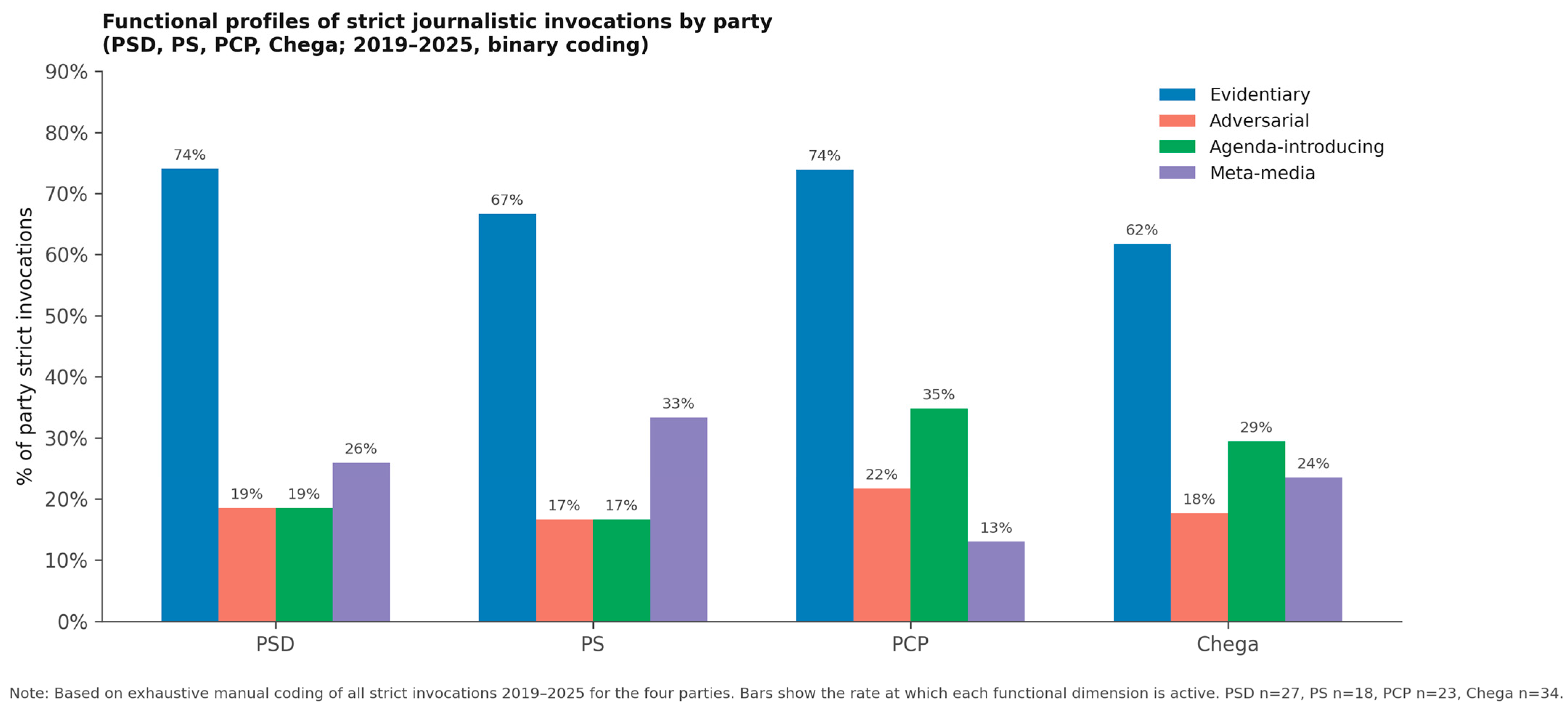
Figure 5 compares the binary functional profiles of PSD, PS, PCP, and Chega for all strictly coded invocations from 2019 to 2025. Across all four parties, evidentiary use is the most frequent binary function. PSD records evidentiary activation in 74% of its coded strict invocations, followed by meta-media (26%), agenda-introducing (19%), and adversarial (19%). PS also shows evidentiary dominance, with evidentiary activation in 67% of cases, followed by meta-media (33%), adversarial (17%), and agenda-introducing (17%).
PCP combines a high evidentiary rate (74%) with the strongest agenda-introducing profile of the four parties (35%), while meta-media activation is comparatively low (13%). Chega records evidentiary activation in 62% of cases, followed by agenda-introducing (29%), meta-media (24%), and adversarial (18%). In primary-function terms, evidentiary use is also the largest category for all four parties: 59% for PSD, 67% for PS, 43% for PCP, and 47% for Chega. Meta-media references are comparatively more visible in PSD and PS, while agenda-introducing references are relatively more prominent in PCP and Chega. Adversarial references remain the least frequent primary category across all four parties.
4. Discussion
The findings show, first, that explicit journalistic references are a real but distinctly minor feature of Portuguese parliamentary speech. This matters because it complicates strong versions of the mediatization thesis. The results do not suggest that parliamentary discourse has been overtaken by media logic in any simple or volumetric sense. Rather, they point to a selective and institutionally filtered process in which journalism enters parliament as an external discursive resource under specific argumentative conditions. In that respect, the findings align more closely with scholarship that treats mediatization as uneven, negotiated, and conditioned by institutional settings rather than as a uniform displacement of political logic by media logic (
Mazzoleni & Schulz, 1999;
Strömbäck, 2008;
Landerer, 2013;
Strömbäck & Van Aelst, 2013;
Strömbäck & Esser, 2014). They also reinforce work in parliamentary studies showing that legislative speech remains structured by procedural norms, party discipline, and institutional roles that constrain communicative adaptation (
Lin & Osnabrügge, 2018;
Bulut & İlter, 2020;
Alemán & Micozzi, 2022). More broadly, they sit comfortably with findings that political actors and journalists continue to perceive news media as influential across multiple stages of the political process, even where that influence is neither uniform nor easily visible in every arena (
Fawzi, 2018).
At the same time, the direction of the trend is itself significant. In relation to E1, the data support the expectation of rarity, but they do not show a straightforward growth in explicit journalistic mobilisation. On the contrary, generic references decline markedly over time, print references also fall, and strict invocations remain consistently marginal. A more critical reading of this pattern is therefore warranted. If parliamentary actors are explicitly invoking legacy journalism less often, this may indicate not only that journalistic references are selective, but also that legacy media may be losing some political relevance as an authority resource inside parliamentary speech. Such a reading sits uneasily with more optimistic assumptions that media remain central reference points simply by virtue of their historical role, and may suggest that the “dance” or struggle between politicians and journalists identified by
Esteves (
2019) is, at least in this domain, tilting towards the political side. In other words, the relationship may still be reciprocal, but politicians appear increasingly less dependent on making that dependence explicit in the parliamentary record. This would also fit broader accounts of a hybrid and platformised communication environment in which political actors can reach publics through a wider set of channels and increasingly operate through more direct, personalised, or networked repertoires of visibility (
Karlsen & Enjolras, 2016;
Chadwick, 2017;
Paatelainen et al., 2022;
Davis, 2026). That does not mean that legacy media no longer matter.
Bock et al. (
2025),
Deacon et al. (
2024), and
Fletcher et al. (
2025) all point to the continued institutional significance of mainstream news organisations, and work on hybrid agenda-setting likewise stresses that legacy media still matter a great deal in structuring political attention (
Langer & Gruber, 2021). But the present results suggest that their relevance should not be assumed to translate automatically into explicit discursive uptake inside parliamentary speech.
This declining visibility is especially interesting when set against the article’s intertextual framework. From a discourse-analytic perspective, what matters is not just whether media remain influential in the background, but whether they are explicitly taken up, cited, reframed, and put to work within parliamentary discourse itself (
Bakhtin, 1986;
N. Fairclough, 2003;
Reyes, 2011). Here, the evidence points not to saturation, but to restraint. If speaking politically often involves replying to, appropriating, and transforming other texts, then journalism is only one among several possible external resources, and apparently not one that MPs mobilise especially often in explicit textual form. This suggests that the intertextual incorporation of news remains real but limited, and that political actors may increasingly prefer to build arguments through other repertoires of authority, including party discourse, institutional standing, prior political statements, or more diffuse mediated common knowledge that no longer requires explicit source attribution. In that sense, the results do not negate mediatization; rather, they suggest that mediatization cannot be read only through explicit citation frequency, since political adaptation to media environments may coexist with a declining need to name legacy media directly. Seen from another angle, this is also compatible with research showing that politicians increasingly use hybrid communication strategically, combining older and newer media while reducing dependence on traditional journalistic gatekeeping (
Karlsen & Enjolras, 2016;
Paatelainen et al., 2022).
E2 is more clearly supported. Parties do differ in the outlet repertoires through which they mobilise strict invocations, but this variation unfolds within a relatively bounded field dominated by a small cluster of established news organisations, above all
Diário de Notícias,
RTP,
Expresso,
Público, and
Jornal de Notícias (with
RTP being mobilised disproportionately through meta-media references). This indicates that when parliamentary actors do borrow journalistic authority, they do so disproportionately from legacy outlets that retain public recognisability and institutional standing. That pattern is consistent with recent work showing that mainstream and legacy news organisations continue to matter as
loci of trust, credibility, and narrative authority even within a fragmented information environment (
Langer & Gruber, 2021;
Fotopoulos, 2023;
Deacon et al., 2024;
Fletcher et al., 2025). It also resonates with scholarship on journalistic authority. If journalism derives part of its authority from being recognised as a legitimate producer of public knowledge, then political actors’ selective preference for established outlets suggests that not all media are equally usable as discursive warrants inside parliament (
Schudson, 2001;
Deuze, 2005;
Carlson, 2016;
Godler & Reich, 2017). Yet the party differences should not be overstated. The repertoires are not radically polarised. Rather, they reveal selective variation within a shared mainstream media field, which suggests that legacy journalism still functions as a residual common reference space even where its explicit mobilisation is rare. At the same time, comparative work on political linking practices suggests that source selection is rarely neutral: political actors can build relatively narrow or selective media repertoires even while operating within broader media systems (
von Nordheim et al., 2023;
Cruz et al., 2026).
E3 is also supported. Strict invocations serve distinct functions, and those functions are not evenly distributed. Evidentiary use is clearly the most common, while meta-media and agenda-introducing uses are also substantial and adversarial uses remain the least frequent. This pattern is important because it shows that journalism is mobilised above all as a source of support, validation, and orientation rather than primarily as a weapon of attack. That finding reinforces the literature on journalistic authority and evidentiality. MPs appear to invoke journalism not merely as circulating content, but as a publicly recognisable form of discursive support whose value lies in its presumed credibility and truth-bearing capacity (
Carlson, 2017;
Godler & Reich, 2017;
Zelizer, 1992,
1993,
2007). At the same time, the distribution also highlights the multifunctionality of media references in parliamentary discourse. In line with work on intertextuality and discourse recontextualisation, journalism is not simply inserted intact into political speech; it is appropriated for different rhetorical and argumentative purposes depending on context (
van Dijk, 1988;
N. Fairclough, 1995b;
Peixinho & Santos, 2021). Recent work on hybrid media communication also points in the same direction, showing that political actors use journalistic content strategically for multiple purposes rather than in a single uniform way (
Paatelainen et al., 2022). The prominence of meta-media references in earlier decades, for example, likely reflects a period in which the media system itself, especially public broadcasting and media regulation, was more directly politicised and institutionally contested. By contrast, the stronger evidentiary profile in the 2020s suggests that when journalism is invoked today, it is more likely to be used to substantiate claims about external reality than to make the media system itself the direct object of parliamentary dispute.
The low level of agenda-introducing references deserves special attention. On the one hand, its presence confirms that journalism still functions, at least to some extent, as an agenda-setting or agenda-importing resource. MPs do occasionally invoke news reports in order to justify raising a topic, signalling that media coverage can still help define what becomes discussable or urgent inside parliament. On the other hand, the rates are low enough to invite a more critical interpretation. If politicians are not very often borrowing legacy media to introduce issues into parliamentary debate, that may suggest that journalism’s visible role in agenda definition inside plenary discourse is weaker than normative democratic ideals often imply. Even if this should be read cautiously, and even if parliamentary speech is a distinctive institutional genre whose patterns cannot be automatically generalised beyond the chamber, the finding is still revealing. Parliamentary agendas are not defined by interventions alone, but also by party strategy, chamber procedures, leadership decisions, government initiatives, and committee work (
Alemán & Micozzi, 2022). For that reason, low explicit agenda-introducing invocation cannot be equated directly with low agenda influence, since media, through mediatization, shapes what enters parliamentary debate through pathways that are not explicitly acknowledged in plenary speech. Even so, in a setting where journalism is often normatively imagined as central to informing public debate and helping structure political priorities, MPs do not appear to rely heavily on explicit journalistic references for that purpose. That gap between normative expectation and observed parliamentary practice is worth underlining. It is made more striking by the fact that hybrid agenda-setting research continues to find substantial agenda influence for legacy media (
Langer & Gruber, 2021) and that political actors themselves still perceive news media influence as extending beyond narrow policy agenda-setting into multiple stages of the political process (
Fawzi, 2018). The present results therefore do not show that journalism has ceased to matter for agenda formation, but they do suggest that its visible parliamentary uptake as an agenda-importing authority is weaker than the broader literature might lead one to expect.
The overlap analysis sharpens the picture further. Functional co-occurrence is generally limited, with evidentiary plus agenda-introducing use the most frequent pairing, and meta-media references comparatively isolated. This suggests that most strict invocations perform fairly bounded discursive tasks rather than blending multiple functions at once. When overlap occurs, it most often takes the form of journalism being used simultaneously to introduce an issue and substantiate its relevance. This is analytically important because it reinforces the idea that media references are not random ornaments in parliamentary speech. They tend instead to be inserted with relatively specific rhetorical purposes. The architecture of overlap therefore supports the broader argument of the article: journalism is mobilised as an external discursive resource in patterned, functional ways rather than as mere passing mention.
The contemporary party-level comparison adds a final qualification. Although parties like PSD, PS, PCP, and Chega all show evidentiary dominance, they do not mobilise strict invocations in exactly the same way. PSD and PS display somewhat stronger meta-media profiles, PCP shows the strongest agenda-introducing orientation, and Chega combines evidentiary dominance with a notable, though not exceptional, presence of agenda-introducing and meta-media uses. The most striking point here is perhaps what the data do not show: within this restricted domain, Chega is not defined primarily by adversarial use of journalistic references. This does not mean that the party does not contest or attack the media in broader political communication, but it does suggest that inside parliamentary speech its explicit mobilisation of journalistic discourse is less exceptional than one might expect. This is important because it reminds us that criticism of the media and dependence on media authority can coexist. Even actors associated with anti-establishment rhetoric may still borrow from journalistic legitimacy when it suits their [parliamentary] objectives. That duality is consistent with broader work on anti-media populism, which shows that attacks on the media can coexist with continued strategic engagement with journalistic institutions and their authority (
Fawzi, 2019;
Panievsky, 2022).