Article

Trust in News Media Across Asia: A Multilevel Analysis of Individual and Societal Factors

Department of Media and Communication, LMU Munich, 80538 Munich, Germany
*
Author to whom correspondence should be addressed.
Journal. Media 2026, 7(1), 8; https://doi.org/10.3390/journalmedia7010008 (registering DOI)
Submission received: 20 October 2025 / Revised: 8 December 2025 / Accepted: 30 December 2025 / Published: 4 January 2026

Abstract

Despite extensive scholarly attention, the exploration of individual-level determinants of news media trust still offers substantial room for further research, particularly from non-Western perspectives. This article moves beyond traditional political and media-related perspectives by incorporating individual capital and cultural values into the analysis of media trust. Using data from the fifth wave of the Asian Barometer Survey (14 countries and territories, N = 25,321), this study employs Hierarchical Linear Modeling (HLM) to examine the effects of four key factors on news media trust in Asia. The findings suggest that individual-level characteristics, including economic capital, traditional values, and authoritarian values, contribute to trust in news media in Asia, whereas social capital has a negative influence. These associations even remain significant after controlling for some political factors. Additionally, authoritarian values shape news media trust through a moderating mechanism, weakening the influence of political trust while reinforcing the role of interpersonal trust. At the societal level, GDP per capita and press freedom influence news media trust in Asia primarily through cross-level interactions rather than direct effects. These findings highlight the complex interaction between societal and individual determinants in shaping news media trust.

1. Introduction

Public trust in news media has garnered growing scholarly attention due to the critical role it plays in democratic institutions, public discourse, and social cohesion; it shapes media selection (Tsfati & Ariely, 2014), underpins the media’s function of informing the public (Strömbäck et al., 2020), and reflects public confidence in social institutions (Hanitzsch et al., 2018). A well-established body of scholarship has primarily focused on the levels, causes, and consequences of media trust, predominantly from Western and democratic perspectives. However, scholars have highlighted that research on news media trust should consider media roles, functions, and the impact of political communication regime and societal context (Dinana et al., 2025; Liu & Bates, 2009; Ognyanova, 2019), as the antecedents and consequences of media trust may vary across cultural contexts (Fawzi et al., 2021). Data from 2015 to 2023 across 46 countries highlight significant cross-national variations in news media trust trends and are not necessarily linear within countries (Fletcher et al., 2024). Therefore, the evidence indicates that moving beyond Western and democratic frameworks in studying news media trust is both necessary and urgent.
Asia presents a promising context for studying news media trust, given its unique political systems, cultural landscapes, and economic development. Politically, the region encompasses a wide spectrum of systems, ranging from full democracies to hybrid and authoritarian regimes (Pye & Pye, 2009), each fostering different media ecosystems and trust dynamics. Culturally, diverse systems shape Asian societies, including Confucianism, Islam, and Hinduism. Despite their differences, these systems consistently emphasize respect for hierarchy, social order, and the authority of elders and leaders (Chacko, 2018; Choi & Woo, 2016; Fish, 2002; Zhai, 2018). Economically, Asia’s economic markets are diverse, comprising both socialist and capitalist economies with widely varying economic growth rates, ranging from highly developed countries such as Japan and Singapore to less developed countries like Cambodia and Myanmar (World Bank, 2023). Moreover, economic growth drives shifts in values and priorities (Abramson & Inglehart, 2009), which in turn influences people’s perception of the media. This rich diversity makes Asia a compelling case for exploring the complex mechanisms underlying trust in news media.
Asia appears to be experiencing a crisis of media trust. Traditionally, it has been regarded as a high-trust region, characterized by strong political, institutional, interpersonal, and media trust (Edelman, 2024; Hanitzsch et al., 2018; Van Deth et al., 2008; Ward et al., 2014). In the digital age, media trust has become increasingly complex within a high-choice media environment (Fletcher & Park, 2017). The fragmented and negative public opinion climate tends to breed confusion and distrust (Mou & Lin, 2017). Studies have highlighted significant declines in trust in news media across the Asia-Pacific region, particularly in South Korea, Taiwan, Indonesia, the Philippines, and Malaysia (Flew, 2019; Newman et al., 2024). This reality makes it crucial to explore how individuals evaluate and trust news media in the context of globalization and digitalization, as trust is related to social cohesion and political stability.
Most of the existing studies focus on demographic, political, and media-related factors, such as political orientation (Brosius et al., 2021), post-materialist values (Tsfati & Ariely, 2014), ideological extremity (Hanitzsch et al., 2018), and different types of media use (Kalogeropoulos et al., 2019). Although the current literature acknowledges that individual capital and cultural values drive public trust in news media (Fawzi et al., 2021; Verboord et al., 2023), few studies have examined these factors, especially in non-Western contexts.
To address these gaps, our work shifts the focus to two additional components of news media trust: individual capital and cultural values. Drawing on data from the fifth wave of the Asian Barometer Survey, which includes 14 representative Asian countries (N = 25,320), this study seeks to examine the direct and interaction-based impacts of these two sets of individual-level factors on news media trust within the Asian context, primarily through multiple HLM analyses. This study aims to move beyond Western-centered models by offering a Global South-oriented understanding of how resource-based and culturally grounded orientations shape the trust in news media across diverse societal contexts.

2. Theoretical Framework

Trust in news media refers to “the willingness of the audience to be vulnerable to news content based on the expectation that the media will perform in a satisfactory manner” (Hanitzsch et al., 2018, p. 5). Generalized trust and specific trust are two common forms of media trust; the former refers to institutional trust in news media or journalism, while the latter focuses on trust in particular content or individual journalists (Fawzi et al., 2021; Strömbäck et al., 2020). Our study focuses on generalized trust in news media, encompassing not only television and newspapers but also online platforms, given that, in the social media age, the public increasingly accesses news through social platforms and search engines, which complicates the identification of news sources (Mancini, 2013; Newman et al., 2024).
Previous research has highlighted several individual-level determinants of news media trust, typically grouped into social, political, and media-related characteristics (Fawzi et al., 2021). Political characteristics constitute one of the most consistent predictors: political trust, political interest, and perceived political knowledge are generally associated with higher news media trust (Hanitzsch et al., 2018; Tsfati & Ariely, 2014; P. Xu et al., 2022), whereas political cynicism, ideological extremity, and anti-elite populist attitudes tend to reduce it (Brosius et al., 2021; Fawzi, 2019; Stroud & Lee, 2013; J. Xu, 2013). In contrast, findings regarding sociodemographic predictors are mixed. Studies disagree on whether gender or age systematically shape trust in news media (Chung et al., 2012; Lee, 2010; Newman et al., 2024; Tsfati & Ariely, 2014), suggesting that demographic influences are context-dependent rather than universal. To bridge gaps in the literature, our study focuses on the influence of individual capital and cultural values on media trust.

2.1. Individual-Level Causes of News Media Trust

A theoretical point of departure for understanding how individual-level factors shape the formation of trust is the theory of trust proposed by Sztompka (1999), which conceptualizes trust as shaped by two fundamental dimensions of the individual: personal capital, referring to what people have, and personality traits, referring to what people are. Building on this theoretical foundation, our study focuses on individual capital and cultural values as key predictors of trust in news media. Individual capital aligns closely with Sztompka’s account of “what people have,” capturing the social and economic resources that shape individuals’ capacity to form trust. Cultural values, in turn, reflect enduring orientations toward authority, tradition, and social order, corresponding to the dimension of “what people are.” Together, these two domains represent fundamental aspects of individual dispositions that have been shown to influence how people evaluate institutions, including the media.

2.1.1. Individual Capital and News Media Trust

To further theorize how individual capital shapes trust, social capital theory provides an additional lens. Specifically, social capital theory posits that social capital facilitates network building, strengthens relationships, and generates collective benefits, thereby enhancing trust among group members (Fukuyama, 1995; Putnam, 1995). This means that trust is inherently rooted in social relationships (Newton, 2001). Individuals with greater social capital are more likely to engage in trusting relationships, not only with social members but also with societal institutions, perhaps including news media. As an aggregate concept, social capital has diverse definitions, interpretations, and applications across different disciplines (Adler & Kwon, 2002; Brehm & Rahn, 1997; Robison et al., 2002). This study adopts an individual-level perspective grounded in private interests and embeds resources and network locations as key indicators in its examination of trust (Lin, 2017). Previous studies found that trust in news and information is deeply embedded in social networks and personal interactions (Kiousis, 2001; Metzger et al., 2010; Ognyanova, 2019), and whether this relationship or mechanism exists in Asian societies needs further exploration. So, we propose:
H1(a): Individual social capital is positively associated with news media trust in Asia.
Economic capital is generally interpreted as being the economic or material resources used to achieve various outcomes, and it includes individuals’ economic characteristics and attributes (McKinnon, 2010; Wacquant & Stones, 2006). The theoretical foundation for linking economic capital to trust can be traced to Sztompka’s (1999) account of “what people have,” which highlights that access to economic resources reduces uncertainty and enhances individuals’ capacity to form trusting relationships. Empirical studies further support this mechanism: higher levels of economic resources are associated with greater perceived security and lower skepticism toward institutions, including the media (Berggren & Jordahl, 2006; Delhey & Newton, 2005; Knack & Zak, 2003), and economic factors have been shown to possess greater explanatory power for social and institutional trust (Caïs et al., 2021). By its very nature, economic capital provides access to education, skills, and information (Wacquant & Stones, 2006), thereby reducing uncertainty and fostering a sense of security. This, in turn, enables individuals to perceive institutions and social structures as reliable. In short, as economic capital increases, individuals are more likely to perceive social and institutional structures as reliable, exhibit less skepticism toward media, and demonstrate greater acceptance of institutional narratives. Based on this consideration, we hypothesize that:
H1(b): Individual economic capital is positively associated with news media trust.

2.1.2. Cultural Values and News Media Trust

Theoretical perspectives on the origins of trust also offer a crucial foundation for understanding how cultural values shape individuals’ trust in news media. Theoretical explanations of trust origins, particularly those of political and media trust, are grounded in two schools of thought: cultural and institutional explanations (Hanitzsch et al., 2018; Tsfati & Ariely, 2014). The cultural explanation posits that trust originates from deep-seated cultural values shaped by socialization, rather than the performance of the media or political system (Mishler & Rose, 2001). Cultural values represent shared abstract ideas about what is good, right, and desirable in a society (R. M. J. Williams, 1970), providing a foundational framework for the behavior and attitudes of individuals or groups in various contexts (Schwartz, 1999), including interpretations of media trust (Müller, 2013). Specifically, cultural values influence individuals’ selective exposure to and interpretation of information (Tsfati & Ariely, 2014; Verboord et al., 2023) and affect how people perceive information and assess risks (Kahan & Braman, 2006), which in turn shapes their trust in news media. For example, Müller (2013) found that value changes have a greater impact on media trust in authoritarian regimes than in democratic ones, with emancipative values negatively correlated with trust in the press. Additionally, post-materialist values (Tsfati & Ariely, 2014) and anti-elite populism (Fawzi, 2019) are proven to be negative predictors of media trust.
Traditionalism and authoritarianism represent two prominent value orientations shared across many Asian societies. Major cultural systems such as Confucianism in East Asia, Hinduism in South Asia, and Islam in parts of Southeast and South Asia emphasize not only respect for hierarchy, authority, and social order, but also the preservation of traditional norms, values, and ways of life (Chacko, 2018; Huang, 2024; Inglehart & Welzel, 2023; Kim, 2010). Therefore, our study focuses on traditionalism and authoritarianism as key cultural values that influence trust in news media. The Schwartz (2012) theory of basic human values identifies ten universal values based on underlying motivations or goals, which are recognized across various cultural contexts. These values are grouped into four higher-order categories along two polar dimensions: the first, openness to change versus conservation, contrasts values of independence with those emphasizing obedience; the second, self-enhancement versus self-transcendence, contrasts self-focused interests with values prioritizing the welfare of others (Schwartz, 2012). For our research, we selected two orientations to investigate: traditionalism, which aligns with values of conservation, and authoritarianism, which aligns with values of self-enhancement.
Traditionalism refers to an individual’s adherence to traditional culture and social customs, prioritizing societal stability, the existing order, and religious beliefs (Schwartz, 2012). Individuals with traditional values tend to resist challenges to established norms (Claessens et al., 2020), which may reduce their trust in alternative media that contradict these values. Instead, they are more likely to trust mainstream media, particularly those that reinforce the existing order and align with the ruling government. Authoritarianism is an ideological attitude prioritizing social control and security, characterized by a preference for authority, hierarchy, and centralized power (Duckitt, 2001; Schwartz, 2012). For authoritarians, trust in news media often depends on whether the news content aligns with authority figures and established norms (Mužík & Šerek, 2023). Any media perceived as criticizing authority or advocating for pluralistic values may face suspicion or distrust from authoritarians. Moreover, studies have shown that both traditional (Shi, 2001; Zhai, 2018) and authoritarian values (Ma & Yang, 2014; Pernia, 2022) are predictors of political and institutional trust. Among adolescents and young adults, authoritarianism predicts higher trust in alternative media (Mužík & Šerek, 2023). Despite theoretical support, the link between traditionalism, authoritarianism, and news media trust has rarely been directly studied, which leads us to propose the second set of hypotheses:
H2: Traditional values (H2a) and authoritarian values (H2b) are positively related to news media trust.
To fully understand the role of individual capital and cultural values in shaping media trust, it is essential to examine both their direct influences and potential interaction-based effects, particularly in moderating the relationship between media trust and its key predictors. In our study, political trust and interpersonal trust are selected as the primary predictors of news media trust based on well-established theoretical traditions that explain the origins of institutional and media trust. Prior research identifies two foundational paradigms: cultural theories, which view interpersonal trust as a deeply socialized disposition developed through early-life experiences, and institutional theories, which conceptualize political trust as an evaluation of institutional performance (Hanitzsch et al., 2018; Mishler & Rose, 2001). These two forms of trust, therefore, represent the most theoretically grounded antecedents of news media trust; interpersonal trust captures generalized expectations of others’ reliability, while political trust reflects confidence in the functioning of political institutions (Hanitzsch et al., 2018; Strömbäck et al., 2020; Tsfati & Ariely, 2014). Building on these perspectives, it is theoretically meaningful to assess whether individual capital and cultural values alter the extent to which interpersonal trust and political trust translate into media trust. Hence, we propose the following research questions:
RQ 1: How do individual capital (economic and social) and cultural values (traditionalism and authoritarianism) moderate the relationship between political trust and news media trust?
RQ 2: How do individual capital (economic and social) and cultural values (traditionalism and authoritarianism) moderate the relationship between interpersonal trust and news media trust?

2.2. Societal-Level Causes of News Media Trust

News media trust is a multidimensional construct shaped by individual and societal factors, with broader social contexts often playing a more decisive role in shaping trust relationships (Ognyanova, 2019). Fawzi et al. (2021) also conceptualizes the antecedents of media trust along two dimensions: the societal level and the individual level. A theoretical explanation behind this is that individual attitudes and behaviors emerge from the dynamic interplay between personal characteristics and the opportunities and constraints embedded in the broader social environment (Bourdieu, 1986; Giddens, 1984). Institutional theories suggest that institutional trust stems from citizens’ evaluations of how effectively institutions perform their expected functions (Mishler & Rose, 2001). Within this framework, trust in news media can be understood as part of broader assessments of institutional performance, including but not limited to how well media institutions operate and how effectively economic institutions function. A higher GDP per capita reflects stronger economic performance, which fosters public confidence in institutions, including the media (Caïs et al., 2021). However, some studies have shown that countries with lower Human Development Index (HDI) scores exhibit the highest levels of media trust (de Zúñiga et al., 2019), while those with higher economic levels show lower trust (Kalogeropoulos et al., 2019; Tsfati & Ariely, 2014). Meanwhile, press freedom often refers to the extent to which journalism is independent of control and censorship by social entities, such as the government (Becker et al., 2007). The level of media freedom shapes people’s perceptions of the credibility and professionalism of journalism. In societies with greater press freedom, citizens are more likely to trust the media due to its autonomy from political or commercial influence. Conversely, media trust may be more closely tied to political alignment in environments with restricted press freedom. Recent experimental evidence also shows that media trust in authoritarian contexts is highly sensitive to the information environment. For example, survey experiments in China demonstrate that state media maintain high trustworthiness only when they provide high-quality and detailed information, whereas low-quality news produced under information control diminishes trust and even increases belief in rumors (Wang et al., 2023). A study from Singapore shows that in hybrid authoritarian media systems, news trust is shaped dynamically by patterns of media consumption: mainstream and non-mainstream sources exert both competitive and complementary influences on trust, rather than operating as mutually exclusive alternatives (Goh et al., 2025). Thus, when examining news media trust across Asian societies, it is essential to consider country-level conditions that reflect broader socioeconomic and political contexts. Based on this premise, the following two sets of research questions are proposed:
RQ 3: To what extent is the relationship between individual capital (economic and social) and news media trust moderated by societal-level factors?
RQ 4: To what extent is the relationship between cultural values (traditionalism and authoritarianism) and news media trust moderated by societal-level factors?

3. Method

3.1. Data

In this study, individual-level data are sourced from the Asian Barometer Survey (ABS) Wave 51, which was conducted between 2018 and 2021, with all data fully released in 2023. The ABS is a cross-national research project that aims to measure public attitudes toward democracy, governance, and social and political values across Asia. The original merged dataset from the ABS Wave 5 contains data from 14 countries and societies collected through face-to-face interviews using a national probability sampling method. Given the significant cultural differences between Australia and Asian countries, as well as its frequent classification as a Western developed democracy in social science research, Australia was excluded from this analysis. The analysis includes 14 countries/societies with a total sample size of 25,321, distributed as follows: Japan (1045), South Korea (1268), China (4941), Mongolia (1283), Taiwan (1259), Hong Kong (1200), the Philippines (1200), Thailand (1200), Vietnam (1200), Malaysia (1237), Singapore (1002), Indonesia (1540), Myanmar (1627), and India (5318). Societal-level data are obtained from publicly available datasets provided by international organizations, including the World Bank, Taiwan’s National Statistics Agency, and Reporters Without Borders. Detailed societal-level data are presented in Appendix A. Due to the nested structure of the data, with respondents nested within countries/societies, hierarchical linear models (HLM) were the appropriate method of analysis (Hofmann, 1997) and were constructed using the “lme 4” package in R.

3.2. Measurement

3.2.1. Individual-Level Measures

The dependent variable, media trust, was the average trust in television, newspapers, and online news (ω = 0.717). The independent variables were operationalized through composite indices, factor analysis, and single-item measures. Variance inflation factor (VIF) analysis indicates no severe multicollinearity among the predictors, as all VIF values remain below the conventional threshold of 4, except for the dummy variables representing different political news channels. Economic capital was measured as a composite variable by averaging the scores of three items assessing the respondents’ economic perceptions, with acceptable internal consistency (ω = 0.719). Social capital was measured using five survey items from Wave 5 of the ABS related to the respondents’ social interactions and interpersonal relationships. Details of these items are provided in Appendix B. An initial exploratory factor analysis (EFA) using principal component analysis with varimax rotation was conducted to examine the underlying factor structure. The analysis yielded a three-factor solution (KMO = 0.523; Bartlett’s χ2 = 856.18, df = 10, p < 0.001). One loaded exclusively on a separate factor with minimal shared variance (loading = 0.991), while another loaded on a second factor (loading = 0.799), reflecting political similarity rather than a core dimension of social capital. They were therefore excluded from the final scale. The remaining three items were retained for confirmatory factor analysis (CFA), which showed excellent model fit (CFI = 1.000, TLI = 1.000, RMSEA = 0.000, SRMR = 0.000). All loadings were statistically significant (p < 0.001), ranging from 0.269 to 0.415. A standardized factor score was extracted and used in subsequent analyses as the final measure of individual-level social capital.
Traditionalism and authoritarianism were measured in ABS as composite variables derived from multiple survey items. Traditionalism was assessed with 12 items reflecting attitudes toward family, group harmony, and traditional norms, while authoritarianism was measured with 10 items capturing beliefs relating to obedience to authority and hierarchical social structures. For both variables, the average scores of the respective items were calculated to create a single composite measure, with the McDonald’s Omega values for both at around 0.8 (traditionalism: ω = 0.807, authoritarianism: ω = 0.784). Although these scales have been widely used and validated in large cross-national surveys such as the Asian Barometer Survey, cross-cultural differences in how the value items are interpreted mean that full measurement equivalence cannot be assumed. Interpersonal trust and political trust were constructed by aggregating responses to multiple survey items. Interpersonal trust included 7 items focusing on trust in different types of individuals, while political trust consisted of 10 items assessing trust in various political institutions and figures. The internal reliability was moderate for interpersonal trust (ω = 0.694) and high for political trust (ω = 0.893). Similarly, political participation was measured using 10 items covering various political activities, such as contacting officials, signing petitions, and participating in protests. The responses to these items were averaged to produce a new score (ω = 0.906). Moreover, political interest was measured using a single survey item that directly asked respondents how interested they are in politics. Political news channel was derived from a single item identifying the most important channel of political and governmental information, which was then recoded as a dummy variable for analysis. Gender (female = 50.5 percent), education (completed secondary school or higher = 61.9 percent), and age (M = 44.55, SD = 16.11) were included as controls. All the question wordings and recoding methods for the independent variables are detailed in Appendix B.

3.2.2. Society-Level Measures

Society-level data in our study were obtained from publicly available sources and include two key predictors. The first variable, GDP per capita (in current US dollars), was used as a measurement of economic development. Data were retrieved from the World Bank database2 for the year 2019 (M = $25,401.50; SD = $16,338.74), aligning with the main implementation year of the ABS Wave 5. The GDP per capita data for Taiwan was sourced from National Statistics, R.O.C. (Taiwan)3. The second country-level variable, press freedom, was measured using the 2019 World Press Freedom Index provided by Reporters Without Borders4. This index evaluates the level of press freedom in each country based on qualitative and quantitative assessments, including media independence, pluralism, and journalist safety. Higher scores indicate greater restrictions on press freedom. Press freedom scores ranged from 21.08 in China to 75.06 in Korea (M = 54.35; SD = 14.50). To ensure comparability and reduce potential scaling issues, both GDP per capita and the Press Freedom Index were standardized before being input into the model. The data sources and country-specific values are detailed in Appendix A.

4. Results

The random intercept model, Model 0 in Table 1, is the null model without any predictors. Model 0 indicates that 10.18% of the variance in media trust is due to society-level differences (ICC = 0.1018), and the remaining 89.82% is attributable to individual-level variation. The significant society effect (p < 0.001) indicates the need to include both individual- and society-level predictors to explain trust in news media.
In the first stage, Model 1 examines whether previously validated individual-level predictors of news media trust remain significant within the Asian context. The results confirm that political trust, interpersonal trust, political participation, and political interest are positive predictors (p < 0.001). Notably, the analysis also finds that differences in media channels for accessing political information (television, newspapers, radio, and the internet) contribute to variations in news media trust. Additionally, gender and education show significant effects, with males generally reporting higher media trust, and higher education levels associated with lower media trust. In our study, no correlation was found between age and media trust. This analysis establishes a baseline for key predictors of news media trust in Asia and acts as a reference for further model comparisons.
Next, the core research variables, individual capital and cultural values, were added to the model to explore their relationships with news media trust. Model 2 shows that economic capital (b = 0.030, p < 0.001) has a positive predictive effect on news media trust in Asia, while social capital (b = −0.020, p < 0.05) exhibits a negative association. H1a is rejected, whereas H1b is supported. The results suggest that traditional values (b = 0.090, p < 0.001) function as a strong positive predictor of news media trust, while the variable for authoritarian values (b = 0.020, p < 0.05) also shows a positive correlation, though to a lesser extent. In Asia, traditional and authoritarian values are significant predictors of trust in news media after controlling for other variables, an outcome which supports H2a and H2b. Notably, society-level variables, including per capita GDP and press freedom, do not show significant direct effects in these models, suggesting the presence of unexplored factors at the macro level. The relationships between individual-level driving factors and news media trust in Asia are visualized in Figure 1.
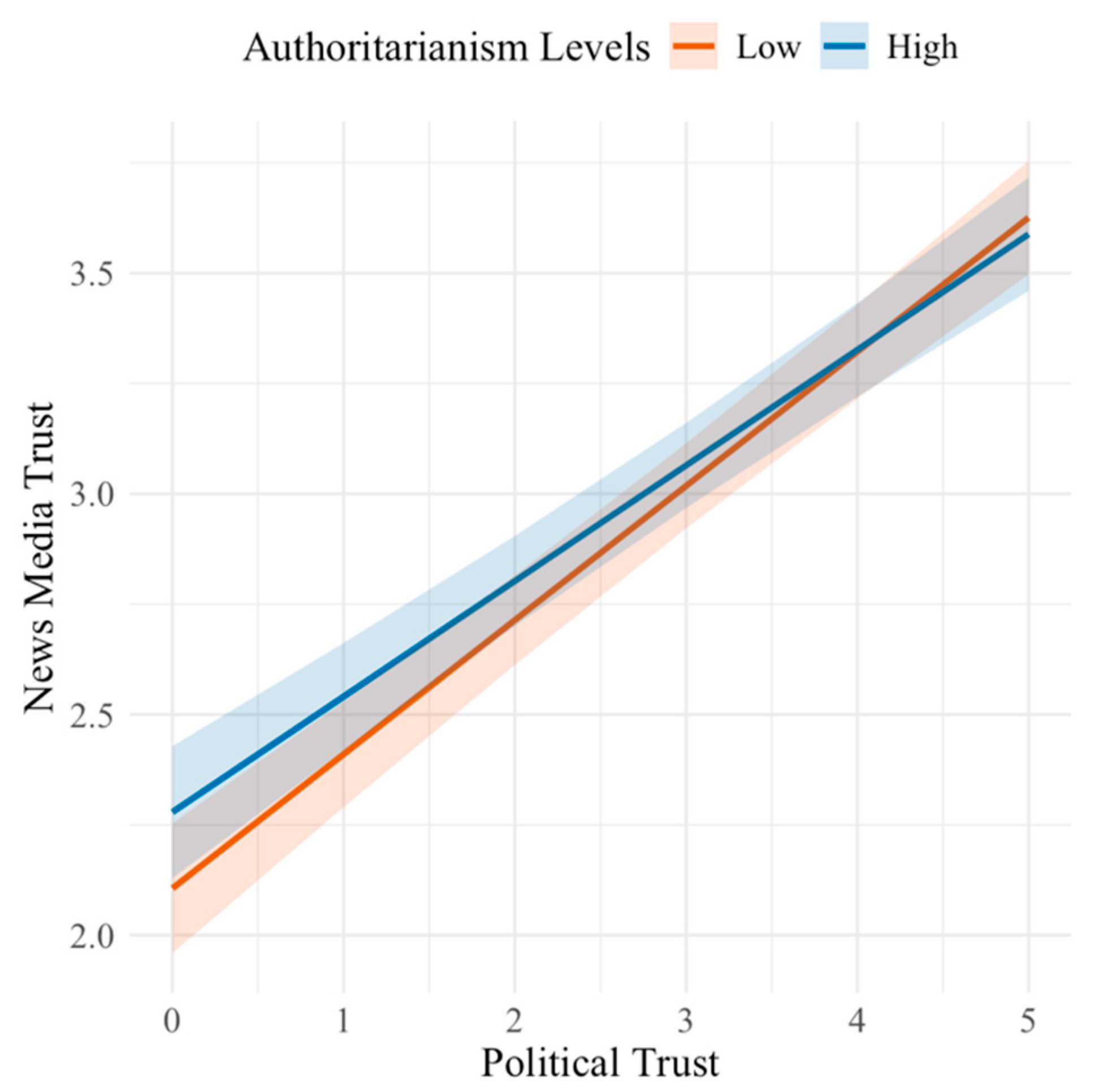
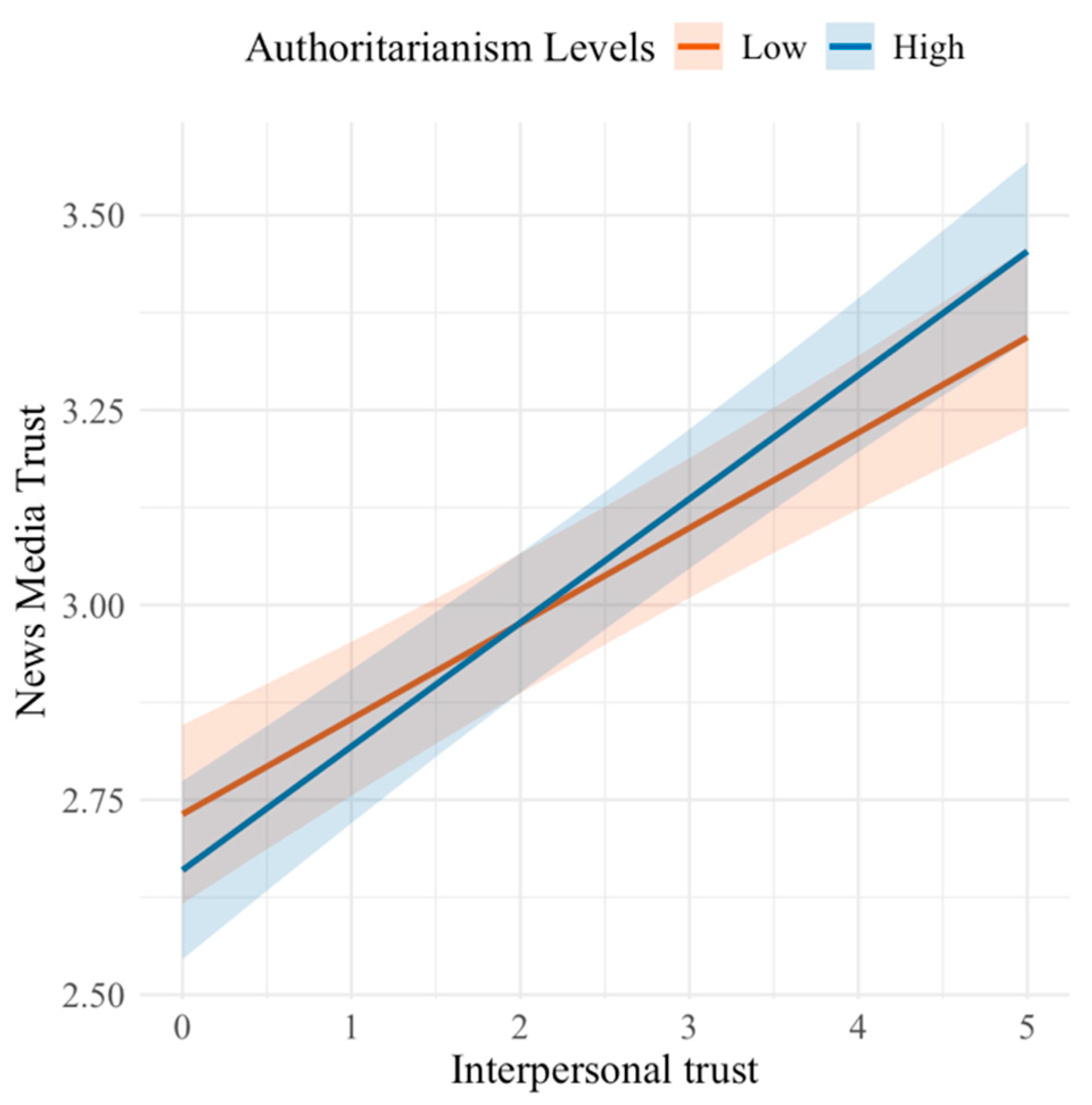
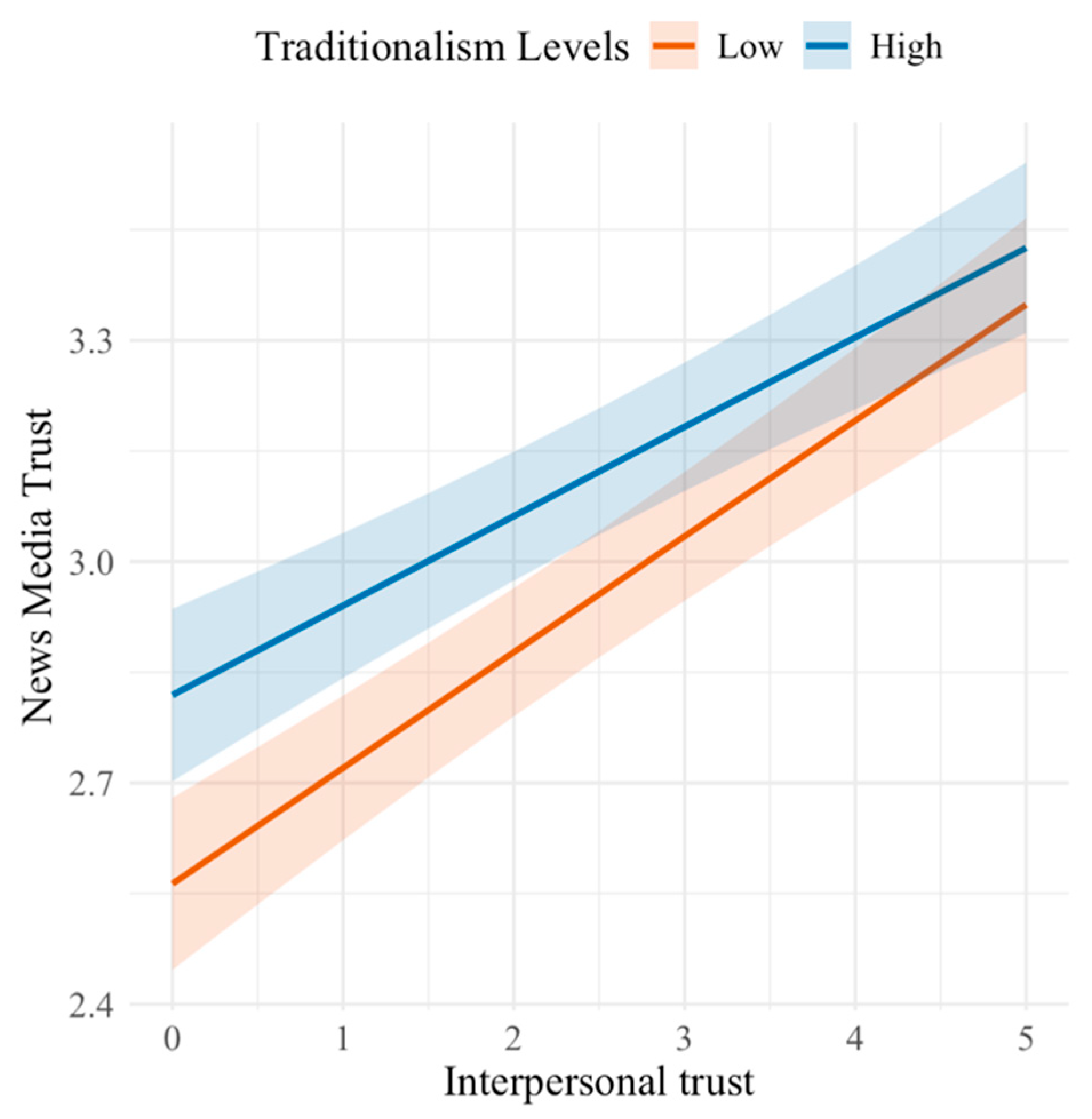
The second stage examines the impact of individual capital and cultural values on trust in news media. To address Research Questions 1 and 2, we constructed Models 3–4 and Models 5–6 to examine the moderating effects of individual capital and cultural values on the relationships between political trust, interpersonal trust, and trust in news media, respectively. The interaction effects indicate that neither economic nor social capital significantly moderates the positive associations between political trust, interpersonal trust, and news media trust. In contrast, authoritarian values significantly alter these two sets of relationships. Specifically, among individuals with stronger authoritarian values, the relationship between political trust and news media trust is significantly weakened, whereas the positive correlation between interpersonal trust and news media trust is significantly strengthened. These patterns are illustrated in Figure 2 and Figure 3. The positive relationship between interpersonal and media trust significantly weakens among individuals with stronger traditional values, as shown in Figure 4. Although both political trust and interpersonal trust are shown to positively predict news media trust, the positive relationship between interpersonal trust and news media trust appears to be more easily affected by other factors. The detailed results are shown in Table 2.
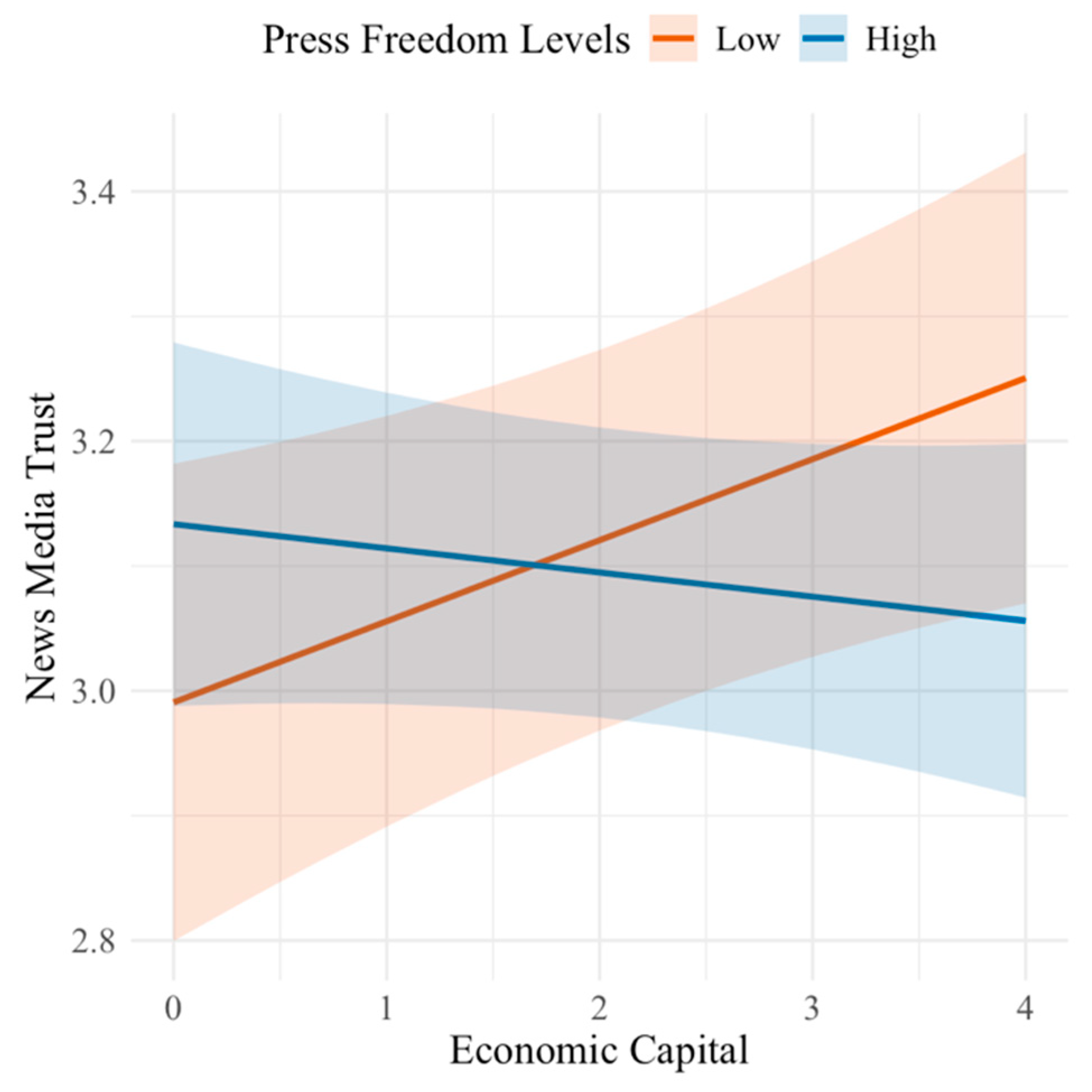
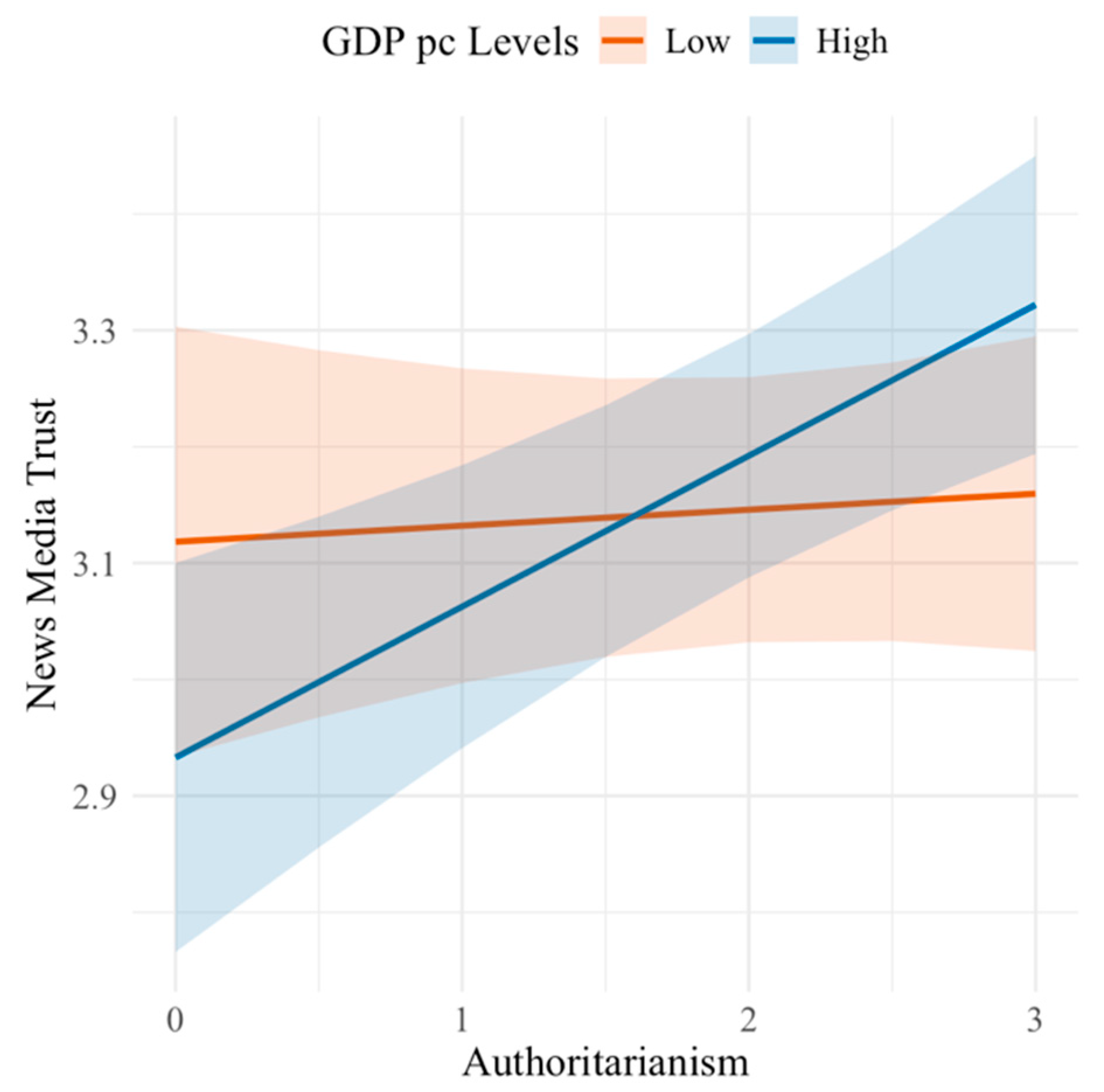
In the third stage, Models 7–10 were constructed by adding interaction terms between country-level variables and the four core studied variables. The findings provided answers to RQ 3 and RQ 4. From the results of cross-level interactions, the interaction between press freedom and economic capital is negatively significant (b = −0.037, p < 0.05), indicating that in countries/societies with higher press freedom, the positive correlation between economic capital and news media trust is weaker. In addition, the interaction between GDP per capita and authoritarianism is significant and positive (b = 0.037 p < 0.05), suggesting that in economically developed Asian countries/societies, individuals with stronger authoritarian values are more likely to trust news media. The detailed results of the cross-level interactions are presented in Table 3, with the significant moderating effects visualized in Figure 5 and Figure 6. In short, although the two country-level variables in this study do not directly predict news media trust, they shape how individual-level factors relate to it. It is worth noting that the significant cross-level interactions capture overarching contextual tendencies rather than effects attributable to individual societies or countries.

Robustness Checks

To assess the robustness of the findings, two additional analyses were conducted. First, alternative operationalizations were applied to the key cultural variables. Specifically, the composite measures of traditionalism and authoritarianism were replaced with factor scores derived from principal axis factoring. Second, a sensitivity test was performed by excluding the country (Singapore, 1002) with the smallest national sample size. In both cases, the direction and significance of the key predictors remained consistent, suggesting that the results are robust.

5. Discussion

The existing research in this field primarily examines the causes and consequences of news media trust based on demographic, political, and media-related characteristics (Brosius et al., 2021; Fawzi, 2019; Fletcher & Park, 2017; Hanitzsch et al., 2018; Tsfati & Ariely, 2014). Using cross-national data and multilevel modeling, this study is among the few that incorporate individual capital and cultural values into the analysis of news media trust, thereby extending the field’s traditional scope. We find that higher economic capital, traditional values, and authoritarian values are associated with greater trust in news media, while strong social capital often breeds distrust; these associations remain significant even after controlling for certain political variables. In addition, authoritarian values influence the relationships between news media trust and its key predictors, including political trust and interpersonal trust. While no societal-level factor in our model shows a significant direct effect on news media trust, economic capital and authoritarian values were found to moderate the relationships between press freedom, GDP per capita, and trust in news media.
Although trust has long been shown to correlate with broader economic conditions and equality of opportunity (Berggren & Jordahl, 2006; Delhey & Newton, 2005), previous studies on news media trust have paid little attention to individuals’ economic characteristics. Our study suggests that individuals with higher economic capital tend to have greater trust in news media in Asian countries/societies, with the correlation being highly significant. Essentially, trust inherently involves risk and uncertainty (Sztompka, 1999), which means that individuals with limited economic resources may view trust as a high-risk behavior, as they have less capacity to cope with potential losses. Moreover, socioeconomic inequalities often lead to unequal access to information resources (Cullen, 2001), as individuals with higher economic capital are more likely to own digital devices, afford stable connections, and engage deeply with high-quality news content. Our study highlights the overlooked role of material resources in shaping trust. In an era of polarization, as inequality rises, economic factors increasingly influence social and institutional trust (Caïs et al., 2021; Rothstein & Uslaner, 2005), and their impact on media trust warrants greater attention.
Another interesting finding is that, in Asia, higher levels of social capital are associated with lower levels of news media trust. This outcome challenges the view in previous studies that social capital positively predicts institutional or social trust (Ellison et al., 2007; Keele, 2007; Li et al., 2005). One possible explanation is that the generation and destruction of trust are deeply rooted in social relationships (Newton, 2001), and people’s views on the news industry are influenced by the preferences and experiences of those around them (Ognyanova, 2019). Individuals with strong social capital rely more on interpersonal communication and community-based sources (K. Williams & Durrance, 2008), enabling bottom-up information evaluation (Metzger & Flanagin, 2007), or strengthening in-group bonds that diminish openness to mainstream narratives (Fukuyama, 1995). This study underscores the pivotal role of personal social networks and interactions in determining media trust. While social capital is often associated with civic engagement and institutional trust, its relationship with media trust seems to be complex and multifaceted in the Asian context.
In Asia, traditional and authoritarian values significantly shape news media trust, and individuals who endorse these values tend to hold higher generalized trust in news media. These findings validate the argument that media trust is deeply rooted in cultural values (Müller, 2013; Tsfati & Ariely, 2014). Asian cultural values are often criticized for their political instrumentality (Welzel, 2011), which reinforces state legitimacy and social conformity rather than fostering critical engagement. Even in democratic or developed nations like Japan, South Korea, Singapore, and India, longstanding traditions and hierarchical power structures—such as zaibatsu, chaebols, and societal hierarchies (Chacko, 2018; Girling, 2006)—reinforce respect for authority and the existing order. Trust in the news media is often shaped by typical characteristics consistent with the undemocratic role of journalism (Garusi et al., 2025). These frameworks position the media as pillars of institutional authority and stability, fostering trust in mainstream narratives.
Our study also examines how individual capital and cultural values influence news media trust, with economic capital and authoritarian values serving as moderators in Asian societies. Specifically, individuals with higher economic capital exhibit a weaker positive association between interpersonal trust and media trust, which may indicate a lower reliance on lived experiences or personal interactions when evaluating news media. Notably, authoritarian values strengthen the effect of political trust on news media trust while diminishing the role of interpersonal trust. This phenomenon may stem from the close link between authoritarian values and political authority in Asian societies (Welzel, 2011), where respect for hierarchy and authority fosters trust in governments and shapes perceptions of media. In authoritarian regimes, this relationship is seen as crucial for maintaining social stability (Müller, 2013). From another perspective, interpersonal trust and political trust could be pretty stable predictors of trust in news media and may be largely unaffected by other individual-level variables. In other words, these relationships exhibit remarkable persistence across varying conditions. However, social capital and traditional values do not meaningfully modify the associations between interpersonal trust, political trust, and news media trust.
At the society-level, structural differences in media systems and economic development shape the relationship between news media trust in Asia. On the one hand, press freedom cannot directly predict news media trust, a finding consistent with previous research conducted in Western contexts (Kalogeropoulos et al., 2019; Soon & How Tan, 2016). On the other hand, higher press freedom fosters a more open and transparent media environment, significantly increasing the diversity of information sources and the accessibility of news channels (Kenny, 2020; Mak, 2021; Nisbet & Stoycheff, 2013). In societies with such an environment, media institutions, often maintaining independence from power structures (Nisbet & Stoycheff, 2013; Schudson, 2008), are better positioned to provide objective and fair reporting. As a result, individuals can access high-quality news through various free or low-cost channels, which diminishes the privileged role of economic capital in shaping media trust and underscores the institutional advantages of press freedom. Asia’s rapid digitalization could amplify this effect by allowing people to access, share, and evaluate news more easily and publicly (Fletcher & Park, 2017).
However, the economic situation at the national level has limited shaping power on news media trust. Unlike previous studies (Kalogeropoulos et al., 2019), this research found no direct correlation between GDP per capita and trust in news media. However, in societies with higher levels of economic development, authoritarian values exhibit a stronger positive correlation with trust in news media. Additionally, Tsfati and Ariely (2014) the study found that media trust tends to be lower in countries with higher levels of economic development, and this relationship loses significance when other factors are taken into account. In other words, the economic level may not directly determine or fully explain variations in news media trust but may instead work through other factors. It is particularly noteworthy that the significant cross-level interactions represent systematic contextual trends rather than the influence of any particular country. These patterns in our study reflect broader structural tendencies across the region rather than being attributable to any single nation. In addition, most of the other cross-level interactions in our study were not statistically significant, indicating that the individual-level determinants of news media trust operate in a relatively stable manner across Asian societies. Although countries differ in their overall levels of trust in news media, the underlying psychological and socialized processes appear to be broadly consistent across national contexts.
Although this study has several limitations, it nonetheless points to important directions for future research. As with every cross-sectional study, a significant limitation of this investigation is related to the issue of causality. The conclusions only describe correlations between individual capital, cultural values, and news media trust, while the underlying causal mechanism requires further investigation. It is also important to acknowledge that the meaning of news media trust may vary across cultural contexts. As Liu and Bates (2009) argued, what constitutes media trust in one country may not be directly comparable to another. While our study treats news media trust as a shared construct for analytical purposes, its interpretation in different Asian societies may be shaped by distinct historical, political, and institutional conditions. Such possible differences in how the broad concept of news media trust is understood need to be taken into account when interpreting the results. Similarly, a related methodological limitation concerns the issue of cultural equivalence, that is, the extent to which constructs carry comparable meanings across societies (Steenkamp & Baumgartner, 1998; Vandenberg & Lance, 2000). Although our study draws on widely used Asian Barometer Survey items, constructs such as traditionalism and authoritarianism may not have identical meanings across societies. Because full measurement invariance could not be tested with the available data, cultural equivalence cannot be assumed. Future research should therefore evaluate measurement invariance more rigorously across different cultural contexts. In addition, this study follows the established literature (Hanitzsch et al., 2018; Tsfati & Ariely, 2014) in adopting a generalized measure of trust in news media. However, as digital platforms, social media, and algorithmic distribution continue to reshape the information environment, trust in different types of media may be shaped by distinct mechanisms (Guo & Lei, 2025). Future work would benefit from examining these forms of media trust separately and exploring the specific factors and conditions that influence them.
Moreover, considering that our study is conducted within an Asian context, its applicability to other societies remains uncertain. Therefore, future research could examine whether the relationships and factors identified in the Asian context are also applicable to regions outside Asia, such as Latin America, Africa, or Western democratic countries, to assess their applicability in different political and cultural contexts. Given that the impact of social capital on political trust varies depending on its components (Bäck & Kestilä, 2009), the debate on whether social capital positively or negatively affects trust in news media may also stem from varying definitions and measures of social capital. Future research should consider this multidimensionality, and the results related to social capital should be interpreted with methodological caution. Although this study focuses on traditional and authoritarian values, the broader cultural foundations of trust in news media deserve exploration. Future studies may consider additional cultural or social characteristics, such as faiths and religions, to assess whether they influence individual trust in news media. Finally, as our work has not identified society-level direct determinants of news media trust in Asia, future work could deepen the cross-level perspective through country-by-country analyses or by comparing groups of societies with similar cultural or institutional profiles to detect more nuanced cross-national patterns.
Despite its limitations, our work makes a significant contribution to the literature by identifying previously overlooked antecedents of news media trust in Asia, even after controlling for both macro-level and micro-level variables. Drawing on data from 14 Asian countries and societies, this study is one of the few to systematically examine trust in news media in the region. It provides empirical cases from the Global South and advances a cultural approach to clarifying how trust in news media is shaped across diverse non-Western contexts. Notably, individual economic capital and traditional values strongly correlate with news media trust, followed by social capital and authoritarian values. Meanwhile, in societies with higher press freedom, the effect of economic capital on news media trust is weaker, whereas in societies with greater GDP per capita, the influence of authoritarian values is stronger. In summary, individual capital and cultural values in Asian societies shape public trust in news media both directly and through their influence on individual- and societal-level factors.

Author Contributions

Conceptualization, K.D. and Z.X.; Methodology, K.D. and Z.X.; Software, K.D. and Z.X.; Validation, K.D.; Formal analysis, K.D.; Investigation, K.D.; Resources, K.D. and Z.X.; Data curation, K.D.; Writing—original draft, K.D.; Writing—review & editing, Z.X.; Visualization, K.D.; Supervision, Z.X.; Project administration, Z.X. All authors have read and agreed to the published version of the manuscript.

Funding

This research received no external funding.

Institutional Review Board Statement

Not applicable.

Informed Consent Statement

Not applicable.

Data Availability Statement

The data presented in this study are openly available on the Asian Barometer Survey website (https://asianbarometer.org/index).

Conflicts of Interest

The authors declare no conflicts of interest.

Appendix A. Cross-National Societal-Level Variables

Country IDCountry NameWorld Press Freedom 2019GDP per Capita 2019
(Current US $)
1Japan70.6440,416.00
2Hong Kong70.3548,359.00
3Korea75.0631,902.40
4China21.0810,143.90
5Mongolia70.494394.90
6Philippines56.093413.80
7Taiwan75.0225,908
8Thailand55.97628.60
9Indonesia63.234151.20
10Singapore48.5966,081.70
11Vietnam25.073491.10
12Cambodia54.11671.40
13Malaysia63.2611,132.10
14Myanmar55.081415.20
18India54.332050.20
Note. data source: 2019 World Press Freedom Index: Reporters Without Borders, RSF. https://rsf.org/en/index (accessed on 13 January 2025); 2019 GDP per capita: WORLD BANK GROUP, https://data.worldbank.org/indicator/NY.GDP.PCAP.CD?end=2019&start=1960 (accessed on 13 January 2025); 2019 GDP per capita: WORLD BANK GROUP, https://data.worldbank.org/indicator/NY.GDP.PCAP.CD?end=2019&start=1960 (accessed on 13 January 2025); National Statistics, R.O.C. (Taiwan), https://nstatdb.dgbas.gov.tw/dgbasAll/webMain.aspx?k=dgmain (accessed on 13 January 2025).

Appendix B. Variable Measurement and Coding

Variable NameQuestion WordingOptionCodeRecoded
Media trustHow much trust do you have in each of the following types of media?
53. Television
54. Newspaper
55. News on the internet
Trust fully15
Trust a lot24
Trust somewhat33
Distrust somewhat42
Distrust a lot51
Distrust fully60
Economic capital4. As for your own family, how do you rate the economic situation of your family today?Very good14
Good23
So-so32
Bad41
Very bad50
5. How would you compare the current economic condition of your family with what it was a few years ago? Is it …
6. What do you think the economic situation of your family will be a few years from now? Will it be …
Much better now14
A little better now23
About the same32
A little worse now41
Much worse now50
Social capital28. How many people do you have contact within a typical week day?0–4 people1
5–9 people2
10–19 people3
20–49 people4
50 or more people5
29. Which of the following best describes your relations with most of your social contacts?Most people’s social status are higher than yours11
Most people’s social status is lower than yours23
Most people’s social status are equal to yours32
30. Among these people you have frequent contacts, which of the following best describes the political views of these people?Virtually all of them have views similar to me14
A lot of them have views similar to me23
Only some of them have views similar to me32
Most of them have views different from me41
Don’t know much about their political views5Missing
31. If you have a difficult problem to manage, are there people outside your household you can ask for help?No, nobody1
Yes, a few2
Yes, some 3
Yes, a lot4
32. If you had friends or co-workers whose opinions on politics differed from yours, would you have a hard time conversing with them?Very hard1
A bit hard2
Not too hard3
Not hard at all4
TraditionalismPlease tell me how you feel about the following statements.
58. For the sake of the family, the individual should put his personal interests second.
Strongly agree
Somewhat agree
Somewhat disagree
Strongly disagree
1
2
3
4
3
2
10
59. In a group, we should sacrifice our individual interest for the sake of the groups collective interest.
60. For the sake of national interest, individual interest could be sacrificed.
61. When dealing with others, developing a long-term relationship is more important than securing one’s immediate interest.
62. Even if parents’ demands are unreasonable, children still should do what they ask.
63. When a mother-in-law and a daughter-in-law come into conflict, even if the mother-in-law is in the wrong, the husband should still persuade his wife to obey his mother.
64. Being a student, one should not question the authority of their teacher.
65. In a group, we should avoid open quarrel to preserve the harmony of the group.
66. Even if there is some disagreement with others, one should avoid the conflict.
67. A person should not insist on his own opinion if his co-workers disagree with him.
68. Wealth and poverty, success and failure are all determined by fate.
69. If one could have only one child, it is more preferable to have a boy than a girl.
AuthoritarianismI have here other statements. For each statement, would you say you …
146. Women should not be involved in politics as much as men
Strongly agree
Somewhat agree
Somewhat disagree
Strongly disagree
1
2
3
4
3
2
10
147. The government should consult religious authorities when interpreting the laws
148. People with little or no education should have as much say in politics as highly educated people
149. Government leaders are like the head of a family; we should all follow their decisions
150. The government should decide whether certain ideas should be allowed to be discussed in society
151. Harmony of the community will be disrupted if people organize lots of groups
152. When judges decide important cases, they should accept the view of the executive branch
153. If the government is constantly checked [i.e., monitored and supervised] by the legislature, it cannot possibly accomplish great things
154. If we have political leaders who are morally upright, we can let them decide everything
155. If people have too many different ways of thinking, society will be chaotic
Interpersonal trustHow much trust do you have in each of the following types of people?
24. Your relatives
25. Trust in your neighbors
26. Trust in other people you interact with
27. Trust in people you meet for the first time
Trust fully15
Trust a lot24
Trust somewhat33
Distrust somewhat42
Distrust a lot51
Distrust fully60
Political trustI’m going to name a number of institutions. For each one, please tell me how much trust do you have in them?
7. Trust in the executive office (president or prime minister)
8. The courts
9. National government in the capital city
10. Political parties [not any specific party]
11. Parliament
12. Civil service
13. The military or armed force
14. The police
15. Local government
16. The election commission
Trust fully15
Trust a lot24
Trust somewhat33
Distrust somewhat42
Distrust a lot51
Distrust fully60
Political participationHere is a list of actions that people sometimes take as citizens. For each of these, please tell me whether you have done any of these things
during the past three years?
70. In the past three years, have you ever contacted elected officials or legislative representatives at any level
71. Contacted civil servants or officials
72. Contacted other influential people outside the government, such as traditional leaders/community leaders.
73. Contacted news media
74. Signed a paper petition
75. Signed an online petition
76. Used the internet including social media networks to express opinions about politics and government
77. Joined a group to actively support a cause (including online)
78. Got together with others face-to-face to try to resolve local problems
79. Attended a demonstration or protest march
80. Taken an action or done something for a political cause that put you in a risk of getting injured
I have done this more than three times14
I have done this two or three times23
I have done this once32
I have not done this, but I might do it if something important happens in the future41
I have not done this and I would not do it regardless of the situation50
Political interest46. How interested would you say you are in politics?Very interested13
Somewhat interested22
Not very interested31
Not at all interested40
Political news channel52. Which one is the most important channel for you to find information about politics and government?Television1
Newspaper (print and online)2
Internet and social media3
Radio4
Other channel (please specify)5

Notes

1
Asian Barometer Survey. (https://www.asianbarometer.org/index) (accessed on 6 January 2025).
2
2019 GDP per capita: WORLD BANK GROUP (https://data.worldbank.org/indicator/NY.GDP.PCAP.CD?end=2019&start=1960) (accessed on 13 January 2025).
3
National Statistics, R.O.C. (Taiwan) (https://nstatdb.dgbas.gov.tw/dgbasAll/webMain.aspx?k=dgmain) (accessed on 13 January 2025).
4
2019 World Press Freedom Index: Reporters Without Borders, RSF. (https://rsf.org/en/index) (accessed on 13 January 2025).

References

  1. Abramson, P., & Inglehart, R. F. (2009). Value change in global perspective. University of Michigan Press. [Google Scholar]
  2. Adler, P. S., & Kwon, S.-W. (2002). Social capital: Prospects for a new concept. Academy of Management Review, 27(1), 17–40. [Google Scholar] [CrossRef]
  3. Bäck, M., & Kestilä, E. (2009). Social capital and political trust in Finland: An individual-level assessment. Scandinavian Political Studies, 32(2), 171–194. [Google Scholar] [CrossRef]
  4. Becker, L. B., Vlad, T., & Nusser, N. (2007). An evaluation of press freedom indicators. International Communication Gazette, 69(1), 5–28. [Google Scholar] [CrossRef]
  5. Berggren, N., & Jordahl, H. (2006). Free to trust: Economic freedom and social capital. Kyklos, 59(2), 141–169. [Google Scholar] [CrossRef]
  6. Bourdieu, P. (1986). The forms of capital. Cultural Theory: An Anthology, 1(81–93), 949. [Google Scholar]
  7. Brehm, J., & Rahn, W. (1997). Individual-level evidence for the causes and consequences of social capital. American Journal of Political Science, 41(3), 999–1023. [Google Scholar] [CrossRef]
  8. Brosius, A., Ohme, J., & de Vreese, C. H. (2021). Generational gaps in media trust and its antecedents in Europe. The International Journal of Press/Politics, 27(3), 648–667. [Google Scholar] [CrossRef]
  9. Caïs, J., Torrente, D., & Bolancé, C. (2021). The effects of economic crisis on trust: Paradoxes for social capital theory. Social Indicators Research, 153(1), 173–192. [Google Scholar] [CrossRef]
  10. Chacko, P. (2018). The right turn in India: Authoritarianism, populism and neoliberalisation. Journal of Contemporary Asia, 48(4), 541–565. [Google Scholar] [CrossRef]
  11. Choi, E., & Woo, J. (2016). The origins of political trust in east Asian democracies: Psychological, cultural, and institutional arguments. Japanese Journal of Political Science, 17(3), 410–426. [Google Scholar] [CrossRef]
  12. Chung, C. J., Nam, Y., & Stefanone, M. A. (2012). Exploring online news credibility: The relative influence of traditional and technological factors. Journal of Computer-Mediated Communication, 17(2), 171–186. [Google Scholar] [CrossRef]
  13. Claessens, S., Fischer, K., Chaudhuri, A., Sibley, C. G., & Atkinson, Q. D. (2020). The dual evolutionary foundations of political ideology. Nature Human Behaviour, 4(4), 336–345. [Google Scholar] [CrossRef]
  14. Cullen, R. (2001). Addressing the digital divide. Online Information Review, 25(5), 311–320. [Google Scholar] [CrossRef]
  15. Delhey, J., & Newton, K. (2005). Predicting cross-national levels of social trust: Global pattern or nordic exceptionalism? European Sociological Review, 21(4), 311–327. [Google Scholar] [CrossRef]
  16. de Zúñiga, H. G., Ardèvol-Abreu, A., Diehl, T., Patiño, M. G., & Liu, J. H. (2019). Trust in institutional actors across 22 countries. Examining political, science, and media trust around the world. Revista Latina de Comunicación Social, 74, 237–262. [Google Scholar]
  17. Dinana, H., Ali, D. A., & Taher, A. (2025). Trust pathways in digital journalism: Comparing western and national news media influence on civic engagement in Egypt. Journalism and Media, 6(2), 61. [Google Scholar] [CrossRef]
  18. Duckitt, J. (2001). A dual-process cognitive-motivational theory of ideology and prejudice. In Advances in Experimental Social Psychology (Vol. 33, pp. 41–113). Academic Press. [Google Scholar] [CrossRef]
  19. Edelman. (2024). 2024 edelman trust barometer. Available online: https://www.edelman.com/trust/2024/trust-barometer (accessed on 13 January 2025).
  20. Ellison, N. B., Steinfield, C., & Lampe, C. (2007). The benefits of facebook “Friends”: Social capital and college students’ use of online social network sites. Journal of Computer-Mediated Communication, 12(4), 1143–1168. [Google Scholar] [CrossRef]
  21. Fawzi, N. (2019). Untrustworthy news and the media as “Enemy of the People?” How a populist worldview shapes recipients’ attitudes toward the media. The International Journal of Press/Politics, 24(2), 146–164. [Google Scholar] [CrossRef]
  22. Fawzi, N., Steindl, N., Obermaier, M., Prochazka, F., Arlt, D., Blöbaum, B., Dohle, M., Engelke, K. M., Hanitzsch, T., Jackob, N., Jakobs, I., Klawier, T., Post, S., Reinemann, C., Schweiger, W., & Ziegele, M. (2021). Concepts, causes and consequences of trust in news media—A literature review and framework. Annals of the International Communication Association, 45(2), 154–174. [Google Scholar] [CrossRef]
  23. Fish, M. S. (2002). Islam and authoritarianism. World Politics, 55(1), 4–37. [Google Scholar] [CrossRef]
  24. Fletcher, R., Andı, S., Badrinathan, S., Eddy, K. A., Kalogeropoulos, A., Mont’Alverne, C., Robertson, C. T., Ross Arguedas, A., Schulz, A., Toff, B., & Nielsen, R. K. (2024). The link between changing news use and trust: Longitudinal analysis of 46 countries. Journal of Communication, 75(1), 1–15. [Google Scholar] [CrossRef]
  25. Fletcher, R., & Park, S. (2017). The impact of trust in the news media on online news consumption and participation. Digital Journalism, 5(10), 1281–1299. [Google Scholar] [CrossRef]
  26. Flew, T. (2019). Communication, culture, and governance in Asia|The crisis of digital trust in the Asia-Pacific—Commentary (Vol. 13) [Trust, digital platforms, governance, algorithms, fake news]. Available online: https://ijoc.org/index.php/ijoc/article/view/12206/2809 (accessed on 10 February 2025).
  27. Fukuyama, F. (1995). Trust: The social virtues and the creation of prosperity. Simon and Schuster. [Google Scholar]
  28. Garusi, D., Juarez Miro, C., & Hanusch, F. (2025). Understanding news media trust through the lens of phenomenological sociology. Communication Theory, 35, 163–172. [Google Scholar] [CrossRef]
  29. Giddens, A. (1984). The constitution of society: Outline of the theory of structuration. Polity. [Google Scholar]
  30. Girling, J. (2006). Democracy or authoritarianism: The economy and politics of modernisation in Japan. In J. Girling (Ed.), Emotion and reason in social change: Insights from fiction (pp. 27–43). Palgrave Macmillan UK. [Google Scholar] [CrossRef]
  31. Goh, Z. H., Seet, S., & Tandoc, E. C., Jr. (2025). The news we choose to trust: Examining long-term mainstream versus non-mainstream news consumption and trust in a liberal-authoritarian media system. Journalism. [Google Scholar] [CrossRef]
  32. Guo, Y., & Lei, Y. (2025). The media trust gap and its political explanations: How individual and sociopolitical factors differentiate news trust preferences in Asian societies. The International Journal of Press/Politics. [Google Scholar] [CrossRef]
  33. Hanitzsch, T., Van Dalen, A., & Steindl, N. (2018). Caught in the nexus: A comparative and longitudinal analysis of public trust in the press. The International Journal of Press/Politics, 23(1), 3–23. [Google Scholar] [CrossRef]
  34. Hofmann, D. A. (1997). An overview of the logic and rationale of hierarchical linear models. Journal of Management, 23(6), 723–744. [Google Scholar] [CrossRef]
  35. Huang, M. (2024). Confucian culture and democratic values: An empirical comparative study in east Asia. Journal of East Asian Studies, 24(1), 71–101. [Google Scholar] [CrossRef]
  36. Inglehart, R., & Welzel, C. (2023). Inglehart–welzel cultural map. Available online: https://www.worldvaluessurvey.org/WVSContents.jsp?CMSID=findings (accessed on 10 February 2025).
  37. Kahan, D. M., & Braman, D. (2006). Cultural cognition and public policy. Yale Law & Policy Review, 24, 149. [Google Scholar]
  38. Kalogeropoulos, A., Suiter, J., Udris, L., & Eisenegger, M. (2019). News media trust and news consumption: Factors related to trust in news in 35 countries (Vol. 13) [Trust in news, social media, digital news consumption, Public Service Broadcaster, press freedom]. Available online: https://ijoc.org/index.php/ijoc/article/view/10141 (accessed on 10 February 2025).
  39. Keele, L. (2007). Social capital and the dynamics of trust in government. American Journal of Political Science, 51(2), 241–254. [Google Scholar] [CrossRef]
  40. Kenny, P. D. (2020). “The enemy of the people”: Populists and press freedom. Political Research Quarterly, 73(2), 261–275. [Google Scholar] [CrossRef]
  41. Kim, S. Y. (2010). Do asian values exist? Empirical tests of the four dimensions of Asian values. Journal of East Asian Studies, 10(2), 315–344. [Google Scholar] [CrossRef]
  42. Kiousis, S. (2001). Public trust or mistrust? Perceptions of media credibility in the information age. Mass Communication & Society, 4(4), 381–403. [Google Scholar]
  43. Knack, S., & Zak, P. J. (2003). Building trust: Public policy, interpersonal trust, and economic development. Supreme Court Economic Review, 10, 91–107. [Google Scholar] [CrossRef]
  44. Lee, T.-T. (2010). Why they don’t trust the media: An examination of factors predicting trust. American Behavioral Scientist, 54(1), 8–21. [Google Scholar] [CrossRef]
  45. Li, Y., Pickles, A., & Savage, M. (2005). Social Capital and Social Trust in Britain. European Sociological Review, 21(2), 109–123. [Google Scholar] [CrossRef]
  46. Lin, N. (2017). Building a network theory of social capital. Routledge. [Google Scholar]
  47. Liu, T., & Bates, B. J. (2009). What’s behind public trust in news media: A comparative study of America and China. Chinese Journal of Communication, 2(3), 307–329. [Google Scholar] [CrossRef]
  48. Ma, D., & Yang, F. (2014). Authoritarian orientations and political trust in east Asian societies. East Asia, 31(4), 323–341. [Google Scholar] [CrossRef]
  49. Mak, M. K. F. (2021). Explaining the gender gap in news access across thirty countries: Resources, gender-bias signals, and societal development. The International Journal of Press/Politics, 28(3), 533–557. [Google Scholar] [CrossRef]
  50. Mancini, P. (2013). Media fragmentation, party system, and democracy. The International Journal of Press/Politics, 18(1), 43–60. [Google Scholar] [CrossRef]
  51. McKinnon, R. I. (2010). Money and capital in economic development. Brookings Institution Press. [Google Scholar]
  52. Metzger, M. J., & Flanagin, A. J. (2007). Digital media, youth, and credibility. The MIT Press. Available online: http://library.oapen.org/handle/20.500.12657/26088 (accessed on 10 February 2025).
  53. Metzger, M. J., Flanagin, A. J., & Medders, R. B. (2010). Social and heuristic approaches to credibility evaluation online. Journal of Communication, 60(3), 413–439. [Google Scholar] [CrossRef]
  54. Mishler, W., & Rose, R. (2001). What are the origins of political trust?: Testing institutional and cultural theories in post-communist societies. Comparative Political Studies, 34(1), 30–62. [Google Scholar] [CrossRef]
  55. Mou, Y., & Lin, C. A. (2017). The impact of online social capital on social trust and risk perception. Asian Journal of Communication, 27(6), 563–581. [Google Scholar] [CrossRef]
  56. Mužík, M., & Šerek, J. (2023). Authoritarianism, trust in media, and tolerance among the youth: Two pathways. Hogrefe Publishing. [Google Scholar] [CrossRef]
  57. Müller, J. (2013). Mechanisms of trust: News media in democratic and authoritarian regimes. Campus Verlag. [Google Scholar]
  58. Newman, N., Fletcher, R., Robertson, C. T., Arguedas, A. R., & Nielsen, R. K. (2024). Digital news report 2024. Available online: https://reutersinstitute.politics.ox.ac.uk/digital-news-report/2024 (accessed on 10 February 2025).
  59. Newton, K. (2001). Trust, social capital, civil society, and democracy. International Political Science Review, 22(2), 201–214. [Google Scholar] [CrossRef]
  60. Nisbet, E. C., & Stoycheff, E. (2013). Let the people speak: A multilevel model of supply and demand for press freedom. Communication Research, 40(5), 720–741. [Google Scholar] [CrossRef]
  61. Ognyanova, K. (2019). The social context of media trust: A network influence model. Journal of Communication, 69(5), 539–562. [Google Scholar] [CrossRef]
  62. Pernia, R. A. (2022). Authoritarian values and institutional trust: Theoretical considerations and evidence from the Philippines. Asian Journal of Comparative Politics, 7(2), 204–232. [Google Scholar] [CrossRef]
  63. Putnam, R. D. (1995). Bowling alone: America’s declining social capital. Journal of Democracy, 6(1), 65–78. [Google Scholar] [CrossRef]
  64. Pye, M. W., & Pye, L. W. (2009). Asian power and politics: The cultural dimensions of authority. Harvard University Press. [Google Scholar]
  65. Robison, L. J., Schmid, A. A., & Siles, M. E. (2002). Is social capital really capital? Review of Social Economy, 60(1), 1–21. [Google Scholar] [CrossRef]
  66. Rothstein, B., & Uslaner, E. M. (2005). All for all: Equality, corruption, and social trust. World Politics, 58(1), 41–72. [Google Scholar] [CrossRef]
  67. Schudson, M. (2008). Why democracies need an unlovable press. Polity. [Google Scholar]
  68. Schwartz, S. H. (1999). A theory of cultural values and some implications for work. Applied psychology: An International Review, 48(1), 23–47. [Google Scholar] [CrossRef]
  69. Schwartz, S. H. (2012). An overview of the Schwartz theory of basic values. Online readings in Psychology and Culture, 2(1), 11. [Google Scholar] [CrossRef]
  70. Shi, T. (2001). Cultural values and political trust: A comparison of the People’s Republic of China and Taiwan. Comparative Politics, 33, 401–419. [Google Scholar] [CrossRef]
  71. Soon, C., & How Tan, T. (2016). The media freedom-credibility paradox. Media Asia, 43(3–4), 176–190. [Google Scholar] [CrossRef]
  72. Steenkamp, J.-B. E. M., & Baumgartner, H. (1998). Assessing measurement invariance in cross-national consumer research. Journal of Consumer Research, 25(1), 78–90. [Google Scholar] [CrossRef]
  73. Stroud, N. J., & Lee, J. K. (2013). Perceptions of cable news credibility. Mass Communication and Society, 16(1), 67–88. [Google Scholar] [CrossRef]
  74. Strömbäck, J., Tsfati, Y., Boomgaarden, H., Damstra, A., Lindgren, E., Vliegenthart, R., & Lindholm, T. (2020). News media trust and its impact on media use: Toward a framework for future research. Annals of the International Communication Association, 44(2), 139–156. [Google Scholar] [CrossRef]
  75. Sztompka, P. (1999). Trust: A sociological theory. Cambridge University Press. [Google Scholar]
  76. Tsfati, Y., & Ariely, G. (2014). Individual and contextual correlates of trust in media across 44 countries. Communication Research, 41(6), 760–782. [Google Scholar] [CrossRef]
  77. Vandenberg, R. J., & Lance, C. E. (2000). A review and synthesis of the measurement invariance literature: Suggestions, practices, and recommendations for organizational research. Organizational Research Methods, 3(1), 4–70. [Google Scholar] [CrossRef]
  78. Van Deth, J. W., Castiglione, D., & Wolleb, G. (2008). Handbook of social capital. Oxford University Press. [Google Scholar]
  79. Verboord, M., Janssen, S., Kristensen, N. N., & Marquart, F. (2023). Institutional trust and media use in times of cultural backlash: A cross-national study in nine European countries. The International Journal of Press/Politics, 30, 19401612231187568. [Google Scholar] [CrossRef]
  80. Wacquant, L., & Stones, R. (2006). Key contemporary thinkers. Macmillan. [Google Scholar]
  81. Wang, C., Zhu, J., & Zhang, D. (2023). The paradox of information control under authoritarianism: Explaining trust in competing messages in China. Political studies, 72(4), 1431–1452. [Google Scholar] [CrossRef]
  82. Ward, P. R., Mamerow, L., & Meyer, S. B. (2014). Interpersonal trust across six asia-pacific countries: Testing and extending the ‘high trust society’ and ‘low trust society’ theory. PLoS ONE, 9(4), e95555. [Google Scholar] [CrossRef]
  83. Welzel, C. (2011). The Asian values thesis revisited: Evidence from the world values surveys. Japanese Journal of Political Science, 12(1), 1–31. [Google Scholar] [CrossRef]
  84. Williams, K., & Durrance, J. C. (2008). Social networks and social capital: Rethinking theory in community informatics. The Journal of Community Informatics, 4(3). [Google Scholar] [CrossRef]
  85. Williams, R. M. J. (1970). American society: A sociological interpretation (3rd ed.). Knopf. [Google Scholar]
  86. World Bank. (2023). GDP per capita (current US$). Available online: https://data.worldbank.org/indicator/NY.GDP.PCAP.CD?end=2023&start=1960 (accessed on 13 January 2025).
  87. Xu, J. (2013). Trust in Chinese state media: The influence of education, Internet, and government. The Journal of International Communication, 19(1), 69–84. [Google Scholar] [CrossRef]
  88. Xu, P., Ye, Y., & Zhang, M. (2022). Exploring the effects of traditional media, social media, and foreign media on hierarchical levels of political trust in China. Global Media and China, 7(3), 357–377. [Google Scholar] [CrossRef]
  89. Zhai, Y. (2018). Traditional values and political trust in China. Journal of Asian and African Studies, 53(3), 350–365. [Google Scholar] [CrossRef]
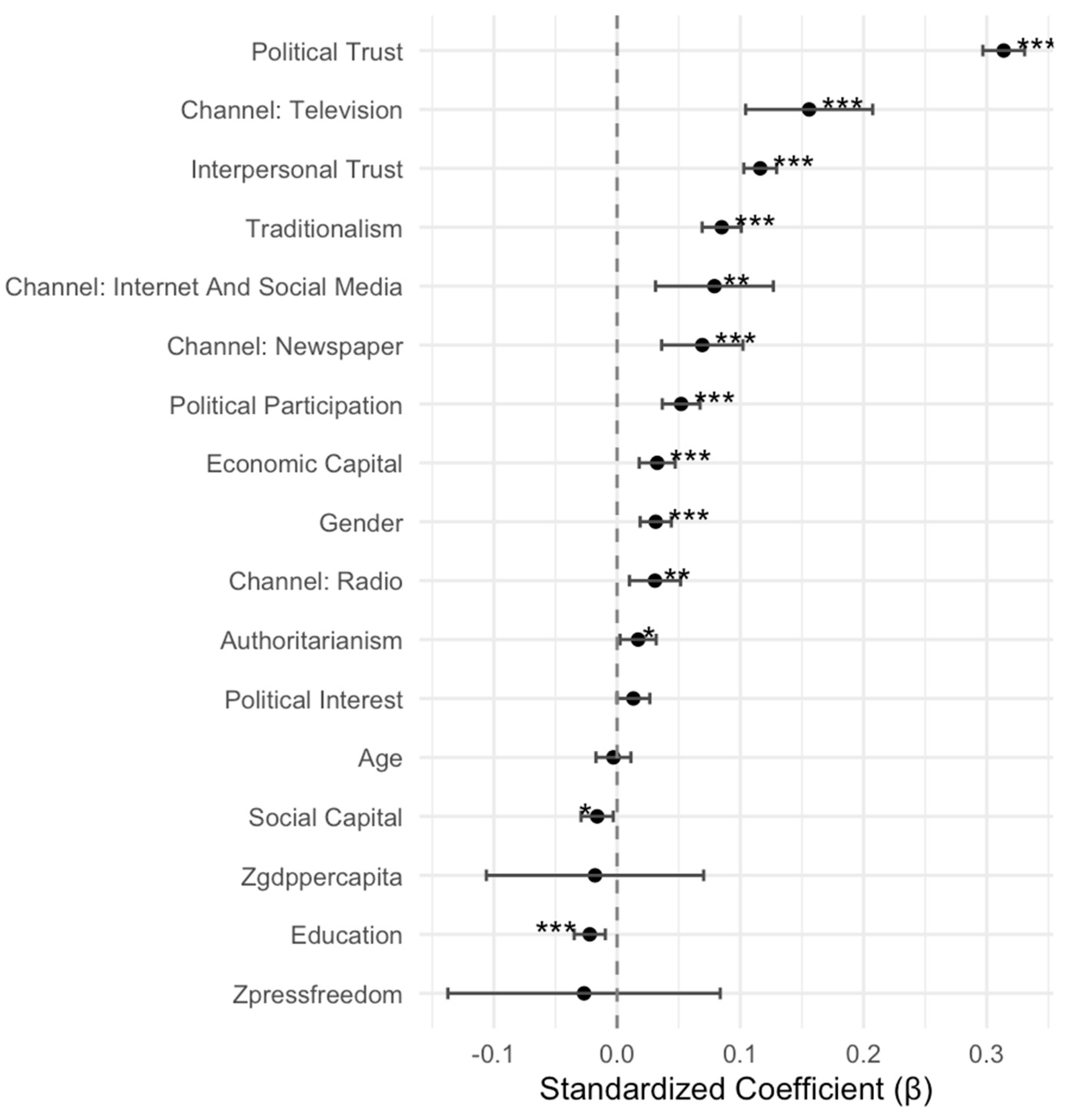
Figure 1. Estimated Fixed Effects with 95% confidence intervals (CI) for News Media Trust. Note. * p < 0.05, ** p < 0.01, *** p < 0.001. Dummy variables (Channel) are interpreted relative to the reference group; other coefficients reflect one-standard-deviation changes.
Journalmedia 07 00008 g001
Figure 2. Effect of Political Trust on News Media Trust Across Levels of Authoritarianism.
Journalmedia 07 00008 g002
Figure 3. Effect of Interpersonal Trust on News Media Trust Across Levels of Authoritarianism.
Journalmedia 07 00008 g003
Figure 4. Effect of Interpersonal Trust on News Media Trust Across Levels of Traditionalism.
Journalmedia 07 00008 g004
Figure 5. Cross-Level Effect of Press Freedom and Economic Capital on News Media Trust.
Journalmedia 07 00008 g005
Figure 6. Cross-Level Effect of GDP per Capita and Authoritarianism on News Media Trust.
Journalmedia 07 00008 g006
Table 1. Multilevel Linear Regression Models Predicting News Media Trust.
Model 0Model 1Model 2
Random Effects
COUNTRY (Intercept)0.322 ***0.190 ***0.180 ***
Residual0.9570.8820.874
Fixed Effects
Intercept−0.080−0.010 ***−0.010 ***
GDP pc−0.050−0.020
Press Freedom−0.030−0.030
Political interest0.020 ***0.010
Political participation0.050 ***0.050 ***
Political trust0.340 ***0.310 ***
Interpersonal trust0.130 ***0.120 ***
Channel_Television 0.160 ***0.160 ***
Channel_Newspaper 0.070 ***0.070 ***
Channel_Internet and social media0.050 *0.080 **
Channel_Radio 0.030 **0.030 **
Gender 0.030 ***0.030 ***
Education −0.020 ***−0.020 ***
Age 0.0000.000
Economic capital 0.030 ***
Social capital −0.020 *
Traditionalism 0.090 ***
Authoritarianism 0.020 *
Variance Explained (R2)
Marginal R2 0.1910.204
Conditional R20.1020.2270.236
Variance Components
Between-group variance (τ2)0.0830.0280.025
Within-group variance (σ2)0.7310.6010.585
Note. Coefficients are standardized betas. * p < 0.05, ** p < 0.01, *** p < 0.001.
Table 2. Individual-Level Interaction Models of Predicting News Media Trust.
Model 3Model 4Model 5Model 6
Random Effects
COUNTRY (Intercept)0.2020.2000.1810.180
Residual0.8720.8720.8740.874
Political trust0.072 ***0.077 ***
Interpersonal trust 0.039 **0.035 *
Fixed Effects
Intercept−0.036−0.035−0.010−0.009
GDP pc−0.051−0.044−0.014−0.017
Press Freedom0.0480.038−0.009−0.016
Political interest0.0110.0110.0130.013
Political participation0.055 ***0.057 ***0.053 ***0.052 ***
Political trust0.323 ***0.322 ***0.312 ***0.312 ***
Interpersonal trust0.115 ***0.115 ***0.120 ***0.120 ***
Channel_Television0.152 ***0.153 ***0.155 ***0.156 ***
Channel_Newspaper0.064 ***0.065 ***0.068 ***0.068 ***
Channel_Internet and social media0.079 **0.079 **0.081 ***0.081 ***
Channel_Radio0.028 **0.029 **0.031 **0.030 **
Gender0.032 ***0.032 ***0.032 ***0.033 ***
Education−0.023 ***−0.023 ***−0.023 ***−0.022 ***
Age0.0020.0020.0020.002
Economic capital0.033 ***0.033 ***0.033 ***0.033 ***
Social capital−0.019 **−0.019 **−0.017 **−0.016 **
Traditionalism0.089 ***0.089 ***0.085 ***0.084 ***
Authoritarianism0.018 *0.018 *0.020 **0.019 **
Political trust * Economic capital−0.000 −0.015 *
Political trust * Social capital0.007 0.024 ***
Political trust * Traditionalism 0.009
Political trust * Authoritarianism −0.022 **
Interpersonal trust * Economic capital −0.011
Interpersonal trust * Social capital 0.002
Interpersonal trust * Traditionalism −0.015 *
Interpersonal trust * Authoritarianism 0.024 ***
Variance Explained (R2)
Marginal R20.1990.2000.1980.202
Conditional R20.2440.2460.2330.236
Variance Components
Between-group variance (τ2)0.0510.0590.0320.029
Within-group variance (σ2)0.5820.5830.5850.584
Note. Coefficients are standardized betas. * p < 0.05, ** p < 0.01, *** p < 0.001.
Table 3. Cross-level Interaction Models of Predicting News Media Trust.
Model 7Model 8Model 9Model 10
Random Effects
COUNTRY (Intercept)0.1820.1800.1640.173
Residual0.8730.8740.8730.873
Economic capital0.042 ***
Social capital 0.014
Traditionalism 0.062 ***
Authoritarianism 0.049 ***
Fixed Effects
Intercept−0.019−0.0050.0000.005
GDP pc−0.026−0.018−0.009−0.007
Press Freedom−0.030−0.026−0.015−0.016
Political interest0.0130.013 *0.014 *0.014 *
Political participation0.050 ***0.052 ***0.055 ***0.059 ***
Political trust0.313 ***0.314 ***0.311 ***0.311 ***
Interpersonal trust0.115 ***0.116 ***0.115 ***0.117 ***
Channel_Television0.152 ***0.156 ***0.155 ***0.156 ***
Channel_Newspaper0.066 ***0.069 ***0.068 ***0.069 ***
Channel_Internet & social media0.079 ***0.081 ***0.082 ***0.083 ***
Channel_Radio0.029 **0.030 **0.029 **0.031 **
Gender0.032 ***0.032 ***0.032 ***0.032 ***
Education−0.025 ***−0.023 ***−0.023 ***−0.022 ***
Age0.0020.0030.0020.002
Economic capital0.0210.034 ***0.036 ***0.035 ***
Social capital−0.013 *−0.015−0.017 *−0.018 **
Traditionalism0.084 ***0.085 ***0.092 ***0.086 ***
Authoritarianism0.016 *0.018 *0.017 *0.035 *
GDP pc * Economic capital−0.002 0.037 *
Press Freedom * Economic capital−0.037 * −0.002
GDP pc * Social capital 0.002
Press Freedom * Social capital 0.003
GDP pc * Traditionalism 0.018
Press Freedom * Traditionalism 0.015
GDP pc * Authoritarianism 0.037 *
Press Freedom * Authoritarianism −0.002
Variance Explained (R2)
Marginal R20.1990.2040.2040.208
Conditional R20.2340.2370.2350.240
Variance Components
Between-group variance (τ2)0.0350.0250.0750.052
Within-group variance (σ2)0.5830.5830.5840.584
Note. Coefficients are standardized betas. * p < 0.05, ** p < 0.01, *** p < 0.001.
Disclaimer/Publisher’s Note: The statements, opinions and data contained in all publications are solely those of the individual author(s) and contributor(s) and not of MDPI and/or the editor(s). MDPI and/or the editor(s) disclaim responsibility for any injury to people or property resulting from any ideas, methods, instructions or products referred to in the content.