
An Agenda Feedback Wheel: News Corp’s Coverage of the Marcia Langton ‘Racism’ Controversy


Abstract
1. Introduction
- conservative advocacy, where news media power is used to advocate for conservative positions in democratic debates;
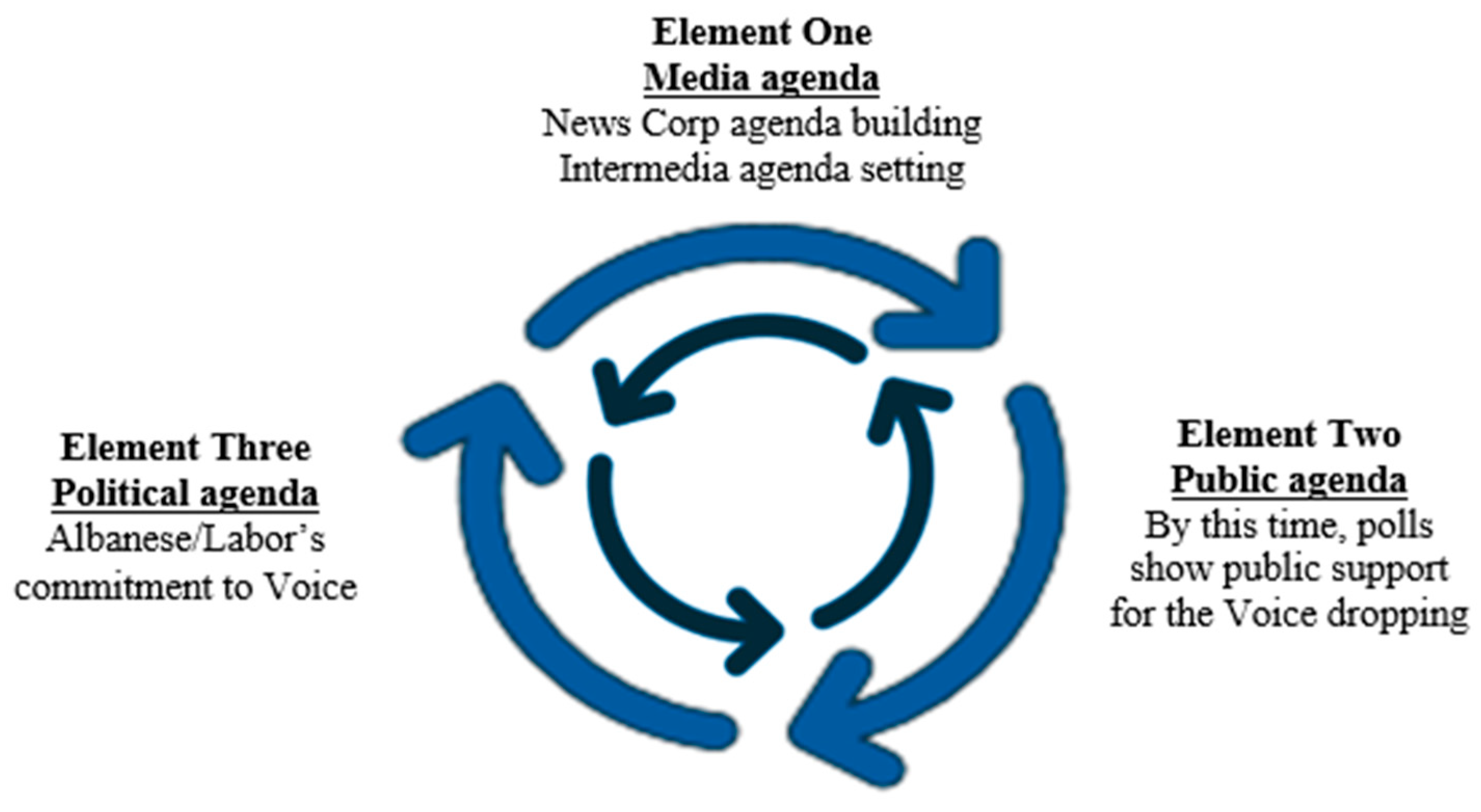
- agenda setting, to understand how this conservative advocacy is a form of active agenda building, which has an intermedia agenda-setting effect;
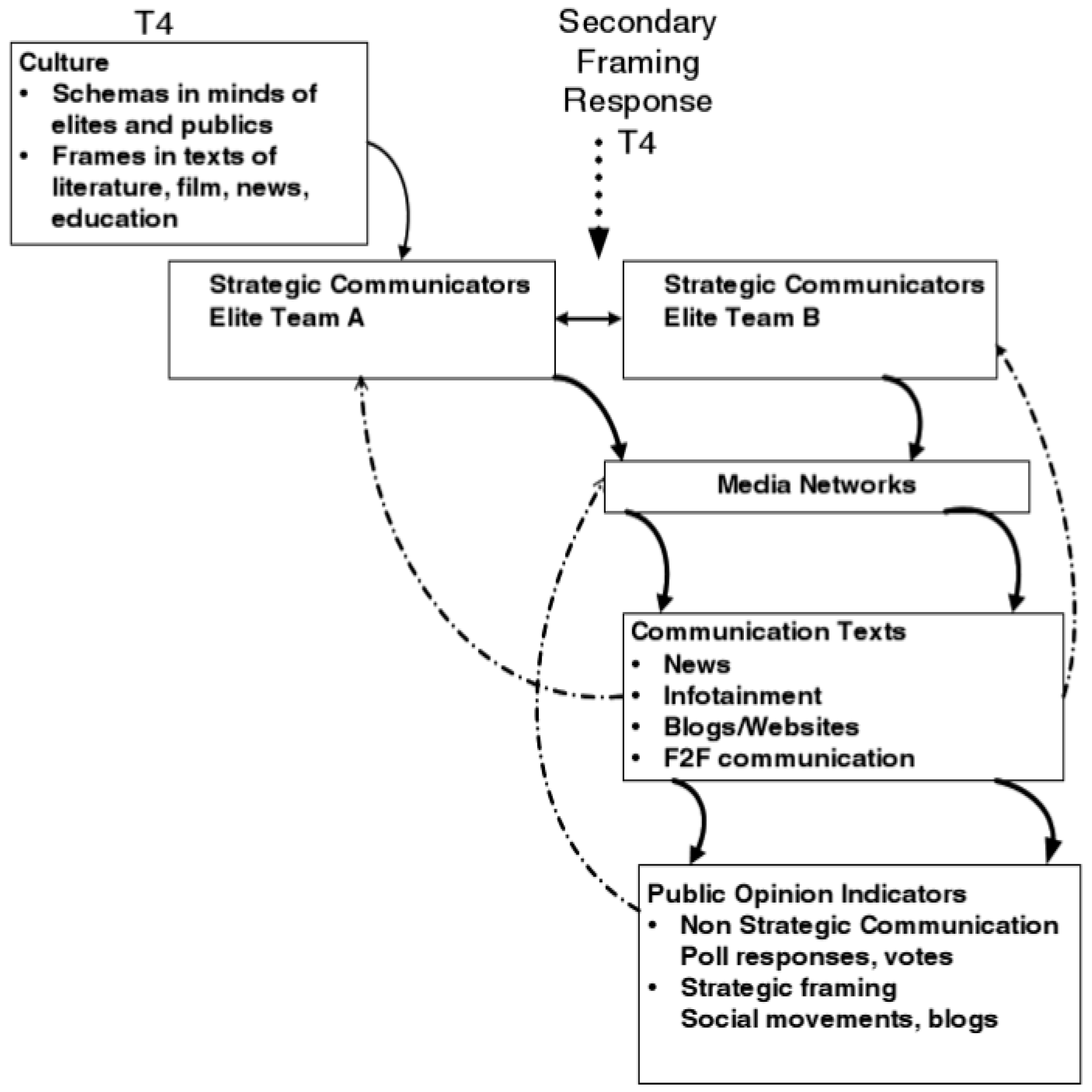
- frame-building theory, which helps to explain the interaction between advocacy frames, more passive journalistic frames, and public opinion.
“This thing is permanent, it‘s divisive, it hasn’t been properly explained and it’s not going to provide the practical outcomes that we want to see for all Indigenous Australians.”
2. Literature Review
2.1. Conservative Media Advocates
2.2. Political Agenda Setting
2.3. Media Agenda Setting: Not a Passive Process
2.4. Frame Building
3. Materials and Method
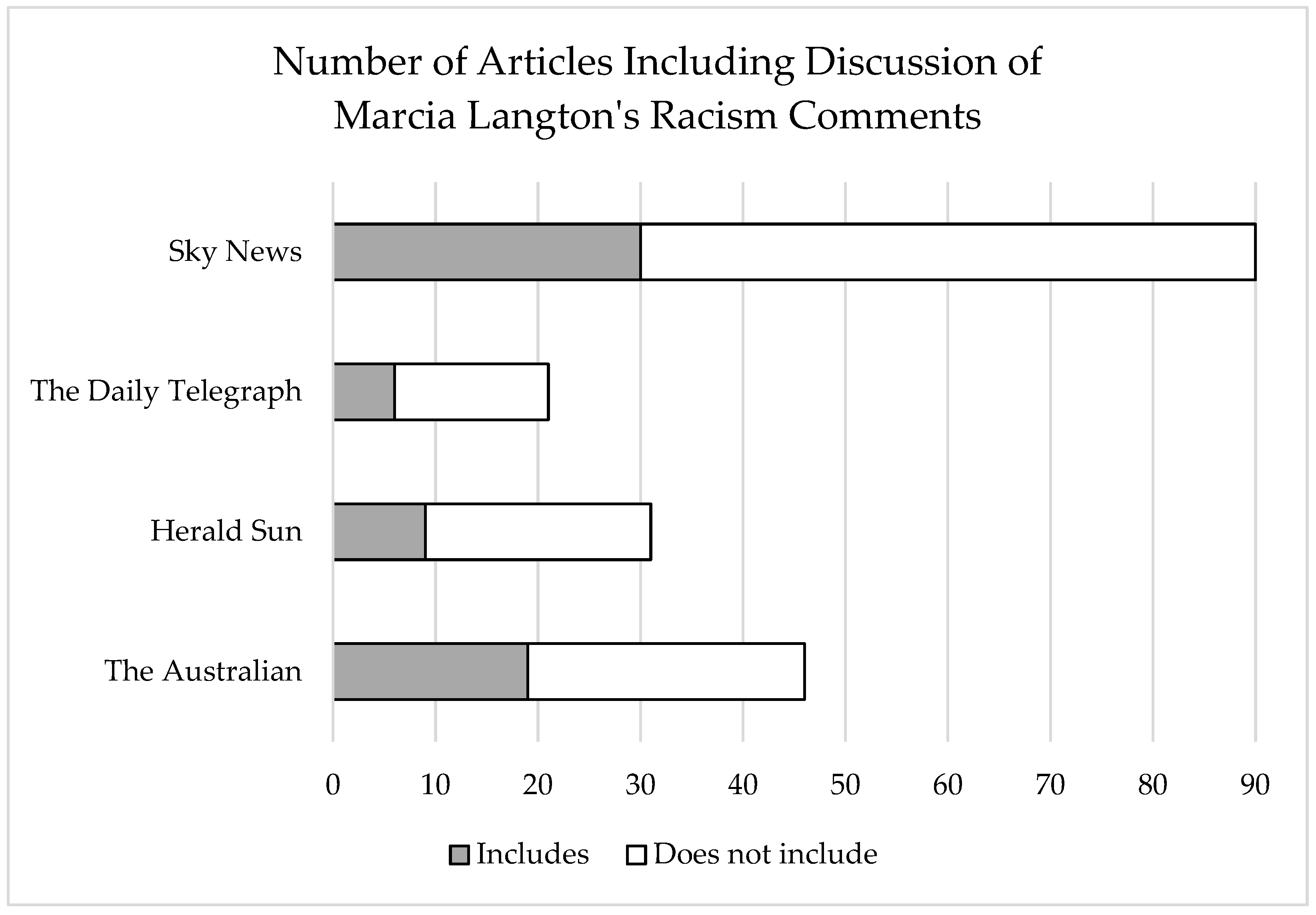
4. Results
“Every time the No case raises one of its arguments, if you start pulling it apart you get down to base racism. I’m sorry to say it but that’s where it lands. Or just sheer stupidity.”
“Australia’s been much better served by someone much less honoured than Langton and that’s Jacinta Nampijinpa Price. The hardest thing is to go against the noisy bullies amongst your own peers. But Price has consistently had the moral courage to do so, it was a tour de force… Her best response was to a loaded question where she simply denied that Aboriginal disadvantage was the result of a colonial past.”
“Langton’s comments were undoubtedly unhelpful to the Yes case—it is perfectly reasonable for voters to have legitimate concerns about constitutional change, and the No campaign is within its rights to appeal to those doubts.”
“when that’s your point of view—if that’s genuinely where you stand—then perhaps you get to a point where you can talk yourself into the idea that being called a racist is more hurtful or damaging or outrageous than being subjected to actual racism … to deny that racist arguments are out there and are being oxygenated by those who should know better is naïve on the very kindest interpretation, and grade-A gaslighting at its worst.”
5. Discussion
6. Conclusions
Author Contributions
Funding
Institutional Review Board Statement
Informed Consent Statement
Data Availability Statement
Conflicts of Interest
References
- Accent Research. (2023). An octopus group accent research report, understanding voter behaviour at the voice referendum: A first look. Available online: https://www.accent-research.com/voice (accessed on 28 January 2025).
- ANU. (2023). Indigenous voice to parliament. Australian National University. Available online: https://www.anu.edu.au/about/strategic-planning/indigenous-voice-to-parliament (accessed on 28 January 2025).
- Arceneaux, P., Albishri, O., Anderson, J., & Kiousis, S. (2024). Dynamcis of campaign, press, and public discourse in electoral politics. Journalism Studies, 25(2), 117–139. [Google Scholar] [CrossRef]
- Armstrong, C. (2023, October 14). Albo in a tearful plea to voters. Daily Telegraph. [Google Scholar]
- Barberã, P., Casas, A., Nagler, J., Egan, P. J., Bonneau, R., Jost, J. T., & Tucker, J. A. (2019). Who leads? Who follows? Measuring issue attention and agenda setting by legislators and the mass public using social media data. The American Political Science Review, 113(4), 883–901. [Google Scholar] [CrossRef] [PubMed]
- Bard, M. T. (2017). Propaganda, persuasion, or journalism? Fox News’ prime-time coverage of health-care reform in 2009 and 2014. Electronic News, 11(2), 100–118. [Google Scholar] [CrossRef]
- Bartholome, G., Lecheler, S., & de Vreese, C. (2015). Manufacturing conflict? How journalists intervene in the conflict frame building process. The International Journal of Press/Politics, 20(4), 438–457. [Google Scholar] [CrossRef]
- Bell, A. M., DeSante, C. D., Gift, T., & Smith, C. W. (2022). Entering the “foxhole”: Partisan media priming and the application of racial justice in America. Research & Politics, 9(4), 20531680221137136. [Google Scholar] [CrossRef]
- Benkler, Y., Faris, R., & Roberts, H. (2018). Network propaganda: Manipulation, disinformation, and radicalization in American politics. Oxford University Press. [Google Scholar]
- Benkler, Y., Tilton, C., Etling, B., Roberts, H., Clark, J., Faris, R., Kaiser, J., & Schmitt, C. (2020). Mail-in voter fraud: Anatomy of a disinformation campaign. Berkman Center Research Publication No. 2020-6. Available online: https://papers.ssrn.com/sol3/papers.cfm?abstract_id=3703701 (accessed on 29 December 2025).
- Biddle, N. (2023). Vast majority of voters still think first nations Australians should have a voice. Australian National University. Available online: https://reporter.anu.edu.au/all-stories/vast-majority-of-voters-still-think-first-nations-australians-should-have-a-voice (accessed on 14 March 2024).
- Broockman, D., & Kalla, J. (2022). The impacts of selective partisan media exposure: A field experiment with Fox News viewers. OSF Preprints. [Google Scholar] [CrossRef]
- Bryant, J., & Finklea, B. W. (2022). Fundamentals of media effects: Third edition. Waveland Press. [Google Scholar]
- Butler, J. (2023a, September 12). Marcia Langton denies criticising no voters, and says media is targeting her. The Guardian. [Google Scholar]
- Butler, J. (2023b, September 13). Marcia Langton to seek legal advice over Dutton post quoting ‘absolutely not true’ voice headline. The Guardian. [Google Scholar]
- Butler, J., & Allam, L. (2023, September 14). ‘A betrayal’: Burney condemns Price claim colonisation had no ongoing negative impacts. The Guardian. Available online: https://www.theguardian.com/australia-news/2023/sep/14/jacinta-nampijinpa-price-says-colonisation-had-no-negative-impacts-on-indigenous-australians (accessed on 29 December 2025).
- Christians, C. G., Glasser, T. L., McQuail, D., Nordenstreng, K., & White, R. A. (2009). Normative theories of the media: Journalism in democratic societies. University of Illinois Press. [Google Scholar]
- Cohen, B. (1963). The press and foreign policy. Princeton University Press. [Google Scholar]
- Crabb, A. (2023, September 14). The attacks on Marcia Langton are not part of a theoretical debate. We know that racism exists. ABC. [Google Scholar]
- Credlin, P. (2023, September 15). Credlin in ‘national hero’: Peta Credlin praises Jacinta Price’s ‘moral courage’. Available online: https://www.youtube.com/watch?v=odfyIXrIlLc (accessed on 28 January 2025).
- Cushion, S., Kilby, A., Thomas, R., Morani, M., & Sambrook, R. (2018). Newspapers, impartiality and television news: Intermedia agenda-setting during the 2015 UK general election campaign. Journalism Studies, 19(2), 162–181. [Google Scholar] [CrossRef]
- Deacon, D., Downey, J., Harmer, E., Stanyer, J., & Wring, D. (2016). The narrow agenda: How the news media covered the Referendum. EU Referendum Analysis, 2016, 34–35. [Google Scholar]
- Dearing, J. W., & Rogers, E. (1996). Agenda-setting. Sage publications. [Google Scholar]
- DiMaggio, A. R. (2022). Conspiracy theories and the manufacture of dissent: QAnon, the ‘Big Lie’, COVID-19, and the rise of rightwing propaganda. Critical Sociology, 48(6), 1025–1048. [Google Scholar] [CrossRef]
- Edwards, G., & Wood, B. (1999). Who influences whom? The President, congress, and the media. The American Political Science Review, 93(2), 327–344. [Google Scholar] [CrossRef]
- Elmelund-Praestekaer, C., & Wien, C. (2008). What’s the fuss about? The interplay of mediahypes and politics. The International Journal of Press/Politics, 13(3), 247–266. [Google Scholar] [CrossRef]
- Entman, R. M. (2007). Framing bias: Media in the distribution of power. Journal of Communication, 57(1), 163–173. [Google Scholar] [CrossRef]
- Entman, R. M., Matthes, J., & Pellicano, L. (2009). Nature, sources and effects of news framing. In K. Wahl-Jorgensen, & T. Hanitzsch (Eds.), The handbook of journalism studies (pp. 175–190). Routledge. [Google Scholar]
- Eshbaugh-Soha, M., & Peake, J. (2005). Presidents and the economic agenda. Political Research Quarterly, 58(1), 127–138. [Google Scholar] [CrossRef]
- Evershed, N., & Nicholas, J. (2023, October 13). Voice referendum 2023 poll tracker: Latest results of opinion polling on support for yes and no campaign. The Guardian. Available online: https://www.theguardian.com/news/datablog/ng-interactive/2023/oct/13/indigenous-voice-to-parliament-referendum-2023-poll-results-polling-latest-opinion-polls-yes-no-campaign-newspoll-essential-yougov-news-by-state-australia (accessed on 29 December 2025).
- Faris, R., Roberts, H., Etling, B., Bourassa, N., Zuckerman, E., & Benkler, Y. (2017). Partisanship, propaganda, and disinformation: Online media and the 2016 US presidential election. Berkman Klein Center for Internet & Society Research Paper. Available online: https://dash.harvard.edu/entities/publication/73120379-47f2-6bd4-e053-0100007fdf3b (accessed on 29 December 2025).
- Fielding, V. (2023). Conservative advocacy journalism: Explored with a model of journalists’ influence on democracy. Journalism, 24(8), 1817–1835. [Google Scholar] [CrossRef]
- Fielding, V. (2025). Evaluating reporting roles in climate disasters. In S. Cottle (Ed.), Communicating a world-in-crisis (1st ed., Vol. 31, pp. 43–63). Peter Lang Publishing. [Google Scholar]
- Fielding, V., Boucaut, R., Son, C., & Beare, A. H. (2025a). News media’s legitimisation of disinformation: Propaganda and the length of the Uluru Statement. Critical Studies in Media Communication, 42(1), 89–94. [Google Scholar] [CrossRef]
- Fielding, V., Son, C., Boucaut, R., & Beare, A. H. (2025b). News corp australia’s conservative advocacy against the indigenous voice to parliament. International Journal of Communication, 19(21), 437–457. [Google Scholar]
- Gaber, I. (2024). Brexit and murdoch—A marriage made in hell. In The routledge companion to business journalism (pp. 399–408). Routledge. [Google Scholar]
- Gaber, I., & Tiffen, R. (2018). Politics and the media in Australia and the United Kingdom: Parallels and contrasts. Media International Australia, 167(1), 27–40. [Google Scholar] [CrossRef]
- Gavin, N. T. (2018). Media definitely do matter: Brexit, immigration, climate change and beyond. The British Journal of Politics and International Relations, 20(4), 827–845. [Google Scholar] [CrossRef]
- Gilardi, F., Gessler, T., Kubli, M., & Müller, S. (2022). Social media and political agenda setting. Political Communication, 39(1), 39–60. [Google Scholar] [CrossRef]
- Hoewe, J., Brownell, K. C., & Wiemer, E. C. (2020). The role and impact of Fox News. The Forum, 18, 367–388. [Google Scholar] [CrossRef]
- Kelly, J., & Lewis, R. (2023, September 12). ‘Base racism’: Indigenous voice to parliament Yes leader Marcia Langton in no-holds-barred call. The Australian. [Google Scholar]
- Lan, X., Tarasevich, S., Proverbs, P., Myslik, B., & Kiousis, S. (2020). President Trump vs. CEOs: A comparison of presidential and corporate agenda building. Journal of Public Relations Research, 32(1–2), 30–46. [Google Scholar] [CrossRef]
- Langer, A. I., & Gruber, J. B. (2021). Political agenda setting in the hybrid media system: Why legacy media still matter a great deal. The International Journal of Press/Politics, 26(2), 313–340. [Google Scholar] [CrossRef]
- Levendusky, M. (2013). Partisan media exposure and attitudes toward the opposition. Political Communication, 30(4), 565–581. [Google Scholar] [CrossRef]
- Levendusky, M. (2024). How partisan media polarize America. University of Chicago Press. [Google Scholar]
- Maley, J. (2023, September 17). Pity the subject of a pile-on. The Age. [Google Scholar]
- Manne, R. (2011). Bad news: Murdoch’s Australian and the shaping of the nation. Quarterly Essay, (43), 1–119. [Google Scholar]
- Martin, G. J., & Yurukoglu, A. (2017). Bias in cable news: Persuasion and polarization. American Economic Review, 107(9), 2565–2599. [Google Scholar] [CrossRef]
- Matusitz, J., & Breen, G.-M. (2012). An examination of pack journalism as a form of groupthink: A theoretical and qualitative analysis. Journal of Human Behavior in the Social Environment, 22(7), 896–915. [Google Scholar] [CrossRef]
- McKnight, D. (2003). “A world hungry for a new philosophy”: Rupert Murdoch and the rise of neo-liberalism. Journalism Studies, 4(3), 347–358. [Google Scholar] [CrossRef]
- McKnight, D. (2013). Murdoch’s politics: How one man’s thirst for wealth and power shapes our world. Pluto Press. [Google Scholar]
- Murphy, K. (2023, September 16). Some Australians seem more outraged by accusations of racism than by racism itself. Guardian Australia. [Google Scholar]
- Peterson, E., Goel, S., & Iyengar, S. (2021). Partisan selective exposure in online news consumption: Evidence from the 2016 presidential campaign. Political Science Research and Methods, 9(2), 242–258. [Google Scholar] [CrossRef]
- Phillips, A. (2019). The british right-wing mainstream and the European referendum. In A. Nadler, & A. J. Bauer (Eds.), News on the right: Studying conservative news cultures (pp. 141–156). Oxford University Press. [Google Scholar]
- Roberts, G. (2023, September 14). Sussan Ley says Liberals not running No campaign as mass distribution of text messages questioned. ABC. [Google Scholar]
- Scheufele, D. A., & Tewksbury, D. (2007). Framing, agenda setting, and priming: The evolution of three media effects models. Journal of Communication, 57, 9–20. [Google Scholar] [CrossRef]
- Schweickart, T., Neil, J., Kim, J. Y., & Kiousis, S. (2016). Time-lag analysis of the agenda-building process between White House public relations and congressional policymaking activity. Journal of Communication Management (London, England), 20(4), 363–380. [Google Scholar] [CrossRef]
- Sevenans, J. (2017). The media’s informational function in political agenda-setting processes. The International Journal of Press/Politics, 22(2), 223–243. [Google Scholar] [CrossRef]
- Shoemaker, P., & Reese, S. (1996). Mediating the message: Theories of influences on mass media content (2nd ed.). Longman. [Google Scholar]
- Starbird, K., DiResta, R., & DeButts, M. (2023). Influence and improvisation: Participatory disinformation during the 2020 US election. Social Media+ Society, 9(2), 20563051231177943. [Google Scholar] [CrossRef]
- Su, Y., & Borah, P. (2019). Who is the agenda setter? Examining the intermedia agenda-setting effect between Twitter and newspapers. Journal of Information Technology & Politics, 16(3), 236–249. [Google Scholar] [CrossRef]
- Tan, Y., & Weaver, D. (2007). Agenda-setting effects among the media, the public, and Congress, 1946–2004. Journalism & Mass Communication Quarterly, 84(4), 729–744. [Google Scholar] [CrossRef]
- Van Aelst, P., & Walgrave, S. (2011). Minimal or massive? The political agenda-setting power of the mass media according to different methods. The International Journal of Press/Politics, 16(3), 295–313. [Google Scholar] [CrossRef]
- Van der Pas, D. (2014). Making hay while the sun shines: Do parties only respond to media attention when the framing is right. The International Journal of Press/Politics, 19(1), 42–65. [Google Scholar] [CrossRef]
- Van Gorp, B. (2010). Strategies to take subjectivity out of framing analysis. In P. D’Angelo, J. A. Kuypers, & I. Ebrary (Eds.), Doing news framing analysis empirical and theoretical perspectives (pp. 84–109). Routledge. [Google Scholar]
- Vesa, J., Bloomberg, H., & Kroll, C. (2015). Minimal and massive! Politicians’ views on the media’s political agenda-setting power revisited. The International Journal of Press/Politics, 20(3), 279–296. [Google Scholar] [CrossRef]
- Vliegenthart, R., Walgrave, S., Baumgartner, F., Bevan, S., Breunig, C., Brouard, S., Chaques Bonafont, L., Grossoman, E., Jennings, W., Mortensen, P., Palau, A., Sciarini, P., & Tresch, A. (2016). Do the media set the parliamentary agenda? A comparative study in seven countries. European Journal of Political Research, 55(2), 283–308. [Google Scholar] [CrossRef]
- Vonbun, R., Konigslow, K., & Schoenbach, K. (2015). Intermedia agenda setting in a multimedia news environment. Journalism Theory, Practice, and Criticism, 17(8), 1054–1073. [Google Scholar] [CrossRef]
- Walgrave, S., Boydstun, A. E., Vliegenthart, R., & Hardy, A. (2017). The nonlinear effect of information on political attention: Media storms and U.S. congressional hearings. Political Communication, 34(4), 548–570. [Google Scholar] [CrossRef]
- Wolfe, M., Jones, B. D., & Baumgartner, F. R. (2013). A failure to communicate: Agenda setting in media and policy studies. Political Communication, 30(2), 175–192. [Google Scholar] [CrossRef]
- Yang, Y. (2025). Weapons of mass deception: How right-wing media wage information warfare and undermine american democracy. Oxford University Press, Incorporated. [Google Scholar]
- Yang, Y., & Bennett, L. (2022). Interactive propaganda. In P. Van Aelst, & J. G. Blumler (Eds.), Political communication in the time of coronavirus (pp. 83–100). Routledge. [Google Scholar]



| Author | Outlet | Headline |
|---|---|---|
| Dennis Shanahan | The Australian | Langton has no one to blame but herself |
| Joe Kelly | The Australian | Langton has form in ‘racism’ attacks |
| James Morrow | Daily Telegraph | Langton denies calling No voters racist and stupid after comments revealed |
| Andrew Bolt | Herald Sun | Langton’s dirty record of playing race card doomed Voice from start |
| Rita Panahi | Herald Sun | Dignified voice of truth-teller Price rises above race-baiting Langton |
| James Morrow and Angira Bharadwaj | Herald Sun | Burney silent on Langton |
| News Day | Sky News | Resurfaced comments reveal Marcia Langton called Jacinta Price ‘coloured help’ |
| News Day | Sky News | Video emerges of Marcia Langton saying ‘hard No voters’ are ‘spewing racism’ |
| Andrew Bolt | Sky News | Marcia Langton ‘embarrassed herself’ trying to ‘hose down’ her disaster comments |
| Chris Kenny | Sky News | Marcia Langton fell for the ‘leftist mistake’ of abusing voters |
| Peta Credlin | Sky News | Mundine responds to Langton’s ‘racist and stupid’ label on No campaigners |
| Jack Houghton | Sky News | ‘Hysterical media elite’ rush to defend Marcia Langton for her controversial comments |
| Andrew Bolt | Sky News | Andrew Bolt slams ‘race baiter’ Marcia Langton after calling out No campaigners |
| Afternoon Agenda | Sky News | Marcia Langton ‘not helping’ the Voice’s cause after ‘disaster’ video emerges |
| Sharri Markson | Sky News | WATCH: Marcia Langton labels No campaigners ‘racist, stupid’ in exclusive footage |
| Peta Credlin | Sky News | ‘No surprise’: Jacinta Price slams Marcia Langton for derogatory ‘attacks’ |
| Sharri Markson | Sky News | Marcia Langton hopes Voice will target ‘anti-racism strategies’ |
| Frame | Sentiment Towards Langton |
|---|---|
| Langton problematic (controversial and divisive) | Negative |
| Langton problem for the Yes campaign | Negative |
| Media scrutiny of racism from the No campaign | Positive |
| Media scrutiny of News Corp’s depiction of Langton | Positive |
| No campaign problematic (controversial/hypocritical) | Positive |
| Outlet | Number of Positive Articles | Number of Negative Articles | Number of Articles Mixed Positive/Negative |
|---|---|---|---|
| Australian Broadcasting Corporation (ABC) | 1 | 4 | 2 |
| The Age | 5 | 3 | 3 |
| The Guardian | 2 | 0 | 1 |
| Sydney Morning Herald | 1 | 0 | 0 |
Disclaimer/Publisher’s Note: The statements, opinions and data contained in all publications are solely those of the individual author(s) and contributor(s) and not of MDPI and/or the editor(s). MDPI and/or the editor(s) disclaim responsibility for any injury to people or property resulting from any ideas, methods, instructions or products referred to in the content. |
© 2025 by the authors. Licensee MDPI, Basel, Switzerland. This article is an open access article distributed under the terms and conditions of the Creative Commons Attribution (CC BY) license.
Share and Cite
Son, C.; Fielding, V.; Beare, A.; Boucaut, R. An Agenda Feedback Wheel: News Corp’s Coverage of the Marcia Langton ‘Racism’ Controversy. Journal. Media 2026, 7, 4. https://doi.org/10.3390/journalmedia7010004
Son C, Fielding V, Beare A, Boucaut R. An Agenda Feedback Wheel: News Corp’s Coverage of the Marcia Langton ‘Racism’ Controversy. Journalism and Media. 2026; 7(1):4. https://doi.org/10.3390/journalmedia7010004
Chicago/Turabian StyleSon, Catherine, Victoria Fielding, Alexander Beare, and Robert Boucaut. 2026. "An Agenda Feedback Wheel: News Corp’s Coverage of the Marcia Langton ‘Racism’ Controversy" Journalism and Media 7, no. 1: 4. https://doi.org/10.3390/journalmedia7010004
APA StyleSon, C., Fielding, V., Beare, A., & Boucaut, R. (2026). An Agenda Feedback Wheel: News Corp’s Coverage of the Marcia Langton ‘Racism’ Controversy. Journalism and Media, 7(1), 4. https://doi.org/10.3390/journalmedia7010004