
Systematic Review

Media and Women Politicians in Southern Africa: A Systematic Review
by
Tigere Paidamoyo Muringa
* and
James Ndlovu
Department of Media, Language and Communication, Faculty of Arts and Design, City Campus, Durban University of Technology, Durban 4001, South Africa
*
Author to whom correspondence should be addressed.
Journal. Media 2026, 7(1), 23; https://doi.org/10.3390/journalmedia7010023
Submission received: 6 November 2025 / Revised: 23 January 2026 / Accepted: 26 January 2026 / Published: 30 January 2026

Abstract

Gendered media framing continues to restrict women’s political representation in Southern Africa, where news narratives often emphasise emotion and personality over policy and competence. This systematic review analysed empirical and grey literature (2000–2025) on the portrayal of women politicians in South Africa, Zimbabwe, Malawi, Zambia, Lesotho, and Namibia. Following PRISMA 2020 standards, 1384 records were identified from academic databases and regional repositories, with 73 records meeting the inclusion criteria. The studies were thematically analysed using feminist media theory. The review uncovers enduring stereotypes—such as motherhood, moral virtue, and emotionality—while leadership competence remains marginalised. Coverage frequently reinforces the “political glass cliff,” portraying women as suitable only during crises. Nonetheless, some evidence of resistance journalism and feminist digital counter-narratives is emerging, driven by NGOs like Gender Links and Media Monitoring Africa. Despite methodological diversity, most studies emphasise qualitative textual analysis and highlight limited audience or production research. Major limitations include reliance on English-language and secondary data, which restrict regional generalisability. Overall, the findings underscore that symbolic exclusion persists across Southern African media, emphasising the need for gender-sensitive newsroom frameworks and transformative reporting practices. This review received no external funding and is not registered in PROSPERO.

1. Introduction

In the new global media landscape, fair political representation depends not only on formal rights but also on how candidates are symbolically portrayed in news and digital platforms. Ideally, news coverage of women politicians should focus on their policy expertise, leadership achievements, and the significance of the issues they address, enabling citizens to evaluate candidates on equal footing (Thomas et al., 2021). In this process, journalism should aim to minimise bias, ensure balanced sourcing, and emphasise context rather than rely on personality stereotypes (Muringa & McCracken, 2021). The role of newsrooms and platforms is crucial because media framing influences what audiences notice, how they interpret candidate credibility, and whether women are perceived as legitimate leaders (Adcock, 2010; Coffie & Medie, 2021).
Nevertheless, empirical evidence from Southern Africa highlights a persistent gap between these normative expectations of fair political journalism and the everyday practices through which women politicians are portrayed. Coverage of women politicians in Southern Africa is often marked by gendered narratives—centred on domesticity, morality, personality, and “soft” traits—rather than policy substance and institutional performance (Geertsema, 2008; J. Mpofu, 2017; Kanjere, 2019; Dos Santos, 2021). This tendency is amplified in digital spaces where partisan messaging, emotional polarisation, and networked harassment can reinforce biases and generate fear (Matsilele & Nkoala, 2023; Tembo, 2024). These patterns stem from long-standing newsroom routines, historic gendered discourses during post-authoritarian transitions, and platform logics that prioritise sensationalism over meaningful debate (Seidman, 1999; Lewis, 2009; Adcock, 2010; Mutsvairo & Ragnedda, 2017). The consequence is a representational challenge: even when formal inclusion has improved, symbolic inclusion remains insufficient. Therefore, undermining democratic assessment of women candidates, fostering hostile online environments, and weakening substantive equality aims linked to regional development agendas (Geisler, 1995, Maphosa et al., 2015; Olaitan, 2024).
Data from multiple studies show that news and social media coverage across Southern Africa often relies on recurring gendered frames—motherhood, moral guardianship, emotionality, and physical appearance—while marginalising competence and policy expertise (Geertsema, 2008; J. Mpofu, 2017; Kanjere, 2019; Dos Santos, 2021). For example, South African case studies reveal that women leaders are frequently portrayed through personalised and moralised lenses in mainstream and ethnic media, affecting identity construction and audience trust (Soobben & Rawjee, 2013; Buiten, 2009; Dos Santos, 2021). Comparative and country-specific research further indicates how online environments enable partisan “metavoicing,” strategic authenticity performances, and counter-messaging by women politicians, while also subjecting them to increased scrutiny and hostility (Matsilele & Nkoala, 2023; Muringa et al., 2024). In Malawi and Zimbabwe, social and legacy media circulate gendered tropes and fear cues related to women’s leadership, shaping public emotions and reinforcing barriers to participation (Tiessen, 2008; Gunde, 2015; Tembo, 2024; Ncube, 2020). Studies based in Lesotho and Namibia similarly highlight persistent sexist frames in print coverage of women in business and politics, indicating a widespread continuity of representational challenges across the region (Rapitse et al., 2019; Nunuhe, 2020).
However, much of the research to date remains fragmented by country, medium, or election cycle, which hinders cross-comparison of frames and newsroom practices across the sub-region (J. Mpofu, 2017; Coffie & Medie, 2021). Several influential studies are single-case dissertations or journal articles that provide depth but lack cross-national synthesis (Katembo, 2005; Mannya, 2013; Nkomo, 2016; Parichi, 2016). In Zimbabwe, extensive scholarship analyses misogynistic discourses, visual stereotyping, and online violence, yet cumulative evidence is scattered across specific topics—from campaign cartoons to social media audiences—limiting its immediate usefulness as actionable guidance for newsrooms (Chikaipa, 2019; Ncube & Yemurai, 2020; Mangena, 2022; Chirongoma & Mavengano, 2023; Mtero et al., 2023; Zigomo, 2022).
Surprisingly, despite several national case studies, there is still no comprehensive, region-wide systematic review that (a) identifies dominant frames and visual tropes across countries and platforms, and (b) extracts practical, evidence-based reporting practices to reduce bias—especially during the heightened significance of elections (Coffie & Medie, 2021; Muringa & McCracken, 2021; Olaitan, 2024). Consequently, little is known about how specific newsroom routines, sourcing strategies, and platform capabilities can be adapted to emphasise competence, policy, and institutional performance while protecting coverage from the “political glass cliff” and related crisis-only narratives (Adcock, 2010; Dos Santos, 2021; Muringa et al., 2024).
The review synthesises empirical evidence on how women politicians are portrayed in both traditional and digital media during elections in Southern Africa, identifies familiar gendered narratives, and highlights emerging counter-framing practices that challenge these depictions. The scope includes academic and grey literature published between 2000 and 2025, covering South Africa, Zimbabwe, Malawi, Zambia, Namibia, and Lesotho, countries with similar postcolonial media environments and democratic transitions. Two key questions guide this inquiry:
i.
How do the media in Southern Africa portray women politicians?
ii.
What reporting practices reinforce or challenge gendered frames, such as the “political glass cliff”?
After this introduction, the paper proceeds as follows. First, it situates the review within feminist media theory and political communication scholarship, utilising regionally grounded studies (Adcock, 2010; Coffie & Medie, 2021). Next, it outlines the methodology, including the search strategy, screening, and appraisal procedures, as well as the approach to thematic synthesis. The findings section then presents the qualitative results and cross-national frames commonly used in reporting women politicians. The discussion section interprets the findings and their implications for literature, theory, and practice. The paper concludes with implications for media practice, training, and policy across the Southern African region.

2. Theoretical Underpinnings: The Feminist Media Theory

This paper contends that media coverage of women politicians in Southern Africa is heavily gendered. During elections, women’s leadership is often emphasised only in times of crisis or uncertainty. This reflects the “political glass cliff” phenomenon. Such framing reinforces perceptions of women’s fragility and exceptionalism, limiting recognition of their competence and authority in stable political settings. To examine this phenomenon, the study employs feminist media theory as its primary analytical framework. Feminist media theory offers conceptual tools to analyse how media institutions, discourses, and visual narratives uphold gender hierarchies by naturalising male political authority and marginalising women’s legitimacy as leaders (Steeves, 1987; McLaughlin, 1993; Thornham, 2007). It argues that media are not passive mirrors of reality but active sites of ideological production, where gendered meanings are created, circulated, and normalised (Lumby, 1994a; Steiner, 2014).
From its early formulations, feminist media analysis has aimed to uncover how symbolic power functions through representation. Steeves (1987) observed that women’s exclusion from political narratives was not just quantitative but structural—rooted in patriarchal codes that favour masculine rationality over feminine emotionality. McLaughlin (1993) similarly emphasised that gendered media discourses shape the limits of democratic participation by defining who can speak, lead, and be trusted in the public sphere. Within this framework, portrayals of women politicians as emotional, indecisive, or domestically defined are seen as mechanisms that perpetuate systemic inequality under the pretence of journalistic neutrality (Rhode, 1995; Thornham, 2007).
Feminist media theorists also argue that media spaces are battlegrounds where gendered meanings are constantly negotiated and contested. Press (2011) and Harp et al. (2018b) assert that contemporary feminist media studies go beyond critique to aim for transformation—seeking to reform media practices through gender-sensitive ethics and structural change. By showing how women’s political visibility is often conditional—shaped by scandal, morality, or “crisis competence”—feminist media theory enables a systematic examination of media bias and its institutional roots (Lumby, 1994a; Watkins & Emerson, 2000).
Empirical evidence from Southern Africa highlights these theoretical concerns. Dos Santos (2021) found that online news coverage of Nkosazana Dlamini-Zuma in South Africa reflected patriarchal narratives of emotional excess and unfitness for leadership. Likewise, Muringa and McCracken (2021) observed similar biases in framing her ANC presidential campaign across Independent Online and News24. J. Mpofu (2017) documented how Southern African media routinely link female politicians to domestic or moral roles instead of governance capabilities, reinforcing symbolic marginalisation. Similarly, Tembo (2024) showed how Malawian social media discourses use fear and ridicule to police women’s political presence, while Rapitse et al. (2019) illustrated how Lesotho’s print media continue to frame women leaders through sexist tropes of emotionality and physical appearance. Ndlovu and Mandiyanike (2025) employ feminist media theory to interrogate how gendered power relations shape processes and outcomes in exploring media representations in the South African context. These examples demonstrate the ongoing nature of patriarchal discourse across platforms and contexts, supporting Thornham’s (2007) view that representational bias is systemic rather than accidental.
Feminist media theory underpins this study’s interpretive and normative aims: to uncover the gendered ideological structures woven into electoral journalism. It provides both critique and reconstruction—showing how patriarchal logics continue in media framing while offering a theoretical basis for creating counter-practices that highlight women’s political competence, diversity, and leadership beyond the crisis-driven “glass cliff.”

Global Perspectives on Media Framing of Women Politicians

Both in African and global comparisons, the literature generally concludes that media portrayals of female politicians remain gendered structurally, despite lacking overt hostility or negativity (Coffie & Medie, 2021; Sazali & Basit 2020). Meta-analytic and comparative studies show that women politicians are often portrayed through personalised and symbolic coding, using categories such as image, family roles, emotionality, and moral impressions, rather than focusing on policy merit or leadership. A meta-analytic study by Sazali and Basit (2020), which used a global sample from diverse regions including Africa, Europe, Asia, and the Americas, confirms that women in politics face greater scrutiny and are judged by stricter standards than men. Similarly, in the African context, a series of content analyses and framing studies across countries like Nigeria, Ghana, Uganda, Kenya, and Southern Africa, examining print media content, reveal fewer coverage instances of women and a stronger emphasis on personal narratives linked to ‘soft’ politics (Ette, 2017; Osei-Appiah, 2019; Coffie & Medie, 2021; Kasadha & Kantono, 2021; Luka & Ugondo, 2025). Methodologically, these studies mainly employ systematic content analysis of the press, focusing on variables such as coverage intensity and tone.
Concurrently, the literature highlights notable contextual differences that complicate a consistent understanding of gendered marginalisation. Comparative African studies show that, although gendered framing is common, its strength and forms vary across different media systems and political environments. For instance, research on Ghanaian media reveals cases of relatively balanced coverage and issue-focused reporting of female candidates, especially in state-affiliated or public-interest outlets (Osei-Appiah, 2019; Coffie & Medie, 2021). Similarly, analyses of international media portrayals of African women leaders suggest that competence-based frames—such as anti-corruption efforts, technocratic skills, and reformist credentials—are present, though they are often subtly infused with references to femininity through mentions of marital status or domestic respectability (Azanu et al., 2023). Beyond Africa, comparative studies across Europe, Australia, and global newspapers reveal that even when coverage is neutral or positive, framing strategies frequently depict women as moral role models, emotional figures, or symbolic representatives rather than as ordinary political actors (Joshi et al., 2019; Wright & Holland, 2014; Haraldsson & Wängnerud, 2019). These observations underline a methodological insight across the literature: sentiment analysis alone is insufficient for capturing gender bias, as seemingly positive coverage can still reinforce restrictive gender norms.
Critically, an increasing portion of the literature explicitly connects gendered media framing to the dynamics of the “political glass cliff,” where women are more visible during crises and disproportionately blamed for institutional failure. Studies on leadership changes and campaign coverage reveal that women politicians are often highlighted when parties or governments face instability, with media narratives later personalising failures and obscuring structural issues (Wright & Holland, 2014; Romanova et al., 2024). In African contexts, evidence from Kenya and East Africa indicates that women legislators must demonstrate exceptional performance—particularly through anti-corruption efforts or legislative activism—to sustain media visibility, reinforcing the notion that women’s leadership is linked to higher risk (Ireri & Ochieng, 2024; Riek et al., 2022). Importantly, the literature also examines ways to challenge these patterns. Mixed-methods research on newsroom practices shows that gender-aware editorial routines, greater representation of women journalists, and deliberate focus on policy expertise and institutional roles lead to more balanced portrayals (Riedl et al., 2022). Overall, the studies suggest that gendered media framing not only mirrors societal bias but also actively shapes political opportunities, perpetuating glass-cliff conditions unless consciously addressed through reporting practices that normalise women’s political authority.

3. Materials and Methods

3.1. Research Design and Approach

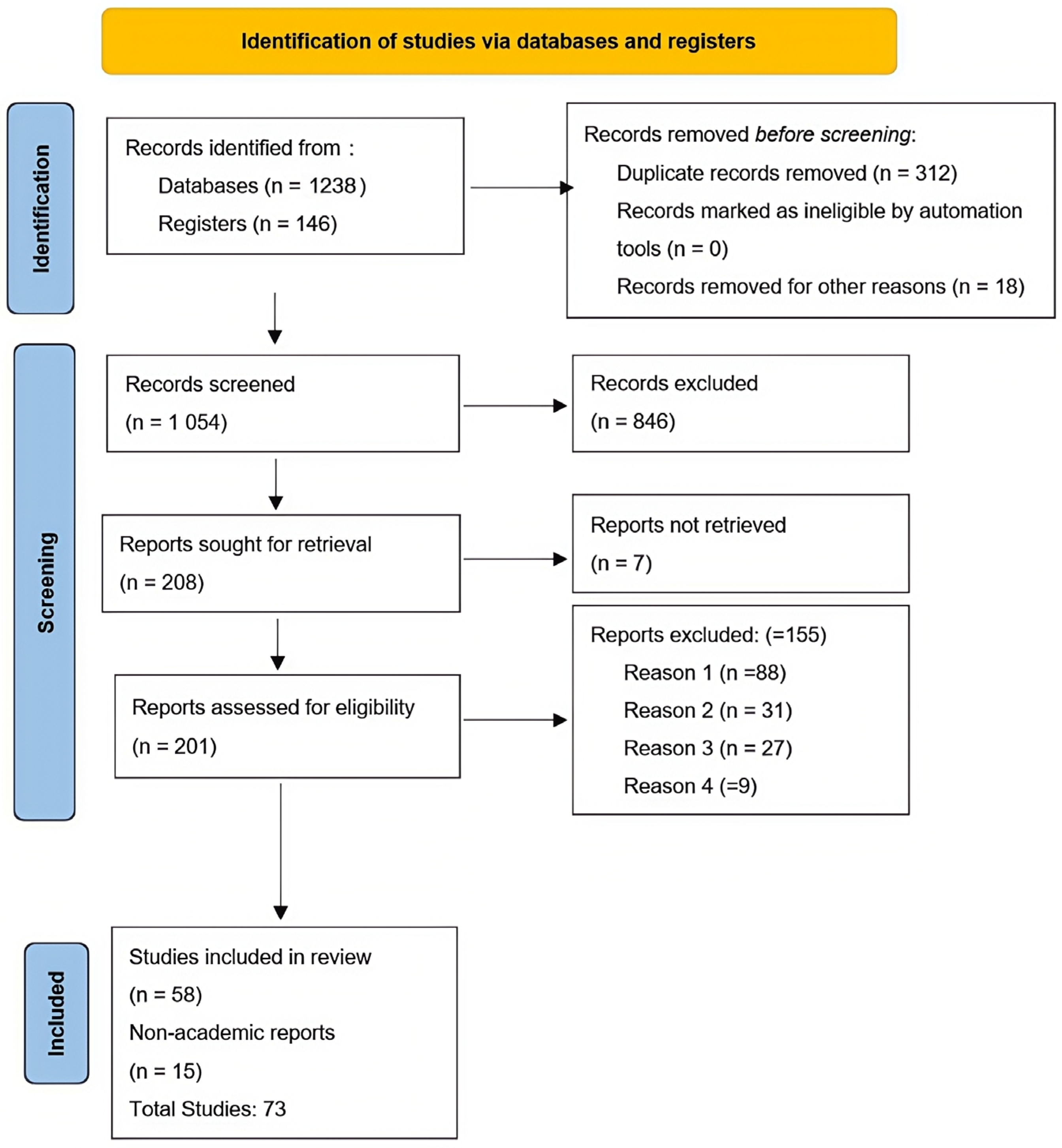
This study adopts a systematic review design with a qualitative thematic synthesis that assists the researchers in mapping research patterns across Southern Africa. This review adhered to the PRISMA 2020 guidelines to ensure transparency and methodological rigour. All stages—identification, screening, eligibility, and synthesis—were systematically documented using the PRISMA flow diagram (see Figure 1) and checklist. Although the protocol was not formally registered (e.g., PROSPERO), it was designed and implemented in full alignment with PRISMA standards to maintain consistency, reproducibility, and credibility. The interpretive dimension of the analysis is guided by feminist media theory, which provides a critical framework for interrogating the gendered structures embedded in political media representation (Steiner, 2014; H. McIntosh & Cuklanz, 2014a).

3.2. Eligibility Criteria

To enhance clarity, reproducibility, and rigour, this review used clearly defined inclusion and exclusion criteria (see Table 1). Inclusion criteria were as follows: (a) studies and credible monitoring reports examining the framing or media portrayal of women politicians or leaders in Southern Africa; (b) focus within Southern Africa (South Africa, Zimbabwe, Malawi, Zambia, Lesotho, Namibia, Botswana); (c) publication dates from 2000 to 2025, covering both legacy and digital media development; (d) publications in English; (e) empirical research designs (qualitative, quantitative, or mixed methods) and grey literature (such as monitoring reports, NGO/NPO policy papers) with explicit methodologies described. Including grey literature is justified because media monitoring organisations in Southern Africa perform systematic data collection following transparent protocols (for example, Media Monitoring Africa [MMA] monitors elections and gender representation).
The exclusion criteria included: (a) non-empirical opinion pieces or blog posts; (b) studies that focus solely on women’s political participation or quotas without analysing media framing; (c) works outside the specified region or timeframe; (d) grey literature lacking methodological transparency (sampling, indicators, or monitoring protocols). These criteria align with best practices in systematic reviews to improve validity and reproducibility (e.g., describing inclusion/exclusion thresholds).

3.3. Information Sources

The researchers searched multidisciplinary databases (Scopus and Google Scholar) and regional repositories (African Journals Online and university ETD portals). Grey literature sources included official websites and portals of Media Monitoring Africa (MMA), Gender Links, MISA (regional, Zimbabwe, Zambia), SANEF (South African National Editors’ Forum), and UNESCO. The date of the last search was 5 November 2025 (Africa/Johannesburg). Example sources include: MMA Media Performance Review 2024; Gender Links SADC/WPP Barometers; MISA Zimbabwe State of the Media 2023; SANEF (2019) Elections Handbook and 2024 training modules; UNESCO’s media gender resources. The researchers also conducted backward and forward citation chasing from key items and manually searched the sites’ “research/analysis” sections.

3.4. Search Strategy

Systematic searches were conducted across Scopus and Google Scholar, chosen for their comprehensive coverage of peer-reviewed social science, media, and gender studies literature. Additionally, structured searches were performed on the official websites of key regional organisations producing methodologically sound grey literature and policy reports, including Media Monitoring Africa (MMA), Gender Links, MISA, SANEF, and UNESCO. Search strings combined population, phenomenon, and context terms using Boolean operators and truncations, tailored to platform-specific syntax. The search was completed on 5 November 2025. A total of 1384 records were identified; after removing duplicates, 1054 were screened. Of these, 201 full texts were evaluated for eligibility, and 73 records met the inclusion criteria. Each step—identification, screening, eligibility assessment, and inclusion—was documented with a PRISMA flow diagram to ensure methodological traceability. Although the review protocol was not registered in advance, all procedures were planned and carried out following PRISMA standards to enhance methodological rigour, transparency, and reproducibility.
Search strings combined phenomenon, region, and media types using Boolean operators and truncations. A core string (adapted per database syntax) as seen in Table 2 below.

3.5. Selection Process

The selection process for this systematic review followed the PRISMA 2020 protocol (Page et al., 2021) to ensure transparency, reproducibility, and methodological rigour. It involved three main stages: identification, screening, and eligibility assessment, conducted by two independent reviewers with disagreements resolved through consensus. In the identification phase, a total of 1384 records were obtained—1238 from academic databases (Scopus and Google Scholar) and 146 from grey literature sources, including Media Monitoring Africa (MMA), Gender Links, the Media Institute of Southern Africa (MISA), the South African National Editors’ Forum (SANEF), UNESCO, and Women in News. After removing 312 duplicates and 18 ineligible documents (non-English or invalid formats), 1054 unique records remained for title and abstract screening. During this stage, 846 items were excluded for not being relevant to the framing of women politicians or media coverage themes.
During the full-text eligibility stage, 201 studies were carefully assessed against the inclusion criteria (media framing focus, Southern African context, and publication between 2000–2025). Of these, 155 were excluded—mainly for lacking methodological details (n = 27), focusing on gender participation without media analysis (n = 88), or being outside the regional or temporal scope (n = 31). Ultimately, 73 records met all criteria and were included in the final review, comprising 58 peer-reviewed studies (see Table 3) and 15 grey literature reports (see Table 4) from reputable organisations such as MMA, Gender Links, and MISA. This diverse selection provided a comprehensive evidence base, combining scholarly analysis and practitioner insights into gendered media representation. The inclusion of grey literature was justified because these organisations employ systematic, indicator-based methodologies comparable to academic research, thereby enhancing the review’s robustness and practical relevance (Tranfield et al., 2003; Petticrew & Roberts, 2006).

3.6. Data Extraction

A data-extraction template in Excel and NVivo was piloted on five items and then refined. Extracted fields included: author(s); year; country; election/campaign period; media type (print/online/social/broadcast); unit of analysis; research design/methods; theoretical framework; framing elements (e.g., motherhood/domesticity; crisis/“glass-cliff”; competence); tone; reinforcing versus challenging practices; key findings; limitations. Monitoring reports added fields for indicators (e.g., share of voice, source gender, visual gender codes). This pilot and systematic extraction enhance reliability (Gough, 2007).
The data synthesis focused on two main outcome areas: (1) media framing of women politicians—including tone, narrative structure, visual presentation, and thematic categorisation (e.g., domesticity, competence, morality, leadership legitimacy)—and (2) reporting practices—such as gender balance in sourcing, visibility, and voice share. All results related to these outcomes were identified across each study, including variations in media type, time period, and analytical approach. Additional variables included country context, publication type (journal, thesis, or report), research design, data collection method, theoretical framework, and unit of analysis (e.g., media texts, journalists, or audiences). Other factors like funding disclosure, institutional affiliation, and data collection period were also recorded to assess potential bias and contextual influence. When methodological clarity was lacking—particularly in older or grey literature sources (e.g., Gender Links, 2015; MISA, 2012)—assumptions were guided by stated indicators and standard monitoring definitions (e.g., “share of voice,” “source gender”). Ambiguous cases were verified through secondary citations or triangulated with regional datasets to ensure consistency and comparability across all studies and reports.

3.7. Risk of Bias in Studies

Across the 73 studies and reports examined, differences in methodological transparency, theoretical framing, and sampling scope revealed varying levels of bias risk. The Critical Appraisal Skills Programme (CASP) and Joanna Briggs Institute (JBI) checklists were used to assess internal validity and analytical rigour. Most peer-reviewed studies (e.g., J. Mpofu, 2017; Dos Santos, 2021; Muringa & McCracken, 2021; Ncube, 2020; Tembo, 2024) demonstrated strong construct validity through clear articulation of research aims, context, and analytical methods. However, a moderate bias risk was observed in a subset of early works (e.g., Katembo, 2005; Geertsema, 2008; Lewis, 2009), where sampling frames were restricted to single newspapers or election cycles, potentially limiting generalisability. A few qualitative theses (e.g., Mannya, 2013; Parichi, 2016; Nkomo, 2016) lacked detailed inter-coder reliability or reflexive positionality statements, raising concerns about interpretive bias. Nonetheless, these limitations were counterbalanced by methodological depth—particularly in multi-level analyses combining textual, cultural, and political viewpoints (e.g., Mangena, 2022; Zigomo, 2022; Muringa et al., 2024).
The grey literature corpus—including reports from Gender Links (2015, 2019, 2020), Media Monitoring Africa (2018), SANEF (2024), and MISA (2012)—was generally of moderate bias risk due to advocacy-linked institutional authorship and non-peer-reviewed status. However, these reports maintained methodological transparency through published indicators (e.g., voice share, tone, source gender) and longitudinal consistency, which enhanced external validity and comparability. Potential reporting bias stemmed from selective issue coverage—particularly during election monitoring cycles focusing on dominant national outlets, as seen in MMA’s Election Briefs (SANEF, 2024) and Gender Links’ (2020) GMPS. In contrast, mixed-method reports such as Mtero et al. (2023) and Sisimayi et al. (2024) displayed stronger reliability through triangulated data and independent verification. Overall, while the risk of bias varied from low to moderate, the convergence of findings across diverse methodologies and sources indicates high confidence in the overall synthesis and strengthens the credibility of the review’s conclusions regarding gendered media framing and representation in Southern Africa.

3.8. Data Synthesis

The synthesis process combined quantitative mapping and qualitative thematic analysis to ensure methodological balance and analytical depth. Studies were initially grouped based on predefined eligibility criteria—country, publication type, time frame (2000–2025), and relevance to the research questions—before being categorised by characteristics such as design, data source, and theoretical framework. Missing or incomplete information (e.g., absent methodological details or statistical indicators) was cross verified through organisational repositories (Gender Links, Media Monitoring Africa, MISA) or triangulated with secondary citations. Quantitative data, including publication trends, geographic distribution, and media types, was processed using Excel to produce descriptive statistics and visual representations (e.g., line graphs, pie charts, word clouds).
For qualitative synthesis, NVivo was employed to code and analyse textual data following Braun and Clarke’s (2006) six-step thematic model. Key codes such as domesticity, competence erasure, crisis leadership, and counter-framing were aggregated and compared across national and media contexts. Heterogeneity among studies—originating from diverse methodologies and media systems—was examined through subgroup comparisons (e.g., country-level, media-type, or theoretical orientation). Sensitivity checks involved re-coding a subset of studies to evaluate thematic consistency. Reporting bias was assessed by cross-referencing results with publicly available monitoring data, while certainty of evidence was determined using the JBI qualitative synthesis framework (Lockwood et al., 2015), ensuring confidence in the interpretative robustness and credibility of the final conclusions.

4. Results

The findings reveal recurring patterns in how women politicians are portrayed in Southern African media. The reviewed studies emphasise persistent gendered narratives, selective visibility, and contextual bias in election reporting. These themes reflect broader structural inequalities in political communication and align with feminist critiques of media representation and power. This section begins by providing a quantitative overview of the studies reviewed before presenting a thematic analysis.

4.1. Characteristics of the Studies

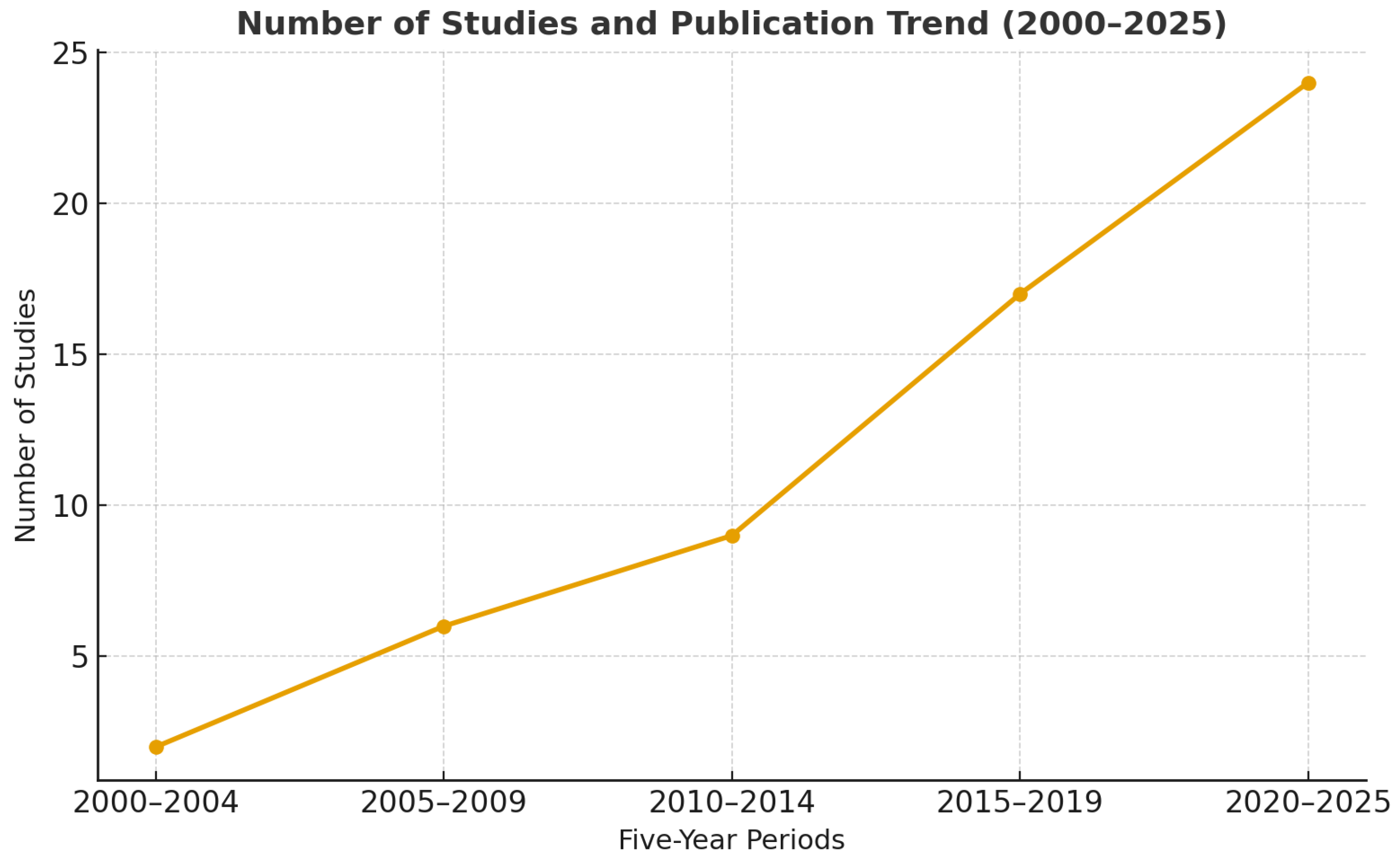
The quantitative overview (where the term ‘quantitative’ is explicitly defined as descriptive bibliometric profiling, not inferential analysis) of the reviewed literature and grey reports (n = 73), including 58 peer-reviewed studies and 15 organisational monitoring reports, reveals clear patterns of growth, concentration, and methodology in gender and media research across Southern Africa. The publication trend shows an approximately 1100% increase in scholarly output between 2000–2004 (e.g., Katembo, 2005) and 2020–2025 (e.g., Muringa et al., 2024; Tembo, 2024; Thatelo, 2025). The most significant surge occurred after 2015, driven by increased regional elections, feminist activism, and the rise in digital political communication (J. Mpofu, 2017; Mutsvairo & Ragnedda, 2017; Mangena, 2022). The geographic distribution remains uneven: Zimbabwe (25.9%), South Africa (24.1%), and Malawi (15.5%) dominate the field (Ncube, 2020; Zigomo, 2022; Gunde, 2015; Muringa & Ndlovu, 2026), whereas Zambia (Phiri, 2020; Lubinda, 2021), Lesotho (Rapitse et al., 2019), and Namibia (Nunuhe, 2020) are under-represented. About 21% of studies—including regional or comparative analyses (Coffie & Medie, 2021; Gender Links, 2020; MISA, 2012)—examined multiple countries, reflecting the cross-border nature of Southern Africa’s political media ecology.
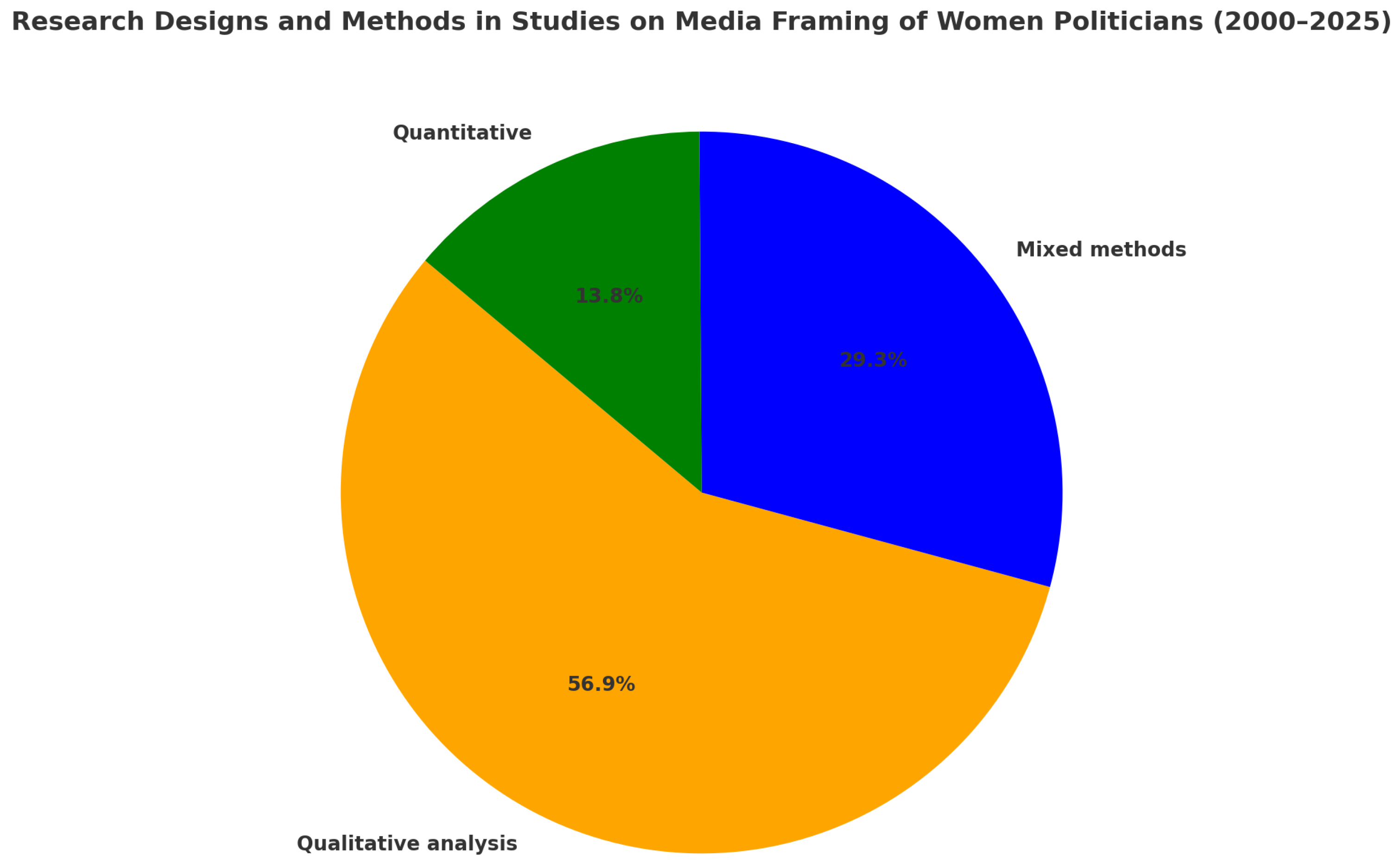
Methodologically, the field remains predominantly qualitative, with 56.9% of studies employing discourse, content, or semiotic analysis of news, print, audiovisual, or online media (Adcock, 2010; Mannya, 2013; Buiten, 2009; J. Mpofu, 2017; Dos Santos, 2021; Muringa et al., 2024). Mixed-method designs (29.3%)—as shown in Gender Links (2019, 2020), Media Monitoring Africa (2018, 2019, 2024b, 2024e, 2024f), and Mtero et al. (2023)—combine gender-indicator coding with interviews or institutional data. Quantitative studies (13.8%), such as Phiri (2020) and Lubinda (2021), measured source gender and voice share, offering comparative and longitudinal insights. Across all methodological types, systematic text coding (70.7%) and semiotic analysis (e.g., Chikaipa, 2019; Chandilanga & Chikaipa, 2024; Ngoshi & Mutekwa, 2013) remain the most common analytical tools, followed by gender-audit indicators (20.7%). Thematically, domesticity and virtue (62.1%), competence erasure (58.6%), and moralisation or sexualisation (53.4%) are the most frequent frames (Parichi, 2016; Ncube, 2020; Zigomo, 2022; Tembo, 2024), while counter-framing and advocacy journalism are less common (29.3%) (Gunde, 2015; S. Mpofu, 2016).
The theoretical foundation is solid: Framing Theory (48.3%) and Feminist Media Theory (41.4%) underpin most analyses (Steiner, 2014; Thornham, 2007; Dos Santos, 2021), while 20.7% of reports—mainly grey literature (Gender Links, 2020; Media Monitoring Africa, 2024b)—were atheoretical but data-rich. Media texts served as the primary unit of analysis in 84.5% of studies, exceeding those examining journalists or audiences (e.g., Matsilele & Nkoala, 2023; Thatelo, 2025). Funding transparency was limited: only 29.3% disclosed financial support, though 79.3% were affiliated with universities (e.g., Stellenbosch, Wits, Rhodes, DUT) and 20.7% were connected to NGOs or IGOs (Gender Links, MMA, MISA, SANEF). Overall, this evidence indicates a developing but uneven research landscape—methodologically diverse yet still text-centred, regionally focused but expanding, and increasingly collaborative between academia and civil society in tackling persistent gender bias in Southern African election coverage.

4.2. Results of Individual Studies

4.2.1. Publication Trends (2000–2025)

The publication trend from 2000 to 2025 shows a steady rise in research on media framing of women politicians in Southern Africa, increasing from just 2 studies (2000–2004) to 24 studies (2020–2025) (see Figure 2). This significant rise after 2015 indicates a growing interest among scholars and practitioners, driven by regional elections, the growth of digital media, and gender advocacy efforts. The continued output during 2020–2025 demonstrates the field’s maturity and institutionalisation, as organisations like Media Monitoring Africa and Gender Links started systematically documenting gendered election coverage alongside increased academic analysis of women’s political representation in news and social media.

4.2.2. Geographic Distribution of Studies

The Table 5 below shows the geographic distribution of studies from 2000 to 2025. Zimbabwe (26%) and South Africa (24%) lead the research efforts, followed by Malawi (16%) and Zambia (7%). Lesotho, Namibia, and SADC-wide studies collectively make up less than 10%, while around 21% of studies are regional or do not specify a country—mainly NGO and media monitoring reports covering multiple Southern African contexts. Table 5 below presents the geographic distribution of studies by country and main thematic focus.

4.2.3. Types of Publications

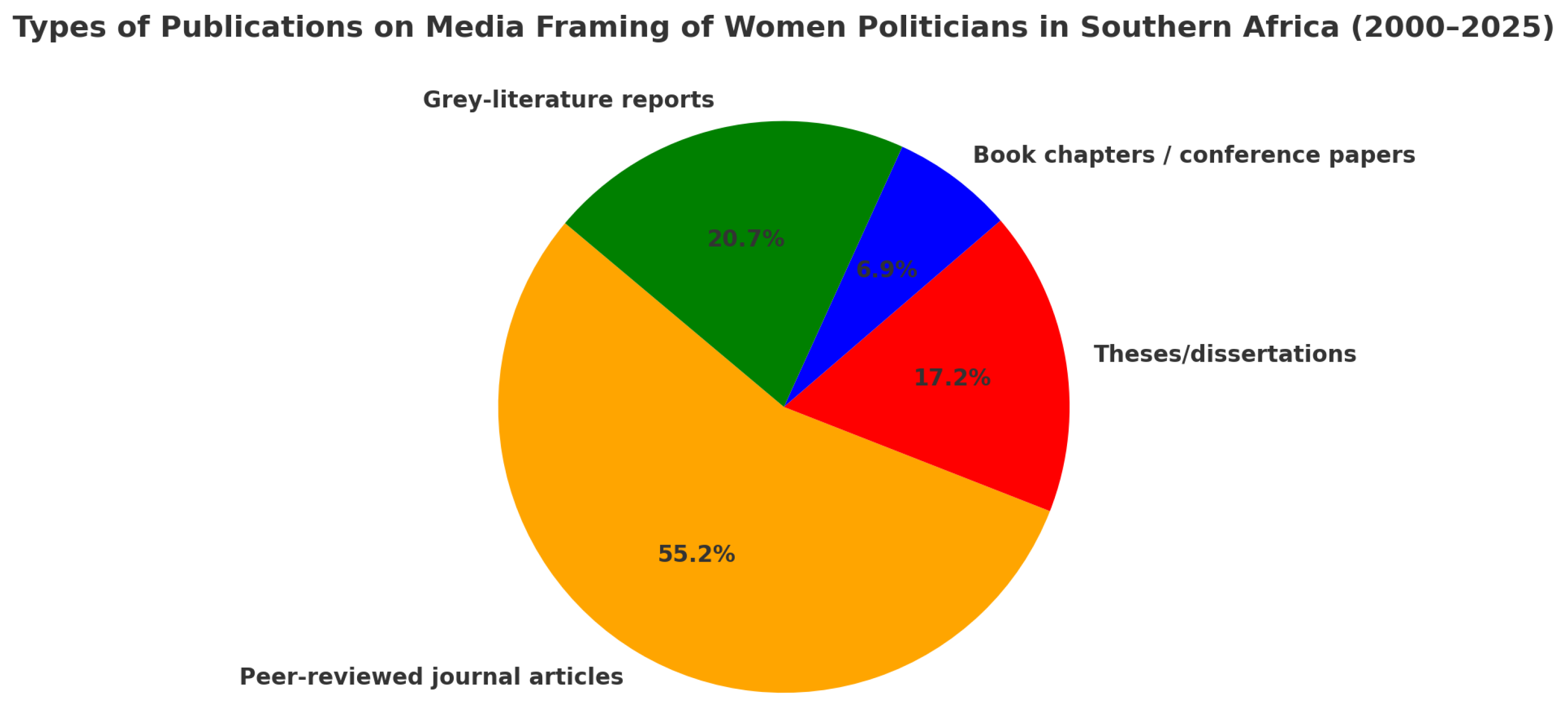
The pie chart (Figure 3) illustrates the types of publications (2000–2025). Peer-reviewed journal articles constitute the largest share (55.2%), followed by theses and dissertations (17.2%) and grey literature reports (20.7%). Book chapters and conference papers form the smallest segment (6.9%), emphasising the field’s strong dependence on peer-reviewed and institutional research outputs.

4.2.4. Research Designs & Methods in Reviewed Studies

Figure 4 shows that qualitative methods dominate at 56.9%, followed by mixed methods at 29.3%, and quantitative approaches at 13.8%, indicating a strong interpretivist tendency in the field. Most studies focus on content, discourse, or semiotic analysis, exploring how gendered meanings are created in media texts. Increasingly, mixed designs combining interviews, surveys, and content coding are used to examine newsroom dynamics and media effects. However, purely quantitative studies remain limited, and audience-centred or longitudinal research is notably underrepresented—highlighting a methodological gap in understanding how media framing impacts public perceptions of women politicians over time.

4.2.5. Thematic/Conceptual Focus (Frame Families; Multi-Coding)

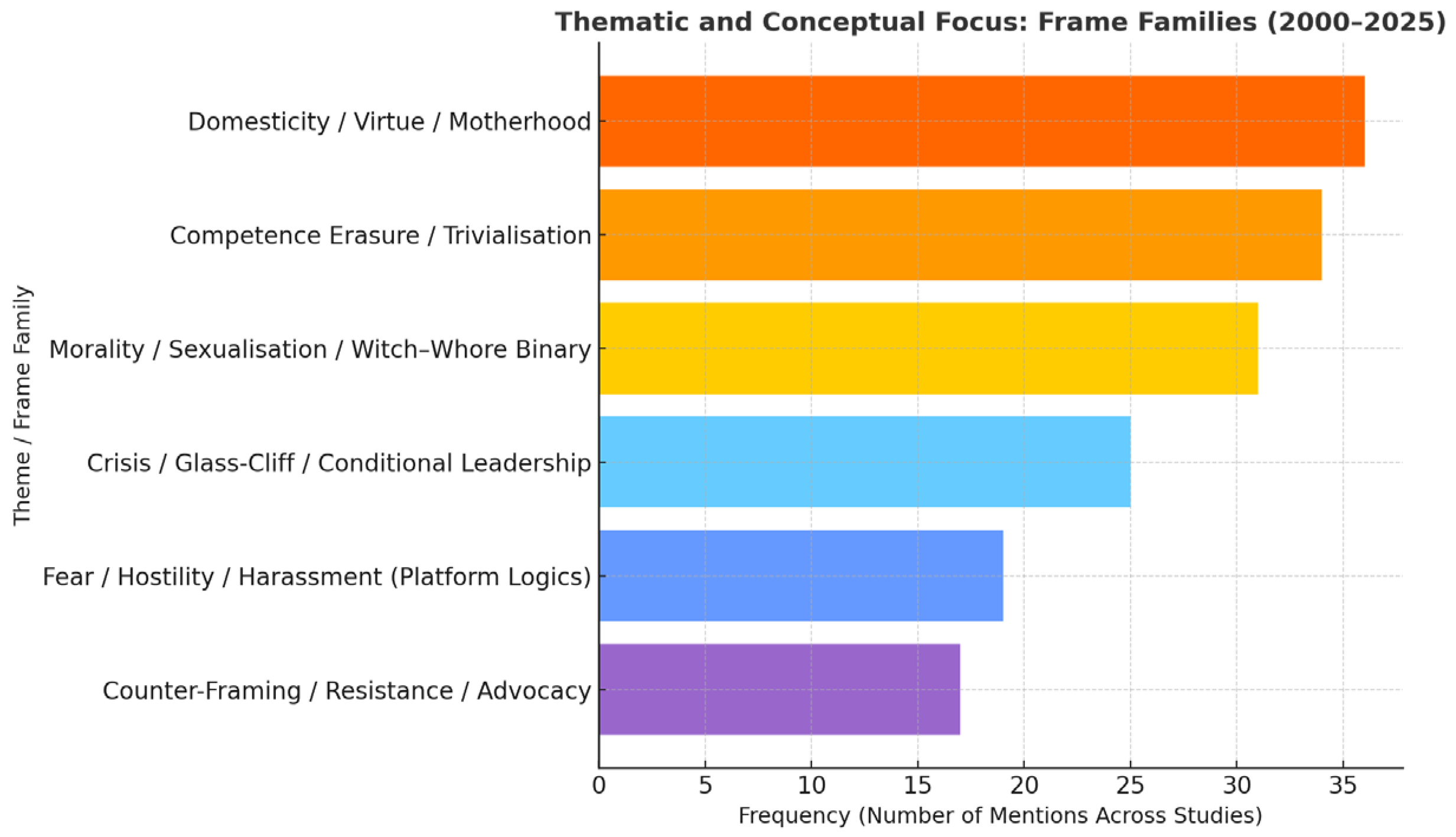
Figure 5 shows that the most common frames are Domesticity/Virtue/Motherhood (62.1%), Competence Erasure/Trivialisation (58.6%), and Morality/Sexualisation (53.4%) (see Figure 5). Meanwhile, Counter-Framing/Resistance (29.3%) appears least frequently—indicating that gendered stereotypes remain prominent in the Southern African media landscape, with only limited evidence of transformative or advocacy-driven reporting.

4.2.6. Theoretical or Conceptual Frameworks Used

The overview shows that Framing Theory (48.3%) and Feminist Media/Gender Theory (41.4%) are the most common guiding frameworks, often used together to interpret how media constructs and supports gendered political identities (see Table 6). About 17.2% of studies employed political communication or discourse approaches, while 20.7% had no clear theoretical basis, especially among grey-literature reports. This indicates that the field is largely theoretically developed, but some practitioner studies remain atheoretical or simply descriptive, highlighting the need for clearer conceptual frameworks.

4.2.7. Journals/Sources of Publication (Top Outlets by Frequency)

Publication outlets are varied and interdisciplinary, with communication and media journals (n = 18) dominating, followed by gender and political studies journals (n = 14). University theses and dissertations (n = 10) also make a notable contribution, indicating strong academic involvement. Meanwhile, NGO/IGO reports (n = 12)—such as those from Media Monitoring Africa and Gender Links—are crucial in connecting research and advocacy. The inclusion of conference proceedings (n = 4) further underscores the ongoing academic discourse on gender and media in the region.

4.2.8. Population/Unit of Analysis

Most studies (84.5%) concentrated on media texts—including news stories, headlines, social media posts, and visuals—highlighting a predominant focus on representational framing rather than production or reception processes. Only 10.3% examined journalists and newsroom dynamics, and a mere 5.2% explored audience interpretations. This imbalance underscores the need for more comprehensive, production-to-reception analyses that investigate how gendered media narratives are both created and consumed.

4.2.9. Data Collection Techniques (Primary)

The data collection methods clearly indicate a dominance of systematic text coding (70.7%), emphasising the field’s dependence on qualitative and interpretive approaches. Organisational monitoring indicators (20.7%)—such as share of voice and source gender—highlight the contribution of NGOs to structured data collection. Interviews (13.8%), surveys (6.9%), and social media analytics (10.3%) are less common but demonstrate increasing methodological variety. Overall, these patterns show a strong focus on text, with emerging digital and hybrid techniques enriching the depth of evidence.

4.2.10. Funding & Institutional Affiliations (Reported)

Funding disclosure remains limited, with only 29.3% of studies reporting their financial sources, highlighting a gap in research transparency. Nevertheless, the majority of work originates from academic institutions (79.3%), demonstrating strong scholarly leadership, while NGOs and IGOs (20.7%) make significant contributions to applied research and advocacy. This collaboration between academia and civil society exemplifies a cooperative ecosystem that promotes gender equity in Southern African media research, though greater openness about funding would further enhance the field’s credibility.

4.3. National Media Contexts and Variations in Gendered Framing

The reviewed literature shows that gendered media framing of women politicians in Southern Africa varies by country, influenced by different national media cultures, political histories, and institutional structures. In South Africa, research consistently highlights a highly professional yet confrontational media landscape where gendered framing occurs through competence erasure, conditional legitimacy, and spectacle, rather than clear moral condemnation. Content and discourse analyses of major outlets such as News24, Independent Online, and Sunday Times reveal that women politicians are often portrayed through narratives about leadership viability, with recurring assertions that the country is “not ready” for female presidents or that women’s authority is limited to crises (Katembo, 2005; Mannya, 2013; Muringa & McCracken, 2021; Kanjere, 2019; Muringa et al., 2024). Visual and rhetorical analyses further demonstrate how South African media reproduce neoliberal and nationalist tropes that focus on toughness, spectacle, and symbolic inclusion without actual power (Lewis, 2009; Buiten, 2009; Thatelo, 2025). Simultaneously, South Africa shows a stronger capacity for counter-framing, especially through social media and NGO-led monitoring efforts, where women politicians actively participate in metavoicing and narrative repair (Matsilele & Nkoala, 2023; Gender Links, 2019; Media Monitoring Africa, 2024b; Zimbabwe Gender Commission, 2018).
In contrast, media contexts in Zimbabwe and Malawi are characterised by moralised, religious, and culturally rooted forms of gendered delegitimisation, heightened by political polarisation and diminished journalistic independence. In Zimbabwe, longitudinal analyses of print and digital media reveal the dominance of archetypal frames—“mother”, “whore”, “witch”—used to police women’s political legitimacy, especially during election periods (Parichi, 2016; Ncube, 2020; Zigomo, 2022; Mangena, 2022). These frames are reinforced through online misogyny, harassment, and symbolic violence, particularly on social media during electoral cycles (Ncube & Yemurai, 2020; Mateveke & Chikafa-Chipiro, 2020; Mtero et al., 2023). Similarly, Malawian studies emphasise the central role of religious discourse and moral panic, where women leaders are portrayed as spiritually suspect or socially disruptive, as seen in coverage of Joyce Banda across news texts, cartoons, and digital spaces (Gunde, 2015; Chiwanda, 2006; Chikaipa, 2019; Tembo, 2024; Chandilanga & Chikaipa, 2024). In Zambia and Lesotho, fewer studies suggest more episodic visibility and institutional silence, with gendered framing linked to party structures, policy exclusion, and limited media scrutiny rather than sustained symbolic violence (Chimba, 2006; Rapitse et al., 2019; Phiri, 2020; Lubinda, 2021). Overall, these national differences expand the analytical scope by showing how gendered media framing is shaped by context-specific interactions of media freedom, political culture, religion, and digital infrastructure, rather than functioning as a uniform regional pattern.

4.4. Qualitative Thematic Analysis of the Review Literature

This section offers a thematic analysis (See Table 7 for summary of themes) of the key areas identified from the reviewed reports. The themes are presented and examined in relation to their relevance to the research questions. The analysis of the findings is conducted through the lens of feminist media theory.

4.4.1. Cultural–Patriarchal Archetypes (Mother/Whore/Witch)

Across the 73 reviewed sources, patriarchal and cultural archetypes emerge as the most persistent framework shaping women’s political representation in Southern African media. Viewed through Feminist Media Theory, these archetypes reproduce symbolic power hierarchies that normalise women’s subordination and make political authority dependent on moral respectability (Steeves, 1987; Thornham, 2007; Press, 2011). Scholars consistently show that journalistic discourse invokes familiar myths of motherhood, virtue, and sexual deviance to assess female politicians’ legitimacy. Rather than merely serving as descriptive stereotypes, these archetypes act as evaluative filters through which political authority is recognised or denied. From a feminist political communication perspective, this suggests that media power does not simply distort women’s images but actively influences the boundaries of political legitimacy by embedding leadership within moralised gender norms.
Empirical evidence from Zimbabwe demonstrates the depth of this moral taxonomy. Ncube (2020) and Zigomo (2022) reveal how media outlets label compliant women as Amai (“mother”) while casting ambitious leaders such as Joice Mujuru and Grace Mugabe as hure (“whore”) or muroyi (“witch”). These studies, supported by Mangena (2022) and Mlotshwa (2018), show how cultural idioms of virtue and impurity sustain patriarchal political culture. In Malawi, Gunde (2015) and Tembo (2024) identify religiously charged rhetoric—epitomized by the “Sesa Joyce Sesa” (“Sweep Joyce Away”) campaign—that feminized and delegitimized President Joyce Banda through Biblical metaphors of sin and cleansing. Kayuni (2016) and Chikaipa (2019) extend this argument, showing that sermons and cartoons conflated political failure with moral corruption. Within South Africa, the narrative that the nation is “not ready for a woman president” (Muringa et al., 2024) aligns with Dos Santos (2021) and Kanjere (2019), where femininity is equated with emotionality and divisiveness rather than competence. While the symbolic vocabulary varies—religious purification in Malawi, cultural idioms in Zimbabwe, and nationalist-political readiness discourse in South Africa—the underlying logic is strikingly consistent. Across contexts, women’s leadership is framed as an ontological disruption that must be explained, contained, or morally corrected. This comparative pattern suggests that national political cultures mediate, but do not fundamentally alter, the patriarchal grammar of media representation.
Analytically, these frames act as what Rhode (1995) describes as “moral hierarchies of credibility.” They regulate women’s political subjectivity by rewarding domestic virtue while punishing ambition, thereby reinforcing the public/private binary that feminist theorists like McLaughlin (1993) and Lumby (1994b) identify as central to media patriarchy. The recurrence of the mother/whore/witch archetype across different countries—whether through Christian iconography in Malawi, nationalist rhetoric in South Africa, or cultural idioms in Zimbabwe—illustrates what Steiner (2014) refers to as the “transnational circulation of gendered scripts.” Even when media claim neutrality, their linguistic and visual codes sustain what Pienaar and Bekker (2007) calls the symbolic disciplining of the female body. Crucially, these findings position the archetypal frame not as a mere leftover from tradition but as a persistent communicative technology that maintains male political dominance. By consistently associating femininity with morality rather than authority, media discourse shifts the focus away from structural causes of political exclusion and instead places accountability onto women’s bodies, behaviours, and emotions.
Despite contextual differences, few studies document sustained counter-frames. Digital feminist interventions (S. Mpofu, 2016) temporarily challenge these archetypes but lack institutional reinforcement. Therefore, the feminist media critique continues to assert that cultural legitimacy, rather than competence, still dictates how news frames female politicians in the region. This persistence helps explain why subsequent themes—particularly competence erasure, crisis framing, and glass-cliff narratives—do not occur independently but are built on this moral-symbolic foundation. Archetypal framing thus forms the ideological basis through which other types of representational inequality are normalised. Overall, this archetypal framing shapes the moral landscape of political communication in Southern Africa and underpins subsequent patterns of competence erasure and symbolic violence discussed in the following theme.

4.4.2. Competence Erasure and Conditional Leadership (“Political Glass Cliff”)

A recurring pattern in the reviewed literature is that women’s political competence is often undermined through what feminist media scholars call “the politics of conditional visibility.” This theme aligns with the “glass cliff” hypothesis, in which women rise to leadership during crises but are quickly portrayed as unfit or emotional once stability is restored. In the Southern African context, this framing combines gendered assumptions of fragility and moral purity with the political strategy of deeming leadership expendable. Feminist media theory (Steiner, 2014; Harp et al., 2018a) explains this as the systemic silencing of women’s authority via symbolic and discursive methods that privilege masculinity as the default indicator of competence. Conceptually, erasing competence acts as a form of discursive risk management within patriarchal political systems. Media narratives permit women to hold leadership roles during moments of instability because their eventual failure can be personalised and gendered, thus shielding dominant political institutions from deeper structural critique.
In Malawi, multiple studies demonstrate how Joyce Banda’s presidency was portrayed as an accidental and crisis-bound leadership (Muringa & Ndlovu, 2026). Chikaipa (2019) and Tembo (2024) show that newspapers and social media narratives depicted Banda as an emotional caregiver rather than a decisive leader, emphasising her domestic persona, attire, and religiosity. Gunde (2015) notes that religious language—describing Banda as “chosen but weak”—diminished her policy contributions, framing them as divine intervention rather than professional skill. Tiessen (2008) and Kayuni (2016) confirm that Malawian media used maternal imagery to present her as a symbolic rather than substantive leader, reinforcing a cultural expectation that women’s leadership is exceptional and temporary. This Malawian case illustrates how the glass-cliff dynamic is culturally localised through religious and maternal symbolism, yet operates similarly to secular political frameworks elsewhere. The outcome is not simply gender bias, but a narrative structure that portrays women leaders as placeholders during crises rather than legitimate political actors with lasting authority.
A similar pattern emerges in South Africa, where Dlamini-Zuma’s presidential bid and subsequent engagement in party politics attracted what Muringa and McCracken (2021) describe as “performance-based skepticism.” Dos Santos (2021) and Kanjere (2019) found that coverage focused on her personality, ambitions, and marital history, while marginalising her extensive administrative career. Mannya (2013) and Buiten (2009) report similar treatment of Lindiwe Mazibuko, whose visibility as a young opposition leader was overshadowed by media obsession with her appearance and age. These findings echo the gendered narrative of crisis competence—celebrating women as reformist figures during periods of instability but erasing them once “normal” politics resumes. From a feminist institutionalist perspective, this pattern demonstrates how media act as gatekeeping institutions that recalibrate legitimacy once the crisis subsides. Women’s competence is portrayed as situation-specific and temporary, while men’s authority is regarded as ongoing and self-evident, reinforcing what Steiner (2014) identifies as the gendered temporality of political power.
In Zambia, Phiri (2020), Lubinda (2021), and Katongo (2017) describe tokenistic patterns where female candidates are portrayed as party ornaments rather than policy leaders. Their inclusion in campaign media often symbolises diversity instead of challenging entrenched male authority. Across Zimbabwe, Mangena (2022), Mlotshwa (2018), and Ncube (2020) identify the same contradiction: women receive coverage mainly when involved in political scandals or conflicts, confirming what Press (2011) calls “visibility through failure.” Collectively, the Zambian and Zimbabwean cases show that conditional leadership is not confined to executive office but extends across electoral campaigns, party politics, and scandal coverage. This indicates that the glass cliff functions as a continuum rather than a single event, shaping women’s political visibility at various stages of political life.
From a feminist media theoretical perspective, this “glass cliff” framing reflects what Lumby (1994b) describes as the illusion of equality—where representation grows without actual structural empowerment. Women’s presence is tolerated only when it maintains patriarchal stability. Although isolated counter-narratives exist—such as Thatelo’s (2025) portrayal of empowered digital representation or Matsilele and Nkoala’s (2023) examples of women asserting policy expertise online—they remain exceptions. These instances, while symbolically significant, highlight rather than challenge the underlying pattern: counter-frames tend to thrive mainly in digital or marginal media spaces, while mainstream legacy media continue to depict competence as a gendered and conditional trait. Therefore, the evidence examined shows that the media landscape in Southern Africa conditions women’s political legitimacy on crisis and spectacle, perpetuating the patriarchal belief that leadership competence is gendered, provisional, and inherently dubious.

4.4.3. Fear Production and Symbolic Violence

A third central theme in the reviewed literature is the creation of fear and symbolic violence against women politicians through media and digital discourse. Using feminist media theory, this theme shows how power functions symbolically—employing humiliation, surveillance, and exclusion to control women’s participation in the public sphere. Gqola’s idea of the “female fear factory” concretely appears in Southern African politics, where online abuse, gendered hate speech, and moral intimidation act as mechanisms of social control (Tembo, 2024; Ncube & Yemurai, 2020; Matsilele & Nkoala, 2023). Such fear-based media practices reinforce patriarchal norms by reaffirming the boundaries of acceptable femininity and silencing women who challenge these norms. Conceptually, fear production functions as a communicative governance tool rather than a mere by-product of political rivalry. Feminist media theory helps explain how intimidation, ridicule, and harassment are used proactively to discipline women’s political engagement, often leading to their exclusion even before formal institutional barriers are put in place.
In Malawi, Tembo (2024) documents how the ruling Democratic Progressive Party (DPP) mobilised social media to spread defamatory narratives about Joyce Banda, portraying her as “unwomanly” and unsuitable for public leadership. Gunde (2015) and Kayuni (2016) add that religious institutions amplified these narratives by circulating sermons and editorials that depicted female politicians as moral threats. Chikaipa (2019) further highlights the role of political cartoons and memes in normalising gendered ridicule, where humour becomes a means for symbolic degradation. Together, these studies demonstrate how cultural and religious metaphors combine with digital platforms to institutionalise fear as a gendered instrument of exclusion. The Malawian case illustrates how fear is justified through moral and religious authority, enabling intimidation to appear as cultural correction. This sets Malawi apart—but does not fundamentally differentiate it—from more openly hostile digital environments elsewhere, showing how fear adapts to local norms while maintaining its exclusionary purpose.
Similar dynamics are evident in Zimbabwe, where Ncube and Yemurai (2020) trace coordinated online harassment targeting women candidates during the 2018 harmonised elections. Trolls weaponised misogynistic tropes—branding women as witches, prostitutes, or “slay queens”—to discipline their digital visibility. S. Mpofu (2016), Mateveke and Chikafa-Chipiro (2020), and Mtero et al. (2023) reveal how these discursive attacks extend beyond individual abuse to a broader politics of silencing that discredits women’s participation in national debates. Mangena (2022), Chikafa-Chipiro (2020) and Zigomo (2022) argue that this symbolic violence works through repetition, turning gendered hostility into a normalised news rhythm. From a symbolic interactionist perspective within feminist media studies, repetition is critical: once misogynistic frames are routinised, they no longer appear as acts of violence but as ordinary political commentary. This normalisation process obscures power relations and renders fear socially acceptable, even humorous, within mainstream political discourse.
In South Africa, Matsilele and Nkoala (2023) and Muringa et al. (2024) demonstrate how female politicians face online trolling that feminises failure and sexualises leadership. The “not ready for a woman president” narrative—sustained through memes and commentary—acts as soft violence that undermines women’s professional credibility. Similarly, Lubinda (2021) and Phiri (2020) in Zambia observe digital exclusion, where online party networks reproduce offline patriarchies by denying women access to digital campaign infrastructure. Comparatively, South Africa and Zambia show how symbolic violence operates even in relatively institutionalised democratic contexts. Here, fear is less about overt threats and more about structural exclusion—through denial of visibility, credibility, and digital resources—suggesting that symbolic violence evolves alongside media professionalisation rather than disappearing.
Viewed through feminist media theory (Steeves, 1987; Thornham, 2007; Steiner, 2014), these practices constitute discursive violence—forms of communication that encode domination under the guise of democratic expression. They reveal what McLaughlin (1993) describes as the contradiction between women’s formal political inclusion and symbolic exclusion from public legitimacy. This contradiction highlights a key finding of the review: democratic media systems can both broaden women’s access to political space and increase the symbolic costs of participation. Fear, therefore, becomes not an anomaly but a structural feature of gendered political communication. Despite some resistance strategies—such as digital counter-narratives documented by S. Mpofu (2016) the review suggests that intimidation and symbolic violence remain enduring features of political communication. As the next section illustrates, these fear-inducing dynamics are closely linked with agenda-setting and visibility regimes, shaping not only how women are treated in political discourse but also whether they can sustain a long-term political presence.

4.4.4. Reinforcing Practices: Gendered Sourcing, Visibility and Lexical/Visual Bias

A predominant pattern emerging from the literature is how newsroom routines—specifically sourcing, visibility, and visual or lexical framing—systematically reinforce patriarchal hierarchies in political communication. From a feminist media theory perspective (Steiner, 2014; Press, 2011; McLaughlin, 1993), these practices are not neutral journalistic habits but gendered discursive mechanisms that regulate who is seen, heard, and legitimised. Across Southern Africa, studies show that women politicians remain marginal in both the quantity and quality of political coverage, while visual and linguistic choices reproduce traditional notions of femininity and emotionality. Sourcing and visibility function as upstream gatekeeping mechanisms that shape all subsequent framing. Before gendered stereotypes are even activated, women are already structurally disadvantaged through limited access to quotation space, expert status, and agenda-setting roles, indicating that exclusion is embedded at the level of news production rather than merely representation.
Monitoring data from Gender Links (2015, 2019, 2020) and Media Monitoring Africa (2018, 2019, 2022, 2024a, 2024b, 2024c, 2024d, 2024e, 2024f) confirm persistent disparities: women constitute less than 25% of sources in political news, are rarely cited as experts, and are most visible in “soft” or social issue stories. This gender gap persists even during elections when women candidates are nominally more visible. Reports from MISA (2012) and SANEF (2024) corroborate this trend, showing that coverage often frames women through gendered adjectives (“strong-willed mother,” “iron lady,” “controversial wife”) rather than policy positions. Such descriptors, while seemingly benign, symbolically re-inscribe male authority by measuring women’s leadership against emotional or moral criteria rather than technical expertise. From a feminist political economy of media perspective, these lexical choices are not accidental but reflect newsroom cultures historically aligned with masculine norms of authority. By foregrounding relational and affective descriptors, journalism performs what Press (2011) identifies as symbolic differentiation—marking women as political deviations rather than standard-bearers of leadership.
Country-specific evidence reinforces this structural bias. In Lesotho, Rapitse et al. (2019) found that print media coverage of female politicians was dominated by sexist imagery that emphasised dress and family life. In Zimbabwe, Parichi (2016) and Ncube (2020) observed how headlines highlighted appearance and personal scandal rather than policy debates, often portraying women as “spectacle” rather than actors (Lewis, 2009). In South Africa, Dos Santos (2021) and Muringa and McCracken (2021) identified persistent visual themes—such as Dlamini-Zuma depicted through domestic metaphors or photographed with male counterparts—to situate her authority within patriarchal norms. Similarly, Soobben and Rawjee (2013) demonstrated that ethnic media replicated these biases by relying on male community voices as authoritative sources. Despite differences in media systems and political contexts, these cases reveal a shared representational logic: women’s authority is visually and verbally mediated through relational proximity to men, culture, or domesticity. Comparative analysis thus indicates that gendered sourcing and visual framing function as transnational newsroom norms rather than isolated national failures.
Analytically, this pattern aligns with Thornham’s (2007) concept of “discursive containment,” where gendered journalism naturalises male rationality and portrays women’s voices as emotional or exceptional. The linguistic bias—manifested through diminutives, relational references, and moralised adjectives—makes women’s political statements seem less credible. Feminist scholars argue that such coverage transforms journalism into a site of symbolic labour, upholding the patriarchal order even within ostensibly democratic media (Steeves, 1987; Lumby, 1994b). Importantly, discursive containment does not silence women completely but redefines their participation in a way that neutralises political impact. Visibility without authority therefore becomes a key mechanism through which democratic inclusion is symbolically granted while real power remains withheld.
While a minority of studies note gradual improvement, the trend remains inconsistent. For instance, Thatelo (2025) observed that digital political advertisements began depicting empowered black women with authority, yet such examples are rare and often commercial rather than editorial. The confinement of progressive representation to advertising and campaign spaces—rather than news journalism—suggests that market logics may outpace editorial reform, raising questions about the depth and sustainability of representational change within news institutions themselves. Overall, the evidence indicates that Southern African newsrooms reinforce gendered power relations through structural sourcing biases and visual lexicons that privilege masculinity as the standard of political credibility. Consequently, visibility itself becomes an exclusionary practice: women appear, but only through patriarchal filters that circumscribe what leadership can look and sound like. This structural conditioning of visibility provides the connective tissue between earlier themes of archetypal framing and competence erasure, demonstrating how symbolic violence is reproduced not only through overt hostility but through the everyday routines of journalism.

4.4.5. Structural Legitimation of Bias: Party, Religious and Cultural Gatekeeping

Beyond newsroom routines, the reviewed literature shows that gendered framing of women politicians in Southern Africa is structurally supported by political, religious, and cultural institutions that influence public discourse. Feminist media theory stresses that media texts are inseparable from the social power networks that shape them (McLaughlin, 1993; Steiner, 2014). These networks—political parties, churches, and traditional authorities—serve as “gatekeepers of respectability,” endorsing patriarchal narratives that influence how female politicians are portrayed. Across 73 studies, such structures appear as the ideological foundation underlying media bias. This shifts the focus of gender bias from the media alone to a broader system of symbolic power. Media representations are revealed as downstream effects of institutionalised authority, implying that journalism often acts more as a relay than the originator of patriarchal meanings.
In Malawi, the intersection of religion and politics provides a vivid example. Gunde (2015) and Kayuni (2016) demonstrate how clergy and faith-based organisations publicly questioned Joyce Banda’s leadership through sermons and newspaper commentaries invoking divine sanction and female submission. Tembo (2024) extends this by showing how political actors used religious metaphors on social media to portray Banda as morally compromised. The result was a fusion of religious conservatism and political strategy, where theological discourse legitimised gender exclusion in mainstream media. Similarly, Chikaipa (2019) and Chandilanga and Chikaipa (2024) show how satirical cartoons embedded patriarchal messages that reinforced women’s association with domesticity and fragility. The Malawian case illustrates how religious authority provides a moral vocabulary that sanitises political exclusion. Rather than appearing overtly discriminatory, gendered bias is reframed as moral guidance, allowing media institutions to reproduce patriarchal norms under the guise of cultural authenticity and spiritual legitimacy.
In Zimbabwe, Mangena (2022), Chirongoma and Mavengano (2023), Dube (2013), Gauti (2022), Mtero et al. (2023) and Ndlovu (2025) highlight how cultural and religious leaders acted as moral arbiters during electoral campaigns, sanctioning or condemning women’s political behaviour. The “Amai” (mother) trope was celebrated as virtuous, while women asserting independence were condemned as “witches” or “harlots” (Ncube, 2020; Manyeruke, 2018; Mhiripiri & Ureke, 2018; Zigomo, 2022). These cultural scripts, embedded in both media and political speeches, reinforced patriarchal order by linking female authority to male endorsement. From a feminist cultural studies perspective, these findings demonstrate how respectability politics operate as a disciplinary technology. Women’s legitimacy is not evaluated on performance or ideology but on conformity to gendered moral scripts, confirming McLaughlin’s (1993) argument that media patriarchy is sustained through everyday cultural consensus rather than coercion alone. In South Africa, Lewis (2009) and Makhunga (2014) show how nationalist rhetoric and party narratives framed women’s leadership within the moral economy of family and loyalty to the African National Congress. Party women’s leagues were often presented as auxiliary rather than autonomous, perpetuating the symbolic feminisation of support and the masculinisation of power. Comparatively, South Africa demonstrates how secular political institutions replicate dynamics similar to religious gatekeeping elsewhere. Whether mediated through theology, tradition, or party ideology, women’s political authority is consistently conditional upon alignment with male-dominated institutional hierarchies.
Feminist media scholars (Press, 2011; Harp et al., 2018b) argue that such legitimation represents a systemic feedback loop between media and patriarchy. Journalists rely on authoritative voices—usually male clergy, traditional chiefs, or party elders—to define the boundaries of acceptable femininity. This structural interdependence renders media reform insufficient unless broader sociocultural hierarchies are addressed. Even well-intentioned coverage reproduces bias when “expertise” is structurally gendered. This feedback loop explains why surface-level reforms—such as gender-sensitive language policies or newsroom diversity initiatives—often fail to disrupt entrenched patterns of bias. Without challenging the institutional sources of authority that journalists depend on, representational change remains fragile and reversible.
While some resistance is emerging—such as advocacy from Gender Links (2020) and the SADC Gender and Media Progress Study (GMPS) that pressure parties to promote gender parity—these interventions often remain tokenistic. The literature suggests that tokenistic inclusion functions as reputational management rather than structural transformation, allowing institutions to signal progress while preserving underlying power asymmetries. The studies suggest that transformation requires dismantling not only media practices but also the patriarchal institutions that underpin them. In summary, gender bias in Southern African political reporting is not merely a journalistic flaw but a reflection of entrenched sociocultural gatekeeping that continuously reauthorises women’s marginalisation in political life. This structural legitimation of bias provides the connective foundation for all preceding themes, demonstrating that archetypal framing, competence erasure, fear production, and visibility bias are not isolated phenomena but interlocking outcomes of deeply embedded institutional power.

4.4.6. Counter-Practices: Gender-Sensitive Journalism and Feminist Resistance

Amid the structural and representational biases identified across the corpus, several studies and grey-literature reports reveal emerging practices that contest patriarchal framings and promote feminist agency in Southern African political communication. Through the lens of Feminist Media Theory, these counter-practices represent forms of epistemic resistance—efforts to re-author the meanings of leadership, credibility, and femininity within public discourse (Steeves, 1987; Thornham, 2007; Steiner, 2014). Although sporadic and uneven, they demonstrate how both journalists and women politicians are using gender-aware tools and feminist self-representation to challenge dominant frames. These counter-practices signal a shift from women being objects of representation to becoming subjects of discursive power. Rather than merely correcting bias, they attempt to destabilise the epistemic foundations through which political authority is gendered, marking an important—if incomplete—reorientation of media power relations.
A key institutional development is the proliferation of gender-sensitive newsroom policies and monitoring frameworks. Organisations such as Gender Links (2015, 2019, 2020) and Media Monitoring Africa (2018, 2019, 2022, 2024a, 2024b, 2024c, 2024d) have institutionalised gender audits, balanced sourcing guidelines, and election-coverage monitoring that exposes gender disparities in voice share and framing. These interventions translate feminist critique into actionable media-ethics tools. The SADC Gender and Media Progress Study (GMPS) (2020) and MISA’s Guidelines on Media Coverage of Elections (2012) establish regional benchmarks for equitable reporting. Empirical studies confirm that outlets adopting these frameworks produce more balanced content and increase women’s policy-based visibility (Lowe Morna, 2009; Gender Links, 2020; Media Monitoring Africa, 2024a). However, these reforms remain fragile, dependent on donor funding and lacking strong enforcement mechanisms within commercial newsrooms. Comparatively, these institutional reforms contrast sharply with the informal gatekeeping structures discussed in earlier sections. While churches, parties, and cultural authorities stabilise patriarchal narratives through moral legitimacy, gender-monitoring bodies rely on normative persuasion rather than coercive power—explaining both their ethical strength and structural vulnerability.
At the representational level, a growing number of women politicians are reclaiming agency through digital counter-narratives and self-branding. In Zimbabwe, S. Mpofu (2016) and Mutizwa et al. (2024) illustrate how feminist activists and women politicians use social-media publics to subvert mainstream stereotypes, employing humour, solidarity campaigns, and counter-hashtags to expose misogyny. Similarly, Matsilele and Nkoala (2023) in South Africa document how female politicians deploy “metavoicing” strategies—reframing online conversations to assert competence and policy expertise in hostile spaces (Muringa & Adjin-Tettey, 2025). Gunde (2015) shows how Joyce Banda’s use of religious rhetoric strategically turned faith discourse into a tool for empowerment rather than subjugation. These cases represent what Harp et al. (2018a) call “feminist praxis in mediated spaces”—a negotiation between visibility and vulnerability. From a feminist communication standpoint, these practices demonstrate strategic hybridity: women simultaneously engage dominant discourses (religion, nationalism, professionalism) while re-signifying them to expand the boundaries of legitimate femininity. This underscores that resistance in mediated politics is rarely oppositional in pure form, but adaptive and context-sensitive.
Analytically, these initiatives demonstrate a gradual epistemic shift from passive representation to active authorship. Yet, as Press (2011) cautions, feminist gains remain precarious within neoliberal media systems where empowerment is often commodified rather than transformative. The counter-practices documented—whether policy audits, advocacy journalism, or online activism—operate within structural limits: newsroom hierarchies remain male-dominated, and institutional change is uneven across the region. Nonetheless, the cumulative effect of these interventions marks a slow re-politicisation of media ethics and a disruption of patriarchal common sense. Importantly, the unevenness of these gains mirrors the asymmetry of power identified across earlier themes. Counter-practices emerge primarily at the margins—civil society, digital platforms, donor-supported initiatives—while core political and media institutions remain largely intact, reinforcing the need to distinguish between symbolic progress and structural transformation.
Overall, feminist resistance and gender-sensitive journalism constitute the most tangible pathways toward equitable representation in Southern African election coverage. While these counter-frames have yet to dislodge entrenched archetypes, they affirm that transformation is possible when feminist critique moves from theory into practice—redefining who speaks, who is heard, and how power is made visible in the media. These counter-practices do not negate the depth of patriarchal media power identified in this review; rather, they illuminate the conditions under which such power can be contested. As such, they provide an essential bridge between the results and the discussion, where the implications for democratic media reform and gender-inclusive political communication are taken up more explicitly.
Taken together, the findings cohere into a single analytical model in which gendered political representation in Southern African media operates as a layered system of symbolic power rather than a set of isolated biases. At the foundation lie cultural–patriarchal archetypes (mother/whore/witch), which supply the moral grammar through which women’s political legitimacy is judged. These archetypes enable competence erasure and conditional leadership, where women are rendered reminders of crisis rather than bearers of enduring authority, crystallising the logic of the political glass cliff. This is intensified through fear production and symbolic violence, whereby harassment, ridicule, and moral intimidation discipline women’s visibility and raise the personal costs of political participation. At the organisational level, gendered sourcing, lexical choices, and visual framing translate these norms into routine newsroom practice, ensuring that visibility itself becomes a regulated and exclusionary resource. Crucially, these representational dynamics are structurally legitimated by parties, religious institutions, and cultural authorities, which function as upstream gatekeepers of respectability and expertise, reinforcing media bias through moral and institutional sanction. Against this system, gender-sensitive journalism and feminist resistance emerge as partial counter-forces—introducing moments of epistemic disruption without yet dismantling the underlying architecture. The model therefore conceptualises gendered media power as a recursive loop in which culture, institutions, and media mutually reinforce patriarchal authority, while resistance remains uneven, peripheral, and contingent—highlighting that meaningful transformation requires intervention across all layers simultaneously rather than reform at the level of representation alone.

5. Discussion

This systematic review critically examined media framing of women politicians in Southern Africa during election periods, guided by feminist media theory (Thornham, 2007; Steiner, 2014) and intersectional feminist analysis. The findings reveal that gendered representations in media are more than individual bias; they reflect deeply institutionalized discursive power structures that regulate political legitimacy. This echoes McLaughlin’s (1993) notion of the “political economy of visibility,” where media visibility for women is systematically constrained by patriarchal norms rather than reflecting genuine political presence.
Globally, feminist media scholarship highlights how media often reinscribes stereotypical gender roles, which Southern African media replicate through the recurrent “mother,” “witch,” and “whore” tropes (Gill, 2007; Banet-Weiser, 2018). Lumby’s (1994b) concept of the “fantasy of feminism in the media” resonates here, signifying a paradox where visibility coexists with constrained agency. Feminists such as Van Zoonen (1994) have argued that media participation for women is contingent on conforming to normative femininity rather than substantive political competency—a trend evident in Southern African contexts (Ncube, 2020; Gunde, 2015). The symbolic domestication of women politicians through moralistic and maternal frames, as Rhode (1995) theorized, serves to contain women within patriarchal respectability, thus limiting their disruptive political potential.
Another dominant theme is the “political glass cliff” wherein women’s leadership is validated primarily during crises—a phenomenon documented both in Southern Africa (Dos Santos, 2021) and extensively in Western feminist political analyses (Ryan & Haslam, 2005). Thornham’s (2007) critique of postfeminist media culture, which replaces structural inequalities with narratives of individualized resilience, finds vivid expression here. This discursive framing negates systemic exclusion by attributing women politicians’ challenges to personal failings or emotional fragility, perpetuating a postfeminist contradiction (Press, 2011) where rhetoric of equality masks entrenched patriarchal hierarchies reproduced through subtle linguistic and visual cues.
Feminist media theorists (Steiner, 2014; Harp et al., 2018b) emphasize how journalistic routines reproduce gender bias through privileging male epistemologies and sources. The pattern of symbolic annihilation (Tuchman, 1978) identified in Southern African media, where women constitute less than a quarter of quoted experts (Gender Links, 2020; Media Monitoring Africa, 2024a), illustrates a global concern reflected in feminist media studies worldwide. Crenshaw’s (1989) intersectionality framework further elucidates layers of exclusion, highlighting how race and class intersect with gender in South Africa and Lesotho to restrict women’s legitimacy as credible voices (Lewis, 2009; Rapitse et al., 2019; Crenshaw, 1989). This speaks to the need for feminist theory to extend beyond gender to its entanglements with other identity axes.
Institutional gatekeeping by religious and cultural authorities compounds these patterns, echoing P. McIntosh and Cuklanz’s (2014b) call for feminist media scholarship to interrogate power beyond texts. Media reliance on patriarchal religious and party elites as authoritative sources, documented in Malawi and Zimbabwe (Kayuni, 2016; Chirongoma & Mavengano, 2023; Lundqvist, 2024), embodies Steiner’s (2014) “gendered professionalism,” where journalistic objectivity is coded as masculine, limiting women’s epistemic authority. This institutional dimension distinguishes Southern African feminist media analysis from many Western paradigms dominated by neoliberal individualism (Gill, 2016).
Encouragingly, feminist resistance and counter-practices indicate epistemic shifts. Initiatives such as those by Gender Links, MISA, and MMA put feminist theory into action through newsroom reforms that challenge hegemonic journalism. Women politicians’ clever use of social media platforms exemplifies Losh’s (2014) idea of “digital feminist self-representation,” demonstrating agency that disrupts misogynistic narratives and institutional silences across various contexts. However, these gains remain limited by neoliberal media economies that commercialise female empowerment without addressing structural inequalities—a tension Watkins and Emerson (2000) describe as endemic to feminist activism within media.
Overall, Southern African feminist media scholarship enhances feminist theory by centring postcolonial and intersectional perspectives, demonstrating how media gender power is structurally influenced by religion, culture, and political gatekeeping rather than solely consumerist ideas emphasised in Western feminist discourse (Press, 2011). This regional specificity broadens feminist media studies, revealing persistent colonial patriarchal systems within democratic institutions and emphasising the importance of transformative media praxis.

5.1. Implications for Theory and Practice

The findings reaffirm the ongoing importance of feminist media theory while extending it into Southern Africa’s postcolonial and digital environments. Consistent with Van Zoonen’s (1994) view of gender and media as cultural practice, the study demonstrates that representation remains a space where femininity and legitimacy are continually negotiated through patriarchal norms. The persistence of stereotypes supports Ross’s (2014) argument that visibility often coexists with marginalisation, where women appear in political news yet lack interpretive authority. At the same time, the selective celebration of “empowered” women aligns with Gill’s (2016) critique of postfeminist neoliberalism, which commodifies empowerment instead of dismantling systemic inequality. The digital counter-narratives identified reflect McRobbie’s (2009) warning about the “undoing of feminism,” where online visibility risks depoliticising feminist resistance. Practically, these insights call for journalism to move from symbolic inclusion towards gender-sensitive institutional reform, embedding intersectional ethics, balanced sourcing, and feminist media literacy in both newsroom culture and training.

5.2. Reporting Biases

Assessment of reporting bias across the 73 included studies and reports revealed moderate variability linked primarily to publication selectivity, limited data disclosure, and advocacy-driven framing. Academic journal articles (e.g., Muringa & McCracken, 2021; Tembo, 2024; Ncube, 2020; Zigomo, 2022) tended to report analytical procedures transparently, though many omitted methodological appendices or coding frameworks, which limited reproducibility. In contrast, institutional reports from Gender Links (2019, 2020) and Media Monitoring Africa (2018) displayed strong procedural clarity but focused selectively on high-profile election periods, producing temporal reporting bias. Several postgraduate theses (e.g., Mannya, 2013; Parichi, 2016; Lubinda, 2021) presented comprehensive qualitative interpretations but often excluded null or contradictory findings. Furthermore, advocacy-focused outputs (e.g., SANEF, 2024; MISA, 2012) may have prioritised politically salient narratives—such as women’s underrepresentation—over neutral statistical interpretation. Nevertheless, triangulation between independent datasets and longitudinal monitoring (e.g., GMPS 2015–2020 series) mitigated the effects of selective reporting, supporting the robustness of the overall synthesis.

5.3. Certainty of Evidence

The certainty of evidence for the synthesised findings is high to moderate, supported by strong consistency across diverse methodological and regional contexts. Studies employing systematic discourse and content analysis (e.g., J. Mpofu, 2017; Dos Santos, 2021; Mangena, 2022; Muringa et al., 2024) displayed high internal validity, reinforcing confidence in recurring themes such as the “mother/whore/witch” archetype and the “political glass cliff.” The credibility of findings is further enhanced by cross-validation from independent monitoring data—notably the Gender Links (2020) and Media Monitoring Africa (2024a) reports—which independently confirmed gendered sourcing imbalances and representational disparities. While some early or small-sample studies (e.g., Katembo, 2005; Soobben & Rawjee, 2013) presented methodological limitations, their conclusions aligned closely with later, more rigorous work, strengthening cumulative reliability. The inclusion of multi-country evidence (e.g., Coffie & Medie, 2021; Mtero et al., 2023) also supports regional generalisability. Taken together, convergence across temporal, methodological, and organisational sources substantiates high confidence in the review’s overarching conclusion: that Southern African media systematically reproduce gendered hierarchies while enabling emergent spaces for feminist resistance and counter-framing.

6. Conclusions

This study examined how women politicians are portrayed during elections in Southern Africa and how reporting practices reinforce or challenge gendered narratives. It argued that media coverage continues to reproduce patriarchal stereotypes, most notably the “mother–whore–witch” frame, and the “political glass cliff,” where women’s leadership is depicted as emotional, temporary, or crisis driven. These patterns affirm the ongoing importance of feminist media theory in explaining how symbolic and structural exclusion influence women’s political visibility. Although feminist counter-practices and advocacy journalism are emerging, they remain limited within mainstream media. The main limitation of this review is its reliance on secondary data, which restricts empirical depth and generalisability across diverse media systems. The exclusive inclusion of English-language sources may have limited the review’s ability to capture gendered media dynamics articulated in vernacular and indigenous-language outlets, which are influential in Southern Africa and may reproduce or contest patriarchal framings in culturally specific ways. Additionally, language barriers and uneven digital access excluded some regional sources. Nonetheless, the study advances feminist media scholarship by integrating intersectional and postcolonial perspectives to demonstrate how gender, culture, and power intersect in political communication. Future research should include multilingual and production-level studies to enhance understanding and develop practical strategies for gender-sensitive journalism and equitable political representation in the region.

Author Contributions

Conceptualization, T.P.M. and J.N.; methodology, T.P.M. and J.N.; software, T.P.M.; validation, T.P.M. and J.N.; formal analysis, T.P.M. and J.N.; investigation, T.P.M.; resources, T.P.M.; data curation, T.P.M.; writing—original draft preparation, T.P.M.; writing—review and editing, T.P.M. and J.N.; visualization, T.P.M.; supervision, T.P.M.; project administration, T.P.M.; funding acquisition, T.P.M. All authors have read and agreed to the published version of the manuscript.

Funding

This research received no external funding.

Institutional Review Board Statement

Not applicable.

Informed Consent Statement

Not applicable.

Data Availability Statement

No new data were created or analyzed in this study.

Acknowledgments

During the preparation of this manuscript, the author utilised ChatGPT-5.2 (developed by OpenAI, United States, version 5.2) for tasks such as structuring the paper and generating themes for the literature review. All outputs were thoroughly reviewed and edited by the authors, who retain full responsibility for the content of this publication. The tables in the manuscript were generated using ChatGPT-5.2. Language editing and proofreading were conducted through a combination of Grammarly and ChatGPT-5.2. It is important to note that while ChatGPT-5.2 provided valuable assistance in organising and refining content, both Grammarly and ChatGPT are not without limitations. These tools, particularly in their versions used, may not fully capture the nuances of academic writing or context-specific information. Consequently, human judgment played a critical role throughout the process to verify the accuracy, coherence, and relevance of the generated content. Editors ensured that the output aligned with academic standards and the specific needs of the research, ultimately ensuring the integrity and rigour of the manuscript.

Conflicts of Interest

The authors declare no conflicts of interest.

References

  1. Adcock, C. (2010). The politician, the wife, the citizen, and her newspaper: Rethinking women, democracy, and media (ted) representation. Feminist Media Studies, 10(2), 135–159. [Google Scholar] [CrossRef]
  2. Azanu, B., Asafo, S., & Quashigah, T. (2023). Framing competence: African women leaders’ representation in US news media. Journal of Communications, Media and Society (JOCMAS), 9(1), 21–46. [Google Scholar] [CrossRef]
  3. Banet-Weiser, S. (2018). Empowered: Popular feminism and popular misogyny. Duke University Press. [Google Scholar]
  4. Braun, V., & Clarke, V. (2006). Using thematic analysis in psychology. Qualitative Research in Psychology, 3(2), 77–101. [Google Scholar] [CrossRef]
  5. Buiten, D. (2009). Gender transformation and media representations: Journalistic discourses in three South African newspapers [Ph.D. dissertation, University of Pretoria]. [Google Scholar]
  6. Chandilanga, H. C., & Chikaipa, V. (2024). ‘No flowers for the new boss’: Interrogating malawian newspapers political cartoon stereotypical representations of a woman anti-corruption bureau director. Agenda, 1, 1–16. [Google Scholar] [CrossRef]
  7. Chikafa-Chipiro, R. (2020). African feminist activism and democracy: Social media publics and Zimbabwean women in politics online. African Journal of Inclusive Societies, 3, 15–29. [Google Scholar] [CrossRef]
  8. Chikaipa, V. (2019). Caring mother or weak politician? A semiotic analysis of editorial cartoon representations of president joyce banda in Malawian newspapers. Critical Arts, 33(2), 14–28. [Google Scholar] [CrossRef]
  9. Chimba, M. D. (2006). Women, media and democracy: News coverage of women in the Zambian press. The University of Wales College of Cardiff. [Google Scholar]
  10. Chirongoma, S., & Mavengano, E. (2023). Introduction: The nexus between gender, religion and the media in Zimbabwean electoral politics. In Electoral politics in zimbabwe, Vol II: The 2023 election and beyond (pp. 1–16). Springer Nature. [Google Scholar]
  11. Chiwanda, M. G. (2006). Mass media coverage of election campaigns and its influence on the voter: Study of the 2004 Malawi general elections [Master’s thesis, Tangaza University College]. Tangaza University Digital Repository. Available online: https://repository.tangaza.ac.ke/server/api/core/bitstreams/be4f2f90-d612-49c1-9c13-1eb94607cc0d/content (accessed on 10 November 2025). Tangaza University Digital Repository.
  12. Coffie, A., & Medie, P. A. (2021). Media representation of women parliamentary candidates in Africa: A study of the daily graphic newspaper and Ghana’s 2016 election. In L. R. Arriola, M. C. Johnson, & M. L. Phillips (Eds.), Women and power in Africa: Aspiring, campaigning, and governing. Oxford University Press. [Google Scholar] [CrossRef]
  13. Crenshaw, K. (1989). Demarginalizing the intersection of race and sex. University of Chicago Legal Forum, 1989(1), 139–167. [Google Scholar]
  14. Dos Santos, B. M. (2021). The representation of the female politician in online news media outlets: Nkosazana dlamini-zuma and theresa may. University of Johannesburg. [Google Scholar]
  15. Dube, T. (2013). Engendering politics and parliamentary representation in Zimbabwe. International Journal of Development and Sustainability, 2(2), 1–14. [Google Scholar] [CrossRef]
  16. Ette, M. (2017). Where are the women? Evaluating visibility of Nigerian female politicians in news media space. Gender, Place & Culture, 24(10), 1480–1497. [Google Scholar] [CrossRef]
  17. Gauti, C. (2022). African women in politics: An analysis on the challenges faced by women in politics in Zimbabwe [Master’s thesis, OsloMet-Storbyuniversitetet]. [Google Scholar]
  18. Geertsema, M. (2008). Women making news: Gender and media in South Africa. Global Media Journal, 7(12), 1. Available online: https://digitalcommons.butler.edu/ccom_papers/4/ (accessed on 10 November 2025).
  19. Geisler, G. (1995). Troubled sisterhood: Women and politics in Southern Africa: Case studies from Zambia, Zimbabwe and Botswana. African Affairs, 94(377), 545–578. [Google Scholar] [CrossRef]
  20. Gender Links. (2015). Annual Report 2015. Available online: https://www.genderlinks.org.za/annual-reports/annual-report-2015 (accessed on 10 November 2025).
  21. Gender Links. (2019). Gender audit of the May 2019 South African elections—Beyond numbers [Audit/monitoring report]. Available online: https://www.genderlinks.org.za/uploads/files/GENDER-IN-2019-SA-ELECTIONS-LR.pdf (accessed on 10 November 2025).
  22. Gender Links. (2024). SADC gender protocol barometer 2024. Gender Links for Equality and Justice. Available online: https://www.genderlinks.org.za/marang/knowledge-hub/publications/sadc-gender-protocol-barometer-2024 (accessed on 10 November 2025).
  23. Gender Links (with MISA/GEMSA). (2020). Gender and media progress study (GMPS)—Regional overview [Regional research programme]. Available online: https://www.genderlinks.org.za/what-we-do/gender-and-the-media/gender-and-the-media-research (accessed on 10 November 2025).
  24. Gill, R. (2007). Gender and the media. Polity Press. [Google Scholar]
  25. Gill, R. (2016). Post-postfeminism?: New feminist visibilities in postfeminist times. Feminist Media Studies, 16(4), 610–630. [Google Scholar] [CrossRef]
  26. Gough, D. (2007). Weight of evidence: A framework for the appraisal of the quality and relevance of evidence. Research Papers in Education, 22(2), 213–228. [Google Scholar] [CrossRef]
  27. Gunde, A. (2015). Online news media, religious identity and their influence on gendered politics: Observations from malawi’s 2014 elections. The Journal of Religion, Media and Digital Culture, 4, 39–66. [Google Scholar] [CrossRef]
  28. Haraldsson, A., & Wängnerud, L. (2019). The effect of media sexism on women’s political ambition: Evidence from a worldwide study. Feminist Media Studies, 19(4), 525–541. [Google Scholar] [CrossRef]
  29. Harp, D., Loke, J., & Bachmann, I. (Eds.). (2018a). Feminist approaches to media theory and research. Springer. [Google Scholar]
  30. Harp, D., Loke, J., & Bachmann, I. (2018b). Intersectionality and visibility in news media: Representing diverse voices. Journalism Studies, 19(2), 260–276. [Google Scholar]
  31. Ireri, K., & Ochieng, J. (2024). Determinants of women legislators’ media coverage in a male-dominated Kenya political landscape. Journalism, 26(9), 1982–1999. [Google Scholar] [CrossRef]
  32. Joshi, D., Hailu, M., & Reising, L. (2019). Violators, virtuous, or victims? How global newspapers represent the female member of parliament. Feminist Media Studies, 20(5), 692–712. [Google Scholar] [CrossRef]
  33. Kanjere, M. M. (2019). Female politicians in South Africa-image and gender discourse. African Journal of Public Affairs, 11(1), 64–74. [Google Scholar]
  34. Kasadha, J., & Kantono, R. (2021). Media representation and its impact on female candidates’ electability in parliamentary elections: A content analysis of three Ugandan newspapers. Journal of Public Affairs, 22(4), 1–9. [Google Scholar] [CrossRef]
  35. Katembo, T. K. (2005). The representation of South African women politicians in the Sunday times during the 2004 presidential and general elections [Ph.D. dissertation, Rhodes University]. [Google Scholar]
  36. Katongo, C. N. (2017). Female political representation in Zambia: A study of four political parties’ policies and perspectives on party gender quotas and reserved seats adoption [Ph.D. dissertation, The University of Zambia]. [Google Scholar]
  37. Kayuni, H. M. (2016). Women, media and culture in democratic Malawi. In Political transition and inclusive development in Malawi (pp. 169–187). Routledge. [Google Scholar]
  38. Lewis, D. (2009). Gendered spectacle: New terrains of struggle in South Africa. In A. Schlyter (Ed.), Body politics and women citizens: African experiences (p. 127). Sida. [Google Scholar]
  39. Lockwood, C., Munn, Z., & Porritt, K. (2015). Qualitative research synthesis: Methodological guidance for systematic reviewers utilizing meta-aggregation. International Journal of Evidence-Based Healthcare, 13(3), 179–187. [Google Scholar] [CrossRef] [PubMed]
  40. Losh, E. (2014). Digital feminist activism: Girls and women transform cyberspace. NYU Press. [Google Scholar]
  41. Lowe Morna, C. (2009, April 30). South Africa: Election coverage through a gender lens. Pambazuka News. Available online: https://www.pambazuka.org/south-africa-election-coverage-through-gender-lens (accessed on 9 January 2026).
  42. Lubinda, C. (2021). Interest groups and the promotion of women participation in Zambia’s political processes: Case of Zambia national women’s lobby (1991–2018) [Ph.D. dissertation, The University of Zambia]. [Google Scholar]
  43. Luka, L., & Ugondo, P. (2025). Gendered framing in political campaign coverage: A content analysis of selected Nigerian newspapers. International Journal of Humanities, Education, and Social Sciences, 3(3), 798–805. [Google Scholar] [CrossRef]
  44. Lumby, C. (1994a). Feminism & the media: The biggest fantasy of all. Media Information Australia, 72(1), 49–54. [Google Scholar]
  45. Lumby, C. (1994b). The fantasy of feminism in the media. Feminist Review, 47, 121–136. [Google Scholar]
  46. Lundqvist, M. (2024). Empowering Malawi’s girls: Media as a tool for developing equal rights and social standing [Unpublished Master’s thesis, Södertörn University]. Available online: https://www.diva-portal.org/smash/get/diva2:1964635/FULLTEXT01.pdf (accessed on 9 January 2026).
  47. Makhunga, L. D. (2014). South African parliament and blurred lines: The ANC Women’s League and the African national congress’ gendered political narrative. Agenda, 28(2), 33–47. [Google Scholar] [CrossRef]
  48. Mangena, T. (2022). Narratives of women in politics in Zimbabwe’s recent past: The case of Joice Mujuru and Grace Mugabe. Canadian Journal of African Studies/Revue Canadienne des Études Africaines, 56(2), 407–425. [Google Scholar] [CrossRef]
  49. Mannya, M. M. (2013). Representation of black, young, women politicians in South African online news media: A case study of lindiwe mazibuko [Ph.D. dissertation, Stellenbosch University]. [Google Scholar]
  50. Manyeruke, C. (2018). A reflection on the women in Zimbabwean politics through gender lenses. Journal of African Foreign Affairs, 5(3), 119–136. [Google Scholar] [CrossRef]
  51. Maphosa, M., Tshuma, N., & Maviza, G. (2015). Participation of women in Zimbabwean politics and the mirage of gender equity. Ubuntu: Journal of Conflict and Social Transformation, 4(2), 127–159. [Google Scholar]
  52. Mateveke, P., & Chikafa-Chipiro, R. (2020). Misogyny, social media and electoral democracy in Zimbabwe’s 2018 elections. In Social media and elections in Africa, Volume 2: Challenges and opportunities (pp. 9–29). Springer International Publishing. [Google Scholar]
  53. Matsilele, T., & Nkoala, S. (2023). Metavoicing, trust-building mechanisms and partisan messaging: A study of social media usage by selected South African female politicians. Information, Communication & Society, 26(13), 2575–2597. [Google Scholar] [CrossRef]
  54. McIntosh, H., & Cuklanz, L. (2014a). Feminist media research. In S. N. Hesse-Biber (Ed.), Feminist research practice: A primer (2nd ed., pp. 264–295). Sage. [Google Scholar]
  55. McIntosh, P., & Cuklanz, L. (2014b). Feminism beyond media texts: Power structures and discourses. Feminist Media Studies, 14(1), 2–15. [Google Scholar]
  56. McLaughlin, L. (1993). Feminism, the public sphere, media and democracy. Media, Culture & Society, 15(4), 599–620. [Google Scholar] [CrossRef]
  57. McRobbie, A. (2009). The aftermath of feminism: Gender, culture and social change. SAGE Publications. [Google Scholar]
  58. Media Monitoring Africa. (2018). 15 years of reporting South African elections: Same same but different [Retrospective report]. Available online: https://mediamonitoringafrica.org/wp-content/uploads/2018/10/15-years-of-reporting-South-African-elections_-Same-same-but-different-.pdf (accessed on 10 December 2025).
  59. Media Monitoring Africa. (2019). Analysing South Africa’s media coverage of 2019 elections [Election monitoring report]. Available online: https://www.mediamonitoringafrica.org/wp-content/uploads/2019/06/2019electionsFinal_v2.pdf (accessed on 10 December 2025).
  60. Media Monitoring Africa. (2022). LGE21 elections report [Election monitoring report]. Available online: https://mediamonitoringafrica.org/wordpress22/wp-content/uploads/2022/02/LGE21-Elections-Report-.pdf (accessed on 10 December 2025).
  61. Media Monitoring Africa. (2024a). Brief 1: An analysis of media’s coverage of the 2024 South African elections [Monitoring brief]. Available online: https://www.mediamonitoringafrica.org/wp-content/uploads/2024/03/Brief-1-An-analysis-of-medias-coverage-of-the-2024-South-African-elections.pdf (accessed on 10 December 2025).
  62. Media Monitoring Africa. (2024b). Brief 3: An analysis of media’s coverage of the 2024 South African elections [Monitoring brief]. Available online: https://www.mediamonitoringafrica.org/wp-content/uploads/2024/05/Brief-3-An-analysis-of-medias-coverage-of-the-2024-South-African-elections.pdf (accessed on 10 December 2025).
  63. Media Monitoring Africa. (2024c). Brief 5: An analysis of media’s coverage of the 2024 South African elections [Monitoring brief]. Available online: https://www.mediamonitoringafrica.org/wp-content/uploads/2024/07/Brief-5-An-analysis-of-medias-coverage-of-the-2024-South-African-elections.pdf (accessed on 10 December 2025).
  64. Media Monitoring Africa. (2024d). Brief 7: An analysis of media’s coverage of the 2024 South African elections [Monitoring brief]. Available online: https://www.mediamonitoringafrica.org/wp-content/uploads/2024/07/Brief-7-An-analysis-of-medias-coverage-of-the-2024-South-African-elections.pdf (accessed on 10 December 2025).
  65. Media Monitoring Africa. (2024e). Media performance review 2024 (Interim report). Media Monitoring Africa. Available online: https://www.mediamonitoringafrica.org (accessed on 10 December 2025).
  66. Media Monitoring Africa. (2024f, May). Media performance review: Interim report [Interim review]. Available online: https://www.mediamonitoringafrica.org/wp-content/uploads/2024/06/MPR_InterimReport_310524_V2.pdf (accessed on 10 December 2025).
  67. Mhiripiri, N. A., & Ureke, O. (2018). Theoretical paradoxes of representation and the problems of media representations of Zimbabwe in crisis. Critical Arts, 32(5–6), 87–103. [Google Scholar] [CrossRef]
  68. MISA (SADC). (2012). Guidelines on media coverage of elections in the SADC region [Normative guideline]. Available online: https://sanef.org.za/wp-content/uploads/2019/03/MISA-Guidelines-on-Media-Coverage-of-Elections-in-the-SADC-Region-2012.pdf (accessed on 10 December 2025).
  69. Mlotshwa, K. (2018). “Invisibility and hypervisibility” of ‘Ndebele women’ in Zimbabwe’s media. Agenda, 32(3), 87–99. [Google Scholar]
  70. Mpofu, J. (2017). Media representation of women in politics and media in southern Africa. European Journal of Social Sciences Studies, 2(7), 32–47. [Google Scholar]
  71. Mpofu, S. (2016). Blogging, feminism and the politics of participation: The case of Her Zimbabwe. In Digital activism in the social media era: Critical reflections on emerging trends in Sub-Saharan Africa (pp. 271–294). Springer International Publishing. [Google Scholar]
  72. Mtero, S., Parichi, M., & Madsen, D. H. (2023). Patriarchal politics, online violence and silenced voices: The decline of women in politics in Zimbabwe. Nordic Africa Institute. [Google Scholar]
  73. Muringa, T. P., & Adjin-Tettey, T. D. (2025). “Meaning in the service of power”: A marxist analysis of media discourse on presidential elections in South Africa. African Journalism Studies, 2(1), 1–24. [Google Scholar] [CrossRef]
  74. Muringa, T. P., & McCracken, D. (2021). Independent online and news24 framing of Nkosazana Dlamini-Zuma: A case study of the African national congress 54th national conference. Communicatio, 47, 1–20. [Google Scholar] [CrossRef]
  75. Muringa, T. P., & Ndlovu, J. (2026). Examining the gendered narratives in news coverage of Joyce Banda. Social Sciences, 15(1), 31. [Google Scholar] [CrossRef]
  76. Muringa, T. P., Sanele, G. J., & Aiseng, K. (2024). “We are not ready for a ‘she’ president”: Navigating media framing of women presidential hopefuls. Agenda, 1(1), 1–18. [Google Scholar] [CrossRef]
  77. Mutizwa, A., Munhape, J., Munemo, S., & Marenga, D. L. (2024). The Zimbabwe political space: An analysis of the barriers to women’s participation in electoral processes? Africa’s Quest for Inclusion: Trends and Patterns, 4(1), 89–105. [Google Scholar]
  78. Mutsvairo, B., & Ragnedda, M. (2017). Emerging political narratives on Malawian digital spaces. Communicatio, 43(2), 147–167. [Google Scholar] [CrossRef]
  79. Ncube, G. (2020). Eternal mothers, whores or witches: The oddities of being a woman in politics in Zimbabwe. Agenda, 34(4), 25–33. [Google Scholar] [CrossRef]
  80. Ncube, G., & Yemurai, G. (2020). Discrimination against female politicians on social media: An analysis of tweets in the run-up to the July 2018 Harmonised Elections in Zimbabwe. In Social media and elections in Africa, Volume 2: Challenges and opportunities (pp. 59–76). Springer International Publishing. [Google Scholar]
  81. Ndlovu, J. (2025). Gendered political violence and the church in Africa: Perspectives from church leaders. Religions, 16(9), 1213. [Google Scholar] [CrossRef]
  82. Ndlovu, J., & Mandiyanike, M. (2025). Gender-based violence ‘matters’: An analysis of conflicting frames of violence in South African Media. Social Sciences, 14(12), 678. [Google Scholar] [CrossRef]
  83. Ngoshi, H. T., & Mutekwa, A. (2013). The female body and voice in audiovisual political propaganda jingles: The mbare chimurenga choir women in Zimbabwe’s contested political terrain. Critical Arts, 27(2), 235–248. [Google Scholar] [CrossRef]
  84. Nkomo, S. (2016). Media representation of political leadership and governance in South Africa–press coverage of Jacob Zuma [Ph.D. dissertation, University of the Witwatersrand]. [Google Scholar]
  85. Nunuhe, F. M. (2020). Deconstruction off gender stereotypes in the media: An analysis of media framing of women in leadership positions in parliament and state-owned enterprises (SOE’S) in Namibia [Ph.D. dissertation, University of Namibia]. [Google Scholar]
  86. Olaitan, Z. M. (2024). Women’s political representation in South Africa and Botswana. In Women’s representation in African politics: Beyond numbers (pp. 123–141). Springer Nature. [Google Scholar]
  87. Osei-Appiah, S. (2019). Media representations of women politicians: The cases of Ghana and Nigeria [Ph.D. dissertation, University of Leeds]. [Google Scholar]
  88. Page, M. J., McKenzie, J. E., Bossuyt, P. M., Boutron, I., Hoffmann, T. C., Mulrow, C. D., Shamseer, L., Tetzlaff, J. M., Akl, E. A., Brennan, S. E., Chou, R., Glanville, J., Grimshaw, J. M., Hróbjartsson, A., Lalu, M. M., Li, T., Loder, E. W., Mayo-Wilson, E., McDonald, S., … Moher, D. (2021). The PRISMA 2020 statement: An updated guideline for reporting systematic reviews. BMJ, 372, n71. [Google Scholar] [CrossRef] [PubMed]
  89. Parichi, M. (2016). The representation of female politicians in Zimbabwean print media: 2000–2008. University of South Africa. [Google Scholar]
  90. Petticrew, M., & Roberts, H. (2006). Systematic reviews in the social sciences: A practical guide. Blackwell Publishing. [Google Scholar]
  91. Phiri, S. (2020). Political communication among female candidates and women electorates in Zambia. In Women’s political communication in Africa: Issues and perspectives (pp. 77–97). Springer International Publishing. [Google Scholar]
  92. Pienaar, K., & Bekker, I. (2007). The body as a site of struggle: Oppositional discourses of the disciplined female body. Southern African Linguistics and Applied Language Studies, 25(4), 539–555. [Google Scholar] [CrossRef]
  93. Press, A. L. (2011). Feminism and media in the post-feminist era: What to make of the “feminist” in feminist media studies. Feminist Media Studies, 11(1), 107–113. [Google Scholar] [CrossRef]
  94. Rapitse, S., Bhila, T., & Mukurunge, T. (2019). Exploring print media coverage of female politicians in Lesotho. International Journal of All Research Writings, 2(2), 83–89. [Google Scholar]
  95. Rhode, D. L. (1995). Media images, feminist issues. Signs: Journal of Women in Culture and Society, 20(3), 685–710. [Google Scholar] [CrossRef]
  96. Riedl, A., Rohrbach, T., & Krakovsky, C. (2022). “I can’t just pull a woman out of a hat”: A mixed-methods study on journalistic drivers of women’s representation in political news. Journalism & Mass Communication Quarterly, 101(3), 679–702. [Google Scholar] [CrossRef]
  97. Riek, J., Muthotho, I., & Mohamed, R. (2022). Media framing women’s participation in decision-making in East Africa: A case of South Sudan women in decision making. Advances in Journalism and Communication, 10(4), 441–457. [Google Scholar] [CrossRef]
  98. Romanova, E., Tarasevich, S., Xiao, L., Alhaddadeh, H., & Kiousis, S. (2024). Gender, politics, and the glass ceiling: Comparative analysis of male and female politicians’ agenda-building efforts in the U.S. primaries. International Journal of Strategic Communication, 19(4), 404–418. [Google Scholar] [CrossRef]
  99. Ross, K. (2014). Women in media: A critical introduction. Palgrave Macmillan. [Google Scholar]
  100. Ryan, M. K., & Haslam, S. A. (2005). The glass cliff: Evidence that women are over-represented in precarious leadership positions. British Journal of Management, 16(2), 81–90. [Google Scholar]
  101. SANEF. (2019). South Africa’s 2019 elections: Handbook for journalists [Handbook]. Available online: https://sanef.org.za/wp-content/uploads/2019/02/190226-SANEF-South-Africa-Elections-2019-Handbook-for-Journalists.pdf (accessed on 5 January 2026).
  102. SANEF (with MMA). (2024). SANEF: South Africa’s 2024 elections—Mitigating online risks [Risk/mitigation brief]. Available online: https://sanef.org.za/wp-content/uploads/2024/10/SANEF-Mitigating-Online-Risks-for-the-2024-Elections.pdf (accessed on 5 January 2026).
  103. Sazali, H., & Basit, L. (2020). Meta-analysis of women politician portrait in mass media frames. Jurnal Komunikasi: Malaysian Journal of Communication, 36(2), 320–334. [Google Scholar] [CrossRef]
  104. Seidman, G. W. (1999). Gendered citizenship: South Africa’s democratic transition and the construction of a gendered state. Gender & Society, 13(3), 287–307. [Google Scholar]
  105. Sisimayi, T. P., Muzorewa, T. T., & Muperi, J. T. (2024). Unveiling layers of inclusion in political spaces: A multidimensional exploration of inclusion in Zimbabwe. AJIS: African Journal of Inclusive Societies, 4(1), 63–78. [Google Scholar] [CrossRef]
  106. Soobben, D., & Rawjee, V. P. (2013, October). Ethnic media and identity construction: The representation of women in an ethnic newspaper in South Africa. In International conference on human and social sciences (Vol. 2, pp. 20–22). MCSER. [Google Scholar]
  107. Steeves, H. L. (1987). Feminist theories and media studies. Critical Studies in Media Communication, 4(2), 95–135. [Google Scholar] [CrossRef]
  108. Steiner, L. (2014). Feminist media theory. In The handbook of media and mass communication theory (pp. 359–379). John Wiley & Sons. [Google Scholar]
  109. Tembo, N. M. (2024). Women, political violence, and the production of fear in Malawian social media texts. International Feminist Journal of Politics, 26(1), 81–99. [Google Scholar] [CrossRef]
  110. Thatelo, M. T. (2025). Visual representation of black women’s empowerment in online political advertisements: A case study of South Africa. Journalism and Media, 6(3), 141. [Google Scholar] [CrossRef]
  111. Thomas, M., Harell, A., Rijkhoff, S. A., & Gosselin, T. (2021). Gendered news coverage and women as heads of government. Political Communication, 38(4), 388–406. [Google Scholar] [CrossRef]
  112. Thornham, S. (2007). Women, feminism and media. Edinburgh University Press. [Google Scholar]
  113. Tiessen, R. (2008). Small victories but slow progress: An examination of women in politics in Malawi. International Feminist Journal of Politics, 10(2), 198–215. [Google Scholar] [CrossRef]
  114. Tranfield, D., Denyer, D., & Smart, P. (2003). Towards a methodology for developing evidence-informed management knowledge by means of systematic review. British Journal of Management, 14(3), 207–222. [Google Scholar] [CrossRef]
  115. Tuchman, G. (1978). The symbolic annihilation of women by the mass media. In G. Tuchman, A. K. Daniels, & J. Benét (Eds.), Hearth and home: Images of women in the mass media (pp. 3–38). Oxford University Press. [Google Scholar]
  116. Van Zoonen, L. (1994). Feminist media studies: Key debates. Media, Culture & Society, 16(2), 299–313. [Google Scholar]
  117. Watkins, S. C., & Emerson, M. O. (2000). Neoliberalism and feminist media activism: Contradictions and challenges. Feminist Review, 64, 128–143. [Google Scholar]
  118. Wright, K., & Holland, J. (2014). Leadership and the media: Gendered framings of Julia Gillard’s “sexism and misogyny” speech. Australian Journal of Political Science, 49(3), 455–468. [Google Scholar] [CrossRef]
  119. Zigomo, K. (2022). Virtue, motherhood and femininity: Women’s political legitimacy in Zimbabwe. Journal of Southern African Studies, 48(3), 527–544. [Google Scholar] [CrossRef]
  120. Zimbabwe Gender Commission. (2018). Preliminary election monitoring report [Election monitoring]. Available online: https://kubatana.net/2018/08/17/zimbabwe-gender-commission-preliminary-election-monitoring-report-2018-harmonised-elections (accessed on 6 January 2026).
Figure 1. Illustrates the PRISMA (Preferred Reporting Items for Systematic Reviews and Meta-Analyses) flow diagram, a tool used to documenting the stages of a systematic review. This diagram outlines the step-by-step process followed in the study to ensure transparency and methodological rigor. Source: Page et al. (2021).
Journalmedia 07 00023 g001
Figure 2. Number of Studies & Publication Trend (2000–2025).
Journalmedia 07 00023 g002
Figure 3. Types of Publication on Media Framing of Women Politicians.
Journalmedia 07 00023 g003
Figure 4. Research Designs & Methods in Studies on Media Framing of Women.
Journalmedia 07 00023 g004
Figure 5. Thematic and Conceptual Focus: Frame Families (2000–2025).
Journalmedia 07 00023 g005
Table 1. Inclusion and Exclusion Criteria for the Systematic Review.
CriteriaStudy Focus/Phenomenon of InterestDescription
Inclusion Criteria
  • Studies analysing the framing or media representation of women politicians or leaders, including reporting practices that reinforce or challenge gendered narratives.
Ensures that all included works directly address the central re-search questions and provide empirical or analytical evidence on gendered framing patterns.
Geographic Focus:
  • Southern Africa (South Africa, Zimbabwe, Malawi, Zambia, Lesotho, Namibia, Botswana).
Focuses on a geographically and culturally coherent region where media structures and gender politics share post-colonial and socio-political dynamics.
Time Frame:
  • 2000–2025.
Captures a 25-year period encompassing shifts from legacy to digital and social media environments, reflecting evolving journalistic practices and gender discourses.
Publication Type:
  • Peer-reviewed journal articles, scholarly books/chapters, doctoral theses, conference papers, and methodologically transparent grey literature (e.g., Media Monitoring Africa, Gender Links, MISA, SANEF, UNESCO reports).
Combines rigorous academic sources with validated practitioner-based monitoring reports to strengthen contextual and applied insights.
Language:
  • English.
Ensures consistency and accessibility of analysis across regional and international scholarly and professional audiences.
Research Design:
  • Qualitative, quantitative, or mixed-methods studies.
Allows for triangulation between interpretive and descriptive findings, enhancing validity and comprehensive understanding.
Exclusion CriteriaNon-peer-reviewed Sources:
  • Opinion pieces, blogs, journalistic commentaries, or news editorials without empirical or analytical frameworks.
Excluded due to limited methodological reliability and absence of systematic analysis.
Grey Literature Without Methodological Detail:
  • Reports lacking sampling procedures, monitoring indicators, or analytic frameworks.
Only methodologically robust grey sources were retained to maintain quality and replicability.
Studies Outside the Time Frame or Geographic Scope:
  • Publications before 2000 or outside Southern Africa.
Ensures contextual comparability, contemporary relevance, and focus on Southern African media systems.
Irrelevant Focus:
  • Works on women’s participation, representation quotas, or leadership not involving media or framing analysis.
Maintains alignment with the study’s aim to examine the media as a site of symbolic gender construction.
Table 2. Search Strings and Sources Used in the Systematic Review.
Search CategorySource/DatabaseSearch String/Query UsedPurpose and Coverage
Peer-reviewed literatureScopus(“women politicians” OR “women political leaders” OR “female candidates” OR “women in politics”) AND (frameOR “media representation” OR portray OR coverage OR discourse) AND (election OR campaign) AND (“Southern Africa” OR “South Africa” OR Zimbabwe OR Malawi OR Zambia OR Lesotho OR Namibia OR Botswana) AND (media OR “news media” OR “social media” OR online OR print OR broadcast)To retrieve internationally indexed journal articles on media framing of women politicians during elections in Southern Africa.
Peer-reviewed literatureGoogle ScholarSame core string as above, adapted to Google Scholar syntax and filters (date range 2000–2025; English language)To capture a broader range of peer-reviewed outputs, including regional journals, theses, and book chapters under-represented in Scopus.
Grey literature (media monitoring)Media Monitoring Africa (MMA)site:mediamonitoringafrica.org (gender OR women) AND (election OR “media performance”)To identify election monitoring briefs and longitudinal reports on gender representation in South African media.
Grey literature (gender advocacy)Gender Linkssite:genderlinks.org.za (media OR “news coverage”) AND (election OR politics)To retrieve gender audits, election coverage reports, and regional monitoring studies across Southern Africa.
Grey literature (media freedom & policy)MISAsite:data.misa.org women AND election AND coverage (Zimbabwe OR Zambia)To capture policy-oriented and monitoring reports on election coverage and gender in the media, particularly in Zimbabwe and Zambia.
Grey literature (journalism practice & safety)SANEFsite:sanef.org.za election AND (handbook OR module) AND gender OR safetyTo identify practitioner-focused guidelines, handbooks, and reports on election reporting, online harms, and gender-sensitive journalism.
Grey literature (global policy)UNESCO Portal“gender equality” AND media AND newsroom (Southern Africa filter where available)To include international policy and normative frameworks relevant to gender, media, and newsroom practices in the Southern African context.
Table 3. Evidence of Peer-reviewed studies included in the study.
CodeTitleAuthor(s)YearTypeMethodology (as Stated)Relevance/Justification
P1Online News Media, Religious Identity and Their Influence on Gendered Politics: Observations from Malawi’s 2014 ElectionsGunde, A.2015JournalQualitative textual/media analysisDirectly links religious discourse & gendered framing in election news.
P2Media Representation of Women in Politics and Media in Southern AfricaMpofu, J.2017JournalReview/critical analysis (NR specifics)Regional synthesis on women’s political media representation.
P3Women, Political Violence, and the Production of Fear in Malawian Social Media TextsTembo, N.2024JournalQualitative social media text analysisPlatform-based gendered intimidation and fear frames in elections.
P4Media Representation of Women Parliamentary Candidates in AfricaCoffie, A.; Medie, P.2021Book chapterComparative review (NR specifics)Continental evidence on frames applied to women candidates.
P5Independent Online and News24 Framing of Nkosazana Dlamini-Zuma: A Case Study of the African National Congress 54th National ConferenceMuringa, T.; McCracken, D.2021JournalFraming analysisCase-based evidence of competence/legitimacy frames in SA.
P6Exploring print media coverage of female politicians in LesothoRapitse, S.; Bhila, T.; Mukurunge, T.2019JournalContent analysisSmall-state perspective; stereotypical archetypes.
P7Metavoicing, trust-building mechanisms and partisan messaging: a study of social media usage by selected South African female politiciansMatsilele, T.; Nkoala, S.2023JournalSocial media/qualitativeHow women politicians counter-frame online.
P8Ethnic Media and Identity Construction: The Representation of Women in an Ethnic Newspaper in South AfricaSoobben, D.; Rawjee, V.P.2013Conf. paperQualitative media analysisAdds ethnic/identity layer to representational frames.
P9Women making news: Gender and media in South AfricaGeertsema, M.2008JournalReview/criticalEarlier SA newsroom context for gendered coverage.
P10Media representation of political leadership and governance in South Africa—press coverage of Jacob ZumaNkomo, S.2016PhDContent/discourse analysisContextual baseline of SA political coverage norms.
P11The politician, the wife, the citizen, and her newspaper: Rethinking women, democracy, and media (ted) representatioAdcock, C.2010JournalCritical discourseClassic on gendered tropes in political reporting.
P12Representation of SA Women Politicians in the Sunday Times (2004 Elections)Katembo, T.K.2005PhDContent analysisElection-specific SA framing of women politicians.
P13Representation of black, young, women politicians in South African online news media: a case study of Lindiwe Mazibuko Mannya, M.M.2013PhDOnline news analysisYouth/age intersection with gender in SA coverage.
P14Examining the Gendered Narratives in News Coverage of Joyce Banda
(Malawi)
Muringa, T.P.; Ndlovu, J.2026JournalContent Analysis Language patterns useful as comparative lens.
P15The Representation of the Female Politician in Online News Media Outlets: Nkosazana Dlamini-Zuma and Theresa May.Dos Santos, B.M.2021ThesisComparative media analysisCross-country read on similar frames.
P16Gender transformation and media representations: Journalistic discourses in three South African newspapersBuiten, D.2009PhDDiscourse analysisNewsroom discourses & gender; SA baseline.
P17Female politicians in South Africa—image and gender discourseKanjere, M.M.2019JournalDiscourse analysisImage politics & gender coding in SA.
P18Women’s Political Representation in South Africa and BotswanaOlaitan, Z.M.2024Book chapterPolicy/representation analysisInstitutional context shaping media narratives.
P19Representation of Female Politicians in Zimbabwean Print Media: 2000–2008Parichi, M.2016ThesisContent analysisLongitudinal Zim print election framing.
P20Mass Media Coverage of Election Campaigns and Its Influence on the Voter Study of The 2004 Malawi General ElectionsChiwanda, M.G.2006ThesisContent analysisEarly Malawi election-media baseline.
P21Emerging political narratives on Malawian digital spacesMutsvairo, B.; Ragnedda, M.2017JournalDigital discourseOnline narratives around politics & gender.
P22Empowering Malawi’ s girls: Media as a tool for developing equal rights and social standing.Lundqvist, M.2024Report/Book (NR)NRGendered media ecology; context for frames.
P23Small victories but slow progress: An examination of women in politics in Malawi.Tiessen, R.2008JournalPolicy/participation analysisParticipation context that media reflects/amplifies.
P24‘No Flowers for the New Boss’: Interrogating Malawian Newspapers Political Cartoon Stereotypical Representations of a Woman Anti-Corruption Bureau DirectorChandilanga, H.C.; Chikaipa, V.2024JournalSemiotic analysisVisual/cartoon frames targeting women leaders.
P25The loving heart of a mother or a greedy politician?: media representations of female presidents in Liberia and Malawi.Sihvonen, E.2016Thesis/ReportMedia representation analysis“Mother/greedy” binary; transferable frame family.
P26“Women, media and culture in democratic Malawi.” Political Transition and Inclusive Development in Malawi. Kayuni, H.M.2016Book chapterCultural/media analysisCultural repertoire that underpins frames.
P27interest groups and the promotion of women participation in Zambia’s political processes: case of Zambia national women’s lobby (1991–2018)Lubinda, C.2021PhDPolicy/participation (NR media)Context on party structures & representation.
P28Caring mother or weak politician? A semiotic analysis of editorial cartoon representations of President Joyce Banda in Malawian newspapersChikaipa, V.2019JournalSemiotic/cartoon analysisVisual gendered archetypes.
P29Geisler, Gisela. “Troubled sisterhood: women and politics in Southern Africa: case studies from Zambia, Zimbabwe and Botswana.”Geisler, G.1995JournalPolitical analysisEarly political culture shaping media frames.
P30investigating the influences of gender and qualifications on political leadership in Zambia; a case study of Chingola districtChinyama, A.2024PhDCase study (NR media)Leadership perceptions that media echo.
P31Female political representation in Zambia: a study of four political parties’ policies and perspectives on party gender quotas and reserved seats adoptionKatongo, C.N.2017PhDPolicy analysisInstitutional drivers of visibility/framing.
P32Women, media and democracy: News coverage of women in the Zambian press.Chimba, M.D.2006ThesisContent analysisHistoric Zambian press patterns re women.
P33Phiri, Sam. “Political communication among female candidates and women electorates in Zambia.” Women’s Political Communication in Africa: Issues and PerspectivesPhiri, S.2020Book chapterQualitative (NR specifics)Communication strategies amid biased media.
P34Blogging, feminism and the politics of participation: “The case of Her Zimbabwe.” In Digital activism in the social media era: Critical reflections on emerging trends in Sub-Saharan AfricaMpofu, S.2016Book chapterDigital activism analysisCounter-framing & agency online.
P35“A reflection on the women in Zimbabwean politics through gender lenses.”Manyeruke, C.2018JournalPolicy/media (NR)Country context; links to delegitimising frames.
P36Unveiling layers of inclusion in political spaces: “A multidimensional exploration of inclusion in Zimbabwe.”Sisimayi, T.P.; et al.2024JournalInclusion analysisStructural inclusion intersecting with media narratives.
P37“We are not Ready for a ‘she’ President”: Navigating Media Framing of Women Presidential Hopefuls.Muringa, T.P.; Sanele, G.J.; Aiseng, K.2024JournalFraming analysisExplicit “glass-cliff/competence” narratives in SA.
P38South African Parliament and blurred lines: The ANC Women’s League and the African National Congress’ gendered political narrativeMakhunga, L.D.2014JournalPolitical/gender narrativeParty discourse feeding media angles.
P39Discrimination against female politicians on social media: An analysis of tweets in the run-up to the July 2018 Harmonised Elections in ZimbabweNcube, G.; Yemurai, G.2020Book chapterSocial-media analysisAbuse/harassment frames during elections.
P40Eternal mothers, whores or witches: The oddities of being a woman in politics in ZimbabweNcube, G.2020JournalDiscourse analysisCanonical Zimbabwean stereotype triad.
P41Theoretical paradoxes of representation and the problems of media representations of Zimbabwe in crisisMhiripiri, N.A.; Ureke, O.2018JournalRepresentation theory critiqueCrisis framing context.
P42Narratives of women in politics in Zimbabwe’s recent past: the case of Joice Mujuru and Grace Mugabe. Mangena, T.2022JournalNarrative/discourse analysisLeadership legitimacy & gender.
P43Introduction: The Nexus Between Gender, Religion and the Media in Zimbabwean Electoral Politics.Chirongoma, S.; Mavengano, E.2023Book chapterThematic analysisReligion-media nexus shaping frames.
P44Participation of women in Zimbabwean politics and the mirage of gender equity.Maphosa, M.; Tshuma, N.; Maviza, G.2015JournalPolicy/participation (NR)Participation context linked to visibility.
P45Patriarchal politics, online violence and silenced voices: The decline of women in politics in Zimbabwe.Mtero, S.; Parichi, M.; Madsen, D.H.2023ReportMixed (NR specifics)Online hostility impacting media narratives.
P46“Invisibility and hypervisibility” of ‘Ndebele women’in Zimbabwe’s media.Mlotshwa, K.2018JournalMedia analysisIntersectional erasure vs. spectacle.
P47African Women in Politics: An Analysis on the Challenges faced by Women in Politics in ZimbabweGauti, C.2022Master’sReview/analysisPractitioner insights on barriers mirrored in media.
P48African feminist activism and democracy: Social media publics and Zimbabwean women in politics online.Chikafa-Chipiro, R.NRBook/ChapterDigital publics analysisCounter-publics & counter-frames.
P49Misogyny, social media and electoral democracy in Zimbabwe’s 2018 elections.Mateveke, P.; Chikafa-Chipiro, R.2020Book chapterSocial media/contentElection-time online gendered attacks.
P50The Zimbabwe political space: An analysis of the barriers to women’s participation in electoral processes?.Mutizwa, A. et al.2024JournalPolicy/participationStructures that shape media salience & frames.
P51The female body and voice in audiovisual political propaganda jingles: the Mbare Chimurenga Choir women in Zimbabwe’s contested political terrain.Ngoshi, H.T.; Mutekwa, A.2013JournalAV semioticsAudiovisual tropes of femininity/power.
P52Virtue, motherhood and femininity: Women’s political legitimacy in Zimbabwe.Zigomo, K.2022JournalDiscourse analysisLegitimacy narratives (virtue/motherhood).
P53Engendering politics & parliamentary representation in ZimbabweDube, T.2013Report/NRNRParliamentary gender context tied to media.
P54“Meaning in the Service of Power”: A Marxist Analysis of Media Discourse on Presidential Elections in South AfricaMuringa, T. P., & Adjin-Tettey, T. D.2025JournalContent Analysis Contemporary update on gendered AV framing.
P55Women’s Representation in African Politics: Beyond NumbersOlaitan, Z.M.2024Book chapterPolicy/representationInstitutional backdrop to media visibility.
P56Visual Representation of Black Women’s Empowerment in Online Political Advertisements: A Case Study of South Africa Thatelo, M.T.2025JournalVisual/content analysisDigital campaign visuals & empowerment frames.
P57Gendered spectacle: New terrains of struggle in South AfricaLewis, D.2009Book chapterCritical analysis“Spectacle” lens for media treatment of women leaders.
P58Women and the remaking of politics in Southern Africa: Negotiating autonomy, incorporation and representation.Geisler, G.G.2004BookPolitical analysisMacro-context for women’s leadership & its media reception.
Table 4. Evidence of Grey Literature Included in the Study.
CodeTitleOrganisation/
Author
YearTypeMethodology/
Indicators
Relevance/Justification
G1South Africa: election coverage through a gender lensLowe Morna (Gender Links (with Media Monitoring Africa) 2009Monitoring brief (election)Media monitoring snapshot of election coverage; gender indicatorsEarly, widely cited baseline on gendered election coverage in SA.
G2Analysing South Africa’s media coverage of 2019 electionsMedia Monitoring Africa (MMA)2019Election monitoring reportContent analysis across outlets; voice/source sharesSystematic evidence of voice gaps during elections; methods transparent.
G315 years of reporting South African elections: Same same but differentMMA2018Retrospective reportLongitudinal monitoring synthesisTrends across democratic elections; contextualises gender patterns.
G4LGE21 Elections ReportMMA2022Election monitoring reportContent analysis & indicator trackingLocal-election specific coverage patterns incl. gender/voice.
G5Brief 1: An analysis of media’s coverage of the 2024 South African electionsMMA2024Monitoring briefOngoing 2024 NPE tracking; issue mix & voice sharesTimely, methods disclosed; feeds into final 2024 synthesis.
G6Brief 3: An analysis of media’s coverage of the 2024 South African electionsMMA2024Monitoring briefAs aboveAdds mid-cycle data for longitudinal comparison.
G7Brief 5: An analysis of media’s coverage of the 2024 South African electionsMMA2024Monitoring briefAs aboveCaptures late-campaign dynamics.
G8Brief 7: An analysis of media’s coverage of the 2024 South African electionsMMA2024Monitoring briefAs aboveCaptures immediate post-poll trends.
G9Gender Audit of the May 2019 South African Elections—Beyond NumbersGender Links2019Audit/monitoringGender voice/source shares; leadership outcomesDirectly quantifies women’s sourcing in election news (2014→2019).
G10Gender and Media Progress Study (GMPS)—regional overviewGender Links (with MISA/GEMSA)2020Regional research programmeStandardised content analysis across SADCCross-country baseline for women’s presence in news; methods published.
G11GMPS South Africa report (2015)Gender Links2015Country reportNational indicators; longitudinal comparison (2010 → 2015)Country-level benchmarks relevant to elections & political beats.
G12Guidelines on Media Coverage of Elections in the SADC RegionMISA (SADC)2012Normative guidelineBest-practice frameworkCitable standard for evaluating reporting practices vis-à-vis gender.
G13Media Performance Review: Interim Report (May 2024)MMA2024Interim reviewCross-outlet performance indicatorsComplements briefs with consolidated metrics. (Counts toward 12 if replacing any brief.
G14SANEF: South Africa’s 2024 elections—mitigating online risksSANEF (with MMA)2024Risk/mitigation briefOnline-harms taxonomy; platform risk indicatorsUseful for “fear/hostility” frames and newsroom practice. (Use if swapping one brief.)
G15Zimbabwe Gender Commission: (2018)ZGC2018Election monitoringObservation-based indicators; gender focusRegional comparator on women’s political participation & media. (Use if expanding set.)
Table 5. Geographical distribution of studies by Country and Dominant Thematic Focus.
Country/ScopeNumber of StudiesDominant Thematic CategoriesDescriptive Notes on Coverage
Zimbabwe19Gendered delegitimisation and stereotyping; Online harassment and misogyny; Crisis and moral framing; Religion and political identity; Digital counter-publics and feminist resistanceThe most extensive national corpus. Research foregrounds print and digital media, elections, symbolic violence (mother/witch/whore tropes), online abuse, and leadership legitimacy. Dominant methodologies include discourse analysis, content analysis, semiotics, and social media studies.
South Africa14Gendered framing of leadership competence; Political legitimacy and authority; Media ideology and spectacle; Visual and digital political communication; Glass-cliff narrativesA methodologically diverse body of work spanning print, online, audiovisual, and visual advertising. Strong engagement with competence framing, ideological power, newsroom cultures, and explicit narratives questioning women’s suitability for leadership.
Malawi10Religious and cultural framing; Gendered intimidation and fear; Visual satire and cartoons; Digital political narratives; Leadership symbolismResearch concentrates on election periods, religious discourse, cartoons, and social media environments. Emphasis is placed on fear production, moral evaluation, and symbolic attacks on women leaders, particularly through visual and semiotic genres.
Zambia6Political participation and visibility; Institutional barriers and quotas; Leadership perceptions; Media–politics interfacePredominantly policy- and participation-oriented studies. Media framing is often discussed indirectly, with attention to how party structures, qualifications, and institutional arrangements shape women’s visibility and public legitimacy.
Botswana2Institutional representation; Gender and political inclusionAppears mainly in comparative or regional political analyses. Media representation is addressed indirectly through institutional and governance-focused discussions of women’s political participation.
Lesotho1Stereotypical archetypes in print media; Gendered visibilityA single empirical content analysis offering a small-state Southern African perspective on stereotypical portrayals of women politicians in print media.
Southern Africa (Regional, multi-country)3Regional gendered media patterns; Political culture and representation; Media and gender power relationsRegional syntheses and macro-analyses situating national findings within shared Southern African historical, cultural, and political contexts shaping women’s media representation.
Africa (Continental comparative)2Comparative gendered framing; Moral and symbolic binaries in leadership representationComparative studies examining recurring frames applied to women politicians across African contexts, including transferable tropes such as virtue, motherhood, and moral legitimacy.
Cross-national (Africa–Global comparison)1Transnational gendered framing; Portability of competence and femininity narrativesExplicit cross-national media analysis tracing how similar gendered frames travel across political systems beyond the African continent.
Table 6. Summary of Theoretical Frameworks, Publication Sources, Populations, Methods, and Institutional Patterns (2000–2025).
CategorySub-Category/Variablen%Interpretive Notes
Section 4.2.6 Theoretical or Conceptual Frameworks UsedFraming Theory (incl. media frames/agenda)2848.3Core conceptual model used to analyse narrative construction and agenda-setting around women politicians.
Feminist Media/Gender Theory2441.4Widely combined with Framing Theory to explore gendered power, visibility, and symbolic representation.
Political communication/discourse/rhetoric1017.2Applied in studies analysing campaign language, political discourse, and rhetoric around leadership.
Atheoretical/implicit framework1220.7Most common in NGO/grey reports; reflects descriptive monitoring with limited theoretical scaffolding.
Observation: The field demonstrates strong theoretical anchoring, with co-usage of Framing and Feminist Media Theory prevalent across the majority of studies.
Section 4.2.7 Journals/Sources of PublicationCommunication/Media journals18Dominant source type, reflecting academic consolidation of gender–media studies.
Gender/Politics/Area studies journals14Highlights the field’s interdisciplinary orientation bridging media and governance.
University theses/dissertations10Indicates strong postgraduate engagement and academic pipeline growth.
NGO/IGO monitors (MMA, Gender Links, MISA, SANEF, UNESCO)12Practitioner outputs vital for real-time evidence and policy advocacy.
Conference proceedings/edited volumes4Reflects scholarly dissemination and emerging debates in regional research forums.
Section 4.2.8 Population/Unit of AnalysisMedia texts (news stories, headlines, social posts, visuals)4984.5Media text analysis dominates, with focus on representation, imagery, and discourse patterns.
Journalists/editors/newsrooms610.3Investigates newsroom practices, gatekeeping, and gender dynamics in production.
Audiences/users35.2Minimal exploration of public reception or reader interpretation, showing a clear research gap.
Section 4.2.9 Data Collection Techniques (Primary)Systematic text coding (content/discourse/semiotic)4170.7Main methodological approach; supports qualitative rigour and cross-study comparability.
Organisational monitoring indicators (share-of-voice, source gender, topic mix)1220.7Common in NGO datasets; introduces measurable gender metrics.
Interviews/focus groups (journalists/actors)813.8Adds qualitative depth through experiential and institutional perspectives.
Surveys (audiences/journalists)46.9Provides quantitative perception data; rarely integrated with textual evidence.
Social media analytics (API/scrape/hashtag tracking)610.3Emerging trend; captures digital discourse and platform-based gender bias.
Section 4.2.10 Funding & Institutional AffiliationsFunding disclosed1729.3Low disclosure rate suggests limited transparency and formal funding channels.
Academic affiliations (lead authors)4679.3Indicates academic leadership in theory-driven inquiry.
NGO/IGO institutional authorship1220.7Signifies active contribution from civil society and intergovernmental agencies in gender–media monitoring.
General Observation: The field reflects a mature, interdisciplinary research ecosystem dominated by text-based qualitative analysis and robust theoretical foundations, yet constrained by limited audience research, experimental designs, and funding transparency.
Table 7. Summary of themes on Media Framing and Reporting Practices on Women Politicians in Southern Africa (2000–2025).
Research QuestionThemeDescription/Analytical InsightsIllustrative Evidence (Countries & Sources)
RQ1: How do the media frame women politicians in Southern Africa?Cultural–Patriarchal Archetypes (Mother/Whore/Witch)Women politicians are framed through patriarchal and culturally resonant archetypes that condition their legitimacy on moral respectability or domestic conformity. Assertive or ambitious women are labelled as “unruly,” “witches,” or “whores,” while maternal or submissive figures are celebrated as “Amai” (mother). These frames draw on deep-rooted gender ideologies that define femininity through subservience and virtue, undermining leadership authority.Zimbabwe: Ncube (2020); Zigomo (2022)—“Amai/hure” dichotomy; Malawi: Gunde (2015); Tembo (2024)—religious metaphors (“Sesa Joyce Sesa”); South Africa: Muringa et al. (2024); Dos Santos (2021)—“not ready for a woman president” discourse.
Competence Erasure and Conditional Leadership (“Political Glass Cliff”)Women’s political competence is overshadowed by focus on family life, emotionality, or appearance. Coverage often links women’s rise to periods of instability, implying they are appointed to fix crises rather than to lead in stable times. This “glass cliff” framing constructs women’s leadership as conditional and temporary, eroding perceptions of authority and sustainability.Malawi: Chikaipa (2019); Tembo (2024)—Banda framed as emotional and crisis-bound; South Africa: Muringa and McCracken (2021)—Dlamini-Zuma depicted as divisive; Zambia: Phiri (2020)—female leaders assigned tokenistic visibility.
Fear Production and Symbolic ViolencePolitical and discursive violence—including online harassment, exclusionary narratives, and sexualised trolling—are used to intimidate women politicians. Such violence reinforces “the female fear factory” (Gqola), discouraging participation and re-inscribing women’s vulnerability. Media and social networks serve as amplifiers of symbolic control and public humiliation.Malawi: Tembo (2024)—online harassment by DPP supporters; Zimbabwe: Ncube and Yemurai (2020)—Twitter-based abuse; Zambia: Lubinda (2021)—exclusion of women in digital campaigning; South Africa: Matsilele and Nkoala (2023)—gendered trolling on political Twitter.
RQ2: What reporting practices reinforce or challenge gendered frames such as the “political glass cliff”?Reinforcing Practices: Gendered Sourcing, Visibility and Lexical/Visual BiasNewsrooms predominantly quote male sources and experts, granting women limited issue-based voice. Visual framing—through domestic imagery, emotive photos, and “iron lady” or “mother” headlines—reinforces stereotypes and undermines policy credibility. These routine practices reproduce patriarchal hierarchies and diminish women’s perceived competence.Gender Links (2024); Media Monitoring Africa (2024c)—<25% women’s voices in political news; Lesotho: Rapitse et al. (2019)—sexist print imagery; Zimbabwe: Parichi (2016)—focus on appearance over substance; South Africa: Dos Santos (2021).
Structural Legitimation of Bias: Party, Religious and Cultural GatekeepingPolitical parties, religious figures, and traditional authorities validate gendered framings by linking leadership to cultural propriety. Party women’s wings are sidelined; events such as beauty shows or appliance donations symbolically tie women to domesticity. Religion is invoked to assess women’s purity or virtue, reinforcing exclusionary media narratives.Malawi: Gunde (2015); Kayuni (2016)—religion used to discredit Banda; Zimbabwe: Mangena (2022); Chirongoma and Mavengano (2023)—cultural leaders as arbiters of morality; South Africa: Lewis (2009)—patriarchal nationalism in coverage of women’s politics.
Counter-Practices: Gender-Sensitive Journalism and Feminist ResistanceAdvocacy-driven initiatives, especially by NGOs like Gender Links and MMA, promote balanced sourcing, gender-aware reporting, and training for journalists. Some women politicians use social media and feminist discourse to reclaim narratives, challenge stereotypes, and foreground competence. These emerging practices disrupt traditional framing but remain sporadic and institutionally fragile.Gender Links (2024); Media Monitoring Africa (2024d); South African National Editors’ Forum (SANEF, 2024)—newsroom gender policy tools; Malawi: Gunde (2015)—feminist counter-speech; Zimbabwe: Zigomo (2022); J. Mpofu (2017)—resistance through digital feminist activism; South Africa: Thatelo (2025).
Disclaimer/Publisher’s Note: The statements, opinions and data contained in all publications are solely those of the individual author(s) and contributor(s) and not of MDPI and/or the editor(s). MDPI and/or the editor(s) disclaim responsibility for any injury to people or property resulting from any ideas, methods, instructions or products referred to in the content.