Article

Online Verbal Aggression on Social Media During Times of Political Turmoil: Discursive Patterns from Poland’s 2020 Protests and Election


by
Dorota Domalewska
Faculty of National Security, War Studies University, 00-910 Warsaw, Poland
Journal. Media 2025, 6(3), 146; https://doi.org/10.3390/journalmedia6030146

Submission received: 23 June 2025 / Revised: 1 September 2025 / Accepted: 1 September 2025 / Published: 9 September 2025

Abstract

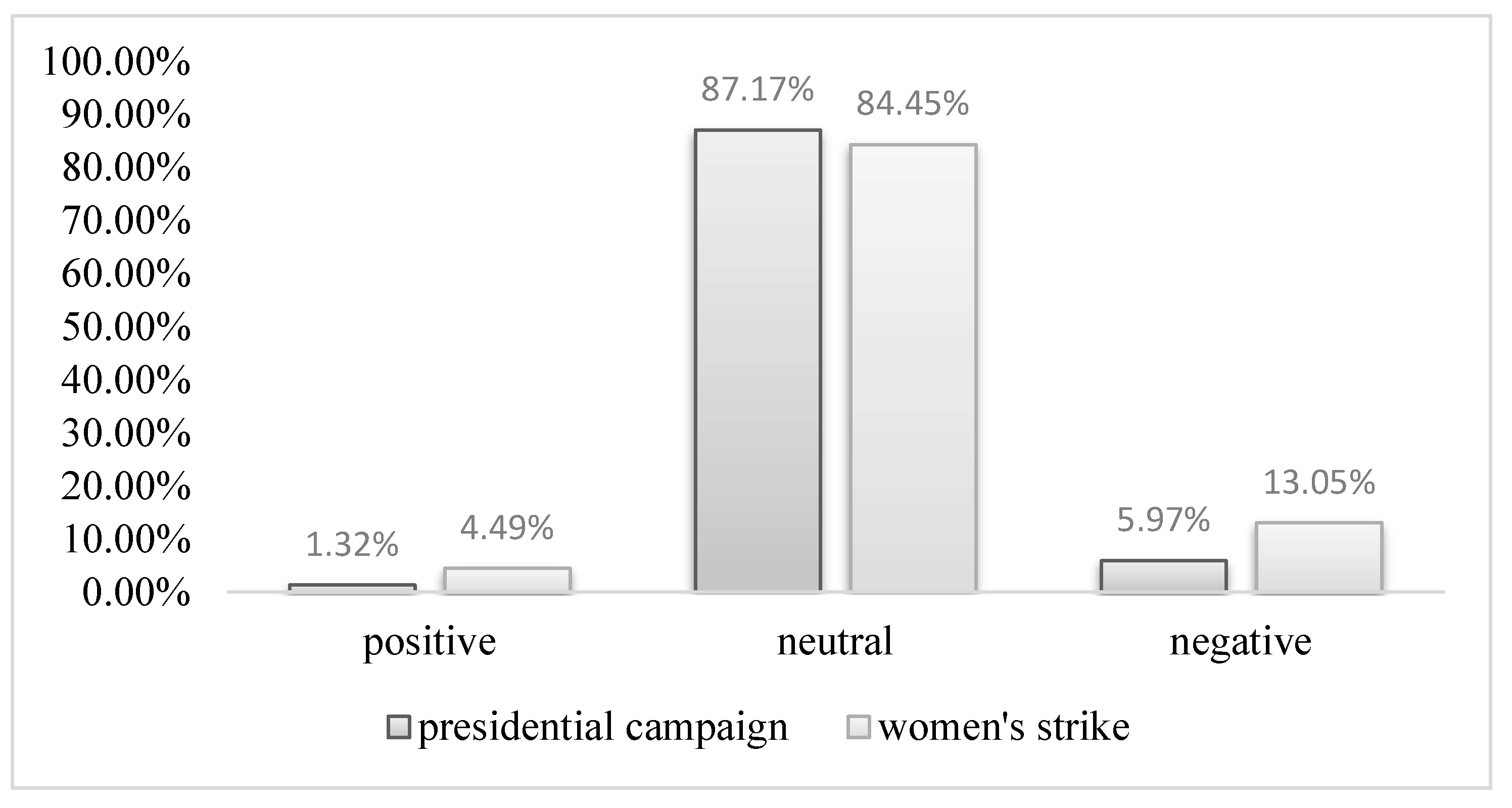
Online aggression and abusive language on social media pose a growing threat to democratic discourse, as they contribute to polarization, delegitimization of political actors, and the erosion of civil debate. While much of the current research relies on computational methods to detect hate speech, fewer studies investigate how online aggression functions discursively in specific socio-political contexts. This study addresses this gap by analyzing patterns of verbal aggression on Facebook and Twitter during two key events in Poland in 2020: the presidential election and the Women’s Strike. Adopting a mixed-method approach (combining sentiment analysis, content analysis, and discourse analysis) and comparing two socio-political events that generated extensive online debate, this study investigates the patterns and communicative functions of hostile and aggressive language on Facebook and Twitter. The study reveals that neutral posts dominated both datasets, but negative and aggressive posts were significantly more frequent during the Women’s Strike, where verbal aggression was used not only to reinforce group identity but also to express moral outrage, trauma, and demands for change. In contrast, aggression during the election campaign was less frequent but more calculated. It functioned as a strategic tool to delegitimize political opponents and reinforce partisan divides. Users employed vitriolic language and profanity as rhetorical tools to undermine authority, reinforce group identity, and mobilize supporters. The study also reveals asymmetric patterns of aggression, with public figures and institutions, particularly the ruling party, Church, and police, being primary targets. The findings have significant implications for understanding the dynamics of online debates and aggression patterns in social media.
Keywords: verbal aggression; vitriol; political campaign; social protests; social media; discourse analysis verbal aggression; vitriol; political campaign; social protests; social media; discourse analysis