Article

Assessing the Impact of Land Use and Land Cover Change on Ecological Environment Quality in Arid and Semi-Arid Grassland Regions: A Case Study of Siziwang Banner, Inner Mongolia


1
School of Resources and Environmental Engineering, Inner Mongolia University of Technology, Hohhot 010051, China
2
Siziwang Banner Development Research Center, Siziwang Banner, Ulanqab 011800, China
3
Key Laboratory of Geological Hazards and Geotechnical Engineering Prevention in Sandy, Arid and Cold Regions, Universities of Inner Mongolia Autonomous Region, Hohhot 010051, China
*
Author to whom correspondence should be addressed.
These authors contributed equally to this work.
Earth 2026, 7(3), 101; https://doi.org/10.3390/earth7030101 (registering DOI)
Submission received: 6 May 2026 / Revised: 28 May 2026 / Accepted: 10 June 2026 / Published: 14 June 2026
(This article belongs to the Topic Land Cover and Ecological Change)

Abstract

Siziwang Banner in Inner Mongolia is a typical arid and semi-arid grassland region where ecological environmental quality is highly sensitive to climate variability and land use and land cover change (LULCC). Clarifying the long-term coupling relationship between LULCC and ecological environmental quality is essential for regional ecological protection and sustainable land management. Based on the Google Earth Engine (GEE) platform, this study integrated multi-temporal Landsat imagery and CLCD-based land use datasets, including an updated 2024 land use layer, to construct a Remote Sensing Ecological Index (RSEI) using standardized and direction-corrected principal component analysis. land use transition matrix analysis, spatial autocorrelation analysis, ecological contribution rate calculation, and GeoDetector were further applied to reveal the spatiotemporal evolution patterns, ecological effects, and driving mechanisms of LULCC in Siziwang Banner from 2000 to 2024. The results showed that: (1) grassland was consistently the dominant land use type, accounting for more than 90% of the total area. The overall land use pattern was characterized by stable grassland dominance, decreasing farmland and unused land, and slight increases in grassland and construction land; forestland showed a high relative growth rate but remained very small in absolute area. (2) The regional ecological environmental quality remained at a lower-to-medium level, with mean RSEI values ranging from 0.27 to 0.47. RSEI showed a phased pattern of initial improvement, subsequent decline, and partial recovery; the marked decline around 2015 was associated with the combined effects of drought stress and land use degradation rather than a single driving factor. RSEI exhibited significant positive spatial autocorrelation, with Moran’s I values ranging from 0.898 to 0.993. High-value clusters were mainly distributed in the southern region, whereas low-value clusters were concentrated in the central and northern regions. (3) Different land use transitions produced differentiated ecological effects. The conversion of unused land to grassland contributed positively to ecological restoration, while grassland degradation and construction land expansion exerted negative effects. The positive RSEI response of some grassland-to-farmland transitions should be interpreted cautiously in relation to local irrigation and intensive farmland management. (4) GeoDetector results indicated that land use type and DEM were the dominant factors controlling the spatial differentiation of RSEI, with average q values of 0.7188 and 0.6178, respectively. The interaction between DEM and land use type showed the strongest explanatory power, indicating that ecological quality was jointly shaped by land use structure and natural background conditions. This study provides a scientific basis for grassland protection, unused-land restoration, farmland management, and spatially differentiated ecological restoration in Siziwang Banner and similar ecologically fragile arid and semi-arid grassland regions.

1. Introduction

Land use and land cover change (LULCC) refers to changes in both human land use activities and biophysical land cover characteristics on the Earth’s surface, and it has become an important component of global environmental change research [1]. As a critical nexus between human society and the natural environment, land use embodies both natural and socio-economic attributes [2]. Human development is inherently dependent on land, which provides essential resources such as living space, food, and transportation [3]. Consequently, social progress inevitably leads to changes in land use and land cover, which serve as integral components of the ecological environment, exerting both direct and indirect influences on regional ecological balance. Conversely, changes in the ecological environment can compel modifications in land use [4]. Since the implementation of economic reforms in 1978, China has witnessed rapid advancements in socio-economic conditions [5]. This swift economic growth, coupled with urbanization and inadequate governance mechanisms, has precipitated severe land supply–demand conflicts, resulting in a myriad of environmental challenges [6]. In the course of urbanization, LULCC typically manifest as the encroachment of grasslands, arable land, and water bodies, leading to environmental degradation and a decline in ecological quality [7]. Among various ecosystems, arid and semi-arid grassland regions are particularly sensitive to LULCC due to their inherent scarcity of water resources, low vegetation cover, and limited ecosystem resilience [8]. Changes in land use—whether through the expansion or contraction of arable land in agro-pastoral transition zones, land degradation caused by industrial activities, or vegetation recovery driven by ecological restoration initiatives—can trigger significant ecological responses in these regions. Therefore, systematically elucidating the spatio-temporal processes of LULCC and its ecological responses in arid and semi-arid grasslands is crucial for understanding the interplay between human activities and the natural environment, as well as for formulating tailored ecological protection policies.
Early investigations into LULCC primarily focused on land resource surveys, the development of classification systems, and preliminary explorations of theories and methodologies [9]. With advances in satellite remote sensing technology and an increase in satellite launches, remote sensing methods have gradually been applied to surface land monitoring [10]. Entering the 21st century, the widespread availability of high-resolution temporal and spatial remote sensing data, coupled with the profound impacts of socio-economic development on land use practices, has made the spatio-temporal processes of LULCC and its ecological environmental effects key areas of research. For instance, Yang Hao utilized Landsat remote sensing imagery and applied visual interpretation techniques to obtain land use classification data for the Beijing–Tianjin–Hebei urban agglomeration across two time periods, revealing that the expansion of construction areas contributes to noticeable thermal environmental effects [11]. Similarly, Jia Jing simulated the impacts of various land use changes on surface runoff in the Qinhuangdao region, finding that the spatial distribution of surface runoff is primarily influenced by changes in forest, agricultural, and construction lands [12]. In recent years, there has been a growing trend in research that integrates remote sensing with geographic information technologies to dynamically assess regional ecological environmental quality, with an increasing diversity and quantitative approach to methodologies. Overall, a close interaction exists between LULCC and ecological environmental quality. Unsustainable land development practices disrupt and degrade ecosystems, as evidenced by declines in composite indices of environmental quality. Conversely, planned land use optimization and ecological restoration can significantly enhance regional ecological health. Recent studies have increasingly combined LULCC assessments with evaluations of ecological environmental quality for comprehensive analysis. For example, Ye Bowen utilized the Google Earth Engine (GEE) platform to analyze habitat quality changes in Bayannur City from 2000 to 2022, utilizing multi-temporal remote sensing images to construct a Remote Sensing Ecological Index (RSEI). Their findings indicated that improvements in habitat quality were primarily associated with increases in arable land and the conversion of wasteland to grassland, while declines were linked to significant reductions in grassland areas [13]. Wang Haifeng analyzed land use data from Guizhou Province between 1985 and 2020, examining the spatio-temporal characteristics of ecological effects stemming from LULCCs across various scales, concluding that ecological environmental quality fluctuates with changes in land use types, particularly between arable land and forest [14]. Li Ying investigated the land use transitions in the Qinghai Lake Basin using six periods of land use/cover data, employing land use transition matrices, ecological environmental quality indices, and ecological contribution rates of land use transitions [15]. Their results highlighted that the conversion of unused land to grassland and water bodies is a critical driver for enhancing ecological environmental quality. These studies collectively underscore the direct impacts of LULCC on ecological environments.
Siziwang Banner in Inner Mongolia is a typical arid and semi-arid grassland region, where ecological environmental quality is highly sensitive to both climate variability and human-induced land use and land cover change (LULCC). Since 2000, ecological restoration projects, grazing regulation, agricultural restructuring, and mine reclamation have been gradually implemented in this region, resulting in notable changes in land use structure and ecological conditions. However, existing studies have paid relatively limited attention to the long-term coupling relationship between LULCC and ecological environmental quality in arid and semi-arid grassland regions, especially the quantitative ecological effects of different land use transitions. Therefore, it is necessary to systematically examine how land use changes affect ecological environmental quality in Siziwang Banner, so as to provide scientific support for ecological protection and sustainable land management in fragile grassland ecosystems. The main aim of this study is to reveal the spatiotemporal evolution of LULCC and ecological environmental quality in Siziwang Banner from 2000 to 2024 and to clarify the ecological effects of major land use transitions. The Google Earth Engine (GEE) platform boasts an extensive repository of geospatial datasets and high-performance parallel computing capabilities and has been extensively adopted for long-term spatiotemporal assessment of ecological environmental quality [16]. Accordingly, leveraging the GEE cloud platform, this study integrates multi-temporal Landsat remote sensing imagery and China Land Cover Dataset (CLCD) land use data spanning 2000 to 2024 to construct the Remote Sensing Ecological Index (RSEI). We employ a comprehensive methodological framework combining land use transition matrix, spatial autocorrelation analysis, and ecological contribution rate calculation to systematically characterize the spatiotemporal evolution patterns of land use and ecological environmental quality in Siziwang Banner and quantitatively identify critical land conversion types and their corresponding ecological effects. Furthermore, Geodetector 1.0-5 was employed to further quantify the explanatory power of natural and anthropogenic factors and to identify their interactive effects on the spatial differentiation of RSEI. This study provides a comprehensive framework for assessing the ecological responses of arid and semi-arid grassland ecosystems to LULCC. The results are expected to offer a scientific basis for optimizing land use structure, strengthening grassland ecological restoration, and formulating differentiated ecological management strategies in Siziwang Banner and other similar ecologically fragile regions.

2. Materials and Methods

2.1. Study Area

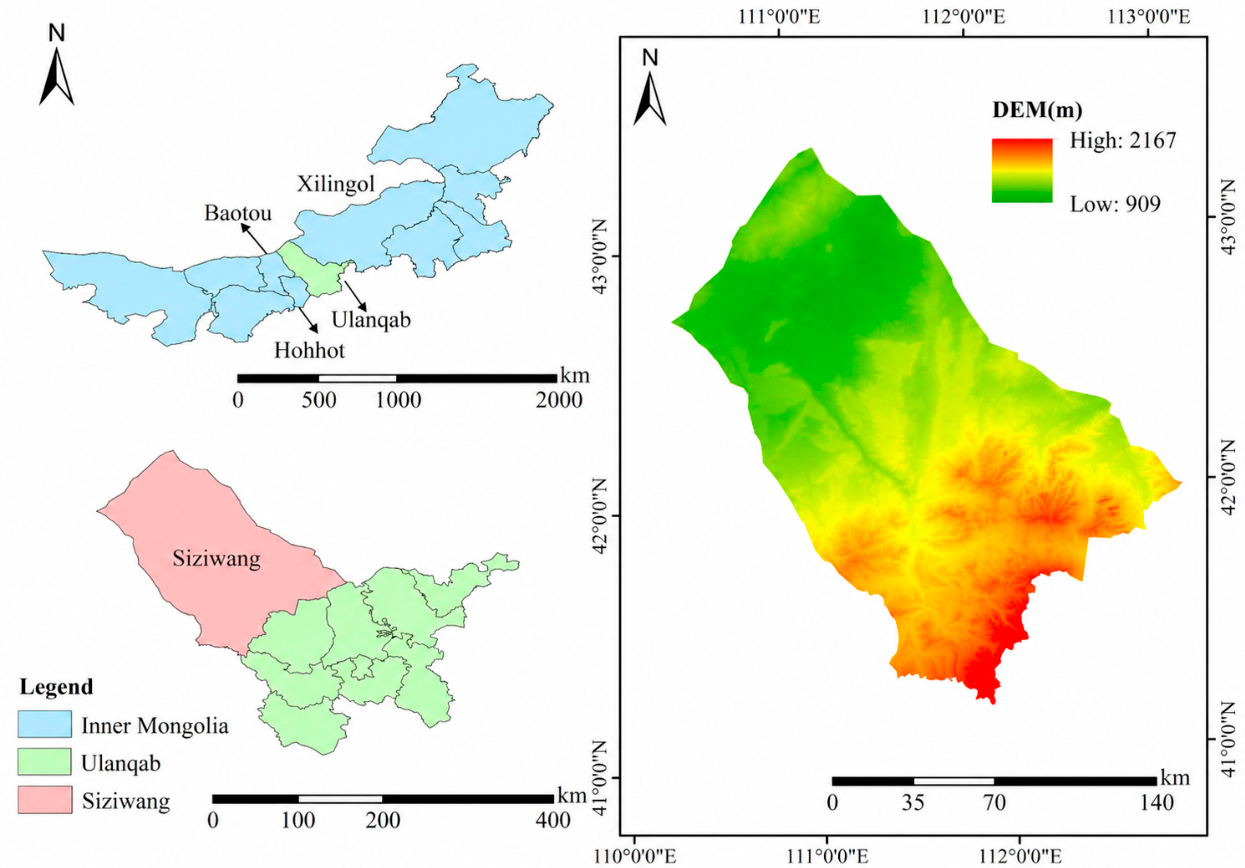
Siziwang Banner (110°20′~113°00′ E, 41°10′~43°22′ N) is located in central Inner Mongolia Autonomous Region and northwestern Ulanqab City, covering a total administrative area of 24,036 km2. Its terrain exhibits a distinct northward gradient, transitioning sequentially from the northern piedmont of the Yin Mountains, through the Ulanqab Hills, to the Mongolian Plateau. With an average elevation of 1400 m, the landscape is dominated by mountains, hills, and plateaus, placing the region firmly within the arid and semi-arid desert steppe biome (Figure 1). Economically, Siziwang Banner is characterized by a livestock-dominated, agro-pastoral mixed economy and boasts a long history of nomadic civilization. Historically, it developed a significant mining industry based on its abundant mineral resources. Past intensive mining activities, compounded by adverse climatic conditions, had led to severe ecological degradation including grassland deterioration, desertification, and sandification. Since 2016, however, the local government has phased out backward and polluting mining enterprises and embarked on a comprehensive ecological transformation pathway. Faced with the dual challenges of ecological fragility and industrial restructuring, Siziwang Banner has vigorously implemented grassland ecological protection and restoration initiatives, grazing prohibition and rest regimes, and grass–livestock balance management. Parallel efforts have focused on developing green industries such as clean energy, improved potato seed breeding, and scientific mutton sheep breeding, alongside mine reclamation projects and comprehensive tourism upgrading. These endeavors have earned the region numerous prestigious accolades, including the National Ecological Protection and Construction Demonstration Zone, National Pilot Major Function Oriented Zone, National “Lucid Waters and Lush Mountains are Invaluable Assets” Practice and Innovation Base, Autonomous Region Civilized City, and National Model Collective for Ethnic Unity and Progress. Against this backdrop, continuous monitoring of land use dynamics and ecological environmental quality in Siziwang Banner aligns with national strategic priorities for green development in ecologically fragile regions and coordinated development in border areas. This study adopts a holistic approach that integrates the integrity of ecological protection and the spatial correlation of industrial distribution, thus defining the entire administrative territory of Siziwang Banner as the study area.

2.2. Data Sources

The primary datasets utilized in this study include Landsat 5 Thematic Mapper (TM) and Landsat 8 Operational Land Imager (OLI) remote sensing imagery, land use classification data, and digital elevation model (DEM) data, as detailed in Table 1.
On the Google Earth Engine (GEE) cloud platform, we acquired cloud-filtered (cloud cover < 10%) Landsat imagery captured during the peak vegetation growing season (June to August) spanning 2000–2024. Standard preprocessing workflows, including radiometric calibration and atmospheric correction, were uniformly applied to all scenes to ensure the accuracy and comparability of subsequent ecological indicator extraction.
The land use and land cover change (LULCC)data employed in this research is the 30 m spatial resolution China Land Cover Dataset (CLCD) covering the period 2000–2024. Although the CLCD is updated annually, we selected data at 5-year intervals for long-term trend analysis, specifically for the years 2000, 2005, 2010, 2015, 2020, and 2024. The original CLCD classification system comprises nine land use categories: farmland, forestland, shrubland, grassland, water bodies, snow cover, barren land, impervious surface, and wetland. In the present study, shrubland was merged into forestland because of its very small area and ecological similarity to sparse woody vegetation. Since Siziwang Banner has no permanent glaciers and snow cover is a temporary phenomenon, Wetlands were merged with water-related land cover types. This reclassification was conducted in strict accordance with the Current Land Use Classification of China (GB/T 21010-2017) [17]. Consequently, the study area was ultimately reclassified into six aggregated land use categories: farmland, forestland, grassland, construction land, water bodies, and unused land [18].
The years 2000, 2005, 2010, 2015, 2020, and 2024 were selected to capture medium-term LULCC dynamics while reducing the influence of short-term interannual fluctuations. The approximately five-year interval is suitable for identifying stable land use transition trends. In addition, 2015 was retained as a key temporal node because the region experienced a marked drought-related decline in ecological quality during this period, while 2024 represents the recent available monitoring year and allows assessment of the latest ecological restoration effects.

2.3. Methods

This study conducts a comprehensive spatiotemporal analysis of LULCC and ecological environmental evolution in Siziwang Banner based on multi-source geospatial datasets. The analytical framework primarily comprises four core components: construction of the Remote Sensing Ecological Index (RSEI), LULCC analysis, spatial autocorrelation analysis, and ecological contribution analysis.

2.3.1. Construction of the Remote Sensing Ecological Index

Leveraging the Google Earth Engine (GEE) cloud-based remote sensing processing platform, we used preprocessed Landsat imagery as the primary data source to calculate four fundamental ecological indicators (greenness, wetness, dryness, and heat). These indicators were then integrated via Principal Component Analysis (PCA) to construct the RSEI, which provides a comprehensive quantitative assessment of regional ecological environmental quality [19]. Specifically, the Normalized Difference Vegetation Index (NDVI), a globally ubiquitous metric that effectively quantifies regional vegetation coverage and growth status, was adopted to represent the greenness component [20]. The wetness component (WET) was used to characterize water content in both vegetation and soil, a parameter intrinsically linked to ecological environmental quality [21]. The dryness component was computed as the arithmetic mean of the Index-based rop-up Index (IBI) (for construction land information) and the Soil Index (SI) (for bare soil information), which robustly reflects the degree of surface desiccation [22]. The heat component, a critical indicator of surface thermal conditions closely associated with anthropogenic activities and climate change, was represented by Land Surface Temperature (LST) retrieved using the atmospheric correction method [23]. Detailed mathematical formulas and parameter specifications for all four ecological indicators are presented in Table 2.
PCA can objectively integrate multiple ecological indicators and avoid subjective weighting. Before PCA, all four ecological indicators were normalized to eliminate the influence of different dimensions and value ranges. NDVI and WET were regarded as positive indicators of ecological quality, whereas NDBSI and LST were regarded as negative indicators. For each indicator, normalization was performed using the pooled minimum and maximum values of all study years within the study area, so as to enhance interannual comparability.
The normalized indicators were then integrated using PCA. Considering that the sign of a principal component is mathematically arbitrary, the direction of PC1 was adjusted according to the ecological meaning of the loadings. When the loadings of NDVI and WET were positive and those of NDBSI and LST were negative, PC1 was used directly. Otherwise, PC1 was multiplied by −1. The final RSEI was calculated by normalizing the direction-corrected PC1 score to the range of 0–1:
RSEI = PC 1 PC 1 min PC 1 max PC 1 min
where PC 1 denotes the direction-corrected first principal component. Thus, higher RSEI values consistently indicate better ecological environmental quality.

2.3.2. Land Use Transition Matrix Model

Building upon the reclassified land use datasets described in Section 2.2, we employed the land use transition matrix model to quantitatively characterize the magnitude, direction, and rate of land use conversions in Siziwang Banner across the six study periods (2000–2005, 2005–2010, 2010–2015, 2015–2020, and 2020–2024). This model is a fundamental analytical tool in land use science that not only depicts the static structure of land use at different time points but also reveals the dynamic transformation processes between different land use categories, providing an intuitive and quantitative basis for identifying dominant LULCC patterns [24]. Mathematically, the land use transition matrix can be expressed as:
S ij = S 11 S 12 S 1 n S 21 S 22 S 2 n S n 1 S n 2 S nn
where S denotes the land area; n denotes the total number of land use categories; i denotes the initial land use category; j denotes the final land use category.

2.3.3. Spatial Autocorrelation of Ecological Environment Quality

Spatial autocorrelation analysis was employed to elucidate the spatial interdependence of ecological environmental quality across the study area and identify clusters of high and low values [25]. Global spatial autocorrelation provides a comprehensive assessment of the overall spatial pattern across the entire study region, revealing whether the spatial distribution of a given attribute exhibits clustered, dispersed, or random characteristics, as well as quantifying the magnitude and statistical significance of these patterns. In contrast, local spatial autocorrelation measures the spatial association between each individual spatial unit and its neighboring units, enabling the detection of localized spatial disparities and the identification of statistically significant hotspots and cold spots [26]. The interpretation of the Global Moran’s I index values is standardized as follows: A positive value approaching 1 indicates significant positive spatial autocorrelation, reflecting clustering of similar attribute values among adjacent spatial units, with the absolute value positively correlated with the intensity of spatial aggregation. A negative value approaching −1 signifies significant negative spatial autocorrelation, indicating heterogeneity of attribute values among neighboring units, with the absolute value positively correlated with the degree of spatial differentiation. A value close to 0 denotes a random spatial distribution, implying no statistically significant spatial dependence among spatial units [27]. The mathematical formula for Global Moran’s I is expressed as:
Global   Mora n , s I = n i = 1 n j = 1 n W i j ( x i x ¯ ) ( x j x ¯ ) ( i = 1 n j = 1 n W i j ) i = 1 n ( x i x ¯ ) 2
Local   Mora n , s I = n ( x i x ¯ ) j = 1 n W i j ( x j x ¯ ) i = 1 n ( x i x ¯ ) 2
where n denotes the total number of spatial units in the study area; x i and x j represent the values of the ecological index X at spatial units i and j; x ¯ is the mean value of the ecological index across all spatial units; Wij is the spatial weight matrix that defines the adjacency relationship between spatial units i and j. For local indicators of spatial association (LISA), the interpretation of local Moran’s I values is as follows: A positive local Moran’s I value indicates that a spatial unit with a high (or low) index value is surrounded by neighboring units with similarly high (or low) values, forming high–high (HH) or low–low (LL) clusters. A negative local Moran’s I value indicates that a spatial unit with a high (or low) index value is surrounded by neighboring units with contrasting low (or high) values, forming high–low (HL) or low–high (LH) spatial outliers. A local Moran’s I value close to 0 indicates no statistically significant spatial association between the spatial unit and its neighbors.

2.3.4. Ecological Contribution Rate Analysis

The ecological contribution rate has been used in LULCC-related ecological assessment studies to quantify how specific land use transitions contribute to changes in regional ecological environmental quality. Yuan et al. used the ecological contribution rate and found that the conversion of a relatively large amount of agricultural production land to urban and rural residential land led to a slight decrease in the ecological environment index, while the transfer of a large amount of agricultural production land to ecological land resulted in a more significant increase in the index [28]. By combining the land use transition matrix with changes in RSEI, this index identifies which conversion types have positive or negative effects on ecological quality [29]. Its advantage is that it links land cover transitions with ecological quality changes in a spatially explicit way. However, the index mainly reflects relative contribution and does not independently prove causality; therefore, in this study, it was interpreted together with LULCC patterns, RSEI changes, and spatial autocorrelation results. The specific calculation formula is expressed as:
G E = | R 2 R 1 | × L S / T S
where GE denotes the ecological contribution rate of a specific land use type transition; R2, R1 represent the mean Remote Sensing Ecological Index (RSEI) values of the converted land parcel at the initial and final stages of the transition period, respectively; LS is the area of the converted land parcel; TS is the total area of the study region.

2.3.5. GeoDetector Analysis of Driving Factors

To quantitatively identify the dominant factors controlling the spatial differentiation of ecological environmental quality, the GeoDetector model was introduced in this study. GeoDetector is a spatial statistical method that detects the explanatory power of different driving factors based on the consistency between the spatial distribution of dependent and independent variables [30]. In this study, the RSEI value was used as the dependent variable, while natural and anthropogenic factors were selected as explanatory variables to explore their individual and interactive effects on ecological environmental quality in Siziwang Banner.
Considering the ecological characteristics of arid and semi-arid grassland regions and data availability, the selected driving factors included natural background factors and human-related factors. The natural factors mainly included DEM, annual precipitation and annual mean temperature. The anthropogenic factors mainly included land use type and population density (Table 3). To avoid circular reasoning, the four indicators used to construct RSEI, including NDVI, WET, NDBSI, and LST, were not directly used as driving factors in the GeoDetector analysis [31,32]. A grid was created to extract the dependent variable (RSEI) and the independent variables, resulting in a total of 1048 grid points. Each dataset was then stratified using the natural breaks method. Additionally, geographical detector modeling was performed on each dataset for six time points (2000, 2005, 2010, 2015, 2020, and 2024).
The factor detector was first used to quantify the explanatory power of each driving factor on the spatial differentiation of RSEI. The explanatory power was measured by the q-statistic:
q = 1 h = 1 L N h σ h 2 N σ 2
where q represents the explanatory power of a driving factor for the spatial differentiation of RSEI; h is the category or stratum of the driving factor; L is the number of strata; N h and N are the number of samples in h stratum and the whole study area, respectively; and σ h 2 and σ 2 are the variance of RSEI in stratum h and the whole study area, respectively. The value of q ranges from 0 to 1. A larger q value indicates a stronger explanatory power of the driving factor on the spatial differentiation of ecological environmental quality.

3. Results

3.1. Spatiotemporal Evolution of Land Use in Siziwang Banner

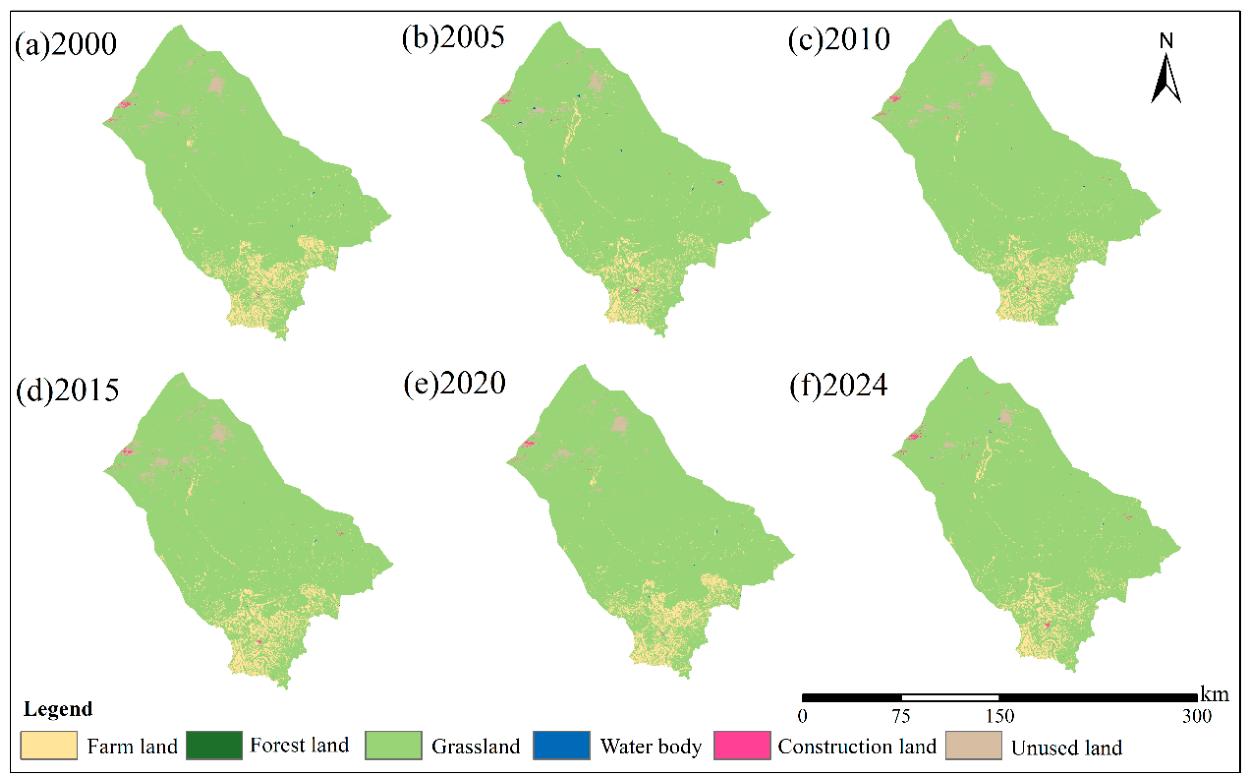
As shown in Table 4, grassland remained the overwhelmingly dominant land use type in Siziwang Banner throughout the study period, indicating the typical landscape characteristics of an arid and semi-arid grassland region. Farmland and unused land generally decreased, whereas construction land expanded steadily. Forestland showed a high relative growth rate, although its absolute area remained very small. Water bodies fluctuated markedly among different years, reflecting the sensitivity of surface water in arid and semi-arid regions to climatic variability. Overall, the land use pattern was characterized by stable grassland dominance, gradual expansion of construction land, and a reduction in unused land. As illustrated in Figure 2, farmland was concentrated in the central and southern parts of the region, while construction land was scattered in a point-like distribution, with a slight increase in local aggregation over time. This spatiotemporal evolution pattern is likely attributable to the implementation of regional ecological conservation policies.
The conversion of grassland, forestland, and water bodies to farmland drove the changes in farmland area in Siziwang Banner. During 2000–2010, these three ecological land types accounted for 23.39% of the total area converted to farmland. This proportion rose slightly to 25.10% during 2010–2020, representing an increase of 1.71 percentage points. The successive implementation of grassland ecological protection projects and intensive farmland consolidation programs in Siziwang Banner has led to more coordinated land use transitions despite minor fluctuations in the proportion of ecological land converted to farmland.

3.2. Spatiotemporal Evolution Trends of Ecological Environmental Quality in Siziwang Banner

3.2.1. Results of Principal Component Analysis

Table 5 presents the PCA results of the four ecological indicators from 2000 to 2024. The contribution rate of PC1 ranged from 69.37% to 81.35%, indicating that the first principal component captured the dominant information of the four ecological indicators and was therefore suitable for constructing RSEI. After direction correction, the PC1 loadings showed consistent ecological signs across all years. NDVI and WET had positive loadings, whereas NDBSI and LST had negative loadings. This pattern is consistent with the ecological interpretation of RSEI, in which vegetation greenness and wetness improve ecological quality, while dryness and heat reduce ecological quality. Therefore, higher RSEI values consistently represent better ecological environmental quality.
Although the signs of the PC1 loadings remained stable, the magnitudes of the loadings varied among years. In particular, LST had relatively high negative loadings in 2005 and 2010, indicating that thermal conditions played an important role in ecological quality changes during these periods. Overall, the PCA results confirm that PC1 had a stable ecological direction during 2000–2024, supporting the use of direction-corrected PC1 for RSEI construction.

3.2.2. Spatiotemporal Evolution Analysis of the Remote Sensing Ecological Index (RSEI) in Siziwang Banner

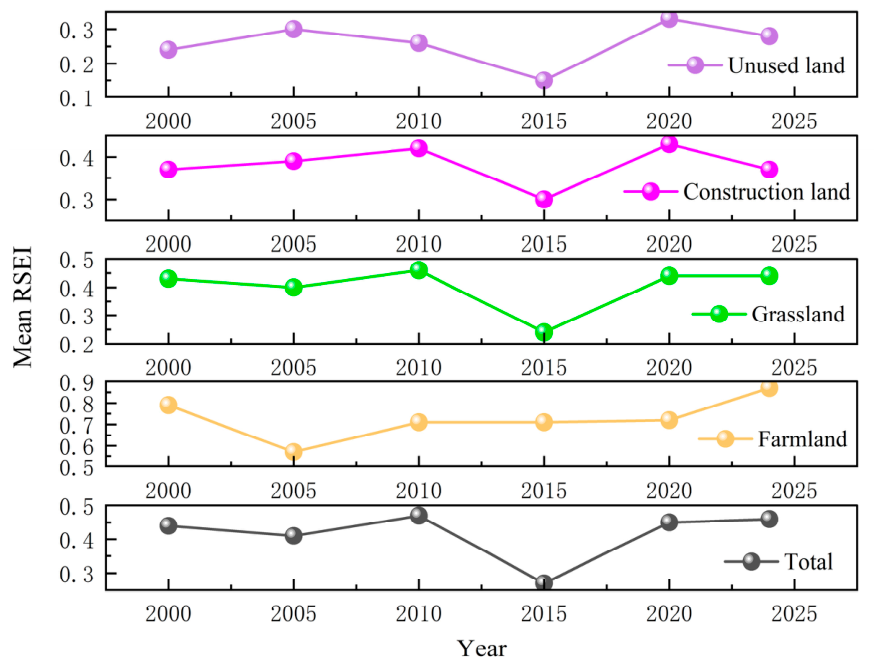
The mean RSEI value of Siziwang Banner ranged from 0.27 to 0.47 during the 2000–2024 study period (Figure 3), with a slight overall increase from 0.44 in 2000 to 0.46 in 2024, indicating that the regional habitat quality remained at a lower-to-medium level throughout the monitoring period. Notably, the mean RSEI exhibited a significant decline during 2010–2015. This period was characterized by a reduction in grassland area, concurrent expansion of farmland and unused land, and the conversion of partial grassland to unused land. This abrupt degradation in ecological quality was primarily attributed to the severe regional drought event that struck Inner Mongolia in 2015, which triggered widespread vegetation decline and a subsequent sharp drop in regional ecological environmental quality. Overall, the ecological environmental quality of Siziwang Banner showed a mild improving trend over the entire 2000–2024 study period, with distinct improvement phases in 2005–2010 and 2015–2024, and degradation phases in 2000–2005 and 2010–2015.
By comparing the temporal dynamics of mean RSEI for the entire study region and dominant land use types, we found that their variation trends were generally consistent. In particular, the mean RSEI of grassland dropped to its lowest point in 2015 but fully recovered by 2024. This recovery directly reflects the implementation effectiveness of a series of ecological conservation policies, including grassland grazing prohibition, grass–livestock balance management, and ecological subsidy programs, with the benefits of ecological restoration becoming increasingly evident over time.
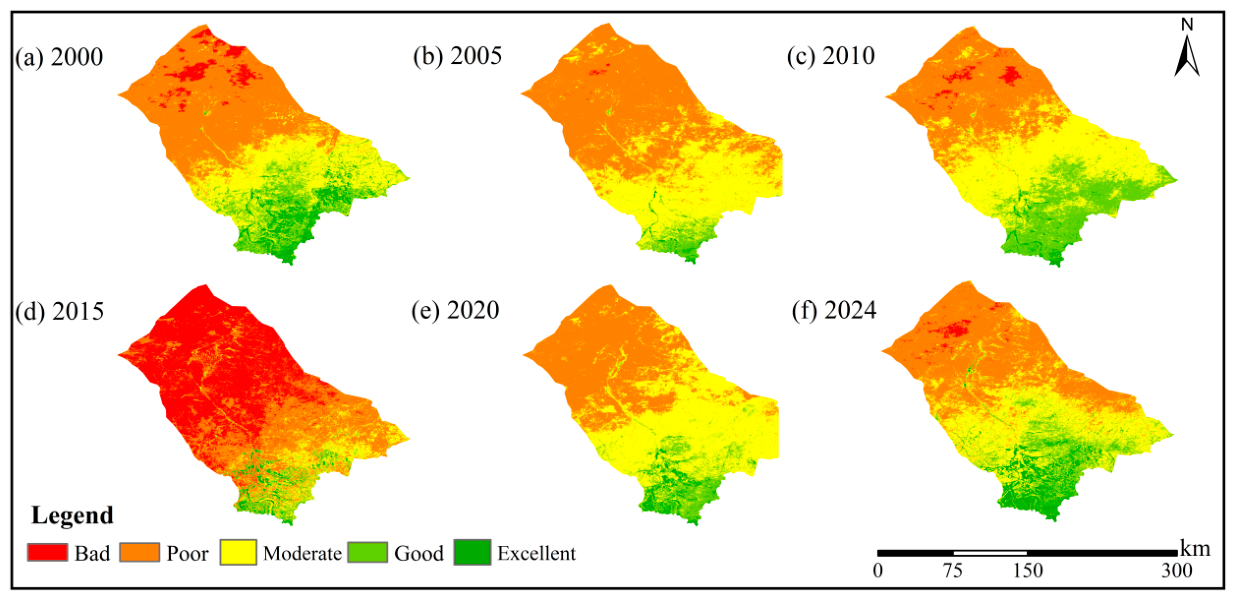
Further analysis of the spatial distribution and proportional changes of each RSEI grade revealed distinct spatiotemporal patterns of habitat quality in Siziwang Banner (Table 6, Figure 4). Overall, the habitat quality of the study area was dominated by Bad, Moderate, and Poor grades. Areas classified as Bad and Poor accounted for 51.0% of the total banner area in 2000, peaked at 81.36% in 2015, and decreased to 44.82% in 2024. These low-habitat-quality areas occupied more than 40% of the total area in most study years and were predominantly distributed in the central and northern parts of the banner. In contrast, regions with Excellent and Good habitat quality were consistently concentrated in the southern area throughout the study period. In 2000, Excellent and Good grades accounted for only 20.5% of the total area, corroborating the overall lower-to-medium level of habitat quality in the region. During 2000–2010, the area of Good grade increased by 37.1%, and the area of Moderate grade increased by 40.0%, indicating a moderate improvement in regional ecological quality. However, a dramatic expansion of Bad grade occurred in 2015, with the combined proportion of Bad and Poor grades exceeding 80%, reflecting a severe deterioration of the ecological environment, consistent with the drought-induced RSEI decline identified in the previous section. During 2015–2024, the proportion of Excellent and Good grades increased by 12.73 percentage points compared with 2015, while the combined proportion of Bad and Poor grades decreased by 36.54 percentage points. Combined with the 99.9% net decrease in the area of Bad grade over 2010–2020, these results demonstrate a significant and sustained improvement in habitat quality during this period. During 2000–2020, the area of the “Bad” ecological quality grade showed large temporal fluctuations. After recalculating the RSEI grade areas using a consistent study-area mask and pixel-area method, we found that the decrease in the “Bad” grade was mainly accompanied by an increase in the “Poor” and “Moderate” grades. This indicates that the lowest-quality areas were partly improved to adjacent quality grades, rather than being completely transformed into high-quality ecological areas.
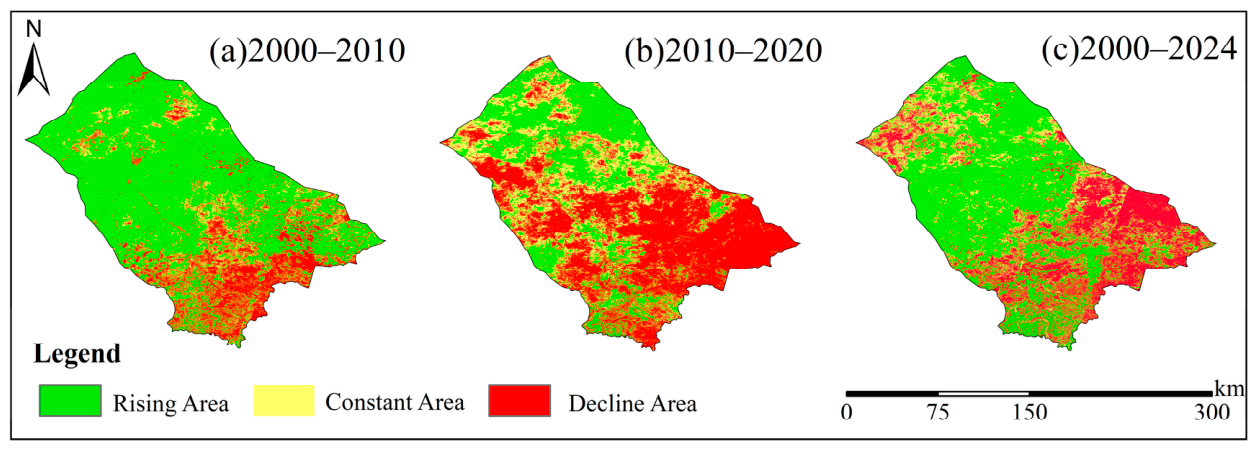
Based on the Change in Remote Sensing Ecological Index (change in RSEI) across different periods during 2000–2024, we classified habitat quality changes in Siziwang Banner into three categories: Deterioration Zone (change in RSEI < −0.02), Stable Zone (−0.02 ≤ change in RSEI < 0.02), and Improvement Zone (change in RSEI ≥ 0.02). This ±0.02 threshold was selected to effectively capture ecologically significant changes in habitat quality, while avoiding the misclassification of minor random fluctuations in the index as substantive ecological shifts. As shown in Table 7 and Figure 5, over the entire 2000–2024 study period, the total area of the Improvement Zone reached 12,513.57 km2, accounting for 52.08% of the total study area, and was mainly distributed in the southern part and partial central regions of the banner. The Deterioration Zone covered 7044.89 km2 (29.32% of the total area), concentrated in the northern part of the study area with scattered patches elsewhere. The Stable Zone occupied 4469.13 km2 (18.60% of the total area) and was sporadically distributed across the banner. Temporally, the most significant improvement in habitat quality occurred during 2000–2010, with the Improvement Zone spanning 16,631.89 km2 (69.22% of the total area). In contrast, a marked deterioration was observed during 2010–2020, with the Deterioration Zone expanding to 11,093.52 km2 (46.17% of the total area). This downward trend persisted into the most recent period (2020–2024), with the Deterioration Zone remaining at 11,259.33 km2 (46.86% of the total area), indicating sustained pressure on regional habitat quality.
Overall, the habitat quality of Siziwang Banner exhibited a general trend of initial improvement followed by sustained deterioration over the 24-year study period. The early stage (2000–2010) was dominated by widespread ecological improvement, while the area of habitat deterioration has expanded continuously since the mid-study period, with the Deterioration Zone still covering nearly half of the total area at the end of the monitoring period. These findings highlight the need for strengthened ecological restoration and management in the northern region and other core deterioration zones, as well as consistent, stable conservation measures in the southern improvement zones, to support the overall improvement of regional habitat quality.

3.2.3. Spatial Autocorrelation Analysis

We performed the Global Moran’s I test to quantify the spatial autocorrelation characteristics of the Remote Sensing Ecological Index (RSEI) in Siziwang Banner, Inner Mongolia, over the 2000–2024 study period. The results demonstrated that all Global Moran’s I value of RSEI across the monitoring period were greater than 0, and all passed the significance test at the p < 0.05 level (Table 8). This indicates that the spatial distribution of RSEI in the study area exhibited a significant positive spatial autocorrelation throughout the study period, meaning that spatial units with similar RSEI values (high–high or low–low value clusters) showed a pronounced aggregated distribution pattern rather than a random spatial distribution.
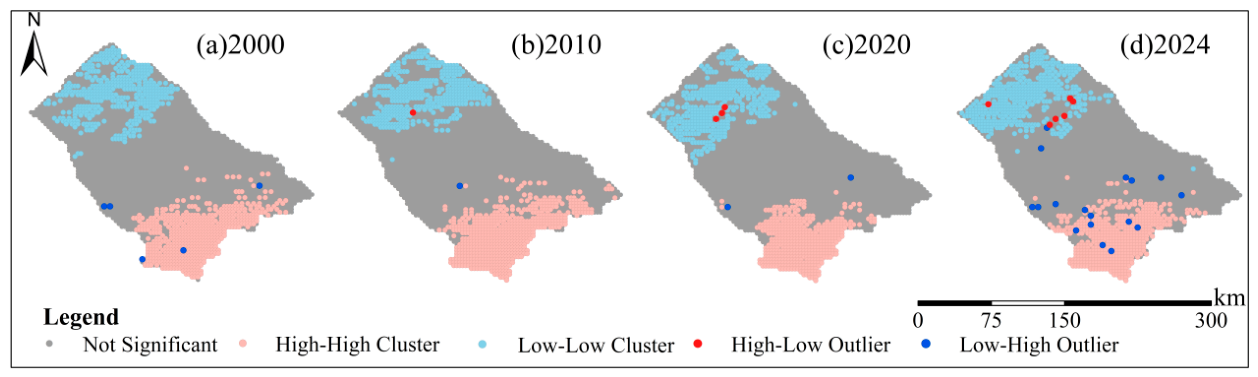
Building on the global spatial autocorrelation results (p < 0.05), the RSEI of Siziwang Banner exhibited consistently significant positive spatial autocorrelation throughout the 2000–2024 study period. This confirms that the spatial distribution of regional ecological environmental quality featured pronounced clustering characteristics, rather than a random spatial pattern. We further employed Local Indicators of Spatial Association (LISA) cluster analysis to characterize the spatiotemporal evolution of this spatial clustering pattern (Figure 6). During 2000–2010, the spatial clustering pattern of RSEI underwent marked changes. In 2000, High–High (HH) clusters were predominantly distributed in the southern and southeastern parts of the banner, corresponding spatially to areas of high-quality grassland and partial forestland. In contrast, Low–Low (LL) clusters were concentrated in the central and northern desert steppe regions. By 2010, the spatial extent of partial HH clusters in the south had expanded, reflecting that vegetation restoration and ecological conservation measures had yielded initial benefits. Meanwhile, the scope of LL clusters in parts of the central region contracted, which was likely associated with local grassland recovery and degraded land management. From 2010 to 2020, the spatial clustering pattern was further reshaped. HH clusters in the southern region remained relatively stable, while the extent of LL clusters in parts of the north expanded around 2015. This expansion was consistent with the widespread vegetation degradation triggered by the severe regional drought event in Inner Mongolia during this period, as identified in the preceding RSEI trend analysis. During 2020–2024, with the continuous implementation of large-scale ecological restoration projects, partial LL cluster areas in the north gradually transitioned to the non-significant type. This indicates that the trend of ecological degradation in these regions had been effectively curbed to a certain extent. Meanwhile, HH cluster areas in the south remained stable, with even slight local expansion, reflecting that sustained conservation and management measures played a positive role in maintaining high-quality ecological conditions.
Overall, the spatial differentiation pattern of ecological environmental quality in Siziwang Banner was shaped by the combined effects of natural factors and anthropogenic activities. The implementation of ecological conservation and restoration projects promoted the positive spatial agglomeration of high-quality ecological areas in the south. Conversely, climate fluctuations (notably extreme drought events) and localized land degradation drove the decline in ecological quality and the spatial agglomeration of low values in the ecologically fragile central and northern regions. The spatiotemporal evolution of this spatial pattern further validates the heterogeneous effects of ecological restoration measures across different regions and provides a spatial basis for the subsequent targeted implementation of ecological restoration and sustainable land management.

3.3. Assessment of Ecological Environmental Effects of Land Use Transition in Siziwang Banner

To elucidate the ecological impacts of land use dynamics, we explored the evolution trends of ecological quality in Siziwang Banner, Inner Mongolia, from the perspective of changes in different land use types. The results revealed heterogeneous evolutionary trends in the mean Remote Sensing Ecological Index (RSEI) values across different land use types in Siziwang Banner during 2000–2024 (Table 9). The absolute magnitude of change ranked in descending order: water bodies, cropland, forestland, unused land, grassland, and built-up land. Specifically, the mean RSEI of cropland increased from 0.7886 in 2000 to 0.8704 in 2024. As a land use type intensively influenced by anthropogenic activities, this improvement was closely associated with the implementation of cropland protection and quality enhancement measures in Siziwang Banner, including high-standard farmland construction, water-saving irrigation retrofitting, and fertilizer and pesticide reduction programs. These interventions effectively enhanced the ecological stability of the cropland ecosystem. The mean RSEI of grassland exhibited a mild increase from 0.4182 to 0.4412 over the study period. This trend reflects the gradual recovery of the desert steppe ecosystem and steady improvement in vegetation coverage, driven by the full implementation of grassland ecological conservation projects, including grazing prohibition, seasonal rest-grazing, grass–livestock balance management, and targeted grassland restoration initiatives. The mean RSEI of unused land rose from 0.2403 to 0.2802, which was attributed to large-scale ecological restoration actions such as desertification control and caragana stubble cutting and rejuvenation programs. These measures achieved effective management of sandy land and a gradual enhancement of the ecological function of previously unused land. The mean RSEI of forestland decreased slightly from 0.9911 in 2000 to 0.9162 in 2024. Despite this minor fluctuation, forestland maintained an overall high level of ecological quality throughout the study period. The slight decline was associated with the adjustment of ecological construction layout in localized areas and natural climate fluctuations. Meanwhile, long-term national ecological projects, including the Three-North Shelterbelt Program and the Beijing–Tianjin Sandstorm Source Control Project, continued to provide a solid guarantee for regional ecological security. The mean RSEI of water bodies declined from 0.6582 to 0.4453 over the study period. The decline in the ecological quality of water bodies may be associated with the high evaporation intensity and strong seasonal fluctuation of water surfaces in arid and semi-arid regions. During dry years, the shrinkage of small and seasonal water bodies can reduce surface wetness and increase land surface temperature, resulting in lower RSEI values. The mean RSEI of built-up land remained generally stable throughout the study period. This reflects that Siziwang Banner prioritized the development of supporting green infrastructure during urbanization and achieved preliminary coordination between urban construction and ecological protection through the improvement of ecological facilities such as urban green spaces and protective green belts.
Overall, the implementation of a series of ecological conservation and restoration projects in Siziwang Banner has driven significant improvements in the ecological quality of core land use types, including cropland, grassland, and unused land. Despite minor fluctuations in the ecological quality of water bodies and forestland, the stability of the regional ecosystem has been continuously enhanced over.
Based on the land use transition matrix and ecological contribution rate results, we conducted a quantitative analysis of the response relationship between land use type conversions and ecological environmental quality in Siziwang Banner. The results showed that LULCC in the study area were dominated by reciprocal conversions between grassland, cropland and unused land, along with the gradual expansion of built-up land.
The ecological contribution of dominant land use transition types varied significantly across the study periods (Table 10). The conversion of grassland to cropland exerted a significant positive effect on the improvement of ecological environmental quality, serving as the core driver of regional ecological quality enhancement. Its ecological contribution rate reached 0.354%, 0.334% and 0.851% during the 2000–2010, 2010–2020 and 2000–2024 periods, respectively. This finding aligns with the marked improvement in cropland ecological quality identified in the preceding analysis, indicating that the implementation of high-standard farmland construction, water-saving irrigation retrofitting and eco-agricultural measures in the region enabled converted cropland to maintain or even enhance its ecological functions. But it does not mean that the conversion of grassland to farmland is generally beneficial to the ecological environment in arid and semi-arid grassland regions. The increase in RSEI may be related to irrigation, crop growth and intensive farmland management, which can temporarily increase vegetation greenness and surface wetness during the growing season. Therefore, uncontrolled farmland expansion should not be encouraged, and grassland conservation should remain a priority in regional land management. The conversion of unused land to grassland made a sustained positive contribution to ecological quality improvement, with contribution rates of 0.123%, 0.083% and 0.186% across the three study periods, respectively, demonstrating the remarkable effectiveness of desertification control and grassland ecological restoration projects in the study area. In contrast, the conversion of cropland to grassland exhibited a negative effect on ecological quality improvement, with contribution rates of 0.681%, 0.400% and 0.881% in the three periods, respectively. This reflects that the implementation of the Grain for Green Program and grassland restoration policies may lead to a short-term decline in ecological environmental quality, as the vegetation of newly restored grassland requires a certain period to establish and reach a stable functional level, resulting in lower RSEI values than the original high-quality cropland in the short term. The conversion of grassland to unused land triggered a decline in ecological quality, with contribution rates of 0.049%, 0.049% and 0.011% across the three periods, respectively, reflecting the negative impact of grassland degradation and desertification on the regional ecological environment. Furthermore, although the area of grassland converted to built-up land was relatively small, it presented a negative ecological contribution, indicating that built-up land expansion during urbanization still exerts localized pressure on the ecological environment, despite the overall stable ecological quality of built-up land across the study period.
Overall, the ecological response to LULCC in Siziwang Banner presented three distinct characteristics. First, regional ecological environment improvement was mainly derived from the benign conversion between grassland and cropland, indicating that under reasonable agricultural and grassland management policies, these two land use types can synergistically enhance regional ecological functions. Second, ecological quality decline was closely associated with grassland degradation (conversion to unused land) and built-up land expansion, reflecting the pressure of land desertification and urbanization on the regional ecosystem. Third, the conversion of unused land to grassland exerted a sustained positive ecological effect, highlighting the critical role of long-term ecological restoration projects in regional ecological conservation. These findings provide clear implications for future regional land use management: to further enhance the stability and resilience of the regional ecosystem and achieve coordinated development of land use and ecological protection, continuous efforts should be made to consolidate the ecological functions of grassland and cropland, strictly control the expansion of unused land caused by grassland degradation, optimize the spatial layout of built-up land, and strengthen ecological supporting infrastructure during urbanization.

3.4. GeoDetector-Based Analysis of Driving Factors

3.4.1. Single-Factor Detection Results

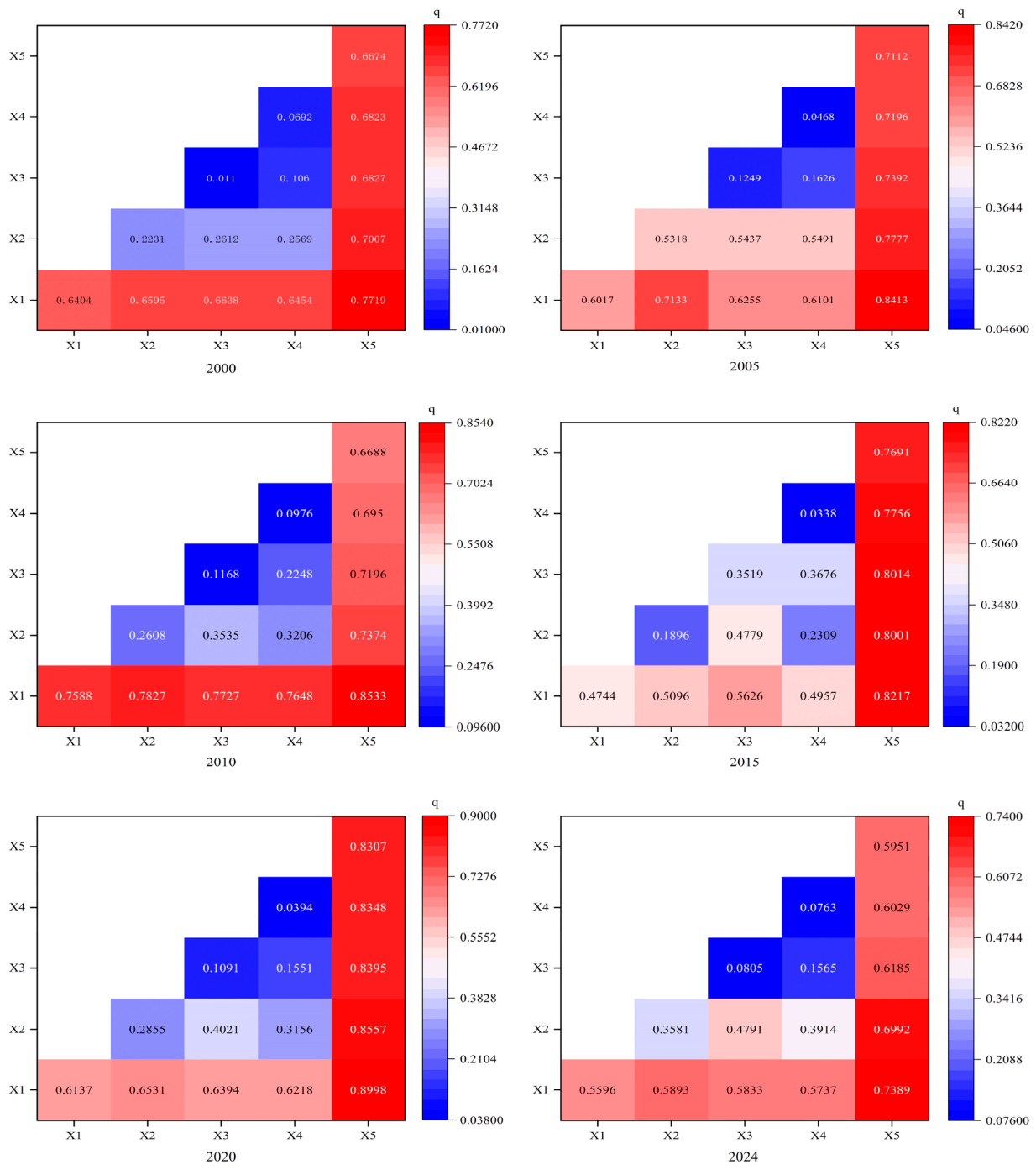
To further quantify the driving mechanisms of the spatial differentiation of ecological environmental quality, GeoDetector was used to identify the explanatory power of five driving factors, including DEM (X1), annual mean precipitation (X2), annual mean temperature (X3), population density (X4), and land use type (X5). The factor detector results are shown in Table 11. In general, land use type and DEM were the dominant factors controlling the spatial differentiation of RSEI in Siziwang Banner, whereas precipitation and temperature showed moderate explanatory power, and population density had the weakest direct explanatory effect.
Among all factors, land use type showed the highest overall explanatory power, with q values ranging from 0.5951 to 0.8307 and an average q value of 0.7188. It ranked first in 2000, 2005, 2015, 2020, and 2024, indicating that the spatial distribution of ecological environmental quality was strongly related to the spatial pattern of land use. DEM also showed consistently high explanatory power, with q values ranging from 0.4744 to 0.7588 and an average q value of 0.6178. In 2010, DEM had the highest explanatory power among all factors, suggesting that the north–south topographic gradient of Siziwang Banner played an important role in shaping the spatial differentiation of ecological quality.
Annual mean precipitation had moderate explanatory power, with q values ranging from 0.1896 to 0.5318. Its explanatory power was relatively high in 2005 and 2024, indicating that water availability was an important climatic factor affecting vegetation growth and ecological quality in arid and semi-arid grassland regions. Annual mean temperature generally showed lower explanatory power than precipitation, but its q value increased markedly to 0.3519 in 2015. This result suggests that thermal conditions and climate stress may have contributed to the ecological quality decline during this period. Population density had the weakest explanatory power, with q values ranging from 0.0338 to 0.0976, indicating that direct population pressure was relatively limited at the regional scale. However, its influence may still be reflected indirectly through land use change and construction land expansion.

3.4.2. Interaction Detection Results

The interaction detector results further revealed that the explanatory power of any two-factor interaction was generally higher than that of each single factor alone, indicating that the spatial differentiation of RSEI was not driven by an isolated factor but by the combined effects of natural and human-related factors. No obvious weakening interaction was observed, and most factor combinations showed bivariate enhancement or nonlinear enhancement (Figure 7). Among all interactions, the interaction between DEM and land use type consistently exhibited the strongest explanatory power. The q values of the DEM and land use type interaction were 0.7719, 0.8413, 0.8533, 0.8217, 0.8998, and 0.7389 in 2000, 2005, 2010, 2015, 2020, and 2024, respectively. These values were higher than the explanatory power of DEM or land use type alone, indicating that the same land use type may produce different ecological effects under different terrain conditions. The interactions between land use type and climatic factors were also prominent. For example, the interaction between precipitation and land use type reached 0.7777 in 2005, 0.7374 in 2010, 0.8001 in 2015, 0.8557 in 2020, and 0.6692 in 2024. Similarly, the interaction between temperature and land use type remained relatively high, especially in 2015 and 2020, with q values of 0.8014 and 0.8395, respectively. These results suggest that climatic conditions can amplify the ecological effects of land use change, particularly in arid and semi-arid grassland ecosystems where vegetation growth is highly sensitive to water and heat conditions. Although population density showed weak explanatory power as a single factor, its interaction with land use type was much stronger than its independent effect. This indicates that human activities mainly influenced ecological environmental quality through changes in land use structure rather than through population density alone. Therefore, population density should be interpreted as an indirect anthropogenic factor whose ecological influence is mediated by land development, agricultural activities, and construction land expansion.
In summary, the GeoDetector results demonstrate that the spatial differentiation of ecological environmental quality in Siziwang Banner was jointly shaped by natural background conditions, land use structure, and climatic variability. DEM and land use type determined the basic spatial pattern of RSEI, while precipitation and temperature regulated ecological fluctuations. The strong interaction between land use type and natural factors further indicates that future ecological restoration and land management should consider both land use optimization and regional environmental constraints.

4. Discussion

4.1. Spatiotemporal Evolution Trends of LULCC in Siziwang Banner

The results of Section 3.1 show that the land use structure of Siziwang Banner was consistently dominated by grassland during 2000–2024, with grassland accounting for more than 90% of the total area. This pattern reflects the typical landscape structure of arid and semi-arid steppe regions. However, the internal land use structure changed noticeably over the study period. Grassland increased slightly from 22,031.43 km2 in 2000 to 22,441.54 km2 in 2024, while farmland and unused land generally decreased. Construction land expanded from 31.90 km2 to 59.06 km2, indicating that ecological protection and urban–rural development occurred simultaneously. Although forestland showed a high relative growth rate, its absolute increase was only about 1.19 km2, suggesting that forestland expansion had limited influence on the overall land use structure. In many arid and semi-arid regions, ecological change is not necessarily driven by dramatic changes in total land use composition, but by relatively small yet ecologically sensitive transitions among grassland, cropland, unused land, and construction land. Therefore, maintaining the stability of dominant grassland landscapes is more important than pursuing large-scale land cover transformation.
Compared with other regions in China, the land use evolution in Siziwang Banner is generally consistent with findings from the Mongolian Plateau, Inner Mongolia, and other northern ecologically fragile areas, where ecological restoration, grazing regulation, and desertification control have promoted grassland recovery in some areas. However, it differs from rapidly urbanizing regions in eastern and southern China, where ecological degradation is often mainly driven by large-scale construction land expansion. In Siziwang Banner, construction land expansion existed but remained spatially limited. The major land use issue was not urban expansion alone, but the ecological balance among grassland conservation, farmland management, and unused land restoration.

4.2. Spatiotemporal Evolution Trends of RSEI in Siziwang Banner

The results of Section 3.2 indicate that the ecological environmental quality of Siziwang Banner remained at a lower-to-medium level, with mean RSEI values ranging from 0.27 to 0.47. The temporal pattern showed phased fluctuations: ecological quality improved during 2000–2010, declined sharply around 2015, and then partially recovered after 2015. The decline during 2010–2015 was closely associated with both regional drought stress and land use degradation, especially the reduction in grassland area and the expansion of unused land. Therefore, this decline should not be interpreted as the result of drought alone, but as the combined effect of climate anomalies and land use change. Arid and semi-arid grasslands are highly sensitive to hydrothermal fluctuations because vegetation growth, surface wetness, soil exposure, and land surface temperature respond rapidly to changes in precipitation and temperature. In this study, the sharp decrease in RSEI in 2015 demonstrates that even when the overall land use structure remains relatively stable, extreme climatic stress can substantially weaken ecological quality.
Spatially, the RSEI showed significant positive spatial autocorrelation during the study period, with Moran’s I values ranging from 0.898 to 0.993. High–High clusters were mainly distributed in the southern part of Siziwang Banner, while Low–Low clusters were concentrated in the central and northern regions. This spatial pattern indicates that ecological environmental quality was strongly constrained by the natural background conditions of the region. The southern area had relatively favorable hydrothermal and vegetation conditions, whereas the central and northern areas were more vulnerable to drought, desertification, and grassland degradation.

4.3. Ecological Effects of LULCC Transitions

The results of Section 3.3 show that different land use transitions had markedly different ecological effects. The conversion of unused land to grassland had a positive effect on ecological quality, reflecting the effectiveness of desertification control and grassland restoration. This result is consistent with previous studies in arid and semi-arid regions of China. The conversion of grassland to unused land had a negative ecological effect, which directly reflects grassland degradation, vegetation loss, and increasing surface exposure. Construction land expansion also produced negative ecological effects, although its area was relatively small. These findings are consistent with the general conclusion of global land change studies [33]. Grassland-to-farmland conversion showed a positive contribution to RSEI improvement, and the mean RSEI of cropland increased from 0.7886 in 2000 to 0.8704 in 2024. However, this does not mean that farmland expansion is generally beneficial to arid and semi-arid grassland ecosystems. The positive RSEI response was likely related to local management conditions, such as high-standard farmland construction, water-saving irrigation, crop growth during the growing season, and intensive agricultural management. These factors can temporarily increase greenness and wetness indicators, thereby improving RSEI values. This result partly differs from studies in many dryland regions where cropland expansion often leads to grassland loss, water consumption, soil degradation, and ecological pressure. Therefore, the finding from Siziwang Banner should be understood as a context-dependent result rather than a general rule. The key implication is that remote sensing ecological indices may capture the short-term surface condition of managed cropland, but they should be interpreted together with water resource use, soil sustainability, and long-term grassland conservation. For regional management, uncontrolled farmland expansion should not be encouraged. Instead, farmland development should be restricted to suitable areas, and grassland conservation should remain the priority of land use planning.

4.4. Driving Mechanisms Revealed by GeoDetector

The GeoDetector results in Section 3.4 provide quantitative evidence for the driving mechanisms of ecological environmental quality. Among the five selected factors, land use type had the highest overall explanatory power, with q values ranging from 0.5951 to 0.8307 and an average q value of 0.7188. DEM also showed strong explanatory power, with q values ranging from 0.4744 to 0.7588 and an average q value of 0.6178. Annual precipitation and annual mean temperature had moderate explanatory power, while population density showed the weakest direct explanatory effect. These results indicate that ecological environmental quality in Siziwang Banner was not controlled by a single factor. Instead, it was jointly shaped by land use structure, topographic background, and climatic conditions. This finding is generally consistent with studies from other arid and semi-arid regions in China and abroad, where land use, terrain, precipitation, and temperature are often identified as key factors affecting vegetation growth, ecological quality, and desertification risk [34]. However, compared with densely populated or rapidly urbanizing regions, the weak explanatory power of population density in Siziwang Banner suggests that human influence was not mainly expressed through population concentration itself, but through land use conversion, agricultural management, grazing regulation, and construction land expansion.
The interaction detector further strengthens this interpretation. The explanatory power of two-factor interactions was generally higher than that of single factors. In particular, the interaction between DEM and land use type showed the strongest explanatory power, with q values ranging from 0.7389 to 0.8998. This means that the ecological effect of the same land use type may differ substantially under different topographic conditions. The interactions between land use type and precipitation or temperature were also strong, indicating that climate conditions can amplify or weaken the ecological effects of land use change. This result indicates that ecological restoration should not be implemented as a uniform policy across the whole region. Instead, restoration measures should be spatially targeted according to terrain, water availability, land use type, and degradation intensity. For Siziwang Banner, the southern high-quality ecological zones should be protected to maintain their stability, while the central and northern low-quality zones should be prioritized for desertification control, degraded grassland restoration, and strict control of construction land expansion. More broadly, this study provides a transferable analytical framework for arid and semi-arid grassland regions: combining RSEI, land use transition analysis, spatial autocorrelation, ecological contribution rate, and GeoDetector can help identify not only where ecological quality changes, but also why it changes and where restoration should be prioritized.

4.5. Limitations and Future Work

This study still has several limitations. RSEI is a remote-sensing-based composite index and mainly reflects surface greenness, wetness, dryness and heat during the growing season; it cannot fully represent biodiversity, soil nutrients, belowground ecological processes or socio-economic ecosystem services. The analysis of climate effects was preliminary and based on available precipitation and temperature variables; future work should incorporate longer meteorological records, field observations and process-based models to better distinguish the relative contributions of climate variability and human land management.

5. Conclusions

Based on multi-temporal Landsat imagery, land use data, RSEI, land use transition matrix, spatial autocorrelation analysis, ecological contribution rate, and GeoDetector, this study systematically analyzed the spatiotemporal evolution of LULCC and ecological environmental quality in Siziwang Banner from 2000 to 2024. The main conclusions are as follows:
(1)
The land use structure of Siziwang Banner was dominated by grassland throughout the study period, with grassland accounting for more than 90% of the total area. The overall land use pattern was characterized by stable grassland dominance, a decrease in farmland and unused land, and slight increases in grassland and construction land. Although forestland showed a high relative growth rate, its absolute area remained very small and had limited influence on the overall land use structure. Therefore, the ecological effects of land use change in Siziwang Banner were mainly associated with transitions among grassland, farmland, unused land, and construction land.
(2)
The ecological environmental quality of Siziwang Banner remained at a lower-to-medium level from 2000 to 2024, with mean RSEI values ranging from 0.27 to 0.47. The temporal evolution of RSEI showed a phased pattern of initial improvement, subsequent decline, and partial recovery. The marked decline around 2015 was related to the combined effects of drought stress and land use degradation, rather than a single climatic or anthropogenic factor. Spatially, RSEI showed significant positive autocorrelation, with high-value clusters mainly distributed in the southern region and low-value clusters concentrated in the central and northern regions. Although ecological quality recovered after 2015 in some areas, local degradation pressure remained evident, especially in northern and central deterioration zones.
(3)
Land use transitions produced differentiated ecological effects. The conversion of unused land to grassland contributed positively to ecological restoration, indicating the effectiveness of desertification control and grassland restoration. In contrast, grassland degradation, represented by the conversion of grassland to unused land, and the expansion of construction land exerted negative ecological effects. The positive contribution of some grassland-to-farmland transitions should be interpreted cautiously. It was likely related to irrigation, crop growth, and intensive farmland management during the growing season, and should not be regarded as evidence supporting uncontrolled farmland expansion in arid and semi-arid grassland regions.
(4)
GeoDetector analysis showed that land use type and DEM were the dominant factors affecting the spatial differentiation of RSEI, with average q values of 0.7188 and 0.6178, respectively. Precipitation and temperature acted as important climatic regulating factors, while population density had relatively weak direct explanatory power. The interaction between DEM and land use type had the strongest explanatory power, indicating that ecological quality was jointly controlled by land use structure and natural background conditions. These findings suggest that future ecological management should strengthen grassland protection, control the expansion of unused land and construction land, optimize farmland management, and implement spatially differentiated restoration strategies according to topography, climate conditions, land use type, and degradation intensity.

Author Contributions

Conceptualization, J.J.; methodology, K.W. and H.Z.; software, K.W. and H.Z.; validation, X.W. and Q.C.; formal analysis, K.W. and H.Z.; investigation, K.W., H.Z. and J.J.; resources, J.J. and H.Z.; data curation, K.W.; writing—original draft preparation, K.W.; writing—review and editing, J.J., K.W. and H.Z.; visualization, K.W. and Q.C.; supervision, J.J.; project administration, J.J., K.W. and H.Z.; funding acquisition, J.J. All authors have read and agreed to the published version of the manuscript.

Funding

This study is support by Natural Science Foundation project of Inner Mongolia Autonomous Region, China (2024MS04025) and Key Research and Development Program of Ordos city, China (YF2024058).

Data Availability Statement

The original contributions presented in the study are included in the article, further inquiries can be directed to the corresponding author.

Acknowledgments

The authors acknowledge the support from the China Land Cover Dataset, the Landsat and SRTM DEM data provided by USGS, and the Google Earth Engine (GEE) platform for its essential cloud-computing capabilities. We would like to express our sincere gratitude to the editor and the reviewers.

Conflicts of Interest

The authors declare no conflicts of interest.

References

  1. Turner, B.L., 2nd; Lambin, E.F.; Reenberg, A. The emergence of land change science for global environmental change and sustainability. Proc. Natl. Acad. Sci. USA 2007, 104, 20666–20671. [Google Scholar] [CrossRef] [PubMed]
  2. Dong, Z.R.; Yuan, Q.Z.; Wang, Z.C.; Ren, P. Analysis and simulation prediction of the evolutionary characteristics of the living-production-ecological spatial conflicts in the agriculture-pastoral ecotone in western Sichuan: Taking four counties in Aba Prefecture as examples. Acta Ecol. Sin. 2023, 43, 6243–6256. [Google Scholar] [CrossRef]
  3. Hu, B.; Li, Z.; Wu, H.; Han, H.; Cheng, X.; Kang, F. Coupling strength of human-natural systems mediates the response of ecosystem services to land use change. J. Environ. Manag. 2023, 344, 118521. [Google Scholar] [CrossRef] [PubMed]
  4. Song, M.; Hu, C.; Yuan, J.; Zhang, A.; Liu, X. Toward an ecological civilization: Exploring changes in China’s land use policy over the past 35 years using text mining. J. Clean. Prod. 2023, 427, 139265. [Google Scholar] [CrossRef]
  5. Li, J.; Gong, J.; Guldmann, J.M.; Yang, J.; Zhang, Z. Simulation of Land-Use Spatiotemporal Changes under Ecological Quality Constraints: The Case of the Wuhan Urban Agglomeration Area, China, over 2020–2030. Int. J. Environ. Res. Public Health 2022, 19, 6095. [Google Scholar] [CrossRef]
  6. Li, Y.; Liu, Y.; Qin, Y.; Zhang, K.; Enwer, R.; Wang, W.; Yuan, S. Evolution and Predictive Analysis of Spatiotemporal Patterns of Habitat Quality in the Turpan–Hami Basin. Land 2024, 13, 2186. [Google Scholar] [CrossRef]
  7. Li, S.C.; Gong, J.; Yang, J.X.; Chen, G.; Zhang, Z.; Zhang, M. Characteristics of LULCC patterns of the Lanzhou-Xining urban agglomeration: Based on an intensity analysis framework. Resour. Sci. 2023, 45, 480–493. [Google Scholar] [CrossRef]
  8. Sun, B.; Fang, C.; Liao, X.; Guo, X.; Liu, Z. The relationship between urbanization and air pollution affected by intercity factor mobility: A case of the Yangtze River Delta region. Environ. Impact Assess. Rev. 2023, 100, 107092. [Google Scholar] [CrossRef]
  9. Ye, Y.P.; Liu, L.J. Research on the evaluation index system of provincial ecological environmental quality in China. Res. Environ. Sci. 2000, 33–36. [Google Scholar]
  10. Xing, R.R.; Ma, A.Q.; Zhang, X.W.; Yu, X.X.; Ma, B.R. Dynamic simulation of land use change in Qingdao City based on Logistic-CA-Markov model. Res. Soil Water Conserv. 2014, 21, 111–114+2. [Google Scholar]
  11. Yang, H.; Wang, Z.Y.; Wang, J.; Meng, N. Study on the impact of land use change on thermal environment in the Beijing-Tianjin-Hebei Urban Agglomeration. J. Nat. Resour. 2018, 33, 1912–1925. [Google Scholar] [CrossRef]
  12. Jia, J.; Shi, X.L. Impacts of land use/cover change (LULCC) on regional runoff: A case study of Qinhuangdao Region. Geogr. Geo-Inf. Sci. 2017, 33, 108–114, 127. [Google Scholar]
  13. Ye, B.W.; Sun, B.; Shi, X.H.; Zhao, Y.L.; Pang, J.Q.; Guo, Y.Y.; Yao, W.Z. Land use change and its impact on ecological environmental quality in Bayannur City. Environ. Sci. 2024, 45, 6899–6909. [Google Scholar] [CrossRef]
  14. Wan, H.F.; Meng, Y.B.; Chen, Y.; Luo, J.Q.; Zhao, Z.L.; Li, J.F. Spatial differentiation characteristics of ecological environmental effects in Guizhou Province based on land use/cover change. J. Northwest For. Univ. 2025, 40, 165–176, 189. [Google Scholar]
  15. Li, Y.; Chen, Z.; Chen, K.L.; Xia, X.S. Ecological effects of land use transition in the Qinghai Lake Basin from 1990 to 2021. Sci. Soil Water Conserv. 2025, 23, 136–148. [Google Scholar] [CrossRef]
  16. Liu, Q.; Xie, Y.; Qin, Y.; Zhang, Y.; Yang, K. Dynamic monitoring and spatio-temporal pattern of ecological environmental quality in Nanning City based on Google Earth Engine. Bull. Soil Water Conserv. 2023, 43, 121–127. [Google Scholar] [CrossRef]
  17. GB/T 21010-2017; Current Land Use Classification. Ministry of Land and Resources of the People’s Republic of China: Beijing, China, 2007.
  18. Jie, Y.; Xin, H. The 30m annual land cover dataset and its dynamics in China from 1990 to 2019. Earth Syst. Sci. Data 2021, 13, 3907–3925. [Google Scholar]
  19. Xu, H. A remote sensing urban ecological index and its application. Acta Ecol. Sin. 2013, 33, 7853–7862. [Google Scholar] [CrossRef]
  20. Pan, Z.D.; Wang, Y.F.; Wang, K.Y.; Zou, W.W.; Sun, Y.J. Ecological quality assessment and driving force analysis of Jiangle County based on the improved remote sensing ecological index. Environ. Sci. 2025, 46, 6419–6431. [Google Scholar] [CrossRef]
  21. Zhang, Q.F.; Chen, Y.N.; Sun, C.J.; Xiang, Y.Y.; He, H.C. Changes in water storage and oasis ecological security assessment in the Tarim River Basin. Arid Land Geogr. 2024, 47, 1–14. [Google Scholar]
  22. Xu, H.; Wang, M.; Shi, T.; Guan, H.; Fang, C.; Lin, Z. Prediction of ecological effects of potential population and impervious surface increases using a remote sensing based ecological index (RSEI). Ecol. Indic. 2018, 93, 93730–93740. [Google Scholar] [CrossRef]
  23. Wang, J.; Guan, Y.; He, X.H.; Dai, Y.H.; Chen, Y.W.; Wang, Y.Q.; Li, H.W.; Fan, D.B. Dynamic monitoring and evaluation of ecological environmental quality in Tumushuke City from 2000 to 2021. Arid Land Geogr. 2024, 47, 465–473. [Google Scholar]
  24. Wang, J.J.; Zhang, S.Y.; Teng, P.C. Research on land use change and vegetation coverage in Jincheng City. Geomat. Spat. Inf. Technol. 2024, 47, 21–24+28. [Google Scholar]
  25. Chen, P.Y.; Zhu, X.G. Regional economic disparities in China based on multi-scale analysis. Acta Geogr. Sin. 2012, 67, 1085–1097. [Google Scholar]
  26. Zhang, J.; Yang, L.P.; Gong, E.J.; Wang, Y.; Ren, J.; Liu, M. Dynamic monitoring of eco-environmental quality in Xi’an City based on Google Earth Engine and modified remote sensing ecological index. Acta Ecol. Sin. 2023, 43, 2114–2127. [Google Scholar]
  27. Zhang, J.; Gao, F.; Liu, K.; He, B.; Wu, J.; Li, Y. Habitat quality assessment and driving factor analysis of the Qarqan River based on the modified remote sensing ecological index. Environ. Sci. 2026, 1–26. [Google Scholar]
  28. Yuan, B.W.; Fan, S.L. Study on land use transition and eco-environmental effects in Zhao’an County, Fujian Province: From the perspective of production-living-ecological space classification. Energy Environ. 2024, 16–20+65. [Google Scholar]
  29. Li, T.; Li, C.K.; Mao, Y.; Cong, Z.; Zhang, P.; Han, T. Spatiotemporal changes in eco-environmental quality and their responses to land use change in a mining region. Earth Environ. 2026, 54, 93–106. [Google Scholar] [CrossRef]
  30. Wang, J.F.; Xu, C.D. Geodetector: Principle and prospective. Acat Geogr. Sin. 2017, 72, 116–134. [Google Scholar]
  31. Zhang, H.; Song, J.Y.; Li, M.; Han, W.H. Eco-environmental quality assessment and cause analysis of Qilian Mountain National Park based on GEE. Chin. J. Ecol. 2021, 40, 1883–1894. [Google Scholar]
  32. Li, H.X.; Wan, H.W.; Sun, L.; Liu, Y.; Li, L.; Wang, Y. Remote sensing assessment and key driving factors of ecosystem health in Xinjiang. Arid Zone Geogr. 2021, 44, 460–470. [Google Scholar]
  33. Bestelmeyer, B.T.; Okin, G.S.; Duniway, M.C.; Archer, S.R.; Sayre, N.F.; Williamson, J.C.; Herrick, J.E. Desertification, Land Use, and the Transformation of Global Drylands. Front. Ecol. Environ. 2015, 13, 28–36. [Google Scholar] [CrossRef]
  34. Reynolds, J.F.; Smith, D.M.S.; Lambin, E.F.; Turner, B.L.; Mortimore, M.; Batterbury, S.P.; Downing, T.E.; Dowlatabadi, H.; Fernández, R.J.; Herrick, J.E.; et al. Global Desertification: Building a Science for Dryland Development. Science 2007, 316, 847–851. [Google Scholar] [CrossRef]
Figure 1. Location of the study area.
Earth 07 00101 g001
Figure 2. Land use types in the study area.
Earth 07 00101 g002
Figure 3. Mean RSEI of main land use types in the study area.
Earth 07 00101 g003
Figure 4. Spatial distribution of RSEI levels in the study area (2000–2024).
Earth 07 00101 g004
Figure 5. Spatial distribution of habitat quality change zones in the study area (2000–2024).
Earth 07 00101 g005
Figure 6. LISA cluster maps of RSEI in the study area (2000–2024).
Earth 07 00101 g006
Figure 7. Interactive detection results of optimal parameter-based Geodetector (X1 DEM; X2 Annual mean precipitation; X3 Annual mean temperature; X4 Population density; X5 Land use type).
Earth 07 00101 g007
Table 1. Data types and sources.
Data TypeSpatial ResolutionAcquisition DatePreprocessing StepsPrimary ApplicationData Source
Landsat 5 Thematic Mapper (TM)30 mJune–August of 2000, 2005, 2010Radiometric calibration, atmospheric correction, cloud masking, and study area clippingCalculation of the Remote Sensing Ecological IndexGoogle Earth Engine (GEE) Landsat Archive https://code.earthengine.google.com
Landsat 8 Operational Land Imager (OLI)30 mJune–August of 2015, 2020, and 2024
China Land Cover Dataset (CLCD)30 m2000, 2005, 2010, 2015, 2020, 2024Study area clipping and land use reclassificationLand use classification and transition matrix analysisChina Land Cover Dataset (CLCD). https://doi.org/10.5281/zenodo.4417810
Digital Elevation Model (DEM)30 mStudy area clipping and topographic reclassificationGeographic reference and topographic characterizationASTER Global Digital Elevation Model (GDEM)
https://www.geodata.cn/
Table 2. Calculation formulas of ecological indices.
IndexFormula
NDVI N D V I = ρ N I R ρ R E D ρ N I R + ρ R E D
WET W E T T M = 0.0315 ρ B I U E + 0.2021 ρ G R E E N + 0.3102 ρ R E D + 0.1594 ρ N I R 0.6806 ρ S 1 0.6109 ρ S 2 W E T O L I = 0.1511 ρ B I U E + 0.1973 ρ G R E E N + 0.3283 ρ R E D + 0.3407 ρ N I R 0.7117 ρ S 1 0.4559 ρ S 2
LST L S T = D N × 0.02 273.15
NDBSI N D B S I = S I + I B I / 2
S I = ρ s 1 + ρ R E D ρ B I U E + ρ N I R ρ s 1 + ρ R E D + ρ B I U E + ρ N I R
I B I = 2 ρ S 1 ρ S 1 + ρ N I R ρ N I R ρ N I R + ρ R E D + ρ G R E E N ρ G R E E N + ρ S 1 2 ρ S 1 ρ S 1 + ρ N I R + ρ N I R ρ N I R + ρ R E D + ρ G R E E N ρ G R E E N + ρ S 1
Where ρ BIUE , ρ GREEM ,   ρ RED , ρ NIR , ρ S 1 , ρ S 2 are the reflectivity values in the blue, green, red, near-infrared, shortwave infrared 1, and shortwave infrared 2 bands, respectively. DN is the digital number or radiance/reflectance value of the thermal infrared band in the Landsat imagery.
Table 3. Selection of Driving Factor Indicators for Ecological Environment Quality Change in Siziwang Banner.
Influencing FactorsDriving FactorVariable Description
Natural background factorsDEMASTER Global Digital Elevation Model (GDEM)
https://www.geodata.cn/
Annual mean precipitationChina Meteorological Data Service Centre. https://data.cma.cn/
Annual mean temperature
Human-related factorsPopulation densityStatistical yearbooks or official statistical data. https://www.stats.gov.cn/
Land use typeChina Land Cover Dataset (CLCD). https://doi.org/10.5281/zenodo.4417810
Table 4. Area changes and change rates of land use types in the study area (2000–2024).
Land TypeArea (km2)Change Rate (%)
2000200520102015202020242000–20102010–20202000–2024
Farmland1568.511487.961290.011671.541243.231317.81−17.75−3.36−15.98
Forestland0.230.280.270.660.661.4217.39144.44469.57
Grassland22,031.4322,245.6622,348.4921,810.1922,396.2622,441.541.440.211.86
Water body4.314.342.342.9215.114.35−45.71545.730.93
Construction land31.933.7736.3641.9447.8359.0614.7330.6885.14
Unused land390.98255.57350.12500.33324.49203.41−10.45−7.32−47.97
Table 5. PCA loading coefficients, eigenvalues, and contribution rates of RSEI indicators from 2000 to 2024.
Year PC1PC2PC3PC4
2000NDVI0.61710.5471−0.5229−0.2153
WET0.23390.29150.7846−0.4945
NDBSI−0.2823−0.3244−0.3258−0.8419
LST−0.69620.7145−0.0676−0.0156
Eigenvalue0.01340.00330.00080.0002
Contribution rate75.41%18.42%4.59%1.57%
2005NDVI0.07090.6604−0.74650.0380
WET0.04610.71680.6227−0.3102
NDBSI−0.0619−0.2032−0.2340−0.9487
LST−0.99440.0930−0.00970.0474
Eigenvalue0.00380.00100.00040.0001
Contribution rate70.82%18.69%7.77%2.72%
2010NDVI0.00770.48210.8545−0.1931
WET0.10610.7413−0.5122−0.4203
NDBSI−0.0011−0.46080.0598−0.8854
LST−0.9943−0.07480.06130.0444
Eigenvalue0.00680.00190.00090.0001
Contribution rate69.37%19.30%9.64%1.69%
2015NDVI0.67970.3861−0.6208−0.0573
WET0.16320.13430.3466−0.9138
NDBSI−0.4629−0.3684−0.6988−0.4019
LST−0.54490.8349−0.0770−0.0037
Eigenvalue0.01540.00280.00060.0001
Contribution rate80.89%15.01%3.57%0.53%
2020NDVI0.4328−0.5975−0.6524−0.1728
WET0.1316−0.23220.5157−0.8141
NDBSI−0.29660.5480−0.5520−0.5540
LST−0.8410−0.5372−0.0603−0.0603
Eigenvalue0.02220.00390.00100.0002
Contribution rate81.35%14.28%3.68%0.69%
2024NDVI0.53450.5839−0.5932−0.1460
WET0.23330.12290.5297−0.8060
NDBSI−0.4451−0.3421−0.5967−0.5732
LST−0.67940.72580.1062−0.0161
Eigenvalue0.02300.00660.00110.0002
Contribution rate73.96%21.51%3.77%0.76%
Table 6. Area changes and change rates of eco-environmental quality types in the study area (2000–2024).
TypeArea (km2)Change Rate (%)
2000200520102015202020242000–20102010–20202000–2024
Excellent1337.15189.31365.08682.13565.231717.72−72.754.828.5
Good3587.101009.504918.02944.842225.692968.8437.1−54.7−17.2
Moderate6847.779397.009587.442850.5311,494.268572.894019.925.2
Poor11,283.3413,395.048789.868483.339742.6310,440.20−22.110.8−7.5
Bad972.6537.15367.6011,067.160.18328.35−62.2−99.9−66.2
Table 7. Area statistics of RSEI change zones (2000–2024).
Type2000–20102010–20202020–20242000–2024
Area (km2)Proportion (%)Area (km2)Proportion (%)Area (km2)Proportion (%)Area (km2)Proportion (%)
Rising Area16,631.8969.226919.9528.88738.8336.3712,513.5752.08
Constant Area3111.5712.956014.1125.034029.4316.774469.1318.6
Decline Area4286.5217.8411,093.5246.1711,259.3346.867044.8929.32
Table 8. Global of Moran’s I RSEI in the study area.
Indicator2000201020202024
Moran’s I0.9770.9930.9230.898
Z statistic62.24863.25165.17757.161
p value0000
Table 9. The mean RSEI for different land use types from 2000 to 2024.
TypeYear
200020052010201520202024
Farmland0.78860.56510.70910.71160.71850.8704
Forestland0.99110.97490.98380.94270.89750.9162
Grassland0.41820.39740.46050.24330.44060.4412
Water body0.65820.60620.64660.59690.35050.4453
Construction land0.36880.39060.42660.29930.43010.3654
Unused land0.24030.29820.26180.14870.33390.2802
Table 10. Major land use transitions and ecological contribution rates (2000–2024).
Land Transfer Types2000–20102010–20202000–2024
Area (km2)Contribution Rate (%)Area (km2)Contribution Rate (%)Area (km2)Contribution Rate (%)
Habitat Quality ImprovementGrassland–Farmland301.1870.354311.9530.334460.9520.851
Unused land–Grassland134.3030.123112.1570.083223.6470.186
Grassland–Water body0.5120.0017.8880.0022.3860.001
Habitat Quality DeteriorationFarmland–Grassland579.2990.681358.3090.4608.650.881
Grassland–Unused land93.3280.04994.1570.04941.7870.011
Farmland–Construction land3.5610.0019.2590.00218.6750.004
Table 11. Results of Single Factor Detection in Different Years.
Year200020052010201520202024
DEM0.69850.60170.75880.47440.61370.5596
Annual mean precipitation0.25310.53180.26080.18960.28550.3581
Annual mean temperature0.14960.12490.11680.35190.10910.0805
Population density0.07430.04680.09760.03380.03940.0763
Land use type0.73790.71120.66880.76910.83070.5951
Disclaimer/Publisher’s Note: The statements, opinions and data contained in all publications are solely those of the individual author(s) and contributor(s) and not of MDPI and/or the editor(s). MDPI and/or the editor(s) disclaim responsibility for any injury to people or property resulting from any ideas, methods, instructions or products referred to in the content.