Article

Rain- and Seismic-Triggered Mass Movements in Coastal Ecuador—A Case Study of the “El Florón” Landslide in Portoviejo


by
Melany Melgar
1,*,
Nayeska Ramírez-Cevallos
1,
Kervin Chunga
1 and
Theofilos Toulkeridis
2,3,*
1
Faculty of Engineering and Applied Sciences, Technical University of Manabí UTM, Portoviejo 130111, Ecuador
2
School of Social Sciences, University of Touristic Specialties UDET, Quito 170301, Ecuador
3
School of Geology, Aristotle University of Thessaloniki, 54124 Thessaloniki, Greece
*
Authors to whom correspondence should be addressed.
Earth 2025, 6(4), 156; https://doi.org/10.3390/earth6040156
Submission received: 11 November 2025 / Revised: 3 December 2025 / Accepted: 7 December 2025 / Published: 11 December 2025

Abstract

On 23 April 2023, a rotational landslide occurred at El Florón III (Portoviejo, Ecuador), triggered by intense rainfall that increased saturation and water pressure in the pores of the colluvial materials. Therefore, the current research predominantly aimed to (i) characterize the geological, geophysical, and geotechnical conditions that controlled the instability, (ii) identify and validate the fault surface, and (iii) evaluate a stabilization alternative in accordance with the Ecuadorian Construction Standard (NEC-15). Additionally, a probabilistic analysis was conducted based on the post-landslide geotechnical characteristics of the material, obtained from direct shear tests, which served as the basis for the back-analysis that determined the parameters governing the soil’s behavior during the event. Based on the parameters obtained for the landslide analysis and the determination of safety factors in accordance with the guidelines of the Ecuadorian Construction Standard, a ground reinforcement configuration was proposed through the implementation of micropiles combined with terracing. This approach allowed for establishing a methodology applicable to landslide scenarios in equivalent environments, considering the specific geotechnical and climatic conditions of the area.

1. Introduction

Globally, one of the most lethal natural hazards is mass movements, with different forms of appearance, such as landslides, rock falls, and avalanches, among many others, being triggered by a multitude and combined forms of inadequate human involvement, environmental factors, and Earth’s internal and external forces [1,2,3,4,5,6]. Mass movements are also subject to gravity as an accelerator of steep slope environments, while varied and prolonged precipitation due to climate change and seismic activity may also be fundamental [7,8,9,10,11,12,13]. There are specific regions worldwide where massive mass movements may occur, one of which is Ecuador’s varied geomorphology [14,15,16,17]. Besides the Andean region of Ecuador, the coastal hilly regions may also provide some ideal zones susceptible to landslides [18,19,20,21,22].
In recent times, there have been some severe and notable occurrences of often deadly mass movements, such as the many earthquake-related landslides in Pedernales (Manabí province) on 16 April 2016, the Tambán landslide (Bolívar province) on 21 December 2021, and the Alausí landslide (Chimborazo province) on 26 March 2023, the latter of which was the deadliest of all historically documented mass movements in Ecuador [23,24,25]. Generally, in Ecuador, the main triggers of landslides are subduction-related earthquakes and associated capable geological faults, as well as high rainfall [26,27,28,29,30,31]. The lithological causes are associated with the saturation of granular soils and well-jointed rocks, resulting from prolonged and intense rainfall [32,33]. Seismic accelerations cause landslides more frequently and to a greater extent than intense precipitation occurrences [19,34,35].
Since the recent Pedernales earthquake (2016, Mw 7.8), about 250 landslides have been mapped. The central coast of Ecuador is also susceptible to landslides caused by the El Niño climate event (1982–1983, 1997–1998) [36,37,38,39,40,41]. However, in 2025, a more severe climate event linked to La Niña Modoki achieved the highest precipitation amounts in the previous 40 and 50 years [42].
The study area of the current study is the capital of the province of Manabí, Portoviejo, being home of a population of some 322,925 citizens [43]. The urban area is composed of dispersive and expansive cohesive soils with poor geotechnical qualities, such as high plasticity, low shear strength, and expansive behavior, making it more vulnerable to landslides. It is situated in a small valley surrounded by high hills [44]. Before cracks and topographic changes in the landscape indicated progressive slope instability in the El Florón area, this poor geological condition of the slopes was apparent on 23 April 2023 [45]. Hereby, an older landslide plane was reactivated by heavy rains during the winter season of that year, forcing the slope to collapse and severely damaging 15 dwellings [46]. Fortunately, potential fatalities were avoided due to the residents’ quick action.
Despite advances in understanding landslides triggered by rainfall and seismic activity in Ecuador, significant research gaps remain, particularly regarding the combined effect of intense rainfall and seismic accelerations on highly weathered colluvial deposits in urban areas of the coastal region. Although recent studies in Italy have demonstrated the effectiveness of using InSAR satellite techniques to monitor slow reactivations related to rainfall and seismic sequences, the sudden failure at El Florón, which caused immediate structural damage, required direct geophysical and geotechnical investigations to determine the rupture mechanism and define urgent stabilization measures [47,48].
Based on this context, the current study provides a detailed characterization of the landslide of the El Florón area through the integration of geophysical and geotechnical methods and a back-analysis based on actual fault conditions, constituting a technical reference applicable to similar scenarios in the Ecuadorian coastal region. Therefore, this work focuses on (i) identifying the lithological units of the subsoil in the affected area, (ii) analyzing the instability conditions through back-analysis with real failure parameters, and, finally, (iii) evaluating stabilization alternatives in accordance with current regulations. The final product may consist of acquiring dynamic parameters of the rock and soil that are relevant to numerous geological scenarios for the study area and similar regions worldwide.

2. Materials

2.1. Study Area

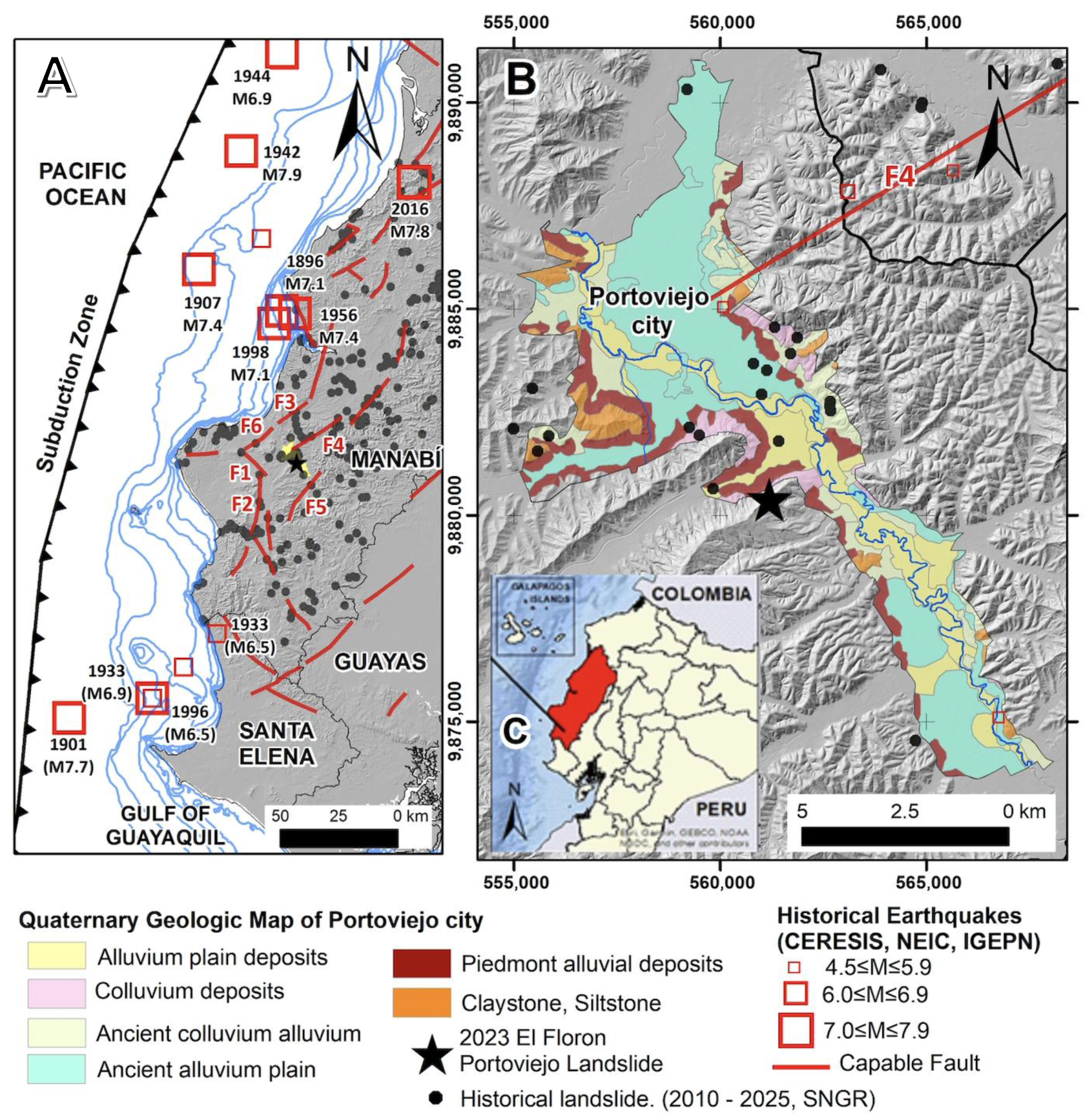
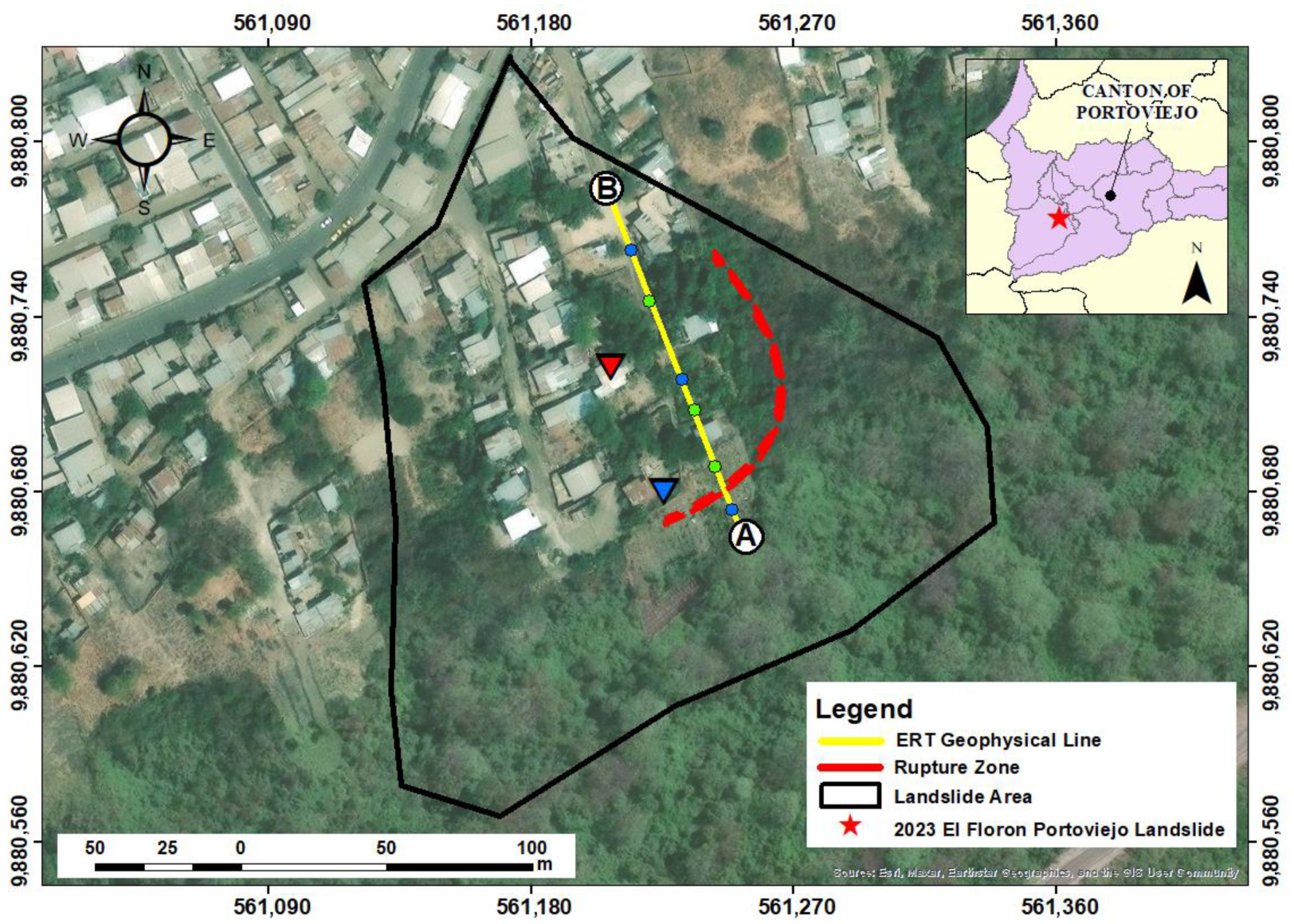
The central coast of Ecuador has experienced a high frequency of landslides in recent decades due to earthquakes and heavy rainfall [18,19,20,49,50]. The Pedernales earthquake on 16 April 2016 (M7.8) recorded landslides with the highest concentration of ground damage [23,51,52,53]. The province’s capital, the canton of Portoviejo, occupies an area of 967 km2 and is home to 20.27% of the total population of the Province of Manabi (see Figure 1). Since the last severe earthquake, so far, approximately 351 geological and hydrological events have been documented, including landslides, which account for around 19.94% of the events that have occurred in the provincial territory [27,54].
The urban area of Portoviejo is defined as a narrow valley between hilly reliefs, with sediment thicknesses and inferior contact with the rock of up to 70 m in depth [44,55]. The hills appear with altitudes below 300 m above sea level (m a.s.l.) and encircle the majority of Portoviejo’s metropolitan area, which is established at an average elevation of 44 m a.s.l. Its geomorphological features include alluvial plains, coastal terraces, hilly reliefs, and river micro-basins [44,56,57].
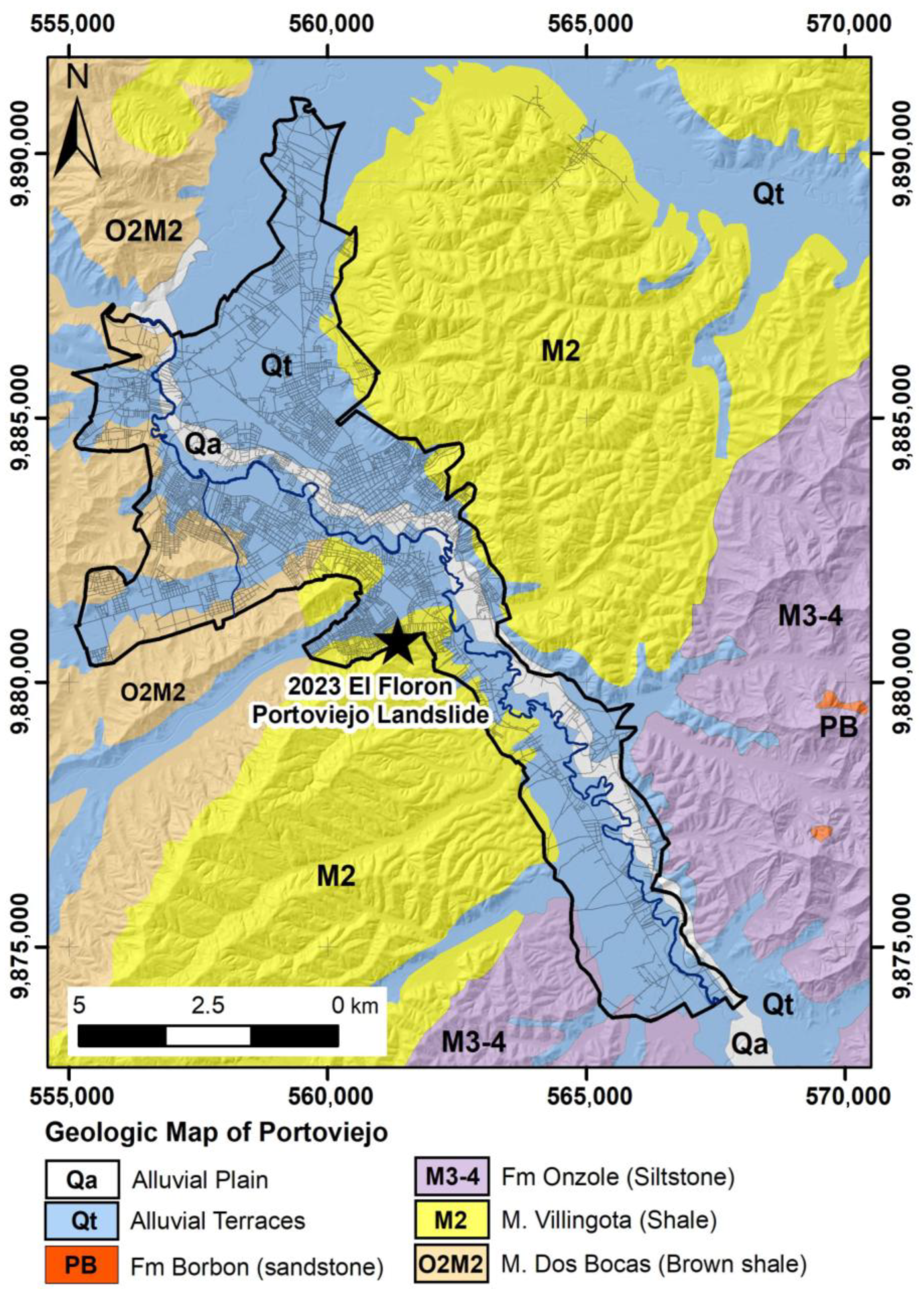
The lithological formation of the Portoviejo canton is made up of ancient alluvial deposits from the Portoviejo River, consisting primarily of Quaternary deposits of gravel, sand, silt, and clay, which demonstrate high fluvial dynamics [58,59]. These materials have a notable influence on slope instability processes and flood susceptibility. Towards the central part of the town of Portoviejo, specifically in the hilly and mountainous areas, units belonging to the Tosagua Formation and the Dos Bocas and Villingota Members emerge [60]. These units are composed of tuffaceous shales with diatoms and thin layers of yellowish sandstones and calcareous shales. The soils of the city of Portoviejo have been classified according to the Unified Soil Classification System (USCS; see Table 1). In addition, the shear rate, age, and geological units are given by strata with their respective thicknesses. Hereby, the Miocene bedrock (Msc) is composed of siltstone and claystone strata of the Tosagua geological formation, in which the shear velocity must be greater than 650 m/s [44,61,62,63].
The Florón sector of Portoviejo city was chosen as the study site for this investigation. It has a population density of 28,000 and is in the southwestern part of the Portoviejo canton [43,64]. There appear sedimentary soils corresponding mainly to siltstone and claystone of the Villingota Formation [60]. The topography of the area is hilly, with moderate to steep slopes that are affected by slope instability, especially during periods of intense rainfall. The landslides lithologically consist of plastic clayey silts, yellow to brown in color, with the variable presence of fine sand and soft shale and mudstone clasts, in addition to the presence of gypsum. Residual soils were also identified that retained the original shale rock structure, with oxidation and features of the layered shale structure, presenting planes of heavily oxidized fragments. These deposits reached thicknesses of up to 11 m in the center of the landslide mass. In general, the lithology, geomorphology, and hydrogeological configuration of El Florón III determine critical geotechnical behavior, with a high propensity for landslides and mass wasting phenomena [46].
Numerous rock and soil slopes that surround the city are composed of cohesive materials. Hereby, some of these slopes have over-consolidated geotechnical conditions, while others have unstable slopes with safety factors of less than 1.05 in pseudo-static conditions and less than 1.5 in static conditions [65]. Due to recent high precipitation rates, soils saturated with clays and silts have seen an increase in instability rate.

2.2. Datasets

The datasets used in this study include meteorological records, geophysical measurements, geotechnical tests, and high-resolution topographic information. Precipitation data were obtained from the INAMHI “La Teodomira” station and remote sensing products from NASA. Historical landslide data were collected from the Secretariat for Risk Management (SGRE). Geophysical surveys (ERT, MASW, and seismic refraction) and direct shear tests in the laboratory provided information on the mechanical properties and characterization of the subsurface. These data were integrated to evaluate slope behavior and its fault mechanism.
A subtropical climate with an average temperature of about 25 °C is found in the ecological region where Portoviejo is situated [66]. However, there is a temperature variation between the hot and cold seasons, with 30 °C registered as the highest from February to May and 21 °C as the lowest temperature from June to October [67]. Rainfall in the central region of Manabí is very seasonal and directly related to the passage of the Intertropical Convergence zone and the eventual warming of the water around the Ecuadorian coast [68]. Records indicate that the rainy season, which lasts from December to May, has an average monthly rainfall of 161 mm, while the dry season, which usually lasts from June to November, has an average monthly rainfall of 13 mm.
The El Niño Southern Oscillation phenomenon (ENSO) is a highly significant climate variability event in the eastern and central equatorial Pacific Ocean [69]. The impacts of ENSO on the territory translate into increased losses due to increased rainfall, landslides, and flooding, mainly in low-lying, coastal areas of Ecuador [70]. In Portoviejo, the capital of Manabí province, specific areas affected by natural disasters have been identified (see Figure 2). This urban center faces a series of challenges associated with certain geographic characteristics. There is the crossing by the Portoviejo River, which increases the risk of flooding during periods of intense rainfall [71]. Additionally, there is also the instability of its soils and the scarce vegetation cover, which accelerate erosion and trigger landslides that affect the drainage and sewage system, becoming a significant risk to the infrastructure and the safety of the population [72].
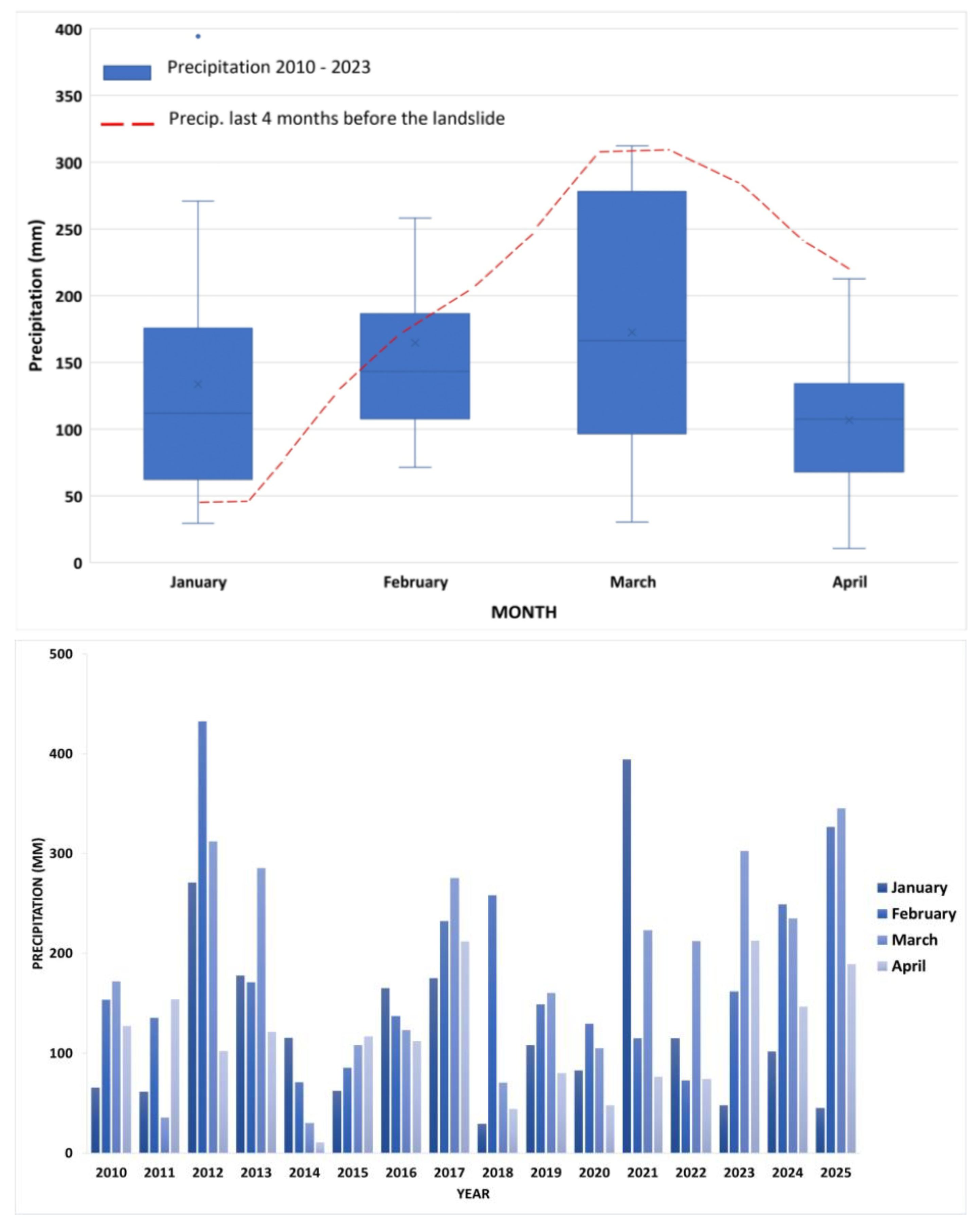
This analysis examines the historical winter precipitation from 1980 to the present for the city of Portoviejo. The National Institute of Meteorology and Hydrology (INAMHI) recorded the highest rainfall associated with ENSO episodes in February 1987 (330 mm), March 1992 (300 mm), February 1998 (358 mm), and March 1998 (460 mm) [73]. The average rainfall for the years 2000 to 2009 was 596.20 mm per year, with the wettest years being 2000 with 733 mm and 2008 with 823 mm, while the driest were 2001, 2003, and 2009 with rainfall below 500 mm [64]. Precipitation recorded between 2010 and 2023 showed marked interannual and seasonal variability, with periods of both deficient and exceptionally heavy rainfall. In 2010, monthly accumulated lows did not exceed 150 mm, a condition that was repeated in 2014 and 2019. Subsequently, in February 2012 and January 2021, rainfall peaks exceeded 400 mm, while in March 2013, records reached values above 300 mm, all well above the historical average.
The intense rainfall recorded in February 2012 and January 2021 in Portoviejo far exceeded historical averages, generating deep saturation in the colluvial and clay deposits of the affected slopes. Under such hydrological conditions, it is widely demonstrated that cohesive soils lose strength and can fail, especially when pre-existing structural discontinuities are present, as is the case in the study area. Global studies consistently demonstrate that episodes of accumulated and intense rainfall are primary causes of landslides, even in the absence of earthquakes. Consequently, the extreme saturation conditions generated in 2012 and 2021 had a direct and decisive effect on the loss of slope stability in Portoviejo, favoring the occurrence of the landslides reported in those years. These records evidence that soil stability in the area is highly sensitive to increased moisture, and that episodes of intense rainfall constitute a decisive triggering factor in the geodynamic behavior of the area. Average precipitation for the months of January to March, calculated for the period 2010–2022, ranged between 11 and 142 mm. However, in 2023, accumulated rainfall tripled these values, with a monthly range of 48 to 303 mm (see Figure 3).
The remarkable temperature increase in 2023 is placed in a broader context, highlighting internal variability as a key factor in the increase in annual mean temperature through its feedback mechanism [74]. Surprisingly, the 2023 ENSO was an unusual double-peak event, displaying two distinct spatial peaks in the eastern and central equatorial Pacific [75]. This unique phenomenon substantially strengthens atmosphere–ocean coupling processes, influencing coastal warming in both Peru and Ecuador [76].
Nonetheless, shortly after, early on 23 April 2023, one of the most significant recent landslides at the Florón research site in the Andrés of Vera parish took place [45]. In March 2023, the highest precipitation accumulations occurred (303 mm) [77]. There was a sequence of mudflow slides when the colluvial soils were saturated and 48 h of accumulated rainfall. Part of the Portoviejo River’s lower–middle basin system consists of these landslides and their tributaries. Based on data from the INAMHI’s La Teodomira weather station, the average amount of precipitation that has historically accumulated between January and April 2023 was 502 mm. However, compared to the historical average for the same period, the cumulative rainfall in 2025 was 851 mm, an increase of 69.0%.
Figure 3. (Above): Box-and-whisker plot of historical monthly precipitation recorded at El Florón III, last four months before the landslide. (Below): Monthly precipitation recorded in El Florón between 2010 and 2025 [77].
Earth 06 00156 g003
The phenomenon of the Niña Modoki is defined by the central Pacific’s sea surface temperatures dropping while the waters in the ocean basin’s eastern and western extremes remain warmer than usual [67,68,78]. From time to time, the Eastern Pacific Ocean experiences variations in its surface temperature, ranging from unusually cold conditions, known as La Niña Modoki, to warm conditions known as ENSO. These phenomena significantly alter precipitation patterns not only in Ecuador, but also in various regions of the world, due to the global atmospheric connections they generate [79,80]. In 2025, this climate pattern was characterized by a high concentration of precipitation during the months of January, February, March, and April, resulting in a considerably high annual rainfall volume, reaching a monthly range of 45 to 345 mm, associated with the ENSO events (see Figure 3). The National Aeronautics and Space Administration (NASA) platform was also used in addition to data from INAMHI [77].
The dynamics of slope deformation in Portoviejo’s hilly reliefs are better understood due to a variety of data from the Florón site. Furthermore, to determine the degree of vulnerability when soils become saturated during the winter, particularly during exceptional rainfall events like those that occurred in 2023 and up to the present, appropriate land use planning should also identify the safety hazards associated with slopes that have residential settlements. These unstable slopes have the potential to reactivate and injure people in the event of a minor earthquake or a distant subduction earthquake within 150 km. This study considers both seismic and severe rainfall triggers when assessing the risk of landslides in Portoviejo [57].

3. Methods Applied and Field Investigation

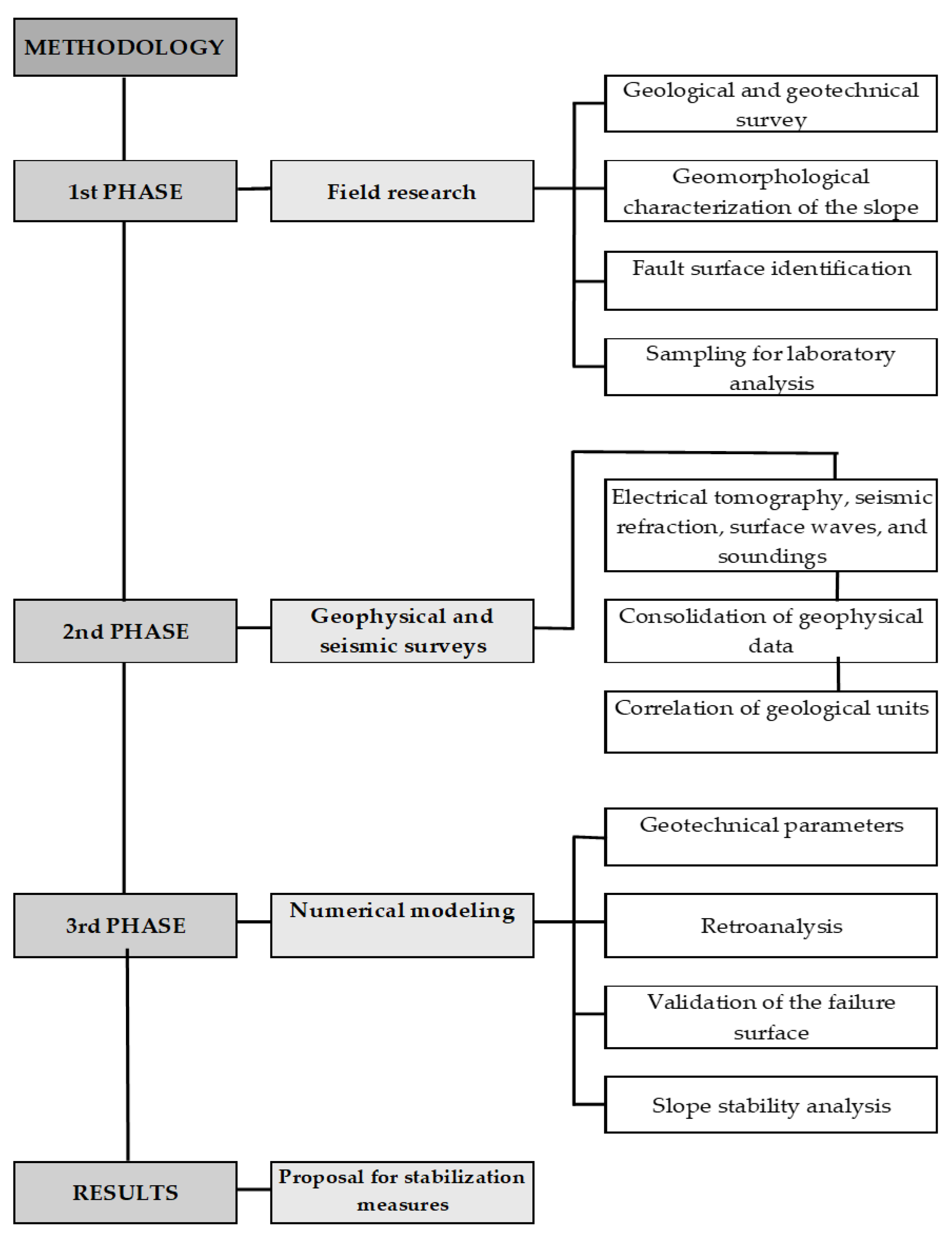
This present study was organized into three stages (see Figure 4). The initial stage comprised the geological reconnaissance, while the second part involved the application of a variety of geophysical prospecting methods. The last stage included an investigation of the kinematics and dynamics of the given unstable slopes.

3.1. Geological Reconnaissance

The initial stage of geological reconnaissance involved mapping transverse fissures in the loose soil and landslide scarps. Runoff water may infiltrate through fissures on unstable slopes with poor tensile strength, changing the structure of the rock mass and defining possible landslide planes [81,82,83]. In fact, the expansive and dispersive behavior of soil is revealed in cohesive lithological materials, which has an impact on dwellings and road infrastructure situated close to unstable slopes [84,85]. Using the Rock Mass Rating (RMR) and Slope Mass Rating (SMR) parameters, the rock mass quality analysis of the slope was assessed [86,87]. Swedge software version 4.0 was used to examine wedge slides. Some free SMR-Tools utility was used to perform the SMR computation [88,89]. This analysis comprised the basic RMR values for each unstable slope, the structural dimensions of the slope (dip-direction/dip), and whether the landslide was planar or wedge-shaped. The SMR geomechanical classification was based on these results. By analyzing (i) uniaxial compressive strength, (ii) the standard geological index, and (iii) the “mi” fracturing factor and disturbance applied to soft rocks, the geotechnical parameters from the Morh–Coulombs and Hoek–Brown criteria allowed the estimation of cohesion and friction angles for each lithological unit [90,91]. This was realized using the geotechnical profile type C [92]. Based on empirical equations put out by [93] and applied to active geological faults that have the potential to produce moderate earthquakes, the PGA-rock (peak ground acceleration on rock) is located near Portoviejo.

3.2. Geophysical Prospection

At the analysis site, three tests were conducted to characterize subsurface conditions and evaluate their geotechnical and geophysical behavior, using advanced indirect prospecting methods.
In the first survey, the Schlumberger array was used to acquire the necessary data, which were subsequently processed using the RES2DINV version 4.1 software. With its help, the geophysical survey of a section identified as the ERT Geophysical Line with a length of 120 m was performed (see Figure 5). Values such as 3.8% and 2.3% are measurement errors that fall below the permitted limit of 10.0%, indicating high precision in data processing. Electrical resistivity tomography (ERT) is a geophysical research technique that allows for the acquisition of the dimensional resistivity profile of the subsurface. The measurements were realized using an ABEM Terrameter LS 3000 resistivity meter, with a network of 41 electrodes distributed at 2.50 and 3 m, applying an electric current with a maximum voltage of ±600 V and an intensity of up to 2500 mA. This profile corresponds to the only ERT line acquired in the study area.
In the second survey, three shear-wave velocity trials were conducted based on surface-wave propagation, identified as VS-01, VS-02, and VS-03. These tests allowed for the acquisition of a geophysical model of the subsurface, with average S-wave velocities ranging around 324 m/s and reaching a maximum depth of 12 m [46]. Shear-wave velocity (Vs) tests were performed during the second stage as part of geophysical prospecting, following known procedures [94,95,96]. By using geoseismic models, the conformation of the rock substrate layers and their relationship with the stratigraphy of the site may be determined [97,98]. The primary stratal systems, joints, and lithological contacts were projected using stereography, and discontinuities in the slope-cut outcrops were determined using a geobrunton compass. Potential planar and wedge-shaped landslides were discovered from the Wulff slipforms using RocSciences’ DIPS (Rocdata v. 3.0, DIPS v. 7.0, SMRTools v. 2.04, RES2DINV v. 4.1) software [99,100].
The third stage consisted of three geotechnical boreholes strategically located within the instability zone, with the execution of standard penetration tests (SPTs). The BH-01 borehole was located above the main scarp of the landslide. The BH-02 borehole was situated in the central zone of the slide mass, while the BH-03 borehole was located at the base on the lower lip of the landslide. The purpose of these tests was to analyze the subsurface stratigraphy and determine the presence, geometry, and depth of the failure plane [46]. A simplified tomographic model of the subsurface was developed, based on the results obtained from the surveys. This model allows for delineating the lithological units and their physical parameters of cohesion, friction angles and unit weight, and safety factors with static and pseudo-static scenarios considering high levels of saturation and seismic coefficients.
The integration of geophysical and geotechnical methods was fundamental in the construction of the subsurface model. Electrical Resistivity Tomography (ERT) allowed for defining the lateral and vertical distribution of geological units, as well as identifying saturated zones. Meanwhile, MASW tests provided shear-wave velocity (Vs) values useful for differentiating layers with varying degrees of stiffness and characterizing lithological units. Both datasets were correlated with the results of SPTs and laboratory tests, which allowed for validating geophysical anomalies and determining the strength parameters of each layer. This multidisciplinary approach facilitated the precise delineation of the fault surface and the characterization of the contact between the colluvial deposit and the bedrock, which controls the instability mechanism. This ensured the accuracy of the parameters used in the numerical modeling of slope stability under static and pseudo-static conditions.

3.3. Kinematics and Dynamics of Unstable Slopes

An investigation of the kinematics and dynamics of unstable slopes was conducted in the third stage of the slope analysis and numerical modeling. By evaluating the intersection of discontinuities in the slope direction, the kinematic analysis identified a deformation mechanism across a listric slip plane between the contact of colluvial soils and the rock. The primary discontinuity was 345/72 (dip direction/dip). To model the sliding failure mechanism and determine the safety factor for the April 2023 event, a second analysis was conducted using the finite element approach [101,102,103]. For the stability models, the examination of the slip planes and safety factors yielded geotechnical characteristics, such as the calculation of slope inclination and landslide stabilizing by reducing shear strength [23,24,25].

4. Results

The results comprehensively cover the geological, geotechnical, and seismic conditions that impact the stability of the study area. Therefore, there are three main sections of the analyses performed, which will be presented subsequently. The first analyzes how seismic activity can trigger landslides in Portoviejo. The area is influenced by the subduction zone and active geological faults nearby. This information is fundamental for establishing the seismic coefficients used in slope stability analyses. Meanwhile, the second part demonstrates laboratory tests indicating uniaxial compressive strengths. Generally, these geological conditions explain the susceptibility to failure and the need for a detailed stability analysis. The last part presents soil characterization, which was performed by combining laboratory and geophysical tests.

4.1. Potential Triggers of Landslides by Seismic Activity of Quaternary Upper-Crustal Faults

The main seismogenic structure on the continental coast of Ecuador is the subduction zone, which is situated on the northwestern boundary of South America. The dynamics of crustal deformation are significantly influenced by the Nazca Oceanic Plate, which collides and subducts against the Caribbean (also known as North Andean Block) and South American Continental Plates at a rate of 6–8 cm/yr [104,105,106,107]. From north to south, this crustal deformation structure is divided into four tectonic segments, which are the Galera II, the Galera I, the Isla de La Plata, and the Salinas segments, which are defined by openings and earthquakes aligned in the South American tectonic plate (Figure 1, [27,56,108,109]). The Pedernales or Galera I segment has a greater earthquake frequency, with 6.9 ≤ Mw ≤ 7.1 occurring every 20 years and 7.6 ≤ Mw ≤ 7.9 occurring every 70–80 years [19,110,111,112]. The segments of Isla de La Plata and Galera I have the potential to cause coseismic deformation in the ground, which could affect the province of Manabí and specifically the city of Portoviejo.
The 2016 Pedernales earthquake (M7.8) was reported in the Galera I segment, with an epicenter 145 km from Portoviejo and measured seismic accelerations in the range of 0.38 g ≤ PGA-soil ≤ 0.5 g. According to a seismotectonic map of the province of Manabí established by the Ecuadorian Construction Standard, the city of Portoviejo is classified as zone VI with a seismic acceleration factor Z = 0.50 g, or a very high level of seismicity, from the perspective of seismic risk analysis [113]. The maximum magnitudes of the Isla de La Plata and Galera 1 tectonic segments are 7.9 degrees (100 percent activation of the structure) and 7.6 degrees (60 percent activation of the structure) [114]. The second seismic source, also considered a cause of landslides, is crustal geological faults, associated with internal tectonic stresses of the continental plate; they can generate shallow earthquakes of moderate to high intensity, ranging in magnitude from 6 to 6.7 [44,115]. The city of Portoviejo may experience comparable accelerated damage because it is in the vicinity of these seismogenic structures [27].
Strong subduction earthquakes, such as the 2016 Pedernales megathrust event (M7.8) might cause tectonic stresses that accelerate the recurrence rates of activation of Quaternary upper-crustal faults that can produce moderate earthquakes with magnitudes of 6.3 ≤ M ≤ 6.7 [44]. The 1942 Jama earthquake (M 7.9) may be a typical example of early activation in the same epicentral region, which even affected an Andean geological fault in the 1949 earthquake (M 6.5) [116]. Hereby, the deterministic seismic risk model should be understood in terms of hazard level, which enables an evaluation of potential geological faults that could be triggered in Ecuador’s central coastal and Andean areas [117].
In seismic hazard studies along the continental coast of Ecuador, several types of equations have been employed [27]. The fault rupture length, along with its kinematics and geometry within the region, are compared to determine the maximum seismic magnitude. For Ecuador, the following equations have been applied to ascertain the maximum magnitude (Mw) of normal, reverse, and strike-slip or shear geological faults [93]:
Strike slip or shear fault; Mw = 5.56 + 0.87 × Log(LF)
Normal fault; Mw = 6.12 + 0.47 × Log(LF)
Reverse fault; Mw = 4.11 + 1.88 × Log(LF)
The mapped surface length of the capable fault, expressed in kilometers, is denoted by the Length of the Fault (LF). The study examined the potential magnitudes (minimum and maximum) of seismic activations for each type of geological fault that can produce earthquakes considering 60.0% and 100.0% of their lengths [113]. Additional equations based on empirical regression correlations between earthquake magnitude and geological fault displacement are as follows [118]:
Fault displacement (in meters) = EXP(−1.38 + 1.02 × LOG(LF))
Peak ground acceleration (PGA-rock) is a seismic coefficient necessary in pseudo-static evaluations of rock slopes and in seismic hazard investigations. The following equation is the one that can be adjusted most accurately to the seismotectonic reality of Ecuador [119]:
PGA rock = (10(0.41M − log10(Ztor + 0.032 × 100.41M) − 0.0034 × Ztor + 1.3)/980
where Ztor, measured in kilometers, is the focal distance or hypocenter from the capable fault and M is the estimated magnitude determined by the fault’s length. For faults with horizontal (strike slip or shear, 85° dip) and vertical (normal and reverse, 60° dip) displacements, Rrup is computed using the following equation, considering different inclination angles:
Rrup = Ztor × COS(60 × PI()/180) + DH × SENO(60 × PI()/180)
Rjb stands for the horizontal projection distance of the study site, while DH denotes the location of the study site in relation to a particular geological fault, both in terms of proximity and distance. Strike-slip faults should have a focal distance of 12 km, while normal and reverse faults should have a Ztor of 16 km. The value of PI is 3.1416. For Portoviejo, we considered a horizontal distance of 4 to 25 km. In this type of capable fault with shear or horizontal displacement, the largest rock accelerations are observed.
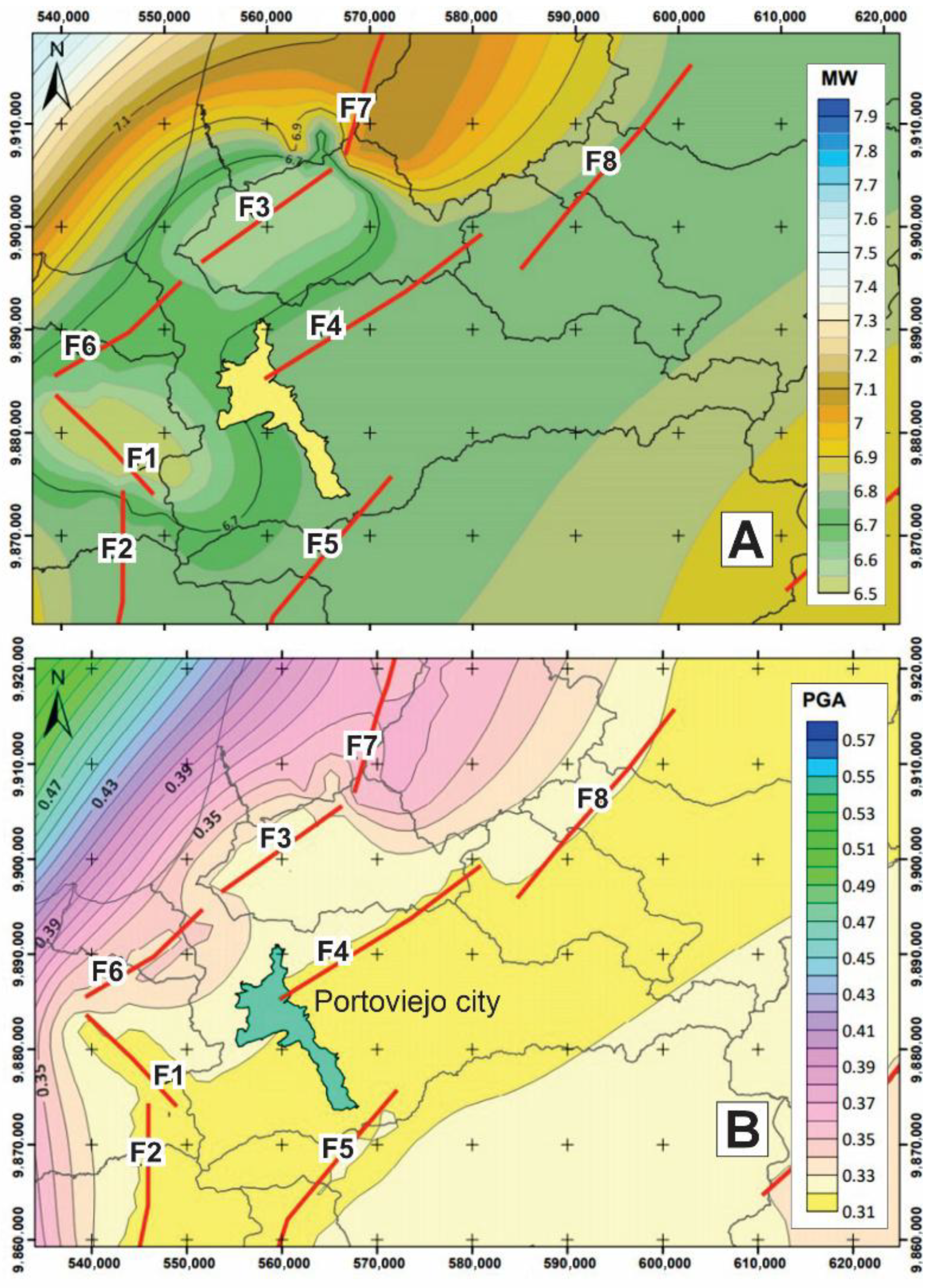
We examined the seismic triggers of faults capable of generating moderate-magnitude earthquakes near Portoviejo in this study (see Figure 6, Table 2). Given the existing saturation of the cohesive colluvial soils surrounding the urban area as a result of the recent heavy rainfall during the winter months of 2023–2025, this triggering factor has the potential to cause several landslides. In an epicentral location, lateral spreading and coherent and disruptive landslides are among the most common environmental effects of earthquakes [19]. The magnitude of the seismic source is correlated with the size of these landslides and the coseismic geological effects they have on the landscape. These landslides on the Ecuadorian coast are correctly attributed to subduction earthquakes or geological faults in the Earth’s crust. The potentially seismic faults mapped within a 25 km radius of Portoviejo with fault lengths ranging from 14 to 25 km are evaluated in this section. At 4 km, the reverse fault, also known as F4, is the closest to the study site.
The F3 and F4 faults exhibit moderate activity, as indicated by the spatial distribution of earthquakes from the United States Geological Survey (USGS), National Earthquake Information Center Institute (NEIC), and Geophysical Institute of the National Polytechnic School (IGEPN) catalogs, with focal distances less than 16 km and magnitudes less than 5.1 [120,121,122] (see Figure 6). One of these two geological faults is responsible for the recent seismic event that occurred on 20 July 2016, with a magnitude of 5.1 and a focal distance of 10 km. The F3 and F4 faults, which are situated north of Portoviejo, may be ascribed a slip rate of 0.1 to 0.5 mm/yr using the seismic magnitude relationship and the recurrence intervals of capable faults [123]. Table 2 displays an approximation of the seismotectonic behavior of capable faults, assigning their maximum magnitudes and PGA-rock, based on the equations of [93,124]. Within a 25 km radius of Portoviejo, the seismic activity is defined in this study considering 100.0% and 60.0% of the length of each of the six geological faults (see Table 2).
With rock accelerations ranging from 0.26 to 0.33 g and magnitudes between 6.3 and 6.7, this study demonstrates that the city of Portoviejo is similarly vulnerable to moderate earthquakes originating from capable faults. The underlying characteristics of the city of Portoviejo are defined by sedimentary deposits 60 to 70 m thick and interbedded between silts and sands. In other words, seismic waves with a PGA-soil between 0.5 and 0.9 g are able to be amplified by the lithological and stratigraphic characteristics of a small valley between hills. To obtain more seismological information from the geometric and kinematic parameters of the F3 fault and its coseismic geological effects on colluvial soils (190 ≤ Vs30 ≤ 520 m/s) of the city of Portoviejo, we applied the web-based Ground Motion Database of the Pacific Earthquake Engineering Research Center (PEER), obtaining a result of periods between 0.1 and 1 sec. The pseudo-static slope stability evaluations in the soils of the hilly reliefs surrounding Portoviejo should use these seismic coefficient values. Accelerations of 0.26 to 0.31 g should be used for rock slopes.

4.2. Geology and Geomechanical Characteristics

The tertiary rock substrate, of Lower Miocene age, is composed of claystones and shales belonging to the Dos Bocas and Villingota geological formations [106,125], where geomechanical properties indicate a uniaxial compressive strength of approximately 35 MPa (in this study). The unfavorable orientation of the discontinuity planes relative to the slope direction, combined with a Geological Strength Index (GSI) of 35, a mi value of 7, and a disturbance factor (D) of 0.5, results in an estimated friction angle of 17°. Furthermore, the Rock Mass Rating (RMR), which ranges from 35.0 to 45.0%, reflects poor structural conditions, suggesting high vulnerability to potential failure. In contrast, the geomechanical characterization of the more consistent shales and mudstones demonstrates a uniaxial compressive strength between 58 and 80 MPa, with a rock quality designation (RQD) of 75.0% [126,127]. The average spacing between discontinuities is 3.5 to 3.6 m, with persistence of 3 to 4 m. The opening in the most critical fracture exceeds 9 mm, with soft fill greater than 5 mm and slight alterations in the walls of the discontinuities. The predominant geohydrological condition on the slope is humid. Under these parameters, the slope has been classified as class III, with a basic RMR of 59.0% [128,129].
Table 3 presents the geotechnical characterization of the sector, obtained from the identification of the stratigraphic units present on the slope (U1, U2, U3, U4, and U5), detailing the lithological information, physical parameters, and mechanical properties of the soil. The data include soil classification using the Unified Soil Classification System (USCS). Also included are the unitary specific gravity (γ), measured in kilonewtons per cubic meter (kN/m3), and the shear-wave velocities, known as S waves (Vs), measured in meters per second (m/s), which allow the evaluation of the stiffness and dynamic behavior of the materials. Likewise, shear strength parameters are incorporated, such as cohesion (c), measured in kilopascals (kPa), and the angle of internal friction (φ), measured in sexagesimal degrees (°), determined both in post-slide conditions and at the time of collapse through retroanalysis. This information facilitates understanding of the geomechanical behavior of the slope and subsequently forms the basis for numerical modeling and slope stability analysis.

4.3. Geotechnical and Geophysical Characterization of the Subsoil

Pleistocene–Holocene residual and transported soils are highly susceptible to phenomena such as soil liquefaction, subsidence, riverbank cracking, and unstable slope displacements due to their particular geotechnical structure and composition [130,131,132]. Documented landslides in the area are of various types, being rotational, translational, planar, disruptive (rock falls, overturns), and lateral spreads (riverbank displacements) [25]. In the El Florón III study sector, an active landslide corresponding to a rotational movement was recorded in April 2023. Between elevations 58 and 60 m above sea level, ground uplift was observed on the lower lip of the landslide, which has caused structural damage to existing homes on the site [46]. At an elevation of 80 m above sea level, a scarp originated on the shoulder of the landslide, with a height varying between 3 and 5 m (between elevations 75 and 80 m above sea level), forming a trench with a depth of 1 m and a width ranging between 3 and 4 m at the base of the scarp. At an elevation of 146 m a.s.l., the slope crest defines the magnitude of the landslide process in the area. Together with the slope toe, located at 70 m a.s.l., this represents a total height difference of 76 m, highlighting the severity of the landslide and its potential impact on the area’s infrastructure [45].

4.4. Geotechnical Conditions of Shales and Siltstones

The physical characteristics of the soft rocks that predominate in the city of Portoviejo’s hilly reliefs were determined using geotechnical parameters based on the Morh–Coulombs and Hoek–Brown criteria [90,91,133,134]. In addition to the Uniaxial Compressive Strength (UCS), measured in megapascals (MPa), and cohesion for siltstone and claystone, external data on the geomechanical characteristics of the geological units and structures were used to establish the friction angle with values for the rock masses. Based on three parameters, the Hoek–Brown model requires some specific information. First, it needs the uniaxial compressive strength of clay shale (σci), which is 35 MPa, second, the frictional character of the siltstone (mi), which is 7, and third, the geological strength index of the rock mass (GSI), which is 35. The “mb” is a reduced value of the material constant of 0.317, while “A” and “S” stand for rock mass constants, which are 0.516 and 0.0002, respectively. Cohesion of 1.89 MPa and friction angles of 18 to 25° are determined for the claystone and siltstone rocks.
Geophysical surveys and geotechnical drilling allowed the delineation of the lithological units to a depth of 40 m. Stratigraphically, the surface lithological unit (U1) is associated with colluvial soils, consisting of highly plastic cohesive silts (MH), according to the Unified Soil Classification System (USCS), with angular claystone clasts. This unit presents resistivity values of 28 Ω.m and a high compressibility that reflects a liquid limit between 50 and 77 and a plastic limit between 34 and 38. The geotechnical parameters acquired in the laboratory tests indicate a specific weight (γ) of 16 kN/m3, a friction angle (φ) fluctuating between 13 and 16°, and a cohesion ranging from 14 to 22 kPa. The direct shear test performed for this unit provides a cohesion of 14,330 KPa and a friction angle of 16°.
The second lithological unit (U2) is composed of ancient colluvial soils, consisting of high-plasticity clayey silts (MH). Its liquid limit ranges between 31 and 38 and its plastic limit between 26 and 37. It presents resistivity values of 12 Ω.m, showing low compressibility, where its geotechnical properties indicate a recorded specific weight of 17 kN/m3, with a friction angle between 15 and 18° and a cohesion between 15 and 23 kPa. The direct shear test performed on this unit yields a cohesion of 15.992 KPa and a friction angle of 17°.
The third lithological unit (U3) is composed of highly weathered and fractured shale with high plasticity (MH), presenting an average compressibility with resistivity values of 13 Ω.m. The liquid limit is between 40 and 80, while the plasticity index varies between 23 and 42. A specific weight of 19 kN/m3 is recorded, with a friction angle between 17 and 19° and a cohesion of 28 and 35 kPa. The results of the shear test yield a cohesion of 34 KPa and a friction angle of 18°.
The fourth lithological unit (U4) corresponds to weathered and fractured shale. It is classified as high-plasticity silt (MH) with resistivity values of 22 Ω.m and high compressibility, where the liquid limit is between 61 and 82, with a plasticity index of 31 and 41. Its specific weight is 20 kN/m3, with a friction angle between 20 and 22° and a cohesion between 38 and 45 kPa. Based on the results of the direct shear test, a cohesion of 40 KPa and a friction angle of 20° are obtained for this unit.
The fifth and final lithological unit (U5) belongs to a moderately hard to hard, high-plasticity (MH) shale. It yields resistivity values of 15 Ω.m, with a high compressibility. Its liquid limit varies between 53 and 64, while the plasticity index ranges from 35 to 40. The specific weight for this unit is 21 kN/m3, with a friction angle between 20 and 23° and cohesion between 40 and 50 kPa. From the unconsolidated undrained triaxial test, a cohesion of 50 KPa and a friction angle of 21° are determined.
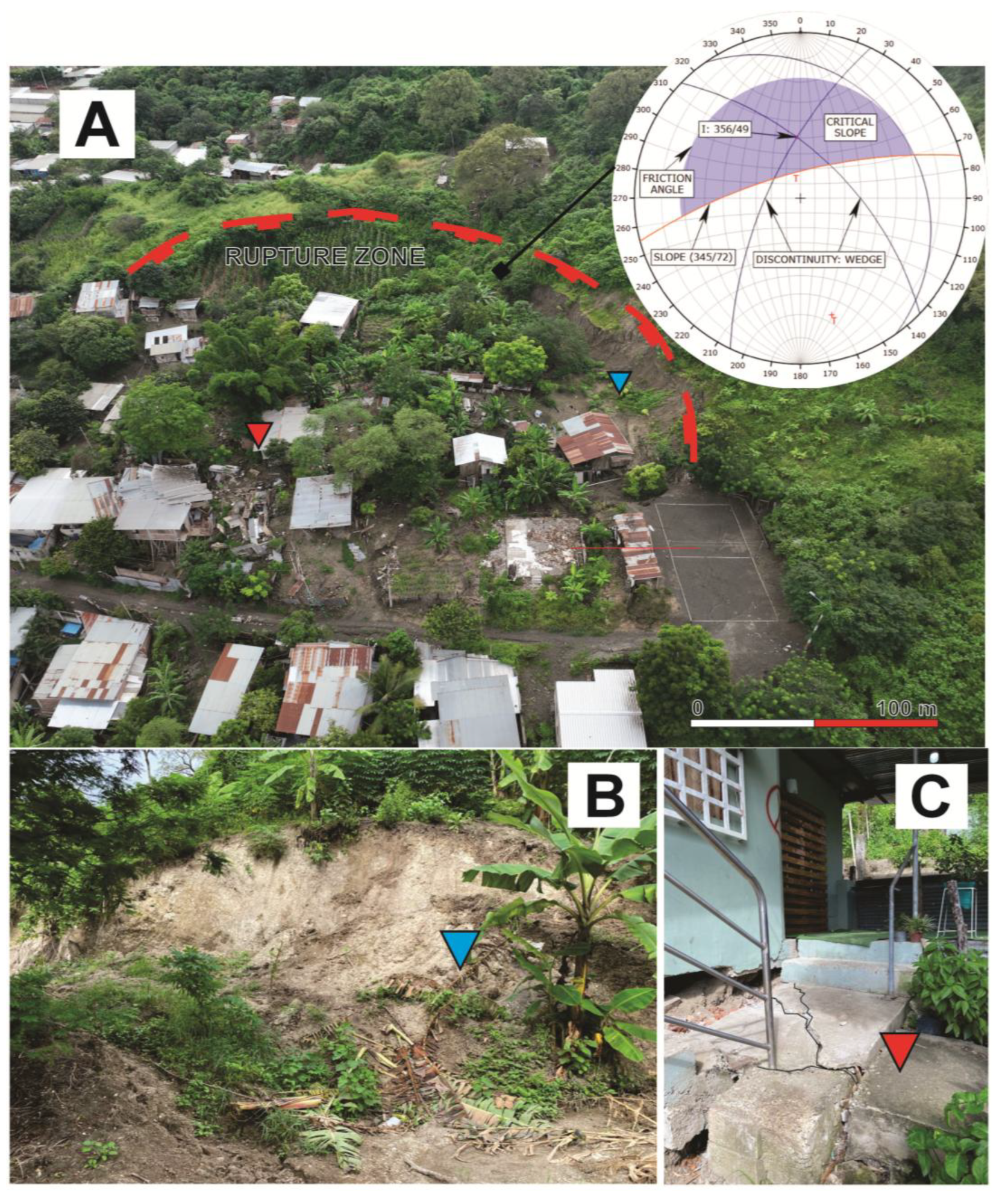
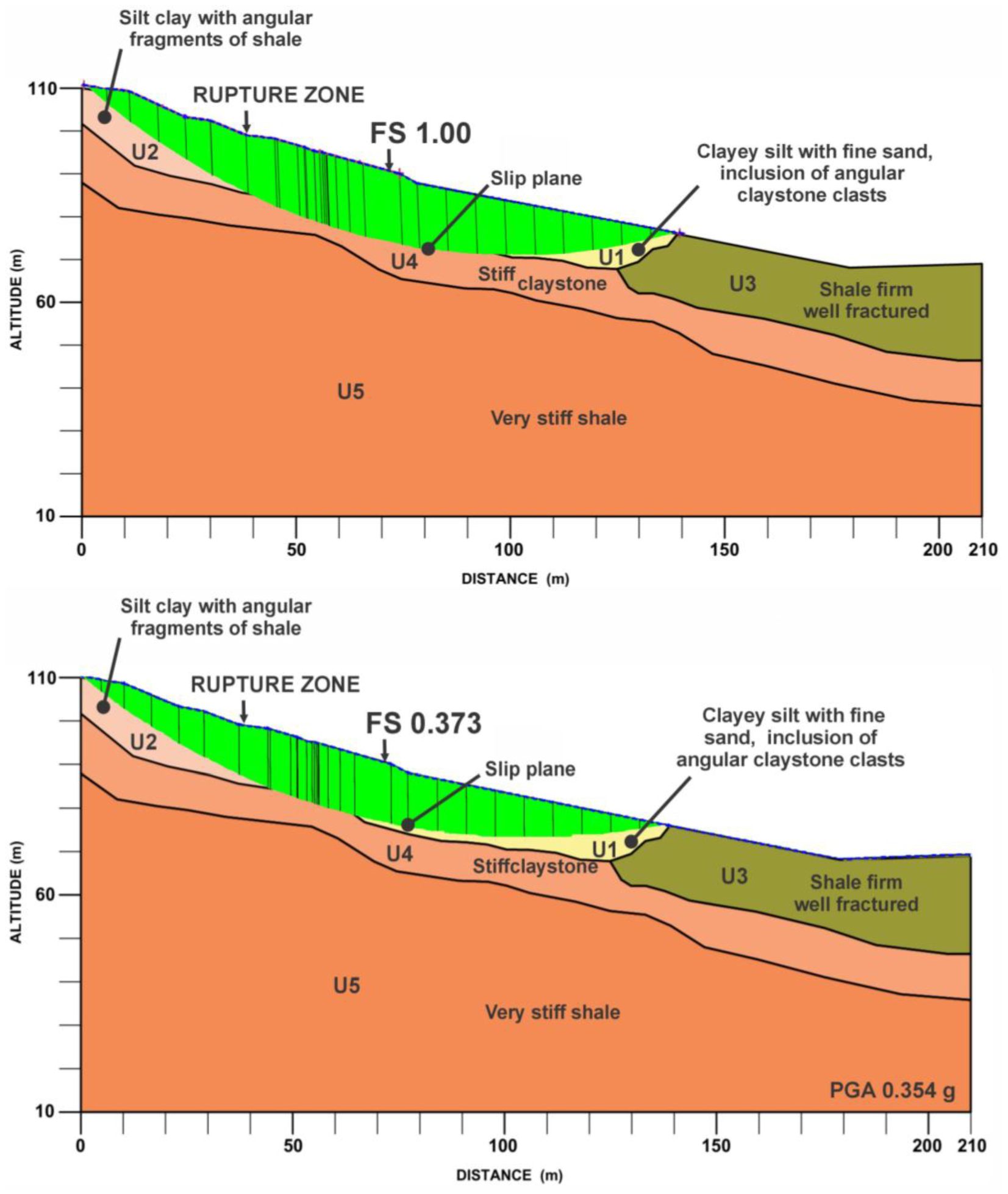
These shear strength parameters will be essential for developing an inverse analysis and understanding the geomechanical values corresponding to the moment of collapse, which are necessary for numerical modeling. Based on the samples tested, it was determined that the sliding body material had a specific gravity of 17.50 kN/m3 and a moisture content of 32.20%. On the exposed face, the values obtained were 18.5 kN/m3, corresponding to the specific gravity and a moisture content of 36.61% (see Figure 7).
Preliminary results obtained through geotechnical surveys performed to a depth of 20 m indicate that the lithological materials in the upper part of the slope correspond to inorganic cohesive soils, classified as moderately and highly plastic (CL and CH). The liquid limit ranges from 50 to 77, while the plasticity index ranges from 14 to 40. Following the landslide that occurred in 2023, and considering the lithological units observed in the slope cut of the main escarpment, an undisturbed sample was extracted using the 30 cm × 30 cm wooden cube method and sent to the laboratory for analysis. The variables obtained in these tests, together with the field analyses, were used to determine the soil shear strength parameters, which are essential for developing a corresponding numerical model [44].
Visual technical inspection of the study area allowed for an evaluation of the deformation dynamics of the landslide, revealing a corresponding rotational geological fault, characterized by structural data of 345/72 (dip/dip-direction). Evidence of deformation in the terrain and its dimension of the detachment and accumulation zone is illustrated in Figure 7. The thickness of the fault zone was estimated to be between 3 and 5 m, which may be related to an ancient strike-slip fault.
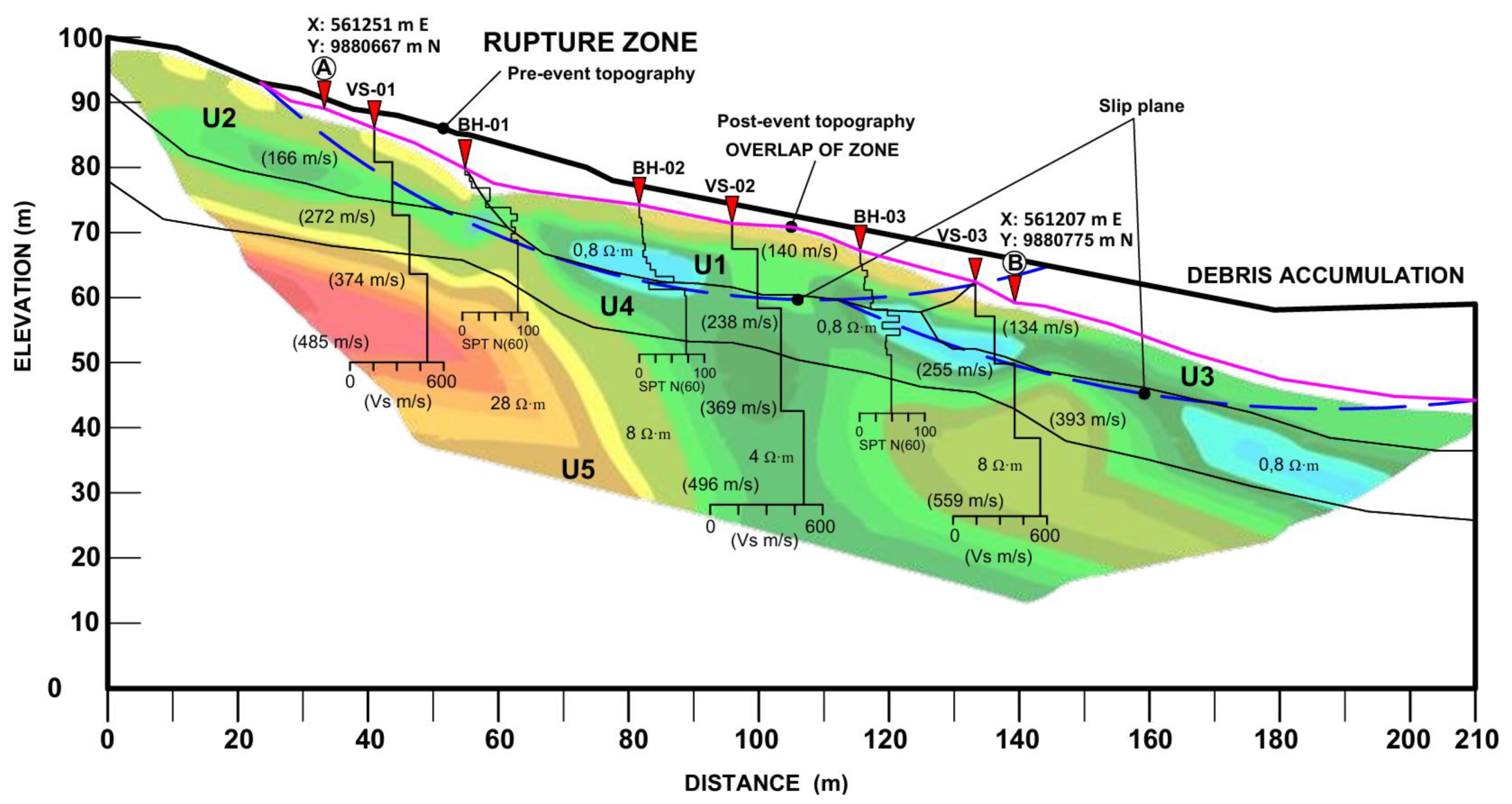
Regarding the damage analyzed during the landslide that occurred on 23 April 2023 in the study area, three deformation zones are identified (see Figure 8). The first zone corresponds to the rupture zone, also known as the detachment of the main scarp, where an approximate slope height of 30 m is recorded. The second zone is the superposition zone, characterized by the presence of secondary scarps visible on the surface, with a depth of 5 m. Finally, the third zone is associated with the accumulation of debris, composed of displaced material that has been transported over a horizontal distance of approximately 400 m, reaching thicknesses of up to 4 m near the secondary scarps. The most resistant stratum, with the greatest rigidity, corresponds to lithological unit U5, which shows seismic velocity values in the range of 489 ≤ vs. (m/s) ≤ 559, as determined by electrical tomography tests.
Therefore, the data obtained from indirect geophysical tests, which allowed the identification of geological units through electrical resistivity values (expressed in Ω m) and geoseismic tests (measured in m/s, Vs30), were integrated with the lithological units observed and classified directly in the field (see Figure 8).
Geophysical exploration using electrical resistivity tomography (expressed in Ω.m) identified distinct lithological horizons to a depth of approximately 30 m. On the main slope of the mass movement, zones of material exclusion with total saturation were identified, reaching depths of up to 5 m. These zones are possibly related to infiltration processes from springs located in the upper part of the corridor known as Ruta del Choclo, as well as infiltration from drinking water networks and wastewater discharges generated by homes located within the area of influence. The electrical resistivity values obtained, averaging 1.50 Ω.m, indicate the presence of areas with high levels of saturation, mainly attributable to surface water infiltration. However, these conditions have not been identified as the main triggering factor of the event recorded on 23 April 2023. Despite this, the interaction of natural, geological and geomorphological factors, together with the presence of weathered materials, unconsolidated deposits, and structural discontinuities with unfavorable orientation, generate significant contrasts in the properties of permeability and stiffness, which demonstrates the coexistence of dense units on materials with plastic behavior [135].
The validation of the fault surfaces was realized through the integration of geophysical methods and direct geotechnical investigations. Electrical Resistivity Tomography (ERT) surveys allowed the identification of marked resistivity contrasts along the slope. There, the colluvial soils (U1 and U2) exhibited values ranging from 12 to 28 Ω·m, indicating highly saturated zones, while the weathered shale and mudstone units (U3, U4, and U5) demonstrated resistivities between 13 and 22 Ω·m, corresponding to more competent materials at depth. These resistivity variations spatially coincided with the landslide fault plane identified in the field. Similarly, the geoseismic tests (Vs30) confirmed variations in subsurface stiffness, clearly delineating the contact between the colluvial soils and the underlying rock mass. The near-surface deposits presented shear-wave velocities between 180 and 310 m/s (U1 and U2), whereas the underlying weathered shale and mudstone units increased to 310–760 m/s (U3 and U4), reaching up to 900 m/s in the most competent unit (U5). This contrast enabled the precise location of the listric fault surface described in the kinematic analysis.
Complementarily, the field geotechnical inspection and the information obtained from test pits, undisturbed samples, and laboratory analyses corroborated the presence of a weakened zone at the interface between the shallow cohesive soils and the weathered shale units (U1–U4). The geometric projection of the main scarp, together with the structural analysis of the plane, allowed the determination of a rotational movement mechanism over a reactivated ancient fault plane, whose geometry coincided with the geophysical contrasts and the geotechnical parameters measured in situ.

5. Discussion

The interpretation of the results is described in three sections that provide an understanding of the applied methodology, the results obtained, and the proposed solutions. Hereby, first, numerical modeling is implemented to evaluate the factors of safety, considering the site’s stratigraphy through geophysical studies. Then, the post-slide conditions are evaluated through retroanalysis, determining factors of safety (FSs) that reflect instability. Finally, we evaluate the potential technical solutions to reduce risks and vulnerabilities in the study area.
The analysis presents uncertainties associated with the natural variability of colluvial soils and highly weathered shales, whose geotechnical parameters were estimated through basic laboratory tests and back-analysis, resulting in approximate ranges. This type of spatial variability in cohesive materials has been widely documented as a critical factor in predicting slope stability [136]. The geophysical techniques used also have limitations. Hereby, MASW profiles have limited depth, while ERT models demonstrate restrictions in the resolution of lithological contacts, which limits the precise definition of the subsurface. Furthermore, the analysis lacks the incorporation of a coupled hydromechanical model; therefore, the slope’s response to rainfall events is interpreted using limited spatial and temporal resolution rainfall data.
The limit equilibrium method allows for a preliminary estimate of the stability state, but it does not reproduce internal deformations or the temporal evolution of the landslide under varying conditions. The lack of advanced geotechnical testing and in situ instrumentation limits the accuracy of the parameters used and restricts the validation of the slope’s actual behavior. Although more sophisticated monitoring techniques exist, such as PS-InSAR, capable of detecting millimeter-scale deformations and analyzing reactivation processes, as demonstrated in recent studies relating landslide dynamics to precipitation patterns [47,48], this study focused on a previously characterized landslide in the area using accessible and complementary methodologies for analysis.
Incorporating advanced triaxial tests is recommended to obtain parameters suitable for Finite Element Method modeling, which would facilitate the evaluation of internal deformations, stress redistribution, and reactivation processes. The installation of piezometers and inclinometers, along with the use of satellite data, including PS-InSAR and approaches such as the sequential inflection point detection (STPD) method, would allow for the correlation of potential reactivations with precipitation patterns and significantly improve landslide monitoring, following approaches like those applied in European studies [47,48]. Additionally, further MASW and ERT campaigns could validate subsequent changes at the site.
The results obtained indicate that the rotational landslide at El Florón was conditioned by unfavorable geological and geotechnical characteristics present on the slope. A highly weathered colluvial deposit with low bearing capacity and a tendency to deform under moderate stress was identified. Furthermore, the orientation of the colluvium–rock contact towards the valley and the presence of structural discontinuities favor the formation of surfaces of weakness and a high susceptibility of the slope to instability. The integration of geophysical data and geotechnical tests allowed for the definition of the geometry of the fault surface and the variability in the strength properties of the colluvium, aspects that directly influence its stability.

5.1. Data and Numerical Modeling

This research allowed for stability analysis of the slope located in the El Florón sector through the implementation of a landslide model. For this purpose, GeoStudio 2018 R2 software (version 9.1.1.16749) was used to simulate different geotechnical conditions of the terrain and calculate the safety factor (SF) against landslides, using the finite element module [137]. The program facilitated a graphic representation of the slope behavior, incorporating the characteristic geomechanical parameters of the study area.
From the identification of the failure surface, determined by geophysical prospecting and visually verified through the projection of the slope scarp, it was established that the given surface reached the upper limit of a stratigraphic unit composed of low-plasticity mudstones. The stratigraphy of the site was defined based on the obtained geophysical data and using the original topography as a reference. For the stability analysis, the limit equilibrium method was employed using the Morgenstern & Price approach, which allows for evaluating the stress distribution along the potential failure surface with an adequate balance between forces and moments [138,139,140,141,142,143,144]. Additionally, the Mohr–Coulomb constitutive model was implemented, where the failure surface was defined by the loss of soil shear strength, influenced by the maximum shear stress and the applied normal stress.
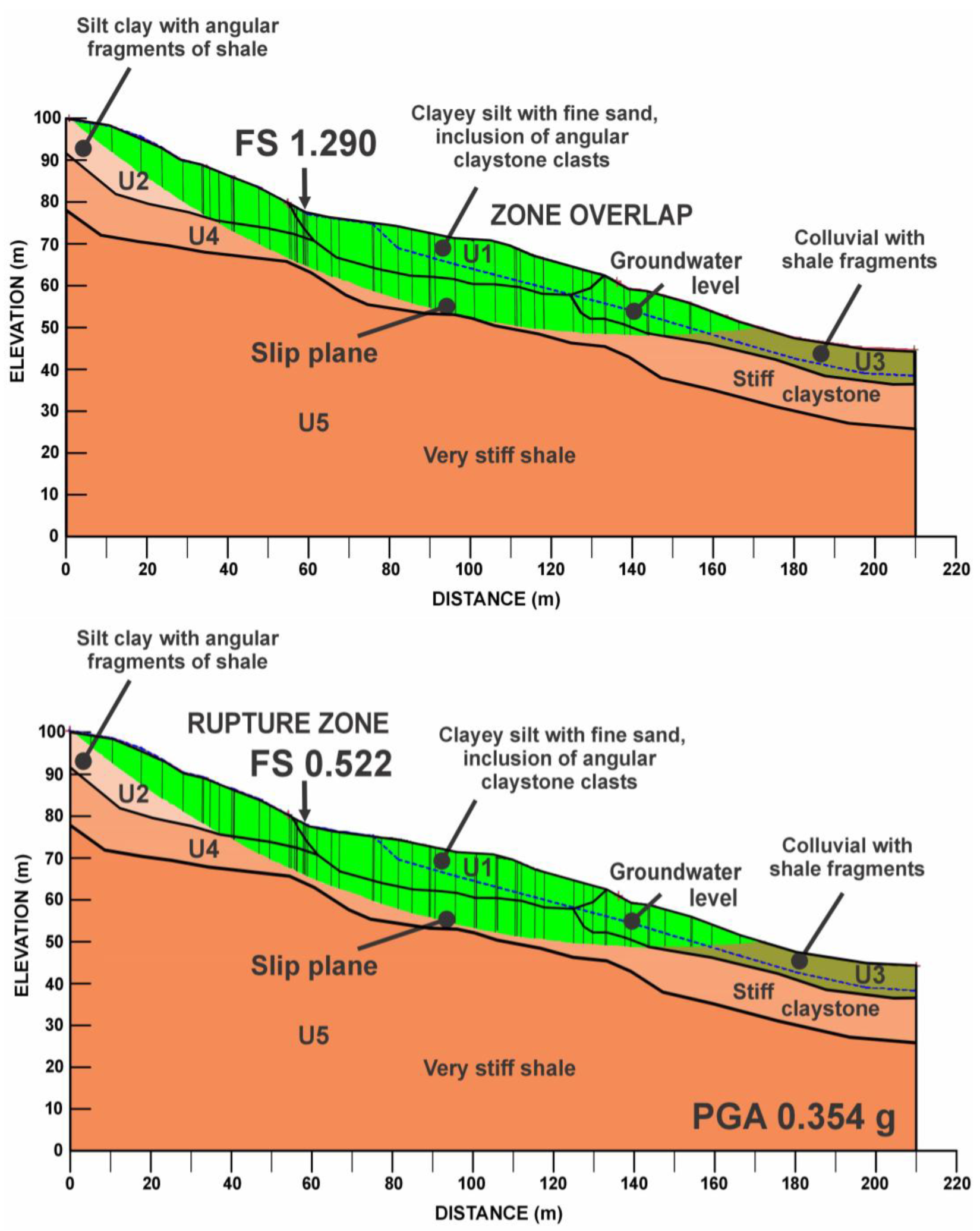
A retrospective analysis [140,141,142,143,144,145] was conducted, considering the index parameters of each stratum integrated into the model, which allowed for estimating the soil strength conditions at the time of the collapse. The results obtained indicated a state of static equilibrium of the slope when the factor of safety (FS) reached a value of one. It is fundamental to clarify that the 2023 landslide was not triggered by seismic activity, but rather by saturation induced by heavy rainfall. Seismic conditions are included solely to assess the potential reactivation of the slope under future dynamic loads, considering the regional tectonic framework and national regulatory requirements for slope stability assessment. According to the NEC-15 SE standard, slope stability analyses must comply with a minimum safety factor of 1.50 under static conditions and 1.05 under pseudo-static conditions [65]. The El Florón is located in an area with a seismic acceleration of 0.5 g, according to the seismic zoning map established in this standard. The seismic demand for the pseudo-static analysis is defined as 60.0% of the peak ground acceleration, considering the seismic zone and the amplification factor Fa based on the site’s geotechnical profile, which corresponds to a value of 0.354 g. This pseudo-static coefficient was integrated into the numerical model using specialized software (GEOSLOPE GeoStudio 2018 R2, version 9.1.1.16749), with the aim of evaluating the slope’s behavior under the design seismic conditions, in accordance with national regulatory requirements.

5.2. Slope Stability Analysis

The geometric projection of the surface was defined based on the topographic morphology of the study area, as well as the internal stratigraphic distribution, characterized from the results obtained through geophysical surveys. Geotechnical parameters derived from laboratory tests and mechanical actions affecting slope stability were considered. The application of back-analysis allows for estimating the geotechnical parameters of the soil at the time of the landslide, based on the current conditions observed in the slope (see Figure 9).
For the selection of shear strength parameters used in the retrospective analysis, the initial values were those obtained from direct shear tests performed on representative samples of the materials involved in the instability. These values were subsequently adjusted iteratively within the numerical model, using the limit equilibrium method, until a safety condition equivalent to that observed during the event recorded in April 2023 was reproduced. This resulted in a limit equilibrium state with an FS in static condition of 1 and pseudo-static condition of 0.373, with a PGA equal to 0.354 g (see Figure 9). This procedure allowed for the estimation of the soil shear strength during the collapse, following the recommendations of NEC-15 and the methodologies applied to the retrospective analysis of slope stability under actual failure conditions. By optimizing the model configuration, the aim is to reproduce the failure event until a limit equilibrium state is reached, represented by a safety factor equal to one.
The stability analyses performed on the slope, based on the pre-landslide topography, indicate safety factors below the minimum values established by the Ecuadorian Construction Standard [65]. Under static conditions, its static safety factor was 1.290, a value lower than that recorded after the failure. This reduction is attributed to the loss of shear strength within the slope body, resulting from internal deformation processes and mass movements. Under pseudo-static conditions, the analysis yielded a safety factor of 0.522, using a seismic coefficient of 0.354 g, indicating a critical state of seismic instability (see Figure 10). These results reaffirm the need to implement structural stabilization measures, given that the slope mass is highly susceptible to collapse during seismic events.
Following the landslide, an emergency intervention focused on removing the landslides and structural debris using heavy backhoe-type machinery. The temporary relocation of 15 affected families was managed by the Decentralized Autonomous Government (GAD) of Portoviejo, guaranteeing their protection in areas considered safe while alternative definitive solutions were evaluated [45]. Currently, community leaders report identifying signs of remaining instability such as transverse cracks, structural inclinations, and active surface movements in the body of the landslide, which has generated great concern among residents of the area. These conditions reflect the urgent need to implement geotechnical stabilization measures and establish a continuous monitoring system to assess the slope’s behavior in the short and medium term. A stability design has been established that complies with the safety factors required by the Ecuadorian Construction Standard (NEC-15) and evaluates the stability of the slope in its current distribution. To this end, a high-resolution photogrammetric survey was performed to obtain a detailed topographic profile reflecting the actual morphology of the study area. The combination of this information and the geomechanical parameters obtained in the retroanalysis allowed for a new stability assessment aimed at developing appropriate technical solutions [24].

5.3. Alternatives for Landslide Prevention

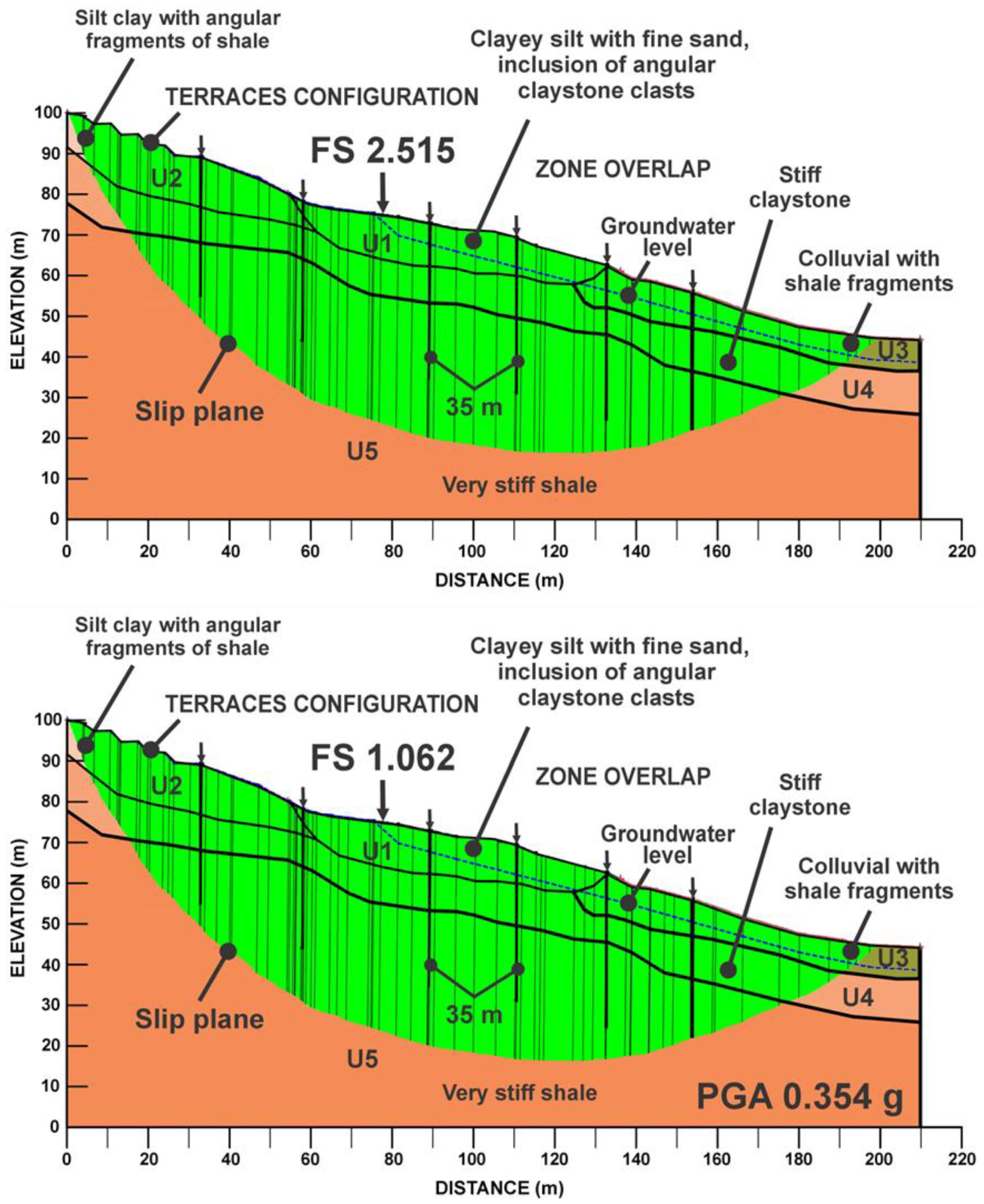
The initial analysis considered the pre-landslide topography instead of developing a new topographic model of the slope (see Figure 11). Based on this, an analysis with a piezometric line was configured in the software to simulate the saturation of the surface materials and represent a critical soil moisture condition consistent with the scenarios that may have contributed to the landslide [27].
According to the preliminary results, the current morphology of the study site has not undergone significant changes since the landslide. These conditions allowed for performing the stability assessment and proposing viable geotechnical stabilization alternatives based on the actual terrain configuration. Due to the presence of vegetation and Layer 2 deposits (see Table 3) at the top of the slope, whose self-weight represented an additional unfavorable load for the system’s stability, a micropiles system with terracing was implemented. The terracing scheme was implemented at the top of the slope, with a total length of 32 m and a 45° inclination relative to the horizontal plane. The construction of four to five terraces was considered, each 2 to 3 m high, not exceeding a total of 5 m, in accordance with technical recommendations aimed at reducing the load induced by saturated materials on the sliding mass.
Six reinforced concrete micropiles were used, each with a diameter of 30 cm and depths ranging from 40 to 50 m, spaced 0.60 m apart. For the design of the micropiles, a unit weight value of 21.57 kN/m3 and a cohesion value of 20.94 kN were adopted for concrete/grout. These values were obtained from correlations by [146,147]. Similar values are common in grout or injection mixes for micropiles, as they offer lower self-weight and facilitate pumping, in addition to being suited to deep support and slope reinforcement applications.
The interface resistance is obtained from the soil properties using an adhesion factor (α) for fine-grained soils or a unit friction resistance fs for granular soils. Therefore, the shear capacity of 570 kN [147] is the result of the strength calculation based on the soil properties, along with the adhesion and interface behavior factors used in the design; these factors and their justification are detailed in Table 4.
Since saturation is one of the main factors affecting slope stability, it is considered essential to implement an adequate drainage system, complementary to the selected stabilization measures, in order to reduce hydrostatic pressures and mitigate the risk of structural damage. The proposed solution achieved a static safety factor of 2.515 and a pseudo-static safety factor of 1.062 under a seismic coefficient of 0.354 g, demonstrating a substantial improvement in slope stability conditions. The adopted configuration allowed for reaching the most resistant stratum, facilitating an effective load transfer to the deeper and more competent subsurface layers.
The following section presents the sensitivity analysis, aimed at determining the influence of groundwater-level variations on slope stability and evaluating the performance of the proposed stabilization system. Table 5 summarizes the evolution of the safety factor (FS) for groundwater depths ranging from 0 to −12 m, representing scenarios from full saturation to partially drained conditions. These results allow the identification of the critical saturation state and verify that the proposed stabilization system maintains stable conditions even when the groundwater level rises to the ground surface, an event typically associated with the clogging of surface drains during intense rainfall episodes. Under this most unfavorable scenario, the geotechnical solution preserves FS values above 1.05 under pseudo-static conditions, meeting the minimum requirements established by NEC-15, which are related to the horizontal seismic coefficient kₕ. In this way, the information synthesized in the table demonstrates the robustness of the design under hydrological variations, ensuring system functionality even under extreme moisture conditions.
The failure envelope may extend beyond the piles in a slope stability analysis because it represents the potential slip surface, while the piles act as reinforcement resisting shear forces. Satisfying the factor of safety indicates that the soil–pile system’s resistance is sufficient to withstand the acting forces, even though the theoretical failure envelope is located below the piles in the analysis model.
The results of the slope stability analysis demonstrate an improvement in safety conditions following the implementation of the micropile system combined with terracing (Table 6). In the post-landslide scenario, the obtained safety factors were 1.290 under static conditions, 0.522 under pseudo-static conditions, and 0.354 under peak ground acceleration (PGA), values that reflect a critical state of instability. However, the proposed solution increased the safety factors to 2.515 under static conditions and 1.062 under pseudo-static conditions, meeting the minimum criteria established by the Ecuadorian Construction Standard (NEC). This improvement confirms the effectiveness of the implemented reinforcement by reducing ground displacements and ensuring slope stability under moderate seismic loads.
This solution meets the performance criteria established in the Ecuadorian Construction Standard (NEC-15), verifying its effectiveness under both static and seismic conditions. This intervention optimized the slope’s geometric configuration and mitigated the stresses acting at the slope crest, which contributed to a significant improvement in overall stability.
In summary, the increased rainfall in the months leading up to the collapse acted as the primary triggering factor, causing an increase in saturation and pore pressure in the surface materials, which led to a reduction in shear strength. Simultaneously, the weak geotechnical behavior of the colluvial deposit and the persistence of structural discontinuities facilitated the development of a rotational slide and the displacement of the material. The relationship between the rainfall anomalies, the geophysical evidence of high saturation, and the results of the slope stability analysis confirm the fault mechanism proposed in the present study.

6. Conclusions

Landslides in Ecuador occur more frequently during periods of intense rainfall associated with El Niño and La Niña events. Under these conditions, the soils on slopes remain saturated for extended periods, increasing their susceptibility to failure and making it more likely that an existing mass movement will increase in magnitude during a seismic event. In this context, the landslide that occurred on 23 April 2023 was directly related to an anomalous excess of accumulated rainfall during the first four months of the year, reaching some 303 mm in March of 2023.
Through geotechnical characterization of the area, it is determined that the geology is composed of colluvial and alluvial deposits overlying highly weathered Miocene shales and siltstones. This lithological configuration favored the development of a semicircular or silty landslide, which subsequently evolved into mudflows, primarily affecting silty-clayey soils with soft, highly plastic clasts and inclusions of completely weathered schist. These materials correspond to a “C” type profile, characterized by low cohesion and high plasticity under saturated conditions, which contributes to their high propensity for landslides and evolution into mudflows.
Furthermore, by integrating geophysical methods such as ERT, seismic refraction, MASW, and VES, along with numerical back-analysis, which allowed for modeling the landslide mechanism according to the data obtained, the stability analysis revealed that the current slope exhibits critical instability, with safety factors of 1.290 under static conditions and 0.522 under pseudo-static conditions, values significantly lower than the minimums required by Ecuadorian regulations. The proposed design, based on a system of micropiles combined with stepped terraces, demonstrated a significant improvement in slope stability, achieving safety factors of FS = 2.515 under static conditions and FS = 1.062 under pseudo-static conditions. These fully comply with the requirements established by NEC-15. This also completely verifies compliance with the minimum requirements established by the standard, corroborating the efficiency of the proposed design in improving slope stability.
Finally, it is proposed to complement the stabilization by installing a surface and subsurface drainage system adapted to the new slope conditions. This system is essential to ensure the efficient evacuation of rainwater and infiltration, preventing the accumulation of pore water pressure and the loss of shear strength. Additionally, the application of chemical stabilization techniques is recommended, using hydraulic binders such as lime, to improve the mechanical properties and durability of the highly plastic soils present in the area.

Author Contributions

Author Contributions: Conceptualization, M.M. and N.R.-C.; methodology, M.M., N.R.-C. and K.C.; software, M.M. and N.R.-C.; validation, T.T.; formal analysis, M.M. and N.R.-C.; investigation, M.M., N.R.-C., K.C. and T.T.; resources, M.M. and N.R.-C.; data curation, K.C. and T.T.; writing—original draft preparation, M.M. and N.R.-C.; writing—review and editing, T.T.; visualization, M.M., N.R.-C. and K.C.; supervision, K.C.; project administration, K.C. and T.T.; funding acquisition, M.M. and N.R.-C. All authors have read and agreed to the published version of the manuscript.

Funding

This research received no external funding.

Data Availability Statement

None available.

Acknowledgments

We express our gratitude to the Technical University of Manabí, the Municipality of Portoviejo, and the Risk Management Secretariat for their technical and logistical support, especially to engineers Ademir Macías, María Fernanda Quiñonez, and Gabriela Solis. We also thank Isela Salinas and David Stay for their assistance in the numerical modeling. We would like to extent our acknowledgments to the four anonymous expert reviewers, whose comments improved our manuscript significantly.

Conflicts of Interest

The authors declare no conflicts of interest.

References

  1. Alexander, D. On the causes of landslides: Human activities, perception, and natural processes. Environ. Geol. Water Sci. 1992, 20, 165–179. [Google Scholar] [CrossRef]
  2. Haque, U.; da Silva, P.F.; Devoli, G.; Pilz, J.; Zhao, B.; Khaloua, A.; Wilopo, W.; Andersen, P.; Lu, P.; Lee, J.; et al. The human cost of global warming: Deadly landslides and their triggers (1995–2014). Sci. Total Environ. 2019, 682, 673–684. [Google Scholar] [CrossRef]
  3. Lacroix, P.; Handwerger, A.L.; Bièvre, G. Life and death of slow-moving landslides. Nat. Rev. Earth Environ. 2020, 1, 404–419. [Google Scholar] [CrossRef]
  4. Persichillo, M.G.; Bordoni, M.; Cavalli, M.; Crema, S.; Meisina, C. The role of human activities on sediment connectivity of shallow landslides. Catena 2018, 160, 261–274. [Google Scholar] [CrossRef]
  5. Pollock, W.; Wartman, J. Human vulnerability to landslides. GeoHealth 2020, 4, e2020GH000287. [Google Scholar] [CrossRef]
  6. Velázquez-Bucio, M.M.; Ferrario, M.F.; Muccignato, E.; Porfido, S.; Sridharan, A.; Chunga, K.; Livio, F.; Gopalan, S.; Michetti, A.M. Environmental effects caused by the Mw 8.2, September 8, 2017, and Mw 7.4, June 23, 2020, Chiapas-Oaxaca (Mexico) subduction events: Comparison of large intraslab and interface earthquakes. Quat. Int. 2023, 651, 62–76. [Google Scholar] [CrossRef]
  7. Bois, T.; Bouissou, S.; Jaboyedoff, M. Influence of structural heterogeneities and of large-scale topography on imbricate gravitational rock slope failures: New insights from 3-D physical modeling and geomorphological analysis. Tectonophysics 2012, 526, 147–156. [Google Scholar] [CrossRef]
  8. Gariano, S.L.; Guzzetti, F. Mass-movements and climate change. Treatise Geomorphol. 2022, 5, 546–558. [Google Scholar] [CrossRef]
  9. Hradecký, J.; Pánek, T. Deep-seated gravitational slope deformations and their influence on consequent mass movements (case studies from the highest part of the Czech Carpathians). Nat. Hazards 2008, 45, 235–253. [Google Scholar] [CrossRef]
  10. Shroder, J.F.; Owen, L.A.; Seong, Y.B.; Bishop, M.P.; Bush, A.; Caffee, M.W.; Copland, L.; Finkel, R.C.; Kamp, U. The role of mass movements on landscape evolution in the Central Karakoram: Discussion and speculation. Quat. Int. 2011, 236, 34–47. [Google Scholar] [CrossRef]
  11. Stoffel, M.; Huggel, C. Effects of climate change on mass movements in mountain environments. Prog. Phys. Geogr. 2012, 36, 421–439. [Google Scholar] [CrossRef]
  12. Stoffel, M.; Tiranti, D.; Huggel, C. Climate change impacts on mass movements—Case studies from the European Alps. Sci. Total Environ. 2014, 493, 1255–1266. [Google Scholar] [CrossRef]
  13. Trauth, M.H.; Alonso, R.A.; Haselton, K.R.; Hermanns, R.L.; Strecker, M.R. Climate change and mass movements in the NW Argentine Andes. Earth Planet. Sci. Lett. 2000, 179, 243–256. [Google Scholar] [CrossRef]
  14. Coltorti, M.; Ollier, C.D. Geomorphic and tectonic evolution of the Ecuadorian Andes. Geomorphology 2000, 32, 1–19. [Google Scholar] [CrossRef]
  15. Harden, C.P. Human impacts on headwater fluvial systems in the northern and central Andes. Geomorphology 2006, 79, 249–263. [Google Scholar] [CrossRef]
  16. Parsons, J.J. The northern Andean environment. Mt. Res. Dev. 1982, 2, 253–264. [Google Scholar] [CrossRef]
  17. Soto, J.; Galve, J.P.; Palenzuela, J.A.; Azañón, J.M.; Tamay, J.; Irigaray, C. A multi-method approach for the characterization of landslides in an intramontane basin in the Andes (Loja, Ecuador). Landslides 2017, 14, 1929–1947. [Google Scholar] [CrossRef]
  18. Alonso-Pandavenes, O.; Torrijo Echarri, F.J.; Garzón-Roca, J. Sustainable management of landslides in Ecuador: Leveraging geophysical surveys for effective risk reduction. Sustainability 2024, 16, 10797. [Google Scholar] [CrossRef]
  19. Chunga, K.; Livio, F.A.; Martillo, C.; Lara-Saavedra, H.; Ferrario, M.F.; Zevallos, I.; Michetti, A.M. Landslides triggered by the 2016 Mw 7.8 Pedernales, Ecuador earthquake: Correlations with ESI-07 intensity, lithology, slope and PGA-h. Geosciences 2019, 9, 371. [Google Scholar] [CrossRef]
  20. Palenzuela Baena, J.A.; Soto Luzuriaga, J.; Irigaray Fernández, C. Characteristics of rainfall events triggering landslides in two climatologically different areas: Southern Ecuador and southern Spain. Hydrology 2020, 7, 45. [Google Scholar] [CrossRef]
  21. Quiñónez-Macías, M.; Chunga, K.; Toulkeridis, T.; Mora-Mendoza, A.; Constantine, A. New Perspectives on the Quaternary Paleogeography of Coastal Ecuador and Its Relationships with Climate Change. Quaternary 2023, 6, 41. [Google Scholar] [CrossRef]
  22. Tibaldi, A.; Ferrari, L.; Pasquarè, G. Landslides triggered by earthquakes and their relations with faults and mountain slope geometry: An example from Ecuador. Geomorphology 1995, 11, 215–226. [Google Scholar] [CrossRef]
  23. Chunga, K.; Ochoa-Cornejo, F.; Mulas, M.; Toulkeridis, T.; Menéndez, E. Characterization of seismogenic crustal faults in the Gulf of Guayaquil, Ecuador. Andean Geol. 2019, 46, 66–81. [Google Scholar] [CrossRef]
  24. Macías, L.; Quiñonez-Macías, M.; Toulkeridis, T.; Pastor, J.L. Characterization and geophysical evaluation of the recent 2023 Alausí landslide in the northern Andes of Ecuador. Landslides 2024, 21, 529–540. [Google Scholar] [CrossRef]
  25. Salinas, I.; Paucar, A.; Quiñónez-Macías, M.; Grau, F.; Barragán-Taco, M.; Toulkeridis, T.; Chunga, K. Geotechnical and Geophysical Assessment of the 2021 Tamban Chimbo Landslide, Northern Andes of Ecuador. Geosciences 2024, 14, 104. [Google Scholar] [CrossRef]
  26. Castelo, C.A.J.; Cruz, M.; Almeida, O.P.; Toulkeridis, T. Comparative determination of the probability of landslide occurrences and susceptibility in Central Quito, Ecuador. In Proceedings of the 2018 International Conference on eDemocracy & eGovernment (ICEDEG), Ambato, Ecuador, 4–6 April 2018; IEEE: Piscataway, NJ, USA, 2018; pp. 136–143. Available online: https://ieeexplore.ieee.org/abstract/document/8372341/figures#figures (accessed on 17 August 2025).
  27. Chunga, K.; Livio, F.; Mulas, M.; Ochoa-Cornejo, F.; Besenzon, D.; Ferrario, M.F.; Michetti, A.M. Earthquake Ground Effects and Intensity of the 16 April 2016 Mw7.8 Pedernales, Ecuador, Earthquake: Implications for the Source Characterization of Large Subduction Earthquakes. Bull. Seismol. Soc. Am. 2018, 108, 3384–3397. [Google Scholar] [CrossRef]
  28. Orejuela, I.P.; Toulkeridis, T. Evaluation of the susceptibility to landslides through diffuse logic and analytical hierarchy process (AHP) between Macas and Riobamba in Central Ecuador. In Proceedings of the 2020 Seventh International Conference on eDemocracy & eGovernment (ICEDEG), Buenos Aires, Argentina, 22–24 April 2020; IEEE: Piscataway, NJ, USA, 2020; pp. 201–207. Available online: https://ieeexplore.ieee.org/abstract/document/9096879 (accessed on 17 August 2025).
  29. Poma, P.; Usca, M.; Fdz-Polanco, M.; Garcia-Villacres, A.; Toulkeridis, T. Landslide and environmental risk from oil spill due to the rupture of SOTE and OCP pipelines, San Rafael Falls, Amazon Basin, Ecuador. Int. J. Adv. Sci. Eng. Inf. Technol. 2021, 11, 1558–1566. Available online: https://ijaseit.insightsociety.org/index.php/ijaseit/article/view/13727 (accessed on 6 November 2025). [CrossRef]
  30. Pozo, M.D.R.; Izquierdo, V.J.M.; Alulema, A.C.L.; Benítez, L.d.P.L.; Sanchez, V.d.R.S.; Toulkeridis, T. Use of the heuristic model and GIS to zone landslide hazards in the Mira River Basin, Ecuador. In Information and Communication Technologies of Ecuador, Proceedings of the 8th Conference, TICEC 2020, Guayaquil, Ecuador, 25–27 November 2020; Springer International Publishing: Cham, Switzerland, 2020; pp. 243–257. [Google Scholar] [CrossRef]
  31. Salcedo, D.; Padilla Almeida, O.; Morales, B.; Toulkeridis, T. Landslide susceptibility mapping using fuzzy logic and multi-criteria evaluation techniques in the city of Quito, Ecuador. Nat. Hazards Earth Syst. Sci. Discuss. 2018, 2018, 1–33. Available online: https://nhess.copernicus.org/preprints/nhess-2018-86/ (accessed on 17 August 2025).
  32. Macías, L.; Bonifaz, H.; Toulkeridis, T.; Pastor, J.L. Geotechnical and geophysical evaluation of the remarkable Chunchi landslide of 2021 in the Andean Ecuador. Nat. Hazards 2025, 121, 10905–10927. [Google Scholar] [CrossRef]
  33. Salcedo, D.; Padilla Almeida, O.; Morales, B.; Toulkeridis, T. Smart city planning based on landslide susceptibility mapping using fuzzy logic and multi-criteria evaluation techniques in the city of Quito, Ecuador. In Doctoral Symposium on Information and Communication Technologies-DSICT; Springer International Publishing: Cham, Switzerland, 2022; pp. 89–103. [Google Scholar] [CrossRef]
  34. Handwerger, A.L.; Fielding, E.J.; Huang, M.H.; Bennett, G.L.; Liang, C.; Schulz, W.H. Widespread initiation, reactivation, and acceleration of landslides in the northern California Coast Ranges due to extreme rainfall. J. Geophys. Res. Earth Surf. 2019, 124, 1782–1797. [Google Scholar] [CrossRef]
  35. Leshchinsky, B.; Lehmann, P.; Or, D. Enhanced rainfall-induced shallow landslide activity following seismic disturbance—From triggering to healing. J. Geophys. Res. Earth Surf. 2021, 126, e2020JF005669. [Google Scholar] [CrossRef]
  36. Bendix, J.; Trachte, K.; Palacios, E.; Rollenbeck, R.; Göttlicher, D.; Nauss, T.; Bendix, A. El Niño meets la Niña—Anomalous rainfall patterns in the” traditional” el Niño region of Southern Ecuador. Erdkunde 2011, 65, 151–167. Available online: https://www.erdkunde.uni-bonn.de/article/view/2674 (accessed on 2 May 2025). [CrossRef]
  37. Covey, D.L.; Hastenrath, S. The pacific el nino phenomenon and the atlantic circulation. Mon. Weather. Rev. 1978, 106, 1280–1287. [Google Scholar] [CrossRef]
  38. Mato, F.; Toulkeridis, T. The missing link in el Niño’s phenomenon generation. Sci. Tsunami Hazards 2017, 36, 128. Available online: https://www.researchgate.net/publication/320068111_The_Missing_Link_in_El_Nino’s_Phenomenon_Generation (accessed on 2 May 2025).
  39. Rollenbeck, R.; Orellana-Alvear, J.; Bendix, J.; Rodriguez, R.; Pucha-Cofrep, F.; Guallpa, M.; Fries, A.; Célleri, R. The Coastal El Niño event of 2017 in Ecuador and Peru: A weather radar analysis. Remote Sens. 2022, 14, 824. [Google Scholar] [CrossRef]
  40. Thielen, D.R.; Ramoni-Perazzi, P.; Zamora-Ledezma, E.; Puche, M.L.; Marquez, M.; Quintero, J.I.; Rojas, W.; Quintero, A.; Bianchi, G.; Soto-Werschitz, I.A.; et al. Effect of extreme El Niño events on the precipitation of Ecuador. Nat. Hazards Earth Syst. Sci. 2023, 23, 1507–1527. [Google Scholar] [CrossRef]
  41. Toulkeridis, T.; Tamayo, E.; Simón-Baile, D.; Merizalde-Mora, M.J.; Reyes–Yunga, D.F.; Viera-Torres, M.; Heredia, M. Climate Change according to Ecuadorian academics–Perceptions versus facts. La Granja Rev. Cienc. La Vida 2020, 31, 21–46. [Google Scholar] [CrossRef]
  42. Morales Donoso, K.; Reyes Pozo, D.; Cascante Almeida, G. Flood hazard assessment using geographic information systems in three cities in Ecuador at a scale of 1: 5000. Rev. Geográfica América Cent. 2025, 2215–2563. Available online: https://revistas.csuca.org/Record/GEOGRAFIA19684 (accessed on 19 October 2025).
  43. INEC. Base de Datos—Censo de Población y Vivienda. Instituto Nacional de Estadística Y Censos. 2022. Available online: https://www.ecuadorencifras.gob.ec/base-de-datos-censo-de-poblacion-y-vivienda/ (accessed on 17 August 2025).
  44. Ortiz-Hernández, E.; Chunga, K.; Pastor, J.L.; Toulkeridis, T. Assessing susceptibility to soil liquefaction using the standard penetration test (SPT)—A case study from the city of Portoviejo, Coastal Ecuador. Land 2022, 11, 463. [Google Scholar] [CrossRef]
  45. Instituto de Investigación Geológico y Energético. IIGE. (2023). Informe técnico de inspección: Deslizamiento barrio Florón—Portoviejo, provincia de Manabí (Código DSE-IT-2023-015). Dirección de Servicios Especializados. Available online: https://www.geoenergia.gob.ec/ (accessed on 17 August 2025).
  46. INGEOCONSA. Estudios y Diseño de Obras de Estabilización del Deslizamiento del Sector “Florón III” de la Parroquia Andrés de Vera, del Cantón Portoviejo. Gobierno Autónomo Descentralizado de Portoviejo GAD. Dirección de Riesgos, Sostenibilidad Ambiental y Cambio Climático. 2023. Available online: https://www.portoviejo.gob.ec/ (accessed on 15 July 2025).
  47. Ciuffi, P.; Bayer, B.; Berti, M.; Franceschini, S.; Simoni, A. InSAR stacking to detect active landslides and investigate their relation to rainfalls in the Northern Apennines of Italy. Geomorphology 2024, 457, 109242. [Google Scholar] [CrossRef]
  48. Ghaderpour, E.; Masciulli, C.; Zocchi, M.; Bozzano, F.; Scarascia Mugnozza, G.; Mazzanti, P. Estimating reactivation times and velocities of slow-moving landslides via PS-InSAR and their relationship with precipitation in Central Italy. Remote Sens. 2024, 16, 3055. [Google Scholar] [CrossRef]
  49. Sarmiento, F.O. Geomorphology of natural hazards and human-induced disasters in Ecuador. Dev. Earth Surf. Process 2009, 13, 149–163. [Google Scholar] [CrossRef]
  50. Soto, J.; Palenzuela, J.A.; Galve, J.P.; Luque, J.A.; Azañón, J.M.; Tamay, J.; Irigaray, C. Estimation of empirical rainfall thresholds for landslide triggering using partial duration series and their relation with climatic cycles. An application in southern Ecuador. Bull. Eng. Geol. Environ. 2019, 78, 1971–1987. [Google Scholar] [CrossRef]
  51. Navas, L.; Caiza, P.; Toulkeridis, T. An evaluated comparison between the molecule and steel framing construction systems—Implications for the seismic vulnerable Ecuador. Malays. Constr. Res. J. 2018, 26, 87–109. Available online: https://www.cream.my/usr/product.aspx?pgid=88&id=49&grpid=13&lang=en (accessed on 15 July 2025).
  52. Sani, J.; Tierra, A.; Toulkeridis, T.; Padilla, O. Evaluation of Horizontal and Vertical Positions Obtained from an Unmanned Aircraft Vehicle Applied to Large Scale Cartography of Infrastructure Loss Due to the Earthquake of April 2016 in Ecuador. In Proceedings of the International Conference on Applied Technologies, Quito, Ecuador, 23–25 November 2022; Springer Nature: Cham, Switzerland, 2022; pp. 60–73. [Google Scholar] [CrossRef]
  53. Toulkeridis, T.; Chunga, K.; Rentería, W.; Rodriguez, F.; Mato, F.; Nikolaou, S.; D’Howitt, M.C.; Besenzon, D.; Ruiz, H.; Parra, H.; et al. THE 7.8 M w EARTHQUAKE AND TSUNAMI OF 16 th April 2016 IN ECUADOR: Seismic Evaluation, Geological Field Survey and Economic Implications. Sci. Tsunami Hazards 2017, 36, 78. Available online: http://www.new.tsunamisociety.org/ (accessed on 4 August 2025).
  54. Secretaría Nacional de Gestión de Riesgos del Ecuador. Unidad de Monitoreo de Eventos Adversos. SNGRE. SITREP PROVINCIALES—MANABÍ. Informe de Situación No. 34. 2025. Available online: https://www.gestionderiesgos.gob.ec/afectaciones-por-lluvias-2024-2025/ (accessed on 11 April 2025).
  55. Suango Sanchez, V.D.R. Zonificación del paisaje con enfoque territorial en la ciudad de Portoviejo. Pro Sci. Rev. Prod. Cienc. E Investig. 2019, 3, 18–27. [Google Scholar] [CrossRef]
  56. Cando-Jácome, M.; Martínez-Graña, A.; Chunga, K.; Ortíz-Hernández, E. Satellite radar interferometry for assessing coseismic liquefaction in Portoviejo city, induced by the Mw 7.8 2016 Pedernales, Ecuador earthquake. Environ. Earth Sci. 2020, 79, 467. [Google Scholar] [CrossRef]
  57. Intriago-García, G.A.; Pacheco-Gil, H.A. Modelo de comportamiento geomecánico para la determinación de zonas inestables dentro de la ciudadela Briones, Portoviejo-Manabí, utilizando métodos geotécnicos, geofísicos y análisis de de-formación INSAR. Rev. Científica Ingeniar Ing. Tecnol. E Investig. 2022, 510, 2–21. Available online: http://journalingeniar.org/index.php/ingeniar/article/view/87 (accessed on 7 May 2025).
  58. Ortiz-Hernández, E.; Macias, L.; Delgado, D. Evaluación del subsuelo, y su comportamiento geotécnico en el Cantón Portoviejo, parroquia 12 de marzo. Rev. Caribeña Cienc. Soc. (RCCS) 2019, 67. Available online: https://www.eumed.net/rev/caribe/2019/12/subsuelo-comportamiento-geotecnico.html (accessed on 12 June 2025).
  59. Moncayo, M.Á.C.; Torrens, R.B.; Quesada, R.W. Estabilización de taludes en el río Portoviejo, Ecuador. Minería Y Geol. 2008, 24, 1–9. Available online: https://www.redalyc.org/articulo.oa?id=223515948003 (accessed on 29 October 2025).
  60. DIGEMI. Mapa geológico de Portoviejo a escala 1: 100.000. Dirección General de Geología y Minas. Ministerio de Recursos Naturales y Energéticos. 1975. Available online: https://www.geoenergia.gob.ec/mapas-tematicos-1-100-000/ (accessed on 17 August 2025).
  61. Bristow, C.R.; Hoffstetter, R.; Feininger, T.; Hall, M.T. Léxico Estratigráfico del Ecuador; Centre National de la Recherche Scientifique: Paris, France, 1977; (In Spanish). Available online: https://www.scribd.com/document/374143199/Lexique-Stratigraphique-EC-1977-BRISTOW (accessed on 24 April 2025).
  62. Stainforth, R.M. Applied Micropaleontology in Coastal Ecuador. J. Paleontol. 1948, 22, 113–151. Available online: http://www.jstor.org/stable/1299388 (accessed on 25 April 2025).
  63. Whittaker, J.E. Benthic Cenozoic Foraminifera from Ecuador: Taxonomy and Distribution of Smaller Benthic Foraminifera from Coastal Ecuador (Late Oligocene—Late Pliocene); British Museum (Nature History) Publishing: London, UK, 1988; 194p, Available online: https://cir.nii.ac.jp/crid/1970023484863624087 (accessed on 25 April 2025).
  64. Cedeño, A.F.C.; Guillén, P.A.S.; Álava, J.O.M. Valoración de la escorrentía de las colinas de la ciudad de Portoviejo. J. Res. Energy Environ. Technol. 2019, 4. [Google Scholar] [CrossRef]
  65. Norma Ecuatoriana de la Construcción. NEC-15. NEC-SE-GC: Geotecnia y Cimentaciones. 2015. Available online: https://www.habitatyvivienda.gob.ec/documentos-normativos-nec-norma-ecuatoriana-de-la-construccion/ (accessed on 12 September 2025).
  66. Pourrut, P.; Róvere, O.; Romo, I.; Villacrés, H. Clima del Ecuador. In El Agua en el Ecuador: Clima, Precipitaciones, Escorrentía; Institut de Recherche Pour le Développement: Marseille, France, 1995; pp. 13–26. Available online: http://www.documentation.ird.fr/hor/fdi:010014831 (accessed on 6 May 2025).
  67. Velez, S.M.P.; Espinoza, G.A.P.; Erazo, S.J.H.; Macías, L.A.V. Evaluación integral de la vulnerabilidad comunitaria a desastres de la Parroquia de Picoazá del Cantón Portoviejo. Reincisol 2024, 3, 2875–2894. [Google Scholar] [CrossRef]
  68. Thielen, D.; Cevallos, J.; Erazo, T.; Zurita, I.; Figueroa, J.; Velásquez, G.; Matute, N.; Quintero, J.; Puche, M. Dinámica espacio-temporal de las precipitaciones durante el evento de El Niño 97/98 en la cuenca de Río Portoviejo, Manabí, costa ecuatoriana del Pacífico. Rev. Climatol. 2016, 16, 35–50. Available online: https://dialnet.unirioja.es/servlet/articulo?codigo=7414793 (accessed on 5 May 2025).
  69. Coronado Franco, K.V.; Selvaraj, J.J.; Guzmán Alvis, A.I. Efecto del fenómeno El Niño en la productividad primaria en el Pacífico colombiano. Acta Agronómica 2012, 61, 7–8. Available online: https://revistas.unal.edu.co/index.php/acta_agronomica/article/view/41434 (accessed on 14 April 2025).
  70. Salazar Vallejo, G.E.; Ortiz León, C.; Ruiz Suing, A. Fenómeno de El Niño en Ecuador su impacto en televisión y redes sociales. Redes. Com Rev. Estud. Para El Desarro. Soc. La Comun. 2016, 197–216. Available online: https://dialnet.unirioja.es/servlet/articulo?codigo=5768473 (accessed on 14 May 2025).
  71. Salazar, V.E.L.; Camacho, J.A.P.; Rosillo, N.G.B. Percepción del riesgo de la población ante amenazas de sismo, inundación y deslizamiento del cantón Portoviejo. Rev. San Gregor. 2022, 1, 1–18. Available online: http://scielo.senescyt.gob.ec/pdf/rsan/v1n50/2528-7907-rsan-1-50-00001.pdf (accessed on 17 August 2025).
  72. Santana Castro, A.G.; Montilla Pacheco, A.J.; Jarre Castro, E.J. Geomática aplicada a la cartografía de desastres en el cantón Portoviejo, Manabí, Ecuador. ULEAM Bahía Mag. (UBM) 2025, 6, 17. [Google Scholar] [CrossRef]
  73. Instituto Nacional de Meterología e Hidrología, Dirección Campus Gustavo Galindo ESPOL-Bloque 5D, Guayaquil. INAMHI. Situación Climática Actual y Perspectivas. 2023. Available online: https://www.inamhi.gob.ec (accessed on 12 April 2025).
  74. Raghuraman, S.P.; Soden, B.; Clement, A.; Vecchi, G.; Menemenlis, S.; Yang, W. The 2023 global warming spike was driven by the El Niño–Southern Oscillation. Atmos. Chem. Phys. 2024, 24, 11275–11283. [Google Scholar] [CrossRef]
  75. Geng, X.; Kug, J.S.; Shin, N.Y.; Zhang, W.; Chen, H.C. Sobre el doble pico espacial del fenómeno de El Niño 2023-2024. Commun. Earth Environ. 2024, 5, 691. [Google Scholar] [CrossRef]
  76. Peng, Q.; Xie, S.P.; Passalacqua, G.A.; Miyamoto, A.; Deser, C. The 2023 extreme coastal El Niño: Atmospheric and air-sea coupling mechanisms. Sci. Adv. 2024, 10, eadk8646. [Google Scholar] [CrossRef]
  77. Data Access Viewer Power NASA. 2025. Available online: https://power.larc.nasa.gov/data-access-viewer/ (accessed on 12 April 2025).
  78. Vincenti, S.S.; Zuleta, D.; Moscoso, V.; Jácome, P.; Palacios, E.; Villacís, M. Análisis estadístico de datos meteoroló-gicos mensuales y diarios para la determinación de variabilidad climática y cambio climático en el Distrito Metropolitano de Quito. La Granja 2012, 16, 23–47. Available online: https://dspace.ups.edu.ec/handle/123456789/8828 (accessed on 16 July 2025). [CrossRef]
  79. Abhik, S.; Dommenget, D.; McGregor, S.; Hutchinson, D.K.; Steinig, S.; Zhu, J.; Capitanio, F.A.; Lunt, D.J.; Niezgodzki, I.; Knorr, G.; et al. Stronger and pro-longed El Niño-Southern Oscillation in the Early Eocene warmth. Nat. Commun. 2025, 16, 4053. [Google Scholar] [CrossRef] [PubMed]
  80. Islam, F.S. Assessment of the Global Climatic Impacts due to El Nino and La Nina Events. J. Glob. Ecol. Environ. 2025, 21, 1–26. [Google Scholar] [CrossRef]
  81. Donati, D.; Stead, D.; Borgatti, L. The importance of rock mass damage in the kinematics of land-slides. Geosciences 2023, 13, 52. [Google Scholar] [CrossRef]
  82. Francioni, M.; Stead, D.; Sciarra, N.; Calamita, F. A new approach for defining Slope Mass Rating in heterogeneous sedimentary rocks using a combined remote sensing GIS approach. Bull. Eng. Geol. Environ. 2019, 78, 4253–4274. [Google Scholar] [CrossRef]
  83. Li, L.; Lan, H.; Strom, A.; Macciotta, R. Landslide length, width, and aspect ratio: Path-dependent measurement and a revisit of nomenclature. Landslides 2022, 19, 3009–3029. [Google Scholar] [CrossRef]
  84. Nnamani, C.H. The chemical and mineralogical composition and their effects on strength parameters of cohesive soil developed over Enugu Shale. Eur. J. Environ. Earth Sci. 2022, 3, 28–35. [Google Scholar] [CrossRef]
  85. Sadeghi, H.; Kiani, M.; Sadeghi, M.; Jafarzadeh, F. Geotechnical characterization and collapsibility of a natural dispersive loess. Eng. Geol. 2019, 250, 89–100. [Google Scholar] [CrossRef]
  86. Daftaribesheli, A.; Ataei, M.; Sereshki, F. Assessment of rock slope stability using the Fuzzy Slope Mass Rating (FSMR) system. Appl. Soft Comput. 2011, 11, 4465–4473. [Google Scholar] [CrossRef]
  87. Tomás, R.; Delgado, J.; Serón, J.B. Modification of slope mass rating (SMR) by continuous functions. Int. J. Rock Mech. Min. Sci. 2007, 44, 1062–1069. [Google Scholar] [CrossRef]
  88. Riquelme, A.J.; Tomás, R.; Abellán, A. Characterization of rock slopes through slope mass rating using 3D point clouds. Int. J. Rock Mech. Min. Sci. 2016, 84, 165–176. [Google Scholar] [CrossRef]
  89. Singh, R. A Windows software for estimation of Slope Mass Rating (SMR). In New Challenges in Rock Mechanics and Rock Engineering; CRC Press: Boca Raton, FL, USA, 2024; pp. 1245–1249. Available online: https://www.taylorfrancis.com/chapters/edit/10.1201/9781003429234-190/windows-software-estimation-slope-mass-rating-smr-rajesh-singh (accessed on 10 October 2025).
  90. Rafiei Renani, H.; Martin, C.D. Slope stability analysis using equivalent Mohr–Coulomb and Hoek–Brown criteria. Rock Mech. Rock Eng. 2020, 53, 13–21. [Google Scholar] [CrossRef]
  91. Zhao, J. Applicability of Mohr–Coulomb and Hoek–Brown strength criteria to the dynamic strength of brittle rock. Int. J. Rock Mech. Min. Sci. 2000, 37, 1115–1121. [Google Scholar] [CrossRef]
  92. Fanourakis, G.C. Utilising Land Type data for geotechnical investigations. J. S. Afr. Inst. Civ. Eng. 2022, 64, 12–24. [Google Scholar] [CrossRef]
  93. Wesnousky, S.G. Displacement and geometrical characteristics of earthquake surface ruptures: Issues and implications for seismic-hazard analysis and the process of earthquake rupture. Bull. Seismol. Soc. Am. 2008, 98, 1609–1632. [Google Scholar] [CrossRef]
  94. Aziman, M.; Hazreek, Z.A.M.; Azhar, A.T.S.; Haimi, D.S. Compressive and shear wave velocity profiles using seismic refraction technique. J. Phys. Conf. Ser. 2016, 710, 012011. [Google Scholar] [CrossRef]
  95. Pegah, E.; Liu, H. Application of near-surface seismic refraction tomography and multichannel analysis of surface waves for geotechnical site characterizations: A case study. Eng. Geol. 2016, 208, 100–113. [Google Scholar] [CrossRef]
  96. Syukri, M.; Muztaza, N.M.; Ismail, N.A.; Fadhli, Z.; Saad, R. Identifying shallow subsurface characteristics via compressional to shear waves velocity ratio (vp/vs) from seismic refraction tomography. J. Teknol. (Sci. Eng.) 2020, 83, 67–73. [Google Scholar] [CrossRef]
  97. Bashir, Y.; Akdeniz, D.N.; Balci, D.; Soner, M.; Ozturk, D.U.; Tekin, M.; Doğan, D.; Karaman, A.; İmren, C. 3D geo-seismic data enhancement leveraging geophysical attributes for hydrocarbon prospect and geological illumination. Phys. Chem. Earth 2025, 138, 103854. [Google Scholar] [CrossRef]
  98. Cross, T.A.; Lessenger, M.A. Seismic stratigraphy. Annu. Rev. Earth Planet. Sci. 1988, 16, 319. [Google Scholar] [CrossRef]
  99. Benmakhlouf, M.; Salvini, R.; Vanneschi, C. Slope stability analyses and geological risk reduction: Two case studies, from engineering-geological characterization to rockfall runout modeling with intervention proposal. Recl. Des Résumes 3ème JJCG-2019 2019, 1, 114. Available online: https://hdl.handle.net/11365/1072114 (accessed on 23 October 2025).
  100. Guillén, N.R.E.; Triana, J.A.A.; Martínez, L.A.G. On the Use of Dips and RocFall for Designing Structures in Highly Fractured Igneous Rocks in the Chilean Patagonia. In Rocscience International Conference (RIC 2023); Atlantis Press: Dordrecht, The Netherlands, 2023; pp. 820–826. [Google Scholar] [CrossRef]
  101. Castaldo, P.; Gino, D.; Bertagnoli, G.; Mancini, G. Partial safety factor for resistance model uncertainties in 2D non-linear finite element analysis of reinforced concrete structures. Eng. Struct. 2018, 176, 746–762. [Google Scholar] [CrossRef]
  102. Farias, M.M.; Naylor, D.J. Safety analysis using finite elements. Comput. Geotech. 1998, 22, 165–181. [Google Scholar] [CrossRef]
  103. Zheng, H.; Tham, L.G.; Liu, D. On two definitions of the factor of safety commonly used in the finite element slope stability analysis. Comput. Geotech. 2006, 33, 188–195. [Google Scholar] [CrossRef]
  104. Kanamori, H.; McNally, K.C. Variable rupture mode of the subduction zone along the Ecuador-Colombia coast. Bull. Seismol. Soc. Am. 1982, 72, 1241–1253. Available online: https://scholar.google.com/scholar_lookup?hl=en&volume=72&publication_year=1982&pages=1241-1253&journal=Bull.+Seismol.+Soc.+Am.&author=H.+Kanamori&author=K.+C.+McNally&title=Variable+rupture+mode+of+the+subduction+zone+along+the+Ecuador%E2%80%93Colombia+coast (accessed on 17 August 2025).
  105. Lonsdale, P. Ecuadorian subduction system. AAPG Bull. 1978, 62, 2454–2477. [Google Scholar] [CrossRef]
  106. Daly, M.C. Correlations between Nazca/Farallon plate kinematics and forearc basin evolution in Ecuador. Tectonics 1989, 8, 769–790. [Google Scholar] [CrossRef]
  107. Gailler, A.; Charvis, P.; Flueh, E.R. Segmentation of the Nazca and South American plates along the Ecuador sub-duction zone from wide angle seismic profiles. Earth Planet. Sci. Lett. 2007, 260, 444–464. [Google Scholar] [CrossRef]
  108. Ortiz-Hernández, E.; Chunga, K.; Toulkeridis, T.; Pastor, J.L. Soil Liquefaction and Other Seismic-Associated Phenomena in the City of Chone during the 2016 Earthquake of Coastal Ecuador. Appl. Sci. 2022, 12, 7867. [Google Scholar] [CrossRef]
  109. Pedoja, K.; Dumont, J.; Lamothe, M.; Ortlieb, L.; Collot, J.-Y.; Ghaleb, B.; Auclair, M.; Alvarez, V.; Labrousse, B. Plio-Quaternary uplift of the Manta Peninsula and La Plata Island and the subduction of the Carnegie Ridge, central coast of Ecuador. J. S. Am. Earth Sci. 2006, 22, 1–21. [Google Scholar] [CrossRef]
  110. Chalumeau, C.; Agurto-Detzel, H.; De Barros, L.; Charvis, P.; Galve, A.; Rietbrock, A.; Alvarado, A.; Hernandez, S.; Beck, S.; Font, Y.; et al. Repeating earthquakes at the edge of the afterslip of the 2016 Ecuadorian MW7. 8 Pedernales earthquake. J. Geophys. Res. Solid Earth 2021, 126, e2021JB021746. [Google Scholar] [CrossRef]
  111. Graindorge, D.; Calahorrano, A.; Charvis, P.; Collot, J.Y.; Bethoux, N. Deep structures of the Ecuador convergent margin and the Carnegie Ridge, possible consequence on great earthquakes recurrence interval. Geophys. Res. Lett. 2004, 31, 1–5. [Google Scholar] [CrossRef]
  112. Toulkeridis, T.; Porras, L.; Tierra, A.; Toulkeridis-Estrella, K.; Cisneros, D.; Luna, M.; Carrión, J.L.; Herrera, M.; Murillo, A.; Salinas, J.C.P.; et al. Two independent real-time precursors of the 7.8 Mw earthquake in Ecuador based on radioactive and geodetic processes—Powerful tools for an early warning system. J. Geodyn. 2019, 126, 12–22. [Google Scholar] [CrossRef]
  113. Norma Ecuatoriana de la Construcción NEC-15. NEC-SE-DS: Peligro Sísmico, Diseño Sismo Resistente Parte 1. 2015. Available online: https://www.habitatyvivienda.gob.ec/documentos-normativos-nec-norma-ecuatoriana-de-la-construccion/ (accessed on 5 November 2025).
  114. Avilés-Campoverde, D.; Chunga, K.; Ortiz-Hernández, E.; Vivas-Espinoza, E.; Toulkeridis, T.; Morales-Delgado, A.; Del-gado-Toala, D. Seismically induced soil liquefaction and geological conditions in the city of Jama due to the M7. 8 Pedernales Earthquake in 2016, NW Ecuador. Geosciences 2020, 11, 20. [Google Scholar] [CrossRef]
  115. Ubanell, A.G. Características Principales de la Fracturación Tardihercínica en un Segmento del Sistema Central Español. 1981. Available online: http://hdl.handle.net/10261/6200 (accessed on 5 August 2025).
  116. Sennson, J.L.; Beck, S.L. Historical 1942 Ecuador and 1942 Peru subduction earthquakes and earthquake cycles along Colombia-Ecuador and Peru subduction segments. Pure Appl. Geophys. 1996, 146, 67–101. [Google Scholar] [CrossRef]
  117. Suárez, G.; Molnar, P.; Burchfiel, B.C. Seismicity, fault plane solutions, depth of faulting, and active tectonics of the Andes of Peru, Ecuador, and southern Colombia. J. Geophys. Res. Solid Earth 1983, 88, 10403–10428. [Google Scholar] [CrossRef]
  118. Béjar-Pizarro, M.; Gómez, J.A.Á.; Staller, A.; Luna, M.P.; Pérez-López, R.; Monserrat, O.; Chunga, K.; Lima, A.; Galve, J.P.; Díaz, J.J.M.; et al. In-SAR-based mapping to support decision-making after an earthquake. Remote Sens. 2018, 10, 899. [Google Scholar] [CrossRef]
  119. Wells, D.L.; Coppersmith, K.J. New empirical relationships among magnitude, rupture length, rupture width, rupture area, and surface displacement. Bull. Seismol. Soc. Am. 1994, 84, 974–1002. [Google Scholar] [CrossRef]
  120. Instituto Geofísico de la Escuela Politécnica Nacional IGEPN. 2025. Available online: https://www.igepn.edu.ec/portal/eventos/informes-ultimos-sismosM.html (accessed on 22 May 2025).
  121. National Earthquake Information Center Institute. (NEIC). 2025. Available online: https://www.usgs.gov/search?keywords=NEIC (accessed on 22 May 2025).
  122. United States Geological Survey. (USGS). 2025. Available online: https://www.usgs.gov/ (accessed on 16 July 2025).
  123. Slemmons, D.B.; De Polo, C.M. Evaluation of active faulting and associated hazard. In Active Tectonics; Wallace, R.E., Ed.; National Academy Press: Washington, DC, USA, 1986; pp. 45–62. Available online: https://nap.nationalacademies.org/read/624/chapter/5 (accessed on 3 June 2025).
  124. Fukushima, Y.; Tanaka, T. A new attenuation relation for peak horizontal acceleration of strong earthquake ground motion in Japan. Bull. Seismol. Soc. Am. 1990, 80, 757–783. Available online: https://gbank.gsj.jp/ld/resource/geolis/199000572 (accessed on 17 August 2025).
  125. Rigail-Cedeño, A.F.; Cornejo, M.H.; Cáceres-Zambrano, J.A.; Alava-Rosado, J.S.; García-Mejía, G. Intercalation of Nontronite Clays from Santa Elena, Ecuador, Using Different Surfactant Hydrophobicity. Minerals 2023, 13, 272. [Google Scholar] [CrossRef]
  126. Deere, D. The rock quality designation (RQD) index in practice. In Rock Classification Systems for Engineering Purposes; ASTM International: West Conshohocken, PA, USA, 1988; pp. 91–101. [Google Scholar] [CrossRef]
  127. Rehman, H.; Ali, W.; Naji, A.M.; Kim, J.-J.; Abdullah, R.A.; Yoo, H.-K. Revisión de sistemas de calificación de macizo rocoso e índices de calidad de tunelaje para el diseño de túneles: Desarrollo, refinamiento, aplicación y limitaciones. Appl. Sci. 2018, 8, 1250. [Google Scholar] [CrossRef]
  128. Hoek, E.; Brown, E.T. Practical estimates of rock mass strength. Int. J. Rock Mech. Min. Sci. 1997, 34, 1165–1186. [Google Scholar] [CrossRef]
  129. Look, B.G. Handbook of Geotechnical Investigation and Design Tables, 1st ed.; Taylor & Francis eBooks: London, UK, 2007. [Google Scholar] [CrossRef]
  130. Huang, Y.; Jiang, X. Field-observed phenomena of seismic liquefaction and subsidence during the 2008 Wenchuan earthquake in China. Nat. Hazards 2010, 54, 839–850. [Google Scholar] [CrossRef]
  131. Huning, L.S.; Love, C.A.; Anjileli, H.; Vahedifard, F.; Zhao, Y.; Chaffe, P.L.B.; Cooper, K.; Alborzi, A.; Pleitez, E.; Martinez, A.; et al. Global land subsidence: Impact of climate extremes and human activities. Rev. Geophys. 2024, 62, e2023RG000817. [Google Scholar] [CrossRef]
  132. Quigley, M.C.; Hughes, M.W.; Bradley, B.A.; van Ballegooy, S.; Reid, C.; Morgenroth, J.; Horton, T.; Duffy, B.; Pettinga, J.R. The 2010–2011 Canterbury earthquake sequence: Environmental effects, seismic triggering thresholds and geologic legacy. Tectonophysics 2016, 672, 228–274. [Google Scholar] [CrossRef]
  133. Bejarbaneh, B.Y.; Armaghani, D.J.; Amin, M.F.M. Strength characterisation of shale using Mohr–Coulomb and Hoek–Brown criteria. Measurement 2015, 63, 269–281. [Google Scholar] [CrossRef]
  134. Lee, Y.K.; Pietruszczak, S.; Choi, B.H. Failure criteria for rocks based on smooth approximations to Mohr–Coulomb and Hoek–Brown failure functions. Int. J. Rock Mech. Min. Sci. 2012, 56, 146–160. [Google Scholar] [CrossRef]
  135. Flores, B.I.; Rodríguez, O.J.; García, M.S.; Gonzáles, H.Y.; García, T.J. Efecto de la permeabilidad en el factor de seguridad de presas de tierra bajo precipitaciones. Ing. y Desarro. 2025, 43, 24–43. [Google Scholar] [CrossRef]
  136. Qin, Z.; Wang, Y.; Liu, X.; Li, L. Spatial—Temporal variation of soil sliding probability in cohesive slopes with spatially variable soils. Int. J. Geomech. 2021, 21, 04020263. [Google Scholar] [CrossRef]
  137. GCAlgerie. GEOSLOPE GeoStudio 2018. 2024. Available online: https://www.gcalgerie.com/geoslope-geostudio-2018/ (accessed on 11 August 2025).
  138. GeoStudio, Manual Tutorial. GEO-SLOPE International Ltd. 2004. Available online: www.geo-slope.com (accessed on 5 October 2025).
  139. Bar, N.; Barton, N. The Q-slope method for rock slope engineering. Rock Mech. Rock Eng. 2017, 50, 3307–3322. [Google Scholar] [CrossRef]
  140. Bar, N.; Barton, N. Rock slope design using Q-slope and geophysical survey data. Period. Polytech. Civ. Eng. 2018, 62, 893–900. [Google Scholar] [CrossRef]
  141. Bojorque Iñeguez, J.A. Métodos Para el Análisis de la Estabilidad de Pendientes. 2011. Available online: https://dspace.ucuenca.edu.ec/items/1cd24ed1-d16c-4f3e-b101-b42f8ee8727e (accessed on 11 August 2025).
  142. Hungr, O.; Leroueil, S.; Picarelli, L. The Varnes classification of landslide types, an update. Landslides 2014, 11, 167–194. [Google Scholar] [CrossRef]
  143. Monteiro, L.S.V.E.; Bandarra, B.S.; Quina, M.J.; Coelho, P.A.L.F. A multidisciplinary evaluation of mixtures of municipal solid waste incineration bottom ash and mine tailings for sustainable geotechnical solutions. Constr. Build. Mater. 2024, 455, 139139. [Google Scholar] [CrossRef]
  144. Morgenstern, N.R.; Price, V.E. The analysis of the stability of general slip surfaces. Géotechnique 1965, 15, 79–93. [Google Scholar] [CrossRef]
  145. Sanhueza Plaza, C.; Rodríguez Cifuentes, L. Análisis comparativo de métodos de cálculo de estabilidad de taludes finitos aplicados a laderas naturales. Rev. La Construcción 2013, 12, 17–29. [Google Scholar] [CrossRef]
  146. Bruce, D.A.; Juran, I. Micropiles Perforados e Inyectados con Lechada: State-of-Practice Review. U.S. Department of Transportation—Federal Highway Administration. 1997. Available online: https://rosap.ntl.bts.gov/view/dot/6813 (accessed on 7 September 2025).
  147. CTE. Código Técnico de la Edificación; BOE número 74; Ministerio de Transportes y Movilidad de España: Madrid, España, 2006; págs. 11816–11831. Available online: https://www.codigotecnico.org/index.html (accessed on 13 June 2025).
Figure 1. Location maps and seismotectonic background of the central coast of Ecuador. (A) Spatial distribution of subduction earthquakes and capable geological faults. (B) Urban geology of Portoviejo defined by [44]. (C) Delineation of the province of Manabí located on the central coast of Ecuador.
Earth 06 00156 g001
Figure 2. Location map of the landslide that occurred on 23 April 2023, at the El Floron III site, Portoviejo canton, Manabí province.
Earth 06 00156 g002
Figure 4. Methodological flowchart illustrating the integrated geophysical–geotechnical approach applied to the characterization and stability analysis of the El Florón III landslide.
Earth 06 00156 g004
Figure 5. Location map of the landslide that occurred on 23 April 2023, at the El Florón site. The inverted triangles and the circles correspond to field data. Hereby, A–B exhibits the start and end of the geophysical line, where the blue points represent the VS, while the green points represent the corresponding BH, both in order as explained in the text.
Earth 06 00156 g005
Figure 6. The city of Portoviejo’s seismic risk from capable geological faults was determined. (A) The kriging approach is used to estimate maximal magnitudes and interpolate. (B) PGA-rock is a representation of gravity accelerations and how they relate to geological faults’ seismic potential.
Earth 06 00156 g006
Figure 7. El Florón landslide on 23 April 2023. (A) Panoramic view of the main landslide scarp hours after the collapse with rupture zone and displacement through a plane of an inactive geological fault, with structural measurement of 345/72. (B) El Florón area and formation of the main scarp, shown with the blue triangle. (C) Impact on infrastructure located in the landslide area, where dame is shown with the red triangle.
Earth 06 00156 g007
Figure 8. Geological profile based on electrical resistivity tomography survey, standard penetration (N60) and seismic shear-wave velocity (Vs30) tests, delineating the lithological units in the bedrock.
Earth 06 00156 g008
Figure 9. Stability analysis diagram of the 23 April 2023, landslide. (Above): Situation at the time of the collapse (retrospective analysis) condition static. (Below): Condition pseudo-static.
Earth 06 00156 g009
Figure 10. Surface area of the land after the collapse. (Above): Condition static. (Below): Condition pseudo-static.
Earth 06 00156 g010
Figure 11. Stability analysis diagram of the reconstruction with a micropile system and earthworks. (Above): Static condition. (Below): Pseudo-static condition.
Earth 06 00156 g011
Table 1. Classification of the geological materials of the seven current Quaternary units and the Tosagua unit of the Miocene in the city of Portoviejo.
Geological UnitsThickness of SedimentsUSCS Soil TypeGeological AgeAverage Shear Velocity Meters
Fill1 ≤ m ≤ 4MH and waste materialsModern110 ≤ Vs ≤ 150
Alluvium Plain
Deposits (Qa)
4 ≤ m ≤ 18CL, CHHolocene130 ≤ Vs ≤ 175
Ancient Alluvium
Plain Deposits (Qaa)
8 ≤ m ≤ 20CL, CH, MLHolocene to Late Pleistocene160 ≤ Vs ≤ 260
Levee Channel
Deposit (Qaa)
2 ≤ m ≤ 6SM, MHHolocene to Late150 ≤ Vs ≤ 230
Colluvium Deposits (Qc)6 ≤ m ≤ 15MH, MLLate Pleistocene180 ≤ Vs ≤ 260
Piedmont Alluvial
Deposit (Qpa)
6 ≤ m ≤ 16ML, MHLate Pleistocene180 ≤ Vs ≤ 280
Ancient Colluvium
Alluvium Deposits (Qca)
4 ≤ m ≤ 30MH, MLLate Pleistocene130 ≤ Vs ≤ 260
Alluvial Valley Fill
Deposit (Qaf)
15 ≤ m ≤ 4ML, MH, SMMiddle Pleistocene300 ≤ Vs ≤ 50
Soft Rock (Msc)˃20 mSiltstone, ClaystoneMioceneVs ˃ 650 m/s
Table 2. Magnitude and PGA-rock assignments from capable faults close to Portoviejo.
Capable
Fault
TypeFault
Length
(km)
Fault
Depth
(km)
Distance to Portoviejo
(km)
Dip Slip FaultFault Width (km)Max Offset
(m)
Estimated
Magnitude
from Type
Fault (Mw)
PGA-Rock (g)Fault Geometry, Rrup
F1 (100%)Shear fault1412158570.86.550.3316
F1 (60%)Shear fault812158560.66.360.3016
F2 (100%)Normal2615196091.16.780.3224
F2 (60%)Normal1615196080.86.680.3024
F3 (100%)Shear fault1612168580.96.600.3317
F3 (60%)Shear fault912168570.76.410.3117
F4 (100%)Inverse251546091.16.750.3111
F4 (60%)Inverse151546080.86.340.2611
F5 (100%)Inverse2515146091.16.750.3119
F5 (60%)Inverse1515146080.86.330.2619
F6 (100%)Strike-slip fault1512168580.86.590.3317
F6 (60%)Strike-slip fault912168570.76.590.3322
Table 3. Technical parameters of the lithological units from unconsolidated and undrained triaxial tests.
LayerDescriptionSUCSγ (Kn/m3)Vs (m/s)Post LandslideCollapse
(Retroanalysis)
c (kPa)φ (°)c (kPa)φ (°)
U1Clayey silt with fine sand, inclusion of angular claystone clastsCH16180–21014.331614.4115.96
U2Silt clay with angular fragments of shaleCL17220–31015.991720.7521.65
U3Shale firm and well fracturedMH19310–540341833.8018
U4Stiff claystoneCH20500–760402021.5520
U5Very stiff shaleCH21760–90050215021
Table 4. Shear strength parameters obtained based on CTE design references [147].
ParametersValuesSafety FactorShear Strength
Diameter (m)0.25FS = c × αQf = Ʃp × L × fs
Pi (π)3.1416
Perimeter (m)0.7854
Length (m)3520.75570.395
Cohesion (kPa)20.75
Adherence factor (α)1
Table 5. Variation in the safety factor (FS) as a function of groundwater-table depth.
#Depth of the Groundwater LevelFS
101.055
2−11.060
3−21.062
4−31.064
5−41.066
6−51.068
7−61.070
8−71.071
9−81.073
10−91.074
11−101.076
12−111.077
13−121.078
Table 6. Comparative results of the slope stability analysis under different conditions.
Description of the Analyzed GeometryFS StaticFS Pseudo-Static (kh = 0.354 g)
Retrospective slope prior to the event1.0000.373
Slope after the event1.2900.522
Slope with a geotechnical stabilization solution2.5151.062
Disclaimer/Publisher’s Note: The statements, opinions and data contained in all publications are solely those of the individual author(s) and contributor(s) and not of MDPI and/or the editor(s). MDPI and/or the editor(s) disclaim responsibility for any injury to people or property resulting from any ideas, methods, instructions or products referred to in the content.