1. Introduction
Public lighting accounts for a significant proportion of municipalities’ electricity use [
1,
2,
3,
4] and is vital for road safety, mobility, and the quality of public spaces [
5,
6,
7]. As a constant and evident urban service, this infrastructure also reflects broader societal expectations regarding energy efficiency, environmental responsibility, and the responsible use of public resources. Recently, the widespread replacement of traditional lighting technologies with light-emitting diode (LED) systems has led to notable efficiency gains and enabled new operational features, including dimming, remote control, and adaptive lighting strategies [
8,
9]. However, these technological strides have not been matched by a similar evolution in how energy performance is assessed and communicated at the system level [
10].
At the same time, the broader road environment has also evolved significantly. Improvements in vehicle braking systems, headlamp performance [
11], road surface quality, traffic signage [
12], and driver-assistance technologies [
13,
14] have altered the conditions under which night-time road visibility and safety are achieved [
15]. This raises the question of whether current lighting requirements, although essential for safety and standardisation, always reflect the most proportionate relationship between lighting service and actual functional need in contemporary urban road systems. In this context, compliance with a given lighting class should not automatically be interpreted as evidence of energy-optimal performance [
16].
Current public-lighting assessment practices include both component-level and installation-level approaches. Product-level parameters, such as rated power, luminous flux, and luminous efficacy, remain important for procurement and technical specification. At the same time, the energy performance of an installed road-lighting system also depends on road geometry, lighting class, luminaire spacing, mounting height, photometric distribution and operational conditions, which have been shown to play a critical role in system-level performance [
17,
18]. Standards-based indicators and lighting-design tools can already assess complete road-lighting installations by considering these parameters, although precise in situ verification may remain technically challenging and resource-intensive at large scale [
19]. However, these technical outputs are not usually translated into a simple, fixed A to G energy classification that can be readily communicated to municipal decision-makers and non-specialist stakeholders.
From a regulatory perspective, the European Norm (EN) 13201 series [
20,
21,
22,
23,
24] already provides a technical basis for road-lighting assessment, including lighting-class selection, photometric requirements, calculation procedures, field measurement and energy-performance indicators. In parallel, energy-performance regulations and labelling schemes are well established for buildings and equipment [
25], but public-space infrastructures such as road lighting remain less represented in simple, communicable classification schemes, partly because of their distributed nature and implementation barriers [
26]. The gap addressed in this paper is, therefore, not the absence of system-level assessment methods, but the lack of a label-oriented interpretation layer capable of converting standards-based technical outputs into a communicable road-segment-level energy classification.
This need is further reinforced by the progressive expiry of mercury exemptions for high-pressure sodium (HPS) lamps under the EU RoHS framework [
27,
28], which increases the urgency of structured municipal transition planning and strengthens the value of transparent road-segment-level assessment tools.
Energy labels serve as a valuable benchmark in this context. In buildings and appliances, energy labelling has demonstrated effectiveness in distilling complex technical data into an accessible, comparable, and actionable format, triggering heuristic decision-making processes that favour efficiency [
29,
30]. Beyond their technical function, labels support behavioural and institutional roles, facilitating Green Public Procurement (GPP) and improving accountability, visibility, and informed decision-making [
31]. Despite their significance, similar methods are largely absent from public lighting, where performance information is rarely communicated transparently and in a standardised manner.
This paper addresses this methodological and institutional gap by proposing an explicitly algorithmic framework for classifying energy use in public lighting at the road-segment level. The framework converts existing European road-lighting standards and established energy-efficiency indicators into a structured assessment process, thereby generating a straightforward and understandable energy label for road segments [
32]. Designed as a voluntary instrument, this approach is not intended for benchmarking or enforcement, but rather to promote transparency, comparability, and visibility of municipal efforts in sustainable urban energy management.
The framework is implemented through a national digital platform for public lighting energy assessment and classification in Portugal [
33]. This article focuses on the conceptual and algorithmic foundations of the classification framework and on its translation into an operational road-segment-level assessment tool for municipal use. Broader dimensions, including environmental externalities, human health, and ecological impacts, are considered beyond the present scope and are identified as relevant directions for future methodological development. Although the framework is implemented in Portugal, its methodological logic is not country-specific and may serve as a basis for future voluntary good-practice guidance on road-segment-level public lighting energy assessment in other municipal or national contexts.
The novelty of this paper should, therefore, be understood as methodological and translational rather than as the creation of a new photometric standard. The proposed framework does not replace the EN 13201 series, nor does it introduce alternative lighting-class requirements or photometric calculation rules. Its contribution lies in developing an algorithmic aggregation and interpretation layer that converts standards-based road-lighting calculations and energy-performance logic into a road-segment-level A to G classification. This enables installed public lighting systems to be assessed as spatial infrastructures, rather than as collections of individual luminaires, and provides a reproducible basis for communicating energy performance to municipal decision-makers and non-specialist stakeholders.
Building on this positioning, this paper makes four specific contributions. First, it defines the road segment as the functional unit for energy classification, thereby shifting the assessment from component-level efficiency to installed-system performance. Second, it formalises an algorithmic aggregation layer that converts standards-based lighting and energy-performance calculations into a reproducible classification procedure. Third, it separates reference energy classification from annual operational energy reporting, clarifying the methodological role of the Energy Efficiency Index (ε), operating profiles and emissions estimates. Fourth, it demonstrates how energy-labelling principles can be extended from products and buildings to public-space infrastructure as a voluntary decision-support and governance instrument.
3. Algorithmic Framework for Road-Segment-Level Energy Classification
This study proposes an algorithmic framework for classifying the energy performance of public lighting systems at the road-segment level. The framework does not aim to replace existing standards, lighting-design software or system-level energy-performance indicators. Rather, it provides a methodological interpretation layer that translates standards-based and installation-level calculation outputs into a structured A to G classification suitable for municipal decision-making and non-specialist communication.
The methodological contribution of the framework lies in the structured combination of four elements that are usually treated separately in public lighting practice: the functional definition of the assessed road segment, the declared lighting service basis, the aggregation of system-level energy-performance variables, and the translation of the resulting indicator into a communicable classification output. The framework should, therefore, be understood as a methodological interpretation layer built on existing standards, system-level lighting calculations and energy-performance indicators, rather than as the first method for assessing road-lighting installations as complete systems or as a replacement for normative photometric assessment.
Although the EN 13201 standard series [
20,
21,
22,
23,
24] provides detailed procedures for lighting-class selection, photometric calculations, and energy-related indicators, its outputs are primarily technical and often difficult for non-specialist stakeholders to interpret. Municipal authorities responsible for managing extensive lighting networks typically require tools capable of translating normative calculations into comparable and interpretable performance metrics. The framework developed in this study responds to this need by converting standardised lighting calculations into a road-segment-level energy classification system expressed through a simple A to G label.
A key methodological choice of the framework is to adopt the road segment as the functional unit of analysis. Conventional efficiency assessments often concentrate on individual luminaires, using light output (lm), luminous efficacy (lm/W), or rated power as primary indicators. However, public lighting performance depends on the interaction between luminaire photometric distribution, installation geometry, pole spacing, mounting height, and road width. By considering the road segment as the reference unit, the framework aligns with the system-based logic inherent in European road lighting standards. It assesses energy performance relative to the luminous service provided to a specific spatial surface.
The framework remains fully compatible with the EN 13201 series. Lighting classes are defined externally according to EN 13201-1 [
20], performance requirements are outlined in EN 13201-2 [
21], and photometric quantities are calculated in accordance with EN 13201-3 [
22], including the use of maintained lighting levels and suitable maintenance factors. The energy performance rationale is conceptually aligned with EN 13201-5 [
24]. The algorithm does not introduce alternative photometric models nor reinterpret normative definitions. Instead, it functions as an aggregation and interpretation layer built on established calculation methods.
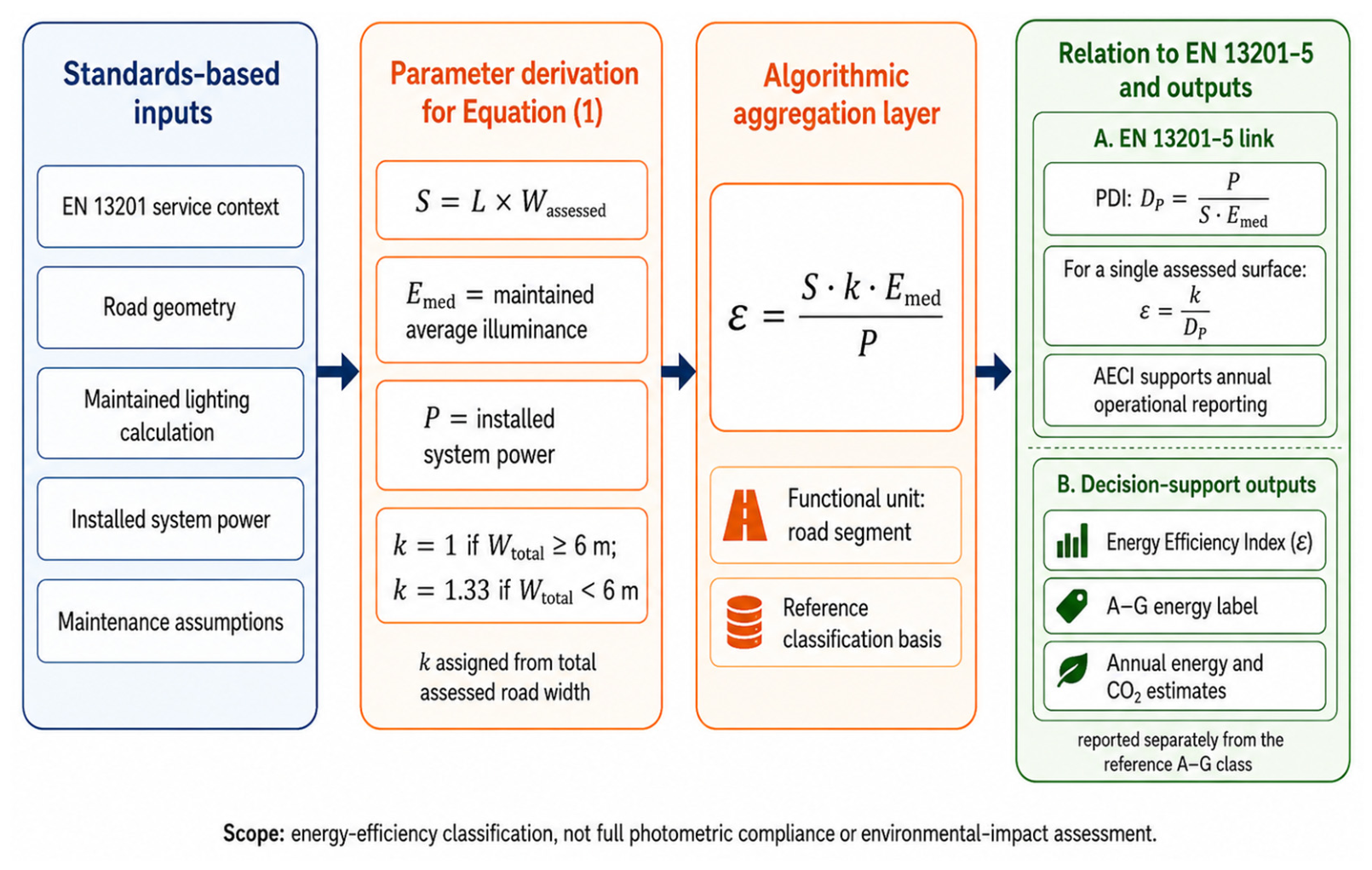
Figure 1 summarises the methodological structure of the proposed framework by linking standards-based input data to the parameters of Equation (1), the algorithmic aggregation layer, the relationship with EN 13201-5 energy-performance indicators, and the resulting classification and reporting outputs. The figure explicitly indicates how the assessed surface area
S, the maintained average illuminance
Emed, the installed system power
P, and the geometric correction factor
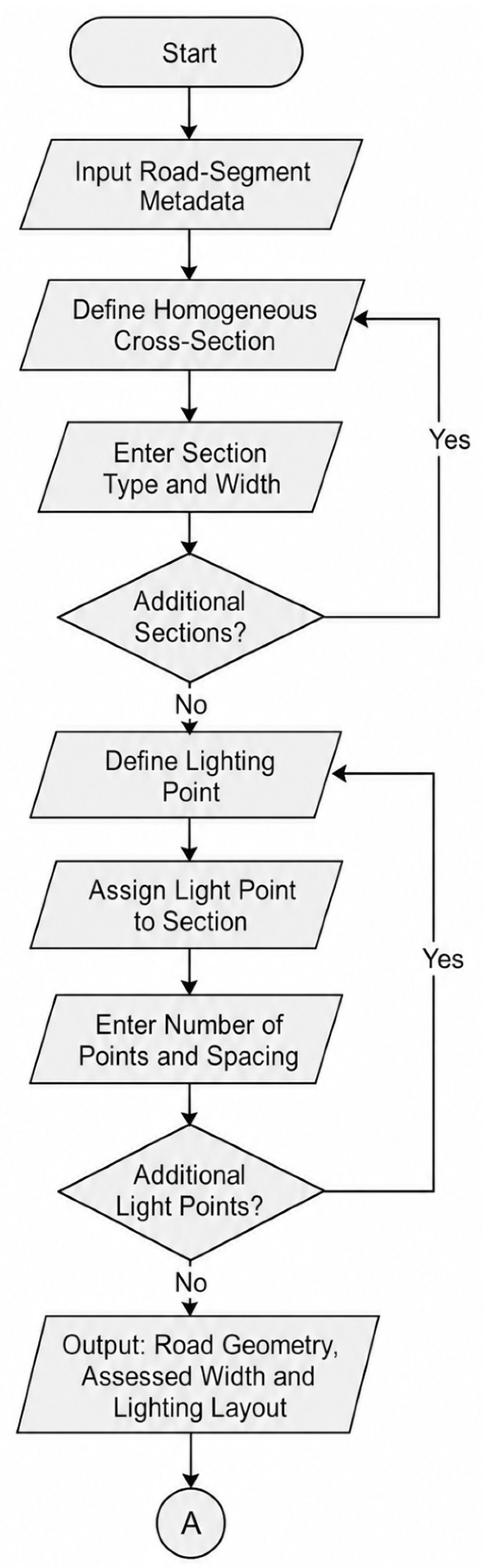
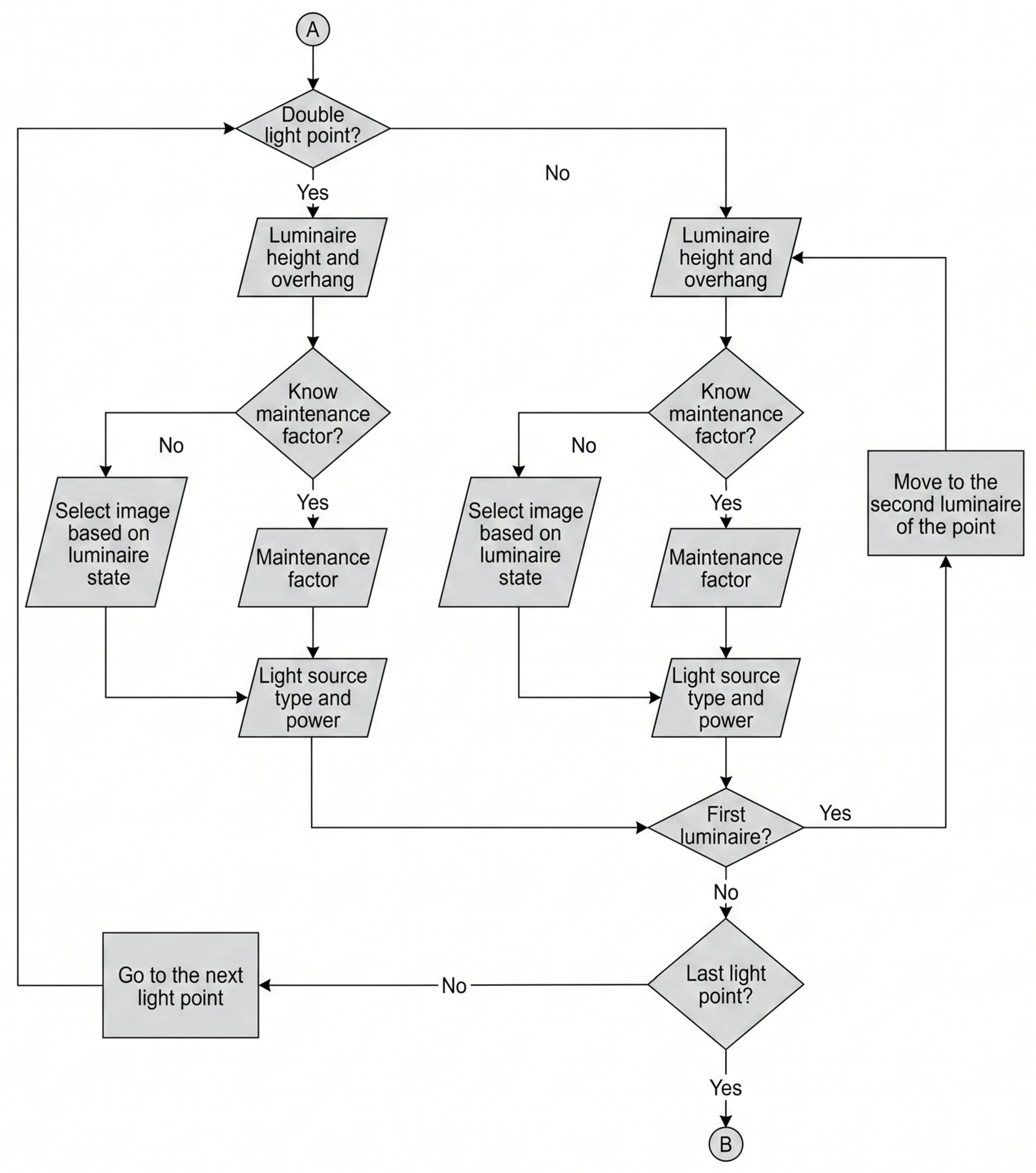
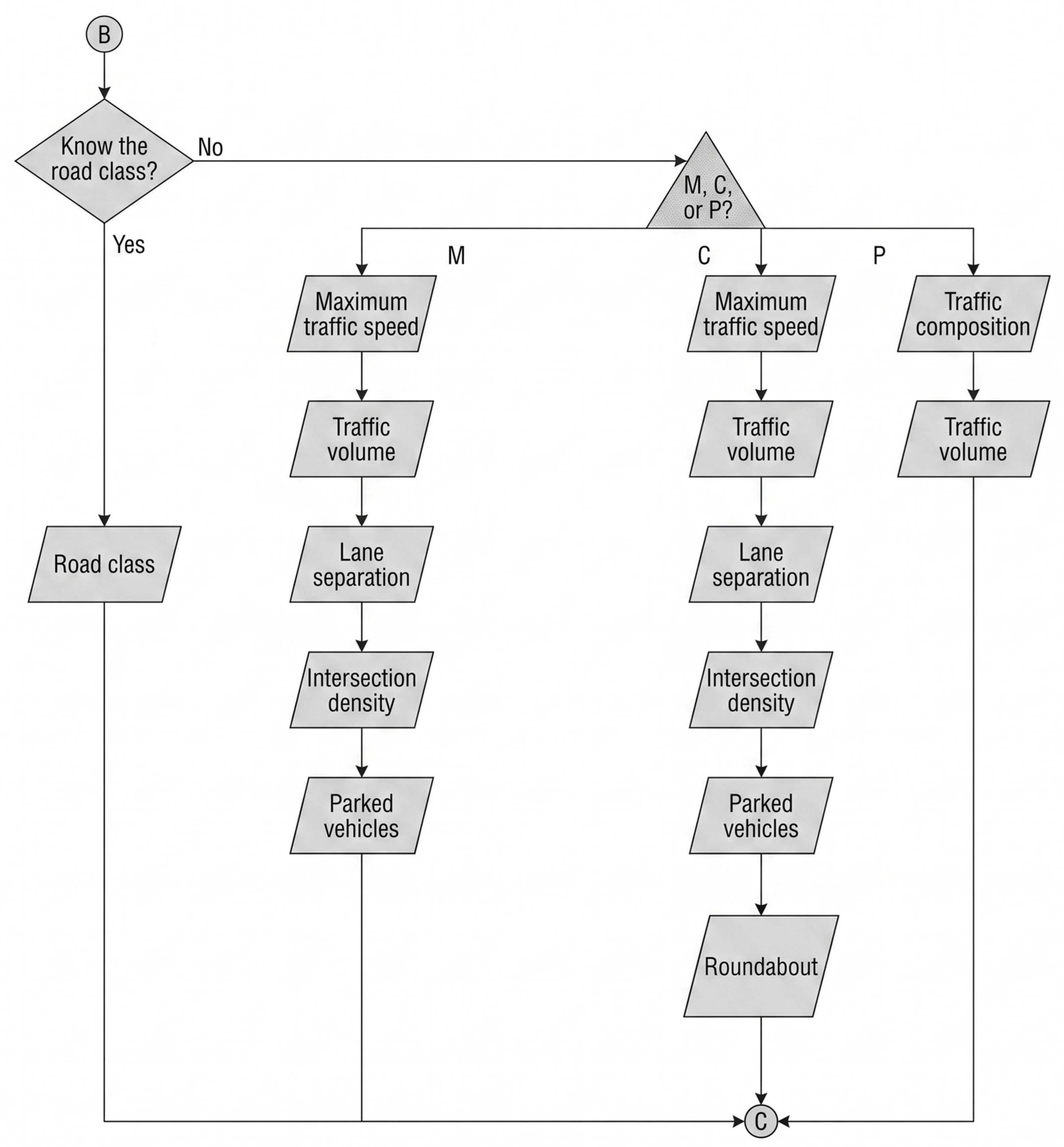
k are derived or assigned within the proposed procedure. For transparency and reproducibility, the full operational workflow implemented in the Public Lighting Consumption Management System (SGCIP) environment is provided in
Appendix A.
This structure clarifies that the proposed index does not replace EN 13201-5 indicators but translates their system-level energy-performance logic into a label-oriented classification layer.
Operationally, the framework processes each homogeneous road segment through a structured sequence of steps. These include characterising the road geometry and installation layout, identifying the applicable service context, defining or calculating maintained lighting performance, incorporating a geometric correction factor, and aggregating installed electrical power. These variables are then combined to compute a single road-segment-level Energy Efficiency Index , which forms the basis for the final classification.
The Energy Efficiency Index (ε) is defined as a service-normalised energy-performance indicator. Its rationale is based on comparing the maintained lighting service provided over a defined road-segment surface with the installed electrical power required to deliver that service. The term S × Emed combines the assessed surface area S and the maintained average illuminance Emed. Since 1 lx = 1 lm/m2, S × Emed is dimensionally equivalent to the maintained luminous flux incident on the assessed target surface. Dividing this term by P expresses the maintained target-surface lighting service delivered per unit of installed system power.
The use of an inverse power-density formulation is intentional. For a single assessed surface, the Power Density Indicator may be expressed as DP = P/(S × Emed). When k = 1, the proposed Energy Efficiency Index follows the reciprocal logic of this indicator, so that ε = 1/DP. When the geometric correction factor is applied, the relationship becomes ε = k/DP. The resulting index is, therefore, a label-oriented, geometrically corrected inverse power-density formulation, designed to express higher energy performance through higher ε values.
Building on this rationale, the framework calculates the Energy Efficiency Index (
ε) for each homogeneous road segment according to Equation (1), where
S represents the assessed surface area of the road segment,
k is the geometric correction factor,
Emed denotes the maintained average illuminance achieved on the assessed surface, and
P corresponds to the total installed system power, including luminaires and auxiliary or control gear losses:
The variables included in Equation (1) are directly linked to the normative and operational logic of the framework. The reference surface area
derives from the declared road-segment geometry, while the maintained lighting level (
) reflects the photometric performance of the installation under maintained conditions, in line with the calculation logic of EN 13201-3 [
22]. The total installed power (
) represents the active installed power of the road segment as a whole system, rather than that of isolated luminaires.
The assessed surface area S is defined as the area of the road-segment surface or surfaces included in the classification. In the simplest case, S = L × Wassessed, where L is the representative segment length, and Wassessed is the total assessed width. Where the road segment is divided into homogeneous transverse sections, S is obtained by summing the corresponding section areas. The included surfaces must be explicitly declared in the assessment and may include the carriageway and, where relevant, other road-corridor elements such as sidewalks, medians, parking bays, or cycle lanes. Surfaces not included in the declared assessment scope are not represented in S and should not be inferred from the resulting label.
The use of Emed in Equation (1) does not replace luminance-based compliance assessment for M lighting classes. For those classes, luminance remains the governing normative design criterion. A luminance-based formulation was not adopted because Lmed is not the governing quantity for all road-lighting classes and depends on road-surface reflection characteristics and observer geometry. Using Emed provides a common energy-oriented normalisation variable across M-, C-, and P-class contexts, while luminance-based compliance for M-classes remains assessed separately through Lmed, U0, Ul, fTI, and EIR. Therefore, the Energy Efficiency Index should be interpreted as an energy-performance classification indicator, not as a substitute for photometric compliance verification.
The geometric correction factor k is assigned according to the total assessed road width, following the SGCIP methodology. It is not calculated as a continuous function of road geometry. The admissible values of k are limited to k = 1 and k = 1.33. The value k = 1 is assigned when the total assessed road width is equal to or greater than 6 m, while k = 1.33 is assigned when the total assessed road width is below 6 m. The inclusion of k does not replace or duplicate the area term S. Rather, S represents the physical assessed surface area, while k is a discrete width-based correction factor used to improve comparability for narrow road segments within the proposed label-oriented classification framework. In this way, the formulation preserves the physical rationale of inverse power-density-type indicators while explicitly embedding the road segment as the functional unit of energy assessment.
The distinction between S and k is methodological. S represents the physical assessed area and scales continuously with the declared geometry. By contrast, k is a discrete correction factor assigned only according to the total assessed road width. It is not recalculated from S and does not represent an additional area term. Therefore, the formulation does not intentionally double count road geometry: S defines the spatial extent of the assessed lighting service, while k applies a fixed correction for narrow road segments within the SGCIP methodology.
The Energy Efficiency Index (
ε) is conceptually aligned with the energy-performance logic of EN 13201-5, but it has a different purpose from the Power Density Indicator (PDI) and the Annual Energy Consumption Indicator (AECI). PDI expresses the installed power required to deliver a maintained lighting level over a defined area, while AECI expresses the annual energy consumed per unit area under specified operating periods. By contrast,
ε is used in the proposed framework as a label-oriented classification indicator: it converts the relationship between lit surface, maintained lighting service and installed power into an increasing efficiency scale suitable for A to G classification.
Table 1 summarises the main similarities and differences between the three indicators.
In the simplified case of a single assessed surface, PDI may be expressed as Equation (2). Under this condition, and when
k = 1, the Energy Efficiency Index follows the reciprocal logic of PDI: Equation (3). More generally, because the SGCIP methodology includes the geometric correction factor
k, the relationship becomes Equation (4). The proposed index can, therefore, be interpreted as a geometrically corrected inverse power-density formulation. This inversion is intentional because higher
ε values correspond to better energy performance and can be directly mapped to the A to G label scale.
The geometric correction factor does not duplicate the influence of road geometry already represented by the illuminated surface area S. The variable S represents the physical area included in the calculation, whereas k is a discrete, rule-based correction factor defined in the SGCIP methodology to improve comparability for narrow road segments. It is quantified solely according to the total assessed road width: k = 1 for total road widths equal to or greater than 6 m, and k = 1.33 for total road widths below 6 m. Therefore, k is not a continuous geometric descriptor and is not recalculated from the assessed area, carriageway width, number of lanes or luminaire spacing.
Because
ε is directly proportional to
k, the influence of this correction factor on the final classification is linear and transparent. For the same values of
S,
Emed, and
P, a road segment with a total width below 6 m obtains an
ε value 33% higher than it would under
k = 1. This correction may affect the assigned A to G class only when the corrected
ε crosses one of the fixed classification thresholds shown in
Table 2. In the comparative simulations presented in
Section 4.2, the total assessed width is 12 m and, therefore,
k = 1, meaning that the geometric correction factor does not influence the difference observed between the high-pressure sodium (SON-T) and LED scenarios.
AECI remains complementary to ε rather than embedded in it. Because AECI depends on annual operating hours, switching schedules, dimming profiles and other temporal operating assumptions, it is used in this framework for annual electricity consumption and CO2 emission estimates. These annual operational indicators are reported separately and do not modify the reference ε value or the corresponding A to G energy class.
The use of maintained average illuminance (Emed) as a unified normalising variable is a core methodological choice of the proposed framework and requires particular caution in the case of M-classes. Under EN 13201-2, M-classes are governed by road-surface luminance criteria for the carriageway, including maintained average luminance, overall uniformity, longitudinal uniformity, disability glare, and edge illuminance ratio, whereas C- and P-classes are primarily based on illuminance criteria. Therefore, the use of Emed in ε should not be interpreted as a reformulation of M-class compliance requirements. Rather, it provides a common energy-oriented normalisation variable that enables road-segment-level classification across different lighting contexts.
For M-class roads, the resulting A to G class should, therefore, be read as an energy-efficiency characterisation of the installed system under the declared reference lighting class, not as evidence of luminance-based compliance. Where compliance confirmation is required,
ε should be interpreted alongside the relevant photometric parameters, including
Lmed,
U0,
Ul,
fTI, and
EIR, as illustrated in the comparative simulation presented in
Section 4.2. This distinction is central to the methodological scope of the proposed label and prevents the energy classification from being confused with a full lighting-quality assessment.
Consequently, the A to G label should be accompanied by an explicit scope statement in technical or public-facing outputs. The label represents the energy efficiency of the declared target surface under the reference lighting service condition. It should not be interpreted as evidence of full-space lighting quality, pedestrian-area adequacy, luminance-based compliance, or environmental and ecological performance, including skyglow, light trespass, and ecological disturbance.
A methodological distinction is, therefore, made between the reference classification indicator and annual operational energy indicators. The Energy Efficiency Index (ε) is calculated for the road segment under the declared reference lighting class and corresponding photometric service level. It is not recalculated based on temporal dimming profiles, switching schedules or lower night-time lighting classes. Accordingly, the framework does not calculate a time-weighted or dimming-adjusted ε. Where adaptive operation is technically justified, it is treated as a separate operational strategy that affects annual electricity consumption and associated CO2 emissions, rather than as a mechanism to improve the reference A to G label. If a lower night-time lighting class is adopted as a new reference condition, the road segment should be reassessed as a separate classification case with its own photometric requirements and input configuration.
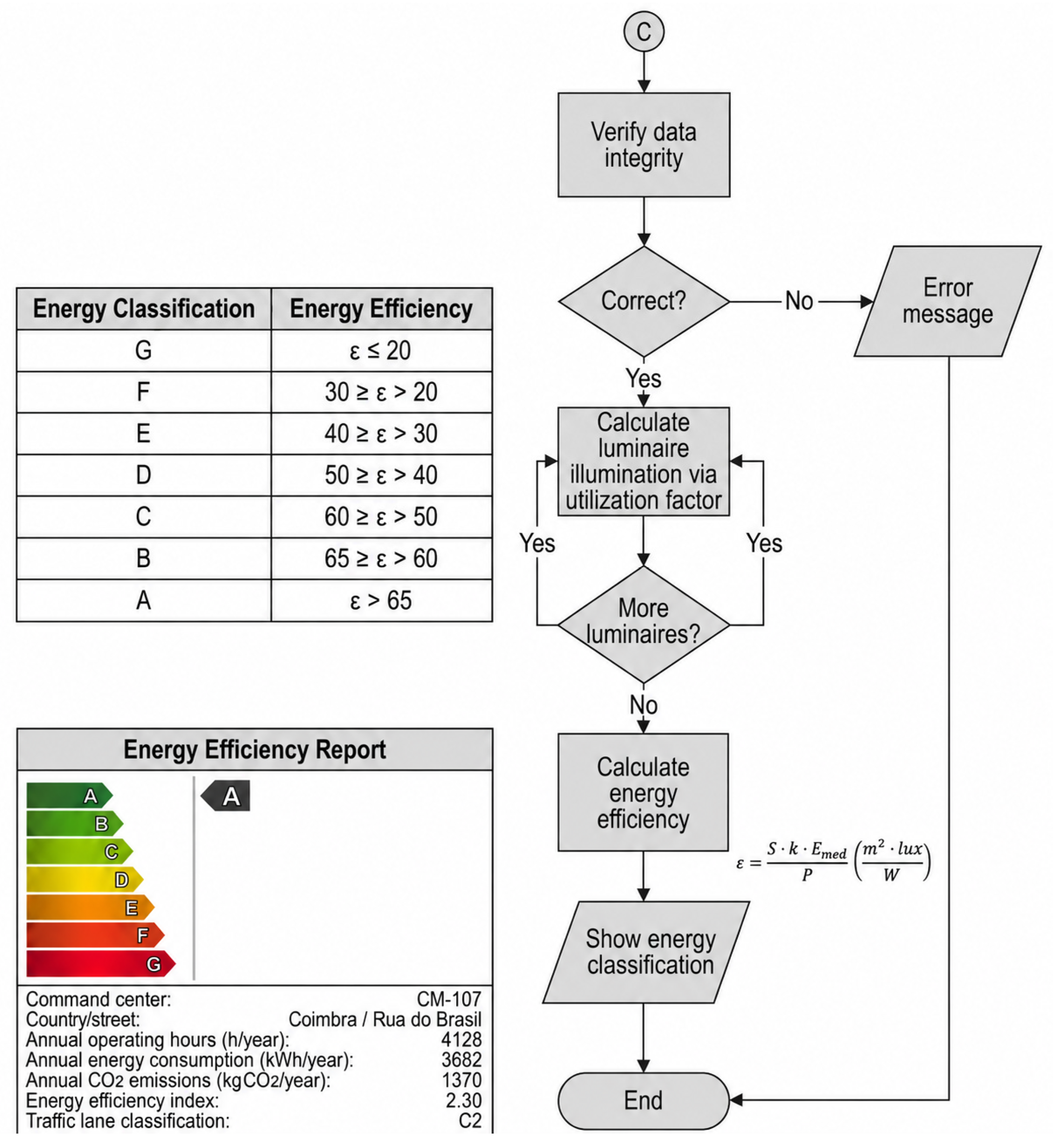
Although the classification logic is summarised conceptually in
Figure 1, its implementation follows a more detailed operational workflow, including sequential steps for data validation, road geometry definition, luminaire configuration, road-class determination, and efficiency calculation, as documented in
Appendix A.
Within the broader Public Lighting Consumption Management System (SGCIP) ecosystem, the same underlying efficiency formulation may also be used in design-oriented applications that incorporate compliance verification. In the context of this study, however, the framework is applied exclusively as a diagnostic and characterisation tool for existing installations under declared geometric and operational conditions. As such, a road segment may receive an energy classification even if minimum photometric requirements are not fully satisfied, since the objective is not to issue a formal judgement of normative compliance, but rather to provide an interpretable energy-oriented characterisation of installed infrastructure.
As European standards do not define a harmonised A to G energy-labelling scheme for road segments, the thresholds used in this framework should not be interpreted as normative limits established by the EN 13201 series. Instead, they are fixed thresholds formally documented in the SGCIP methodology for classifying the energy efficiency of public lighting installations. This methodology operationalises the Portuguese Reference Document for Energy Efficiency in Public Lighting (DREEIP) reference framework, which provides guidance for energy-efficient public lighting and identifies relevant energy-performance indicators, including power density, annual energy consumption, installation lighting factor, utilisation factor, and an energy efficiency index.
Within the SGCIP methodology, the Energy Efficiency Index is calculated as
ε =
S ×
k ×
Emed/
P, where
S is the illuminated surface area,
Emed is the maintained average illuminance,
P is the installed active power including luminaires and auxiliary equipment, and
k is a geometric correction factor. The correction factor is explicitly defined as
k = 1 for total road widths equal to or greater than 6 m and
k = 1.33 for total road widths below 6 m. The resulting
ε value is then mapped to the fixed A to G thresholds shown in
Table 2.
These thresholds were not derived from the statistical distribution of the pilot dataset and should not be interpreted as percentile-based cut-off points. They also do not result from a new statistical calibration or cost–benefit optimisation performed in this study. Rather, they are used as fixed technical benchmark thresholds documented in the SGCIP methodology and framed by the Portuguese DREEIP reference framework. Accordingly, they should not be treated as universally applicable limits without technical review. Their use as fixed thresholds is intended to preserve comparability across municipalities and over time within the Portuguese SGCIP context. At the same time, their transfer to other European or non-European jurisdictions would require technical review and possible recalibration to reflect local lighting standards, road typologies, design practices, available technologies, maintenance assumptions and governance objectives.
In this way, complex technical calculations are translated into a communicable format suitable for reporting, prioritisation, and stakeholder engagement, while preserving traceability to the underlying methodological logic.
To facilitate large-scale deployment, the proposed methodology was operationalised within the broader SGCIP digital ecosystem, developed in Portugal under the 7th edition of the Energy Consumption Efficiency Promotion Plan (PPEC), promoted by the national electricity regulator, ERSE [
43]. The SGCIP ecosystem was designed to support the management of public lighting energy consumption and the classification of road-segment-level energy performance based on a dedicated calculation methodology aligned with the applicable normative framework.
In practical terms, it comprises two complementary tools: an online application that allows municipalities to characterise road segments and obtain a standardised energy classification for existing installations [
44], and a desktop software environment that supports lighting design, refurbishment studies, and new project development aimed at improving energy performance under defined road and lighting conditions [
45]. This study focuses exclusively on the online classification module, which functions as a diagnostic and governance-oriented tool. The digital infrastructure guarantees standardisation, reproducibility, and methodological integrity, without altering the core conceptual framework.
4. Case Illustration: The SGCIP Approach (Portugal)
4.1. Digital Implementation of the Classification Platform
The purpose of this subsection is to document the operational implementation of the proposed methodology in the SGCIP platform.
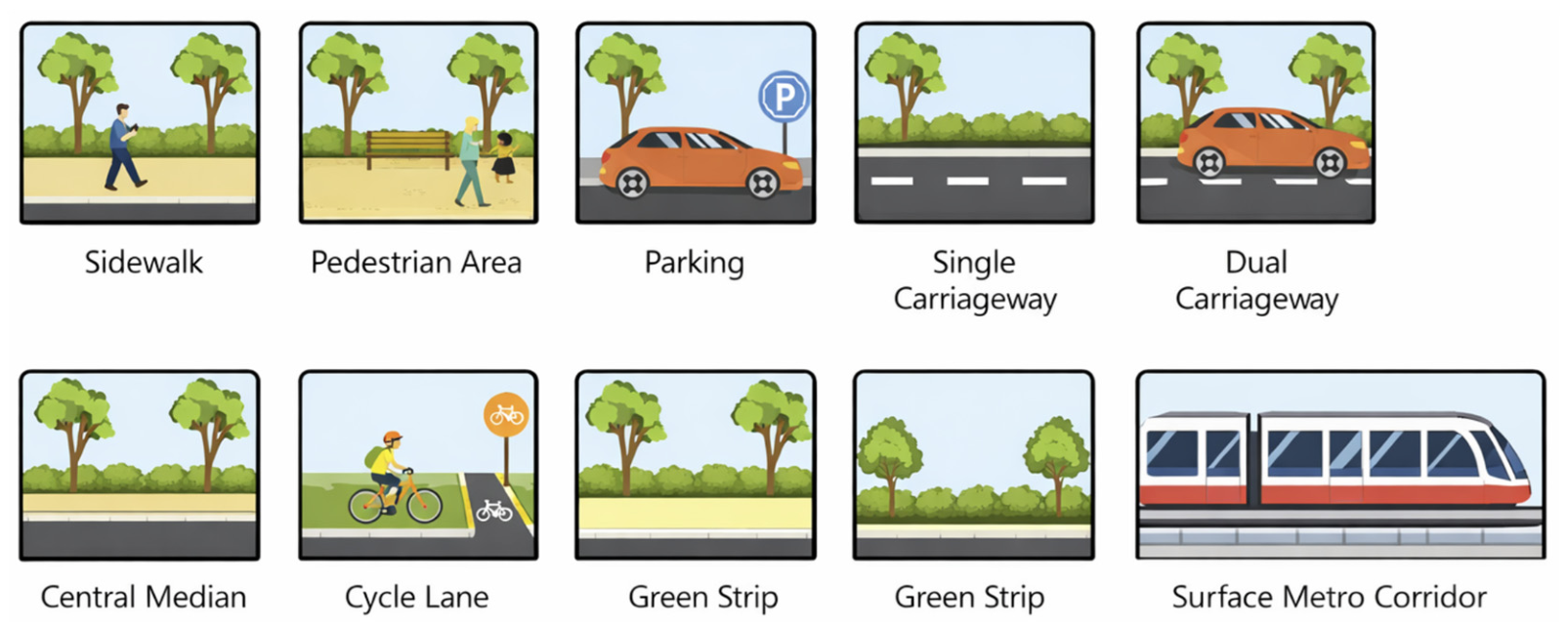
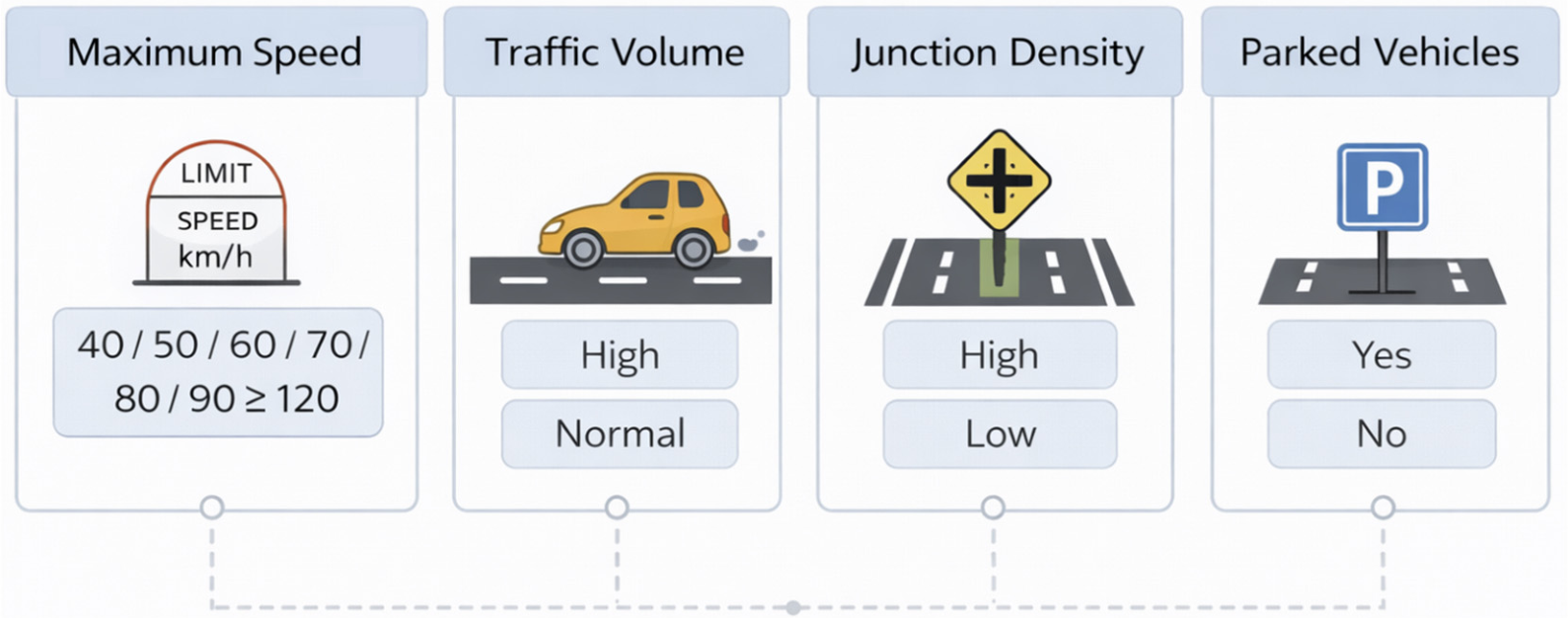
Figure 2,
Figure 3 and
Figure 4 are, therefore, not intended to constitute additional methodological contributions, but to illustrate how the input data required by the computational framework are collected and structured in the application. The formal relationship between input parameters and the model variables
S,
k,
Emed, and
P is provided in
Figure 1.
The Portuguese SGCIP platform serves as a case illustration of the proposed methodological framework. Its role is to demonstrate how the road-segment classification logic can be operationalised in a real municipal context through standardised inputs, reproducible calculations and comparable outputs. The emphasis is, therefore, placed on the methodological applicability and interpretability of the framework, rather than on the software platform as a standalone technical product.
Following the development of the algorithmic framework described in the previous section, the proposed method was deployed through the SGCIP online classification module to support road-segment energy assessment at the municipal level. The aim of this implementation was not to introduce an alternative lighting design tool, but to enable systematic characterisation of the energy performance of existing public lighting installations under standardised conditions.
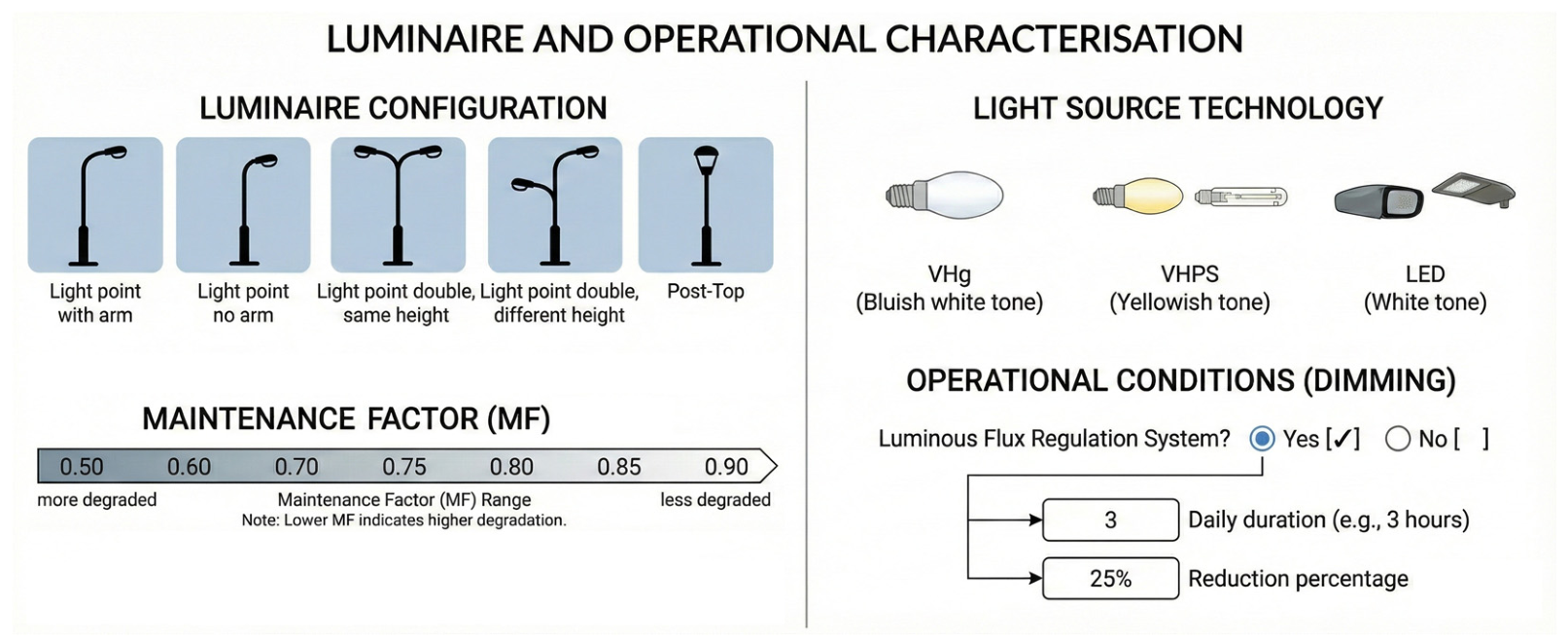
The digital environment was designed to maintain methodological consistency while ensuring ease of use for municipal technicians. Users are expected to characterise the road-segment geometry (
Figure 2), identify the applicable lighting class and the corresponding normative service context (
Figure 3), and define the installed luminaires, maintenance assumptions and operational conditions (
Figure 4). Taken together, these three input layers provide the spatial, normative, and operational basis required for the internal computation of the Energy Efficiency Index (
ε) and the resulting energy label. Rather than being treated as isolated descriptive fields, these inputs are processed as structured variables within the platform’s internal calculation sequence. In practical terms, the geometric configuration of the road segment determines the reference surface area and influences the geometric correction factor used in the efficiency formulation, while the selected lighting class establishes the normative service context of the segment. The luminaire configuration, installed power, maintenance factor, and photometric assumptions are then combined to estimate the maintained lighting delivered to the assessed surface under the declared reference lighting class. Based on this integrated reference calculation logic, the platform computes the Energy Efficiency Index (
ε) defined in Equation (1) and automatically assigns the corresponding A to G energy class according to the fixed thresholds presented in
Table 2. Operating schedules and dimming profiles, where declared, are treated separately for annual energy consumption and CO
2 emission estimates and do not alter the reference energy class.
The digital implementation mainly functions as a standardisation tool. In practical terms, this is achieved by embedding the methodological sequence directly into the user workflow: the platform requires users to define the road-segment geometry, applicable road class, luminaire arrangement, maintenance assumptions, and operating conditions through a predefined sequence of structured inputs. These inputs are then subjected to internal validation checks before the platform applies the calculation logic associated with the classification framework. Data-input quality control in the SGCIP implementation combines platform-based safeguards with technical responsibility from municipal users. The platform reduces manual input errors by requiring the characterisation of road geometry, lighting class, luminaire configuration, maintenance assumptions, and operating conditions through structured fields and a predefined workflow. It also includes basic plausibility safeguards intended to prevent the submission of manifestly inconsistent values, such as unrealistically high or low road widths, spacing values, installed power values, or operating assumptions. However, the platform does not replace technical verification by municipal staff. The reliability of the classification depends on the quality of the underlying inventory and on the ability of municipal technicians to confirm, update, or field-check the data used for each road segment. This reduces interpretive variability by ensuring that road segments are assessed under a consistent procedural logic rather than through ad hoc assumptions or isolated product specifications. In this way, the platform prevents efficiency claims based solely on nominal luminaire characteristics and instead anchors the resulting classification in a system-level representation of the installed road-lighting configuration.
It is important to emphasise that the classification module operates in diagnostic mode. Its purpose is to characterise the energy performance of installed road segments as they currently are, rather than to validate compliance or optimise design parameters. This distinction enables municipalities to evaluate both legacy infrastructure and recently renovated segments using a consistent methodological framework, even if photometric requirements are not fully met. The platform thus functions as a transparency and governance tool rather than as an enforcement or certification mechanism.
4.2. Comparative Simulation Under Identical Road and Normative Conditions
To further examine the discriminatory capacity of the proposed Energy Efficiency Index (ε), two lighting configurations were simulated under identical geometric and normative conditions using the SGCIP platform. The objective was not to optimise a specific lighting design or to provide an exhaustive robustness validation across all road-lighting classes, but to evaluate how the classification logic performs when comparing a common technological transition in municipal lighting infrastructure on the same road segment. The M4 scenario was, therefore, selected as a controlled illustrative case, allowing the effect of the SON-T to LED transition to be assessed while keeping the road geometry, reference lighting class and operating assumptions constant.
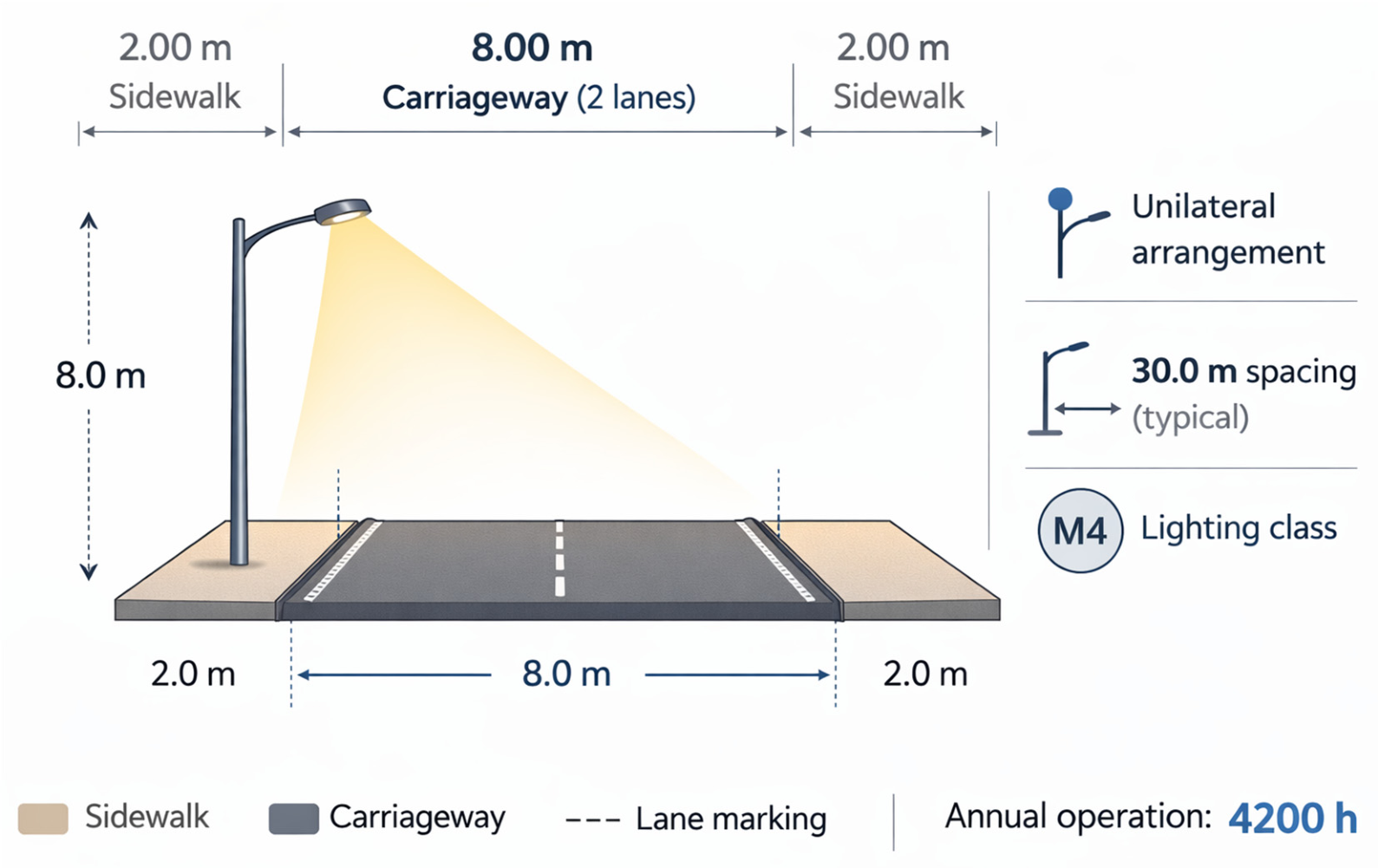
All scenarios were modelled on a typical urban cross-section comprising an 8 m carriageway with two traffic lanes and a 2 m sidewalk on each side. The layout features a unilateral arrangement with 19 luminaires mounted at a height of 8 m and an interdistance of 30 m. The target lighting class was set to M4, corresponding to a medium-luminance category for motorised traffic roads under the EN 13201 framework, which requires specified thresholds for maintained average luminance, uniformity, and glare control. An annual operating time of 4200 h was assumed, representing typical full-night operation in Portuguese municipal networks. The geometric and installation parameters adopted in the simulation are illustrated in
Figure 5.
Figure 5 should be interpreted as a controlled geometric reference for the comparative simulation. It does not represent the photometric distribution of the luminaires or the luminance distribution on the road surface; the main luminaire and optical input data used in the simulation are reported separately in
Table 3.
The photometric and energy calculations for the comparative simulation were carried out using the SGCIP tool, the desktop implementation of the SGCIP calculation environment. The purpose of the simulation was not to optimise the luminaire arrangement or to compare commercial products, but to apply the same road geometry, lighting class, operating assumptions, and classification procedure to two representative technological configurations. To improve transparency and reproducibility,
Table 3 summarises the main luminaire and optical input data used in the SON-T and LED scenarios.
The comparison, therefore, reflects not only a reduction in installed power, but also differences in luminous flux, maintenance assumptions and photometric distribution. In particular, the higher utilisation factor of the LED configuration indicates that a greater proportion of the emitted luminous flux is directed towards the assessed surface, contributing to the improved energy classification under the same road geometry and lighting class.
The comparative simulation was designed as a controlled case illustration rather than as a comprehensive optimisation study. The road geometry, mounting height, pole spacing, and luminaire arrangement were intentionally kept constant in both scenarios to isolate the effect of replacing a conventional SON-T configuration with an LED configuration under identical geometric and normative conditions. Therefore, the comparison should not be interpreted as an assessment of all possible modernisation strategies, nor as a sensitivity analysis of the influence of spacing, mounting height or luminaire arrangement on the Energy Efficiency Index.
To estimate associated greenhouse gas emissions, the Portuguese specific emission factor of 0.2 kg CO2/kWh was used.
The initial scenario presents a legacy installation utilising high-pressure sodium (SON-T) technology. The simulated luminaires operate at a system power of 165.0 W (nominally 150 W) and provide a luminaire luminous flux of 12,452 lm, with a maintenance factor of 0.60. Their photometric distribution is classified as full cut-off, with short reach, narrow spread, and tight control. To mirror typical operational conditions of ageing infrastructure, characterised by lamp lumen depreciation, magnetic ballast inefficiencies, and dirt accumulation, a maintenance factor of 0.60 was applied.
Under these conditions, the installation consumes approximately 9493 kWh per year and emits 1899 kg of CO2 annually.
Photometrically, the system shows a utilisation factor (fu) of 0.44 and maintains an average luminance (Lmed) of 0.74 cd/m2. This value narrowly falls short of the ≥0.75 cd/m2 requirement for class M4, indicating slight non-compliance under maintained conditions.
The resulting Energy Efficiency Index is ε = 26.9 m2 lx/W, corresponding to Energy Class F.
The second scenario illustrates a typical modernisation process, replacing SON-T luminaires with LED technology in accordance with standard utility replacement ratios (i.e., replacing 150 W sodium lamps with about 50 W LED systems). The chosen LED luminaires operate at a system power of 51.2 W and provide a luminaire luminous flux of 7335 lm, with a maintenance factor of 0.85. Their photometric distribution is classified as cut-off, with intermediate reach, narrow spread, and moderate control. With improved lumen maintenance and optical stability, a maintenance factor of 0.85 was used. Under the operating assumptions used in SGCIP simulation, annual energy consumption drops to 3869 kWh/year, with corresponding CO2 emissions of 774 kg/year, using an emission factor of 0.2 kg CO2/kWh.
The LED setup fully meets the M4 photometric standards, achieving Lmed = 0.81 cd/m2. The utilisation factor rises to 0.67, indicating better optical control and a higher proportion of emitted flux reaching the target carriageway. These enhancements result in an Energy Efficiency Index of ε = 82.2 m2 lx/W, thereby categorising the installation as Energy Class A. Because both the SON-T and LED scenarios are assessed under identical geometric and normative conditions, this comparison reflects a direct technological efficiency improvement while maintaining the same lighting service level.
The main system-level performance indicators for the two directly comparable configurations, both evaluated under identical geometric conditions and the same lighting class (M4), are summarised in
Table 4.
The purpose of this comparison is not to demonstrate the general superiority of LED technology over SON-T systems, which is already well established in contemporary public-lighting practice. Rather, the case illustrates how the proposed classification framework processes two technological configurations under identical geometric and normative conditions and translates the resulting energy-performance differences into an A to G label. The example should, therefore, be interpreted as a controlled demonstration of the classification workflow, not as a comprehensive test of the discriminatory capacity of ε among contemporary LED-based solutions.
To strengthen the analytical traceability of the proposed classification procedure, the Energy Efficiency Index (ε) was verified using the direct outputs of the two simulated configurations. For both scenarios, the representative calculation module corresponds to a 30 m road segment with a total assessed width of 12 m, including the 8 m carriageway and two 2 m sidewalks, resulting in a reference area of 360 m2. In the LED configuration, the maintained average illuminance used for energy classification was 11.69 lx, and the system power associated with the representative module was 51.2 W, resulting in ε = (360 × 11.69)/51.2 = 82.2 m2 lx/W. In the SON-T configuration, the corresponding values were 12.33 lx and 165.0 W, resulting in ε = (360 × 12.33)/165.0 = 26.9 m2 lx/W. These calculations reproduce the values generated by the SGCIP platform and confirm the internal mathematical consistency of the classification output.
Because the reference simulation concerns an M-class road, an additional quantitative check was performed to illustrate the potential divergence between illuminance-based energy normalisation and luminance-based compliance interpretation. In the SON-T configuration, the maintained average illuminance used for energy classification was 12.33 lx, while the maintained average luminance on the carriageway was 0.74 cd/m2. In the LED configuration, the corresponding values were 11.69 lx and 0.81 cd/m2. Thus, although Emed decreases by 5.2% from the SON-T to the LED scenario, Lmed increases by 9.5%, and the LED configuration meets the M4 luminance requirement while the SON-T configuration remains slightly below it. The ratio between Emed and Lmed also changes from 16.7 to 14.4 lx/(cd/m2), corresponding to a 13.4% decrease.
The results in
Table 5 show that, for M-class roads, maintained average illuminance and maintained average luminance may evolve differently when the lighting technology and photometric distribution change. Therefore, the potential bias introduced by using
Emed as a unified normalising variable is not a fixed numerical error, but a configuration-dependent interpretive risk. It depends on luminaire photometry, road-surface reflection properties, geometry, and observer-related luminance calculation conditions. For this reason, the proposed A to G label should be interpreted as an energy-efficiency classification under the declared reference service condition, while M-class compliance must continue to be assessed using luminance-based parameters such as
Lmed,
U0,
Ul,
fTI, and
EIR.
Beyond overall energy reductions, the simulations show notable differences in photometric performance. The transition from SON-T to LED technology enhances carriageway lighting quality, with overall uniformity (U0) rising from 0.43 to 0.46 and longitudinal uniformity (Ul) improving from 0.70 to 0.84, both exceeding the normative thresholds for class M4. Glare (fTI) remains within prescribed limits in both scenarios.
However, the improved optical precision of LED systems decreases peripheral spill light beyond the primary target surface. For the sidewalk opposite the luminaires (classified as P3, requiring Emed ≥ 7.50 lx), both the legacy and LED configurations achieved slightly lower maintained illuminance values than the normative setpoint. This observation confirms that the proposed classification framework evaluates energy efficiency relative to the declared assessed surface and does not replace a comprehensive multi-surface compliance assessment.
In addition to technology-driven upgrades, further energy savings may be achieved through operational strategies such as adaptive lighting control. Under EN 13201-1, temporal changes in traffic volume, weather conditions, or other relevant parameters may justify the use of lower lighting levels during specific periods, provided that the quality requirements of the applicable lighting class are still met. In the proposed framework, however, such adaptive operation is not used to assign the reference A to the G energy class. The label remains based on the reference lighting class and corresponding photometric service level. Adaptive dimming is, therefore, reported only through annual energy consumption and CO2 emission estimates, not as a separate classification case. Because the lighting service level changes over time, adaptive lighting configurations are not treated as strictly equivalent to installations operating under a constant lighting class, but rather as operational optimisation strategies that can complement efficient lighting system design.
Overall, the results demonstrate that the proposed classification framework clearly distinguishes between legacy and modern lighting technologies when evaluated under identical service conditions. The substantial improvement in the Energy Efficiency Index observed in the LED scenario highlights the capacity of technology-based upgrades to reduce electricity consumption while maintaining compliance with lighting standards. More broadly, the ability to translate complex technical performance into a clear and comparable indicator supports more informed municipal decision-making when prioritising public lighting upgrades.
4.3. Pilot Phase and Institutional Adoption
The methodology was initially tested through a voluntary pilot phase involving 21 Portuguese municipalities. By February 2026, adoption had expanded to 103 municipalities, including all those that had participated in the pilot phase. During this early implementation stage, the platform generated 127 road-segment classifications, while two additional records were subsequently cancelled. These figures should not be interpreted as a statistically representative national sample, but rather as evidence of operational feasibility, early user engagement, and institutional acceptance of the proposed framework.
Participation reflected municipal interest in obtaining structured, communicable indicators for public lighting management. Municipal technicians used the platform to characterise representative road segments, typically selected for lighting audits, refurbishment programmes, or exploratory efficiency assessments.
The road segments classified during the pilot and early adoption stages covered a broad spectrum of urban typologies, including historic narrow streets, residential neighbourhood roads, and multi-lane arterial corridors. This diversity helped test the operational applicability of the framework across different geometries and lighting configurations. However, this initial implementation was not designed to produce statistically representative national benchmarking results. Its primary purpose was to assess operational usability, methodological consistency, and institutional uptake under real municipal conditions.
For this reason, the pilot and early adoption data should not be interpreted as a systematic robustness test across M-, C-, and P-class roads, nor as a controlled comparison between urban and rural lighting contexts. The available classifications demonstrate that the workflow can be applied by municipalities to different road typologies, but they do not yet provide a balanced experimental matrix capable of quantifying the discriminatory behaviour of the label across all lighting classes and operating conditions.
An important feature of this early implementation stage was that municipalities mainly classified road segments that had recently undergone LED retrofitting. This is reflected in the aggregate class distribution observed in the dataset, in which 94% of classified segments were assigned to Class A, 2% to Class B, 1% to Class C, 2% to Class D, and 1% to Class E. The predominance of Class A results should, therefore, be interpreted in light of this self-selection bias and should not be extrapolated to the wider Portuguese public-lighting stock or used as evidence of the statistical distribution of energy classes at the national level. Rather, it reflects a strong early-use selection effect, since municipalities tended to prioritise recently upgraded, high-efficiency installations when first engaging with the platform.
The seven-class structure remains relevant as a common interpretative scale for heterogeneous public-lighting stocks, but its discriminatory performance among contemporary LED-based systems requires further testing with more diverse datasets.
This does not undermine the internal calculation logic of the framework, but it limits the interpretability of class frequencies and prevents extrapolation to national performance distributions. The current results should, therefore, be interpreted as evidence of feasibility, usability, and institutional uptake, rather than as a benchmarking exercise, a statistical validation of the A to G thresholds, or an assessment of the national public-lighting stock.
At the same time, the pilot and initial rollout helped clarify the main practical and methodological boundaries of the proposed framework, particularly regarding input data quality, interpretation of M-classes, geometric sensitivity, operational assumptions, and environmental scope. Although platform safeguards and municipal technical checks reduce input errors, they do not eliminate the uncertainty associated with input data. Outdated municipal inventories, incorrect luminaire specifications, unverified installed power values or simplified assumptions regarding maintenance conditions may still affect the calculated efficiency index. In the pilot and early adoption phase, municipalities worked with real installation data and, where necessary, checked or updated geometric and technical parameters before classification. Even so, classifications based on incomplete or uncertain data should be interpreted as preliminary diagnostic outputs rather than definitive assessments. Future development of the platform should include stronger data-quality flags, improved interoperability with municipal asset inventories and clearer traceability of the assumptions used in each classification record.
Furthermore, because the Energy Efficiency Index (ε) uses maintained average illuminance as a practical normalising variable across all road classes, its interpretation requires particular caution in the case of M-classes, for which luminance remains the governing normative criterion. The resulting classification should, therefore, be understood as an energy-oriented proxy of system performance, rather than as a direct representation of luminance-based compliance.
As with any simplifying geometric parameter, unusual or highly irregular configurations may affect the sensitivity of the resulting index. Further empirical calibration across a wider range of real-world road typologies could, therefore, help refine the behaviour of the geometric correction factor (k).
Annual energy estimates depend on declared dimming schedules and on the assumed relationship between dimming level and electrical power. This uncertainty affects annual energy and CO2 estimates only, not the Energy Efficiency Index (ε) or the reference A to G class. In simplified terms, if dimmed operation represents a share Sd of annual energy use and the power assigned to dimmed periods has a relative modelling error δd, the resulting relative error in annual energy consumption is approximately Sd × δd. For example, if dimmed operation accounts for 50% of annual energy use, a ±20% modelling error in dimmed-period power would translate into approximately ±10% uncertainty in annual energy and CO2 estimates. This reinforces the need to report dimming-based annual savings as operational estimates, while keeping the reference energy label independent from dimming profiles.
Finally, the framework intentionally separates energy performance from broader environmental externalities such as skyglow, light trespass, and ecological disturbance. Although these effects are environmentally relevant and increasingly important in sustainable lighting practice, they are not included in the current A to G classification scale. Consequently, the label should be interpreted primarily as an indicator of energetic efficiency rather than of overall lighting sustainability. Future methodological developments may, therefore, incorporate complementary environmental and ecological descriptors into a broader performance framework.
Overall, the pilot implementation and early institutional uptake confirm that the proposed framework is operationally feasible, scalable at the national level, and institutionally acceptable as a voluntary governance tool, while also clarifying the methodological boundaries within which its outputs should be interpreted.
5. Discussion
5.1. System-Level Performance Versus Component-Centric Assessment
Section 3 and
Section 4 show that the proposed framework should be interpreted as a classification and decision-support layer, rather than as a replacement for standards-based lighting assessment. Its practical relevance lies in using the road segment as the functional unit and in linking the declared lighting service condition with system-level installed power, maintained lighting performance and geometric assumptions.
The relationship between the proposed Energy Efficiency Index (
ε), the Power Density Indicator (PDI), and the Annual Energy Consumption Indicator (AECI) is summarised in
Table 1. This comparison is central to the interpretation of the proposed framework. PDI and AECI remain the established EN 13201-5 indicators for installation-level energy-performance assessment: PDI describes the installed power required to provide a maintained lighting service on the assessed surface, while AECI describes annual energy use per unit area under defined operating conditions. The proposed
ε indicator should, therefore, not be interpreted as replacing these indicators or as introducing a new photometric compliance metric.
The added value of ε lies in its interpretative and decision-support role. It reformulates the power-density logic in an increasing direction, incorporates the declared road-segment functional unit and the geometric correction factor, and maps the resulting value onto a fixed A to G classification scale. In this sense, ε provides additional practical information not by replacing PDI or AECI, but by converting technically robust installation-level energy-performance information into a communicable label for municipal comparison, procurement support, public reporting and governance. AECI remains complementary for annual energy and CO2 reporting, while ε provides the reference energy class associated with the declared lighting service condition.
The purpose of the SON-T versus LED comparison is not to demonstrate that LED technology is more efficient, a fact already extensively documented in the literature [
38,
46,
47], but to evaluate whether the proposed road-segment-level classification framework effectively captures system-level performance shifts under controlled normative conditions.
It is also important to recognise that visual perception in road environments depends not only on absolute light levels, but on the spatial distribution and uniformity of luminance. Uniform lighting conditions at moderate levels may provide better visual comfort and hazard detection than higher but poorly distributed illumination [
48,
49,
50]. In this sense, the improvements in uniformity observed in the LED scenarios reinforce that increased
ε does not result from reduced service quality, but from a more coherent distribution of light across the carriageway.
The comparison simulation in
Section 4.2 demonstrates this point. Under the same geometric constraints, the framework differentiates between a legacy SON-T setup and an LED retrofit not just by wattage reduction, but also by considering optical control and maintenance conditions. By explicitly reflecting the utilisation factor, the framework rewards systems that more effectively direct emitted flux to the target area. This illustrates why installation-level interpretation remains necessary: luminaires with similar luminous efficacy can produce different system-level results when photometric distribution and layout differ.
Operational optimisation, including adaptive dimming, remains relevant for municipal energy management, but it is not part of the reference classification algorithm. For example, traffic-dependent operation may justify a transition from M4 to M6 during late-night hours [
51], but this represents a different operational service condition rather than the reference M4 classification basis. If such a lower lighting class were used as a new classification scenario, the photometric requirements, luminous flux setting and potentially the optimised luminaire configuration would need to be reassessed accordingly. For this reason, adaptive operation is not recalculated as a new
ε-based label in the present framework. Instead, it is treated as an operational adjustment affecting annual electricity consumption and CO
2 emission estimates. This distinction prevents the A to G label from being improved by assumed dimming profiles that do not correspond to the declared reference lighting service level.
5.2. Institutional Adoption and Implications for Urban Governance
The voluntary participation of 103 Portuguese municipalities, corresponding to approximately one-third (33.4%) of all municipalities in Portugal [
52], in the SGCIP platform, indicates institutional demand for structured, communicable indicators for public lighting management. This governance relevance becomes even more evident in the context of the ongoing HPS phase-out, where the main challenge is no longer technological availability but municipalities’ capacity to plan and implement the transition in a timely and structured manner. This adoption shows that a key barrier for municipalities is not the absence of technical standards, but rather the lack of scalable mechanisms that convert normative calculations into operational workflows.
From a governance perspective, the standardisation enabled by a platform-based classification can be as important as the label itself. In large municipal networks, benchmarking across road segments and timeframes is often hampered by fragmented inventories, inconsistent calculation practices, and ad hoc reporting of retrofit programmes. By centralising calculation logic and applying fixed thresholds, the proposed framework supports consistent internal benchmarking, prioritisation of refurbishment where service-to-power ratios are poor, and clearer communication of progress.
In practical decision-making terms, the framework can support three complementary municipal application pathways. First, it can support renovation priority ranking by identifying road segments with low energy classes or low ε values under the declared reference service condition. These segments can then be selected for detailed technical review, especially where high installed power, poor utilisation of light on the target surface, or outdated technology indicate inefficient service delivery. The label should not be used as the only investment criterion, but it provides a transparent screening tool for prioritising refurbishment candidates within large municipal networks.
Second, the framework can support Green Public Procurement (GPP) [
31,
53,
54] by shifting tender specifications from product-only requirements towards installation-level performance expectations. For example, instead of specifying only minimum luminaire efficacy in lm/W, a municipality could require bidders to demonstrate the expected road-segment energy class,
ε, annual electricity consumption, and CO
2 emissions for representative road geometries and lighting classes. This would help ensure that procurement decisions reward system-level performance rather than isolated component efficiency.
Third, the framework can support retrofit monitoring and public reporting. Before-and-after classifications can be used to document whether refurbishment measures improve the energy performance of specific road segments while maintaining the declared lighting service. Annual energy and CO2 estimates can then be reported separately from the reference A to G class, allowing municipalities to communicate both structural efficiency improvements and operational savings from measures such as adaptive dimming.
These examples also show that hardware selection and control strategies should be treated as interconnected decisions. To harness the benefits of efficient technologies and adaptive lighting, municipalities need operational governance, including documentation of dimming schedules, monitoring practices, and capacity-building for technical staff.
5.3. Methodological Boundaries and Avenues for Future Research
To ensure scalability and ease of interpretation, a key methodological decision was to keep the A to G label energy centric. The label characterises energy performance relative to a declared target surface and reference lighting service basis; it does not constitute a holistic sustainability rating, a multi-surface compliance certificate, or evidence that all adjacent pedestrian areas are adequately illuminated. For this reason, public-facing communication of the label should explicitly state that the classification refers to energy efficiency within the defined assessment scope and does not represent full-space lighting quality or ecological impact.
The peripheral lighting trade-off observed in
Section 4.2 exemplifies this boundary. Directional LED optics can maximise carriageway efficiency while reducing spill light to adjacent sidewalks. Consequently, a high carriageway rating (e.g., Class A) does not necessarily imply adequate illumination of pedestrian areas, supporting the need for complementary, pedestrian-oriented strategies where peripheral compliance is required.
Moreover, the framework does not explicitly quantify environmental externalities (e.g., skyglow, light trespass, and ecological disturbance) [
55,
56,
57], nor does it provide a health-oriented appraisal of glare beyond the relevant photometric compliance parameters. This boundary is important because energy efficiency and lighting sustainability are related but distinct dimensions: a system may achieve a high energy-efficiency class while still creating undesirable light emissions, excessive brightness, inappropriate spectral characteristics, or impacts on sensitive receptors. In addition, an A-class result should not be interpreted as an absolute optimum, but as evidence that the assessed road segment exceeds the highest threshold defined within the adopted classification scale. More efficient configurations may still exist within the same class. Future methodological development should, therefore, integrate environmental and health-related aspects as complementary descriptors or warning flags, rather than as hidden components of the core A to G energy label. In methodological terms, this means that these dimensions should be considered as parallel reporting layers, not as weighting factors within
ε, so as to avoid conflating energy efficiency with comprehensive lighting sustainability. Potential descriptors include upward light output or upward light ratio, spectral characteristics such as correlated colour temperature and blue-light content, light trespass risk at adjacent pedestrian or residential areas, glare-related indicators, operating schedules or curfew compliance, and environmental sensitivity zoning. This approach would allow municipalities to track broader sustainability impacts while preserving the interpretability and comparability of the energy-efficiency label.
Finally, as with any model-based assessment, results depend on the quality of the input data, including geometry, installed power, maintenance assumptions, and operating profiles. A central methodological boundary concerns the use of illuminance-based normalisation within ε for M-class roads, where luminance remains the governing normative criterion. This does not invalidate the use of ε as an energy-oriented classification indicator, but it means that the A to G label should not be interpreted as a luminance-compliance certificate. For M-class applications, the label should be read together with the relevant luminance-based and glare-related parameters when compliance confirmation is required. For these reasons, the road-segment-level label should be interpreted primarily as a decision-support and transparency instrument, complementing targeted in situ photometric verification where strict compliance confirmation is necessary.
Although the framework was developed and implemented in the Portuguese context, its methodological logic is not intrinsically country-specific. The transferable core of the approach lies in defining the road segment as the functional unit, using a declared lighting service basis, separating reference energy classification from annual operational reporting, and translating energy-performance calculations into a communicable label. However, practical application in other jurisdictions would require contextual adaptation rather than direct replication. Elements requiring local review include the lighting-class selection procedure, applicable photometric compliance criteria, classification thresholds, emission factors, maintenance assumptions, operating-hour profiles, dimming conventions, input-data quality requirements, and public communication rules.
A practical adaptation strategy would, therefore, involve five steps. First, the applicable lighting standard should be identified and mapped against the EN 13201/CIE-based logic used in the present framework. Second, the relevant road typologies, target surfaces and lighting classes should be defined according to local practice. Third, the A to G thresholds should be technically reviewed or recalibrated to reflect local design practices, technologies, maintenance factors and governance objectives. Fourth, the adapted framework should be tested on representative M-, C-, and P-class or equivalent road types, including urban and rural contexts where relevant. Fifth, the reporting outputs should be validated with local technical authorities and municipal users to ensure that the label is interpreted as an energy-efficiency indicator rather than as a full lighting-quality or sustainability certificate.
Accordingly, the present study should be understood as providing a transferable methodological template, not as demonstrating full international validation. Future work should, therefore, include practical verification of the adapted framework in other European and non-European contexts, particularly where national lighting standards, road typologies, maintenance practices, or governance objectives differ from those used in the Portuguese SGCIP implementation.
The proposed Energy Efficiency Index uses active installed power
P because the core purpose of the label is to characterise active-energy performance associated with the lighting service delivered by the road segment. This is consistent with the use of electricity consumption expressed in kWh for annual energy and CO
2 reporting. However, the index does not characterise the broader electrical impact of the installation on the distribution network. The power factor, reactive power, apparent power, current waveform distortion, and harmonic content are not included in
ε. This means that two installations with similar
ε values may impose different electrical burdens on the network, particularly when comparing discharge-lamp systems with electromagnetic ballasts and LED systems with electronic drivers. A high
ε value should, therefore, not be interpreted as evidence of proportional economic savings or as a complete assessment of grid impact, especially where reactive-energy charges or power-quality constraints apply. Future developments could include complementary power-quality descriptors or an additional apparent-power-based indicator, for example, Equation (5), where
Q is reactive power. Such an indicator would complement, rather than replace, the active-energy-based classification proposed in this study.
Future validation should, therefore, include a structured scenario matrix covering different lighting classes and territorial contexts, including M-, C-, and P-class roads, urban and rural layouts, different carriageway and sidewalk configurations, unilateral and bilateral luminaire arrangements, and static and adaptive operating profiles. Such testing would allow the robustness and discriminatory capacity of the framework to be assessed more systematically across the range of conditions encountered in municipal lighting networks.
One limitation of the illustrative case study is that it considers only a fixed-geometry retrofit scenario. The mounting height, pole spacing, luminaire arrangement and road geometry were kept constant to provide a controlled comparison between SON-T and LED configurations. As a result, the case study does not assess the sensitivity of ε to alternative design configurations or to LED-enabled optimisation strategies, such as increased pole spacing, modified mounting height, different luminaire arrangements, or alternative photometric distributions. Future work should, therefore, test the proposed indicator across broader modernisation scenarios, including comparisons among different LED configurations, to evaluate how changes in road geometry, spacing, mounting height, optical design, and lighting-control strategies influence the resulting energy classification.
A further methodological consideration relates to threshold design: while fixed A to G thresholds support longitudinal comparability and avoid inflationary effects, future work may explore additional informative stratification within the highest class (e.g., optional sub-classes or supplementary reporting of
ε) to better differentiate highly optimised adaptive installations [
58,
59].
6. Conclusions
Public lighting is an essential urban service, supporting visual comfort, mobility, and pedestrian safety while also representing a relevant source of municipal electricity consumption and environmental impact.
This paper presents an innovative road-segment energy classification framework for public lighting that converts standards-based lighting assessment into a straightforward A to G label suitable for municipal decision support. By adopting the road segment as the functional unit, the proposed method overcomes the limitations of component-focused evaluation and enables the comparison of installed lighting systems against a declared normative service basis. Its main contribution lies in an algorithmic aggregation layer, implemented through the Energy Efficiency Index (ε), which combines road geometry, lighting service provided, installed power, and maintenance assumptions into a traceable and communicable indicator.
The Portuguese SGCIP implementation demonstrates the operational feasibility of deploying this approach at scale through a dedicated digital platform. The voluntary participation of 103 municipalities indicates institutional demand for structured, standardised outputs that can support internal benchmarking, prioritise refurbishment, and enable transparent reporting. The comparative simulations further show that ε effectively distinguishes between legacy and retrofit configurations under identical geometric and normative conditions. Operational strategies such as adaptive dimming, including traffic-dependent operation under lower night-time lighting classes, remain relevant for annual energy and CO2 reporting, but are deliberately kept separate from the reference A to G classification. In this sense, the framework reinforces the idea that road-lighting energy performance is a system attribute rather than a product feature.
The framework is deliberately energy-focused and should be interpreted accordingly. The A to G label characterises energy performance relative to a defined target surface and a declared service basis; it is not a comprehensive sustainability rating or a multi-surface compliance certificate. Results remain dependent on input data quality and require careful interpretation, particularly when luminance-based classes are translated into simplified energy characterisation. Likewise, environmental externalities such as skyglow, light trespass, and ecological disturbance are not captured in the current label and should not be inferred from the assigned energy class.
Beyond its Portuguese implementation, the proposed framework offers a potentially transferable methodological basis, provided that its thresholds, reporting rules, and input assumptions are reviewed and adapted to the applicable lighting standards, road typologies, and governance objectives of each jurisdiction. Its structure could inform the development of a voluntary international code of practice for road-segment-level energy classification, built on existing lighting standards rather than replacing them. Such a code could establish common principles for defining the road segment as the functional unit, declaring the lighting service basis, ensuring minimum data quality, applying transparent calculation rules, and reporting results through a simple A to G label. In this sense, the contribution of this study lies not only in the digital operationalisation of the SGCIP platform, but also in the conceptual demonstration that energy labelling principles can be meaningfully extended from products and buildings to integrated public lighting systems.
Future work should focus on extending the framework in three complementary directions: exploring the integration of complementary environmental descriptors, such as upward light output, spectral characteristics, light trespass potential, glare-related indicators, and environmental sensitivity zoning, without transforming the energy label into a comprehensive environmental certification scheme; improving the representation of dimming behaviour and operational profiles to strengthen comparability across municipalities; and refining reporting at the upper end of the scale to better differentiate highly optimised adaptive installations while preserving the long-term comparability enabled by fixed thresholds.
Overall, the proposed approach provides a scalable and transparent basis for voluntary road-segment energy labelling, thereby strengthening municipal capacity to manage public lighting networks in a structured, comparable, and decision-relevant manner.




 ,
,