Article

Enhanced Optimization-Based PV Hosting Capacity Method for Improved Planning of Real Distribution Networks


by
Jairo Blanco-Solano
1,*,
Diego José Chacón Molina
2 and
Diana Liseth Chaustre Cárdenas
2
1
Escuela de Ingenierías Eléctrica, Electrónica y de Telecomunicaciones (E3T), Universidad Industrial de Santander (UIS), Bucaramanga 680002, Colombia
2
Unidad de Gestión Operativa, Centrales Eléctricas del Norte de Santander (CENS), Cúcuta 540001, Colombia
*
Author to whom correspondence should be addressed.
Electricity 2026, 7(1), 12; https://doi.org/10.3390/electricity7010012
Submission received: 3 December 2025 / Revised: 16 January 2026 / Accepted: 29 January 2026 / Published: 2 February 2026

Abstract

This paper presents an optimization-based method to support distribution system operators (DSOs) in planning large-scale photovoltaic (PV) integration at the medium-voltage (MV) level. The PV hosting capacity (PV-HC) problem is formulated as a mixed-integer quadratically constrained program (MIQCP) without linearizing approximations to determine PV sizes and locations while enforcing operating limits and planning constraints, including candidate PV locations, per-unit PV capacity limits, active power exchange with the upstream grid, and PV power factor. Our method defines two HC solution classes: (i) sparse solutions, which allocate the PV capacity to a limited subset of candidate nodes, and (ii) non-sparse solutions, which are derived from locational hosting capacity (LHC) computations at all candidate nodes, and are then aggregated into conservative zonal HC values. The approach is implemented in a Hosting Capacity–Distribution Planning Tool (HC-DPT) composed of a Python–AMPL optimization environment and a Python–OpenDSS probabilistic evaluation environment. The worst-case operating conditions are obtained from probabilistic models of demand and solar irradiance, and Monte Carlo simulations quantify the performance under uncertainty over a representative daily window. To support integrated assessment, the index G exp is introduced to jointly evaluate exported energy and changes in local distribution losses, enabling a system-level interpretation beyond loss variations alone. A strategy was also proposed to derive worst-case scenarios from zonal HC solutions to bound performance metrics across multiple PV integration schemes. Results from a real MV case study show that PV location policies, export constraints, and zonal HC definitions drive differences in losses, exported energy, and solution quality while maintaining computation times compatible with DSO planning workflows.

1. Introduction

Recent changes in energy policy, standards, and regulations have increased the integration of distributed generators at medium-voltage (MV) and low-voltage (LV) levels in distribution networks. Utility planning teams seek integration opportunities to maintain service quality as distributed generation expands. A key task is to estimate, in the initial stage, the optimal sizing and placement of distributed generators that can be accommodated with the existing infrastructure before investing in new technologies within the smart-grid framework [1,2]. The transition to distribution networks with high distributed generation (DG) penetration requires reliable estimates of the available integration capacity. Utilities require tools that provide continuous routinely updated estimates as projects advance and DG units interconnect with the network. For instance, in Colombia, grid-connected PV systems continue to grow, creating challenges for secure and efficient planning and operation of distribution networks [1,3]. At the MV level, interconnections range from tens to thousands of kilowatts, and are typically at 13.8 kV. In addition, planning rules are absent despite interconnection requests commonly involving large DG units.
To enable the secure integration of distributed generators (e.g., PV systems), we address the Hosting Capacity (HC) problem [1,2,4]. The PV-HC determines the locations and sizes of PV systems that maximize the injected power while satisfying the regulatory operating limits without compromising the system operation, reliability, or power quality. We developed an optimization-based method to determine the PV sizes and locations at the MV level of a distribution network. The resulting HC plans support centralized planning by distribution system operators (DSOs) by considering network constraints to define feasible PV integration paths. The outcomes provide actionable guidance for private developers, and the DSO might even invest in the identified PV deployment. When no investors implement the optimal set of PV systems, Locational HC (LHC) is required. LHC estimates the node-level integration capacity by treating each node as a potential interconnection point for future PV projects.
The objective of this study is to develop an enhanced PV–HC method that estimates the integration limits of a distribution network under realistic operating conditions. This method produces (i) sparse solutions, in which the optimal HC allocates PV to a subset of nodes, and (ii) non-sparse solutions, in which all nodes are treated as candidate interconnection points.

1.1. Literature Review

Intermittent power injections from distributed generators can affect the distribution network operation, including the voltage profiles, normal and short-circuit currents, and power quality. Performance indices quantify HC impacts, including over-and undervoltages, voltage imbalance, flicker, overloads, energy losses, and power quality effects [1].
Studies such as [5,6,7,8,9,10] estimated the HC by enforcing operating limits and using stochastic or iterative schemes, and evaluated the impacts on distribution network operation. Ref. [5] first identifies operating constraints that may be violated in LV networks and then estimates HC using Monte Carlo simulations that account for uncertainty in demand and PV location and size. In [6], addresses HC in LV networks using a stochastic mixed aleatory epistemic framework and reports that voltage constraints are the dominant limiting factor. Ref. [7] applies a genetic algorithm-based approach to estimate HC in a real MV distribution network using time series of demand and irradiance related variables, including temperature and PV inverter efficiency. Ref. [8] models both aleatory and epistemic uncertainties and estimates HC in a LV network through a stochastic framework. Ref. [9] combines an analytical approach with optimal power flow to estimate HC; the reported simulation times are up to 160 min for the OPF-based method and 3.5 min for the proposed algorithm. Overall, these studies incur high computational demands and long runtimes owing to the stochastic treatment of demand and PV-related uncertainties, including location and PV potential.
Poor PV siting and sizing reduce the benefits of DG integration, leading to inefficient operation, higher costs, and increased losses. To mitigate these issues, DSOs often apply conservative rules that limit DG integration based on expert judgment and broad operational estimates. In some countries, at the LV level, utilities limit the DG to 50% of the customer’s annual peak demand or 50% of the MV/LV transformer’s rated capacity [2]. These rules restrict projects that can be safely accommodated when feeder characteristics are considered, and rigorous HC analysis is performed [11]. In contrast, MV-level integrations differ because national regulators generally do not adopt conservative rules. Therefore, the HC of MV feeders must be determined using mathematical methods that prevent reliability and power quality violations. Given typical feeder lengths, several studies have presented HC as maps that show the DG limiting capacity along the feeder [11,12].
Numerous HC estimation methods have been proposed and reviewed in recent state-of-the-art studies [13]. There are two main classes of methods: stochastic and optimization-based methods. Stochastic approaches for LV and MV levels commonly use Monte Carlo simulations with uncertainty models. Stochastic approaches explicitly model the uncertainty in HC calculations. Their drawbacks are (i) high computational demand, which limits their applicability to large real-world feeders, and (ii) non-unique HC outcomes, which complicate consolidating results for public release (e.g., HC maps).
On the other hand, optimization-based HC methods yield unique solutions (under convexity and solver tolerances) and provide interpretable results with clear optimal conditions for decision-making. Their limitations arise from the network size and complexity, which motivate modeling simplifications that can degrade HC accuracy. Applying these methods to real feeders requires detailed network data, and formulations run using moderate computational resources. The literature reports an increasing use of optimization-based HC at MV, driven by rising interconnection requests with unit sizes ranging from hundreds to thousands of kilowatts. Among the optimization-based methods, a representative class comprises linear formulations for HC estimation. In [10], a linearized model is proposed to determine HC while accounting for demand variability and uncertainty in distributed generation. The authors report error reductions relative to linear DistFlow approximations, which can exhibit errors of approximately 10%. Similarly, ref. [14] proposed a linear programming formulation and reported errors of 16.2% in voltage angles and 9.4% in power losses when comparing linearized results with nonlinear power flow solutions. Errors in power losses are a key limitation of linear approaches, particularly when DG planning seeks to assess or reduce network losses.
Second-order cone programming (SOCP) formulations are proposed in [15,16]. In [15], a mixed-integer SOCP (MISOCP) model maximizes PV integration while considering reconfiguration, OLTC regulation, VAR compensation, and PV power-factor control; the reported computation times are on the order of 10,000 s for acceptable solutions. In [16], an SOCP formulation that maximizes PV integration with reconfiguration requires 15.1 h for the 6.6-kV network under study.
Mixed-integer quadratically constrained programming (MIQCP) formulations are less common for HC estimation in MV networks. In [17], an MIQCP model is proposed that considers reconfiguration, power-factor control, and reverse power flow for HC estimation in the MV IEEE 33-bus network. Although the approach models the correlation among uncertainties, the results are limited to PV integration at a subset of nodes and do not evaluate the integration capability across different network areas. This motivates further research on MIQCP-based formulations that deliver accurate results, avoid errors introduced by linear approximations, and maintain computation times compatible with distribution-planning studies. The MIQCP formulation proposed in our work differs from [17] in that it combines the SOCP load-flow formulation in [18] with an extension that introduces binary variables for PV siting and continuous variables for the PV unit capacity to maximize PV injections. In addition, our proposed model does not introduce relaxations or linearizations and incorporates ZIP load models to represent demand.
Increasing integration capacity remains a central challenge, motivating methods that identify network upgrades to accommodate additional DG. Recent studies such as [19] propose an MISOCP formulation that coordinates capacitor-bank operation, substation on-load tap changers, voltage regulators, and network reconfiguration to increase PV-HC. In this context, where operational strategies and enabling technologies are used to enhance HC, a key planning principle is to first determine HC without new investments and then identify upgrades that increase integration capacity. Accordingly, our study proposes a methodology that addresses the HC problem in the initial phase without considering investments while delivering accurate optimal solutions with competitive computational performance.

1.2. Contributions

The contributions of this study are as follows.
  • An optimization model for PV-HC estimation that uses an MIQCP formulation without linearizing approximations enforces the operating limits and planning constraints relevant to the DSO and yields accurate PV-HC solutions. The model includes configurable constraints to assess the impact of per-unit generation caps, power exchange with upstream grids, and other factors. This method is formulated to determine the HC without considering investments in new operational functionalities that increase DG integration.
  • A new PV–HC methodology that introduces sparse and non-sparse solution classes. Unlike the common practice that reports only the global optimum, this method explores a set of interconnection-feasible PV–HC solutions. Feasibility is defined relative to the global optimum ( HC ): a solution x is feasible if HC ( x ) α HC , with a user-specified threshold α ( 0 , 1 ] ( e . g . , α = 0.9 ) .
  • We propose the index G exp for joint analysis of energy-loss and exported-energy metrics under an optimally determined HC solution. The interpretation of this index is consistent with the DSO planning perspective, which evaluates each network in the context of the upstream grid and interconnected networks rather than as an isolated unit.
  • We introduce a strategy to select worst-case scenarios from the zonal HC solutions computed for the network. These worst-case scenarios are used in the performance evaluation environment to bound the operating metrics, given the multiple PV integration schemes that may materialize in the network.

1.3. Paper Organization

The remainder of this paper is organized as follows. Section 2 introduces the mathematical formulation of the proposed model. Section 3 presents the tool developed to estimate HC, developing a discussion of sparse and non-sparse solutions from a distribution network planning perspective. Section 4 presents the case study results. The paper is concluded in Section 5.

2. MIQCP Model for HC Estimation

A PV–HC solution for a distribution network specifies the locations and sizes of PV systems that, in aggregate, maximize the injected power while satisfying the operating constraints to ensure a reliable and safe service. We formulated the problem as a mixed-integer quadratically constrained program (MIQCP). A key challenge is building representative demand–generation scenarios to parameterize the optimization. These scenarios must be sufficiently representative of the uncertainty to ensure the robustness and reliability of the HC solution.

2.1. Power Flow in Distribution Networks

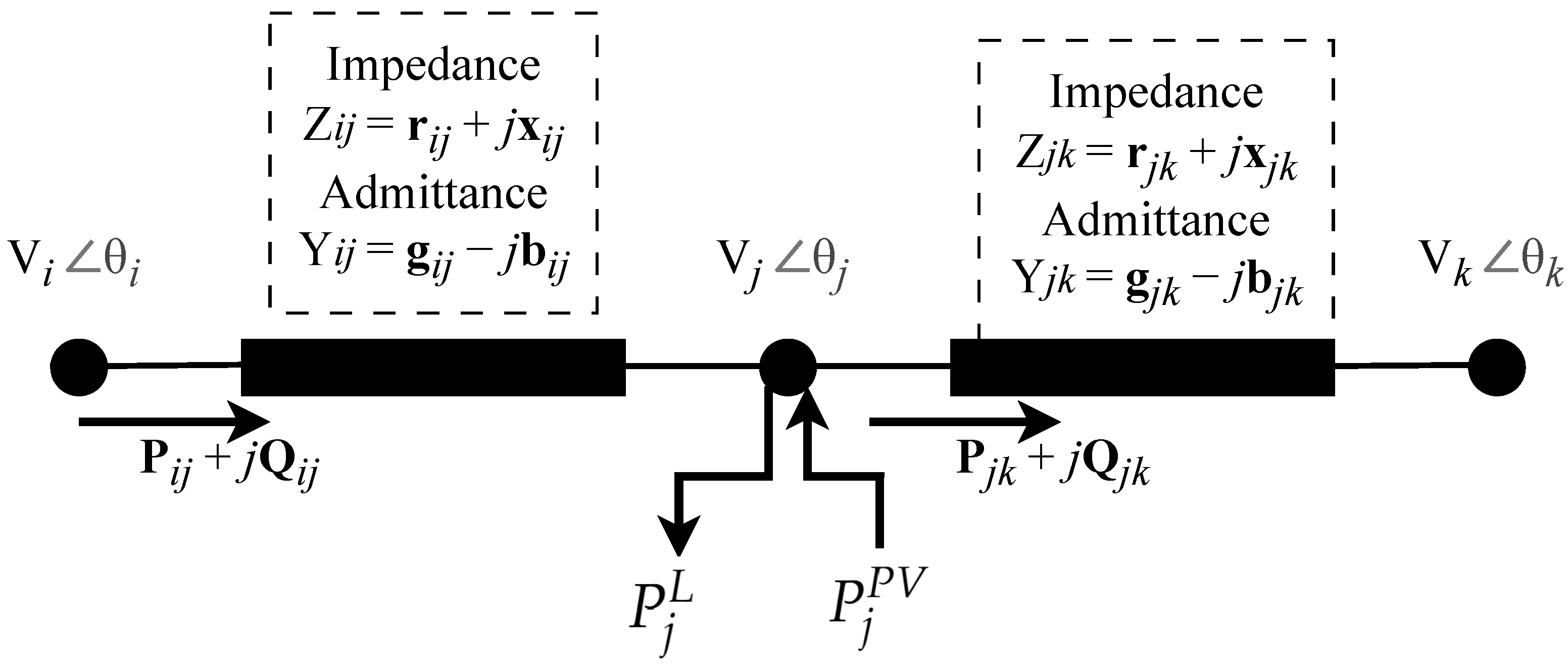
Consider the line equivalent shown in Figure 1, with three nodes and all variables and parameters expressed in per-unit quantities. At node j, the load and PV interconnection are represented. The line segment between nodes i and j is characterized by series impedance ( r i j + j x i j ) or admittance ( g i j j b i j ).
Following the radial load flow formulation in [18], (1) and (2) define the active and reactive power flows from node i to node j. Equations (3)–(5) provide the equivalent relationships used to cast the radial distribution load flow using conic programming.
P i j = 2 g i j u i g i j R i j + b i j T i j
Q i j = 2 b i j u i b i j R i j g i j T i j
R i j = | V i | | V j | c o s θ i j
T i j = | V i | | V j | s i n θ i j
u j = | V j | 2 / 2
Equations (6) and (7) enforce the nodal power balance at node j. The notation j k denotes a branch from j to its downstream node k. Each branch ( i , j ) S br is characterized by resistance r i j and reactance x i j . Equation (8) links the squared branch current magnitude on ( i , j ) and the squared voltage magnitude at nodej to the squared active and reactive power flows on that branch. Equation (9) relates the difference in the squared voltage magnitudes across ( i , j ) to the active and reactive power flows, squared current magnitude, and line impedance parameters.
P i j r i j | I i j | 2 = P j L P j P V + k : j k P j k
Q i j x i j | I i j | 2 = Q j L Q j P V + k : j k Q j k
| I i j | 2 | V i | 2 = P i j 2 + Q i j 2
| V j | 2 = | V i | 2 2 ( r i j P i j + x i j Q i j ) + ( r i j 2 + x i j 2 ) | I i j | 2

2.2. Objective Function

The objective function maximizes the sum of the active power injections at the PV interconnection nodes. Equation (10) defines this objective over a set of n gd candidate nodes G PV = { j 1 , j 2 , , j n gd } . The DSO planning team configures G PV based on the available information regarding prospective PV projects in the distribution network.
maximize F = ( j ) G PV P j PV

2.3. Power Flow Constraints

The physics of the distribution network operation are modeled by the constraints in (11)–(16). Node j = 1 is defined as the slack bus, where substation injections (slack bus) ( P S , Q S ) into the downstream network are represented. Constraints (13) and (14) impose the active and reactive power balances at each node j, following the SOCP formulation in (1)–(5). A ZIP load model represents the demand with parameters wpz, wpi, and wpp and a nominal voltage of 1 p.u. Using the same framework, constraints (15) and (16) enforce the current magnitude and conic voltage drop relationships derived from (8) and (16), respectively.
For node j = 1 :
P j P V + P S = P j L + k : j k P j k
Q j P V + Q S = Q j L + k : j k Q j k
For node j 1 :
k : j k P j k = P j L w p z · ( 2 u j ) + w p i · 2 u j + w p p P j P V i : i j P i j r i j l i j   = 2 u j k : j k g j k + k : j k g j k R j k b j k T j k
k : j k Q j k = Q j L w p z · ( 2 u j ) + w p i · 2 u j + w p p Q j P V i : i j Q i j x i j l i j   = 2 u j k : j k b j k + k : j k b j k R j k + g j k T j k
2 u i l i j = P i j 2 + Q i j 2
2 u j = 2 u i 2 ( r i j P i j + x i j Q i j ) + ( r i j 2 + x i j 2 ) l i j
Constraints (17) and (18) complete the second-order cone formulation of the PV–HC optimization problem [18].
2 u i u j R i j 2 + T i j 2
R i j 0

2.4. Operational Limits of the Network

Constraints (19)–(22) set the slack bus voltage ( V 1 ) and enforce the voltage, current, and power limits at the nodes, lines, and transformers. Constraint (22) limits the apparent power exchanged at the slack bus, and (23) bounds the active power exported to the upstream network.
u 1 = V 1 2 2
V min 2 / 2 u j V max 2 / 2
l i j I i j , max 2
P S 2 + Q S 2 S s m a x 2
P S P S r e f
Equations (24) and (25) impose the maximum power-injection limits for each PV unit. Constraint (24) is used in scenarios that restrict DG size, for example, to PV systems with a capacity below 1 MW. This is relevant in countries where regulations define DG classes according to the rated capacity [3]. The binary variable w g d j models the location decisions and number of PV units to be interconnected.
P j P V w g d j P gd max
Q j P V = P j P V tan arccos ( p f )
( j ) G PV w g d j N m a x g d
The objective function in (10), together with constraints (11)–(26), defines an MIQCP problem that can be solved using commercial solvers in modeling environments, such as AMPL [20]. In the Abbreviations subsection, we define the sets, parameters, and decision variables of the proposed optimization model. In this study, we solved the model using the Gurobi 12.0 solver within the AMPL.
We propose the index G exp defined in (27) to quantify the relationship between exported energy and the variation in network energy losses under PV integration. In this context, the expected exported energy ( E exp ) and energy losses ( E loss ) computed over solar irradiance hours (periods 6–17). Moreover, E loss base denotes the energy loss in the base case without PV integration. When Δ E loss 0 in Equation (28), losses decrease, and G exp is computed using the energy losses obtained with PV integration ( E loss ).
G exp = E exp Δ E loss , if Δ E loss > 0 , E exp E loss , if Δ E loss 0 .
Δ E loss = E loss E loss base .
In addition, the percentage change in losses ( Δ loss ) is evaluated according to Equation (29).
Δ loss ( % ) = Δ E loss E loss base × 100

3. HC Estimation Methodology and Distribution Planning

The MIQCP formulation is used for HC estimation in scenarios in which the DSO planning teams configure constraints to assess the integration capacity of their distribution networks. The following set of constraints, referred to as DSO-constraints, represents the planning decisions specified for each scenario under evaluation.
  • Constraint on PV locations: This constraint evaluates the impact of excluding selected network zones from PV interconnections and its effect on the HC solution. The binary variable w g d j in (24) acts as an activation flag for the candidate PV nodes: w g d j = 0 ensures that node j is not available for PV integration. In addition, the parameter N m a x g d limits the number of candidate nodes that can host PV systems. For example, this setting is useful when the planner seeks to determine the HC associated with a single PV system interconnected at a single node within a feasible candidate set.
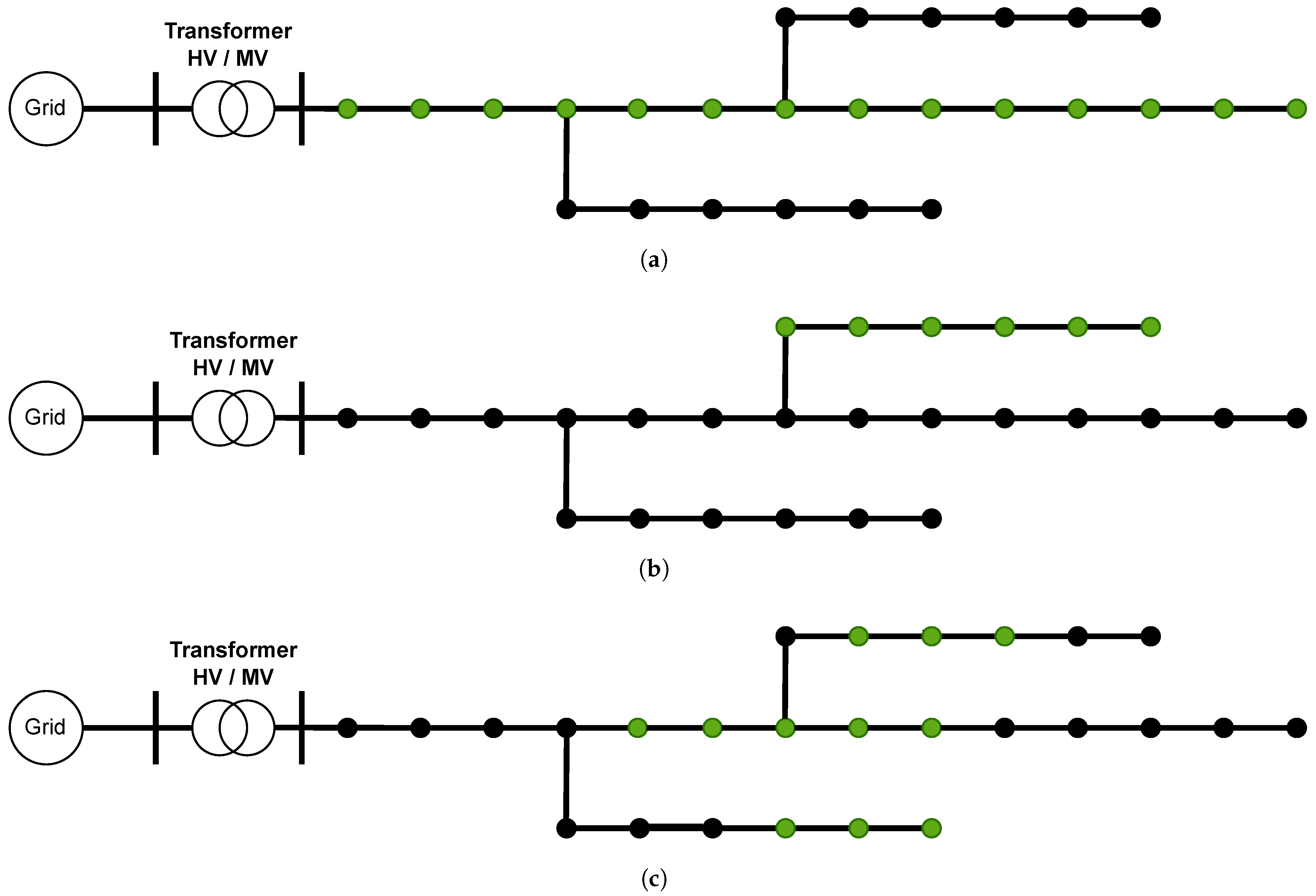
    Figure 2 shows a radial distribution network with one main feeder and two laterals. All nodes are at the MV level. Three candidate node configurations (in green) are illustrated for HC estimation. In Figure 2a, candidate nodes lie along the main feeder; Figure 2b considers only nodes on a lateral feeder; and Figure 2c includes both main- and lateral-feeder nodes, a typical case when potential interconnection points for distributed generation projects have been identified. An analysis of the HC estimate with zone restrictions can be useful for planning protection device upgrades when certain PV system locations impact protection coordination.
    Figure 2. Candidate nodes (green) for PV interconnection in three scenarios: (a) All nodes on the main feeder. (b) All nodes on the lateral feeder. (c) Selected nodes based on the PV interconnection potential.
    Figure 2. Candidate nodes (green) for PV interconnection in three scenarios: (a) All nodes on the main feeder. (b) All nodes on the lateral feeder. (c) Selected nodes based on the PV interconnection potential.
    Electricity 07 00012 g002
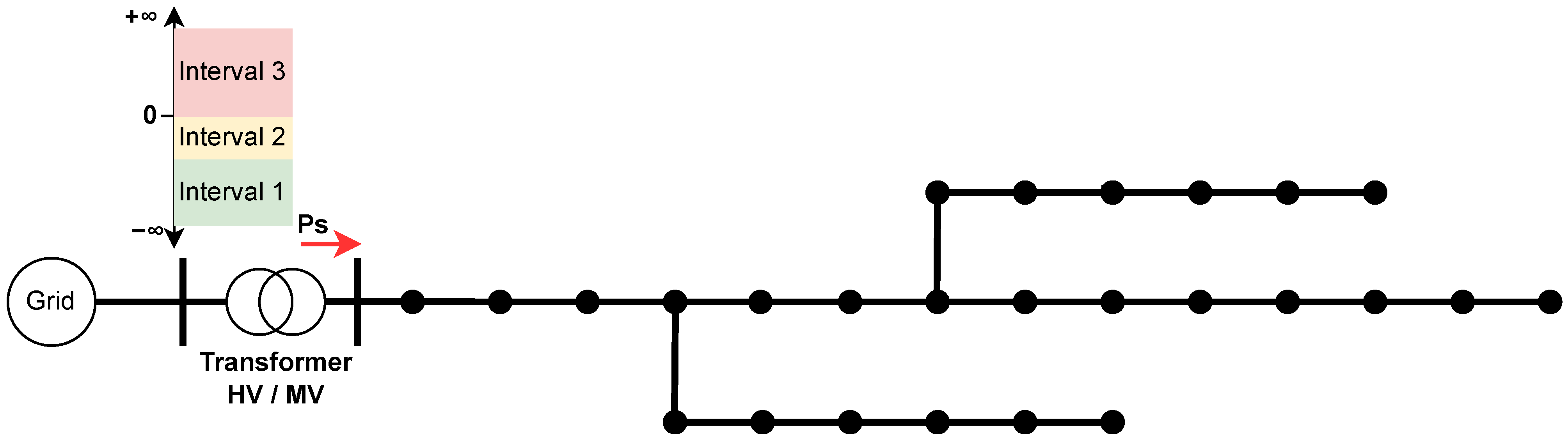
  • Constraint on power exchange with the upstream grid: The active power P S at the slack bus can be constrained to the reference value P S r e f selected by the planning team. In Figure 3, P S represents the active power injected into the slack bus from the upstream grid. From Equation (23), P s P S r e f . Figure 3 shows three feasible intervals for P S r e f . For instance, selecting P S r e f = (Interval 1: ( , S n ]), where S n denotes the rated power of the element connected to the slack bus, yields a solution limited by the feeder export capability. Setting P S r e f = 0.5 S n (Interval 2: (− S n , 0)) causes constraint (23) to become binding before reaching the maximum export capability S n . Finally, choosing P S r e f = 0 (Interval 3: [0, + )) limits active power export to the upstream grid, which is relevant when planners identify the operating conditions under which export must be avoided. In general, tuning P S r e f enables the assessment of the impact of active power export constraints on HC results and overall network performance.
    Figure 3. Possible settings of the upstream-grid power-exchange constraint.
    Figure 3. Possible settings of the upstream-grid power-exchange constraint.
    Electricity 07 00012 g003
  • PV unit capacity constraint: Variable P j P V is limited by the parameter P gd max in (24). This enables the analysis of scenarios with many small-scale projects versus scenarios with fewer, higher-capacity projects. In Colombia, for example, regulation distinguishes between distributed generators below 1000 kW and plants with a capacity greater than or equal to 1000 kW. This framework has led to a preference for PV systems below 1000 kW, given the less-demanding permitting processes. Therefore, for planning teams, it is relevant to assess how this constraint affects HC in their distribution networks.
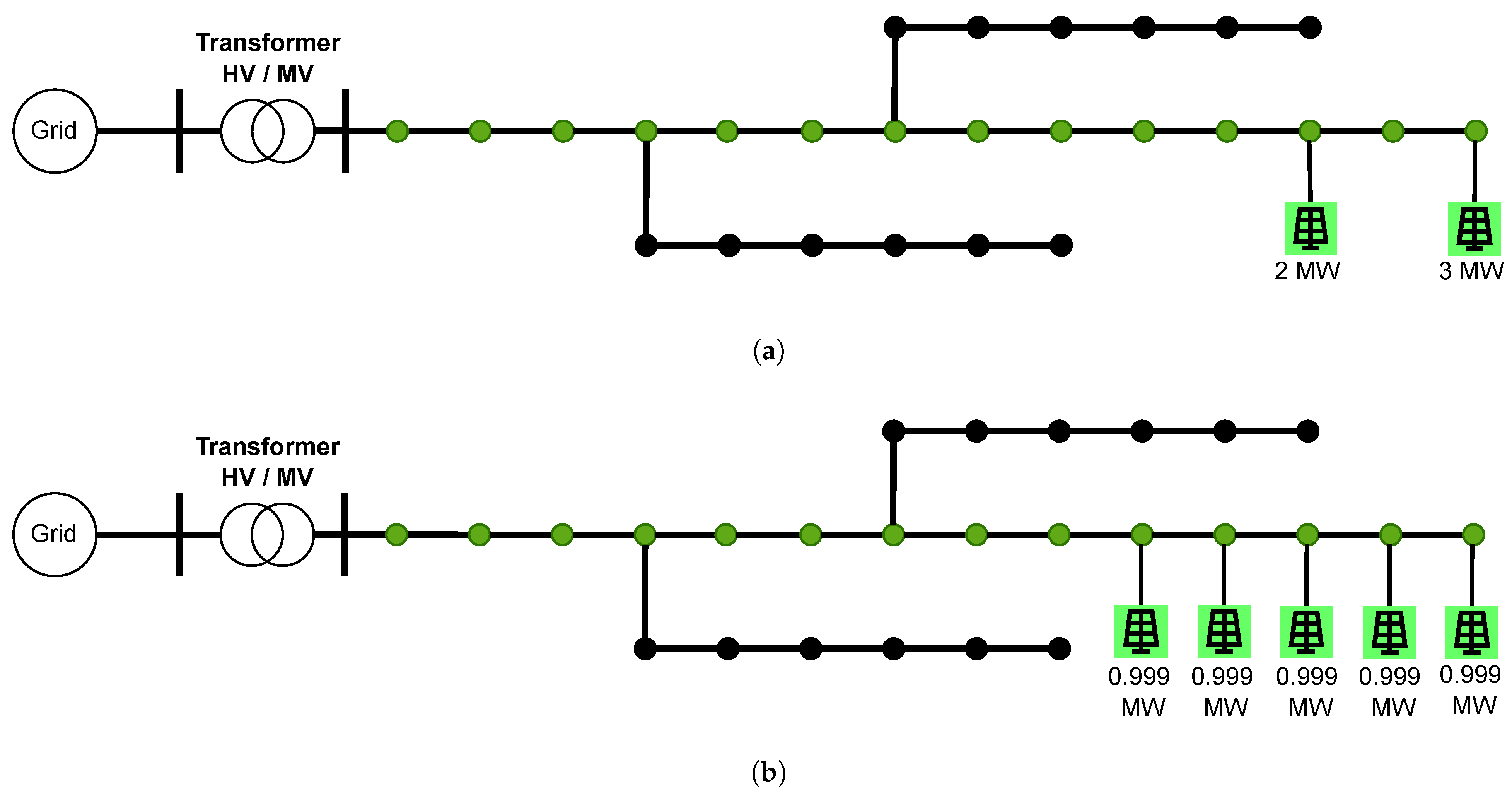
    Figure 4 illustrates two PV integration scenarios. In Figure 4a, the HC solution does not impose a per-unit capacity limit within the candidate node set, and a total of 5 MW is obtained with two interconnected PV systems. In Figure 4b, the HC is also 5 MW, but five PV systems are interconnected because each unit is constrained to have a capacity below 1000 kW. Although the total HC is 5 MW in both cases, the locations and number of PV units can affect the distribution network performance in different ways, for example, in the resulting energy losses.
  • PV system power factor constraint: The parameter p f in constraint (25) can be set to different values to assess the impact of allowing reactive power flow at PV terminals. This is useful for quantifying the benefits of reactive power management as an operational control mechanism to increase HC in the network, as reported in the literature.
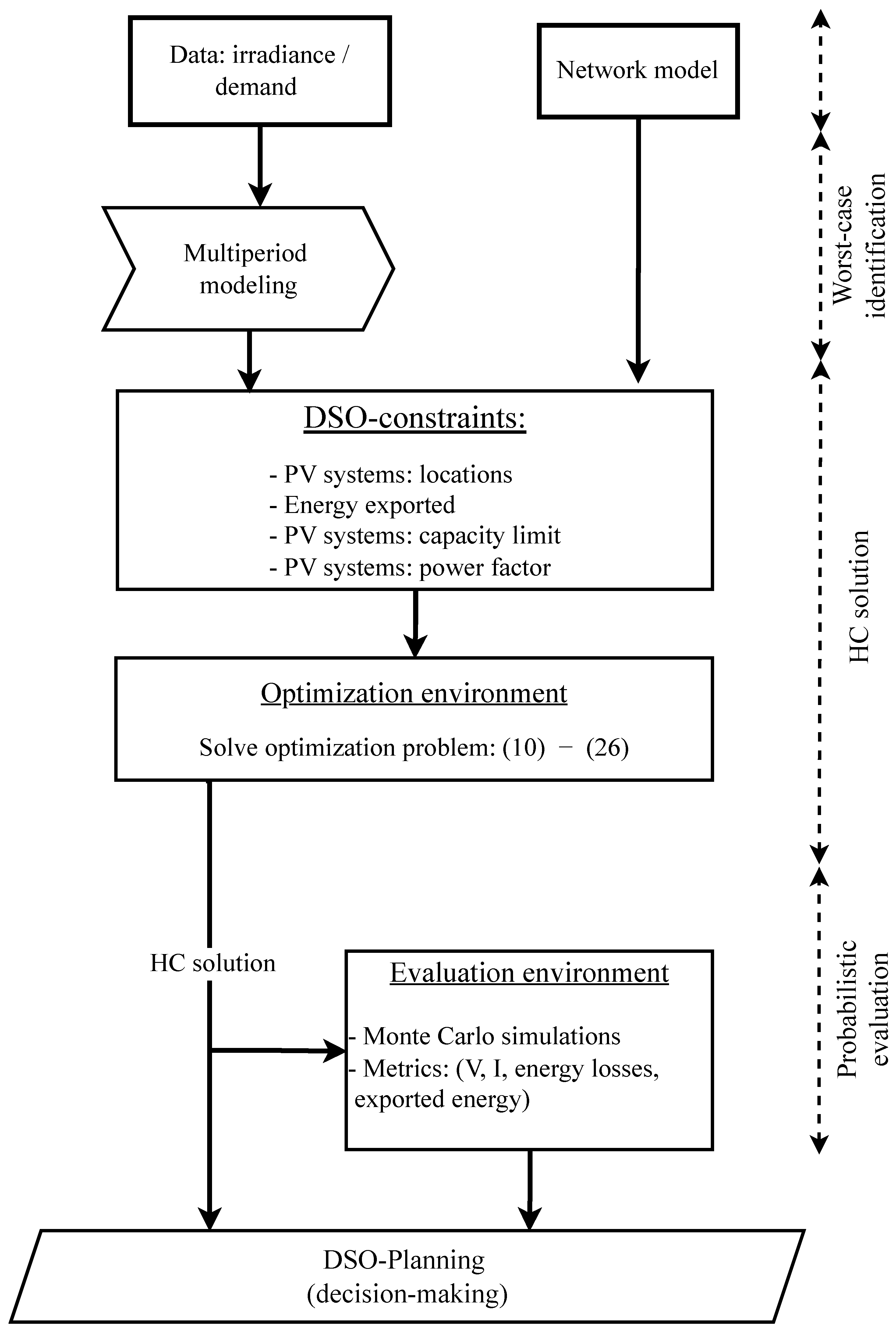
The proposed methodology for planning PV system integration in distribution networks is implemented in a tool called the Hosting Capacity–Distribution Planning Tool (HC-DPT). This tool computes HC while accounting for the characteristics of real distribution networks operated by electric distribution utilities.
The HC-DPT comprises two main modules.
1.
An optimization environment that integrates Python and AMPL to formulate and solve the MIQCP optimization problem defined in (10)–(26), thereby providing the HC solutions. This environment can produce two types of HC solutions: sparse and non-sparse. In addition, the set of DSO-constraints is configured by the user according to the type of analysis to be performed, as previously discussed.
2.
A probabilistic network evaluation environment that uses Monte Carlo simulations in a Python–OpenDSS co-simulation platform was used to analyze the power flows in the distribution network based on the HC solutions computed in the optimization module. This environment provides performance metrics for network operations under different PV integration scenarios.
The input data used by the HC-DPT and the two types of HC solutions that it produces are described below.
Figure 4. PV interconnections in two scenarios: (a) HC computed without a per-unit PV capacity limit. (b) HC computed using PV units constrained to below 1000 kW.
Electricity 07 00012 g004

3.1. Input Data

Because DSOs maintain georeferenced asset data and parametric models for network elements, HC estimation uses the following inputs:
  • Line and transformer impedance parameters.
  • Rated current capacities of lines and transformers.
  • Network nominal voltage and slack-bus reference voltage.
  • Rated capacities and locations of reactive power compensation devices.
  • Probabilistic model of solar irradiance in the feeder’s area of influence.
  • Probabilistic model of equivalent demand at the three-phase nodes of MV level.
Probabilistic models of irradiance and equivalent demand are used to determine a worst-case that defines the demand/irradiance values applied in the optimization environment. In this study, we adopt the multiperiod analysis in [21] to obtain this worst-case. The resulting demand values enter the optimization problem through P j L and Q j L , together with the ZIP load model in (13) and (14).

3.2. Sparse HC Solution

A sparse solution to the HC problem is one in which the vector of PV injections
P PV = P j 1 P V , P j 2 P V , , P j n gd P V
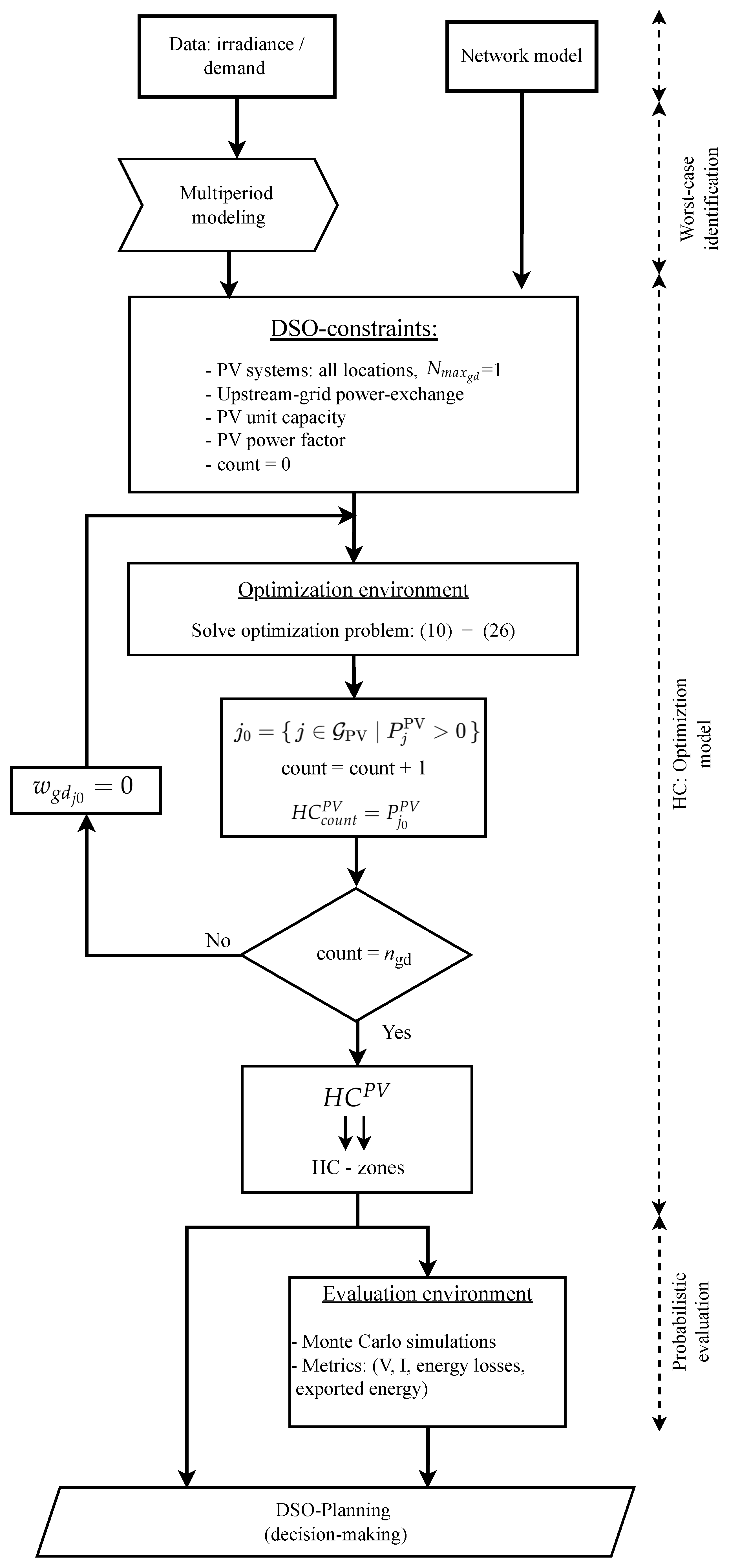
has few nonzero components; that is, P PV 0 n gd . In this type of solution, only a subset of candidate nodes satisfies P j PV > 0 , whereas most nodes satisfy P j PV = 0 . Thus, in a sparse HC solution, the network hosts distributed generation at a limited number of locations while meeting the technical constraints and user-defined settings. Figure 5 shows the flowchart of the methodological approach for sparse HC estimation, indicating the inputs, execution steps, and outputs. The procedure is intended for adoption by DSOs because it uses information available in their databases and can be integrated into distribution planning processes.
The stages in the flowchart of Figure 5 are described as follows:
1.
The input data comprise the network model, historical active and reactive demand, and solar irradiance records. The demand and irradiance time series must be time-aligned over the analysis window.
2.
The multiperiod model is used to determine the worst-case scenario applied in the optimization problem. An equivalent demand level at the MV nodes is computed to feed the optimization. When direct measurements at the MV nodes are not available, the state estimation of the demand at unmetered nodes can also be formulated as an optimization problem.
3.
The DSO configures the set of DSO-constraints according to the analysis objectives. For nodes that are not candidates for PV interconnection, the variable w g d j = 0 is fixed. For the remaining constraints, the parameters P S ref , P gd max , and pf are specified.
4.
The optimization problem is solved using the network model, multiperiod model, objective function in (10), and constraint set in (11)–(26). The HC solution is given by the sum of all the PV capacities obtained, identifying each MV node with a PV installation and its corresponding maximum injectable power.
5.
The resulting HC solution is assessed by the DSO planning team. The same HC solution, defined by PV locations and injection capacities, is then used in a probabilistic evaluation based on Monte Carlo simulations, which analyze power flows under demand and irradiance uncertainty. This probabilistic evaluation yields metrics that verify compliance with voltage and current limits at all nodes and elements and provides central-tendency values for exported energy and energy losses.
This sparse HC estimation procedure supports DSO planning teams in identifying potential investors to implement optimally sized PV projects and in defining an integration plan with reduced uncertainty regarding DG interconnection requests.

3.3. Non-Sparse HC Solution

A non-sparse solution of the HC problem is one in which most candidate nodes satisfy P j PV > 0 , that is, P PV 0 n gd . In this case, the PV injections are more evenly distributed throughout the system. Therefore, a non-sparse HC solution is characterized by hosting generation at most of the candidate nodes. Figure 6 shows a flowchart of the methodological approach for non-sparse HC estimation. The stages are:
1.
The input data and worst-case identification follow the same assumptions used in the sparse HC flowchart shown in Figure 5.
2.
The DSO specifies nodes that are unavailable for PV interconnection by setting w g d j = 0 at each node. For the remaining constraints, the parameters P S ref , P gd max , and p f are set. In addition, the parameter N max gd = 1 is imposed such that each optimization run considers a single PV system. Under these restrictions, each solution corresponds to the LHC because HC is computed independently at each network node [9,11].
3.
The optimization problem is solved using the network model, the multiperiod model, the objective function in (10), and the constraint set in (11)–(26). The variable count ensures that all candidate nodes in G PV are explored, simultaneously solving for the optimal integration of one PV system. Therefore, the problem is solved n gd times. In each iteration, the node j 0 corresponding to the optimal PV interconnection point is identified, and the optimal PV capacity is stored in the vector HC PV . At the end of each iteration, node j 0 is removed from the candidate set by fixing w g d j 0 = 0 such that it cannot be selected in subsequent runs.
Figure 5. Flowchart of sparse HC estimation in a distribution network with three-phase PV systems.
Electricity 07 00012 g005
Figure 6. Flowchart of non-sparse HC estimation in a distribution network with three-phase PV systems.
Electricity 07 00012 g006
4.
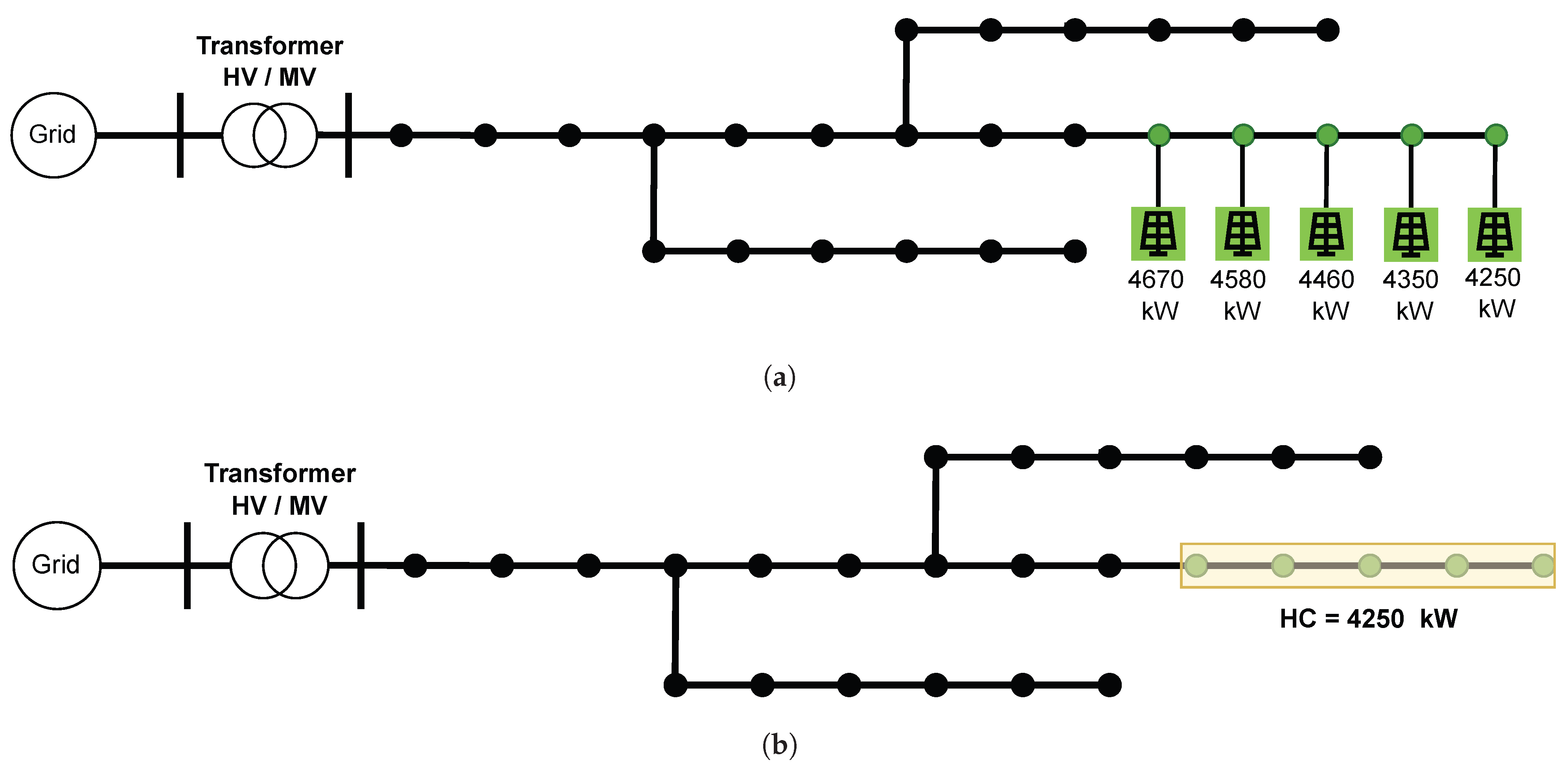
The entries of HC PV are then used to construct non-sparse HC solutions. A non-sparse HC solution corresponds to an HC value for a zone defined by a group of nodes. The procedure first identifies zones whose nodes have similar LHC values and then assigns a single conservative HC value to each zone. Figure 7a illustrates an example of the LHC results for five candidate nodes. The data show a maximum LHC of 4670 kW and a minimum of 4250 kW , where the minimum is 91 % of the maximum. The conservative zonal HC is taken as the minimum LHC in the group, provided that this minimum is not lower than 90 % of the maximum. The 90 % threshold is user-defined and reflects the desired level of conservatism. In Figure 7a, the conservative solution is 4250 kW , which applies to the zone formed by the five nodes, as shown in Figure 7b.
5.
The non-sparse HC solutions are then analyzed by the DSO planning team. The solutions are interpreted as follows:
(a)
The HC value of a given zone is the maximum capacity that can be integrated either by a single PV system at a single node or by the aggregate capacity of n PV projects connected to several nodes within the same zone. Therefore, all nodes in the zone are candidate locations for safe PV integration up to the zonal HC value.
(b)
It is not valid to define an HC solution that simultaneously combines the PV locations and capacities from two or more zones. Because zones are defined from LHC values, any integration scheme to be implemented or evaluated must place PV systems within a single zone.
(c)
PV interconnection studies can proceed sequentially by analyzing each project individually. After a project is connected, zonal HC values are recomputed by considering the installed PV capacity. In this way, the non-sparse HC solutions are updated as PV systems are added, and the zones evolve in terms of both the HC value and spatial extent.
Figure 7. Construction of a non-sparse HC solution: (a) LHC values at five nodes. (b) Non- sparse HC solution for the five-node zone.
Electricity 07 00012 g007
6.
Non-sparse HC solutions can also be evaluated in the operational context of the distribution network. For each proposed PV integration scheme, the evaluation environment is used to compute performance metrics, such as exported energy and changes in energy losses. This enables planners to compare candidate integration schemes and select those with better performance, for example, with lower energy losses.
4. Cases Study, Results, and Discussion

4.1. IEEE 33-Bus Distribution Test Network

For benchmarking purposes, the proposed method is applied to the IEEE 33-bus standard distribution test network. Detailed network data are provided in [22]. In [14], a linear HC formulation is presented, and its results are used as a reference for comparison with the proposed MIQCP approach. The slack-bus voltage is fixed at 1.0 p.u., with voltage limits of 0.9–1.1 p.u. The active power exchanged with the upstream grid is limited to 4.6 MW, and the thermal rating of all lines is set to 300 A. The PV power factor is fixed at unity. The HC is calculated under base-load conditions considering two scenarios: (i) Scenario 1, where all buses are eligible for PV integration, and (ii) Scenario 2, where only buses 2 and 3 are eligible for PV integration. Table 1 summarizes the HC results reported in [14] and those obtained using the proposed method for both scenarios.
The grid hosting capacity results differ by 8.4% and 0.7% for Scenarios 1 and 2, respectively. For both methods and scenarios, the constraint on active power export to the upstream grid is binding and therefore limits the HC value. In terms of computational performance, the proposed method is 6.68 times faster when solving the optimization problem for Scenario 1, where all buses are considered as candidate PV interconnection points.
For Scenario 1, the HC solutions obtained with both methods are validated using a nonlinear power flow to verify compliance with the network operating limits. The solution reported in [14] achieves an HC of 8484 kW (bus 2: 7624 kW; bus 19: 90 kW; bus 20: 770 kW). The corresponding power flow results are as follows: active power export to the upstream grid = 4563 kW, maximum voltage = 1.0059 p.u., minimum voltage = 0.91867 p.u., and maximum line current = 236 A. The proposed method yields an HC of 9262 kW (bus 9: 12 kW; bus 18: 2959 kW; bus 22: 6291 kW). The power flow results are as follows: active power export to the upstream grid = 4600 kW, maximum voltage = 1.0934 p.u., minimum voltage = 0.95709 p.u., and maximum line current = 259 A. These results show that the proposed method attains a higher HC while satisfying all operating constraints, thereby increasing the utilization of the distribution network capacity for PV integration.
Additionally, the HC solution obtained with the proposed method under Scenario 1 is assessed by comparing the nonlinear power-flow results with the decision-variable values returned by the optimization environment. The mean relative errors are 0.029% for voltage magnitudes, 0.217% for current magnitudes, 0.45% for line active power flows, 0.30% for line reactive power flows, 0.20% for active power export to the upstream grid, and 1.0% for power losses. These results validate the accuracy of the proposed optimization environment for HC estimation, enabling PV sizing while enforcing operational constraints with errors below 1%.

4.2. Description of the Real Distribution Network

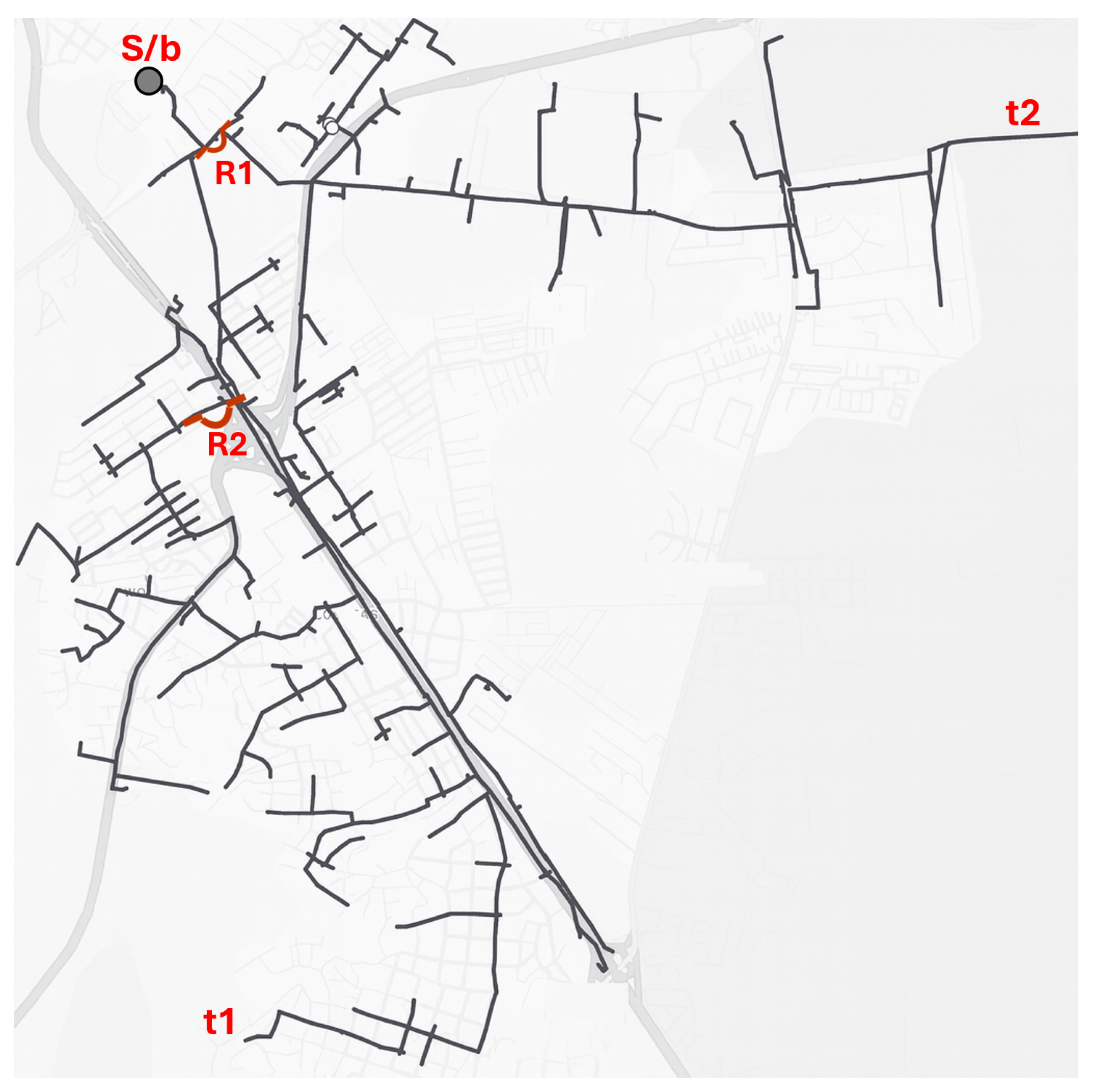
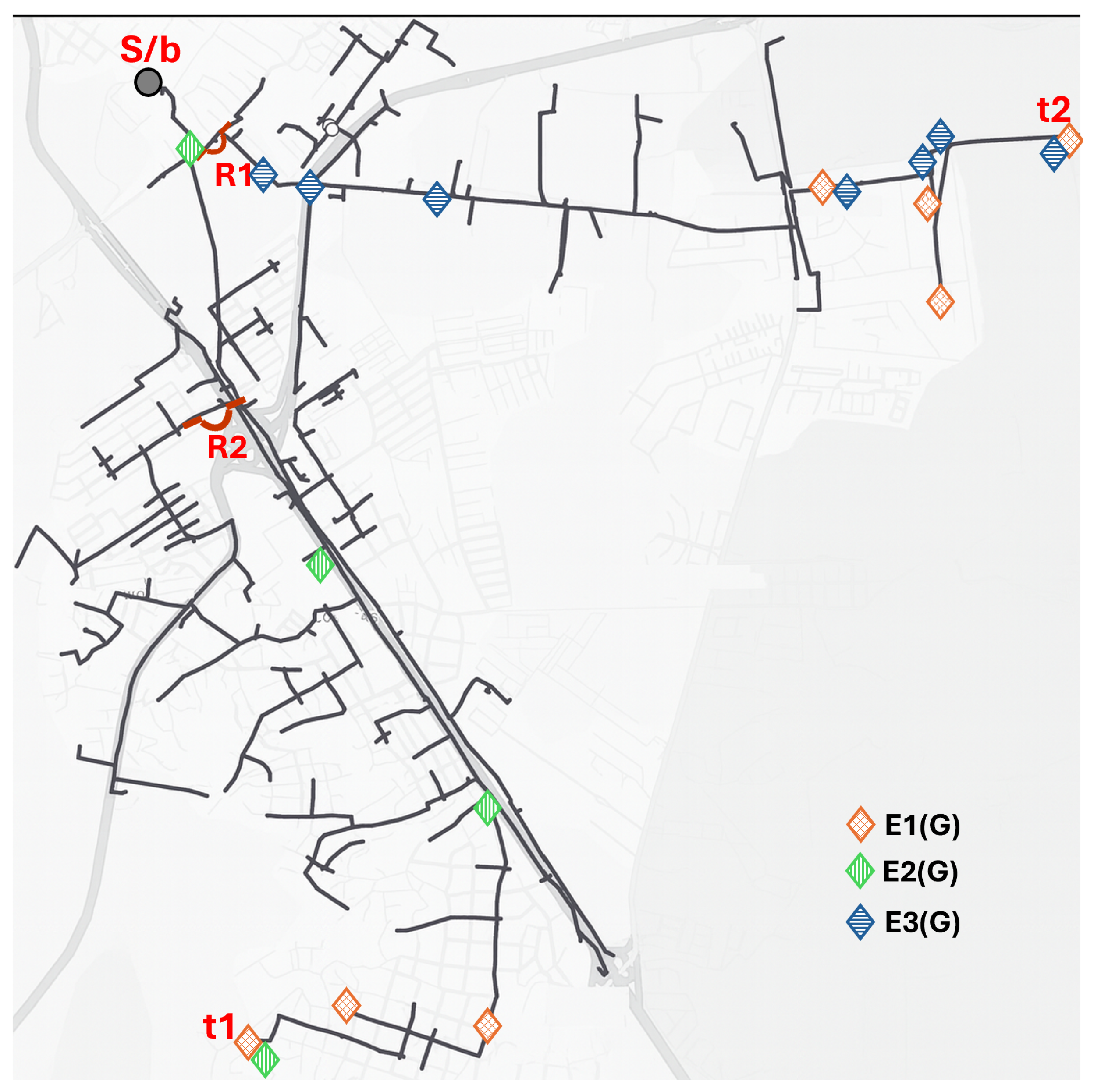
We also apply the proposed method to a real medium-voltage distribution network operated by CENS S.A. E.S.P., denoted as CENS 1428-bus. The network serves urban and rural customers; demand is primarily residential, with smaller commercial and industrial shares. It connects to a substation through a 40 MVA, 115/13.8 kV transformer; the same substation also supplies five additional feeders. Figure 8 shows the CENS 1428-bus single-line diagram; labels t 1 and t 2 denote the ends of the two primary feeders that originate at the slack bus ( S / b ) . Table 2 summarizes the main characteristics of the network.

4.2.1. Load Modeling

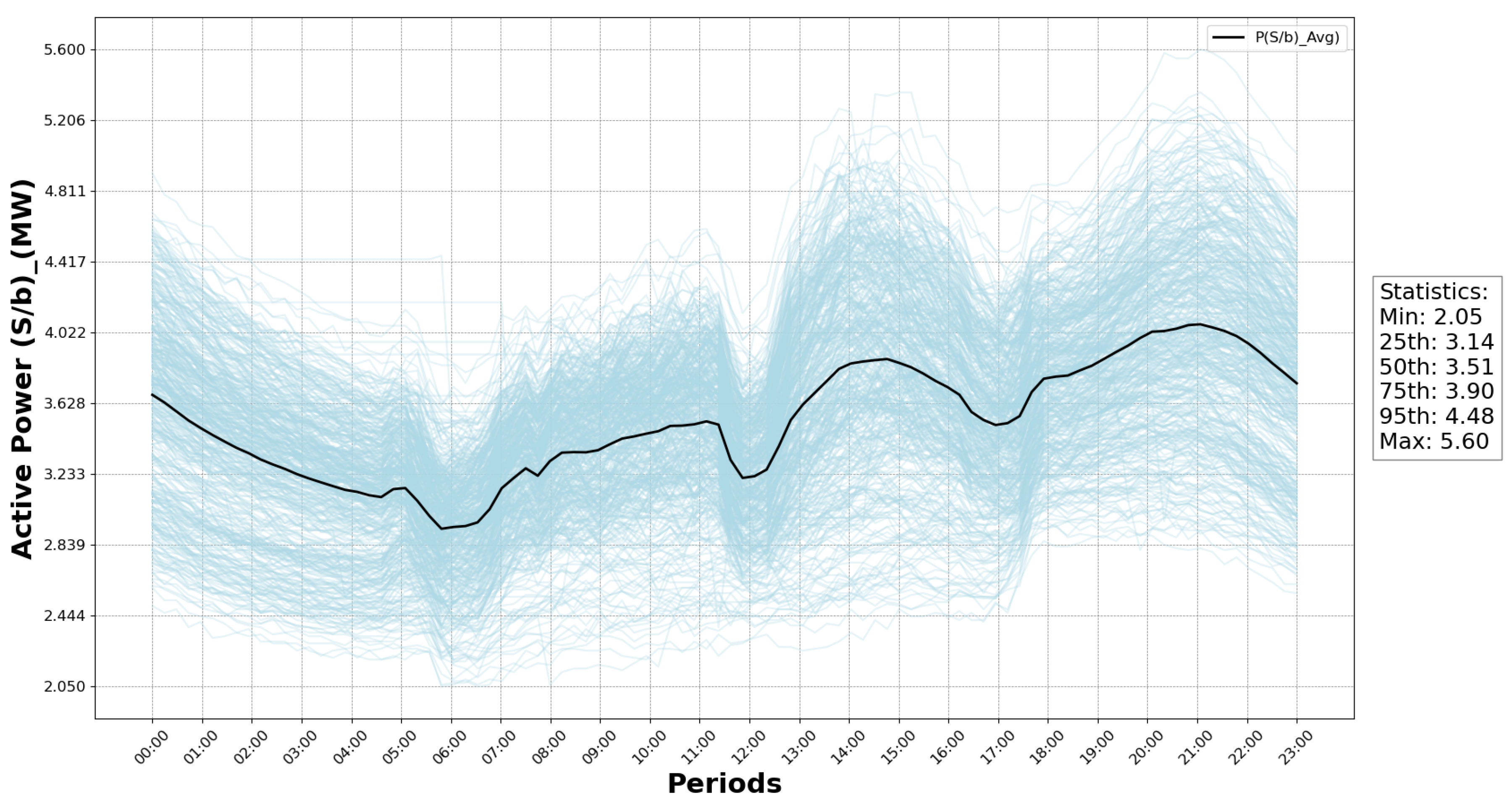
The utility has historical demand measurements from three SCADA-connected reclosers located at (i) the slack bus, (ii) 0.4 km from the slack bus ( R 1 in Figure 8), and (iii) 1.2 km from the slack bus ( R 2 in Figure 8). Active and reactive power measurements were recorded at 15-min intervals. Figure 9 shows the hourly distribution of the measurements recorded at the slack bus for 2023–2024, where the black line denotes the hourly mean. Year-over-year demand increases of 18.54% (2023) and 7.82% (2024) were observed. For all data, descriptive statistics are also shown (minimum, 25th/50th/75th/95th percentiles, and maximum).
The recorded demand time series feed the multiperiod modeling framework proposed in [21]. The load composition of the circuit is 95% residential, 3.6% commercial, and 1.4% industrial. Consequently, a ZIP demand model is employed for the aggregated demands at the MV nodes. This model incorporates CVR parameters C V R w a t t = 0.6 and C V R v a r = 4 [23]. This framework supports both the HC problem formulation and Monte Carlo scenarios used to perform the probabilistic evaluation of the HC solutions.

4.2.2. Solar Irradiance Modeling

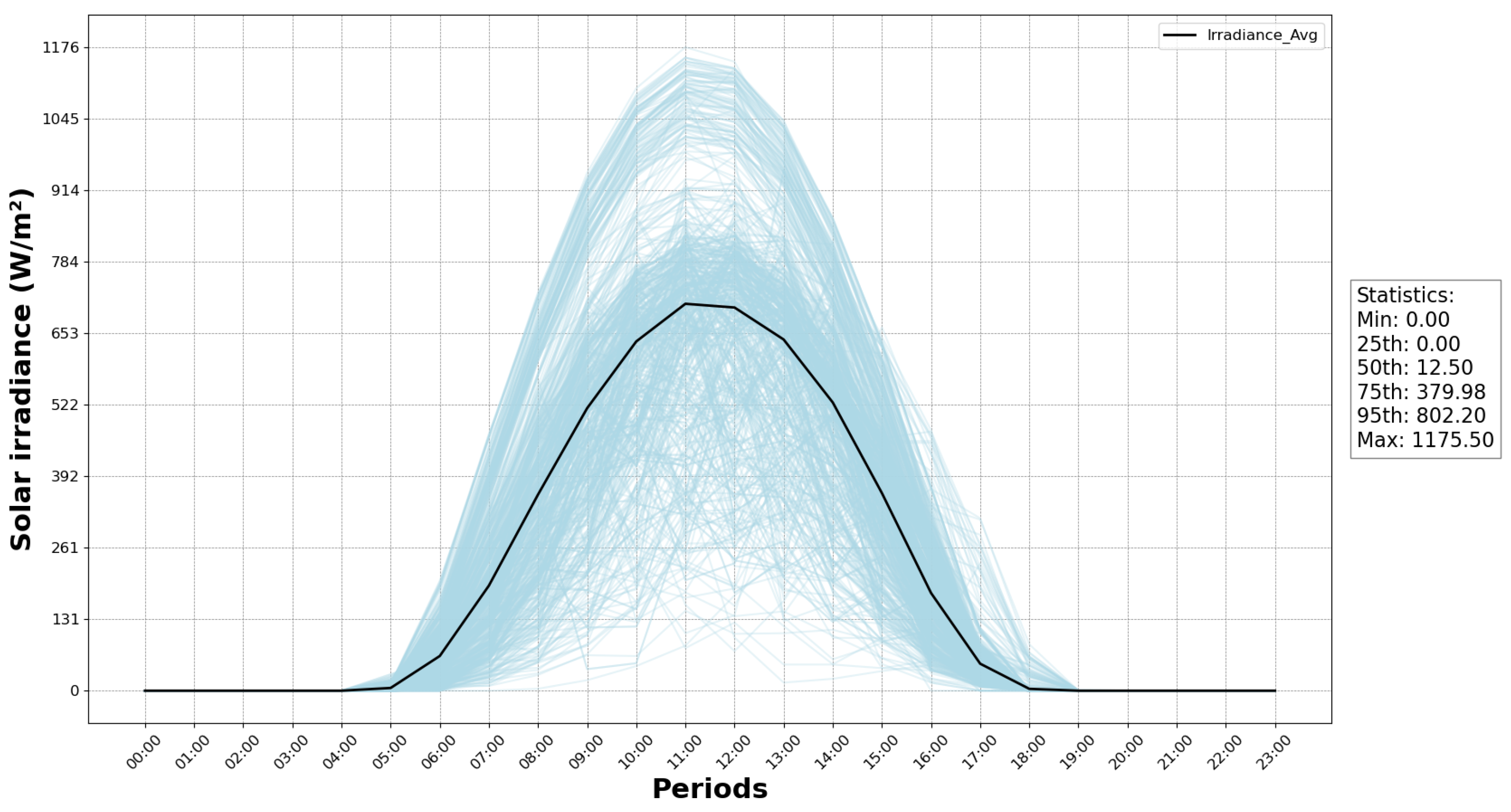
Solar irradiance data were recorded by a weather station located within the 1428-bus CENS feeder service area. The dataset utilized in this study spans the 2023–2024 period, as depicted in Figure 10. The hourly descriptive statistics for irradiance W/m2 are computed and summarized in Table 3. The derived statistics are fundamental to both the HC problem formulation and probabilistic evaluation of the distribution system’s operational performance under PV integration.

4.2.3. Multiperiod Modeling

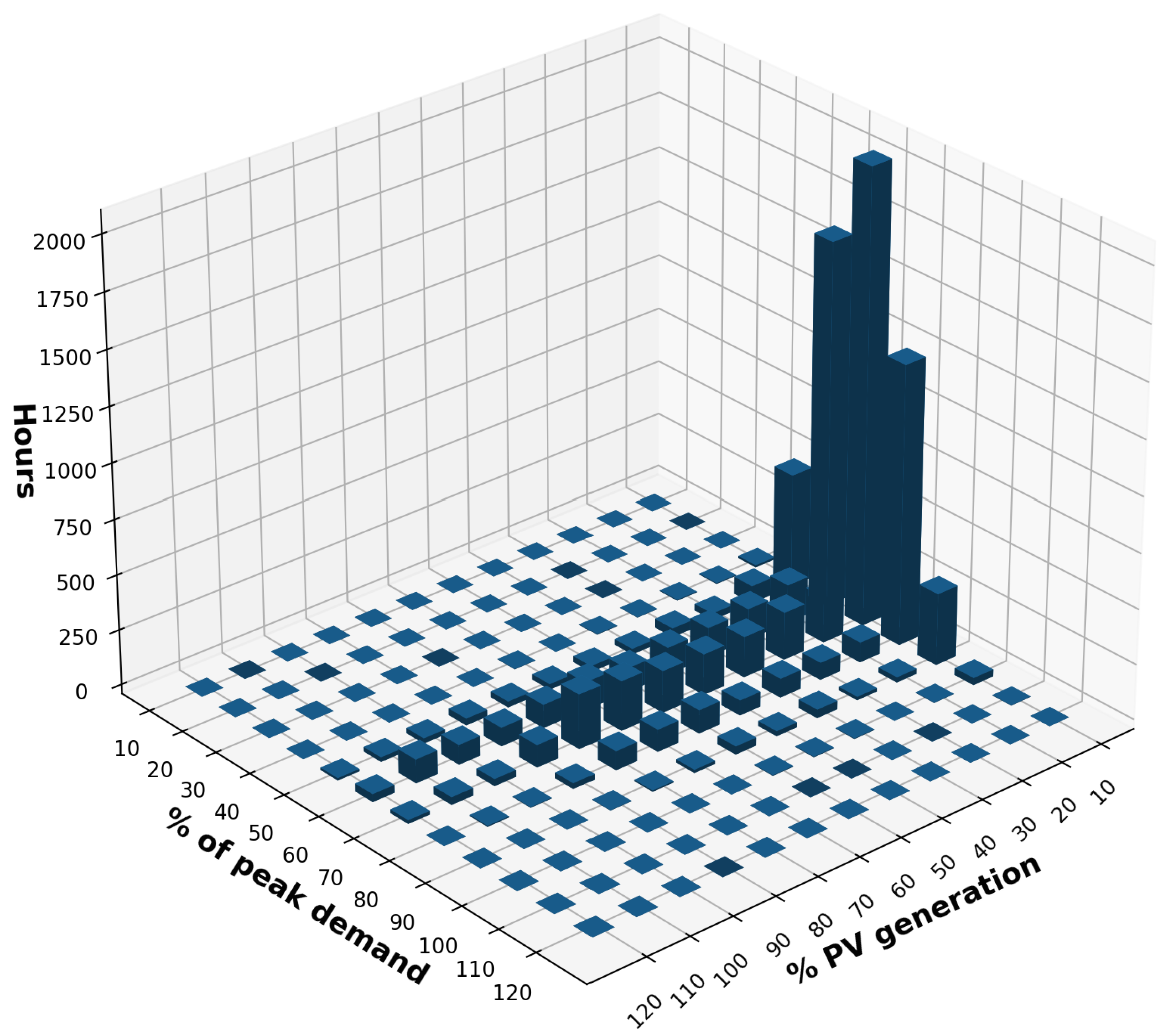
The multiperiod model proposed in [21] was applied using the dataset spanning 2023–2024 (depicted in Figure 9 and Figure 10). Figure 11 presents a correlation analysis between slack bus demand patterns and solar irradiance profiles. From this analysis, a worst-case operating point is established, defined by a 40% demand level relative to 100% solar irradiance.
We implement the HC estimation in AMPL co-simulated with Python and solve it with Gurobi 12.0 [20]. Probabilistic power-flow analysis was conducted within a Python framework co-simulated with OpenDSS software [24]. All simulations are executed on a workstation equipped with an Intel Xeon Gold 5416S (2.00 GHz) processor and 64 GB of RAM.

4.3. Results and Discussion

This section reports the HC results of the case study. Table 4 lists the optimization parameters used to solve the HC problem; these settings are identical for the sparse and non-sparse formulations. The voltage constraint applies a 2.5% safety margin relative to the regulatory bounds (0.9–1.1 p.u.) to account for uncertainty and modeling approximations (e.g., worst-case selection and ZIP load modeling) and to reduce infeasibility in practice. The line and transformer current limits are set to 80%, consistent with the planning practice that treats this threshold as the trigger for new distribution investments. The same power factor ( p f ) value is used for all PV systems.

4.3.1. Sparse HC Results

We apply the HC estimation procedure to the primary and secondary branches. Table 5 reports the results under the constraint P s 10 , 000 kW, with the negative reference P S r e f indicating that active power export to the upstream grid is allowed. In the table, the HC column represents the sum of the limiting PV injections at the interconnected nodes. We evaluate scenarios with and without a per-PV unit limit. Constrained cases (DG) set the maximum unit size to <1000 kW or below, consistent with the Colombian definition of one class of distributed generators [3]; unconstrained cases (G) impose no unit size limit. The candidate node sets are E1, all system nodes; E2, primary nodes between the slack bus and terminal t 1 ; and E3, primary nodes between the slack bus and terminal t 2 . For each scenario, we report the number of integrated PV systems and the maximum and minimum unit capacities. Figure 12 shows the PV placements for three HC solutions (E1(G), E2(G), and E3(G)).
Within the probabilistic evaluation of the HC solutions, we run Monte Carlo simulations to compute scenario metrics: 144,000 simulations in total, that is, 24,000 per scenario across six scenarios. For the voltage (V) and current (I) variables in Table 5 and Table 6, the symbol ✓ indicates no violation of the nodal voltage limits or element current ratings in any period.
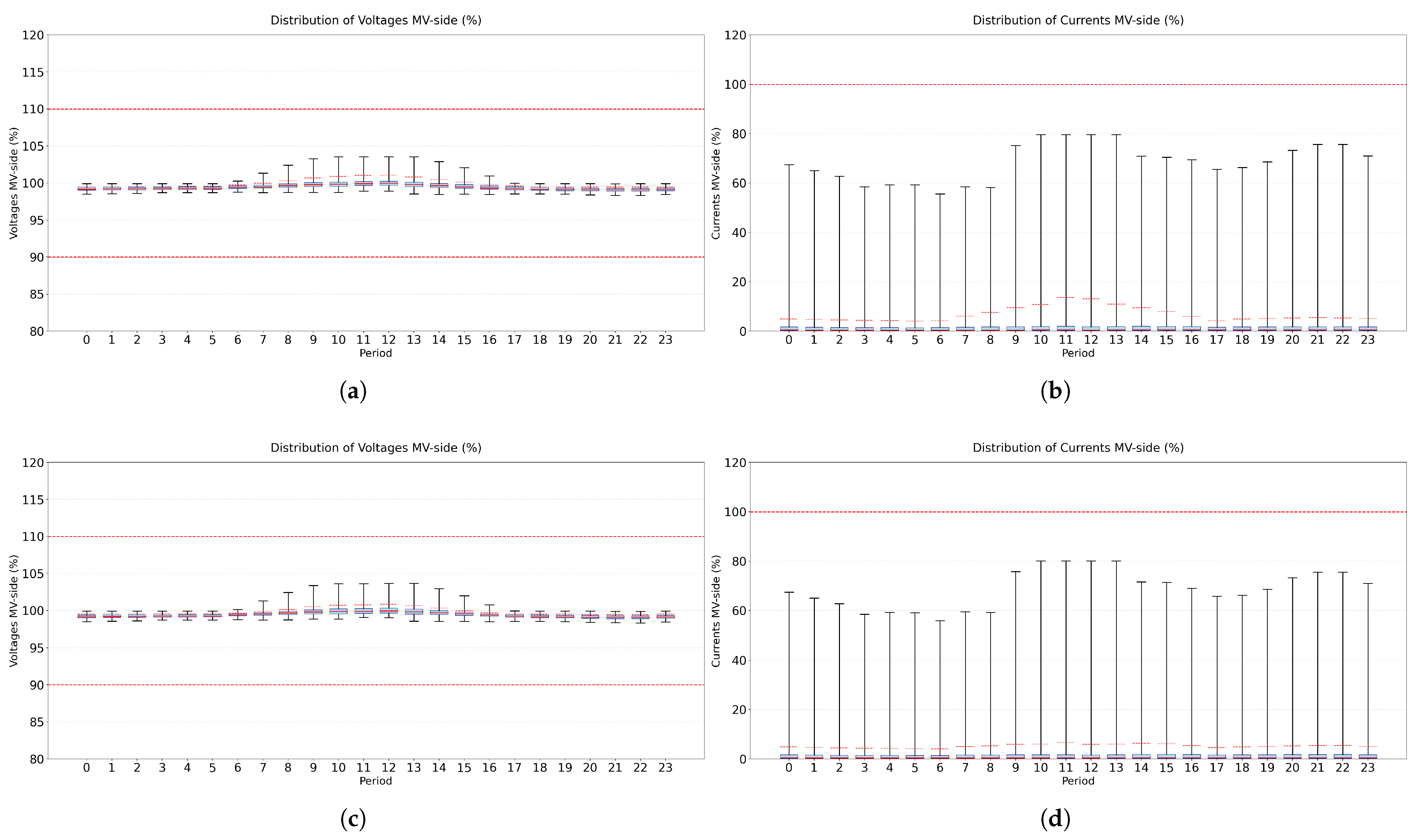
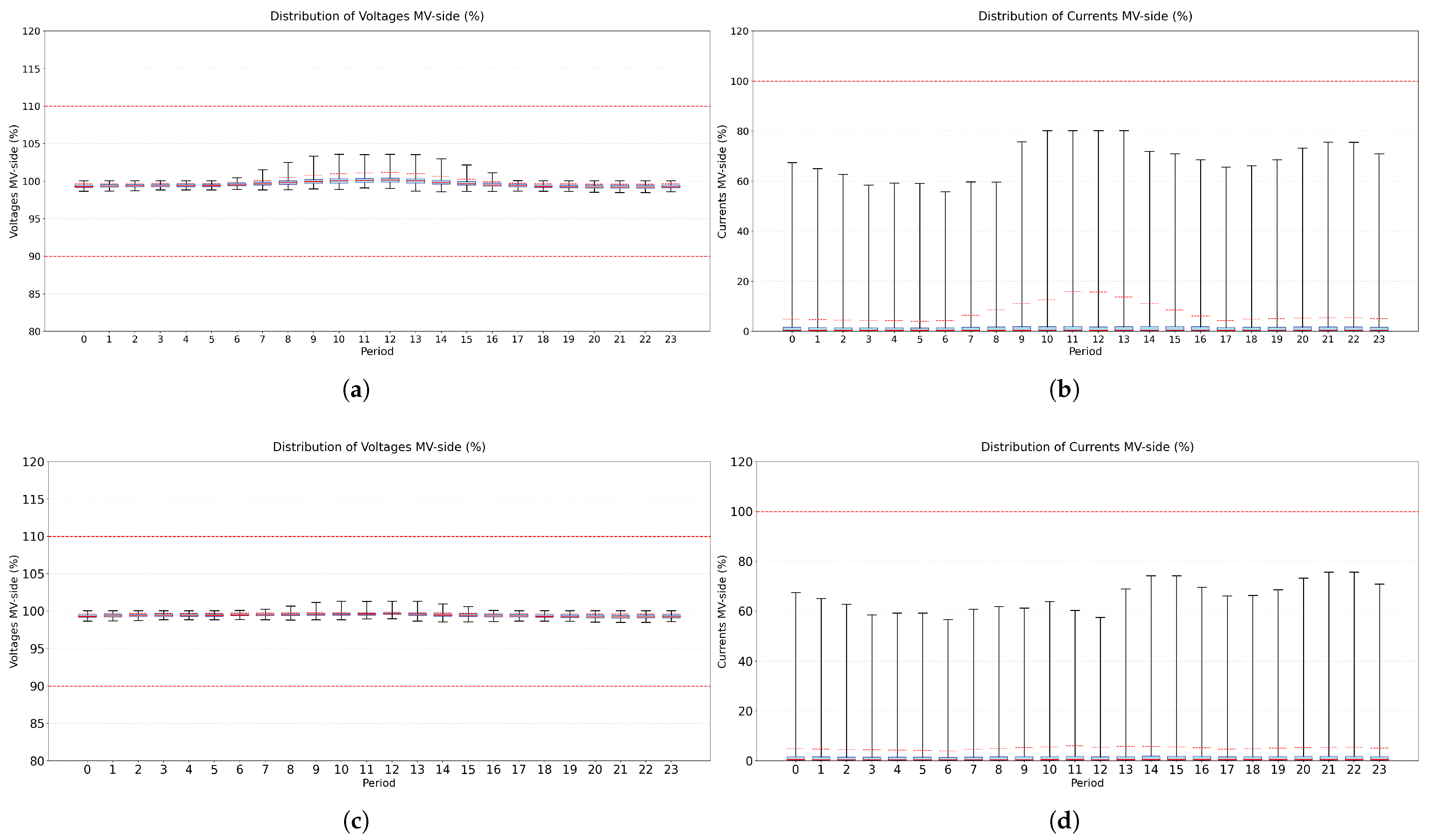
For illustration, Figure 13a,b reports the (V) and (I) values for the E1(G) outcome as hourly box plots with active power exchange with the upstream grid. The red dashed lines mark the operating limits, and no violations occurred during any hour. Voltages are expressed as percentages of the 13.8 kV (nominal voltage). The currents are expressed as percentages of each element’s nominal current. Figure 13c,d presents the (V) and (I) values for the E1(G) outcome with zero active power exchange with the upstream grid. All operating constraints are satisfied, with greater dispersion in voltage and current observed in Figure 13a,b, owing to the higher HC obtained in this scenario.
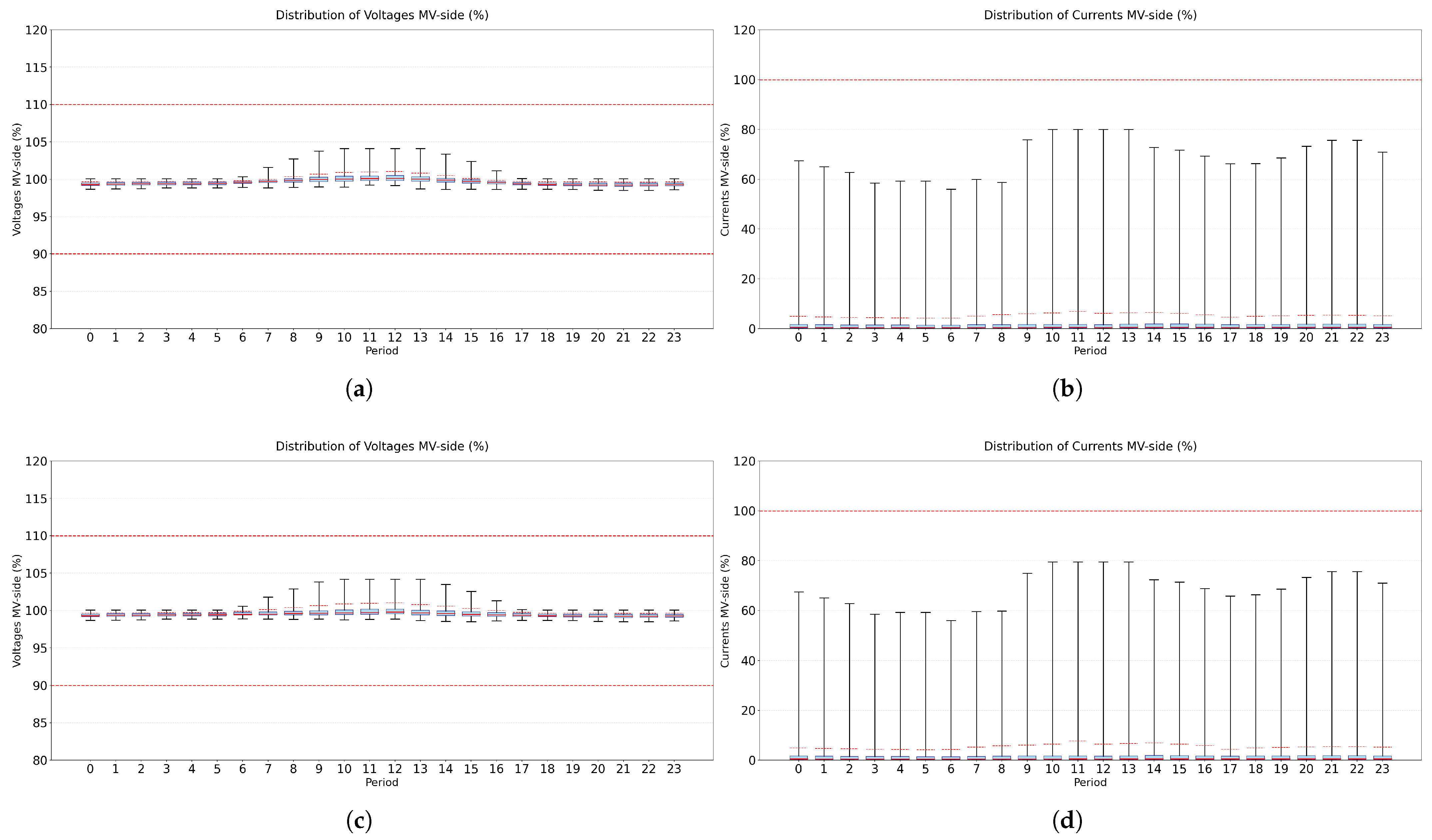
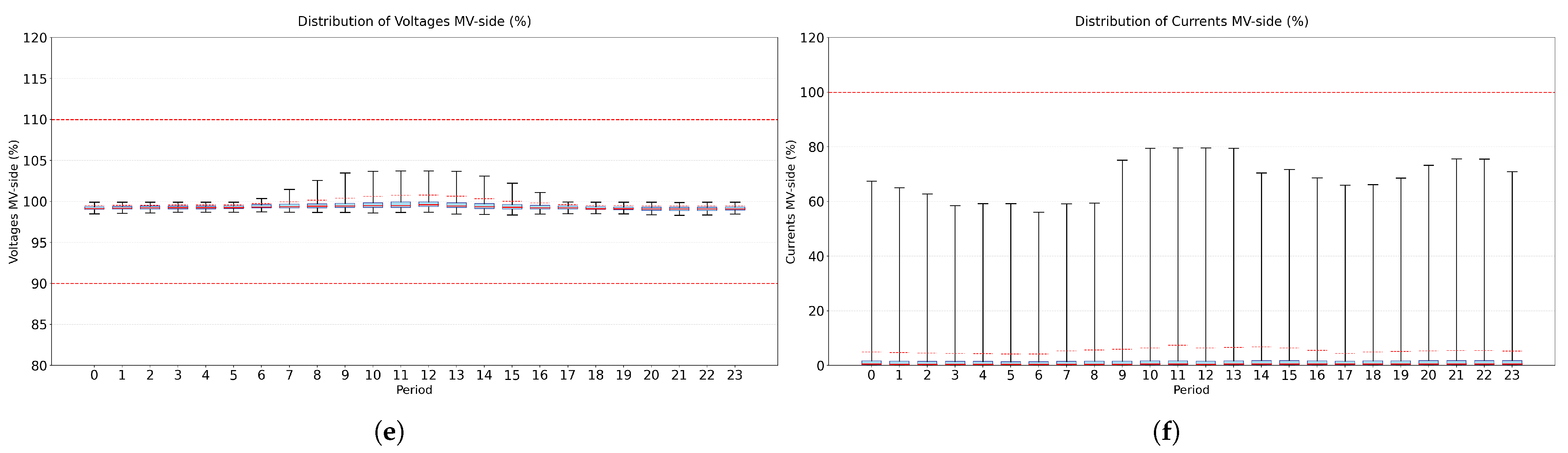
Figure 14a–d shows the voltage (V) and current (I) results for scenarios E2(G) and E3(G) in Table 5. In both cases, the operating constraints were met, and the profiles were very similar across the two scenarios. Figure 15a–f reports the performance results for the cases in Table 5 that consider PV units with capacities below 1000 kW , namely E1(DG), E2(DG), and E3(DG). Once compliance with the operating constraints is verified for scenarios with a higher HC, it is guaranteed for scenarios with a lower HC.
For each scenario, Table 5 and Table 6 report the expected exported energy ( E exp ) and energy losses ( E loss ) computed over solar irradiance hours. The reference energy loss is E loss base , whose central tendency value is 218 kWh for the CENS 1428-bus network. Table 6 shows the results under a zero export constraint. In this case, the mean HC is 1844 kW, which represents a 75.8% reduction relative to the 7622 kW average obtained in scenarios that allow power export. The energy-loss metric ( E loss ) is computed for all scenarios, and Δ loss was evaluated. G exp is omitted because all values are zero.

4.3.2. Non-Sparse HC Results

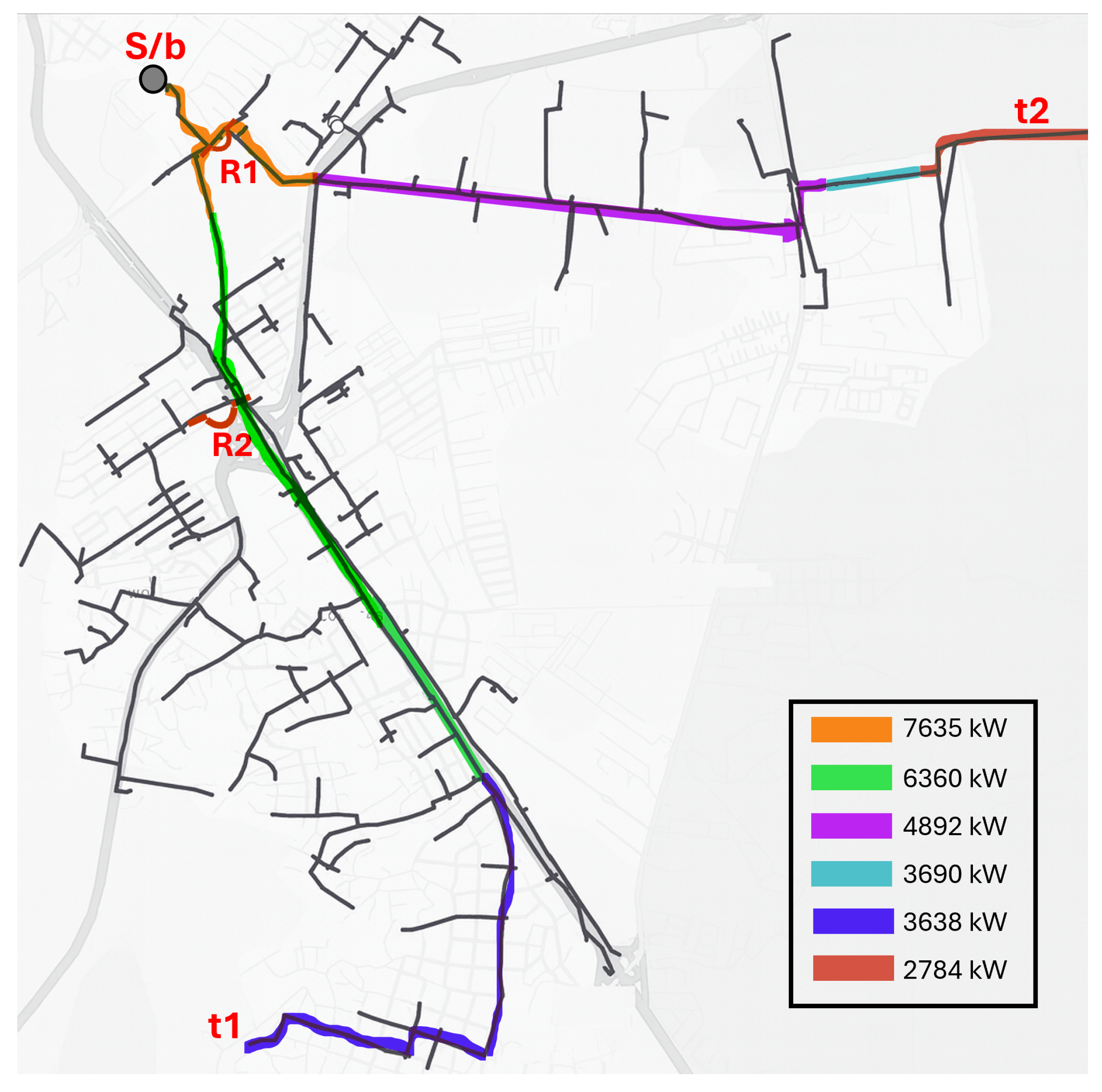
The results in Figure 16 correspond to the non-sparse HC estimation applied to the two main branches of the feeder. Six zones are identified, each associated with a limiting injection capacity. These zonal HC values are obtained by selecting a conservative value that safely represents PV integration in each zone.
Figure 14. Box plots of performance metrics of escenarios E2(G) and E3(G) of Table 5 (The red dashed line corresponds to the respective operating limits): (a) Voltages on the MV-side in scenario E2(G). (b) Currents on the MV-side in scenario E2(G). (c) Voltages on the MV-side in scenario E3(G). (d) Currents on the MV-side in scenario E3(G).
Electricity 07 00012 g014
Figure 15. Box plots of performance metrics of escenarios E1(GD), E2(GD) and E3(GD) of Table 5 (The red dashed line corresponds to the respective operating limits): (a) Voltages on the MV-side in scenario E1(GD). (b) Currents on the MV-side in scenario E1(GD). (c) Voltages on the MV-side in scenario E2(GD). (d) Currents on the MV-side in scenario E2(GD). (e) Voltages on the MV-side in scenario E3(GD). (f) Currents on the MV-side in scenario E3(GD).
Electricity 07 00012 g015aElectricity 07 00012 g015b
Figure 16. Non-sparse HC along the two main feeders.
Electricity 07 00012 g016
For example, the green zone has a zonal HC of 6360 kW and includes 33 nodes. This means that either a single PV system rated 6360 kW can be integrated at one node in the green zone, or multiple PV systems can be connected at different nodes in the zone, provided that the sum of their capacities does not exceed 6360 kW . Once a set of PV systems that utilize the 6360 kW capacity is installed in the green zone, HC must be recalculated for the remaining zones to identify the residual potential for subsequent projects.
The method is also applied to determine zonal HC on lateral feeders, identifying zonal HC values and their associated limiting injection capacities. In the optimization environment, 65 lateral feeders derived from the two main branches are modeled. Table 7 summarizes the statistics of the zonal HC values computed for the 73 zones obtained through the conservative solution procedure. Lateral feeders are grouped according to the main branch from which they originate. The results in Table 7 show that the laterals derived from branch 1-t2 exhibit higher zonal HC values, indicating a greater integration potential in the area supplied by branch 1-t2 and its laterals.
Non-sparse HC solutions can be evaluated in a probabilistic environment to estimate performance metrics, such as technical losses and exported energy. For a given zonal hosting capacity, multiple PV systems satisfy the integration-capacity limit; therefore, selected cases of interest, including worst-cases for energy losses, can be analyzed.
Table 8 reports the performance results for four HC solutions with PV integrated within the green HC zone of 6360 kW . Solutions H C PV 1 and H C PV 2 correspond to a single PV unit of 6360 kW connected to the first node in the zone (closest to the slack bus) and the last node in the zone, respectively. Solutions H C PV 3 and H C PV 4 correspond to integrations with PV units smaller than 1000 kW , specifically, six 999 kW units and one 366 kW unit, respectively. These PV systems are connected at seven nodes as follows: for H C PV 3 , at the seven consecutive nodes in the zone closest to the slack bus, and for H C PV 4 , at the seven nodes in the zone farthest from the slack bus.

4.3.3. Discussion

The proposed HC estimation method enables the exploration of feasible HC solutions in a distribution network, both sparse and non-sparse, with PV systems interconnected at a wide set of locations. The performance evaluation environment then assesses the impact of candidate HC solutions that are considered feasible for implementation.
In the optimization environment, the computation time to obtain each sparse HC solution reported in Table 5 and Table 6 was less than 42 s. For the non-sparse solutions in Figure 16 and Table 7, evaluating all nodes on the main and lateral feeders requires 25 min. These computation times are suitable for planning teams responsible for PV integration in distribution networks.
In the performance evaluation environment, considering one HC solution at a time, the Monte Carlo simulations for a single hourly period required 9 min. Thus, for the 12-period window with solar irradiance, the probabilistic performance metrics of the network were obtained within 108 min.
Regarding the results obtained with the proposed method, a key finding is the impact of the constraint on active power export to the upstream grid. When exports are forced to zero, sparse HC decreases by approximately 75% relative to the integration potential when exports are allowed. This result is relevant for planning teams, which often adopt conservative integration strategies that avoid export and consequently reduce the number of PV systems that can be integrated, as illustrated in this study.
The location-constrained cases E 2 and E 3 yield lower HC values than the unconstrained location case E 1 . However, both remain above 90% of the global maximum of 7830 kW ; therefore, a planning team may still regard them as feasible options for PV interconnection. The acceptance margin for feasible solutions (e.g., 10% below the global optimum in this example) is set by the planning team according to its own criteria when deciding which solutions to retain.
The sparse HC solutions computed for the 12 scenarios reported in Table 5 and Table 6 were subjected to probabilistic evaluation using Monte Carlo simulations. For each scenario, the results show that the voltage and current-capacity limits are satisfied at all nodes and network elements. These findings support the suitability of the optimization settings used to solve the HC problem, both in the selection of the demand level and in the configuration of the operating constraints.
One metric of interest in Table 5 is the exported energy, which identifies HC solutions with the highest expected export. Scenario E 3 ( DG ) is notable because the HC solution with eight PV units, each limited to ≤1000 kW, yields the lowest exported energy value among all scenarios. This outcome is driven by the physical characteristics of the conductors on the corresponding main branch 1-t2 and by the losses associated with integrating the eight PV systems at the determined locations.
The analysis of the Δ loss metric in Table 5 shows an increase in energy losses in all six scenarios relative to the base case without PV. However, we propose the index G exp to provide a more comprehensive assessment by balancing the increase in local distribution losses against exported energy, which reduces losses in upstream networks. Thus, Δ loss alone is insufficient to quantify the net impact of an optimally selected PV portfolio. The reported G exp values show that integrations on the main branch 1-t1 (scenarios E 2 ( G ) and E 2 ( DG ) ) are the most beneficial, with exported energy reaching up to 32 times the increase in the local loss. These results can help planners identify HC solutions that provide the greatest benefit for the DSO and, more generally, for end users by highlighting integration schemes with superior efficiency metrics.
For scenarios E 1 ( G ) , E 2 ( G ) , and E 2 ( D G ) in Table 6, the energy losses remain approximately equal to the base case value without PV. In the remaining scenarios, the losses increase, even though the HC values are much lower than those in Table 5. These findings indicate that even for low HC values, losses may increase when integration occurs in specific areas of the network. A method such as that proposed here allows these areas to be identified a priori during distribution-planning studies.
The non-sparse HC solutions obtained on the main branches define eight HC zones for safe PV integration in the distribution network. Some zones cover large portions of the feeder and provide useful information to stakeholders interested in projects at the nodes within each zone. These zonal HC values give the DSO compact and easily interpreted information that streamlines the connection studies required in PV interconnection approval processes.
Table 7 reports the zonal HC values for all lateral feeders, which are similar and close to those obtained for the main branches. Taken together, these results provide a global view of the integration capacity of the distribution network.
The results in Table 8 are obtained by probabilistically evaluating the PV integrations defined from the green zonal HC result. The zonal HC of 6360 kW is lower than that of the sparse solutions in Table 5 because it is a conservative value selected for a set of 33 nodes. The performance metrics for the non-sparse solutions indicate lower network losses, with further reductions when the PV systems are located near the slack bus. This guides decision making so that the 6360 kW HC solution, which is 81% of the global maximum HC, is integrated at locations that avoid increasing network losses.
The same quantitative analysis can be extended to the remaining HC zones to identify areas with the largest increases in energy losses and assess their impact on exported energy.

5. Conclusions

This paper presents an optimization-based framework for estimating the photovoltaic hosting capacity in MV distribution networks to support distribution system operator planning. The PV-HC problem is formulated as a mixed-integer quadratically constrained program without linearizing approximations, preserving the nonlinear power-flow relationships and operating limits required to represent secure PV integration. The formulation jointly determines PV sizes and locations while enforcing DSO-configurable constraints on candidate PV locations, per-unit PV capacity limits, active-power exchange with the upstream grid, and PV power factor. This structure provides a unified mechanism to represent alternative regulatory and operational policies within the same HC model.
A central contribution of this study is the definition and use of sparse and non-sparse HC solution classes. Sparse solutions allocate PV capacity to a limited subset of candidate nodes, supporting planning contexts dominated by a small number of projects. Non-sparse solutions are derived from sequential locational HC evaluations and aggregated into conservative zonal HC values that support multiple projects distributed along the extended feeder sections. Together, these solution classes shift the focus from a single optimum to a set of feasible integration plans that can be interpreted and compared in the planning context.
The proposed method was implemented in the Hosting Capacity–Distribution Planning Tool (HC-DPT), which integrates a Python–AMPL optimization environment with a Python–OpenDSS probabilistic evaluation environment. The worst-case operating points are obtained from probabilistic models of demand and solar irradiance, and Monte Carlo simulations quantify the performance under uncertainty. The results from a real MV case study show that the framework computes sparse and non-sparse HC solutions under multiple planning constraints with computation times compatible with routine DSO workflows. Regarding the limitations, the proposed method relies on high-quality network modeling data, which are often challenging to obtain in real distribution systems owing to discrepancies between the network model and field assets. Moreover, constructing the optimization model requires expert knowledge for data preparation and tabulation, because this stage is prone to errors that may lead to inaccurate HC results or prevent algorithm execution. In addition, the method requires sufficient and reliable measurement data for demand modeling.
For the IEEE 33-bus case study, the proposed method shows high accuracy and improved computational performance when benchmarked against a linear HC formulation. The proposed MIQCP approach accommodates an 8.4% higher PV capacity by maximizing PV integration while enforcing physical laws and regulatory limits through a computationally efficient formulation. Validation using a nonlinear power flow yields errors below 1% in the operating variables, which supports the accuracy of the HC results obtained using the proposed method.
The real case study yielded planning-relevant findings. Active-power export constraints at the upstream interface strongly affect HC outcomes; enforcing zero export reduces sparse HC by approximately 75% relative to cases that allow export, illustrating the impact of conservative operating policies. PV siting also affects both HC and performance; concentrating PV on selected main branches can achieve HC values close to the global optimum with favorable loss and export behavior, whereas integration on specific laterals can increase losses, even at low HC levels. Zonal HC outputs provide compact indicators that can be communicated to stakeholders and used to streamline interconnection processing, provided that zonal limits are respected and updated as PV systems are added.
Finally, the index G exp strengthens the planning assessment by jointly accounting for exported energy and changes in local distribution losses, supporting a system-level interpretation beyond loss variations alone. By combining MIQCP-based HC computation, zonal HC construction, worst-case scenario selection, and probabilistic performance evaluation, the proposed framework provides DSOs with actionable quantitative information to compare integration strategies and support secure and efficient large-scale PV deployment in MV distribution networks.

Author Contributions

Conceptualization, J.B.-S.; methodology, J.B.-S.; software, J.B.-S.; validation, J.B.-S. and D.J.C.M.; formal analysis, J.B.-S. and D.J.C.M.; investigation, J.B.-S. and D.J.C.M.; resources, J.B.-S., D.J.C.M. and D.L.C.C.; data curation, J.B.-S.; writing—original draft preparation, J.B.-S.; writing—review and editing, J.B.-S.; visualization, J.B.-S.; supervision, D.J.C.M. and D.L.C.C.; project administration, J.B.-S., D.J.C.M. and D.L.C.C. All authors have read and agreed to the published version of the manuscript.

Funding

This work was supported by the Ministry of Science, Technology, and Innovation (Ministerio de Ciencia, Tecnología e Innovación-Minciencias) and the Francisco José de Caldas Fund (Fondo Francisco José de Caldas), Colombia, under grant No. 112721-344-2023. The article processing charge was likewise funded by MinCiencias and the Francisco José de Caldas Fund.

Institutional Review Board Statement

Not applicable.

Informed Consent Statement

Not applicable.

Data Availability Statement

Data are available upon request.

Acknowledgments

We gratefully acknowledge Centrales Eléctricas del Norte de Santander S.A. E.S.P. (CENS) for providing the data and conditions required to conduct this research. The authors acknowledge the Universidad Industrial de Santander (UIS) for institutional support and resources provided to the principal investigator during the development of this study. During the preparation of this manuscript, we have used ChatGPT (OpenAI) for language editing.

Conflicts of Interest

The authors D.J.C.M. and D.L.C.C. are employed by CENS. The authors declare no conflicts of interest.

Abbreviations

SymbolDescription
Sets
S br set of feeder branches
G PV candidate nodes for PV interconnection
Parameters
P j L active power demand at node j at nominal voltage (1 p.u.)
Q j L reactive power demand at node j aat nominal voltage (1 p.u.)
r i j series resistance of branch i j
x i j series reactance of branch i j
p f Power factor of the PV systems
g i j series conductance of branch i j
b i j series susceptance of branch i j
I i j , max current rating of branch i j
V min minimum permissible voltage magnitude
V max maximum permissible voltage magnitude
S s m a x maximum apparent power at the slack bus
w p z , w p i , and w p p ZIP load model parameters
P S r e f Limit on the active power entering the slack bus from the upstream grid
P gd max PV unit capacity limit
N m a x g d Maximum number of candidate nodes that can host PV systems
u 1 Equivalent voltage magnitude at the slack bus
Variables
P j P V Active power injected by the PV system at node j
Q j P V Reactive power injected by the PV system at node j
P S Active power injected at the slack bus
Q S Reactive power injected at the slack bus
P i j Active-power flow in branch i j
Q i j Reactive-power flow in branch i j
u j Equivalent voltage magnitude at node j
l i j Squared current magnitude in branch i j
w g d j Binary variable indicating the interconnection of a PV system at node j
R i j Variable equivalent to | V i | | V j | c o s θ i j
T i j Variable equivalent to | V i | | V j | s i n θ i j

References

  1. Mousa, H.H.H.; Mahmoud, K.; Lehtonen, M. A Comprehensive Review on Recent Developments of Hosting Capacity Estimation and Optimization for Active Distribution Networks. IEEE Access 2024, 12, 18545–18593. [Google Scholar] [CrossRef]
  2. Qamar, N.; Arshad, A.; Mahmoud, K.; Lehtonen, M. Hosting capacity in distribution grids: A review of definitions, performance indices, determination methodologies, and enhancement techniques. Energy Sci. Eng. 2023, 11, 1536–1559. [Google Scholar] [CrossRef]
  3. Comisión de Regulación de Energía y Gas (CREG). Resolución CREG 174 de 2021. 2021. Available online: https://gestornormativo.creg.gov.co/gestor/entorno/docs/resolucion_creg_0174_2021.htm (accessed on 21 October 2025).
  4. National Laboratory of the Rockies (NRL). Advanced Hosting Capacity Analysis. 2024. Available online: https://www.nrel.gov/solar/market-research-analysis/advanced-hosting-capacity-analysis (accessed on 11 November 2025).
  5. Qammar, N.; Arshad, A.; Miller, R.J.; Mahmoud, K.; Lehtonen, M. Probabilistic hosting capacity assessment towards efficient PV-rich low-voltage distribution networks. Electr. Power Syst. Res. 2024, 226, 109940. [Google Scholar] [CrossRef]
  6. Mulenga, E.; Lulea, N.E. Multiple distribution networks hosting capacity assessment using a stochastic approach. Sustain. Energy Grids Netw. 2023, 36, 101170. [Google Scholar] [CrossRef]
  7. Hanjalic, M.; Melic, E.; Saric, M.; Hivziefendic, J. Hosting Capacity Assessment in Electrical Power Distribution Systems Using Genetic Algorithm. Electr. Power Compon. Syst. 2023, 51, 2354–2366. [Google Scholar] [CrossRef]
  8. Mulenga, E. Solar PV Stochastic Hosting Capacity Assessment Considering Epistemic (E) Probability Distribution Function (PDF). Electricity 2022, 3, 586–599. [Google Scholar] [CrossRef]
  9. Ul Hassan, S.J.; Gush, T.; Kim, C.H. Maximum Hosting Capacity Assessment of Distribution Systems with Multitype DERs Using Analytical OPF Method. IEEE Access 2022, 10, 100665–100674. [Google Scholar] [CrossRef]
  10. Abad, M.S.S.; Ma, J.; Mang, D.; Ahmadyar, A.S.; Marzooghi, H. Probabilistic Assessment of Hosting Capacity in Radial Distribution Systems. IEEE Trans. Sustain. Energy 2018, 9, 1935–1947. [Google Scholar] [CrossRef]
  11. Pereira, O.; Parajeles, M.; Zúñiga, B.; Quirós-Tortós, J.; Valverde, G. Hosting Capacity Estimation for Behind-the-Meter Distributed Generation. IEEE Trans. Power Syst. 2024, 39, 4911–4923. [Google Scholar] [CrossRef]
  12. Carmelito, B.E.; de Carvalho Filho, J.M. Hosting Capacity of Electric Vehicles on LV/MV Distribution Grids-A New Methodology Assessment. Energies 2023, 16, 1509. [Google Scholar] [CrossRef]
  13. Zenhom, Z.M.; Aleem, S.H.E.A.; Zobaa, A.F.; Boghdady, T.A. A Comprehensive Review of Renewables and Electric Vehicles Hosting Capacity in Active Distribution Networks. IEEE Access 2024, 12, 3672–3699. [Google Scholar] [CrossRef]
  14. Alturki, M.; Khodaei, A.; Paaso, A.; Bahramirad, S. Optimization-based distribution grid hosting capacity calculations. Appl. Energy 2018, 219, 350–360. [Google Scholar] [CrossRef]
  15. Wu, H.; Yuan, Y.; Zhang, X.; Miao, A.; Zhu, J. Robust comprehensive PV hosting capacity assessment model for active distribution networks with spatiotemporal correlation. Appl. Energy 2022, 323, 119558. [Google Scholar] [CrossRef]
  16. Takenobu, Y.; Yasuda, N.; Minato, S.i.; Hayashi, Y. Scalable enumeration approach for maximizing hosting capacity of distributed generation. Int. J. Electr. Power Energy Syst. 2019, 105, 867–876. [Google Scholar] [CrossRef]
  17. Solat, S.; Aminifar, F.; Shayanfar, H. Distributed generation hosting capacity in electric distribution network in the presence of correlated uncertainties. IET Gener. Transm. Distrib. 2021, 15, 836–848. [Google Scholar] [CrossRef]
  18. Jabr, R.A. Radial distribution load flow using conic programming. IEEE Trans. Power Syst. 2006, 21, 1458–1459. [Google Scholar] [CrossRef]
  19. Home-Ortiz, J.M.; Macedo, L.H.; Vargas, R.; Romero, R.; Mantovani, J.R.S.; Catalao, J.P.S. Increasing RES Hosting Capacity in Distribution Networks Through Closed-Loop Reconfiguration and Volt/VAr Control. IEEE Trans. Ind. Appl. 2022, 58, 4424–4435. [Google Scholar] [CrossRef]
  20. Fourer, R.; Gay, D.M.; Kernighan, B.W. AMPL: A Modeling Language for Mathematical Programming; Boyd & Fraser Publishing Company: Boston, MA, USA, 1993. [Google Scholar]
  21. Capitanescu, F.; Ochoa, L.F.; Margossian, H.; Hatziargyriou, N.D. Assessing the Potential of Network Reconfiguration to Improve Distributed Generation Hosting Capacity in Active Distribution Systems. IEEE Trans. Power Syst. 2015, 30, 346–356. [Google Scholar] [CrossRef]
  22. Venkatesh, B.; Ranjan, R.; Gooi, H. Optimal reconfiguration of radial distribution systems to maximize loadability. IEEE Trans. Power Syst. 2004, 19, 260–266. [Google Scholar] [CrossRef]
  23. Short, T.A.; Mee, R.W. Voltage reduction field trials on distributions circuits. In Proceedings of the 2012 IEEE PES Transmission and Distribution Conf. Expo. (T&D), Orlando, FL, USA, 7–10 May 2012. [Google Scholar] [CrossRef]
  24. Dugan, R.C.; McDermott, T.E. OpenDSS Manual: The Open Distribution System Simulator; Electric Power Research Institute (EPRI): Palo Alto, CA, USA, 2012; Available online: https://sourceforge.net/projects/electricdss/ (accessed on 1 March 2024).
Figure 1. Distribution line model.
Electricity 07 00012 g001
Figure 8. Single-line diagram of the CENS 1428-bus network.
Electricity 07 00012 g008
Figure 9. Values of active power demand for the CENS 1428-bus, years 2023–2024.
Electricity 07 00012 g009
Figure 10. Values of solar irradiance, years 2023–2024.
Electricity 07 00012 g010
Figure 11. Hours with coincident demand/generation for the CENS 1428-bus feeder.
Electricity 07 00012 g011
Figure 12. HC-sparse solutions: PV placement.
Electricity 07 00012 g012
Figure 13. Box plots of performance metrics (The red dashed line corresponds to the respective operating limits): (a) Voltages on the MV-side in scenario E1(G) of Table 5. (b) Currents on the MV-side in scenario E1(G) of Table 5. (c) Voltages on the MV-side in scenario E1(G) of Table 6. (d) Currents on the MV-side in scenario E1(G) of Table 6.
Electricity 07 00012 g013
Table 1. Results of the two HC estimation methods for IEEE 33-bus.
MethodScenario 1Scenario 2
HC (kW)Constraint
activated
Computing
Times (s)
HC (kW)Constraint
Activated
Computing
Times (s)
[14]8484Power
export
218484Power
export
NR a
Proposed
method
9262Power
export
3.14 8546Power
export
0.2384
a NR: not reported.
Table 2. Characteristic of the CENS 1428-bus network.
CharacteristicReal Distribution Network
CENS 1428-bus
Length, km38.7
Nominal voltage, kV13.8
Peak load, kW5600
MV / LV transformers236
Customers9829
Operating conditionRadial/unbalanced
Table 3. Descriptive statistics for solar irradiance (W/m2).
ValuePeriod
567891011121314151617
Min0792939501829715223600
25th05215230545055261360253542927210121
50th77822941959371078176869356137817739
75th1210831754575388199297784569547525257
95th17156422680907105811261113100481858831682
Max302014697289461101117611491042864637372114
Table 4. Optimization parameters for solving the HC problem.
ParameterValue
Slack bus voltage1.0 p.u.
Maximum voltage1.075 p.u.
Minimum voltage0.925 p.u.
Maximum line loading80%
Maximum transformer loading80%
Power factor of P j P V 1
Table 5. HC of the CENS 1428-bus feeder with P s 10 , 000 kW.
Nodes(G): Unconstrained P gd max
(DG): Constraint P gd max < 1000 kW
HC (kW), E exp (kWh), E loss (kWh)
HC (kW)Computing times (s)# PVs Max/Min   V      I    E exp E loss Δ loss G exp
E1(G)7830427
3655/31
11,652761+249%21
E1(DG)7807308
1000/827
11,471656+201%26
E2(G)7798294
3682/20
11,583602+176%30
E2(DG)7506288
1000/680
10,466544+150%32
E3(G)7776127
2841/35
11,457656+201%26
E3(DG)7014148
1000/270
8897602+176%23
Table 6. HC of the CENS 1428-bus feeder with P s 0 .
Nodes(G): Unconstrained P gd max
(DG): Constraint P gd max < 1000 kW
HCComputing times (s)# PVs Max/Min   V      I    E exp E loss Δ loss
E1(G)184482
1817/27
0212−3%
E1(DG)184473
1000/27
0251+15%
E2(G)184441
1844/–
0214−2%
E2(DG)1843152
1000/843
0209−4%
E3(G)184531
1845/–
0254+17%
E3(DG)184433
1000/110
0251+15%
Table 7. Statistic of zonal HC on lateral feeders (kW).
Laterals Originating From:Number of ZonesMin25th50th75th95thMax
1- t 1 50230935553589387047476452
1- t 2 23233835704682470748914977
Table 8. Network performance metrics for four HC solutions in green zone.
HC SolutionVI E exp ( kWh ) E loss ( kWh ) Δ loss ( kWh ) G exp
H C P V 1 6918170 48 41
H C P V 2 6651312−9471
H C P V 3 6759145 73 47
H C P V 4 6732198 20 34
Disclaimer/Publisher’s Note: The statements, opinions and data contained in all publications are solely those of the individual author(s) and contributor(s) and not of MDPI and/or the editor(s). MDPI and/or the editor(s) disclaim responsibility for any injury to people or property resulting from any ideas, methods, instructions or products referred to in the content.