
Proceeding Paper

Luminescence Decay Dynamics of a Down-Shifting Material †

by
Emeka Harrison Onah
1,*,
N. L. Lethole
1,2 and
P. Mukumba
1
1
Physics Discipline, Department of Computational Sciences, University of Fort Hare, Private Bag X1314, Alice 5700, Eastern Cape, South Africa
2
SAMRC Microbial Water Quality Monitoring Centre, University of Fort Hare, Private Bag X1314, Alice 5700, Eastern Cape, South Africa
*
Author to whom correspondence should be addressed.
Presented at the 4th International Conference on Applied Research and Engineering, Pretoria, South Africa, 21–23 November 2025.
Mater. Proc. 2026, 31(1), 24; https://doi.org/10.3390/materproc2026031024 (registering DOI)
Published: 29 April 2026
(This article belongs to the Proceedings of The 4th International Conference on Applied Research and Engineering)

Abstract

This study demonstrated luminescence decay dynamics of BaSiO3:Eu2+, elucidating its potential as a spectral converting down-shifting material for improving the performance of dye-sensitized solar cells (DSSCs). Time-resolved photoluminescent (TRPL) measurements under excitation pulses of a picosecond pulsed light-emitting diode (EPLED) revealed complex decay dynamics described by a triple-exponential model. Average lifetime was in nanoseconds, which facilitated rapid emission of down-shifted photons, essential to mitigating reabsorption losses. The presence of a fast decay channel is crucial to minimizing photon reabsorption and maximizing the flux of visible photons transferred to the dye molecules of DSSCs to enhance photocurrent generation.

1. Introduction

The search for sustainable and clean energy has driven significant advancements in solar energy conversion technology. Among these, dye-sensitized solar cells (DSSCs) have emerged as a promising alternative to conventional silicon-based photovoltaics due to their cost-effectiveness, flexibility and good performance under low-light and indoor conditions [1,2,3,4]. However, despite these advantages, DSSCs face challenges in terms of low-light-harvesting capability, especially in the ultraviolet (UV) region of the solar spectrum. Most sensitizing dyes used in DSSCs exhibit minimal absorption in the UV, leading to suboptimal utilization of the full solar irradiance. To address this limitation, researchers have been exploring the use of down-shifting materials, which are phosphors that can absorb high-energy photons (UV) and re-emit them in the visible range where the dye molecules are more responsive [5,6,7]. Advances in material design, such as durability under environmental stress and process scalability, have been explored in structural composites and advanced materials’ long-term functional stability [8,9,10]. In this context, luminescent down-shifting materials for DSSCs must combine optical efficiency with structural and environmental stability. Among various luminescent materials, barium orthosilicate doped with divalent europium (BaSiO3:Eu2+) has good optical and photostability properties. The BaSiO3:Eu2+ was selected due to its broad visible emission well-matched to common DSSC dye absorption, chemical stability with low phonon energy of the silicate host, and favorable nanosecond-scale decay dynamics compared to other alternatives like the aluminate vanadate and titanate-based down-shifting materials. In terms of photostability [11,12], the material equally exhibits robust photostability under prolonged UV irradiation, making it suitable as a down-shifting material in photovoltaic applications, which can absorb high UV light and emit it in the visible region where DSSCs have good spectral responsivity for better device performance.
However, the application of BaSiO3:Eu2+ in DSSCs centers on luminescent decay dynamics [13,14]. The excited-state lifetimes and the balance between radiative and non-radiative transitions govern the emission process in such phosphors. Luminescent decay lifetime reflects the average time [15] an excited electron remains in the excited 5d state before returning to the ground 4f state, either by emitting a photon or by transferring energy through non-radiative channels. This decay behavior affects the timing and probability of energy transfer [16] to adjacent dye molecules in the DSSC structure. In down-shifting applications, materials with faster decay lifetimes are generally preferable as they indicate efficient radiative transition and reduced energy losses. In materials like BaSiO3:Eu2+, multi-exponential decay profiles are often observed due to the presence of multiple Eu2+ environments. This effect can enhance overall luminescent performance, due to its impact on emission efficiency and stability.
In this study, we analyzed the luminescent decay behavior of BaSiO3:Eu2+ synthesized via a conventional solid-state technique. Surface morphology and elemental composition were analyzed by a scanning electron microscope (SEM) and energy-dispersive X-ray spectroscopy (EDS), respectively. The luminescent properties were studied through photoluminescent (PL) excitation (355 nm) and PL emission (565). PL emission demonstrated strong broadband emission from approximately 460–650 nm attributed to the 4f65d1 → 4f7 electronic transition of Eu2+. Quantum yield analysis was carried out to determine the luminescence efficiency in terms of the ratio of the integrated emission spectrum to the integrated excitation spectrum of the material. Time-resolved PL measurements under excitation pulses of a picosecond pulsed light-emitting diode—EPLD—demonstrated complex decay dynamics, which can be described via a triple-exponential model. The average lifetime was estimated to be in nanoseconds, which facilitated rapid emission of down-shifted photons essential for mitigating reabsorption losses. The presence of a fast decay channel is crucial to minimizing photon reabsorption and maximizing the flux of visible photons transferred to the dye molecules of DSSCs to enhance photocurrent generation. Therefore, this research depicted the suitability of the down-shifting material for efficient energy transfer in DSSCs. The rapid luminescent decay revealed effective down-shifting of high-energy UV photons into lower energy levels in the visible range, thereby encouraging photon absorption for DSSC enhancement. The novelty of this work demonstrates that, unlike previous studies that primarily focused on the steady-state photoluminescence or device-level efficiency enhancement, this study uniquely emphasized time-resolved photoluminescence (TRPL) decay dynamics of BaSiO3:Eu2+ and its direct relevance to luminescence down-shifting for DSSC applications. Specifically, this study provided a clear demonstration of how fast decay components mitigate photon reabsorption losses, which, to the best of our knowledge, has not been studied in prior Eu2+-doped silicate materials. It also explicitly established a link between nanosecond-scale average lifetime and enhanced photon flux transferred to DSSC dye molecules.

2. Materials and Methods

2.1. Experimental Procedure

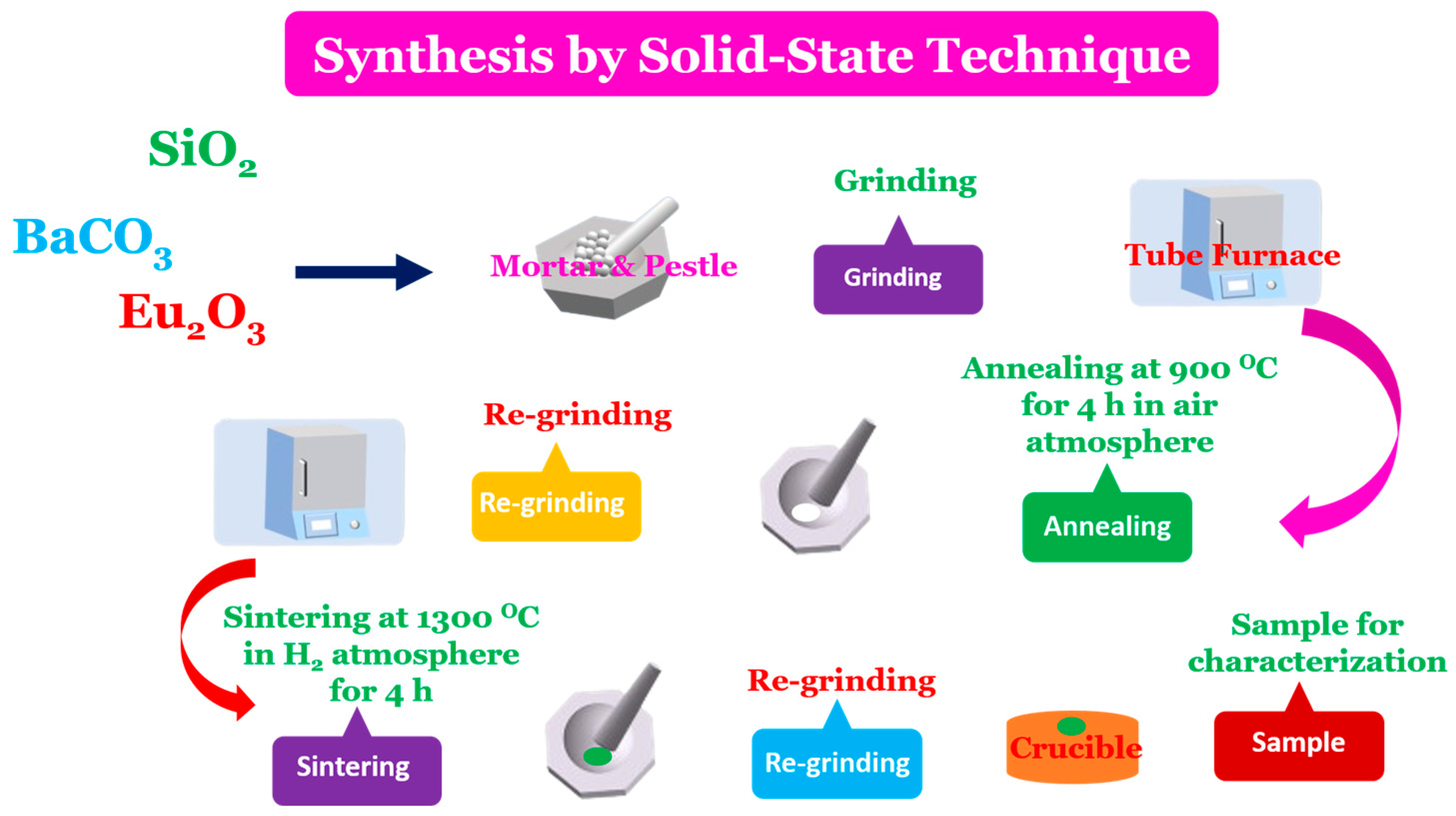
The starting materials for the synthesis of Ba(1−x)SiO3:xEu2+ were barium carbonate (BaCO3), silicon dioxide (SiO2), 99.99%, and europium oxide (Eu2O3), 99.99%, all of analytical grade, purchased from Sigma-Aldrich chemical company, Johannesburg, South African branch. The europium (II)-doped barium silicate phosphor Ba(1−x) SiO3:xEu2+ (x = 0.03 mol) was synthesized by the conventional solid-state route. The choice of concentration (x = 0.03 mol = 3 mol %) of Eu2+ was due to the concentration quenching effect usually observed in Eu2+-activated silicate. Concentration beyond this threshold could lead to non-radiative energy transfer between activator ions, which can reduce emission efficiency. The workflow for the synthesis is shown in Figure 1. The specific experimental steps applied were as follows: first, the starting materials were initially weighted according to the nominal stoichiometry of Ba0.97SiO3:0.03Eu2+ phosphor; then, the powders were mixed evenly and milled thoroughly using a mortar and pestle. The chemical reaction that governed the stoichiometry calculation was as follows:
2BaCO3 + 2SiO2 + 2Eu2O3 Materproc 31 00024 i001 2Ba(1−x)SiO3:xEu2+ + 2CO2 + 3O2
The ground samples were placed in an alumina crucible and subsequently transferred into a tube furnace, where it was annealed at 900 °C for 4 h in vacuum. After re-grinding, the sample was sintered to 1300 °C for 4 h under an H2 reducing atmosphere at approximately 100 standard cubic centimeters per minute (SCCM) in the same instrument. After cooling down the programmable furnace, the nominal compound of the BaSiO3:Eu2+ phosphor was obtained. Microstructural analysis was performed to study the surface morphologies of the phosphors using the scanning electron microscope (SEM) model—JSM-7800F—JOEL Limited, Tokyo, Japan—with an electron beam voltage of 5.0 keV and further equipped with an energy-dispersive X-ray spectroscope (EDS) for elemental identification. Photoluminescent (PL) emission was performed using the Cary Eclipse Spectrophotometer (Agilent Technologies, Santa Clara, CA, USA) and the emission lifetime measurement was carried out using the FLS980 spectrometer (Edinburgh Instruments, Scotland, UK). All characterizations were performed at room temperature, and all plots were created using Python 3.9.

2.2. Average Lifetime Estimation

The emission lifetime measurements were achieved using the FLS980 spectrometer (Edinburgh Instruments, Scotland, UK). The lifetime was recorded by the excitation with pulses of a picosecond pulsed light-emitting diode (LED), with the model number EPLED (360 nm, 100 kHz)—Edinburgh Instruments, Scotland, UK. The triple-exponential equation follows the following form [17,18,19]:
I t = A 1 e t τ 1 + A 2 e t τ 2 + A 3 e t τ 3 + C
where I is the luminescence intensity, t is the time, A1, A2 and A3 are the fitting parameters, τ 1 , τ 2 and τ 3 are the lifetimes for short, intermediate and long exponential components, and C is the constant offset or baseline. τ 1 is from the surface of Eu2+, τ 2 is near the surface and τ 3 is from the core of the phosphor particles. τ 1 is linked to the surface-related recombination, τ 2 is due to near-surface Eu2+ environments and τ 3 is attributed to the bulk lattice Eu2+ ions experiencing minimal non-radiative losses. The average lifetime (τav) can be estimated by Equation (2) [17,19].
τ a v = A 1 τ 1 2 + A 2 τ 2 2 + A 3 τ 3 2 A 1 τ 1 + A 2 τ 2 + A 3 τ 3
The coefficient of determination (R2) was applied as a performance metric for measuring the goodness of the triple-exponential model. The value of R2 ranges from 0 to 1. An R2 close to 1 indicates that a significant portion of the variability in the measured data was captured by the model, suggesting a strong correlation between the predicted and actual values. R2 is mathematically defined as follows [20]:
R 2 = 1 i = 1 n y i y i ^ 2 i = 1 n y i y ¯ 2
where n is the number of samples, y i is the actual value, y i ^ is the predicted value, and y ¯ is the mean of the actual value.

3. Results and Discussion

3.1. SEM Analysis

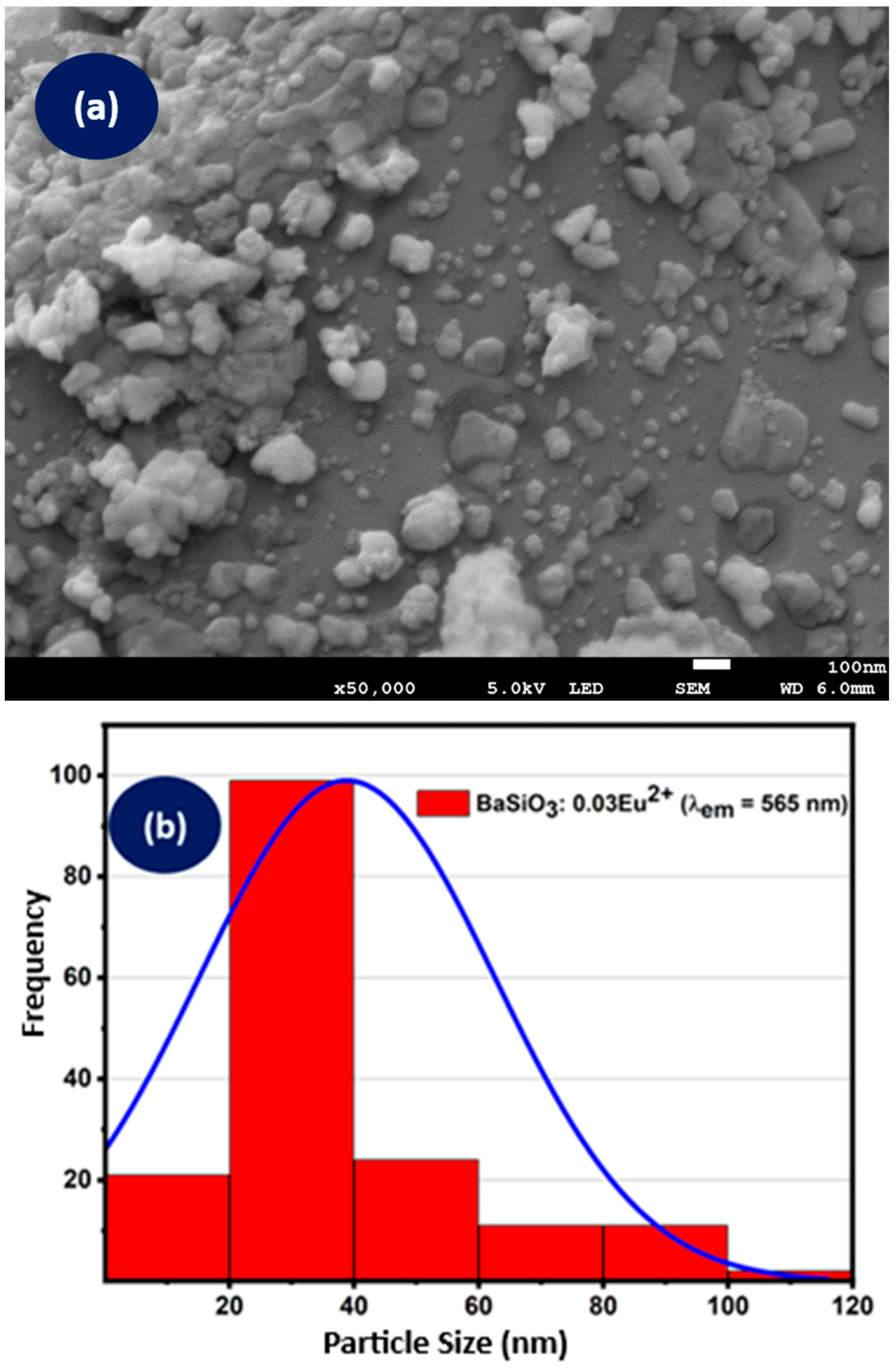
SEM is a crucial technique to gain insight into the morphology of nanomaterials. It provides insights into the shape, size, and surface morphology of the materials [21,22]. Surface morphology plays a critical role in the design and synthesis of phosphor materials, as it directly influences their optical and luminescent properties. The structural characteristics of the phosphor particles, such as their size, shape, and surface area, determine their efficiency in converting energy into light. Figure 2a shows the SEM image of the BaSiO3:Eu2+-emitting phosphors. The surface morphology of the sample has small and large particle sizes of non-uniform agglomeration. The surface of the sample has irregular shapes, which means that the distribution of the particle sizes is not homogenous. As shown in Figure 2b, the average size of the phosphor was estimated to be 30.5 nm. Nanoparticles with a mean size of around 30.5 nm offer a good balance between surface area and optical functionality. While particle agglomeration may locally reduce effective surface area and introduce light scattering, the nanometer-scale particles (~30.5 nm) still provided sufficient surface interaction for efficient photon conversion. Furthermore, moderate agglomeration can enhance light trapping and scattering within the DSSC architecture, which may be beneficial for photon harvesting. Smaller particle agglomeration provides a greater surface area for dye adsorption, which is essential for maximizing light-harvesting efficiency [23,24] in DSSCs. Therefore, while some larger particles are present, their lower frequency distribution suggests that they are unlikely to significantly hinder charge transport.

3.2. EDS Analysis

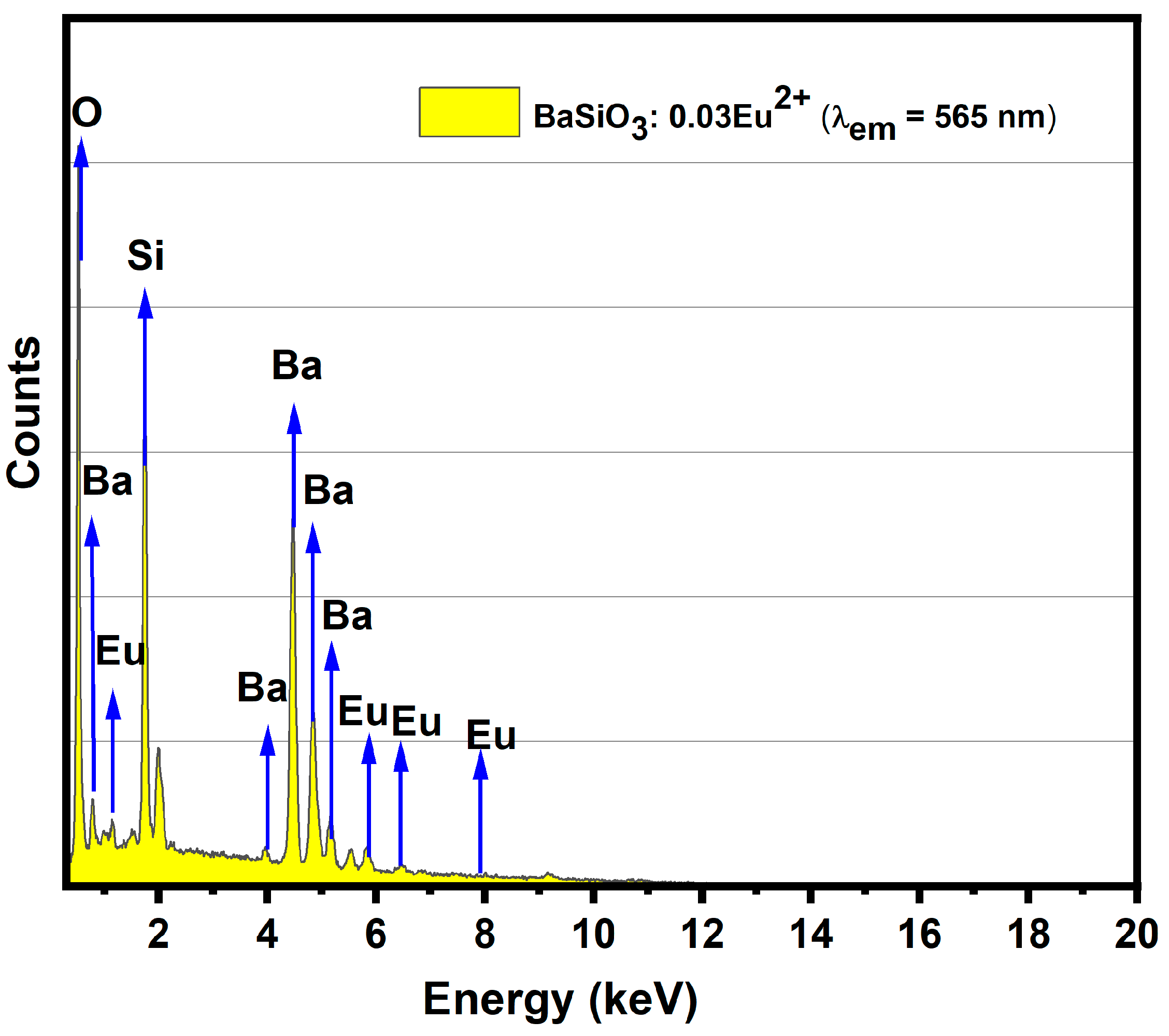
EDS is a qualitative and quantitative analytical technique that provides information on the chemical composition of a sample for elements with atomic numbers (Z) greater than 3 [17]. By exciting the sample via bombarding with a focused electron beam, EDS can be conducted. This excitation causes the emission of X-rays from the sample. The emitted X-rays are collected by the X-ray detector, and the individual X-rays detected are converted into electrical energy. Therefore, the electrical signals produced in this process serve as fingerprints for identifying elements, which allows elemental analysis to be conducted on the sample. In this study, EDS was primarily employed for qualitative elemental confirmation rather than stoichiometric quantification, due to the known limitations of EDS for low-dopant-concentration detection. As shown in Figure 3, the prominent peaks in the spectrum corresponded to barium (Ba), silicon (Si), oxygen (O), and europium (Eu), all of which are anticipated elements in the compound. Multiple strong peaks attributed to barium are observed at approximately 0.7 keV, 4 keV, 4.5 keV, 5.2 keV, and 5.7 keV, which align with the Ba Lα and Lβ emission lines. This shows that barium is a major constituent, as expected from the BaSiO3 matrix. A peak for silicon is visible around 1.75 keV, which is consistent with the presence of silicon from the orthosilicate (SiO4) structure. Additionally, a distinct peak at approximately 0.5 keV confirms the presence of oxygen, which is a crucial constituent of the oxide network. Europium was also detected through several small peaks ranging between 1.1 keV and 8 keV. These peaks are characteristic of Eu M and L emission lines. Although Eu was present in a low concentration (3 mol%), the sensitivity of EDS qualitative analysis enabled its detection, indicating that the doping process was effective. The presence of europium peaks confirms that Eu2+ ions were effectively integrated into the host lattice, thereby acting as substitutes for Ba2+ due to their similar ionic radii.

3.3. Photoluminescent Study

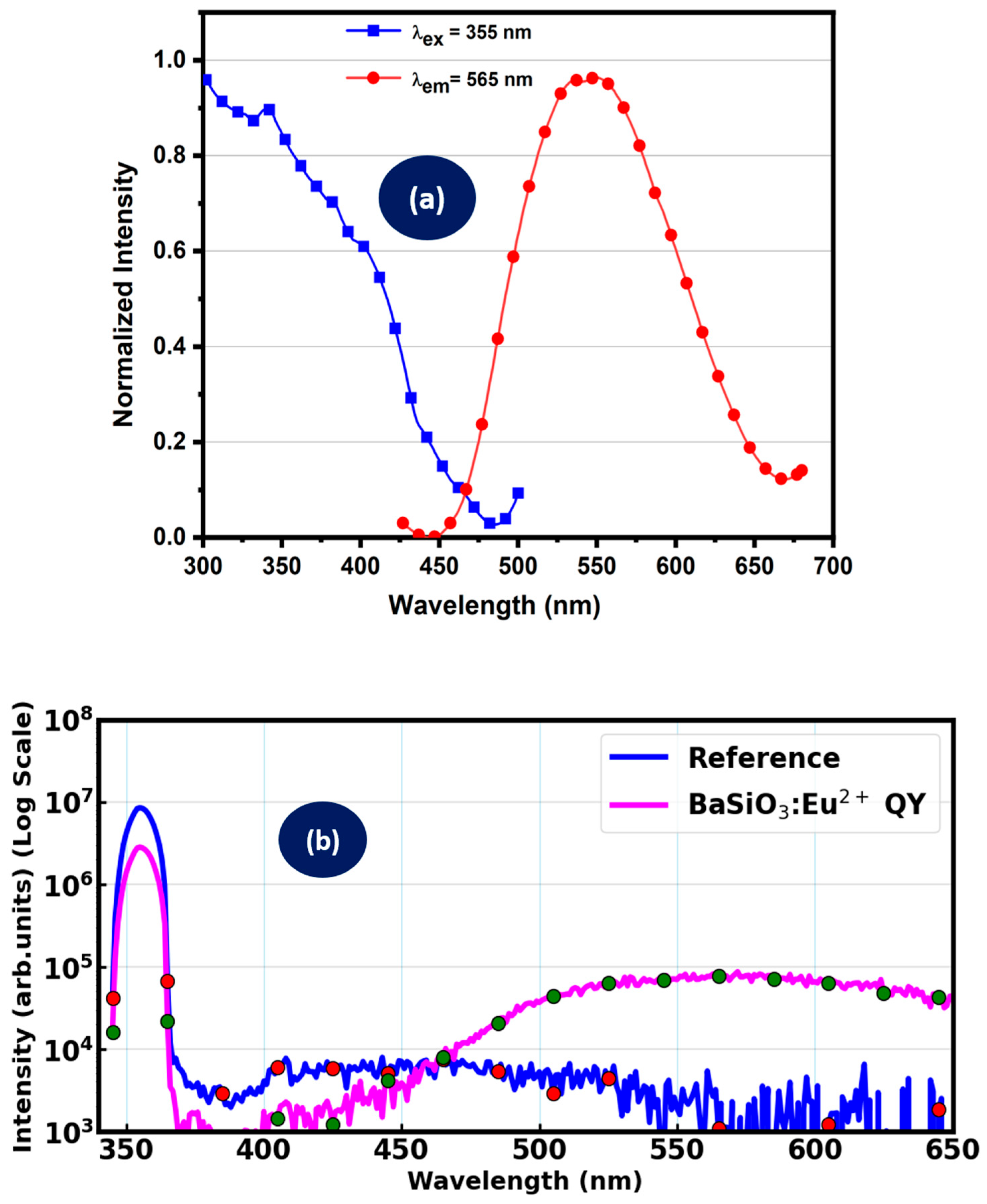
Photoluminescence is the emission of light from a material under optical excitation, and the light emitted can be collected for spectral analysis. A material undergoing photo-excitation causes its electrons to move to the allowed excited states. The electrons in the process of returning to the ground state emit energy, which may include the emission of light (the luminescent/radiative process) or no emission (non-radiative process). While recording the photoluminescence, both the excitation and emission spectra are scanned. Figure 4a presents the excitation and emission spectra of the phosphor. A broad absorption band from 300 to 460 nm was observed (λem = 565 nm) in the phosphor peaking at 355 nm. This can be attributed to the electronic dipole allowing the 4f7 → 4f65d1 transition of the BaSiO3: Eu2+ phosphor [18,19]. It also showed a broad emission band (λex = 355 nm), and the Stokes shift was calculated to be >200 nm from the difference between the emission wavelength and the excitation wavelength, which showed that emission spectra were found at longer wavelengths [19]. The incident photons of the UV–blue wavelengths were absorbed by the BaSiO3:Eu2+ phosphor and re-emitted within the visible wavelengths, approximately 460–650 nm, thereby demonstrating the luminescence down-shifting behavior of the material. Since DSSCs do not efficiently absorb the UV light, materials like BaSiO3:Eu2+ can effectively capture the UV/blue light and re-emit it as visible light, which can then be absorbed by the dye molecules of DSSCs [25].
The photoluminescence quantum yield of the silicate-doped europium (II) with the reference was depicted in Figure 4b. The fluorescence emission spectrum of the material and the excitation spectrum of the reference were collected using the integrating sphere. Quantum yield estimation resulted in a value of 0.05, which denotes the ratio of the integrated photon emission with respect to the integrated excitation spectra of the material. The photoluminescent and quantum yield analysis positioned BaSiO3:Eu2+ as a UV-absorbing down-shifting material that is suitable for DSSC applications. Also, a previous study on BaSiO3:Eu2+ [14] showed strong overlap between the emission range of the material (460–650 nm) and the N719 dye absorption profile (360–600 nm), thereby facilitating efficient energy transfer potential. Through the mechanism of energy transfer, the absorbed UV photons are re-emitted to the visible wavelengths for better utilization in DSSC devices.

3.4. Photoluminescent Emission Lifetime

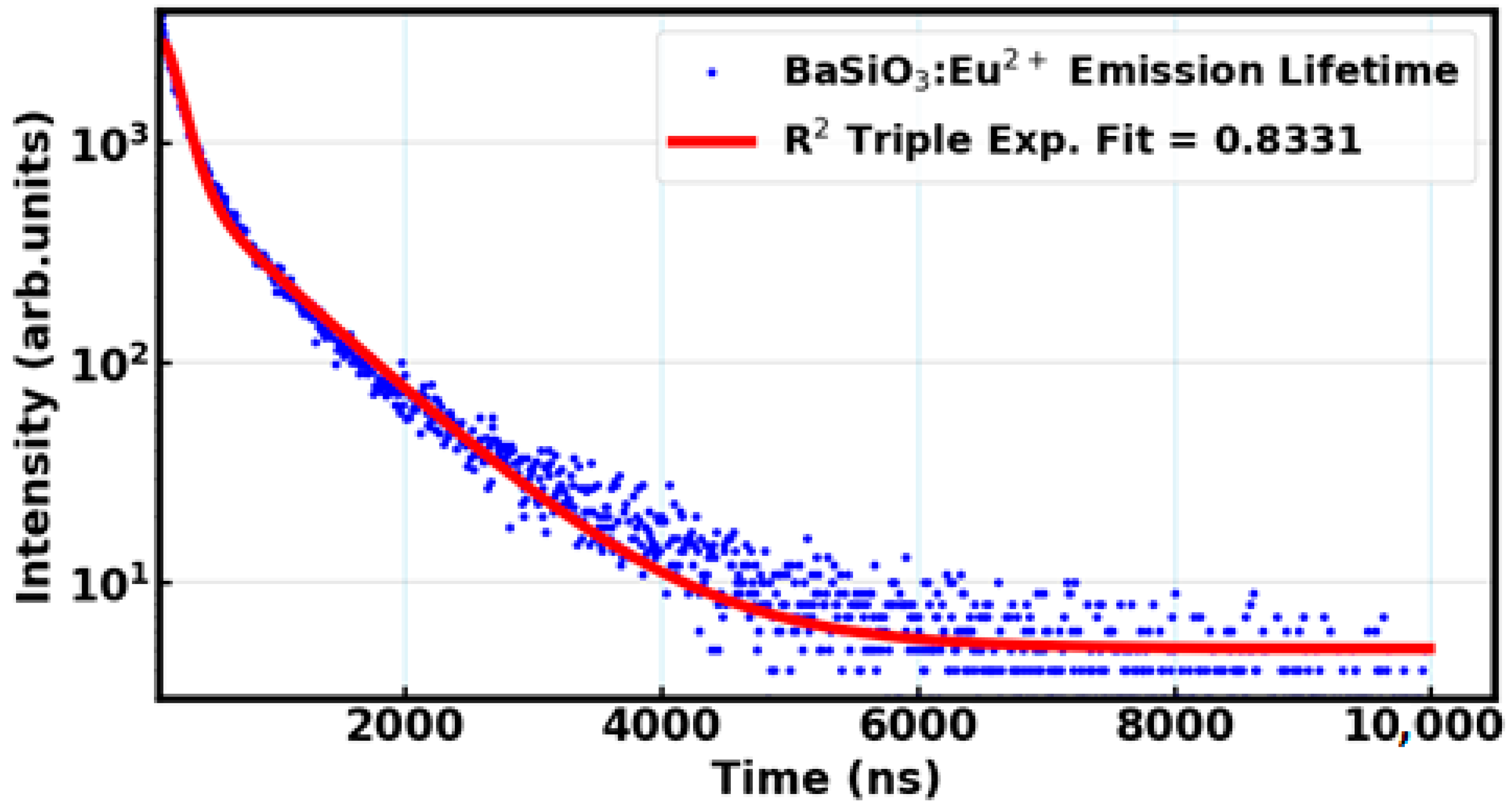
Time-resolved photoluminescent (TRPL) measurements performed under the excitation pulses of a picosecond pulsed light-emitting diode—EPLED—have provided significant insights into the emission dynamics of the material under study [26]. It emphasizes how the triple-exponential decay behavior and the presence of a fast decay channel in the down-shifting material, such as the BaSiO3:Eu2+, facilitate energy transfer. By analyzing the time-resolved emission data, it was found that the photoluminescent decay does not follow a simple single-exponential behavior but is instead characterized by a complex decay dynamic that can be accurately described by a triple-exponential model, as shown in Figure 5. The coefficient of determination (R2) from the triple-exponential fit was 0.8331, which shows the goodness of fit. This triple-exponential decay implies the presence of triple emissive pathways or different populations of excited states within the material, each contributing to the overall photoluminescent signal with distinct lifetimes. The average photoluminescent lifetime was calculated to be approximately 567 nanoseconds, which positions the material in a regime where the emission occurs rapidly enough to be useful for practical applications like DSSCs. The observed average lifetime is comparable to and shorter than the lifetimes reported for Eu2+-activated silicate [27]. This relatively shorter lifetime supports faster emission and reduced reabsorption losses, which are crucial for down-shifting applications in DSSCs. Table 1 shows the emission lifetime decay parameters. The nanosecond-scale lifetime is especially beneficial in applications involving photon down-shifting, where higher-energy photons (such as ultraviolet or blue light) absorbed by the material are re-emitted at longer wavelengths, typically within the visible spectrum [28,29,30].
By ensuring that the luminescent centers emit photons quickly after excitation, the system effectively reduces the probability that these photons will be reabsorbed, thus enhancing the overall photon flux available for subsequent processes. In practical terms, this fast decay channel increases the efficiency with which down-shifted photons are transferred to adjacent functional layers, such as dye molecules in dye-sensitized solar cells (DSSCs). These solar cells rely on the absorption of visible photons by dye molecules to generate photocurrents; thus, maximizing the flux of these photons directly translates into improved device performance [31]. The interplay between the luminescent properties of the down-shifting material and the photovoltaic dye is crucial for optimizing photocurrent generation in DSSCs. The dye molecules are sensitized to absorb photons within a specific spectral range, often the visible region, and convert this absorbed light into electrical energy. However, many conventional photovoltaic materials have limited absorption in the ultraviolet region, which contains a significant portion of the solar spectrum. By incorporating a down-shifting layer that absorbs high-energy photons and re-emits them at longer wavelengths better matched to the dye’s absorption profile, the effective spectral utilization of the solar spectrum is improved [32,33,34].

4. Conclusions

This work explored the luminescent decay dynamics of BaSiO3:Eu2+ and its application as a spectral down-shifting material to improve the performance of dye-sensitized solar cells (DSSCs). The DSSCs, although cost-effective and efficient in low-light conditions, absorb very low UV light. BaSiO3:Eu2+ can address this limitation by absorbing high-energy UV photons and re-emitting them in the visible region of the spectrum, where DSSC dyes are more responsive. This study highlights that fast decay lifetimes are critical as they ensure efficient emission, minimize reabsorption losses, and enhance photon flux to the dye molecules. The material was synthesized using a solid-state route and characterized with SEM, EDS, photoluminescence (PL), and time-resolved photoluminescent (TRPL) spectroscopy. SEM revealed non-uniform particle morphology with an average particle size of approximately 30.5 nm, offering a balance between surface area and optical performance. EDS confirmed the successful incorporation of Eu2+ into the BaSiO3 matrix. PL measurements showed strong broadband emission in the visible region, under UV excitation, confirming its down-shifting capability.
Time-resolved photoluminescent measurements demonstrated that BaSiO3:Eu2+ exhibits complex triple-exponential decay dynamics, with an average lifetime of approximately 567 ns. The presence of a fast decay channel was particularly important, as it reduced photon reabsorption and increased the flux of visible photons transferred to DSSC dyes. While direct DSSC device integration was not performed in this study, we acknowledge this limitation, and the device-level integration will be implemented in future work. However, the novelty of this work illustrated that, unlike many previously reported down-shifting materials that primarily focused on steady-state photoluminescence enhancement, this study emphasized time-resolved luminescence decay dynamics as a key performance metric for DSSC-related down-shifting applications. BaSiO3:Eu2+ exhibited a nanosecond-scale average lifetime with a distinct fast decay channel, which is crucial for minimizing photon reabsorption. These findings presented BaSiO3:Eu2+ as an efficient down-shifting material that is capable of improving light harvesting and photocurrent generation in DSSC by converting otherwise underutilized UV light into useful visible photons.

Author Contributions

Conceptualization, E.H.O. and N.L.L.; methodology, E.H.O.; software, E.H.O.; validation, E.H.O., N.L.L. and P.M.; formal analysis, E.H.O.; investigation, E.H.O.; resources, N.L.L.; data curation, E.H.O.; writing—original draft, E.H.O.; writing—review and editing, N.L.L.; visualization, E.H.O.; supervision, N.L.L. and P.M.; project administration, N.L.L.; funding acquisition, N.L.L. All authors have read and agreed to the published version of the manuscript.

Funding

This work was supported by the Technology Innovation Agency Seed Fund of the Department of Research and Innovation, South Africa. The Research Niche Area (RNA), Renewable Energy Wind in Research Partnerships and Innovation, Postgraduate Studies and Postdoctoral Fellowships, University of Fort Hare, Alice, South Africa, also supported it.

Institutional Review Board Statement

Not applicable.

Informed Consent Statement

Not applicable.

Data Availability Statement

The original contributions presented in this study are included in the article. Further inquiries can be directed to the corresponding author.

Acknowledgments

We are grateful to the South African Medical Research Council for funding support (SAMRC—UFH—P790) at the SAMRC Microbial Water Quality Monitoring Centre.

Conflicts of Interest

The authors declare no conflict of interest.

Abbreviations

DSSCsDye-sensitized solar cells
EDSEnergy-dispersive X-ray spectroscopy
PLPhotoluminescent
SEMScanning electron microscope
SCCMStandard cubic centimeters per minute
TRPLTime-resolved photoluminescent
UVUltraviolet

References

  1. Grätzel, M. Dye-sensitized solar cells. J. Photochem. Photobiol. C Photochem. Rev. 2003, 4, 145–153. [Google Scholar] [CrossRef]
  2. Hagfeldt, A.; Boschloo, G. Dye-sensitized solar cells. Chem. Rev. 2010, 110, 6595–6663. [Google Scholar] [CrossRef]
  3. Chander, N.; Khan, A.F.; Komarala, V.K. Improved stability and enhanced efficiency of dye sensitized solar cells by using europium doped yttrium vanadate down-shifting nanophosphor. RSC Adv. 2015, 5, 66057–66066. [Google Scholar] [CrossRef]
  4. O’Regan, B.; Gratzelt, M. A low-cost, high-efficiency solar cell based on dye-sensitized colloidal TiO2 films. Nature 1991, 353, 737–740. [Google Scholar] [CrossRef]
  5. Hosseini, Z.; Huang, W.K.; Tsai, C.M.; Chen, T.M.; Taghavinia, N.; Diau, E.W. Enhanced Light Harvesting with a Reflective Luminescent Down-Shifting Layer for Dye-Sensitized Solar Cells. ACS Appl. Mater. Interfaces 2013, 5, 5397–5402. [Google Scholar] [CrossRef]
  6. Hwangbo, S.; Kim, J.T.; Hwang, K.S.S. Improved efficiency of dye-sensitized solar cells by doping of strontium aluminate phosphor in TiO2 photoelectrode. Mater. Sci.-Pol. 2015, 33, 237–241. [Google Scholar] [CrossRef]
  7. He, W.; Atabaev, T.S.; Kim, H.K.; Hwang, Y.-H. Enhanced sunlight harvesting of dye-sensitized solar cells assisted with long persistent phosphor materials. J. Phys. Chem. C 2013, 117, 17894–17900. [Google Scholar] [CrossRef]
  8. Srinivasan, T.; Suresh, G.; Ramu, P.; Vignesh, R.; Harshan, A.V.; Vignesh, K.P. Effect of hygrothermal ageing on compressive behavior of glass fiber reinforced IPN composite pipes. Mater. Today Proc. 2021, 45, 1354–1359. [Google Scholar] [CrossRef]
  9. Bai, G.; Tsang, M.K.; Hao, J. Luminescent ions in advanced composite materials for multifunctional applications. Adv. Funct. Mater. 2016, 26, 6330–6350. [Google Scholar] [CrossRef]
  10. Fernandes, R.V.; Junior, N.A.C.; Perdomo, A.D.P.; Duarte, J.L.; Laureto, E. Optimizing the optical properties of a dye-based luminescent down-shifter to improve the performance of organic photovoltaic devices. Dye. Pigment. 2019, 169, 1–6. [Google Scholar] [CrossRef]
  11. Terraschke, H.; Wickleder, C. UV, blue, green, yellow, red, and small: Newest developments on Eu2+-doped nanophosphors. Chem. Rev. 2015, 115, 11352–11378. [Google Scholar] [CrossRef]
  12. Dhale, S.P.; Ugemuge, N.S. Metal Oxide-Based Luminescent Technologies: Past and Future. In Luminescent Metal Oxides; CRC Press: Boca Raton, FL, USA, 2023; pp. 1–23. [Google Scholar]
  13. Jia, Y.; Sun, W.; Pang, R.; Ma, T.; Li, D.; Li, H.; Zhang, S.; Fu, J.; Jiang, L.; Li, C. Sunlight activated new long persistent luminescence phosphor BaSiO3: Eu2+, Nd3+, Tm3+: Optical properties and mechanism. Mater. Des. 2016, 90, 218–224. [Google Scholar] [CrossRef]
  14. Onah, E.H.; Lethole, N.; Mukumba, P. Efficient Energy Transfer Down-Shifting Material for Dye-Sensitized Solar Cells. Materials 2025, 18, 3213. [Google Scholar] [CrossRef]
  15. LC3pez-Ruiz, N.; HernC!ndez-BC)langer, D.; Carvajal, M.; CapitC!n-Vallvey, L.; Palma, A.; MartC-nez-Olmos, A. Fast lifetime and amplitude determination in luminescence exponential decays. Sens. Actuators B Chem. 2015, 216, 595–602. [Google Scholar] [CrossRef]
  16. Gopich, I.V.; Szabo, A. Theory of the energy transfer efficiency and fluorescence lifetime distribution in single-molecule FRET. Proc. Natl. Acad. Sci. USA 2012, 109, 7747–7752. [Google Scholar] [CrossRef]
  17. Chen, H.; Ding, J.; Ding, X.; Wang, X.; Cao, Y.; Zhao, Z.; Wang, Y. Synthesis, Crystal Structure, and Luminescence Properties of Tunable Red-Emitting Nitride Solid Solutions (Ca1−xSrx) 16Si17N34: Eu2+ for White LEDs. Inorg. Chem. 2017, 56, 10904–10913. [Google Scholar] [CrossRef] [PubMed]
  18. Dahiya, H.; Dalal, M.; Singh, A.; Siwach, A.; Dahiya, M.; Nain, S.; Taxak, V.B.; Khatkar, S.P.; Kumar, D. Spectroscopic characteristics of Eu3+-activated Ca9Y(PO4)7 nanophosphors in Judd–Ofelt framework. Solid State Sci. 2020, 108, 106341. [Google Scholar] [CrossRef]
  19. Meetei, S.D.; Singh, S.D. Effects of crystal size, structure and quenching on the photoluminescence emission intensity, lifetime and quantum yield of ZrO2: Eu3+ nanocrystals. J. Lumin. 2014, 147, 328–335. [Google Scholar] [CrossRef]
  20. Onah, E.H.; Lethole, N.L.; Mukumba, P. Optoelectronic Devices Analytics: MachineLearning-Driven Models for Predicting the Performance of a Dye-Sensitized Solar Cell. Electronics 2025, 14, 1948. [Google Scholar] [CrossRef]
  21. Abdelkader, D.; Jebali, A.; Larbi, A.; Harizi, A.; Rabeh, M.B.; Khemiri, N.; Antoni, F.; Kanzari, M. Synthesis, characterization, structural and optical absorption behavior of SnxSbySz powders. Adv. Powder Technol. 2016, 27, 734–741. [Google Scholar] [CrossRef]
  22. Yakuphanoglu, F.; Ilican, S.; Caglar, M.; Caglar, Y. The determination of the optical band and optical constants of non-crystalline and crystalline ZnO thin films deposited by spray pyrolysis. J. Optoelectron. Adv. Mater. 2007, 9, 2180–2185. [Google Scholar]
  23. Song, W.; Gong, Y.; Tian, J.; Cao, G.; Zhao, H.; Sun, C. Novel photoanode for dye-sensitized solar cells with enhanced light-harvesting and electron-collection efficiency. ACS Appl. Mater. Interfaces 2016, 8, 13418–13425. [Google Scholar] [CrossRef]
  24. Katyayan, S.; Agrawal, S. CaSiO3: Eu2+, Er3+, BaSiO3: Eu2+, Er3+ and SrSiO3: Eu2+, Er3+ phosphors: Molten salt synthesis, optical and thermal studies. J. Mater. Sci. Mater. Electron. 2020, 31, 8472–8480. [Google Scholar] [CrossRef]
  25. Onah, E.H.; Lethole, N.L.; Mukumba, P. Luminescent Materials for Dye-Sensitized Solar Cells: Advances and Directions. Appl. Sci. 2024, 14, 9202. [Google Scholar] [CrossRef]
  26. Zhang, X.; Meng, F.; Zhang, J.; Cai, P.; Seo, H.J. Luminescence properties of Eu2+ in T–phase Ba1.3Ca0.7SiO4 lattice from multiple crystallographic sites at different temperatures. Mater. Chem. Phys. 2016, 177, 538–542. [Google Scholar] [CrossRef]
  27. Yamaga, M.; Masui, Y.; Sakuta, S.; Kodama, N.; Kaminaga, K. Radiative and nonradiative decay processes responsible for long-lasting phosphorescence of Eu2+-doped barium silicates. Phys. Rev. B-Condens. Matter Mater. Phys. 2005, 71, 205102. [Google Scholar] [CrossRef]
  28. Cardoso, M.A.; Correia, S.F.H.; Frias, A.R.; Gonçalves, H.M.R.; Pereira, R.F.P.; Nunes, S.C.; Armand, M.; André, P.S.; Bermudez, V.; Ferreira, R. Solar spectral conversion based on plastic films of lanthanide-doped ionosilicas for photovoltaics: Down-shifting layers and luminescent solar concentrators. J. Rare Earths 2020, 38, 531–538. [Google Scholar] [CrossRef]
  29. Wang, L.; Guo, W.; Hao, H.; Su, Q.; Jin, S.; Li, H.; Hu, X.; Qin, L.; Gao, W.; Liu, G. Enhancing photovoltaic performance of dye-sensitized solar cells by rare-earth doped oxide of SrAl2O4: Eu3+. Mater. Res. Bull. 2016, 76, 459–465. [Google Scholar] [CrossRef]
  30. Hafez, H.; Saif, M.; Abdel-Mottaleb, M.S.A. Down-converting lanthanide doped TiO2 photoelectrodes for efficiency enhancement of dye-sensitized solar cells. J. Power Sources 2011, 196, 5792–5796. [Google Scholar] [CrossRef]
  31. MaC’aira, J.; Andrade, L.-S.; Mendes, A.L. Review on nanostructured photoelectrodes for next generation dye-sensitized solar cells. Renew. Sustain. Energy Rev. 2013, 27, 334–349. [Google Scholar] [CrossRef]
  32. Hosseini, Z.; Taghavinia, N.; Diau, E.W.-G. Luminescent Spectral Conversion to Improve the Performance of Dye-Sensitized Solar Cells. ChemPhysChem 2017, 18, 3292–3308. [Google Scholar] [CrossRef] [PubMed]
  33. Nowsherwan, G.A.; Khan, M.; Nowsherwan, N.; Ikram, S.; Hussain, S.S.; Naseem, S.; Riaz, S. Emerging trends in lanthanide-based upconversion and downconversion material for PSCs & DSSCs. J. Mater. Sci. 2024, 59, 16411–16448. [Google Scholar] [CrossRef]
  34. Rehman, A.U.; Aslam, M.; Khan, M.; Shahid, I.; Siddiq, A.; Iqbal, M.A.; Ahmed, S. Enhancing the photovoltaic performance of solid-state dye-sensitized solar cells with composite materials and luminescent down-shifting. J. Electron. Mater. 2020, 49, 6292–6299. [Google Scholar] [CrossRef]
Figure 1. Workflow for the synthesis of BaSiO3:Eu2+ via the solid-state technique.
Materproc 31 00024 g001
Figure 2. (a) SEM image of BaSiO3:0.03Eu2+ phosphor; (b) particle size distribution of BaSiO3:Eu2+ nanoparticles (the blue line indicates the landu fit to the particle size distribution which is asymmetric due to non-uniform particle agglomeration).
Materproc 31 00024 g002
Figure 3. EDS spectrum of BaSiO3:Eu2+.
Materproc 31 00024 g003
Figure 4. (a) Photoluminescence excitation and emission spectra of the BaSiO3:Eu2+ phosphor (the small blue squares in the spectrum denote excitation related data points and the small red circles indicate emission related data points). (b) Quantum yield of BaSiO3:Eu2+ with its reference spectrum (the small red circles in the reference spectrum indicate data points of the reference and the small green circle in the sample spectrum indicate data points related to the BaSiO3+Eu2+ QY).
Materproc 31 00024 g004
Figure 5. Triple-exponential fit to emission lifetime decay of BaSiO3:Eu2+.
Materproc 31 00024 g005
Table 1. Emission lifetime decay parameters.
τ 1 (ns) τ 2 (ns) τ 3 (ns) τ a v (ns) C R 2
858681556750.8331
Disclaimer/Publisher’s Note: The statements, opinions and data contained in all publications are solely those of the individual author(s) and contributor(s) and not of MDPI and/or the editor(s). MDPI and/or the editor(s) disclaim responsibility for any injury to people or property resulting from any ideas, methods, instructions or products referred to in the content.