
Proceeding Paper

Sustainable High-Entropy Alloys from E-Waste: Microstructural Refinement and Hardness Improvement Through Heat Treatment †

by
Kerryn Ngobeni
,
Gontse Nkwana
,
Retshepile Motloung
,
Edward Jabulani Dlamini
,
Paul Oluwaseun Adu
,
Olorundaisi Emmanuel
*,
Chika Oliver Ujah
,
Samson Dare Oguntuyi
and
Peter Apata Olubambi
Centre for Nanoengineering and Advanced Materials, School of Mining, Metallurgy and Chemical Engineering, University of Johannesburg, Johannesburg 2092, South Africa
*
Author to whom correspondence should be addressed.
Presented at the 4th International Conference on Applied Research and Engineering, Pretoria, South Africa, 21–23 November 2025.
Mater. Proc. 2026, 31(1), 15; https://doi.org/10.3390/materproc2026031015
Published: 15 April 2026
(This article belongs to the Proceedings of The 4th International Conference on Applied Research and Engineering)

Abstract

Electronic waste (e-waste) recycling presents a sustainable pathway for developing advanced materials while mitigating environmental concerns. In this study, a high-entropy alloy (HEA) was fabricated via casting using a hybrid feedstock comprising 40% e-waste metallic fractions (Cu-Sn-Pb-Zn) and 60% Al-Ni-Cr-Mn-Si industrial scrap. The as-cast alloy was subjected to heat treatment under controlled conditions to evaluate its microstructural evolution and hardening response. Microstructural analysis revealed the formation of multiphase structures, with distinct transformations in grain morphology and phase distribution after thermal processing. Hardness measurements indicated a significant enhancement in mechanical performance, attributed to microstructural refinement and phase stabilization induced by heat treatment. These findings demonstrate the potential of integrating e-waste into high-entropy alloy design, offering a circular metallurgical approach to produce value-added structural materials with improved mechanical properties.

1. Introduction

Most metallic alloys are traditionally designed based on the properties of their primary element, which serves as the base material due to its inherent characteristics optimal for a specific application. Additional elements are then incorporated to enhance or modify secondary properties such as strength, oxidation resistance, and hardness. In contrast, Yeh et al. [1] introduced a different alloy design approach by developing an alloy consisting of five elements in nearly equal atomic ratios. Instead of forming complex solid solutions and intermetallic compounds, this alloy exhibited a simple solid-solution structure. This innovation gave rise to a new class of materials known as high-entropy alloys (HEAs), also referred to as multi-principal-element alloys [2], which have since attracted significant interest due to their outstanding mechanical and functional properties [3].
High-entropy alloys represent a paradigm shift in alloy design, departing from conventional systems dominated by one or two principal elements. By incorporating five or more elements in near-equimolar ratios [4], HEAs maximize configurational entropy, which favors the stabilization of simple solid-solution phases such as FCC, BCC, or HCP while suppressing brittle intermetallic compounds [5]. Because HEAs consist of elements in equal or near-equal proportions, their mixing entropy is higher than their melting entropy. These alloys are primarily characterized by four core effects: high entropy, lattice distortion, sluggish diffusion, and cocktail effects [6]. As a result, HEAs display remarkable strength, hardness, and fracture toughness even at low temperatures, as well as excellent resistance to corrosion, oxidation, wear, and radiation. They are therefore widely applied in refractory materials, diffusion barriers, anti-fatigue structural materials, wear-resistant components, high-frequency transformers, and magnetic shielding applications [7,8].
In conventional alloys, the matrix’s strength and toughness are typically improved through mechanisms such as fine-grain strengthening, solid-solution strengthening, and second-phase hardening [9]. Similar principles apply to HEAs, where the composition and heat-treatment parameters significantly influence their microstructural evolution and mechanical behavior [10]. Kim [11], for example, studied a Co-Cu-Mn-Ni high-entropy alloy and found that grain refinement achieved through low-temperature annealing improved cryogenic mechanical properties. Munitz [12] observed that heat treatment at 1100°C transformed the sigma phase of an Al-Co-Cr-Fe-Ni HEA into a BCC phase, which softened the alloy. Likewise, the mechanical performance of Al0.5-Co-Cr-Fe-Ni-Si0.2 [13] and Al-Cr-Fe-Ni2-Ti0.5 [14] HEAs improved significantly after optimized heat treatments. Zhaopeng Tong [15] further demonstrated that the Fe-Cr-Co-Mn-Ni HEA with controllable microstructure and excellent mechanical properties could be obtained through a combination of laser additive manufacturing and heat treatment. After annealing at 900 °C, the precipitation of a strengthening phase in Al-Co-Cr-Fe-Ni enhanced its strength, while Al-Cr-Fe-Cu-Ni HEAs exhibited superior wear resistance following heat treatment at 950 °C [16,17].
HEAs derive their exceptional properties from the synergistic interactions among multiple constituent elements, providing superior mechanical strength, thermal stability, and corrosion resistance [18]. Inspired by the success of HEAs, Laws et al. (2015) [19] introduced the concept of high-entropy brass (HEBr) and high-entropy bronze (HEB) alloys as a platform for developing high-performance copper-based materials. Since their emergence in the early 21st century, HEAs have demonstrated outstanding performance in demanding sectors such as automotive, aerospace, and energy systems, owing to their superior wear resistance and structural integrity [20,21]. Among these systems, HEB and HEBr alloys have gained particular attention for their unique compositions and mechanical behavior. These copper-based multicomponent systems typically combine Cu with elements such as Mn, Ni, Al, Sn, and Zn. The integration of binary Cu-X (X = Zn, Al, or Sn) characteristics with Cu-Mn-Ni solid solutions produces complex microstructures, often containing both FCC and BCC phases, which contribute to a favorable balance of strength, ductility, and wear resistance [22,23,24].
E-waste, composed mainly of discarded electronic devices and components, represents a significant secondary reservoir of valuable and critical metals [25]. The rapid expansion of the electronics industry has dramatically increased e-waste generation, posing environmental and health hazards while also offering opportunities for sustainable resource recovery [26]. E-waste contains a diverse array of materials, including precious metals such as Au and Ag; base metals like Cu, Sn, Zn, Ni, Co, Al, and Mn; and toxic elements including Pb and Hg [27]. By 2023, global e-waste generation exceeded 50 million tonnes per year, raising urgent concerns about environmental sustainability and resource management [28]. Recycling and reusing metals from e-waste in alloy manufacturing not only mitigate environmental pollution but also promote circular economy principles and resource efficiency [29,30].
In this present work, e-waste-derived metal scrap primarily composed of Cu, Sn, Pb, and Zn was used as the base feedstock for alloy fabrication. Table 1 summarizes the chemical composition of the as-received e-waste scrap, which served as the foundational input for developing a novel multicomponent high-entropy bronze alloy (HEBA) system derived from recycled electronic waste. To achieve the desired compositional complexity and meet HEA design criteria, high-purity elemental additions of Al, Ni, Cr, Mn, and Si were introduced, each selected for its specific metallurgical role in enhancing the alloy’s stability and performance. Nickel, in particular, acts as a stabilizing element that suppresses Pb segregation [31], an important consideration in high-temperature applications where lead enrichment at metal-oxide interfaces can compromise the passive oxide layer. By promoting the formation of stable intermetallic compounds, Ni helps maintain alloy uniformity and structural integrity.
High-entropy alloys synthesized from recycled feedstocks such as Cu, Ni, Al, and rare-earth elements have exhibited properties comparable to those produced from refined materials, confirming the viability of this sustainable approach. However, casting HEBAs from heterogeneous e-waste feedstocks remains challenging due to compositional variability, differences in melting points and densities, and elemental impurities that can hinder chemical homogeneity [32,33]. For example, Pb, with its low melting point and strong segregation tendency, can significantly affect the alloy’s microstructure and mechanical performance [34].
Casting methods therefore play a crucial role in achieving uniform microstructures and stable phases. Vacuum induction melting (VIM) has proven particularly effective for HEA production because it minimizes oxidation, reduces contamination, and enhances compositional uniformity [35]. The use of copper crucibles and rapid solidification during VIM promotes fine-grained microstructures while minimizing macro-segregation [36]. Furthermore, multiple remelting cycles and post-casting vacuum annealing refine the microstructure, stabilize phases, and alleviate residual stresses [37].
This study investigates the fabrication and characterization of high-entropy bronze alloys derived from recycled e-waste, focusing on complex CuSnPbZnAlNiCrMnSi compositions. The alloy was produced via crucible induction melting and analyzed for microstructural evolution, phase formation, and microhardness properties. By addressing key challenges such as impurity control, phase segregation, and compositional variability, this research demonstrates the feasibility of producing high-performance HEB alloys from recycled materials. The findings advance sustainable metallurgy by linking e-waste valorization with high-entropy alloy design and by showing how controlled heat treatment can refine microstructure, mitigate segregation, and improve hardness. The novelty of this work lies in combining sustainable feedstock utilization with advanced HEA design principles, thereby establishing a circular metallurgical pathway for developing value-added structural materials from e-waste.

2. Materials and Methods

2.1. Synthesis and Experimental Materials

The starting materials for the alloy production included e-waste scrap, presented in Table 1, and foundry return scrap shown in Table 2. The two fractions were blended at a 40:60 ratio to form a high-entropy bronze (HEB) alloy system, denoted as Cu-Sn-Pb-Zn-Al-Ni-Mn-Cr-Si. The 40:60 ratio was selected to achieve a balance between sustainability, compositional control, and alloy performance. The e-waste fraction (Cu–Sn–Pb–Zn-rich) served as the primary copper-based matrix necessary for bronze formation, while the industrial scrap fraction (Al–Ni–Cr–Mn–Si) was required to introduce sufficient compositional complexity to meet high-entropy alloy design criteria. Preliminary melting trials indicated that e-waste fractions above 40 wt.% resulted in excessive Pb and Sn contents, increasing segregation and casting defects, whereas lower e-waste fractions (<40%) reduced the sustainability impact and limited Cu-based matrix dominance. Other ratios (30:70 and 50:50) were initially considered; however, the 40:60 blend exhibited the best balance between process stability, alloy integrity, and circular material utilization.
The alloy design was guided by the High-Entropy Alloy Prediction Software (HEAPS), which applies semi-empirical parameters to evaluate thermophysical criteria and was carefully selected to supplement the recycled base metals and to achieve the target multicomponent composition characteristic of HEBAs as stated above. The e-waste scrap was initially subjected to melting using an induction furnace under ambient atmosphere, followed by casting into a chill mold. The as-cast alloy was subsequently analyzed for its elemental composition using an X-ray fluorescence (XRF) spectrometer, model Rigaku ZSX Primus II. This compositional analysis ensured precise quantification of all major and trace elements prior to alloy development.
The targeted alloy composition was evaluated using the High-Entropy Alloy Prediction Software (HEAPS), which applies semi-empirical models based on configurational entropy, atomic size mismatch (δ), mixing enthalpy (ΔHmix), and valence electron concentration (VEC) to predict phase stability and the likelihood of solid-solution formation [21,38]. Based on HEAPS predictions, the critical thermodynamic parameters for HEA design were satisfied, with ΔHmix between −22 and 7 kJ/mol, ΔSmix between 11 and 19.5 J/mol·K, and VEC between 6.87 and 8, as shown in Table 3.
The alloying elements were chosen based on their metallurgical compatibility with the e-waste scrap and their potential to enhance solid-solution formation, microstructural homogeneity, and phase stability in accordance with high-entropy alloy design principles. The designed HEBA with their nominal compositions are summarized in Table 4.
Melting was carried out in a crucible-type induction furnace, and the molten alloys were cast into metallic chill molds to ensure rapid solidification and fine-grain microstructure development. The chill mold casting process promotes directional solidification, minimizes macro-segregation, and enhances structural uniformity and critical factors for assessing the alloy’s performance. Post-heat treatment was carried out using a muffle furnace at 750 °C for 2 h, followed by controlled annealing. To investigate the microstructural and phase characteristics of the heat-treated HEB alloy, a comprehensive characterization approach was employed. Optical microscopy (OM) was used for initial microstructural evaluation, following standard metallographic preparation. The samples were polished using oxide polishing suspension (OPS) containing colloidal silica (SiO2) to achieve a mirror-like surface finish suitable for microstructure observation. No chemical etching was required, as the contrast provided by OPS polishing was sufficient for optical analysis.

2.2. Characterization and Analysis of the Developed Cu-Sn-Pb-Zn-Al-Ni-Mn-Cr-Si HEBA

2.2.1. Microstructure and Crystalline Phase Characterization

After grinding and polishing to highlight the grains, the surface microstructure of the fabricated HEBA was analyzed using a JEOL JSM-7900F scanning electron microscope (SEM) manufactured in Tokyo, Japan by JEOL Ltd. The grain size, bonding structure, and grain patterns at the borders were examined using SEM images.

2.2.2. Annealing

The annealing was carried out using a 1979 ATLAN Industrial High-Temperature Muffle Furnace. Two different samples were prepared for heat treatment. One was annealed in a closed crucible, while the second sample was not heat-treated and served as the control. The sample was heat-treated at 750 °C for two hours and allowed to cool in the furnace. The heat-treated sample was processed metallographically by grinding and polishing for microstructural and mechanical analysis.

2.2.3. Microhardness

The microhardness behavior was examined using the INNOVATEST FALCON 500, manufactured in Maastricht, Netherlands, by INNOVATEST Europe B.V., fitted with a diamond indenter. This was accomplished by dwelling at 0.5 mm intervals and applying a 500 gf load for 10 s. On the sample, five indentations were made; the hardness was determined by averaging the resulting values.

3. Results and Discussion

3.1. The Microstructural Characterization of the Fabricated Cu-Sn-Pb-Zn-Al-Ni-Mn-Cr-Si HEBA

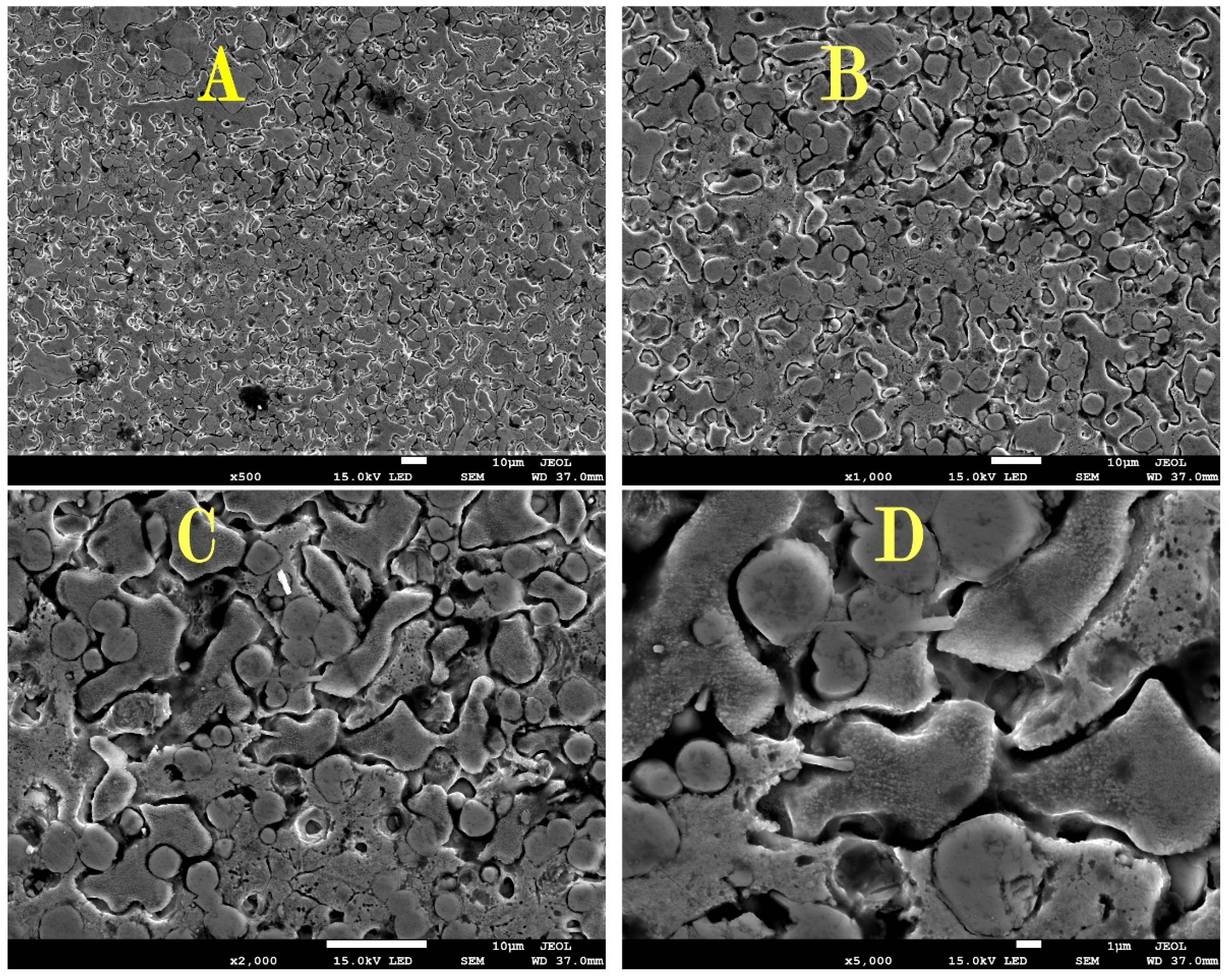
The scanning electron micrograph (Figure 1) of the non-heat-treated Cu-Sn-Pb-Zn-Al-Ni-Mn-Cr-Si HEBA reveals a highly heterogeneous and multiphase structure typical of multicomponent alloys produced by direct casting. The observed microstructure is dominated by a complex dendritic morphology interspersed with inter-dendritic networks of varying contrast. These contrasts, visible as bright and dark regions, arise from differences in atomic number among the constituent elements. In backscattered electron imaging, elements with higher atomic numbers, such as Cu, Sn, and Pb, appear brighter, whereas regions enriched in lighter elements, such as Al, Si, and Mn, appear darker. This compositional contrast is a clear indication of significant elemental partitioning and non-equilibrium solidification during the casting process [1,2,39].
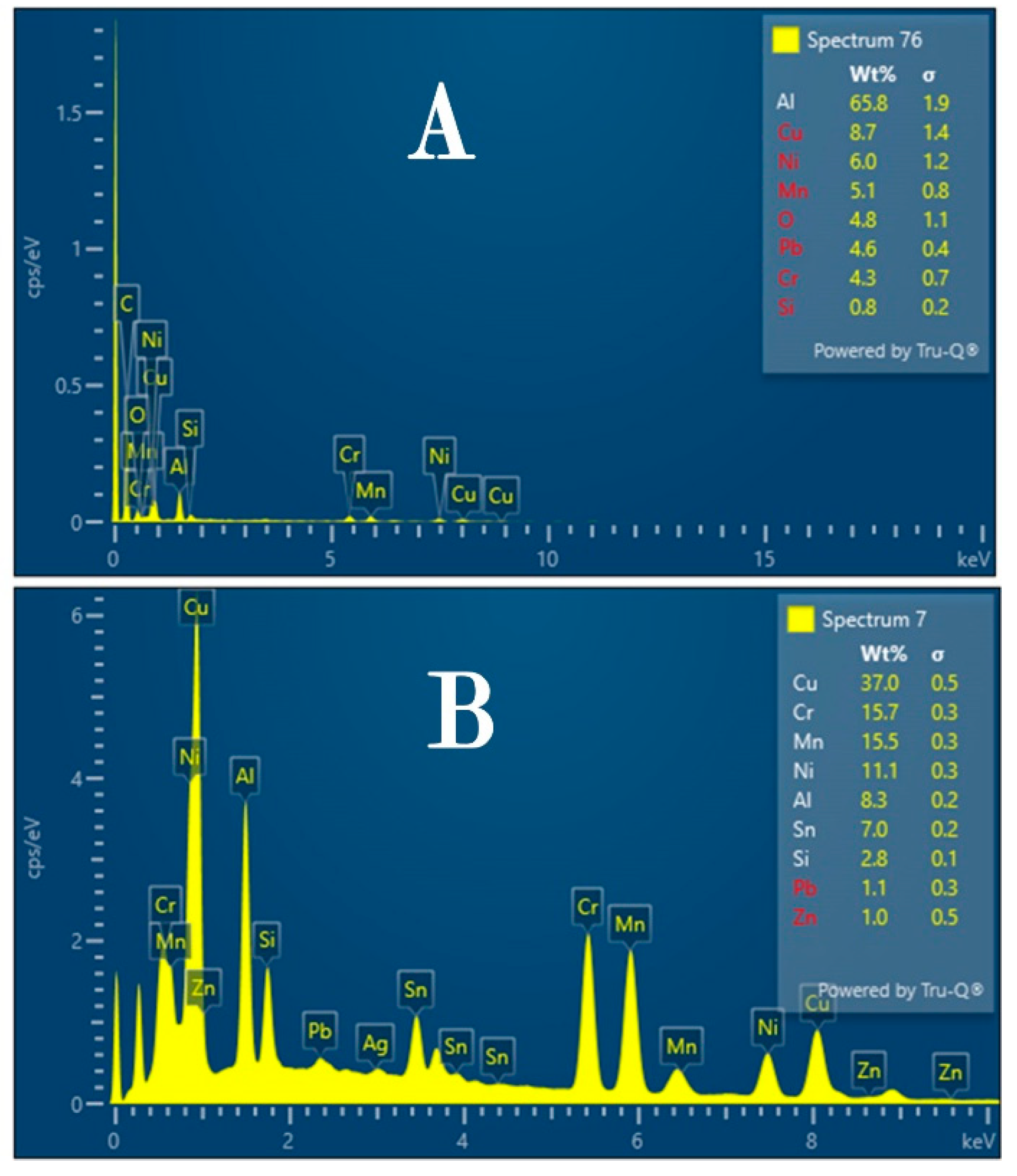
The dendritic regions, which constitute the darker portions of the image, are enriched with Al, Ni, Cr, and Mn, forming solid-solution phases that solidified early from the melt. The inter-dendritic areas, in contrast, are brighter and enriched in Cu, Sn, and Pb, elements that have lower melting points and solidify later in the process, as shown in Figure 2. The presence of these Cu-Sn-Pb-rich networks suggests the coexistence of both solid-solution and intermetallic domains, corroborating the multiphase nature of the alloy system. Due to the low mutual solubility of Pb in the metallic matrix, discrete Pb-rich globules or segregated clusters are likely distributed along grain boundaries and inter-dendritic zones. These segregations are consistent with reports on other Pb-containing high-entropy and bronze alloys, where phase immiscibility and localized lead enrichment are commonly observed [40,41].
The lack of a uniform grain structure further confirms that the as-cast alloy has not reached a state of compositional equilibrium. The wide disparity in melting temperatures and diffusion coefficients among Cu, Sn, Pb, and Al likely led to incomplete mixing during solidification, resulting in distinct phase domains. This compositional heterogeneity is characteristic of high-entropy systems fabricated without subsequent homogenization treatment. Moreover, the presence of fine microsegregation within both dendritic and inter-dendritic zones indicates rapid cooling conditions and limited atomic diffusivity at the solid–liquid interface.
Closer examination of the micrograph also reveals the presence of casting-induced defects such as micro-porosity and isolated voids. These defects likely originated from gas entrapment and shrinkage during solidification. The incorporation of low-melting-point constituents such as Pb and Sn, which tend to liquate during late solidification, can further exacerbate porosity formation. Additionally, small dark inclusions observed within certain regions may correspond to oxide particles, possibly Al2O3 or SiO2 [42], formed due to partial oxidation of reactive alloying elements during melting and handling in air, as the presence of oxide could be identified from the EDS image in Figure 2. Such inclusions are common in Al- and Si-bearing systems and can affect mechanical and corrosion performance if not mitigated through processing control or fluxing [43].
The microstructural characteristics confirm that the non-heat-treated Cu-Sn-Pb-Zn-Al-Ni-Mn-Cr-Si HEBA is compositionally inhomogeneous, containing both metallic solid-solution and intermetallic phases. This condition is expected for alloys derived from multi-source metallic and electronic scrap materials, where differences in melting points and affinity among constituent elements promote segregation. The bright Cu-Sn-Pb-rich inter-dendritic phases are expected to impart ductility and self-lubricating behavior, while the darker Ni-Cr-Mn-Al-Si-rich dendritic matrix likely contributes to strength and oxidation resistance. However, the pronounced elemental segregation and the presence of porosity and phase discontinuities may reduce the alloy’s overall mechanical uniformity and serve as potential crack initiation sites under applied stress [44].
Post-solidification heat treatment, such as homogenization, is thus necessary to promote diffusion and achieve a more uniform chemical distribution. Such thermal processing would facilitate dissolution of solute-rich phases into the matrix, refine the dendritic morphology, and potentially enhance hardness, wear resistance, and corrosion stability. In high-entropy bronze systems, homogenization has been shown to significantly reduce microsegregation and improve interfacial bonding between the constituent phases, leading to superior mechanical and tribological properties [45]. The observed as-cast microstructure therefore provides a baseline for assessing the subsequent microstructural and property evolution of this alloy during heat treatment.
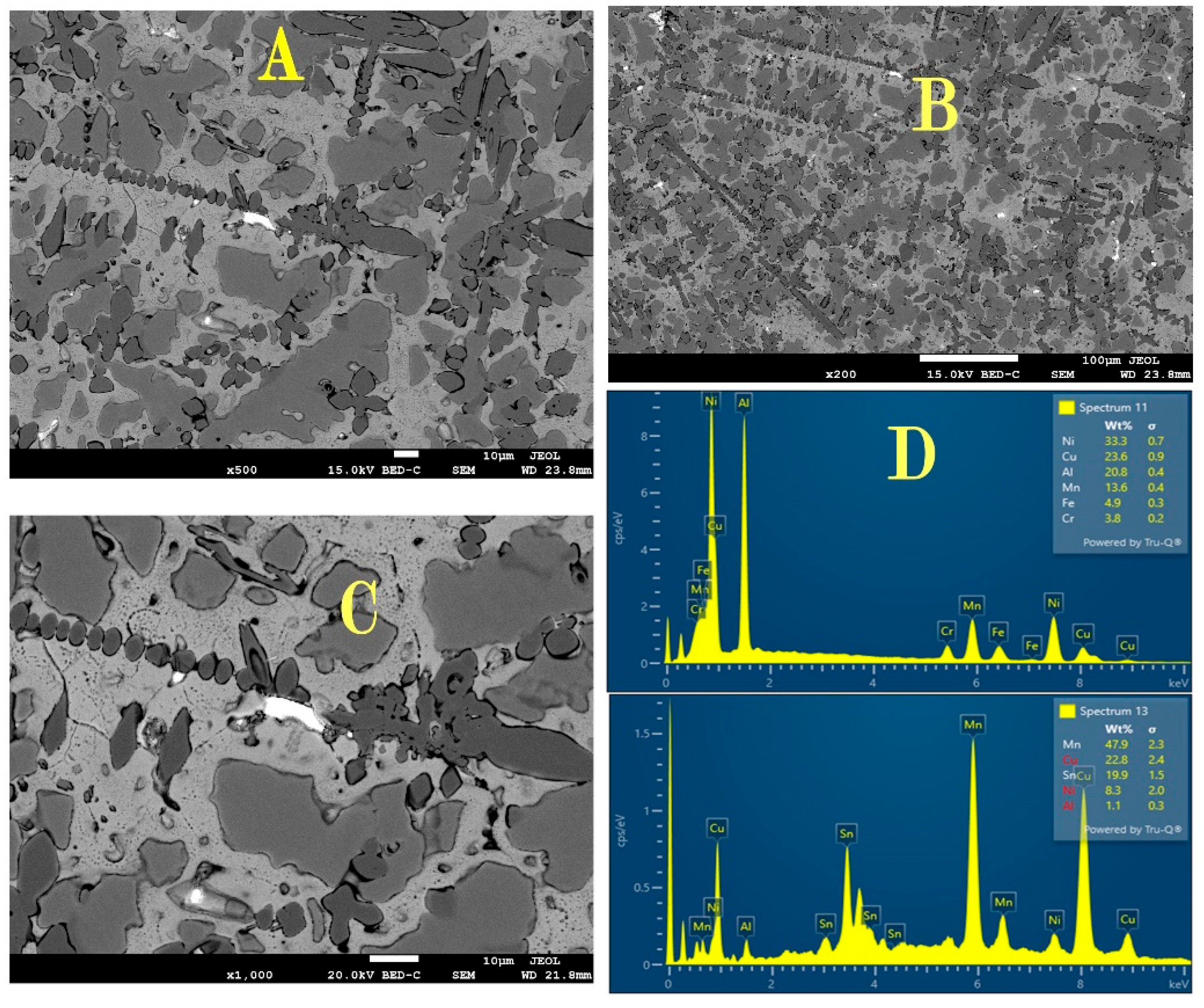
The scanning electron micrograph of the heat-treated Cu-Sn-Pb-Zn-Al-Ni-Mn-Cr-Si HEBA (Figure 3), subjected to heat treatment at 750 °C for 2 h followed by furnace cooling, reveals a significant transformation in the microstructural morphology compared to the as-cast condition (Figure 1). The most notable change is the visible reduction in compositional heterogeneity and the partial dissolution of solute-rich inter-dendritic networks, indicating that the thermal exposure promoted diffusion-driven homogenization. The previously coarse dendritic features observed in the as-cast alloy have become less distinct, replaced by a more uniform and refined microstructure with smoother phase interfaces.
The heat treatment facilitated atomic diffusion among the constituent elements, thereby reducing the degree of segregation between Cu-Sn-Pb-rich and Al-Ni-Cr-Mn-Si-rich regions. This is evident from the diminished contrast between bright and dark areas in the micrograph, signifying a more homogeneous elemental distribution. At 750 °C, which is sufficiently above the solidus of the alloy’s lower-melting constituents (Sn and Pb) but below the melting point of the matrix-forming elements (Ni, Cr, and Mn), limited solid-state diffusion and partial re-equilibration occurred. As a result, some of the eutectic or intermetallic phases that formed during non-equilibrium solidification were either dissolved or redistributed within the matrix. The appearance of a more continuous solid-solution network implies the stabilization of a thermodynamically favored multiphase equilibrium structure during the furnace-cooling process [1,2,39].
In addition to the microstructural homogenization, the heat treatment contributed to the mitigation of casting-induced defects. Pores and voids that were evident in the as-cast sample appear less frequent or have reduced in size after treatment, likely due to diffusion-assisted healing and volumetric shrinkage during thermal exposure. The smoother grain boundaries and reduced interfacial discontinuities also suggest enhanced diffusion bonding between adjacent grains. Furthermore, the Pb-rich segregations that were previously isolated along inter-dendritic regions now appear more finely dispersed, a consequence of solid-state redistribution of the low-melting Pb phase into neighboring Cu- and Sn-rich regions. This redistribution is beneficial for enhancing both mechanical and tribological performance, as Pb in solid solution or as finely dispersed particles acts as an internal solid lubricant, reducing localized stress accumulation and improving wear resistance [40,41].
The observed microstructural refinement can be correlated with improved mechanical behavior, particularly hardness. During heat treatment, the partial dissolution of coarse intermetallic compounds and the subsequent redistribution of solute atoms promote a more uniform load-bearing network. This homogenization minimizes micro-galvanic coupling between electrochemically dissimilar regions, enhancing the alloy’s corrosion and oxidation resistance, an essential attribute for high-entropy bronze alloys designed for multifunctional applications [43,44]. Moreover, the furnace-cooling route preserved the equilibrium phases without introducing significant thermal stresses, thereby stabilizing the microstructure for long-term performance.
The heat treatment at 750 °C for 2 h resulted in notable microstructural evolution characterized by reduced segregation, refined phase morphology, and improved interfacial coherence. The transition from the dendritic, highly heterogeneous as-cast structure to a more homogeneous and stable multiphase configuration underscores the beneficial effect of post-casting thermal processing. The homogenized structure is expected to exhibit superior hardness, wear resistance, and corrosion stability due to the uniform distribution of strengthening elements such as Ni, Cr, and Mn within the Cu-Sn-based matrix. These findings corroborate earlier studies on multicomponent Cu-based and high-entropy alloys, which report similar microstructural stabilization and property enhancement following intermediate-temperature heat treatments [46,47].
The experimental observations are in good qualitative agreement with HEAPS predictions. The calculated ΔHmix, ΔSmix, and VEC values predict the formation of stable FCC/BCC-dominated solid solutions with limited intermetallic formation, which aligns with SEM observations of a multiphase but predominantly solid-solution matrix. A Cu-rich FCC matrix with secondary phases associated with Sn- and Pb-rich regions, in agreement with the predicted moderate ΔH-mix and VEC values (>8), was observed.

3.2. Mechanical Properties of the Cu-Sn-Pb-Zn-Al-Ni-Mn-Cr-Si HEBA

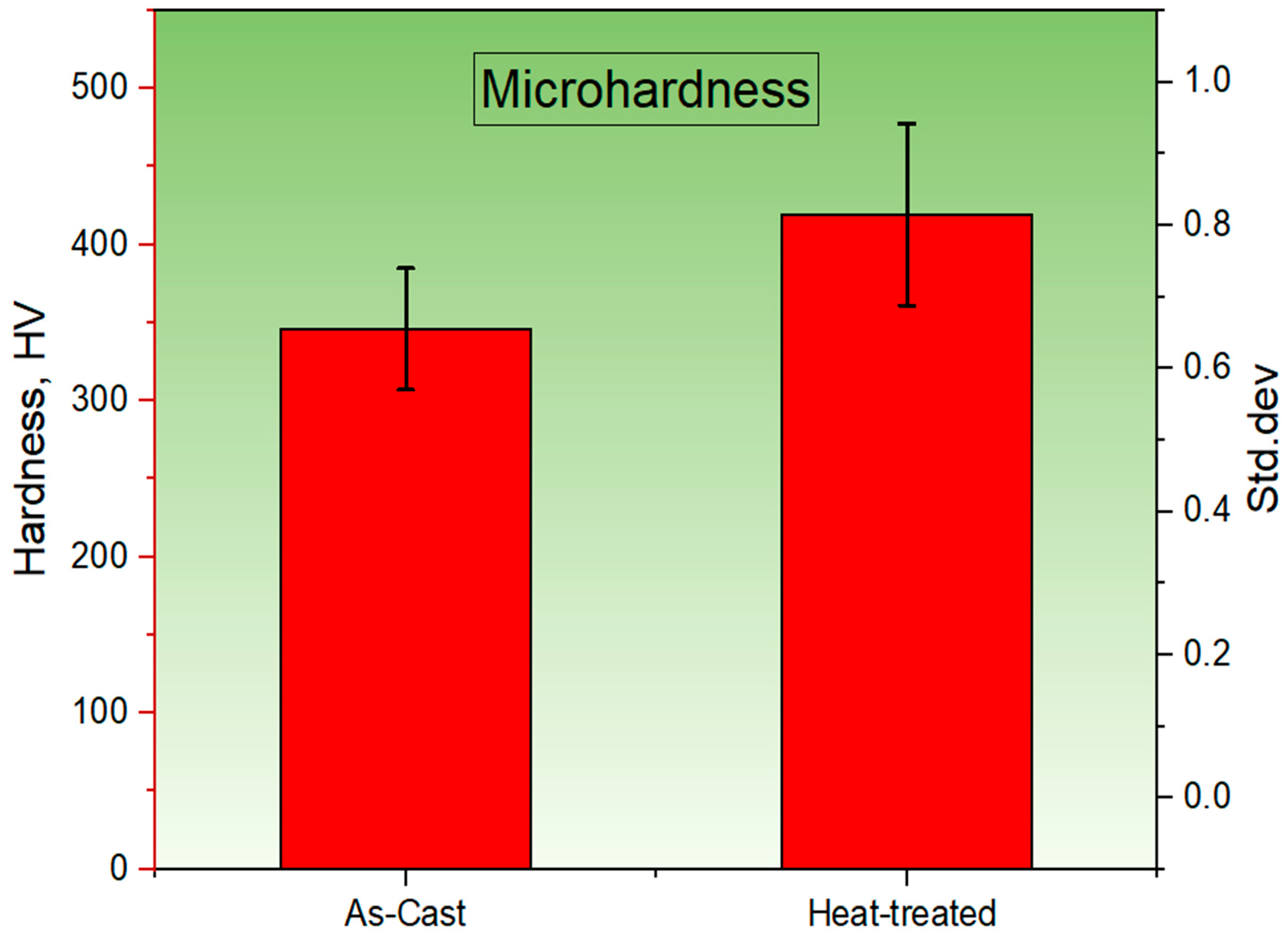
The heat treatment of the Cu-Sn-Pb-Zn-Al-Ni-Mn-Cr-Si high-entropy bronze alloy resulted in a notable increase in hardness. The as-cast sample exhibited a hardness of 346.0 HV, reflecting the as-solidified microstructure characterized by dendritic grains and elemental microsegregation. After heat treatment at 750 °C for two hours followed by furnace cooling, the hardness increased to 419.4 HV, representing an approximate 21% improvement as shown in Figure 4. This enhancement is attributed to microstructural homogenization, reduction in residual stress, and the possible formation of fine precipitates or secondary phases that impede dislocation motion. These results demonstrate that heat treatment effectively strengthens the alloy by refining its microstructure and promoting phase uniformity, providing improved resistance to plastic deformation. The increase in hardness is expected to enhance the alloy’s wear and tribo-corrosion resistance, suggesting improved performance in applications where mechanical integrity and surface durability are critical. The developed HEBA exhibits a hardness of 419.4 HV after heat treatment, which is significantly higher than conventional tin bronzes and leaded bronzes [48,49,50]. It is also comparable to or exceeds hardness values reported for several high-entropy brasses and bronzes (typically 250–400 HV), confirming the mechanical competitiveness of the developed alloy.
The developed HEB alloy shows promise for wear-resistant components, bearing materials, bushings, and tribological applications, where high hardness, corrosion resistance, sustainability, and self-lubricating behavior are beneficial. The alloy indeed is limited as a result of:
  • Compositional variability inherent to e-waste feedstocks;
  • Need for controlled melting and homogenization;
  • Potential regulatory constraints related to Pb.
However, these challenges can be mitigated through feedstock characterization, blending strategies, and post-processing controls, making the alloy scalable for specialized industrial applications.

4. Conclusions

The study demonstrates that heat treatment significantly enhances the hardness and microstructural uniformity of the Cu-Sn-Pb-Zn-Al-Ni-Mn-Cr-Si high-entropy bronze alloy. The as-cast sample exhibited a hardness of 346.0 HV, corresponding to a coarse dendritic structure with evident elemental segregation. After heat treatment at 750 °C for two hours followed by furnace cooling, the hardness increased to 419.4 HV, representing an approximate 21% improvement. SEM analysis revealed a refined and more homogenized microstructure with reduced segregation and improved phase distribution. The increase in hardness is attributed to microstructural homogenization, stress relaxation, and the formation of fine strengthening phases. The enhanced hardness and structural uniformity indicate that heat treatment improves the alloy’s strength, wear resistance, and stability, making it suitable for high-performance structural and tribological applications. While Pb is a toxic element, its presence in this alloy system is mitigated by low atomic fraction, encapsulation within a metallic matrix, and reduced mobility after homogenization heat treatment. Importantly, the study promotes controlled reuse of Pb already present in e-waste, preventing environmental release through improper disposal. This approach aligns with circular metallurgy principles by stabilizing hazardous elements in engineered alloys rather than allowing uncontrolled environmental exposure.

Author Contributions

Conceptualization, O.E., C.O.U. and P.A.O.; methodology, K.N., G.N., R.M., E.J.D., C.O.U., O.E., S.D.O. and P.A.O.; software, O.E., P.O.A., and P.A.O.; validation, C.O.U., O.E., and P.A.O.; formal analysis, O.E., C.O.U. and P.A.O.; investigation, K.N., G.N., R.M. and E.J.D.; resources, P.A.O.; data curation, O.E. and C.O.U.; writing—original draft preparation, E.J.D., O.E. and C.O.U.; writing—review and editing, C.O.U., O.E., and P.A.O.; visualization, C.O.U. and O.E.; supervision, O.E., C.O.U. and P.A.O.; project administration, O.E., C.O.U., and P.A.O.; funding acquisition, P.A.O. All authors have read and agreed to the published version of the manuscript.

Funding

This research was funded by the Department of Science, Technology, and Innovation (DSTI), South Africa, and the University of Johannesburg.

Institutional Review Board Statement

Not applicable.

Informed Consent Statement

Not applicable.

Data Availability Statement

The original contributions presented in this study are included in the article. Further inquiries can be directed to the corresponding author.

Acknowledgments

The authors thank the Department of Science, Technology, and Innovation (DSTI), South Africa, and the University of Johannesburg for funding the research that produced this work.

Conflicts of Interest

The authors declare no conflicts of interest.

References

  1. Yeh, J.W.; Chen, S.K.; Lin, S.J.; Gan, J.Y.; Chin, T.S.; Shun, T.T.; Tsau, C.H.; Chang, S.Y. Nanostructured high-entropy alloys with multiple principal elements: Novel alloy design concepts and outcomes. Adv. Eng. Mater. 2004, 6, 299–303. [Google Scholar] [CrossRef]
  2. Cantor, B.; Chang, I.T.H.; Knight, P.; Vincent, A.J.B. Microstructural development in equiatomic multicomponent alloys. Mater. Sci. Eng. A 2004, 375–377, 213–218. [Google Scholar] [CrossRef]
  3. Chuang, M.H.; Tsai, M.H.; Wang, W.R.; Lin, S.J.; Yeh, J.W. Microstructure and wear behavior of AlxCo 1.5CrFeNi1.5Tiy high-entropy alloys. Acta Mater. 2011, 59, 6308–6317. [Google Scholar] [CrossRef]
  4. Fu, X.; Schuh, C.A.; Olivetti, E.A. Materials selection considerations for high entropy alloys. Scr. Mater. 2017, 138, 145–150. [Google Scholar] [CrossRef]
  5. Biswas, K.; Gurao, N.P.; Maiti, T.; Mishra, R.S. High Entropy Materials: Basic Concepts. In High Entropy Materials. Materials Horizons: From Nature to Nanomaterials; Springer: Singapore, 2022; pp. 27–46. [Google Scholar] [CrossRef]
  6. Sonar, T.; Ivanov, M.; Trofimov, E.; Tingaev, A.; Suleymanova, I. An overview of microstructure, mechanical properties and processing of high entropy alloys and its future perspectives in aeroengine applications. Mater. Sci. Energy Technol. 2024, 7, 35–60. [Google Scholar] [CrossRef]
  7. Kamal, M.V.; Ragunath, S.; Sagar, M.H.; Radhika, N.; Saleh, B. Recent advancements in lightweight high entropy alloys—A comprehensive review. Int. J. Light. Mater. Manuf. 2024, 7, 699–720. [Google Scholar] [CrossRef]
  8. Tang, X.; Hou, Y.; Wang, C.; Liu, Y.; Meng, Z.; Wang, Y.; Cheng, G.; Zhou, W.; La, P. Microstructure and mechanical properties of CoCrFeNiTa high entropy alloy prepared by mechanical alloying and spark plasma sintering. Mater. Charact. 2024, 210, 113826. [Google Scholar] [CrossRef]
  9. Gao, Q.; Liu, Z.; Li, H.; Zhang, H.; Jiang, C.; Hao, A.; Qu, F.; Lin, X. High-temperature oxidation behavior of modified 4Al alumina-forming austenitic steel: Effect of cold rolling. J. Mater. Sci. Technol. 2021, 68, 91–102. [Google Scholar] [CrossRef]
  10. Liu, H.; Liu, J.; Li, X.; Chen, P.; Yang, H.; Hao, J. Effect of heat treatment on phase stability and wear behavior of laser clad AlCoCrFeNiTi0.8 high-entropy alloy coatings. Surf. Coatings Technol. 2020, 392, 125758. [Google Scholar] [CrossRef]
  11. Kim, D.G.; Jo, Y.H.; Park, J.M.; Choi, W.M.; Kim, H.S.; Lee, B.J.; Sohn, S.S.; Lee, S. Effects of annealing temperature on microstructures and tensile properties of a single FCC phase CoCuMnNi high-entropy alloy. J. Alloys Compd. 2020, 812, 152111. [Google Scholar] [CrossRef]
  12. Munitz, A.; Salhov, S.; Hayun, S.; Frage, N. Heat treatment impacts the micro-structure and mechanical properties of AlCoCrFeNi high entropy alloy. J. Alloys Compd. 2016, 683, 221–230. [Google Scholar] [CrossRef]
  13. Zhang, C.; Wu, G.F.; Dai, P.Q. Phase Transformation and Aging Behavior of Al0.5CoCrFeNiSi0.2 High-Entropy Alloy. J. Mater. Eng. Perform. 2015, 24, 1918–1925. [Google Scholar] [CrossRef]
  14. Jiang, L.; Jiang, H.; Lu, Y.; Wang, T.; Cao, Z.; Li, T. Mechanical properties improvement of AlCrFeNi2Ti0.5 high entropy alloy through annealing design and its relationship with its particle-reinforced microstructures. J. Mater. Sci. Technol. 2015, 31, 397–402. [Google Scholar] [CrossRef]
  15. Tong, Z.; Ren, X.; Jiao, J.; Zhou, W.; Ren, Y.; Ye, Y.; Larson, E.A.; Gu, J. Laser additive manufacturing of FeCrCoMnNi high-entropy alloy: Effect of heat treatment on microstructure, residual stress and mechanical property. J. Alloys Compd. 2019, 785, 1144–1159. [Google Scholar] [CrossRef]
  16. Liang, J.T.; Cheng, K.C.; Chen, S.H. Effect of heat treatment on the phase evolution and mechanical properties of atomized AlCoCrFeNi high-entropy alloy powders. J. Alloys Compd. 2019, 803, 484–490. [Google Scholar] [CrossRef]
  17. Malatji, N.; Lengopeng, T.; Pityana, S.; Popoola, A.P.I. Effect of heat treatment on the microstructure, microhardness, and wear characteristics of AlCrFeCuNi high-entropy alloy. Int. J. Adv. Manuf. Technol. 2020, 111, 2021–2029. [Google Scholar] [CrossRef]
  18. Łach, Ł. Phase Stability and Transitions in High-Entropy Alloys: Insights from Lattice Gas Models, Computational Simulations, and Experimental Validation. Entropy 2025, 27, 464. [Google Scholar] [CrossRef] [PubMed]
  19. Laws, K.J.; Crosby, C.; Sridhar, A.; Conway, P.; Koloadin, L.S.; Zhao, M.; Aron-dine, S.; Bassman, L.C. High entropy brasses and bronzes e Microstructure, phase evolution and properties. J. Alloys Compd. 2015, 650, 949–961. [Google Scholar] [CrossRef]
  20. Cheng, B.; Zhang, F.; Lou, H.; Chen, X.; Liaw, P.K.; Yan, J.; Zeng, Z.; Ding, Y.; Zeng, Q. Pressure-induced phase transition in the AlCoCrFeNi high-entropy alloy. Scr. Mater. 2019, 161, 88–92. [Google Scholar] [CrossRef]
  21. Martin, P.; Madrid-Cortes, C.E.; Cáceres, C.; Araya, N.; Aguilar, C.; Cabrera, J.M. HEAPS: A user-friendly tool for the design and exploration of high-entropy alloys based on semi-empirical parameters. Comput. Phys. Commun. 2022, 278, 108398. [Google Scholar] [CrossRef]
  22. Nagase, T.; Shibata, A.; Matsumuro, M.; Takemura, M.; Semboshi, S. Alloy design and fabrication of ingots in Cu-Zn-Mn-Ni-Sn high-entropy and Cu-Zn-Mn-Ni medium-entropy brasses. Mater. Des. 2019, 181, 107900. [Google Scholar] [CrossRef]
  23. Ifeoma, A.; Nnakwo, K.C.; Nwankwo, N.E. Synergistic effects of alloying elements and solid solution treatment on the impact energy, density and conductivity of Cu-3Si-3 (Zn, Sn) alloys system. Int. J. Civ. Struct. Eng. Res. 2023, 11, 85–90. [Google Scholar] [CrossRef]
  24. Liu, D.D.; Zhou, Y.J.; Yang, R.; Su, J.H.; Song, K.X.; Yang, S.D.; Zhang, X.B.; Zhou, F.; Zhang, G.S.; Jiang, K.X.; et al. Effect of electromagnetic stirring current on the mechanical properties of Cu-15Ni-8Sn alloy and its mechanism of inducing dendrite refinement and Sn distribution homogenization. Mater. Today Commun. 2023, 37, 107224. [Google Scholar] [CrossRef]
  25. Işıldar, A.; Rene, E.R.; van Hullebusch, E.D.; Lens, P.N.L. Electronic waste as a secondary source of critical metals: Management and recovery technologies. Resour. Conserv. Recycl. 2018, 135, 296–312. [Google Scholar] [CrossRef]
  26. Divyasri; Kumar, D.M.V.; Babu, D.R.; Vedik, B. Recycling of E-waste and Green Electronic Manufacturing. E3S Web Conf. 2025, 619, 01013. [Google Scholar] [CrossRef]
  27. Torralba, J.M.; Iriarte, D.; Tourret, D.; Meza, A. Using multicomponent recycled electronic waste alloys to produce high entropy alloys. Intermetallics 2024, 164, 108128. [Google Scholar] [CrossRef]
  28. Gulliani, S.; Volpe, M.; Messineo, A.; Volpe, R. Recovery of metals and valuable chemicals from waste electric and electronic materials: A critical review of existing technologies. RSC Sustain. 2023, 1, 1085–1108. [Google Scholar] [CrossRef]
  29. Rene, E.R.; Sethurajan, M.; Ponnusamy, V.K.; Kumar, G.; Dung, T.N.B.; Brindhadevi, K.; Pugazhendhi, A. Electronic waste generation, recycling and resource recovery: Technological perspectives and trends. J. Hazard. Mater. 2021, 416, 125664. [Google Scholar] [CrossRef] [PubMed]
  30. Xia, D.; Charpentier, N.M.; Maurice, A.A.; Brambilla, A.; Yan, Q.; Gabriel, J.C.P. Sustainable route for Nd recycling from waste electronic components featured with unique element-specific sorting enabling simplified hydrometallurgy. Chem. Eng. J. 2022, 441, 135886. [Google Scholar] [CrossRef]
  31. Nordlien, J.H. TEM Characterization of Segregated Lead on Annealed Aluminum. 2003. Available online: https://yingday.folk.ntnu.no/NilsYD/TEMCCDbasic/PDFpapers/HRTEM_internal_reference.pdf (accessed on 12 June 2025).
  32. Ho, P.H.; Jabłońska, M.; Beltrami, G.; Martucci, A.; Cacciaguerra, T.; Paulus, W.; Di Renzo, F.; Fornasari, G.; Vaccari, A.; Benito, P.; et al. Promotion effect of rare earth elements (Ce, Nd, Pr) on physicochemical properties of M-Al mixed oxides (M = Cu, Ni, Co) and their catalytic activity in N2O decomposition. J. Mater. Sci. 2021, 56, 15012–15028. [Google Scholar] [CrossRef]
  33. Bielowicz, B. Waste as a Source of Critical Raw Materials—A New Approach in the Context of Energy Transition. Energies 2025, 18, 2101. [Google Scholar] [CrossRef]
  34. Ren, X.; Chen, N.; Zhang, G.; Xu, H.; Zhang, Y.; Shi, Z.; Zhaojie, W.; Yijun, L. Effect of Pb on microstructure and mechanical properties of Tin Babbitt alloy. J. Phys. Conf. Ser. 2023, 2478, 052007. [Google Scholar] [CrossRef]
  35. Choi, N.; Park, N.; Kim, J.K.; Karasev, A.V.; Jönsson, P.G.; Park, J.H. Influence of manufacturing conditions on inclusion characteristics and mechanical properties of fecrnimnco alloy. Metals 2020, 10, 1286. [Google Scholar] [CrossRef]
  36. Tong, X.; You, G.; Luo, J.; Ebrahimi, M.; Wu, G. Rapid cooling effect during solidification on macro- and micro-segregation of as-cast Mg–Gd alloy. Prog. Nat. Sci. Mater. Int. 2021, 31, 68–76. [Google Scholar] [CrossRef]
  37. Hussain, M.; Najib, A.S.M.; Fadil, N.A.; Bakar, T.A.A. Microstructure and Phase Chemistry of Vacuum Induction Melting Fabricated-Equimolar AlCoCrFeNi HEA During Spinodal Dissolution Annealing. Int. J. Integr. Eng. 2024, 16, 145–153. [Google Scholar] [CrossRef]
  38. Olorundaisi, E.; Babalola, B.J.; Anamu, U.S.; Teffo, M.L.; Michel, N.; Ogunmefun, A.O.; Odetola, P.; Peter, A. Phase formation and mechanical analysis of sintered Ni 25 Al 25 Co 15 Fe 15 Mn 8 Ti 7 Cr 5 high entropy alloy. J. Manuf. Lett. 2024, 41, 153–159. [Google Scholar] [CrossRef]
  39. Miracle, D.B.; Senkov, O.N. A critical review of high entropy alloys and related concepts. Acta Mater. 2017, 122, 448–511. [Google Scholar] [CrossRef]
  40. Zhang, L.J.; Fan, J.T.; Liu, D.J.; Zhang, M.D.; Yu, P.F.; Jing, Q.; Ma, M.Z.; Liaw, P.K.; Li, G.; Liu, R.P. The microstructural evolution and hardness of the equiatomic CoCrCuFeNi high-entropy alloy in the semi-solid state. J. Alloys Compd. 2018, 745, 75–83. [Google Scholar] [CrossRef]
  41. Hemphill, M.A.; Yuan, T.; Wang, G.Y.; Yeh, J.W.; Tsai, C.W.; Chuang, A.; Liaw, P.K. Fatigue behavior of Al 0.5CoCrCuFeNi high entropy alloys. Acta Mater. 2012, 60, 5723–5734. [Google Scholar] [CrossRef]
  42. Olorundaisi, E.; Olubambi, P.A. Evaluating microstructural changes and hardness in equal atomic Ni-Al-Co-Fe-Mn-Ti-Cr high-entropy alloy subjected to heat treatment in oxidative and non-oxidative environments. Manuf. Lett. 2025, 44, 405–415. [Google Scholar] [CrossRef]
  43. Zhang, Y.; Zuo, T.T.; Tang, Z.; Gao, M.C.; Dahmen, K.A.; Liaw, P.K.; Lu, Z.P. Microstructures and properties of high-entropy alloys. Prog. Mater. Sci. 2014, 61, 1–93. [Google Scholar] [CrossRef]
  44. Otto, F.; Dlouhý, A.; Somsen, C.; Bei, H.; Eggeler, G.; George, E.P. The influences of temperature and microstructure on the tensile properties of a CoCrFeMnNi high-entropy alloy. Acta Mater. 2013, 61, 5743–5755. [Google Scholar] [CrossRef]
  45. Guo, S.; Liu, C.T. Phase stability in high entropy alloys: Formation of solid-solution phase or amorphous phase. Prog. Nat. Sci. Mater. Int. 2011, 21, 433–446. [Google Scholar] [CrossRef]
  46. Shun, T.T.; Chang, L.Y.; Shiu, M.H. Microstructure and mechanical properties of multiprincipal component CoCrFeNiMo x alloys. Mater. Charact. 2012, 70, 63–67. [Google Scholar] [CrossRef]
  47. Chen, N.; Li, Y.; Dai, Y.; Qu, W.; Xing, Y.; Ye, Y.; Wen, Z.; Guo, C.; Wu, F.; Chen, R. A Li+ conductive metal organic framework electrolyte boosts the high-temperature performance of dendrite-free lithium batteries. J. Mater. Chem. A 2019, 7, 9530–9536. [Google Scholar] [CrossRef]
  48. Poojary, S.; Marakini, V.; Rao, R.N.; Vijayan, V. Enhancing microstructure and mechanical properties of nickel aluminium bronze alloy through tin addition. Sci. Rep. 2023, 13, 16907. [Google Scholar] [CrossRef] [PubMed]
  49. Ren, X.; Zhang, G.; Xu, H.; Wang, Z.; Liu, Y.; Sun, F.; Kang, Y.; Wang, M.; Lv, W.; Yin, Z. Effects of B on the Structure and Properties of Lead-Tin Bronze Alloy and the Mechanism of Strengthening and Toughening. Materials 2021, 14, 7806. [Google Scholar] [CrossRef]
  50. Liang, Y.; Jiang, H.; Lei, Q.; Jiang, L.; Zhang, X.; Xiao, S.; Liu, X.; Li, L.; Pei, Z.; Li, Q. Cr 3 C 2 reinforced tin-bronze matrix composites with enhanced mechanical properties and wear resistance. Mater. Charact. 2024, 210, 113805. [Google Scholar] [CrossRef]
Figure 1. Scanning electron micrograph of the non-heat-treated Cu-Sn-Pb-Zn-Al-Ni-Mn-Cr-Si HEBA showing dendritic and inter-dendritic regions with pronounced compositional contrast and segregation at different magnifications: (A) 100 μm; (B) 1000 μm; (C) 2000 μm; (D) 5000 μm.
Materproc 31 00015 g001
Figure 2. EDS micrograph of the Cu-Sn-Pb-Zn-Al-Ni-Mn-Cr-Si HEBA before heat treatment, showing (A) dendritic (Al-rich) and (B) inter-dendritic (Cu-rich) regions.
Materproc 31 00015 g002
Figure 3. EDS and SEM micrograph of Cu-Sn-Pb-Zn-Al-Ni-Mn-Cr-Si HEBA after heat treatment at 750 °C for 2 h (furnace cooled), showing refined microstructure and reduced compositional contrast compared to the as-cast condition at different magnifications: (A) 500 μm; (B) 2000 μm; (C) 1000 μm.
Materproc 31 00015 g003
Figure 4. Microhardness of the as-cast and heat-treated bar graph.
Materproc 31 00015 g004
Table 1. Chemical composition (at.%) of as-received e-waste.
ElementZnPbSnCu
wt.%2.726.8025.8963.31
at.%431776
Table 2. HEA composition.
ElementAlNiSiMnCr
wt.%17.9719.553.1230.5028.86
at.%29.9915.005.0025.0025.00
Table 3. Thermophysical criteria obtained via prediction using HEAPS.
Density
ρ (g/cm3)
Enthalpy of Mixing
(−22 ≤ ΔHmix ≤ 7) (KJ/mol)
Entropy of Mixing
(11 ≤ ΔSmix ≤ 19.5) (KJ/mol)
VEC
6.87 ≤ VEC ≤ 8
6.72−7.0815.487.05
Table 4. Alloy compositions in Cu-Sn-Pb-Zn-Al-Ni-Mn-Cr-Si.
ElementCuSnPbZnAlNiMnCrSi
wt.%36.782.351.291.449.4816.7615.1113.631.47
at.%31.131.060.331.1818.9015.3914.7913.641.06
Disclaimer/Publisher’s Note: The statements, opinions and data contained in all publications are solely those of the individual author(s) and contributor(s) and not of MDPI and/or the editor(s). MDPI and/or the editor(s) disclaim responsibility for any injury to people or property resulting from any ideas, methods, instructions or products referred to in the content.