
Proceeding Paper

Potential of Hydrogen as a Future Green Fuel Technology for the Current Industry †

by
Osama Majeed Butt
1,* and
Muhammad Shakeel Ahmad
2
1
Institute of Electrical, Electronics & Computer Engineering, University of the Punjab, Lahore 54000, Pakistan
2
UM Power Energy Dedicated Advanced Center (UMPEDAC), University of Malaya, Kuala Lumpur 50603, Malaysia
*
Author to whom correspondence should be addressed.
Presented at the 4th International Conference on Applied Research and Engineering, Pretoria, South Africa, 21–23 November 2025.
Mater. Proc. 2026, 31(1), 13; https://doi.org/10.3390/materproc2026031013
Published: 16 April 2026
(This article belongs to the Proceedings of The 4th International Conference on Applied Research and Engineering)

Abstract

Alternative fuel and greenhouse emissions are always a keen focus for researchers aiming to cater to energy demands. There is an urgent need to find new clean and inexhaustible energy sources. In the past few years, hydrogen has gained attention from researchers as a green fuel. The scientific and policy maker circles have now widely recognized the practicality of hydrogen as an energy carrier through the due to its clean combustion, ease of transportation, distribution, and utilization. Different ways of its production and its use in different applications have also been widely studied. In this study, a review is carried out on how to produce hydrogen using the electrolysis process by renewable energy and its potential for application in different industries. Hydrogen gas can be used as a fuel to power catalytic boilers, gas-powered heat pumps, and direct-flame combustion boilers that are more or less the same as natural gas boilers. A large variety of district heating techniques can be repurposed to employ hydrogen cost-effectively. The use of hydrogen gas is not limited to combustion engines and industrial applications but is also applicable for house heating purposes. Finally, it is suggested that an alkaline electrolyzer could be energized with renewable sources to produce hydrogen which could be used as an alternative auxiliary fuel for the incineration system in managing municipal solid waste. This could be a step towards a green environment in terms of alternative clean fuel and municipal solid waste management.

1. Introduction

The high demand for energy is mostly dependent on non-renewable sources of energy due to their maturity in technology. There is an urgent need to find both sustainable and scalable energy sources as a solution to cater to these high demands [1]. The focus is on using alternative sources of energy in an effort to reduce carbon emissions by 40% by 2030, with an ambition for them to decrease by 70% by 2050, compared to 2008 [2]. Hydrogen is seen as a promising fuel among prospective alternative energy sources, particularly due to its environmental impact. On burning, hydrogen emits no carbon dioxide. Also, the carbon dioxide released into the environment during its production can be controlled depending on the method of production. It was anticipated that the hydrogen market would increase from 70 million tons in 2019 to 120 million tons in 2024 [3,4]. Hydrogen is categorized as grey, blue, or green depending on the basic ingredients and production method. About half of the hydrogen produced globally comes from the steam reforming of natural or shale gas [3]. Hydrogen is categorized as blue when carbon emissions are caught, stored, or utilized [5], whereas green hydrogen refers to the utilization of a renewable feedstock and a renewable source of energy for raw material conversion and processing facility operation. The environmental impact of producing grey and blue hydrogen is extremely severe. This can result in emissions of 830 million tons of carbon dioxide per year [6]. On the other hand, a variety of renewable energy sources, including wind, solar, nuclear, hydropower, geothermal, and biomass, can be used to create green hydrogen [7]. As of now, wind and solar energy are the most often employed renewable sources for hydrogen production. The majority of processes for creating green hydrogen focus on either dehydrogenating hydrogen carrier molecules or water splitting reactions (such as water electrolysis, water thermolysis, photocatalytic water splitting, and thermochemical water splitting) [8].

2. Methods for the Synthesis of Hydrogen

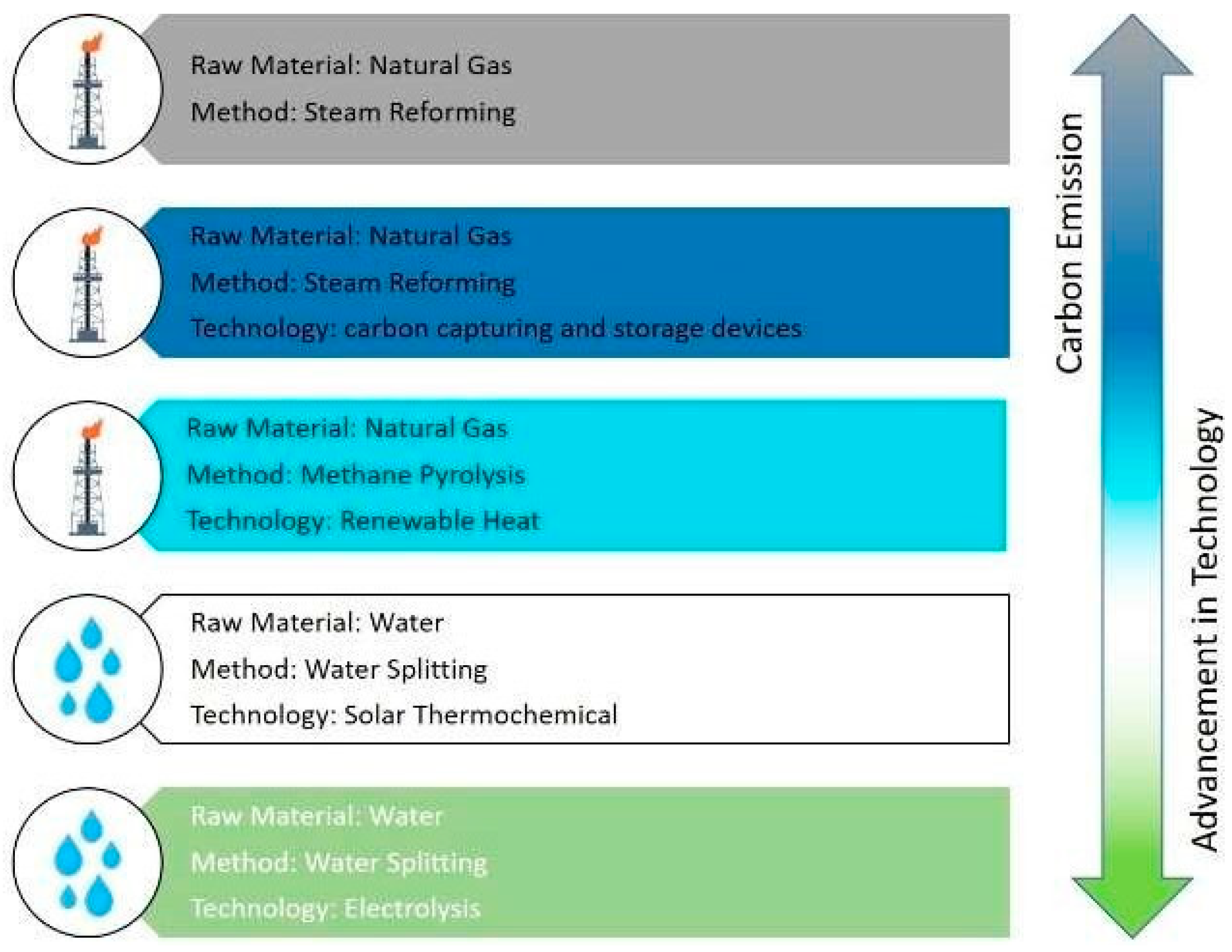
Hydrogen is progressively emerging as an efficient replacement for fossil fuels as a clean, sustainable new energy source, helping to reduce greenhouse gas emissions and the rate of global warming. The sustainability of hydrogen is dependent on choosing the appropriate way for its production (shown in Figure 1). Although studies on hydrogen from more environmentally friendly sources have received much attention, fossil fuels still account for the majority of hydrogen production. Due to its maturity and the addition of a membrane reactor, SMR (Steam Methane Reforming) is currently the most dominant technology in producing hydrogen. On the other hand, some areas may be more suitable for CG (coal gasification) due to the distribution of local resources for the production of hydrogen. Hydrogen produced from SMR is categorized as grey hydrogen because of the direct emission of carbon dioxide. Different ways of capturing this carbon dioxide before it is disseminated in the environment were introduced using carbon capture and storage (CCS) technology [9]. When CCS is used for hydrogen production, the resulting product is labelled blue hydrogen. Although CCS devices prevent carbon dioxide from being emitted into the environment, they add an additional cost to the procedure. Renewable energy-based hydrogen production is becoming increasingly significant and is continually being technologically improved. Among all means of green hydrogen production, water electrolysis is the most practical method [10].
Green hydrogen produced using water electrolysis is progressively becoming the recommended alternative for future hydrogen production. Rapid advancement in electrolysis technology helps in transitioning from alkaline electrolyzers to flexible and efficient polymer electrolyte membrane electrolyzers. Another technology for hydrogen production that is considered as environmentally friendly is the solar thermochemical splitting of water, the product of which is classified as white hydrogen [11]. On the other hand, aquamarine hydrogen is produced through the pyrolysis of methane, performed using solar thermochemical phenomena [12]. This procedure involves no direct carbon emission.
Among all green hydrogen production methods, biomass gasification currently exhibits the highest energy and exergy efficiencies, at 53.6% and 49.8%, respectively [13], significantly outperforming solar PV- and geothermal-based electrolysis. However, environmental concerns and feedstock limitations can constrain its sustainability.

3. Potential of Green Hydrogen

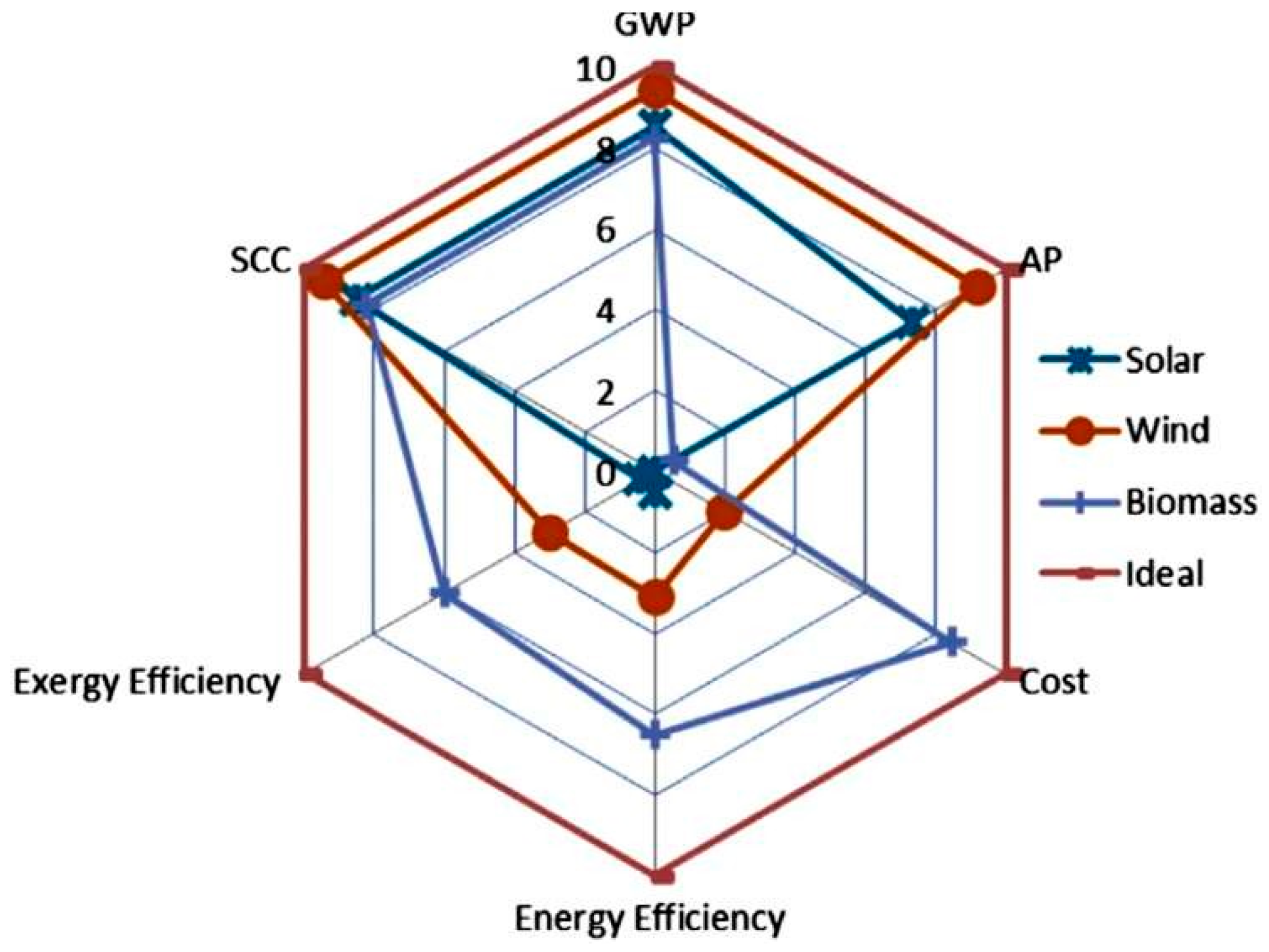
The affordable supply of hydrogen is the key pillar of the low-carbon hydrogen economy. However, green hydrogen is expensive compared to other means of production. Due to the need for a sophisticated and expensive multi-component system, green hydrogen production technology is currently not mature in terms of efficiency and cost. The cost of green hydrogen that is produced using renewable electricity sources can be in the range of $ 2.28–7.43/kg [14]. This cost is much higher than that for grey or blue hydrogen. Different renewable energy-based hydrogen production methods which include solar PV, biomass gasification, and geothermal power generation were analyzed in terms of thermodynamics based on energetic and exergetic approaches [13]. It was reported (summarized in Table 1) that a solar PV-based hydrogen system has overall energy and exergy efficiencies of 16.95% and 17.45%, which is lower than the values of biomass gasification, which are 53.6% and 49.8%, respectively. On the other hand, a geothermal energy-based hydrogen production system has the lowest energy and exergy efficiencies at 10.45% and 10.2%, respectively. These three renewable energy-based hydrogen production systems, based on solar PV, biomass gasification and geothermal power, were found to be capable of producing 2.26 g/s, 106.9 g/s and 32.02 g/s hydrogen, respectively. Performance evaluation of different renewable resources including solar, wind and biomass was carried out for the production of hydrogen. These performances are analyzed in Figure 2 based on energy and exergy efficiency, cost, global warming, the acidification problem, and also the social cost of carbon [15]. Although biomass gasification technology showed better technical efficiency, solar and wind electrolysis systems showed better results in terms of environmental aspects.
Hydrogen-based energy systems offer distinct advantages over conventional renewable sources like solar or wind, primarily in storage, transportation, and energy density. Hydrogen can store surplus renewable electricity in chemical form, allowing for dispatchable energy supply even during periods of low generation. With a high calorific value (150,000 KJ/kg), hydrogen exceeds traditional fuels, offering more compact energy storage and facilitating use in sectors hard to electrify, such as high-temperature industries, shipping, and aviation.

Potential Usage of Hydrogen

Different green and renewable sources are being studied as an alternative. Recently, researchers have become interested in using hydrogen as an alternative fuel for a variety of purposes. It is regarded as a renewable synthetic fuel. In terms of carbon dioxide and carbon monoxide emissions, hydrogen is a possible source of renewable energy [16]. It is seen as being environmentally beneficial and is thought to be a future green fuel with zero emissions because, in contrast to fossil fuels, all that is released is water vapour when it burns with oxygen. The calorific value of hydrogen is another aspect that gives it an advantage over other fuels, as shown in Table 2.
Studies are also being done on the usage of hydrogen fuel for rail industries. A major difficulty is storing hydrogen so that a locomotive can run on some hydrogen fuel. However, statistical analyses suggest that it might be a practical alternative fuel [17]. Reduced greenhouse gas (GHG) emissions from maritime transportation are becoming a challenge. The most effective way to reduce emissions is the use of alternative fuels instead of conventional fuel. Green hydrogen is a promising alternative for the shipping industry [18]. Long-distance rail networks that cannot afford to provide high electricity may use hydrogen-powered trains. Because of their advantages of (i) greater temperature tolerance and (ii) faster rate of recharge than conventional vehicles, hydrogen-powered forklifts can compete with battery-electric vehicles (BEVs) in a variety of applications. Likewise, high-capacity mining equipment, trucks, and airport support services could also use hydrogen.
Techno-economic analysis shows that hydrogen technically has great potential in this industry but still research is highly required to reduce its cost and make this alternative an economically feasible solution. For example, manufacturing cement demands high temperatures of above 1000 °C. The direct electrification of this heat may be a good alternative. Fossil fuels are used with a combination of electrification to achieve high temperatures. This could cause an increase in GHG emissions. Hydrogen has the potential to achieve such high temperatures due to its high calorific value while helping in the decarburization of the process. Co-feeding hydrogen into refineries, ammonia plants, and steel blast furnaces can greatly accelerate the initial phases of green hydrogen commercialization. Low-level hydrogen merging in the grid would significantly impact industrial consumers of natural gas (e.g., the petrochemical sector) since it reduces the quality of the natural gas raw material.
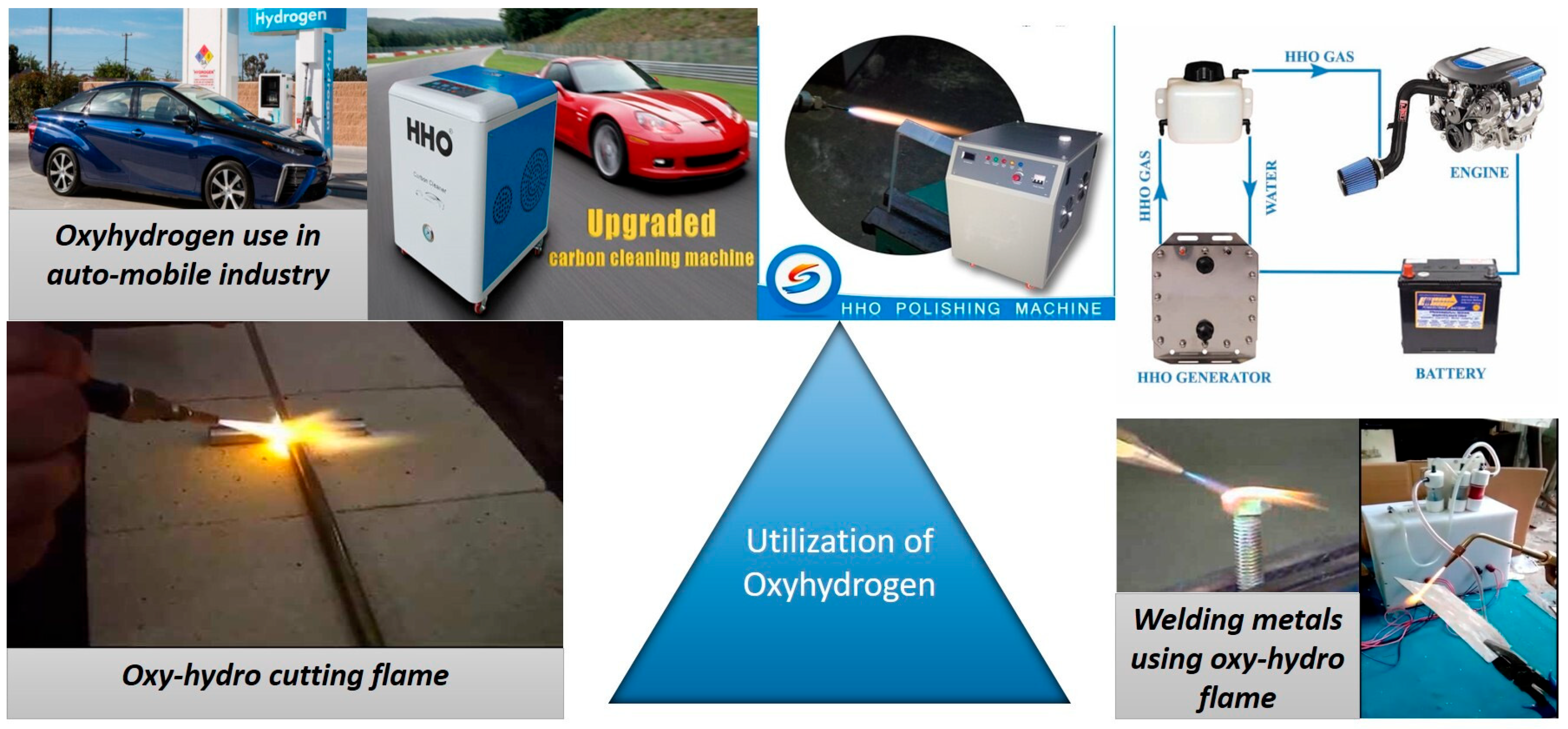
All applications of boilers that resemble natural gas burners can use hydrogen gas as an alternative fuel. This involves gas-powered heat pumps, combustion boilers, and catalytic boilers. The deployment of carbon capture and storage (CCS) technology or contemporary turbines that can use 100% hydrogen will be required to fully decarbonize the energy sector. It is possible to modify a wide range of district heating methods such that hydrogen can be used as fuel [18]. Due to its high heating value, it is much more feasible to use hydrogen in cutting and welding applications [16]. It not only prevents the emission of toxic gases but also makes processing easier due to its high temperature and focused flame.
Applications for hydrogen gas go beyond industrial and combustion engine use (Figure 3). It can also be in a vast application for heating homes [19]. Burning hydrogen fuel could be a decarbonization solution in areas where direct electricity is unavailable and natural gas is typically utilized for heating. However, this would necessitate updating or replacing current natural gas grids and would be very expensive in a dedicated hydrogen power system. A new technology of incinerators was exploited recently to manage the challenge of municipal solid waste using hydrogen as fuel [20]. Based on a study [14] whose results are shown in Table 3, it was concluded that hydrogen gas has the potential to be the cheapest source used for heating purposes.
Despite its significant potential, hydrogen-based energy generation faces several limitations that must be addressed before it can be widely adopted. One of the primary challenges is hydrogen storage, as it requires high-pressure compression, liquefaction at cryogenic temperatures, or complex chemical carriers—all of which add considerable cost and complexity [9]. Additionally, hydrogen has a low volumetric energy density, which necessitates larger storage volumes compared to conventional fuels, making it less practical for certain applications [3]. The distribution and transportation infrastructure for hydrogen is also underdeveloped, as existing natural gas pipelines are generally not suitable without modifications due to hydrogen’s small molecular size and associated embrittlement risk [21]. Safety concerns also persist because hydrogen is highly flammable and prone to leakage, requiring stringent containment and handling protocols [4]. Moreover, the initial capital costs of hydrogen production systems, especially those based on electrolysis powered by renewables, remain high, and their overall efficiency can be lower than other direct electrification methods [14]. These limitations highlight the need for continued research and technological advancement, particularly in storage materials, safety systems, and scalable infrastructure, to make hydrogen a truly viable and competitive clean energy carrier in the global transition to sustainable energy systems.

4. Conclusions and Recommendations

With the increasing demand for energy, there is an urgent need for both short- and long-term solutions based on clean and green energy to support life on earth. Due to its ease of manufacturing, cheap cost of capital and maintenance, and environmental friendliness, hydrogen could contribute to the development of green energy solutions for a variety of combustion applications. The use of hydrogen gas as an alternative fuel in the transportation industry has enormous potential. This can help in reducing 30% to 40% of the total carbon emissions that the automobile industry is responsible for. Also, the use of hydrogen fuel in industrial applications could help protect the environment from greenhouse gas emissions. As a strategic technology to reach the carbon-free goal, hydrogen and hydrogen energy systems are well-established. According to the findings of this comprehensive research, hydrogen energy systems could result in mutually beneficial outcomes for both the public and private sectors. More green hydrogen is the answer to sustainable and environmentally friendly systems. This involves hydrogen production from the electrolysis of water energized by renewable energy sources. However, there are challenges associated with the transportation, distribution, and storage of hydrogen that hinder its broad use as an energy vector and transmitter.

Author Contributions

Conceptualization, O.M.B. and M.S.A.; methodology, O.M.B.; validation, M.S.A.; resources, M.S.A.; data curation, O.M.B.; writing—original draft preparation, O.M.B.; writing—review and editing, M.S.A.; visualization, O.M.B.; supervision, M.S.A.; project administration, M.S.A. All authors have read and agreed to the published version of the manuscript.

Funding

This research received no external funding.

Institutional Review Board Statement

Not applicable.

Informed Consent Statement

Not applicable.

Data Availability Statement

No new data were created or analyzed in this study. Data sharing is not applicable to this article.

Conflicts of Interest

The authors declare no conflicts of interest.

References

  1. Lewis, N.S. Toward cost-effective solar energy use. Science 2007, 315, 798–801. [Google Scholar] [CrossRef] [PubMed]
  2. Dorner, R.W.; Hardy, D.R.; Williams, F.W.; Willauer, H.D. Heterogeneous catalytic CO2 conversion to value-added hydrocarbons. Energy Environ. Sci. 2010, 3, 884–890. [Google Scholar] [CrossRef]
  3. Safari, F.; Dincer, I. A review and comparative evaluation of thermochemical water splitting cycles for hydrogen production. Energy Convers. Manag. 2020, 205, 112182. [Google Scholar] [CrossRef]
  4. Osman, A.I.; Mehta, N.; Elgarahy, A.M.; Hefny, M.; Al-Hinai, A.; Al-Muhtaseb, A.H.; Rooney, D.W. Hydrogen production, storage, utilisation and environmental impacts: A review. Environ. Chem. Lett. 2022, 20, 153–188. [Google Scholar] [CrossRef]
  5. Hermesmann, M.; Müller, T. Green, turquoise, blue, or grey? Environmentally friendly hydrogen production in transforming energy systems. Prog. Energy Combust. Sci. 2022, 90, 100996. [Google Scholar] [CrossRef]
  6. Rozyyev, V.; Thirion, D.; Ullah, R.; Lee, J.; Jung, M.; Oh, H.; Atilhan, M.; Yavuz, C.T. High-capacity methane storage in flexible alkane-linked porous aromatic network polymers. Nat. Energy 2019, 4, 604–611. [Google Scholar] [CrossRef]
  7. d’Amore-Domenech, R.; Leo, T.J. Sustainable hydrogen production from offshore marine renewable farms: Techno-energetic insight on seawater electrolysis technologies. ACS Sustain. Chem. Eng. 2019, 7, 8006–8022. [Google Scholar] [CrossRef]
  8. Wang, M.; Wang, G.; Sun, Z.; Zhang, Y.; Xu, D. Review of renewable energy-based hydrogen production processes for sustainable energy innovation. Glob. Energy Interconnect. 2019, 2, 436–443. [Google Scholar] [CrossRef]
  9. Dawood, F.; Anda, M.; Shafiullah, G. Hydrogen production for energy: An overview. Int. J. Hydrogen Energy 2020, 45, 3847–3869. [Google Scholar] [CrossRef]
  10. Diab, J.; Fulcheri, L.; Hessel, V.; Rohani, V.; Frenklach, M. Why turquoise hydrogen will be a game changer for the energy transition. Int. J. Hydrogen Energy 2022, 47, 25831–25848. [Google Scholar] [CrossRef]
  11. Boretti, A. There are hydrogen production pathways with better than green hydrogen economic and environmental costs. Int. J. Hydrogen Energy 2021, 46, 23988–23995. [Google Scholar] [CrossRef]
  12. Yu, M.; Wang, K.; Vredenburg, H. Insights into low-carbon hydrogen production methods: Green, blue and aqua hydrogen. Int. J. Hydrogen Energy 2021, 46, 21261–21273. [Google Scholar] [CrossRef]
  13. Ishaq, H.; Dincer, I. Comparative assessment of renewable energy-based hydrogen production methods. Renew. Sustain. Energy Rev. 2021, 135, 110192. [Google Scholar] [CrossRef]
  14. Dincer, I. Green methods for hydrogen production. Int. J. Hydrogen Energy 2012, 37, 1954–1971. [Google Scholar] [CrossRef]
  15. Acar, C.; Dincer, I. Comparative assessment of hydrogen production methods from renewable and non-renewable sources. Int. J. Hydrogen Energy 2014, 39, 1–12. [Google Scholar] [CrossRef]
  16. Butt, O.M.; Ahmad, M.S.; Che, H.S.; Rahim, N.A. Usage of on-demand oxyhydrogen gas as clean/renewable fuel for combustion applications: A review. Int. J. Green Energy 2021, 18, 1405–1429. [Google Scholar] [CrossRef]
  17. Marin, G.; Naterer, G.; Gabriel, K. Rail transportation by hydrogen vs. electrification—Case study for Ontario, Canada, II: Energy supply and distribution. Int. J. Hydrogen Energy 2010, 35, 6097–6107. [Google Scholar] [CrossRef]
  18. Atilhan, S.; Park, S.; El-Halwagi, M.M.; Atilhan, M.; Moore, M.; Nielsen, R.B. Green hydrogen as an alternative fuel for the shipping industry. Curr. Opin. Chem. Eng. 2021, 31, 100668. [Google Scholar] [CrossRef]
  19. Helling, F.; Götz, S.; Singer, A.; Weyh, T. Fast modular multilevel series/parallel converter for direct-drive gas turbines. In Proceedings of the 2015 IEEE NW Russia Young Researchers in Electrical and Electronic Engineering Conference (EIConRusNW), St. Petersburg, Russia, 2–4 February 2015; pp. 198–202. [Google Scholar]
  20. Butt, O.M.; Bibi, S.; Ahmad, M.S.; Che, H.S.; Zahid, T.; Bibi, S.; Abd Rahim, N. Hydrogen as Potential Primary Energy Fuel for Municipal Solid Waste Incineration for a Sustainable Waste Management. IEEE Access 2022, 10, 114586–114596. [Google Scholar] [CrossRef]
  21. Komitov, G.; Rasheva, V.; Binev, I. Determining the expenses for heating of a residential building using different energy sources. IOP Conf. Ser. Mater. Sci. Eng. 2019, 595, 012046. [Google Scholar] [CrossRef]
Figure 1. Hydrogen production technologies based on their nature and environmental aspects.
Materproc 31 00013 g001
Figure 2. Comparison of renewable resources for the production of hydrogen.
Materproc 31 00013 g002
Figure 3. Potential use of hydrogen in different applications.
Materproc 31 00013 g003
Table 1. Energy and exergy comparison of different renewable technologies for the production of hydrogen.
TechnologyEnergy (%)Exergy (%)Production Capacity (g/s)
Solar PV16.9517.452.26
Biomass Gasification53.649.8106.9
Geothermal Power10.4510.232.02
Table 2. The calorific value of different types of fuel.
Sr.Type of FuelCalorific Value
(KJ/kg)
1.Kerosene43,124
2.Diesel42,600
3.Natural Gas38,000–50,000
4.Charcoal33,000
5.Hydrogen150,000
Table 3. Value of heating per hour at different energy sources.
No.Energy SourcesEnergy RequirementEfficiency %Cost of Heating
1Hydrogen gas1.49 kWh550.16 €/h
2Electricity9.29 kWh951.00 €/h
3Wood pellets1.76 kg750.45 €/h
4Agro pellets2.79 kg700.36 €/h
5Natural gas (CNG)0.94 m3900.41 €/h
6LPG0.67 kg880.73 €/h
7Gas oil0.70 L8577 €/h
Disclaimer/Publisher’s Note: The statements, opinions and data contained in all publications are solely those of the individual author(s) and contributor(s) and not of MDPI and/or the editor(s). MDPI and/or the editor(s) disclaim responsibility for any injury to people or property resulting from any ideas, methods, instructions or products referred to in the content.