1. Introduction
The continuous increase in atmospheric CO
2 concentrations is a major contributor to global climate change, driving the need for efficient and scalable carbon capture technologies. Solid adsorbents with a high surface area and tunable porosity have gained attention as promising alternatives to conventional liquid-based systems due to their lower regeneration energy requirements and potential for integration into industrial processes [
1]. Amorphous mesoporous magnesium carbonates (AMMCs) have emerged as attractive solid materials owing to their unique nanostructure, high specific surface area, and chemical stability, which enable enhanced CO
2 adsorption and multifunctional applications.
Conventional synthesis routes for bulk magnesium oxide (MgO), such as calcination and thermal decomposition, typically produce materials with low surface areas (28 m
2·g
−1) [
2], limiting their adsorption performance. In contrast, the sol–gel method enables the production of MgO with enhanced textural properties, particularly when employing organic acids such as citric, oxalic, and maleic acids as gelling agents [
3].
In this study, we report a one-pot synthesis approach for AMMCs using MgO precursors obtained via the sol–gel method with different organic acids as gelling agents. This route avoids high-pressure and high-temperature conditions, offering a scalable and energy-efficient alternative. The resulting AMMCs exhibit mesoporous structures with specific surface areas and pore sizes modulated by the nature of the MgO precursor. AMMCs synthesized via a solvothermal reaction between MgO, CO
2, and methanol exhibited pore sizes below 6 nm and surface areas approaching 600 m
2·g
−1 [
4]. The AMMCs present a better performance in water adsorption than the water adsorption capacity reported by hygroscopic zeolite-Y [
5]. The influence of the gelling agent on the textural and adsorption properties of AMMCs was systematically evaluated, highlighting the potential of this method for the rational design of high-performance CO
2 adsorbents and multifunctional porous materials.
2. Materials and Methods
Magnesium oxide samples were synthesized using the sol–gel method with either no addition or the addition of different gelling agents (oxalic acid (P1), citric acid (P2), or maleic acid (P3)). The resulting intermediate oxides were labeled as MgO P0 (control with no gelling agents), MgO P1, MgO P2, and MgO P3. Amorphous mesoporous magnesium carbonate (AMMC) samples were synthesized via a solvothermal method with different intermediate MgO precursors and were labeled as MgCO
3 P0, MgCO
3 P1, MgCO
3 P2, and MgCO
3 P3. Synthesis details are described in the
Supplementary Information (SI).
The structural parameters and physical properties of the AMMC samples were measured using powder X-ray diffraction (PXRD) and adsorption methods, respectively. The PXRD measurements were collected on a Bruker model D4 Endeavor X-ray diffractometer (CuKα, 40 kV, and 20 mA, Bruker AXS GmbH, Karlsruhe, Germany) operating with a 2θ range of 20–90° with a sweep of 0.02° every 3 s. The textural parameters were measured using the BET and BJH methods in a Micromeritics TriStar physisorption (Micromeritics Instrument Corporation, Norcross, GA, EE. UU) apparatus with liquid nitrogen (N2) at −196 °C. Before analysis, the sample (approximately 100 mg) was degassed for 4 h at 120 °C using N2 as a carrier gas.
The CO2 adsorption isotherms of all materials were obtained on a Micromeritics ASAP2020 Plus sorption analyzer (Micromeritics Instrument Corporation, Norcross, GA, EE. UU). The adsorption process was carried out at 273 K and at pressures varying from 5 to 700 mmHg using pure CO2 with an equilibration time of 5 s. Before the adsorption analysis, each sample was pretreated for 1 h under vacuum at 200 °C.
Temperature-programmed desorption of water (TPD-H2O) was performed on a Micromeritics Autochem II 2920 instrument equipped with a thermal conductivity detector (TCD) and coupled to a mass detector (MS) (Micromeritics Instrument Corporation, Norcross, GA, EE. UU.). For the analysis, about 100 mg of the sample prior to TPD-H2O was treated for 1 h in a fixed-bed reactor with a flow rate of 50 mL min−1 of He and saturated with water using a saturator at 0 °C. Weakly adsorbed water species were removed with a flow rate of 50 mL min−1 of helium (He) at 50 °C (5 °C·min−1) for 2 h. Subsequently, the desorption step was initiated, increasing the temperature to 75 °C (5 °C·min−1) with a flow of 20 mL min−1 of He to remove any excess weakly adsorbed water. Once 75 °C is reached, the system was heated up to 800 °C (5 °C·min−1) with a flow of 20 mL min−1 of He. The calibration of the amount of adsorbed water is described in the SI.
3. Results and Discussion
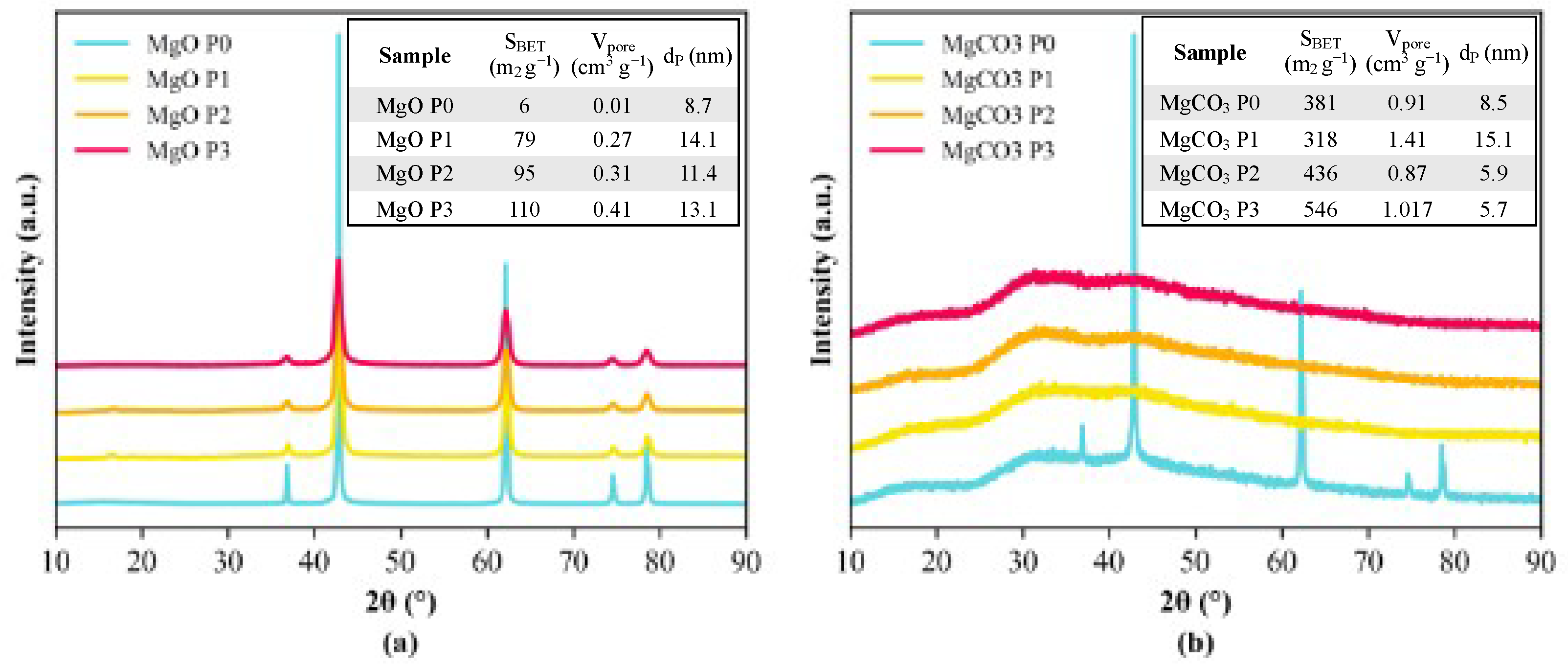
X-ray diffraction patterns of the magnesium oxides (
Figure 1a) prior to carbonation confirmed the presence of the periclase phase (JCPDS 96-900-0506), with characteristic peaks at 2θ: 36.9°, 42.9°, 62.2°, 74.6°, and 78.6°. The control sample (MgCO
3 P0) displayed peaks at 2θ: 36.9°, 42.9°, 62.2°, 74.6°, and 78.6°. These peaks corresponded to unreacted MgO (
Figure 1b). In contrast, the magnesium carbonate samples did not exhibit a well-defined crystalline structure.
The inserts of
Figure 1a and
Figure 1b also summarize the textural properties of MgO and MgCO
3, respectively. The surface area (S
BET) and pore volume (V
P) of MgCO
3 samples varied, depending on the gelling agent used for the synthesis of MgO precursors. These differences were, in general, reflected during the carbonation process, as the MgO sample with the higher surface area yielded the MgCO
3 sample with the higher surface area. For instance, through carbonating MgO P3 with a surface area of 110 m
2·g
−1, the MgCO
3 P3 sample with a higher surface area of 546 m
2·g
−1 could be obtained.
The infrared spectra of the magnesium oxide samples revealed their structures (
Figure S1a). The adsorption band between 3412 and 3712 cm
−1 is attributed to the stretching of the hydroxyl (OH) group of surface water molecules. The band at 1702 cm
−1 is attributed to the stretching of the OH groups of surface water. The bands at 870 and 1459 cm
−1 are assigned to the carbonate species on the surface of magnesium oxide due to CO
2 adsorption. The bands at 650 and 430 cm
−1 are ascribed to the vibration of the Mg-O bond of magnesium oxides [
2].
Furthermore, the infrared spectra of magnesium carbonates confirmed their formation (
Figure S1b). The adsorption bands at 3739 and 3390 cm
−1 are attributed to the stretching vibrations of adsorbed water molecules. The bands at 1429 and 860 cm
−1 correspond to the stretching and bending of the C=O bonds of MgCO
3, and the broad bands at 660 and 430 cm
−1 correspond to the vibrations of the Mg-O bond of magnesium carbonate [
6].
To rationalize the adsorbent–adsorbate interaction, the CO
2 adsorption data (
Figure S2a) were fitted to the Langmuir and the Freundlich adsorption models (
Figure S2b,c). The Langmuir isotherm is a mathematical model that describes the adsorption of molecules on a solid surface at a constant temperature. It is based on the idea that adsorption occurs in monolayers, i.e., only one layer of molecules binds to the surface, and that there is no interaction between the adsorbed molecules. The Freundlich isotherm is an empirical model that describes the relationship between the amount of substance adsorbed on a solid surface and the concentration of the substance in the surrounding fluid phase at a constant temperature. It is commonly used to model adsorption processes, especially in systems with heterogeneous surfaces or dilute solutions. The fitted adsorption parameters are shown in
Table 1. In the Freundlich equation,
n indicates the heterogeneity of the adsorption sites. The higher the value of
n, the greater the difference in adsorption energy between the sites of the material. The adsorption process is favorable when
n has values between 1 and 10 [
7]. According to the correlation coefficients, R
2, for the two sets of fittings in
Figure S2, the experimental CO
2 adsorption data of the different MgO fitted better to the Freundlich model in general. The negative ΔG
0 values deduced from the Langmuir model suggest that the interactions between CO
2 and the basic sites of MgO made with the sol–gel method are stronger compared to those of the MgO obtained without the use of gelling agents.
The H
2O-TPD profiles of the various AMMC samples reveal the nature of water adsorption on the surface of the MgCO
3 samples (
Figure S3). Two distinct desorption peaks were identified (
Figure S3a), corresponding to different adsorption mechanisms. The first peak is attributed to the physisorbed water molecules, which were weakly bound to the surface, as confirmed by mass spectrometry (
Figure S3b). Similarly, the mass detector signals from water and CO
2 suggest that the second peak corresponds to the chemisorbed water and the release of CO
2 associated with the thermal decomposition of AMMC (
Figure S3c). The amount of desorbed water was quantified and summarized in
Table 2. The trend in mmol of water desorbed per gram of AMMC follows the trend order: MgCO
3 P1 > MgCO
3 P0 > MgCO
3 P3 > MgCO
3 P2 (
Table 2). This behavior is directly correlated to the distribution of average pore size and pore volume of these samples [
5].