


Abstract
In this study, the solvent displacement method was used. This is a low-energy technique that generates a spontaneous “oil-in-water” nanoemulsion by diffusing ethanol from the oily phase to the aqueous phase. Subsequently, chitosan, a biocompatible and biodegradable cationic polymer, was incorporated, applying ionic gelation with sodium sulfate (Na2SO4) to achieve uniform coatings. Atomic force microscopy (AFM) characterization revealed nanocapsules with defined morphology and regular topography. Analysis with WSxM 4.0 Beta 10 software revealed a partially ordered hexagonal arrangement, which was evidence of controlled synthesis and the potential of chitosan as a polymeric system.
1. Introduction
Nanotechnology has revolutionized the development of new materials by enabling the manipulation and assembly of atoms and molecules at the nanometer scale. This capability allows for the design of structures such as nanoparticles and nanosystems with applications in various fields, such as chemistry, biology, and medicine. The versatility of these materials lies in the possibility of using both organic and inorganic components, making their synthesis and design of great interest for science and technology [1,2].
Polymeric materials are widely used in the manufacture of nanoparticles due to their many advantages. They are characterized by their low cost, natural abundance, and ease of production. In addition, they contain a large number of intrinsic functional groups in their chemical structure, which confer remarkable physicochemical properties in solutions [3].
In this context, chitin emerges as a naturally occurring polymer of great relevance. It is obtained from the exoskeletons of arthropods (such as insects, shrimp, and crabs) and from certain fungi. To overcome some of its limitations, such as its low solubility, chitin undergoes a deacetylation process, in which the acetyl group is removed from its structure to produce chitosan [4].
Despite this transformation, chitosan still has limitations, particularly its poor solubility at physiological pH. However, this drawback can be addressed by chemical modification aimed at adjusting its hydrophilic–lipophilic (HLB) balance, surface load, and functionality. An effective method for this purpose is ionic gelation, which allows the modulation of the structure and properties of chitosan to optimize its performance in various applications [5,6].
Atomic force microscopy (AFM) was used for characterization to determine its morphology and topography, and WSxM 4.0 Beta 10 software was used for image analysis [7,8,9].
2. Materials and Methods
2.1. Materials
The substances used in this study were Chitosan (medium molecular weight) was sourced from Sigma-Aldrich (St. Louis, MO, USA)., acetic acid (1% v/v) was obtained from Fermont (Monterrey, Mexico), Tween 20 was purchased from Azumex (Puebla, Mexico), Span 85 was sourced from Sigma-Aldrich (St. Louis, MO, USA), oleic acid was sourced from Sigma-Aldrich (St. Louis, MO, USA), Na2SO4 was sourced from Omnichem (Puebla, Mexico), and Milli-Q water Millipore (Molsheim, France).
2.2. Synthesis of Nanocapsules
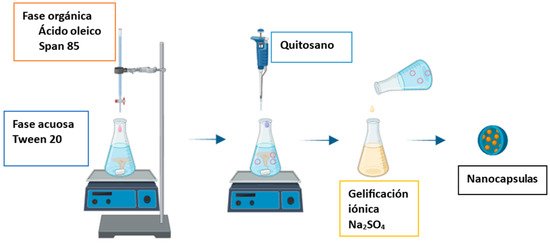
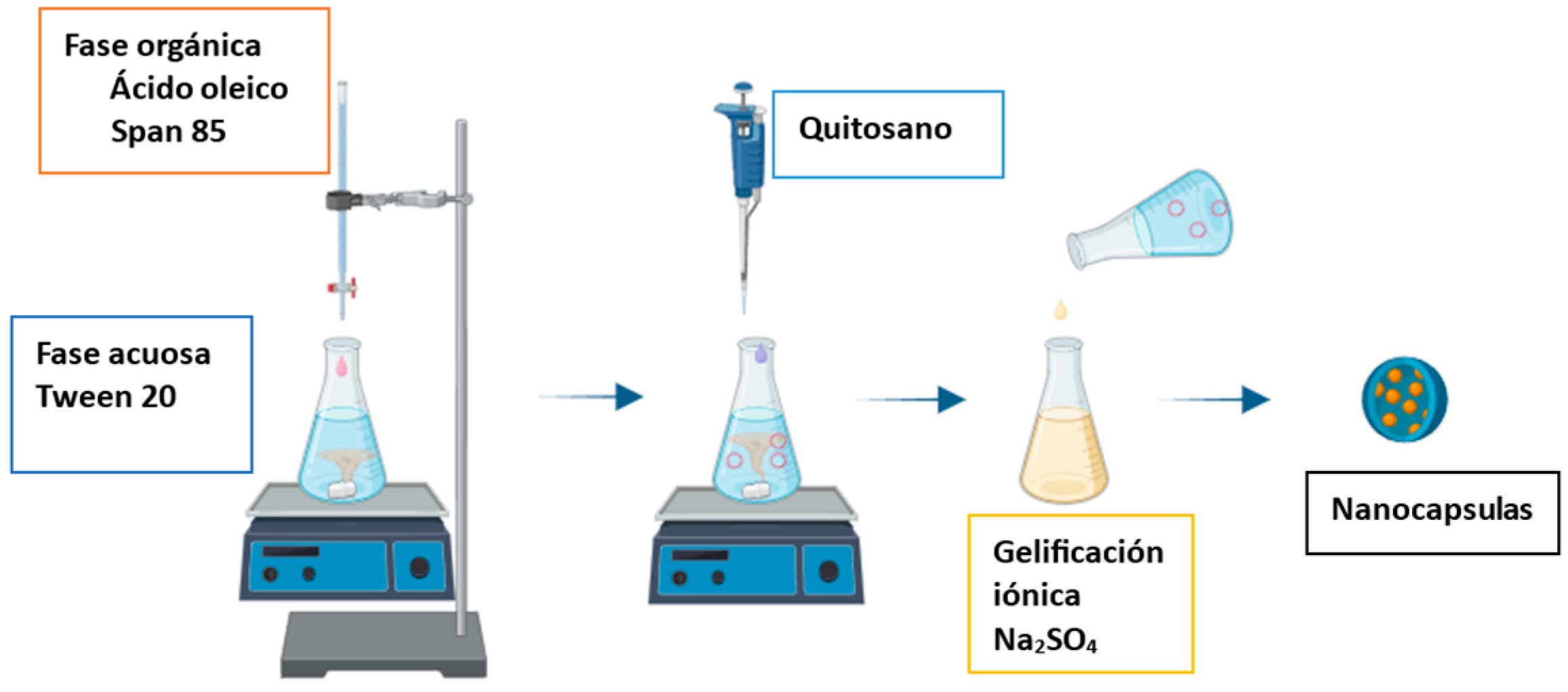
The components of the synthesis were selected to achieve spontaneous emulsion, favored by the presence of a nonionic hydrophilic surfactant in the aqueous phase (Tween 20) and the combination of a nonionic lipophilic surfactant (Span 85) and an oil in this case (oleic acid). This fulfilled the function of forming the center of the nanocapsule, but it also helped to reduce the tension between phases and control size to improve assembly with chitosan. The emulsion was magnetically stirred at 250 rpm while the organic ethanolic phase was added drop by drop. Subsequently, chitosan dissolved in 1% acetic acid (v/v) was incorporated. An ionic gelation was made with 15 mL of Na2SO4, this reagent adds a monovalent ion capable of electrostatically cross-linking the polymer chains with opposite charge. Sodium sulfate was used. It is a solvation reagent that facilitates the displacement of the solvation layer that keeps the polymer in a colloidal state. This gives better rigidity to the capsule system. This was followed by centrifugation (Hettich Micro 220R centrifuge, Tuttlingen, Germany) at 4500 rpm for 45 min and resuspension in 2 mL of milli-Q water (Figure 1) [5,6].
Figure 1.
Chitosan nanoencapsulation synthesis created with BioRender.
Characterization: The nanocapsules were analyzed by atomic force microscopy (AFM). AFM imaging was performed with a Nanoscope Analysis 1.40 system (Bruker Corporation, Billerica, MA, USA) in tapping mode. Image analysis was performed using, the images were analyzed using WSxM 4.0 Beta 10 (Nanotec Electrónica S.L., Madrid, Spain).
3. Results
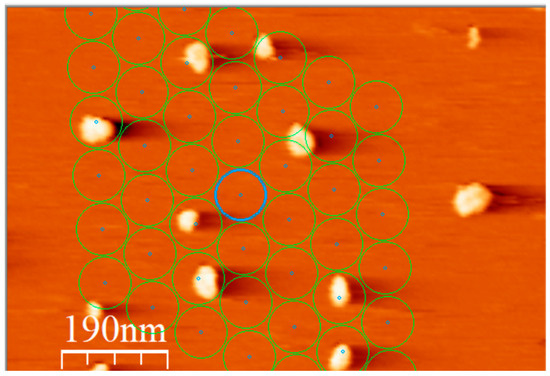
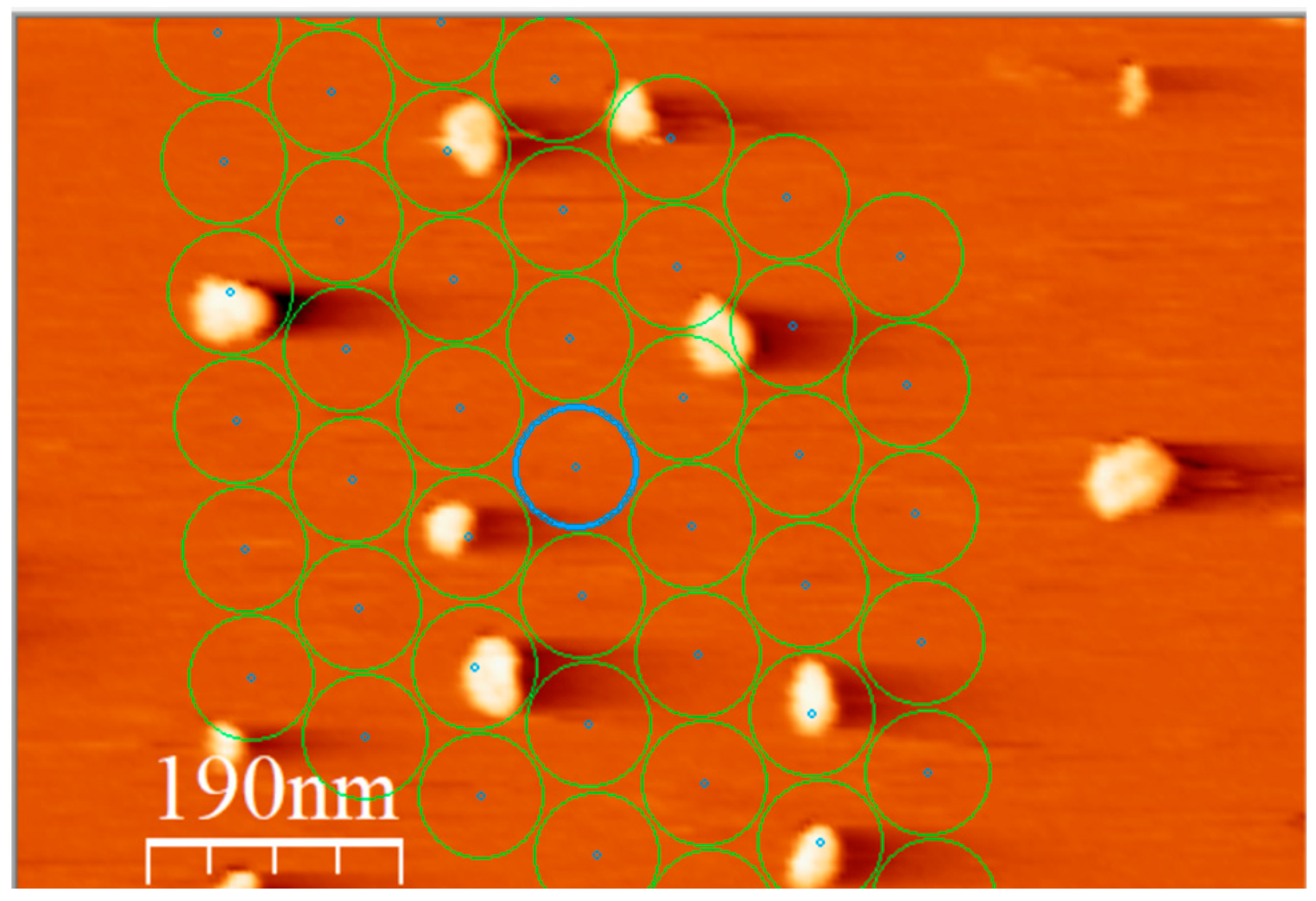
The characterization of the nanocapsules was performed by atomic force microscopy (AFM) in bypass mode. The parameters analyzed included morphology, surface distribution, estimated size, organization, and uniformity. Indicators were obtained with WSxM 4.0 Beta 10 software. The area was selected in a representative way; this involved, choosing area where the nanocapsules were defined and free from scanning artifacts, such as streaks or irregularities, to avoid biases associated with accumulation or topographic defects. This allowed uss to more accurately compare the morphological characteristics of the set (Figure 2).
Figure 2.
Micrograph showing the morphology of chitosan nanocapsules (AFM’s own image).
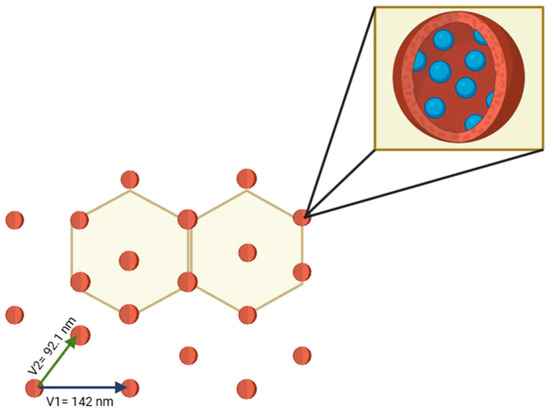
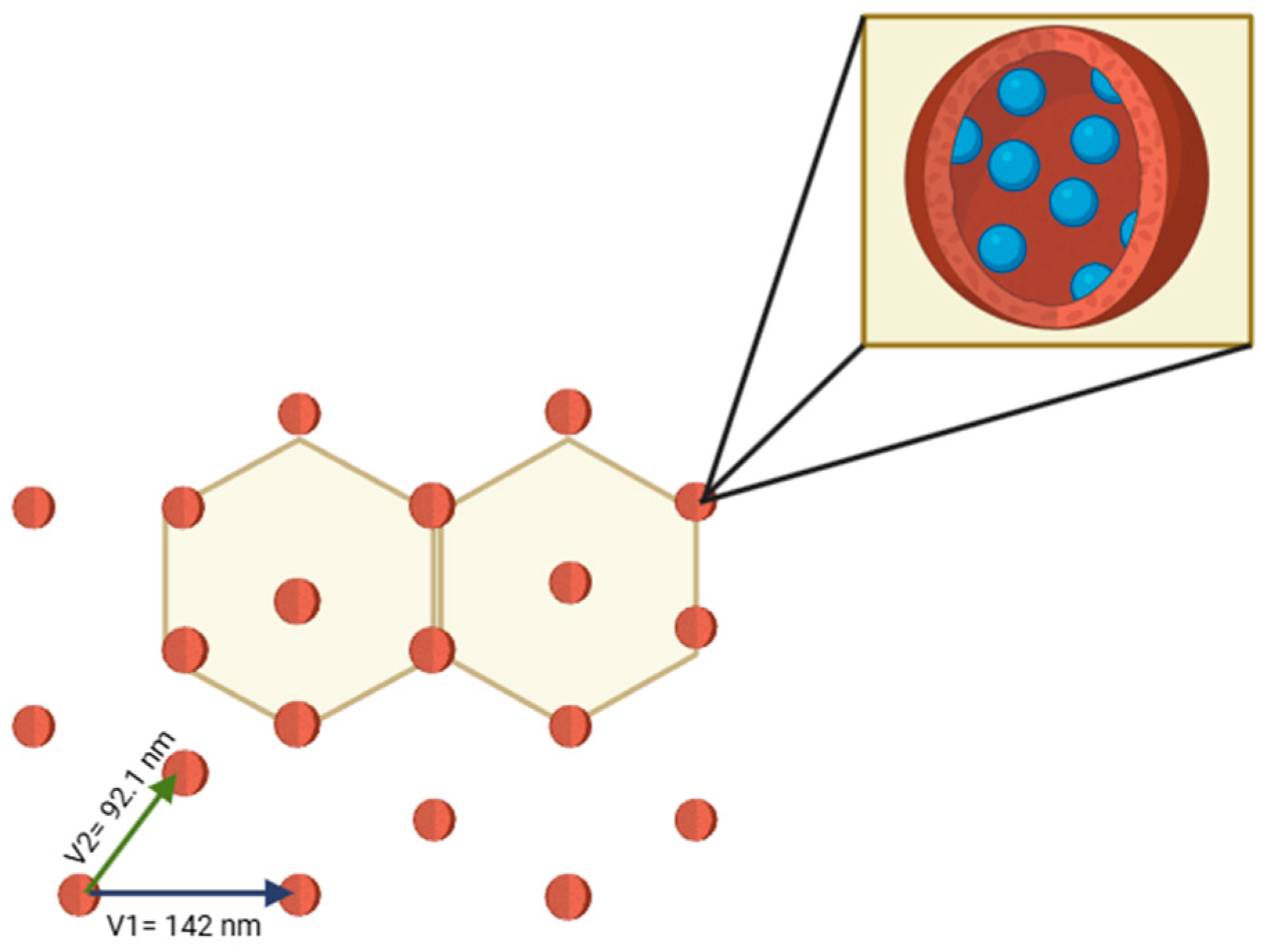
The nanocapsules exhibited average dimensions of 141.2 nm in width (V1) and 92.1 nm in height (V2). Surface analysis revealed a partially regular arrangement, confirmed by a hexagonal lattice simulation based on vectors V1 and V2. The morphology suggests controlled interactions during synthesis, possibly influenced by pH, drying rate, or the presence of ligands (Figure 3).
Figure 3.
Conceptual schematic of the idealized hexagonal pattern based on AFM measurements and analysis of the WSxM 4.0 Beta 10 software of chitosan nanocapsules, created with BioRender.
4. Discussion
The results are consistent with previous studies describing chitosan’s ability to form stable nanostructures. The observation of a hexagonal pattern in the particle distribution is a significant finding, as it indicates a certain degree of self-organization, which can improve stability and functionality. The ionic emulsification and gelation method proved to be an efficient and reproducible way of obtaining chitosan nanocapsules [5,6,7].
The orderly arrangement of nanoscale particles is essential to improve the functionality and optimize the performance of various nanomaterials. Several studies have indicated that this process depends on the balance of intermolecular and surface forces (such as van der Waals, colloidal, capillary, convective, and chemical interactions), as well as interactions with molds or templates (physical confinement, chemical functionalization, and layer-by-layer deposition methods). The recent literature highlights both advances in stencil-less self-assembly techniques and strategies for fabricating stencil surfaces, emphasizing their influence on process efficiency and control. In addition, it has been documented that the spatial orientation of nanoparticles facilitates the creation of surfaces with micropatterns that are useful in a wide range of technological applications [9].
5. Conclusions
The chitosan nanocapsules exhibited a well-defined nanometric morphology, with dimensions of 141 nm in width and 92.1 nm in height. AFM analysis revealed predominantly spherical or subspherical shapes with smooth surfaces and a partial hexagonal lattice arrangement, indicating good uniformity and suggesting controlled synthesis conditions. The nanocapsules also showed a tendency to self-organize, likely due to surface interactions and charging, indicating low dispersion. These results confirm the potential of chitosan as a polymeric system for biomedical applications.
Author Contributions
Conceptualization: I.A.D.S. and R.E.R.C.; Methodology: R.E.R.C., A.C.U. and F.E.V.H.; Research: R.E.R.C., G.S.C., J.J.O. and A.J.B.R.; Writing—original draft: R.E.R.C.; Writing—revision and editing: I.A.D.S.; Supervision: I.A.D.S. and A.C.U. All authors have read and agreed to the published version of the manuscript.
Funding
This research did not receive external funding.
Institutional Review Board Statement
Not applicable.
Informed Consent Statement
Not applicable.
Data Availability Statement
Data are contained within the article.
Acknowledgments
The authors thank the Faculty of Chemical Sciences, UABJO, for supporting the use of the laboratory facilities.
Conflicts of Interest
The authors declare that they have no conflicts of interest.
References
- Bhushan, B. Springer Nanotechnology Manual, 4th ed.; Springer: Berlin, Germeny, 2017. [Google Scholar] [CrossRef] [Scilit]
- Torchilin, V.P. Multifunctional nanocarriers for the delivery of drugs and biologically active substances. Nat. Rev. Drug Discov. 2014, 13, 813–827. [Google Scholar] [CrossRef] [Scilit] [PubMed]
- Jain, K.K. Applications of nanobiotechnology in clinical diagnostics. Clin. Chem. 2007, 53, 2002–2009. [Google Scholar] [CrossRef] [Scilit] [PubMed]
- Ahmed, E.M. Hydrogel: Preparation, characterization and applications: A review. J. Adv. Res. 2015, 6, 105–121. [Google Scholar] [CrossRef] [Scilit] [PubMed]
- Agnihotri, S.A.; Mallikarjuna, N.N.; Aminabhavi, T.M. Recent advances in chitosan-based micro- and nanoparticles in drug delivery. J. Control. Release 2004, 100, 5–28. [Google Scholar] [CrossRef] [Scilit] [PubMed]
- Reis, C.P.; Neufeld, R.J.; Ribeiro, A.J.; Veiga, F.; Nanoencapsulation, I. Methods for the preparation of drug-loaded polymeric nanoparticles. Nanomedicine 2006, 2, 8–21. [Google Scholar] [CrossRef] [Scilit] [PubMed]
- Mukhopadhyay, P.; Maity, S.; Mandal, S.; Chakraborti, A.S.; Prajapati, A.K.; Kundu, P.P. preparation, characterization and in vivo evaluation of pH sensitive, safe quercetin-succinylated chitosan-alginate core-shell-coronana noparticule for diabetes treatment. Carbohydr. Polym. 2014, 112, 627–637. [Google Scholar] [CrossRef] [Scilit] [PubMed]
- Horcas, I.; Fernández, R.; Gómez-Rodríguez, J.M.; Colchero, J.; Gómez-Herrero, J.; Baro, A.M. WSXM: A software for scanning probe microscopy and a tool for nanotechnology. Rev. Sci. Instrum. 2007, 78, 13705. [Google Scholar] [CrossRef] [Scilit] [PubMed]
- Jambhulkar, S.; Ravichandran, D.; Zhu, Y.; Thippanna, V.; Ramanathan, A.; Patil, D.; Fonseca, N.; Thummalapalli, S.V.; Sundaravadivelan, B.; Sun, A.; et al. Nanoparticle Assembly: From Self-Organization to Controlled Micropatterning for Enhanced Functionalities. Small 2024, 20, 2306394. [Google Scholar] [CrossRef] [Scilit] [PubMed]
Disclaimer/Publisher’s Note: The statements, opinions and data contained in all publications are solely those of the individual author(s) and contributor(s) and not of MDPI and/or the editor(s). MDPI and/or the editor(s) disclaim responsibility for any injury to people or property resulting from any ideas, methods, instructions or products referred to in the content. |
© 2025 by the authors. Licensee MDPI, Basel, Switzerland. This article is an open access article distributed under the terms and conditions of the Creative Commons Attribution (CC BY) license (https://creativecommons.org/licenses/by/4.0/).