


Abstract
Postoperative infections in orthopedic implants remain a major complication, particularly in open fractures, where early bacterial colonization and the limited bioactivity of titanium alloys hinder osseointegration. This study reports a hierarchical coating synthesized in situ on Ti-407 alloy, integrating bioactive and antibacterial functions. TiO2 nanotube arrays were formed by anodization and subsequently functionalized by sequential electrodeposition of Ag nanoparticles and doped hydroxyapatite (HA) (Ca, P, Mg, Zn). SEM/EDS confirmed uniform coatings with a Ca/P ratio near stoichiometric HA (1.61). Agar diffusion assays against E. coli ATCC® 25922™ revealed well-defined inhibition zones, confirming the antibacterial efficacy of the coatings. These findings highlight the potential of hierarchical coatings to enhance bone integration while reducing infection risk in orthopedic implants.
1. Introduction
Postoperative infections remain one of the most serious complications in orthopedic surgery, with incidences ranging from 1 to 4% overall and reaching higher values in open fractures [1,2]. Such infections compromise implant function, prolong hospitalization, and increase treatment costs. Their persistence is mainly attributed to bacterial adhesion and biofilm formation, which shield microorganisms from antimicrobials and host immune responses, making eradication challenging [2]. Among the implicated pathogens, Escherichia coli has gained attention as an emerging nosocomial agent due to its prevalence in device-associated infections, its strong biofilm-forming capacity, and its increasing multidrug resistance [3,4].
Titanium alloys remain the reference materials for orthopedic implants due to their mechanical strength, biocompatibility, and corrosion resistance. Ti-6Al-4V is widely used, but it presents concerns related to the release of Al3+ and V5+ ions under wear or corrosion, which have been associated with cytotoxicity and inflammation [5]. In this context, Ti-407 (Ti-3.9V-0.85Al) has emerged as a promising alternative because its lower Al and V content contributes to improved ductility, higher damage tolerance, and better manufacturability compared with Ti-6Al-4V [6]. Nevertheless, like other titanium alloys, Ti-407 is bioinert: it does not promote osteointegration nor confer antibacterial properties.
Surface modification has been explored to address these limitations. Electrochemical anodization enables the formation of self-organized TiO2 nanotube arrays, whose nanotopography favors cell adhesion and can be functionalized with bioactive agents [7,8]. Fluoride ions in the electrolyte play a critical role by forming soluble [TiF6]2− complexes that locally dissolve the oxide and allow for controlled nanotube growth [8]. These nanotubes also act as reservoirs for therapeutic agents, while improving corrosion resistance and reducing ion release into the biological environment [9].
Electrodeposition is a versatile and reproducible technique to incorporate functional compounds on metallic substrates. Sequential electrodeposition allows for the controlled deposition of metallic silver (Ag0), which provides broad-spectrum antibacterial activity, and osteoconductive minerals such as Ca2+, Mg2+, Zn2+, and PO43−, which promote bone regeneration [10,11,12]. Compared with physical methods (e.g., sputtering, PVD), electrodeposition is low-cost, does not require vacuum or high temperatures, and can be adapted to complex nanotubular architectures. Previous studies reported that Ag nanoparticles act as nucleation centers for hydroxyapatite (HA), leading to Ca/P ratios close to stoichiometric HA (1.67) and improving cellular response [13,14,15].
Despite these advances, the combined application of anodization and sequential electrodeposition on Ti-407 alloy has been scarcely investigated, particularly regarding its antibacterial potential against clinically relevant pathogens. Previous studies have shown that the hierarchical incorporation of materials—combining microscale and nanoscale surface features—can modulate interfacial chemistry, enhance bioactivity, and improve antibacterial performance, underscoring the relevance of multi-scale surface engineering approaches [16,17,18]. Therefore, the present study aimed to functionalize Ti-407 surfaces by anodization and sequential electrodeposition of Ag0 and bioactive ions, characterize the resulting hierarchical coatings, and evaluate their antibacterial efficacy against E. coli ATCC® 25922™. This approach seeks to provide a dual-function surface—bioactive and antibacterial—toward safer orthopedic implants.
2. Materials and Methods
2.1. Processing of Ti-407 Alloy Samples
Rectangular plates of Ti-407 titanium alloy (TIMETAL® 407, TIMET, Exton, PA, USA) were cut into 1 × 1 cm2 specimens with a thickness of 3 mm using a precision diamond saw (VC-50, LECO, St. Joseph, MI, USA). The surfaces were etched in a solution of HF:HNO3:H2O (5:4:1), rinsed with distilled water, 96% ethanol (J.T. Baker, Phillipsburg, NJ, USA), and acetone (ACS grade, Sigma-Aldrich, St. Louis, MO, USA), and subsequently ground with 2400-grit SiC abrasive paper (OnPoint Abrasives, Oro Valley, AZ, USA). After cleaning, samples were air-dried and stored until use.
2.2. Surface Modification by Anodization
Anodization was performed in a two-electrode cell, using Ti-407 samples as the anode (1 cm2 exposed area) and a platinum plate as the cathode, connected to a DC power supply (9110, B&K Precision, Yorba Linda, CA, USA) set at 15 V (current limit 1 A). The interelectrode distance was fixed at 20 mm. Under these conditions, the operating current remained within the 2–15 mA·cm−2 range. The electrolyte (100 mL) consisted of 1.0 M (NH4)2SO4 and 0.25 M NH4F (Sigma-Aldrich, St. Louis, MO, USA) in distilled water. The process was maintained for 30 min at room temperature. After anodization, the samples were rinsed with distilled water, ethanol, and acetone, dried, and stored until use. No post-anodization annealing was performed.
2.3. Electrodeposition of Functional Coatings
Three types of functional coatings were deposited on anodized Ti-407 samples, previously treated by electrochemical anodization to generate self-organized TiO2 nanotube arrays. All electrodeposition processes were conducted at room temperature in a two-electrode configuration using the anodized Ti-407 sample as the cathode (1 cm2 exposed area) and a platinum plate as the anode (interelectrode distance: 20 mm). A DC power supply (9110, B&K Precision, Yorba Linda, CA, USA) was set at 5 V with a current limit of 1 A. Under these conditions, the operating current stabilized between 5 and 20 mA·cm−2 for Ag deposition and 0.5–5 mA·cm−2 for bioactive coatings.
- Electrodeposition of metallic silver (Ag0): In the first group, silver was deposited by immersing the anodized samples for 5 min in 100 mL of 0.05 M AgNO3, prepared using 90 mL of ethylene glycol and 10 mL of distilled water. This 9:1 solvent ratio was selected because ethylene glycol-based systems have been shown to enhance electrolyte stability, including chemical, ionic, and thermal stability [19]. After deposition, the samples were dried with hot air, and excess solution was removed using compressed air for 30 s.
- Electrodeposition of bioactive ions: In the second group, anodized samples were treated for 20 min in 100 mL of an aqueous solution containing 0.2 M of K2HPO4, 0.1 M of MgCl2·6H2O, 0.2 M of CaCl2·2H2O, and 0.05 M of ZnCl2. After deposition, the same drying and air-blowing procedure was applied.
- Sequential electrodeposition of Ag and bioactive ions (hierarchical coating): In the third group, the anodized samples first underwent the silver deposition step described for the first group, followed immediately by immersion in the bioactive ion solution under the same conditions used for the second group. Both deposition stages were followed by drying and compressed air removal of excess solution.
2.4. Surface and Elemental Characterization
The surface morphology and coating architecture of all the sample groups were analyzed using field-emission scanning electron microscopy (FE-SEM, Nova NanoSEM™ 200, FEI, Hillsboro, OR, USA). Elemental composition was determined by energy-dispersive X-ray spectroscopy (EDS, EDAX, Pleasanton, CA, USA) integrated into the microscope, through area scans performed on representative regions of the samples.
2.5. Antibacterial Evaluation
Antibacterial activity was evaluated using agar diffusion assays against Escherichia coli ATCC® 25922™. The bacterial strain was maintained by daily subcultures for three days prior to the experiments to ensure optimal viability. Rectangular Ti-407 specimens (1.0 × 1.0 cm, 3.00 mm thick; exposed area = 1 cm2) were UV-sterilized at 302 nm for 2.5 h to ensure surface sterility. Standard Petri dishes were prepared with 15 mL of nutrient agar. Each Petri dish was uniformly streaked with E. coli using a sterile swab to achieve a homogeneous bacterial distribution. After inoculation, the sterilized Ti-407 specimens were aseptically placed at the center of the plates and incubated at 37 °C for 24 h. Antibacterial performance was assessed by the presence or absence of inhibition zones and quantified by measuring their diameters (mm). These assays were conducted as three independent experiments, each performed in triplicate. The experimental conditions evaluated were (i) bacterial control (E. coli only), (ii) untreated Ti-407, (iii) anodized Ti-407, (iv) bioactive ion-coated Ti-407, (v) Ag-coated Ti-407, and (vi) Ag + bioactive ion-coated Ti-407.
3. Results and Discussion
3.1. Surface Morphology of Anodized and Functionalized Coatings
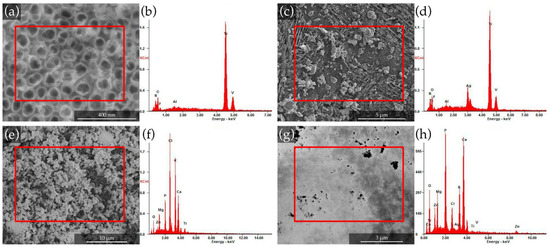
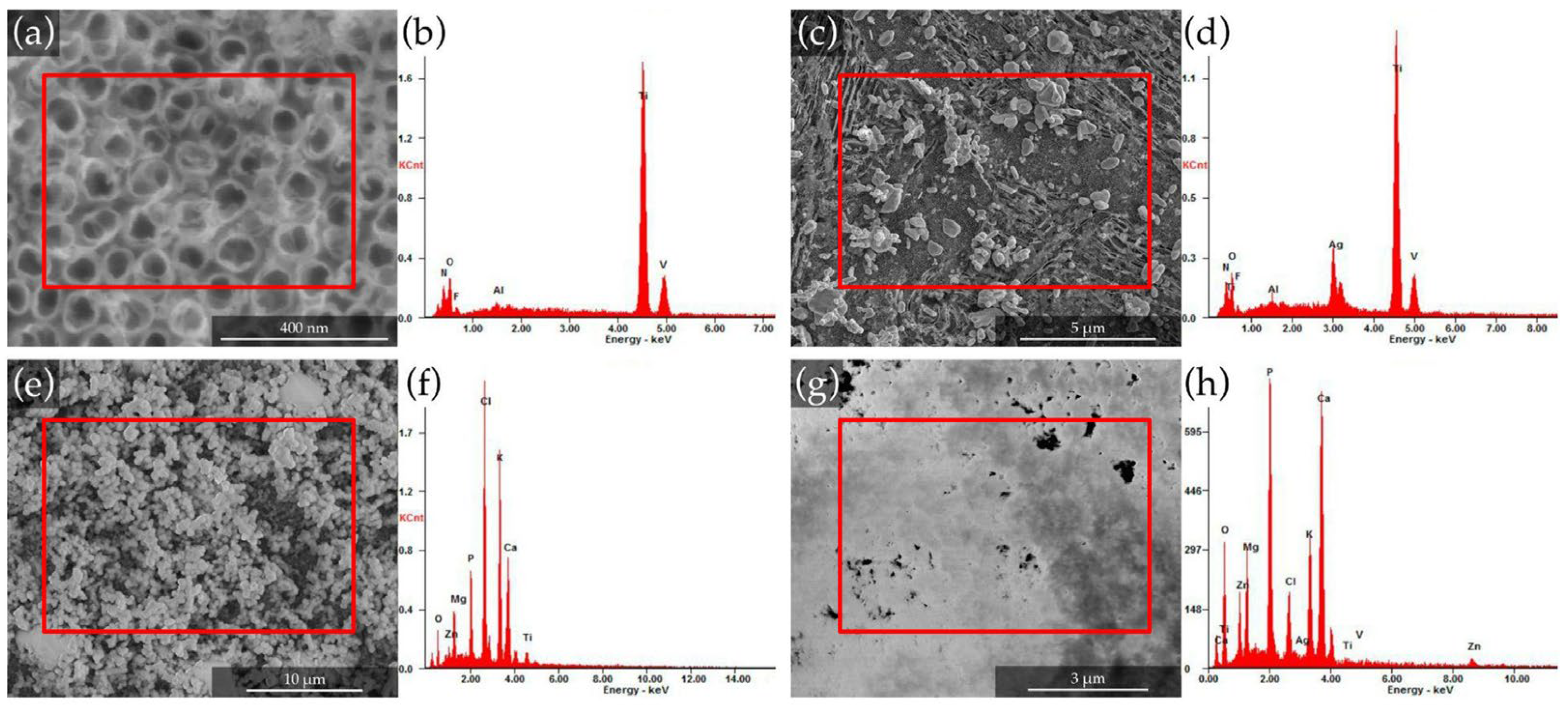
The anodization of Ti-407 alloy at 15 V for 30 min in an aqueous electrolyte containing 1.0 M of (NH4)2SO4 and 0.25 M of NH4F led to the formation of TiO2 nanotube arrays with uniform alignment and average diameters of 44.03 ± 8.77 nm (Figure 1a). This ordered nanostructure arises from the fluoride-driven growth–dissolution mechanism widely documented in the literature [8], which facilitates the self-organization of oxide nanotubes on titanium surfaces. These nanostructured surfaces are particularly relevant in biomedical applications, as they have been reported to improve cell adhesion and promote osseointegration by enhancing surface–cell interactions [7,9].
Figure 1.
SEM micrographs (and corresponding EDS spectra) of Ti-407 samples taken at different magnifications: (a,b) anodized Ti-407 (120,000×) with self-organized TiO2 nanotube arrays (44.03 ± 8.77 nm); (c,d) anodized + Ag (7000×), showing Ag0 particles distributed on the nanotubular surface; (e,f) anodized + Zn-Mg-CaP (3000×), showing continuous mineral coating; (g,h) anodized + Ag + Zn-Mg-CaP (30,000×), showing hierarchical coatings with Ag0 and mineral phases. The red rectangles in (a,c,e,g) highlight the representative regions selected for EDS analysis.
In the anodized + Ag samples (Figure 1c), electrodeposition resulted in the formation of granular Ag0 quasi-spherical particles, which were distributed along the surface. Two distinct microparticle populations were identified, with average sizes of 1.95 ± 0.22 µm and 505 ± 36 nm, respectively, based on triplicate measurements from three independent specimens. This bimodal morphology suggests that silver acts as a heterogeneous nucleation site, potentially facilitating subsequent mineral deposition. Beyond its structural role, the incorporation of Ag0 also introduces localized antibacterial functionality, laying the foundation for multifunctional coatings in orthopedic applications [11,13].
The anodized + Zn-Mg-CaP samples (Figure 1e) displayed continuous mineral coatings rich in Ca, P, Mg, and Zn. These coatings exhibited densely packed agglomerates with an average particle diameter of 1.84 ± 0.54 µm, quantified from SEM micrographs (n = 40). Their micrometer-scale dimensions could influence subsequent hierarchical electrodeposition steps by affecting potential nucleation sites or local surface-energy variations, although this potential effect was not assessed. The dense and homogeneous coverage further reflects the effectiveness of the electrodeposition process in forming bioactive mineral layers [10,12].
Finally, the anodized + Ag + Zn-Mg-CaP samples (Figure 1g) exhibited hierarchical coatings in which Ag0 particles and mineral phases were intimately integrated with the nanotubular architecture. These samples showed the densest and most uniform layers, highlighting a synergistic effect between silver and bioactive mineralization [11,13].
The combination of TiO2 nanotubes with bioactive coatings on Ti-407 alloy has previously been shown to enhance osteoblast viability through the incorporation of Ca2+, P, Mg2+, K+, and Zn2+ [20]. In the present work, this layered strategy exhibits promising potential as a multifunctional platform capable of providing both antibacterial activity (via Ag0) and osteoconductive behavior (via doped hydroxyapatite (HA)). These attributes are especially relevant for orthopedic applications, which remain prone to postoperative infections [1,2], often involving microbial biofilm formation on implant surfaces [11,13].
3.2. Chemical Composition and Mineral-Phase Assessment via EDS
SEM-EDS analysis provided both qualitative and semi-quantitative insights into the elemental composition of the surface coatings across the five sample groups, including the untreated control. Table 1 presents the elemental distribution (wt%) for each group, confirming distinct compositional signatures associated with anodization and electrodeposition steps. Notably, the control sample serves to validate the baseline composition of the Ti-407 alloy, while the other four conditions illustrate the effect of successive surface modifications. The baseline elemental composition was compared with the manufacturer’s official technical specifications for the Ti-3.9V-0.85Al alloy (TIMETAL® 407) [6,21]. The measured vanadium content (3.82 ± 0.23 wt%) lies well within the specified range of 3.5–4.3 wt%. Although the measured aluminum content (1.60 ± 0.11 wt%) exceeds the datasheet upper limit of 1.15 wt%, values in this range are still considered acceptable given the known limitations of EDS in accurately quantifying light elements at low concentrations.
Table 1.
Elemental composition (wt%) of Ti-407 samples evaluated by SEM-EDS (mean ± SD, n = 3).
Values represent mean ± standard deviation of triplicate measurements performed on three independent samples per condition. Representative EDS spectra corresponding to each modified group are shown in Figure 1b,d,f,h.
The anodized samples (Figure 1b) exhibited dominant Ti and alloying elements (V, Al), with an increase in oxygen and detectable fluorine, confirming the growth of a TiO2-rich layer via fluoride-assisted anodization [8].
The anodized + Ag samples (Figure 1d) revealed strong Ag peaks (14.78 ± 1.02 wt%), indicating the successful electrodeposition of metallic silver on the surface. The decrease in Ti intensity confirmed surface coverage without complete masking of the nanotubular architecture [11,13].
The anodized + Zn-Mg-CaP samples (Figure 1f) incorporated Ca and P with a Ca/P molar ratio > 2.0, indicative of Ca-rich, non-stoichiometric phases such as amorphous calcium phosphates, CaO, or Ca(OH)2. Minor amounts of Mg and Zn were also detected, confirming partial ionic incorporation [12,14].
In contrast, the anodized + Ag + Zn-Mg-CaP samples (Figure 1h) showed a balanced Ca/P molar ratio of 1.61 ± 0.04, close to the stoichiometric value of hydroxyapatite (1.67) [14]. This suggests the successful formation of an HA-like phase doped with Mg2+ and Zn2+, where Ag0 acted as a nucleating agent, facilitating ordered mineral growth. The Ca/P molar ratio was calculated by converting the EDS semi-quantitative wt% values of Ca and P into their corresponding molar amounts using the atomic weights of each element. The molar fraction of Ca was then divided by the molar fraction of P to obtain the Ca/P ratio. All values correspond to triplicate measurements from three independent specimens.
Chlorine was detected in low concentrations across the mineralized regions, likely originating from residual precursor salts used in the electrodeposition process, but its presence is not considered to have any significant impact on the coating’s structure. Additionally, nitrogen was detected in the anodized and anodized + silver samples, originating from the ammonium sulfate electrolyte used during anodization. Its presence is not expected to interfere with the coating’s structure or function.
The overall electrochemical pathway can be described in four stages:
- Ti anodization (NT formation): Ti(s) → Ti4+ + 4e− Ti4+ + 2O2− → TiO2(s) TiO2 + 6F− + 4H+ → [TiF6]2− + 2H2O;
- Silver electrodeposition: Ag+ + e− → Ag0(s);
- Mineral electrodeposition: 10Ca2+ + 6PO43− + 2OH− → Ca10(PO4)6(OH)2(s) with substitutions: Ca10-x-y(MgxZny)(PO4)6(OH)2;
- Final product (functionalized surface): Ti0 → TiO2 → Ag0 → Ca10-x-y(MgxZny)(PO4)6(OH)2.
This model highlights the dual role of Ag: providing intrinsic antibacterial activity and catalyzing the nucleation of near-stoichiometric HA. Comparable results have been reported in Ti-based systems where metallic nanoparticles facilitated electrochemically induced apatite nucleation [12,13].
From a biomedical perspective, coatings with Ca/P > 2.0 are less stable and exhibit reduced bioactivity, whereas near-stoichiometric HA layers support osteoblast adhesion and bone integration [11,14]. The hierarchical samples (anodized + Ag + Zn-Mg-CaP) therefore demonstrate a promising balance of osteoconductive and antibacterial properties, relevant for the prevention of postoperative infections and the enhancement of implant performance.
3.3. Antibacterial Activity Against Escherichia coli Assessed by Agar Diffusion
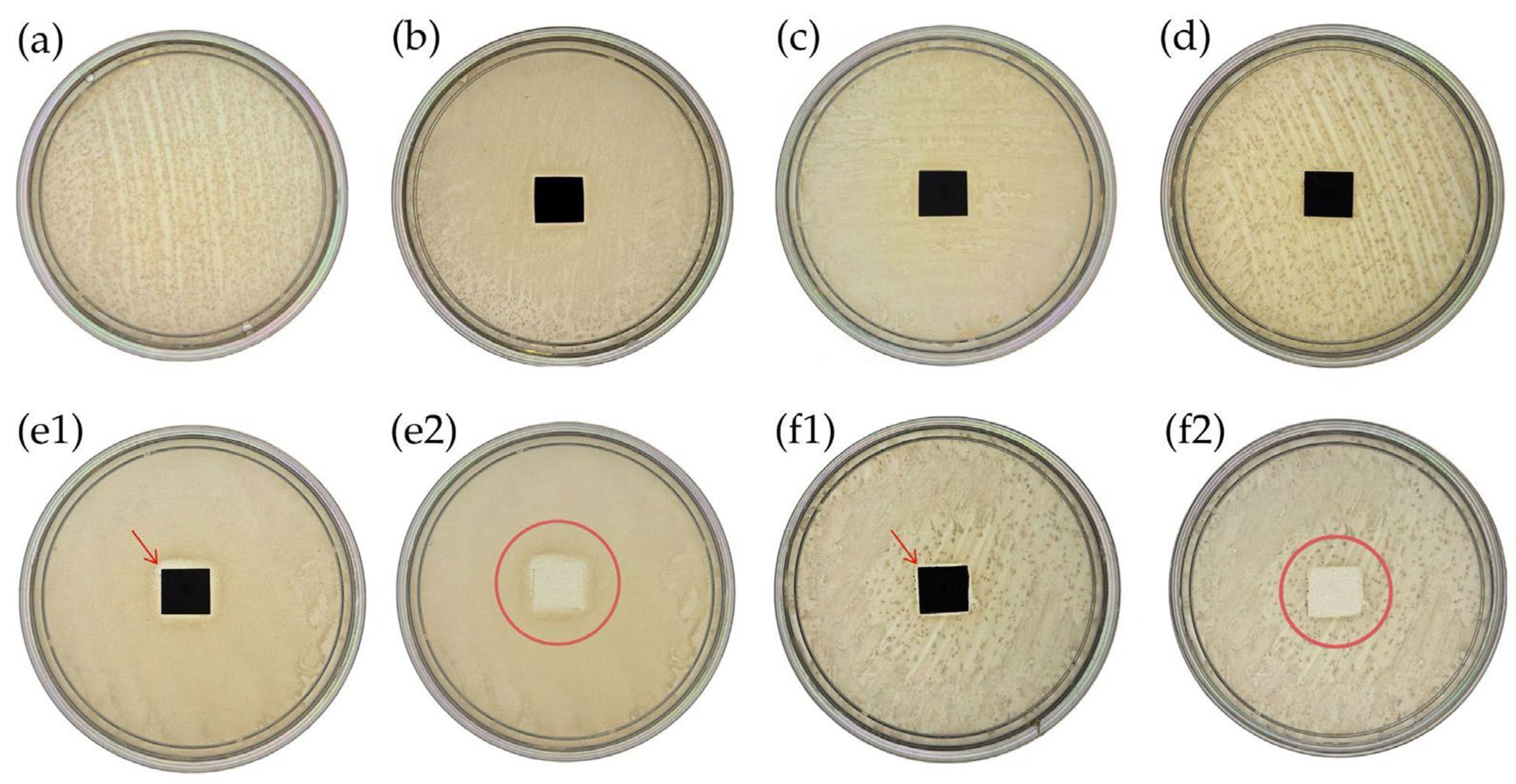
Agar diffusion assays revealed clear differences in antibacterial behavior among the tested groups (Figure 2).
Figure 2.
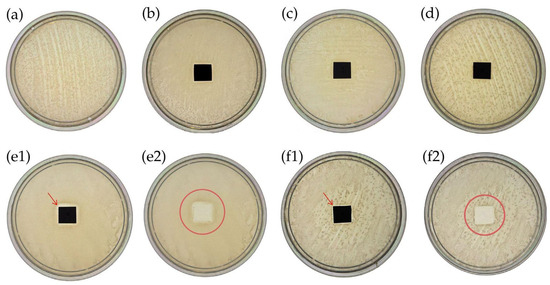
Antibacterial activity of Ti-407 samples evaluated by agar diffusion against E. coli ATCC® 25922™: (a) bacterial control; (b) untreated Ti-407; (c) anodized Ti-407; (d) anodized + Zn-Mg-CaP; (e1) anodized + Ag; (e2) inhibition halo generated by silver; (f1) anodized + Ag + Zn-Mg-CaP; (f2) inhibition halo generated by the hierarchical coating. The red arrows and circles indicate the bacterial inhibition areas.
Control samples (Figure 2a–c), including untreated Ti-407 and anodized-only specimens, showed no inhibition zones, indicating no intrinsic antibacterial activity. This observation aligns with previous reports demonstrating that titanium and anodized TiO2 surfaces, while favorable for osseointegration, lack inherent antibacterial effects unless functionalized with antimicrobial agents [7,9].
The anodized + Zn-Mg-CaP group (Figure 2d) showed no antibacterial effect under the tested conditions. In contrast, the anodized + Ag samples (Figure 2(e1,e2)) exhibited a well-defined inhibition halo surrounding the metallic sample. The diameter of the halo, measured from the edge of the sample outward to the boundary of visible bacterial inhibition, was 1.95 ± 0.12 mm, based on three independent specimens measured in triplicate. This antibacterial effect is attributed to the release of Ag+ ions, which diffuse radially and exert cytotoxic effects by disrupting bacterial membrane integrity, generating reactive oxygen species (ROS), and interfering with protein function and DNA replication [22,23,24,25].
The anodized + Ag + Zn-Mg-CaP samples (Figure 2(f1,f2)) also displayed an inhibition zone, albeit slightly smaller (1.42 ± 0.10 mm), consistent with the reduced silver content observed in EDS measurements (see Table 1). The dual presence of silver and mineral coating suggests a controlled release mechanism, where Ag+ diffusion is modulated by the hierarchical architecture. Similar findings have been reported for silver-containing and mineral-doped coatings, in which structural complexity regulates ion release and sustains antibacterial performance [11,13,25]. Antibacterial action occurs via a local concentration gradient, as illustrated in the figure by red arrows indicating ion release and red circles denoting bacterial growth suppression.
These findings confirm the antibacterial potential of silver-functionalized coatings and highlight the importance of hierarchical design in modulating both efficacy and ion release. This is particularly relevant for orthopedic applications, where postoperative infections involving E. coli are frequent [3] and difficult to eradicate due to biofilm formation on implant surfaces [4].
4. Conclusions
The hierarchical strategy combining the anodization of Ti-407 to form TiO2 nanotubes with sequential electrodeposition of silver and minerals (Ca, P, Mg, Zn) enabled the synthesis of coatings with bioactive potential and antibacterial properties. EDS analysis showed that the presence of silver promoted the nucleation of doped hydroxyapatite, achieving a Ca/P molar ratio close to the stoichiometric value (1.61), in contrast to the non-stoichiometric calcium-rich phases (>2.0) observed in silver-free samples, suggesting a specific nucleating role of silver in mineral organization. Antibacterial assays against Escherichia coli ATCC® 25922™ revealed inhibition zones around the silver- and silver + mineral-functionalized samples, confirming the antibacterial efficacy of the coatings, although the limited halo size suggests that bactericidal performance could be further optimized by adjusting the silver content or surface nanotopography. Overall, the findings support this methodology as a reproducible and cost-effective route for developing implantable surfaces with mineral organization and antibacterial protection, potentially reducing the risk of postoperative infections. Despite these promising results, this study has some limitations, as bioactivity was not directly assessed and antibacterial testing was restricted to a single bacterial strain (E. coli ATCC® 25922™).
Future work should therefore include in vitro osteoblast assays, broader antibacterial screening against clinically relevant pathogens, complementary techniques such as XRD, FTIR/Raman spectroscopy, and standardized antibacterial testing according to ISO 22196 [26] and cytocompatibility evaluations following ISO 10993-5:2009 [27] to further validate the multifunctional potential of the coatings.
Author Contributions
Conceptualization, A.P.T.-J. and F.E.M.-A.; methodology, A.P.T.-J. and F.E.M.-A.; validation, A.P.T.-J., F.E.M.-A. and M.P.B.-G.; formal analysis, A.P.T.-J. and F.E.M.-A.; investigation, A.P.T.-J. and F.E.M.-A.; resources, M.P.B.-G. and E.M.L.-C.; data curation, A.P.T.-J.; writing—original draft preparation, A.P.T.-J. and F.E.M.-A.; writing—review and editing, A.P.T.-J., F.E.M.-A., M.P.B.-G., E.M.L.-C., Y.Q.-G., J.A.G.-G. and A.M.-D.l.C.; visualization, A.P.T.-J.; supervision, F.E.M.-A., M.P.B.-G. and E.M.L.-C.; project administration, F.E.M.-A. All authors have read and agreed to the published version of the manuscript.
Funding
This research received no external funding.
Institutional Review Board Statement
Not applicable.
Informed Consent Statement
Not applicable.
Data Availability Statement
The original contributions presented in this study are included in the article. Further inquiries can be directed to the corresponding author.
Acknowledgments
This research was made possible by the technical support and infrastructure of the Universidad Autonoma de Nuevo Leon—through the Facultad de Ciencias Biologicas (FCB) and the Facultad de Ingenieria Mecanica y Electrica (FIME)—and by Tecnologico de Monterrey, Institute for the Future of Education (IFE).
Conflicts of Interest
The authors declare no conflicts of interest.
References
- Tanner, M.C.; Fischer, C.; Schmidmaier, G.; Haubruck, P. Evidence-based uncertainty: Do implant-related properties of titanium reduce the susceptibility to perioperative infections in clinical fracture management? A systematic review. Infection 2021, 49, 813–821. [Google Scholar] [CrossRef] [Scilit] [PubMed]
- Liu, H.; Wang, Y.; Xing, H.; Chang, Z.; Pan, J. Risk factors for deep surgical site infections following orthopedic trauma surgery: A meta-analysis and systematic review. J. Orthop. Surg. Res. 2024, 19, 811. [Google Scholar] [CrossRef] [Scilit] [PubMed]
- Bonten, M.; Johnson, J.R.; van den Biggelaar, A.H.J.; Georgalis, L.; Geurtsen, J.; de Palacios, P.I.; Gravenstein, S.; Verstraeten, T.; Hermans, P.; Poolman, J.T. Epidemiology of Escherichia coli Bacteremia: A Systematic Literature Review. Clin. Infect. Dis. 2021, 72, 1211–1219. [Google Scholar] [CrossRef] [Scilit] [PubMed]
- Katongole, P.; Nalubega, F.; Florence, N.C.; Asiimwe, B.; Andia, I. Biofilm formation, antimicrobial susceptibility and virulence genes of uropathogenic Escherichia coli isolated from clinical isolates in Uganda. BMC Infect. Dis. 2020, 20, 453. [Google Scholar] [CrossRef] [Scilit]
- Willis, J.; Li, S.; Crean, S.J.; Barrak, F.N. Is titanium alloy Ti-6Al-4V cytotoxic to gingival fibroblasts—A systematic review. Clin. Exp. Dent. Res. 2021, 7, 1037–1044. [Google Scholar] [CrossRef] [Scilit]
- Sneddon, S.; Xu, Y.; Dixon, M.; Rugg, D.; Li, P.; Mulvihill, D.M. Sensitivity of material failure to surface roughness: A study on titanium alloys Ti64 and Ti407. Mater. Des. 2021, 200, 109438. [Google Scholar] [CrossRef] [Scilit]
- Wu, B.; Tang, Y.; Wang, K.; Zhou, X.; Xiang, L. Nanostructured titanium implant surfaces facilitating osseointegration from protein adsorption to osteogenesis: The example of TiO2 nanotube arrays. Int. J. Nanomed. 2022, 17, 1865–1879. [Google Scholar] [CrossRef] [Scilit]
- Zhuang, Y.; Li, P.; Qin, L.; Zhang, S.; Chen, B.; Zhu, Y.; Wang, B.; Zhu, X. Real role of fluoride ions in the growth of anodic TiO2 nanotubes. J. Phys. Chem. C 2024, 128, 5741–5748. [Google Scholar] [CrossRef] [Scilit]
- El-Bassyouni, G.T.; Mouneir, S.M.; El-Shamy, A.M. Advances in surface modifications of titanium and its alloys: Implications for biomedical and pharmaceutical applications. Multiscale Multidiscip. Model. Exp. Des. 2025, 8, 265. [Google Scholar] [CrossRef] [Scilit]
- Yi, J.; Li, M.; Zhu, J.; Wang, Z.; Li, X. Recent development and applications of electrodeposition biocoatings on medical titanium for bone repair. J. Mater. Chem. B 2024, 12, 9863–9893. [Google Scholar] [CrossRef] [Scilit]
- Ribeiro, B.; Offoiach, R.; Monteiro, C.; Morais, M.R.G.; Martins, M.C.L.; Pêgo, A.P.; Salatin, E.; Fedrizzi, L.; Lekka, M. Electrodeposition of Zn and Cu nanoparticles into TiO2 nanotubes on Ti6Al4V: Antimicrobial effect against S. epidermidis and cytotoxicity assessment. Micro 2024, 4, 97–116. [Google Scholar] [CrossRef] [Scilit]
- Huang, H.Y.; Manga, Y.B.; Huang, W.-N.; Lin, C.-K.; Tseng, C.-L.; Huang, H.-M.; Wu, C.-Y.; Wu, C.-C. Effect of hydroxyapatite formation on titanium surface with bone morphogenetic protein-2 loading through electrochemical deposition on MG-63 cells. Materials 2018, 11, 1897. [Google Scholar] [CrossRef] [Scilit]
- Safavi, M.S.; Khalil-Allafi, J.; Restivo, E.; Ghalandarzadeh, A.; Hosseini, M.; Dacarro, G.; Malavasi, L.; Milella, A.; Listorti, A.; Visai, L. Enhanced in vitro immersion behavior and antibacterial activity of NiTi orthopedic biomaterial by HAp–Nb2O5 composite deposits. Sci. Rep. 2023, 13, 16045. [Google Scholar] [CrossRef] [Scilit] [PubMed]
- Dorozhkin, S.V. A review on the dissolution models of calcium apatites. Prog. Cryst. Growth Charact. Mater. 2002, 44, 45–61. [Google Scholar] [CrossRef] [Scilit]
- Shirdar, M.R.; Izman, S.; Taheri, M.M.; Assadian, M.; Kadir, M.R.A. Effect of post-treatment techniques on corrosion and wettability of hydroxyapatite-coated Co–Cr–Mo alloy. Arab. J. Sci. Eng. 2015, 40, 1197–1203. [Google Scholar] [CrossRef] [Scilit]
- Maher, S.; Ignjatović, N.L.; Lazarević, M.; Petrović, S.; Žekić, A.; Losic, D. Combined Effects of Dual-Scale Modified Surface with Micro- and Nanostructures on the Cellular Biocompatibility, Osteoinduction, and Antibacterial Properties of Titanium Implants. J. Funct. Biomater. 2025, 16, 157. [Google Scholar] [CrossRef] [Scilit] [PubMed]
- Zwahr, C.; Helbig, R.; Werner, C.; Lasagni, A.F. Fabrication of multifunctional titanium surfaces by producing hierarchical surface patterns using laser-based ablation methods. Sci. Rep. 2019, 9, 6721. [Google Scholar] [CrossRef] [Scilit]
- Ding, X.; Zhou, L.; Wang, J.; Zhao, Q.; Lin, X.; Gao, Y.; Li, S.; Wu, J.; Rong, M.; Guo, Z.; et al. The effects of hierarchical micro/nanosurfaces decorated with TiO2 nanotubes on the bioactivity of titanium implants in vitro and in vivo. Int. J. Nanomed. 2015, 10, 6955–6973. [Google Scholar] [CrossRef] [Scilit]
- Bertoloni, C.; Legeai, S.; Michel, S.; Meux, E.; Lapicque, F. Electroleaching and electrodeposition of silver in ethaline 1:2 and propeline 1:3: Transport properties and electrode phenomena. Environ. Sci. Adv. 2024, 3, 875–884. [Google Scholar] [CrossRef] [Scilit]
- Melendez Anzures, F.E. Biocompatibilidad de Nanoestructuras Formadas por Anodizado en Aleaciones de Base Titanio para Aplicaciones Biomedicas. Ph.D. Thesis, Universidad Autonoma de Nuevo Leon, Monterrey, Mexico, 2023. Available online: http://eprints.uanl.mx/26463/1/1080312748.pdf (accessed on 26 September 2025).
- TIMET. TIMETAL® 407 Datasheet. Available online: https://www.timet.com/documents/datasheets/alpha-and-beta-alloys/timetal-407.pdf (accessed on 27 September 2025).
- Morones, J.R.; Elechiguerra, J.L.; Camacho, A.; Holt, K.; Kouri, J.B.; Ramírez, J.T.; Yacaman, M.J. The bactericidal effect of silver nanoparticles. Nanotechnology 2005, 16, 2346–2353. [Google Scholar] [CrossRef] [Scilit]
- Rai, M.; Yadav, A.; Gade, A. Silver nanoparticles as a new generation of antimicrobials. Biotechnol. Adv. 2009, 27, 76–83. [Google Scholar] [CrossRef] [Scilit] [PubMed]
- Liao, C.; Li, Y.; Tjong, S.C. Bactericidal and cytotoxic properties of silver nanoparticles. Int. J. Mol. Sci. 2019, 20, 449. [Google Scholar] [CrossRef] [Scilit] [PubMed]
- Akshaya, S.; Rowlo, P.K.; Dukle, A.; Nathanael, A.J. Antibacterial coatings for titanium implants: Recent trends and future perspectives. Antibiotics 2022, 11, 1719. [Google Scholar] [CrossRef] [Scilit] [PubMed]
- ISO 22196:2011; Measurement of Antibacterial Activity on Plastics and Other Non-Porous Surfaces. International Organization for Standardization: Geneva, Switzerland, 2011.
- ISO 10993-5:2009; Biological Evaluation of Medical Devices—Part 5: Tests for in Vitro Cytotoxicity. International Organization for Standardization: Geneva, Switzerland, 2009.

Disclaimer/Publisher’s Note: The statements, opinions and data contained in all publications are solely those of the individual author(s) and contributor(s) and not of MDPI and/or the editor(s). MDPI and/or the editor(s) disclaim responsibility for any injury to people or property resulting from any ideas, methods, instructions or products referred to in the content. |
© 2025 by the authors. Licensee MDPI, Basel, Switzerland. This article is an open access article distributed under the terms and conditions of the Creative Commons Attribution (CC BY) license (https://creativecommons.org/licenses/by/4.0/).