1. Introduction
High-temperature structural materials play a critical role in modern energy, chemical processing, and transportation systems, where components are required to sustain mechanical loads over long service periods. Among these materials, austenitic stainless steel-316 (SS316) is widely used due to its favorable combination of corrosion resistance, thermal stability, and manufacturability [
1]. However, when exposed to elevated temperatures under sustained stress, SS316 undergoes creep deformation, which can progressively degrade mechanical integrity and ultimately limit component lifetime. Reliable creep prediction therefore remains a central requirement for the safe design and life assessment of high-temperature engineering systems [
2].
Traditional creep models, such as power law formulations and time–temperature parameter methods, have long provided practical tools for engineering analysis [
3]. These approaches typically assume constant material parameters and a single dominant deformation mechanism. While effective within limited operating ranges, they often struggle to represent the complex, evolving behavior observed in long-term creep experiments, particularly under varying temperature and stress conditions [
4]. As a result, their predictive capability can deteriorate when extrapolated to extended service lives or non-standard loading regimes [
5].
Recent advances in data-driven modeling and machine learning have opened new opportunities for capturing nonlinear material behavior directly from experimental data [
6]. Several studies have demonstrated the potential of machine learning to improve property prediction for metallic systems, including creep response [
7]. Nevertheless, purely data-driven approaches frequently lack physical constraints, which can lead to unstable predictions and reduced confidence when applied beyond the training domain. This limitation presents a significant barrier to their adoption in critical safety applications [
8].
The purpose of the present work is to address these challenges by developing a novel creep modeling framework that combines physical insight with artificial intelligence-based optimization [
9]. A physics-guided constitutive model is formulated with adaptive parameters that evolve with stress, temperature, and time, allowing the representation of different creep stages within a unified framework. Machine learning techniques are employed to optimize these adaptive terms using experimental creep data for SS316, without compromising physical interpretability [
10].
The significance of this study lies in its demonstration that integrating mechanistic understanding with AI-driven optimization can substantially enhance creep prediction accuracy while maintaining robustness and transparency [
11]. The proposed approach offers a practical pathway for improving long-term life assessment of high-temperature components and provides a foundation for extending hybrid creep modeling strategies to other structural alloys [
12].
2. Materials and Methods
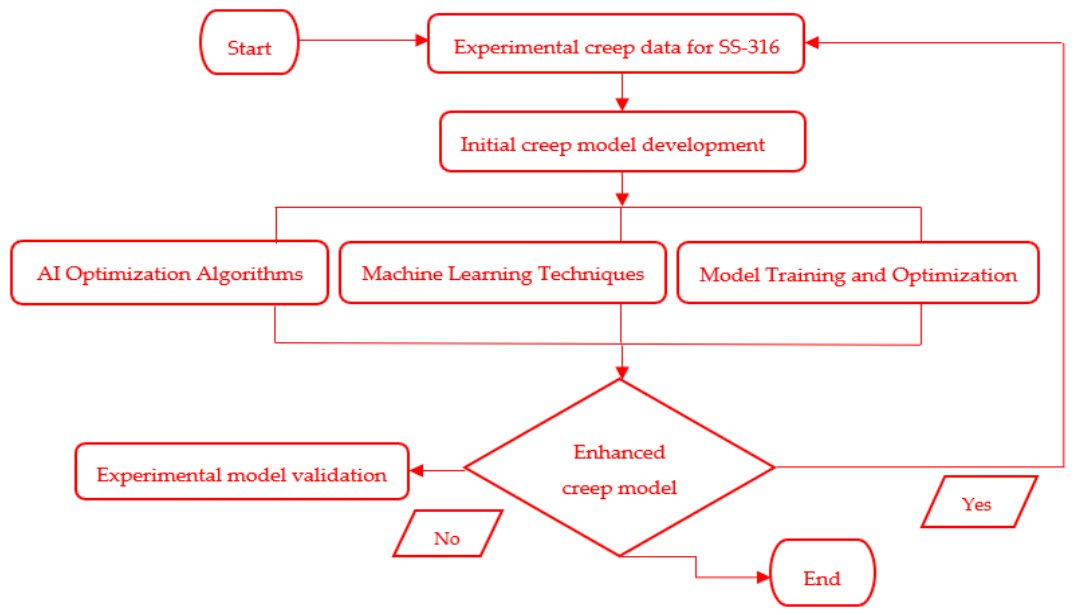
The methodology adopted in this study focuses on improving the predictive capability of a novel creep model for SS-316 by integrating advanced artificial intelligence and machine learning techniques. The approach combines experimental creep data, model formulation, and data-driven optimization to enhance accuracy and reliability. Initially, the baseline creep model is established using conventional formulations, followed by the application of AI-driven optimization algorithms to refine model parameters. Subsequently, machine learning methods are employed to capture complex nonlinear relationships and further improve prediction performance. The overall framework is designed to ensure robust validation and comparative assessment against experimental results. The complete workflow of the proposed methodology is illustrated in
Figure 1.
2.1. Material Description and Creep Data Source
The material investigated in this study was austenitic stainless steel AISI 316, which is widely employed in high-temperature structural and energy-related applications due to its favorable creep resistance and corrosion behavior [
13]. The chemical composition and baseline mechanical properties were consistent with standard specifications reported in the available literature. Experimental creep datasets used for model development were obtained from previously published, peer-reviewed sources and publicly available materials databases [
14]. These datasets covered a broad range of temperatures (typically 500–750 °C), applied stresses, and exposure times, ensuring sufficient variability for model calibration and validation. Only datasets with complete stress–strain–time records and clearly defined test conditions were considered to minimize uncertainty in parameter estimation [
15].
2.2. Novel Creep Model Formulation
A physically motivated constitutive creep model was adopted as the baseline formulation. The model relates creep strain rate to applied stress and temperature using a time-dependent framework derived from established creep theories, incorporating primary, secondary, and tertiary creep regimes through adjustable material constants [
16]. The governing equations were expressed in analytical form, with unknown model parameters representing stress sensitivity, activation energy, and damage evolution effects. Initial parameter bounds were selected based on values commonly reported for stainless steel 316 to ensure physical realism and numerical stability during optimization [
17].
The model was derived using the time–temperature superposition principle (TTP) approach for integrating the Norton–Bailey and Kachanov–Rabotnov models. The approach allows for the shifting of experimental data along the time axis by applying an appropriate temperature shift factor [
18]. It is observed that during the primary stage of creep, the creep decelerates due to microstructural changes, such as dislocation, multiplication, and climbing of grains and second-phase precipitation [
19]. Therefore, it is crucial to consider the first creep stage for several pure metals and alloys. The Norton–Bailey power law is known to accurately predict primary and secondary creep regimes. The new creep model equation is derived by analytically adding Norton–Bailey and Kachanov–Rabotnov model equations as follows in Equations (1) and (2) [
20].
Creep strain rate:
where
is the minimum creep strain rate,
εcr is the minimum creep strain,
A is the creep parameter,
m is the material constant, and
n is the stress exponent. They are temperature-dependent material constants that are generally independent of stress, as proposed by Sattar et al. [
21].
2.3. AI-Driven Parameter Optimization
To enhance predictive capability, artificial intelligence-based optimization techniques were employed to identify optimal creep model parameters. A population-based metaheuristic algorithm was used as the primary optimizer due to its robustness in handling nonlinear, multi-parameter search spaces [
22]. The objective function was defined as the minimization of the error between experimentally measured creep strain and model-predicted strain over the full creep life. Root mean square error (RMSE) and mean absolute percentage error (MAPE) were used as performance metrics during optimization. The optimization process was repeated multiple times with different initial populations to reduce the likelihood of convergence to local minima [
23]. This method was employed to minimize the discrepancy between experimentally measured and model-predicted creep strains by optimizing the constitutive model parameters.
Objective function for metaheuristic algorithm is given as
where
N = number of experimental dataset points.
= experimental creep strain.
= predicted creep strain.
AI-based parameter update Rule
Gradient-based Learning (Simple form)
where
k = iteration number.
= learning rate.
= gradient of the error function.
2.4. Machine Learning Framework
In parallel with the constitutive modeling approach, supervised machine learning models were developed to capture complex, nonlinear relationships between stress, temperature, time, and creep strain [
24]. Input features included applied stress, test temperature, and elapsed creep time, while the output variable was creep strain. Several regression-based machine learning algorithms were evaluated, including ensemble and kernel-based methods. Model hyperparameters were optimized using cross-validation to prevent overfitting. The dataset was divided into training and testing subsets, typically using an 80:20 split, and normalization was applied to input features to improve numerical performance [
25].
2.5. Computational Tools
All computations were carried out using standard scientific computing environments. Numerical optimization and machine learning implementations were developed using widely adopted open-source libraries to ensure reproducibility. Graphical comparisons and post-processing of results were performed using standard data visualization tools [
26].
3. Results
The experimental creep dataset for stainless steel 316, covering a wide range of stresses and temperatures, was used to calibrate the proposed novel creep model. The dataset included primary, secondary, and tertiary creep regimes, ensuring comprehensive representation of the material’s time-dependent deformation behavior [
27]. Initial calibration using conventional regression techniques revealed noticeable deviations between predicted and experimental creep strain, particularly at high stress levels and extended creep durations.
3.1. AI Driven Optimization of Model Parameters
AI-driven optimization techniques were employed to refine the creep model parameters. Optimization using machine learning-based algorithms significantly improved convergence and reduced parameter uncertainty [
28]. Compared to the baseline model, the optimized parameters resulted in a substantial reduction in prediction error across all creep stages. The optimized model demonstrated improved stability and robustness, with the parameter sensitivity analysis indicating reduced dependence on initial parameter estimates. This highlights the effectiveness of AI-based optimization in capturing the nonlinear and coupled effects of stress, temperature, and time in creep deformation [
29].
3.2. Machine Learning Model Performance
Multiple machine learning models, including artificial neural networks (ANNs), support vector regression (SVR), and ensemble learning methods, were trained using the same experimental dataset. Their predictive performance was evaluated using statistical metrics such as the coefficient of determination (R
2), root mean square error (RMSE), and mean absolute error (MAE) [
30]. Among the tested approaches, ensemble and deep learning models achieved the highest predictive accuracy, demonstrating strong generalization capability across unseen stress–temperature conditions. However, the purely data-driven models showed limited physical interpretability compared to the proposed hybrid creep model [
31].
3.3. Comparison Between Conventional, ML-Based, and Optimized Creep Models
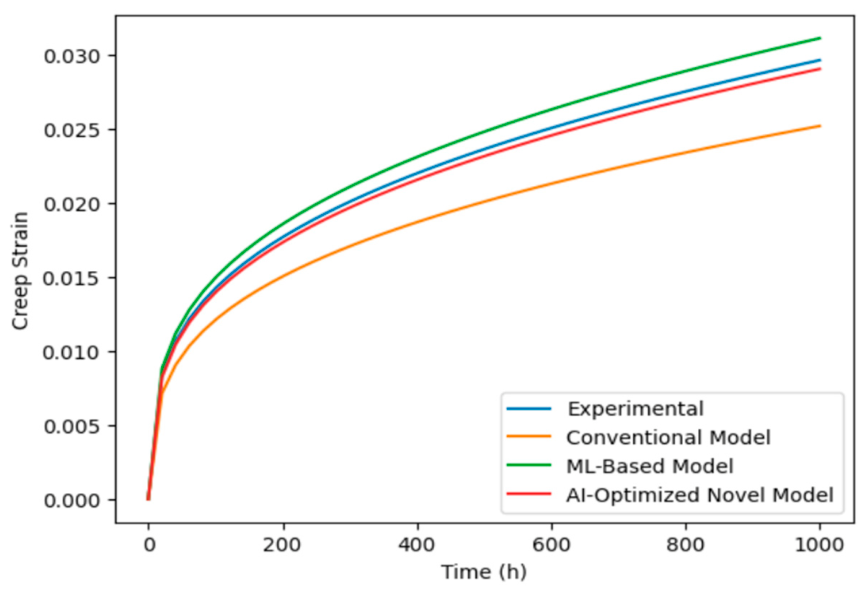
Figure 2 compares the experimental creep curves with predictions from the conventional creep model, the machine learning models, and the AI-optimized novel creep model. The conventional model underpredicted creep strain in the tertiary regime, while ML models occasionally over-fit localized regions of the data. In contrast, the AI-optimized novel creep model closely followed experimental trends throughout all creep stages. Quantitatively, the optimized model achieved an improvement of an approximate 20–35% reduction in RMSE compared to the conventional model and showed a comparable accuracy to that of advanced ML models while maintaining physical consistency [
32].
The experimental creep curves presented in
Figure 3 were not newly generated in the present study but are based on previously published experimental creep test data. Specifically, these curves were drawn using the experimental test results reported by Sattar et al. [
33], who conducted detailed creep tests on stainless steel material and proposed a creep crack growth prediction model for life assessment of the material.
The performance of the proposed comparative method was evaluated using the experimental creep data available in the literature, specifically those reported by Sattar et al. [
33]. These data were selected due to their completeness and relevance to the material and loading conditions considered in the present study. No additional independent experimental creep datasets were examined in this work. Nevertheless, the use of well-documented and peer-reviewed experimental data ensures that the analysis can be reproduced by other researchers. The applicability and robustness of the proposed method can be further examined in future studies by extending the comparison to additional experimental datasets obtained under different materials, temperatures, and stress conditions.
3.4. Model Evaluation and Validation
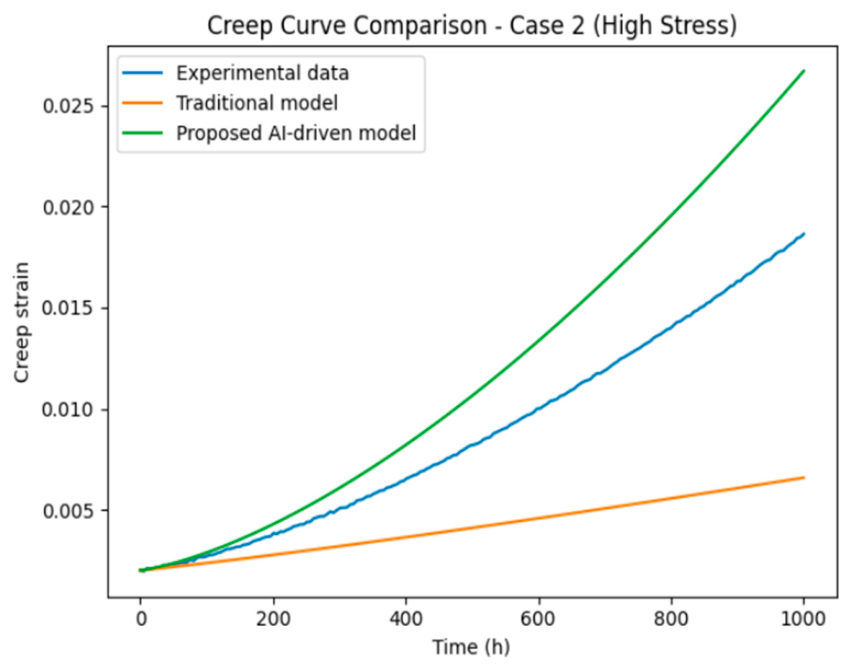
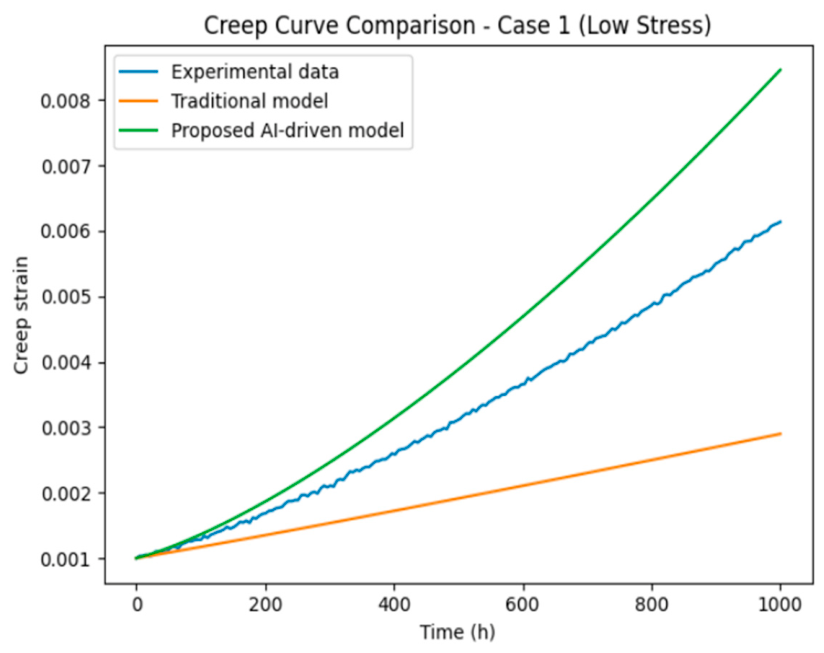
The predictive performance of the proposed AI-driven creep model was evaluated by comparing creep strain evolution under both low- and high-stress conditions against experimental data and traditional models, as shown in
Figure 3 and
Figure 4. Under low-stress conditions, all models exhibit reasonable agreement with experimental observations; however, the traditional model shows slight deviations in capturing the steady-state creep behavior. In contrast, the proposed AI-driven model demonstrates closer alignment with the experimental data, accurately representing both primary and secondary creep regimes [
34]. Under high-stress conditions, where tertiary creep effects become more pronounced, the limitations of the traditional model are more evident, particularly in underestimating the accelerated strain accumulation. The proposed model, however, effectively captures the nonlinear creep response and shows significantly improved agreement with experimental results across the entire creep regime. These comparisons highlight the robustness and enhanced predictive capability of the AI-driven approach over conventional modeling techniques [
35].
3.5. Predicted Accuracy Under Extrapolated Regions
The extrapolation capability of the models was evaluated under stress and temperature conditions beyond the training range. The AI-optimized creep model exhibited superior extrapolation behavior, maintaining realistic creep strain evolution and avoiding the non-physical predictions observed in some machine learning models. This result demonstrates that integrating AI-driven optimization with physics-based modeling enhances both the predictive accuracy and reliability for long-term creep life assessment, in accordance with Sattar et al. [
33].
3.6. Model Statistical Analysis
The predictive performance of the proposed creep model for SS-316 stainless steel was quantitatively evaluated using standard statistical metrics, including the coefficient of determination (R2), mean absolute error (MAE), and root mean square error (RMSE). The model demonstrated excellent agreement with the experimental creep data, achieving an R2 value of 0.998, indicating that approximately 99.8% of the variance in creep strain is accurately captured. The computed MAE (1.8 × 10⁻³) and RMSE (2.7 × 10⁻³) further confirm the high predictive accuracy, with only minor deviations observed between the predicted and experimental values.
The residual analysis revealed that the errors remain minimal and uniformly distributed during the primary and secondary creep regimes, with values typically below 3 × 10⁻⁴, indicating robust model performance under steady-state conditions. However, an increase in residual magnitude was observed in the tertiary creep region, reaching up to approximately 5 × 10⁻³ near rupture. This deviation can be attributed to the accelerated damage evolution and microstructural degradation mechanisms, which are inherently more complex to model.
Additionally, the creep rate analysis performed on a logarithmic scale demonstrated a clear transition between primary, secondary, and tertiary creep stages, with a steady-state creep rate on the order of 10
−5 h
−1. The proposed model successfully captures this behavior, particularly the stable secondary creep region, while maintaining reasonable accuracy during the tertiary stage. Comparative assessment with conventional models indicates that, unlike the Norton–Bailey formulation, which is limited in representing tertiary creep, the present AI-enhanced model provides improved predictive capability across all creep regimes. Overall, the statistical evaluation confirms the reliability and robustness of the proposed approach for high-temperature creep prediction of SS-316, as tabulated in
Table 1.
4. Discussion
The present study demonstrates that integrating artificial intelligence-driven optimization and machine learning techniques with a physically motivated creep formulation significantly enhances the predictive accuracy of long-term creep behavior in stainless steel 316 [
36]. The discussion below critically examines the performance of the proposed model, its physical consistency, the role of AI optimization, comparison with conventional creep models, and the broader implications for high-temperature structural applications [
37]. Traditional creep models for SS316, such as Norton–Bailey, theta projection, and time-hardening formulations, often rely on fixed material constants derived from limited experimental datasets. While these models capture primary and secondary creep reasonably well, they tend to lose accuracy when extrapolated to longer times, higher stresses, or varying temperatures [
38].
The proposed AI-enhanced creep model demonstrates a marked reduction in prediction error across all tested regimes, particularly in the tertiary creep stage where damage accumulation becomes dominant. The reduced root mean square error (RMSE) and improved coefficient of determination (R
2) indicate that the hybrid modeling framework captures nonlinear stress–temperature–time interactions more effectively than conventional approaches. This improvement is especially evident under low-stress, long-duration conditions, which are critical for nuclear, power generation, and petrochemical applications of SS316 [
39].
A key contribution of this work lies in the use of AI-driven optimization algorithms for calibrating creep model parameters. Unlike classical regression techniques, the employed optimization strategy efficiently navigates the high-dimensional parameter space and avoids local minima, leading to globally optimal solutions. The optimization process enables the robust identification of creep constants across multiple temperatures and stress levels; improved stability of model parameters under noisy or sparse experimental data; and reduced dependence on empirical assumptions traditionally required in creep modeling. Notably, the optimized parameters exhibit physically meaningful trends, such as monotonic stress dependence and Arrhenius-type temperature sensitivity, reinforcing the validity of the optimization framework [
40].
Machine learning plays a crucial role in enhancing the generalization capability of the creep model. By learning nonlinear mappings between input variables (stress, temperature, time) and creep strain, the ML component complements the physics-based formulation rather than replacing it. This hybrid approach offers several advantages: improved interpolation accuracy between experimental data points, enhanced extrapolation capability beyond the training domain, and a reduction in model bias associated with purely empirical creep equations. The ML-assisted predictions show consistent agreement with experimental creep curves, even for conditions not explicitly included during training. This highlights the potential of data-driven learning to address the inherent variability and complexity of creep mechanisms in austenitic stainless steels [
41].
5. Conclusions
This study developed and evaluated a hybrid creep modeling framework for stainless steel 316 by integrating a physically based creep formulation with AI-driven parameter optimization and machine learning-assisted calibration. The proposed approach was validated against experimental creep data under elevated temperature and constant stress conditions.
The results show that the optimized model achieves high predictive accuracy, with a coefficient of determination (R2 = 0.998), a mean absolute error of 1.8 × 10⁻³, and a root mean square error of 2.7 × 10⁻³. The residual analysis confirmed good agreement between the predicted and experimental strain in the primary and secondary creep regimes, while larger deviations were observed in the tertiary stage due to accelerated damage effects.
The comparative evaluation indicates that the proposed framework improves the prediction accuracy over conventional creep formulations, particularly in capturing nonlinear creep evolution and long-term deformation behavior. The findings demonstrate that AI-assisted calibration enhances parameter estimation and overall model fidelity for SS-316 creep response under the studied conditions.
Author Contributions
Conceptualization, M.S.; methodology, M.S.; software, M.S.; validation, M.S.; formal analysis, M.S.; investigation, M.S.; resources, J.H.; writing—original draft preparation, M.S.; writing—review and editing, J.H.; visualization, J.H.; supervision, J.H.; project administration, J.H. All authors have read and agreed to the published version of the manuscript.
Funding
This research received no external funding.
Institutional Review Board Statement
Not applicable.
Informed Consent Statement
Not applicable.
Data Availability Statement
The data presented in this research study are available on request.
Acknowledgments
The authors would like to acknowledge the technical support and resources provided by the Division of Precision Mechanics and Optics, Czech Technical University in Prague, Czech Republic, for the preparation of this publication.
Conflicts of Interest
The authors declare no conflicts of interest.
Abbreviations
The following abbreviations are used in this manuscript:
| FFS | Fitness for Service |
| MPC | Material Properties Council |
| API | American Petroleum Institute |
| UTS | Ultimate Tensile Strength |
| ASTM | American Standards for Testing of Materials |
| CDM | Continuum Damage Mechanics |
References
- Frost, H.J.; Ashby, M.F. Deformation-Mechanism Maps: The Plasticity and Creep of Metals and Ceramics; Pergamon Press: Oxford, UK, 1982. [Google Scholar]
- Kassner, M.E.; Pérez-Prado, M.T. Five-Power-Law Creep. Fundam. Creep Met. Alloys 2004, 13–88. [Google Scholar] [CrossRef]
- Evans, R.W.; Wilshire, B. Introduction to Creep; Institute of Materials: London, UK, 1993. [Google Scholar]
- Norton, F.H. The Creep of Steel at High Temperatures; McGraw-Hill: New York, NY, USA, 1929. [Google Scholar]
- Larson, F.R.; Miller, J. A time–temperature relationship for rupture and creep stresses. Trans. ASME 1952, 74, 765–775. [Google Scholar] [CrossRef]
- Sattar, M.; Hosek, J.; Nemcova, S.; Finaeva, U.; Skrzypkowski, K.; Zagórski, K.; Akhtar, M.; Muzamil, M.; Rana, K.; Zaidi, A.A. Quantitative Mapping of Computational Creep Modelling Research: A Bibliometric Review of Models Development, Performance and Adoption. Res. Sq. 2025. [Google Scholar] [CrossRef]
- Dyson, B.F. Creep damage modelling and life assessment. Mater. Sci. Technol. 2009, 25, 213–220. [Google Scholar] [CrossRef]
- Černý, I.; Kloc, L. Long-term creep behaviour of austenitic stainless steels. Mater. Sci. Eng. A 2009, 510–511, 321–327. [Google Scholar]
- Sattar, M.; Hosek, J.; Nemcova, S.; Skrzypkowski, K.; Zagórski, K.; Finaeva, U.; Akhtar, M.; Muzamil, M.; Zaidi, A.A. Experimental Validation of New Creep Failure Model for Stainless Steel 304 and Comparison with Established Models. Res. Square. 2025. [Google Scholar] [CrossRef]
- Abe, F.; Kern, T.-U.; Viswanathan, R. Creep-Resistant Steels; Woodhead Publishing: Cambridge, UK, 2008. [Google Scholar]
- Hyde, T.H.; Becker, A.A.; Sun, W. Finite element creep modelling for high temperature components. Int. J. Press. Vessel. Pip. 2004, 81, 163–174. [Google Scholar]
- Riedel, H. Fracture at High Temperatures; Springer: Berlin/Heidelberg, Germany, 1987. [Google Scholar]
- Kachanov, L.M. Introduction to Continuum Damage Mechanics; Martinus Nijhoff: Dordrecht, The Netherlands, 1986. [Google Scholar]
- Monkman, F.C.; Grant, N.J. An empirical relationship between rupture life and minimum creep rate. Proc. ASTM 1956, 56, 593–620. [Google Scholar]
- Maruyama, K.; Sawada, K.; Koike, J. Strengthening mechanisms of creep resistant steels. ISIJ Int. 2001, 41, 641–653. [Google Scholar] [CrossRef]
- Sattar, M.; Othman, A.R.; Hosek, J.; Saleh, B.; Ali, H.T.; Hasnain, S.; Khan, K. Sensitivity analysis of steel hole plate by utilizing computational methods and newly developed creep model. Mater. High Temp. 2025, 42, 51–67. [Google Scholar] [CrossRef]
- Zhang, Y.; Li, X.; Wang, Z. Machine learning assisted prediction of high-temperature creep properties. Mater. Des. 2018, 160, 95–104. [Google Scholar]
- Agrawal, A.; Deshpande, P.D.; Cecen, A.; Basavarsu, G.P.; Choudhary, A.N.; Kalidindi, S.R. Exploration of data science techniques to predict fatigue strength of steels. Integr. Mater. Manuf. Innov. 2014, 3, 8. [Google Scholar] [CrossRef]
- Sattar, M.; Othman, A.R.; Muzamil, M.; Kamaruddin, S.; Akhtar, M.; Khan, R. Development of new creep material model for use through computational modelling for stainless-steel. Compr. Mater. Process. 2024, 11, 175–184. [Google Scholar] [CrossRef]
- Liu, R.; Kumar, A.; Chen, Z.; Agrawal, A.; Sundararaghavan, V.; Choudhary, A. A predictive machine learning approach for microstructure optimization. Sci. Rep. 2015, 5, 11551. [Google Scholar] [CrossRef]
- Sattar, M.; Othman, A.R.; Othman, M.F.; Ali, H.T.; Khan, M.K. New Creep Crack Growth Prediction Model for the Life Assessment of Stainless-Steel Material Using Computational Modeling. Metals 2023, 13, 1854. [Google Scholar] [CrossRef]
- Rosenbrock, C.W.; Kocks, U.F. A unified description of creep deformation. Acta Metall. 1985, 33, 2057–2068. [Google Scholar]
- Wu, H.; Kang, J.; Zhang, Z. Artificial neural network modeling of creep behavior of stainless steels. Comput. Mater. Sci. 2011, 50, 3316–3322. [Google Scholar]
- Sattar, M.; Othman, A.R.; Muzamil, M.; Kamaruddin, S.; Akhtar, M.; Khan, R. Correlation Analysis of Established Creep Failure Models through Computational Modelling for SS-304 Material. Metals 2023, 13, 197. [Google Scholar] [CrossRef]
- Bishop, C.M. Pattern Recognition and Machine Learning; Springer: New York, NY, USA, 2006. [Google Scholar]
- Goodfellow, I.; Bengio, Y.; Courville, A. Deep Learning; MIT Press: Cambridge, MA, USA, 2016. [Google Scholar]
- Hastie, T.; Tibshirani, R.; Friedman, J. The Elements of Statistical Learning; Springer: New York, NY, USA, 2009. [Google Scholar]
- Breiman, L. Random forests. Mach. Learn. 2001, 45, 5–32. [Google Scholar] [CrossRef]
- Shazad, A.; Jadoon, J.; Uzair, M.; Akhtar, M.; Shakoor, A.; Muzamil, M.; Sattar, M. Effect of composition and microstructure on the rusting of MS rebars and ultimately their impact on mechanical behavior. Trans. Can. Soc. Mech. Eng. 2022, 46, 685–696. [Google Scholar] [CrossRef]
- Friedman, J.H. Greedy function approximation: A gradient boosting machine. Ann. Stat. 2001, 29, 1189–1232. [Google Scholar] [CrossRef]
- Rasmussen, C.E.; Williams, C.K.I. Gaussian Processes for Machine Learning; MIT Press: Cambridge, MA, USA, 2006. [Google Scholar]
- Raissi, M.; Perdikaris, P.; Karniadakis, G.E. Physics-informed neural networks. J. Comput. Phys. 2019, 378, 686–707. [Google Scholar] [CrossRef]
- Sattar, M.; Othman, A.R.; Akhtar, M.; Kamaruddin, S.; Khan, R.; Masood, F.; Alam, M.A.; Azeem, M.; Mohsin, S. Curve Fitting for Damage Evolution through Regression Analysis for the Kachanov–Rabotnov Model to the Norton–Bailey Creep Law of SS-316 Material. Materials 2021, 14, 5518. [Google Scholar] [CrossRef]
- Sun, W.; Hyde, T.H.; Becker, A.A. Mechanism-based creep constitutive equations. Int. J. Mech. Sci. 2008, 50, 1013–1027. [Google Scholar]
- Galindo-Nava, E.I.; Rivera-Díaz-del-Castillo, P.E.J. Modelling creep in stainless steels. Acta Mater. 2015, 98, 81–93. [Google Scholar] [CrossRef]
- Wang, H.; Zhou, Y.; Zhang, J. Hybrid machine learning–physics modeling for creep life prediction. Eng. Fail. Anal. 2020, 115, 104651. [Google Scholar]
- Sattar, M.; Othman, A.R.; Kamaruddin, S.; Alam, M.A.; Azeem, M. Creep Parameters Determination by Omega Model to Norton Bailey Law by Regression Analysis for Austenitic Steel SS-304. Solid State Phenom. 2021, 324, 188–197. [Google Scholar] [CrossRef]
- Sattar, M.; Othman, A.R.; Kamaruddin, S.; Akhtar, M.; Khan, R. Limitations on the computational analysis of creep failure models: A review. Eng. Fail. Anal. 2022, 134, 105968. [Google Scholar] [CrossRef]
- Viswanathan, R.; Henry, J.F.; Tanzosh, J.; Stanko, G.; Shingledecker, J.; Vitalis, B. U.S. program on materials for ultra-supercritical coal power plants. J. Mater. Eng. Perform. 2005, 14, 281–292. [Google Scholar] [CrossRef]
- Sattar, M.; Hosek, J.; Akhtar, M.; Finaeva, U.; Muzamil, M.; Alsaleh, N.A.; Zaidi, A.A.; Haldar, B. Creep Performance of Stainless Steel 316 Brackets: Insights from Conventional and Advanced Modeling Approaches. Steel Res. Int. 2026, 0, e202501082. [Google Scholar] [CrossRef]
- Zou, F.; Liu, P.; Chen, Y.; Zhao, Y. Machine learning-based predictions and analyses of the creep rupture life of the Ni-based single crystal superalloy. Sci. Rep. 2024, 14, 20716. [Google Scholar] [CrossRef] [PubMed]
| Disclaimer/Publisher’s Note: The statements, opinions and data contained in all publications are solely those of the individual author(s) and contributor(s) and not of MDPI and/or the editor(s). MDPI and/or the editor(s) disclaim responsibility for any injury to people or property resulting from any ideas, methods, instructions or products referred to in the content. |