1. Introduction
Since the discovery of carbon nanotubes (CNTs), they have attracted significant attention due to their unique electrical and thermo-mechanical properties. Incorporation of CNTs in a composite as a filler allows the unique CNT properties to be transferred to the polymer matrix [
1]. CNT-based composites are used in optoelectronics, in the manufacture of fuel cells, actuators, etc. [
1,
2].
However, the main problem in composite preparation and production is the inhomogeneous distribution and aggregation of the filler in the polymer matrix. Good distribution of CNTs in a composite can be achieved through the surface modification. Grafting of polymers onto the CNT surface allows not only enhance the CNTs distribution in the polymer matrix, but also to improve the compatibility between the filler and the polymer matrix [
3,
4]. The CNT surface modification can be performed using two different approaches: non-covalent and covalent modification [
5].
Non-covalent modification is based on the π-π, electrostatic, and hydrophobic interactions [
6]. Non-covalent modification can be performed using small molecules, surfactants, ionic liquids, synthetic and (bio)polymers. Non-covalent modification does not damage the CNT surface, but this approach usually provides only a small percentage of the molecules attached to the CNT surface. Non-covalent modification is less-time-consuming and easy to perform [
7,
8]. Compared to non-covalent modification, the covalent approach provides a higher degree of grafting of compounds to the CNT surface [
9,
10]. In covalent modification, first, an oxidation on the CNT surface to introduce oxygen-containing groups (such as hydroxyl or carboxyl groups) takes place. These sites are available for further modification through the formation of ester and amide groups with polymers. The process is more complex and requires more synthetic steps and time compared to the non-covalent approach [
11,
12]. The main drawback of the covalent modification is the CNT surface damage due to the transformation (surface oxidation) of sp
2-hybridized carbon atoms to the sp
3-hybridized ones. These defects in the π-conjugated system of CNTs can have a negative effect on the electrophysical properties [
13].
Among the polymers used for CNTs modification, polysiloxanes draw special attention. Polysiloxanes are polymers with the main chain consisting of alternating atoms of silicon and oxygen, and side groups, which can be methyl, ethyl, phenyl, etc. Polysiloxanes possess a special affinity to the CNT surface, placing their methyl groups on the CNT surface. Meanwhile the key properties of polysiloxanes are their hydrophobicity, biocompatibility, thermo- and frost resistance, and wide working temperature range; polysiloxanes are soluble in many polar and non-polar solvents. The usage of polysiloxanes to modify the CNT surface allows one to improve the dispersibility of CNTs in solvents and polymer composites. The application fields of modified CNTs can be extended by their modification with redox-active molecules to use the modified CNTs and composites based on them as components of flexible electrochemical (bio)sensors, ion detection and separation systems, energy storage devices, etc. [
14,
15,
16,
17].
Thus, the aim of the study includes the following: (i) to compare the non-covalent and covalent approaches of CNTs modification with ferrocenyl-containing oligo- and polysiloxanes; (ii) to study influence of the conducted modifications on the electrical conductivity of silicone composites based on them.
2. Materials and Methods
Multi-walled carbon nanotubes (MWCNTs) Taunit M (with the average length ≥ 2 µm, an outer diameter of 10–30 nm, an inner diameter of 5–15 nm) were supplied from NanoTechCenter, Ltd. (Tambov, Russia). Prior to the modification the MWCNTs were dried for 4 h at 120 °C. For the covalent modification via ligand exchange reaction, 1,3,5,7-tetra(2-ferrocenylethyl)-1,3,5,7-tetramethylcyclotetrasiloxane (Fc
4D
4) in the presence of AlCl
3 and Al was used [
16]. For the non-covalent modification, ferrocenyl-containing polysiloxanes bearing 20 and 80 mol% of ferrocenyl groups were utilized [
17].
The modified MWCNTs were analyzed by Raman spectroscopy (Bruker, Bremen, Germany) and X-Ray photoelectron spectroscopy (XPS) (Waltham, MA, USA).
Soft silicone composites based on SylgardTM184 (Dow Corning, Midland, MI, USA) filled with modified MWCNTs were prepared using a solution-blending method using chloroform as a solvent. For this, 900 mg of component A of Sylgard 184 and 5 mL of chloroform were vortexed for 1 min. Simultaneously, a required amount of modified MWCNTs (to achieve 5 or 10 wt.% concentration) was mixed with 5 mL of chloroform and sonicated for 10 min in the sonication bath. The dispersion of MWCNTs was transferred to pre-prepared Sylgard 184 solution and sonicated for 10 min. The solvent was evaporated under reduced pressure on the rotary evaporator. The resulting mixture was combined with 100 mg of component B Sylgard 184 and thoroughly mixed with a spatula for 2 min. Then the mixture was applied to a brass gold-coated electrode (d = 20 mm) and covered with the second similar electrode. The mixture was cured for 2 h at 100 °C.
The electrical conductivity of the soft flexible composites was measured using broadband dielectric spectroscopy (Novocontrol Technology, Montabaur, Germany) at room temperature in a frequency range from 0.1 to 105 Hz. The sample presented a thin film of approx. 200 μm with d = 20 mm.
3. Results and Discussion
3.1. Comparison of Non-Covalent and Covalent Approaches of CNT Modification with Ferrocenyl-Containing Oligo- and Polysiloxanes
Modification of multi-walled carbon nanotubes (MWCNTs) with ferrocenyl-containing polysiloxanes was performed using the covalent and non-covalent approaches. In covalent functionalization, Fc
4D
4 in its initial and polymerized forms were grafted to the MWCNT surface in the presence of AlCl
3/Al. The conducted covalent modification resulted in iron atom coordination to the MWCNT surface, which was confirmed in our earlier study [
16]. In non-covalent modification, ferrocenyl-containing polysiloxanes with 20 and 80 mol.% of ferrocenyl moieties were used [
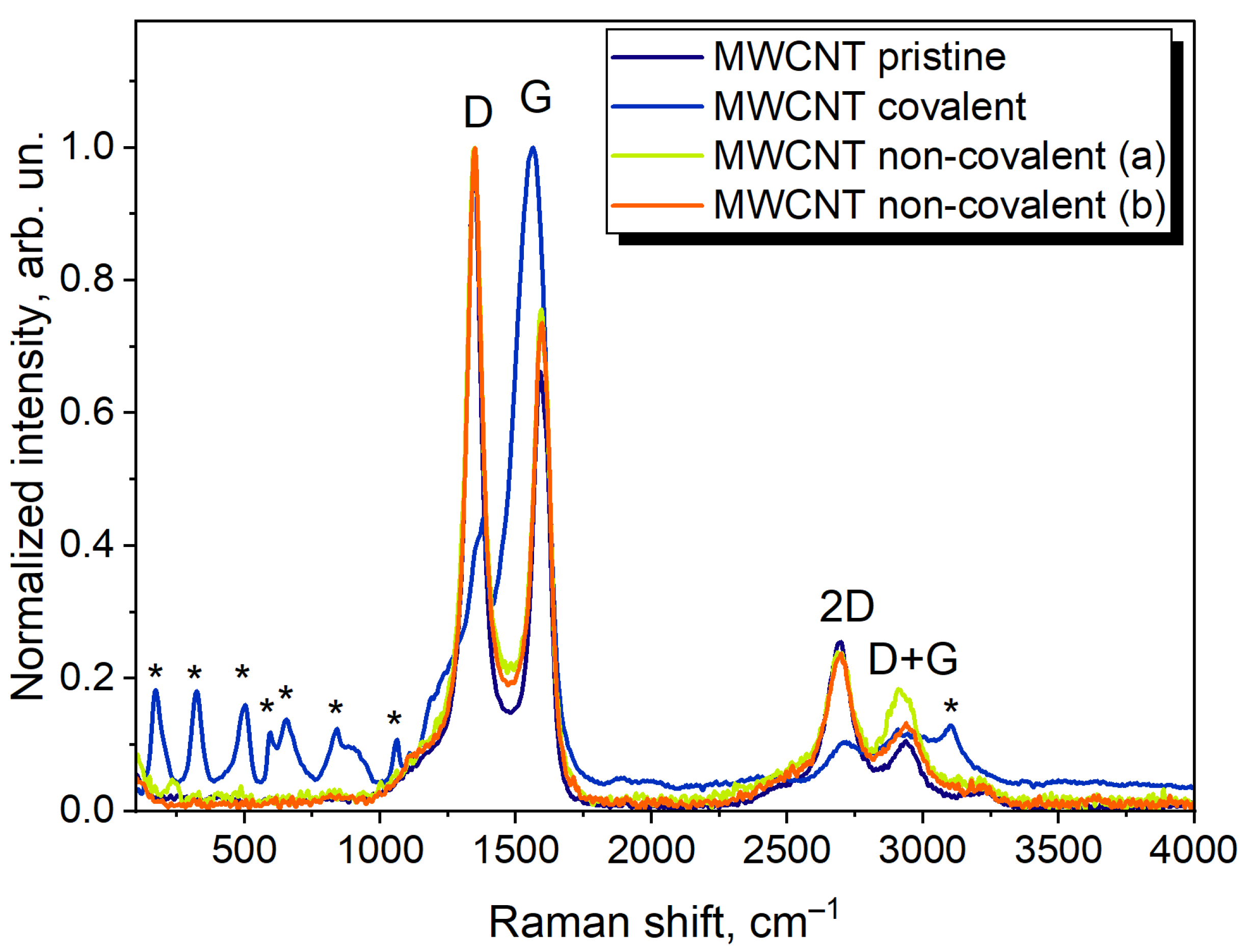
17]. In order to reveal changes in structure of the modified MWCNT, Raman spectra were registered [
16,
17] and compared (
Figure 1).
In the Raman spectra of all the MWCNT samples, first- and second-order spectra are presented (the spectra were registered at excitation wavelength λ
exc= 532 nm). The first-order spectra consist of defect-induced D-band and G-band (at 1350 and 1580 cm
–1), which represents Csp
2 vibrations of carbon nanotubes [
18]. After covalent modification, the visible changes in relative intensity of the D-band (decrease compared to the pristine MWCNTs) and G-band (increase) are detected. The covalent modification of the G-band also results in an increase in the full width at half maximum (FWHM) of the G-band [
19]. In the covalent modification, the peaks associated with ferrocenyl-containing (poly)siloxanes are detected at 168, 322, 497, 595, 651, 833, 1064, and 3105 cm
–1. Considering non-covalent modification of MWCNTs with ferrocenyl-containing polysiloxanes, no significant changes (except a negligible decrease in FWHM of the G-band) were detected in MWCNTs modified with ferrocenyl-containing polysiloxanes. In accordance with the literature [
20,
21], the absence of significant changes in non-covalently modified MWCNTs point on the preservation of electronic and closely related vibrational structure of modified MWCNTs.
We also analyzed the Fe and Si content (Fe 2p and Si 2p (atom.%)) of ferrocenyl-containing (poly)siloxanes in covalently and non-covalently modified MWCNTs by XPS (
Table 1) [
16,
17].
To analyze the Fe and Si atom content, the XPS survey spectra were registered. The Fe content in the MWCNT samples modified with ferrocenyl-containing polysiloxanes bearing 20 and 80 mol.% of ferrocenyl groups is close (
Table 1), while the Si content is higher due to the predominant amount of —(CH
3)
2SiO— units (80 mol.%) and higher molecular weight of ferrocenyl-containing polysiloxane with 20 mol.% of ferrocenyl groups. The number average molecular weights
Mn of ferrocenyl-containing polysiloxanes with 20 and 80 mol% of ferrocenyl moieties are 15400 and 2900, respectively. As for covalent modification of MWCNTs with initial Fc
4D
4 and its polymerized form, the iron content is 4.6–6.4 times higher than in non-covalent modification. A higher degree of grafting of ferrocene derivatives in covalent modification compared to non-covalent was demonstrated in the ref. [
9].
3.2. Influence of the Conducted Covalent and Non-Covalent Modifications on the Electrical Conductivity of Silicone Composites Based on Them
In accordance with the literature, the percolation threshold of non-modified MWCNTs Taunit M in silicone composite prepared by the solution-blending method is 5 wt.% [
24]. It has been reported that at incorporation of higher amounts of non-modified MWCNTs, the composite has delaminated [
24]. At the same time, for some fields, a higher amount of the filler along with its homogeneous distribution in the silicone matrix is vital (e.g., piezophotonic materials [
25]). The higher amount of MWCNTs in the silicone matrix (10 wt.%) was achieved by incorporation of MWCNTs modified with Fc
4D
4 and its polymerized forms. The obtained composite demonstrated good distribution of the filler in silicone, fine film-forming and mechanical properties, and electrical conductivity at the level of semiconductors 8∙10
–8 S∙cm
–1 [
16].
Considering the non-covalent approach, silicone composites reinforced with 5 wt.% of MWCNTs modified with ferrocenyl-containing polysiloxane (20 and 80 mol.% of ferrocenyl groups) exhibited adequate distribution in silicone and conductivity at the level of semiconductors. The electrical conductivity of silicone composite based on MWCNTs non-covalent modified with ferrocenyl-containing polysiloxanes (20 mol.% of ferrocenyl-groups) is 1∙10–7 S∙cm–1, while conductivity of the silicone composite prepared with ferrocenyl-containing polysiloxane (80 mol.% of ferrocenyl-groups) is close to the value of the silicone composite prepared via covalent approach. Preparation of composites with 10 wt.% of the non-covalent modified samples was unsuccessful.
4. Conclusions
In this study covalent and non-covalent modifications of MWCNTs with ferrocenyl-containing polysiloxanes were analyzed by Raman spectroscopy and XPS. The Raman spectroscopy demonstrated preservation of electronic structure in the case of non-covalent modification. The higher degree of grafting was found in the case of covalent modification, which was found from the XPS survey spectra. MWCNTs modified with the two approaches were used for soft silicone composite preparation. In both cases, we obtained composites with conductivity at the level of semiconductors. A higher amount of the filler (10 wt.%) was incorporated in the silicone matrix when MWCNTs were modified via the covalent approach.
Author Contributions
Methodology, investigation, writing—original draft preparation, visualization, and data curation, E.A.G.; conceptualization, supervision, data curation, resources, writing—review and editing, and funding acquisition, R.M.I. All authors have read and agreed to the published version of the manuscript.
Funding
This study was supported by the Russian Science Foundation (project 24-13-00038).
Institutional Review Board Statement
Not applicable.
Informed Consent Statement
Not applicable.
Data Availability Statement
Data can be requested from the authors.
Acknowledgments
The physicochemical measurements were performed at the Research Park of the St. Petersburg State University (Centre for Physical Methods of Surface Investigation, Centre for Optical and Laser Materials Research, Centre for Innovative Technologies of Composite Nanomaterials).
Conflicts of Interest
The authors declare no conflict of interest.
Abbreviations
The following abbreviations are used in this manuscript:
| CNTs | Carbon nanotubes |
| Fc4D4 | 1,3,5,7-tetra(2-ferrocenylethyl)-1,3,5,7-tetramethylcyclotetrasiloxane |
| MWCNTs | Multi-walled carbon nanotubes |
| XPS | X-Ray photoelectron spectroscopy |
References
- Jomaa, M.H.; Masenelli-Varlot, K.; Seveyrat, L.; Lebrun, L.; Dib Jawhar, M.C.; Beyou, E.; Cavaillé, J.Y. Investigation of Elastic, Electrical and Electromechanical Properties of Polyurethane/Grafted Carbon Nanotubes Nanocomposites. Compos. Sci. Technol. 2015, 121, 1–8. [Google Scholar] [CrossRef] [Scilit]
- Kumar, S.K.; Benicewicz, B.C.; Vaia, R.A.; Winey, K.I. 50th Anniversary Perspective: Are Polymer Nanocomposites Practical for Applications? Macromolecules 2017, 50, 714–731. [Google Scholar] [CrossRef] [Scilit]
- Díez-Pascual, A.M. Chemical Functionalization of Carbon Nanotubes with Polymers: A Brief Overview. Macromolecules 2021, 1, 64–83. [Google Scholar] [CrossRef] [Scilit]
- Basheer, B.V.; George, J.J.; Siengchin, S.; Parameswaranpillai, J. Polymer Grafted Carbon Nanotubes—Synthesis, Properties, and Applications: A Review. Nano-Struct. Nano-Objects 2020, 22, 100429. [Google Scholar] [CrossRef] [Scilit]
- Naqvi, S.T.R.; Rasheed, T.; Hussain, D.; Najam Ul Haq, M.; Majeed, S.; Shafi, S.; Ahmed, N.; Nawaz, R. Modification Strategies for Improving the Solubility/Dispersion of Carbon Nanotubes. J. Mol. Liq. 2020, 297, 111919. [Google Scholar] [CrossRef] [Scilit]
- Punetha, V.D.; Rana, S.; Yoo, H.J.; Chaurasia, A.; McLeskey, J.T.; Ramasamy, M.S.; Sahoo, N.G.; Cho, J.W. Functionalization of Carbon Nanomaterials for Advanced Polymer Nanocomposites: A Comparison Study between CNT and Graphene. Prog. Polym. Sci. 2017, 67, 1–47. [Google Scholar] [CrossRef] [Scilit]
- Zhao, Y.-L.; Stoddart, J.F. Noncovalent Functionalization of Single-Walled Carbon Nanotubes. Acc. Chem. Res. 2009, 42, 1161–1171. [Google Scholar] [CrossRef] [Scilit] [PubMed]
- Bilalis, P.; Katsigiannopoulos, D.; Avgeropoulos, A.; Sakellariou, G. Non-Covalent Functionalization of Carbon Nanotubes with Polymers. RSC Adv. 2014, 4, 2911–2934. [Google Scholar] [CrossRef] [Scilit]
- Goff, A.L.; Moggia, F.; Debou, N.; Jegou, P.; Artero, V.; Fontecave, M.; Jousselme, B.; Palacin, S. Facile and Tunable Functionalization of Carbon Nanotube Electrodes with Ferrocene by Covalent Coupling and π-Stacking Interactions and Their Relevance to Glucose Bio-Sensing. J. Electroanal. Chem. 2010, 641, 57–63. [Google Scholar] [CrossRef] [Scilit]
- Syrgiannis, Z.; Melchionna, M.; Prato, M. Covalent Carbon Nanotube Functionalization. In Encyclopedia of Polymeric Nanomaterials; Kobayashi, S., Müllen, K., Eds.; Springer: Berlin/Heidelberg, Germany, 2014; pp. 1–8. ISBN 978-3-642-36199-9. [Google Scholar]
- Makableh, Y.F.; Bozeya, A.; Alnasra, I.; Rawshdeh, T.; Hammam, H.A. Investigation of the Structure and Tensile Strength of Ultrahigh Molecular Weight Polyethylene and Amide Functionalized Single-Walled Carbon Nanotubes Nanocomposites. Polym. Bull. 2023, 80, 12815–12833. [Google Scholar] [CrossRef] [Scilit]
- Huang, J.; Zhou, J.; Liu, M. Interphase in Polymer Nanocomposites. JACS Au 2022, 2, 280–291. [Google Scholar] [CrossRef] [Scilit]
- Karousis, N.; Tagmatarchis, N.; Tasis, D. Current Progress on the Chemical Modification of Carbon Nanotubes. Chem. Rev. 2010, 110, 5366–5397. [Google Scholar] [CrossRef] [Scilit]
- Clarson, S.J.; Fitzgerald, J.J.; Owen, M.J.; Smith, S.D. (Eds.) Silicones and Silicone-Modified Materials; ACS Symposium Series; American Chemical Society: Washington, DC, USA, 2000; Volume 729, ISBN 978-0-8412-3613-4. [Google Scholar]
- Mark, J.E. Some Interesting Things about Polysiloxanes. Acc. Chem. Res. 2004, 37, 946–953. [Google Scholar] [CrossRef] [Scilit]
- Golovenko, E.A.; Pankin, D.V.; Deriabin, K.V.; Kirichenko, S.O.; Perevyazko, I.; Koroleva, A.V.; Islamova, R.M. Modified with Ferrocenyl-Containing Oligo- and Polysiloxanes Multi-Walled Carbon Nanotubes for Soft Conductive Silicone Composites. Mater. Today Commun. 2024, 41, 110429. [Google Scholar] [CrossRef] [Scilit]
- Golovenko, E.A.; Pankin, D.V.; Kirichenko, S.O.; Islamova, R.M. Influence of Ferrocenyl Groups Content in Polysiloxanes on Carbon Nanotubes Performance. J. Mater. Sci. Mater. Electron. 2025, 36, 1536. [Google Scholar] [CrossRef] [Scilit]
- Maslova, O.A.; Mikheykin, A.S.; Leontiev, I.N.; Yuzyuk, Y.I.; Tkachev, A.G. Diagnostics of Carbonaceous Nanomaterial “Taunit” by Raman Spectroscopy. J. Nanoelectron. Optoelectron. 2012, 7, 95–98. [Google Scholar] [CrossRef] [Scilit]
- Golovenko, E.A.; Pankin, D.V.; Deriabin, K.V.; Volkov, A.I.; Kirichenko, S.O.; Levin, O.V.; Islamova, R.M. Ligand Exchange Reaction between Ferrocene and Multiwalled Carbon Nanotubes: A Contemporary Approach. Langmuir 2024, 40, 6909–6917. [Google Scholar] [CrossRef] [Scilit] [PubMed]
- Osswald, S.; Havel, M.; Gogotsi, Y. Monitoring Oxidation of Multiwalled Carbon Nanotubes by Raman Spectroscopy. J. Raman Spectrosc. 2007, 38, 728–736. [Google Scholar] [CrossRef] [Scilit]
- Jorio, A.; Souza Filho, A.G. Raman Studies of Carbon Nanostructures. Annu. Rev. Mater. Res. 2016, 46, 357–382. [Google Scholar] [CrossRef] [Scilit]
- Racz, A.S.; Menyhard, M. Evaluation Methods for XPS Depth Profiling; A Review. Appl. Surf. Sci. Adv. 2025, 30, 100872. [Google Scholar] [CrossRef] [Scilit]
- Sezer, N.; Koç, M. Oxidative Acid Treatment of Carbon Nanotubes. Surf. Interfaces 2019, 14, 1–8. [Google Scholar] [CrossRef] [Scilit]
- Deriabin, K.V.; Kirichenko, S.O.; Lopachev, A.V.; Sysoev, Y.; Musienko, P.E.; Islamova, R.M. Ferrocenyl-Containing Silicone Nanocomposites as Materials for Neuronal Interfaces. Compos. B Eng. 2022, 236, 109838. [Google Scholar] [CrossRef] [Scilit]
- Silva, A.D.; Henriques, C.A.; Malva, D.V.; Calvete, M.J.F.; Pereira, M.M.; Serpa, C.; Arnaut, L.G. Photoacoustic Generation of Intense and Broadband Ultrasound Pulses with Functionalized Carbon Nanotubes. Nanoscale 2020, 12, 20831–20839. [Google Scholar] [CrossRef] [Scilit] [PubMed]
| Disclaimer/Publisher’s Note: The statements, opinions and data contained in all publications are solely those of the individual author(s) and contributor(s) and not of MDPI and/or the editor(s). MDPI and/or the editor(s) disclaim responsibility for any injury to people or property resulting from any ideas, methods, instructions or products referred to in the content. |
© 2026 by the authors. Licensee MDPI, Basel, Switzerland. This article is an open access article distributed under the terms and conditions of the Creative Commons Attribution (CC BY) license (https://creativecommons.org/licenses/by/4.0/).