

Proceeding Paper

Phase Transition and Transport Properties in p-Type β-FeSi2 Semiconductor †

by
Sopheap Sam
1,2,*,
Kosuke Yamazaki
3 and
Hiroshi Nakatsugawa
3,*
1
Department of Industrial and Mechanical Engineering, Faculty of Electrical Engineering, Institute of Technology of Cambodia, Russian Federation Blvd, P.O. Box 86, Phnom Penh 120404, Cambodia
2
Research and Innovation Center, Institute of Technology of Cambodia, Russian Federation Blvd, P.O. Box 86, Phnom Penh 120404, Cambodia
3
Graduate School of Engineering Science, Yokohama National University, 79-5 Tokiwadai, Hodogaya, Yokohama 240-8501, Kanagawa, Japan
*
Authors to whom correspondence should be addressed.
Presented at the 4th International Online Conference on Materials, 3–6 November 2025; Available online: https://sciforum.net/event/IOCM2025.
Mater. Proc. 2025, 26(1), 7; https://doi.org/10.3390/materproc2025026007
Published: 28 January 2026
(This article belongs to the Proceedings of The 4th International Online Conference on Materials)

Abstract

The thermoelectric (TE) performance of iron silicide (β-FeSi2) can be enhanced by introducing metal dopants. However, such doping often leads to the emergence of secondary phases, which negatively affect the Seebeck coefficient and overall TE efficiency. Consequently, it is crucial to understand the phase transitions involved and how they influence the transport properties in order to optimize the material’s performance. This work investigates the influence of Mn-doping on the phase change and properties of p-type β-Fe1−xMnxSi2. The findings show that the semiconducting β-phase decreases sharply when x ≥ 0.09, indicating that the optimal doping concentration lies below this level. As a result, the maximum power factor of 970 μW m−1 K−2 and a dimensionless figure of merit (ZT) value of 0.12 are achieved at x = 0.03. This study clarifies how the phase composition relates to the thermoelectric properties of p-type β-FeSi2.

1. Introduction

Iron disilicide (β-FeSi2) is a key semiconductor for high-temperature thermoelectric applications because of its strong thermal stability and excellent resistance to oxidation [1,2]. In addition, this compound is abundant and non-toxic to the environment. The TE performance of pristine β-FeSi2 remains low because of its high electrical resistivity and the influence of bipolar diffusion. The efficiency of a thermoelectric material is evaluated using the dimensionless figure of merit (ZT), which is defined as follows: ZT = S2ρ−1κ−1T, where S is the Seebeck coefficient, ρ is the electrical resistivity, T is the temperature, κ represents the total thermal conductivity, which includes contributions from both electronic and lattice heat transport (κ = κe + κl) [3]. Therefore, decreasing ρ and increasing S could improve the ZT value. The doping approach could simultaneously decrease ρ due to the improvement of carrier density and increase ρ due to the reduction in bipolar effect.
The conduction behavior of β-FeSi2 can be tuned to both n-type and p-type by doping with elements that have more or fewer valence electrons to the Fe or Si site [4,5,6,7]. For n-type β-FeSi2, Ir doping yielded the highest ZT value of 0.6 by Qiu et al. [8]. Such a high ZT value is due to the improvement in power factor (PF = S2ρ−1) and reduction in κ. For p-type, the highest ZT = 0.35 was obtained by co-doping of Al and Os as reported by Du et al. [9], where the role of Al is to improve the PF value, and Os acts as a heavy element to reduce the κ. It is noted that Ir and Os have a heavier atomic mass and larger radius than Fe. This contributes to mass fluctuations and strain field fluctuations, resulting in a reduction in κl. As reviewed above, the performance of p-type is lower than that of n-type β-FeSi2. This is because the n-type dopant (i.e., Ir element) has a high solid solution up to 16% in the β-FeSi2 system. In addition, a recent study attempted to improve the solubility of the Co element by prolonging annealing time up to 15 days [10]. They obtained the maximum ZT = 0.3 at 900 K at a high doping level of 8%Co. As for p-type, Yamashita and co-workers produced a sample containing 7% Mn using spray-drying followed by compaction and sintering [7]. They reported a maximum ZT value of 0.15 at 900 K. Dabrowski and colleagues found that p-type β-FeSi2 exhibits much lower thermoelectric performance compared to its n-type counterpart [11]. By preparing samples with the pulse plasma sintering (PPS) method, they investigated p-type β-FeSi2 by doping phosphorus (P) at the Si site and manganese (Mn) at the Fe site. Even with these dopants, the best p-type result was a ZT of only about 0.06, achieved with 8% Mn substitution. The low TE performance of p-type materials is mainly because of the low solubility of the dopant, resulting in the formation of secondary phases (ε and α-phase). Hence, understanding the phase transitions and their relationship with transport properties is essential.
In this study, we focus on examining the effect of Mn as a p-type dopant on the phase transitions and transport behavior of Fe1−xMnxSi2, with x = 0.00, 0.01, 0.03, 0.05, 0.07, and 0.10. We also study the relationship between the phase transition and the thermoelectric properties of these materials.

2. Experiments

The bulk of Fe1−xMnxSi2 alloys, with x = 0.00, 0.01, 0.03, 0.05, 0.07, and 0.10, were synthesized using high-purity elemental grains (Fe, Mn, Si) through the arc melting process in a low-pressure argon 10−3 Pa atmosphere. Synthesis steps included layering elements by their melting points (Mn at the bottom) and using a titanium getter to purify the chamber atmosphere. To achieve uniform material composition, the ingots were melted several times, taking care to gradually increase arc power to prevent material loss and avoid electrode contact. The resulting metallic α + ε phase samples were cut and then underwent a critical two-step heat treatment in a vacuum-sealed quartz tube. The first step is at 1423 K for 3 h for homogenization, and then the second step is at 1113 K for 20 h to transform them into the target semiconducting β-phase.
Structural characterization was conducted using X-ray diffraction (XRD) on a Rigaku SmartLab system with Cu Kα radiation, and the phase occupation and crystal structure parameters were obtained through Rietveld analysis using the RIETAN-FP (version 3.12) program, where standard crystal parameters were referred to inorganic Crystal Structure Database (ICSD). The code #9119-ICSD was used for β-phase [12], code #41997-ICSD was used for ε-phase [13], and code #5257-ICSD was used for α-phase [14]. The microstructure and elemental composition were observed by scanning electron microscope (SEM-SU8010, Hitachi High-Technologies, Tokyo, Japan) equipped with an energy-dispersive X-ray spectroscopy detector (EDS XFlash5060FQ, Bruker, Berlin, Germany). Thermoelectric properties were subsequently measured over a broad temperature range from 80 K to 800 K. The Seebeck coefficient (S) and electrical resistivity (ρ) were evaluated using a ResiTest8300 system and a custom-built apparatus, respectively. The total thermal conductivity (κ) was finally evaluated with the ULVAC PEM-2 power efficiency measurement system.

3. Results and Discussion

3.1. Structural and Phase Transition

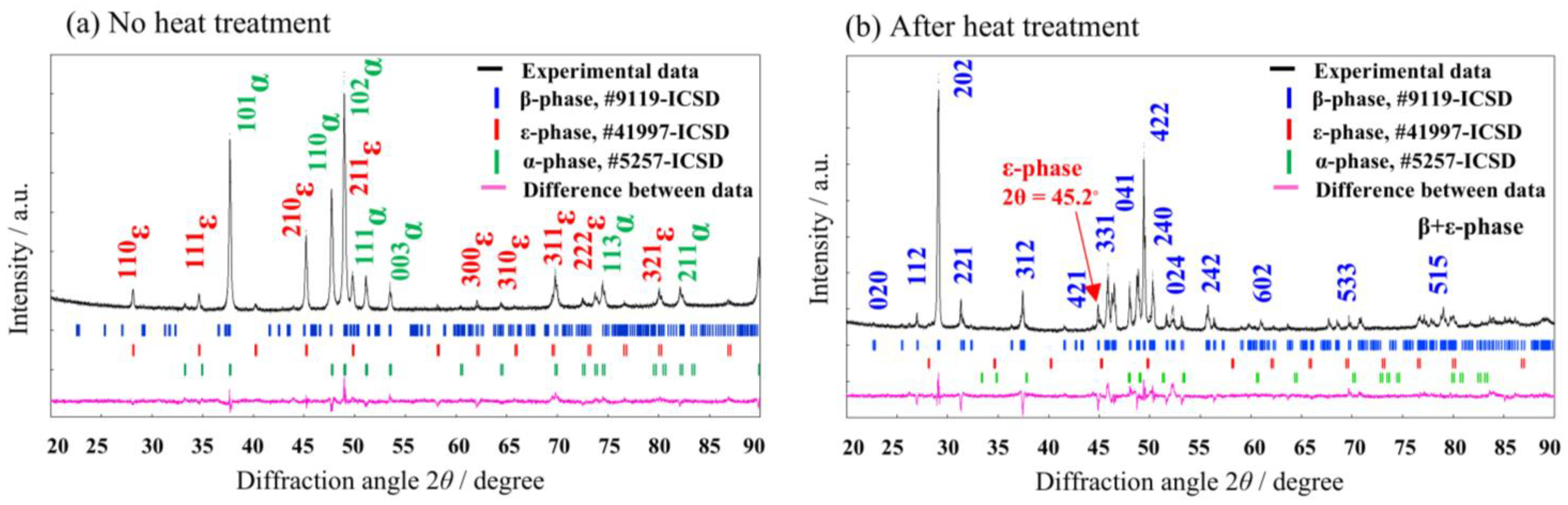
Figure 1a,b show the XRD profile of pure FeSi2 before and after heat treatment. We use pure FeSi2 as the base sample to confirm that it can be crystallized in β-phase for the proposed heat treatment process. Before undergoing heat treatment, the sample exhibited crystallization in the α and ε phases, as evidenced by the indexed peaks in Figure 1a. The secondary phases formed as a result of the high temperatures during the arc melting process. Following heat treatment, the sample transformed predominantly into the β-phase, with only a minor presence of the ε-phase, as shown in Figure 1b. The residual trace of the ε-phase is consistent with the findings previously reported by Nogi et al. [15]. However, Rietveld analysis indicates that the heat-treated sample consists of approximately 97% β-phase, while the α- and ε-phases share the occupancy with only ~3%. This indicates that the heat treatment process is necessary to obtain the semiconducting β-phase.
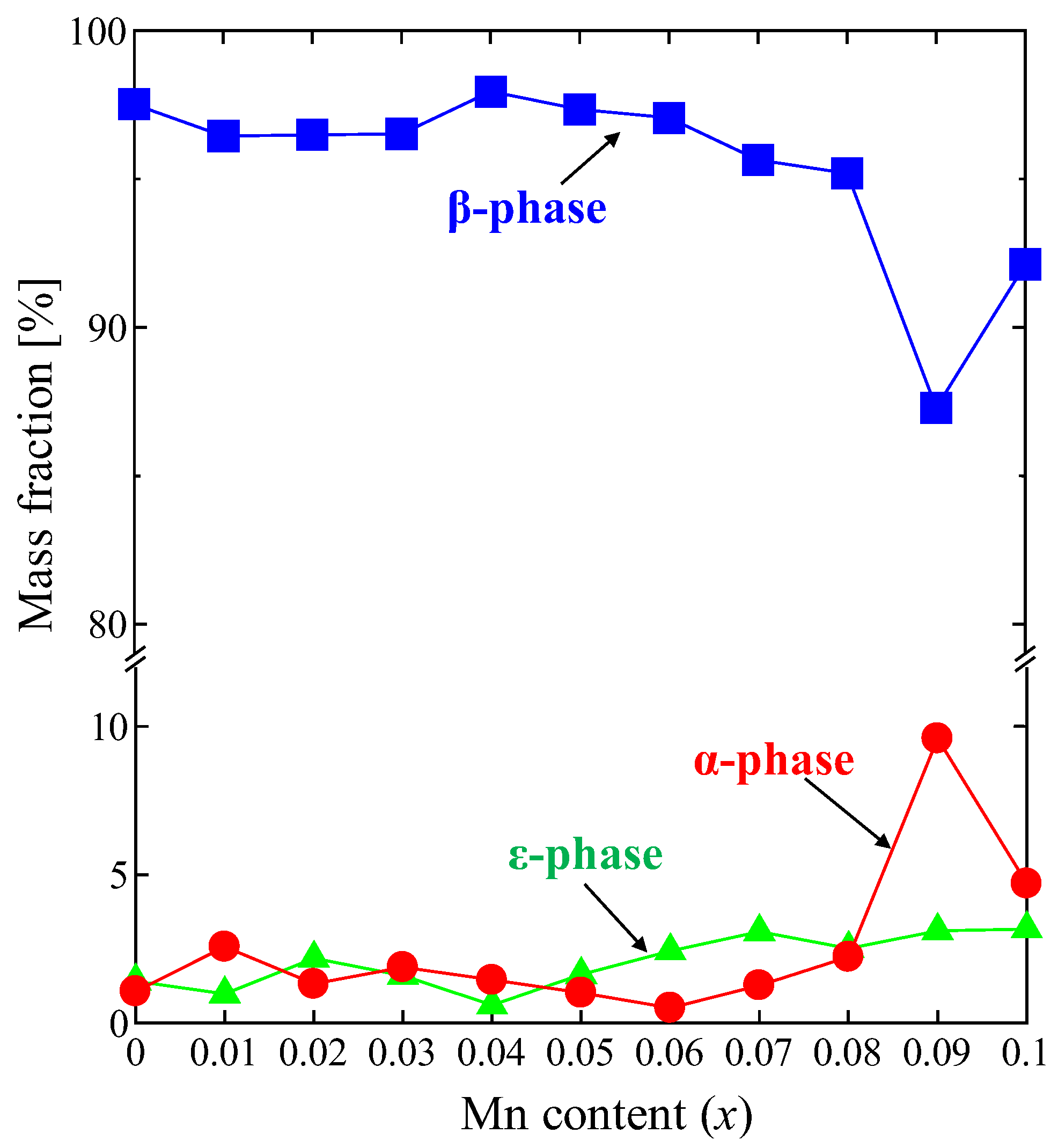
Figure 2 shows the phase fraction of Fe1−xMnxSi2 calculated by Rietveld analysis as a function of doping level x. For 0 ≤ x ≤ 0.08, the β-phase is stabilized and higher than 95%. When x ≥ 0.09, the fraction of β-phase significantly declines, whereas the proportions of α- and ε-phases increase. It is important to note that the reduction in the semiconducting β-phase or the rise in metallic α- and ε-phases leads to a deterioration in thermoelectric performance. This is because the Seebeck coefficient of metal is low ∆S = −∆V/∆T. Therefore, it can be considered that the optimum substitution level of Mn should be lower than 9%. However, it is necessary to confirm by investigating the transport properties to verify our consideration.
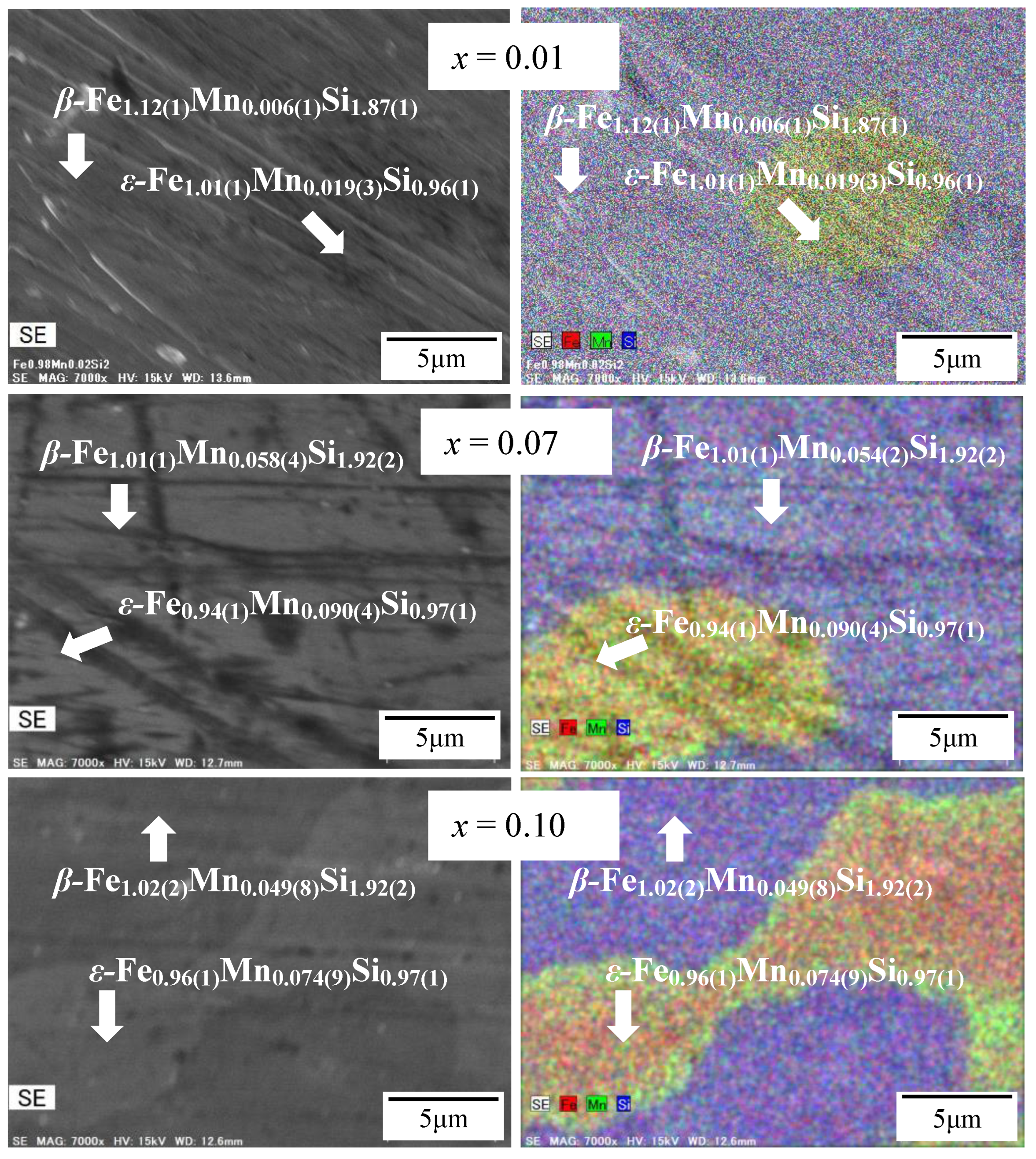
The SEM-EDS mapping of Fe1−xMnxSi2 is illustrated in Figure 3, and the results of elemental analysis are listed in Table A1 in Appendix A. In the β-phase area, the Fe:Si composition ratio is approximately 1:2, corresponding to β-FeSi2. On the other hand, in the ε-phase area, the Fe:Si ratio is approximately 1:1, corresponding to the ε-phase. As shown in Figure 3, the size of the secondary ε-phase grain tends to increase with increasing Mn doping. Notably, Mn is preferentially accumulated in the ε-phase regions (as shown by the green color), indicating that the formation of the secondary phase suppresses further Mn incorporation into the main β-phase. This behavior is similar to that reported for Ni-doped β-FeSi2 in the literature [5].
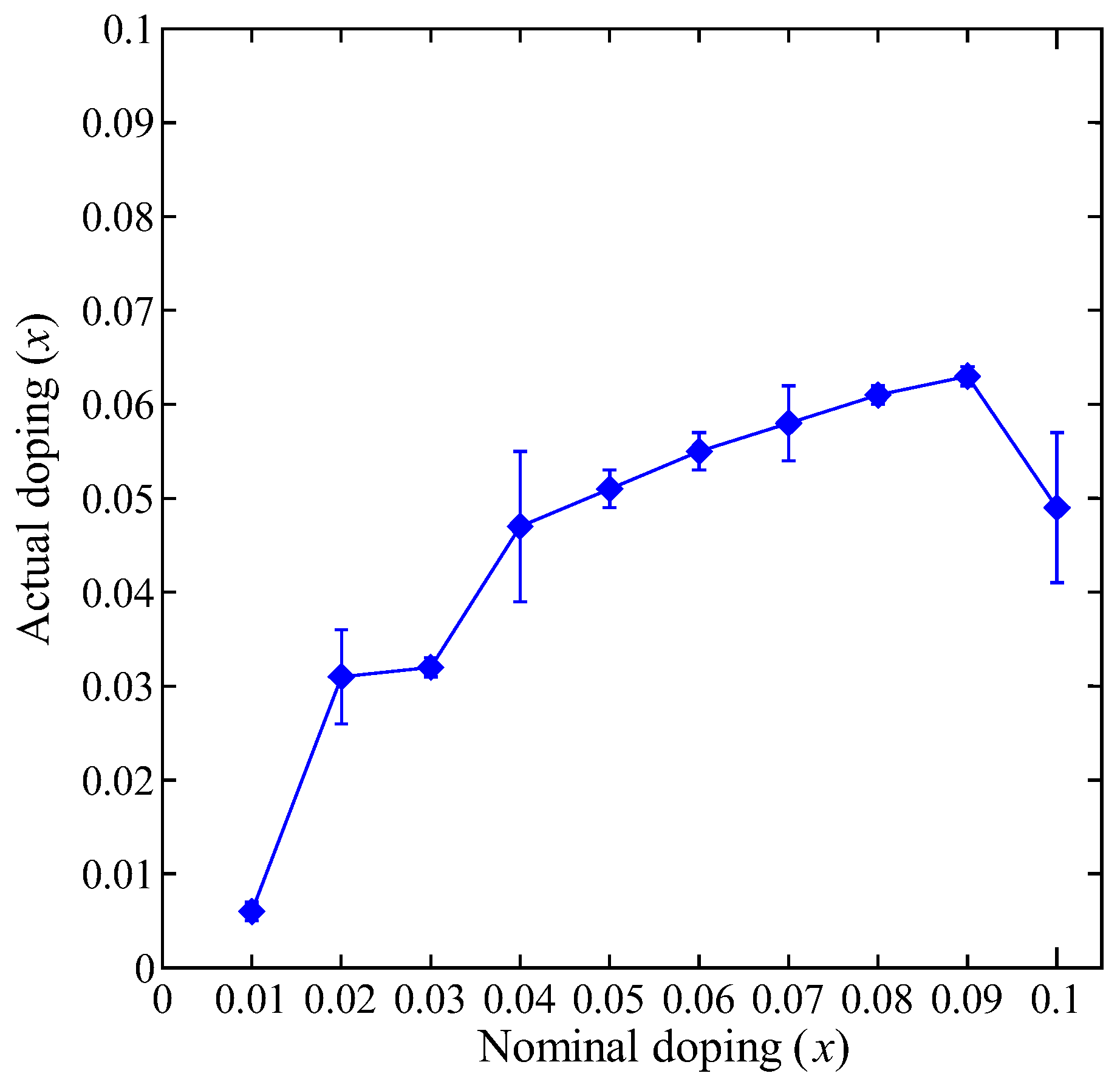
The actual versus nominal Mn doping level (x) in the β-FeSi2 phase is plotted in Figure 4. The maximum actual Mn content of x = 0.063 is achieved at a nominal composition of x = 0.09, indicating that the solid solubility limit of Mn in β-FeSi2 is approximately 6.3%. At a nominal composition of x = 0.10, the actual Mn content in the β-phase decreases, which is attributed to the increased formation of the secondary ε-phase, where Mn is preferentially incorporated.

3.2. Transport Properties

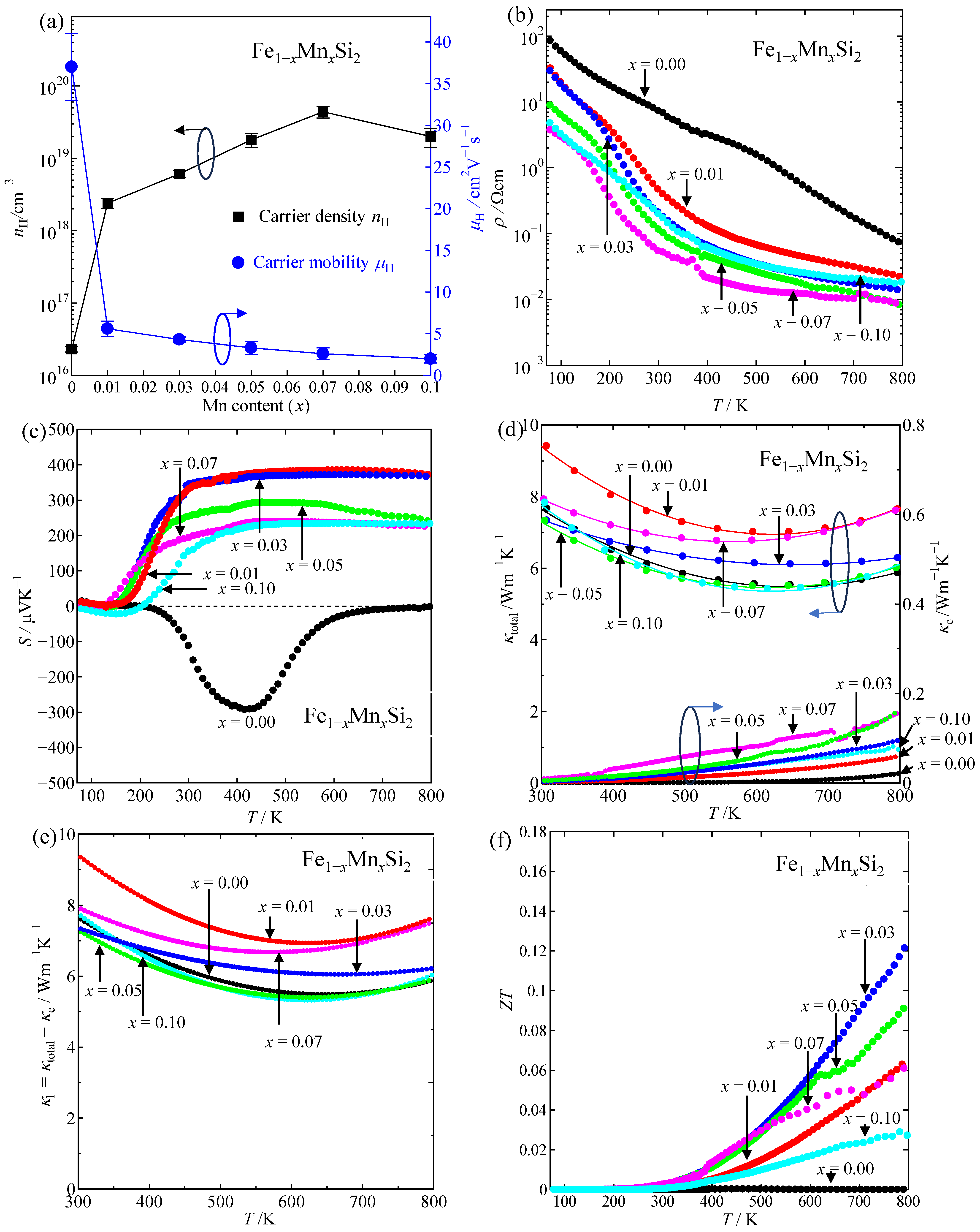
Figure 5 presents transport properties for Fe1−xMnxSi2. Figure 5a shows the carrier concentration nH and μH measured at room temperature. The addition of Mn increases the nH from approximately 1016 cm−3 to 1018–1019 cm−3, corresponding to an enhancement of 2–3 orders of magnitude. In contrast, compared to the non-doped sample, the μH of Mn-doped samples decreases by several tens of cm2V−1s−1, due to enhanced carrier scattering associated with the increased carrier concentration. For the pure sample (x = 0), the electrical resistivity (ρ) decreases from 102 to 10−1 Ωcm as the temperature rises from 80 K to 800 K, indicating the semiconducting behavior over the measured temperature (Figure 5b). On the other hand, at 300 K, the ρ decreases by nearly two orders of magnitude with Mn doping (x), resulting from the increased carrier density. Thus, Mn incorporation enhances the electrical conductivity. The electrical resistivity of x = 0.10 is relatively high, although its metallic α + ε phase is maximum. This is because the second phase constitutes only about 8% of the total. The remaining 92% is the β phase of the semiconductor phase. Therefore, although the metallic phase is indeed expanding, at x = 0.10, the second phase has not yet formed a network capable of contributing to electrical conductivity. In addition, once the secondary phase forms, Mn becomes less soluble in the β-phase, leading to a reduced carrier concentration. Consequently, the overall electrical transport is still dominated by the semiconducting β-phase, resulting in a higher electrical resistivity at x = 0.10.
Figure 5c shows the temperature dependence of the Seebeck coefficient (S) for Fe1−xMnxSi2. At room temperature, the Seebeck coefficient of the undoped sample is negative, confirming n-type behavior, whereas the Mn-doped samples exhibit positive S values, characteristic of p-type conduction. Therefore, Mn is a p-type dopant for β-FeSi2. At 0 ≤ x ≤ 450 K, the absolute value of S for the undoped sample rises with temperature as the conduction mechanism shifts from impurity-band transport to polaron conduction. [9]. Afterward, it begins to decline and approaches ~0 μVK−1 as the temperature rises to 800 K, which is attributed to the bipolar diffusion effect. The S of Mn-doped samples is more uniform from room temperature to high temperature because of the reduction in bipolar effect. This indicates that Mn could improve not only the electrical conductivity but also suppress the bipolar effect in the β-FeSi2 system. In addition, at room temperature, we could clearly see that S increases with Mn doping for x ≤ 0.03 due to the decrease in mobility or increase in effective mass. However, it decreases with increasing Mn doping for x ≥ 0.05 due to the increase in carrier concentration. The reduction in S with higher x is further attributed to the presence of secondary metallic phases. Consequently, the highest power factor (PF = S2ρ−1) reaches 970 μWm−1K−2 in the x = 0.03 sample.
It should be noted that, with increasing Mn doping, the carrier concentration increases, while the carrier mobility decreases due to enhanced impurity scattering. As a result, the electrical resistivity decreases. However, the Seebeck coefficient decreases for 0.07 ≤ x ≤ 0.10, which is primarily attributed to the increased carrier density and the formation of secondary metallic phases with intrinsically low Seebeck coefficients. These results suggest that the evolution of thermoelectric properties in the low-doping regime (x ≤ 0.07) is mainly governed by carrier concentration modulation rather than minor changes in phase content.
Figure 5d reveals that the total thermal conductivity (κtotal) rises with increasing Mn content. This trend is likely attributed to the growing fraction of metallic phases introduced by Mn doping, as mentioned above. In addition, as x increases, the electronic component of the thermal conductivity (κe) increases. The κe is calculated by κe = L0−1, where L0 represents the Lorenz number, T denotes the temperature, and ρ denotes the electrical resistivity. For the value of L0, it is calculated by the measured Seebeck coefficient as reported by previous studies [5,16]. Consequently, the decrease in ρ results in the rise in κe. As shown in Figure 5e, the lattice thermal conductivity (κl) is the dominant contribution to κtotal, since the electronic thermal conductivity κe is relatively small for all samples. The increase in κl with Mn doping, therefore, leads directly to the observed increase in κtotal. This behavior can be understood by considering the relationship between the phonon mean free path (MFP) and the characteristic size of the secondary phase grains. When the size of the secondary phase grain is smaller than the MFP, enhanced phonon scattering reduces the lattice thermal conductivity. However, when the size of the secondary phase grain is much larger than the phonon MFP, phonon scattering at phase boundaries becomes less effective, resulting in a higher κl. The phonon mean free path of β-FeSi2 has been reported to be approximately several hundred nanometers [17,18]. As shown by the SEM-EDS mapping in Figure 3, referring to the scale bar of 5 μm, the characteristic size of the secondary ε-phase grains is on the order of several micrometers, which is significantly larger than the phonon MFP. This indicates that phonon scattering by the secondary phase is limited, contributing to the increase in κl and κtotal, consequently in Mn-doped samples.
The thermoelectric performance is calculated by ZT = S2ρ1κ1T, and its values as a function of temperature are plotted in Figure 5f. The ZT values for all Mn-doped samples increase with increasing temperature, mainly due to the decrease in ρ. Similarly to the power factor, the maximum ZT of 0.12 is observed for the x = 0.03 sample at 800 K. For x values greater than 0.03, ZT decreases with increasing x due to the decrease in S, as illustrated in Figure 5c, where carrier density is the dominant factor.

3.3. Thermoelectric Properties in Relation to Structural Properties

The thermoelectric properties of Fe1−xMnxSi2 are dependent on the structural properties, specifically the phase fraction of the semiconducting β-phase relative to the metallic α- and ε-phases. The necessity of a post-arc-melting heat treatment to achieve high purity (as high as ~97%) of the β-phase in the non-doped material confirms that this phase is essential for exhibiting the required semiconducting behavior (high electrical resistivity ρ and temperature-dependent Seebeck coefficient S). The addition of the Mn dopant effectively modulates the electrical properties by creating p-type materials, but its structural stability is limited; while the semiconducting β-phase remains dominant up to x = 0.08, higher doping levels (x ≥ 0.09) cause an increase in the metallic α- and ε-phases. The degradation of the structure negatively affects thermoelectric performance because the rising metallic phase content reduces the Seebeck coefficient S, due to metals’ inherently low S, while simultaneously increasing the thermal conductivity, thereby lowering the efficiency of the material. Consequently, optimal thermoelectric performance is achieved at a doping level (x = 0.03) that retains high β-phase purity while effectively modulating electrical properties.

4. Conclusions

In conclusion, achieving high-purity semiconducting β-FeSi2 requires a necessary heat treatment process. Mn is confirmed as an effective p-type dopant, significantly increasing electrical conductivity and suppressing the bipolar diffusion effect, which stabilizes the Seebeck coefficient at high temperatures. The maximum thermoelectric performance, ZT = 0.12 at 800 K, is achieved at the optimal concentration of 3% Mn doping. This result represents the optimization of Mn doping, where structural stability is maintained while enhancing the electrical transport properties.

Author Contributions

Conceptualization, S.S. and H.N.; methodology, S.S.; software, H.N.; validation, S.S.; formal analysis, S.S., K.Y. and H.N.; investigation, S.S.; resources, H.N.; data curation, S.S. and K.Y.; writing—original draft preparation, S.S.; writing—review and editing, S.S. and H.N.; visualization, S.S.; supervision, H.N.; project administration, H.N. All authors have read and agreed to the published version of the manuscript.

Funding

This research received no external funding.

Institutional Review Board Statement

Not applicable.

Informed Consent Statement

Not applicable.

Data Availability Statement

All data are included in the article.

Acknowledgments

The XRD was performed at the Instrumental Analysis and Evaluation Center, Yokohama National University. The thermal conductivity was measured by the PEM-2 apparatus at the National Defense Academy.

Conflicts of Interest

The authors declare no conflicts of interest.

Appendix A

Table A1. Elemental composition of Fe1−xMnxSi2 characterized by SEM-EDS at room temperature.
xAreaElementAtomic %Composition RatioChemical Formula
0.01βFe37.5(5)1.12(1)β-Fe1.12(1)Mn0.006(1)Si1.87(1)
Mn0.19(4)0.006(1)
Si62.4(5)1.87(1)
εFe50.9(6)1.01(1)ε-Fe1.01(1)Mn0.019(3)Si0.96(1)
Mn0.9(1)0.019(3)
Si48.2(6)0.96(1)
0.03βFe35.6(7)1.07(2)β-Fe1.07(2)Mn0.032(1)Si1.90(2)
Mn1.1(1)0.032(1)
Si63.4(4)1.90(2)
εFe50.6(9)1.01(1)ε-Fe1.01(1)Mn0.036(8)Si0.95(2)
Mn1.8(4)0.036(8)
Si47.6(9)0.95(2)
0.05βFe35.7(4)1.07(1)β-Fe1.07(1)Mn0.051(2)Si1.88(1)
Mn1.7(1)0.051(2)
Si62.6(5)1.88(1)
εFe49.4(600.98(1)ε-Fe0.98(1)Mn0.077(2)Si0.94(1)
Mn3.8(1)0.077(2)
Si46.8(5)0.94(1)
0.07βFe33.7(3)1.01(1)β-Fe1.01(1)Mn0.058(4)Si1.93(1)
Mn1.8(1)0.058(4)
Si64.5(5)1.93(1)
εFe47.1(6)0.94(1)ε-Fe0.94(1)Mn0.090(4)Si0.97(1)
Mn4.5(2)0.090(4)
Si48.4(6)0.97(1)
0.09βFe34.2(3)1.02(1)β-Fe1.02(1)Mn0.063(1)Si1.91(1)
Mn2.1(1)0.063(1)
Si63.8(3)1.91(1)
εFe46.4(6)0.93(1)ε-Fe0.93(1)Mn0.099(2)Si0.97(1)
Mn4.9(3)0.099(2)
Si48.6(3)0.97(1)
0.10βFe33.9(7)1.02(2)β-Fe1.02(2)Mn0.049(8)Si1.93(2)
Mn1.6(3)0.049(8)
Si64.4(6)1.93(2)
εFe48.5(4)0.96(1)ε-Fe0.96(1)Mn0.074(9)Si0.97(1)
Mn3.7(4)0.74(9)
Si47.3(3)0.97(1)

References

  1. Cheng, J.; Chen, X.; Zhou, J.; Zhang, J.; Qiu, P.; Shi, X.; Chen, L. Crystal Structure and Chemical Bonding of β-FeSi2 and ε-FeSi. J. Phys. Chem. C 2024, 128, 13998–14006. [Google Scholar] [CrossRef]
  2. Iida, T.; Inoue, R.; Shiojiri, D.; Hirayama, N.; Hamada, N.; Kogo, Y. Silicide materials: Thermoelectric, mechanical properties, and durability for Mg-Si and Mn-Si. In Thermoelectric Energy Conversion; Funahashi, R., Ed.; Woodhead Publishing Series in Electronic and Optical Materials; Elsevier: Amsterdam, The Netherlands, 2021; pp. 389–427. ISBN 978-0-12-818535-3. [Google Scholar]
  3. Takeuchi, T. New Thermoelectric Materials with Precisely Determined Electronic Structure and Phonon Dispersion. In Thermoelectrics and Its Energy Harvesting; Rowe, D.M., Ed.; Taylor & Francis Group: Abingdon, UK, 2017; pp. 7-1–7-27. ISBN 9781315216904. [Google Scholar]
  4. Saito, T.; Asakawa, R. Production of (Fe,Co)Si2 and (Fe.Mn)Si2 Thermoelectric Materials by Spark Plasma Sintering. Crystals 2023, 14, 56. [Google Scholar] [CrossRef]
  5. Sam, S.; Odagawa, S.; Nakatsugawa, H.; Okamoto, Y. Effect of Ni Substitution on Thermoelectric Properties of Bulk β-Fe1−xNixSi2 (0 ≤ x ≤ 0.03). Materials 2023, 16, 927. [Google Scholar] [CrossRef] [PubMed]
  6. Kim, S.W.; Cho, M.K.; Mishima, Y.; Choi, D.C. High temperature thermoelectric properties of p- and n-type β-FeSi2 with some dopants. Intermetallics 2003, 11, 399–405. [Google Scholar] [CrossRef]
  7. Yamashita, O.; Tomiyoshi, S.; Sadatomi, N. Thermoelectric properties of p- and n-type FeSi2 prepared by spray drying, compaction and sintering technique. J. Mater. Sci. 2003, 38, 1623–1629. [Google Scholar] [CrossRef]
  8. Qiu, P.; Cheng, J.; Chai, J.; Du, X.; Xia, X.; Ming, C.; Zhu, C.; Yang, J.; Sun, Y.; Xu, F.; et al. Exceptionally Heavy Doping Boosts the Performance of Iron Silicide for Refractory Thermoelectrics. Adv. Energy Mater. 2022, 12, 2200247. [Google Scholar] [CrossRef]
  9. Du, X.; Qiu, P.; Chai, J.; Mao, T.; Hu, P.; Yang, J.; Sun, Y.-Y.; Shi, X.; Chen, L. Doubled Thermoelectric Figure of Merit in p-Type β-FeSi2 via Synergistically Optimizing Electrical and Thermal Transports. ACS Appl. Mater. Interfaces 2020, 12, 12901–12909. [Google Scholar] [CrossRef] [PubMed]
  10. Cheng, J.; Gan, L.; Zhang, J.; Xi, J.; Xi, L.; Yang, J.; Deng, T.; Qiu, P.; Shi, X.; Chen, L. Thermoelectric properties of heavily Co-doped β-FeSi2. J. Mater. Sci. Technol. 2024, 187, 248–257. [Google Scholar] [CrossRef]
  11. Dąbrowski, F.; Ciupiński, Ł.; Zdunek, J.; Kruszewski, J.; Zybała, R.; Michalski, A.; Jan Kurzydłowski, K. Microstructure and thermoelectric properties of p and n type doped β-FeSi2 fabricated by mechanical alloying and pulse plasma sintering. Mater. Today Proc. 2019, 8, 531–539. [Google Scholar] [CrossRef]
  12. Dusausoy, Y.; Protas, J.; Wandji, R.; Roques, B. Structure cristalline du disiliciure de fer, FeSi2β. Acta Crystallogr. Sect. B Struct. Crystallogr. Cryst. Chem. 1971, 27, 1209–1218. [Google Scholar] [CrossRef]
  13. Sales, B.C.; Jones, E.C.; Chakoumakos, B.C.; Fernandez-Baca, J.A.; Harmon, H.E.; Sharp, J.W.; Volckmann, E.H. Magnetic, transport, and structural properties of Fe1−xIrxSi. Phys. Rev. B 1994, 50, 8207–8213. [Google Scholar] [CrossRef] [PubMed]
  14. Li, G.; Bai, W.; Shi, N.; Fang, Q.; Xiong, M.; Yang, J.; Ma, Z.; Rong, H. Linzhiite, FeSi2, a redefined and revalidated new mineral species from Luobusha, Tibet, China. Eur. J. Miner. 2012, 24, 1047–1052. [Google Scholar] [CrossRef]
  15. Nogi, K.; Kita, T. Rapid production of β-FeSi2 by spark-plasma sintering. J. Mater. Sci. 2000, 35, 5845–5849. [Google Scholar] [CrossRef]
  16. Sam, S.; Nakatsugawa, H.; Okamoto, Y. Optimization of Co additive amount to improve thermoelectric properties of β-FeSi2. Jpn. J. Appl. Phys. 2022, 61, 111002. [Google Scholar] [CrossRef]
  17. Ail, U.; Gorsse, S.; Perumal, S.; Prakasam, M.; Umarji, A.; Vivès, S.; Bellanger, P.; Decourt, R. Thermal conductivity of β-FeSi2/Si endogenous composites formed by the eutectoid decomposition of α-Fe2Si5. J. Mater. Sci. 2015, 50, 6713–6718. [Google Scholar] [CrossRef]
  18. Hsin, C.-L.; Liu, Y.-T.; Tsai, Y.-Y. Suppressed Umklapp scattering of β -FeSi2 thin film and single crystalline nanowires. Nanotechnology 2017, 28, 485702. [Google Scholar] [CrossRef] [PubMed]
Figure 1. Rietveld refinement for the XRD results of pristine FeSi2. (a) Before heat treatment, showing indexed peaks corresponding to the ε and α phases. (b) After heat treatment, displaying indexed peaks of the β phase along with a small residual ε phase. The standard crystal parameters were referred to the Inorganic Crystal Structure Database (ICSD). The code #9119-ICSD was used for the β-phase [12], code #41997-ICSD was used for the ε-phase [13], and code #5257-ICSD was used for the α-phase [14].
Materproc 26 00007 g001
Figure 2. Phase fraction of Fe1−xMnxSi2 after heat treatment as a function of Mn doping level (x).
Materproc 26 00007 g002
Figure 3. SEM-EDS mapping of Fe1−xMnxSi2 after heat treatment. The Fe is mapped in red, Mn in green, and Si in blue. The arrows indicate the area of β-phase and ε-phase.
Materproc 26 00007 g003
Figure 4. Actual versus nominal Mn doping for Fe1−xMnxSi2 characterized by SEM-EDS.
Materproc 26 00007 g004
Figure 5. Transport properties of Fe1−xMnxSi2. (a) Carrier density nH and mobility μH at room temperature. (b) Electrical resistivity ρ as a function of temperature. (c) Seebeck coefficient S. (d) Total thermal conductivity (κtotal) and electronic thermal conductivity (κe). (e) Lattice thermal conductivity(κl) and (f) ZT value calculated by ZT = S2ρ−1κ−1T.
Materproc 26 00007 g005
Disclaimer/Publisher’s Note: The statements, opinions and data contained in all publications are solely those of the individual author(s) and contributor(s) and not of MDPI and/or the editor(s). MDPI and/or the editor(s) disclaim responsibility for any injury to people or property resulting from any ideas, methods, instructions or products referred to in the content.