


Abstract
With the increasing global concern regarding climate change and the need to reduce greenhouse gas emissions, carbon capture and utilization (CCU) technologies are seen as one of the primary steps toward large-scale decarbonization prospects. In this context, a thorough assessment of each CCU pathway is required from both the techno-economic and environmental perspectives. In this work, the potential of carbon biofixation through microalgae cultivation is evaluated through the preliminary technical design and calculation of plant economics in the case of the Turakurgan natural gas-fired combined cycle power plant located in the eastern part of Uzbekistan. The primary data used in this study are obtained from the open access project report of the targeted power station, along with recently published literature sources. According to the results, although the purchase and installation costs of photobioreactors require significant investments in the capital costs, the technology would still be cost competitive as long as there is a carbon tax imposition of around USD 50 per ton of CO2 emissions. However, CO2 biofixation can be relatively more suitable compared to benchmark absorption, particularly in low-CO2-concentration conditions. Future research will involve a more comprehensive examination of CO2-based microalgae cultivation and its comparison with chemical absorption and membrane-assisted separation techniques.
1. Introduction
When it comes to fighting against the escalating threats of climate change, primarily driven by anthropogenic CO2 emissions, specifically by fossil fuel combustion, urgent actions need to be taken toward carbon reduction at both global and national scales. The fossil fuel-fired power generation sector, a major contributor to greenhouse gas emissions, is the first target to initiate the decarbonization plans [1]. In this context, the Republic of Uzbekistan, hereinafter referred to as Uzbekistan, also plays a key role in the CO2 emission profile of Central Asian countries. Uzbekistan, as a member of Paris Agreement, announced its first NDC plan for CO2 emission reduction by 10% per unit of GDP by 2030, with a base year of 2010, followed by a further reduction by 35% within the previously planned period. Apart from that, Uzbekistan also has an ambition of reaching net zero emissions in its power sector by 2050. This target can be achieved by switching to renewable energy sources (RESs) in combination with CCSU technology [2,3,4].
The fossil fuel dependency in the energy sector of Uzbekistan is substantial, accounting for more than 40% of the country’s total CO2 emissions. The majority of fossil fuel-fired power plants burn natural gas as a primary fuel responsible for an almost 80% of CO2 emissions of the power sector [2]. While conventional natural gas-fired power plants offer a cleaner alternative to coal-fired plants, their emissions remain a significant concern. Among natural gas-fired power plants, most of the power plants operate in combined cycle mode. Natural gas combined cycle (NGCC) power plants, which utilize a combination of gas and steam turbines, offer higher efficiency and lower emissions compared to their conventional counterparts. However, even NGCC plants emit substantial amounts of CO2, necessitating the implementation of CCSU technologies to further reduce their environmental impact [5].
There are several methods and techniques for CO2 capture from power plants, each being related to one of the pre-, post-, and oxy-fuel combustion methods. Among them, the post-combustion carbon capture (PCC) technique is considered the most mature, as it can be retrofitted to existing power plants with minor modifications. PCC offers a range of CO2 capture approaches, including chemical and physical absorption, adsorption, membrane separation, cryogenic separation, and CO2 biofixation [6]. Each of these methods has its own advantages and disadvantages, and the choice of method depends on factors such as the flue gas composition, desired capture efficiency, resource availability, geolocation, and economic considerations.
As for the PCC from NGCC power plant, the main challenge is the relatively low concentration of CO2 in the flue gas at around 4 vol% compared to conventional natural gas-fired (8–9%) and coal-fired (12–14%) power generation exhausts [5]. In this case, while the energy-intensive nature and high costs of many PCC techniques can be seen as disadvantages, CO2 algae cultivation emerges as a feasible candidate for implementing CCSU in NGCC power plants due to not only its suitability but also the simultaneous capability for utilization as biomass and subsequent bioproducts. Apart from that, NGCC flue gas is rather cleaner than coal-fired exhausts, containing mainly H2O, CO2, N2, O2, and trace amount of NOx and SOx, which eliminates the need for flue gas pre-treatment for biofixation as some algae cultures can simply tolerate them [7].
CO2 biofixation is a biological process in which CO2 is captured and converted into organic compounds by living organisms, such as plants, algae, and certain bacteria [8]. Incorporating microalgae-mediated biofixation for carbon capture and utilization (CCU) presents a promising solution for reducing CO2 emissions from thermal power plants. As highlighted in the review by Scapini et al. [9], microalgae have demonstrated significant potential in biofixating CO2 through photosynthesis at rates 10–50 times higher than terrestrial plants. Key species such as Chlorella, Scenedesmus, and Arthrospira are particularly effective in capturing CO2 directly from industrial flue gases while tolerating high concentrations of pollutants like nitrogen oxides (NOx) and sulfur oxides (SOx) [9]. Additionally, microalgal biorefineries, as part of the bio-CCU strategies, offer a promising platform for transforming waste CO2 into economic assets, thus contributing directly to global sustainability initiatives [10]. Algae cultivation can also be highly effective for wastewater treatment and the removal of toxic pollutants. For example, microalgal–bacterial systems biofixate carbon along with efficiently removing nitrogen and organic carbon from wastewater, offering a sustainable method for treating industrial effluents while simultaneously producing valuable biomass [11].
There were several studies dealing with CCSU application in thermal power plants through PCC biofixation. For instance, Gharanjik et al. explored the use of various microalgae strains for CO2 capture directly from flue gas emitted by the Neka thermal power plant. The study focused on three microalgae species, Spirulina sp., Chlorella vulgaris, and Scenedesmus obliquus, and compared their ability to biofixate CO2, grow, and accumulate lipids under different CO2 concentrations (0.03%, 2%, and 5%). The findings suggest that Chlorella vulgaris is highly efficient in CO2 biofixation and lipid production, making it suitable for biodiesel production. This research highlights the potential of using flue gas from power plants as a direct source of CO2 for microalgae cultivation without pre-treatment [12]. Oliveira et al., investigated the economic viability of biofixation for CO2 emissions from Portuguese NGCC power plant flue gas using microalgae Chlorella vulgaris in a closed-loop photobioreactor [13]. According to the summary of their results, algal-based CO2 fixation can be economically viable despite the large investment requirement. In addition, Llamas et al. also studied the techno-economic aspects of algae cultivation using power plant flue gas, testing both open raceway pond and closed photobioreactors [14]. They emphasized different biomass market value and biomass production in these two different techniques. Based on their results, as long as there is a carbon cost of EUR 50 per ton of CO2, the technology can compete with other pathways. Furthermore, there are several other research studies and investigations that have been conducted on CO2 biofixation in studies of microalgae characteristics and performances [15,16,17]. However, most of those investigations either focused on CO2-based bioproducts or algae characteristics. Considering that this pathway requires detailed data such as the location, resource, water or wastewater, and land availability, and the real characteristics of NGCC flue gas, this study aims to evaluate the CO2 biofixation and its techno-economic and environmental viability to the specific Turakurgan NGCC power plant located in Uzbekistan.
2. Methodology
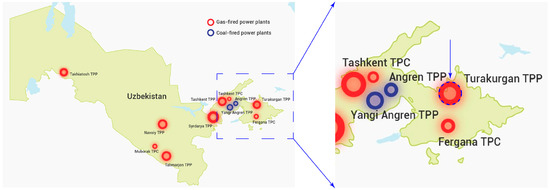
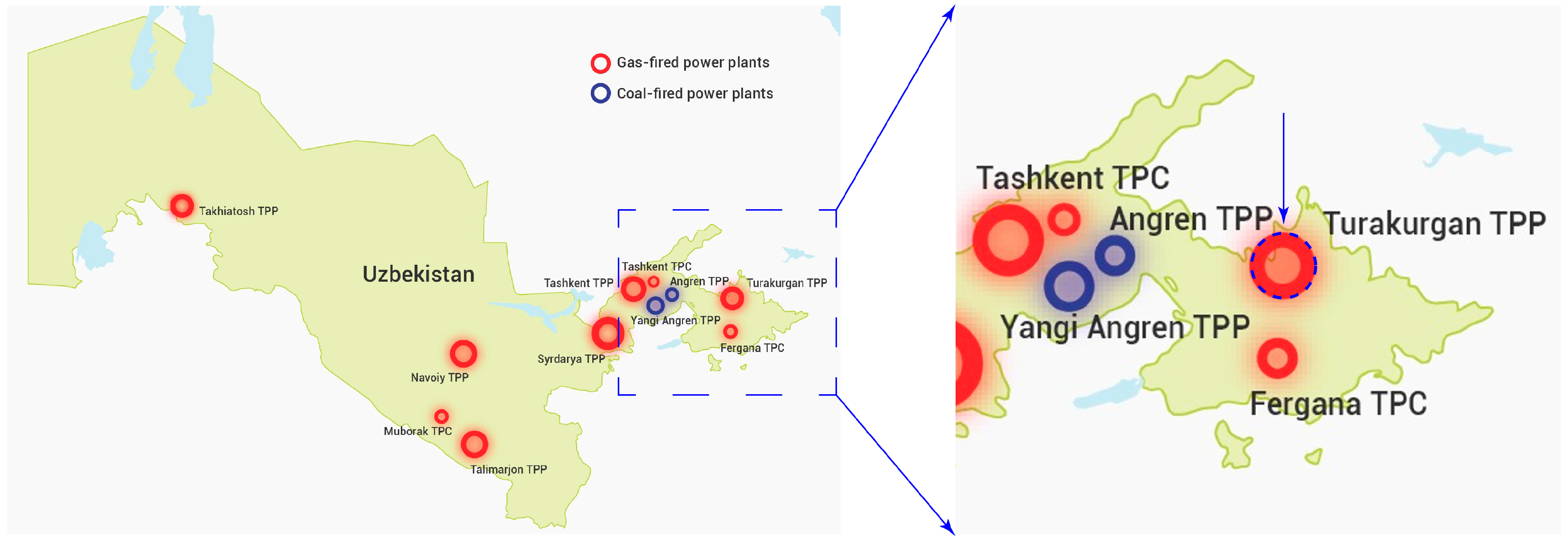
Several processes and their interdependence must be taken into account while implementing a biological CCSU unit in the Turakurgan NGCC power plant. The present investigation proposes extracting flue gases directly from the power plant’s exhaust, bypassing the stack, and then introducing them into an adjacent microalgae cultivation system. This method eliminates the need to vent flue gases into the atmosphere. To facilitate this process, the microalgae production unit must be built near the power plant, as the flue gases cannot be transported over long distances. Figure 1 below shows the locations of the large-scale power plants in Uzbekistan (left) and the selected Turakurgan NGCC power plant (right). Table 1 provides the flue gas stream characteristics at the stack.
Figure 1.
Locations of the large-scale power plants in Uzbekistan (left) and the selected Turakurgan NGCC power plant (right).
Table 1.
Flue gas characteristics at the stack of the power plant.
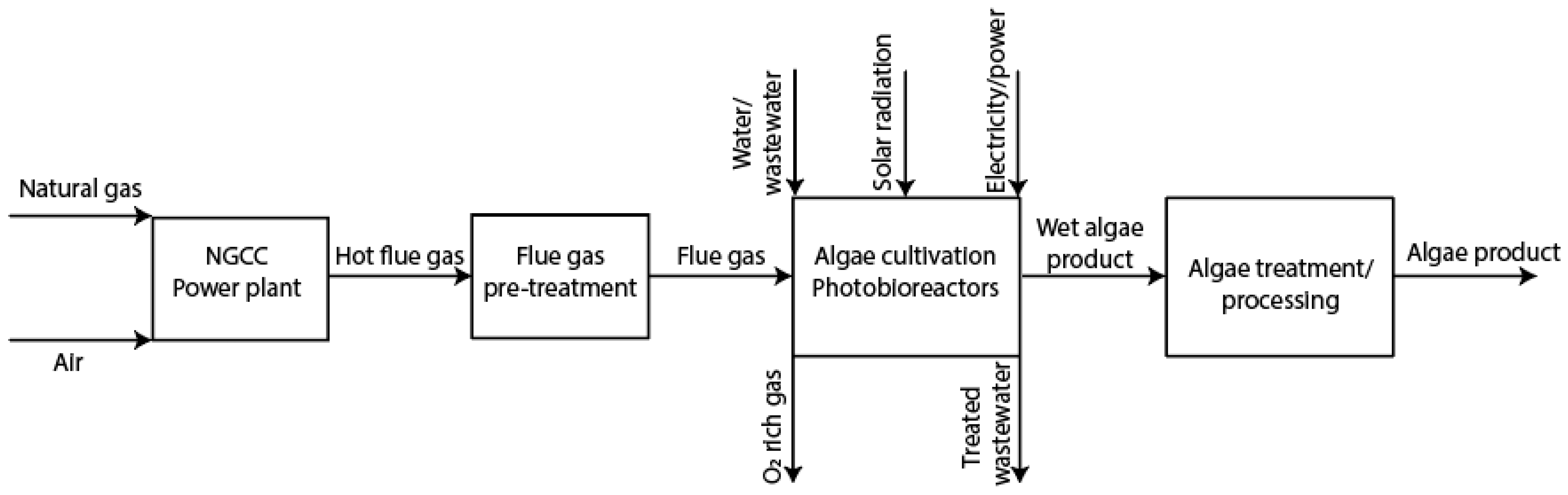
The process begins with an NGCC power plant that generates flue gas, which undergoes pre-treatment before being directed into photobioreactors for algae cultivation (see Figure 2). In these reactors, algae fix the CO2 from the flue gas, aided by solar radiation and water. The wet algae product is then sent for further treatment and processing, leading to the final algae product, while treated wastewater and oxygen-rich gas are released as byproducts.
Figure 2.
General process flow diagram of CO2 biofixation through algae cultivation.
Table 2 provides the dimensions of the main equipment used in the CO2 biofixation process through microalgae cultivation. The total volume of the photobioreactors is 946,583 m3, with each individual photobioreactor having a volume of 320 m3, a length of 1629 m, and a diameter of 0.5 m. There are 2958 photobioreactors in total. Additionally, the direct contact cooler has a volume of 1700 m3, and the mixing tank for each photobioreactor holds 27 m3.
Table 2.
The dimensions of the main equipment.
As for the technical assessment, there has not been any large-scale CO2 biofixation plant with a closed pond system. Therefore, we used general chemical engineering principles and the literature data to estimate the techno-economic performance of the plant to identify the viability and competitiveness of the plant. The main parameters, assumptions, and considerations for technical analysis of the plant are as follows [7,13,18,19,20]:
- For algal CO2 fixation, flue gas with a CO2 concentration of 2–5 vol% is enough.
- Several studies indicate that 1 kg of microalgal biomass can fix roughly 1.80 to 2 kg of CO2.
- Raceway ponds capture CO2 at an efficiency of around 10%, significantly less than greenhouses (35%) and photobioreactors (up to 75%).
- Chlorella vulgaris microalgae culture is considered to have a CO2 fixation rate of between 3.4 and 6.2 g/L/day (average 4.8 g/L/day).
- Trace elements like NOX in flue gas can act as nutrients for microalgae, eliminating the need for scrubbing.
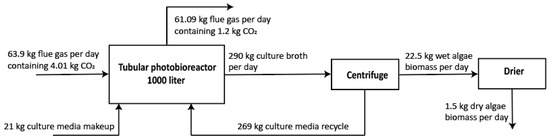
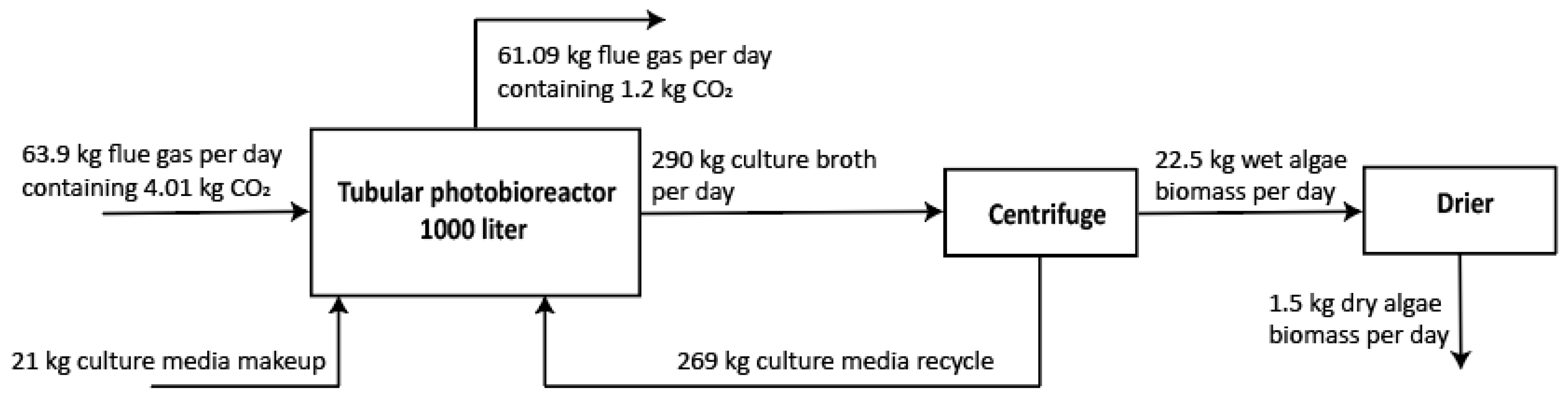
The mass balance of the process is provided in Figure 3, showing each 1 m3 volume of the photobioreactors. The carbon fixation rate in the literature varies significantly, ranging from 0.2 to 30 kg/m3 per day, depending on the characteristics of the flue gases mentioned above. A conservative value of 2.9 kg/m3 per day was chosen as a less favorable scenario to account for potential difficulties in carbon uptake within the system. Biomass productivity is considered to be 1.5 kg/m3/day, with a specific growth rate of 1.93 kg CO2/kg biomass/day.
Figure 3.
Mass balance of the process.
In terms of the economic estimation, the net present value of the CO2 fixation plant is used to evaluate the economic viability of this route (Equation (1)). Sensitivity analysis is also employed to estimate the required carbon allowance in different costs as a profit for the fixation plant.
where: n is the life of the project in years, CFi is the calculated net cash flow for the ith period, and r is the discount rate. As for CFi, it is calculated as the total annual revenue (TAR) subtracting the total OPEX using the following expressions (Equation (2)):
Apart from that, there are several assumptions and considerations for economic estimation, which are provided below in Table 3.
Table 3.
Assumptions and considerations for economic estimation of the CO2 fixation plant [13,14,21].
3. Results and Discussion
The techno-economic estimation results of CO2 biofixation through microalgae cultivation with 450 MW Turakurgan NGCC power plant flue gas are obtained in this study.
Given the massive levels of CO2 emissions for biofixation, the microalgae cultivation system will also need to be at a very large scale. However, from the first glance, according to the rough estimation, it can be viable as long as there is a driver of using CO2 from power plant flue gas, such as carbon tax imposition. Apart from that, the results are also highly dependent on the biomass production facility, quality, and cost.
Table 4 provides a comprehensive summary of the techno-economic indicators for the CO2 biofixation plant under a carbon allowance of EUR 50 per ton of CO2 and a biomass production cost of EUR 750 per ton. The results emphasize the dual benefits of the biofixation system, namely effective CO2 removal and substantial biomass production.
Table 4.
Different tuning results for techno-economic estimation at a CO2 allowance of 50 EUR/ton CO2 and produced biomass cost of 750 EUR/ton.
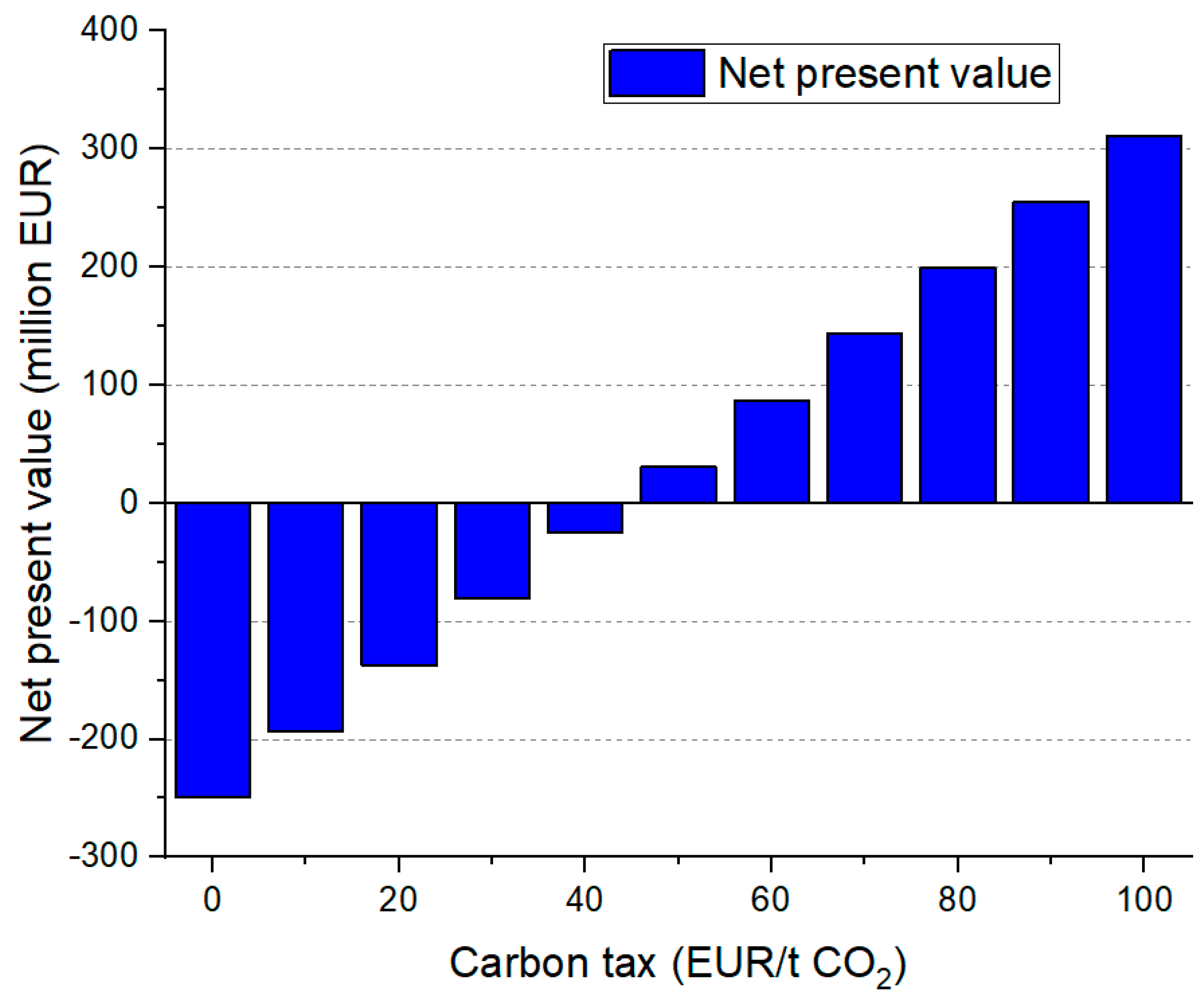
The techno-economic indicators emphasize the dual benefits of the biofixation system: effective CO2 removal and substantial biomass production. With an annual CO2 removal of 823,527 tons and biomass production of 425,962 tons, the system not only mitigates carbon emissions but also generates valuable biomass, contributing to the overall revenue. Despite a very high costs of CAPEX, the project achieves a positive NPV of EUR 31.084 million at a CO2 allowance of EUR 50/ton, demonstrating that the economic returns from the biomass revenue and CO2 removal allowances can offset the initial and ongoing expenses. On the other hand, the NPV analysis, as depicted in Figure 4, illustrates the financial performance of the carbon biofixation project under various carbon tax scenarios. The NPV represents the difference between the present value of cash inflows and the present value of cash outflows over the project’s lifetime.
Figure 4.
Net present value in response to the different carbon tax costs.
The analysis reveals that without a carbon tax, the project would incur significant financial losses, as indicated by the negative NPV in a EUR 0/t CO2 tax scenario. However, introducing a carbon tax dramatically shifts the economic landscape, turning the NPV positive at around EUR 50/t CO2 and continuing to increase with higher taxes.
These findings highlight the importance of economic incentives such as carbon taxes and CO2 allowances in promoting CCU technologies. The positive NPV at a moderate carbon tax level suggests that policy frameworks encouraging higher carbon taxes could substantially enhance the financial attractiveness of CCU projects, facilitating wider adoption and contributing to climate change mitigation efforts.
4. Conclusions
This study assessed the feasibility of using microalgae cultivation for carbon capture and utilization (CCU) by designing a preliminary technical plan and calculating the economics of a system implemented at the Turakurgan natural gas power plant in eastern Uzbekistan.
This study underscores the critical role of carbon taxes and financial incentives in the viability of CCU projects. Higher carbon tax levels significantly enhance the NPV, suggesting that economic policies are pivotal in driving the adoption of sustainable technologies. Moreover, the production of biomass as a by-product provides a valuable revenue stream, further bolstering the economic case for CCU implementations in natural gas-fired power plants. Overall, while large-scale microalgae cultivation is necessary to handle significant CO2 emissions, a few factors make it potentially viable. Firstly, a carbon tax on power plant emissions could incentivize capturing CO2 for biofixation. Secondly, the success of this approach depends heavily on optimizing biomass production facilities for both high yields and cost-effectiveness.
Author Contributions
Conceptualization, M.F., A.N. and M.V.; methodology, A.K. and T.A.; software, A.K. and Z.T.; validation, A.K. and Z.T.; formal analysis, A.K. and T.A.; writing—original draft preparation, A.K. and Z.T.; writing—review and editing, M.F., A.N. and M.V.; visualization, A.K. and Z.T.; supervision, M.F., A.N. and M.V. All authors have read and agreed to the published version of the manuscript.
Funding
This research was partially supported by the Slovak Research and Development Agency (grant no. APVV-18-0134 and APVV-19-0170).
Institutional Review Board Statement
Not applicable.
Informed Consent Statement
Not applicable.
Data Availability Statement
The original contributions presented in the study are included in the article; further inquiries can be directed to the corresponding author.
Acknowledgments
The co-first authors recognize the support of Adham Norkobilov, Miroslav Variny, and Marcos Fallanza for their supervision and conceptualization. The co-first authors acknowledge the collaboration between the University of Cantabria and Tashkent Institute of Chemical Technology, as well as the National Scholarship Program of the Slovak Republic for providing the opportunity to carry out this study.
Conflicts of Interest
The authors declare no conflicts of interest.
Abbreviations
| NGCC | Natural gas combined cycle |
| NDC | Nationally determined contribution |
| GDP | Gross domestic product |
| NPV | Net present value |
| CCSU | Carbon capture, storage, and utilization |
| CCU | Carbon capture and utilization |
| RES | Renewable energy sources |
| PCC | Post-combustion carbon capture |
| CAPEX | Capital expenditure |
| OPEX | Operational expenditure |
References
- Papadis, E.; Tsatsaronis, G. Challenges in the Decarbonization of the Energy Sector. Energy 2020, 205, 118025. [Google Scholar] [CrossRef] [Scilit]
- Turakulov, Z.; Kamolov, A.; Norkobilov, A.; Variny, M.; Fallanza, M. Assessment of CO2 Emission and Decarbonization Measures in Uzbekistan. Int. J. Environ. Res. 2024, 18, 28. [Google Scholar] [CrossRef] [Scilit]
- NDC Status. The Republic of Uzbekistan. Available online: https://climatepromise.undp.org/what-we-do/where-we-work/uzbekistan (accessed on 3 June 2024).
- Kamolov, A.; Turakulov, Z.; Norkobilov, A.; Variny, M.; Fallanza, M. Evaluation of Potential Carbon Dioxide Utilization Pathways in Uzbekistan. Eng. Proc. 2023, 56, 194. [Google Scholar] [CrossRef] [Scilit]
- Kamolov, A.; Turakulov, Z.; Norkobilov, A.; Variny, M.; Fallanza, M. Decarbonization Challenges and Opportunities of Power Sector in Uzbekistan: A Simulation of Turakurgan Natural Gas-Fired Combined Cycle Power Plant with Exhaust Gas Recirculation. Eng. Proc. 2023, 37, 24. [Google Scholar] [CrossRef] [Scilit]
- Wang, M.; Lawal, A.; Stephenson, P.; Sidders, J.; Ramshaw, C. Post-Combustion CO2 Capture with Chemical Absorption: A State-of-the-Art Review. Chem. Eng. Res. Des. 2011, 89, 1609–1624. [Google Scholar] [CrossRef] [Scilit]
- Ghorbani, A.; Rahimpour, H.R.; Ghasemi, Y.; Zoughi, S.; Rahimpour, M.R. A Review of Carbon Capture and Sequestration in Iran: Microalgal Biofixation Potential in Iran. Renew. Sustain. Energy Rev. 2014, 35, 73–100. [Google Scholar] [CrossRef] [Scilit]
- Turakulov, Z.; Kamolov, A.; Norkobilov, A.; Variny, M.; Díaz-Sainz, G.; Gómez-Coma, L.; Fallanza, M. Assessing Various CO2 Utilization Technologies: A Brief Comparative Review. J. Chem. Technol. Biotechnol. 2024, 99, 1291–1307. [Google Scholar] [CrossRef] [Scilit]
- Scapini, T.; Woiciechowski, A.L.; Manzoki, M.C.; Molina-Aulestia, D.T.; Martinez-Burgos, W.J.; Fanka, L.S.; Duda, L.J.; Vale, A.D.S.; De Carvalho, J.C.; Soccol, C.R. Microalgae-Mediated Biofixation as an Innovative Technology for Flue Gases towards Carbon Neutrality: A Comprehensive Review. J. Environ. Manag. 2024, 363, 121329. [Google Scholar] [CrossRef] [Scilit] [PubMed]
- Sen, R.; Mukherjee, S. Recent Advances in Microalgal Carbon Capture and Utilization (Bio-CCU) Process Vis-à-Vis Conventional Carbon Capture and Storage (CCS) Technologies. Crit. Rev. Environ. Sci. Technol. 2024, 1–26. [Google Scholar] [CrossRef] [Scilit]
- Bucci, P.; Marcos Montero, E.J.; García-Depraect, O.; Zaritzky, N.; Caravelli, A.; Muñoz, R. Assessment of the Performance of a Symbiotic Microalgal-Bacterial Granular Sludge Reactor for the Removal of Nitrogen and Organic Carbon from Dairy Wastewater. Chemosphere 2024, 351, 141250. [Google Scholar] [CrossRef] [Scilit] [PubMed]
- Gharanjik, M.A.; Najafpour-Darzi, G.; Jahanshahi, M.; Mohammadi, M. Potential CO2 Biofixation by Microalgae Strains for Industrial Application. Int. J. Environ. Sci. Technol. 2024, 21, 7479–7490. [Google Scholar] [CrossRef] [Scilit]
- Oliveira, G.M.; Caetano, N.; Mata, T.M.; Martins, A.A. Biofixation of CO2 Emissions from Natural Gas Combined Cycle Power Plant. Energy Rep. 2020, 6, 140–146. [Google Scholar] [CrossRef] [Scilit]
- Llamas, B.; Suárez-Rodríguez, M.C.; González-López, C.V.; Mora, P.; Acién, F.G. Techno-Economic Analysis of Microalgae Related Processes for CO2 Bio-Fixation. Algal Res. 2021, 57, 102339. [Google Scholar] [CrossRef] [Scilit]
- Acién, F.G.; Fernández, J.M.; Magán, J.J.; Molina, E. Production Cost of a Real Microalgae Production Plant and Strategies to Reduce It. Biotechnol. Adv. 2012, 30, 1344–1353. [Google Scholar] [CrossRef] [Scilit] [PubMed]
- Hanifzadeh, M.M.; Sarrafzadeh, M.H.; Tavakoli, O. Carbon Dioxide Biofixation and Biomass Production from Flue Gas of Power Plant Using Microalgae. In Proceedings of the 2012 Second Iranian Conference on Renewable Energy and Distributed Generation, Tehran, Iran, 6–8 March 2012; IEEE: Piscataway, NJ, USA, 2012; pp. 61–64. [Google Scholar]
- Singh, H.M.; Kothari, R.; Gupta, R.; Tyagi, V.V. Bio-Fixation of Flue Gas from Thermal Power Plants with Algal Biomass: Overview and Research Perspectives. J. Environ. Manag. 2019, 245, 519–539. [Google Scholar] [CrossRef] [Scilit] [PubMed]
- Bai, A.; Popp, J.; Pető, K.; Szőke, I.; Harangi-Rákos, M.; Gabnai, Z. The Significance of Forests and Algae in CO2 Balance: A Hungarian Case Study. Sustainability 2017, 9, 857. [Google Scholar] [CrossRef] [Scilit]
- Li, J.; Zhao, X.; Chang, J.-S.; Miao, X. A Two-Stage Culture Strategy for Scenedesmus Sp. FSP3 for CO2 Fixation and the Simultaneous Production of Lutein under Light and Salt Stress. Molecules 2022, 27, 7497. [Google Scholar] [CrossRef] [Scilit] [PubMed]
- Pavlik, D.; Zhong, Y.; Daiek, C.; Liao, W.; Morgan, R.; Clary, W.; Liu, Y. Microalgae Cultivation for Carbon Dioxide Sequestration and Protein Production Using a High-Efficiency Photobioreactor System. Algal Res. 2017, 25, 413–420. [Google Scholar] [CrossRef] [Scilit]
- Kun.uz, Tariffs for Electricity and Gas May Increase from May 1. Available online: https://kun.uz/en/news/2024/04/16/tariffs-for-electricity-and-gas-may-increase-from-may-1 (accessed on 10 July 2024).

Disclaimer/Publisher’s Note: The statements, opinions and data contained in all publications are solely those of the individual author(s) and contributor(s) and not of MDPI and/or the editor(s). MDPI and/or the editor(s) disclaim responsibility for any injury to people or property resulting from any ideas, methods, instructions or products referred to in the content. |
© 2024 by the authors. Licensee MDPI, Basel, Switzerland. This article is an open access article distributed under the terms and conditions of the Creative Commons Attribution (CC BY) license (https://creativecommons.org/licenses/by/4.0/).