


A Holistic Approach on Smart Garment for Patients with Juvenile Idiopathic Arthritis †


Abstract
:1. Introduction
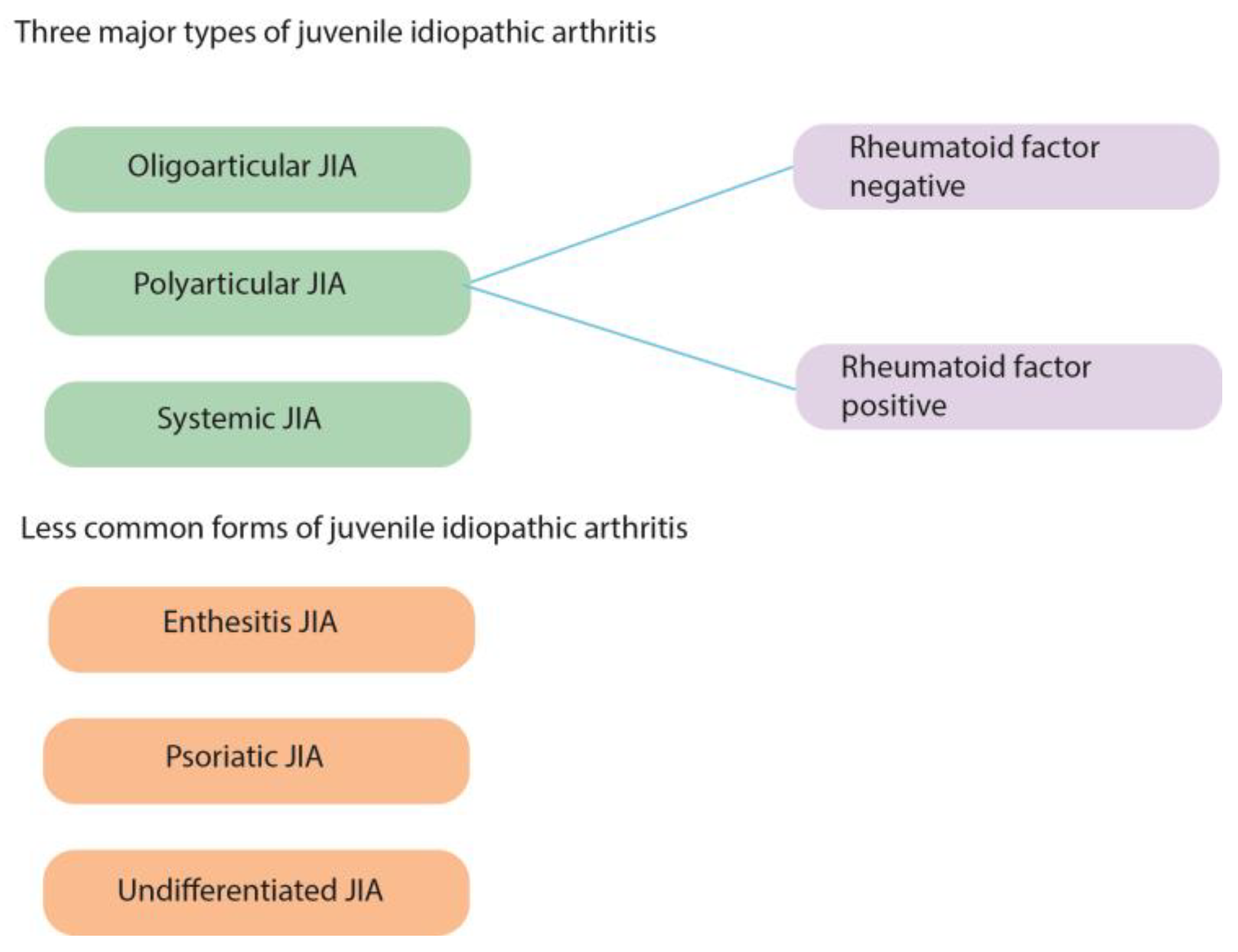
2. Objective
3. Literature Review
4. Problem Statement
5. Methodology
6. Observation and Interviews
7. Feasibility Analysis
8. Conclusions
Author Contributions
Funding
Institutional Review Board Statement
Informed Consent Statement
Data Availability Statement
Conflicts of Interest
References
- Di Ludovico, A.; La Bella, S.; Di Donato, G.; Felt, J.; Chiarelli, F.; Breda, L. The benefits of physical therapy in juvenile idiopathic arthritis. Rheumatol. Int. 2023, 43, 1563–1572. [Google Scholar] [CrossRef] [PubMed]
- Barut, K.; Adrovic, A.; Şahin, S.; Kasapçopur, Ö. Juvenile Idiopathic Arthritis. Balk. Med. J. 2017, 34, 90–101. [Google Scholar] [CrossRef] [PubMed]
- Prakken, B.; Albani, S.; Martini, A. Juvenile idiopathic arthritis. Nat. Rev. Dis. Primers. 2022, 8, 5. [Google Scholar] [CrossRef] [PubMed]
- Zaripova, L.N.; Midgley, A.; Christmas, S.E.; Beresford, M.W.; Baildam, E.M.; Oldershaw, R.A. Juvenile idiopathic arthritis: From aetiopathogenesis to therapeutic approaches. Pediatr. Rheumatol. 2021, 19, 135. [Google Scholar] [CrossRef] [PubMed]
- Packham, J.C.; Hall, M.A. Long-term follow-up of 246 adults with juvenile idiopathic arthritis: Functional outcome. Rheumatology 2002, 41, 1428–1435. [Google Scholar] [CrossRef] [PubMed]
- Capurso, M.; Lo Bianco, M.; Cortis, E.; Rossetti, C. Constructing an Explanation of Illness with Children: A Sample Case Study of Juvenile Arthritis. Child Care Pract. 2016, 22, 247–256. [Google Scholar] [CrossRef]
- Hinks, A.; Marion, M.C.; Cobb, J.; Comeau, M.E.; Sudman, M.; Ainsworth, H.C.; Bowes, J.; Becker, M.L.; Bohnsack, J.K.; Haas, J.-P.; et al. Brief Report: The Genetic Profile of Rheumatoid Factor–Positive Polyarticular Juvenile Idiopathic Arthritis Resembles That of Adult Rheumatoid Arthritis. Arthritis Rheumatol. 2018, 70, 957–962. [Google Scholar] [CrossRef] [PubMed]
- Grabovac, I.; Haider, S.; Berner, C.; Lamprecht, T.; Fenzl, K.H.; Erlacher, L.; Quittan, M.; Dorner, T.E. Sleep Quality in Patients with Rheumatoid Arthritis and Associations with Pain, Disability, Disease Duration, and Activity. J. Clin. Med. 2018, 7, 336. [Google Scholar] [CrossRef]
- Chaplin, H.; Ioannou, Y.; Sen, D.; Lempp, H.; Norton, S. OP0101 Exploring pain and the impact of jia on adolescents and young adults: A mixed-methods study. Ann. Rheum. Dis. 2018, 77, 101. [Google Scholar] [CrossRef]
- Tao, X. Smart Technology for Textiles and Clothing; Tao, X., Ed.; Woodhead Publishing: Sawston, UK, 2001. [Google Scholar]
- Gilsoo, C.; Seungsin, L.; Jayoung, C. Review and Reappraisal of Smart Clothing. Int. J. Hum.-Comput. Interact. 2009, 25, 582–617. [Google Scholar]
- Brown, D. The Arrival Of 2020 Brings Smart Clothing to The Forefront Of Healthcare. Available online: https://www.youareunltd.com/ (accessed on 24 July 2023).
- Sankaran, S.; Britto, P.I.; Petchimuthu, P.; Sushmitha, M.; Rathinakumar, S.; Mallaiyan, V.M.; Ayyavu, S.G. Monitoring of Physiological and Atmospheric Parameters of People Working in Mining Sites Using a Smart Shirt: A Review of Latest Technologies and Limitations. In Computational Intelligence for Engineering and Management Applications: Select Proceedings of CIEMA 2022; Springer: Berlin/Heidelberg, Germany, 2023. [Google Scholar] [CrossRef]
- Stojanović, S.; Geršak, J.; Uran, S. Development of the Smart T-Shirt for Monitoring Thermal Status of Athletes. Autex Res. J. 2022, 23, 265–274. [Google Scholar] [CrossRef]
- Perego, P.; Sironi, R.; Gruppioni, E.; Andreoni, G. TWINMED T-SHIRT, a Smart Wearable System for ECG and EMG Monitoring for Rehabilitation with Exoskeletons. In International Conference on Human-Computer Interaction; Springer Nature: Cham, Switzerland, 2023. [Google Scholar] [CrossRef]
- Moreno, M.V.; Herrera, E. Evaluation on Phantoms of the Feasibility of a Smart Bra to Detect Breast Cancer in Young Adults. Sensors 2019, 19, 5491. [Google Scholar] [CrossRef]
- Elsheakh, D.N.; Elgendy, Y.K.; Elsayed, M.E.; Eldamak, A.R. Circularly Polarized Textile Sensors for Microwave-Based Smart Bra Monitoring System. Micromachines 2023, 14, 586. [Google Scholar] [CrossRef] [PubMed]
- Raji, R.K.; Miao, X.; Wan, A.; Niu, L.; Li, Y.; Boakye, A. Design and Fabrication of Smart Bandeau Bra for Breathing Pattern Measurement. In Proceedings of the Future Technologies Conference (FTC) 2019; Springer International Publishing: Cham, Switzerland, 2020; Volume 2. [Google Scholar] [CrossRef]
- Navalta, J.W.; Ramirez, G.G.; Maxwell, C.; Radzak, K.N.; McGinnis, G.R. Validity and Reliability of Three Commercially Available Smart Sports Bras during Treadmill Walking and Running. Sci. Rep. 2020, 10, 7397. [Google Scholar] [CrossRef] [PubMed]
- Lee, S.; Rho, S.H.; Lee, S.; Lee, J.; Lee, S.W.; Lim, D.; Jeong, W. Implementation of an Automated Manufacturing Process for Smart Clothing: The Case Study of a Smart Sports Bra. Processes 2021, 9, 289. [Google Scholar] [CrossRef]
- Feng, Y.; Wang, H.X.; Liu, P.B.; Qi, H.; Pan, R.Z.; Zhang, H.P.; Zhang, H. Optical Fiber Bragg Grating Based Sensing System of Flexible Wearable Smart Sleeve for Tracking Human Arm Joint Movements. Meas. Sci. Technol. 2023, 34, 084010. [Google Scholar] [CrossRef]
- Qiao, G.; Sun, J. Self-monitoring of stresses in grouted sleeves using smart grout. Struct. Health Monit. 2022, 21, 2922–2932. [Google Scholar] [CrossRef]
- DelPreto, J.; Brunelle, C.L.; Taghian, A.G.; Rus, D. Sensorizing a Compression Sleeve for Continuous Pressure Monitoring and Lymphedema Treatment Using Pneumatic or Resistive Sensors. In Proceedings of the 2023 IEEE International Conference on Soft Robotics (RoboSoft), Singapore, 3–7 April 2023. [Google Scholar] [CrossRef]
- Vuohijoki, T.; Ihalainen, T.; Merilampi, S.; Virkki, J. Multidisciplinary development of Smart Jacket for elder care. Finn. J. Ehealth Ewelfare 2022, 14, 271–283. [Google Scholar] [CrossRef]
- Khan, A.U.A.; Saha, A.K.; Bristy, Z.T.; Tazrin, T.; Baqui, A.; Dev, B. Development of the Smart Jacket Featured with Medical, Sports, and Defense Attributes using Conductive Thread and Thermoelectric Fabric. Eng. Proc. 2023, 30, 18. [Google Scholar] [CrossRef]
- Ozsahin, D.U.; Almoqayad, A.S.; Ghader, A.; Alkahlout, H.; Idoko, J.B.; Duwa, B.B.; Ozsahin, I. Development of smart jacket for disc. In Modern Practical Healthcare Issues in Biomedical Instrumentation; Academic Press: Cambridge, MA, USA, 2022. [Google Scholar] [CrossRef]
- Hwang, J.-H.; Jee, S.; Kim, S. Developing a Prototype of Motion-sensing Smart Leggings. Fash. Text. Res. J. 2022, 24, 694–706. [Google Scholar] [CrossRef]
- Carrasco, V.B.; Vidal, J.M.; Caparros-Manosalva, C. Vibration motor stimulation device in smart leggings that promotes motor performance in older people. Med. Biol. Eng. Comput. 2023, 61, 635–649. [Google Scholar] [CrossRef] [PubMed]
- Barhoumi, H. A novel design approach and ergonomic evaluation of Class I compression legging. Int. J. Cloth. Sci. Technol. 2021, Ahead-of-Print. [CrossRef]
- Rudolf, A.; Stjepanovič, Z.; Penko, T. Review of Smart Clothing with Emphasis on Education and Training; Technical Textiles-Present and Future: Iasi, Romania, 2022. [Google Scholar] [CrossRef]
- Mccoy, L. Developing Sports Bras for young Arthritic Women: Required Features and Functions; Washington State University: Pullman, WA, USA, 2021. [Google Scholar]
- Singh, S. A Study on Adaptive Clothing for Females with Arthritis. Int. J. Adv. Sci. Res. Manag. 2019, 5, 4. [Google Scholar]
- Chandra, R.; Anand, N. Adaptive Clothing for the Rheumatoid Arthritis Patients, International Textiles & Apparel Sustainability Conference Held in Mauritius Adaptive Clothing for The Rheumatoid Arthritis Patients. 2016. Available online: https://sciendo.com/chapter/9788366675735/10.2478/9788366675735-036 (accessed on 2 December 2023).
- Azher, N.; Saeed, M. Adaptive Clothing for females with arthritis impairement. J. Univ. Med. Dent. Coll. 2012, 3, 52–59. [Google Scholar]
- Sperling, L.; Karlsson, M. Clothing fasteners for long-term-care patients: Evaluation of standard closures and prototypes on test garments. Appl. Ergon. 1989, 20, 97–104. [Google Scholar] [CrossRef] [PubMed]
- Fang, J. Responsive Wearables for Rheumatoid Arthritis; Massachusetts Institute of Technology: Cambridge, MA, USA, 2020. [Google Scholar]
- Nasir, S.H.; Troynikov, O.; Massy-Westropp, N. Therapy gloves for patients with rheumatoid arthritis: A review. Ther. Adv. Musculoskelet. Dis. 2014, 6, 226–237. [Google Scholar] [CrossRef]
- Socher, R. MANOVIVO: Wearable Smart Glove Offering Custom Support for People with Rheumatoid Arthritis. Wearable Technol. 2018. Available online: https://wt-obk.wearable-technologies.com/2018/11/manovivo-wearable-smart-glove-offering-custom-support-for-people-with-rheumatoid-arthritis/ (accessed on 2 December 2023).
- Underwood, S. Smart clothing and disability: Wearable technology for people with arthritis. Smart Clothes Wearable Technol. 2009, 4, 371–387. [Google Scholar]
- Swedberg, R. Exploratory Research. In The Production of Knowledge: Enhancing Progress in Social Science; Elman, C., Gerring, J., Mahoney, J., Eds.; Strategies for Social Inquiry; Cambridge University: Cambridge, MA, USA, 2020; pp. 17–41. [Google Scholar]

| Authors | Garment Type | Nature of Work | Type of Patient | Limitations |
|---|---|---|---|---|
| Mccoy (2021) [31]. | Sports Bra | Developing sports bras for young arthritic women: Required features and functions. Easy joint movement (Adaptive garment). | Young adolescent girls, Juvenile Idiopathic arthritis. | The study does not incorporate smart technology to assist women in wearing sports bras for shoulder, neck, and back pain. Prototype and trial test was missing in the research. |
| Singh (2019) [32]. | Kurta pattern design | A Study on Adaptive Clothing for Females with Arthritis (Adaptive garment). | Old women, Rheumatoid arthritis. | Limited geographical representation of participants. The research lacked a prototype and trial test. |
| Chandra, & Anand, (2016) [33]. | Saree design | Adaptive clothing for Rheumatoid arthritis patients, Easy to drape saree. | Women, Type of JIA Rheumatoid arthritis. | Limited geographical representation of participants, the trial test was missing in research. |
| Azher (2012) [34]. | Three set clothing | Adaptive clothing for rheumatoid impairment. | Women with Rheumatoid Impairment. | Only focused on ethnic wear. A limited demographic approach was used in the study. |
| Sperling & Karlsson (1989) [35]. | Clothing fastners | Clothing fasteners for long-term-care patients: Evaluation of standard closures and prototypes on test garments. | Both Elderly men and women, Osteoarthritis and Rheumatoid. | Small sample size, limited diversity. |
| Fang (2020) [36]. | Glove | Responsive wearables for rheumatoid arthritis. Customization for individual pain point, support in affected area (Smart wearable). | Both men and women, Type of JIA Rheumatoid arthritis. | Wearing gloves in varying seasons is not feasible. |
| Nasir,(2014); Socher (2018) [37,38]. | Smart Glove | Wearable Smart Glove Offering Custom Support for People with Rheumatoid Arthritis, monitor the hand movement and provide support. | Both men and women have rheumatoid arthritis. | Wearing gloves across various seasons is not viable |
| Underwood (2009) [39]. | Glove | Smart clothing and disability: wearable technology for people with arthritis. | Both men and women have rheumatoid arthritis. | The glove lacks the capability to track hand activities and provide feedback to the patient and doctor. |
| Sensor Integration | Adaptive Support | Interactive Interface | Connectivity | Organic |
|---|---|---|---|---|
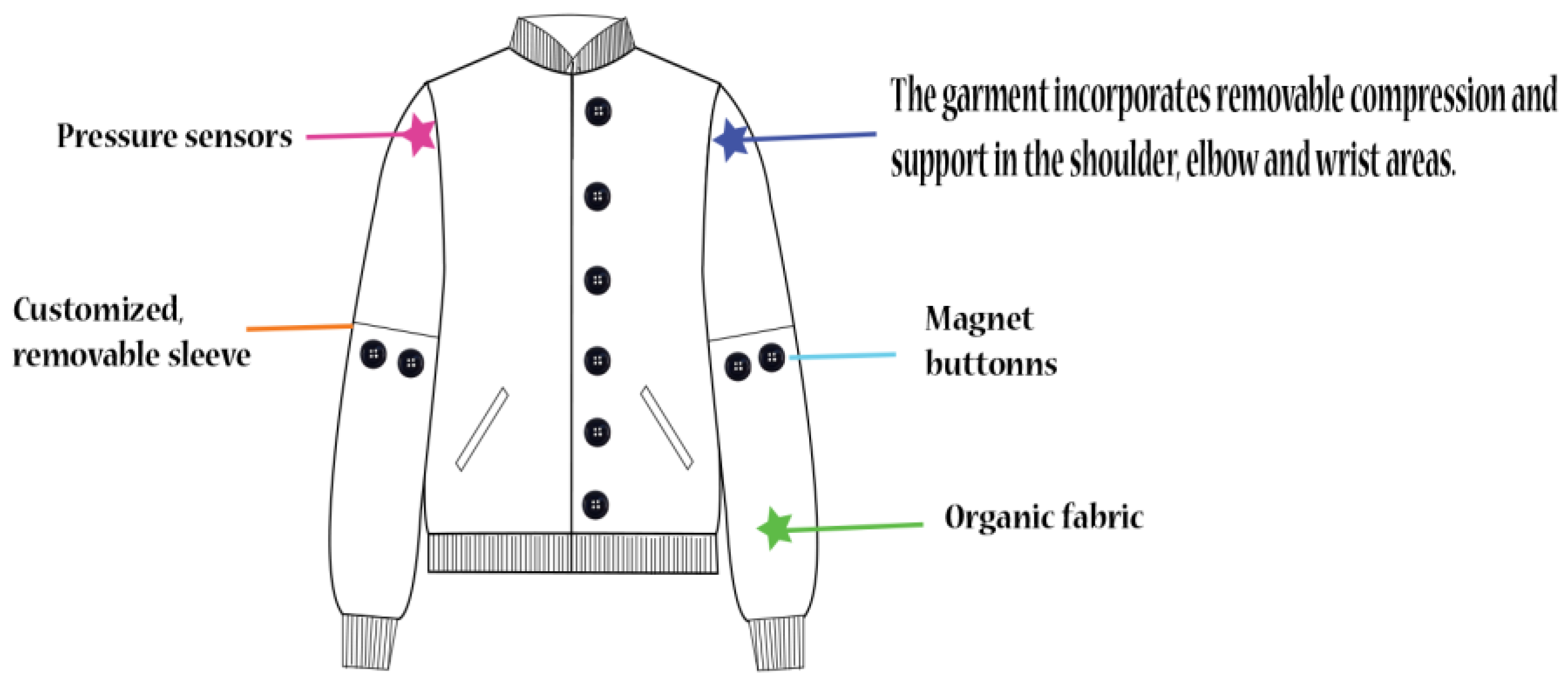
| 1. Incorporation of sensors to monitor joint movement and inflammation. 2. Real-time data collection and analysis for accurate insights. 3. Pressure sensors function similarly to a massaging action, offering alleviation from joint discomfort and stiffness. | 1. Adjustable compression, magnet buttons, customization, removable sleeves, and support based on individual needs. 2. Enhances joint stability and reduces pain during movement. | 1. User-friendly interface for patients to interact with the garment. 2. Visual feedback on joint mobility, inflammation levels, and usage patterns. | 1. Wireless connectivity to smartphones or healthcare devices. 2. Allows seamless data sharing with healthcare providers for remote monitoring. | 1. Utilization of organic fabric to enhance joint comfort for patients. 2. Contribution to sustainability through support for eco-friendly practices. |
Disclaimer/Publisher’s Note: The statements, opinions and data contained in all publications are solely those of the individual author(s) and contributor(s) and not of MDPI and/or the editor(s). MDPI and/or the editor(s) disclaim responsibility for any injury to people or property resulting from any ideas, methods, instructions or products referred to in the content. |
© 2023 by the authors. Licensee MDPI, Basel, Switzerland. This article is an open access article distributed under the terms and conditions of the Creative Commons Attribution (CC BY) license (https://creativecommons.org/licenses/by/4.0/).
Share and Cite
Safal, C.; Princy, R.; Sampath, K.J.P.; Prasad, H.C.S. A Holistic Approach on Smart Garment for Patients with Juvenile Idiopathic Arthritis. Eng. Proc. 2023, 59, 83. https://doi.org/10.3390/engproc2023059083
Safal C, Princy R, Sampath KJP, Prasad HCS. A Holistic Approach on Smart Garment for Patients with Juvenile Idiopathic Arthritis. Engineering Proceedings. 2023; 59(1):83. https://doi.org/10.3390/engproc2023059083
Chicago/Turabian StyleSafal, Choudhary, Randhawa Princy, Kumar J. P. Sampath, and H. C. Shiva Prasad. 2023. "A Holistic Approach on Smart Garment for Patients with Juvenile Idiopathic Arthritis" Engineering Proceedings 59, no. 1: 83. https://doi.org/10.3390/engproc2023059083
APA StyleSafal, C., Princy, R., Sampath, K. J. P., & Prasad, H. C. S. (2023). A Holistic Approach on Smart Garment for Patients with Juvenile Idiopathic Arthritis. Engineering Proceedings, 59(1), 83. https://doi.org/10.3390/engproc2023059083

